
Jai Arjun Singh's Blog, page 23
July 11, 2020
Stray thoughts after completing an essay
There is never a shortage of things to gripe about if you’re a writer — more so an independent writer who is usually expected to work for very little payment (even when the requests come from people who begin their emails by gushing about how they have been “fans” for years and how it would be a “privilege” to have you in their publication or book).
But there is also truth in the cliche about the adrenaline rush of finishing a biggish project (assuming that you’re 70-75 percent satisfied with the result). And for me personally, this feeling is most intense when I have completed an essay of a specific length — say, between 3,000 and 6,000 words. The feeling is never quite the same for shorter pieces (which is not to undermine the hard work that goes into even a short column when you’re doing it with seriousness) — but surprisingly, it isn’t quite the same for much longer pieces either.
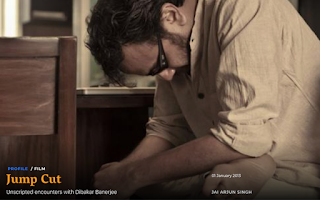 This can be hard to explain. When I finished the first draft of my 12,000-word profile of Dibakar Banerjee in late 2012 (after what was possibly the most intense 5-day writing period I have known), it felt like an Everest had been scaled — but it also felt like the piece was too vast, and about too many different things, for me to get a real sense of the whole. That it could have been structured in six or seven other ways without it making much of a difference. (It also felt like I had thrown my hands up at some point and said “Enough. Just send the bloody thing already.”)
On the other hand, it can be very fulfilling to finish essays half or one-third that length, such as the “Monsters I have known” piece I did for The Popcorn Essayists, or a few long pieces for Scroll or Yahoo, or the essay about religious cinema last year, or a Mahabharata piece for Caravan years ago. (Or even the closing chapter of the Hrishikesh Mukherjee book, a stand-alone of sorts, which happened after I hit on the idea of starting with Dharmendra’s phone call to me at 8 one morning and then segueing into an “anthology of moments” from Hrishi-da’s cinema.) When such pieces come together moderately well, you feel like you have done something substantial, but also that you have the measure of it, that you were more or less in control throughout the process — and that you have gone over it enough times to remove unnecessary repetitions or careless mistakes.
All this is a way of saying that two days ago I finally sent off a 5,500-word essay I had been working on (and fuming about, and constantly scratching away at and rewriting and trimming) for the past four months — the only real writing project I managed during a period when writing has been one of the last things on my mind.
It’s a personal essay, and since it was done for a book it probably won’t be published until next year. I can’t reveal more just now, except to say that it eventually became a piece about my mother, though that wasn’t what it was intended to be when I began writing it (there was another, specific theme). Inadvertently, it has also turned out to be a challenge to myself: in the past couple of years I have put together lots of notes for more specific writings about my parents and my grandparents, without doing anything much with those notes. Maybe it’s time to get started on some of those pieces — if only selfishly, to begin the long and desperate journey towards another adrenaline rush.
But there is also truth in the cliche about the adrenaline rush of finishing a biggish project (assuming that you’re 70-75 percent satisfied with the result). And for me personally, this feeling is most intense when I have completed an essay of a specific length — say, between 3,000 and 6,000 words. The feeling is never quite the same for shorter pieces (which is not to undermine the hard work that goes into even a short column when you’re doing it with seriousness) — but surprisingly, it isn’t quite the same for much longer pieces either.
 This can be hard to explain. When I finished the first draft of my 12,000-word profile of Dibakar Banerjee in late 2012 (after what was possibly the most intense 5-day writing period I have known), it felt like an Everest had been scaled — but it also felt like the piece was too vast, and about too many different things, for me to get a real sense of the whole. That it could have been structured in six or seven other ways without it making much of a difference. (It also felt like I had thrown my hands up at some point and said “Enough. Just send the bloody thing already.”)
 On the other hand, it can be very fulfilling to finish essays half or one-third that length, such as the “Monsters I have known” piece I did for The Popcorn Essayists, or a few long pieces for Scroll or Yahoo, or the essay about religious cinema last year, or a Mahabharata piece for Caravan years ago. (Or even the closing chapter of the Hrishikesh Mukherjee book, a stand-alone of sorts, which happened after I hit on the idea of starting with Dharmendra’s phone call to me at 8 one morning and then segueing into an “anthology of moments” from Hrishi-da’s cinema.) When such pieces come together moderately well, you feel like you have done something substantial, but also that you have the measure of it, that you were more or less in control throughout the process — and that you have gone over it enough times to remove unnecessary repetitions or careless mistakes.
All this is a way of saying that two days ago I finally sent off a 5,500-word essay I had been working on (and fuming about, and constantly scratching away at and rewriting and trimming) for the past four months — the only real writing project I managed during a period when writing has been one of the last things on my mind.
It’s a personal essay, and since it was done for a book it probably won’t be published until next year. I can’t reveal more just now, except to say that it eventually became a piece about my mother, though that wasn’t what it was intended to be when I began writing it (there was another, specific theme). Inadvertently, it has also turned out to be a challenge to myself: in the past couple of years I have put together lots of notes for more specific writings about my parents and my grandparents, without doing anything much with those notes. Maybe it’s time to get started on some of those pieces — if only selfishly, to begin the long and desperate journey towards another adrenaline rush.


July 10, 2020
Hear ye! Details for the film-appreciation courses
 As promised, here are the details for the two film-appreciation modules: one on Hindi-film song sequences, the other on Val Lewton's 1940s films. Each of these is the starting point for a series of discussions I will be conducting around Indian and non-Indian cinema. I am doing this alone to begin with, but in the next 2-3 months I will also be working occasionally with the Film and Television Institute of India (FTII) as well as with a cinema website. I will provide information as and when that happens.
 For now:
MODULE 1: Celebrating the song sequence and its place in the Hindi-film narrative
A four-week module (one 2-hour class per week) that will examine the many functions, moods and aesthetics of the song sequence – this will also be a prelude to a course about significant (non-musical) sequences and vignettes from Hindi films.
Fees:
For participants in India and Asia
Rs 3000 for the full 4-week course
Alternately: Rs 1000 per week for those who are not sure about committing to the full course, or prefer to test the waters first. (This is not an option I plan to offer for subsequent courses, though.)
For participants outside Asia
$100 for the full 4-week course
Alternately: $30 per week
Dates and timings:
Four Sundays: July 19, July 26, August 2, August 9 – 6.30 pm to 8.30 pm IST
A few of those who have mailed me expressing interest are in time zones that make the above hours impractical. Accordingly, for only this module, I am offering another option for each of the four classes, on the same dates:
July 19, July 26, August 2, August 9 – 9 am to 11 am IST
If you mail me confirming your interest in this module, please also mention your preferred time. (This applies to anyone, since some participants based in India might prefer the morning slot too.) If a reasonable number of participants apply for the morning slot, I will conduct each of these sessions across both timings.
*******************
MODULE 2: Val Lewton and the art of subtle horror
A two-week module (one two-hour class per week) that will follow the broad format of the film-noir sessions I have recently hosted: that is, I will provide a number of Lewton films to the participants beforehand (most of these films are not available for free online) and I will then lead a discussion around specific works and the horror genre as it was then.
Fees:
For participants in India and Asia
Rs 2000 for the 2-week course (a 2-hour class per week, plus all the Lewton films being made available for downloading and viewing).
For participants outside Asia
$70 for the 2-week course.
Dates and timings:
Wednesday July 29 and Wednesday August 5 (7 pm to 9 pm)
A candid note: knowing that many of us are struggling financially during these tough and unpredictable times, I have kept the fees as low as I could. Friends and acquaintances, including some who have recently begun teaching courses themselves, advised higher rates, given my prior experience as a writer and lecturer. But I prefer to be pragmatic at this point, especially given that this is the first time I am hosting something like this on my own. This is also why I am offering the payment-per-class option.
Meanwhile, as a value-addition of sorts, I will continue to host occasional informal discussions around old films I love, as and when time permits; all of you are welcome to attend those. As some of you know, the recent discussions around the film noirs Gun Crazy and In a Lonely Placewent nicely, and it would be good to have more of those in the near future.
Those interested in either or both of these courses, please let me know at jaiarjun@gmail.com, along with your timings preference. I would also appreciate it if you could share these details with other film enthusiasts.
July 9, 2020
The loneliness of the outgoing introvert
[I wrote this “I’m a misanthrope but please feel sorry for me anyway, boo hoo hoo” piece for the Pen Drive column in today’s Mint. Best of all: the pic that appeared with the column -- my best profile photo so far, which you can see here]
----------------------------
 Ever since the pandemic and the attendant lockdowns began, we have heard a great deal about the introvert-extrovert divide and how our changed circumstances have affected those at each end of the spectrum. There have, for instance, been pieces by introverts about how they are temperamentally better equipped than “social people” to deal with this situation. It’s what one might call the “apna time aa gaya” subgenre of writing.
On the face of it, I should be able to relate to this gloating. I have been a solitary type as long as I remember – or perhaps it would be more accurate to say that while I can be gregarious and social at times (and have a performative Mr Hyde-ish side beneath the surface), I am most comfortable with long periods of being alone. One offshoot of this quality is that I have been working from home for 14 years – good practice, as it turned out, for 2020.
But I have found much of the personality analysis during this period quite reductive, and my own pandemic experience has been different from what you’d expect from the classic-cliched introvert.
Partly, this was circumstantial. For the initial weeks of the lockdown, when most people were cooped up at home, I was out and about quite a lot: first, because I live between two flats located ten minutes apart in the same neighbourhood, with responsibilities to discharge in both. Second, my concern about street animals in lockdown time culminated in daily feeding expeditions, and soon I was interacting with other like-minded people – including local animal-feeders and rescuers whom I had never met or spoken with before. During these many outdoor stints, I also inevitably spent time conversing with colony guards, shopkeepers, pharmacy employees. It was atypically social behaviour in a very unsocial time – and a disquieting indication that I might not be the irredeemable misanthrope I’d thought I was.
Then, after things had stabilised a bit on the animal-feeding front, and Covid’s widening net dictated that one became more cautious (even as the lockdowns officially ended), I started to feel the introvert’s unrest.
In my view the stereotypical image of the introvert – sitting at home, nose buried in a book (or in Netflix) – is simplistic, even though I have often been that creature. Nor am I impressed by the homily that goes “Someone who has developed the reading habit can never be bored.”
Avid readers can get restless and distracted too – and not just because of the worry that is gnawing away at all of us these days, for our own health, the health of those we care about, and our dwindling income. There is the other, peculiar challenge of being an unsocial sort in a world where “unsocial” is no longer a choice but an imposition.
It is said that extroverts derive their energy from being around other people, while introverts need to “recharge” alone. This may be broadly true, but what if being “alone” or “with yourself” doesn’t necessarily mean being confined at home? What if you want to exercise the option of being alone in a crowd? To get out every now and again, do regular-seeming things, but without it being tied to specific, planned activities with people you know. What if you feel stifled by the lack of privacy and me-time at home where your needy dog’s ever-loving eyes are following you around all the time?
I might not miss getting out to meet friends, or even feel the need to speak with friends on the phone or through video – but I do miss going to a restaurant alone for a quick bite or drink. Or watching a film (after carefully picking a seat that is unlikely to have other people nearby – social distancing was possible in an earlier time too). Walking around in a (not too) crowded mall or park, going on a short metro ride when it isn’t rush hour: absorbing human energies, feeling the hum of being around people, but without any pressure to interact or to do things. (Is being introverted a sort of commitment-phobia?)
And, yes, for someone who is mostly unsocial but capable of being very social when it comes to things that excite him, there are also frustrations that outgoing people will relate to. When it comes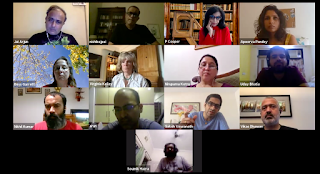 to teaching classes or leading film-club discussions, I miss the electric thrill of being in the physical presence of a group of people who are invested in the talk; the option of being able to walk between desks, stand next to someone who is making an interesting observation. To make eye contact while gushing about a film or a scene that affected us similarly – something that isn’t possible in the same way on a computer screen where all of us are shut up in our little boxes like characters in Hitchcock’s Rear Window or Tati’s Playtime.
With these possibilities reduced, even the world of the grumpy recluse has diminished.
Sorry, extroverts – I know it’s hard enough for you already, without us unsocial types making it all about ourselves again and sticking our paws into your jar of sympathy cookies.
----------------------------
 Ever since the pandemic and the attendant lockdowns began, we have heard a great deal about the introvert-extrovert divide and how our changed circumstances have affected those at each end of the spectrum. There have, for instance, been pieces by introverts about how they are temperamentally better equipped than “social people” to deal with this situation. It’s what one might call the “apna time aa gaya” subgenre of writing.
On the face of it, I should be able to relate to this gloating. I have been a solitary type as long as I remember – or perhaps it would be more accurate to say that while I can be gregarious and social at times (and have a performative Mr Hyde-ish side beneath the surface), I am most comfortable with long periods of being alone. One offshoot of this quality is that I have been working from home for 14 years – good practice, as it turned out, for 2020.
But I have found much of the personality analysis during this period quite reductive, and my own pandemic experience has been different from what you’d expect from the classic-cliched introvert.
Partly, this was circumstantial. For the initial weeks of the lockdown, when most people were cooped up at home, I was out and about quite a lot: first, because I live between two flats located ten minutes apart in the same neighbourhood, with responsibilities to discharge in both. Second, my concern about street animals in lockdown time culminated in daily feeding expeditions, and soon I was interacting with other like-minded people – including local animal-feeders and rescuers whom I had never met or spoken with before. During these many outdoor stints, I also inevitably spent time conversing with colony guards, shopkeepers, pharmacy employees. It was atypically social behaviour in a very unsocial time – and a disquieting indication that I might not be the irredeemable misanthrope I’d thought I was.
Then, after things had stabilised a bit on the animal-feeding front, and Covid’s widening net dictated that one became more cautious (even as the lockdowns officially ended), I started to feel the introvert’s unrest.
In my view the stereotypical image of the introvert – sitting at home, nose buried in a book (or in Netflix) – is simplistic, even though I have often been that creature. Nor am I impressed by the homily that goes “Someone who has developed the reading habit can never be bored.”
Avid readers can get restless and distracted too – and not just because of the worry that is gnawing away at all of us these days, for our own health, the health of those we care about, and our dwindling income. There is the other, peculiar challenge of being an unsocial sort in a world where “unsocial” is no longer a choice but an imposition.
It is said that extroverts derive their energy from being around other people, while introverts need to “recharge” alone. This may be broadly true, but what if being “alone” or “with yourself” doesn’t necessarily mean being confined at home? What if you want to exercise the option of being alone in a crowd? To get out every now and again, do regular-seeming things, but without it being tied to specific, planned activities with people you know. What if you feel stifled by the lack of privacy and me-time at home where your needy dog’s ever-loving eyes are following you around all the time?
I might not miss getting out to meet friends, or even feel the need to speak with friends on the phone or through video – but I do miss going to a restaurant alone for a quick bite or drink. Or watching a film (after carefully picking a seat that is unlikely to have other people nearby – social distancing was possible in an earlier time too). Walking around in a (not too) crowded mall or park, going on a short metro ride when it isn’t rush hour: absorbing human energies, feeling the hum of being around people, but without any pressure to interact or to do things. (Is being introverted a sort of commitment-phobia?)
And, yes, for someone who is mostly unsocial but capable of being very social when it comes to things that excite him, there are also frustrations that outgoing people will relate to. When it comes
 to teaching classes or leading film-club discussions, I miss the electric thrill of being in the physical presence of a group of people who are invested in the talk; the option of being able to walk between desks, stand next to someone who is making an interesting observation. To make eye contact while gushing about a film or a scene that affected us similarly – something that isn’t possible in the same way on a computer screen where all of us are shut up in our little boxes like characters in Hitchcock’s Rear Window or Tati’s Playtime.
With these possibilities reduced, even the world of the grumpy recluse has diminished.
Sorry, extroverts – I know it’s hard enough for you already, without us unsocial types making it all about ourselves again and sticking our paws into your jar of sympathy cookies.
July 6, 2020
Two film courses: Hindi-movie song sequences and Val Lewton’s psychological horror
Spreading the word about two film-appreciation modules I have lined up, each of which is the starting point for a larger series of courses around Indian and non-Indian cinema. If you are interested, contact me at jaiarjun@gmail.com for details of the courses. And please spread the word to anyone else who might want to sign up for one or both of these.
Module 1: Celebrating the song sequence, and its place in the Hindi-film narrative
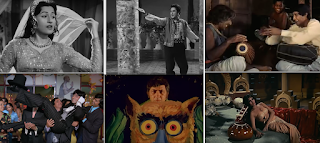 Though music and dance have been among the defining elements of popular Hindi cinema, the song sequence as it used to be – with its disruption of narrative and apparent lack of logic – has sometimes invited derision from those who don’t care for “loud” or “melodramatic” forms of expression. However, such sequences often work within the context of a movie to deepen our attitudes to the characters and situations, and help us understand the film better.
We will look at a number of song sequences from Hindi films across the decades, and examine their visual language as well as the functions they serve: the revelation of character and relationship, the use of space, commentaries on the star system, the shifting of registers between comedy, pathos and other moods. The scenes in question will be from films by major directors like Bimal Roy, Vijay Anand, Guru Dutt, Raj Kapoor and Hrishikesh Mukherjee, as well as more recent approaches in the works of Zoya Akhtar, Dibakar Banerjee and others. There will be some room for whimsy as well.
This will also be the starting point for a larger course about specific sequences (not just musical sequences) in Indian cinema. Without being rigid about this, my preference would be for students who, even if they don’t know much about old Hindi cinema, are extremely open-minded about what they are willing to watch and think about. (These classes will not only focus on sequences that have obvious and easily identifiable artistic merit; I will look at scenes that some of us instinctively think of as cheesy/technically shoddy/outdated but which are inventive and unusual in their own ways.)
Module 2: Val Lewton and the workings of understated horror
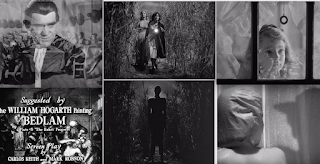 Thanks to the recent surge in Indian horror films (including “social-message horror films”) and web series, there have been many conversations around the genre – including the difference between “psychological”/”restrained” horror and jump-scare/monster horror. Predictably, such discussions tend to extol the former and denigrate the latter, and this goes with the implication that subtle psychological horror is something relatively new in cinema. But very few movie-buffs these days talk about – or even know much about – the Val Lewton-produced B-movies of the 1940s, which include such distinctive works as The Seventh Victim, I Walked with a Zombie, and Cat People.
Most of these films are only around 65 to 75 minutes long, and are characterised by their storytelling economy and directness, as well as the building of a very identifiable mood – they are creepy, but with a pervasive sense of sadness, and centred around people who are lonely or haunted in some way.
The format for these classes will follow the film-noir discussions I have been hosting: that is, I will upload some of Lewton’s films and make them available to those who are interested in the classes; this will be followed by a two-hour discussion about the films in particular, as well as the workings of the genre.
Please do get in touch for course details, and spread the word to other movie buffs and students.
Module 1: Celebrating the song sequence, and its place in the Hindi-film narrative
 Though music and dance have been among the defining elements of popular Hindi cinema, the song sequence as it used to be – with its disruption of narrative and apparent lack of logic – has sometimes invited derision from those who don’t care for “loud” or “melodramatic” forms of expression. However, such sequences often work within the context of a movie to deepen our attitudes to the characters and situations, and help us understand the film better.
We will look at a number of song sequences from Hindi films across the decades, and examine their visual language as well as the functions they serve: the revelation of character and relationship, the use of space, commentaries on the star system, the shifting of registers between comedy, pathos and other moods. The scenes in question will be from films by major directors like Bimal Roy, Vijay Anand, Guru Dutt, Raj Kapoor and Hrishikesh Mukherjee, as well as more recent approaches in the works of Zoya Akhtar, Dibakar Banerjee and others. There will be some room for whimsy as well.
This will also be the starting point for a larger course about specific sequences (not just musical sequences) in Indian cinema. Without being rigid about this, my preference would be for students who, even if they don’t know much about old Hindi cinema, are extremely open-minded about what they are willing to watch and think about. (These classes will not only focus on sequences that have obvious and easily identifiable artistic merit; I will look at scenes that some of us instinctively think of as cheesy/technically shoddy/outdated but which are inventive and unusual in their own ways.)
Module 2: Val Lewton and the workings of understated horror
 Thanks to the recent surge in Indian horror films (including “social-message horror films”) and web series, there have been many conversations around the genre – including the difference between “psychological”/”restrained” horror and jump-scare/monster horror. Predictably, such discussions tend to extol the former and denigrate the latter, and this goes with the implication that subtle psychological horror is something relatively new in cinema. But very few movie-buffs these days talk about – or even know much about – the Val Lewton-produced B-movies of the 1940s, which include such distinctive works as The Seventh Victim, I Walked with a Zombie, and Cat People.
 Most of these films are only around 65 to 75 minutes long, and are characterised by their storytelling economy and directness, as well as the building of a very identifiable mood – they are creepy, but with a pervasive sense of sadness, and centred around people who are lonely or haunted in some way.
The format for these classes will follow the film-noir discussions I have been hosting: that is, I will upload some of Lewton’s films and make them available to those who are interested in the classes; this will be followed by a two-hour discussion about the films in particular, as well as the workings of the genre.
Please do get in touch for course details, and spread the word to other movie buffs and students.
June 30, 2020
Essay for sale : a spiritual cinematic quest
As mentioned earlier in this space, I wrote a personal essay last year for the “India and Europe” issue of the Swedish journal Ord&Bild . The piece was about my experiences with religious/spiritual cinema (Indian and European) over the decades, how this intersected with a personality conflict with my grandmother, and my re-engagement with Hindi cinema as an adult. It covers films ranging from Amar Akbar Anthony to Satyajit Ray’s Devi, from Carl Dreyer’s Day of Wrath and Michael Powell’s A Canterbury Tale to Raju Hirani’s PK, and also touches on such real-world events as the milk-drinking Ganesha statues of 1995 and the Babri Masjid demolition.
 The translated version was published a few months ago, but I have the original English version (around 4500 words) and am looking for a home for it. Anyone here who knows of/runs a suitable publication, please DM me. Or if anyone in publishing knows of an anthology-in-progress that such a piece might fit into.
It would be great to be paid decently for it, but I have to be somewhat realistic (a.k.a. hopelessly cynical) and don’t have high expectations when it comes to such things. (In any case, if nothing else works out, I will put it on the blog so it can die quietly.)
The translated version was published a few months ago, but I have the original English version (around 4500 words) and am looking for a home for it. Anyone here who knows of/runs a suitable publication, please DM me. Or if anyone in publishing knows of an anthology-in-progress that such a piece might fit into.
It would be great to be paid decently for it, but I have to be somewhat realistic (a.k.a. hopelessly cynical) and don’t have high expectations when it comes to such things. (In any case, if nothing else works out, I will put it on the blog so it can die quietly.)Hoping to hear from someone here, or to get a useful contact or two…
June 26, 2020
Two video discussions — with Baradwaj Rangan and Devashish Makhija
Sharing a couple of Zoom discussions I recently participated in.
A conversation with Baradwaj Rangan: two blog-era critics reflect on their journeys through social media, then and now — how have writing, reviewing and online discussion changed during this time?
This is something Baradwaj and I had wanted to do for a while. The result was some rambling, some navel-gazing and some tripping over oneself - that tends to happen with these things - but it was nice to do this, and hopefully it will be of interest to those who have followed our work (and culture criticism more generally) over the past two decades. I also hope we can do a sequel sometime, where we can discuss a few things we left out here.
*******
And from a few weeks earlier, here is the full video of the “Cinema and Migrant Crises” fundraising conversation I had with author-filmmaker Devashish Makhija, about the migrant issue as depicted in his latest feature film Bhonsle, as well as other aspects of his work.
(Speaking of which: Bhonsle, an excellent and demanding film with Manoj Bajpayee as a tired old policeman, has only just been released for a general public — it is on Sony Liv.)
A conversation with Baradwaj Rangan: two blog-era critics reflect on their journeys through social media, then and now — how have writing, reviewing and online discussion changed during this time?
This is something Baradwaj and I had wanted to do for a while. The result was some rambling, some navel-gazing and some tripping over oneself - that tends to happen with these things - but it was nice to do this, and hopefully it will be of interest to those who have followed our work (and culture criticism more generally) over the past two decades. I also hope we can do a sequel sometime, where we can discuss a few things we left out here.
*******
And from a few weeks earlier, here is the full video of the “Cinema and Migrant Crises” fundraising conversation I had with author-filmmaker Devashish Makhija, about the migrant issue as depicted in his latest feature film Bhonsle, as well as other aspects of his work.
(Speaking of which: Bhonsle, an excellent and demanding film with Manoj Bajpayee as a tired old policeman, has only just been released for a general public — it is on Sony Liv.)
June 25, 2020
Online film-club discussions: In a Lonely Place (1950)
 About the second of the film-noir discussions I am hosting. The film: the 1950 In a Lonely Place, directed by Nicholas Ray, with Humphrey Bogart as a cynical, caustic screenwriter who comes to be suspected of murder. This is one of a number of films made around this period that cast a dark gaze on the inner workings of the entertainment business (other major examples include Sunset Boulevard and All About Eve from the same year, as well as The Bad and the Beautiful and the light-hearted but equally sardonic Singin’ in the Rain).
As before, this is how it goes:
– Those who are interested, mail me at jaiarjun@gmail.com so I can share the link to the film through Google Drive.
– Watch the film. Make notes if you feel like it.
– We get together on Zoom for an hour or two to talk about the film, as well as historical context, recommendations for other related works and so on.
Please mail me so we can set this up. Last week’s Gun Crazy discussion had more than 30 participants and went reasonably well; ideally that should be the maximum number, but it is flexible. I can also share the link with anyone who wants to just watch the film.
P.S. This discussion will only be next week, since I have committed to a Jaane bhi do Yaaro talk this Sunday.
P.P.S. the second still here is from an incidental little scene, but look at that Indian tourism poster. <!-- /* Font Definitions */ @font-face {font-family:"Cambria Math"; panose-1:2 4 5 3 5 4 6 3 2 4; mso-font-charset:0; mso-generic-font-family:roman; mso-font-pitch:variable; mso-font-signature:3 0 0 0 1 0;} @font-face {font-family:Calibri; panose-1:2 15 5 2 2 2 4 3 2 4; mso-font-charset:0; mso-generic-font-family:swiss; mso-font-pitch:variable; mso-font-signature:-536859905 -1073732485 9 0 511 0;} /* Style Definitions */ p.MsoNormal, li.MsoNormal, div.MsoNormal {mso-style-unhide:no; mso-style-qformat:yes; mso-style-parent:""; margin:0cm; margin-bottom:.0001pt; mso-pagination:widow-orphan; font-size:12.0pt; font-family:"Calibri",sans-serif; mso-ascii-font-family:Calibri; mso-ascii-theme-font:minor-latin; mso-fareast-font-family:Calibri; mso-fareast-theme-font:minor-latin; mso-hansi-font-family:Calibri; mso-hansi-theme-font:minor-latin; mso-bidi-font-family:"Times New Roman"; mso-bidi-theme-font:minor-bidi; mso-fareast-language:EN-US;} a:link, span.MsoHyperlink {mso-style-priority:99; color:#0563C1; mso-themecolor:hyperlink; text-decoration:underline; text-underline:single;} a:visited, span.MsoHyperlinkFollowed {mso-style-noshow:yes; mso-style-priority:99; color:#954F72; mso-themecolor:followedhyperlink; text-decoration:underline; text-underline:single;} .MsoChpDefault {mso-style-type:export-only; mso-default-props:yes; font-family:"Calibri",sans-serif; mso-ascii-font-family:Calibri; mso-ascii-theme-font:minor-latin; mso-fareast-font-family:Calibri; mso-fareast-theme-font:minor-latin; mso-hansi-font-family:Calibri; mso-hansi-theme-font:minor-latin; mso-bidi-font-family:"Times New Roman"; mso-bidi-theme-font:minor-bidi; mso-fareast-language:EN-US;}size:612.0pt 792.0pt; margin:72.0pt 72.0pt 72.0pt 72.0pt; mso-header-margin:36.0pt; mso-footer-margin:36.0pt; mso-paper-source:0;} div.WordSection1 {page:WordSection1;}</span></font></style></div>
June 24, 2020
Found while rummaging through old cupboards...
... an appointment booklet from one of my mother’s Bombay trips, when she was pregnant with me.
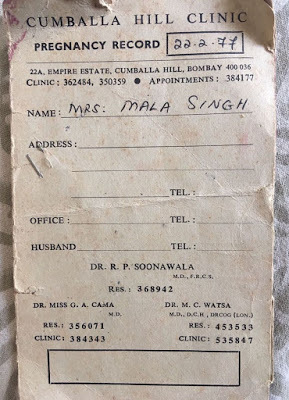
The main obstetrician mentioned here, Dr Rustom Soonawala, is very well-known in his field (checking online, I learn that not only were Ranbir, Karisma and Kareena Kapoor delivered by him, but that “Vijay Mallya flew RP to Los Angeles to deliver his son Sidhartha”. All in a day’s work for a kingfisher, I suppose). But I was more amused to see one of the other names, Dr MC Watsa.
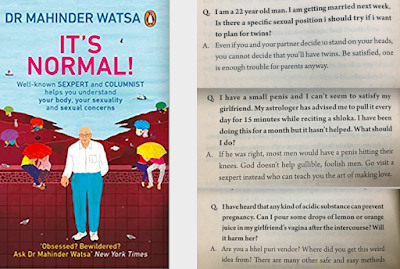 That’s Mahinder Watsa, who has been writing the “Ask the Sexpert” column for Mumbai Mirror for a couple of decades. He’s 96 now, and still replying to sex questions. Penguin published his book It’s Normal! a few years ago and it has some enjoyably silly humour in it. I wonder if my mother met him back then, and if he said anything outrageous to her.

The main obstetrician mentioned here, Dr Rustom Soonawala, is very well-known in his field (checking online, I learn that not only were Ranbir, Karisma and Kareena Kapoor delivered by him, but that “Vijay Mallya flew RP to Los Angeles to deliver his son Sidhartha”. All in a day’s work for a kingfisher, I suppose). But I was more amused to see one of the other names, Dr MC Watsa.
 That’s Mahinder Watsa, who has been writing the “Ask the Sexpert” column for Mumbai Mirror for a couple of decades. He’s 96 now, and still replying to sex questions. Penguin published his book It’s Normal! a few years ago and it has some enjoyably silly humour in it. I wonder if my mother met him back then, and if he said anything outrageous to her.
June 15, 2020
Film noir discussions: Gun Crazy (1950)
 An update about the online film discussions I mentioned in the last post. While I am putting together a module for classes, I wanted to kick things off with a couple of informal sessions centred on 1940s-50s film noir. This is how it will go:
 – I upload a film and make it available through Google Drive.
– Those who are interested, mail me at jaiarjun@gmail.com so I can share the link.
– Watch the film. Make notes if you feel like it. Preferably, don’t read detailed analyses of the film before our discussion. (When I share the link, I will provide a basic synopsis along with points of interest and what to look out for.)
– We get together on Zoom for an hour or two on a specific date to talk about the film; I will try to provide some historical context, recommendations for other related works and so on, but in my experience some of the sharpest observations during such classes come from people who have watched the film for the first time without preconceptions/too much contextual information.
 For the film-noir discussions, I will include some of the more famous works in the genre, such as Double Indemnity, The Third Man, The Big Heat, The Asphalt Jungle, and In a Lonely Place. But I want to start with a “B-noir” that doesn’t have major stars or a major director but is a personal favourite: the 1950 ˆ, which was one of the first “couple on the run” films, made nearly two decades before Bonnie and Clyde, and a big influence on the French critics-turned-filmmakers of the decade to come. (There are visual similarities between Gun Crazy and Godard’s Breathless, for example.)
 Please mail me at jaiarjun@gmail.comso we can set this up. I would rather start small, which means no more than 20-25 participants for the discussion. But I’m happy to share the link with anyone who wants to just watch the film. <!-- /* Font Definitions */ @font-face {font-family:"Cambria Math"; panose-1:2 4 5 3 5 4 6 3 2 4; mso-font-charset:0; mso-generic-font-family:roman; mso-font-pitch:variable; mso-font-signature:3 0 0 0 1 0;} @font-face {font-family:Calibri; panose-1:2 15 5 2 2 2 4 3 2 4; mso-font-charset:0; mso-generic-font-family:swiss; mso-font-pitch:variable; mso-font-signature:-536859905 -1073732485 9 0 511 0;} /* Style Definitions */ p.MsoNormal, li.MsoNormal, div.MsoNormal {mso-style-unhide:no; mso-style-qformat:yes; mso-style-parent:""; margin:0cm; margin-bottom:.0001pt; mso-pagination:widow-orphan; font-size:12.0pt; font-family:"Calibri",sans-serif; mso-ascii-font-family:Calibri; mso-ascii-theme-font:minor-latin; mso-fareast-font-family:Calibri; mso-fareast-theme-font:minor-latin; mso-hansi-font-family:Calibri; mso-hansi-theme-font:minor-latin; mso-bidi-font-family:"Times New Roman"; mso-bidi-theme-font:minor-bidi; mso-fareast-language:EN-US;} a:link, span.MsoHyperlink {mso-style-priority:99; color:#0563C1; mso-themecolor:hyperlink; text-decoration:underline; text-underline:single;} a:visited, span.MsoHyperlinkFollowed {mso-style-noshow:yes; mso-style-priority:99; color:#954F72; mso-themecolor:followedhyperlink; text-decoration:underline; text-underline:single;} .MsoChpDefault {mso-style-type:export-only; mso-default-props:yes; font-family:"Calibri",sans-serif; mso-ascii-font-family:Calibri; mso-ascii-theme-font:minor-latin; mso-fareast-font-family:Calibri; mso-fareast-theme-font:minor-latin; mso-hansi-font-family:Calibri; mso-hansi-theme-font:minor-latin; mso-bidi-font-family:"Times New Roman"; mso-bidi-theme-font:minor-bidi; mso-fareast-language:EN-US;}size:612.0pt 792.0pt; margin:72.0pt 72.0pt 72.0pt 72.0pt; mso-header-margin:36.0pt; mso-footer-margin:36.0pt; mso-paper-source:0;} div.WordSection1 {page:WordSection1;}</font></style></div>
June 13, 2020
Thinking about online film discussions (+ a recommendation for He Walked by Night)
I have been thinking about hosting a few online discussions around cinema —I hesitate at this point to call them “film-appreciation classes”, though that is what the eventual goal is — and I wondered in particular if there might be takers for conversations around American/British films of the 1930s and 1940s. Across genres: from noir and psychological horror (e.g. Val Lewton) to screwball comedy (Preston Sturges) and films that are hard to classify (the works of Powell-Pressburger). The idea being 1) to examine ways of “reading” a film by looking closely at specific works, 2) to acquire a deeper sense of film history - something that I know many young movie enthusiasts struggle with today, given all the demands on their time — and how the past has influenced the present.
 Anyway, I will provide updates about such a project here (and hopefully some of this blog's readers will be interested). But for now, a quick B-noir recommendation. A couple of such films are playing on Mubi India, among them the 1948 He Walked by Night.
This is a lean and gripping low-budget movie, structurally unusual for its time, and it has some historical importance too: it was while playing a supporting role in this film that the actor Jack Webb came up with the idea for the police-procedural series Dragnet — a show with a long and very influential run on both TV and radio. (Dragnet might not mean very much to Indian viewers — even those of us who know old Hollywood quite well — but it helped prepare the ground for much later police shows that we do know, such as Hill Street Blues.)
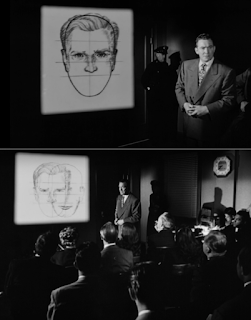
Much like another 1948 film The Naked City (which also led to a TV series much later, and which I wrote about here), He Walked by Night is made in a semi-documentary style. Though it has a narrative and a dramatic arc, it also focuses on the painstaking nuts and bolts of police-work: forensics, the creation of a suspect profile based on the testimonies of several witnesses, and of course sheer luck.
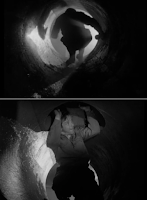 One more point of note: a year before a much more famous (and respectable) film noir, The Third Man, this film features a climax where the antagonist runs through a complex network of storm drains, with the police in pursuit. These sequences may not be as poetically constructed and shot as the corresponding scenes in The Third Man (and there are no canted angles!), but they are gritty and suspenseful in their own right. A very fine film if you have a taste for this sub-genre.
P.S. like Paatal Lok, He Walked by Night also has a “villain” who seems to care for dogs. This is turning into a motif…
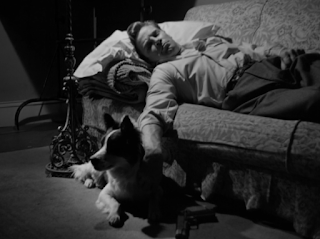
 Anyway, I will provide updates about such a project here (and hopefully some of this blog's readers will be interested). But for now, a quick B-noir recommendation. A couple of such films are playing on Mubi India, among them the 1948 He Walked by Night.
 This is a lean and gripping low-budget movie, structurally unusual for its time, and it has some historical importance too: it was while playing a supporting role in this film that the actor Jack Webb came up with the idea for the police-procedural series Dragnet — a show with a long and very influential run on both TV and radio. (Dragnet might not mean very much to Indian viewers — even those of us who know old Hollywood quite well — but it helped prepare the ground for much later police shows that we do know, such as Hill Street Blues.)
Much like another 1948 film The Naked City (which also led to a TV series much later, and which I wrote about here), He Walked by Night is made in a semi-documentary style. Though it has a narrative and a dramatic arc, it also focuses on the painstaking nuts and bolts of police-work: forensics, the creation of a suspect profile based on the testimonies of several witnesses, and of course sheer luck.
 One more point of note: a year before a much more famous (and respectable) film noir, The Third Man, this film features a climax where the antagonist runs through a complex network of storm drains, with the police in pursuit. These sequences may not be as poetically constructed and shot as the corresponding scenes in The Third Man (and there are no canted angles!), but they are gritty and suspenseful in their own right. A very fine film if you have a taste for this sub-genre.
 P.S. like Paatal Lok, He Walked by Night also has a “villain” who seems to care for dogs. This is turning into a motif…

Jai Arjun Singh's Blog

- Jai Arjun Singh's profile
- 11 followers
Jai Arjun Singh isn't a Goodreads Author
(yet),
but they
do have a blog,
so here are some recent posts imported from
their feed.

