
Jai Arjun Singh's Blog, page 78
May 16, 2013
Phantoms in tunnels, and the quiet creepiness of the first Hannibal Lecter film
Being increasingly stressed out by road travel, I have had much reason to be grateful for the Delhi Metro in the last few years. But one of the more oddball benefits of the underground line involves a personal fetish, which I will hesitantly reveal here: I like watching the glow of an approaching train.
Not the train itself, mind, but the intangible things that herald its approach. This is roughly how it goes. Standing on the platform, staring into the darkness of the tunnel, you first have the vaguest sensation of light molecules shifting in the far distance, so that you’re unsure you can trust your eyes (and often, it does turn out to be an optical illusion). Then, very slowly, the sides of the tunnel light up, the specific effect depending on the degree of curvature of the route leading into the platform; in some stations you can see the train head-on from a long way off, and that’s no fun. Eventually this phantom light resolves itself into something concrete, the shadow of the train glides along the wall before the big worm itself appears, no longer scary now that it has a clear physical shape. But for those few seconds before it comes into view, there is a tantalising little Plato’s Cave effect where you can give your imagination full rein: what is there? What is coming? (Yes, I know, the more literal-minded of you might say: “It’s a TRAIN, you moron!” But indulge me.)
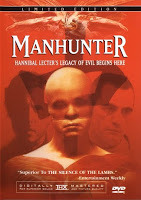 Here’s why I’m going on about this: I sometimes experience real-world situations as echoes of spooky moments from thrillers or horror films (at times this can be the only way to get through the drudgery that is real life), and the glow in the tunnel evokes the effect of a scene from Michael Mann’s 1986 film
Manhunter
. It’s been a long time since I watched this stylish thriller, but I thought of it when I heard about the new TV series
Hannibal
, about that most famous of fictional gentleman cannibals, Hannibal Lecter. Lecter is best known to movie-goers for his appearance in The Silence of the Lambs (and its cash-in-on-the-publicity sequels, where Anthony Hopkins reprised the role that got him an Oscar), but his first movie appearance was a 10-minute part in Manhunter, an adaptation of Thomas Harris’s superb thriller Red Dragon. Another British actor, Brian Cox, played the role, and the film – like the TV series – touched on Lecter’s complex relationship with detective Will Graham, who apprehended him.
Here’s why I’m going on about this: I sometimes experience real-world situations as echoes of spooky moments from thrillers or horror films (at times this can be the only way to get through the drudgery that is real life), and the glow in the tunnel evokes the effect of a scene from Michael Mann’s 1986 film
Manhunter
. It’s been a long time since I watched this stylish thriller, but I thought of it when I heard about the new TV series
Hannibal
, about that most famous of fictional gentleman cannibals, Hannibal Lecter. Lecter is best known to movie-goers for his appearance in The Silence of the Lambs (and its cash-in-on-the-publicity sequels, where Anthony Hopkins reprised the role that got him an Oscar), but his first movie appearance was a 10-minute part in Manhunter, an adaptation of Thomas Harris’s superb thriller Red Dragon. Another British actor, Brian Cox, played the role, and the film – like the TV series – touched on Lecter’s complex relationship with detective Will Graham, who apprehended him.
Anyway, the Manhunter scene that I relive in Metro stations begins with a security guard in an underground parking lot, reading the newspaper. Hearing a sound in the far distance, he peers around at the slanting, covered path that cars take to reach the parking base: nothing there, so he gets back to the paper. But the noise – a deep roaring, along with the sound of something rolling along – persists and grows. The camera cuts to the curved path and we see an orange glow lighting up the wall. The guard turns back again, this time a look of terror crosses his face as he leaps up from his chair and runs away; cut back, and at last we get the morbid payoff: a burning figure in a wheelchair heading straight at the camera, at us. (If you’ve been watching the film in sequence, you will know that the character in the wheelchair is a pesky tabloid reporter who had the poor luck to fall into the hands of a serial killer called the Red Dragon.)
 It’s worth mentioning that the scene is brightly lit, and it may even be daylight outside the parking lot – the sense of unfathomable evil created here, as elsewhere in Manhunter, has nothing to do with dark shadows or what we think of as the regular trappings of horror cinema. This is a classic example of a film that achieves very menacing effects by keeping explicit detail to a minimum. In Harris’s book, we are told in a single terse sentence that the killer bites off the captive reporter’s lips. The visualisation of this moment in the film is even more restrained – no blood or gore, just an accumulation of little things: the Dragon with his back to the camera casually putting on a new set of teeth, telling the reporter they must seal their deal with a kiss, slowly bending his face towards him; cut to the exterior of the house, with birds calling across the night sky, perhaps implying the lipless screaming that is going on within.
In fact, some of the scariest scenes in the film are almost unnaturally bright, and the refusal to overuse genre conventions is reflected in the art design in the Hannibal Lecter scenes, which contrast strongly with the ones in The Silence of the Lambs. The later film showed Lecter incarcerated in a gloomy, dungeon-like prison cell that looked like it might have rats scuffling about and a private uncovered sewer running down the corridor outside, while Manhunter has him in a neat, blindingly white room where you could almost smell the anti-septic (I kept feeling that the doctor had a generous dose of Brylcreem in his hair!).
 But the sterile tidiness of the setting only enhances the creepiness of these scenes: Lecter’s most distinct qualities – his old-world courtliness, his ability to look deep into the hearts and minds of others, and to manipulate their emotions – are very much on view. Visiting him in his cell, Will Graham is confronted with the terrifying knowledge that he has a deeply psychological connection with the man sitting before him, and that he might easily become a monster by wrestling with monsters. When Graham dashes out of the building after their meeting – even though the only demon pursuing him is the one inside his own mind – you can almost hear his heart pounding. And your own too. If the TV series comes close to replicating the insidiously scary quality of this film, it should be worth watching.
[Did a version of this for my DNA column. More thoughts on horror movies infecting the real world in my essay "Monsters I Have Known". And earlier posts on Thomas Harris and Hannibal Lecter here, here and here.]
Not the train itself, mind, but the intangible things that herald its approach. This is roughly how it goes. Standing on the platform, staring into the darkness of the tunnel, you first have the vaguest sensation of light molecules shifting in the far distance, so that you’re unsure you can trust your eyes (and often, it does turn out to be an optical illusion). Then, very slowly, the sides of the tunnel light up, the specific effect depending on the degree of curvature of the route leading into the platform; in some stations you can see the train head-on from a long way off, and that’s no fun. Eventually this phantom light resolves itself into something concrete, the shadow of the train glides along the wall before the big worm itself appears, no longer scary now that it has a clear physical shape. But for those few seconds before it comes into view, there is a tantalising little Plato’s Cave effect where you can give your imagination full rein: what is there? What is coming? (Yes, I know, the more literal-minded of you might say: “It’s a TRAIN, you moron!” But indulge me.)
 Here’s why I’m going on about this: I sometimes experience real-world situations as echoes of spooky moments from thrillers or horror films (at times this can be the only way to get through the drudgery that is real life), and the glow in the tunnel evokes the effect of a scene from Michael Mann’s 1986 film
Manhunter
. It’s been a long time since I watched this stylish thriller, but I thought of it when I heard about the new TV series
Hannibal
, about that most famous of fictional gentleman cannibals, Hannibal Lecter. Lecter is best known to movie-goers for his appearance in The Silence of the Lambs (and its cash-in-on-the-publicity sequels, where Anthony Hopkins reprised the role that got him an Oscar), but his first movie appearance was a 10-minute part in Manhunter, an adaptation of Thomas Harris’s superb thriller Red Dragon. Another British actor, Brian Cox, played the role, and the film – like the TV series – touched on Lecter’s complex relationship with detective Will Graham, who apprehended him.
Here’s why I’m going on about this: I sometimes experience real-world situations as echoes of spooky moments from thrillers or horror films (at times this can be the only way to get through the drudgery that is real life), and the glow in the tunnel evokes the effect of a scene from Michael Mann’s 1986 film
Manhunter
. It’s been a long time since I watched this stylish thriller, but I thought of it when I heard about the new TV series
Hannibal
, about that most famous of fictional gentleman cannibals, Hannibal Lecter. Lecter is best known to movie-goers for his appearance in The Silence of the Lambs (and its cash-in-on-the-publicity sequels, where Anthony Hopkins reprised the role that got him an Oscar), but his first movie appearance was a 10-minute part in Manhunter, an adaptation of Thomas Harris’s superb thriller Red Dragon. Another British actor, Brian Cox, played the role, and the film – like the TV series – touched on Lecter’s complex relationship with detective Will Graham, who apprehended him.Anyway, the Manhunter scene that I relive in Metro stations begins with a security guard in an underground parking lot, reading the newspaper. Hearing a sound in the far distance, he peers around at the slanting, covered path that cars take to reach the parking base: nothing there, so he gets back to the paper. But the noise – a deep roaring, along with the sound of something rolling along – persists and grows. The camera cuts to the curved path and we see an orange glow lighting up the wall. The guard turns back again, this time a look of terror crosses his face as he leaps up from his chair and runs away; cut back, and at last we get the morbid payoff: a burning figure in a wheelchair heading straight at the camera, at us. (If you’ve been watching the film in sequence, you will know that the character in the wheelchair is a pesky tabloid reporter who had the poor luck to fall into the hands of a serial killer called the Red Dragon.)
 It’s worth mentioning that the scene is brightly lit, and it may even be daylight outside the parking lot – the sense of unfathomable evil created here, as elsewhere in Manhunter, has nothing to do with dark shadows or what we think of as the regular trappings of horror cinema. This is a classic example of a film that achieves very menacing effects by keeping explicit detail to a minimum. In Harris’s book, we are told in a single terse sentence that the killer bites off the captive reporter’s lips. The visualisation of this moment in the film is even more restrained – no blood or gore, just an accumulation of little things: the Dragon with his back to the camera casually putting on a new set of teeth, telling the reporter they must seal their deal with a kiss, slowly bending his face towards him; cut to the exterior of the house, with birds calling across the night sky, perhaps implying the lipless screaming that is going on within.
In fact, some of the scariest scenes in the film are almost unnaturally bright, and the refusal to overuse genre conventions is reflected in the art design in the Hannibal Lecter scenes, which contrast strongly with the ones in The Silence of the Lambs. The later film showed Lecter incarcerated in a gloomy, dungeon-like prison cell that looked like it might have rats scuffling about and a private uncovered sewer running down the corridor outside, while Manhunter has him in a neat, blindingly white room where you could almost smell the anti-septic (I kept feeling that the doctor had a generous dose of Brylcreem in his hair!).
 But the sterile tidiness of the setting only enhances the creepiness of these scenes: Lecter’s most distinct qualities – his old-world courtliness, his ability to look deep into the hearts and minds of others, and to manipulate their emotions – are very much on view. Visiting him in his cell, Will Graham is confronted with the terrifying knowledge that he has a deeply psychological connection with the man sitting before him, and that he might easily become a monster by wrestling with monsters. When Graham dashes out of the building after their meeting – even though the only demon pursuing him is the one inside his own mind – you can almost hear his heart pounding. And your own too. If the TV series comes close to replicating the insidiously scary quality of this film, it should be worth watching.
[Did a version of this for my DNA column. More thoughts on horror movies infecting the real world in my essay "Monsters I Have Known". And earlier posts on Thomas Harris and Hannibal Lecter here, here and here.]


May 8, 2013
Fathers and storytellers (notes on Bombay Talkies)
Last month I wrote about a film –
Lessons in Forgetting
– that centres on a protective father and his free-spirited daughter, the latter’s personality colliding with stereotypical ideas about the “good Indian girl”. Coincidentally, a few days ago, while watching the anthology film
Bombay Talkies
, it struck me that all four short movies in it touch on the relationship between fathers and their children, as well as on changing perceptions of masculinity and “male roles”. And a buried theme is a man’s ability – or inability – to tell stories and to deal with different types of narratives.
In fact, the very first scene in Bombay Talkies – in the short film directed by Karan Johar – has a young man angrily confronting his intolerant father who can’t accept, or perhaps even comprehend, that his son is gay. (The film’s title “Ajeeb Dastaan Hai Yeh” comes from one of the great Hindi-film songs, a rendition of which is beautifully used here, but it can also at a stretch be translated as “This is a queer tale”.) Later, in Zoya Akhtar’s short film, another middle-class father – more sensitive on the face of it, but also a man who has clear ideas about what a son should grow up to be – slaps his little boy when he sees him dressed in a girl’s clothes.
 There is some ambiguity in this child’s obsession with “Sheila”, the Katrina Kaif character in the Tees Maar Khan item number: does it entail a straight crush on Kaif, expressed through joyful imitation (I’m thinking now of my own childhood dalliances with Parveen Babi or Sridevi songs), or does it reflect gender identification, a biological imperative to “be” a girl? Whatever the case, Akhtar’s film ends with an idyllic scene where the boy gets to perform “Sheila ki Jawani” in front of a small, initially bemused but eventually appreciative audience. Beyond this, his future is uncertain; it’s hard to see him pursuing his dancing ambitions in the long run without a serious conflict with his dad.
Watching that scene, I couldn’t help think that exactly a hundred years ago Dadasaheb Phalke was making films where male actors performed in drag (because respectable women weren’t supposed to act in these shady motion-picture things) - and this led to reflections on gender roles and the creative impulse. In a world that encourages easy classifications, artists, performers or creative people are supposed to be particularly sensitive, and “sensitivity” in turn – broadly defined – is a trait associated more with women than with men. But think of gender characteristics and behaviour as existing along a continuing line (rather than clearly demarcated), and there may be something to the idea that when a man performs on stage, or briefly turns storyteller for his child or for a group of people in his train compartment (which are things that happen in Bombay Talkies), he is tapping into his existing “feminine” side. Or that he is temporarily made more introspective, placed at a remove from the aggression that society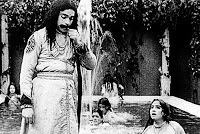 often demands of men. (Those men in Phalke’s films – some of them might have felt embarrassed in women’s clothes, but the more dedicated actors among them may have felt briefly liberated from gender expectations. In addition to having a grand time preening about the set, or just reveling in the experience of being “someone else”.)
Bombay Talkies has a number of characters who are performers or mimics or tellers of tales, or people who (channeling Eliot) prepare a face each morning before going out to deal with the world. In Johar’s film, Gayatri (Rani Mukherjee) and her husband are living a lie of sorts; one can easily see the little boy in Akhtar’s film growing up to do the same thing; in Dibakar Banerjee’s film, Purandar (Nawazuddin Siddiqui) dreams of getting rich through emu-farming (though the bird is clearly taking more than it gives) while his mundane real-world existence requires that he heads out to find a building-watchman job where (as he himself puts it) you aren’t required to do much more than stand at attention for hours on end.
Purandar has other dimensions: he is a loving father who unselfconsciously does household work alongside his wife and is apparently comfortable in female presence, hanging about with the women of his chawl as they exchange a salty joke or two. Perhaps these traits are inseparable from his qualities as an actor who brings all his integrity to a bit-part role, and as a storyteller who puts on a silent performance for his little girl at the end. (Banerjee – who is of course a storyteller himself – has said that his own experience with fatherhood informed his treatment of this narrative.)
Finally, in Anurag Kashyap’s film about a son who travels to Bombay to try and meet his father’s favourite film star, I think one can suggest that movie-love has turned both the protagonist Vijay and his father into raconteurs – people who have a feel for the spoken word, for parody, dramatic flow and the right pauses. They are amateur performers, and I’d think this would make them more attentive people and strengthen the bond between them. If violence and intolerance are failures of the imagination, perhaps the problem with the fathers in Johar’s and Akhtar’s films is that never having developed a taste for fantasy and role-playing, they lack the empathy that comes with it.
*****
Sidenote: In reviews and in casual discussions with friends, I have heard Kashyap’s film being described as disappointingly simple – and indeed, on the face of it, there is something pedestrian about the story of a young man trying to get a darshan of Amitabh Bachchan (who eventually “blesses” us viewers with a cameo appearance and underlines His divinity by doing unto a murabba what Lord Rama did unto the berry offered him by Shabari). It might seem even more trite if you recall all the behind-the-scenes talk about Kashyap’s real-life reconciliation with Bachchan, and how gratified he seemed by it. But given this director’s sly sense of humour and the awareness in his earlier work of the subtle ways in which worship and irreverence mingle (see his superb short film Pramod Bhai 23, for example), I think the story invites more than a face-value reading.
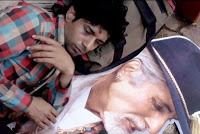 Vineet Kumar is very good as Vijay, but also consider the casting in light of the small part Kumar played in Kashyap’s
Gangs of Wasseypur
. There he was Sardar Singh’s eldest son Danish, the heir apparent, with the dialogue at one point likening him to the Vijay played by Bachchan in
Trishul
– the clear hero of that film, whose smouldering presence made younger brother Shashi Kapoor seem effete in comparison. (Indeed there is an oft-circulated joke that Shashi Kapoor was one of Bachchan’s most convincing heroines. In Trishul, when the two men have a fight scene where they get to land an equal number of punches on each other – the obligatory ego-salve for male stars of the time – you don’t for a minute buy into it.)
Vineet Kumar is very good as Vijay, but also consider the casting in light of the small part Kumar played in Kashyap’s
Gangs of Wasseypur
. There he was Sardar Singh’s eldest son Danish, the heir apparent, with the dialogue at one point likening him to the Vijay played by Bachchan in
Trishul
– the clear hero of that film, whose smouldering presence made younger brother Shashi Kapoor seem effete in comparison. (Indeed there is an oft-circulated joke that Shashi Kapoor was one of Bachchan’s most convincing heroines. In Trishul, when the two men have a fight scene where they get to land an equal number of punches on each other – the obligatory ego-salve for male stars of the time – you don’t for a minute buy into it.)
But Gangs of Wasseypur’s depiction of life as the banana peel on which the fondest cinematic fantasies may slip included a sequence of events where the limp-wristed younger brother Faisal becomes - to his own surprise - the film's protagonist. “Jab aankh khuli to dekha ki hum Shashi Kapoor hai. Bachchan toh koi aur hai,” Faisal says in an earlier moment of drug-addled self-pity, but this “second lead” ends up as the kingpin after his elder brother is casually bumped off. Watch GoW, then see Vijay’s father in Bombay Talkies mimic Dilip Kumar while telling his story about his own encounter with that thespian decades earlier, and consider the eventual fate of the murabba that Bachchan so self-importantly bites into; I think Kashyap’s film is more than a straight-faced, rose-tinted view of supplicants trying to collect stardust in a glass jar.
In fact, the very first scene in Bombay Talkies – in the short film directed by Karan Johar – has a young man angrily confronting his intolerant father who can’t accept, or perhaps even comprehend, that his son is gay. (The film’s title “Ajeeb Dastaan Hai Yeh” comes from one of the great Hindi-film songs, a rendition of which is beautifully used here, but it can also at a stretch be translated as “This is a queer tale”.) Later, in Zoya Akhtar’s short film, another middle-class father – more sensitive on the face of it, but also a man who has clear ideas about what a son should grow up to be – slaps his little boy when he sees him dressed in a girl’s clothes.
 There is some ambiguity in this child’s obsession with “Sheila”, the Katrina Kaif character in the Tees Maar Khan item number: does it entail a straight crush on Kaif, expressed through joyful imitation (I’m thinking now of my own childhood dalliances with Parveen Babi or Sridevi songs), or does it reflect gender identification, a biological imperative to “be” a girl? Whatever the case, Akhtar’s film ends with an idyllic scene where the boy gets to perform “Sheila ki Jawani” in front of a small, initially bemused but eventually appreciative audience. Beyond this, his future is uncertain; it’s hard to see him pursuing his dancing ambitions in the long run without a serious conflict with his dad.
Watching that scene, I couldn’t help think that exactly a hundred years ago Dadasaheb Phalke was making films where male actors performed in drag (because respectable women weren’t supposed to act in these shady motion-picture things) - and this led to reflections on gender roles and the creative impulse. In a world that encourages easy classifications, artists, performers or creative people are supposed to be particularly sensitive, and “sensitivity” in turn – broadly defined – is a trait associated more with women than with men. But think of gender characteristics and behaviour as existing along a continuing line (rather than clearly demarcated), and there may be something to the idea that when a man performs on stage, or briefly turns storyteller for his child or for a group of people in his train compartment (which are things that happen in Bombay Talkies), he is tapping into his existing “feminine” side. Or that he is temporarily made more introspective, placed at a remove from the aggression that society
 often demands of men. (Those men in Phalke’s films – some of them might have felt embarrassed in women’s clothes, but the more dedicated actors among them may have felt briefly liberated from gender expectations. In addition to having a grand time preening about the set, or just reveling in the experience of being “someone else”.)
Bombay Talkies has a number of characters who are performers or mimics or tellers of tales, or people who (channeling Eliot) prepare a face each morning before going out to deal with the world. In Johar’s film, Gayatri (Rani Mukherjee) and her husband are living a lie of sorts; one can easily see the little boy in Akhtar’s film growing up to do the same thing; in Dibakar Banerjee’s film, Purandar (Nawazuddin Siddiqui) dreams of getting rich through emu-farming (though the bird is clearly taking more than it gives) while his mundane real-world existence requires that he heads out to find a building-watchman job where (as he himself puts it) you aren’t required to do much more than stand at attention for hours on end.
Purandar has other dimensions: he is a loving father who unselfconsciously does household work alongside his wife and is apparently comfortable in female presence, hanging about with the women of his chawl as they exchange a salty joke or two. Perhaps these traits are inseparable from his qualities as an actor who brings all his integrity to a bit-part role, and as a storyteller who puts on a silent performance for his little girl at the end. (Banerjee – who is of course a storyteller himself – has said that his own experience with fatherhood informed his treatment of this narrative.)
Finally, in Anurag Kashyap’s film about a son who travels to Bombay to try and meet his father’s favourite film star, I think one can suggest that movie-love has turned both the protagonist Vijay and his father into raconteurs – people who have a feel for the spoken word, for parody, dramatic flow and the right pauses. They are amateur performers, and I’d think this would make them more attentive people and strengthen the bond between them. If violence and intolerance are failures of the imagination, perhaps the problem with the fathers in Johar’s and Akhtar’s films is that never having developed a taste for fantasy and role-playing, they lack the empathy that comes with it.
*****
Sidenote: In reviews and in casual discussions with friends, I have heard Kashyap’s film being described as disappointingly simple – and indeed, on the face of it, there is something pedestrian about the story of a young man trying to get a darshan of Amitabh Bachchan (who eventually “blesses” us viewers with a cameo appearance and underlines His divinity by doing unto a murabba what Lord Rama did unto the berry offered him by Shabari). It might seem even more trite if you recall all the behind-the-scenes talk about Kashyap’s real-life reconciliation with Bachchan, and how gratified he seemed by it. But given this director’s sly sense of humour and the awareness in his earlier work of the subtle ways in which worship and irreverence mingle (see his superb short film Pramod Bhai 23, for example), I think the story invites more than a face-value reading.
 Vineet Kumar is very good as Vijay, but also consider the casting in light of the small part Kumar played in Kashyap’s
Gangs of Wasseypur
. There he was Sardar Singh’s eldest son Danish, the heir apparent, with the dialogue at one point likening him to the Vijay played by Bachchan in
Trishul
– the clear hero of that film, whose smouldering presence made younger brother Shashi Kapoor seem effete in comparison. (Indeed there is an oft-circulated joke that Shashi Kapoor was one of Bachchan’s most convincing heroines. In Trishul, when the two men have a fight scene where they get to land an equal number of punches on each other – the obligatory ego-salve for male stars of the time – you don’t for a minute buy into it.)
Vineet Kumar is very good as Vijay, but also consider the casting in light of the small part Kumar played in Kashyap’s
Gangs of Wasseypur
. There he was Sardar Singh’s eldest son Danish, the heir apparent, with the dialogue at one point likening him to the Vijay played by Bachchan in
Trishul
– the clear hero of that film, whose smouldering presence made younger brother Shashi Kapoor seem effete in comparison. (Indeed there is an oft-circulated joke that Shashi Kapoor was one of Bachchan’s most convincing heroines. In Trishul, when the two men have a fight scene where they get to land an equal number of punches on each other – the obligatory ego-salve for male stars of the time – you don’t for a minute buy into it.)But Gangs of Wasseypur’s depiction of life as the banana peel on which the fondest cinematic fantasies may slip included a sequence of events where the limp-wristed younger brother Faisal becomes - to his own surprise - the film's protagonist. “Jab aankh khuli to dekha ki hum Shashi Kapoor hai. Bachchan toh koi aur hai,” Faisal says in an earlier moment of drug-addled self-pity, but this “second lead” ends up as the kingpin after his elder brother is casually bumped off. Watch GoW, then see Vijay’s father in Bombay Talkies mimic Dilip Kumar while telling his story about his own encounter with that thespian decades earlier, and consider the eventual fate of the murabba that Bachchan so self-importantly bites into; I think Kashyap’s film is more than a straight-faced, rose-tinted view of supplicants trying to collect stardust in a glass jar.
May 7, 2013
Legends of Halahala - silent pictures from another world
[Did this piece for the magazine Democratic World]
What people are willing to consider literary, or even literate, is highly variable. Often, one hears the casual remark “This mass-market/popular novel is not literature” – a statement that, apart from being inaccurate at a purely definition-based level, also suggests an elitism that runs against the long, complex history of art and popular culture. However, even the most broad-based definitions of literature are sure to contain the word “writing”. It is taken for granted that words, made up of those tiny shapes we call alphabets – so intimidating when we can’t decipher them, and so empowering when we can – are involved. And this may be why, when asked about my favourite Indian novels of the past year, I hesitate for a second before mentioning Legends of Halahala .
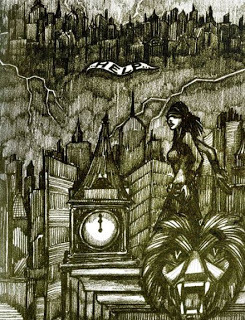 But only for a second. This is a work of graphic fiction by the hugely talented artist Appupen (the pen name of George Mathen), his second after the extraordinary
Moonward
. Like that book, Legends of Halahala is set on a planet that resembles our own in many basic ways. It employs different drawing styles to tell five stories set in separate periods, each presenting a perspective on love, obsession and its effects. There is conventional, youthful (some might say foolish and impetuous) romance, but there is also the cutesy idea of two oddball, parasite-like creatures – from the remote “Oberian” era – being each other’s forever-companions. There is a man pining for the super-heroine he encountered as a child, and another man – a swarthy, motorbike-riding daredevil – who is the rescuer of, and then the abductor of, a supermodel’s absconding left breast (!). And in the bleakest of these tales, titled “16917P’s Masterpiece”, there is the love of artistic creation as a form of self-affirmation.
But only for a second. This is a work of graphic fiction by the hugely talented artist Appupen (the pen name of George Mathen), his second after the extraordinary
Moonward
. Like that book, Legends of Halahala is set on a planet that resembles our own in many basic ways. It employs different drawing styles to tell five stories set in separate periods, each presenting a perspective on love, obsession and its effects. There is conventional, youthful (some might say foolish and impetuous) romance, but there is also the cutesy idea of two oddball, parasite-like creatures – from the remote “Oberian” era – being each other’s forever-companions. There is a man pining for the super-heroine he encountered as a child, and another man – a swarthy, motorbike-riding daredevil – who is the rescuer of, and then the abductor of, a supermodel’s absconding left breast (!). And in the bleakest of these tales, titled “16917P’s Masterpiece”, there is the love of artistic creation as a form of self-affirmation.
Most intriguingly, the book is almost completely wordless. This is not a minor achievement. Last year, the Chennai-based publishing house Blaft produced an anthology of visual storytelling titled The Obliterary Journal . The name came from the book’s tongue-in-cheek mission to “obliterate” conventional literature – and yet, most of the stories in that collection, though beautifully drawn, did use text; words and images worked in unison. And this has been true of the majority of international graphic novels too, even the ones that do spectacular things with pictorial form. Alan Moore’s Watchmen – about an alternative America where costumed “superheroes” are becoming irrelevant in the face of the world’s biggest problems – is one of the most intricate works of storytelling I have ever seen, in its use of visuals that echo each other, and an intense narrative within a narrative. But it is also a book that you read – the first time, at least – in the normal way, since the story is propelled by dialogues and by stream-of-consciousness musings from a journal maintained by one of the main characters.
 Reading a narrative made up entirely of drawings involves a different cerebral process, but within a few pages of Legends of Halahala I was hooked; so adept and fluid is Appupen’s artwork that these stories don’t need words. The few bursts of conversation there are take the form of exclamations and are depicted in a droll, almost cheesily visual way: when a king’s servant has to announce that the royal dinner is ready, the speech bubble issuing from his mouth contains a picture of a plate and cutlery; when the king and queen realise their daughter is missing and shout out her name, we only see her image in the speech balloon (we never learn what she is called); and after a dragon-like creature is sternly instructed to stop setting things ablaze with his fire-breath, we see a “no smoking” sign emanating from his head as he crawls sheepishly away. In a cheeky touch, most of the written words that adorn the book’s back-cover are fake blurbs such as “Book of the year!” by a publication called The Halahala Observer.
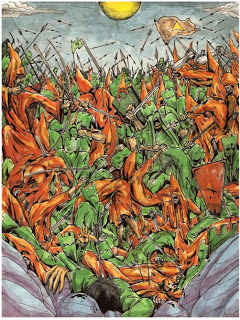
But it is the true silences that are most impressive. The first story – about star-crossed lovers whose fathers rule rival kingdoms – is the most straightforward one, linear and very easy on the eye. It is also bright and vividly coloured, which is central to its purpose: the kingdoms are represented by green and orange respectively, and this distinguishing colour scheme runs through the story, right up to a cheeky last panel where the two lovers are finally united and the picture of a heart on a flag brings the two colours together. Contrast this look with that of the next story, drawn in deliberately gloomy black and white, where a child and his parents – walking the streets of what looks like a Hollywood noir film from the 1940s – are rescued from a monster by Ghost Girl. (When we seen the grown up version of the boy years later – a depressed-looking man still haunted by the memory of his saviour – the panels acquire a neon yellow tinge.)
Just as interesting as the differences, though, are the similarities – the visual motifs that subtly connect the tales. For instance, the opening illustrations for three of the stories involve a chasm that has to be bridged: in “Stupid’s Arrow”, it is the valley that divides the kingdoms, a tenuous rope bridge stretched across it; in “The Saga of Ghost Girl”, the skyscrapers of a metropolis are drawn in a slanted way so that the gap between them becomes another sort of valley, and we see the small figure of the super-heroine swinging from one building to another. And there are many other touches that you might properly register only on a second or third read. (Isn’t the image on the opening page of the first story – the silhouette of the valley and the rocky hills – akin to the bottom half of an India map, complete with a little Sri Lanka tapering away at the bottom? And if so, could the kingdoms stand for the politics associated with the western and eastern extremes of the country? Or is this over-analysis? Decide for yourself.)
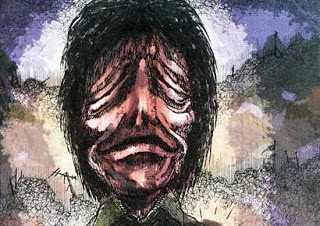 Three of the stories in Legends of Halahala end with clear heart symbols, but if you squint at the final pages of the other two you might see distorted heart shapes in them too: in the rings of cigarette smoke floating across a city’s dark skyline. Or in the broken pieces of a plaque on which a man banished from a machine-run land has inscribed “16917P was here” as he uses his art to battle oblivion - by building a monument to assert his presence in a world where he is an outcast. On the evidence of his two books so far, Appupen’s own tryst with literary fame is well underway, and happily graphic novels are not as marginalised as they once were.
[A few earlier posts on graphic novels and visual storytelling: the many faces of the Indian comics industry; Jis desh mein manga bikhti hai; the Pao Collective's anthology; Ambedkar in Gond art; the maali who weeded out myth; Kashmir Pending and The Barn Owl; on reviewing a graphic novel]
What people are willing to consider literary, or even literate, is highly variable. Often, one hears the casual remark “This mass-market/popular novel is not literature” – a statement that, apart from being inaccurate at a purely definition-based level, also suggests an elitism that runs against the long, complex history of art and popular culture. However, even the most broad-based definitions of literature are sure to contain the word “writing”. It is taken for granted that words, made up of those tiny shapes we call alphabets – so intimidating when we can’t decipher them, and so empowering when we can – are involved. And this may be why, when asked about my favourite Indian novels of the past year, I hesitate for a second before mentioning Legends of Halahala .
 But only for a second. This is a work of graphic fiction by the hugely talented artist Appupen (the pen name of George Mathen), his second after the extraordinary
Moonward
. Like that book, Legends of Halahala is set on a planet that resembles our own in many basic ways. It employs different drawing styles to tell five stories set in separate periods, each presenting a perspective on love, obsession and its effects. There is conventional, youthful (some might say foolish and impetuous) romance, but there is also the cutesy idea of two oddball, parasite-like creatures – from the remote “Oberian” era – being each other’s forever-companions. There is a man pining for the super-heroine he encountered as a child, and another man – a swarthy, motorbike-riding daredevil – who is the rescuer of, and then the abductor of, a supermodel’s absconding left breast (!). And in the bleakest of these tales, titled “16917P’s Masterpiece”, there is the love of artistic creation as a form of self-affirmation.
But only for a second. This is a work of graphic fiction by the hugely talented artist Appupen (the pen name of George Mathen), his second after the extraordinary
Moonward
. Like that book, Legends of Halahala is set on a planet that resembles our own in many basic ways. It employs different drawing styles to tell five stories set in separate periods, each presenting a perspective on love, obsession and its effects. There is conventional, youthful (some might say foolish and impetuous) romance, but there is also the cutesy idea of two oddball, parasite-like creatures – from the remote “Oberian” era – being each other’s forever-companions. There is a man pining for the super-heroine he encountered as a child, and another man – a swarthy, motorbike-riding daredevil – who is the rescuer of, and then the abductor of, a supermodel’s absconding left breast (!). And in the bleakest of these tales, titled “16917P’s Masterpiece”, there is the love of artistic creation as a form of self-affirmation.Most intriguingly, the book is almost completely wordless. This is not a minor achievement. Last year, the Chennai-based publishing house Blaft produced an anthology of visual storytelling titled The Obliterary Journal . The name came from the book’s tongue-in-cheek mission to “obliterate” conventional literature – and yet, most of the stories in that collection, though beautifully drawn, did use text; words and images worked in unison. And this has been true of the majority of international graphic novels too, even the ones that do spectacular things with pictorial form. Alan Moore’s Watchmen – about an alternative America where costumed “superheroes” are becoming irrelevant in the face of the world’s biggest problems – is one of the most intricate works of storytelling I have ever seen, in its use of visuals that echo each other, and an intense narrative within a narrative. But it is also a book that you read – the first time, at least – in the normal way, since the story is propelled by dialogues and by stream-of-consciousness musings from a journal maintained by one of the main characters.
 Reading a narrative made up entirely of drawings involves a different cerebral process, but within a few pages of Legends of Halahala I was hooked; so adept and fluid is Appupen’s artwork that these stories don’t need words. The few bursts of conversation there are take the form of exclamations and are depicted in a droll, almost cheesily visual way: when a king’s servant has to announce that the royal dinner is ready, the speech bubble issuing from his mouth contains a picture of a plate and cutlery; when the king and queen realise their daughter is missing and shout out her name, we only see her image in the speech balloon (we never learn what she is called); and after a dragon-like creature is sternly instructed to stop setting things ablaze with his fire-breath, we see a “no smoking” sign emanating from his head as he crawls sheepishly away. In a cheeky touch, most of the written words that adorn the book’s back-cover are fake blurbs such as “Book of the year!” by a publication called The Halahala Observer.
But it is the true silences that are most impressive. The first story – about star-crossed lovers whose fathers rule rival kingdoms – is the most straightforward one, linear and very easy on the eye. It is also bright and vividly coloured, which is central to its purpose: the kingdoms are represented by green and orange respectively, and this distinguishing colour scheme runs through the story, right up to a cheeky last panel where the two lovers are finally united and the picture of a heart on a flag brings the two colours together. Contrast this look with that of the next story, drawn in deliberately gloomy black and white, where a child and his parents – walking the streets of what looks like a Hollywood noir film from the 1940s – are rescued from a monster by Ghost Girl. (When we seen the grown up version of the boy years later – a depressed-looking man still haunted by the memory of his saviour – the panels acquire a neon yellow tinge.)
Just as interesting as the differences, though, are the similarities – the visual motifs that subtly connect the tales. For instance, the opening illustrations for three of the stories involve a chasm that has to be bridged: in “Stupid’s Arrow”, it is the valley that divides the kingdoms, a tenuous rope bridge stretched across it; in “The Saga of Ghost Girl”, the skyscrapers of a metropolis are drawn in a slanted way so that the gap between them becomes another sort of valley, and we see the small figure of the super-heroine swinging from one building to another. And there are many other touches that you might properly register only on a second or third read. (Isn’t the image on the opening page of the first story – the silhouette of the valley and the rocky hills – akin to the bottom half of an India map, complete with a little Sri Lanka tapering away at the bottom? And if so, could the kingdoms stand for the politics associated with the western and eastern extremes of the country? Or is this over-analysis? Decide for yourself.)
 Three of the stories in Legends of Halahala end with clear heart symbols, but if you squint at the final pages of the other two you might see distorted heart shapes in them too: in the rings of cigarette smoke floating across a city’s dark skyline. Or in the broken pieces of a plaque on which a man banished from a machine-run land has inscribed “16917P was here” as he uses his art to battle oblivion - by building a monument to assert his presence in a world where he is an outcast. On the evidence of his two books so far, Appupen’s own tryst with literary fame is well underway, and happily graphic novels are not as marginalised as they once were.
[A few earlier posts on graphic novels and visual storytelling: the many faces of the Indian comics industry; Jis desh mein manga bikhti hai; the Pao Collective's anthology; Ambedkar in Gond art; the maali who weeded out myth; Kashmir Pending and The Barn Owl; on reviewing a graphic novel]
May 4, 2013
Author, auteur, rationalist, fabulist: an essay on Satyajit Ray
[Did this profile of Satyajit Ray for the African magazine Cityscapes. Since the piece was meant for a largely non-Indian readership – including people who would know of Ray only in passing – there is necessarily some formality and simplification, including the setting down of biographical detail that is widely known in India. But I tried to avoid making it a dry, encyclopaedia-like piece and to discuss something I personally find intriguing, the divide between Ray’s “serious” work and his excursions into fantasy. As always, no attempt at being “comprehensive” here: it would be possible to write a hundred such essays about Ray without saying everything interesting there is to say about him.]
------------------
The tall man – very tall by Indian standards – is moving about a cluttered room, monitoring elements of set design while his film crew get their equipment in place. Depending on whom he talks to, he alternates between English and his mother tongue Bengali, speaking both languages with casual fluency. He asks an actor to try a rehearsal without his false moustache, jokes and banters for a few seconds, but then shifts quickly back into the meter of the sombre professional, the father figure keeping a close watch on things. He sits on the floor at an uncomfortable, slanted angle and looks through the viewfinder of the bulky camera, placing a cloth over his head to shut out peripheral light; so pronounced is the difference in height between him and his assistants, it's akin to seeing Santa surrounded by his elves, examining the underside of his sleigh.
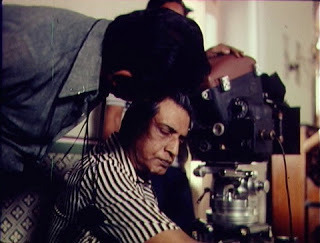 Satyajit Ray is multi-tasking in ways you would expect most directors to do during a shoot, but there is something poetically apt about this busy yet homely scene, which opens a 1985 documentary - made by Shyam Benegal - about his life and career. Ray was an auteur in the most precise sense of that versatile word. Apart from directing, he wrote most of the screenplays of his movies – some adapted from existing literary works, others from his own stories. He also composed music, drew detailed, artistic storyboards for sequences, designed costumes and promotional posters, and frequently wielded the camera. Above all, he brought his gently intelligent sensibility and a deep-rooted interest in people to nearly everything he did. He was, to take recourse to a cliché with much truth in it, a culmination of what has become known as the Bengali intellectual Renaissance.
The Indian state of West Bengal, from which Ray hailed, has long been associated with capacious scholarship and a well-rounded cultural education, with the towering figure in its modern history – certainly the one most well-known outside India – being the Nobel laureate Rabindranath Tagore, a multitalented writer, artist and song composer. As a young man in the early 1940s, Ray studied art at Shantiniketan, the pastoral university established by Tagore, but this was just one episode in his cultural flowering. He was born – in 1921 – into a family well-steeped in the intellectual life: his grandfather Upendrakishore (a contemporary and friend of Tagore) was a leading writer, printer, composer and a pioneer of modern block-making; Ray’s father Sukumar Ray was a renowned illustrator and practitioner of nonsense verse whose work has delighted generations of young Bengalis (and now, increasingly through translation, young Indians across the country).
From this fecund soil emerged a sensibility so broad that it defies categorisation. If cinema had not struck the young Satyajit’s fancy (he was an enthusiast of Hollywood movies, interested initially in the stars and later in the directors) he might have made an honourable career in many other disciplines. He worked as a visualiser in an advertising agency and as a cover designer for books before embarking on his film career; even today, people who are familiar only with one aspect of his creative life are surprised to discover his many other talents. And for this reason, a useful way of looking at Ray is through the prism of the narrow perceptions that have sometimes been used to define or pigeonhole him. These usually come from those who are only familiar with his work in fragments: viewers from outside India, as well as non-Bengali Indians who may have seen only a few of his films.
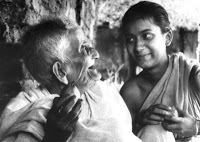 Simplistic labels have been imposed on him ever since his debut feature Pather Panchali (Song of the Little Road) came to international attention and won a prize at the 1956 Cannes festival. Based on a celebrated 19th century novel by BibhutibhushanBandopadhyaya, this subtle, deeply moving film is about a family of impoverished villagers, including a little boy named Apu, who would become the protagonist of the celebrated Apu Trilogy – travelling to Calcutta as an adolescent in Ray’s next film Aparajito (The Unvanquished) and finally coming of age in Apur Sansar (The World of Apu). Though Pather Panchali is rightly regarded a milestone in the history of Indian cinema, it was also the subject of misunderstandings among those who were not yet accustomed to dealing with directors and movies from this country. In a perceptive 1962 essay about a later Ray film
Devi
(The Goddess), the American critic Pauline Kael noted that some early Western reviewers had mistakenly believed Ray was a “primitive” artist and that Apu’s progress over the three films in some way represented the director’s own journey from rural to city life. Indeed, the critic Dwight Macdonald wrote of Apur Sansar that while Ray handled village life well enough, he was “not up to” telling the story of a young writer in a city, which is “a more complex theme” – the implication being that rural stories were somehow truer both to Ray’s own life experience and to the Indian condition in general.
Simplistic labels have been imposed on him ever since his debut feature Pather Panchali (Song of the Little Road) came to international attention and won a prize at the 1956 Cannes festival. Based on a celebrated 19th century novel by BibhutibhushanBandopadhyaya, this subtle, deeply moving film is about a family of impoverished villagers, including a little boy named Apu, who would become the protagonist of the celebrated Apu Trilogy – travelling to Calcutta as an adolescent in Ray’s next film Aparajito (The Unvanquished) and finally coming of age in Apur Sansar (The World of Apu). Though Pather Panchali is rightly regarded a milestone in the history of Indian cinema, it was also the subject of misunderstandings among those who were not yet accustomed to dealing with directors and movies from this country. In a perceptive 1962 essay about a later Ray film
Devi
(The Goddess), the American critic Pauline Kael noted that some early Western reviewers had mistakenly believed Ray was a “primitive” artist and that Apu’s progress over the three films in some way represented the director’s own journey from rural to city life. Indeed, the critic Dwight Macdonald wrote of Apur Sansar that while Ray handled village life well enough, he was “not up to” telling the story of a young writer in a city, which is “a more complex theme” – the implication being that rural stories were somehow truer both to Ray’s own life experience and to the Indian condition in general.
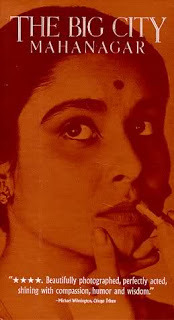 If so, this is a laughable idea. Ray was very much the product of a cosmopolitan setting and way of life: he lived in a big city, travelled abroad extensively before becoming a filmmaker, and spoke English with a clipped accent that contained traces of the British colonial influence. In choosing to film Bandopadhyaya’s novel with its village setting, he had stepped out of his personal comfort zone: the worlds he chronicled in later, urban films, such as Mahanagar (The Big City) and the Calcutta Trilogy of the 1970s were much more intimately familiar to him than the world of Apu’s penurious family was. These “city films” are diverse in their themes and subject matter, but the best of them are particularly insightful depictions of restive middle-class youngsters in a soft-socialist society increasingly besotted by the go-getting, capitalist way of life – a milieu that was conservative in some ways but forward-looking in other ways – and of how an individual might gradually get corrupted by a system.
However, there is a related point to be made here. If one is seeking a “quintessential Indian filmmaker” – meaning a director whose work represents the movie-going experience for a majority of Indians – Satyajit Ray was not that man. His films had a cool, formal polish, an organic consistency, which was far removed from the episodic structures and dramatic flourishes of commercial Indian cinema. He was influenced not by local moviemakers but by foreign directors ranging from Jean Renoir to Billy Wilder. And he had a sensibility rooted in classical Western and Bengali literature, which sometimes manifested itself in hidebound snobbery towards films that indulged “style” at the expense of “substance”, or theatrical melodrama over “realism”. In 1947, Ray and some of his friends co-founded Calcutta's first film society. “We were critical of most Indian cinema of the time,” he says in the documentary mentioned at the beginning of this piece, “We found most of our stuff shoddy, theatrical, commercial in a bad way.”
This may also be the time for a personal aside: the cinema of Ray was not the cinema of my childhood. Growing up in north India, I mainly watched the escapist entertainers of the Bombay film industry, latterly known as “Bollywood” – movies that mixed disparate tones and genres and contained narrative-disrupting song-and-dance sequences. It was only in my teens, in the early 1990s – around the time a feeble Ray, lying on his deathbed, was giving his halting acceptance speech for a Lifetime Achievement Oscar – that I entered his world. I had become interested in what we called “world cinema” – beginning with classic Hollywood, then the French, Italian and Japanese movie movements – and I saw Ray’s films as part of a tradition defined by exclusion: everything that was not mainstream Hindi cinema. I grew to love his work, but even today I feel a little lost when faced with specific Bengali references in his films; a little cut off by virtue of not understanding the language or having been born in that cultural tradition. (It doesn’t help that the subtitles on most Indian DVDs are execrable.) I also feel ambivalent about his condescension towards commercial Hindi cinema.
But given the cultural disconnect between my world and his, it is remarkable how accessible Ray’s films were in most ways that mattered. This may be because, as the critic-academic Robin Wood put it, “Ray's films usually deal with human fundamentals that undercut all cultural distinctions.” His best work hinges on instantly recognisable aspects of the human condition: from the loneliness of a bored housewife, dangerously drawn to her younger brother-in-law, in Charulata (one of Ray’s most accomplished films, based on a famous Tagore story) to four restless men making a languid, not properly thought out attempt to escape city life in Aranyer Dinratri (Days and Nights in the Forest). In his capacity to engage with the inner lives of many different types of people and to find the right expression for them, he is one of the most universally appealing of directors.
****
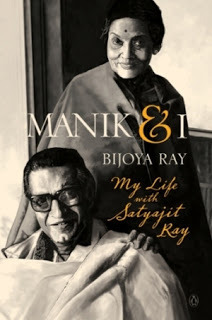 In the memoirs of Ray’s wife Bijoya – recently published in English translation as Manik & I – there is a glimpse of the director as a privileged and mollycoddled man. One anecdote has Ray being startled that Bijoya knew how to replace a fused light-bulb herself, without having to call an electrician. In the no-nonsense style of the spouse who can deconstruct the myth around a great man, she writes: “He never once touched the air conditioner in our room. If he entered the room for a rest and couldn’t see me anywhere, he’d shout out, ‘Where are you? Please switch the AC on for me.’ Such was my husband.”
Amusing and revealing though these stories are, they should also guard us against making facile connections between an artist’s work and his life; they take nothing away from Ray’s interest in people who were much less privileged, who did not share his background or personal concerns. In fact, “humanist” is a word that has often been used to describe Ray’s film work – so often that it has become a closed term, sufficient in itself. Roughly speaking, it can be taken to mean that he cared deeply about people and their circumstances, and that he chose empathy over judgement (his best films lack villain figures who can serve as easy explanations for why bad things happen). But I would argue that to properly understand this quality, one must recognise how complex and apparently contradictory he could be as an artist.
Consider, for instance, that the man who could be narrow-minded about genre films (in a book review, he airily dismissed Francois Truffaut’s efforts to present Alfred Hitchcock as a serious artist) was the same man who admitted in an essay that if he could take only one film to a desert island, it would be a Marx Brothers movie. The filmmaker known for his literariness and economy of expression also displayed a light, absurdist sense of humour and wrote many delightful stories in such commercially popular genres as science-fiction, detective fiction and horror.
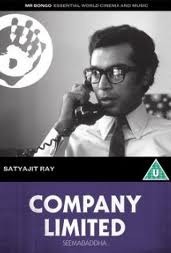 Many of the perceptions of Ray swim around a basic idea: Satyajit Ray was a “serious” filmmaker. Now this statement is not in doubt if the word is used in its broad sense, to describe any rigorous artist who has achieved at a high level. But in a developing country like India, where cinema is often seen as having an overt social responsibility, very sharp lines tend to get drawn between “escapist” and “meaningful” films, and the word “serious” is sometimes used as an approving synonym for pedantry, humourlessness, absence of personal style or lack of interest in things that are not self-evidently a part of the “real” world. However, none of these qualities apply to Ray. There was nothing pedantic about his major work. His narratives are so fluid, it is possible to get so absorbed in his people’s lives, that one is scarcely conscious of watching an “art” film. And the identifiably weaker moments in his oeuvre are the laboured or self-conscious ones. For most of its running time, his 1971 film Seemabaddha (Company Limited) is an absorbing narrative about an upwardly mobile executive slowly being drawn into compromise and amorality. But the very last shot – where a key character literally vanishes into thin air, thereby identifying her as a symbol for the protagonist’s conscience – is one of the notable missteps in Ray’s career, a classic example of a filmmaker spoon-feeding an idea to his audience at the last moment, rather than letting the accumulation of events in the film speak for themselves (as they have been doing).
An offshoot of the “serious” tag is the idea that Ray was concerned only with content, not with form. But watch the films themselves and this notion quickly dissolves. Even Pather Panchali, his sparsest film on the surface – made when he was a young director with an inexperienced crew, learning on the job – is anything but a bland documentary account of life in an Indian village. It is full of beautifully realised, carefully composed sequences (many of which derive directly from Ray’s delicate storyboard drawings) and thoughtful use of sound and music.
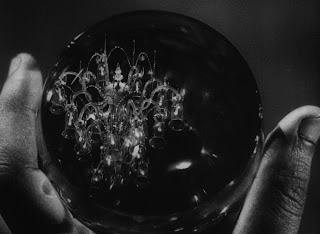 There is clearer evidence of Ray the stylist in such films as his 1958 classic Jalsaghar (The Music Room), about a once-rich landlord now become a relic of a forgotten world. It is obvious right from the opening shot that Ray intended this to be a film of visual flourishes. (In an essay in his book Our Films, Their Films, he admitted that having won an award at Cannes shortly before making Jalsaghar, he had become a little self-conscious and allowed himself the indulgence of a crane for overhead shots.) There are carefully composed shots which draw attention to themselves – a chandelier reflected in a drinking glass, an unsettling zoom in to a spider scuttling across a portrait, a view of a stormy sky seen through the windows of the music room – as well as sequences that stress the contrast between the zamindar’s past glory and the delusions that now crowd his mind. One constantly gets the impression of a director trying to use the camera in inventive ways, as one does in other movies such as the 1966 Nayak (The Actor), with its stylistic nods to scenes from Federico Fellini’s Eight and a Half, Akira Kurosawa’s Yojimbo and other international films, and the 1970 Pratidwandi (The Adversary), which makes effective, ghostly use of negative film at key moments.
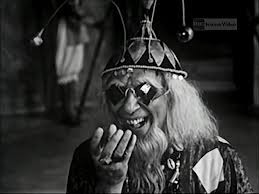 But for the most pronounced sense of Ray’s creative flair and versatility, one should consider a film that has long been among his most beloved and well-known works in Bengal, and at the same time among his most neglected, least-seen films outside India: the 1968 adventure classic Goopy Gyne Bagha Byne (The Adventures of Goopy and Bagha). Based on a story by Ray’s grandfather Upendrakishore about two lovable adventurer-musicians who foil a wicked magician’s plans in the fictitious land of Shundi, this film (along with its 1980 sequel Hirak Rajar Deshe) is an important pointer to Ray’s strong fabulist streak, and a conundrum for those who would construct pat narratives about him being the solemn antidote to Bollywood escapism – as a man who only told stark, grounded stories about the “real India”.
To watch Goopy Gyne Bagha Byne is to marvel at how playful Ray could be. One of his grandest achievements as a filmmaker was this film’s mesmerising, six-minute-long ghost dance, featuring four varieties of ghosts representing archetypes from India’s colonial past – a scene that is immediately followed by a darkly poetic sequence where the King of Ghosts (speaking in rhyme, and in Ray’s own synthesiser-distorted voice) grants the two heroes a series of boons. However, this wonderful adventure story also has a strong undercurrent of pacifism, which finds expression in an uplifting climactic scene where hungry soldiers lay down their weapons and make a beeline for pots of sweets that Goopy and Bagha have conjured for them. The anti-war theme isn't underlined, but it is there for anyone to see.
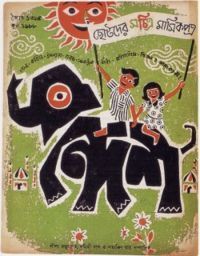 The fantasy genre allowed him to display his warmth in its rawest, least guarded form, and this gentle, unselfconscious erudition is on view throughout his writings too. He wrote dozens of short stories for younger readers, most of them initially published in the popular children’s magazine
Sandesh
(founded by his grandfather in 1913, revived by Ray himself in the early 1960s) – but many non-Bengalis I know have experienced them for the first time as adults, and attest that their sharp characterisations, expert pacing, and eye for detail make nonsense of the idea that they are meant only for children. These stories often broaden the reader’s horizons, supplying a wealth of information about places and histories; but they invariably do this by embedding the information in the fabric of a well-paced narrative rather than presenting it in a professorial manner.
The fantasy genre allowed him to display his warmth in its rawest, least guarded form, and this gentle, unselfconscious erudition is on view throughout his writings too. He wrote dozens of short stories for younger readers, most of them initially published in the popular children’s magazine
Sandesh
(founded by his grandfather in 1913, revived by Ray himself in the early 1960s) – but many non-Bengalis I know have experienced them for the first time as adults, and attest that their sharp characterisations, expert pacing, and eye for detail make nonsense of the idea that they are meant only for children. These stories often broaden the reader’s horizons, supplying a wealth of information about places and histories; but they invariably do this by embedding the information in the fabric of a well-paced narrative rather than presenting it in a professorial manner.
Along with tales about ghosts and monsters, there are some subtle but moving stories about people caught in a life-altering moment. In one of my favourite stories “The Class Friend”, a well-to-do middle-aged man, Mohit Sarkar, is unexpectedly visited by a former school friend named Joy, whom he has not seen in 30 years. Joy has had a hard life and has aged beyond recognition, though the anecdotes he relates seem to confirm his identity. However, when it becomes clear that he has come seeking financial assistance, the preoccupied and wary Mohit manages to rationalise that the man before him is an imposter; or even if it really is his old friend, the gap between them is now so great that he wants nothing to do with him.
 By this time, the reader – accustomed to little subterfuges in Ray’s stories – doesn’t quite know what to expect, but the tale ends with an understated variation of the more pronounced twists in Ray’s supernatural work: after being rebuffed once, Joy sends his 14-year-old son to Mohit’s house to collect the money; Mohit looks at the boy and at last recognises the face of the friend he had known in a much more innocent time. This personal epiphany closes an ostensibly “simple” story that is really quite complex and mature in its cognisance of the self-deception of human beings and the cleansing power of memory. Importantly, it conveys all this with characteristic lightness of touch.
It is also, in a strange and moving way, a story about the importance of maintaining faith – which is perhaps a peculiar observation to make about a man who was himself a firm rationalist. One of Ray’s greatest films – the 1960 Devi, about a childlike old man who believes his daughter-in-law is an incarnation of a goddess – is as sharp an attack on the perniciousness of organised religion and the follies of those who unquestioningly fall under its sway as any Indian filmmaker has ever dared to make. In a fiery tribute to Ray shortly after his death in 1992, the actor-playwright Utpal Dutt held this film up as a shining rebuke to the maudlin religious movies and TV serials regularly made in India. And by all accounts, Ray lived his life by the precepts of the questioning spirit. But he also recognised the human need – especially the child’s need – for the regenerating power of fantasy and imagination. He was sceptical of charlatans posing as mystics, feeding off the vulnerabilities of insecure people – a common phenomenon in India – but he was also open to the idea that there are things that lie beyond our understanding, things that current science has not yet been able to reveal.
Hence the paranormal elements in his stories – as in “Two Magicians” which is, among other things, an elegy for an old-world mysticism buried by the trickery of modern-day conjurors. In another story “The Maths Teacher, Mr Pink and Tipu”, one might expect Ray to be on the side of a mathematics teacher who forbids a child from reading fairy-tales “that sow the seeds of superstition in a young mind”. But the teacher, for the purposes of the story, is an antagonist: our sympathies are with the little boy, Tipu, who is being denied the opportunity to immerse himself in the magical (in more than one sense) world of storytelling. And eventually it is a brush with the supernatural that brings the story the resolution we are hoping for.
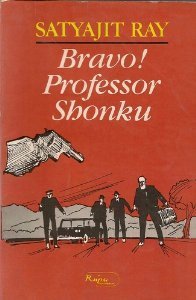 It would be easy to overlook these works, or to clearly demarcate them from the rest of Ray’s achievements, as if they constituted his own brand of self-indulgent escapism that did not belong in the same moral universe as his more grounded work. But I think that would be a mistake. To appreciate the wholeness of his vision, one should look at each film and story as a vital part of an organic career, rather than resort to distinctions such as “for mature viewers” and “for children”. The wide-eyed sense of wonder, the surrealism and nonsense verse of Goopy Gyne, are as much a part of his legacy – and his artistic sensibility– as the clear-sighted rationalism of Devi, or the starkness of the Apu Trilogy, are. The apparent paradoxes in his work are not paradoxes at all but indicative of a well-rounded, inclusive understanding of the frailties, needs and potentials of human beings – and ultimately, perhaps, this is what “humanist” really means.
[Some earlier posts on Ray and his work: an essay on Nemai Ghosh's photos of Ray; Goopy and Bagha; the restored Jalsaghar; Beyond the World of Apu; Devi; Professor Shonku]
------------------
The tall man – very tall by Indian standards – is moving about a cluttered room, monitoring elements of set design while his film crew get their equipment in place. Depending on whom he talks to, he alternates between English and his mother tongue Bengali, speaking both languages with casual fluency. He asks an actor to try a rehearsal without his false moustache, jokes and banters for a few seconds, but then shifts quickly back into the meter of the sombre professional, the father figure keeping a close watch on things. He sits on the floor at an uncomfortable, slanted angle and looks through the viewfinder of the bulky camera, placing a cloth over his head to shut out peripheral light; so pronounced is the difference in height between him and his assistants, it's akin to seeing Santa surrounded by his elves, examining the underside of his sleigh.
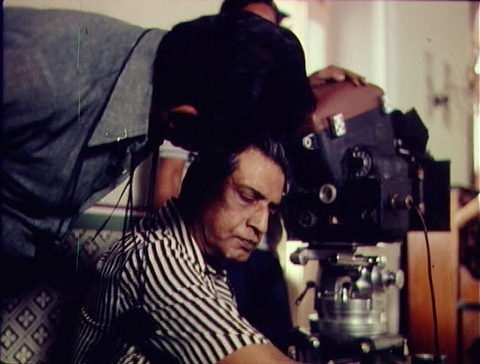 Satyajit Ray is multi-tasking in ways you would expect most directors to do during a shoot, but there is something poetically apt about this busy yet homely scene, which opens a 1985 documentary - made by Shyam Benegal - about his life and career. Ray was an auteur in the most precise sense of that versatile word. Apart from directing, he wrote most of the screenplays of his movies – some adapted from existing literary works, others from his own stories. He also composed music, drew detailed, artistic storyboards for sequences, designed costumes and promotional posters, and frequently wielded the camera. Above all, he brought his gently intelligent sensibility and a deep-rooted interest in people to nearly everything he did. He was, to take recourse to a cliché with much truth in it, a culmination of what has become known as the Bengali intellectual Renaissance.
The Indian state of West Bengal, from which Ray hailed, has long been associated with capacious scholarship and a well-rounded cultural education, with the towering figure in its modern history – certainly the one most well-known outside India – being the Nobel laureate Rabindranath Tagore, a multitalented writer, artist and song composer. As a young man in the early 1940s, Ray studied art at Shantiniketan, the pastoral university established by Tagore, but this was just one episode in his cultural flowering. He was born – in 1921 – into a family well-steeped in the intellectual life: his grandfather Upendrakishore (a contemporary and friend of Tagore) was a leading writer, printer, composer and a pioneer of modern block-making; Ray’s father Sukumar Ray was a renowned illustrator and practitioner of nonsense verse whose work has delighted generations of young Bengalis (and now, increasingly through translation, young Indians across the country).
From this fecund soil emerged a sensibility so broad that it defies categorisation. If cinema had not struck the young Satyajit’s fancy (he was an enthusiast of Hollywood movies, interested initially in the stars and later in the directors) he might have made an honourable career in many other disciplines. He worked as a visualiser in an advertising agency and as a cover designer for books before embarking on his film career; even today, people who are familiar only with one aspect of his creative life are surprised to discover his many other talents. And for this reason, a useful way of looking at Ray is through the prism of the narrow perceptions that have sometimes been used to define or pigeonhole him. These usually come from those who are only familiar with his work in fragments: viewers from outside India, as well as non-Bengali Indians who may have seen only a few of his films.
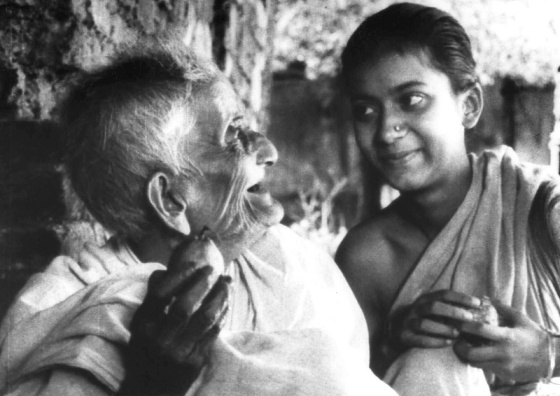 Simplistic labels have been imposed on him ever since his debut feature Pather Panchali (Song of the Little Road) came to international attention and won a prize at the 1956 Cannes festival. Based on a celebrated 19th century novel by BibhutibhushanBandopadhyaya, this subtle, deeply moving film is about a family of impoverished villagers, including a little boy named Apu, who would become the protagonist of the celebrated Apu Trilogy – travelling to Calcutta as an adolescent in Ray’s next film Aparajito (The Unvanquished) and finally coming of age in Apur Sansar (The World of Apu). Though Pather Panchali is rightly regarded a milestone in the history of Indian cinema, it was also the subject of misunderstandings among those who were not yet accustomed to dealing with directors and movies from this country. In a perceptive 1962 essay about a later Ray film
Devi
(The Goddess), the American critic Pauline Kael noted that some early Western reviewers had mistakenly believed Ray was a “primitive” artist and that Apu’s progress over the three films in some way represented the director’s own journey from rural to city life. Indeed, the critic Dwight Macdonald wrote of Apur Sansar that while Ray handled village life well enough, he was “not up to” telling the story of a young writer in a city, which is “a more complex theme” – the implication being that rural stories were somehow truer both to Ray’s own life experience and to the Indian condition in general.
Simplistic labels have been imposed on him ever since his debut feature Pather Panchali (Song of the Little Road) came to international attention and won a prize at the 1956 Cannes festival. Based on a celebrated 19th century novel by BibhutibhushanBandopadhyaya, this subtle, deeply moving film is about a family of impoverished villagers, including a little boy named Apu, who would become the protagonist of the celebrated Apu Trilogy – travelling to Calcutta as an adolescent in Ray’s next film Aparajito (The Unvanquished) and finally coming of age in Apur Sansar (The World of Apu). Though Pather Panchali is rightly regarded a milestone in the history of Indian cinema, it was also the subject of misunderstandings among those who were not yet accustomed to dealing with directors and movies from this country. In a perceptive 1962 essay about a later Ray film
Devi
(The Goddess), the American critic Pauline Kael noted that some early Western reviewers had mistakenly believed Ray was a “primitive” artist and that Apu’s progress over the three films in some way represented the director’s own journey from rural to city life. Indeed, the critic Dwight Macdonald wrote of Apur Sansar that while Ray handled village life well enough, he was “not up to” telling the story of a young writer in a city, which is “a more complex theme” – the implication being that rural stories were somehow truer both to Ray’s own life experience and to the Indian condition in general. If so, this is a laughable idea. Ray was very much the product of a cosmopolitan setting and way of life: he lived in a big city, travelled abroad extensively before becoming a filmmaker, and spoke English with a clipped accent that contained traces of the British colonial influence. In choosing to film Bandopadhyaya’s novel with its village setting, he had stepped out of his personal comfort zone: the worlds he chronicled in later, urban films, such as Mahanagar (The Big City) and the Calcutta Trilogy of the 1970s were much more intimately familiar to him than the world of Apu’s penurious family was. These “city films” are diverse in their themes and subject matter, but the best of them are particularly insightful depictions of restive middle-class youngsters in a soft-socialist society increasingly besotted by the go-getting, capitalist way of life – a milieu that was conservative in some ways but forward-looking in other ways – and of how an individual might gradually get corrupted by a system.
However, there is a related point to be made here. If one is seeking a “quintessential Indian filmmaker” – meaning a director whose work represents the movie-going experience for a majority of Indians – Satyajit Ray was not that man. His films had a cool, formal polish, an organic consistency, which was far removed from the episodic structures and dramatic flourishes of commercial Indian cinema. He was influenced not by local moviemakers but by foreign directors ranging from Jean Renoir to Billy Wilder. And he had a sensibility rooted in classical Western and Bengali literature, which sometimes manifested itself in hidebound snobbery towards films that indulged “style” at the expense of “substance”, or theatrical melodrama over “realism”. In 1947, Ray and some of his friends co-founded Calcutta's first film society. “We were critical of most Indian cinema of the time,” he says in the documentary mentioned at the beginning of this piece, “We found most of our stuff shoddy, theatrical, commercial in a bad way.”
This may also be the time for a personal aside: the cinema of Ray was not the cinema of my childhood. Growing up in north India, I mainly watched the escapist entertainers of the Bombay film industry, latterly known as “Bollywood” – movies that mixed disparate tones and genres and contained narrative-disrupting song-and-dance sequences. It was only in my teens, in the early 1990s – around the time a feeble Ray, lying on his deathbed, was giving his halting acceptance speech for a Lifetime Achievement Oscar – that I entered his world. I had become interested in what we called “world cinema” – beginning with classic Hollywood, then the French, Italian and Japanese movie movements – and I saw Ray’s films as part of a tradition defined by exclusion: everything that was not mainstream Hindi cinema. I grew to love his work, but even today I feel a little lost when faced with specific Bengali references in his films; a little cut off by virtue of not understanding the language or having been born in that cultural tradition. (It doesn’t help that the subtitles on most Indian DVDs are execrable.) I also feel ambivalent about his condescension towards commercial Hindi cinema.
But given the cultural disconnect between my world and his, it is remarkable how accessible Ray’s films were in most ways that mattered. This may be because, as the critic-academic Robin Wood put it, “Ray's films usually deal with human fundamentals that undercut all cultural distinctions.” His best work hinges on instantly recognisable aspects of the human condition: from the loneliness of a bored housewife, dangerously drawn to her younger brother-in-law, in Charulata (one of Ray’s most accomplished films, based on a famous Tagore story) to four restless men making a languid, not properly thought out attempt to escape city life in Aranyer Dinratri (Days and Nights in the Forest). In his capacity to engage with the inner lives of many different types of people and to find the right expression for them, he is one of the most universally appealing of directors.
****
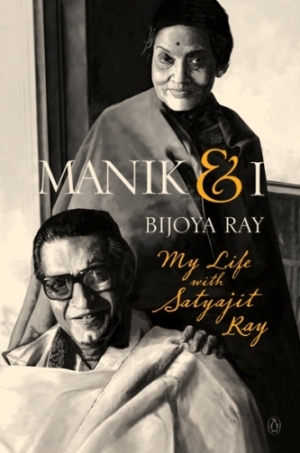 In the memoirs of Ray’s wife Bijoya – recently published in English translation as Manik & I – there is a glimpse of the director as a privileged and mollycoddled man. One anecdote has Ray being startled that Bijoya knew how to replace a fused light-bulb herself, without having to call an electrician. In the no-nonsense style of the spouse who can deconstruct the myth around a great man, she writes: “He never once touched the air conditioner in our room. If he entered the room for a rest and couldn’t see me anywhere, he’d shout out, ‘Where are you? Please switch the AC on for me.’ Such was my husband.”
Amusing and revealing though these stories are, they should also guard us against making facile connections between an artist’s work and his life; they take nothing away from Ray’s interest in people who were much less privileged, who did not share his background or personal concerns. In fact, “humanist” is a word that has often been used to describe Ray’s film work – so often that it has become a closed term, sufficient in itself. Roughly speaking, it can be taken to mean that he cared deeply about people and their circumstances, and that he chose empathy over judgement (his best films lack villain figures who can serve as easy explanations for why bad things happen). But I would argue that to properly understand this quality, one must recognise how complex and apparently contradictory he could be as an artist.
Consider, for instance, that the man who could be narrow-minded about genre films (in a book review, he airily dismissed Francois Truffaut’s efforts to present Alfred Hitchcock as a serious artist) was the same man who admitted in an essay that if he could take only one film to a desert island, it would be a Marx Brothers movie. The filmmaker known for his literariness and economy of expression also displayed a light, absurdist sense of humour and wrote many delightful stories in such commercially popular genres as science-fiction, detective fiction and horror.
 Many of the perceptions of Ray swim around a basic idea: Satyajit Ray was a “serious” filmmaker. Now this statement is not in doubt if the word is used in its broad sense, to describe any rigorous artist who has achieved at a high level. But in a developing country like India, where cinema is often seen as having an overt social responsibility, very sharp lines tend to get drawn between “escapist” and “meaningful” films, and the word “serious” is sometimes used as an approving synonym for pedantry, humourlessness, absence of personal style or lack of interest in things that are not self-evidently a part of the “real” world. However, none of these qualities apply to Ray. There was nothing pedantic about his major work. His narratives are so fluid, it is possible to get so absorbed in his people’s lives, that one is scarcely conscious of watching an “art” film. And the identifiably weaker moments in his oeuvre are the laboured or self-conscious ones. For most of its running time, his 1971 film Seemabaddha (Company Limited) is an absorbing narrative about an upwardly mobile executive slowly being drawn into compromise and amorality. But the very last shot – where a key character literally vanishes into thin air, thereby identifying her as a symbol for the protagonist’s conscience – is one of the notable missteps in Ray’s career, a classic example of a filmmaker spoon-feeding an idea to his audience at the last moment, rather than letting the accumulation of events in the film speak for themselves (as they have been doing).
An offshoot of the “serious” tag is the idea that Ray was concerned only with content, not with form. But watch the films themselves and this notion quickly dissolves. Even Pather Panchali, his sparsest film on the surface – made when he was a young director with an inexperienced crew, learning on the job – is anything but a bland documentary account of life in an Indian village. It is full of beautifully realised, carefully composed sequences (many of which derive directly from Ray’s delicate storyboard drawings) and thoughtful use of sound and music.
 There is clearer evidence of Ray the stylist in such films as his 1958 classic Jalsaghar (The Music Room), about a once-rich landlord now become a relic of a forgotten world. It is obvious right from the opening shot that Ray intended this to be a film of visual flourishes. (In an essay in his book Our Films, Their Films, he admitted that having won an award at Cannes shortly before making Jalsaghar, he had become a little self-conscious and allowed himself the indulgence of a crane for overhead shots.) There are carefully composed shots which draw attention to themselves – a chandelier reflected in a drinking glass, an unsettling zoom in to a spider scuttling across a portrait, a view of a stormy sky seen through the windows of the music room – as well as sequences that stress the contrast between the zamindar’s past glory and the delusions that now crowd his mind. One constantly gets the impression of a director trying to use the camera in inventive ways, as one does in other movies such as the 1966 Nayak (The Actor), with its stylistic nods to scenes from Federico Fellini’s Eight and a Half, Akira Kurosawa’s Yojimbo and other international films, and the 1970 Pratidwandi (The Adversary), which makes effective, ghostly use of negative film at key moments.
 But for the most pronounced sense of Ray’s creative flair and versatility, one should consider a film that has long been among his most beloved and well-known works in Bengal, and at the same time among his most neglected, least-seen films outside India: the 1968 adventure classic Goopy Gyne Bagha Byne (The Adventures of Goopy and Bagha). Based on a story by Ray’s grandfather Upendrakishore about two lovable adventurer-musicians who foil a wicked magician’s plans in the fictitious land of Shundi, this film (along with its 1980 sequel Hirak Rajar Deshe) is an important pointer to Ray’s strong fabulist streak, and a conundrum for those who would construct pat narratives about him being the solemn antidote to Bollywood escapism – as a man who only told stark, grounded stories about the “real India”.
To watch Goopy Gyne Bagha Byne is to marvel at how playful Ray could be. One of his grandest achievements as a filmmaker was this film’s mesmerising, six-minute-long ghost dance, featuring four varieties of ghosts representing archetypes from India’s colonial past – a scene that is immediately followed by a darkly poetic sequence where the King of Ghosts (speaking in rhyme, and in Ray’s own synthesiser-distorted voice) grants the two heroes a series of boons. However, this wonderful adventure story also has a strong undercurrent of pacifism, which finds expression in an uplifting climactic scene where hungry soldiers lay down their weapons and make a beeline for pots of sweets that Goopy and Bagha have conjured for them. The anti-war theme isn't underlined, but it is there for anyone to see.
 The fantasy genre allowed him to display his warmth in its rawest, least guarded form, and this gentle, unselfconscious erudition is on view throughout his writings too. He wrote dozens of short stories for younger readers, most of them initially published in the popular children’s magazine
Sandesh
(founded by his grandfather in 1913, revived by Ray himself in the early 1960s) – but many non-Bengalis I know have experienced them for the first time as adults, and attest that their sharp characterisations, expert pacing, and eye for detail make nonsense of the idea that they are meant only for children. These stories often broaden the reader’s horizons, supplying a wealth of information about places and histories; but they invariably do this by embedding the information in the fabric of a well-paced narrative rather than presenting it in a professorial manner.
The fantasy genre allowed him to display his warmth in its rawest, least guarded form, and this gentle, unselfconscious erudition is on view throughout his writings too. He wrote dozens of short stories for younger readers, most of them initially published in the popular children’s magazine
Sandesh
(founded by his grandfather in 1913, revived by Ray himself in the early 1960s) – but many non-Bengalis I know have experienced them for the first time as adults, and attest that their sharp characterisations, expert pacing, and eye for detail make nonsense of the idea that they are meant only for children. These stories often broaden the reader’s horizons, supplying a wealth of information about places and histories; but they invariably do this by embedding the information in the fabric of a well-paced narrative rather than presenting it in a professorial manner.Along with tales about ghosts and monsters, there are some subtle but moving stories about people caught in a life-altering moment. In one of my favourite stories “The Class Friend”, a well-to-do middle-aged man, Mohit Sarkar, is unexpectedly visited by a former school friend named Joy, whom he has not seen in 30 years. Joy has had a hard life and has aged beyond recognition, though the anecdotes he relates seem to confirm his identity. However, when it becomes clear that he has come seeking financial assistance, the preoccupied and wary Mohit manages to rationalise that the man before him is an imposter; or even if it really is his old friend, the gap between them is now so great that he wants nothing to do with him.
 By this time, the reader – accustomed to little subterfuges in Ray’s stories – doesn’t quite know what to expect, but the tale ends with an understated variation of the more pronounced twists in Ray’s supernatural work: after being rebuffed once, Joy sends his 14-year-old son to Mohit’s house to collect the money; Mohit looks at the boy and at last recognises the face of the friend he had known in a much more innocent time. This personal epiphany closes an ostensibly “simple” story that is really quite complex and mature in its cognisance of the self-deception of human beings and the cleansing power of memory. Importantly, it conveys all this with characteristic lightness of touch.
It is also, in a strange and moving way, a story about the importance of maintaining faith – which is perhaps a peculiar observation to make about a man who was himself a firm rationalist. One of Ray’s greatest films – the 1960 Devi, about a childlike old man who believes his daughter-in-law is an incarnation of a goddess – is as sharp an attack on the perniciousness of organised religion and the follies of those who unquestioningly fall under its sway as any Indian filmmaker has ever dared to make. In a fiery tribute to Ray shortly after his death in 1992, the actor-playwright Utpal Dutt held this film up as a shining rebuke to the maudlin religious movies and TV serials regularly made in India. And by all accounts, Ray lived his life by the precepts of the questioning spirit. But he also recognised the human need – especially the child’s need – for the regenerating power of fantasy and imagination. He was sceptical of charlatans posing as mystics, feeding off the vulnerabilities of insecure people – a common phenomenon in India – but he was also open to the idea that there are things that lie beyond our understanding, things that current science has not yet been able to reveal.
Hence the paranormal elements in his stories – as in “Two Magicians” which is, among other things, an elegy for an old-world mysticism buried by the trickery of modern-day conjurors. In another story “The Maths Teacher, Mr Pink and Tipu”, one might expect Ray to be on the side of a mathematics teacher who forbids a child from reading fairy-tales “that sow the seeds of superstition in a young mind”. But the teacher, for the purposes of the story, is an antagonist: our sympathies are with the little boy, Tipu, who is being denied the opportunity to immerse himself in the magical (in more than one sense) world of storytelling. And eventually it is a brush with the supernatural that brings the story the resolution we are hoping for.
 It would be easy to overlook these works, or to clearly demarcate them from the rest of Ray’s achievements, as if they constituted his own brand of self-indulgent escapism that did not belong in the same moral universe as his more grounded work. But I think that would be a mistake. To appreciate the wholeness of his vision, one should look at each film and story as a vital part of an organic career, rather than resort to distinctions such as “for mature viewers” and “for children”. The wide-eyed sense of wonder, the surrealism and nonsense verse of Goopy Gyne, are as much a part of his legacy – and his artistic sensibility– as the clear-sighted rationalism of Devi, or the starkness of the Apu Trilogy, are. The apparent paradoxes in his work are not paradoxes at all but indicative of a well-rounded, inclusive understanding of the frailties, needs and potentials of human beings – and ultimately, perhaps, this is what “humanist” really means.
[Some earlier posts on Ray and his work: an essay on Nemai Ghosh's photos of Ray; Goopy and Bagha; the restored Jalsaghar; Beyond the World of Apu; Devi; Professor Shonku]
May 2, 2013
A cinematic time machine - notes from the centenary film festival
[Did a version of this for my DNA column]
“These films were made during the relatively short period in cinema history when the only way to see a motion picture was to gather in groups in a darkened theatre,” writes George Stevens Jr in the anthology Conversations with the Great Moviemakers of Hollywood’s Golden Age . The words (and the book itself) are an ode to a time when film-watching was not yet possible in the privacy of one’s home, and I thought about them a few months ago, while watching Billy Wilder’s classic The Apartment in a mini-theatre; it was a reminder that despite my love of old Hollywood, I have seen very few of those films in conditions approximating a traditional theatre setting. And as a professional writer, one can feel like a bit of a fake pontificating about such movies despite being so removed in space and time from the way in which they were first seen (and intended to be seen).
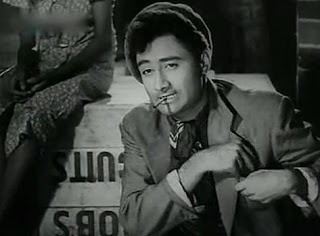 I thought of Stevens’ words again at the Centenary Film Festival in Delhi last week, where I saw movies like the Navketan classic
Baazi
and Bimal Roy’s iconic
Madhumati
in a large hall in the Siri Fort Auditorium. Though the screen wasn’t covered end to end (most of the films I saw took up barely half the total screening space) and the prints weren't consistently good, it was still an experience to be valued. Early in Baazi, there is a terrific, symbolism-laden scene where the small-time gambler Madan (Dev Anand) is taken to a swish club and led ever deeper into a den of urban vice; as one door after another opens to admit him, new secrets come into view. I could relate to Madan’s wide-eyed expression: watching these films in this environment, I felt like I was walking through a time portal into a new and exotic place.
I thought of Stevens’ words again at the Centenary Film Festival in Delhi last week, where I saw movies like the Navketan classic
Baazi
and Bimal Roy’s iconic
Madhumati
in a large hall in the Siri Fort Auditorium. Though the screen wasn’t covered end to end (most of the films I saw took up barely half the total screening space) and the prints weren't consistently good, it was still an experience to be valued. Early in Baazi, there is a terrific, symbolism-laden scene where the small-time gambler Madan (Dev Anand) is taken to a swish club and led ever deeper into a den of urban vice; as one door after another opens to admit him, new secrets come into view. I could relate to Madan’s wide-eyed expression: watching these films in this environment, I felt like I was walking through a time portal into a new and exotic place.
It was a place where you could see stars like Dilip Kumar rendered youthful again, on a big screen in a darkened hall, and imagine that this was how the original audiences saw them. You could gape at an opening-credits list that read like a roll-call of legends. (From Baazi: Guru Dutt, Balraj Sahni as writer, S D Burman and Sahir Ludhianvi, Zohra Sehgal in charge of “Dances”, and as assistants in small font size, V K Murthy, who would become one of our finest cinematographers, and Raj Khosla. From Madhumati: Bimal Roy, Ritwik Ghatak as screenplay-writer, Rajinder Singh Bedi, Salil Choudhury, Hrishikesh Mukherjee as editor.) Watching with the benefit of hindsight, you could engage in speculation too. To see an early, vulnerable Dev Anand – before his trademark mannerisms had been honed, and long before he went down the thorny road of self-parody – is to wonder: what if the audience hadn’t connected with this young man’s personality? What if Baazi had been a flop, Navketan had never got off the ground and Guru Dutt’s directorial career had been shelved? What would the history of Hindi film have looked like then? In a dark hall, these questions have a special immediacy.
To clarify, I’m not romanticising the theatre experience for the sake of it. Personally I like watching films on my own time and in my own space, many of my most cherished viewing experiences have been sans company, and there is a wider case to be made for the virtues of non-communal movie-watching. (In the US in the 1950s, home viewing begat a generation of movie students-turned-filmmakers who could appreciate personal, individualistic films without being distracted by other, possibly unresponsive viewers.) Nor was the Centenary Festival shorn of irritants. People walked in and out of auditoria, talking loudly, leaving doors open with light and sound flooding in. The emceeing before some screenings was over-earnest, there were prolonged and self-aggrandising speeches that sometimes led to delays.
And yet there was something special in the air. I felt it when a large section of the audience cheered loudly at the first appearance of the young Dev in his cap, scarf and old jacket – made up to look like a scruffy street vagabond but still an undeniable “star” presence – and when Rajesh Khanna burst through the door of the doctor’s clinic in Anand. Or when rows of viewers whistled at Johnny Walker’s drunken act atop a tree in Madhumati. Or when the man sitting in front of me began humming the opening notes of “Suhana Safar” in anticipation, during the montage of nature shots preceding the song.
 Even watching the Fearless Nadia-starrer Diamond Queen – in a poor and poorly projected print – brought its own frisson. I overheard conversations between old people who had a dim memory of what Homi Wadia films were like (“lots of stunts”) but seemed to have forgotten about their remarkable blonde action heroine (playing a liberated “city-returned girl” who would have greatly intimidated Baazi’s Madan). A gentleman behind me, apparently knowledgeable, said a confident “Yes yes, Fearless Nanda” while reading out the opening credits for the edification of his companions.
There are other facets to watching old movies in this way. Performances which seem over-declamatory on TV can sometimes work better in a hall, because you feel like the actor is directing his gestures at a theatre full of people. It is closer to the experience of the stage, and one isn’t preoccupied with “naturalism” because this isn’t a mundane setting like your living room – it’s a special space that you have paid to be admitted into, where you perform the unnatural ritual of sitting quietly in the dark, like an audience at a magic performance, while pictures flash before your eyes at 24 frames a second. “Originally, the idea was to take yourself out of normal time to see a film,” the director Shyam Benegal told me during a recent conversation, “But when you watch a film on TV, you can be doing other things – chatting, eating, answering the door; you aren’t out of normal time.”
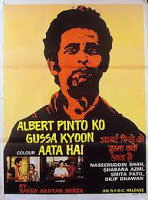 These screenings mostly took me out of “normal time”, but there were some unseemly ruptures in the fourth wall too. During a screening of Saeed Mirza’s
Albert Pinto ko Gussa Kyon Aata Hai
, the sound vanished for a few minutes until someone yelled in the general direction of the projection room. Shortly afterwards, the framing went awry, and finally there was an alarming moment when the film seemed to dissolve and burn in front of our eyes mid-scene. (The effect was akin to what Ingmar Bergman did in Persona, deliberately fraying the reel to interrupt the film’s narrative. But formally inventive as Mirza's film is in its own ways, that definitely wasn't what was going on here.)
These screenings mostly took me out of “normal time”, but there were some unseemly ruptures in the fourth wall too. During a screening of Saeed Mirza’s
Albert Pinto ko Gussa Kyon Aata Hai
, the sound vanished for a few minutes until someone yelled in the general direction of the projection room. Shortly afterwards, the framing went awry, and finally there was an alarming moment when the film seemed to dissolve and burn in front of our eyes mid-scene. (The effect was akin to what Ingmar Bergman did in Persona, deliberately fraying the reel to interrupt the film’s narrative. But formally inventive as Mirza's film is in its own ways, that definitely wasn't what was going on here.)
For a tense five minutes, some of us wondered if we had been unwilling witnesses to a crime against art – the grisly destruction of an important print – but the film resumed and we were sucked back into the illusion. Still, it was a sobering reminder of what has and can be lost. The centenary fest was a welcome initiative, but on the 100th anniversary of the first public show of Raja Harishchandra, the poor state of film preservation and careless attitudes to screening often beg the question "Dadasaheb Phalke ke bhoot ko gussa kyon aata hai?"
“These films were made during the relatively short period in cinema history when the only way to see a motion picture was to gather in groups in a darkened theatre,” writes George Stevens Jr in the anthology Conversations with the Great Moviemakers of Hollywood’s Golden Age . The words (and the book itself) are an ode to a time when film-watching was not yet possible in the privacy of one’s home, and I thought about them a few months ago, while watching Billy Wilder’s classic The Apartment in a mini-theatre; it was a reminder that despite my love of old Hollywood, I have seen very few of those films in conditions approximating a traditional theatre setting. And as a professional writer, one can feel like a bit of a fake pontificating about such movies despite being so removed in space and time from the way in which they were first seen (and intended to be seen).
 I thought of Stevens’ words again at the Centenary Film Festival in Delhi last week, where I saw movies like the Navketan classic
Baazi
and Bimal Roy’s iconic
Madhumati
in a large hall in the Siri Fort Auditorium. Though the screen wasn’t covered end to end (most of the films I saw took up barely half the total screening space) and the prints weren't consistently good, it was still an experience to be valued. Early in Baazi, there is a terrific, symbolism-laden scene where the small-time gambler Madan (Dev Anand) is taken to a swish club and led ever deeper into a den of urban vice; as one door after another opens to admit him, new secrets come into view. I could relate to Madan’s wide-eyed expression: watching these films in this environment, I felt like I was walking through a time portal into a new and exotic place.
I thought of Stevens’ words again at the Centenary Film Festival in Delhi last week, where I saw movies like the Navketan classic
Baazi
and Bimal Roy’s iconic
Madhumati
in a large hall in the Siri Fort Auditorium. Though the screen wasn’t covered end to end (most of the films I saw took up barely half the total screening space) and the prints weren't consistently good, it was still an experience to be valued. Early in Baazi, there is a terrific, symbolism-laden scene where the small-time gambler Madan (Dev Anand) is taken to a swish club and led ever deeper into a den of urban vice; as one door after another opens to admit him, new secrets come into view. I could relate to Madan’s wide-eyed expression: watching these films in this environment, I felt like I was walking through a time portal into a new and exotic place.It was a place where you could see stars like Dilip Kumar rendered youthful again, on a big screen in a darkened hall, and imagine that this was how the original audiences saw them. You could gape at an opening-credits list that read like a roll-call of legends. (From Baazi: Guru Dutt, Balraj Sahni as writer, S D Burman and Sahir Ludhianvi, Zohra Sehgal in charge of “Dances”, and as assistants in small font size, V K Murthy, who would become one of our finest cinematographers, and Raj Khosla. From Madhumati: Bimal Roy, Ritwik Ghatak as screenplay-writer, Rajinder Singh Bedi, Salil Choudhury, Hrishikesh Mukherjee as editor.) Watching with the benefit of hindsight, you could engage in speculation too. To see an early, vulnerable Dev Anand – before his trademark mannerisms had been honed, and long before he went down the thorny road of self-parody – is to wonder: what if the audience hadn’t connected with this young man’s personality? What if Baazi had been a flop, Navketan had never got off the ground and Guru Dutt’s directorial career had been shelved? What would the history of Hindi film have looked like then? In a dark hall, these questions have a special immediacy.
To clarify, I’m not romanticising the theatre experience for the sake of it. Personally I like watching films on my own time and in my own space, many of my most cherished viewing experiences have been sans company, and there is a wider case to be made for the virtues of non-communal movie-watching. (In the US in the 1950s, home viewing begat a generation of movie students-turned-filmmakers who could appreciate personal, individualistic films without being distracted by other, possibly unresponsive viewers.) Nor was the Centenary Festival shorn of irritants. People walked in and out of auditoria, talking loudly, leaving doors open with light and sound flooding in. The emceeing before some screenings was over-earnest, there were prolonged and self-aggrandising speeches that sometimes led to delays.
And yet there was something special in the air. I felt it when a large section of the audience cheered loudly at the first appearance of the young Dev in his cap, scarf and old jacket – made up to look like a scruffy street vagabond but still an undeniable “star” presence – and when Rajesh Khanna burst through the door of the doctor’s clinic in Anand. Or when rows of viewers whistled at Johnny Walker’s drunken act atop a tree in Madhumati. Or when the man sitting in front of me began humming the opening notes of “Suhana Safar” in anticipation, during the montage of nature shots preceding the song.
 Even watching the Fearless Nadia-starrer Diamond Queen – in a poor and poorly projected print – brought its own frisson. I overheard conversations between old people who had a dim memory of what Homi Wadia films were like (“lots of stunts”) but seemed to have forgotten about their remarkable blonde action heroine (playing a liberated “city-returned girl” who would have greatly intimidated Baazi’s Madan). A gentleman behind me, apparently knowledgeable, said a confident “Yes yes, Fearless Nanda” while reading out the opening credits for the edification of his companions.
There are other facets to watching old movies in this way. Performances which seem over-declamatory on TV can sometimes work better in a hall, because you feel like the actor is directing his gestures at a theatre full of people. It is closer to the experience of the stage, and one isn’t preoccupied with “naturalism” because this isn’t a mundane setting like your living room – it’s a special space that you have paid to be admitted into, where you perform the unnatural ritual of sitting quietly in the dark, like an audience at a magic performance, while pictures flash before your eyes at 24 frames a second. “Originally, the idea was to take yourself out of normal time to see a film,” the director Shyam Benegal told me during a recent conversation, “But when you watch a film on TV, you can be doing other things – chatting, eating, answering the door; you aren’t out of normal time.”
 These screenings mostly took me out of “normal time”, but there were some unseemly ruptures in the fourth wall too. During a screening of Saeed Mirza’s
Albert Pinto ko Gussa Kyon Aata Hai
, the sound vanished for a few minutes until someone yelled in the general direction of the projection room. Shortly afterwards, the framing went awry, and finally there was an alarming moment when the film seemed to dissolve and burn in front of our eyes mid-scene. (The effect was akin to what Ingmar Bergman did in Persona, deliberately fraying the reel to interrupt the film’s narrative. But formally inventive as Mirza's film is in its own ways, that definitely wasn't what was going on here.)
These screenings mostly took me out of “normal time”, but there were some unseemly ruptures in the fourth wall too. During a screening of Saeed Mirza’s
Albert Pinto ko Gussa Kyon Aata Hai
, the sound vanished for a few minutes until someone yelled in the general direction of the projection room. Shortly afterwards, the framing went awry, and finally there was an alarming moment when the film seemed to dissolve and burn in front of our eyes mid-scene. (The effect was akin to what Ingmar Bergman did in Persona, deliberately fraying the reel to interrupt the film’s narrative. But formally inventive as Mirza's film is in its own ways, that definitely wasn't what was going on here.)For a tense five minutes, some of us wondered if we had been unwilling witnesses to a crime against art – the grisly destruction of an important print – but the film resumed and we were sucked back into the illusion. Still, it was a sobering reminder of what has and can be lost. The centenary fest was a welcome initiative, but on the 100th anniversary of the first public show of Raja Harishchandra, the poor state of film preservation and careless attitudes to screening often beg the question "Dadasaheb Phalke ke bhoot ko gussa kyon aata hai?"
April 22, 2013
Lessons in perspective - how we see a free-spirited young woman in Lessons in Forgetting
Last year’s National Award winner for Best Feature Film in English, Unni Vijayan’s
Lessons in Forgetting
– an adaptation of Anita Nair’s 2010 novel – is playing in exactly four halls in the Delhi region this week. One of those is the ultra-luxurious PVR Director’s Cut in Vasant Kunj. You might well question the decision to screen a low-profile, relatively low-budget film – with potential word-of-mouth appeal – in a venue where the tickets are priced at Rs 1200 each, but that’s a subject for another piece.
 Though this is a well-intentioned film with a certain visual flair, I had problems with it – much of the English dialogue wasn’t convincing to my ears, the story was diffused and a crucial lead performance was stiff and impassive. However, one thing I did find interesting and want to discuss here is how the narrative structure leads the viewer down a winding path, making us confront our attitudes to things like personal morality and the gap between “modern” and “traditional” lifestyles – issues that have been central to much of the discourse around sexual harassment recently, including the many outrageous statements about rape that continue to be made by people in positions of authority, and the voyeuristic attention directed at the “westernised” woman whose behaviour and dressing sense are seen as directly related to the bad things that happen to her.
(Plot discussion to follow, but no major spoilers) Very early in Lessons in Forgetting, we learn that a 19-year-old girl named Smriti had a terrible accident (though it might also have been an attack) on a beach in the town of Minjikapuram, Tamil Nadu: having suffered brain damage, she is now in a vegetative state at home, and her father Jak (Adil Hussain) is trying to understand what happened, while also learning things about the person she was. In one of the first scenes, a doctor at the hospital where Smriti was taken puts on a show of conditional sympathy. Yes, this is such a terrible thing, "but, you know, this Western culture..." and then his voice trails off, but he begins again: “I’m not blaming anyone, but when girls are let loose...” And he tells Jak that tests indicated his daughter had “been with” more than one man shortly before the tragedy.
Jak is stunned. He knew Smriti was leading a fairly independent life, that she was part of a theatre troupe and had gone on this trip with friends, including boys. But there are some images and ideas that his mind can’t directly process. And so it is apt that the narrative now resorts to stylised imagery, with a sand-art animation sequence that is one of the very best things in the movie.

As the opening credits play, the animation shows us a father and his little daughter on a beach; he playfully throws her in the air, she flies away from him (literally, for she has sprouted wings) and mid-flight she begins to turn into a adult woman, her hair growing longer, her breasts filling out. In the frank and daring cartoon visuals that follow, we see this young woman having sex with a man, then possibly participating in an orgy too – and this image looks like a throbbing brain, perhaps suggesting that much of what we are seeing represents the febrile imagination of the father, pondering what his “little girl” might be doing, with other men, with more than one man. Here is a loving, protective dad who also has a sliver of male sexual jealousy in his reptile brain, as so many loving, protective dads do.
 Or at least, that’s how I interpret the sequence. The story of this father’s quest to understand his daughter’s life – and perhaps to reclaim or redeem her – also reminded me a little of Ethan Edwards’ obsessive search for his “defiled” niece in
The Searchers
(and of another film, Paul Schrader’s Hardcore, in which George C Scott plays a man looking for his daughter who may have joined the porn industry).
Or at least, that’s how I interpret the sequence. The story of this father’s quest to understand his daughter’s life – and perhaps to reclaim or redeem her – also reminded me a little of Ethan Edwards’ obsessive search for his “defiled” niece in
The Searchers
(and of another film, Paul Schrader’s Hardcore, in which George C Scott plays a man looking for his daughter who may have joined the porn industry).
Frankly, Adil Hussain’s bland, one-note performance as Jak doesn’t allow these comparisons to be sustained beyond a point, but what follows is still intriguing. Jak meets some of Smriti’s friends and discovers that she had been sexually intimate with more than one boy in her group. Through their stories (presented in inter-woven flashbacks) we learn that she was promiscuous and possibly a little flighty and irresponsible in how she treated the people she was close to. The boys themselves have clearly been scarred by their involvement with her: one has become a depressive alcoholic, another has taken quick-fix solace in religion but doesn’t seem to be at peace, and while all this is presented very simplistically we get the point.
To an extent, these scenes define our initial attitudes to Smriti. We are seeing her mainly through male eyes (and of course I can’t separate my own maleness from what I’m writing here) – as a free-spirited girl with showy eyebrow piercings, riding a scooter in a short skirt, flitting from one guy to the next without always being mindful of hurt feelings; and later, walking about a little imprudently in torn jeans in a small, conservative town, standing out from the other members of her group, constantly drawing attention to herself.
But late in the film, there is a subtle shift in perspective. The character comes into her own, the male gaze is supplanted, and vital gaps in the story are filled in by a sympathetic older woman who knew Smriti. We learn that she was plucky and good-hearted, with a conscience and an insufficient sense of self-preservation (“Don’t run away from the things that terrify you,” her father told her when she was a child – advice that he will have cause to regret later), and that what eventually happened to her was not only grossly disproportionate as “punishment” for her (real or imagined) faults, it is also a direct result of the compassion that stems from her “modern” upbringing.
 The film's intensity meter rises in these final sequences: the slackness of the earlier scenes gives way to greater pace and urgency, and more convincing performances by Maya Tideman (as Smriti) and Raghav Chanana (as her last boyfriend Soman). And it builds towards an unflinchingly disturbing sequence where male group aggression takes on a carnival-esque form, with undertones of the faux-righteous double-think that lies behind so many cases of sexual assault: “Let’s teach her a lesson.”
Given how effective that ending is – and how powerful and lovely that animated sequence in the beginning was – it’s a pity that so much of the midsection of Lessons in Forgetting is trite and uninvolving, the dialogues and the acting rubbing against each other in awkward ways. “They? They who? I thought this was an accident,” Jak says when he hears for the first time about people who had scores to settle with his daughter. Each word is enunciated clearly in Hussain’s refined voice, but there is little tension behind them; this isn’t so much a grieving father wanting to uncover the truth as a student in an elocution class. (It’s just as well that the residents of Minjikapuram are allowed to speak their own dialect rather than a stilted version of English, which so afflicts much of the film.)
I was also puzzled by some of the decisions made while adapting Nair’s novel. In the book, Jak is one of two central characters, the other being a middle-aged woman named Meera, who works for him and is going through a personal crisis of her own. The film chooses to focus on the Jak-Smriti story, which is fine – but it is done in a half-baked way so that Meera (Roshni Achrekar) continues to be nominally important, a sort of second lead, without ever becoming a fleshed-out character. We get only fragments of her life and it feels like bits and pieces have been carelessly left out (her teenage daughter, for instance, appears to be shaping up to be an important counterpoint to the Jak-Smriti story, but then simply fades out of sight). Watching the scenes about Meera and her family, I felt like the film had originally been an hour longer but had had an unseemly encounter with a chopping block.
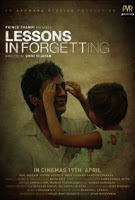 Still, the good bits in Lessons in Forgetting reminded me of the good bits in two other flawed but interesting films I saw in the last few months:
Jalpari: The Desert Mermaid
and
Listen... Amaya
. The link with the former is clearer – both Lessons in Forgetting and Jalpari deal with female foeticide, with a well (or a pool) of dark secrets harboured by small, self-contained communities, and both link gender discrimination with a damaging imbalance in nature. (In Jalpari, the village that is determined to stop producing women also has a serious water scarcity; Nair’s book uses cyclones as an important metaphor, one that isn’t really explored in the film.)
Still, the good bits in Lessons in Forgetting reminded me of the good bits in two other flawed but interesting films I saw in the last few months:
Jalpari: The Desert Mermaid
and
Listen... Amaya
. The link with the former is clearer – both Lessons in Forgetting and Jalpari deal with female foeticide, with a well (or a pool) of dark secrets harboured by small, self-contained communities, and both link gender discrimination with a damaging imbalance in nature. (In Jalpari, the village that is determined to stop producing women also has a serious water scarcity; Nair’s book uses cyclones as an important metaphor, one that isn’t really explored in the film.)
The more tenuous similarities with Listen... Amaya have to do with the relations between children and single parents who are very close to each other: if the latter can be over-protective and reluctant to loosen the strings, children can be just as insecure about the idea of their parents having a sexual side. In this context, I felt Lessons in Forgetting may have been a better-realised film if it had explored the bond between Jak and Smriti at fuller length, letting us see how a certain type of parent-child relationship can be a little like walking gingerly across a beach littered with very sharp shells – and how it can affect the subsequent choices and actions of both sets of people.
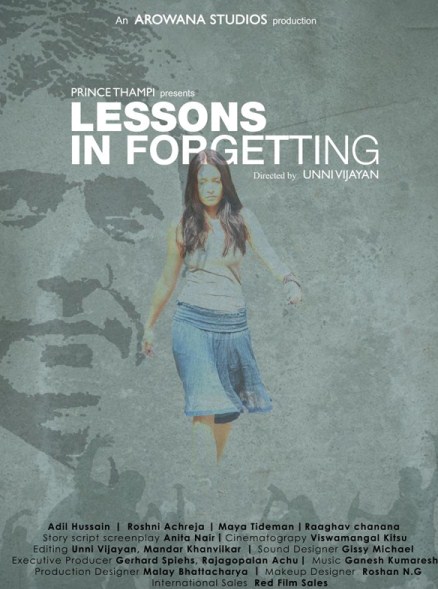 Though this is a well-intentioned film with a certain visual flair, I had problems with it – much of the English dialogue wasn’t convincing to my ears, the story was diffused and a crucial lead performance was stiff and impassive. However, one thing I did find interesting and want to discuss here is how the narrative structure leads the viewer down a winding path, making us confront our attitudes to things like personal morality and the gap between “modern” and “traditional” lifestyles – issues that have been central to much of the discourse around sexual harassment recently, including the many outrageous statements about rape that continue to be made by people in positions of authority, and the voyeuristic attention directed at the “westernised” woman whose behaviour and dressing sense are seen as directly related to the bad things that happen to her.
(Plot discussion to follow, but no major spoilers) Very early in Lessons in Forgetting, we learn that a 19-year-old girl named Smriti had a terrible accident (though it might also have been an attack) on a beach in the town of Minjikapuram, Tamil Nadu: having suffered brain damage, she is now in a vegetative state at home, and her father Jak (Adil Hussain) is trying to understand what happened, while also learning things about the person she was. In one of the first scenes, a doctor at the hospital where Smriti was taken puts on a show of conditional sympathy. Yes, this is such a terrible thing, "but, you know, this Western culture..." and then his voice trails off, but he begins again: “I’m not blaming anyone, but when girls are let loose...” And he tells Jak that tests indicated his daughter had “been with” more than one man shortly before the tragedy.
Jak is stunned. He knew Smriti was leading a fairly independent life, that she was part of a theatre troupe and had gone on this trip with friends, including boys. But there are some images and ideas that his mind can’t directly process. And so it is apt that the narrative now resorts to stylised imagery, with a sand-art animation sequence that is one of the very best things in the movie.

As the opening credits play, the animation shows us a father and his little daughter on a beach; he playfully throws her in the air, she flies away from him (literally, for she has sprouted wings) and mid-flight she begins to turn into a adult woman, her hair growing longer, her breasts filling out. In the frank and daring cartoon visuals that follow, we see this young woman having sex with a man, then possibly participating in an orgy too – and this image looks like a throbbing brain, perhaps suggesting that much of what we are seeing represents the febrile imagination of the father, pondering what his “little girl” might be doing, with other men, with more than one man. Here is a loving, protective dad who also has a sliver of male sexual jealousy in his reptile brain, as so many loving, protective dads do.
 Or at least, that’s how I interpret the sequence. The story of this father’s quest to understand his daughter’s life – and perhaps to reclaim or redeem her – also reminded me a little of Ethan Edwards’ obsessive search for his “defiled” niece in
The Searchers
(and of another film, Paul Schrader’s Hardcore, in which George C Scott plays a man looking for his daughter who may have joined the porn industry).
Or at least, that’s how I interpret the sequence. The story of this father’s quest to understand his daughter’s life – and perhaps to reclaim or redeem her – also reminded me a little of Ethan Edwards’ obsessive search for his “defiled” niece in
The Searchers
(and of another film, Paul Schrader’s Hardcore, in which George C Scott plays a man looking for his daughter who may have joined the porn industry).Frankly, Adil Hussain’s bland, one-note performance as Jak doesn’t allow these comparisons to be sustained beyond a point, but what follows is still intriguing. Jak meets some of Smriti’s friends and discovers that she had been sexually intimate with more than one boy in her group. Through their stories (presented in inter-woven flashbacks) we learn that she was promiscuous and possibly a little flighty and irresponsible in how she treated the people she was close to. The boys themselves have clearly been scarred by their involvement with her: one has become a depressive alcoholic, another has taken quick-fix solace in religion but doesn’t seem to be at peace, and while all this is presented very simplistically we get the point.
To an extent, these scenes define our initial attitudes to Smriti. We are seeing her mainly through male eyes (and of course I can’t separate my own maleness from what I’m writing here) – as a free-spirited girl with showy eyebrow piercings, riding a scooter in a short skirt, flitting from one guy to the next without always being mindful of hurt feelings; and later, walking about a little imprudently in torn jeans in a small, conservative town, standing out from the other members of her group, constantly drawing attention to herself.
But late in the film, there is a subtle shift in perspective. The character comes into her own, the male gaze is supplanted, and vital gaps in the story are filled in by a sympathetic older woman who knew Smriti. We learn that she was plucky and good-hearted, with a conscience and an insufficient sense of self-preservation (“Don’t run away from the things that terrify you,” her father told her when she was a child – advice that he will have cause to regret later), and that what eventually happened to her was not only grossly disproportionate as “punishment” for her (real or imagined) faults, it is also a direct result of the compassion that stems from her “modern” upbringing.
 The film's intensity meter rises in these final sequences: the slackness of the earlier scenes gives way to greater pace and urgency, and more convincing performances by Maya Tideman (as Smriti) and Raghav Chanana (as her last boyfriend Soman). And it builds towards an unflinchingly disturbing sequence where male group aggression takes on a carnival-esque form, with undertones of the faux-righteous double-think that lies behind so many cases of sexual assault: “Let’s teach her a lesson.”
 Given how effective that ending is – and how powerful and lovely that animated sequence in the beginning was – it’s a pity that so much of the midsection of Lessons in Forgetting is trite and uninvolving, the dialogues and the acting rubbing against each other in awkward ways. “They? They who? I thought this was an accident,” Jak says when he hears for the first time about people who had scores to settle with his daughter. Each word is enunciated clearly in Hussain’s refined voice, but there is little tension behind them; this isn’t so much a grieving father wanting to uncover the truth as a student in an elocution class. (It’s just as well that the residents of Minjikapuram are allowed to speak their own dialect rather than a stilted version of English, which so afflicts much of the film.)
I was also puzzled by some of the decisions made while adapting Nair’s novel. In the book, Jak is one of two central characters, the other being a middle-aged woman named Meera, who works for him and is going through a personal crisis of her own. The film chooses to focus on the Jak-Smriti story, which is fine – but it is done in a half-baked way so that Meera (Roshni Achrekar) continues to be nominally important, a sort of second lead, without ever becoming a fleshed-out character. We get only fragments of her life and it feels like bits and pieces have been carelessly left out (her teenage daughter, for instance, appears to be shaping up to be an important counterpoint to the Jak-Smriti story, but then simply fades out of sight). Watching the scenes about Meera and her family, I felt like the film had originally been an hour longer but had had an unseemly encounter with a chopping block.
 Still, the good bits in Lessons in Forgetting reminded me of the good bits in two other flawed but interesting films I saw in the last few months:
Jalpari: The Desert Mermaid
and
Listen... Amaya
. The link with the former is clearer – both Lessons in Forgetting and Jalpari deal with female foeticide, with a well (or a pool) of dark secrets harboured by small, self-contained communities, and both link gender discrimination with a damaging imbalance in nature. (In Jalpari, the village that is determined to stop producing women also has a serious water scarcity; Nair’s book uses cyclones as an important metaphor, one that isn’t really explored in the film.)
Still, the good bits in Lessons in Forgetting reminded me of the good bits in two other flawed but interesting films I saw in the last few months:
Jalpari: The Desert Mermaid
and
Listen... Amaya
. The link with the former is clearer – both Lessons in Forgetting and Jalpari deal with female foeticide, with a well (or a pool) of dark secrets harboured by small, self-contained communities, and both link gender discrimination with a damaging imbalance in nature. (In Jalpari, the village that is determined to stop producing women also has a serious water scarcity; Nair’s book uses cyclones as an important metaphor, one that isn’t really explored in the film.) The more tenuous similarities with Listen... Amaya have to do with the relations between children and single parents who are very close to each other: if the latter can be over-protective and reluctant to loosen the strings, children can be just as insecure about the idea of their parents having a sexual side. In this context, I felt Lessons in Forgetting may have been a better-realised film if it had explored the bond between Jak and Smriti at fuller length, letting us see how a certain type of parent-child relationship can be a little like walking gingerly across a beach littered with very sharp shells – and how it can affect the subsequent choices and actions of both sets of people.
April 18, 2013
A tribute to Balraj Sahni as he nears his 100
(Did a version of this for my DNA column)
With the birth centenary of one of Hindi cinema’s most respected actors just around the corner – May 1 is the date – I came across an amusing little anecdote about Balraj Sahni. In his biography Balraj: My Brother, Bhisham Sahni recalls a Bombay producer saying the young Balraj resembled the Hollywood legend Gary Cooper. “Balraj took this as a compliment, but it was meant to convey that he had grown too lean and thin for the role of a hero in Hindi films; the Indian audiences preferred chubby and round-faced heroes.”
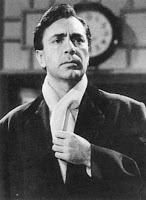 There were other ways in which Balraj would confound expectations of the Indian movie star in the 1940s and 50s. Having trained as a BBC announcer in England, and also being familiar with a relatively “realistic” stage tradition – compared to the Parsi theatre that gave Hindi cinema many of its florid conventions – he had a knack for understatement that recalled the best work of such American star-actors as Spencer Tracy ... or Gary Cooper for that matter, of whom Orson Welles once said: “You’d see him working on the set and you’d think my god, they’re going to have to retake that one! He almost didn’t seem to be there. And then you’d see the rushes, and he’d fill the screen.”
Those who observed Sahni may have felt similarly. Watching him as the idealistic Dr Nirmal in the 1960 film Anuradha , I was most struck by his performance in the scenes where the doctor, doing his rounds on his bicycle, casually chats with patients. Nothing very important or purposeful is happening here in terms of the narrative, but so much lies in the way Sahni listens and responds; you feel that the character has a life and personality that extends beyond the restricted world of the film.
We sometimes label acting as subtle or loud, quiet or exaggerated, but there are variances even within those categories. Dr Nirmal represents a different sort of understated performance from the one Sahni gave in Garm Hava , where you can see that Salim Mirza (losing family and status but holding on to personal dignity as the hot winds of Partition blow around him) is constantly suppressing his feelings; that a reservoir of emotion lies behind the stiff posture, the pursed lips and even the way he grips his cane. For contrast, watch him as the large-hearted Pathan in Kabuliwala : the role is marked by flourishes (for this is a flamboyant man, especially when he is trying to impress children with his wares) and by an accent that draws attention to itself. But though the film sometimes comes close to caricature in its depiction of boisterous Afghanis rolling their eyes and singing jolly songs together in an alien land, Sahni's performance has an internal consistency that transcends the role’s superficial trappings – and everything important about the character comes together brilliantly in his brief look of terror at the end when he realises that his beloved “Mini bacchha”, now grown up, may not have recognised him.
None of this came easily to the actor, if Bhisham Sahni’s book is to be believed. It reveals things about Balraj’s many struggles with film acting and his realisation that even the so-called “natural” performer needed to switch gears when the lights came on; you didn’t simply go in front of the camera and continue to be yourself, the process was more complicated than that. There are descriptions of his fear of the camera (“it was like going before the gallows”), of having to shake off stiffness, even wetting his pants in nervousness between shots – all indicative of how much it mattered to him that he did the best possible job. But there is also a story about how he became less self-conscious after a conversation with a real-life rickshaw-puller whom he met while shooting Do Bigha Zamin ; the encounter helped him to stop obsessing about acting methods and to relax into his role, by seeing it as an opportunity to pay tribute to real people undergoing real hardships.
 Sahni’s career was not exactly sprinkled with classic films, and most fans will agree that the three movie roles he will be best remembered for are Shambu the farmer who moves to the city to earn money in Do Bigha Zamin; the kabuliwala who travels from Afghanistan to Hindustan for similar reasons and forms a bond with a little girl; and the beleaguered Salim Mirza. These are all men in debt, separated from the people they love, adjusting to new things, watching the way of life they knew passing them by – in other words, tragic heroes. Yet they are also vibrant and multidimensional. Do Bigha Zamin is often thought of a relentlessly bleak film, but Shambu is a cheerful, upbeat sort at heart. Even after he is reduced to a wreck in front of his greedy landlord, he is optimistic enough to think that it doesn’t matter that he knows no one in the big city; he can make friends after getting there. (“Jaan pehchaan wahaan jaane par hee hogi, bapu.”) In a
film with a somewhat overblown reputation for De Sica-like realism,
Sahni grounds the edifice by playing the character as a
well-rounded individual rather than just a victim or a symbol.
 Here and elsewhere, it is also worth noting what a fine, attentive lover Sahni could be on screen. His latter-day role as the elderly Lala Kedarnath ardently singing “Ae Meri Zohra Jabeen” to his wife in Waqt is well known (perhaps too well known; it sometimes invites annoyingly patronising attitudes about old people), but he was equally moving in less demonstrative romantic parts. An undervalued aspect of Do Bigha Zamin is the depiction in its early scenes of the love between Shambu and his wife, the playfulness of their banter, which makes onlookers say “They’ve been married for 10 years, why does he still keep whispering to her?” The humour and affection stays intact even in times of stress (“Tujhe khareedne ki himmat hai kissi mein?” he jokes when his wife complains that he should sell her too, along with their other valuables), and much of the film's power comes from watching the gentle smile erased as circumstances become much worse.
It may be a mistake though to judge Sahni only by his work in “respectable” cinema. “He seemed to lend his gravitas to many films that did not seem worthy settings for his talent,” sniffed Leela Naidu in her memoir, but I’m not sure this is a bad thing. Recently I saw him in a tiny, inexplicable part as Rajendra Kumar’s father in Aman, a film that also has a famous special appearance by the then 94-year-old Bertrand Russell. In his one big scene, Sahni – who is chummily credited only as “Gautamdas’s dad” in the IMDB credits – tries to persuade his doctor son to stay in India instead of going to Japan to help nuclear-radiation victims. He then masterfully keeps a straight face - and continues speaking his own pain-soaked lines with conviction - when Kumar likens himself to a sweet-smelling flower whose sugandh isn’t meant only for the maali who tended it.
The scene is a reminder that the measure of actors can lie not just in their obviously great roles, but in their ability to make the best of preposterous situations. A continuing joy for any true Balraj Sahni fan is discovering his performances of integrity in dozens of “unworthy” roles, a reminder that acting in a commercial medium isn’t just an ivory-tower pursuit, and that the true artiste can achieve big things across a range of canvases.
With the birth centenary of one of Hindi cinema’s most respected actors just around the corner – May 1 is the date – I came across an amusing little anecdote about Balraj Sahni. In his biography Balraj: My Brother, Bhisham Sahni recalls a Bombay producer saying the young Balraj resembled the Hollywood legend Gary Cooper. “Balraj took this as a compliment, but it was meant to convey that he had grown too lean and thin for the role of a hero in Hindi films; the Indian audiences preferred chubby and round-faced heroes.”
 There were other ways in which Balraj would confound expectations of the Indian movie star in the 1940s and 50s. Having trained as a BBC announcer in England, and also being familiar with a relatively “realistic” stage tradition – compared to the Parsi theatre that gave Hindi cinema many of its florid conventions – he had a knack for understatement that recalled the best work of such American star-actors as Spencer Tracy ... or Gary Cooper for that matter, of whom Orson Welles once said: “You’d see him working on the set and you’d think my god, they’re going to have to retake that one! He almost didn’t seem to be there. And then you’d see the rushes, and he’d fill the screen.”
Those who observed Sahni may have felt similarly. Watching him as the idealistic Dr Nirmal in the 1960 film Anuradha , I was most struck by his performance in the scenes where the doctor, doing his rounds on his bicycle, casually chats with patients. Nothing very important or purposeful is happening here in terms of the narrative, but so much lies in the way Sahni listens and responds; you feel that the character has a life and personality that extends beyond the restricted world of the film.
We sometimes label acting as subtle or loud, quiet or exaggerated, but there are variances even within those categories. Dr Nirmal represents a different sort of understated performance from the one Sahni gave in Garm Hava , where you can see that Salim Mirza (losing family and status but holding on to personal dignity as the hot winds of Partition blow around him) is constantly suppressing his feelings; that a reservoir of emotion lies behind the stiff posture, the pursed lips and even the way he grips his cane. For contrast, watch him as the large-hearted Pathan in Kabuliwala : the role is marked by flourishes (for this is a flamboyant man, especially when he is trying to impress children with his wares) and by an accent that draws attention to itself. But though the film sometimes comes close to caricature in its depiction of boisterous Afghanis rolling their eyes and singing jolly songs together
 in an alien land, Sahni's performance has an internal consistency that transcends the role’s superficial trappings – and everything important about the character comes together brilliantly in his brief look of terror at the end when he realises that his beloved “Mini bacchha”, now grown up, may not have recognised him.
None of this came easily to the actor, if Bhisham Sahni’s book is to be believed. It reveals things about Balraj’s many struggles with film acting and his realisation that even the so-called “natural” performer needed to switch gears when the lights came on; you didn’t simply go in front of the camera and continue to be yourself, the process was more complicated than that. There are descriptions of his fear of the camera (“it was like going before the gallows”), of having to shake off stiffness, even wetting his pants in nervousness between shots – all indicative of how much it mattered to him that he did the best possible job. But there is also a story about how he became less self-conscious after a conversation with a real-life rickshaw-puller whom he met while shooting Do Bigha Zamin ; the encounter helped him to stop obsessing about acting methods and to relax into his role, by seeing it as an opportunity to pay tribute to real people undergoing real hardships.
 Sahni’s career was not exactly sprinkled with classic films, and most fans will agree that the three movie roles he will be best remembered for are Shambu the farmer who moves to the city to earn money in Do Bigha Zamin; the kabuliwala who travels from Afghanistan to Hindustan for similar reasons and forms a bond with a little girl; and the beleaguered Salim Mirza. These are all men in debt, separated from the people they love, adjusting to new things, watching the way of life they knew passing them by – in other words, tragic heroes. Yet they are also vibrant and multidimensional. Do Bigha Zamin is often thought of a relentlessly bleak film, but Shambu is a cheerful, upbeat sort at heart. Even after he is reduced to a wreck in front of his greedy landlord, he is optimistic enough to think that it doesn’t matter that he knows no one in the big city; he can make friends after getting there. (“Jaan pehchaan wahaan jaane par hee hogi, bapu.”) In a
 film with a somewhat overblown reputation for De Sica-like realism,
Sahni grounds the edifice by playing the character as a
well-rounded individual rather than just a victim or a symbol.
 Here and elsewhere, it is also worth noting what a fine, attentive lover Sahni could be on screen. His latter-day role as the elderly Lala Kedarnath ardently singing “Ae Meri Zohra Jabeen” to his wife in Waqt is well known (perhaps too well known; it sometimes invites annoyingly patronising attitudes about old people), but he was equally moving in less demonstrative romantic parts. An undervalued aspect of Do Bigha Zamin is the depiction in its early scenes of the love between Shambu and his wife, the playfulness of their banter, which makes onlookers say “They’ve been married for 10 years, why does he still keep whispering to her?” The humour and affection stays intact even in times of stress (“Tujhe khareedne ki himmat hai kissi mein?” he jokes when his wife complains that he should sell her too, along with their other valuables), and much of the film's power comes from watching the gentle smile erased as circumstances become much worse.
It may be a mistake though to judge Sahni only by his work in “respectable” cinema. “He seemed to lend his gravitas to many films that did not seem worthy settings for his talent,” sniffed Leela Naidu in her memoir, but I’m not sure this is a bad thing. Recently I saw him in a tiny, inexplicable part as Rajendra Kumar’s father in Aman, a film that also has a famous special appearance by the then 94-year-old Bertrand Russell. In his one big scene, Sahni – who is chummily credited only as “Gautamdas’s dad” in the IMDB credits – tries to persuade his doctor son to stay in India instead of going to Japan to help nuclear-radiation victims. He then masterfully keeps a straight face - and continues speaking his own pain-soaked lines with conviction - when Kumar likens himself to a sweet-smelling flower whose sugandh isn’t meant only for the maali who tended it.
The scene is a reminder that the measure of actors can lie not just in their obviously great roles, but in their ability to make the best of preposterous situations. A continuing joy for any true Balraj Sahni fan is discovering his performances of integrity in dozens of “unworthy” roles, a reminder that acting in a commercial medium isn’t just an ivory-tower pursuit, and that the true artiste can achieve big things across a range of canvases.
April 16, 2013
The lady varnishes

Lata Mangeshkar has watched every Hitchcock film...and then some. Today's HT City tells me that Lata-ji loves Hitchcock's Gaslight in particular. Now, given that this isn't a Hitch film in the first place (which is okay, she is in her 80s and memory is treacherous for those of us less than half that age), I enjoyed the report's fussy inclusion of the correct year of the movie next to the title - even though the reference is part of a direct quote and it's unlikely that the great lady would have said something like "I loved Gaslight (1944) especially." Good to see some serious research going on at the copy desk.
(Having said which, what does one do when you're interviewing a legend and collecting quotes for a one-column snippet, and she makes a factual error? Do you gently correct her [assuming you know better yourself]? Can you simply leave the inaccurate bit out of your story, if the story is rendered pointless without it? And what does the poor guy on the copy-desk do when, after googling for a small detail, he discovers that the whole premise is dubious? I'm glad I don't have to face any of these dilemmas firsthand.)
Pandavas in the sky with diamonds (on Sandipan Deb’s modern Mahabharata)
[Did a version of this review for Biblio. And here I had thought this piece was the last thing I would ever write about the great epic. To quote Michael Corleone, or is it Bheeshma, “Just when I thought I was out, they PULL me back again”]
-------------------
Even if you don’t know beforehand that Sandipan Deb’s bulky underworld thriller The Last War is a modern version of the Mahabharata, the dots will begin connecting within the first couple of pages. In the opening chapter, set in July 2007, a conflicted gunman named Jeet and his family friend and advisor Kishenbhai discuss a great war that lies ahead. Over glasses of Glenmorangie, they speak indolently of “dharma”, mull the ethics of taking up arms against friends and family. The conversation is full of high-sounding hokum. “Now listen, brother, and I will explain the fucking philosophy of action,” Kishenbhai says (as he pours himself a stiff drink and plumbs the ice bucket), “If we allow the mind to stray, it can take you into all sorts of unrelated detours.”
Mumbo-jumbo aside, this prelude – which is, as should be clear, a tongue-in-cheek variation on the Bhagwad Gita – puts some of the story’s blocks in place. The men are interrupted by Jeet’s lover Jahn – this narrative’s Draupadi – who fierily demands vengeance for what was done to her years earlier (we are also told she “shares a bond” with Kishenbhai, who “instinctively sensed her slightest desire and fulfilled it even before she had articulated it properly in her own mind”). There are allusions to a period of banishment, to a young son named Abhi (Abhimanyu), to Jeet’s nemesis Karl (Karna), and to family elders named Yash Bauji (Bheeshma) and BK Acharya (Drona) whom Jeet is reluctant to kill.
 Having served this aperitif, the book flashbacks to 1955, when the saga of the “Kuru clan” begins with the gifted archer Yash Kuru practising his skills near the Gateway of India (much as the young Bheeshma did on the banks of the Ganga). Yash happens to catch the eye of an elderly Parsi smuggler and goes on to become a hitman and eventual caretaker for the latter’s crime empire; over the decades, he tutors generations of businessmen, beginning with his own nephews and their children, who grow up to be versions of the Pandavas and Kauravas. Then things get ugly, as they will do if you're living and working in the underworld.
There have been many Mahabharata retellings in recent years, including point-of-view ones that filter the story through this or that character, and creative treatments like Shashi Tharoor’s The Great Indian Novel, which used tropes from the epic to examine modern India’s political history. The Last War is an addition to that large corpus, and it is a promising idea to shift the tale to the organised-crime world of the last 60 years, letting the familiar dramatic episodes play out against the backdrop of a fast-changing city, with occasional references to real-life events. There is a certain irreverence built into the book’s fabric too: the very first chapter, after all, give us a Krishna and Arjuna faux-philosophising over Scotch, and we know that all the characters, including Kishenbhai, are basically gangsters.
Yet, as this narrative lumbers on, it turns out to be less imaginative than many of the seemingly more conventional Mahabharata tellings – the one that retain the original setting. There are a few good twists – Yudhisthira goes to jail when he is tricked and implicated in a cricket-betting controversy – and I liked witty little touches such as the transformation of the original story’s Jarasandha (born as two halves and eventually returned to this state after a wrestling bout with Bheema) into twin brothers Jara and Sandha, small-time players challenging the Kurus for control of the underworld, who sometimes complete each other’s sentences. But in a nearly 600-page book, these touches are too few and far between, and too much of the other invention occurs at a sniggering, schoolboy level (Arjuna’s famous bow Gandiva becomes Jeet’s pet gun Gandu).
Instead of using the Mahabharata template discerningly, Deb lifts entire episodes, plot details and even dialogues wholesale, and clumsily sticks them into situations where they are laughably anachronistic. Thus, the episode of Arjuna seeing only the eye of the wooden bird he has to shoot at is presented exactly as it is in the original, except that of course Jeet is using a rifle. After Jahn/Draupadi is nearly raped by Ranjit/Duhshasana, she swears that she won't tie or oil her hair until she has soaked it in his blood. In one mind-boggling passage that shows how mundane these episodes can be if unthinkingly replicated, Preeti maaji (Kunti) recognises that the adult Karl was the baby she had abandoned because of – wait for it – the azure colour of his eyes. (In the original, it was the divine, unmistakable, Sun-gifted armour and earrings glued to Karna’s body. Presumably there weren't a lot of other young men running around with those accessories.) As if to acknowledge the existence of the many Mahabharata perspective tellings, a few random chapters are narrated in the first person by a different character (Jahn, Karl), but there is no pattern to this – it is a device indulged in for its own sake. And because the author is so keen to stick to the basics of the story, while also getting on with the action, there are passages like the one where we are hurriedly informed of the exact months and years of birth of the three “Pandavas” and the two “Kauravas”.
And so on, but you get the idea. (Apart from the laziness of this writing, that first sentence is grammatically problematic, appearing to suggest that Rahul is also Preeti’s son.) This is compounded by trite character summaries – Rishabh (Yudhisthira) is virtuous and introverted and fond of playing cards, Vikram (Bheema) is strong and naughty but also a protector of the weak – and by bombastic language. The characters say things like “This is my word to you as Rahul, son of Shankar” and “I curse you, Rahul, that if you are lying to me, then at the most important moment of your life, when you will require your physical and mental strength the most, that strength will desert you, and you will be left a weak man. This is a mother’s curse. It will be true.” Jeet and Karl make pronouncements about how each has to prove he is the greatest gunman of the age. “I have not come here with hope that I will be able to secure a peaceful settlement,” says Kishenbhai affectedly, “but only in order that the world will not hold me to blame.”
All of which may prompt the reader to ask, “Who cares about your silly ego games, you nobodies?”
This is not a minor point. To read the original Mahabharata is to buy into the conceit that the very public actions and interrelationships of these royals affect the whole of Bharatvarsh. There is the inbuilt assumption that every last family in the land is invested in the saga of the Pandavas and Kauravas; that their exploits amount to a Dwapara Yuga version of front-page news (or in some cases, page-three news); that bards are roaming every corner of the kingdom, regularly updating the “common people” with the stories; that the great war will alter all lives for good and for ill.
For such a conceit to work in a contemporary scenario, one would probably have to hypothesise a situation where, say, Rahul Gandhi and Narendra Modi and their supporters were facing off in a dharma-yudh being breathlessly covered by every TV channel in the land, with the future of India and the world on the line. Or a subtler thriller where battlefield action was substituted by the twists and turns of electoral politics. But the scale of the action in The Last War is very modest - even given what we know of the Mumbai underworld's reach - and the narrative itself inadvertently reveals this in places. (At one point the cricket betting subplot includes a needlessly prolonged account of the 1996 World Cup final between Sri Lanka and Australia, complete with mentions of real-life participants – Arjuna Ranatunga, Glenn McGrath etc. But this, like a later allusion to the September 11 attacks, becomes a reminder that a much larger world exists outside the one inhabited by these self-absorbed characters, and that they are fairly inconsequential in the overall scheme of things.)
Given this, Deb’s decision to use the archaic, self-aggrandising prose of an ancient epic seems ridiculous. In the context of underworld skirmishes, what does it mean to say that it has to be “decided” whether Jeet or Karl is the "greatest warrior"? It is not as if they are even going to face off in an old-style gun duel. The Arjuna-Karna battle was governed by certain rules of warfare; their final duel, even if it was settled unjustly, was a one-on-one confrontation involving individual skill that would be gaped at by others on the battlefield. The situations are not remotely comparable, it amounts to a lazy transposition, and after a while one begins to wish for Quick Gun Murugun or Chulbul Pandey to turn up and show these boys what is what.
The prose also includes multiple esoteric references to “dharma” or duty. Deeply ambiguous as this concept already is in the original Mahabharata, it becomes meaningless in a situation where everyone is operating outside the law to begin with. To his credit, Deb does show awareness of this in an early character sketch of Yash bauji that captures something of Bheeshma’s relentless self-righteousness, as well as the self-deception of anyone rationalising a position of power and privilege.
And yet, the characters go on saying things about “the malleability of dharma”, and doing it in a languid, theoretical way that seems to have no real relevance to their own lives and actions. (Incidentally, it is indicated that English is their primary language of communication, which makes some of this dialogue seem even more woodenly incongruous.)
For me, two questions were central to understanding whether this book worked or not. First: does it do anything especially fresh or creative with the Mahabharata? As indicated above, no. Whereupon the second question follows: does it work on its own terms, as a good, fast-paced thriller? This is a little more difficult to answer. Certainly there is a lot of action, there is a sense of a multidimensional saga with people flitting in and out of the frame, and in a few – too few – passages there is interesting use of setting (as in a sequence set in Dharavi) and a glimpse of a shadowy, noirish Mumbai. (“They call this the city full of life, but should life be like this? [...] It was a city of mediocre, obedient zombies. What a place to run your sort of business, Rishabh.”) But it all drags on for too long, and besides it is never possible to read this as a stand-alone story, for the Mahabharata reference points are everywhere, constantly weighing the narrative down.
 Searching for a key to the tonal incongruities, I returned to one of the Gita conversations. (Turning to the Gita for “answers” does seem like a reasonable thing to do.) At one point, cutting through Jeet and Kishenbhai’s psychobabble, Jahn asks Jeet to sing to her, whereupon he begins droning the lyrics to the Beatles’ “Lucy in the Sky with Diamonds” (and she joins in by screaming the line “The girl with kaleidoscope eyes”). The moment made strange sense. Perhaps this whole story is a drug-induced fever dream, with these bored people amusing themselves by using the ancient epic as a palimpsest for their own lives. In which case, I wish Deb had been much more over the top and thrown in a few more flourishes as well as an extended Epilogue set in heaven as an opium den where all the assassinated Kurus would carry on as if nothing had happened. After all, as Kishenbhai sagely puts it, “Why grieve? Either for the dead or the living? No point at all. We are here today, we were here yesterday, we will be here tomorrow. There was never a time when we were not around.”
-----------------------------
[A selection of Mahabharata-related posts from the archives: Ekta Kapoor's Kahaani Hamaaray Mahabharat Ki - 1, 2, 3, 4, 5; flash fiction on the fall of Bheeshma; astonishing births in the Mahabharata; Karna and the Madraka women; how Rukmi learnt to stop worrying; on Prem Panicker's Bhimsen; The Palace of Illusions; Groucho Marx as Krishna; Irawati Karve's Yuganta; a long piece for Caravan about perspective tellings; Devdutt Pattanaik's The Pregnant King]
-------------------
Even if you don’t know beforehand that Sandipan Deb’s bulky underworld thriller The Last War is a modern version of the Mahabharata, the dots will begin connecting within the first couple of pages. In the opening chapter, set in July 2007, a conflicted gunman named Jeet and his family friend and advisor Kishenbhai discuss a great war that lies ahead. Over glasses of Glenmorangie, they speak indolently of “dharma”, mull the ethics of taking up arms against friends and family. The conversation is full of high-sounding hokum. “Now listen, brother, and I will explain the fucking philosophy of action,” Kishenbhai says (as he pours himself a stiff drink and plumbs the ice bucket), “If we allow the mind to stray, it can take you into all sorts of unrelated detours.”
You were born and you are going to die. That’s the writing on the wall. Then you are reborn and take a look at the wall, and it’s still the same message out there. Who knows where’s the beginning, where’s the end? What we see are the intervening formations. Do your stuff, get the fuck out. Your duty.
Mumbo-jumbo aside, this prelude – which is, as should be clear, a tongue-in-cheek variation on the Bhagwad Gita – puts some of the story’s blocks in place. The men are interrupted by Jeet’s lover Jahn – this narrative’s Draupadi – who fierily demands vengeance for what was done to her years earlier (we are also told she “shares a bond” with Kishenbhai, who “instinctively sensed her slightest desire and fulfilled it even before she had articulated it properly in her own mind”). There are allusions to a period of banishment, to a young son named Abhi (Abhimanyu), to Jeet’s nemesis Karl (Karna), and to family elders named Yash Bauji (Bheeshma) and BK Acharya (Drona) whom Jeet is reluctant to kill.
 Having served this aperitif, the book flashbacks to 1955, when the saga of the “Kuru clan” begins with the gifted archer Yash Kuru practising his skills near the Gateway of India (much as the young Bheeshma did on the banks of the Ganga). Yash happens to catch the eye of an elderly Parsi smuggler and goes on to become a hitman and eventual caretaker for the latter’s crime empire; over the decades, he tutors generations of businessmen, beginning with his own nephews and their children, who grow up to be versions of the Pandavas and Kauravas. Then things get ugly, as they will do if you're living and working in the underworld.
There have been many Mahabharata retellings in recent years, including point-of-view ones that filter the story through this or that character, and creative treatments like Shashi Tharoor’s The Great Indian Novel, which used tropes from the epic to examine modern India’s political history. The Last War is an addition to that large corpus, and it is a promising idea to shift the tale to the organised-crime world of the last 60 years, letting the familiar dramatic episodes play out against the backdrop of a fast-changing city, with occasional references to real-life events. There is a certain irreverence built into the book’s fabric too: the very first chapter, after all, give us a Krishna and Arjuna faux-philosophising over Scotch, and we know that all the characters, including Kishenbhai, are basically gangsters.
Yet, as this narrative lumbers on, it turns out to be less imaginative than many of the seemingly more conventional Mahabharata tellings – the one that retain the original setting. There are a few good twists – Yudhisthira goes to jail when he is tricked and implicated in a cricket-betting controversy – and I liked witty little touches such as the transformation of the original story’s Jarasandha (born as two halves and eventually returned to this state after a wrestling bout with Bheema) into twin brothers Jara and Sandha, small-time players challenging the Kurus for control of the underworld, who sometimes complete each other’s sentences. But in a nearly 600-page book, these touches are too few and far between, and too much of the other invention occurs at a sniggering, schoolboy level (Arjuna’s famous bow Gandiva becomes Jeet’s pet gun Gandu).
Instead of using the Mahabharata template discerningly, Deb lifts entire episodes, plot details and even dialogues wholesale, and clumsily sticks them into situations where
 they are laughably anachronistic. Thus, the episode of Arjuna seeing only the eye of the wooden bird he has to shoot at is presented exactly as it is in the original, except that of course Jeet is using a rifle. After Jahn/Draupadi is nearly raped by Ranjit/Duhshasana, she swears that she won't tie or oil her hair until she has soaked it in his blood. In one mind-boggling passage that shows how mundane these episodes can be if unthinkingly replicated, Preeti maaji (Kunti) recognises that the adult Karl was the baby she had abandoned because of – wait for it – the azure colour of his eyes. (In the original, it was the divine, unmistakable, Sun-gifted armour and earrings glued to Karna’s body. Presumably there weren't a lot of other young men running around with those accessories.) As if to acknowledge the existence of the many Mahabharata perspective tellings, a few random chapters are narrated in the first person by a different character (Jahn, Karl), but there is no pattern to this – it is a device indulged in for its own sake. And because the author is so keen to stick to the basics of the story, while also getting on with the action, there are passages like the one where we are hurriedly informed of the exact months and years of birth of the three “Pandavas” and the two “Kauravas”.
Preeti gave birth to Rishabh in December 1962, followed shortly afterwards by Shankar’s son Rahul, in April 1963. Preeti’s second son Vikram arrived in the world in April 1964 and then Jeet in March 1965. Aditi’s second son Ranjit was born in July 1964...
And so on, but you get the idea. (Apart from the laziness of this writing, that first sentence is grammatically problematic, appearing to suggest that Rahul is also Preeti’s son.) This is compounded by trite character summaries – Rishabh (Yudhisthira) is virtuous and introverted and fond of playing cards, Vikram (Bheema) is strong and naughty but also a protector of the weak – and by bombastic language. The characters say things like “This is my word to you as Rahul, son of Shankar” and “I curse you, Rahul, that if you are lying to me, then at the most important moment of your life, when you will require your physical and mental strength the most, that strength will desert you, and you will be left a weak man. This is a mother’s curse. It will be true.” Jeet and Karl make pronouncements about how each has to prove he is the greatest gunman of the age. “I have not come here with hope that I will be able to secure a peaceful settlement,” says Kishenbhai affectedly, “but only in order that the world will not hold me to blame.”
All of which may prompt the reader to ask, “Who cares about your silly ego games, you nobodies?”
This is not a minor point. To read the original Mahabharata is to buy into the conceit that the very public actions and interrelationships of these royals affect the whole of Bharatvarsh. There is the inbuilt assumption that every last family in the land is invested in the saga of the Pandavas and Kauravas; that their exploits amount to a Dwapara Yuga version of front-page news (or in some cases, page-three news); that bards are roaming every corner of the kingdom, regularly updating the “common people” with the stories; that the great war will alter all lives for good and for ill.
For such a conceit to work in a contemporary scenario, one would probably have to hypothesise a situation where, say, Rahul Gandhi and Narendra Modi and their supporters were facing off in a dharma-yudh being breathlessly covered by every TV channel in the land, with the future of India and the world on the line. Or a subtler thriller where battlefield action was substituted by the twists and turns of electoral politics. But the scale of the action in The Last War is very modest - even given what we know of the Mumbai underworld's reach - and the narrative itself inadvertently reveals this in places. (At one point the cricket betting subplot includes a needlessly prolonged account of the 1996 World Cup final between Sri Lanka and Australia, complete with mentions of real-life participants – Arjuna Ranatunga, Glenn McGrath etc. But this, like a later allusion to the September 11 attacks, becomes a reminder that a much larger world exists outside the one inhabited by these self-absorbed characters, and that they are fairly inconsequential in the overall scheme of things.)
Given this, Deb’s decision to use the archaic, self-aggrandising prose of an ancient epic seems ridiculous. In the context of underworld skirmishes, what does it mean to say that it has to be “decided” whether Jeet or Karl is the "greatest warrior"? It is not as if they are even going to face off in an old-style gun duel. The Arjuna-Karna battle was governed by certain rules of warfare; their final duel, even if it was settled unjustly, was a one-on-one confrontation involving individual skill that would be gaped at by others on the battlefield. The situations are not remotely comparable, it amounts to a lazy transposition, and after a while one begins to wish for Quick Gun Murugun or Chulbul Pandey to turn up and show these boys what is what.

The prose also includes multiple esoteric references to “dharma” or duty. Deeply ambiguous as this concept already is in the original Mahabharata, it becomes meaningless in a situation where everyone is operating outside the law to begin with. To his credit, Deb does show awareness of this in an early character sketch of Yash bauji that captures something of Bheeshma’s relentless self-righteousness, as well as the self-deception of anyone rationalising a position of power and privilege.
There was a tight framework of logic within which Yash’s mind functioned, and almost any problem was attacked from the first principles of that logic or the carefully worked out corollaries. It was a system complete in itself [...] its building blocks would effortlessly rearrange themselves to adapt and respond to every situation.
And yet, the characters go on saying things about “the malleability of dharma”, and doing it in a languid, theoretical way that seems to have no real relevance to their own lives and actions. (Incidentally, it is indicated that English is their primary language of communication, which makes some of this dialogue seem even more woodenly incongruous.)
For me, two questions were central to understanding whether this book worked or not. First: does it do anything especially fresh or creative with the Mahabharata? As indicated above, no. Whereupon the second question follows: does it work on its own terms, as a good, fast-paced thriller? This is a little more difficult to answer. Certainly there is a lot of action, there is a sense of a multidimensional saga with people flitting in and out of the frame, and in a few – too few – passages there is interesting use of setting (as in a sequence set in Dharavi) and a glimpse of a shadowy, noirish Mumbai. (“They call this the city full of life, but should life be like this? [...] It was a city of mediocre, obedient zombies. What a place to run your sort of business, Rishabh.”) But it all drags on for too long, and besides it is never possible to read this as a stand-alone story, for the Mahabharata reference points are everywhere, constantly weighing the narrative down.
 Searching for a key to the tonal incongruities, I returned to one of the Gita conversations. (Turning to the Gita for “answers” does seem like a reasonable thing to do.) At one point, cutting through Jeet and Kishenbhai’s psychobabble, Jahn asks Jeet to sing to her, whereupon he begins droning the lyrics to the Beatles’ “Lucy in the Sky with Diamonds” (and she joins in by screaming the line “The girl with kaleidoscope eyes”). The moment made strange sense. Perhaps this whole story is a drug-induced fever dream, with these bored people amusing themselves by using the ancient epic as a palimpsest for their own lives. In which case, I wish Deb had been much more over the top and thrown in a few more flourishes as well as an extended Epilogue set in heaven as an opium den where all the assassinated Kurus would carry on as if nothing had happened. After all, as Kishenbhai sagely puts it, “Why grieve? Either for the dead or the living? No point at all. We are here today, we were here yesterday, we will be here tomorrow. There was never a time when we were not around.”
-----------------------------
[A selection of Mahabharata-related posts from the archives: Ekta Kapoor's Kahaani Hamaaray Mahabharat Ki - 1, 2, 3, 4, 5; flash fiction on the fall of Bheeshma; astonishing births in the Mahabharata; Karna and the Madraka women; how Rukmi learnt to stop worrying; on Prem Panicker's Bhimsen; The Palace of Illusions; Groucho Marx as Krishna; Irawati Karve's Yuganta; a long piece for Caravan about perspective tellings; Devdutt Pattanaik's The Pregnant King]
April 13, 2013
Rendezvous with Drama - quick notes on Nautanki Saala
In one of the smoother throwaway moments in Rohan Sippy’s film
Nautanki Saala
, as emotions run high backstage during a performance of a play titled Raavan Leela, one character yells at another, “Yeh theatre hai, yahaan drama nahin chalega!” The line is a cousin of
Dr Strangelove
’s “This is the War Room, you can’t fight in here!” and the conceit involved is similar: that it’s possible for a group of professionals to coolly play God in a sterile, controlled environment (whether directing actors on a stage to manipulate an audience’s emotions or making political decisions that will affect millions of lives) without letting their own feelings get in the way, or indeed, without showing feelings at all.
 Nautanki Saala is officially inspired by the French film
Apres Vous
(which I haven’t seen) and I hear that some scenes, such as one involving a grandmother and a potentially incendiary letter, are direct lifts. But it entertainingly uses the Ramayana story as a parallel for its own narrative (the glimpses we get of the Raavan Leela suggest a Phantom of the Opera-meets-Zangoora-in-Lanka production, for which I’m fairly sure there is no equivalent in the French film) and it is also thematically similar to Sippy’s earlier movie
Bluffmaster
. In that one, a conman played by Abhishek Bachchan finds himself on the receiving end of a giant, convoluted con which eventually has a therapeutic effect on him. In Nautanki Saala, RP (Ayushmann Khurana), who is a different sort of “conman” (being the director and lead actor of a play), goes through a similar process of self-discovery. Ostensibly he is the one helping someone else – a suicidal young man named Mandar (Kunal Roy Kapur) – but the story’s arc leads up to a point where RP is asked “Jaal sirf tum biccha sakte ho?” Or, as someone else puts it, “Sacch jaanne ke liye kabhi kabhi nautanki karni padti hai.”
Nautanki Saala is officially inspired by the French film
Apres Vous
(which I haven’t seen) and I hear that some scenes, such as one involving a grandmother and a potentially incendiary letter, are direct lifts. But it entertainingly uses the Ramayana story as a parallel for its own narrative (the glimpses we get of the Raavan Leela suggest a Phantom of the Opera-meets-Zangoora-in-Lanka production, for which I’m fairly sure there is no equivalent in the French film) and it is also thematically similar to Sippy’s earlier movie
Bluffmaster
. In that one, a conman played by Abhishek Bachchan finds himself on the receiving end of a giant, convoluted con which eventually has a therapeutic effect on him. In Nautanki Saala, RP (Ayushmann Khurana), who is a different sort of “conman” (being the director and lead actor of a play), goes through a similar process of self-discovery. Ostensibly he is the one helping someone else – a suicidal young man named Mandar (Kunal Roy Kapur) – but the story’s arc leads up to a point where RP is asked “Jaal sirf tum biccha sakte ho?” Or, as someone else puts it, “Sacch jaanne ke liye kabhi kabhi nautanki karni padti hai.”
That probably makes this film sound more interesting than it is; actually, it’s very uneven, alternating between a few inspired comic moments and some prolonged and awkwardly performed scenes. Given the premise – with people constantly putting on a show, both inside the theatre and outside it – there are naturally lots of inside jokes (the very title derives from an exclamation from a legendary film made by Sippy's dad) and self-referential humour. The soundtrack plays “Dramebaaz” at regular intervals, there are one-liners like “Stop playing God, Ram”, Ayushmann gets to say his own name onscreen (something that wouldn’t be practicable in most regular movies) courtesy a cheeky little “Ayushmaan bhav”. And people speak to each other back-stage in the archaic language of the play (“Peeda kya hai, vats?”) – the best of these scenes don’t feel like forced attempts to extract humour, they provide a sense of artistes who are so steeped in what they are doing that this language comes naturally to them (or perhaps speaking like this just helps them stay in character). But of course it can also bespeak an inability to separate life from theatre, which is a lesson RP has to learn.
Some of the sight gags are good too, such as the use of the Mean Streets poster with De Niro’s Johnnie Boy, or the scene where Mandar emerges from a steamy bathroom after a shower, looking like a halo-soaked deity, his hand raised in what seems like a gesture of benediction (though he’s really just trying to swat a mosquito), giving RP the inspiration to test him for the role of Rama. And there are a few lunatic asides, such as the scenes involving a fast-talking, expressionless nurse whose speech has to be interpreted by an assistant (a reminder of the joke about chemists being the only people who can decipher a doctor’s handwriting). In moments like these Nautanki Saala shows a knack for off-the-wall comedy that it doesn’t quite take all the way.
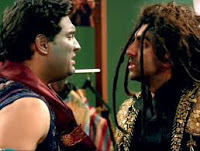 The thing is, with a film that has a few good ideas, some sharp one-liners and a couple of likable performances, you can make it sound consistently good just by listing some of those high points (as I’ve done above). But my lasting impression of Nautanki Saala wasn’t the little moments that worked – it was the large, dull stretches between them. There are too many scenes where the script squeezes a premise dry and then continues wringing away while the actors flounder. Even Kunal Roy Kapur’s masterful act as the dull-eyed Big Moose-like depressive – mooning over a broken relationship, sleepwalking his way through life and making things complicated for others – can’t salvage the needlessly extended scene where an audition turns into a Dumb Charades game. And Pooja Salvi’s non-performance as the much-desired Nandini makes nearly all her scenes flat and uninvolving – which is problematic because here is the girl who is supposed to be the beating heart of this comic-drama, the object of Mandar and RP’s affections.
That said, it might be noted that when we first see Nandini, it is as an unmoving silhouette in profile, behind a translucent curtain. Her function is that of a muse, a blank slate, like the sculpture Pygmalion falls in love with, and she is also the one character who isn’t putting up an act (for most of the film anyway) – and so, a more generous reviewer than me might point out that having a better actor in this role might have defeated the purpose; that a bland performance is appropriate. I’ll abstain from that line of subtextual analysing though – it would mean being as gullible as the Raavan Leela audience members*** who nod at each other and say “ah, okay” when Ram makes an accidental entrance with “Nandini” on his lips and then hurriedly modifies it to “Janak-Nandini Sita”.
--------------------
[*** two of whom are played by the excellent Anuvab and Deepanjana Pal, whose parts here should really lead to the institution of a “best cameo” category at our film award shows]
 Nautanki Saala is officially inspired by the French film
Apres Vous
(which I haven’t seen) and I hear that some scenes, such as one involving a grandmother and a potentially incendiary letter, are direct lifts. But it entertainingly uses the Ramayana story as a parallel for its own narrative (the glimpses we get of the Raavan Leela suggest a Phantom of the Opera-meets-Zangoora-in-Lanka production, for which I’m fairly sure there is no equivalent in the French film) and it is also thematically similar to Sippy’s earlier movie
Bluffmaster
. In that one, a conman played by Abhishek Bachchan finds himself on the receiving end of a giant, convoluted con which eventually has a therapeutic effect on him. In Nautanki Saala, RP (Ayushmann Khurana), who is a different sort of “conman” (being the director and lead actor of a play), goes through a similar process of self-discovery. Ostensibly he is the one helping someone else – a suicidal young man named Mandar (Kunal Roy Kapur) – but the story’s arc leads up to a point where RP is asked “Jaal sirf tum biccha sakte ho?” Or, as someone else puts it, “Sacch jaanne ke liye kabhi kabhi nautanki karni padti hai.”
Nautanki Saala is officially inspired by the French film
Apres Vous
(which I haven’t seen) and I hear that some scenes, such as one involving a grandmother and a potentially incendiary letter, are direct lifts. But it entertainingly uses the Ramayana story as a parallel for its own narrative (the glimpses we get of the Raavan Leela suggest a Phantom of the Opera-meets-Zangoora-in-Lanka production, for which I’m fairly sure there is no equivalent in the French film) and it is also thematically similar to Sippy’s earlier movie
Bluffmaster
. In that one, a conman played by Abhishek Bachchan finds himself on the receiving end of a giant, convoluted con which eventually has a therapeutic effect on him. In Nautanki Saala, RP (Ayushmann Khurana), who is a different sort of “conman” (being the director and lead actor of a play), goes through a similar process of self-discovery. Ostensibly he is the one helping someone else – a suicidal young man named Mandar (Kunal Roy Kapur) – but the story’s arc leads up to a point where RP is asked “Jaal sirf tum biccha sakte ho?” Or, as someone else puts it, “Sacch jaanne ke liye kabhi kabhi nautanki karni padti hai.”That probably makes this film sound more interesting than it is; actually, it’s very uneven, alternating between a few inspired comic moments and some prolonged and awkwardly performed scenes. Given the premise – with people constantly putting on a show, both inside the theatre and outside it – there are naturally lots of inside jokes (the very title derives from an exclamation from a legendary film made by Sippy's dad) and self-referential humour. The soundtrack plays “Dramebaaz” at regular intervals, there are one-liners like “Stop playing God, Ram”, Ayushmann gets to say his own name onscreen (something that wouldn’t be practicable in most regular movies) courtesy a cheeky little “Ayushmaan bhav”. And people speak to each other back-stage in the archaic language of the play (“Peeda kya hai, vats?”) – the best of these scenes don’t feel like forced attempts to extract humour, they provide a sense of artistes who are so steeped in what they are doing that this language comes naturally to them (or perhaps speaking like this just helps them stay in character). But of course it can also bespeak an inability to separate life from theatre, which is a lesson RP has to learn.
Some of the sight gags are good too, such as the use of the Mean Streets poster with De Niro’s Johnnie Boy, or the scene where Mandar emerges from a steamy bathroom after a shower, looking like a halo-soaked deity, his hand raised in what seems like a gesture of benediction (though he’s really just trying to swat a mosquito), giving RP the inspiration to test him for the role of Rama. And there are a few lunatic asides, such as the scenes involving a fast-talking, expressionless nurse whose speech has to be interpreted by an assistant (a reminder of the joke about chemists being the only people who can decipher a doctor’s handwriting). In moments like these Nautanki Saala shows a knack for off-the-wall comedy that it doesn’t quite take all the way.
 The thing is, with a film that has a few good ideas, some sharp one-liners and a couple of likable performances, you can make it sound consistently good just by listing some of those high points (as I’ve done above). But my lasting impression of Nautanki Saala wasn’t the little moments that worked – it was the large, dull stretches between them. There are too many scenes where the script squeezes a premise dry and then continues wringing away while the actors flounder. Even Kunal Roy Kapur’s masterful act as the dull-eyed Big Moose-like depressive – mooning over a broken relationship, sleepwalking his way through life and making things complicated for others – can’t salvage the needlessly extended scene where an audition turns into a Dumb Charades game. And Pooja Salvi’s non-performance as the much-desired Nandini makes nearly all her scenes flat and uninvolving – which is problematic because here is the girl who is supposed to be the beating heart of this comic-drama, the object of Mandar and RP’s affections.
That said, it might be noted that when we first see Nandini, it is as an unmoving silhouette in profile, behind a translucent curtain. Her function is that of a muse, a blank slate, like the sculpture Pygmalion falls in love with, and she is also the one character who isn’t putting up an act (for most of the film anyway) – and so, a more generous reviewer than me might point out that having a better actor in this role might have defeated the purpose; that a bland performance is appropriate. I’ll abstain from that line of subtextual analysing though – it would mean being as gullible as the Raavan Leela audience members*** who nod at each other and say “ah, okay” when Ram makes an accidental entrance with “Nandini” on his lips and then hurriedly modifies it to “Janak-Nandini Sita”.
--------------------
[*** two of whom are played by the excellent Anuvab and Deepanjana Pal, whose parts here should really lead to the institution of a “best cameo” category at our film award shows]
Jai Arjun Singh's Blog

- Jai Arjun Singh's profile
- 11 followers
Jai Arjun Singh isn't a Goodreads Author
(yet),
but they
do have a blog,
so here are some recent posts imported from
their feed.

