
Nancy Wilson's Blog, page 25
March 21, 2013
March 20: God’s Pleasure
In Colossians 1:10, Paul is praying for the Colossians “that you may walk worthy of the Lord, fully pleasing Him,”
As with any Scripture, there are always several things to note, but I’d like to just mention one. Notice God’s pleasure with us when we walk worthy. We tend to think of God’s displeasure with us more than His pleasure with us. But we misread Him when we see Him this way. Of course He requires things of us. Like an earthy father, He exhorts, comforts and charges. We are to take up our cross and follow Him obediently. But when we do this, He is pleased and satisfied with us.
A false view of our heavenly Father may be attached to our own earthly fathers. How many of us know for a fact that our fathers are pleased with us? Do we think of our fathers as judges, ministers of wrath, seldom pleased and always angry with us? If so, it is no wonder that we think of God the same way.
We know what it is like to be pleased with our own children, satisfied with their progress and efforts at obedience. That is what we must compare this to. We are happy with our kids when they obey us cheerfully, when they are trying hard to do what might not be easy for them, and you know how much it pleases them to see your pleasure. In the same way, we are blessed when God is pleased with us.
Some parents withhold their pleasure. When they see the kids’ obedience, they simply pile on more commands. It’s never enough. That is not how God treats us. He wants us to enjoy Him and enjoy His pleasure. In the same way, parents should demonstrate their pleasure with and to their children.
Remember God’s words spoken at Jesus’ baptism: “This is my beloved Son, in whom I am well pleased” (Mt. 3:17). God the Father expressed His pleasure in His Son in a very public way. This is the tone we want to set in our own homes, with our own children: You are mine, and I am pleased with you.
My last conversation with my own earthly father (and neither of us knew it was going to be the last) was quite memorable. I had called him on Father’s Day, and I was expressing my love and appreciation for him when he butted in to tell me how happy he was with me. I thank God for an earthly father who expressed his pleasure with and to me. And that was only possible because of our heavenly Father, “The Father of our Lord Jesus Christ, from whom the whole family in heaven and earth is named” (Eph. 3:14) who takes pleasure in His children.


March 20, 2013
March 19: Proverbs 13:10

By pride comes nothing but strife,
But with the well-advised is wisdom.
I think we are probably all very familiar with the fact that pride makes trouble. It is played out all the time around us, and it is clear that pride can be truly annoying. Think of someone coming alongside you in the grocery store to tell you something you are doing wrong with your child. Think of a friend talking at length about her great figure. Think of someone referring constantly to how refreshing their eleven trips to Tahiti have been for them. Think of any time someone dogmatically says something that you know to be wrong but won’t listen when you tastefully correct them. Think of all the stuck up “church ladies” you have ever known who are too proud to admit to having ever sinned.
Now think of all the situations where pride is not direct. When it was a disinterested look that communicated superiority, or an eye roll when you said something. Maybe it was someone not noticing you at all – looking past you, making trouble for you, or not inviting you to something.
It is easy for us to see how pride in all these situations causes strife. Because one rude comment makes you bristle, and after a short narrative in your head about how ridiculous that was that he thought that of you, you see your chance to make a slighting remark back, whilst you hoist the garbage bag by yourself. And the strife is off to a great start.
The thing that I want to point out in this today is the old saying it takes two to tango. The reality is that only pride is offended by pride in others. When someone doesn’t think highly of you – or suddenly imposes themselves on you – this is only a cause of strife if you are feeling that you were, in fact, more important.
Pride is not a strike anywhere match. When it rubs up against joy, gratitude, laughter, kindness, humility, and forgiveness, it will do nothing but wear itself out. The pride of others, if it is actually a problem, is a problem best handled with our own humility. Often times we don’t want to handle it – we don’t want to actually help the person who is being prideful. We want to stamp it out. We want to embarrass them, expose them for the idiot we think they are.
Many of us spend our time making ourselves into that scratchy patch on a matchbook. If anyone so much as alludes to something that I perceive to be a topic upon which she thinks she is better than me – explosion. If my husband so much as accidentally infers that his work is more stressful than mine – a bonfire. If my children do not revere the work that I have done with the mopping today – if they are so arrogant as to just think that what they are doing is more important than what I am doing – then they will spend quite a lot of time getting spiritual cigarette burns.
Wisdom is the opposite of pride, it is the opposite of explosive. It is not defensive against the pride of others. It is not wounded when someone looks self important. It does not need to hash out who knows more about cloth diapers, curriculums, nutrition, or how to make a beautiful home out of cast off plastic bottles. It is not competitive. Wisdom is the antidote to strife, because it is the antidote to pride.
If you find yourself frequently wound up about other people, you need to deal with pride. People mess up. People are rude. People are more fit than you. That is life. Wisdom ends the strife of pride before it begins, because wisdom is a big splash of water in the face of pride. But it is in the face of your own pride that is ready to be offended, ready to spark. Mortify the pride that takes offense at pride, and you will learn wisdom.
March 18: Walking Worthy
In Paul’s letter to the Ephesians, he beseeches (pleads or implores) them to “walk worthy of the calling with which you were called” (4:1). What is the calling with which we were called? We bear the name of Christ. We have been made alive in Him (2:1), raised up (vs. 6), and saved through faith (vs. 8). We are Christians, so we are to live in a manner consistent with the name of Christ.
So what does it look like to walk worthy of our calling?Paul lists a few things here to get us started.
1. With all lowliness and gentleness. This little word all seems to imply that we do not occasionally show a little humility of heart, but rather our lives are characterized by it.
2. With longsuffering. This means we are acquainted with difficulty, and we know how to suffer pain or hardship with humility and grace. Notice this is long suffering, implying that walking worthy involves suffering for a long time. The Christian life is not a spring, but a long-distance walk, steady as she goes.
3. Bearing with one another in love. Walking worthy includes putting up with a lot of provocation without fussing and whining. When provoked, we respond in love with forgiveness. That’s how Jesus does it.
4. Endeavoring to keep the unity of the Spirit in the bond of peace. When we walk worthy of the calling, we try especially hard to preserve what God has given us, which is unity of the Spirit. We have so much in common with our fellow believers. Why would we sacrifice this peaceful bond of unity? We are called to protect it.
March 16: Happiness
Man is always searching for happiness and invariably looking in the wrong places. But God tells us where we can find happiness, the kind that doesn’t evaporate when the circumstances change, the kind that establishes a foundation in our lives that won’t be shaken even in hard (or unhappy) times. This kind of happiness is not light and frothy, blowing in and quickly disappearing. This is the bedrock happiness whose author is God. Notice how we find it from these verses below.
1. “Whoever trusts in the Lord, happy is he” (Proverbs 16:20). This is the starting point for all happiness (or blessedness). If we are not trusting in the Lord, we are trusting in something else. What could possibly be trustworthy like God? If we trust in ourselves, we are bound to find out quickly that we are finite. If we trust in circumstances, they will change. Only God is worthy of our complete trust. He is faithful. When we trust Him, we are happy in all circumstances.
2. “Happy is the man who finds wisdom” (Proverbs 3:13). Foolishness always eventually leads to ruin and misery, even if some may not get there immediately. God invites us to look for, search for, listen to, and pray for wisdom. This will bring happiness with it.
3. “Happy is the man who is always reverent” (Proverbs 28:14). When we reverence our holy God, we will treat others respectfully as a natural consequence. God blesses those who hallow His name, so we should consider how we speak to Him and about Him. We should also consider that we bear His name, so our lives should honor Him. This results in more happiness for us. When we live in a right relationship with our Maker, we are free to enjoy Him.
4. “Happy is the man whom God corrects” (Job 5:17). When the Holy Spirit convicts us of sin, we should rejoice because this is the kindness of God toward us. His correction demonstrates our relationship to Him as our loving Father. When we receive correction, we know we are being sanctified for our good and His glory. This should make us happy!
5. “He who has mercy on the poor, happy is he” (Proverbs 14:21). It is more blessed to give than to receive. As we have mercy on the little ones around us, the unfortunate, the grieving, the poor in spirit, we are reflecting our Father who has shown His mercy to us. This is how we are working out what He is working in us. And this is one more way that we can be a happy people in the Lord.
March 19, 2013
March 15: Running the Race
Therefore we also, since we are surrounded by so great a cloud of witnesses, let us lay aside every weight, and the sin which so easily ensnares us, and let us run with endurance the race that is set before us, looking unto Jesus, the author and finisher of our faith, who for the joy that was set before Him endured the cross, despising the shame, and has sat down at the right hand of the throne of God. – Hebrews 12:1
Once upon a long time ago I found myself on Virginia Beach. It was a pretty big day – at least all the people who were familiar with that beach kept being pleased about it, and the waves were not tiny. I had not spent much time in the ocean, growing up in Idaho and all. Most of the ocean that is reasonably accessible to us here is freezing cold. So while I had seen it, I had not ever really gone in all the way for a swim. So this experience was a new one. And the ocean was totally unreasonable. The waves were big enough that they would just pick you up and chuck you over somewhere else, and while I know how to swim, this didn’t seem to be much about swimming. So as I would try to get out, a wave would hit me from behind, and throw me down into the sand, filling my suit with sand. So naturally I would try to get the sand out in the water again and then make a run for the beach again. Same thing. It was funny and wild and exhausting all at the same time. Eventually I made it out – I think by giving up on the sand-free suit idea.
Now the reason I bring this up is that it was brought to mind recently by the situation in my house. I told my husband that I feel like I am spending a lot of time in that terrible part where you are running so slowly because of the water you are running through, and the big waves just keep coming from behind me – preparing another cosmic joke at my expense every 20 seconds or so. What had occurred to me suddenly was that I was trying so hard to get up on the beach. I feel like my life is supposed to be walking on the beach. In sight of the glorious waves of course, but out of the way, and certainly not with a swimming suit that is stretching to accommodate sand.
But I think the reality is that God has called me to a life in the water right now. He wants me to be survival swimming, alternating with some dead man’s float. He has called me to the water. When I am having a hard time in my life, so much of the burden is caused by me trying to get myself out of the water and onto the beach. It’s not easy in the water, and it’s not easy on the beach, but it is terrible in the 15 yards that bridge the two. I’m not gonna get out of this water – and I shouldn’t want to. That is part of contentment. This is the race that God has laid out for me. It is a race of endurance and patience. A race of snotty noses and interrupted sleep, discipline and meal making. Nursing and kissing pinched fingers. Laughing and not getting the house together. This race has different difficulties.
But the difficulties of my race are not the same as the difficulties of trying to switch races. In my life, embracing the reality of my work is simply part of contentment and obedience. My race involves at least one major milk spill a day. My race involves accidently going three days without stepping out of the house. My race involves a certain level of brain strain that comes from baby loving and nursing and talking to little people all day. My race involves the many layers of diet, exercise, and time.
But I know that I am fighting what God has laid out for me when I am tempted to think of other situations. When I am thinking that if only I could get these people to not get in the way of what I need to do. When I am thinking that I ought to be able to run out to the gym during the day without difficulty. When I think that something is wrong with a life that generates as much mud on the floor, clothes in the enormous hamper, or tired in the evening. When I start thinking that what I am supposed to be achieving is a moment in time. A moment of escape. A clean house that stays that way. The size I want to be. The amount I want to be reading. The way I want my children to be.
But this is a race. And it is a long one and it is a hard one. It is the kind of race that has moments where your legs are numb and you think you can’t do it anymore. It has moments of second winds, where everything seems possible. When we embrace what God has called us to do, we are looking to Him. And when we look to Him, we can rest. Because He is the one who laid it out for us. He is the one who made us for it. And He is the one who has showed us where to look. Fix your eyes on Him. Be content with what He is asking of you. Set your heart on Him, your hope in Him, because you can trust in Him.He is the author, but also the finisher of our faith.
March 14: Body Image
I beseech you therefore, brethren, by the mercies of God, that you present your bodies a living sacrifice, holy, acceptable to God, which is your reasonable service. And do not be conformed to this world, but be transformed by the renewing of your mind, that you may prove what is that good and acceptable and perfect will of God. – Romans 12:1
“Body image” is a term that we are probably all familiar with. It refers to the way you perceive your body in terms of appearance. Many women would describe themselves as having poor body image, simply meaning that they are not happy with it. They might have always been that way – it may be a design feature such as being really tall, having really pale skin, having strong features, or a flat chest. Or it may be something that happened at some point – weight gain, pregnancy aftermath, a big scar, or a lack of fitness. All of these things affect the way we think of our bodies, and the way we think of our bodies is something that gets into all of our lives. We are creatures after all.
Many of us also despise the way that our culture represents the female body – in large part because we could never achieve it. Even if we lost that weight, got super skinny, got breast implants, went tanning, got braces, and eye coloring contacts – even then there would not be a fan blowing our hair alluringly and photoshop could not change the way the people in real life see us. But the real problem with the way the world portrays women’s bodies is not that it is unrealistic about what women are, the problem is that it is a lie about what we are for.
Form does indeed follow function. The world believes that our bodies are for the sexual pleasure of whomever. The ultimate good in the world is to have a perfectly formed, sexually free body. A body that is so “perfect” that it can hide the soul-raisin within. This is why those random campaigns to get plus sized models to appear in sexy ads are so comic. Changing the definition of what we want these bodies to look like doesn’t get anywhere near to solving our problems.
So what does God say our bodies are for? When He made the first woman in the garden, He made her as a helper, as a companion, as a lover, and as a mother. Her body was made as the tool for those tasks. Her body was made to house a soul that was to grow and flourish as it worshipped her Creator, and obeyed Him. Her body was not the point. God did not task Eve with standing sexily about the garden. He gave her jobs to do. Jobs that she would need a body for.
Getting right with your Creator is the first and most important step in getting right with your body. Your body was made to serve God. It is a tool that we use to honor Him as we obey. We use it to be modest, to be chaste, to be hard working. We use it to be lovers of our husbands, mothers to our children. As Christian women, our body image should be based on the body – giver, not on some construct of a diseased society.
Now I can imagine two different kinds of women reading this. One is thinking, “Yes, and amen! What is with all these young girls who think they need to be cute when they are having babies? What is with that? What is with all these men who are so corrupt that they want women to look good? Like my husband. Doesn’t he understand that having babies and not fixing my hair is what God made me for?!”
The other is saying, “Careful now, you’re gonna be making Christian women think that fitness doesn’t matter and that looking good for your husband isn’t important! They are all going to think you mean that fatness forever is the only way to serve God. They all think I am worldly because I like to dress cute. That’s not what they need to hear!”
Either way, that is the wrong response. If you hear this and apply it to everyone else, you aren’t hearing it. God loves you, and He gave you your body. When we understand this, we are secure. Security in this is the only way to deal with the realities of the life we have in joy. Our bodies change. Our bodies go through phases of life with us. But in all of those phases there is a way to honor God with our bodies, a way to present our bodies as a living sacrifice.
March 17, 2013
March 13: Lowliness of Mind
“Let nothing be done out of selfish ambition or conceit, but in lowliness of mind let each esteem others better than himself” (Philippians 2:3).
Lowliness of mind is the opposite of pride. This idea of putting others first is a theme in Scripture. “Be kindly affectionate to one another with brotherly love, in honor giving preference to one another” (Romans 12:10).
Unfortunately, we are all pretty good at finding out the faults and shortcomings of others, and either pointing these faults out or sharing them (complaining about them) with others. You may hear parents do this. They don’t want others to think they approve of their children’s mistakes or failures or bad habits, so they point them out or make fun of them. But this is pride. Rather than “esteeming them better than themselves” by training and teaching and loving, the parent tries to put distance between them. But children need their parents to identify with them, not put distance and criticism between them. That’s how parents drive their kids away.
Lowliness of mind has to be cultivated. A lowly mind naturally puts others first; it considers their frame. It sees the faults, but overlooks them, and doesn’t keep a record of them. Pride takes note of the shortcoming and gets annoyed at them. But love covers them.
Spurgeon said, “Faults are thick where love is thin.” If someone is especially on your fault-finding radar, then pray for love. Ask God to give you the love to spread over the faults you see. Seek His forgiveness.
So start at home. Whom are you finding fault with? Your husband? Your kids? Your parents or friends or roommates? If you have a critical spirit, you do not have lowliness of mind.
If you are critical of your children or friends or husband, they will pick up on it and be discouraged or get defensive. Lowliness of mind encourages and nurtures. It genuinely considers others to be better or more important; it doesn’t just pretend to have that mindset.
How do we get this? We might start by taking a minute to consider some of our own faults and shortcomings. We’re not so hot ourselves! Lowliness of mind is a work of the Spirit in our lives. Pride is the work of our own flesh. So we know where to go to get this.
“For I say, through the grace given to me, to everyone who is among you, not to think of himself more highly than he ought to think, but to think soberly, as God has dealt to each one a measure of faith” (Romans 12:3).
March 12, 2013
March 12: Walking on Water with Jesus
One of the wonderful stories of Jesus is the one about when He walked on the water, and it is told in Matthew 14:22-33, Mark 6:45-52, and John 6:15-21. The account in Matthew includes Peter’s request for the Lord to command him to come out on the water to Jesus and his subsequent sinking. The Mark account includes the fact that Jesus “would have passed them by” (6:48) if they had not all cried out to Him in fear. It also includes the fact that the disciples “had not understood about the loaves, because their heart was hardened” (6:52).
I love this story for many reasons, but I especially appreciate what it teaches us about Jesus and what it teaches us about our faith in affliction.
First, Jesus meant to pass the boat by, though the Scripture doesn’t tell us why. One Bible teacher suggested that perhaps He would have shown them His glory in some way as He walked past them. Others suggest that He was giving them an opportunity to call to Him for help, and that He would not have intended to pass them by. If the first is the case, then we might learn from this that if our sin didn’t blind us, we might see more of God’s glory. If the latter is the case, then we can be comforted in knowing that God always uses affliction to manifest Himself to us, by getting right into the boat with us. Both are true, what ever the reason was that Jesus planned to pass them.
“No difficulties can obstruct Christ’s gracious appearances for his people, when the set time is come. He will either find, or force, a way through the most tempestuous sea, for their deliverance” (Matthew Henry’s Commentary on the Whole Bible).
The disciples’ fear caused Him to to speak to them: “Be of good cheer! It is I; do not be afraid” (Luke 14:27; Mark 6:50). Jesus is quick to respond to our cry for help. He is merciful to us, even when we do not recognize Him. The disciples should have recognized the Lord, as should we, walking on the water in the midst of the waves and wind. But like the disciples, we are afraid, distracted by our circumstances. The disciples thought He was a ghost! Like the disciples, “We often perplex and frighten ourselves with phantasms, the creatures of our own fancy and imagination”(Matthew Henry again).
Then there is Peter. He sometimes over-estimated his faith, as do we. “Lord, if it is You, command me to come to You on the water” (Matthew 14:28). But once Peter got out on the water, he doubted: “But when he saw that the wind was boisterous, he was afraid” (vs. 30). Even then, Jesus reached out to him. He didn’t let him sink so as to teach him a lesson. He taught a much more powerful lesson by catching him and not letting him sink.
We sometimes have big plans to display our faith. We think we can homeschool or start a Christian school or go to the mission field or have a dozen kids or start a church or stand up boldly for Jesus among the unbelievers. And Jesus may bid us to go ahead when we ask. But then we may start to doubt, and the doubt causes us to start to sink. Our great faith isn’t quite as big as we thought it was.
But we ought not to give up at that point. We should do as Peter did and cry out to Jesus, “Lord, save me!” He will grab our hand and get into the boat with us, calming the waves and getting us to shore. That’s the kind of Savior He is.
Strudel-doodle-do

I just have to get a little something off of my chest before I commence with this recipe. I went to a clearance sale the other day at a fabric store, and while I was at the counter with my epic 80′s fabric, a woman told me something. She said, “I was looking on Pinterest the other day, and I saw the most amazing thing!” Now, she was excited about this and wanted to let me in on it. She went on, ” You smash up two bananas, stir in some instant oatmeal, and that’s it!”
After a moment’s pause I said, “What is it?” and she gleefully said, “Cookies!”
Now if it pleases you to smash up bananas to eat with instant oatmeal in the privacy of your own home, smash away. Gobble it up. I don’t care. But let’s just realize that these are not cookies. We have access to a very rich culinary heritage. Let’s not forget what a real cookie is!
This recipe is for Apple Strudel. It is brilliant and also dear to me. When Luke and I were first married, we went back to Chicago at Christmas. His mom hauled out this recipe and told me it was time to learn. We stayed up late in their small kitchen with a lot of people talking and helping and milling about. When it finally got out of the oven at about one in the morning, the kitchen was still full of a lot of eager eaters. We cut into it and spat it out right away. Apparently in all the people milling about, Luke’s sister had been cleaning up and dumped a bowl of table salt into the top of the sugar canister. So we had stayed up late into the night making a salted apple roll. But I learned how to do it, even if not what it is supposed to taste like then, and I came home with my photocopy straight out of the Slovenian Church cookbook. The ladies in that book looked like they knew their way around a strudel, as well as everything else.
Although that is a great memory for me, it isn’t the only reason I love this recipe. My mother-in-law is Dutch 100%. She got this cookbook and taught herself to make strudel so that she could make it for her father-in-law. He passed away quite young, but not before she had made him strudel. So here I am, also not Slovenian, although I have the name now, making strudel still. Generally we all try to use sugar. Also, I took all these pictures before daylight savings on a rainy winter day. Just the kind of weather that is bad for food photography but wonderful for strudel. You’ll just have to bear with it!
It isn’t a hard thing to make at all. It is a tiny bit of a production, but not much. You make the dough and let it sit at least an hour and up to five. In the meantime, you can peel the apples, toast the breadcrumbs, melt the butter, and mix the cinnamon and sugar. Once these things are all ready, it is just the fun part left.

Dough:
Mix 3 T. oil, 1 large egg, and 1 t. salt in a small bowl. Put 3 cups all purpose flour into the bowl of your Kitchen Aid. (I am confident that if Millie Paisoli and Frances Zibert had a Kitchen Aid, they would have used it. As it was, they recommend beating vigorously with a wooden spoon for 5-7 minutes, followed by kneading for 15. See what I mean?)
With the mixer running, pour in the mixture, and then 1 cup lukewarm water. Let it mix. I leave it in the Kitchen Aid for several minutes – because all that kneading brings out the gluten which this recipe depends on. The dough should be smooth and soft – not too sticky to handle, but not dry. Put a little oil in a bowl, knead the dough by hand for just a minute and to shape it into a nice ball, then press it into the oil and flip. Cover with some plastic wrap, and let it rest in a warm place for at least an hour, and up to five.
In the meantime, peel 3# baking apples. Granny Smith are a reliable choice here, but Jonathans, Jonagolds, Winesap, or any apple that bakes well will work. Mix 1 cup of sugar with one teaspoon of cinnamon in a small bowl and set aside. In a saucepan, brown a cup of fine bread crumbs in 3/4 c. butter. Set aside. Melt another 3/4 c. butter and set aside.
Preheat the oven to 450 degrees. Now you put a clean sheet or tablecloth on the table and sprinkle flour on it. Rub it in little. Put your dough in the center, and roll out to a circle about 18″ across. Pour some of the warm melted butter on it, and rub it in with your palms. Now, with your palms, reach under the dough and begin stretching. You want to work from the inside out, walking around the table as you go. Gently stretch and move along. You want the whole thing to cover an area about 3ft x 4ft. Just work quickly without worrying about it. I believe strudel is like pie, in that it can channel anxiety. This is not rocket science. Try to be like the women in the Old Country who just made it without comparing it to the perfect strudel of all time which they have seen on Pinterest. As you stretch, you will be making this dough stinking thin. You should be able to read a newspaper through it when you are done.
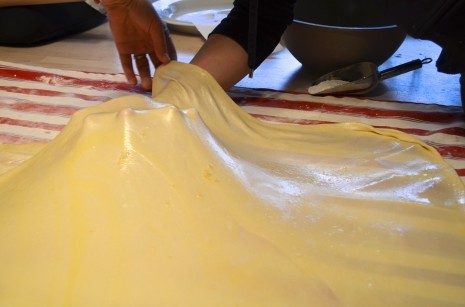
When it gets to be huge and fairly rectangular, you will want to trim the edges. I use a pizza wheel – just to cut the very edge, which remains thick, off. Now on to assembly. Get your buttered toasted breadcrumbs and sprinkle them all over the dough, except the bottom 4″ (lengthwise). Spread slices of apples on the lower half of dough (also leaving the bottom 4″). Sprinkle the cinnamon sugar over all the apples. Now fold that bottom 4″ up over the apples.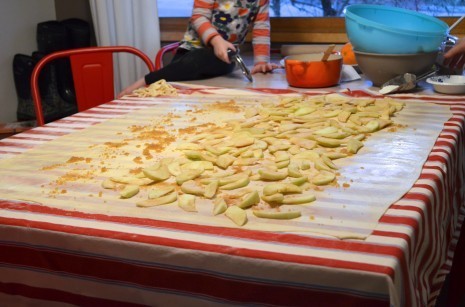
Now pick up the edge of the tablecloth and carefully begin rolling.
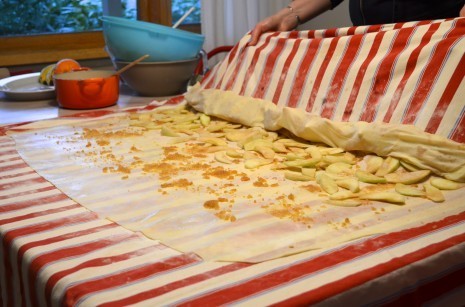
When you get to the end of the apples, stop. There is still butter! Drizzle all but a couple tablespoons on the remaining bit of pastry. Then roll it all the way up. It is possible that the side edges are supposed to be turned in too. I don’t, and the ends are delicious so I’m not worried about it, but if you like to keep things tidy, you might try that. When it is all rolled up, transfer it to a greased jelly roll pan. As you can see, you will need to shape it in an S to fit it on.

Use the last little bit of butter to brush the outside, and then pop it in the oven. Bake at 450 degrees for 20 minutes, then 375 degrees for 20 to 25 more. Cover with a clean tea towel for 10 minutes when it gets out of the oven; then cut in half and transfer with a couple of spatulas to a platter. Dust with confectioners sugar. Yum. This serves quite a few people. I make two when I do it for Sabbath dinner. A lot of people have seconds, some have thirds, and we have leftovers. So I’d say you can safely get 20 slices out of one, and, served with some ice cream, no one has anything to complain about.

March 11: Proverbs 22:6

Train up a child in the way he should go, and when he is old he will not depart from it.
This is a forever popular verse in parenting discussions, because as much as it is a command, it is also a promise. The idea that there is anything that we might do that can direct our children for life is hugely appealing. But I think that parents often go at it in a weird way. The way your child should go is not an abstract thought. It is not about presenting the right way in flashcards or on a white board. It is not about laying out for them the basics of a life that you imagine would be good for them.
Of course this is all very appealing. It does seem like something that we could achieve. It seems like we just need to sit our kids down and fire a bunch of planned righteousness at them. We have an idea in our heads about what the ideal Christian life looks like, and we think that if we point it out to our children, shazaam, when they are old they will stay on that path.
But this is not the point of the verse. Train them up in the way they should go. Train them up in your obedience. Train them up in your thankfulness. Train them up in your faithfulness. Train them up in your self sacrifice. Train them up in your repentance. The way that they should go should be the way that you are going. You are not to be pointing out some mountain path in the distance and saying, “Do that kids!”
The point of this verse is that your children are learning the path because they are walking it with you. We ought to be able to say to our children, “This is how it is done.” The misconception here is often that if you didn’t do something right a long way back, that you are not on the path, and thus cannot teach your children by example. Parents disconnect themselves from the teaching because they want better for their children. But what kind of nonsense is this? If you have Jesus, you have the Way. You have the Truth. You have the Life. If you are walking in fellowship with God, you are walking in the way.
I think that the temptation to point elsewhere is strong when we are not especially proud of our own past performance. But the Christian life is not about our living sinlessly, it is about Christ living sinlessly. We need to see that our own failings, brought to God in repentance, are the very things that qualify us to teach our children. The human heart is full of sin. Your children, even though they are growing up in a Christian home, will struggle with temptation. But if they have grown up in a life that is full of the sweet air of repentance, the sweet water of life, the bread of sacrifice, and the presence of a savior, they will not ever want to depart from it. When the fellowship is sweet no one wants to leave.
On the flip side, we can easily drive our children away from the faith by pretending that whatever the righteous life is, it is to be found out there somewhere. We think that the way that they should go is far removed from the way that we have been. We want them to control themselves around the internet while we look at our phones under the table at dinner. We want them to keep themselves pure before marriage, but we go ahead and watch smutty shows. We tell them to control themselves, but we don’t discipline our emotions, we indulge our every pity party. We want them to be joyful, but we forget the source of our own joy.
Walk in the way as parents. Walk in Christ with your children. Bring them along. Let them see that you repent, that you have joy, that you love. If we are faithful to God and our children in this way, we will be walking together the length of our lives.
Train your children up in the way of life. Train them up in the way of obedience. Train them up in the way of Jesus Christ. And when they are old, they will certainly not depart from it.
Nancy Wilson's Blog

- Nancy Wilson's profile
- 292 followers

