
A.B. Gayle's Blog, page 4
October 17, 2013
The Power of It
 The Last Rebellion by Lisa Henry
My rating: 5 of 5 stars
What a brilliantly written, well executed short story.
And it's free. This cements Lisa Henry's status as a very talented and versatile writer.
I want Miller's story next.....
The following discussion is spoilerish. I'm not giving away the specifics of the plot, but the content may still best be read after you finish reading it yourself.
What follows is an exploration of the power of one word.
After reading the story, I was surprised to find some reviewers referred to the ending as HFN (Happy for Now). Apparently “The Last Rebellion” was written to a story prompt which called for that.
The author herself has admitted the ending is ambiguous.
Why?
It all hinges around the two letter word: “it”
“Rho never saw it coming.”
But what is “it”?
Is it a positive outcome, something good happening in his life?
Or is it, his death?
Either outcome is possible and neither is "correct".
It’s the question of which the reader chooses that becomes interesting.
Pronouns have power. Our editors urge us to eliminate “it” from our manuscripts purely because of this ambiguity. I’ve lost count of the number of times I’ve pointed this out when editing or beta’ing.
Most times, the author knows exactly what the word refers to, but because of other nouns used nearby, that may not be as obvious to the reader who has to pause and work “it” out.
Sometimes, the author may wish to leave this ambiguity in place, like I suspect Lisa Henry has done here.
Both variants can lead to sequels. In one, the couple would have to find ways that they can be together even though they are on different sides of a conflict.
In the other, the survivor may come to regret his action and over time change and hopefully even find ways to redeem himself, learning his lesson that there are no winners in war.
The case can be made for both interpretations. Studying the text, analyzing character’s dialogue and inner thoughts. Hints can be seen if you want to see them.
What it does expose is how much of the reader’s own personalities, experiences and wishes go into their interpretation. Those who want a happy ending will sometimes ignore the bits that don’t fit into this box. And vice versa. Is it the glass half full/glass half empty divide? Is it readers looking for or expecting a certain grittiness of a particular author?
Even though this is a gay fiction short story, I believe it is just as worth studying on these lines from an academic literary point of view. There is no reason why mm romances have to be light and fluffy. No reason why authors can’t test boundaries and try different literary styles. As long as they know what they are doing and why they are doing it.
I’d like to think there are enough intelligent readers out there to appreciate a story based on its craft and style as much as the plot and characters.
I’d be interested in hearing from other readers. What’s your take on that line? What does “it” stand for?
S
P
O
I
L
E
R
Click "Read More" Here's my interpretation. Miller kills/executes Rho. Probably by snapping his neck. Rho didn't see his death coming.
Why? Because Miller's primary motive was to break Rho whichever way he could. He recognised Rho had been trained to or was, by his nature, able to withstand normal interrogation techniques.
Miller wanted to see if he could use kindness or at least appeal to other needs Rho had. Once Rho had submitted, Miller knew he had "broken" him and the experiment was over. Underlying that was a fatalistic recognition that Rho had no future. Miller had already prevented his execution once (probably by a gunshot to the head while bound and hooded never seeing or experiencing freedom or sunshine again). The usual fate of prisoners who were no longer needed. To Miller, at least Rho found peace and did not die in fear.
Let's look at the other interpretation. Rho never saw a "positive outcome" coming. Could Miller have gone AWOL and kept Rho at his farm?
Possibly, but why have that sentence in there at all? Remember we are in Rho's head at this point in time. Wouldn't the verb have been "happening"? and why place this at the end of the story. It's an omniscient viewpoint and would more likely have occurred earlier before we are shown how "good" it is. In fact, the story could have simply ended with "And it's good.
Personally, I felt the tragic ending suited the situation even though I felt gutted after.
But I could picture Miller doing it almost out of kindness and Rho's death would haunt him ever after. Where could he go from there? Could he ever redeem himself or would he see his soul forever tainted with that stain?" View all my reviews


October 7, 2013
Passes with Flying Colours
 Flying Colors by Clare London
My rating: 5 of 5 stars
I've been waiting for this book for ages, ever since I first "met" Red and Carter in "True Colors". I confess to being one of the ones begging for their story. Spin offs, sequels and series are harder to write than they look. Clare and I even shared a blog about the concept of sequels and series here: http://www.abgayle.com/1/category/cla...
So I pre-ordered the story and devoured it as soon as I could.
I was not disappointed. It isn't easy getting the balance between showing the established couple from the initial book, keeping their relationship with the character in the picture, building the new relationship and making it relevant to the world they live in.
I feel Clare came up trumps. I felt convinced they were right for each other. Neither revealed their true fears and strengths to the other inititally for fear of being hurt, but we saw those strengths in their interactions with others.
I enjoyed the way they dealt with the youth centre. Sure it is a trope, but there were a number of very pointed messages in there from the author about how these things could and should be organised, so I felt that lifted it from being just a plot device.
As usual, the prose read fluidly. I'm a nit picker, and if it had been in my hands as a beta reader there would be very little "red" on the page. Which as those who have had to suffer at my hands know is a rare thing.
I haven't read anyone else's reactions to the story for the simple reason, I wanted to see it through my own eyes first.
If anything, I enjoyed it more than I did "True Colors". Not sure why, perhaps because I knew the characters better. Red and Carter are likeable but not two dimensional. I appreciated the interaction with the parents.
The tension and conflict didn't come from manufactured bullies or villains, it was more whether they could get over their own prejudices. At one stage Carter makes a joke about Zeke and Miles being like Jane Austen's story, there was certainly a lot of prejudice on Carter's side. But he gradually saw through the brittle exterior and allowed Red into his life.
As a spin-off it certainly passed with "Flying Colors".
View all my reviews
October 2, 2013
Another great story by Jeff Mann
 Purgatory: A Novel of the Civil War by Jeff Mann
My rating: 5 of 5 stars
I have a confession to make.
I was so worried that there wouldn't be a HEA that I read the end first.
Then, once I knew the answer, I flipped to halfway through and read to the end, and then once that was done, I flipped back to the beginning.
I know, I know. I shouldna' done that, but I actually found it intriguing, seeing how Jeff Mann manipulated the writing to make each subsequent action plausible.
I noted one review condemned the story because of the POV's cowardice.
To understand that, it helps to have read Jeff's other works, both his fiction and his essays to gain an understanding of his fascination with the South and his championing of their cause in the Civil War and to appreciate his love for the methods they used back then to punish their captives. Methods he has applied in his own BDSM sessions (or at least dreamed of using)
The final reason I accepted the POV characters actions (not condoned or excused) was the size factor. He was a small man, an individual who could have rebelled sooner but that would have brought into question all his actions and motives to date. Loyalty to a cause, loyalty to a lost brother, loyalty to a family member who had saved his life on a number of occasions is not easy to fight, especially when underneath the love he feels for another man are all the feelings that this love is "wrong" and sinful.
I felt that any quicker determination to buck the system would have been unbelievable. Yeah, the story would have been shorter, but all too convenient.
It is a tribute to Mann's writing, that once again I coped with the present tense, and enjoyed a story which on the surface shouldn't have appealed to me. A master storyteller and wonderful writer.
View all my reviews
September 8, 2013
My Kind of Sucker Story
 Desire and Devour, Stories of Blood and Sweat by Jeff Mann
My rating: 5 of 5 stars
Boy this guy can write. When a poet writes prose the difference is marked. I'm not a fan of shifters, shedders and suckers. Too often the genre is just used to circumvent the need to conform to contemporary rules and standards.
I also hate the vast majority of books written in the present tense. In some cases it suits stories dealing with young self centred heroes living in a world which revolves around them, but more often it seems pretentious. It's prevalent in fan fiction which is why I don't read much fan fiction. Often, just knowing a book has been written in present tense is enough to stop me buying it.
I hadn't read the blurb before reading this collection of stories and I was well into the first one before I realised I'd strayed not only into vampire territory but also was reading something in the present tense. Once again I honestly hadn't noticed.
Not know it was paranormal? Maybe the cover should have alerted me, but I'd already read some of Jeff's stories and knew he was into kinky leather sex. I figured, a bit of cutting might have been involved or maybe it was meant to be metaphorical. Lol.
The stories vary in length and are really stand alones with a common hero. If you're a fan of vampires, I'd definitely recommend it.
But more than that. If you're a fan of good writing. Writing that flows effortlessly and brings in enough lyrical description to lift the story above its peers then I'd also recommend this book. The editor in me kept marvelling at the way he constructs his sentences, but that feeling never lasted long as the content swept me up again and stopped me dwelling on the nuts and bolts and ensured I relaxed and enjoyed the overall effect.
View all my reviews
July 26, 2013
A Repeat Review because it's worth it
 Drag Queen by Robert Rodi
My rating: 5 of 5 stars
There’s an old writing rule attributed to Chekhov: “If in the first act you have hung a pistol on the wall, then in the following one it should be fired. Otherwise, don’t put it there.”
This concept deals with foreshadowing, and the fact that all details, however small, are significant and should be integral parts of the story. Well in Robert Rodi’s “Drag Queen”, the gun (in this case Blossom Dearie) isn’t fired until twenty pages before the end. (If you don’t know who Blossom is, honey, google it.)
As I read, I envisaged a few ways ‘the gun” might be fired, but didn’t predict the way it was in the end. That unpredictability, for me, is always a plus.
Written in 1995, “Drag Queen” explores the world of chicks with dicks, in the purest sense of the phrase.
Underneath the humor, the book explores a few serious themes, and has some classic quotes:
“Elizabeth the First, She’s been my real obsession. Probably the first great drag-queen role model in history.”This dialogue came after a long section where the concept that men have had heroes to model themselves on ever since the time of Homer, while it's been different for women:
“I was determined to find a forgotten iconic tradition for women, and hon, it was just not there....The few women who did achieve any real influence or power over the years had to invent themselves from scratch.”
The words were spoken by Kitten Kaboodle who just happens to be the long lost identical twin brother of Mitchell Sayer an uptight, anal retentive lawyer who specialises in real estate cases.
As you can imagine, the sparks fly. From the time poor Mitchell tracks down Donald and discovers to his horror he is a drag queen, he ends up in all sorts of dire predicaments, including sucking a few cocks in a leathermen orgy, something he’d never have dreamed of doing beforehand, and tries desperately to forget afterwards.* Not that that was Kitten’s fault, more Simon an ex-boyfriend who is heavily into the scene. No Kitten was too busy chasing after one of Mitchell's college pals or trying to avoid being upstaged by another drag queen who, God forbid, mimed her songs.
I really enjoyed the story. Campy, irreverent, sarcastic and over the top, just like the people it’s talking about. Underneath there is a worthwhile message. Mitchell's adoptive mother sums it up best:
"Maybe he's someone desperately trying to find a corner of the world where he can fit...Someone who shows more courage every time he walks down a street than you or I have ever had to show in our lives.Especially as Donald says about himself:
"I'm just this ordinary nothing of a man. Someone you'd never look at twice if you saw him on the street. A big gray absence of a person."*Note, I read this book AFTER sending my beta, Kate, a synopsis of "Leather+Lace"!!! But it was good to see that great minds think alike! Maybe it was just as well I wasn't born a bloke as who knows what mischief I might have got up to....
View all my reviews
July 8, 2013
Is It Real? Who cares as long as it's Entertaining
 Homosapien ... a fantasy about pro wrestling by Julie Bozza
My rating: 5 of 5 stars
After reading, and loving, four of Julie Bozza's most recent books, I had been checking this one out, but the reviews and the fact I'm not a fan of pro-wrestling made me wary of buying it.
However, I am a big admirer of Julie’s writing and her recent post into why she wrote the book made me curious: http://juliebozza.com/?p=1077
And I'm so glad I succumbed to temptation, as her story actually deals with the aspects that turn me off: the fakery, the frenetic fanfares, the fans themselves.
If you’re expecting a traditional m/m romance, this isn’t the book for you, but if you’re looking for an amusing, heart-warming, thought-provoking book this is.
While Patrick, her narrator, is awed by the romance that blossoms between his dour, idealistic, intelligent boss and his hero, a flamboyant pro-wrestler, he also explores the true nature of pro-wrestling and discovers the potentially deal-breaking fact that the fights and characters are all scripted. Note, I didn’t say “fake” and the difference is very much at the heart of the book.
Sure, the guys are excellent stunt men and the sport is potenitally dangerous, however, I wouldn’t recommend that anyone should bet on the outcome of pro-wrestling matches, relying purely on technique or form. For if you did, you would be laying odds on whether you knew which way the soap opera unfolded. It would be like betting on what happened next in “Lost” or in the lives of Posh and Beck - a real life couple who carefully script what the public knows about their lives.
While the book doesn't deal with these sort of things I was reminded of many other instances that are manipulatively scripted while ostensibly being "real". For example, it’s becoming more obvious that shows like "Big Brother" are scripted. At least as far as what the producers care to show and what they don’t. Even the morning radio shows that revolve around the witty banter between two radio jocks is scripted to an extent. Just check out the comedy writers who are sometimes given credit. And another form of “script” is done in “real-life” diary blogs which sometimes even use made-up characters and include content based on comments from previous blogs all in an effort to gain maximum interest and patronage.
Because that’s what it all comes down to in the end. Bums on seats.
The pro-wrestlers' situations and storylines are manipulated to gain the most impact, whether shocking or affectionate. The viewers are also being manipulated. We love to hate just as much as we love to love.
In a way, pro-wrestling is the grown up version of clown routines at the circus. It is soap opera for men. There was even one section where the author told about how they’d performed live to differently aged groups of kids with cancer. The storyline/action changed appropriately.
Does this make it fake?
Should we care that it’s not “real”?
These are the sorts of questions that are covered in the book.
But the most telling conflict at the centre of the book is the way being a gay professional wrestler was seen as a mockery at first and then later brought out a lot of homophobic reactions from the red-neck crowds and fellow participants. This raised the question should this have been allowed to continue?
There was one brilliant quote in the book that summed up the author’s take on the situation. It came from Patrick after his eyes have been “opened”
”it occurs to me that the crowds are free to enjoy Butch and Sundance and their gay antics, because they are now beginning to know or at least guess that it’s all scripted. They don’t have to be uncomfortable about it, they can just cheer or (preferably, in this case) boo to their hearts’ content……because the mob just might find themselves enjoying all this queerness, and that might just painlessly widen out to an acceptance of real queerness before anyone notices.”The writing style is worthy of comment as well. As a writer, I tried to picture other ways the subject could have been handled. For current day scenes, it even starts out in past tense and switches to present tense. We are given part of the story as reconstructed dialogue between two people and the narrator wasn’t present at the time. Patrick addresses the reader, yet fails to give insight into his own personal life at the time. Yet what happens to him is also ultimately affected by the pro-wrestling scene. These sorts of things might turn off some readers, but I loved the sheer audacity of it. Much like people either do or don’t like the flamboyance of pro-wrestling.
The themes of “Good versus Bad” and “Us versus Them” also formed a thread in the book.
None of these themes are “told” to us. We have to pay attention and see them ourselves, although the way Julie (or should I say the owner of WWW, Jack Dynes) switched to The Fallen vs The Righteous was an interesting twist. As Patrick says:
It’s all heat, whether it’s cheering or jeering, and heat’s a good thing. Heat is what they want.”In the end, this is what the story is all about. Giving people what they want. Not necessarily what they need. Or it is, if what they need is a bit of passion in their lives. A bit of excitement.
I really enjoyed the book both on a visceral and intellectual level. Those only looking for the former might be frustrated that we aren’t given the story in traditional format, but I doubt the theme could have been explored so effectively if we were. At times, I was reminded of Jane Davitt’s Hourglass which deals with two men who appear in a TV show together.
Julie ends off with a statement:
”Wrestling’s more than just violence or a soap opera or a parody. It’s a postmodern phemomenon.It is definitely worth thinking about this while reading it. See how many times we, as viewers or readers, are manipulated into reacting a certain way. With the instant feedback of TV ratings, being able to measure Youtube and Facebook “likes” and website “hits” those who manipulate or write the “scripts” can tweak them to gain maximum effect.
These sorts of stories deserve to be read more. Thank you, Julie for writing it.
View all my reviews
July 1, 2013
Charm: A Two-Edged Sword
 The Definitive Albert J. Sterne by Julie Bozza
My rating: 5 of 5 stars
This book is about charm.
The use of it. The abuse of it. The lack of it. The strength of it.
Albert Sterne is not a charming man.
He is impatient, abrupt, arrogant, irascible, the list goes on.
Fletcher Ash, the only person who has managed to penetrate his defensive field, possesses charm in abundance. He gets on with everyone. His work mates. His superiors. He likes people.
On the surface, you’d assume that being charming is a good thing, yet one of the hardest hitting sections of the book involves a scene where Fletcher comes to realize that he’s been charmed by someone else.
The villain also charms his victims into a false sense of security before striking like a snake.
It is this shared ability to charm that allows Fletcher to gain an insight into the murderer’s psyche.
There are four linchpins in every murder mystery. Whodunit? What was their motive? How did they do it? And will they get away with it?
The same questions could be addressed to the book itself.
The first? Easy. Julie Bozza spent the majority of her life in Australia but has now returned to England, the land of her birth. Is this relevant? Yes, in that I gather from other reviews that she has some of her facts wrong regarding American FBI procedures. If she has, those errors didn’t bother me, as my awareness of them is based on what I’ve gleaned from TV. Can we be sure that what we see on TV is correct, anyway. Do they follow the same procedures in all cases? And what happens if you have people whose nature ensures they do things their way, not necessarily the correct way? I gather from correspondence that she researched it as much as she could (not just TV), finding in the process that even “Silence of the Lambs” got some facts wrong.
In the end, the procedural aspects didn’t bother me because I was too wrapped up in solving the mystery of the people themselves to be bothered about these sorts of things.
The plot itself revolves around one man’s obsession in tracking down a serial killer. Given the title, you’d think that man was Albert Sterne, but it’s his friend, Fletcher Ash who takes centre stage for most of the book.
For a large section, Albert isn’t even physically present, however, the nature of his personality and their relationship still impinge on Ash’s actions. As his frustration grows because of his inability to solve the crime and prevent more murders, Albert is the one constant he can depend on. It is Albert who gets him back on track when he goes off the rails. He is the one definite thing in Fletcher’s life. The constant.
Albert’s irascible nature actually becomes a relief because it is honest. It is who Albert is. He hasn’t charmed anyone. Not even Fletcher. If anything, he has held Fletcher at arm’s length. Struggling against allowing anyone into his life.
Ash could distract him at the most inopportune moments. A complete waste of energy. But he realized there was no way to undo the damage. He could only hope to minimize its effects, give it the necessary time to wear off.What a gorgeous way to say he’s in love without saying the “l” word.
I enjoy books where you have to decipher the “shows” or the clues, for yourself. Books that are a mystery on another layer. We’re not told how much Albert loves Ash. We are told that on one level, he doesn’t want to be. But deep down, it’s another matter. If you examine the text, paying attention as you read, all sorts of clues crop up to what is really driving him. For example, Albert’s obsession with the color blue. The analogy of the weeds that infiltrate his garden. The ones he grudgingly accepts because of their blue flowers that remind him of Fletcher’s eyes. The way he cooks and prepares a haven for Fletcher even while verbally warning him away. The descriptions we get:
Ash’s face brightened again, then slowly began to outshine the spring sun.How can a man who thinks like that be described as cold and unfeeling?Why is he like that might be a better question.
Fletcher has to resort to this type of detection to determine how Albert feels about him. This inability of Albert’s to share his feelings and his passion openly frustrate Ash. Hence his need to seek out what he thinks at first is a more honest relationship only to have his eyes opened to some unpleasant truths.
One of the benefits of eReaders is the ability to annotate as I go. I mark paragraphs that strike me as worth remembering, or quoting. By the time I finished reading, I had a stack.
Woven into the text were some thought-provoking comments on society and people in general. At one point, Fletcher has a conversation about minorities with Xavier, a black gay politician:
“A minority people wants to maintain solidarity, to create a home or an identity without internal divisions, so that it can face the rest of the world. They want to present a positive image. So dissidents, like gays within that minority are silenced twice over because they’re disruptive and they’re seen as a negative. You find that with blacks, with Jews, with Chinese Americans, whatever.”And then he goes on to say later:
”We need to mingle to successfully co-habit this small world of ours, but mingle without imposing templates on everyone. We need to appreciate the individual, celebrate differences rather than persecute them…..a minority within a minority, like gay black men, needs to first find pride and dignity in its own identity, on its own terms….A small group needs to develop authentic self-determination and then they can choose to become part of mainstream society - a part of the wonderful diverse whole that deserves and demands as much respect as any other part.Wonderful words, and yet Fletcher was later to question this man’s morals.
This concept of good co-existing with evil or at least cold-hearted pragmatism lies at the heart of each of the four cornerstones of this story: Garrett, Xavier, Albert and Ash. It is the struggle to balance these that I found really fascinating.
Does the end justify the means?
How do you determine where that boundary lies? How did Fletcher?
One telling phrase was
“But if I wouldn’t approve of your means and tactics in the hands of a right wing reactionary, then I can’t in all conscience approve of you.”From a traditional story telling structure, this whole section in the centre of the book, where Albert Sterne is absent breaks all the rules. Yet even though he is not present, what happens here, the need for Fletcher to seek a different type of relationship and what he learns from it are all totally necessary.
Without it, the guilt, the change in direction, the recognition of what was lacking would not have resonated so soundly.
What other structural points make this book stand head and shoulders above the rest? Incorporation of dreams into text. We are slipped into them seamlessly. No italics to jerk us awake. We are as unaware of them as Fletcher is but soon learn to recognize the sign. See them change to reflect the action leading up to it and the inner turmoil that they are reflecting. These aren’t the typical m/m romance’s clichéd dreams of sex, these are psychologist’s bread and butter. Yearnings for connection, fear of failure.
When awake, Fletcher is acutely aware of the problems with their relationship. And so is Albert who recognizes that he
expected too much, as well, and neither could meet the other’s needs.But they keep trying. They don’t have hissy fits. They may not lay all the cards on the table when they communicate, but that reflects their own natures and backgrounds.
I have yet to read the follow up story to this, which I gather is a prequel of sorts. I gather it explores their pasts to show how they became the men they are in this book and what motivates them to act the way they do.
Profiling is an important part of whodunits. Building a picture of the perpetrator from the crimes they commit. Trying to gain an understanding about who they are and why they did what they did. In some ways, I’ve done that with the characters already. It will be interesting to see how accurately I interpreted the clues in this book.
Did the story work? Did Julie get away with doing something different?
Even though it’s long, I loved the book and devoured it almost non-stop. For once, the head hopping didn’t bother me, because it was necessary. The sections inside the killer’s mind are gruesome, but I felt they were needed to heighten the sense that it was important that Fletcher solve the crimes before he struck again. It’s not pretty being inside the mind of an evil man, but this is a rare case in a whodunit where I think it is necessary. Not for the graphic details but to see the extreme version where charm is harmful.
It’s not an easy read. If you want a light-hearted book about two special agents catching a serial killer with lots of graphic sex, read the Cut and Run series.
In some ways, the realtioship between the two men reminded me of Dan and Vadim in Special Forces. But whereas that, too, was a story about a man with irresistible charm and another more dour and introspective, Albert is not Vadim. He’s more aware of and sympathetic to the fact that Ash has changed over time.
And even in Fletcher had been there, the fire of him all but irresistible, Albert would still have been wholly unsure how to respond. All he could do was watch that relentless happy optimism of Fletcher’s die. All Albert could do was hope this wasn’t revenge,This isn’t a romance, but it is a love story. Not romantic love but deeper, more meaningful love.
“One of the reasons I love you,” he finally said slowly, “is that you always insist on me doing my best. We both know how often I fall short of the mark but on the important things, you insist and I try.”Trust and respect mean more than the three easy words. In this case, two simple words broke through the barriers he’d erected
”It’s necessary.I’m so glad others who have read this story liked it and appreciated it.
View all my reviews
June 14, 2013
Essays exploring a Contentious Topic
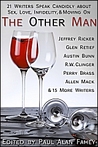 The Other Man by Paul Alan Fahey
My rating: 5 of 5 stars
To say that “The Other Man” is all about infidelity is short-changing the subject and defining the concept by very narrow values. While it’s true that for many readers and reviewers, infidelity is a deal breaker, the fact that these essays are all based on actual experiences makes them an intriguing study of this taboo topic.
Each essay shows a different aspect of the picture, making the issue less black and white and much more complex.
Firstly, Jeffrey Ricker details how while young, single and desperate he often found himself hooking up with married men when he used online dating services. This suited both parties as he wasn’t looking for commitment and neither were they. He states that according to the Kinsey Institute, between 20 and 25 percent of men engage in extramarital sex at least once during their marriage. Other studies put the number between 30 and 60 percent. Yet, during his summer of sin, the author never once saw himself as a home wrecker. In fact, he often felt he was the only one who saw anything wrong with what he was doing. Finally, he realized that there was a difference between fun and happiness and he wasn’t going to find the latter with someone whose heart was already spoken for. When he finally settled down, his relationship “wasn’t in the least bit open.” He was too selfish for that.
While living in a country where gay men were forced to remain in the closet, Glen Retief’s discovered that his rival was not a single person but many. His partner believed in monogamy but “had problems with truthfulness” and because sex had always been done on the sly, it had become a habit that his lover found impossible to break.
The more traditional concept is explored in the next story. After being cuckolded by his last boyfriend Jason Schneiderman had been determined to ease his way into his next relationship: “no longer falling into bed on first dates” only to discover that the man he is platonically dating already has a boyfriend who lives in another city. Unwittingly, he has become “The Other Man.” They decide to make it “just sex” and the person he is with is candid about their relationship with his current boyfriend. The strange thing is, that by eliminating the pressure of forming a committed relationship and worrying about love, the author relaxes and finds he really enjoys the time they spend together as well as the great sex. Time doesn’t stand still though and gradually things change.
The next story, by Austin Bunn, also involves straying husbands. In the essay, he describes the pro’s and con’s both for himself and them. According to him, married men have been trained by their wives to seduce and weren’t beyond using these wiles to catch available gay men. “They knew the triggers, the lingo, their niche in the market.” Inevitably a lot of the men he met were conflicted between their competing thoughts: heterosexual self image and homosexual desire. Denial predominates as they resist what they don’t want to think about. He thinks that the forbidden nature of these encounters might also explain why sex with straight men is such a common attraction for many gay men. What could have been a sordid story turns into an interesting look into this very common situation as it explores the possible motives for both types of men. For a time, “Married men validated my freedom without threatening my loyalty, just as I did for them.”
Another married man features in the next story by R.W.Clinger but this time the man is emotionally paired to the author and bleeds for him, literally, when he gets the guilts for being unfaithful. This is the viewpoint of the man betrayed. In highly charged prose we are led to feel the torment and jealousy after the confession. Then the mental breakdown of both parties as they try to come to terms with the infidelity. Intense emotions matched by intense, disturbing writing.
Tom Mendicino’s essay recounts an episode which later inspired his novel, “Probation” about a married man with unfulfilled homosexual cravings.
Some of the contributors to the anthology are authors, others have blogs. One of these is Mark Canavera who writes for the Huffington Post and worked for a time as a humanitarian aid and development worker in West Africa. While in a relationship with a local man he intercepted emails from his lover to someone who was described as “the only one who loves me.” However, earlier the author was himself discovered cheating, so the story revolves around the justification for doing so and the way infidelities eventually have to be laid to rest. “The parties must declare a truce; they must lay down their weapons. There is not any other way to cure them.” Forgiveness, yet another side to the concept of “The Other Man”.
A chance hook-up in an airport toilet kicks off the next story by Chuck Willman. This finds another angle, the hurt that can be caused to “The Other Man” who can be totally oblivious that he fills that position.
I really enjoyed “Just Wally and Me” by Allen Mack. In this case, “The Other Man” scenario covers how they, as a committed couple were affected by stories of their friends breaking up because of infidelity and resolved to set rules to live by when they were apart. “Neither of us expected the other would or should remain celibate.” “Outside sex was, to us, simply an adventure, not affection.” They were open about these encounters which sometimes even led to threesomes. However, on one occasion the rules were broken. Once was enough. An ultimatum was issued.
In “Way Off”, David Pratt, (author of “Bob the Book”) discovers that the threat to the committed relationship wasn’t another person but another thing. In this case, his boyfriend’s dream of becoming an actor. Infidelities were forgiven as they were caught up in a belief that if things were different they could be up on stage and become something they felt they were always meant to be.
Success was something the next author, Perry Brass had, in the guise of a book called “How to Survive You Own Gay Life: An Adult Guide to Love, Sex and Relationships.” The success of the book resulted in fan letters and many were from one persistent man. Despite being in a committed relationship for twenty years and the fan recently being divorced they have an affair. When it finally ends, we hear of the anguish this caused the author and the painful recovery process as he honestly bares his soul. Sometimes, the one who bears the brunt of the pain is the one who strays.
Many of those who contributed stories write now from the comfort and security of long term relationships. Thirty-seven years in the case of the editor of the anthology, Paul Alan Fahey. But before he found his soul-mate, he too had an early relationship “based on movie fantasies of romantic love.” As the romance waned and they drifted apart, he was picked up, almost literally, by a guy he thought of as a real jerk, but he was desperate. Even as he drives off with him, he’s mentally making excuses and imagining what is going to happen if his boyfriend finds out. It’s only when he’s listening to a particular song in the car that he realizes that there will be no going back. In other words even if nothing ever comes of it, sometimes it needs an encounter with “Another Man” to make it clear that the current relationship isn’t working.
Jeff Mann’s touching story chronicles the hurt felt by the “Other Man” when the furtive affair finishes, especially when the intensity of feelings was never reciprocated. Even twenty years later and in a happy relationship for the last fourteen years he recalls the way he was totally besotted even knowing that the end was inevitable. “Somehow I sensed that I’d never encounter such passion again, and I was determined to live it to the hilt as long as I could, despite the guilt I felt in deceiving Dick, despite the looming loneliness bound to come.” Poem after poem was written. “It was a once-in-a-lifetime ardor and inspiration, I thought. I was right.”
“Ballad Echoes” revolves around Spanish songs the author learned in Mexico from his lovers. The lyrics often expressed what he was feeling. In this case, feeling he was responsible for looking after his HIV infected lover and keeping the relationship going despite the fact love was no longer present and he’d fallen for another man. Ultimately both affairs ended but they taught him valuable lessons to take into a more lasting relationship.
Philip Dean Walker’s essay focuses on what happened when the Other Man was someone lusted after for some time. What should he do when this demi-God asks him out even though he knows he has a conveniently absent boyfriend. “It was easier just to hop into bed without a second thought….” Later he comments that: “The other man can pretend he has his man’s heart, and can even fool himself that he’ll leave his partner one day.” Inevitably he has to endure the “emotional jet lag one experiences in going from such a high to such an unfathomable low in a short amount of time.” After the demi-God goes back to his boyfriend, the author bemoans the fact that he can’t let go.
In Wes Hartley’s story, he outlines how he met his current boyfriend while going out with the young man’s uncle. We are assured that this is purely in an avuncular mentoring way as, like all teenagers, the kid needed a lot of head. The fact that the younger man hooks up with another even younger man, doesn’t faze anyone. As Wes says, “Three’s a Charm.”
In “Last Tango in Cambridge” Lewis DeSimone starts by relating how he was pulled out of the closet by suddenly falling in love with someone who was already taken. But when they eventually fell into bed together, it was sex in its rawest form. “It wasn’t sex we were afraid of; it was love.” He is told in surprise that “it was possible to love two people at once.” He states that he wasn’t “so oblivious as to believe our affair was innocent.” Yet he was romantic enough to believe that “Love is stronger than ethics.” He blamed it on reading too many novels, telling himself that great love requires great pain. In hindsight he believes it was the type of relationship that he needed at that stage of his life. His stolen lover became his mentor and taught him about literature, music, but being “in love” didn’t mean the same thing to them both. It was a perpetual romance, and they didn’t spend enough time together to grow tired of each other. The tedious aspects of life never cropping up to spoil the fantasy. Ultimately, the author realized it would never be enough, but he remembers his first lover as he was, “a creature caught in amber. Something beautiful I can pick up now and then…” and he wants to keep him preserved like that to remind him of a time when he it seemed possible that “romance would never end.”
“You Without Me” by William Henderson once again involves a married man having sex with a male, but this time, the narrator is the married man, finally getting to the point when he can admit that he is gay and is no longer interested in being married to his wife of a dozen years. For once, the present tense suits the tale perfectly, with the action unfolding for both the writer and the reader at the same time, just as mystifying to both because it is such new ground.
Rodney Ross, author of "The Cool Part of His Pillow” amusingly relates how he and his partner are The Other Couple. The college sweethearts who are still together thirty years later. As such they have become the sounding board for less fortunate couples who break up. Over the years, they witness the redrawn dinner lists, the battle over custody of the dog, and worst of all are often forced to take sides, sticking by their friends, or at least the one who ends up using the third plate at their dinner table when the relationship breaks down.
“The Child” by Felice Picano draws a picture of another type of third wheel. In this case, an open relationship that spanned sixteen years ended up with a body-builder being mentored by his partner. Unfortunately, that partner died and Felice was forced to pick up the burden of keeping an eye on an adult who couldn’t look after himself.
The final essay relates how the author stubbornly continued to hold a prior arranged party after being jilted by his partner of ten years. The fiasco became known as The Divorce Party and the entertainment wasn’t what the guests expected.
The strength of the anthology rests in the variety of slants each author contributes to the topic. The writing style is varied and the prose flows smoothly. No single story stands out or drags the others down by being inferior. I only found one typo: palette for palate.
View all my reviews
June 6, 2013
Hurt by a Cult Religion and an Evil Stepmother
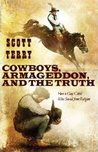 Cowboys, Armageddon, and The Truth: How a Gay Child Was Saved from Religion by Scott Terry
My rating: 5 of 5 stars
4.5 rounded up to 5
Scott Terry’s recollection of growing up in a household dominated by people claiming to adhere to the precepts of being Jehovah’s Witnesses is harrowing reading. What the author as a child longed for, more than anything, was acceptance and attention. Not because he was gay, as that was still something he was barely aware of, but first and foremost as a person and as a child of a father whose love he longed for. Everything changed when his mother left and he gained the stepmother from hell, Fluffy.
In some ways, the author’s life paralleled that of Cinderella. The evil stepmother and the step siblings who received everything that they craved for and the father who lurked in the background, unwilling to stand up to his new wife and preferring to remain ignorant to the way she was mistreating his children. At times, the deprivation of food and love to which the author was subjected took on almost fairy-tale horror proportions, but I have no doubt that the account reflects reality.
Being young and not comprehending the reason for this, his treatment filled him with confusion and resentment as much as anything. Later in life, his main questions were about why this was done as much as condemnation for it. Finally, he was able to escape and find love and acceptance from other relatives.
The fact that the abuse he received was not sexual didn’t lessen the damage it did to his spirit and his growth as a person. The fact that he continually struggled to fit this mistreatment with a love and loyalty that lingered for his cowboy father and even to extent the religion he was brought up in made the memoir more poignant. Thankfully, the author doesn’t seem to have been consumed by rage toward either. Anger and bitterness still survive but, at the end, these morphed more into disappointment. Both father and religion suffered because they weren’t what they could have been or should have been.
The book didn’t rate a perfect score for me as I would have preferred more reflection in the aftermath as to the reason for these shortfallings in the religion and his parents rather than a catalogue of their failings. From what I gather, he mainly wanted to document exactly what he had been forced to suffer for the benefit of the people who had helped him. Almost as if this litany of memories was evidence at a trial. The trial being, in essence, trying to deal with the guilt of rebellion against the fact that he could no longer respect his parents and uphold the religion and beliefs he was told to revere.
In some ways, growing up is all about finding your own path in life, unfortunately for Scott Terry the grip of a religion that thrives on fear and a stepmother that also used fear to exert control threw him into a deep pit that needed a steep climb to escape.
Using fear to hold people in your power is just another form of bullying and just like bullying it exposes the fear inside the perpetrator that this is the only way they can maintain control. In no way does it reflect on the person who is being bullied. In this case it was a vindictive stepmother jealous of love being given to anyone but herself or her progeny and a cult needing fear to ensure people’s obedience.
It certainly appears to have taken the author a long time to overcome the abuse and make peace with his guilt for doing things he’d been forced into in an effort to survive. Children should never have to endure this sort of treatment. The effects last long afterward and that fact alone makes it difficult to forgive the perpetrators, whether people or religion.
His exploits after he finally escapes his childhood and grows into a man who accepts he is gay are barely touched on, but are nevertheless interesting. Especially as it took him some time to comprehend that not all gay men are effeminate. His account of arriving in the Castro back in the late eighties reminded me of accounts of people “finding religion” later in life. He was presented with a new Truth.
Confessing his gayness to himself and the relative who had taken him under her wing was a huge step in his life and led to my favorite lines in the book.
“I’m gay,” I blurted.Memoirs are made up of memories and, as such, they consist of a jumble of things that have stuck over the years. To an outsider, these memories can seem irrelevant and at times unbelievable, but they are a valid and necessary way to show to those who didn’t live these memories what exactly happened.
She stopped chewing for a few seconds.
“And how are you doing with that?” she asked.
The debate between nature and nurture never denies the profound effect of the latter. In this case, nurture didn’t make the author gay, but his experiences certainly shaped who he is today. You can feel a lingering sadness at the way he feels cut off from his sister who is still a Jehovah’s Witness. Thankfully, as he recounts at the end, he found someone who taught him to love himself and thus he was finally able to love others.
Apart from the horrors mentioned, the memoir draws a vivid picture of the Okies, a cult religion and a past era.
View all my reviews
May 27, 2013
My Baby turns One
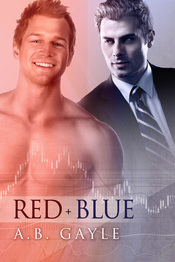 “Red+Blue” turned one the other day.
Its first year was a salutary lesson that you can’t please everyone.
Comments varied from: “You know those books that aren't bad, but they seem to last forever?” to “I liked reading about the developing relationship from the POV of both MCs. It is nice to read a book where the author takes the time to allow affection & love to develop at a natural & languid pace.”
From: “ I've encountered many harebrained people in my life but the main characters here are complete embarrassment to mankind.” to “A.B. Gayle delivers in spades by giving us two well rounded, compelling mains in Ben and Adrian and a small cast of three dimensional secondary characters.”
Some liked the setting: “I really enjoyed the section of the book as the men travel through the lakes. There were some beautiful descriptions of the landscape, the weather and the journey.” While others hated being out in the wild: “I would have probably liked the camping trip more if it had been shorter but that's because I don't understand the appeal of camping and I'm a sucker for work relationships.”
Some liked the POV format: “I really enjoyed the presentation of this book, which was divided into three parts. Gayle tells the tale first through the eyes of Ben Dutoit (Red). Next is the story of Adrian Sutherland (Blue). Then, as the relationship between the two men evolves, their stories combine into a 3rd-person narrative (Red+Blue).” While others hated that aspect.
Some thought it boring, others didnt: "I just couldn't put this book down. It kept you on the edge of your seat the entire time.”
Some thought it was better than my latest release, others prefer "Leather+Lace."
I could go on and list more widely diverging viewpoints from different readers. Each is valid in its own right. For them....
What this diversity of reaction demonstrates is that every reader is different because we all bring our own expectations and preconceptions into the mix. It may simply depend on the mood they're in when reading it. What their last book was. What type of book they like to read.
Completing "Red+Blue" taught me a lot about writing, but this past year has taught me a lot about readers. Thanks to all who bought it, read it, reviewed it. I am glad it gave enjoyment to so many.


