Rosa Say's Blog: Managing with Aloha, page 19
November 5, 2014
Dear Manager, Don’t let me get bored.
Interesting work will be intentional work.
We often hear this interesting/intentional work of Ho‘ohana described this way: Good work will be engaging. Good work will be important and count for something, and it will be fulfilling.
I doubt anyone would argue, yet this is what was reported by The Atlantic as an all-too-common workplace story:
Two years ago a civil servant in the German town of Menden wrote a farewell message to his colleagues on the day of his retirement stating that he had not done anything for 14 years. “Since 1998,” he wrote, “I was present but not really there. So I’m going to be well prepared for retirement—Adieu.” The e-mail was leaked to Germany’s Westfalen-Post and quickly became world news. The public work ethic had been wounded and in the days that followed the mayor of Menden lamented the incident, saying he “felt a good dose of rage.”
The municipality of Menden sent out a press release regretting that the employee never informed his superiors of his inactivity. In a lesser-known interview with the German newspaper Bild a month later, the former employee responded that his e-mail had been misconstrued. He had not been avoiding work for 14 years; as his department grew, his assignments were simply handed over to others. “There never was any frustration on my part, and I would have written the e-mail even today. I have always offered my services, but it’s not my problem if they don’t want them,” he said.
— The Art of Not Working at Work
The article goes on to talk about cyberloafing and modern-day slacking. It asked these questions: “Does having a job necessarily entail work? If not, how and why does a job lose its substance? And what can be done to make employees less lazy—or is that even the right question to ask in a system that’s set up in the way that ours is?”
You can probably guess my quickest, Managing with Aloha answer to all 3 questions:
Good management matters.
Not a constant look-over-all-shoulders management, but thoughtfully deliberate management as a Ho‘ohana helper, supporter and steady source of encouragement. To count solely on employee initiative, hoping it will be an unending wellspring of self-motivation, and then lament a stoppage at someone’s annual performance review, doesn’t cut it.
Neither does blind trust in work ethic, or a foolish reliance on peer pressure. Managers must recharge workplace energies, and renew any tired, worn out “same ol’ same ol’ thang” conditions with fresh thinking.
As Alaka‘i Managers, we try harder, and we do better. That said, no manager can do it all, and be everything to everyone. Second to great management, and just as critically important:
Culture matters.
Here was another story the article shared:
Consider the last novel by David Foster Wallace, The Pale King, in which an IRS worker dies by his desk and remains there for days without anyone noticing that he is dead. This might be read as a brilliant satire of how work drains liveliness such that no one notices whether you are dead or alive. However, in the strict sense of the word, this was not fiction. In 2004, a tax-office official in Finland died in exactly the same way while checking tax returns. Although there were about 100 other workers on the same floor and some 30 employees in the auditing department where he worked, it took them two days to notice that he was dead. None of them seemed to feel the loss of his labors; he was only found when a friend stopped by to have lunch with him.
How could no one notice?
Yikes. I cannot imagine such a thing happening where there is a healthy workplace culture.
What is culture?Great managers know that CULTURE is simply a group of people who share common values, and operate within those values.
Culture is learned. Culture represents a series of agreements based on value alignment, and results from honoring those agreements.
“Cyberloafing and modern-day slacking” are symptoms, not cause.
This was the article takeaway that resonated with me: “There’s a widely held belief that more work always exists for those who want it. But is that true? Everywhere we look, technology is replacing human labor.” People are not carving time for slacking or cyberloafing out of productive work with the result that expected work is not getting done: They cruise, stay off a manager’s radar, and surf the web to fill a void, knowing they have to keep up the appearance of adding value when expectations are too low.
Our workforce is not lazy by default. The greater likelihood is that they’re bored and unchallenged.
And they’ve gotten awfully good at pretending they’re not.
“If I had to describe my 16 years of corporate work with one phrase, it would be ‘pretending to add value.’ … The key to career advancement is appearing valuable despite all hard evidence to the contrary. … If you add any actual value to your company today, your career is probably not moving in the right direction. Real work is for people at the bottom who plan to stay there.”
— Dilbert creator Scott Adams gives his impressions of 16 years of employment at Crocker National Bank and Pacific Bell.
In City Slackers, Steve McKevitt, a disillusioned “business and communications expert,” gloomily declares: “In a society where presentation is everything, it’s no longer about what you do, it’s about how you look like you’re doing it.”
Both quotes bring back to mind another I saw recently on fulfillment, giving us a simple yet practical look on what the statement “Good work will be fulfilling.” eventually looks like and sounds like:
What is fulfillment made of? Mostly relief.
— Emily Fox Gordon for the New York Times
If you are an Alaka‘i Manager, please assess the health of your own workplace culture, and do so honestly. Resist the pull of complacency, and do not hesitate to address what you find. Supervise.
Don’t fear micromanagement: Help more. Get more involved in the work being done, so you can diagnose any boredom and pretending which may exist.
Chances are that your employees want you to be more involved than you think they do. I titled this post “Dear Manager, Don’t let me get bored.” just in case they want to print it, and leave it on your desk.
Here is some complementary reading in MWA’s Aloha Archives:
Managing Basics: Study Their Work
People Who Do Good Work
Hana ‘eleau: Working in the Dark
Beauty in the Work: “Things Occur to You.”
1-Catch the Good, 2-Tell Them!Much more can be found taking the tags in the footer if any of those value-verbing themes resonated with you.



November 3, 2014
An Attitude of Scarcity or an Expectation of Abundance: Choose Palena ‘ole
There is an attitude of scarcity in Hawai‘i election season campaigning which is very distressing to me. We mostly hear it connected to those “ballot initiatives” which are proposed amendments to the State Constitution or County Charter(s) — proposals we can vote on.
In that campaigning, whether by candidate or special interest group, we are essentially hearing that something may be the right thing to do, but it’s too hard administratively, making its rightness (Pono) irrelevant. Ouch! When something is wrong, do we really want to take the easier way out? Do we have that little confidence in our own abilities, that we cannot cope, survive, and emerge the stronger?
Another facet of this, is when we hear opinions of what should be done for the middle and/or lower classes versus the privileged, or for public sector versus the private sector, or for this community group versus another one. There is way too much us versus them. Whatever way we hear these things, they mean that an attitude of scarcity is in play — i.e. There is not enough to go around for all of us.
In both of these fearful themes — for that’s what they are, the voices of fear — people throw their better sense of reason out the window, and vote to protect their own and ignore the greater good. They ignore the values of true Aloha, Mālama, and ‘Ohana, for all are abundant values, and somehow justify another version in their restrictions. Auwe.
We are better than that.
We have much more abundance available to us than we may think we do.

Scarcity = Short term thinking.
Abundance = Long term thinking.
You must remember, that life goes on when the election is over… if a change is not made toward better, a change to redirect our efforts no matter how difficult that change might be, whatever wrong which exists will continue. Beyond simply continuing, it will compound itself unchecked.
Is that a risk you are willing to take until our next election?
I am NOT saying to vote for change no matter what.
I AM saying to be careful you don’t “leave well enough alone” when the status quo actually isn’t well at all!
Vote with courage, and vote for all of us, with Kākou, the value of inclusiveness in mind. I ask you, as an Alaka‘i Manager and a leader in your community, to be a voice of reason, and opt for Palena ‘ole – our Key Concept 9 in Managing with Aloha cultures. Trust in the certainty that we can progress with future-forward thinking, and stewardship of our greater good.
In short, Palena ‘ole is the Expectation of Abundance. It is positive expectancy, and confidence in who we are as a whole society of unlimited capacity:
Key 9. PALENA ‘OLE:Palena ‘ole is the Hawaiian concept of unlimited capacity. This is your exponential growth stage, and about seeing your bigger and better leadership dreams come to fruition. Think “Legacy” and “Abundance” and welcome the coaching of PONO into your life as the value it is. We create our abundance by honoring human capacity; physical, intellectual, emotional, and spiritual. When we seek inclusive, full engagement and optimal productivity, any scarcity will be banished. Growth is welcomed and change is never feared; enthusiasm flourishes. PALENA ‘OLE is an everyday attitude in an ‘Ohana in Business, assuming that growth and abundance is always present as an opportunity. Given voice, Palena ‘ole sounds like this: “Don’t limit yourself! Why settle for ‘either/or’ when we can go for the ‘and’ and be better?”
Site category for Key 9: Palena ‘ole
If I may suggest a start in your further reading: Palena ‘ole Positivity is Hō‘imi— look for it.



On November 4th, your Civic Duty calls. Answer, and answer well.
There is a rather popular saying in Hawai‘i right now, and it goes like this:
“No vote, no grumble.”
What mostly happens however, sad to say, is that people don’t vote, yet keep grumbling. Hawai‘i has a terrible track record with voter registration and voter turn-out, however we’re very good at talking story when it comes to having naysaying opinions heard (the p.c. phrase for whining).
It’s too late for anyone who hasn’t registered, but to be registered and still not vote? Simply not excusable, whether you’re here in Hawai‘i too, or somewhere else with elections happening tomorrow.
Vote, and Make it Count
Those of us who do vote, have to help the grumblers emerge from their negativity by making our own votes count: We have to vote, and we have to make the best possible choices we can make.
When you vote, you are selecting someone to be an Alaka‘i Manager of society: They will be a manager of civic action, a manager of community livelihood, and a manager of positive communication — communication which must turn negativity into the forward-thinking productivity of Ho‘ohana, and the meaningful, substantive progress of Mālama and ‘Imi ola. Communication which must rally society, and bring us together in the way of Lōkahi, Kākou, and the cooperative synergies of those values.
All of this brings 2 things to mind for me, as the voter and Managing with Aloha coach that I am. Intention and Ho‘ohiki – the ability to keep any campaign promises made, specifically those promises which do align with values that speak to the greater good of our community.
Good Intention
Intention is a word we use a lot in Managing with Aloha cultures, and for very good reason. Intention must be clear, for clarity responds to unanswered questions in a way that will spur next action.
It’s often difficult, and sometimes impossible, to get the complete consensus of everyone concerned by that answer, but action taken will spur the baby steps necessary to get an initiative started — to get the proverbial ball rolling. Change is always possible, and if you erred, you can change course as you proceed, but there’s now more action-based experience to substantiate and better inform the decision-making that follows.
Language of Intention (MWA Key Concept 5 ) makes sure all of these things are well communicated. This is where I find that most candidates do a poor job in election season. Despite all the money spent, they don’t do that well in communicating their ideas and their plans to us. Voting becomes our best guess.
In many voting municipalities these days, money talks the loudest, as a way we determine “true intention” — who is paying for the ad, and for the other campaigning done, and what are their motives? Do those motives align with our values, or not? In other words, can you ignore the static noise (what is actually said) and accurately tune in to the signal (what is actually wanted as a result of power gained).
Expect that better always exists, and can always happen.
As we say in Managing with Aloha, lead with your positive expectancy!
Your “best guess” is something you must make, making it by exercising your right to vote. Voting is a privilege of democracy. The system may be flawed, but we still need it to work for us when elections are over and operations are switched back on.
What voters do, is create probable cause. Voters put the “reasonable grounds” in place so progress can happen.
Ho‘ohiki: Managers make promises they can keep.
In the context of voting for the right candidate, I described Ho‘ohiki as, “the ability to keep any campaign promises made, specifically those promises which do align with values that speak to the greater good of our community.”
And values? They drive behavior: Let’s Define Values
The kaona of Ho‘ohiki:
Hiki means ‘Can do.’ Ability is present, and it awaits intention and/or opportunity.
To Ho‘o is to ‘Make happen.’
Thus Ho‘ohiki is to deliver, and to deliver fully.
— On Ho‘ohiki: Keeping your promises
Do your best to tune into a candidate’s signals as their true promises.
Do your best to tune into a ballot initiative’s signals as it’s value-based promise. (I have Tumblr’d the ballot initiative resource links for those who live in Hawai‘i.)
Please, don’t walk into the ballot box unprepared, and planning to vote on impulse, or on static noise.
Do your best to shut out the noisy static of wayward intentions, and make your best guess about who your most promising candidate will be — promising as an Alaka‘i Manager driven by the values best for our community, values we constantly learn of in Managing with Aloha as the behavior drivers they are.
If Language of Intention has faltered, and it is still a best guess for you, you’ll be the one to turn best guess into most probable outcome. Creating probable cause via value-drivers is something I know a Managing with Aloha values-learner can do: It’s something I trust in you completely for, because I know who we are as the Ho‘ohana Community.
See you at the polls tomorrow. We Ho‘ohana Kākou, and always will.
Rosa
From the Aloha Archives: The Manager’s Oath
Promises are made in context, and the person making his or her promise is wise to frame it well, opting for best timing, while being sensitive to caveats which seem to negate their good intentions.
The case can be well made for promises which are wonderful to make, and magnificent in their keeping, for they mark significant beginnings where, “The best is yet to come.”
Management is one of those cases, as managing meant.
A promise helps make management a partnership rather than a directive.Here is a sampling of promises every Alaka‘i Manager can challenge themselves to make. Collectively, I think of them as a manager’s oath, and a manager’s growth.
I promise to be clear, and to tell the truth, even when it is difficult to do so.
I promise to listen to you with positive expectancy, even when you’re feeling negative.
I promise to be your coach, and to be your partner. I promise to be a good boss.
I promise to provide you with the resources you need from me, and help you find others.
I promise to make work safe for you, both physically and emotionally.
I promise to learn with you, and innovate with you, keeping our work interesting, joyful and worthwhile.
I promise to converse with you regularly, and help you find growth in our partnership.
I promise to answer your concerns, and to follow up when I say I will. I promise to keep my word.
I promise to believe in you, and be your mentor and champion even when you don’t believe in yourself.
I promise I will question you when I should be smart enough, and brave enough to do so.
I promise I will challenge you to be better, and to fill your capacities, helping you banish boredom and complacency, replacing those ills with curiosity and wonder.
I promise I will constantly encourage you, talking you through your mistakes, and helping you ‘fail forward’ whenever setbacks happen.
I promise I will never, ever, take you for granted.
I promise to be trustworthy, so you always feel you can confide in me.
I promise to behave well, aspiring to consistently be the person you can admire and look up to.



November and the Gratitude of Mahalo
I know that several of you have turned our November/December Value Your Month to Value Your Life value pairing of ‘Ike loa (the value of learning) and Ha‘aha‘a (the value of humility) into a triplet in November, adding Mahalo (the value of thankfulness) to the mix:
As a value, Mahalo includes thankfulness, appreciation, and gratitude as a way of living. We live in thankfulness for the richness that makes life so precious at work and at home, and we are able to sense our gifts elementally. Mahalo is the opposite of indifference and apathy, for it is the life perspective of giving thanks for what you have by using your gifts — and all of your gifts — in the best possible way.
I’ve also heard from a few who are sticking with a pairing and valuing their months this way:
November: ‘Ike loa and Mahalo
December: ‘Ike loa and Ha‘aha‘a
It’s all good!
Mahalo has become a very wise and habitual practice for November within our tribe of Alaka‘i Managers, as people look forward to their Thanksgiving holiday. Getting into seasonal spirit is a very good thing indeed — why not have the rest of the world conspire with you in good intention? — and I encourage you to do so as well if you feel that tug. Mix in your generous and appreciative dollops of Mahalo if you suspect you would otherwise miss it this year!
Archive Aloha: You are Your Habits, so Make ‘em Good!
So I thought I’d share a 30 Days of Gratitude resource with you in that spirit, done by Dani DiPirro of www.PositivelyPresent.com:
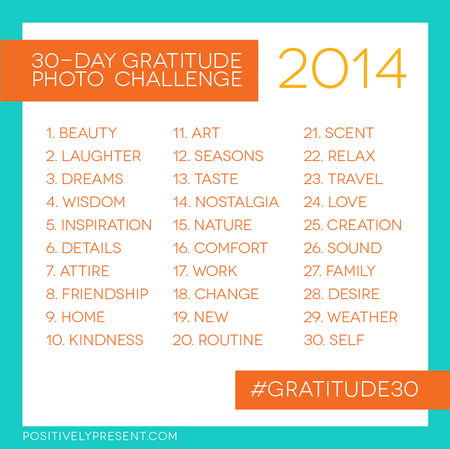
She’s done it as a photo challenge you can participate in, and follow along on via Pinterest, Instagram, or Twitter, however you could easily use it as a journaling challenge instead, dedicating a “writing to learn” page per day inspired by her prompts — she has written up short yet thoughtful snippets on each word theme of the graphic above on her site: 30-day gratitude photo challenge: 2014 edition.
This, for instance, was her prompt for today, November 3rd:
DAY 3: DREAMS
What we dream says a lot about what matters to us. What do you dream about often (either in the literal or the abstract sense)? Do you have reoccurring dreams at night? Do you find yourself daydreaming about the same things?
I don’t think her challenge will become a daily habit for me personally, but you may see me dip into it occasionally this month via my own photo-taking. Here are my links on those social media sites: Rosa on Pinterest, Instagram, Twitter. While there, watch for others in our Ho‘ohana Community and connect with them too.


November 2, 2014
November~December 2014: The Value Immersion of ‘Ike loa and Ha‘aha‘a
How goes your weekend? Ready for our Value Your Month to Value Your Life update?
Photo credit: www.weheartit.com
In our Value Pairings way recently, September and October were both dedicated to the Managing with Aloha values of Kuleana (the value of personal responsibility) and ‘Ike loa (the value of learning).
VYMTVYL = Focus, Constancy, Results“Working within a value of the month program gives you focus, it gives you habit-building constancy — value alignment gets woven into your normal m.o. versus degrading into occasional practice, aka ‘flavor of the month’ flip-flopping — and it gives you tangible results in seemingly small, but meaningful ways, as those results get naturally connected to the seasonality of your working progressions.”
— Change it up with Value Pairings
For November and December, we will be gaining the goodness of value immersion continuing with ‘Ike loa, and moving on to Ha‘aha‘a, the value of humility.
From our values vocabulary: 4. VALUE IMMERSIONIMMERSION means to go ‘all in.’
When you choose a value for your workplace culture, you align it completely — in everything you do (you make it your constant). When confronting change, you realign and audit your value integrity in every strategic juncture.
3rd time the charm?
If you are just getting started with your own Managing with Aloha practice, I encourage you to visit this article, already referenced and linked twice within this posting, for it will help you jump in very quickly!
Change it up with Value Pairings: Learn about…
Value Your Month to Value Your Life: 3 different approaches — which is best for you?
Connective Windows, and Strength-building Constraints
A Cheat-sheet on our MWA values vocabulary
Give some thought to your own “connective windows” and “strength-building constraints,” and write me if there is anything in particular you’d like to chomp on these next two months with ‘Ike loa and/or with Ha‘aha‘a. For as Ha‘aha‘a teaches:
Ha‘aha‘a helps us understand that no individual can satisfy every need. All in the ‘Ohana are needed. All are to be respected and supported for the talent and uniqueness they offer.
Postscript: For those without access to a Hawai‘i island newsstand, here is the RosaSay.com copy of the essay published for Ke Ola magazine’s November/December 2014 issue:
‘Ike loa, the value of learning.


September 15, 2014
Managing with Aloha’s Learning Landscape: “Know well”
The value of learning might very well be prime example of a value that most of share, for learning is also a human being’s survival skill.
What differs between us, is how much this value reaches into our lives above pure survival — above those hierarchy levels Maslow called our physiological needs (survival), safety needs (our sense of security), love and community (our sense of belonging): Once those needs are met in at least a baseline way, how prevalent will learning be in our day-to-day living?
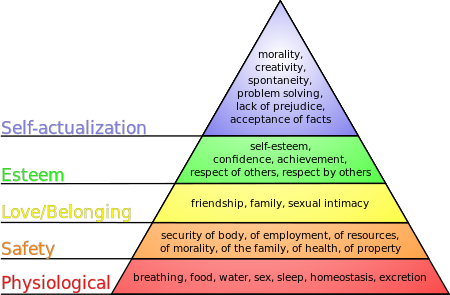
From Wikipedia: “An interpretation of Maslow’s hierarchy of needs, represented as a pyramid with the more basic needs at the bottom.”
Learning can also come with its share of baggage, the baggage of our past experiences with it. There is immense variation in the family, school, athletic, professional and self-development landscapes!
Thus, in awareness of these two variables, learning’s current intensity and the hefty experience it might carry, I always advise Alaka‘i Managers who are new practitioners of value-based culture building, to start their ‘Ike loa value alignment efforts with that first phrase that appears beneath the heading of ‘Ike loa in Managing with Aloha: “To know well.”
We can leapfrog over knowing well, dismissing it with relative ease, in wanting to work on those ‘higher and [supposedly] better’ levels of learning that have to do with esteem and self-actualization, but I urge Alaka‘i Managers — and I urge you — to slow down, be less dismissive, and spend some time thinking about this learning practice of knowing well. To know, and know well, can open a lot of doors for you, doors you didn’t even notice before.
What would you like to know?
If you sit with an open journal page (and a cup of tea or coffee is nice, helping as they do in our slowing down when we need to), I’ll bet you could very easily come up with a short list of what you’d like to know better than you presently do, devoting time to next-stepping toward knowing it better. Sidestep work for a moment, and think about the hobbies you’d like to give more time to. And be specific: Don’t list ‘golf” — list the club you want to pull out of your bag more than you do. Don’t list ‘gardening‘ — list the scientific name of the plant genus you want to cultivate, and why.
The more you know, in this realm of ‘knowing well,’ the more interestingness you will weave into your life, i.e. into your golfing and gardening experiences (in those examples).
Step back into your work world, and your list might get long, frenzied even, as you press pen onto page with more intensity, trying to write everything down.
Go for it, and make your list, however once you’re done I want you to put that one aside: The head-clearing is enough for now, and the items you listed will be on that page when you’re ready for them. Turn your journal page for another list.
What would you like to know about other people?
On this one, write down the names of everyone on your team. If you don’t have a set team, list the names of the people you work with regularly or most frequently on a day-to-day basis.
Now next to their names, write down how you can get to know them better.
Not what you want to know about them (they’ll eventually tell you themselves), but how you, in what you can simply do, can get to know them better through proactive, thoughtful actions:
Maybe a commitment to personal phone calls instead of brief texting and emailing…
Maybe an invitation to coffee or lunch…
Maybe asking for their ideas on a project you’re tackling, or the next time you find you’re stuck…
Maybe an invitation to walk with you and chat next time you take a stretch or nature-break…
Maybe you’ll initiate a conversation you’ve been meaning to have with them for quite some time…
Maybe you’ll be a connector for them, introducing them to someone on your extended team, or in your network…
Maybe you want to study a facet of their work which is foreign to you, asking them to help you…
Maybe, just maybe, you’ll weave them into your Daily Five Minutes, the best workplace circle of comfort, and relationship-builder of knowing well that there is. To review the Daily Five Minutes — required for anyone wishing to call themselves an Alaka‘i Manager — go to page 145 in the book, or click here: Revisiting the Daily 5 Minutes: Lessons Learned.
The more you know, in this realm of ‘knowing well,’ the better, the more interesting, and the more enjoyable your relationships and partnering will be, and the more you will be working with Aloha — theirs and yours.
Get to know the people who surround you, and resolve never to take them for granted. They will open doors for you.

The art of conversation is a constant topic in Managing with Aloha cultures, for talking is like a tap from which human spirit-spilling will naturally flow. Conversations are like puzzle pieces in our Language of Intention [Key 5] and they come together in glorious pictures of sharing, understanding and empathy. They are the pictures of healthier workplace cultures, where confusion melts away, and clarity gets ever clearer as people get honored. They are pictures where people believe “we are better together” and they act that way.
These are the precepts of conversation at Say Leadership Coaching — we call them “MWA Conversation 101” internally, harking back to their history in the Managing with Aloha philosophy, and we will often refer to them as “a Kākou kind of thing” in better communication practices, referring to KĀKOU as their value-driver. In our batch of 5 (our preference in any list-making), they are:
1 — Converse daily. Come up for conversational air.
2 — If you can talk about it instead of writing about it, do.
3 — Did you listen? What did you hear?
4 — Seek an agreement in each and every conversation you have.
5 — Enjoy it. Relish conversations and never dread them.
Read more about each one: Conversational Catch-up ~ with Aloha
Bonus Linklove: All Conversations Are Not Created Equal


September 11, 2014
Keeping it Real
Can you pull this off?
This can be a tough thing for managers, and it amounts to having a certain credibility in the work you do each and every day, with reliable constancy. We can ‘step up’ when we need to, when we have a solid foundation to launch from.
Our people expect realistic balance from us, not head-in-the-clouds encouragements that are unreachable, and possibly unreasonable. Small, but consistent wins are the very best ones: Managing: Be a Big Fan of the Small Win.
It’s something my son describes as “Keeping it Real.” But make no mistake about it: Positive thinking is indeed leadership.
Are you the person others will instinctively look to for guidance and reassurance when things go awry?
What we have to do, as Alaka‘i managers, is work within our values each and every day, creating our foundational credibility, and our reliability: Values drive the behaviors which align with what we authentically believe in.
To do so, we focus on our Ho‘ohana – our intentional, and most worthwhile work, and on ‘Imi ola – our vision for that work, realistic within and for our “best possible life.”
We clothe ourselves in Ho‘ohanohano as our demeanor of respect and self-respect, as we equip ourselves with Mālama, constantly caring for and about those whom our actions may affect, and keeping our mutually-held best interests in mind.
Those are the 5 values I think of most readily for my guidance when I get challenged, knowing I want to stand tall, yet keep it real: Alaka‘i, Ho‘ohana, ‘Imi ola, Ho‘ohanohano, and Mālama.
Which would you choose, knowing all have their roots in Aloha? :: The 19 Values of Aloha.
If you feel a certain situation challenges you, choose a value to focus within. The only thing ‘naive’ in feigned positivity or wishful thinking, is ignoring those values, for I guarantee you they’ll be in play for everyone else as what they expect from you.
There are several articles here in the archives tagged with positive expectancy: Might it be time for a helpful review? Here are a few suggestions:
Palena ‘ole Positivity is Hō‘imi— look for it
Ka lā hiki ola and Leadership: A Sense of Hope
Great Managers Start Great: An ALOHA Rite of Passage
The Opportunity to Reset
Be Brave in Setting Your Limits

Ka lā hiki ola, “the dawning of a new day.”


September 3, 2014
Change it up with Value Pairings
Value Your Month to Value Your Life
When people ask me, “What’s the best way to start ‘managing with Aloha’ in everyday practice?” I always recommend that they commit to some kind of value of the month program. You can do it on your own, you can do it with an accountability partner or in a team approach (what many in our Ho‘ohana Community refer to as their ‘grassroots Aloha’) or you can do it organizationally in workplace culture-building.
Working within a value of the month program gives you focus, it gives you habit-building constancy — value alignment gets woven into your normal m.o. versus degrading into occasional practice, aka ‘flavor of the month’ flip-flopping — and it gives you tangible results in seemingly small, but meaningful ways, as those results get naturally connected to the seasonality of your working progressions. When you include an accountability partner, or choose the team or organizational approaches, you simultaneously improve your key partnerships as well, boosting your relationship-building with values-based collaboration.
Be honest about which of these 3 approaches will work best for you (individual, team, or whole-organization).
I’m always a fan of partnering and all-in culture-building, however don’t underestimate the individual approach, especially if you’ve never explored your values in any in-depth way before. Wanting to work on your personal values first is our human nature, and it always proves to be a very good thing: Taken altogether, your values are your personal brand. They define your reputation. Recommended reading in the archives:
The instinctive, natural selection of Wanting and
Value Your Month for One — You.Steady your foundations. My Ho‘ohanohano advice for Alaka‘i Managers continues to play on repeat: Do good for yourself first, then do that good for others once you have your personal credibility to stand tall on.
I’ve written a short ebook on the specifics of a value of the month program (Value Your Month to Value Your Life), and in the past we’ve focused on the systematic immersion of a one-value-per-month approach. Currently however, we’ve changed it up in our Managing with Aloha evolution, and I’ve invited you to join me here in my two-at-a-time practice, where each value gets our focus for a full four months immersion.
Here is the calendar that will take us into the 1st half of 2015:September – October 2014: Kuleana (responsibility) and ‘Ike loa (learning)
November – December 2014: ‘Ike loa (learning) and Ha‘aha‘a (humility)
January – February 2015: Ha‘aha‘a (humility) and Ho‘ohanohano (dignity)
March – April 2015: Ho‘ohanohano (dignity) and Alaka‘i (leadership)
May – June 2015: Alaka‘i (leadership) and Mālama (caring)

Values-based practices are exceptionally adaptable: Weave your Managing with Aloha sensibilities into life, and into work as they happen for you.
I’ve been working through this ‘two-at-a-time practice / four months immersion’ for 21 months now, ever since my 1st column for Ke Ola magazine in January of 2013: Why Values? And Why “Manage with Aloha?”
I started on my own first, and then introduced the strategy to my team of partnerships connected to my business, Say Leadership Coaching — we systematically value-align with the 9 Key Concepts by the time each value’s 4-month immersion has been completed: The 9 Key Concepts — Why these 9?
Connective Windows, and Strength-building Constraints
I’ve begun to suggest these value pairings to client projects as well, because the experience has been too good not to share. In their aggregate, our experiences with value pairings have had two commonalities:
You get new windows. Working on values in pairs will take you ‘outside the box’ of a single value’s emphasis. You look farther, much as you’ll look to the distance when staring out of a window for the first time. In this view plane, you’re seeing a value’s connection to its new pairing, and your value alignment work begins to focus on those new connections. The clarity which results may surprise you!
You get useful constraints. The Theory of Constraints says that every system, no matter how well it performs, has at least one constraint that limits its performance – this is the system’s ‘weakest link.’ Practitioners use the theory by identifying a constraint and changing the way that they work so they can overcome it. In a value pairing, we leverage constraints in the more positive way of strength management — we work on strongest links and we strengthen them. Those strong links? Our other values.
For example, think about the possibilities in pairing Ha‘aha‘a, the value of humility, with Pono, the value of rightness and balance. Humility softens righteousness with self-coaching, and puts its contexts in better perspective, helping people arrive at the rightness and balance of Pono with a Ho‘ohanohano demeanor.
So are you ready to change it up with me, and with others in our Ho‘ohana Community?
Wonderful! I shall give you a few days before I post again so you can revisit the language of intention of our vocabulary (see the postscript below), and bookmark anything you wish to keep reference handy to in the archives (the other links I have added within this post for you). As you do so, start to keep our values for September and October in mind for some early experience with the positive constraints they can be…
1. Kuleana Essay for Ke Ola, and 2. ‘Ike loa
Mahalo nui for being here with me!
~ Rosa

Postscript:Here’s a cheatsheet on the values vocabulary I regularly use here at ManagingWithAloha.com.
1. VALUE ALIGNMENT
Frames the key objective — To align the actual behaviors of a workplace culture with the values we say we believe in from an intellectual and convicted point of view: We believe in this deeply, and therefore, this is what we consistently do, or aspire to do.2. VALUE MAPPING
Names the process [of VALUE ALIGNMENT] — We map out how we intend to achieve our objective, much in the same way we map out objectives like mission and vision, and all our strategic initiatives.3. VALUE VERBING
Puts the process of VALUE MAPPING into the everyday language of workplace culture. We put value mapping intentions into executable actions with highly active, next-action verbs.4. VALUE IMMERSION
IMMERSION means to go ‘all in.’ When you choose a value for your workplace culture, you align it completely — in everything you do. When confronting change, you realign and audit your value integrity in every strategic juncture.5. VALUE STEERING
Refers to projects, pilot programs, and experimental initiatives. A value or pairing of values will be chosen to steer a project as primary value/conviction criteria: It is a value which encapsulates the over-riding WHY a project is taken on to begin with.If you have not yet seen it, this posting will give you a good introduction to our ‘Language of We’ and recommends a valuable page to bookmark (different from the Glossary):
Managing with Aloha’s Lexicon Morphology



September 1, 2014
September Cheer, Kuleana, and ‘Ike loa
Wonderful thought, isn’t it? (Found it on Pinterest.)
I do hope your 3-day weekend was spent collecting and appreciating your own “lovely tokens” too… wouldn’t it be great if each and every month ended and newly began on a 3-day weekend holiday? We’d have no excuse for not making each of those weekends a Ka lā hiki ola opportunity.
I want to start by saying Aloha mai Kākou to those of you who may be getting this Managing with Aloha posting by email for the first time, for I see there are quite a few of you! Opening up my Feedburner subscribers listing to take a peek was a terrific surprise, and I’m so glad you have decided to be part of our Ho‘ohana community — welcome!
My silence here since mid-March was due to an “everything but” hiatus I’d taken to concentrate on a key event and an overdue goal. The event: A very exciting family wedding (my daughter) which turned into a large family reunion opportunity for us as well. The goal: Reclusive time necessary for me to work on additional values research now that my initial work publishing Managing with Aloha is a decade in the history books. My business, Say Leadership Coaching, has afforded me a real-time, and continuous workplace culture-building laboratory over that decade, but thorough research can be much broader in scope, and I was feeling the need for that educational, universal, box-busting fuel injection of fresh energy.
As you can imagine, big ‘Ohana celebrations and solitary research introspection don’t naturally mix well, and I kept these efforts separate, thus the lengthy hiatus. My research and writing isn’t yet done, but I’ve been getting anxious as well — anxious to get back to you, and the value alignment work we do Kākou, together. So September, tokens connected to labor’s glories (which we know of as the goodness of Ho‘ohana), and a 3-day weekend to get ready proved pretty irresistible! So let’s get to it, shall we?
We Value our Month to Value our Lives
We start in our best possible place; within our values [From the Archives: Ethos: Be true to your Values.]
Concentrating as we do, on Living, Working, Managing, and Leading with Aloha is about value alignment: Living, working, managing, and leading true to the passions and beliefs woven into our values — into the values we purposely choose, and the values we commit to intentionally practice.
My own value-of-the-month immersion practice has morphed into a strategy wherein two-values/two-months are worked through together, and I invite you to join me: For September and October, I will be concentrating on Kuleana, the value of responsibility (chapter 10 in the book), and ‘Ike loa, the value of knowledge and learning, to “know well” (chapter 11, provided for you here on this site).
If you have questions or challenges with these values, or would like to share opportunities and experiences in practicing them, please speak up! Add a comment here, or write me.
We’re better together!
Ho‘ohana kākou,
~ Rosa
Postscript:My two-values/two-months value immersion is a consequence of my current value writing as a columnist for Ke Ola magazine. Kuleana is now published as the value focus of their September/October 2014 issue, and ‘Ike loa will appear in the November/December 2014 issue, at which time we will continue to work on ‘Ike loa and add Ha‘aha‘a, the value of humility to the mix.
September/October 2014: Kuleana, the value of personal responsibility
July/August 2014: Kākou, the value of inclusiveness and the ‘Language of We’
May/June 2014: Lōkahi, the Value of Harmony and Unity
March/April 2014: What does ‘Ohana mean to you?


March 13, 2014
Got Passion?
passion |ˈpa sh ən|
noun
~ strong and barely controllable emotion : a man of impetuous passion.

We often think of passion as an indicator of emotional attachment. It’s a noun we tend to think of as an adjective, believing that people are either passionate about something, or they’re not, and that’s that. It is what it is, and if we associate or partner with that person we have to deal with it as is; their feelings after all, are their feelings.
That’s not really true.
The truth is, that passion can be encouraged, supported, and cultivated, something that all managers can do for themselves, and then for their staff:
Passion is a direct result of the healthy culture-building done with value alignment.
Passion can be cultivated, and existing passions can be grown.
Within Managing with Aloha, we will associate passion with the value of Ho‘ohana most often, associating it with purpose, and with Key 2 on Worthwhile Work. We all like the outcomes that passion will deliver. We readily agree that passionate work will be better work. Passionate work will be more enjoyable for us, and it will be more satisfying, meaningful and fulfilling. Once passion is connected to the work we do, tasks seem to magically morph into easier work:
People Who Do Good Work.
This, is what Ho‘ohana sounds like.
Like it? Might love it? Run with it.
So how can we get passion, if we don’t already have it? Are there concrete, next-stepping action steps we can take?
Joshua Becker suggests 4 of them, and he shared this in his recent newsletter:
The Quickest Shortcut to Influence: Passion.Passionate people change others. They draw attention. They pique interest. They sell ideas.
…There is something absolutely magnetic when you hear somebody talk with passion—even the most introverted presenter can silence a room when they begin speaking with excitement about something they love.I have a friend named Jamy who is the single-greatest recruiter I have ever met. She loves children and runs a local, non-profit organization committed to helping kids succeed in life. And she organizes scores of adult volunteers every single week. Her secret to recruitment and influencing adults? You got it, passion! You can see it in her eyes and hear it in her voice when she begins talking about the opportunity and need to equip and empower kids.
Exuding passion in your conversation and writing is the quickest shortcut to influence. Before our ideas can influence others, we must believe in them ourselves (become passionate) and learn how to display that passion to others (a natural outflow).
I realize passion is difficult to manufacture—that is what makes it so effective. But there are some things we can intentionally do to increase our passion about any topic:
1) we can focus on the joy it has brought into our lives;
2) we can understand the specific benefits it will bring to others;
3) we can study how others talk about the topic; and
4) we can gain confidence by sharing it with others whenever the possibility arises.As we do these things, our passion will stir and continue to grow. And as a result, our influence will continue to expand.
~ Joshua Becker
I completely agree with him on this connection between passion and influence: Passion is contagious, and it’s a good contagion; others will more readily follow your lead: Purposeful Following.
Here is the MWA value alignment I would connect to Becker’s 4 suggestions:
1) Hō‘imi to “focus on the joy” and Nānā i ke kumu to look to the source of your best-life connection. Mahalo to continually fortify those feelings, living with appreciation of your elemental gifts.
2) Lōkahi and ‘Ohana to “understand the specific benefits it will bring to others” whom we think of as our co-working partners and teammates.
3) ‘Ike loa and the Daily 5 Minutes to “study how others talk about the topic” understanding how much we can learn from other people.
4) Kākou to “share it with others whenever the possibility arises” in our Language of We, doing so Ho‘ohanohano to “gain confidence” in a way that feels good and right for us.
Once you gather up your intentions in this values-based way, get personal with passion by making it highly actionable: Rewrite Becker’s 4 suggestions in the next-stepping way that feels best for you: Next-stepping and other Verbs. Be specific, writing your action steps in a to-do list conducive to tracking and checking off what you have done.
Extra Credit: Consider your passions (yes, they can be plural!) to be the cornerstones of your strengths inventory. Scroll through the titles of our Key 7. Strengths Management category here, and dip into the articles that may offer more coaching for you.