Rosa Say's Blog: Managing with Aloha, page 20
March 1, 2014
What does ‘Ohana mean to you?
There are three things I immediately associate with the value of ‘Ohana whenever I think about it, and within the context of our Managing with Aloha practice:
Form and function; i.e. how ‘Ohana is “the human circle of Aloha.” There are so many comforts within that circle!
Inclusiveness is not just for families. Form can be ‘Ohana-driven in shaping organizational structure, and for behavioral culture building; i.e. all an “‘Ohana in Business” [Key 6] can possibly be.
Inputs and outputs, particularly those driven by conversation, and by the communication processes we align with all our operational stuff; i.e. the way that ‘Ohana is guaranteed to get people talking.
 I have expanded a bit more on each of these in the article I wrote on ‘Ohana for the March/April 2014 issue of Ke Ola magazine being distributed today: You can read a copy archived on RosaSay.com: ‘Ohana, the Value of Family Aloha.
I mostly go into number 2., given the single-page limits of the magazine. If number 1. is more of interest to you, I think you will enjoy revisiting the chapter in my book. For this post, here on ManagingWithAloha.com, let’s talk story a little bit more about number 3.
Talk to me. Talk of us, and of Who we Are
‘Ohana is an excellent value-driven talk story to have when you are looking for staff input, and it need not be done in formal meetings. In fact, the more informal it is, likely the better:
Huddle up, and Talk Story.I encourage Alaka‘i Managers to talk story often — to huddle with their team (and do call it a ‘huddle’ instead of a ‘meeting’) and simply talk about something and just about anything, where the manager has no issue or resolution in mind, and no agenda of any kind other than to get everyone in the team talking, encouraging their stories to be told and listened to.
To hear the story, listen to the values… Huddles, Values and the Work Ethic we Value
A Review of Our Basics: To ‘manage with Aloha’ is to honor values, and to use them as relevant workplace tools, aligning work practices with values-based belief, conviction, and cause. To identify the personal values of their team, a manager must learn to listen to the talk stories they encourage, in order to have values reveal themselves in presently held context, i.e. within each human being.
Please stop what you are doing for a moment, and think about this. Think about the spontaneity, and genuine giving of heartfelt opinion that will occur during your talking story opportunities. Those are the inputs which seem to flow of their own emotion, compared to those times people look stumped, ill-prepared to answer a question on a meeting agenda, or times they simply are not in the mood to speak up, suggest something, participate, and get involved.
‘Ohana is our universally needed comfort, and thus, humanity’s universal understanding.
As the subject matter of a conversation, ‘Ohana is a pretty magical blending of agenda hopes and talking story. ‘Ohana can be a value-mapping topic of your suggestion, but everyone is an expert on family in some way — and they are confident in their expertise, very willing to give it, secure in the telling of their experiences, both good, and not so good.
There are natural times people check in, and
there are also times people naturally check out.
With ‘Ohana, they are virtually guaranteed to check in.
What other values come immediately to mind for you, for this same conversational effect?
From Ke Ola:
“The ‘Let’s Talk Story’ title we gave to these meetings was very appropriate, for they beautifully illustrated something else about the value of ‘Ohana: It gets people talking, and empathizing. The conversation about this value is often supportive, passionate, and extremely positive.”
“This spring, I encourage you to take up the discussion, and walk the talk of ‘Ohana in your own workplace, whether called a family business, a corporate one, a not-for-profit, or a volunteering effort. What behaviors can the value of ‘Ohana, as our human circle of Aloha, inspire in you, and in your culture-building?”
— ‘Ohana, the Value of Family Aloha
For related articles here, within MWA Central, click to the indexes of 1) the ‘Ohana tag, and 2) our Key 6 category on The ‘Ohana in Business Model. This may be a good article to start with: The Workplace Mixology of ‘Ohana.



January 30, 2014
Conversational Catch-up ~ with Aloha
January can feel like a rather odd month for me, and for my SLC coworkers and partners. It’s odd in that business wise, we’re likely to be working on a few December remainders though most everyone else is eagerly zooming into the new year. We’ve been on our holiday hiatus over the first week or two (we close up shop in mid-December, and all vacation over the holiday season, for Ho‘omaha) and the last two weeks of January are reserved for easing back in, connected to our foundational basics (like this one: Honor Your Survivors). We don’t schedule any brand new business until February. In essence, February 1st is Say Leadership Coaching’s New Year’s Day.
We do this to be PONO with our KĀKOU communications (The Language of We).
Our January focus is on finishing conversations that may have been left with any pending follow-up. We want to be sure that all of our conversational partners do not feel forgotten, neglected, or left behind, shed with the old year as we move on. So it may be odd compared to the rest of the world’s new year’s eagerness, but it’s also good. It’s very satisfying. Any conversations we may have started, or had to leave still pending when we closed over the holidays, will resume again, and they will get finished in their best possible way. At the very least, those conversations have to be clear on their next-stepping and trigger the doing, so they can continue until reaching their most satisfying conclusion.
It gets interesting for us, and we have to support each other in our follow-up efforts, because people aren’t always expecting to hear back about old stuff, unless that is, they’ve gotten to know us and participate in our working culture.
Given the choice of starting something new, or following up with something already in the works, we’ll go for the finish. We don’t like cloudy assumptions. We do like clear expectations. If we can converse, and talk story about it, we will. A good finish, and the Balance it gives us, is a great lead-in to whatever may be Next.
SLC Conversation 101
The art of conversation is a constant topic in Managing with Aloha cultures, for talking is like a tap from which human spirit-spilling will naturally flow. Conversations are like puzzle pieces in our Language of Intention [Key 5] and they come together in glorious pictures of sharing, understanding and empathy. They are the pictures of healthier workplace cultures, where confusion melts away, and clarity gets ever clearer as people get honored. They are pictures where people believe “we are better together” and they act that way.
These are the precepts of conversation at SLC — we call them “MWA Conversation 101” internally, harking back to their history in the Managing with Aloha philosophy, and we will often refer to them as “a Kākou kind of thing” in better communication practices, referring to KĀKOU as their value-driver. In our batch of 5 (our preference in any list-making), they are:
1 — Converse daily. Come up for conversational air.
2 — If you can talk about it instead of writing about it, do.
3 — Did you listen? What did you hear?
4 — Seek an agreement in each and every conversation you have.
5 — Enjoy it. Relish conversations and never dread them.
Here is a little more about each one:
1 — Converse daily. Come up for conversational air.
There is a lot of independent processing in the work we do, and this reminds us not to get too self-absorbed in solitary, nose-to-the-grindstone work. This is about staying connected to the flow of our ‘Ohana in Business [Key 6] and “Converse daily” is an addition to The Daily Five Minutes. We aim for getting additional input or feedback, for having interesting conversations, and for conversing outside the norm. We value curiosity and the seeking of Palena ‘ole pathways [Key 9].
2 — If you can talk about it instead of writing about it, do.
I’m not the only writer around here, far from it. Writing with Aloha is still alive and well, a branch of our Ho‘ohana Publishing division, and we write like we breathe! Our SLC working culture is one of “writing to learn,” journalling in morning pages or curation logs, promoting self-coaching exercises, engaging in the studious recapping of lessons-learned, and meticulous status checks on culture-building pillars. So it is far, far too easy for us to dash off an email or text instead of picking up the telephone. We want to talk about it, whatever ‘it’ is, so we can converse and not just broadcast, though sensitivity is required. (FaceTime and Skype for instance, should be expected so they aren’t intrusions.)
“If you want ACTION, don’t write. Go and tell the guy what you want.” ~ David Ogilvy
3 — Did you listen? What did you hear?
‘What did you hear?’ means you have to have listened well enough to repeat it from the other person’s point of view, and not just your own processing of it. This is a constant self-coaching for everybody, and especially necessary in a culture like ours where talking story and spirit-spilling is the norm, and speaking up is not a problem! It reminds us to take in just as good as we dish out, to be ‘good receivers’ (in the vocabulary of D5Ming), and to not make lofty pronouncements (which speakers, coaches, teachers, and facilitators can easily fall into doing.)
4 — Seek an agreement in each and every conversation you have.
We’re mostly referring to next-stepping here, and not conclusive agreements. This is more about mindfulness while still within the throes of a conversation as it happens. We always ask ourselves, What will be the next step for each person participating in the conversation? and then we ask, And then what? so we will ask good questions, be diligent in considering our best possible outcomes, and be thorough about scheduling follow-up while empathizing with what is actually required of those actions. Our sights are on decision-making that will take us to the next conversation in a progressive way. (‘Conclusive agreements’ usually come together in our pilot programs.)
5 — Enjoy it. Relish conversations and never dread them.
Believe me, we have uncomfortable conversations too (skim the articles of our problem-solving tag). We don’t shy from them because we don’t like stuff swept under the rug. We make sure unpleasant conversations happen when they should, and we make sure we get past them. It’s all a matter of engaging in conversation with an attitude of positive expectancy, even if that conversation began unhappily as a confrontation of some kind. We can enjoy the triumph that emerges from a difficult conversation that happened in the spirit of ALOHA and HO‘OHANOHANO respectfulness, just as much as we enjoy the light-hearted nonsensical ones where we nalu it and goof off together.
In that pregnant pause, when silence is golden:SLC’s Conversation 101 came to be as a result of one of our pilot projects. When you look at your cultural conversations as a possible project, and you’re willing to work on the quality of those conversations during a no-holds-barred/let’s-have-fun-with-this pilot, there can be wonderful side effects.
One of ours for example, is that we’re now so comfortable with pregnant pauses, and those moments of silence in a conversation where no one is talking, and people sit or stand quietly to think about what was just said. We can think about it while still in each other’s company, without rushing to fill those valuable moments of quiet reflection with needless noise, reflecting together instead. What this Circle of Comfort does for us is improve our listening abilities: We need not think about something while another person is still talking, missing out on hearing them completely, for we know there will be time within the conversation for both hearing and thinking, with our responses being the better for it.
A Conversational Culture encourages best practices.
We’re very good at encouraging and sharing conversations at SLC. During January in particular, we’re often talking story about conversations we’ve just had with others — customers and clients, network partnerships, even social media conversations. LinkedIn for example, is a place where we are often still in that getting-to-know-each-other phase. We share those good surprises we have had within those conversations to encourage each other to have more of them.
As for any pending business, where we have reopened an older conversation, we have to be sensitive to when people have in fact, moved on without us, anxious to turn their calendar page to a new year, both literally and figuratively. Making those phone calls can be tough when it’s so much easier to justify it with, “They probably don’t feel it’s as necessary as we do.” so it helps that we’re all doing it as January’s normal-for-us m.o. in getting back to work.
But you know what? An overwhelming majority of people are happy and pleased we didn’t just let things drop, and that we didn’t assume, “it’s probably too late for this.” We asked, and we let the other person decide if it was too late or not, and we don’t aggressively pursue whatever they wish to drop. We followed up, brave enough to check in, open old messes if we should, and apologize if we have to.
Know your cultural habits, and build better practices of your own.
That sub-heading just above our 5-batch of practices, was SLC Conversation 101 and not ‘MWA’ Conversation 101, to convey that we have culturally adapted the tenets of Managing with Aloha into our company-specific conversational precepts. Think of them as a conversational drill-down to those Rules of Engagement we recently revisited, precise to who we are as writers and publishers, coaches and teachers, speakers, facilitators and consultants.
Might you need an ALOHA or KĀKOU batching of conversation’s best practices pertaining to what you do too? Doing so can launch you on a leadership journey within your industry, where you are setting a higher standard for the conversations of your profession, and inspiring fresh energies for 2014 and beyond.
How do you converse, and how might you get better at it?
How can you make conversation your happy place? Pursuing the enjoyment of each conversation is a magnificent place to start.
[A review on batching: Managerial Batching: 1, 2, 5 and 7 and on Rules of Engagement.]

To archive dive on the art of Managing with Aloha conversation here at MWA Central:
— Start here: Managing with Aloha’s Lexicon Morphology
— Value Links: KĀKOU, HO‘OHANOHANO
— VerbING Tag Links: Conversing, Talking Story, Good Questioning, Asking for Help, Speaking up, Partnering.
— Category Link: Key 5 on Language of Intention


January 26, 2014
Honor Your Survivors, Part II
When I suggest journaling or self-coaching exercises to you, you can bet that I’m doing them too. So I tackled the one presented in Honor Your Survivors as my weekend project. It was great!
To review the exercise suggestion:
“Rewrite these five lessons into manageMEANT lessons. What can these very foundational lessons in a garden, teach us about culture-building with the human beings we are raising, and growing? Concentrate on MĀLAMA as your value-driver.”
Here’s what I came up with.
Lesson 1: “Gardening success is all about the soil, preparing a nutrient-rich mix that will drain and re-wet well. Composting is a HUGE part of the mix; there are no chemical fertilizers in the rainforest.”
~Honor Your Survivors
Lesson 1: Fertile Soil = Best Foundation.
The values of ALOHA and HO‘OHANA are our foundation, both for Managing with Aloha and within my own company, Say Leadership Coaching (SLC). Therefore, to honor the people who are my survivors, I need to remind myself about the importance of those two values — to them. I know what they mean to me, to our core philosophy, and to the value alignment of my company, but how are they meaningful, relevant, practical, useful, and inspirational to my survivors as the unique individuals they are?
So I made a list of names (a list I would use for the entire exercise), and answered that question for each person on the list. If I had any doubts, or needed to update my own answers, I did the best possible thing I could do — I asked them.
~ Honor Your Survivors
Lesson 2: Climate as conducive to Culture.
The ‘climate’ question I translated this lesson to was, How is culture at its healthiest for this individual?
As a quick review, this is how we have defined culture:
CULTURE is simply a group of people who share common values, and operate within those values.
Culture is learned. Culture represents a series of agreements based on value alignment, and it results from honoring those agreements.
Therefore, the climate of a healthy workplace culture, is about shared values, i.e. that intersection where a person’s personal values will intersect with the organizational values of our workplace:
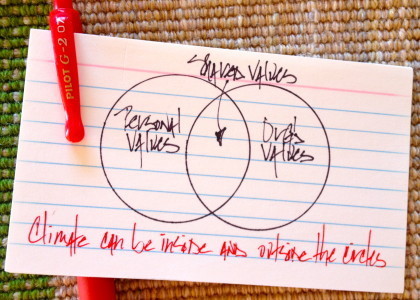
At SLC, we have 5 core values we operate with: Aloha, Ho‘ohana, Hō‘imi, Alaka‘i, and ‘Ike loa. [ You can read more about the Healthy Workplace Compass we use at RosaSay.com: Values in Healthy Work. ]
I’d already reviewed ALOHA and HO‘OHANA with Lesson 1, so Lesson 2 was about the other three for me: I used the same list of names, and thought specifically about how Hō‘imi, ALAKA‘I, and ‘IKE LOA could deal with each person’s ‘watering and wind resistance’ and ‘keep any pests at bay’ — especially if a cultural agreement must be made or revisited. In other words, it became a HO‘OMAU question about their persistence, self-discipline, tenacity and resilience.
It was rather fun, to go with those metaphors and identify specific challenges… I have killed several plants by over-watering my garden… and I bet you can think of which ‘pests’ to keep away from your team! Then the next step was dealing with them effectively — how could I, as their manager, be smart about it, and support them in dealing with their obstacles and challenges? HO‘OMAU was my why, but so was my desire for value alignment, so I restricted myself to Hō‘imi, ALAKA‘I, and ‘IKE LOA as sources for my possible answers.
~ Honor Your Survivors
Lesson 3: Companion Planting = Partnering.
This lesson in the exercise pointed directly to relationship and partnering for me. With a few of my survivors I concentrated on the relationship between the two of us, and thought about how I could strengthen it. With others I focused on a relationship they had with someone else, a relationship that was critical to their HO‘OHANA; it may have been someone else on our team, or it may have been one of our clients.
It felt good to know that I was focused on ETHOS here, and those three choices that are so central to “the characteristic spirit of [our] culture,” values, relationships, and intentional work: Ethos: Be true to your Values.
~ Honor Your Survivors
Lesson 4: Energy = Our Greatest Asset.
Ah! Our all-important sources of ENERGY, with the value of ALAKA‘I as our lever, as applies to both management and leadership. This was my reminder that human energy is the most important resource we have in a healthy workplace culture:
Reference postings:
Alaka‘i Managers are the new Energy Bunnies
Managing Energies: Struggle & Ease
To cut to the chase with this, would you rather work with someone who’s in a great mood, or with someone who’s not? What is that energy within a good mood all about, and what keeps it flowing?
To manage with Aloha (managing), we channel our existing energies in good ways; to lead with Aloha (leading), we create new sources of energy, especially in regard to a sense of hope. For each person on my list, what were those at-the-ready energy sources — what were their live wires, and hot currents? Those answers went into my managemeant journal next.
~Honor Your Survivors
Lesson 5: Compost = Nutrition/Fuel:
I found this last lesson to be very useful, in separating the energy of the previous lesson, from a person’s needs for nutrition and fuel, and I kept going back and forth between Lessons 4 and 5, pushing myself to see the difference and get this right.
Energy became the result of something else for each individual person — What were their personal sources of nutrition and/or fuel? What keeps them going? What recharges them? and What’s the spirit-spiller that keeps them self-motivated? The value of ‘IKE LOA was very helpful to me here, as was PALENA ‘OLE [Key 9] and what we have learned about a person’s four-fold capacity: Physical, Emotional, Intellectual, and Spiritual.
I especially loved the analogy of compost as a reminder that no past learning and no experiences are ever wasted; all of our lessons-learned stay with us, and get incorporated into all the future HO‘OHANA building we will do. So Lesson 5 brought this exercise full circle for me, to my desire to help each person on my list with their HO‘OHANA. Sometimes, the best thing a manager can do for someone else, is help them see connections they are much too close to, to see for themselves.
The entire exercise was exploratory, and helpful in the way that an analogy can tickle your creativity, getting you to look at what you do — in this case, managing others — in a different way.
The most important part of it though, is still to come.
Following up: Now what?
What I came up with, concerning my partners in my SLC ‘Ohana in Business, is just too good to keep to myself. In honoring my survivors — our initial goal — I want to share my compliments and say thank you (MAHALO) for the wonderful things I have newly associated with them in this exercise, and second, I want to offer my support in ways that they will suggest as most helpful to them (MĀLAMA).
As their manager I feel newly equipped, however I want to enlist them in my follow-up. So I’m taking my cue from coaching I’ve shared with you before: Do with, not for.
They all read this blog, and they’ll know what I’ve done, so my next step is quite simple: I’m setting an appointment with each one next week to talk story about it. We’ll proceed with our next-stepping from there together, Kākou.


January 23, 2014
Honor Your Survivors
Preface: In the dawning of a brand new year, many of us enjoy looking ahead, and mapping out new projects. I’m feeling some déjà vu here… May I suggest a way we are well advised to slow down?
As those who follow my finds and photos on Ho‘ohana Aloha can attest to, gardening is a hobby of mine. Cicero said, in Letters to His Friends, Vol 2: Books 7-12, “If you have a garden and a library, you have everything you need.”
Well, not quite, but close!

My gardening surprise, has been its management lessons.
Gardening is a very harmonious analogy for much we talk about here in regard to living, working, managing and leading with ALOHA, from foundation — every gardener will tell you, “first, it’s all about the soil” — to PALENA ‘OLE growth [our Key 9] where watchful pruning can get rather ruthless!
I keep lists of monthly gardening chores and yearly planting resolutions, much in the same curation-obsessed way I keep my list of managemeant chores and New Year Engagement Intentions. The Hawaiian tagline I have beneath each list’s header says,
Mai poina! — don’t forget!
Year after year, my first list entry for the month of January is consistently “Honor your survivors.”
Generally speaking, most plants are either annuals or perennials. An annual is a plant that lives out its entire life cycle in one season (a biannual will require 2 years to produce flowers and seeds). A perennial is a plant that lives for multiple seasons, and can endure winter dormancy; it stops growing during cold spells, but it is still alive and well. Hawai‘i has a long growing season, but there will still come a time when it’s best to let an annual go to seed, die gracefully, and return to the soil in compost; you then start a new seedling for a healthier plant.
So, what I mean by, “Honor your survivors” is that I give all my gardening care and attention to my yard’s still-alive perennials as the year begins, before I get tempted to purchase or reseed any annuals come Spring.
I think of my perennials as survivors — they survived the elements, and they also survived me, and my management of their care. I also like thinking of them as my kūpuna, the elders of the garden who continue to thrive, and remind me of certain things just by my looking at them, when, mai poina, I shouldn’t forget something in caring for the overall health of my gardens.
These gardening chore efforts, to honor what I already have growing — pruning, re-composting, getting a pest-repelling companion plant, or repotting and moving something to a better shaded or sunnier spot altogether, will often stretch into February or March for me, but I’ll concentrate on them devotedly, and I’ll no longer rush through them. A few years within this habit have now gone by for me, and I know better. Spring’s annual newness will arrive in my garden, but only when the elders and I are ready to welcome them. And we will. All in good time.

How do you honor your survivors?
Once I learned about the differences between annuals, biannuals, perennials and what each one required from me in growing them, I couldn’t help but think about many of my management chores in similar ways. Even temporary neglect has its place in the garden, when I must remind myself to simply leave something alone to fend for itself, and adapt as it grows stronger without any interference from me.
Take delegation: There can be a fine line between co-authorship support, and hovering over someone you delegated something to — we usually call it micromanagement.
So at this time of year, I go with the flow of the garden in my management almanac too. I give the bulk of my managerial attention to the survivors of my own organization (Say Leadership Coaching) and to my constant partnerships (people who aren’t my employees, but whom we consistently will work with) to assure they are hale and hearty too, and filled with the spirit of ALOHA and energy of KA LĀ HIKI OLA.
My goal is quite simple: I want to be sure I never, ever take them for granted. Mai poina ~ I cannot, and will not forget about all the good they do with me, and for me, and for the work of Managing with Aloha.
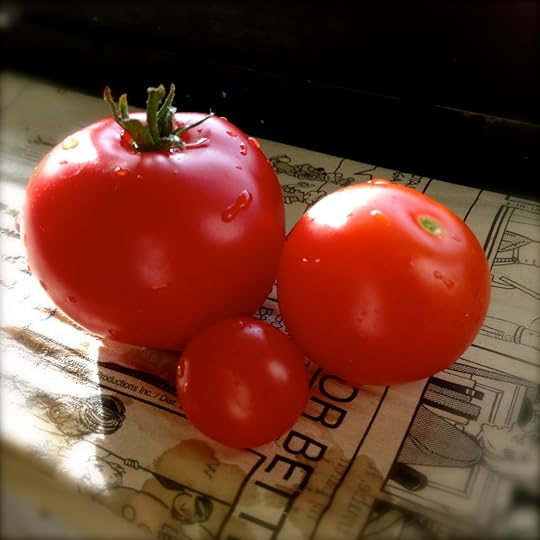
My chore list varies depending on who I am focusing on in particular, and intensity can vary from year to year, for not everyone’s growth spurt is the same; needs are different, just as in the garden. Jobs change, and goals change, and HO‘OHANA will change. People are pretty interesting perennials!
Sometimes it is more about a situation, and what it has caused to happen. We’ve had a few years post-Great Recession where “survivors guilt” has been a pretty commonplace phrase, and many businesses are still in reinvention mode, testing their reshaped business models, and hopefully, attending to their people most of all. Plant, animal, or person, we all need a sense of belonging, and a sunny spot in which to stretch toward the sun and reach for the moon.

My encouragement to you, in writing this post, is to please continue to think about your business model in that same way — as a work in progress to be tested and retested, and as a garden patch of human growth potential, where you constantly honor your survivors, giving them all the care (MĀLAMA) and attention they need from you. Without good health, and without the ALOHA Spirit expressed in kindnesses given to each other, everything else we do in business is moot, and is for naught.
Let’s make this analogy personal for you.
Here’s another journaling exercise just for fun ~ who knows where it might take you?
“The garden offers a new kind of thinking — a necessary schooling in emotional generosity.”
~ Damon Young, The Wisdom of Gardens
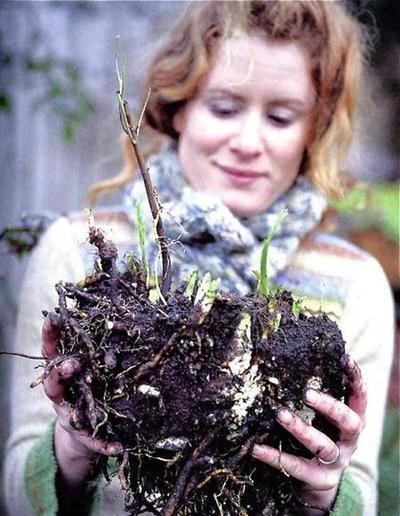
In her 2009 book, Garden Anywhere, Alys Fowler writes, “Gardening is something you do, not something you buy.”
Once I got a bit more serious (i.e. intentional) about gardening, mixing my own soil, graduating from container gardening to raised beds, actually eating what I grew, doing my own composting etc., I set a goal to release my landscaping service and tackle our yard care myself, enlisting the rest of the family to help me. It became a longer-term goal than I had originally anticipated, because there was a lot to learn (and a lot of trials with that family enlistment project!)
I started tracking my lessons-learned as a recap to my monthly chore lists – I began curating. At the end of the year I would compile all 12 of those monthly recaps into an annual log. At first I was photo-journaling, and simply trying to build better gardening habits, amazed at the mistakes I would repeat unless I gave more attention to what I was doing, and to what different plants required. Like people, plants come in all shapes and sizes, and are riddled with variation, though supposedly in the same species.
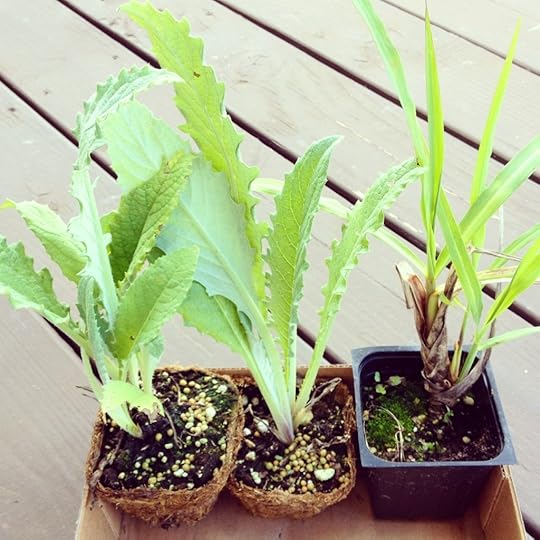
Here is what I wrote after my first ‘serious year’ learning to be a decent gardener — for the record, I don’t have a green thumb, and gardening is a hobby I really have to work at, though come to think of it, that serious effort is likely a big part of the attraction for me.
Lesson 1: Gardening success is all about the soil, preparing a nutrient-rich mix that will drain and re-wet well. Composting is a HUGE part of the mix; there are no chemical fertilizers in the rainforest.
Lesson 2: After the soil, it’s all about climate – which includes water, wind resistance, and keeping pests at bay.
Lesson 3: After soil and climate, you boost your success w/companion planting and diversity – Just 1 plant per variety can produce more than enough for our small family. So take time to plan well, and give plants enough room of their own to stretch in, while remembering how important their companions are.
Lesson 4: No sense wasting time and energy (water/soil expense etc.) on a plant you aren’t going to eat, or don’t really care about, just to see if you can grow it – make a different choice.
Lesson 5: Composting is extremely satisfying in terms of the circle of life: Nothing goes to waste. Even with 2 tumblers and small-chop rushing, I can’t produce it fast enough for all the places I’d like to use it.
Here’s the journaling exercise, as self-coaching for Alaka‘i Managers:
Rewrite these five lessons into manageMEANT lessons. What can these very foundational lessons in a garden, teach us about culture-building with the human beings we are raising, and growing? Concentrate on MĀLAMA as your value-driver:
MālamaTo Mālama is to take care of, to serve and to honor, to protect and watch over. Thus Mālama is thought of as the benevolent value of stewardship with compassion. In business it refers to the utmost care of all business assets, with particular caring for the most important ones, our human assets. Think about it: Human energy creates all our other resources, physical, financial and otherwise. Acts of caring drive us to high performance levels in our work with others: In giving we become unselfish. We forge stronger partnerships because we elevate others.
Archive Aloha: The feeling of déjà vu I mentioned ~ This January, Slow Down.



January 19, 2014
Curating Value Alignment
When I urged you to “Be a curator” as opposed to a documenter, I was primarily focusing on how we as managers can begin to curate work performance with the objective of strength-building: Curate, and Be Curated.
I also said, “Do it for yourself, and [then] do it for those you manage.” so work becomes more intentional and worthwhile for both of you.
There are several Curation Paths you can choose from when you consider self-development:
You can curate your reading inputs as one way to start.
You can curate what you eat — your nutrition, or some other aspect of health.
You can curate your habits, once you identify them (whether good or bad), and you can curate your management style.
You can curate the subject matter of your specific learning targets.
You can curate your choices in skill-building, and in strength-building by curating your energy.
You can curate a pathway of projects, and the pilots likely to result from those projects.
You can curate your Someday/Maybe(s) to reset your opportunities for them.
You can curate your Bucket List as dreamed versus accomplished.
You can curate your travel, your wardrobe, your gardening, your handcrafting… the list goes on and on. List-making is curating 101, and oh the possibilities! If you dabble in social media, you’re probably curating your friends and follows, having found that purely collecting them gets unwieldy really quickly.
So back to WORK…
To curate for those you manage, changing each ‘your’ to ‘their’ in the list above can break it down in a general way, juicing up your thinking about this, but to be practical, you want to be more specific than that.
 To curate a job performed, you’ll have to start by curating the work that is expected out of that job. Remember the stickie note? It broke curating down into three more verbs: a) selecting, b) organizing, and c) looking after. Managerial skill is a direct result of the intentions you devote to each of those things, in alignment with your value-driven work expectations.
Whew… let’s say that again, slowly. Managerial skill is a direct result of the intentions an Alaka‘i Manager will devote to selecting work, organizing work, and looking after work, in alignment with their value-driven work expectations. Your intentions are rooted in your calling.
Managing with Aloha gives us a very focused point of view.
Consider a stack of resumés from candidates applying for a job with you: They have curated their past experiences and whatever they deem to be their most desirable qualities, according to their point of view on your most likely job expectations, as they are guessing them to be. Did they nail it, or do you want something else?
Said another way, who writes the job description? Are your job descriptions static, or are they a work-in-progress? I dearly hope they are w.i.p.s. Coauthored? Even better, as that zenith where HO‘OHANA and ‘IMI OLA can meet!
We do work on work here, as our overarching objective. The Managing with Aloha distinction in that task of defining what work is expected from each job, can be found in the value-driving guidance of HO‘OHANA. We also curate according to the role of the manager, for strength management, and for our other expectations which shape the job at hand: Workplace Culture-building. We call them, collectively, our 9 Key Concepts.
With ALOHA is Key 1 — Start “with Aloha”
With WORTHWHILE WORK is Key 2 — HO‘OHANA
Value Alignment is Key 3.
Curating Value Alignment:
If we go back to that MWA-loaded sentence… “Managerial skill is a direct result of the intentions an Alaka‘i Manager will devote to selecting work, organizing work, and looking after work, in alignment with their value-driven work expectations.” …it naturally follows that the Ace Alaka‘i Manager remains true to the ethos of his/her organizational values: Ethos: Be true to your Values.
This is where you say, “And for me, those values are…” standing up for them (Kū), and employing them as the desired behavior-drivers of your expectations. If you are here to learn about the values of ALOHA, you enlist in our work and join us with these values, but it may be that the organization you work for is focused on different choices. That’s okay (and it’s normal!): Use this site, and your Managing with Aloha resource text as a benchmark or model you can learn from, and in the company of our Ho‘ohana Community.
Our Value Alignment Toolkit:
This is a good place to review our Language of Intention, pertaining to what we do with values around here: Values are our ALOHA-packed value tools of choice:
1. VALUE ALIGNMENT
Frames our key objective — To align the actual behaviors of a workplace culture with the values we say we believe in from an intellectual and convicted point of view: We believe in this value deeply, and therefore, this is what we consistently do, or aspire to do; this is how we will behave. Alignment is agreement, and value alignment agrees on both intention (why) and execution (how to, what to, where to, and who with).
[VALUE ALIGNMENT defined in the 9 Key Concepts, and as Key 3 category.]
2. VALUE MAPPING
Names the process [of VALUE ALIGNMENT] — We map out how we intend to achieve our objective, much in the same way we map out objectives like mission and vision, and all our strategic initiatives. Visualize a map: The values we select and work with, act as guide and compass.
[VALUE MAPPING tagged for learning.]
“Process is all of the rungs of the ladder between the bottom rung and the top rung. You can’t really get anywhere meaningful without process.”� ~ designer Frank Chimero
3. VALUE VERBING
Puts the process of VALUE MAPPING into the everyday language of workplace culture. We transform our VALUE ALIGNMENT intentions into executable actions via highly active, next-action verbs. We create our talk, so we can then walk that talk.
[VALUE VERBING tagged for learning. This is the post you will want to start with: Next-stepping and other Verbs.]
4. VALUE IMMERSION
Immersion means to go ‘all in.’ When you choose a value for your workplace culture, you align it completely — in everything you do. VALUE IMMERSION is flexible and adaptive when it has your constant attention: When confronting change, you realign and audit your value integrity in every strategic juncture. Remember: You can change your values too, growing them as your culture grows.
[VALUE IMMERSION is the primary objective of a Value of the Month program: Value Your Month for One — You.]
5. VALUE STEERING
VALUE STEERING is similar to VALUE MAPPING, but it is specific to project work, and refers to projects, pilot programs, and experimental initiatives. A value or pairing of values will be chosen to steer a project as primary value/conviction criteria: Those choices are the values which encapsulate the over-riding WHY a project is taken on to begin with, and they will do the steering necessary, as project work tends to wander — as it should, exploring and testing options, contingencies, and useful rabbit holes.
[In our storied history, ‘steering’ also refers to the Lesson of the Six Seats, found within chapter 9 of Managing with Aloha, on the value of KĀKOU.]
Jump in, for the water’s refreshing.

I know this seems like a lot. As with any language, it gets easy once you use it deliberately and consistently, as a toolbox. You a) talk the talk, so b) you can walk that talk. It actually becomes less, in that magic way that a language of intention will zoom as a culturally invented, and always reiterated-to-improve insiders’ shortcut. And believe me, this has gotten to be fun for the Alaka‘i Managers who deliberately and consistently are building a “with Aloha” culture of their own design.
Now stop reading, open up our toolbox, and go do something in your own value-aligned way. Be a Curator.
Let’s give Frank Chimero the final word on this; on doing… create your artifact in the curating you set out to do:
“Execution is important because you don’t learn otherwise. We learn best through experience and by doing, and doing creates artifacts.”
“If you make something (even just a rough something), now you have something to talk about, something to critique, something to analyze and something to change. More importantly, you get a sense of accomplishment. You were productive and you get to see what you did that day. I think there’s a special satisfaction to that, but unfortunately the fear we have of judgement is stronger than our memory of the pride of doing something.”


January 17, 2014
Curate, and Be Curated
Have you cracked open that gorgeous new journal you got for Christmas?
The clean slate we get each January, is an opportunity for managers to employ start-fresh record-keeping. In this era where a smartphone’s camera and voice recorder normally sits in your pocket or is commonly cradled in hand, (and is often of way better quality than your old point-and-shoot camera or clunky mailroom copier) there is little excuse for not doing that record-keeping, and making it slicker, more efficient, and also more fun. The tactile, analog goodness of your actual pen on paper handwriting, can then be devoted to writing to learn.
This is not going to be a post about your equipment options however, nor is it about your analog versus digital choices. It IS a post about your intention as an Alaka‘i Manager.
Do you document, or do you curate?
There’s a difference between documentation and curation in the way most managers currently practice them. Let’s push at their edges, and purposely make the value-verbing distinction for our Managing with Aloha Language of Intention [Key 5 and Managing with Aloha’s Lexicon Morphology].
As you will read, I encourage you to document less, as conventionally has been done, and curate more.
As an ‘IKE LOA -valued objective, I want you to be curated as an Alaka‘i Manager.
As an ALAKA‘I -valued objective, I want all your partners to be curated successes as a result of your leadership influence, and the ALOHA -filled time they spend in your company, and by merit of your partnership.
I know you want those things too, or you wouldn’t have read this far.
“Don’t ask yourself what the world needs. Ask yourself what makes you come alive. The world needs more people who have come alive.”
— Jonathan Harris
Repeat after me: “Documentation is old school. I’m a Curator now.”
Documentation is old school. It’s cover-your-butt transcription for progressive discipline, for union arbitration and other H.R. cautions and legalities. Documentation is done for evidence, way more than for worthy record-keeping.
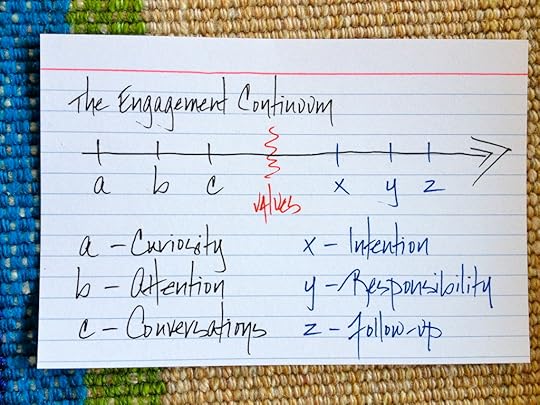
You pay attention when you document because you have to, but not necessarily because you are intending to engage better (refer back to the Engagement Continuum here: The Real Rules of Engagement) — and there may in fact be the intention to wash your hands of a situation as expeditiously as possible, documenting well so you can pass it on to someone else.
In contrast, curation is keeping, and curation is remembering, and curation is wanting to look back so you can look forward in a much better way. George Bernard Shaw might have said that curation is wanting “to be thoroughly used up.”
Curation is the result of a finely honed organizational skill, caring for the record-keeping which truly matters (i.e. is Alaka‘i Manager-intentional). Curation is a strength-building activity, that will, in effect, document progressive performance, and successful progress through improvement (holomua). We curate in a striving for excellence (kela, KŪLIA I KA NU‘U).
In workplaces, we’ve conventionally documented to catch a wrong, and too many managers remain stuck in that habit.
What we can do instead, is curate to listen better, to see good, and to catch a right [‘select’ on that neon green stickie note definition].
We’ll curate to get swallowed by our learning [to ‘organize’].
We’ll curate to HO‘OMAU and MĀLAMA; to perpetuate our good results with better habits, and with stewardship and ongoing care [to ‘look after’].
We’ll curate to keep our promises, to find all adjacent possibilities, and to stay out of dark places.
A manager will curate the Art of Good Work.
In doing so, that manager will become an artist too, painting a beautiful picture of what a workplace can be.
If there was a document dedicated to everything about you, what would you want it to be? While the argument can rightly be made that we learn from our mistakes, we don’t really want them documented, other than maybe, to illustrate how far we’ve come since our transgressions, and to see how much we have learned since then.
I’ll wager you would much rather have a curation — a document devoted to your strengths, and to that path you carved, which continually led to more of your potential [for Palena ‘ole, the unlimited capacity of Key 9].
I’ll also wager that each and every one of your partners would rather have that strength-building, potential-charging curation too.
As an Alaka‘i Manager, gift that curation to them, and do it for yourself.
Curate, and Be Curated.
Related Reading Suggestions:
1-Catch the Good, 2-Tell Them!
Managing: Be a Big Fan of the Small Win
Managing Energies: Struggle & Ease
Review this post’s curation as an example:…and as a journaling exercise in self-coaching [previous 2 links are to those tags]:
I categorized this post as applicable to 5 of our 9 Key Concepts: What is the Managing with Aloha connection you make to each one in the current state of your learning about the philosophy?
Key 3 on Value Alignment and Value-Verbing
Key 4 on The Role of the Manager, and The Calling of Alaka‘i Managers
Key 5 on Language of Intention, both authoring your talk, and walking that talk
Key 7 on Strengths Management, and honing an organizational skill that may not necessarily be one of your strengths ~ yet. We curate to get better, and get stronger.
Key 9 on the abundance mentality of Palena ‘ole, where capitalizing good opportunity with Mālama, can beget more good possibility
Extra credit :)
To drill down even more, dive into the category links for each key in the right side column of the site.
Practice using our value-verbing, by reviewing the tags selected in the post footer below.However you organize your learning within your journal (annotation, marginalia… in regard to reading inputs, I use Kindle/Goodreads, and a handwritten paper journal) or digital record-keeping (I use Evernote) is how you presently curate. Reflect and adjust, and hone your skill: Is it working for you? What might work better?
If you were to strictly curate your direct reports’ job performance, curating it for you, and not for H.R. or for anyone else, how would you do it differently?


January 12, 2014
Ka lā hiki ola and Leadership: A Sense of Hope
Ka lā hiki ola ~ literally; ‘the dawning of a new day’
Ka lā hiki ola ~ the Value of Hope and Optimism
Ka lā hiki ola ~ the Expectation of whatever is ‘next’ coupled with the expectation of Better
Leadership ~ championing the Clarity of Compelling Vision
Leadership ~ the Act of Leading toward the Future (whether that future is tomorrow, next week, next quarter, or in the next decade)
Leadership ~ the engine of Positive Energy in any organization
Ka lā hiki ola + Leadership = A Sense of Hope
Leadership is “the engine that could.”
Writers wax eloquent on what leadership is, and what it can be, and I have been one of them, I know. We hold leadership in the high esteem of our most visionary thinking, and we perch our pictures of leadership upon lofty pedestals.
I get my chance to whittle down my definition of leadership, and ‘get real’ about it, each time I visit a workplace, conduct a workshop, or coach a facilitation: I watch the leaders-of-title in those places and situations, watching what works for them, and what falls short. I listen to how they converse, and if they do so, given the opportunity. I watch their demeanor as others talk back, and they listen, or appear to. I watch the informal leaders too, for they are so readily seen: leadership is highly visible.
Thanks to these opportunities, I keep gravitating to a 3-word definition of leadership. Our 19 Values of Aloha conspire: It’s a definition consistently complemented by our Managing with Aloha values of ALOHA (to be in-spirit), ‘IMI OLA (create your best future), HO‘OMAU (persist and persevere) and KA LĀ HIKI OLA most of all:
Leadership is a sense of hope.
“I think I can. I think I can. I think I can. I know I can.”
― Little Engine That Could, by Watty Piper
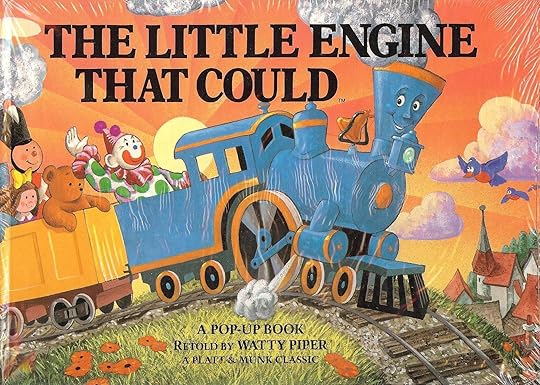
The successful leaders I have the privilege to see, are those who embody that ‘little engine that could’ in their organizations. They’re the ones who try hardest of all — to encourage, and to say, “what if?” They will pull their teams, and their entire organization over whatever obstacles, challenges, yeah-buts and other possibility robbers that stand in their way.
They know they don’t have all the answers, and they are okay with that. What they do know, is that an answer or an alternative can be found, and they can find it. They have no doubt that possibilities exist, waiting to be discovered.
Similar to Sense of Place [Key 8], a sense of hope is a place we dwell in for comfort despite the unknowns, while feeling our sense of belonging there. We are where we need to be, and where we can gain the courage we will need to continue, ever-aspiring for better and best. En-courage-ment.
Hope is no.1 on the list of our Twelve Aloha Virtues:
“Hope is such a beautiful thing. It is an attitude about the best of possibility becoming real. Hope looks at all the good that is true about the present and assumes it will Ho‘omau, be perpetuated into our future — and then some.”

From Emily Dickinson ~ “Hope is the thing with feathers that perches in the soul – and sings the tunes without the words – and never stops at all.”
Leadership is a Sense of Hope
The ‘falling short’ I often see, is when leaders fall back on only their own past experiences, or their position-holding credibility alone, and try to explain… and explain… and explain (whether by repetition or a different tactic) — simply to explain. And they explain without a sense of hope.
They’re condescending with those explanatory speeches and pronouncements they give, hoping to educate everyone else in the room. They get so involved in their explanations and justifications (often about a decision that has already been made) that they don’t notice the signs when people simply tune out. Those people might humor them, but they’re really wondering when their leader will get a clue, and see things as they really are — and then inspire them, so everyone can look forward to better.
The result is an impasse, where all the energy has been drained out of the room.
When I’m there, whether as teacher, as coach, or as facilitator, I know I have to get the energy back into the room as my next step. Whatever else I may have had planned for our time together gets pushed aside until positive energies flow once more. Until there is that soft, comforting glimmer of hope.
Please review: Alaka‘i Managers are the new Energy Bunnies.
Yes. Leadership is a sense of hope.
A sense of hope is the leadership style that gets a purposeful following.
Please review: Purposeful Following.
An organization without optimism is sickly, and needs to get its’ better energies back if it’s to get healthy again. Positive thinking recharges everyone’s batteries, reawakening their desire to get involved and participate instead of sitting back, arms folded with that tell-tale “I really don’t like this.” posture branding their resistance.
Inject a sense of hope as the best medicine you can possibly have. You will often find that those explanations you tried to give before aren’t even necessary.
Ka lā hiki olaKa lā hiki ola translates to “the dawning of a new day.” This is the value of optimism, hope and promise. We are reminded that there will always be the dawning of another day — life affords us many different opportunities, and it is up to us to grab hold of them, and make this day our day, and the best day ever.
This value is the guiding light of Key Concept 9 in Managing with Aloha as a complete lifestyle philosophy; Palena ‘ole, the concept of unlimited capacity. Build on your past, but don’t get hung up on it: The future is always bigger, with the promise of much more abundance.
…Continue your learning here…



January 10, 2014
A Discipline with Reading
One of my personal resolutions for this shiny new year, is to read books with constancy.
‘Books’ is the operative word: I do read rather voraciously, but in the last few months my regular reading diet has primarily been web-based, or dabbles in ‘tastings’ such as offered by Kindle Singles. Many of my choices are longer reads (such as the wonderful offerings on Aeon Magazine), but they aren’t books, and I’m feeling the need for more book-inspired reading and learning.
There are many differences, I think, between books and other kinds of reading. The chief one for me, in a word, is immersion, and the length and quality of that immersion when you savor a book, and are in no rush to finish it.
As you well know, immersion is a practice I enjoy with our values study too: Value Your Month for One — You.
When you immerse within something, you succumb to having it swallow you whole, fully within its context and atmosphere, so you can do that concentrated and attentive savoring of the experience with as little distraction as possible. You hold onto your own discerning powers of spirit though, succumbing only until you have made your own decisions, and begin to float: You are ready to newly emerge from that swallow, getting your own feet back under you to then power through the rest of your life with refreshed, and re-energized vitality.
You immerse to experience, to learn, and to decide on your keepers so you can newly use them, and move on to whatever is Next for you, wherein you’ll balance out your chosen engagements.
‘Real books’ or kindling: I’ll take both, thank you.
 I’d actually started on my book-reading resolution when I picked up Wild, From Lost to Found on the Pacific Coast Trail, by Cheryl Strayed about 3 months ago in paperback. My family noticed when the book stack piled up on our living room coffee table as my annual winter sabbatical started, with The Time Keeper, by Mitch Albom sitting on top even though I still deferred to my Kindle (a 2008 dinosaur, by today’s standards).
So for Christmas, they pooled their pennies to get me a new Kindle 3G Paperwhite — a wonderful upgrade! If you want to make quick progress with a fresh intention, a family gift related to it will surely do the trick, spurring you into habitual actions quickly as a way to demonstrate your gratefulness to the gift-givers you live with.
The first book I decided to read on my new Paperwhite, was Wuthering Heights by Emily Brontë (which Amazon.com offers on Kindle for $0.00). I deliberately chose a classic to start with, knowing its’ older English language would slow me down in the reading, and it has.
 Wuthering Heights was required reading for me back in high school, as it was for many of you, I imagine. My remembrance of it was very sketchy, other than having the name Heathcliff firmly park itself in my memory banks, as the dashing, and romantic hero. Turns out my memory of Heathcliff had grown exceptionally kind over the years, for he is neither dashing or romantic, and I am finding the book is not at all what I thought I remembered.
Am I enjoying it? And savoring it? Thoroughly.
I have just finished it, and I am going to return to the beginning to read it again, and before I choose my next book to read. Now that I know the story (the correct one!) I’m going back to sink deeper into the telling of it, going back ‘into the river’ a different person, as Richard Ford has described:
“Our recalled affection for a book is, after all, always woven into how we entertain and balance the best parts with the less artful passages or the wooden infrastructural bits the novelist couldn’t bear to take out. Novels are forgiving forms: good writing over here often forgives less good writing over there, so that the whole may prosper. Rereading all of a novel sometimes invites us to be more forgiving ourselves.
The point here (unsurprisingly) is that rereading a treasured and well-used book is a very different enterprise from reading a book the first time. It’s not that you don’t enter the same river twice. You actually do. It’s just not the same you who does the entering.”
— Richard Ford for Eighteen Bridges: Rereading, A Different Hunger
~ ~ ~
“Wuthering Heights was first published in 1847, and it is the only novel Emily Brontë wrote. She never saw her name in print because the book – about a doomed love affair between Cathy and Heathcliff – was first published under a male pseudonym, Ellis Bell, due to fears she would face prejudice as a female writer. It was only after her death from consumption in 1848, aged 30, that the novel’s brilliance was recognised and it went on to become an English literary classic.”
Source: The Guardian: Copy of Wuthering Heights sells for six figures
Immersion’s Reading Discipline
I started this post, by saying “read books with constancy” and not “read more books,” because my resolution is about immersion’s persuasions, and not about numbers. Mine is a resolution which recognizes that ‘less’ can truly be ‘more.’

Photo: The Mind of a Fiction Book Lover
I am still quite a fan of Goodreads, and intend to keep up with past habits there as the place to park my book reviews when I write them, but this year I am staying away from the Reading Challenge they promote: I found it can have the detrimental effect of rushing me through books to finish them and update my numbers, and that’s not at all the point of my reading goal. Just the opposite: I want to stretch out my reading, annotating, journaling, and reflecting as I go, so I stay awhile, and notice more.
The social emphasis of Goodreads or any other book club will not be the goal either. I do enjoy the Goodreads community, but am cautious about having reviewer and referral conversation there influence me too soon, i.e. before I “emerge from the swallow” of my own first reading. Maria Popova, curator extraordinaire on BrainPickings — which I highly recommend to anyone wanting to stoke a fire in their sense of curiosity — explained it best for me, in this interview she did with Findings:
How has reading become more social for you?
It hasn’t.
I have a friend who “skims” books by turning on the popular highlights feature in Kindle and only reading those. It works for her, but to me that’s the death of reading.
Reading is a bootcamp for developing and exercising critical thinking. Without that — intellectual apocalypse! And critical thinking is about developing a point of view, and all writing is — or, should be — about arguing a point of view, implicitly or explicitly. When you bring the crowd into the equation, this concept completely disappears — because a crowd cannot have a point of view, at least not one that is simultaneously focused and authentic to each individual in the crowd.
I don’t need a focus group of strangers to tell me what I should be reading or, more dangerously, how to read what I’m reading. Decision by committee doesn’t work in creative labor, and it certainly doesn’t work in intellectual labor.
Mortimer Aldler, in the wonderful How to Read a Book, says that marginalia are your private dialogue with the author, the intellectual tug-of-war that is really the greatest compliment you can pay an author. Being guided by other people’s marginalia is like letting a thousand voices into your head while trying to hold a challenging debate. Have those conversations, by all means, but do so over dinner or tea with people whom you respect and only after you have read the very thing you’re going to discuss and made up your mind about it.
“Listen, then make up your mind,” Gay Talese famously said about the secret of writing. It’s only logical that this should be inverted when it comes to reading: “Make up your mind, then listen.”
That said, I’ve always taken this advice to heart, from Tim Sanders, in Love is the Killer App:
“If you haven’t found some application within a few months of reading your books, question your aggregation methods… Visualize a discussion. If you’re not using books in your conversation and in your business strategy, review your selection process.”
~ Force of Habit, and the Force of Change
Bottom line: What is your reading goal?
Our recent mood here, talking story about engagement, leads me to thinking about my 2014 book-reading engagement continuum this way: Read for me first, and re-read for me first, privately wallowing in the experience and noticing as much as I can. When I emerge from the swallow, conversing about the entire experience will be the sweet icing on the cake.
A 5-Batch of related links (all of these will take you off-site):
An article on The Guardian about Kindle Singles: The big short – why Amazon’s Kindle Singles are the future. “All hail the ‘bookeen’, a new format that’s perfect for short stories, novellas and essays.”
Thankfully, my family realized a new e-reader was the gift for me, and not a tablet. This article gives a good comparison on the two: Kindle Fire Vs. Kindle Paperwhite.
How We Will Read, was a 2012 series for Findings, and they interviewed Steven Johnson, Laura Miller and Maud Newton, Craig Mod, Ryan Chapman, Kevin Kelly, Richard Nash, Clive Thompson, Clay Shirky, Baratunde Thurston, and Paul Carr in addition to Maria Popova. There are gems in each interview.
The book which influenced me most in recent memory, is at first glance a cookbook, but actually so much more: An Everlasting Meal: Cooking with Economy and Grace by Tamar Adler. I have given more than a case worth away as gifts, and did two reviews on it: A short one on Goodreads first, and a longer one for TalkingStory.org second: How to Fill up by Spilling .
If you would like to read more books too, I’ll again point you to Maria Popova’s BrainPickings for her recent listing: The 13 Best Books of 2013: The Definitive Annual Reading List of Overall Favorites.



January 5, 2014
The Real Rules of Engagement (Redux)
“Yet ‘balance’ hasn’t slipped completely out of our vocabulary.”
— Balance, 2014.
In my final publishing of that posting, I discovered there were so many Managing with Aloha verbing tags a balancing act can pertain to, even after I tried to narrow them down. Did you notice all of them in the post footer?
Let’s continue the conversation, shall we?
If we stick to the gist of it, BALANCE 2014 was about attention moving toward intention, and settling within welcomed engagement, without “Please, just leave me alone” withdrawal putting up an attention-blinding roadblock. The Venn diagram would look like this:
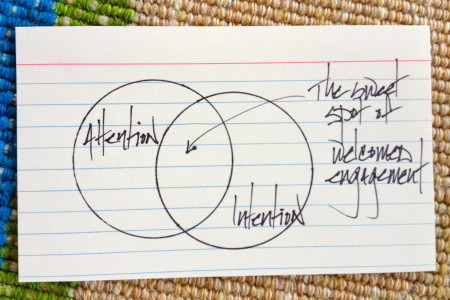
The self-coaching journaling I asked you to do at the end of the posting, was something I did for myself and my Say Leadership Coaching team too. We had a conversation about what attention means: I’ve noticed. I’m pausing to listen better, and think about it. Whereas intention means: I can own this too, or at least participate with you… this is is what I’m going to do, converting attention to action.
The exercise led me toward thinking more about engagement as a bigger, more inclusive word for the kinds of actions we will take. Engagement can run the gamut, from having a conversation we might not otherwise have had on something, to turning that initial conversation into a comprehensive new project.
Food for thought, and for Coaching in value-mapping:When you think about ENGAGEMENT, which of our 19 Values of Aloha most readily come to mind for you? Think about your why-to and how-to decisions and their value alignment [MWA Key 3]: There aren’t ‘right’ answers, just contextual ones, as best suit your current workplace or other Sense of Place.
Discretionary Actions vs. Rules
And then there are workplace RULES, whether explicit (stated clearly and in detail, leaving no room for confusion or doubt), and expected in team behaviors, or implicit (implied though not plainly expressed).
Taking action of any kind is essentially about personal decision-making, and about taking initiative and affirmative action. Workplace rules are more baseline and foundational; they contribute to the sense of place within your ‘Ohana in Business [Key 6] by stating expectations on professional attitude — for everyone: Personal decision-making is expected to be in harmonious alignment [Lōkahi and Kākou] with those positive, and profession-affirming attitudes. If those workplace rules are written well, they will also connect with and articulate key workplace values.
Which brings me back to this redux revival of an article in our Managing with Aloha publishing annals: “The Real Rules of Engagement” was something I wrote for Lifehack.org several years ago. As you read through this, see if you can determine which value-drivers influenced our team back then. As you will read, sporting metaphors were in favor, and helped us keep our rules rather succinct. The links I have added in will refer you to our previous conversations here on MWA Central.
The Real Rules of Engagement
On a recent late night I found myself needing to wind down before sleep, I flipped on the TV and happened to catch the tail end of Rules of Engagement.
 The military action drama seemed so completely out of context for me, for without ever having seen the movie when it came out for the first time in 2000, the phrase “Rules of Engagement” had quickly caught on in our workplace a bit more literally.
For us, the phrase meant that work was not a spectator sport; it was one you participated in fully, going for the score every time. Further, we couldn’t afford to carry bench-warmers: When you came to work, everyone expected you to “suit up” and be fully engaged. Period.
That was the primary rule of engagement; that you did just that — engage and participate from the moment you clocked in. However there were some others that we felt were our ground rules of professionalism, and the fact that we all understood and agreed to them afforded us some basic efficiencies. Moreover, they kept unnecessary annoyances and many small petty squabbles out of our workplace, opening the door wider for Aloha and only Aloha.
Rules of Engagement
1. Engage. Participate. Be fully present. No auto-pilot.
2. Meetings and multiple appointments are a fact of work-life; the least we can do is be on time so they can start on time and our peers are not kept waiting.
3. Respect the attention of your peers. Come prepared means come prepared.
4. Always have a pen and paper for note-taking. First, you respect others who are giving you information by acknowledging it, and secondly you’re expected to capture it, and follow-up; forgetting is not an option.
5. Whatever your role is, you’re expected to be the expert in that role. Own it, and don’t be shy about it. Stake your claim proudly. (This was part of the no bench-warmers philosophy.)
6. When you say you’ll follow-up on something, do. If it’s not going to happen, say so. People trip when you sweep stuff under the rug. (On apology, and making amends.)
7. Own up to your mistakes and be okay with them. Making mistakes is perfectly fine for we all make them. However huffing and puffing about them with excuses and justifications is not fine. Get over it (we already did) and just correct it.
8. Communicate. We have found that relying on mind-reading doesn’t work that well for us.
9. Trust and be trust-worthy. Much easier when Rules 1 – 8 are honored and we all keep it real.
They may seem obvious, however having Rules of Engagement can save heaps of time and wasted energy, and they can stem frustration. We purposely kept ours to less than 10 in a Q&D* brainstorm one day that happened when someone had asked, “What are your pet peeves? What would make things so much pleasant here if those pet peeves went away forever?” and we committed to each other to do just that — make them go away forever.
*Q&D stands for Question and Dialogue, which we preferred to Q&A.
Rules of Engagement. It has a nice ring to it, don’t you think? Gather your folks together, and brainstorm your own, be they at work, at home, in your club or association, and on your sports or community team. Just imagine the bliss if everyone were to fully engage, participate, and be present.
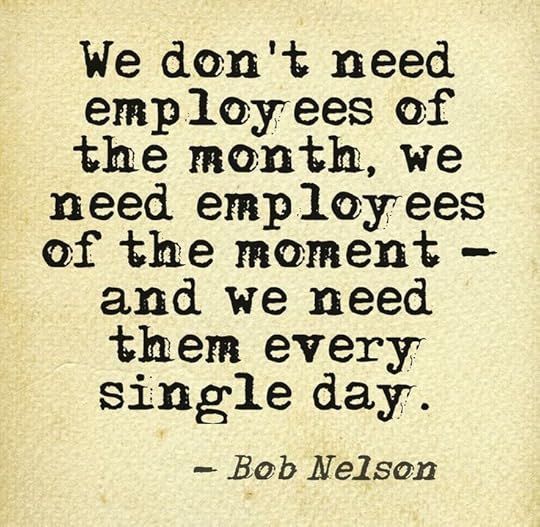
The January 4th reminder on my desk’s perpetual calendar, 365 Ways to Manage Better, coaching us to catch people doing right, and performing well. Acknowledge them, and thank them, and you’ll be reinforcing the behaviors you value most.
Begin with the End in Mind
We had some specific objectives in mind, and they framed the Q&D brainstorm which generated our Rules. Here is another example (a Pinterest link which will open on another tab for you) pertaining to meeting expectations. I like their “no surprises” rule.
Would writing Rules of Engagement assist your workplace team? A very beneficial way to facilitate a Q&D brainstorm of your own, would be to ask everyone what they consider to presently be your explicit workplace expectations, in comparison to your implicit ones, using a Rules of Engagement draft to better articulate and blend the two. It’s sure to be a very interesting conversation.
1st Draft: Pursue clarity with explicit and implicit expectations.
2nd Draft: Determine your value drivers. Are there any key values missing, or misstated?
Then decide how you will use your new rules, doing some next-stepping, and inculcating them into your habits. Engage with them.


January 3, 2014
Balance, 2014
We used to talk about work/life balance — a lot. Nowadays, work/life integration is the phrase in vogue, and I use and prefer it too, particularly when we talk of striving for that sweet spot where working with Aloha meets living with Aloha and we are at our best, sustaining a livelihood that nourishes our sense of personal well-being.
Yet ‘balance’ hasn’t slipped completely out of our vocabulary.
I find that ‘balance’ will often enter our conversations today, pertaining to one situation in particular: Achieving a balance of attention between two worlds most of us will occupy these days ~ the ‘real world’ and the ‘virtual world.’
There’s an in-person us, and the 2014 screen-seen us, e.g. in social media and other publishing or ‘status updating,’ and we wonder about our presence in each of them, and our credibility with each one.

All of this, is about what we pay attention to, and when.
I’d love for us to speak of integration in these situations too, or better yet, of alignment. However I can understand why balance is the word that fits; people may not want to integrate or align them at all, and they are happy with having the separation with exists. We may prefer to keep them separated, at least until we can better investigate the drawbacks and benefits of each one:
Balance Scale: Yes, please. Prevailing rule: No jumping from one dish to the other.
Venn Diagram: Hmm… Prevailing rule: Push farther into that integrating intersection as much as you can, so the circles overlap more and more. Oh. No thank you.
Is there a right answer here? Depends on who we’re talking about. I don’t think we can get up on our high horse and proclaim we must have more authenticity and realness, without knowing about the value-drivers in place, and a person’s reasons for their choices. It may, for instance, be a case where a person’s ‘screen time’ — blogging, tumbling, ‘gramming, tweeting, and making other updates, or just playing with apps, and lurking in certain online communities — is about learning, or research, and they reserve what they consider to be their ‘real life time’ for their conversations and true engagement.
And there’s the rub for the Alaka‘i Manager when it comes to the workplace; discerning what his or her team’s value drivers are.
Values essentially do two things for us: They define our WHY and they give us a HOW-TO.Those two things don’t always go together, and when they do, the result is very, very powerful. To start with your WHY is to begin all efforts with your personal truth about something, to start with its “good sense.” To proceed, and take action with a HOW-TO connected to your WHY, is to honor your personal truth.
~ Let’s Define Values
I will say this: It’s much, much easier to do diagnostics on values (necessary when people won’t simply speak up and tell you what they are) when you’re dealing with the real world — i.e. where the communication cues you see, hear, or otherwise sense, are emanating from a human being standing before you in flesh and blood. You’re occupying the same space and time, with Sense of Place to help you, and you can ask questions, to be sure your understanding of whatever they wish to convey is complete. You can ask how you can help; how they hope you’ll respond. You can ask for their help too, and for their partnership, so you’re not going it alone.
Though it may not seem like it at times, real life, and in-person engagement is also much easier to keep up with. Technology flits and zooms wildly, and we can no longer count on generational distinctions; they have become faulty stereotypes.
So what to do?
You cannot engage (i.e. manage well) when someone isn’t paying attention to you. And you need their attention first, for Aloha-valued intention second.
That balance scale with separate dishes is about attention-filtering, whereas that venn diagram is about intention-movement, to widen one’s circle of comfort, and/or circle of influence.
Rest assured: Creating an with Aloha workplace atmosphere will trump technology’s early adopter/ late adopter flare-ups every single time. Everyone prefers real world warmth when it is readily available, and welcomes them in; it’s our nature as human beings and not cyborgs.
Create a Sense of Place:
Create a workplace where you help people speak up, so they will tell you about that balancing act within their attentions, and so they move toward engagement.
Make it safe, and make it comfortable — comforting even, pleasant and warm — for people to be their real selves with you, to want to be in-person with you as the best place they can be.
We call it that place of ALOHA. It’s a good place. For balance, for integration, for being content and satisfied. Set a place for Aloha at every table you sit at, and no one will look for a balance scale dish to jump into instead.
Related coaching for Alaka‘i Managers:
Speak up, I’m listening
The Rub of the Business Model is Solved by your Values
Ethos: Be true to your Values
Hana ‘eleau: Working in the Dark
A Sense of Place Delivers True Wealth
Key 8. SENSE OF PLACE:Think “working in my neighborhood” for no culture exists in a vacuum. Sense of Place is both the feel OF a place, and the feel FOR a place. Sense of Place is about greater community locally and connectivity globally. It is saying a “thank you” with stewardship, and engaging at a higher level with those places which have gotten you this far, and continue to nourish you daily in a multitude of tiny ways that collectively are absolutely HUGE factors in your success. It is giving back, recognizing that place nurtures and sustains us; it shapes our experiences and lends cultural richness to life. Always will.
Site category for Key 8: Sense of Place
Read more: The 9 Key Concepts of Managing with Aloha and The 9 Key Concepts — Why these 9?
Coaching Assignment:Open your self-coaching journal, and write-to-learn, so you can figure out your first move in creating a better Sense of Place within your workplace:
Write a short paragraph which describes what your workplace Sense of Place feels like now. Be honest: Tell it like it is. This is for your eyes only.
Describe your currently prevailing workplace balance scale of attention (it may not be about screens and social media at all, but about something else.) It may be helpful to think about what your people are most interested in learning, for you want to recognize that there are both good attentions, and not-so-good ones. Recognize those times that are simply for play, and sort out where beneficial play belongs in your workplace.
Draw a simple venn diagram with just 2 or 3 circles, and use it to describe the engagement and intention movement you want more of, i.e. begin with the end in mind.
What will be your next move? Once again, the objective is to create a warm and welcoming Sense of Place where those circles overlap, so people feel drawn there, moving their individual intentions in that direction. If you get stumped or overwhelmed, this can help: Next-stepping and other Verbs.