Peter M. Ball's Blog, page 14
June 3, 2021
Some Updates From the Brain Jar
Greetings, Lost and Lonely Blog Readers. It has, as they say, been a while. It’s the curse of having a lingering affection for an older, largely superceded form of online communication, plus the sheer pant-shitting terror of trying to launch a successful publishing company in the midst of global chaos. A good deal of the stuff that I used to blog about now finds its way into the weekly newsletter, which is itself supported by the Eclectic Projects Patreon where a lot of the conversations about what I’m posting tend to take place.
I’m also trying some new forms of online presence at the moment, which is a little terrifying in and of itself. I’ve fired up the ringlight and the webcam to start doing a little more video over on Facebook (itself a response to going offline for a week, and realising that a phone would still allow me to talk books and writing if people were used to seeing me on-screen as a face and voice instead of a stream of words).
Here’s the first attempt, talking about the recently launched chapbook edition of Angela Slatter’s No Good Deed.
There’s some slightly meatier vids coming about writing and publishing, which wil likely get crossposted here for folks who miss hearing me bang on about such things. Stay tuned, etcetera and so forth. More good things are coming.
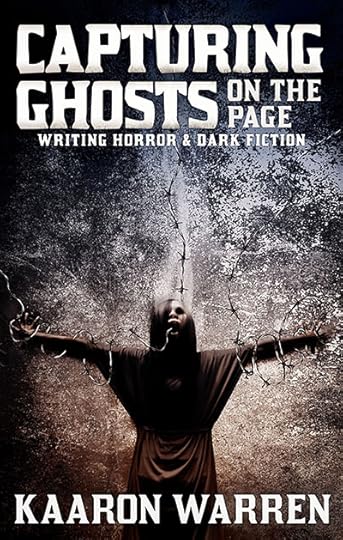
In other Brain Jar news, we recently opened pre-orders on Kaaron Warren’s entry in the writer chaps series.
“Don’t write merely to shock. People are used to shock-horror. You need to get beneath the skin. Use a flensing knife and keep it sharp. It’s good to shock, but only as part of the story you tell.”
In these essays, Kaaron Warren—the Shirley Jackson Award-winning writer behind Slights, The Greif Hole, and Into Bones Like Oil—explores the craft and philosophy of trapping dark and disturbing fiction on the page.
Drawn from essays, workshops, and articles about the craft and business of writing, Capturing Ghosts On The Page feature’s Warren’s tips on writing ghost stories, overcoming professional jealousy, working to an anthology brief, tapping your dreams for inspiration, and more.
Whether you want an insight into the creative process that drives Warren’s dark and enchanting fiction, or you are an aspiring writer seeking tips from one of the most talented authors of horror fiction writing today, this chapbook is a peek into the mindset and practice of a celebrated Australian author.
It’s an outstanding book of writing advice, showing the kind of wit and insight that Kaaron Warren fans have long come to expect from her fiction. It comes out on June 15, and details are over on the Brain Jar Press website


March 17, 2021
And Now We Are 44
Today I turn 44, and I’m returning to one of my most enduring birthday traditions: posting god-awful birthday selfies designed to worry my Mother about the kinds of content that gets put up on the internet.
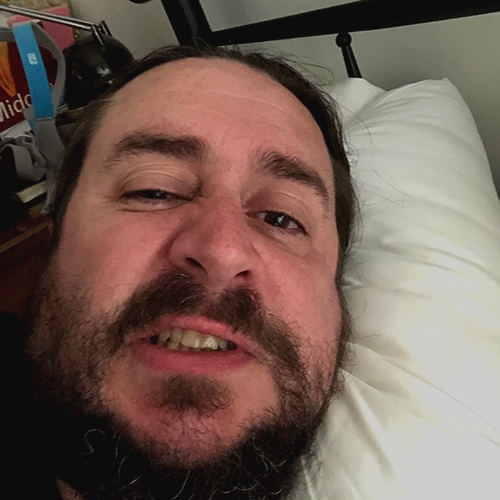 Yaaar! Somewhere along the line, I grew a terrible pandemic beard and haven’t yet found a reason to shave it off.
It’s the first of these that I’ve done in a log while, largely because 2019 and 2020 where incredibly shit years for birthday celebrations. In 2019, I spent the day sitting vigil while my father passed away and my sister prepared for cancer surgery. I had plans to try and reclaim the day with happier memories in 2020, just so I didn’t spend the run-up to each birthday getting lost in memories and grief, but 2020 delivered us a global pandemic and the first wave of Australian lockdowns in March, so it proved to be the exact opposite of what I was hoping for.
Still, it’s another year, eh? And this year I’m going in with a plan. While I normally avoid having any expectations or desires around my birthday, this year I’ve given myself a present.
More specifically, I’ve started a Patreon to fun the creation of non-fiction content here, in my newsletter, and in a suite of other spaces.
Once upon a time, I would devote about eight to ten hours a week to producing free stuff about writing, publishing, pop culture, and more. It wasn’t always the most efficient form of self-promotion as an author, but I enjoyed it and people found a lot of useful stuff amid my weekly burble.But when you publish other people, and they’re trusting you to do right by the books you’ve contracted, inefficient-but-fun takes a back seat.
Over the past year regular readers have mitigated that by throwing some cash into a digital tipjar, but I’m hitting a place where I wanted something a little more formal and predictable. Craig Mod has probably the best take on fan-supported writing that I’ve seen, referring to it as implicit and durable permission machines. They free creators to go take chances on weird, commercially weak projects that still have a lot of value.
And when I sat down earlier this year, pondering what I really wanted for my birthday this year, that’s exactly the thing that appealed to me: permission. Permission to do the kind of writing I really enjoy, which is rougher and weirder and not-likely-to-be-paid-for in any other way. And the kind of writing I’m not going to be able to justify devoting the time to unless there’s a payment attached (even if said payment is small and token — it shows interest in a world where free writing gets less and less feedback).
If you’ve got a few bucks to spare, and you’d like to see me do more work in this space, join up and be part of the advisory board who gets to weigh in on future directions, rough drafts, and early research. More details here: https://www.patreon.com/user?u=5686487
January 9, 2021
Sunday Is Weird
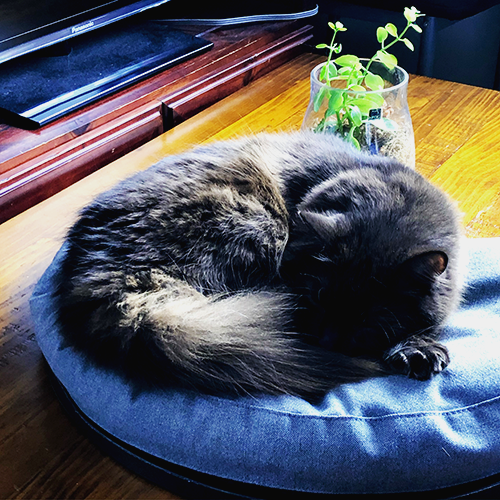
Our not-so-beloved downstairs neighbours are moving out today, in the midst of the Brisbane lockdown. It’s a bizarre riot of sound compared to a very quiet Saturday, during which the cat slept on the laptop table for several hours and I engaged in a prolonged doomscroll following Australia’s current virus news, American post-election fall-out, and the rest of the world just basically figuring 2021 will roll on just like 2020.
Brain Jar Press has new books to announce, but I held off figuring that last week was a bit too busy to compete for attention. This proved a smart choice, given the way our book sales (rightly) tanked as all eyes turned towards the news.
But it’s also an inauspicious way to start my first week as a full-time publisher. There’s no real possibility of hitting the ground running this week, no easy tasks that could move the needle on sales and inch towards the kind of benchmarks I need to start hitting for the next eight months.
Time to construct a new to-do list, methinks, ’cause it’s all going to be hard stuff for the next little while.
January 4, 2021
The Egg-Splat of Screen Time in 2020
I’ve used RescueTime to track my computer and phone usage for a few years now, and it continues to be a surprisingly underrated tool in my kit. Today they sent in my year in review for 2020, showing me how I spent my screen time throughout last year, and it was really interesting to note some of the ways the data is different to previous years. Case in point, the little egg-splat they produce that visually represents your time by month and category.
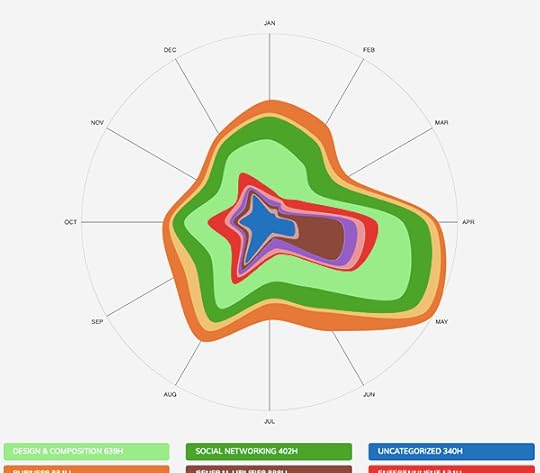
I’m used to these being an irregular shape, but the April-through-May bulge is one of those aberrations that tells me just how different 2020 was to a regular year. There’s a massive blow-out in “general utilities” time, which proves to be the endless hours spent learning to use Zoon and teaching online when the university closed the campus. It’s accompanied by a bulge in my purple “research” hours, which is basically how RescueTime logs “hours spent reading blogs and ebooks.”
At the same time, I also find myself looking at the big block of “design & composition” green in late May, trying to figure out why I’ve logged so much productive time without having anything to show for it. The answer, digging into those months, is a combination of a freelance gig that would not die and a massive surge in PhD writing as I tried to put half-finished parts to bed before taking a leave of absence in July. Both were huge jobs that basically dropped off my radar the moment they were done, and thus feel largely invisible to me as I look back at the things I did with 2020.
And this, at its core, is one of the reasons I find RescueTime valuable: it makes the invisible visible. It renders what actually happens at the computer as data, which often doesn’t match my assumptions. This end-of-year stuff is valuable, but my favourite use of it is checking the log at the end of the day. Often, when I’ve got the feeling that I’ve worked so hard for very little progress on a project, RescueTime will quietly inform me that has more to do with spending all my time doing other things. I’ll have spent 45 minutes of a four-hour block of time actually staring at the work document, and the rest of the time clicking around the internet or answering email.
Which often means I can sit down and give the project a little extra time and turn a day where I’m unsatisfied with my progress into one where I’m pretty damn happy, instead of railing against how hard things are (although, occasionally, an extra hour just confirms I’m trying to do something pretty damn hard, but that’s a useful data point in and of itself).
There is a lot more the software can do, especially on a paid plan, but I get a huge amount of value from the free option. It’s worth checking out if you enjoy the idea of tracking data.
January 1, 2021
Small
I spent the dying days of 2020 making lists of habits I’d like to establish (or, in most cases, re-establish in the wake of 2020’s unpredictable daily routines). Stuff like I’d like to start blogging everyday, and maybe turn the blog into a monthly zine or chapbook’s worth of content or post a free short story to every month or release 52 chapbooks over the course of the year.
All of them fell victim to my inability to pull the trigger on a year-long commitment, and thus risk the body-blows to my ego. Because they were all ego projects, to some extent or another. Attempts to stay in contact with my self-perception as someone who writes as my plans for 2021 looked increasingly focused on editorial tasks.
365 days is a daunting timespan, just as 100,000 words is a daunting amount of words to write if you’ve never written a novel. There’s always the danger that ambition outstrips ability, that motivation fades once the immediate need that drove you to the activity is satiated and you’re left with a whole lot of work thats’ no longer filling the same emotional void that drove you to the project in the first place.
It’s easier to start small and focused: blog for seven days straight. Post a single story for free.
Then stop and re-assess: has it brought me closer to the goal I was trying to achieve? Is it worth continuing in this line?
A whole year is just twelve months, and each month is just a handful of 7 day streaks in a row. If you get caught up in the 365, you lose track of how easy those seven days could be without the looming expectations hanging over you.
(Although I’m still tempted by the 52 chapbooks idea. I may yet pull the trigger on that one).
December 31, 2020
Mapping the Uncertainty (Or Why I’m Logging My Way Through 2021)
It’s New Year’s Day here in Brisbane. January 1st, 2021. The hell year of 2020 is in the rear view, and the coming year is shiny and new and only a little splattered by the ongoing shit it inherited from the previous 365 days.
I woke up this morning, wrote three pages, then spent an hour walking around the neighbourhood to check out the damage New Year’s wrought. Here, in my neck of the woods, it’s mostly roadside vomiting and evidence of some kind of car accident at the intersection near my house. More than I expected, as we seemed to be taking things quietly last night, but nowhere near the New Year’s record.
Once home, I made a coffee and fired up a fresh logbook for the year.
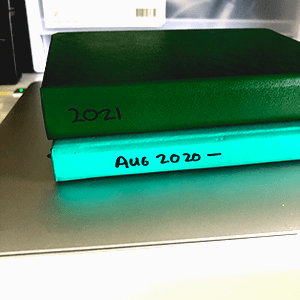 Okay, 2021. Now it’s fucking on…
I picked up the logbook habit from Austin Kleon, who advocates for the practice on his blog and in his book Steal Like An Artist. The process is basically what it says on the tin: log all the major things you do across a day in one place, so you’ve got an ongoing record of your year and what you did with it.
It’s also a way of keeping track of little details: when did I last put the electric toothbrush on to charge (or, for that matter, when did I last change the brush head)? When was the last time I contacted X about that project? How long has it been since we started watching that TV show?
All of that is useful stuff, and usually lives in my bullet journal for review when I need it, but this year I’ve elected to give it a dedicated notebook for two important reasons.
The first is the utility of creating an object that represents time physically, rather than conceptually. It’s one thing to acknowledge that a month has passed, but another to look see the year split between what’s already gone and what is yet to come. There is always a very tangible representation of how much of the year is left, accessible at a quick glance.
The second reason—the considerably more important one—comes down to the fact that 2021 is a transition year. Later today I finish my business plan and submit it to the folks as the NEIS program training, who are ready to sign off on eight months of funding while I try to build Brian Jar Press into a viable small business. I get to put all my attention on editing, publishing and selling books for a stretch, because that funding gives me some breathing space to pay rent while I build up the Brain Jar list.
Which is an outstanding and exciting prospect—especially given everything that’s going on, where there’s very little that’s genuinely excited about—but it’s also a big mindset shift. My brain is still wired for writing a lot, not publishing, and every habit and routine I have is built around getting more writing done.
Couple that with twenty years of my self-identity hanging off the notion of writing for a living, and there’s some days when the transition to publisher is a psychological struggle. I get anxiety about setting aside one part of my career to focus on another, and I grumble about the various publishing tasks which mean 2000 words a day is not a sustainable habit (let us set aside that it’s never been a sustainable habit for me).
At the same time, there’s other life changes our household is navigating: a partner with some ongoing health conditions that mean we’re re-learning routines and the distribution of housework; a global pandemic that’s changed our relationship to damn-near everything, including working from home; my own health issues, physical and mental, which can be managed fairly easily if I pay attention (but always slide the moment I get busy).
Basically, there’s a lot going on right now, and a lot of is new. I have very little idea of how long it takes to get things done, and my attempts to estimate and budget my time is running into roadblocks at every step. Logging is a way to get a handle on that, and recognise that things like uploading one of our new books to all sales sites takes a good six hours rather than the two I’d usually budget.
And thus, I save myself a world of frustration, because I know that trying to write a lot on upload days is a futile exercise. Far better to spend that extra hour targeting a different goal. Basically, the logbook is a tool dedicated to mapping my way through the uncertainty of my life at the moment.
It doesn’t always feel like that—here in the 21st century, we’re used to thinking of maps as things inside the GPS, telling us exactly how to get from one place to another—but all of them started as exactly this: a representation of the route explorers took as they navigated the unknown, so those that followed could find the safest and most efficient route.
AND SPEAKING OF BOOK UPLOADS
We recently announced one of our big projects for 2020 over at Brain Jar Press, offering a six month subscription to the Writer Chaps line of non-fiction chapbooks from some of Australia’s best writers of fantasy, science fiction, and horror.
I’ll be back to talk about why these books are so interesting next week, but for the moment I’ll just say this: I kicked this project off by contact six writers whose writing-about-writing was a huge influence on me when I first turned to writing fiction back in 2006. The whole series kicks off with Angela Slatter’s You Are Not Your Writing & Other Sage Advice on January 16, but you can subscribe to the whole first season and Brain Jar Press will send you chapbooks from Angela, Tansy Rayner Roberts, Sean Williams, Alan Baxter, and Kaaron Warren over the coming months.
Take a moment to go check ’em out.
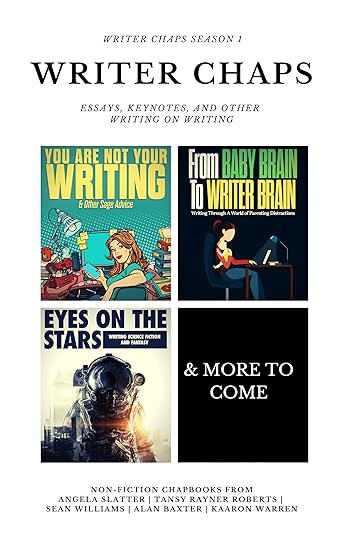
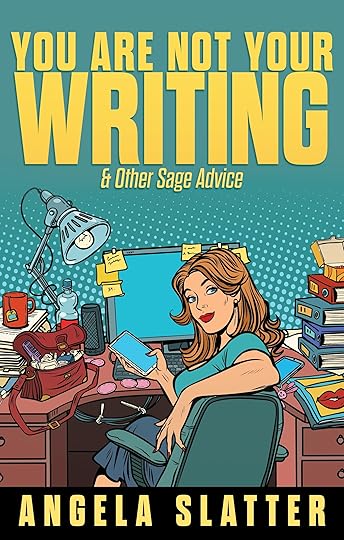
Writer Chaps Season One Subscription | You Are Not Your Writing & Other Sage Advice
December 28, 2020
The Line When Soup Becomes Soup
I spend a lot of time fascinated by the mutability of words, which is one of those things that’s seeped into my fiction from time-to-time. This made me a sucker for Something Something Soup Something, a concept that’s part-online game and part philosophy experiment about the mutability of a simple concept like “soup”.
The narrative behind the game is simple: it’s the future; aliens are making soup and teleporting it into your kitchen, but their understanding of soup is often flawed and needs a level of oversight. You stand by the teleporter and look at their creations, saying yes or no to each, and after a round of 20 or so serves the game will put together your personal philosophy of soup based upon your choices.
It’s a really simple concept and a similarly simple bit of coding, but the gameplay is secondary to the experiment going on behind the scenes – while there’s a general consensus about certain elements that make soup soup, these aren’t universal. The concept is vague, shifting, and impossible to define, particularly once you’re presented with options that might be soup.
The results challenge the idea that any concept is truly knowable, despite our belief that there are specific definitions. It’s a timely reminder of the problems inherent in that assumption:
Most people believe that we live in a world where everyone understands what words mean. But that assumption seems to be very flawed from the outset. So if we actually misunderstand each other on such simple concepts as ‘soup’, imagine how badly we misunderstand each other on more complex matters like democracy, freedom, or justice. The implications are very real and very telling.
(From You Don’t Know What Soup Is in Think! magazine)
What’s interesting about this for writers isn’t just the commentary on how language works, but the model that it presents with regards to genre. People love to assume that genres are static, knowable things, but those definitions are constantly in flux and willing to shift to accommodate texts that only meet some of the requirements. The process Something Something Soup Something asks players to go through is analogous to the theories of genre that I was looking at for the PhD, and which Kim Wilkins talks about in her essay about the way her novel was positioned (and repositioned) by various publishers and readers who wanted it to be a fantasy, a romance, or something else.
For the record, I am strongly in the camp that believes that food should be served on plates, not wooden boards or kitchen sinks or whatever tragedy of culinary service finds its way to We Want Plates. The discovery that my personal theory of soup is largely dependent on the liquidity and edibility, and willing to allows for a diversity of containers and eating utensils, caught me a little off-guard.
December 17, 2020
What Readers Ought To Know About What Writers Ought To Know About Die Hard
Every December, around this time, my blog goes a little crazy as folks discover the What Writers Out To Know About Die Hard series of posts and start asking particularly sensible questions like, “wait, we’re only halfway through, were’s the rest of the series?” and “so you’re going to finish writing this, right?”
And much as I always nod and promise I’ll get back to it one day, the odds of it making it to the top of my to-do list have always been low for a couple of complex reasons, most of which I fell into the habit of not talking about in public. So, with that in mind, here’s the current state of play:
I wrote these back in 2013/2014, when I wasn’t in the best of physical or emotional health. They were powered by a clinging-on-by-the-skin-of-my-teeth energy that fueled all my writing at the time, trying to bang things out before my sleep condition left me falling asleep at the keyboard and filling the page with the same letter. I reacted a lot, rather than planning next steps, and dug holes without figuring out how to get out of them. It’s…hard…to touch upon that mindset again.Writing an entry is a huge amount of work. Each post averages about five thousand words, and takes about two days to produce while I do the close reading of the film. I’ve spent more time engaging in close analysis of Die Hard than any book or series I’ve looked at for my PhD thesis, which is saying something. I’ve spent more time analysing Die Hard than I’ve spent editing short novels, and technically this writing thing is how I make my living. And while I was single and employed, back when I started this series, I now have a partner and a freelance career, neither of which affords me the space to spend two days futzing about with the DVD player logging time codes.The internet moved on and blogging holds less appeal. I pulled back on blogging because it often involved working three times harder for half the readership I got back in 2013, which changes the math of how will I spend my limited writing and promotion time? Especially when you have less time to devote to maintaining an online presence, and more need to get paid for your writing because your job situation (and mortgage) is different.My opinions on the film/theory have evolved over the last few years. The version of this series I’d write here in 2020 is different to the version I started in 2013. I’ve got another 7 years of thinking about writing and structure under my belt, and there are different aspects of the film that resonate with me. For example, I’ve got 3,000 words of Part Four written, and it covers about eight minutes of the film and it’s use of microstructure in a sequence, rather than the rest of the second act.
Add in a bunch of little things, like moving from the DVD player with easily accessed time-codes and fine-tuned pause-rewind-fast-forward controls to streaming services that don’t regard such things as necessary, and finishing the series is a shit-ton of work that starts with updating and re-writing parts one through three, then producing a word-count roughly equivalent to writing a new Keith Murphy book (or a time equivalent roughly equal to editing about 3 or 4 new books for Brain Jar Press). Given that writing and publishing are how I pay my bills, rather than collecting a steady paycheck as I did back in 2013, the math never works out in Die Hard‘s favour.
Every now and then I toss around the idea of just writing it as a book, because I suspect the only way of justifying the project is attaching a dollar value to it, but that would make the series a whole different beast. I’ve considered doing it as a Patreon project, but I’m always wary of Patreon’s tendency to silo content.
But I do like doing this analysis. I keep circling around the film and making notes and meaning to get back to it, and after seven years I’m rather open to the idea of crossing it off my to-do list.
So here’s my current thinking:
Re-start the series in 2021, kicking off with a polish and revision of the first three posts. It’s not happening prior to that because, frankly, I’m watching it with my partner on Christmas day and I’d rather not do that with six prior viewings in my head

November 25, 2020
Pattern Recognition: The November Resolutions
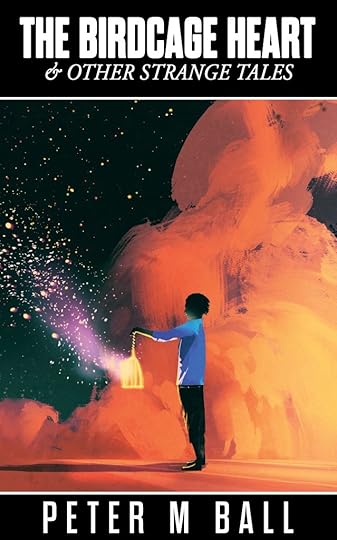
On the 30th of November I celebrate three years since Brain Jar Press launched its first book, the Birdcage Heart & Other Strange Tales. I’d been so focused on the upending Brain Jar birthday I overlooked another milestone—on the 27th it’s been twelve years since I started writing this blog and charting my progress as a emerging science fiction writer.
It’s tempting to make noises about blogging less often than once did, and wish for the days when a blog post would inspire conversation and feedback, but the truth is I’ve already blogged more often in November 2020 than I did back in heyday of blogs back in 2008.
It’s got me thinking about recurring pattern in my life, where November rolls around and I focus my sights on changing up my approach to a particular aspect of my writing and publishing career. In the past it’s manifested as starting a blog and publishing company, but also starting year-long writing challenges, investing in courses on marketing or cover design as I try to fill gaps in my game, or applying for mentorship programs and other forms of training.
Basically, there’s a weird little confluence of the publishing industry slowing down a bit, paid work easing off for contractors or university sessional staff, and the traditional end-of-year freakout about the cost of the holidays that gets me asking how am I going to up my game next year and taking the first steps to do so.
This year is no exception. Behind the scenes, I’m doing two courses at the moment—one is all about managing a micro-business and setting up a business plan to guide your decision making in the first few years, the other is a deep dive into email marketing and newsletter systems. Both are forcing me to take a harder look at processes and decision than I’ve had to in a long time, which is a weird combination of challenging, nerve-wracking, and liberating.
I’ve never really been one for New Year Resolutions, but may be the result of getting it all in a month early. It may be time to start logging this as a pattern in my quarterly review each year, so I know that it’s coming and make more meaningful choices about how I’m going to make use of the lets-fix-this/up-my-game energy that kicks in this time of year.
Speaking of upping my game: Brain Jar Press is running a small sale on that collection to celebrate the third birthday of our first book. You can pick up a copy in print and ebook through the Brain Jar Press webstore at a massive 30 discount%, with free shipping inside Australia (and discounted shipping overseas via our we’ll-send-it-to-you-from-a-local-to-you -printer option)
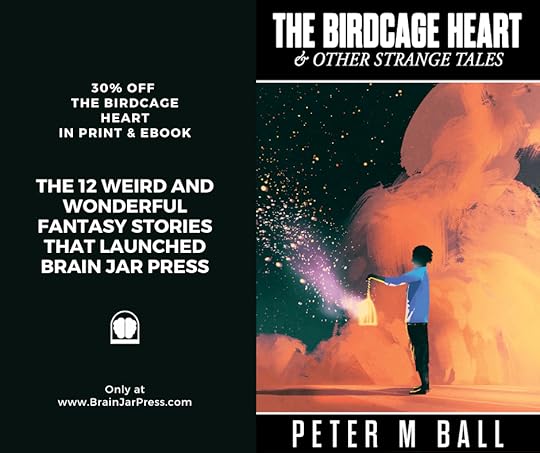
I’m happy to sign and personalise copies upon request, since they’re largely being mailed from my living room. Just drop me a note at the checkout or via my email as you place your order, letting me know who to make it out too.
November 24, 2020
An Important Publishing Lesson: Don’t Launch Your Company in November
Ah, the holiday season is almost upon us. All the signs are there: Brisbane is turning into a sweltering slow cooker of humidity; Netflix swarms viewers with terrible Christmas movies (and, frankly, the temptation to watch them all is oddly overwhelming); NaNoWriMo is in full swing; and the sales of Brian Jar books evaporate into the ether as everyone waits for the Black Friday deals at the end of the month.
There are many lessons I’ve picked up the hard way in this publishing gig, but one of the biggest I’d pass on to aspiring indie publishers or writers is this: don’t launch your goddamn publishing company in November.
If you attempt it, you’re launching a new book into a maelstrom of distractions that will make it hard to nab the attention of readers. You’ll end up drowned out by the Black Friday promotions, American thanksgiving, the swarm of NaNoWriMo deals aimed at writers, and that lingering awareness everyone has that they’re about to blow a whole lot of cash on presents and Secret Santa exchanges at the office and a series of holidays celebrations.
Naturally, three years ago, I cluelessly ignored all of this and put my first Brain Jar Press book up for sale on November 30. And in every year since, I hit November and plan a celebratory new release to mark Brian Jar’s birthday, and quietly forget the lesson of the previous year about how difficult it is to sell books at this time of year.
Fortunately The Birdcage Heart & Other Strange Tales did pretty well, despite the handicap. It’s a solid perennial seller for Brian Jar Press, got shortlisted for Best Collection at the Aurealis Awards, and has evolved into a rather pretty books as I got better at the design and production.
To celebrate turning 3, we’re running a 30% off deal on the collection in print and ebook over at the Brain Jar Press store until December 1st.