Peter M. Ball's Blog, page 2
July 16, 2025
Go To Sleep, Dumbass
The Wellness Industrial Complex has does a pretty good job of co-opting the idea of self-care and turning it into an aspirational lifestyle choice rather than ongoing maintenance of physical and mental health. The whole idea of self-care is now associated with affluence and privilege, or a kind of low-budget hedonism where pizza and Netflix where folks who can’t afford spa days and wellness make do with the small, ironic pleasures afforded to them.
And it’s not surprising, because actual self-care starts with small things that are incredibly hard to do when you’re actually in need of self-care.
Case in point: going to bed at a reasonable hour.
For me, this means getting my shit together at 9:30 and being in bed by ten, preferably without a screen nearby to distract me and keep me awake. That affords me a good eight-hour window in which I can sleep prior to my six AM “get up and write” alarm, even if I’m going to wake up after five or six hours because eight hours’ sleep seems beyond me.
I know this, and I know my life is smoother when I stick to the ten PM bedtime, and yet it takes effort to actually achieve it. It’s always tempting to stay up later—one more TV show, one more chapter, just a little more fucking around on the phone.
I pay a price for every hour I stay up past bedtime—a price in the amount of work done, the state of my mental health, and my trust in the routines that keeps things moving forward—so it’s almost never the right choice long-term, but humans aren’t built for long-term thinking. It’s not our default.
Real self-care is hard and incredibly goddamned basic and requires sacrificing the pleasures of now for the long-term gains. It starts with simple choices: Go to bed at a reasonable hour, eat enough vegetables, do the stretches that help ease the lingering pain, stick to your routine.
All basically free—no affluence required—but it’s not as fun as self-care as lifestyle brand and incredibly hard to do.
The post Go To Sleep, Dumbass appeared first on Peter M. Ball.


When Every Book Is Evergreen
One of the most useful parts of Thompson’s Merchants of Culture is the breakdown of the five modes of capital used in the publishing industry and its adjacent fields. I’ve used these to build a publishing company, guide my writing career, and solve all manner of problems.
But I also see a gap, born of Thompson’s focus. He specifically calls out Financial Capital as a key form of leverage, encapsulating all the cash-on-hand resources as well as the ability to generate credit, financing, and investment. It’s a key part of any artistic organisation, as very little happens without it.
The missing element — based on my experience — is probably time, which doesn’t appear anywhere else on his list. Traditional publishers default to the velocity models, focusing on a short, hot burn with sales — they generate interest, release the bulk of their stock into the world, and expect to sell the most copies in the first month. Failure to do so means using financial resources to warehouse books, using connections and marketing to keep books alive after the rest of the industry has set them aside, and tying up human capital managing the unsold books. That’s only viable for the evergreen titles, which generate so much interest there is constant demand.
Indie publishers can work slow, because the books are always there. The financial cost of storing an ebook or print-on-demand title is negligible, so it doesn’t matter if they sell tomorrow, next week, next month, or in five years.
If you wait long enough—and keep your costs low—every book is profitable.
And you can overcome a lot of financial resources by thinking long term and embracing the time to DIY and build your skills.
When you’re an indie publisher, every book is evergreen. And that means you can take chances, step away from the status quo, and do something surprising with utter confidence that one day—maybe months, maybe years— it will pay off.
You can write the book of your heart and eventually it will find its people. Maybe slowly, a reader gained here and there, but they will come.
The post When Every Book Is Evergreen appeared first on Peter M. Ball.
Working within the limits of your day
I’ve got nine minutes to write a post this morning, because the fiction writing went long. Ordinarily, that would be enough—I can dump a rough idea here, wander off to work, then come home and redraft the concept into a couple of hundred decent words.
But today is not an ordinary day. There are meetings at work—which take their toll on my socially anxious brain—and pans later this evening which wipe out my night shift. Finishing a reasonable post means giving up sleep, or accepting what’s possible today is out of the ordinary and reshaping my expectations.
On days like this, I set aside my expectations and go back to the core principles: what is the most useful thought or idea I can put out into the world today?
Today, it’s this: success starts with surveying the landscape and figuring out what’s possible from where you are right now. Nine focused minutes can deliver upon your core goal, if you’re clear about what that is.
Or it can be the time you spend faffing around, wishing things were different.
Faffing is the easy option, but it’s not always the best.
The post Working within the limits of your day appeared first on Peter M. Ball.
Current Projects – November 2021
Now that I’m consistently carving out space to write in my week, I thought it might be useful to get into the habit of touching base with all the projects hat have my attention right now, regardless of whether that attention is active/current or just a nagging sense of oh God, I really need to finish that.
Possibly not interesting to anyone who isn’t me, but occasionally I like to log these things so I can come back and review my work cycles years down the line. Current status/word counts are included where feasible, details about where things are up to when not.
And I’m breaking things down into different territories because it’s the way my brain works.
THESIS PROJECTSMy thesis consists of two fiction projects and an exegesis, and I’ve got until the end of March to get drafts of all three to my supervisor.
Median Survival Time
A third-person SF novella based on the question “what if Jack Reacher was a space marine, female, and we stopped kidding about the fact that he’s basically got all the hallmarks of PTSD hypervigilance with none of the side-effects.” STATUS: 25,997 words of a proposed 32,000, and there are three or four scenes that need to be drafted.
Cerberus Station Rumble
A first person SF novella that riffs on Robert E. Howard’s Sailor Steve Cositgan boxing stories, except it starts with the premise of “what changes if this character is female and an sailor/MMA fighter in space?” STUTUS: Currently 37,053 words long as a finished draft, but it needs some work before it’s ready to go.
The Exegesis
The dreaded theoretical component, which needs to be 20,000 words long (and as my supervisor is fond of reminding me, doesn’t need to be a word more than that). Status: There’s apparently a draft that’s 22,586 words long, but I haven’t looked at it since my dad died so I wouldn’t swear it’s usable. My gut says I’ve got closer to 10,000 words that will fit, but my brain doesn’t hold this stuff terribly well.
Eclectic Projects – FictionCan’t See The Undead For The Trees
A mosaic zombie apocalypse novella set in the mountains of the Sunshine Coast here in Australia. Third person, past tense, because I’m not used to writing in either and want to get some practice in. Current wordcound is under a thousand words typed, but there are about thirty pages of notes and handwritten drafts getting me to this point. STATUS: Active project, 912 words in. Nailing down the voice of the eight POV characters.
Bad Neighbours
Short Story riffing on three billy goats gruff. A bridge troll moves into a ground floor apartment, then struggles with the noise from the shitty neighbours upstairs. May have been written as a coping mechanism while our old neighbours were being dicks. STATUS: 6,242 words and in need of a strong conclusion.
Gun Mage (Keith Murphy 4)
Urban Fantasy Thriller. Picks up after Keith prevents Ragnarök, and finds himself stuck on the Gold Coast sa a free agent with a mythical sword he’s got no desire to use. Has to learn to use magic in order to fend off a fey take-over of the city. STATUS: Blocking out early scenes and characters.
The Fall of Iron Hold (Blades Against Death 1)
Novella. Part of an ongoing fantasy serieal which basically asks “what if Dumas wrote a zombie apocalypse novel in which the Church guards were the good guys and D&D magic was a thing”. Third person, past tense. Status: 6800 words of a proposed 30,000.
The Secret Gig (The Kaleidoscope’s Children 3)
Third phase of a mosaic series tracing the after-effects of a cult band with uncanny powers happening on the gold coast. Big X-Files vibe, with a loop back to book 1. A concept that was badly derailed by the shift to publishing other people with Brian Jar 2.0, and never quiet reclaimed its place in the work queue. STATUS: About ten thousand words of really rough draft I’ve been meaning to get back to since December of 2020.
The Gun Witch of Half-Moon Bay (Crossbones & Sorcery 2)
Novella or novelette following on from The Last Great House Of Isla Tortuga. First person, pirate fantasy. Another project that was seriously derailed by the implementation of Brain Jar 2.0 in the middle of 2020. Status: 7751 words of a draft done, but I’m stalled until I can do some research into piracy and warfare in the age of sail.
Night of the Cavvy (Creature Features 1)
Novella, Contemporary pulp horror. A crew of RPG geeks find themselves haunted by demon possessed guinea pigs. Some books I just plan to write because they will entertain my partner. STATUS: Locking down early scenes and characters.
Untitled (Century City 1)
The daughter of a pulp era sidekick returns to the seedy, post-golden age “city of the future” pulled together by the science heroes of the fifties. She investigates dad’s murder by working her way through a series of folks who are riffs of classic pulp characters and the Doc Savage support staff, trying to uncover a very old secret. Status: Blocking out a structure, characters, proposed length, and what the series might look like.
The Rabbit Says Run
Weird thriller idea based on a book cover I designed. A young man is kidnapped and chased through an underground complex by a rabbit-masked, shotgun wielding killer, while a hyperactive game show hosts delivers commentary. STATUS: Blocking out structure and potential series plan (especially now Squid Game has brought the genre back into prominence).
Thirty Minute Run (Hell Track Part 1)
Fantasy-Cyberpunk novella about a motorcycle courier with a dark secret and the demon-sponsored corporation determined to bring her into the arena of death that entertains the masses. Theoretically, this was going to be the first original Brain Jar project back in 2017, but I couldn’t figure out how to structure it without writing a 400,000-word monster. STATUS: Need to pull some details out of the original draft and re-think it as a novella serial.
Eclectic Projects – Non-FictionWhat Writers Out To Know About Die Hard 2.0
A rethink and redraft of the blog series, incorporating new ideas and interest that have built up since the original stalled. I largely started a Patreon in the hopes it would get this progect finished. STUTUS: 14,000 words drafted, and about half done with the long-awaited Act Two, Part Two section.
Living That Ampersand Life/Part-Time Creative
Non-fiction series about splitting your focus between competing priorities as a creative. Originally planned to do it as a newsletter series that doubled as a book draft, but it got a little unwieldy. STUTUS: 10,000 of a proposed 15,00 to 20,000 words done, but I need to re-scope the project a little.
The Neo-Pulp Manifesto
An essay looking back at the habits and strategies of the pulp writers, and what’s worth importing into the new pulp era given that certain market conditions are similar (you can write and release in huge quantities again), while others are definitely not (your backlist is permanently available, rather than disposable). STATUS: I’ve got a collection of notes and rough ideas that need to be formatted into something cohesive.
Pivot Fast and Trust The Data: Launching Brain Jar Press 2.0
A long essay about the revamp of Brain Jar, written with the goal of walking people through how to launch a small press using the tools and philosophy that worked for me (and the pitfalls that derailed me). STATUS: Draft is 4300 words long and about half done.
Everything I Know About Running Cons and Festivals I Learned From Professional Wrestling
Random post that I’ve half-drafted, based on a realisation I had while talking about festival design with people who definitely don’t think the way I do. STATUS: about a thousand words in draft format.
The Best of Man vs. Bear
A sequel book to You Don’t Want To Be Published, collating a series of blog posts I’m proud of from last decade. Status: I’ve got 70 blog posts selected, totaling 112,000 words. I need to decide how to order them and break them into themes, and maybe remove some that could be their own books (Trashy Movie Writing School and Everything I know About Writing I Learned From Pro Wrestling).
The Arcane Art of Title Development
A white-paper about title design offered free to aspiring writers/publishers, built from prior newsletter fragments. STATUS: I need to write one final entry, and it’s pretty much ready to go.
A White Paper Of Common Writing Scams
A free ebook I want to write logging signs that you’ve been scammed by a vanity publisher or not-so-ethical small press whose operating in the grey zone. STATUS: I need to break down what I really want to cover, and pull together some existing twitter threads and blog posts that can be repurposed.
Note From the Brain Jar Quarterly (Ebook Archive)
Compilations of the newsletter archive in ebook/PDF form, downloadable and accessible. I was originally going to this by month, but quarters made more senses. STATUS: I’ve got files ready for all the newsletters from 2017 to 2020, but I need to do formatting, proofing, and cover designs.
Freelance JobsDesign Job 1
A cover design and interior layout for a student press out at UQ, and my third or fourth time around doing some iteration of this gig. We’re at the fine-tuning stage of the work, which is always the worst part – hyper-enthusiastic young editors will frequently scour the manuscript for fixes that can’t be done, or want to implement copyedit changes at the proofing stage. Deadline isn’t until February next year at this stage, but I want to get it clear before the end of November because February next year is two months away from running a festival
Design Job 2
A straight cover design for a new client, who commissioned me during the brief window when I was open. The design is mostly done at this stage—I just need to swap in the final art and do some last-minute tweaks, then find out whether they want a cover.
Making Your Backlist Work For You
Two-hour Workshop for the RWA Conference, now scheduled for December 10 2021. Which, now that I’ve written own, is far closer than I’m thinking and totally a justification for doing this exercise.
You Don’t Want To Be Published
A workshop I may or may not be delivering in 2022, depending on how it can be rescheduled (It was originally scheduled for the week in May where I’m not running a festival)
The post Current Projects – November 2021 appeared first on Peter M. Ball.
Habits, Bets, and Who You Are
I upgraded the calendar tracking yesterday afternoon, after deciding that maybe stickers would make a difference. And, let me say, it probably did: I didn’t quite earn a two jewel sticker for hitting 1,500 words yesterday, but I definitely did way more than the 750 words I intended to write (and ended up pulling double duty on the Patreon/Socials column as well).
Of course, weekends are good for doing slightly more work. The challenge is meeting that same push to do more during the week. I had a very fuck-around-and-not-really-focused morning because we stayed up late Sunday night, and still jammed out my words for the day (which also involved some redrafting and cutting of yesterday’s work, so it’s more productive than it looks).
I’m pondering the success of the calendar today, and why it seems to work a little better for me than the Don’t Break The Chain/Seinfeld method. In a lot of ways, this shares a lot of the psychological tricks that make Don’t Break The Chain motivating — I hate the idea of seeing blank space on the calender, and start my day with the goal of filling it.
But Don’t Break The Chain comes with one major flaw: the moment you break it, the psychological reward of building the chain is lost. A bad day can quickly turn into two or three.
There’s an interesting take on habit building in James Clear’s Atomic Habits where he argues every habit is connected to self-image and identity. You put forth an identity you want — I’m a writer — and stack up evidence to support that through your ritualised and habitual actions. But that can be a double-edged sword, as those actions and habits also tell you what you’re not.
For something like Brain The Chain, you live on the edge of the sword. While the chain goes up, you’re a writer. When you break it, you not just failed to write, but you’ve shattered your postiive self-image and welcomed in all your worst fears about yourself (this is, perhaps, not something people without anxiety manage, but I’ve encountered enough writers with anxiety issues that wonder if anxiety and the desire to write a comorbid conditions).
The thing about not breaking a chain or buidling a writing streak is that they’re bets you make with yourself, and they’re at their most useful when you’re on a winning streak. Your identity is, in essence, pass/fail.
And every writer is going to fail, somewhere along the line. They’ll get sick, or their car will break down, or the story will be frustratingly awful. Something will always break the chain, and if you’re lucky it’ll happen several hundred days in when it doesn’t feel like a big thing.
Most folks won’t get lucky.
The calendar isn’t one big bet, but a series of small ones. Breaking the chain doesn’t matter because the goal isn’t buidling a chain, it’s celebrating the small victories that slowly add up to a finished project, and down the line a fully-fledged writing career. It has the capacity to celebrate different milestones and markers — right now I’ve got stickers for 750 words, but also finishing a draft and submitting/publishing a book and launching a new Brain Jar Project.
It is, in effect, a cumulative build rather than a pass-fail line.
And right now, that works for me. I get to celebrate those victories that confirm, yes, this is who I want to be, without the looming threat of failure. It’s a visual record and celebration of the parts of myself it would be all to easy to let slide amid the chaos of the new job (and, it must be said, the relative security of having a steady paycheque instead of living and dying by the release of new books).
Now, if you’ll excuse me, I’ve gotta go put a gold star on my calendar.
The post Habits, Bets, and Who You Are appeared first on Peter M. Ball.
The Search For A New Routine: An Interlude
I’ve mentioned there were a few big projects I needed to clear off the deck in October a few times now, and I’m pleased to report that one of the biggest is now over (and went swimmingly). On Sunday, Sarah and I snuck off with a couple of witnesses to make our partnership official, signing all the paperwork to become spouses at approximately 2:30 PM.
It was—intentionally—a very low-key affair. I’ve long been of the opinion that there is nothing like planning a wedding together to figure out if you’re really on the same page as your partner, and you learn a lot about your long-term capability and values.
Fortunately, Sarah and I were on the same page about pretty much everything: we were both more interested in being married than the ceremony itself, and we wanted to strip away as much of the bullshit (particularly the patriarchal bullshit) that surrounds weddings as possible. Our celebrant worked with us to boil the ceremony down to the bare necessities required to be legally married, and we only told the bare minimum of friends required to make things official and help us get ready.
At the same time, it’s amazing how much mental real-estate even low key wedding with only three people in attendance will take up in your week. Our celebrant was fantastic at figuring out what we wanted—and at accepting that certain decisions would be made on the fly—but gently asked questions that allowed her to pull off certain surprises like the sign out front and the very spooky booklet containing our vows. She even pulled off a brave-as-heck gamer joke halfway through the ceremony, despite not really knowing the context, simply because she’s picked up that everyone in our ceremony were folks who were gaming with Sarah and I when we first started dating.
And, now that it’s done and the new week begins…I started slotting into a new routine with considerable ease. Getting up at six to write for two hours before I head to work, leaning into the pen-and-paper notebook approach to prevent myself from doing Brain Jar Work instead; sneaking in a quick, forty-minute burst of Patreon writing at the cafe before heading into work; writing myself a list of Brain Jar stuff to do in the evenings.
We still have a month of disruption ahead of us — a huge part of November will be getting Sarah up to speed on Brain Jar’s systems and goals — but I’m feeling a lot more confident that the new normal is going to settle sooner rather than later.
The post The Search For A New Routine: An Interlude appeared first on Peter M. Ball.
The Search For A New Routine: Minimum Viable Product and Patronage
One of the most confronting terms I’ve seen thrown around in contemporary indie publishing discussions is minimum viable product. It’s a phrase we’ve inherited from the software side of the industry, where developers release an early version of their programs with a core baseline of features that will be useful to early adopters. Later iterations of the product then build upon the feedback of that core user base, guiding the future development and building up the buzz around the product.
On the indie side of things, the first person to use the term appears to be Michael Anderle, a coder-turned-author who applied the philosophy to his early science fiction offerings. Books went out with terrible covers, not-so-great copyedits, and structural edits to be applied later, using the speed of publishing to lure in a particular type of early reader and gauge the future potential. These days Anderle is better known as the founder of 20 Books to 50K, but he lays out his earliest publishing philosophy in his 90 Days to 10K white paper from 2016.
I do a lecture on digital publishing workflows for UQ every year, talking to a crew of aspiring editors, and the response when I lay out Anderle’s philosophy and approach to publishing usually involves a physical recoil. He works completely at odds with the expectations of anyone involved in the velocity model of publishing, where books absolutely need to come out in the best viable form in order to nail the one-month sales window. At the same time, Anderle has built a publishing empire in the space of five years, with LMBPN Publishing putting out a hundred or so books a year.
I’ve used the Minimum Viable Product method myself in the past, despite my reservations. There were books I’ve put out specifically so I can embrace the learning curve, starting with the Short Fiction Lab series and its rapid iteration of cover design and formatting. I’ve released books with the wrong title development (Exile and its sequels) and rapidly worked to update those books. That is Minimum Viable Product in a nutshell, although I wouldn’t have called it that: a confidence that shipping now is okay, because there’s always a chance to fix things and redevelop if it doesn’t work. Even indie writers who don’t believe in Minimum Viable Product, preferring to put out a polished product, still use a variation of this philosophy by releasing books to beta readers and review teams, taking on board their feedback in the lead-up to release.
For all my discomfort with minimum viable product as a philosophy, I’ve found the variation of it that works for me when releasing fiction and non-fiction. I frequently warn authors that I’m completely okay with a Brain Jar Press book launching slow and taking time to find its audience, because I know that all our books will eventually. It’s not something you’re used to if you come out of the traditional publishing space, but that’s part of the charm of working with a small press.
At the same time, there is an area where minimum viable product still causes me to have kittens, and that’s here on Patreon.
One of the quirks of crowd-support platforms like Patreon and Kickstarter is the necessity of defining your minimum viable product before you launch. It’s right there in the reward levels and the promised exchange—support me for this much, and you’ll get this in return—and it’s hard to resist the siren song of promising that little bit more. And while most people are largely interest in supporting rather than rewards, at least in my experience, each of those goals comes with a level of psychic weight for the creator. They’re promises that should be delivered upon.
We’re eight months into me running this Patreon thus far, and I’m staring down the barrel of another evolution as I learn to work around the day job and figure out the new normal. And one thing that’s incredibly clear at this stage is that the minimum viable product I dreamed up back in March is no longer possible with the time I’ve got.
While I put a lot of this at the foot of the time crunch a day job brings to bear, that’s not the entire story. Where I work is also in a state of flux, and simple changes like writing in a coffee shop have unexpected consequences. I can no longer write and post as a single unit of activity, for example, because the WIFI access is haphazard and dependent on a phone hotspot; and even if I can get online, the bandwidth precludes me from using the online AI copyediting program I use to clean up my messy first drafts before they go live. My writing space is no longer surrounded by a huge pile of non-fiction I can refer to for inspiration and quotes, nor do I have access to my research notebooks as I write.
Similarly, I’d fallen back into the routine of writing my newsletters on a Tuesday for a few months, doing the whole email in one fell swoop. They’d be uploaded on a Wednesday, giving me Thursday as a back-up if my schedule didn’t allow it. All that changed a few months back, when my Write Club days (which are no longer reserved for writing) switched from Thursday to Tuesday and threw off my newsletter game. Being out of the house five days a week has thrown me off even more, to the point where I’m slowly re-mapping where newsletters fit into my week.
It’s trickier than it used to be, because the time I have to work is both heavily compressed and eats into the time I used to spend hanging out with my partner. So it’s not just a matter of establishing new patterns, but also breaking the groove of two sets of older patterns and expectations about how our life works.
All this is one of the reasons I predicted it would take a few months to hit the new normal, and why we’re only just starting to approach it after finishing up old jobs, clearing freelance gigs, and getting the wedding out of the way. Despite being three weeks into the BWF job right now, it’s essentially three days into figuring out what routines and choices are possible within the new paradigm.
I’d promised myself no major changes to projects until we hit the relative normalcy of December (not a phrase I thought I’d ever use), but I suspect there will be a reconfiguring of the Patreon at the end of this month to bring the expected minimum viable product in line with the delivered minimum viable product.
I think I’ve got regular updates licked at this point—they take place in the twenty minute café window before work, after I’ve done three pages of handwriting on the creative project. That’s the sustainable window in my current schedule, with newsletters and blog scheduling left for the weekend when I’m surrounded by WIFI. I suspect the Patreon will have a bit of a different pitch come December too, given that my focus is slowly inching back towards doing new fiction work.
And while all that feels good—I’ve got the problem of producing new drafts relatively sorted with the current schedule—it means I start looking at the next round of issues. The next thing to feel out is when work gets revised, and how I can manage the shipping/distribution/posting as a sperate activity, and start incorporating time for engaging with comments.
The post The Search For A New Routine: Minimum Viable Product and Patronage appeared first on Peter M. Ball.
May 28, 2025
Is Social Media Really “Free” Book Marketing?
Part two in an ongoing series thinking through the relationship between social media, marketing, and being an active writer. You can read all installments here.
Is Social Media Really “Free” Book Marketing?THE UNWAVERING FAITH IN SOCIAL PROMOTIONWriters are not alone in being seduced by the potential marketing power of social media. One perk that comes from running a small publishing company alongside my writing career is the freedom to access opportunities aimed at small businesses.
In recent years, this has meant being part of programs that pair emerging small business owners with industry mentors who can offer advice and insight. Through them, I’ve learned some interesting techniques in monitoring finances, staging growth, accessing merchandising, and more.
On the topic of marketing, however, the default advice has been incredibly consistent. My first mentor advised me to start a podcast, looking towards Joe Rogan as an example of the power social media can have. Another suggested YouTube, citing Alex Hermozi’s powerhouse influence.
“Social media is free,” they both informed me, “and the potential reach is huge.”
As someone who grew up with social media and has experienced the enshittification process multiple times, I agree with half that statement.
TIME AND LEVERAGEMy most recent mentor, who made the case for YouTube, made their argument because of another client in a similar space.
They worked with a book YouTuber who’d spent four years building up their audience and were now profiting from views on their videos and the ability to leverage a 10,000 strong audience via Kickstarter. They were having phenomenal success, and my mentor saw a solution to my current business problem of “how can I increase pre-orders on new titles”.
But here’s the question I asked my mentor: how much time is devoted to making those videos every week? How much up-front investment in tools and training did they do to make their videos look as professional as they do?
Any form of social media—whether text based or video or podcast audio—requires an investment of capital. Most writers—me included—have a limited supply of capital to spend, and want to make smart decisions.
In short, we want to spend the least amount of capital for the most significant results possible.
I’ve written about the modes of capital we use in the publishing industry before, and it draws upon a broader study of publishing by John Thompson in Merchants of Culture.
I recommend both these resources as a supplement for what follows, but this runs through my head every time a mentor suggests I start a broadcast channel like a podcast, TikTok, or YouTube channel.
CAPITAL EXCHANGES IN SOCIAL MEDIASocial media, much like publishing, involves an exchange of capital in order to generate effects. When my mentors recommend social media, they’re often focused on the potential capital gains social media is capable of.
The benefits of social media, when done right, are simple:
• • It generates Social Capital, building relationships and networks with readers and other creators, all of which can be leveraged to help your career.
• • It also generates Symbolic Capital, in the form of prestige and/or the slow accumulation of status around your presence in certain fields of the industry.
I want to be clear: both these things are useful. Brain Jar Press launched on the strength of my social capital as a publisher; I started the press with a contacts list born of several years running one of Australia’s largest writing conferences. I knew a lot of successful authors, and they trusted me personally to do right by them.
I used those networks to put out a bunch of books that were attached to existing big names in Australian genre fiction, or emerging names who were on the rise. Our early list featured multiple World Fantasy Award winners, Hugo Winners, and a New York Times best-seller.
It gave us a profile and prestige far beyond what you’d expect for a small press that was primarily me working on a laptop while reclining on the couch.
BUT WE OFTEN HAVE TO SPEND CAPITAL TO GAIN CAPITALI built Brain Jar Press off my social capital, which was earned through my human capital (I had a skill set that my employers wanted) and my intellectual capital (I’d published a bunch of stories, which brought me into genre spaces where I got to know my future boss).
The benefits of social media often involve similar exchanges.
So when my mentors tell me social media is “free”, here’s what I’m already thinking about.
First and foremost, social media requires Financial Capital.
I know. This sounds counter-intuitive, given that social media is “free”. That’s the inherent trap of thinking about cost in terms of cold hard cash and credit, since they’re the most visible (and, let’s be honest, useful) forms of financial capital out there.
And in social media, much like everywhere else, cold cash can solve a swathe of problems and really turbo-charge the value you get from a platform.
Don’t have the time to build an audience organically? Throw money at the site to boost your presence and advertising your services. Don’t know how to edit audio or video? Hire yourself an editor to produce new content faster than everyone else!
So money changes the equation around social media, but that’s not what I’m thinking about here. Because Financial Capital isn’t just about money. Financial capital can represent chunks of time you can allocate to a project—money is, after all, just a useful social metaphor representing time and its value.
Similarly, Financial Capital also captures how long you can devote running something at a deficit before you need it to profit. Investing time without having a pay-off is an inherent advantage, which is why so many apps and services in our world siphon down huge chunks of venture capital.
If they can run at a loss for long enough, undercutting the competition until they’re the last app standing, then they’re going to make a long-term profit that drastically outweighs the short-term cost. That’s the philosophy of Amazon and Uber and Facebook, and countless pieces of tech that have launched in the years since.
And it’s true of creators as well. If you can devote four years to slowly building an audience on a platform, with no need to monetise that time upfront, that gives you a huge advantage over a creator who is squeezed for time and needs to make every hour they devote to their writing business count.
Even free social media requires the expenditure of time. Worse, the return on investment is a) uncertain, b) slow, and c) vulnerable to the enshittification of the platform destroying the time investment (see, authors trying to rebuild their platforms after the destruction of Twitter)
BUT ITS NOT JUST TIME AND MONEYThe financial capital of “free” social media is an important consideration, but it’s not the only one.
Leveraging social media often requires the author to develop skills, which we dub Human Capital. The moment I consider starting a podcast or jumping on YouTube, I’m already thinking about the skills I’d need to develop in order to really maximise my time expenditure.
I’m not a natural presenter when put in front of a camera, nor am I comfortable speaking out loud. I’d have to build up skills in editing and mastering this form of media, learn how to best leverage the platform I’ve chosen, and possibly even learn how to use their advertising platforms to maximise reach.
If I don’t know how to do any of that as a baseline, I have to learn it or hire out. More financial capital traded away for the skill set.
Finally, producing social media content involves creating intellectual capital. This is the writer’s stock-and-trade. We create a piece of intellectual property—a poem, a story, an essay, a book—and try to trade that property for money and other rewards.
Creating intellectual property for social media often means creating less of the core work we’re trying to sell. Sure, you may earn creator fees from a platform, but unless you dreamed of being an influencer, that’s more time away from the writing you hoped would pay your bills.
There’s an opportunity cost inherent in creating all those forms of media, and writers need to be comfortable with the trade-off.
WHERE AM I RICH? WHERE AM I BROKE?When I sit down with a mentoring client to talk publishing, I usually kick off with a discussion about the five forms of capital and publishing and ask the most important question any writer can ponder:
Where is your capital strongest? Where are the gaps where your leverage is weak?
If you’ve got a lot of pre-existing skills that make video or audio production easy, plus a good job you enjoy working that allows you to make videos after hours, then your strengths are Human Capital and Financial Capital.
In that situation, a YouTube channel might leverage those strengths to build the connections and network that will help your career flourish, especially if you don’t have many social or professional links in publishing and reader spaces.
Video and audio are not my strength. I’ve got a mild lisp that I get very self-conscious of when recording. My social anxiety runs riot when talking about writing and not being able to see an audience. My skill-set in these areas is rudimentary, at best.
Personally, I don’t have four years to build up an audience and help this pay off. Not if there are other opportunities that a) play to my strengths, and b) minimise the potential for algorithmic fuckery destroying all my efforts.
Which is not to say I don’t believe in the power of social media, just that I’m judicious about which forms of social media I pursue. Especially in situations where, as I am right now, time isn’t on my side.
I’ve experimented with YouTube before. Recording and editing a ten-minute video represented about two hours of work, on average, and even assuming that came down as I grew more comfortable with the software…yeah, that’s three hours I’m not writing a book.
It’s three hours I’m not editing, or leveraging the skills I’ve already built up over years as a working writer.
It’s not even three hours where I’m writing newsletters like this one (or, more likely, three newsletters I can schedule over a week).
And the perk of writing a newsletter is that nobody cuts my potential audience in half because I have the temerity to post a link to my books and take folks out of their email program.
THE ADVANTAGE OF THINKING BROADLY ABOUT PLATFORMI started this series by asking writers to broaden their understanding of social media.
The three hours invests in YouTube, or creating Facebook content, or hanging out on TikTok, it all has potential value.
But I could spend those same three hours writing a short story, and it’s easier to see the value of those three hours. I know from experience three hours can be enough to do a solid 2,500 words. If sold to a magazine, those three hours will earn me around 5 cents a word.
Both will expose me to potential readers.
But the short story readers have just seen a clear example of what I do as a writer, whereas a YouTube clip where I talk about books I’ve loved or thread offering writing tips is showing me one step removed from the books I sell.
Sure, the story might not sell, but there’s no guarantee social media content will take off either. Plus, in my experience, the short story will have a long afterlife. My record is selling the same story five times, making three times more than I made on the first publication, and the stories then found their way into a collection.
Plus, that story might become social media content itself down the line.
If I have time to think about YouTube one day, my first port of call would do readings of my stories and putting them on there.
If a story sells, I can talk about the sale and the publication on social media, which is likely to get more likes and re-posts from other users (launch posts, in my experience, get much higher engagement than anything else I post on social media. There are reasons for this we’ll probably get to as this series goes on).
So I don’t hate social media. Hell, in writing this series I’m essentially engaging in social media marketing. This will go out on newsletters and get talked about on social media and will appear on my blog.
It’s a piece of evergreen content I’m hoping will bring people to my site to hear me bang on about books for years to come.
Should circumstance change and I find myself with a little more time on my hands for trialing video content, I may even transform this into a YouTube video.
Eventually, it will have a second life as a book that people can purchase and keep on their shelves.
I love this aspect of social media, but there’s a key philosophy at the heart of my approach.
I create for my platforms first. If I don’t control it, the content I create there is an outpost, pointing back to terrain where I have the most control over who sees it.
Building intellectual property that is primarily aimed at YouTube, for example, is of greater long-term benefit to YouTube than it is to me.
Creating something that I can put on YouTube and get people to follow me here is considerably more valuable.
The heart of what writers do is build intellectual property in order to generate capital. Social media is one form of doing that, but it’s worth questioning what it costs us to put work out there and whether we’re getting a proper return.
ACTION STEPBy nature, I’m pretty big picture when I talk about things like social media. My goal is to get people to think about what they’re doing and question some of the conventional wisdom about how and why we spend time online.
Especially when there are countless messages being thrown at writers—aspiring and established—about the efficacy and necessity of being active in these online spaces.
But I’m going to break stride here and suggest one action step which will pay dividends as I progress through this series.
Install a piece of time tracking software on your computer and other devices, so you can get an accurate picture of how much time you’re really spending on social media.
My tool of choice is RescueTime, which is installed on any computer, phone, or tablet I use regularly. It has app-blocking capabilities to enhance focus, but ten years into my relationship with the software, I rarely end up using them.
What I look at is the time logs. How many hours were spent nose-deep in my works in a project this week? How many hours were spent in meetings? Were spent laying out books? Were spent writing newsletters?
How much time did I invest in being on Facebook, or Instagram, or Threads, or Bluesky?
Rather than trusting my gut or my memory about the effort that goes into all these channels, I want clear data. I want to compare the results of my social media efforts with the time invested in making them happen.
The results can be startling.
Ultimately, the question around any social media becomes: are the gains worth the time I’m investing in this platform?
Answering that question starts with getting an actual idea of just how much time you’re spending trying to make those gains, especially when the dopamine hit of “Oh, I got a new follower!” makes it easy to overestimate just how effective your online presence is.
Looking to level up your writing and publishing? When you’re ready, here are some ways I can help:Books I’ve Written: I’ve got a few books on writing and the writing business, including the collection of some of my best writing advice (You Don’t Want To Be Published and Other Things Nobody Tells You When You First Start Writing) and my PhD research into the poetics of series fiction.Books I Publish: When I’m not working on my GenrePunk Ninja Projects I’m the editor and publisher behind Brain Jar Press. We’ve published several books and chapbooks about writing, drawing on advice and presentations given by some of the best speculative fiction writers in Australia and beyond.One On One Mentoring: I offer a limited amount of one-on-one mentoring and coaching for writers and publishers, built off two decades of teaching writing and publishing for universities, writers festivals, and non-profit organisations.
March 17, 2025
And Now We Are Forty-Eight
It’s the eighteenth of March here in Australia, which means I’ve just turned another year older. We’re still fixing things up after the cyclones and floods in our neck of the wood, so it’s going to be a quiet one this year.
While I’m skipping the customary birthday selfie this year, I’ve still got a celebratory thing for you all. Turns out I’ve written a bunch of stories about birthday parties over the year, and I’d largely forgotten about this one until my “on this day” log reminded me.
It’s a story about birthdays and parties and social media, and probably a pretty good argument for why I should never be trusted with any of the three.
It also feels a lot more plausible than it did a few years back, when I first wrote it.
Leitner’s birthday is sponsored by Cuervo and livestreamed on Facebook, Jitterbug, and A26. Vintage socials because Leitner’s whole brand is retro, bleakly obsessed with the parts of the Weft that nearby tore down the world with their reckless approach to interconnectivity. It’s 10:13 and Leitner is already trashed and shirtless, screaming insults at the Korean contingent who Wefted in rather than booking a flight or passage via transmat.
“You’re ruining the authenticity,” he bellows. “This whole night lives and dies on the strength of the aesthetic.”
Bobbi tells him to calm down, and Leitner turns his rage on her. Tears strips off his best friend, precise verbiage trying to conceal the fact he’s six tequila shots past sober.
Fucking Leitner, we all think. Here we go again.
This, too, is part of the spectacle. It’s part of the reason people RSVP yes when Leitner throws a bash.
There are three hundred and fifty-three bottles of Cuervo at Leitner’s party and one of them—randomly selected, unmarked and undistinguishable from the rest of the bottles in the crate—came laced with explosive nanos set to trigger at the time of Leitner’s birth at 11:54 PM. At the appointed time, those of us who drank from the bottle will rupture, splattering nearby partygoers with blood and internal organs. The nanobots will shape the remaining viscera into the Cuervo logo, equal parts confession and product placement on the streams. Leitner brought me in to run the calculations during the planning stages of the party, figuring how many guests he could afford to lose and still meet the numbers he promised to his sponsors.
Fucking Leitner, I thought. Only you would think murdering your friends for profit is a good idea.
But I’m a professional, so I did the numbers and delivered an acceptable total.
I accepted the invitation because I wanted to see it happen, just like everyone else.
Leitner’s story: they have groomed him for this since birth, a third-generation influencer whose grandmother went big on the TikTok before it turned into a battleground between China and the rest of the world. His mom grew up on Jitterbug, captured the heart of a streaming audience that numbered in the millions. All the firsts in her life were sponsored, broadcast, and remixed. Leitner shares his mother’s cheekbones and affection for the spotlight, although he abandoned his original fair-haired, dimpled aesthetic to become the bad boy of the Weft.
Leitner’s birthday’s celebrated in the heart of an old reactor. He’s set up a portable transmat station so folks can port in directly, and those of us who come in old-school are blind-folded and escorted from a pre-approved checkpoint to ensure we’re not exactly sure where the festivities take place. Fucking Leitner thinks about these things early, brought in a swarm of two hundred drones to shoot the footage for the streams.
A passing server offers me a shot, along with a pinch of lemon and a slice of lime. I’d idly considered trying to sneak in a sensor, but I assumed Leitner prepared for that eventuality just in case somebody tried it. Each shot is a game of explosive roulette, and he isn’t going to let me bypass it.
Bobbi Pinn is Leitner’s plus one and partner in crime on the Weft. They’ve been publicly together for three years now, and I’d argue he’s been getting worse since they fell into one-another’s orbit. It was her idea to invite the Koreans Leitner spent the last twenty-minute berating for their temerity to attend via Weft.
Leitner dresses to make an impression—leather pants, the left side of his head buzzed down to stubble—but Bobbi’s aesthetic is simpler. Flannel, thick glasses, and sturdy boots. Protective colouration. Her first viral featured Bobbi tracking some of her grandmother’s Truther friends through the woods of West Virginia, taking them down one-by-one with a bowie knife and a slingshot.
She spots me downing my first shot and carves a path through the crowd. “Ellis Parker,” she says. “Thought knew better than to show up for something like this.”
I peck her on the cheek. “Thought ‘this’ was your idea, somehow.”
“Not this time. The students surpassed the master this year.” Bobbi offers a grimace, hiding her pride. “Fucking Leitner.”
“Fucking Leitner,” I agree, and signal a waiter to bring is another shot. I take two, and offer the second to Bobbi.
She accepts with a tight grin. “He tell you how many people this will kill, in the end?”
“I’ve run the numbers. The odds aren’t awful. One in one hundred and twenty-three, and maybe one in three will do enough damage to be fatal.”
Bobbi shakes her head. “I prefer a game of skill. When you lose, you almost deserve it.”
I know how the game is played, and why she’s telling me all this. There’s a drone hovering just above eye-level, discretely recording our conversation and broadcasting on the streams. Even now, with their numbers down compared to the major players, this data will be consumed by millions and recut for future consumption on the parts of the Weft where people really gather and tastemakers decide who wins and who loses.
Bobbi Pinn expects all this to go wrong, and our conversation is the shield against the inevitable backlash.
I mingle. I drink. I meet new people and flirt with a tank girl from the streets of Kyiv, one of the next-gen adopters of the original movement who focused on reclaiming rusting tanks from war zones rather than buying the beasts brand new. As Leitner’s parties go, it’s one of the better ones, not least because I keep my head down and avoid the host’s notice.
It can’t last forever, and it doesn’t. Leitner corners me at 11:03 PM, just as the atmosphere inside the reactor chamber shifts in response to the alcohol consumed and the impending time of detonation. He grips my hand and pulls me in for a hug, slapping my back with exaggerated force to ensure the cameras get it.
“My dear fucking Ellis, I’m so pleased to see you here,” Leitner says. “I thought I’d spooked you when I laid out the plans.”
“It’s your birthday. Wouldn’t miss it for the world.”
“You’re a sweet human being, Ellis Parker,” Leitner says. “Come with me, for a moment. I’ve got something you’ll want to see.”
He offers a hand and I take it, content to follow him through the throng. Three drones break off from the cloud overhead, following our movement. The party is in full swing now, everybody’s sweat tinged with the sharp scent of tequila and desperate hope they haven’t drunk from the tainted bottle.
Leitner leads me off the main floor, through winding corridors, to the control room. The small console is one hundred percent hardware, plastic buttons in a metal chassis, no hint of the hard light interface or AR overlays of modern tech. One drone hovers at the top of the doorway. Another slips through and takes position up in the eaves of the control room, inching sideways in the search for a good shooting position.
“I’ve got a gift for you,” Leitner says. “A little thank-you for all your help.”
He produces two powder-blue tabs of MDMA. Vintage drugs, no real tailoring for your individual biome or mental norms. Both are stamped with a crow in flight, and he dots one against his index finger to offer it to me.
“I had a friend of mine doctor these in the lead-up,” he said. “Tachyon infused to slow the passage of time, and there’s nanos with a fifty-percent chance of blocking the explosives in the lethal bottle. Figured you might want to tip the balance, make sure you walk out alive.”
I snag the pill and pocket it, all too aware of the cameras overhead. Leitner wants me to decide live, show the world whether I’m willing to play by the rules or live by the odds we’ve calculated.
Fucking Leitner, man. I tell you. He’s even worse than his lady friend.
The clock ticks towards the appointed hour. Questions overheard in the countdown:
“The thing I really want to know is how much is he leaving to chance?”
“I bet you any money we haven’t drunk enough to get to the tainted bottle. Some bastard servers going to go up a week after this party’s done.”
“It’s not like Leitner to bend the rules, is it? He doesn’t do that shit, yeah?”
“You know what I wanted for my birthday? It wasn’t killing a whole bunch of friends.”
“We’re acquaintances at best. Do you really want to die for a casual acquaintance?”
I decide I don’t like these people. I don’t know how Leitner stands them.
Then I hear it, from a Balinese streamer who flew in on the same flight I did. “Did Leitner offer you, you know, MDMA? Some of the special MDMA for his special friends?”
And in that moment, I see another game, something more than chance. A wheel ticking alongside the first wheel, and it’s no longer a game of chance.
Fucking Leitner, he’s smarter than he looks, and so many folks are going to pay for it.
It’s coming up on 11:50. Leitner’s nowhere to be seen. I search the dance floor, then the bar, then the corridors leading up to control panel. No sign of the birthday boy, but I find Bobbi Pinn. She slouches against the viewing window overlooking the central chamber, her eyelids heavy and her gestures languorous from more tequila than seemed sensible.
“Ellis Parker,” she says. “Still alive, I see.”
“Four minutes until anyone dies. We know nothing for sure yet.”
“No, I guess we don’t.”
Bobbi Pinn can’t hide the ghost of smile, the smug confidence of a woman who believes she’s been spared. My MDMA still burns a hole in my pocket, promising that death will pass me over regardless of the odds. I’m guessing Leitner offered her a similar taste of surety, and Bobbi wasted no time in downing the ecstasy.
Bobbi asks: “Have you seen Leitner anywhere?”
I haven’t. Not for a half-hour now, and Leitner doesn’t fade into the background. Hair raises on the back of my neck, and the drone hovering overhead shifts position to get a close-up.
“Bobbi, did Leitner give you something? Did he offer you a way to skip the blast?”
Her head lolls to one side, her glasses askew on her nose. She’s drunk and stoned on MDMA, otherwise, she’d see it too.
“Of course. That man fucking loves me,” she says. “He gave me the option to be safe, if I wanted to be sure.”
The gall of it is breathtaking. Fucking Leitner. I pull the pill from my pocket, show it to the drone. I offer the streaming audience a wink, then deliver a statement of my own. “Thanks for the offer, bud, but I prefer to let fate play this hand just like everyone else. If I’ve drunk from the poison chalice…”
I drop the pill onto the floor. There’s a bottle of Cuervo on the control panel, and I take another slug. It burns, going down, and my stomach is churning, and I hope I understand the game now. I hope I’m reading the situation right, that Leitner isn’t playing a game with wheels within wheels within wheels, because then I’ve fucked myself.
11:54 PM. The hour of Leitner’s birth. The hour when one hundred and thirty-seven nano explosive clusters detonate, punching holes in flesh and internal organs. Bobbi Pinn’s stomach splatters against the control room’s console and viewport. On the floor, the Balinese streamer is ripped to shreds, blasting those around here with a shower of gore and viscera.
Fucking Leitner appears on the makeshift stage erected for the party’s DJ. The Cuervo logo is everywhere, splattered on walls, on ceilings, on the stained clothing and flesh of other partygoers. The streaming numbers must be through the roof, and Leitner beams like he did in the streams of his youth, his sallow features dimpled and eager.
“My friends,” he announces. “My excellent friends… you have all chosen wisely.”
There’s a roar from the survivors as the music kicks in, and the party gets into the mood. I should go down there, be part of it. Celebrate my friend’s ingenuity and the numbers this stunt will pull. The sponsorships he’ll pick up for his next stunt, the boundaries he’ll need to push in order to keep the myth of Leitner alive and bad as he wants it to be.
I calculated the numbers for him, and he realised it wasn’t enough. A game of death based on chance is powerful, but a game of death based on choice…
Well, if nothing else, all these years of streams and influence have taught us nothing sells like people being punished for bad behaviour.
It’s brilliant, but I don’t have the stomach for the remainder of the party. My heart thumps in a panic, adrenaline spike easing off to a baseline wariness, and I step around Bobbi Pinn’s body on my way to the exit.
WANT TO CHECK OUR MORE OF MY SHORT FICTION? MY FIRST COLLECTION IS ON SALE!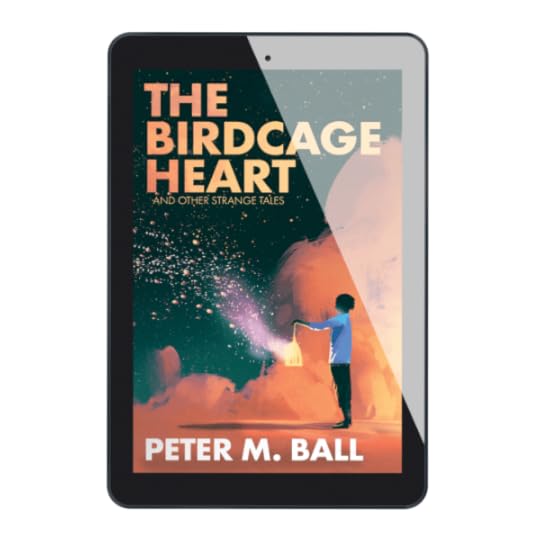 The Birdcage Heart & Other Strange Tales $4.99 – $10.49
 Finalist for Best Collection, Aurealis Awards 2017
In stock\n","backorders_allowed":false,"dimensions":{"length":"20.3","width":"12.7","height":"1.08"},"dimensions_html":"20.3 × 12.7 × 1.08 cm","display_price":10.4900000000000002131628207280300557613372802734375,"display_regular_price":17.489999999999998436805981327779591083526611328125,"image":{"title":"The Birdcage Heart and other stories","caption":"","url":"https:\/\/petermball.com\/wp-content\/uploads\/2021\/09\/The-Birdcage-Heart-and-other-stories.png","alt":"The Birdcage Heart and other stories","src":"https:\/\/i0.wp.com\/petermball.com\/wp-content\/uploads\/2021\/09\/The-Birdcage-Heart-and-other-stories.png?fit=600%2C600&ssl=1","srcset":"https:\/\/i0.wp.com\/petermball.com\/wp-content\/uploads\/2021\/09\/The-Birdcage-Heart-and-other-stories.png?w=1080&ssl=1 1080w, https:\/\/i0.wp.com\/petermball.com\/wp-content\/uploads\/2021\/09\/The-Birdcage-Heart-and-other-stories.png?resize=300%2C300&ssl=1 300w, https:\/\/i0.wp.com\/petermball.com\/wp-content\/uploads\/2021\/09\/The-Birdcage-Heart-and-other-stories.png?resize=1024%2C1024&ssl=1 1024w, https:\/\/i0.wp.com\/petermball.com\/wp-content\/uploads\/2021\/09\/The-Birdcage-Heart-and-other-stories.png?resize=150%2C150&ssl=1 150w, https:\/\/i0.wp.com\/petermball.com\/wp-content\/uploads\/2021\/09\/The-Birdcage-Heart-and-other-stories.png?resize=768%2C768&ssl=1 768w, https:\/\/i0.wp.com\/petermball.com\/wp-content\/uploads\/2021\/09\/The-Birdcage-Heart-and-other-stories.png?resize=500%2C500&ssl=1 500w, https:\/\/i0.wp.com\/petermball.com\/wp-content\/uploads\/2021\/09\/The-Birdcage-Heart-and-other-stories.png?resize=100%2C100&ssl=1 100w","sizes":"(max-width: 600px) 100vw, 600px","full_src":"https:\/\/i0.wp.com\/petermball.com\/wp-content\/uploads\/2021\/09\/The-Birdcage-Heart-and-other-stories.png?fit=1080%2C1080&ssl=1","full_src_w":1080,"full_src_h":1080,"gallery_thumbnail_src":"https:\/\/i0.wp.com\/petermball.com\/wp-content\/uploads\/2021\/09\/The-Birdcage-Heart-and-other-stories.png?resize=100%2C100&ssl=1","gallery_thumbnail_src_w":100,"gallery_thumbnail_src_h":100,"thumb_src":"https:\/\/i0.wp.com\/petermball.com\/wp-content\/uploads\/2021\/09\/The-Birdcage-Heart-and-other-stories.png?resize=600%2C600&ssl=1","thumb_src_w":600,"thumb_src_h":600,"src_w":600,"src_h":600},"image_id":11189,"is_downloadable":false,"is_in_stock":true,"is_purchasable":true,"is_sold_individually":"no","is_virtual":false,"max_qty":8,"min_qty":1,"price_html":"$17.49 Original price was: $17.49.$10.49Current price is: $10.49.","sku":"P9780648176138","variation_description":"","variation_id":10241,"variation_is_active":true,"variation_is_visible":true,"weight":".207","weight_html":".207 kg"},{"attributes":{"attribute_pa_format":"ebook"},"availability_html":"","backorders_allowed":false,"dimensions":{"length":"","width":"","height":""},"dimensions_html":"N\/A","display_price":4.9900000000000002131628207280300557613372802734375,"display_regular_price":4.9900000000000002131628207280300557613372802734375,"image":{"title":"PMB | Square | Birdcage Heart cover on Tablet","caption":"","url":"https:\/\/petermball.com\/wp-content\/uploads\/2023\/04\/PMB-Square-Birdcage-Heart-cover-on-Tablet.png","alt":"PMB | Square | Birdcage Heart cover on Tablet","src":"https:\/\/i0.wp.com\/petermball.com\/wp-content\/uploads\/2023\/04\/PMB-Square-Birdcage-Heart-cover-on-Tablet.png?fit=600%2C600&ssl=1","srcset":"https:\/\/i0.wp.com\/petermball.com\/wp-content\/uploads\/2023\/04\/PMB-Square-Birdcage-Heart-cover-on-Tablet.png?w=1080&ssl=1 1080w, https:\/\/i0.wp.com\/petermball.com\/wp-content\/uploads\/2023\/04\/PMB-Square-Birdcage-Heart-cover-on-Tablet.png?resize=300%2C300&ssl=1 300w, https:\/\/i0.wp.com\/petermball.com\/wp-content\/uploads\/2023\/04\/PMB-Square-Birdcage-Heart-cover-on-Tablet.png?resize=1024%2C1024&ssl=1 1024w, https:\/\/i0.wp.com\/petermball.com\/wp-content\/uploads\/2023\/04\/PMB-Square-Birdcage-Heart-cover-on-Tablet.png?resize=150%2C150&ssl=1 150w, https:\/\/i0.wp.com\/petermball.com\/wp-content\/uploads\/2023\/04\/PMB-Square-Birdcage-Heart-cover-on-Tablet.png?resize=768%2C768&ssl=1 768w, https:\/\/i0.wp.com\/petermball.com\/wp-content\/uploads\/2023\/04\/PMB-Square-Birdcage-Heart-cover-on-Tablet.png?resize=600%2C600&ssl=1 600w, https:\/\/i0.wp.com\/petermball.com\/wp-content\/uploads\/2023\/04\/PMB-Square-Birdcage-Heart-cover-on-Tablet.png?resize=100%2C100&ssl=1 100w","sizes":"(max-width: 600px) 100vw, 600px","full_src":"https:\/\/i0.wp.com\/petermball.com\/wp-content\/uploads\/2023\/04\/PMB-Square-Birdcage-Heart-cover-on-Tablet.png?fit=1080%2C1080&ssl=1","full_src_w":1080,"full_src_h":1080,"gallery_thumbnail_src":"https:\/\/i0.wp.com\/petermball.com\/wp-content\/uploads\/2023\/04\/PMB-Square-Birdcage-Heart-cover-on-Tablet.png?resize=100%2C100&ssl=1","gallery_thumbnail_src_w":100,"gallery_thumbnail_src_h":100,"thumb_src":"https:\/\/i0.wp.com\/petermball.com\/wp-content\/uploads\/2023\/04\/PMB-Square-Birdcage-Heart-cover-on-Tablet.png?resize=600%2C600&ssl=1","thumb_src_w":600,"thumb_src_h":600,"src_w":600,"src_h":600},"image_id":11463,"is_downloadable":false,"is_in_stock":true,"is_purchasable":true,"is_sold_individually":"no","is_virtual":true,"max_qty":"","min_qty":1,"price_html":"$4.99","sku":"E9780648176114","variation_description":"","variation_id":10242,"variation_is_active":true,"variation_is_visible":true,"weight":"","weight_html":"N\/A"}]"> Format Choose an optionEbookPaperbackClear The Birdcage Heart & Other Strange Tales quantity Add to cart SKU: BCHPMB Category: Collection
“Only Peter M. Ball’s fiction makes falling down the rabbit hole feel like flying. Funny and surprising, with moments of extraordinary grace.”
Angela Slatter, Author of the World Fantasy Award-winning The Bitterwood Bible and Other Recountings
March 5, 2025
Two Writing and Publishing Lessons from the First Hours of A Hurricane
I’m writing this from an apartment packed down for impending cyclone/hurricane due to hit Brisbane some time in the next 24 hours. It’s expected to be a category 2—possibly levelling up to a category 3 if we get unlucky—and it’ll be the worst storm to hit Brisbane in 70 years.
We’re 100% certain to lose power over the next few days. There’s a flood expected in our neck of the woods, although it usually stops at the end of the street rather than reaching our position on the hill.
Naturally, this makes me think about writing and publishing, because everything makes me think about writing and publishing (It’s also a nice distraction from the looming desire to freak the fuck out because we’re as prepped as we’re going to get, and there’s literally zero control over what the weather does next).
So, what can we learn from this moment? I’ll start with the obvious.
WRITERS NEED A CASHFLOW BUFFEREven if we make it through the storm unscathed, the cyclone is going to be mildly catastrophic for me as a freelancer.
I get paid by the hour for many gigs, and I’m conservatively estimating that I’ll be losing about eight hours of freelance gigs that normally cover my living expenses.
This is not a huge problem for me, because the first rule of freelancing is to get ahead of your expenses. I do my best to keep a month’s worth of living and business expenses in the bank for circumstances exactly like this.
Ordinarily, it would be more than a month. Three months of expenses is an “I don’t have to stress about things” reserve, while six months is ideal. Alas, I already had to dip into my capital twice this year, and I hadn’t finished building things up again.
Fortunately, I’d built it up some, because rebuilding the savings buffer is always the priority after it’s depleted.
And so long as I’ve either relocated to somewhere with internet access or we’ve got power and Wi-Fi by March 16, I’m good to pick up my regular gigs and bring up cash flow up to speed.
But the core of this is simple. If you write for a living, and you’re self-employed, you can’t count on things going right. You need to prepare for the weeks where things go wrong, and you lose valuable time to unexpected events.
But that brings me to my second thought of the week:
YOUR WRITING IS AN ASSET, NOT A PAYCHECKA lot of my freelancing is paid-by-the-hour work. I trade an hour of my time to mentor other writers or run workshops or provide layout and design skills, and they pay me an agreed upon fee.
This isn’t so different from working in an office job, except I’m responsible for my own taxes and resources. And there’s no sick pay.
I occasionally work with small business mentors who look at my income streams and note that I make more from my freelancing than my writing and publishing endeavours most week.
“Why don’t you pare back on publishing and put more effort into teaching?” they ask. “You could double your cash flow easy.”
And while there are many answers, the most important is always this: an hour spent doing freelance work will only ever earn me what I earn in that hour.
An hour spent working on a book builds me an asset, which I can leverage down the line to earn future income.
Most writers aren’t taught to think of what they produce as assets. We lock into the work-for-hire mindset: I produce; I get paid. This is particularly true in the old, velocity publishing model where writers earn an advance and then a trickle of royalties.
But make no mistake: writing is an asset-based business. As Australian agent Alex Adsett is fond of saying: your books and stories are like owning a house. You lease the rights to do something with it to people, but you still own it.
And when folks are done with the lease, you can lease it to someone else or move into the house yourself.
The trick used to be that you could only lease things: you needed publishers to get work out to readers.
Fortunately, writers in the 21st century have other options.
One of the nice things about this week has been the number of existing assets that have quietly earned money in the background. I can’t ship physical books right now—and probably won’t be able to for a few weeks if the flooding is bad—but ebook sales have been ticking along.
My newsletters are quietly picking up new readers for both Brain Jar Press books and my own GenrePunk titles.
Even my coffee mugs and merch tick along without me needing to be online.
But that’s just the start of the things that bring me comfort right now.
FINDING NEW WAYS TO LEVERAGE ASSETS GIVES YOU OPTIONSThe nice thing about assets is this: they give you options. Even if things are catastrophically bad and the cyclone wipes out my print stock here at the offices, there are still things I could do in the aftermath to help shore up my cash-flow and restock my buffer.
For example:
I can write and schedule a bunch of newsletters directing people’s attention to projects I can sell without being present, all of which can reach people outside my immediate location where we’re all huddled out of the storm. I can pull together short-term bundle deals and market them to readers as limited-time “help me get back on my feet” options. With my own online store set-up, this has the advantage of getting cash in my account in a matter of hours.I can take some of my existing bundles and put them in front of new audiences by uploading them to storefronts I don’t currently offer them. My Urban Fantasy bundle, for example, is only available at the Brain Jar Press store.I could kick start a new edition of an existing project, or move one of my prior projects up and launch it as a Kickstarter. There’s a range of possibilities here, stretching back over 25 years of writing across multiple genres, with plenty of markets to tap into.I can take a bunch of books and publish them in new formats, either by putting them into print for the first time, or by doing hardcovers.I can scour my old social media feeds and produce a bunch of new mugs for writers. I can hit the internet and find reprint/translation options for some old short stories (I’ve got stories that have been reprinted four or five times, earning me ten times more than the check for the first publication). I can generate new books on the fly by dipping into some of the writing I’ve done that isn’t yet published in book or ebook form. I’ve been meaning to do a follow up for You Don’t Want To Be Published for a while now, and have enough writing stuff to fill two or three books in a pinch. Ditto old blog posts about RPG gaming, or running a small creative business, and launching a writing event.I can take some old writing workshops and record online versions. Or offer to do a live version as a one-off event via Zoom.All of which gives me options before writing and release something new, which is also happening in the background. Some of those options draw upon work I did back in 2004—and I’ve built a lot of assets own the two decades since.
The main reason I haven’t done a lot of the above is time and the short-term opportunity cost of doing them instead of freelancing.
Once you remove freelancing from my week, I can pick one or two options and get them prepped for launch using a notebook and a laptop.
Plus, cyclone recovery ads a compelling marketing event to the pitch to potential readers, answering not just “why do I want this” but also “why do I want to pay for it now”.
I’m usually loathe to engage in pity marketing, where you tug at a reader’s heart strings instead of offering them a compeling deal, but needs must.
It does lead me to the thing lots of people misunderstand when they go into a writing career. We’re often told there’s no money in writing, but what it usually means is there’s no steady paycheck in being a writer.
And that’s true: there isn’t.
But asset building is nothing to sneeze at, especially if you know how to leverage what you’ve already done and earn money from it again and again.
I’ve got a lot of assets.
So I’ve got a lot of options for when things calm down again.
Which gives me a nice, calming activity to focus on as the wind picks up and the rains arrive, because I’m definitely going to need a distraction.
Want to help me out? Consider some of the following: Fuck Around, Find Out Narrative Structure Mug $9.49 Add to cart
 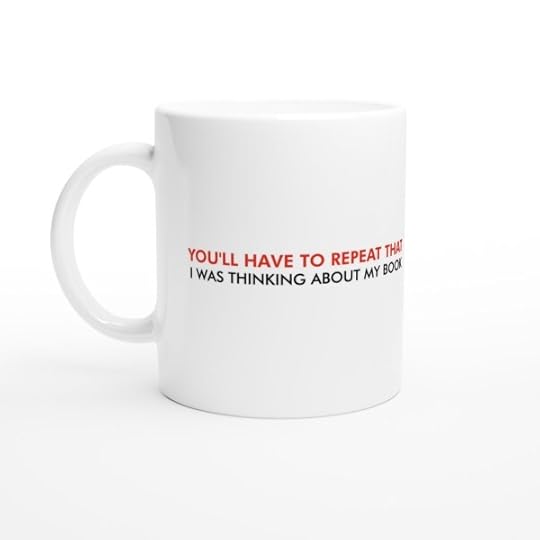 “You’ll Have To Repeat That” Mug $9.49 Add to cart
  GenrePunk Books Mug $10.49 Add to cart
  The Reminder (Also, A Coffee Mug) $9.49 Add to cart