Peter M. Ball's Blog, page 3
February 27, 2025
What is Author Platform, Really?
I recently offered GenrePunk Ninja subscribers a list of options for a series of deep dive entries, and got them to vote on which they were interested. The two winners where “how do we do author platform in 2025” and “what can fiction publishers learn from comic books”, so I’ll be doing a short series on both here over the next month or so.
What is Author Platform, Really?THE SOCIAL MEDIA CONUNDRUMI’ve been making some strategic changes in my writing and publishing businesses of late, and the biggest of them is “get very bad at social media with fierce intention.”
Facebook and its ilk have always presented a conundrum on the writing front: I don’t enjoy being on social media, but I do enjoy having an audience. How do I find the latter if I don’t make use of the former?
I’m not alone in this. Many creators have felt it, and the conversations are growing louder in creative circles. For instance:
Hank Green has been questioning the value of social media that devalues links off-site.Cory Doctorow coined the word of 2024—enshittification—in his essay describing the decay phase of a platform where user experience gives way to monetization.Direct sales became a hot topic among indie publishers eager to escape the hegemony of Amazon, especially as organic discovery is replaced by pay-per-click advertising on the platform.My own relationship with social media hasn’t been the same since reading Mike Monteiro’s Ruined By Design, where he captured the business model of Twitter as “Twitter makes money by getting you to fight with Nazis” (115). I’m all for fighting nazis, but making money by forcing people to do it seemed stupid (and an accurate description of being on Twitter at the time), so I stopped using Twitter.
Things have come to a head with the fallout of the most recent US election, which saw companies like Meta abandon active moderation of their platforms. It took 12 hours for my Instagram feed to transform into something abhorrent.
I deleted the app off my phone after being shown a reel of a dog crapping in someone’s mouth. The cost-to-benefit of staying on the platform no longer worked for me. It seems to have clamed in the weeks since, but I’m wary.
Meanwhile Threads—which I spent so much time on talking writing in January 2024 it turned into a book—is now a place that shows me engagement bait designed to make me angry.
Twitter/X had been dead to me for a while, and nothing I see about the platform has convinced me I was wrong.
Yet much as I’d love to quit these platforms altogether, I keep my foot in because that’s the business I’m in. Social media sites are places where potential readers gather, so in theory it behoves me to be present on the network.
After all, aren’t writers meant to have a “platform” to sell their work?
THE RISE OF “AUTHOR PLATFORM”It’s worth considering where all the advice around social media and writing really originated.
In the nineties nobody placed any real emphasis on fiction authors building a platform. In 2025, it seems impossible to think about publishing a book without considering it.
The notion that fiction authors ‘needed a platform’ picked up speed in the early 2000s, when the first wave of successful authors emerged with huge audiences built on Blogs or platforms like MySpace.
The publishing industry was ecstatic. “These people are best-sellers with minimal marketing costs! This is amazing.”
And so the cycle began, often misunderstanding why these first wave writers were successful.
“You need a blog,” authors were told, and so they set up blogs even if they had no interest in them. A few early posts would slow to a trickle, then become an intermittent cycle of “I know I haven’t blogged for a while, but…”
Some authors actively resented the process, making it clear they’d only done this because their agent/publisher said they had too. Oddly, those blogs rarely took off.
At the same time, enough people blogged with enthusiasm that they built platforms, perpetuating the notion that blogs were important.
The publishing industry—always eager to embrace anything which will sell books and create buzz—dove into the internet headfirst.
Then indie publishers—working faster and leaner than their traditional counterparts, embraced social media tools and the one-to-one connection with their readers and become an industry-wide phenomenon.
And the idea of “author platform” was born, becoming a hot topic for the last two decades with very little real interrogation of what’s really going on.
THE ERA OF DWINDLING RETURNSThe first sin of author platform was always failing to understand that some people are a natural fit for some modes of engagement. Platforms advice became one size fits all. Author X sold a huge number of books by blogging or talking on TikTok, ergo authors Y and Z should do the same thing.
This failed to take into account two things. The first is the skills of the author in question, and how well they fit a particular platform.
Perhaps the writer had a natural flair for witty bon mottes, for example, which made them idea for Twitter. Or they were incredibly personable and held great conversations, which is ideal for podcasting.
The second thing was timing.
Over the last two decades I’ve lived through multiple waves of platformm advice. As blogging faded in popularity the cycle of replacement platforms began: Facebook, Twitter, Podcasts, Newsletters, Google Plus, Telegram, Instagram, TikTok, Circles, Patreon, Substack, and so on and so on and so on.
And, again, some people excelled at those places. They built a platform and sold books.
Other people sunk time and effort into them for minimal effects.
And every time, there was a real misunderstanding of how and why these platforms worked.
Here’s a key detail many people miss: the best time to leverage a social media platform is while it’s new and building audience. Once it’s established–and often by the time people start offering coures on how to use it–the platform is past that moment.
See, new platforms need to build user numbers fast, often with an eye to paying back venture funding. This means they give away the thing that connect creators value—reach and attention—for free, in exchange for content that makes using the platform valuable.
And if platforms stayed that way, everything would be rosy.
But that’s not how capitalism works, and sooner or later a platform needs to pay their venture funding back.
MEMORIZE THIS WORD “ENSHITTIFICATON”Sci-Fi writer and internet commentator Cory Doctrow caused a small phenomenon when he introduced the word “enshittifiation” to the lexicon in 2024. In five syllables, he crystallised the frustration many writers felt with maintaining a platform.
If you haven’t read his primary essayon the topic, you really should. I’d argue it’s among hte most important things writers can read here in 2025.
For those resistant to outside reading, the core of Doctorow’s argument is simple: when a new platform launches, they want users, so if you’re providing content and drawing attention to their platform they’ll show you to more and more users.
Eventually the platform reaches a critical mass and starts needing to earn money back. This is when the user experience begins to decay, and the decay happens increasingly sharply as things go on.
Because here’s the thing: social media platforms trade in data and attention. They have an audience whose attention you want to capture. While they’re willing to show things to that audience for free while building to a critical mass, now they want to charge people for it.
So things get…shittier. Your posts reach slightly fewer people unless you’re willing to pay for a boost. Your followers don’t see everything you post unless you’re a paid member, or willing to run ads.
Soon the platform you used to get for free is going to cost you an arm and a leg if you want to reach your audience, or it easts up more time as you optimise your organic reach.
Either way, it costs you money to find the readers you used to connect with for free.
Yet authors–especially newer authors–cling to the idea that being on social media is essential in order to sell books.
WHAT AUTHOR PLATFORM REALLY ISFor my money, the most insightful definition anyone has offered about Author Platform was Jane Friedman’s 2012 definition: an ability to sell books because of who you are or who you can reach (A Definition of Author Platform).
Friedman’s essay has been updated a few times since it was first written, with a stronger focus on non-fiction where a “strong platform” is more essential, but the principles she lays out are incredibly useful for fiction writers.
Platforms emerge from a strong body of work distributed through outlets and mediums you want to be identified with and your target audience reads.
The definition is social media agnostic. In fact, you can apply it to any number of tools, but the actual metric is important: how many people can you reach? how can you compel them to take action and buy books?
If you haven’t covered both, then your platform is going to keel over. If you’re reliant on a social media platform in order to reach your audience, then you should expect to earn less and less over time as the cost of reaching your audience grows.
Social media can be a useful part of your author platform, but if it cannot sell books, then what the hell is investing time there?
EXPANDING YOUR PERSPECTIVEFortunately, Friedman’s definition offers some useful ways of stepping away from platforms. While it’s natural to default to social media options, there’s actually all sorts of things writers can do to increase their reach.
Writing short stories and submitting them to major magazines in your genre is totally a platform building activity.
Going to conventions and events to meet readers where they gather is a platform building activity.
Writing non-fiction articles and guest posts of interest to your fiction readers is a platform building activity.
Putting out new books and expanding your body of work is a platform building activity.
Arguably, all of them can be more effective than posting a blog online or building ten hours of TikTok videos.
They key part of what we’re doing is building authority and connection with readers, then using that connection to sell books.
Because here’s the thing very few authors consider with regards to online platforms.
Social media is in the attention business, but so are we.
The biggest cost to sitting down and reading a book isn’t the price per volume, but the hours and minutes a reader has to spend consuming our story and the risk that time will be wasted if they don’t like what we’ve written
Looking to level up your writing and publishing? When you’re ready, here are some ways I can help:Books I’ve Written: I’ve got a few books on writing and the writing business, including the collection of some of my best writing advice: You Don’t Want To Be Published and Other Things Nobody Tells You When You First Start Writing.Books I Publish: When I’m not working on my GenrePunk Ninja Projects I’m the editor and publisher behind Brain Jar Press. We’ve published several books and chapbooks about writing, drawing on advice and presentations given by some of the best speculative fiction writers in Australia and beyond.One On One Mentoring: I offer a limited amount of one-on-one mentoring and coaching for writers and publishers, built off two decades of teaching writing and publishing for universities, writers festivals, and non-profit organisations.


February 3, 2025
Psychology, Memory, and “Write First Thing In The Morning”
For years, I’ve been a start your writing first thing in the morning guy.
I get up around 4:30 AM most days. On good days, I feed the cats and hammer a few words into the word processor by 5, then braindump into my journal before planning the day.
I can jam out a good hour of writing before the rest of house rises. Maybe two, on a weekend, when the spouse-mouse gets to sleep in.
On a bad day, I try for 50 words or so. Just something to get my toe in.
Because here’s the thing: even if I don’t finish all the writing tasks on the list, starting the day with writing sets my focus. It’s easier to go back and finish the things.
If I skip those 50 words, getting to the keyboard will be a struggle. Other things take priority, and writing becomes one more task I need to find the time to do, rather than the thing I’ve already started and should get back to.
Lately, I’ve been pondering how much this start early, stay focused approach relates to the Zeigarnik effect.
Why Unfinished Tasks Stick In Your MemoryIf you spend a lot of time splitting your focus between multiple projects or priorities, it’s worth getting familiar with the work of Bluma Wulfovna Zeigarnik (and it’s not just because her name is exceptional) and Maria Ovsiankina (ditto).
Back in the twenties, Zeigarnik did some of the first psychological studies into the relationship between your memory and unfinished tasks, and she even lends her name to a phenomenon known as the Zeigarnik Effect.
The simplified version of the effect is this: tasks that are interrupted are more easily recalled than those that were completed. They linger in our memory.
The inspiration for Zeigarnik’s work started with servers in cafes and restaurants.
Her professor and mentor noted servers would memorize huge amounts of detail about customers, orders, and unpaid bills while serving, but the specific details vanished the moment delivery finished and the order paid for.
One could chat with a server for hours and they’d remember anyone, yet if you returned to the restaurant an hour after the meal to collect a forgotten hat, the same server would struggle to remember you, your table, or your order.
Zeigarnik wanted to explore this phenomenon and set out to do a series of experiments and quickly noticed a correlation between memory and unfinished tasks.
In one early experiment, she discovered 110 children out of 138 subjects had better recall of a puzzle they were working on when interrupted halfway through and then allowed to return to the task.
Open LoopsProductivity gurus have a different name for the Zeigarnik effect: open loops.
The stuff we start and leave unfinished stays with us, taking up brainpower and bits of mental energy. A big part of most productivity practices involves limiting and closing the number of open loops on your plate.
Not because they’re inherently a bad thing, but because you want to devote your open loops to the most critical tasks on your to-do list.
So when I kick off my day with writing and get even a few words into a story, I have an open loop in my head. I may be elsewhere, focused on doing the dishes or mentoring or shipping books around the world.
But part of my brain is still keeping the story alive, figuring out how to progress it. I can recall where I’m up to, and what might come next.
And I’m eager to get back to it.
This is where Maria Ovsiankina comes in, because she ran a series of experiments around the Zeigarnik effect and discovered that starting a task and interrupting it creates a need to go back and finish that task, even if there is no additional incentive or need to do so.
The open loop creates intrusive thoughts, getting stuck in the mind and potentially creating stress if you’re unable to get back to them.
Juggling PrioritiesThere’s a lot more detailed study and debate around both these phenomena, but if you’ve ever danced between multiple priorities, you have felt something akin to the Zeigarnik Effect in action.
We all get interrupted halfway through a task, whether through an intentional time limit (I can only work on this for an hour) or a clash of priorities (I want to write, but my partner rightly thinks I should unload the dishwasher like I promised).
On a good day, we can harness those interruptions to come back to the project refreshed, but on a bad day the Zeigarnik Effect will make us grouchy, stressed out, and prone to procrastination.
This is particularly true if your life involve multiple tasks or priorities that rely on your ability to engage in deep, focused work, and you frequently put down one complex task in order to start another.
Deep, focused work is tiring as hell, especially when done back-to-back.
More importantly, it’s consuming if you step away before you’re ready to — big projects used to haunt me when they were unfinished. The Ovsiankina impulse to get back to them and clear the decks was too strong.
I often manged badly. Getting up in the middle of the night and do a few extra hours work just to clear my head, lest insomnia kick my ass.
If I couldn’t do that, I’d get overwhelmed and grumpy… and that grumpiness soon turned into anxiety and depression.
Here’s the thing about writing and publishing: even when your full time, it’s a gig with a lot of small, bitty tasks that need doing. It’s never just writing the story, it’s submitting and publishing and marketing and interviews.
Couple that with the bigger problem: most writers and publishers aren’t working at it full time. It’s a priority among a sea of priorities, some of which put limits on our time.
So it pays to figure out how to play smart with your brain.
Tricking Your Brain Into Working For YouThe nice thing about the Zeigarnik Effect is this: your brain’s management of open loops is insanely easy to trick.
If you’re walking away from a half-finished project, all it takes is jotting down when you’ll be resuming work and it’ll satisfy the part of your brain that wants to keep focused on it. Loop closed, temporarily, until you’re ready to re-open.
Better yet, it can work even if you don’t have the specific time in mind — one reason writing to-do lists is so soothing to our psyche is that the very act of writing them down closes open loops.
It’s also the reason to-do lists are so easy to ignore once they’re done — your brain files the entry away as “finished” now, and your subconscious is no longer gnawing at the unfinished stump of the task.
You can see echoes of this in many productivity systems, particularly the “next action” approach to tracking projects in one of the venerable heavyweights of the division, David Allen’s Getting Things Done.
Knowing how to put the brain in park is an essential skill for any writer, but as I hinted at the start of this essay, sometimes leaving an open loop on a complex project is hugely beneficial.
If I’m stuck on a scene in a novel, for example, it’s usually because I’m taking too few chances or writing to a cliche.
Leaving the work half-finished at the start or end of the day gives my subconscious an opportunity to draw unexpected connections, and by the next time I sit down to write, there will be a new slant or twist to make the scene.
The Second Half Of My Morning RoutineOn a good day, I start with writing. On a great day, I follow my writing session with 15 minutes of brain-dump journaling.
I do this because open loops are incredibly useful to me in certain situations. In others, I want to close that loop off if the next major task on my list isn’t related to writing or I’m splitting my focus between multiple projects.
Ergo, I start my day with writing. I open the loop and use it to provide my through-line.
But I also brain dump major projects.
Whenever I need to set a project aside for a while—to get it out of my head so I can focus on other stuff—my first port of call is writing things down.
I usually start with a particular phrase: “here’s some interesting ideas for/problem I’m struggling with around <>”.
Then I’ll fill a page based on that prompt, or something like it. Occasionally, I’ll go a little further, but I try to keep it contained and simple — one page or fifteen minutes of focus.
Never more than half an hour or three pages of scribbled notes. The important thing is that it happens before I sit down to plan the coming day.
The brain dump journal may look like a brainstorming space, but that’s just an illusion. In truth, it’s a cheat that’s designed to let me have my cake and eat it too.
Leaving the project unfinished gives my subconscious time to noodle over the possibilities while I’m not meant to be working, and it’s rare I sit down in the morning without some fresh insight or connection that I hadn’t considered the day before.
Brain dumping before I start work for the day — or even planning/reviewing my work for the day — captures those insights and puts the project in “park” to clear my focus for the day ahead.
Writing things down closes the loop so it doesn’t drag on our focus.
This is especially useful when I’m making the switch from a fiction project to non-fiction, or from writing to editorial or mentoring work.
That would be perk enough, but over the years I’ve noticed projects that are ‘parked’ in the journal unfinished are typically easier to pick up after a break, even if I’ve left them to lie fallow for a week or more.
Sometimes I may have to go back and read the entry associated with it to collect the loose threads, but once that’s done, I can pick up where I left off and hit the ground running.
Just like the kids in Zeigarnik’s early experiment, the interruption improves my recall of the contours and specifics of the problem.
The One-Two Punch: Write First, Then JournalThe brain dump journal is a powerful tool for anyone splitting their focus between too many goals or identities, but not always an easy one to maintain.
Handwriting in a journal always felt like a luxury before I knew the psychology behind it, which meant it got set aside when things got too hectic and I wanted to focus on productive work.
It took diving into the work of Zeigarnik and Ovsiankina to wrap my head around why the journal was useful and essential, which made it easier to justify the habit when things get hectic.
Admittedly, you don’t need to embrace the journal — the process of interruption and “parking” projects by writing a next step can work just as effectively — but I’ve discovered that a kicking off with a writing session and a brain ump session l makes for a great lynchpin for the rest of my day.
Looking to level up your writing and publishing? When you’re ready, here are some ways I can help:Books I’ve Written: I’ve got a few books on writing and the writing business, including the collection of some of my best writing advice: You Don’t Want To Be Published and Other Things Nobody Tells You When You First Start Writing.Books I Publish: When I’m not working on my GenrePunk Ninja Projects I’m the editor and publisher behind Brian Jar Press. We’ve published several books and chapbooks about writing drawn from some of the best speculative fiction writers in Australia and beyond.One On One Mentoring: I offer a limited amount of one-on-one mentoring and coaching for aspiring writers and publishers, built off two decades of teaching writing and publishing for universities, writer festivals, and non-profit organisations.February 1, 2025
What Just Clicked for Me While Talking to D—!
I’m up at 4:00 AM talking to D— from tech support, trying to work out (for the ninth time since October) a weird glitch that means I can receive emails but not send them through some of my accounts.
I’m very familiar with the tech support script at this stage: First, D— understands how frustrating this is for me.
Then, he asks the same questions I’ve answered in the last eight rounds, gets me to delete my email software and set it up from scratch, and change some passwords.
Then D—makes a change to the back end, asks me to wait 24 to 48 hours, and promises that this time it’ll be fixed for sure.
By now, I ask for the log number of our call, because I know I’ll be contacting them again in 28 hours and going through the exact same script again with a different member of the tech support team.
I try to be polite through the whole thing, because I’ve worked tech support before. D— is one of a huge team of tech support folks working for a major ISP and m problem—whatever it is—doesn’t fit into their script.
At the same time, I’m one of their smaller customers. They’ve got no real incentive to prioritize my issues, and it’s not D—‘s ass on the line if this doesn’t get resolved.
Which is actually one of the things I love about running Brain Jar Press and GenrePunk books: we’re small1. I’m hands-on with every aspect of the business. I get to know my readers and what they’ve ordered and where problems arise.
One of the best things about running my own store, rather than sending folks to places like Amazon, is getting excited about each new reader who shows up or coming to recognise the real hardcore fans who are there for each new book.
My ass is always all the line when it comes to Brain Jar and GenrePunk. I’m all in on every interaction, and I’m invested in solving problems when readers contact me on the rare occasions things have gone wrong.
It also means I can occasionally do projects just because a handful of people are going to love them.
A reader will mention how much they love stories about time travel or Vikings or TV shows like Sliders, and that will sit in the back of my mind until a short story or novella pops out.
In this case the story is On The Corner of Caxton and Petrie, 12:04 AM, which will appear in Unfamiliar Shores coming out later this month.
We live in a world that celebrates huge corporations, and even my anti-capitalist ass can recognise the benefits of them.
But there’s still something to be said working hands on and personal with your readers, and it’s literally one of the best parts of this gig.
Even the “we” can be msileading here, as it’s often just me and the cats. My Spouse-Mouse is there when Brain Jar needs them, and there’s the occasional freelancer or intern, but current day-to-day operations are all me. ︎
︎
January 31, 2025
What Can Writer/Publishers Learn From Recipe Formatting?
What does a recipe look like? If you looked one up in the old pen-and-paper days, there’s a familiar layout: ingredient lists; procedural instructions; a photograph to make your mouth water.
These days, on the internet, the recipe has all those things… and a long, digressive story up top that contextualises how and why the author is writing about and cooking this particular meal.
To the aspiring chefs at the Culinary Institute of America, a recipe is a three-column format. (Example 1; Example 2)
One column lays out the timeline for the entire meal, logging what needs to be done when.
The second column lists everything they need to produce, and the equipment needed to cook and serve it.
The third column breaks down the ingredients needed for each recipe on their docket.
It’s the first column that makes the difference, logging everything from prepping ingredients to turning the oven on to gathering equipment for every stage.
There’s no space here for instructions hidden in the ingredient list (“wait, these onions were meant to be chopped?”) or unexpectedly necessary utensils (“Jesus, fuck, why didn’t you say we’d need a pastry brush?”).
It looks nothing like the recipes you’re used to, but once you’ve seen one, it’s hard to go back. The flow of cause-and-effect is too clear, the mapping-out of requirements to clean.
But it also takes up space—a precious resource in design for both books and websites—and goes into detail that many first-time cooks may find intimidating.
Ergo, the more useful approach gives way to the aesthetically pleasing, less detailed option and the detailed, timesaving layout of the CIA is a piece of secret knowledge shared by the pros.
Physical documents that become internalised by the time they graduate into the world.
The most useful way to approach something isn’t always the most popular, especially when the purpose behind the presentation moves from create a useful learning tool to create an aesthetically pleasing book.
Here’s the thing: I’m a writer and a publisher. Producing aesthetically pleasing books is kinda my thing, but I’m very conscious of the limitations that come with that.
If you’re trying to write books about writing, for example, the aesthetics and standards of the publishing industry shape the eventual output.
Books are ‘meant’ to be a certain length—usually 200 to 350 pages—in order to be commercially successful.
Books are ‘meant’ to follow a certain structure, and they should be aimed at new beginners (because there’s more aspiring writers to buy it than established writers).
When you’re selling books into bookstores, working at velocity, selling to aspiring writers makes sense because you need numbers to mitigate your print costs.
A velocity publisher—ideally—needs to clear at least two-thirds of their print run within a month of release.
A nice approach if you can make it work, but it shapes the way we talk about writing. It changes what can be accomplished.
So, I sometimes force myself to think about the three column recipe format, and ask myself how I want to present ideas.
What happens if we let books be shorter?
What happens if I produce short, cheap essays on very specific niches?
What happens if we don’t aim the book at writers just starting out?
Which is how I end up producing the GenrePunk Ninja essay series and the Writer Chaps series over at Brain Jar Press. Trying to break my own assumptions about what a book ‘should’ look like and try something new.
It’s not the right format for everyone, but I’m also not a velocity publisher. I take my time finding an audience for books and connecting them with the right readers.
They’re there just in case someone needs them in that format, and I can build longer books out of those parts for the folks who absolutely need a 200 page paperback to feel like they’re reading a book.
There’s not one way to write a recipe anymore, and it opens up what you can do as a writer and publisher.
And it’s one of the things I love most about publishing right now.
January 29, 2025
The Best Worst Start To The Year
So, picture this: It’s a new year and—for once—you’re ready to go out and kick ass. You’re ticking off daily task checklists and things are humming along. Your ambitious plans are achievable, and you’re delivering on your resolutions.
Work is good. Health is good. Life is fucking great. For the first time in a long while, you’re ahead of where you need to be.
Then things go wrong. Your spouse is sick for a week, and nobody can figure out why.
Then you figure it out—there’s water trapped in the walls of your house, growing black mould in the bedroom—so you spend a week camped out on the kitchen floor.
Then some cavities in your wisdom teeth get infected, and the surgery you’d carefully planned for next month ends up happening now now now.
Then the surgery complications arrive, and you re-enact scenes from the Exorcist that involve vomiting up blood. Which, at least, distracts you from the catastrophic political situation going on.
You’re thirty days into 2025 and so much has gone wrong. You’re on longer ahead on work. Huge chunks of your day are spent talking to insurance companies, trying to get the mould thing fixed.
You dimly remember, nine days later, that your new book went live, and you forgot to mention it to anyone.
Now imagine you look at all that, sigh, and think about how happy you are, because things are going well.
LIVING IN THE GAP VS LIVING IN THE GAINAs you may have surmised, nothing in the above is truly hypothetical. By many standards, I’ve had a truly abysmal start to the year.
And I would probably be writing a very different email if I hadn’t read Dan Sullivan’s The Gap And The Gain in the waning days of 2024.
The core philosophy of the book is simple: there’s two ways of measuring what you’re doing with your life/business/writing.
The first is looking at your goals and measuring the gap between where you are and where you want to be.
The second is looking at where you started and measuring the gains you’ve made since the origin point.
One puts your focus on the things you’ve failed to do, while the other puts your focus on your wins.
It’s easy to look at everything I laid out in the introduction and think about the opportunities I’ve missed in January. Hell, at one point I cracked a joke about being cursed, because it felt like one damn thing after another.
But if I flip the script and look at gains:
What We Talk About When We Talk About Brains came out and—even with no launch-week promo—has sold about 50% more copies than my new releases normally do .We’ve been living with a crazy mould problem for a while, which adversely affected my wife’s health, and now we’ve cleared that problem out (and we’re slowly putting the bedroom back together).Good financial decisions in late 2024 meant—for the first time in a while—I was fully prepared to cover a few weeks where I wasn’t able to work (which is huge when you’re a freelancer/self-employed and don’t get sick leave).I didn’t have time to celebrate my new book coming out but I also have Unfamiliar Shores dropping in late February because this year’s releases are set up months in advance.Plus, the really important thing: as things calmed down, my focus on gains made it easier to get back in the swing of things.
I’m not quite kicking all my goals for the week, but new books are getting scheduled for GenrePunk Books and Brain Jar Press, my writing speed is picking up, and I’m clearing my freelance gigs to make space for new work.
Lots of terrible things happened in January 2025.
But it’s still shaping up to be a pretty good year.
If you’re struggling with the state of the world right now—and, honestly, I don’t blame you—narrowing your focus down to a handful of wins might be the right step.
Not because bad things aren’t happening, but because we live in a capilist hellscape which says you need to get things done in order to survive despite everything that’s going on.
In bad times focusing on the wins—however small—can be a survival strategy.
But Also, What We Talk About When We Talk About Brains is outDid you catch this bit of news seeded in the above? My ‘What if Raymond Carver lived through a zombie apocalypse’ collection of short fiction, What We Talk ABout When We Talk About Brains, is now live and in the world!
Here’s what you need to know:
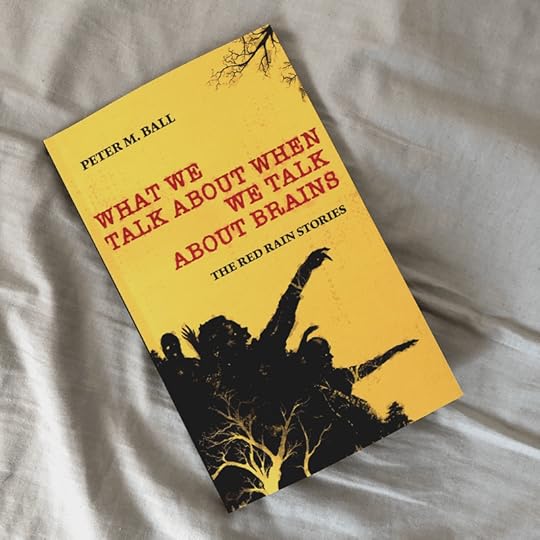
Vicious storms of red rain sweep across Australia, raising the dead as zombies hungry for human flesh. Fortunately, we’ve all seen zombie movies and know what comes next, allowing the locals to band togetherand live small, desolate, ordinary livesdespite the ever-present danger.
Drawing inspiration from George Romero and Raymond Carver in equal measure, Peter M. Ball presents six dirty realism tales of quiet desperation and spare, razor-sharp narration in a world overrun by the walking dead.
 What We Talk About When We Talk About Brains – Ebook $3.49 SKU: e9781922479761
September 25, 2024
006: Sometimes The Right Call Is Stepping Back
I’ve ended up taking a short, unscheduled break from writing newsletters over the last fourteen days. Regular GenrePunk Ninja transmissions will resume in October, and some of the ideas in this week’s entry might be expanded out.
Mainly, though, if you’re hungry for great advice about writing and publishing, however, I’m going to direct your attention to Cory Doctorow’s recent speech about Disenshittifying Online Spaces (watch it on youtube | read it online).
Doctorow is speaking to a room full of tech folk and coders, but what he’s saying is incredibly important to anyone involved in the creative industries.
It’s important he’s pointing out the problems with online spaces and we, as writers, use online spaces to promote our work and build community. They are a boon in many ways, but their usefulness can be short lived.
Tech and social media companies thrive by capturing attention and communities, then locking you into those spaces and turning your attention into profit.
Usually, they do this by making things shittier. Amazon started as a bookstore that offered incredible organic reach to independent publishers, with a recommendation engine that was scarily predicted.
Now that they’re the place to read ebooks, for most folks, they have turned their attention to selling advertising tools instead. Authors hoping readers will stumble over their work now pay for the previliege.
The same cycle has played out again and again. Facebook used to be great for keeping in touch with readers (and, hell, your friends), but now it’s an algorithmic nightmare where you see more ads than friends.
Tiktok used to put videos in front of a huge number of eyeballs, but now you’ll be lucky to break 200 views as you feed more content into the mill and quietly hope something goes viral.
One of the reasons I recommend Doctorow’s most recent speech is the way he breaks down the way virality can work on these platforms. Notably, he talks about the TikTok “heating tool”, which the use to manipulate engagement.
For those who haven’t clicked over to see Doctorow in person, here’s the important part:
Emily Baker-White from Forbes revealed the existence of a back-end feature that Tiktok’s management can access they call the “heating tool.”
When a manager applies the heating tool to a performer’s account, that performer’s videos are thrust into the feeds of millions of users, without regard to whether the recommendation algorithm predicts they will enjoy that video.
…
Tiktok’s heating tool is a way to give away tactical giant teddy bears. When someone in the TikTok brain trust decides they need more sports bros on the platform, they pick one bro out at random and make him king for the day, heating the shit out of his account.
That guy gets a bazillion views and he starts running around on all the sports bro forums trumpeting his success: I am the Louis Pasteur of sports bro influencers!“
The other sports bros pile in and start retooling to make content that conforms to the idiosyncratic Tiktok format. When they fail to get giant teddy bears of their own, they assume that it’s because they’re doing Tiktok wrong, because they don’t know about the heating tool.
Tiktok has a heating tool, and the’re not the only one. As Doctorow notes, we’re live in a world where your food delivery app can track when you get paid and therefore bump up the price you pay for food delivery.
I suspect every platform has something similar.
Which brings me to why this is imporant for writers to know: as we hit the fourth quarter of the year, there’s going to be an uptik in the number of ads and marketing campaigns trying to convince writers you’re writing and publishing wrong.
No writer is ever satisfied with the number of books we’re selling, so there’s money to be made in promising folks you have a solution. In the hour before I wrote this my Facebook feed was full of potential solutions: facebook adveritising, tiktok courses, making better use of reels, writing better newsletters.
These will be supplemented by ads about launching high-paid courses and coaching, writing low-content books using AI, learning to write more “saleable” novels, and countless other approaches.
But selling a solution means you need to convince people they have a real problem. That their career is out of control, but you’re promising a way of regaining control.
That promise is seductive for writers, who often feel like there’s no control in this career at all.
It’s more seductive than usual in 2024, because we’re entering into the high-stress period leading into the US election. Everyone’s on edge, regardless of which side of politics they’re on, because political ideology is closely aligned with our sense of self.
We live in fear that the other side is going to take over, and fuck everything up. The discourse on our social feeds slowly drifts to more contentious topics. Algorithmic patterns show us entries designed to get our dander up, because angry people engage and engagement drives use.
Which is one of the reasons I’m taking a break from writing long entries at the moment: I don’t want to be online.
Going on threads leads me down spiraling rabbit holes of anger. Being on Youtube subjects me to advertising from local political parties here in Brisbane ahead of our state election.
Facebook is determined to make me feel bad about my writing and publishing systems, with promises I can turn everything around by spending hundreds (or thousands) on a course that teaches me how to do things better.
I have nothing against courses, but I know that this is the point of the year where it’s easier to get suckered into spending on them as a reactive choice.
The final quarter of the year is a hard time to sell books at the best of times, and its worse than usual during an election year.
Even if advertising or spitting content into a social media machine is your strategy of choice, the added costs and distractions 2024 brings make everything harder and more expensive.
So instead of reacting, I’m asking myself what would actually be a useful and productive use of my time. I’m dailing back my social media use so I’m not suckered into the discourse. I’m focusing on building up new titles I can launch in early 2025.
The launches I’ve got in mind for the end of the year are very targeted and specialised, and are more focused on information gathering and testing systems than hitting huge sales targets.
Outside of that, I’m writing books and hanging with my spouse and patting my cats. Trying to calm my nervous system in a world that wants my to spend a huge chunk of my day in fight or flight.
Ironically, all of this taps into what today’s newsletter should have been about: asking what someone who offers you writing advice wants you to do with that advice.
Often, in the writing and publishing space, the answer is “buy my widget that helps.”
I certainly have widgets for sale. Books on writing and mentorship sessions and a bunch of other stuff.
Mostly, though, I don’t want to put a huge amount of effort into selling them and I can’t promise they’ll do anything other than give you important stuff to think about with regards to your writing and publishing.
The thing that makes me happiest is when people buy coffee mugs and ebooks because it means I can put these ideas into the world and go back to writing fiction. 
I run this newsletter because, primarily, I want writers to think about their business differently. To make smarter decisions that support their long-term goals, rather than short-term reactions that involve blowing a lot of cash and burning out.
It’s one of the reasons why, after four years of tinkering away and putting things behind a paywall, I stopped wriitng about writing on Patreon and started holding forth on blogs and newsletters where the ideas are easily shared.
ADDITIONAL READINGBooks I’ve Written: I’ve got a few books on writing and the writing business, including the collection of some of my best writing advice: You Don’t Want To Be Published and Other Things Nobody Tells You When You First Start Writing.Books I Publish: When I’m not working on my GenrePunk Ninja Projects I’m the editor and publisher behind Brain Jar Press. We’ve published several books and chapbooks about writing, drawing on advice and presentations given by some of the best speculative fiction writers in Australia and beyond.One On One Mentoring: I offer a limited amount of one-on-one mentoring and coaching for writers and publishers, built off two decades of teaching writing and publishing for universities, writers festivals, and non-profit organisations.This isn’t new territory for Docotrow. He’s written about the enshittification on TikTok in recent memory, and he has a whole book about Chokepoint Capitalism. I reguard both as recommended reading if you’re serious about making a living from writing, and they’re very worth your time.
Looking to level up your writing and publishing? When you’re ready, here are some ways I can help:
September 11, 2024
005: Bad Weeks Happen – On Writing And Resilience
Like many of you, I have good weeks and bad weeks on the writing front. This week has been rocky, and if you’re feeling like things are unsettled and unfocused too, that’s a pretty natural response to this point of the year.
Ordinarily, my response in this newsletter would be offering advice: here’s how to bounce back when life impedes writing. Or I would point out that sometimes a rough writing week is a natural flow-through from good things, and you’re just figuring out the new normal after a big success.
I had some good news this week—I’m officially Doctor Peter M. Ball now, with a degree to frame and put on my wall. It’s big news, but also…confronting. This was my second attempt at getting a PhD, and being a student has been part of my self-image for a long time.
Now, that phase of my life is over. I’m not the student anymore. I have to redefine myself and what I do. All the things I’ve been putting off “until the PhD is over” now have to be done.
The narrative I’m telling myself no longer fits the vision of what I should do, and so I’m flailing a little. Course-correcting my internal narrative isn’t as easy as I’d like.
And here’s the important bit: that’s how it goes, sometimes.
WRITING AND RESILIENCEI’m always fascinated by psychologies framing of resilience, which represents our emotional and mental ability to respond to a crisis, then return to a pre-crisis state.
A litany of factors influenced your resilience, from internal aspects such as your self-esteem, ability to self-regulate, and utilise a positive outlook, through to external factors such as support systems and access to opportunities and resources.
Writers need a fair amount of resilience. There’s a certain ego inherent to writing—to putting things on a page and thinking people will want to read it—but it’s also a career where there are remarkably few things you can control and a lot of rejection and uncertainty.
Worse, it’s a job where cash flow is uneven, where the rewards for hard work are received in a distant, hypothetical future. A job where even the people closest to you can see your writing as something slightly frivolous and easily set-aside.
Writers, by nature, have to be resilient, but it doesn’t take much to overwhelm your baseline toolkit for maintaining that resiliency. Often, all it takes is one or two additional stressors to push you into the zone where you can’t just bounce back.
I’m currently three major stressors into the red-zone, on top of a small pile of stuff I was dealing with prior to this week, so I’ve been having days where the easiest solution is burn your entire career down and start from scratch.
Not the best solution, but that’s the thing about stressors overwhelm your resilience: you stop thinking proactively and start reacting, and your reactions are rarely the logical choice.
THE URGE TO DO MOREThe problem with being overwhelmed is that the obvious solution is to just do more until you catch up.
I’ve been writing for a living for twenty-plus years now. This isn’t my first go-around with overwhelm, and I for years my default response was jamming my foot against the accelerator and trying to do more until metastasized into burnout, anxiety, and depression.
Even this week, watching the stressors mount up, my first instinct was to try and write more. “All this would be solved if I just wrote 915,000 words a year! That’s just 2500 words a day! That’s how Stephen King built his career.”
And it is. But when you look at the habits that bolstered that approach—including his alcoholism—and the support system he built up, his situation isn’t my situation.
It’s probably not yours either.
And, of course, a certain amount of success and the financial freedom it affords makes it easier to hit that regular word count.
It’s not impossible to write 2,500 words a day without those things, nor is it necessarily easy to do just because you have them, but let’s not pretend they aren’t contributing factors.
SLOW DOWN TO SPEED UPWhile my first instinct might be trying to do more, eventually my brain realises what’s happening and switches over to an alternate tactic:
Do less. Slow down. Think about what needs to happen.
I internalised this lesson after reading Dan Charnas’ Work Clean, which asks what people in other professions can learn from chefs and the technique of mise en place. In it, he notes the fundamental irony of speeding up in response to stress:
You get sloppyYou miss thingsYour station gets messy and things take you more time, because nothing is where it should be.Soon meals get sent back and you have to remake them, putting you further in the weeds.From this perspective, the trick to doing more is slowing down and working clean. Implementing precision and making the right choices, following through on the next steps instead of leaving things half-done.
I recommend Work Clean to every writer I know because there’s so many similarities between kitchens and creative work: like writers, chefs have to get the meal out in order to get paid. Careers are built on buzz and being good at that they do.
Building systems and mindsets to facilitate this is central to what we do.
This is backed up by all manner of psychological advice, too. When you feel overwhelmed, the most valuable thing you can do is breathe deep, step away from the chaos, and give yourself space to think what could happen next?
Rather than focusing on the options that are closed to you, because there are now more taxes on your attention than you can handle, you can choose to delay or defer some tasks. You can deliver a slightly different version of what you intended.
You can choose not to do certain things at all.
There’s a litany of other techniques I can recommend to anyone who is feeling overwhelmed right now. I’ve had to learn to build up resilience the hard way, and the stuff that works for me is a blend of tools from books like Work Clean, doing my time with psychologists, and talking to friends about how they handle things.
But a full write-up of what to do next is beyond my capacity right now. Today is a day for stepping back and doing less, buying myself some space. What I can do is recommend the book that helped me most, and share one of the other perks buying yourself space can deliver.
ESCAPE THE EITHER/OR MINDSETThis wasn’t going to be a long post when I started. After taking a step back and surveying my commitments, figuring out how I could deliver a newsletter this week, my goal was to write an apology email and direct people towards the two GenrePunk Ninja supplemental essays that have gone live on the blog.
I sat down to write just that, and realised that while I couldn’t write the 3,000 word essay I’d originally planned, there was a shorter, more manageable piece of advice I could offer in the time I had available.
I figured it out as I wrote the introduction and adjusted my plans accordingly.
I adjusted because I had space to think, and realised I had more options than “big newsletter” and “no newsletter”
And I adjusted because once my fingers were on the keyboard, I naturally start thinking about what could happen instead of what I think should happen.
This is a small but important thing: writing is part of building up my resilience. These newsletters are a designed to help other writers, sure, but they’re also a narrative I’m putting out into the world about my own craft and process.
Trying to write the essay I meant to write and post here was similarly difficult—I could barely find the time to sit down and put fingers to the keyboard.
This essay? It’s coming as a surprise, even as I write it. It’s a better fit for where my brain is this week, and helps nudge the story I’m telling myself even as the words come out.
I’m back in a space where I feel like I have emotional, behavioural, and creative flexibility, rather than struggling to fit into the constraints I felt building up around me earlier.
And possibility and flexibility are the wellsprings from which resilience flows.
WANT MORE GENREPUNK NINJAThis week is a short essay, but if you’re in the mood for more GenrePunk Ninja thoughts on writing, here are three options I haven’t mentioned in the newsletter:
Bonus Essay 1: On Heinlein’s Habits And the New Pulp EraBonus Essay 2: Here Be Dragons – On Publishing Scams and the Digital Publishing EraBoth essays are available for free on the blog, but they’re long reads. I’ve made low-cost ebook versions available if you’d like to read on your devices instead of your web browser.
Meanwhile, if you’re interested in my PhD research into series fiction and how it changes the writing process, I’ve published On Writing Series as an ebook with all my PhD research collected into one place.
Looking to level up your writing and publishing? When you’re ready, here are some ways I can help:Books I’ve Written: I’ve got a few books on writing and the writing business, including the collection of some of my best writing advice: You Don’t Want To Be Published and Other Things Nobody Tells You When You First Start Writing.Books I Publish: When I’m not working on my GenrePunk Ninja Projects I’m the editor and publisher behind Brain Jar Press. We’ve published several books and chapbooks about writing, drawing on advice and presentations given by some of the best speculative fiction writers in Australia and beyond.One On One Mentoring: I offer a limited amount of one-on-one mentoring and coaching for writers and publishers, built off two decades of teaching writing and publishing for universities, writers festivals, and non-profit organisations.
September 5, 2024
Bonus Essay: Here Be Dragons – Vanity presses, scams, and publishing in the digital era
Welcome to GenrePunk Ninja supplemental, where I occasionally post foundational essays written before I launched the GenrePunk Ninja newsletter, especially if they’re timely to other conversations occurring online. This essay originally appeared in Eclectic Projects issue 2 in 2023.
Estimated Reading Time: 30 Minutes | Don’t like reading online? Get an ebook copy here.
Back in the early 2000s, when I was fresh out of an arts degree and struggling to pay rent, I scored a job with a newly launched small press who believed eBooks were the next big thing.
This sounds commonplace herein 2023, but I’m older than dirt and we’re talking about an era when smartphones didn’t exist. The owners had stumbled onto this belief years before Amazon launched the Kindle and we all carried high powered mini computers in our pockets. In those heady days, eBooks were consumed on dedicated, high-end Sony devices with a sizeable price tag and very little market penetration. In fact, the market suffered from a real chicken-and-the-egg dilemma—not enough people bought e-readers to drive the price of the devices down, while the lack of devices capable of reading eBooks meant they were expensive to produce and garnered few rewards.
No sane person doubled down on eBooks in that era. They were, at best, an entertaining gimmick. But these folks looked at the technology and saw a cash-cow, especially if they got in on the ground floor.
Looking back, it should have been one of the most exciting and transformative gigs I’ve ever worked. Alas, the owners were also two of the worst people I’ve ever met. Two days a week I’d show up at their offices where the radio was tuned to the local we-are-religious-and-hate-all-you-fuckers station, then work to a half-hearted brief that left me wondering what, exactly, the owners hoped to achieve.
The publishing team—myself and one other graduate tasked building a press and starting a popular blog—were spectacularly ill-equipped to do either task, lacking the experience, contacts, and technical know-how to deliver what we were asked to do. Of course, our employers were also similarly ill-equipped and had no concept of what to do beyond paying us for our efforts. In a sad precursor to many jobs I’ve worked since then, the attitude seemed to be “the internet is there and free to use—please do so to make us money.”
The two of us shared office space with our employer’s other business, a mortgage brokerage who seemed to broker mortgages for an invisible pool of clients, none of whom we ever saw or heard anything about. The overall vibe was creepy as hell, and ultimately not that great—we were expected to deliver weekly reviews on the blog, but also had to pay for all the books, films, and products out of pocket.
All in all, the job got old real fast and the weird, terrible energy wore down any enthusiasm I had for the exciting ebook-driven future. It’s only looking back, with the benefit of several decades experience, I can see the strong foundations of what they were trying to do and the language to describe their business strategy.
The pitch should have been “we’re creating a content-driven marketing outlet using new technology in an effort to capture decent market-share in an about-to-boom industry. A perfectly valid tactic if you can finance the years of building up content and an audience in order to position yourself for success. Were the owners nicer people—or better at articulating their vision—it might have worked despite the perilously awful timing and incomplete approach to funding. Their site launched two years ahead of the blogging boom, and a full eight years ahead of the ebook boom, which meant resources, software, and knowledge of what we were doing were all make-it-up-as-you-go-along.
Alas, they weren’t the kind of folks who inspired such loyalty or experimentation. As you might surmise from their radio choices, the owners were essentially right-wing fundamentalists who embraced the Field of Dreams theory of creative business development: they’d built it, and writers and readers would come. No additional effort required. I got the feeling they believed in the prosperity doctrine: initiate a project and god would provide, just as they believed he’d come down to smite the gays, the blacks, and the poor who dared to exist in his shining kingdom.
I’ve never loathed any employer quite as much as I loathed these guys, but they paid and it was a publishing job in a city were such things were non-existent, so I did our best to deliver despite my reservations. Blog posts were written—mostly reviews and odd humour pieces—and we reached out writers who might be interested in going digital with their books. Very few of them bit, but that wasn’t unexpected: the company offered a pretty shitty deal and limited distribution.
It was a bad job, but it wasn’t yet the worst I’ve ever worked.
That came when they decided to pivot, and embrace a new business model: relaunching their publishing house as a digital-first vanity press.
Strange MutationsProfessional writers and publishers take a dim view of vanity presses, which are often derided as scams run by inveterate swindlers who prey upon the dreams of folks who want to become authors. I don’t disagree with this stance—the bulk of this essay offers a similar argument—but I’d be remiss if I didn’t pause to note that the vanity press model is not inherently unethical.
The history of publishing is endlessly interesting, full of norms and industry conventions that developed in response to the state of the market. Go back far enough, in the eighteenth and nineteenth century, and the business model of vanity presses was actually the norm. Writers paid for the production of their book, and received a greater percentage of the profits and greater control of their work.
Even now, an author approaching a vanity press with a clear vision of what they’d like to achieve, what they can afford to spend, and how they’ll make a return on their investment is capable of having a great experience. It’s rare, because vanity presses don’t typically target folks who have their shit together on that level, but essentially the line between vanity press scam and publishing services provider is often one of promises made, fees levied, and information provided to the customer.
The term vanity press started entering the vernacular in the 1940s, when a publisher named C. M. Flumiani was at the heart of the largest publishing-oriented fraud case in US history at the time. Eventually jailed for scamming writer out of $500,000 with his vanity set-up1, which promised promotion, expert editing, and agenting services. In reality, promotion meant including the book as a line entry in Flumiani’s catalogue, accepting all books sent their way, and doing very little else.
Flumiani was hardly the only vanity press to be targeted in the period—two others were quickly swept up in legal challenges of their own—but he was the highest profile and a pivot-point in the perception of such publishers. For decades after, vanity presses and those who used them were a source of scorn in the publishing landscape, and while the tools vanity presses employ have shifted, the strategies were remarkably consistent all the way through to mid-2000s.
Then, in 2007, the Ebook boom began. Jeff Bezos launched a dedicated reader as a loss leader for the world’s biggest online retail store2, and in doing so opened up access to the platform to individual authors. For years after, the industry struggled with the question of whether eBook publishing constituted vanity publishing or the re-emergence of an old business mode as a feasible approach. Increasingly, the latter has won out—once again, authors invested in and controlled every aspect of their work, and took home a larger share of the profit. The self-publishing boom has evolved rapidly in the last fifteen years, with a huge swathe of writers refining the model and developing tactics that capitalized on it.
Many of the folks who turned to digital publishing with the rise of ebooks, putting out their own novels and marketing them to readers directly, sidestepped the issues of vanity publishing. They didn’t pay exorbitant fees to produce their books, and they knew exactly how their books would be distributed and marketed to readers.
In many ways, the self-publishing boom was a blessing for those of us who routinely found ourselves commiserating with folks scammed by vanity presses. Rather than spending thousands of dollars to publish a print book that would never earn back the expense, aspiring writers eager to get their book out no matter what could produce an ebook on their computer with a double-digit budget and word processor file. Said books might only sell a dozen copies at best, but this is true of many vanity press releases, and digital releases were economic and could be done for a handful of pocket change rather than a bill for thousands.
THE ETHICAL QUANDARYI’d like to say my employer’s transition from struggling digital press to full-fledged vanity outfit was gradual, the powers that be taking small steps towards the model without my colleague and I noticing. Alas it happened very fast, and was difficult to miss: when my co-worker and I failed to generate a stream of prospective titles from our pool of writing contacts, the owners moved onto the next phase of their plan and rolled out the vanity press playbook.
It started with a series of competitions for fiction and non-fiction, earning a profit off the exorbitant entry fees that didn’t match the paltry prize money or the promise to publish the winners. It was clearly a bad deal for anyone with a modicum of sense, and I was saved from my first ethical dilemma when there weren’t enough entries and the two folks who submitted were refunded.
When those competitions failed, the owners pointed us towards a company whose business model they wanted to emulate, and it was clear they were going to offer publication-for-a-fee to anyone who submitted. By this point, I wanted to leave. Problem was, I also wanted to pay rent, and the job market was tight for someone with my particular set of skills. Which is how I spent a few weeks working under the vanity model as I plotted my escape.
Working for a vanity press or publishing scam, even briefly, is a hell of a learning experience. I’m often surprised by the folks who have done so, and even go on to write about their experiences publicly.3 It would be right up there with reading slush as a learning experience, were it not for the ethical quagmire you navigate—I remember sitting in their office the day the presses vanity ambitions clicked into place, plotting out how myself fired for gross incompetence.
My co-worker had already fled, but I had to be fired from the gig. Quitting, while tempting, would mean a six week wait until I could claim unemployment. If they let me go, I could start my unemployment application the next day and not starve while looking for another gig. I started submitting copy late for blogging assignments, and screwing up mail-outs between regularly calling in sick. It took a few weeks for everyone concerned to decide I was done, and even then, they didn’t fire me so much as throw out a bunch of buzzwords about pivoting the focus of the press and cancelling my contract because we were mostly “content development” rather than editorial
At my last staff meeting—attended so I could collect my final paycheck—they were all excited about signing their first author. This guy had written, near as I could tell, a pro-Nazi thriller with autobiographical elements. The book came with a clear marketing hook, too—the author’s father was a member of the SS, and he leaned on family stories to create his narrative.
While there are many times I’ve cursed the demands of late-stage capitalism, slowly manoeuvring us all into jobs where we put up with a damn lot in the name of not being broken against the cruel rocks of poverty, there have been few times where I’ve hated the necessity of earning money quite as much as that damn meeting.
And while it’s hard to feel even a pang of sympathy for someone who’s pro-Nazi, especially in 2001 when they were relatively siloed rather than a highly visible presence in our online lives, I still listened to my mortgage broker ex-boss wax philosophical about how big this book would be once the author’s check cleared and almost felt a pang of empathy for the poor bastard handing over the money.
It was the most slavish, dogged commitment to capitalism over ethics I’d seen, but the level of delusion on both sides was honestly a little sad.
THE BEST JOB I’VE EVER WORKEDIf there’s a bright side to working for ethically bankrupt scammers with publishing aspiration, it’s probably this: you become very attuned to the shitty ways people with bad intentions can manipulate their targets. You develop a keen eye for the opportunities that aren’t really opportunities at all, but a way of making a buck out of folks with the desire to publish their writing.
Six years after I worked for the aspiring vanity press, I found my way to a job as the manager of the Australian Writers Marketplace, one of those yearly books full of writing opportunities that soon went the way of the dodo when the internet did the job better. A big part of my job was vetting writing opportunities for possible inclusion in the book and online database, making sure they weren’t lures designed to pull writers towards vanity outfits.
Working in that space as digital publishing boomed proved interesting, because ebooks and the internet introduced endless gray areas we had to navigate. I’d often be faced with answering a key question—is this a scam, or a misguided attempt at disrupting the industry? Plenty of folks approached writers with honest intentions, but set up business models that ‘disrupted’ without understanding what they were disrupting, and how writers could benefit from using the exciting new publishing pathway they’d invented.
Over time, I paid attention to the buzzwords in the marketing copy. Every time the words “bold” or “experiment” were deployed, it usually signalled a misguided tech provocateur attempting to replicate what Jeff Bezos had already done. Meanwhile, vanity presses leaned into the “bold new approach” and promises that ebook were just as legitimate as print (even as they pushed for print packages producing several thousand physical copies).
Competitions were also a rich seam of scams to be cross-checked. The easiest to spot were the competitions run to make money, easily identified by their exorbitant entry fees and meagre prize money. The ones to watch for were the loss leaders: competitions sponsored by vanity press outfits or high-end publishing service companies.
These competitions often appeared legitimate on the surface, with decent prize money and a reasonable entry fee, because the competition wasn’t really about who won and who lost. Instead, it was about collecting the details of a couple of hundred potential customers, all of whom could now be targeted for fee-based services down the line. The hit rate on those efforts may very, very low, but with the mark-up vanity presses put on their services, they only needed a handful of people from the hundreds they contacted in order to make the effort pay off. There are few businesses who won’t spend a couple of hundred bucks now in order to make five thousand dollars down the line.
Publishing companies and agents were trickier to police, as the line between “outright malicious” and “well intentioned, but probably not useful” was blurry. I spent my days searching for agents and small presses who violated the ethical guidelines of major industry organisations by sending rejection letters recommending authors try a particular freelance editor for their next submission, or offering of publication if writers would just cover the cost of producing the book.4
Even here, time made it clear there were certain phrases to look for. Just ‘bold; and ‘experiment’ typically signalled a poorly thought-through attempt at disrupting the industry, the folks trying a back-end publishing scam would appeal to the dream of getting published in their writers’ guidelines. “Everyone else has rejected you,” they’d whisper in their subtext, “but we’ll work with you to make your publishing dreams come true.”
STRANGE NEW WORLDHere in 2023, where digital publishing is on the rise and thousands of authors make a legitimate career publishing books on their own, the line between ‘folks who offer services to indie publishers’ and ‘a fully-fledged vanity press’ still seem blurry to the untrained eye. The main difference between the two is price, and the tenor of the marketing copy—self publishing services sell their skills, and vanity presses sell a dream.
The notion of getting published is seductive to new writers, especially when they mistake getting published for the goal they really want to achieve with their writing.5 I’ve written about this siren song before, and will no doubt to it again, but the truth is publishing is a hunting ground full of easy targets if you’ve got a less-than-ethical bent. The lack of real understanding about how the industry works—even among some of the folks working within it—combines with the grand ambitions of aspiring writers with big dreams and no sense of how realistic their dreams and business model may be.
It used to be easier. For years, writers cautioned beginners to embrace some variation of Yog’s Law, which states “Money should flow towards the writer.” I cleaved to it myself for many years, in the days before digital publishing and widespread access to distribution, because it made perfect sense in the traditional publishing model. And yet, here in 2023, offering it up feels a bit like an elegant weapon of a more civilized age, one where the traditional publishing model was the only effective publishing model.
In this world, all writers worked to much the same approach: write good work, and sell the rights to a publisher, who leveraged their monetary capital and highly-trained staff to distribute and promote the book widely and quickly sell as many copies as possible. It’s one of the reasons vanity presses were such a money pit—writers would pay for the production of the book, utterly missing that the most valuable things traditional presses invested their capital in was marketing and distribution.
Then the Jeff Bezos ebook gamble paid off, kicking off the ebook boom, and soon we all carried mobile devices with more computing power than the designers of early e-readers could dream of. Readers now carry whole libraries in their pocket, and writers have easy access to global delivery systems that can get your book into the hands of folks on the far side of the globe with the touch of a button.
Self-publishing boomed with ebooks because the thing that always limited authors who self-published—a lack of access to distribution and the cultural capital to get their work onto physical books shelves—evaporated overnight. News articles about self-publishing billionaires and unlikely success stories soon followed, endless stories about authors whose books had been rejected time and again by traditional publishers only to be embraced by readers once they self-published. For the first time in decades, writers were offered an alternate business model to the velocity-driven pace of traditional publishing, and success was feasible using both approaches.
And Yogs law went out the window.
My years with the Australian Writers Marketplace coincided with the big self-publishing boom, and I’d come into that gig with a few years of self-publishing under my belt. My biggest frustration in that period was coaxing new writers to the realisation that there were two business models at work, even though both were focused on selling books. In much the same way that that opening a fast-foot franchise, launching your own café, starting a five-star restaurant, and opening a food truck all demand a different approach to your business, choosing between self-publishing or going through a traditional publishing route represented very different ways of making money from your work. Applying the tactics of one wouldn’t necessarily serve you well when doing the other.
Yog’s law lost viability because self-published authors did spend money, especially as ebooks matured and the market became crowded. They invested their cash in editorial, formatting, and cover design. They spent money on ads to get their book in front of people, and on tools that made their lives easier. As the ebook market grew larger and more players were active within it, the cost of publishing a book has dropped while the cost of positioning your book and finding readers have grown.
More importantly, figuring out how to successfully self-publish has grown more complex. For example, Amazon—once known for the accuracy of its book recommendation algorithm—has increasingly asked authors to pay for advertising on the Amazon store in order to get their books noticed by readers. This is coupled with a strong push for authors to embrace their dedicated subscription program (and its exclusivity clauses which means Amazon’s the only place the author can sell their ebook).
Many writers are content to do exactly that, and their strategies adapt to what makes a book successful in that context. Emergent strategies such as the “99 cent launch” or making heavy use of Amazon’s advertising system play to the conventions of the Kindle Unlimited page reads, hoping that low-priced sales to the author’s existing readers will spike the book up Amazon’s best-seller lists and therefore get the book noticed by Kindle Unlimited readers so income can be made on the page reads.
Those same strategy, deployed by a writer outside that Kindle Unlimited program, is unlikely to have the same effect. Rather, highly successful self-publishers outside of KU work other tactics, from making connection with merchandisers at various stores, selling bundles, relying on long-tail sales at full price, and more.
This complexity, alongside the early rhetoric of self-published authors making bank with a low investment of time and money, creates a new breeding ground for publishing scams. As business tactics bifurcate based on each author’s chosen strategy, a new wave of shady players have found their way into the industry.
Many vanity presses—realising that folks now misunderstand what’s required to be a successful self-publisher is almost as poorly understood as the old traditional publishing model—simply rebranded themselves as self-publishing services. “We’ll help you self-publish,” they promise, then charged far more than many experience self-publishers would ever pay for far worse editorial and design.
Meanwhile, in another part of the field, teaching people how to promote their self-published books has become the new cash cow. Course after course promises to teach business models and techniques in which success is guaranteed. Writers can learn Amazon ads, Facebook ads, TikTok, newsletter strategies, direct sales strategies, and more, all promised as the magic bullet that will turn your book into a success.
While there’s also plenty of well-regarded and respectable courses who do this as well, even the best of them fail to acknowledge they’re working to a specific business model and the efficacy of their methods fades the further you deviate from it.
These days, one of the tricks to spotting publishing scams and bad actors in the training space is asking yourself what’s the business model here? If you can’t understand how everybody involved in the production and supply chain of the book makes money, the there’s probably something hinky going on and its worth digging a little deeper. The dangers of a vanity press are easy to spot within this context: a traditional publisher invests their money in an authors book, so they’re incentivised to make that money back as quickly as possible. A vanity publisher, already paid by the author, lacks that same incentive because the money’s already in their pocket.6
The flaw, of course, is that the folks who most need to ask questions about the business models in play are those least likely to do so. As Alexa T. Dodd notes in her essay about starting her career with a vanity outfit:
“In truth, as a teenager, I didn’t want to do the research that would tell me the real reason I was published had very little to do with my own talent and very much to do with my family’s ability to agree to a price tag. And perhaps this is the source of the shame: that for so long I imagined myself to be what my high school teachers, my parents, and my friends believed me to be—a writer better than average, a prodigy, even—when, in reality, I was nothing more than a girl whose parents could pay for a publishing contract, only to discover that the paying couldn’t fulfill a dream.”
What Five Years with a Predatory Vanity Press Taught Me About Art and Success
Like Dodd, the greatest benefit of my time watching a small press evolve into a vanity outfit is the knowledge I took away: the publishing world is full of dangers, and folks willing to take advantage of your naivety. While we position books as art and a greater good, a cultural gift writers bestow upon the world, what actually gets a book published under the traditional model is the potential to turn a profit. Despite the cultural myths about creative careers as a calling or dream, what we all do—whether writer, publisher, or bookseller—is best treated like a business.
When it works right, everybody in the publishing makes solid money from a writer’s work, but if you can’t understand how that happens then you’re out of your depth.
THE NEW AGE OUTLAWSThe nice thing about digital publishing is the number of vanity presses that couldn’t pivot fast enough to make the transition. Several of the major players here in Australia went by the wayside, including my former employers. The other nice thing is the rise of legitimate small presses with niche audiences and speciality lists, taking advantage of the same distribution and tools self-publishers use to find a global audience.
And yet, the terrible thing about digital publishing is the astonishing number of folks with very little understanding of the industry who set up a press, then reinvent old publishing scams organically. These folks are rarely are they engaging in outright fraud and shenanigans, but nonetheless there are all manner of familiar strategies that exist in an ethical grey zone.
Setting aside the obvious scams of vanity presses rebranding themselves as “assisted self-publishing” services or “hybrid” publishers, engaging in the age-old grift of promising much and delivering little, new technologies and tools have seen a a stream of what-the-fuck-are-you-doing “opportunities” find their way into my inbox and social media feed.
For example, I recently saw a small press launch a Kickstarter to fund their 2022 publishing schedule. Readers are encouraged to kick in a few bucks, but the core backing rewards started with the right to submit to the press. The editors in question are calling it a bold experiment in finding new funding models, but the only thing that separates this from most publishing scams is the use of Kickstarter to disguise the fee-for-submission clause.
Similarly, I keep seeing the echoes of an old poetry anthology scam. You can read a more detailed account of this particular scam at the SWFA supported Writer Beware site7 but the short version runs like this:
Promote a competition or anthology to poets, who tend to produce small works where you can pack dozens of contributors into the same volume.Accept pretty much everyone who submits, or name dozens upon dozens of runners-up, offering publication with no (or nominal) payment for their work. Market the resulting anthology to contributors, rather than readers, on the assumption that they’ll be so proud of their publication the author will urge friends and family to buy multiple copies.These used to be a problem specific to poetry because it was the form best suited to it—you can fit hundreds of poems in an anthology, while the same page count could sustain around fifteen short stories or one novel. A sufficient quantity of published authors were required to make the scam work.
This old poetry boondoggle has found it’s found its echo in the fiction side of the industry with the popularity of flash fiction as an internet-based form.8 While there are definitely legitimate ways of doing a flash fiction anthology as a commercial product, the presses who do several anthologies a year always make me nervous, particularly when the contributors are early career and debuting writers.
Like poetry, flash lends itself to doing books with a huge number of contributors. The sheer fact that you can fit 50 to 100 flash fictions into an anthology length book makes it rife for abuse—that’s a lot of aspiring authors, and their families/friends, who represent a very easy market to tap. Meanwhile, coaxing a new reader into picking up a flash fiction anthology is considerably harder than coaxing them into picking up a novel, or even an anthology of longer works. In many cases, the readership for flash anthologies remains the writers themselves.
While the authors for these flash collections may get a dopamine rush from seeing their name in print, they aren’t getting paid for their work or finding new readers. It’s not pushing anyone’s career forward or building them towards bigger things. These anthologies, essentially, reinvent one of the shadiest practices of poetry publishing and give it new life.
Other presses turn into content mills, relying on constant turn-over to make a little money from a whole lot of titles. It doesn’t take much effort to produce a book these days9, nor do you need a lot of upfront cash if authors are willing to work for a share of ebook royalties instead of getting an advance.
With those parameters in mind, it’s easy to treat publishing as a kind of slot machine, accepting hundreds of books and putting them into the world with very little editing or marketing support. Most will struggle to break even, although once again new authors hyping books to friends and family will likely cover costs. Content mills can amble along breaking even on most works, earning a profit on the the handful that take off.
Admittedly, publishing is always a gamble. The content mill model isn’t too far from what the publishing industry has traditionally done for centuries—what separates a low budget mill from a high-end publisher is traditionally the amount of capital invested in each new release and the expected return on that investment. A publisher who needs to recoup a couple of grand for each book they release is a very different beast from someone who breaks even at fifty bucks, as they’ll need to get a lot more books into a lot more hands.
The thing about each of these approaches is this: they’re easy to come to organically, if you don’t know the history. If you do one flash fiction and it makes a profit, why wouldn’t you do more? If putting out one book earns you $100 per month, why wouldn’t you put out ten times that number and make a living wage? Why not a hundred lesser works, which may sell a fraction of the copies, but make up for the difference in bulk?
Capitalism makes it easy to justify that choice on the publishing end, but it means writers now have to ask themselves, is this opportunity worth my time?
IT’S ALL ABOUT THE HUNGERIf there’s two things that unites every publishing scam, ill-conceived disruption in the publishing landscape, and ethically murky publishing opportunity, it’s that they all prey on the uniformed author’s desire to ‘get published’ above all else, and they’re primarily effective because the cultural myths around writing encourage folks to believe some pretty erroneous things about how writing and publishing works.
The tactics for luring people in continue to evolve. Vanity presses now promise aspiring authors credibility and reach rather than access, and highlight the ease of using their services. They often highlight the difficulty of accessing other publishers, and prey upon the feeling that your work is unnoticed and the mythology of ‘being discovered’ and launching out of nowhere to become a best seller. Promises are made about working with the author to make the manuscript everything it could be, giving it the best chance of success.
Often, they will make mention of outside industry organisations to establish credibility. “We’re members of the institute of editors,” they’ll claim. “We’re part of the small press network.”
Other presses will focus on vanity metrics to help their authors look good. Many literary awards, for example, can be entered for a nominal entry fee and filing out a form, after which the book is considered “on the long list” or “nominated”. Folks who understand the industry know the short list is the important part, but a vanity press can treat the ‘nomination’ as news and sooth the egos of authors worried they might have been scammed.
The main job of a vanity press is to look good and whisper, like Gríma Wormtongue, sweet promises into the author’s ear about how successful they’ll be. Few legitimate presses talk about doing editorial work in their guidelines because editorial guidance is an industry standard—it happens to every book. Fewer still will make a big deal about an award nomination that involves filing out a form and handing over their credit card, because they know prestige doesn’t lie in the nomination.
ON BAD ACTORS AND BULLSHIT SPOTTINGHere’s the worst thing about most of the vanity presses and small presses engaged in dubious, grey-area tactics: very few of them set out to run scams or see themselves as moustache-twirling villains taking advantage of writers. Even my former boss at the vanity press legitimately believed he’d tapped into the future of publishing and found a way to bootstrap a publishing company into existence with long-term benefits for writers excluded from the larger publishers.10 Small presses who find themselves transformed into content mills, or publishing flash fiction anthologies, are often run by folks with good intentions, big dreams, and a need to keep the lights on.
Every new publisher and magazine launching in the modern era has to reckon with a singular cold reality: producing books is quick and easy with digital publishing, but selling them is hard. It’s easier to do harm by accident than ever before, and you’re asking writers to trust your ability to do right by their work.
In writing, you learn that every good antagonist is the hero of their own story, and so many of the bad actors I’ve come across seem to start with good intentions. Many truly believe their business is necessary and good, allowing people who don’t otherwise have access to the publishing industry to produce books.
There is some truth to that. The issue with vanity presses isn’t one of the services they offer, but the framing of their marketing, the prices they charge, and the willingness to take advantage of someone else’s lack of knowledge.
WELCOME TO THE AGE OF VIGILANCESo how do you avoid getting scammed as a writer? These days, it requires vigilance. Yog’s law is still a useful principle if you’re going through legacy publishers, but self publishing requires a new adage. Some writers do spend money these days—often quite a bit—but there’s a difference between those who do so from a place of research and knowledge and those who throw money at anyone who promises them success.
Truthfully, digital publishing tools make judging scam strategies far messier. As the cost of entry for publishing drops, some folks find themselves with potentially dodgy business models through lack of industry knowledge, or just iterating out, rather than any real intent to screw the authors who publish with them. In the 21st Century, the challenge isn’t just avoiding the obvious scams, it’s learning to recognise the folks whose business models aren’t a good fit for your long-term goals.
There’s a level of vigilance that’s required for author and publisher alike these days. As someone entrusted with other authors work, I’m forever wary of the possibility that Brain Jar Press could easily fall prey to implementing author mill model: producing lots of titles, with minimal editorial and low-budget design, to turn a profit on the breadth of what’s published. Many of those things are true of the Brain Jar business model—I do want breadth, and a slow trickle of long-term sales—but I wanted to couple it with editorial, design, and a marketing plan that justifies the faith authors put in us to get their work out there.
I’m mindful of this because it’s all too easy to create opportunities that mimic the scams of yesteryear without meaning too, and even easier to actively rip people off with meaning too if you’re not conscious of taking an ethical approach.
More and more, the impetus falls on authors to know how the industry works, but also how the industry is bifurcating into many different parts. Understanding half the industry is no longer enough: a thorough understanding of self-publishing strategies doesn’t insulate you against bad actors in the traditional publishing space, while traditional authors looking to go indie have fallen prey to the overpriced marketing scheme and occasional vanity press masquerading as a self-publishing service or hybrid publishing house.
I hate to say it, but there are no easy answers anymore. No good rule of thumbs that will protect you in all situations, or excuse you from going through the process of learning about your industry and business mode from a diverse range of sources.
Working with reasonably priced publishing services are the heart and soul of many self-published writers careers, but how much is too much to spend? The trouble doesn’t arise when an educated author seeks to employ such services, taking the trouble to budget the costs and work out returns, but when aspiring authors looking to abdicate all responsibility for their business and buy their way to success.
Some of them still find their way to the major vanity presses, reasonably assuming that it costs thousands of dollars to put a book to print.
There’s no way to skip doing the work in publishing anymore, and nobody will care about your book or your business more than you.
REFERENCESBlock, Lawrence. A Writer Prepares. A Lawrence Block Production, 2021.Dodd, Alex T. “What Five Years with a Predatory Vanity Press Taught Me About Art and Success.” Literary Hub, August 2022. https://lithub.com/what-five-years-with-a-predatory-vanity-press-taught-me-about-art-and-success/Mamatas, Nick. “The Term Paper Artist: The lucrative industry behind higher ed’s failings.” The Smart Set, October 2010. https://www.thesmartset.com/article10100801/Laquintano, Timothy. “The Legacy of the Vanity Press and Digital Transitions.” The Journal of Electronic Publishing, Volume 16, Issue 1, Summer 2013. https://doi.org/10.3998/3336451.0016.104Tice, Carol. “Content Mills–Why Aspiring Writers Should Avoid Them.” Writer Beware, Science Fiction Writers of America blog, March 2010. https://www.sfwa.org/2010/03/12/guest-blog-post-content-mills-why-aspiring-writers-should-avoid-them/“Vanity Anthologies” Writer Beware, Science Fiction Writers of America. https://www.sfwa.org/other-resources/for-authors/writer-beware/anthologies/Looking to level up your writing and publishing? When you’re ready, here are some ways I can help:Books I’ve Written: I’ve got a few books on writing and the writing business, including the collection of some of my best writing advice: You Don’t Want To Be Published and Other Things Nobody Tells You When You First Start Writing.Books I Publish: When I’m not working on my GenrePunk Ninja Projects I’m the editor and publisher behind Brain Jar Press. We’ve published several books and chapbooks about writing, drawing on advice and presentations given by some of the best speculative fiction writers in Australia and beyond.One On One Mentoring: I offer a limited amount of one-on-one mentoring and coaching for writers and publishers, built off two decades of teaching writing and publishing for universities, writers festivals, and non-profit organisations.FOOTNOTESThere’s a fascinating paper on the history of vanity publishing here: https://doi.org/10.3998/3336451.0016.104
︎Astute readers may note I’m carefully avoiding certain brand names in this essay (here’s a hint—it’s a site named after the world’s largest river and their branded e-reader). This is a legacy of the current marketplace, where many distributors are wary of books that mention their competitors, even when discussing their shortfalls. ︎I can recommend Lawrence Block’s autobiography, A Writer Prepares, detailing his time working for the Scott Meredith Literary Agency in New York during the pulp era. Also recommended is The Term Paper Artist essay by writer and editor Nick Mamatas, exploring the ethics and practicalities of writing term papers via a content mill during the early stages of his writing hustle. ︎At the time, industry organisations held strict ethical guidelines suggesting agents should not provide paid services or recommend folks on. Agents, by the nature of their job, were paid by selling the writers work to publishers.Interestingly, in recent years, many industry organizations have relaxed those guidelines—agents campaigned for the ability to offer these services because changes in the publishing industry made agenting alone untenable for many smaller players.
I’m still not convinced this was the right call, and research the hell out of any agent offering paid services before signing with them.
︎See my essay You Don’t Want To Get Published. ︎Many vanity presses go one step further here. Having extracted money from the author for the production of the book, they will point to the lack of sales and suggest it’s time to pay for advertising to get the book selling. ︎Look for the details about vanity anthologies here: https://www.sfwa.org/other-resources/... ︎This is not a slight against the form—I love flash fiction. I’ve published several chapbooks worth of vignettes and flash fiction through Brain Jar Press at time of writing, and we’ve contracted many more. But these are single-author collections, marketed towards a reader base instead of the other contributors, and I purposely avoid anthology projects until I can pay all the writers involved an equitable rate for their work. ︎My record is taking a book from finished draft to publication in the space of 24 hours, using a budget of $30. ︎Admittedly, he’s not alone in this. A few years after I left the vanity press, I worked a short contract for a promotional printing company who firmly believed “the internet is the future.” They spent my entire tenure refusing to do anything that would improve their SEO, set up e-commerce facilities, or make other improvements requiring money or time to implement. But they firmly believed that if we could just make the mysterious internet work for us their business would be transformed, and they would like me to get on with this please… ︎
September 4, 2024
004: Unpacking Writing Advice – What’s The Philosophy?
This week’s newsletter is the second of a trilogy, dealing with a fundamental challenge of being a writer: not all the advice you’re offered is a great fit for you, even if it worked perfectly for the person offering the advice.
Over the years, I’ve routinely found this out the hard way, applying advice indiscriminately and realising too-late that the result it promotes isn’t necessarily a god fit for my goals or my practice. As a result, there’s three things I like to figure out before taking any advice on board.
Last week, I broke down the biggest: how much capital does this advice require, and do I have the resource base to implement it? In a world where countless ‘gurus’ are advertising courses and services, working to your resources rather than the promise of the add is an important survival trait.
Today, we deal with the second question: What’s the philosophy behind this advice?
Once again, a relatively simple question hides a surprising amount of complexity. For instance, philosophy will involve a whole bunch of sub-questions, such as:
What does this person think a ‘good’ book is?What do they think is acceptable, or not acceptable, regarding making money from art?What role do they think stories (or paintings, or theatre, or art) serves within their culture?What do they think needs to change in their industry? What is regarded as ‘sacred’? What is open to compromise?What are their beliefs about particular genres, or the kinds of work you like to do?There are all sorts of outstanding advice out there that simply isn’t a good fit for some people.
For example, I have a huge amount of respect for Dean Wesley Smith as someone who writes about indie publishing and practice, but he operates with a different philosophy of what art should do than me.
More recently, there’s a considerable debate about the role AI plays in creation that is bringing these questions into public debate, and we’re increasingly seeing these philosophical differences lead to anger and hostility.
So let’s jump straight to one of the big ones:
SHOULD ART EARN MONEY?As someone who frequently writes about creativity and business in various venues, I get a lot of static from people who fundamentally disagree with my approach. “Art should not make money,” they say. “What’s good for business is bad for art. “
This isn’t surprising. Western culture typically places art and commerce on opposite sides of a binary, with long-standing constructs that there are “high” and “low” art, often divided by the intended audience for a piece and the money it’s likely to earn.
Serious literature focused on the interests of white, male, well-educated men is art; genre fiction aimed at children, at women, or at the interests of the working class is crass and commercial.
This isn’t a truth it’s a philosophy and someone who Cleaves to this philosophy is going to find it a very difficult to implement things I believe are important as a creative practitioner with decades of experience but simultaneously they are a bad person for me to take advice from because their goals and their because their philosophy is incompatible with the way I see the business of art.
Obviously, there are many cultural problems with art/commerce divide based on cultural privilege. The past few decades have gone a long way towards unpacking those belief systems, but cultural narratives die hard. If nothing else, the steady stream of authors setting out to “reinvent” a genre they don’t normally write in speaks to the lack of understanding and respect for the craft of people who write there.
With advice, this divide means everyone offering you writing advice comes at the question of what is good writing slightly differently. They also have similarly divergent ideas about what your writing should do.
For some people, writing is a muse-driven art, while others will regard themselves as artisans who have learned a particular skill.
NOT A BINARY CHOICEIt’s easy to see philosophical divide as a binary: art made with “pure” purposes, unsullied by the realities of commerce, is good; art made for earning money is bad.
In reality, that binary is more like a spectrum. We may believe that art should be ‘pure’, but believe financial rewards ‘great’ work are acceptable so long as they weren’t expected during the creation.
We may believe that art can be a business, but it should also uphold philosophical goals of some kind.
It would be easier if the choice were binary, because right now everyone exists in perpetual shades of grey. Most writers—and, heck, most people—are dealing with a conflict between their philosophical ideal and the compromises they’re willing to make in order to exist in the present.
For example, I may believe that late-stage capitalism is a mess that should be torn down and replaced by something better, but my ability to enact change is limited and engaging with capitalism is necessary if I want shelter, food, and more.
Writing and other art forms exist in a very similar space. One reason it’s worth grappling with the philosophy of the person offering advice is making sure you’re willing to make the same compromises.
I mentioned Dean Wesley Smith earlier—a long-time commentator on publishing and self-publishing whose advice is backed by decades of experience. Philosophically, I suspect there are a huge number of similarities between my philosophy of art and business and what Dean believes.
His years of blogging and thought experiments inform a considerable amount of my thinking about publishing, and even when we disagree, grappling with those disagreements inspires some interesting insights.
But the divergences between our philosophies matter, because we have differing opinions on what our writing should do. Dean works like an old-school pulp writer, producing a huge number of works at speed, with output taking priority over anything else.
This rarely meshes with my own goals as a writer. I like to produce a lot—and I love pulp fiction—but I don’t believe it’s the best response to the current marketplace, nor is it a clean fit for my artistic goals beyond making money.
Often, when faced with writing advice that sounds good, it’s worth looking at the creator’s work and career. Would you be happy producing the work they produce? Do you want your career to resemble theirs? If the answer to either is no, look twice at their suggestions.
MY CORE PHILOSOPHIESSince you’re here reading this newsletter, let me break down some of the core philosophical beliefs that guide my advice here in GenrePunk.Ninja:
Writers should create long-term, sustainable businesses that allow them to continue to write. Huge, short-term success is less interesting to me than ongoing, moderate success that gives me the freedom to write the things I want to write. Focusing on a core, fundamental business strategy rather than quick hacks will pay off long term. Short-term tactics based on a platform or software that you don’t control aren’t reliable. You want as much direct contact with your core audience as you can get. Social media and other tools will get enshittified in time. Don’t spend money you can’t afford to lose on writing, and control your costs if you publish yourself. If you must spend money, invest in skills and tools that will increase in value over the breadth of your career. Writing is an asset-generation business that favours creating a long backlist, because books and stories are assets you can leverage in multiple different ways. Time is your most valuable asset. Creative practice has a symbiotic relationship with the marketplace for art. It’s hard to consistently produce good work if the marketplace isn’t willing to platform, but the marketplace often responds to innovation. Good art asks us to re-examine something familiar and see it in a new life, whether that’s a genre, a moral question, a piece of technology, or something else. Great writing can rewrite the world, one reader at a time. Art is not sacred, and it sure as shit doesn’t come from the muse. Writing is a craft and anyone can learn the skills. I would prefer to write for something greater than money, but earning money allows me to find new readers and continue creating new work. Both things interest me. Writing is art, but selling your work is a business, and you should treat your fucking business like a business.Even if I’m not actually the biggest fan of making money from my art—as mentioned above, I think late stage capitalism is flawed and destructive—but I do like solving problems and learning new things.
With that in mind, I’ll happily devour business philosophies in the name of earning enough money to let me do my weird-ass thing as a writer.
SO WHAT’S YOUR PHILOSOPHY?Figuring out your own philosophy of art can be tricky. Lots of people don’t realise they’ve taken a wrong turn until after the fact, when the results aren’t what they hoped.
When working with a writer, my first question often isn’t what I believe, but trying to figure out what they believe right now and how I can meet their goals. Sometimes, that means unpacking the hidden assumptions in their goals.
As I wrote long ago, many writers don’t want to get published. They list it as a goal, but it’s short-hand for a more complicated lump of philosophies and desires.
Looking to level up your writing and publishing? When you’re ready, here are some ways I can help:Books I’ve Written: I’ve got a few books on writing and the writing business, including the collection of some of my best writing advice: You Don’t Want To Be Published and Other Things Nobody Tells You When You First Start Writing.Books I Publish: When I’m not working on my GenrePunk Ninja Projects I’m the editor and publisher behind Brain Jar Press. We’ve published several books and chapbooks about writing, drawing on advice and presentations given by some of the best speculative fiction writers in Australia and beyond.One On One Mentoring: I offer a limited amount of one-on-one mentoring and coaching for writers and publishers, built off two decades of teaching writing and publishing for universities, writers festivals, and non-profit organisations.
August 28, 2024
003: Unpacking Writing Advice–Every Strategy Requires Capital
Writing advice is never a one-size-fits-all thing. Context and philosophy is everything, yet there’s a tendency for both the givers and receivers of advice to assume a bon mot of wisdom applies without questioning the resources, genre, goals, and ideology behind it.
I’ve built a career out of helping writers figure out their craft and their business, and I’ve seen the phenomena over and over:
Writers who have a long history of writing their novels intuitively–or by the seat of their pants–who believe their fortunes would fare better if they learn how to plot.Eager small presses and indie publishers are ready to fork out for expensive advertising courses, regardless of whether they have the resources, business structure, and backlist to make the techniques offered work.Writers who naturally approach their work with slow consideration and rewrites, who doggedly push themselves to write at Stephen King speeds (or faster, if you’re an indie).
No sooner do you decide that you’re going to write that someone comes along to make you feel you’re doing things wrong. It doesn’t help that we’re now in the post Gold Rush era of indie publishing, where there is more money to be made selling toolkits and courses than selling books.
Nor that the publishing industry–whether indie or traditional–is so poorly understood by many people involved that it’s easy to buy into the feeling that you’re doing things wrong.
That frustration makes it easy for people to sell us solutions, whether it’s as well-meaning advice offered for free or expensive courses full of resources.
So today I’m going to talk about the three questions I ask before taking onboard any advice or strategies I encounter:
What type of resources does this advice favour? What’s the philosophy of the person offering it? What’s their goal in offering this advice in this context?
Figuring out the answer to one of these questions can be great for separating good advice from the chaff. Knowing the answer to all three can help identify the advice that will transform your writing and publishing, rather than merely become a source of ongoing guilt.
This also means these are big topics, so I’m going to tackle the first of them–understanding the resource base required–then return to tackle the next two in a future newsletter.
UNDERSTAND THE RESOURCE BASEAsking yourself what resources are required to implement the advice is always my first port-of-call. It is, without a doubt, the absolute best question a writer can ask.
I hold with John B. Thompson’s belief there are five broad types of capital we use to get things done in the publishing industry:
Economic Capital, representing financial resources from cash (and cash-flow) through to existing stock and assets through to the ability to raise cash through loans. For my own purposes, I’d also add time as an economic resource–the ability to invest a couple of hundred bucks knowing it will pay off in a decade makes it possible to make very different decisions than someone who needs to earn that money back fast.Human Capital, representing the skills, knowledge, and experience of the staff involved in a venture (which, for many writers, is just them). Social Capital, Thompson’s catch-all for the friendships, contacts, and networks that can be brought to bear in the publishing field, and the ability to generate favours.Intellectual Capital, which in publishing terms is essentially the intellectual property one has the rights to publish and exploit. Your stories–and the various ways they can be produced in digital, physical, and performance formats–are intellectual capital, but so is a huge amount of stuff writers generate in workshops, presentations, social media, etc. Symbolic Capital, which represents the prestige, recognition, and respect accorded to people and institutions. This form of capital is intangible, but highly valuable, and it’s something publishers court (and many writers crave almost as much as financial reward).
Everyone in the publishing industry–from writers going trad to dedicated indies to publishers to reviewers and reader groups–starts with certain strengths and weaknesses, and uses the capital they have to build up the other types.
Capital influences everything in writing. At its most basic level, it shows how the advice from one area of the publishing landscape (traditional publishing) can be detrimental to someone operating in another (indie publishing).
A TALE OF TWO WRITERSThe form of capital most writers start with is a combination of time (economic capital) and skill (Human capital) which they transform into a book (intellectual capital). What they do from there is often a series of strategic and tactical choices.
Book sales essentially convert intellectual property into cash–a seemingly straightforward trade. Thing is, few people buy books just because they exist. They need to know the book exists, and be coaxed into parting with their resources (time, money, attention) in order to acquire your work.
Indies and trad put both have strategies they use to convince readers the exchange is worthwhile, but they leverage capital very differently in order to make it happen.
Let’s break it down.
EXAMPLE 1: THE TRAD PUB WRITERA writer who goes with a publisher is basically offering access to their intellectual capital for the publisher’s economic and production resources, as well as the staff’s skills and networks.
The publisher’s human capital polishes up and improves the manuscript, trading the efforts of designers and editors for an improved piece of intellectual property.
Traditional publishing is often driven by velocity–selling a lot of books quickly–so they want as many people to buy the book in the first three weeks as possible. So they then invest their financial resources in print runs and their social resources into building up the symbolic capital around a book.
Advance reader copies go to reviewers and librarians and other stakeholders who can generate buzz and anticipation–both forms of symbolic capital. The publishers’ promotional arm trades economic resources and their own reach to get opportunities and visibility for the book.
If all goes well, their book receives excellent reviews and sales (symbolic capital), and builds up a fanbase (social capital). When this capital accumulates enough, the writer can negotiate a larger chunk of the publisher’s resources (including the all-important advance) for future works.
If they’re really lucky, the writer attracts other stakeholders–like film makers, or publishers who want translations–who will cut a similar deal in order to access the writer’s intellectual property.
Similarly, the accumulated audience and prestige can land them paid gigs at universities, writers’ festivals, and other places that both trade on the prestige of the writers they bring in (and bestow a little of their own symbolic value on the writer at the same time).
If things don’t go well enough to justify a second book, let alone a higher advance, the writer has a bunch of different choices.
They might focus on a different format for a while, writing short stories and articles to build up their audience and their profile.
They might write a different genre, or use a pen name, to “re-set” the expectations of the industry.
They might stop writing altogether, deciding that the time, emotional labour, and frustration of trading their skill and intellectual property
EXAMPLE 2: THE INDIE WRITERLike the trad-pubbed writer, the typical indie starts from a similar place: they trade time and skill to produce a piece of intellectual property.
They aren’t loaning the right to exploit intellectual property to someone else, though–they want to exploit it themselves. That means they need to build up the skills required to handle most publishing tasks, hire out and trade financial resources to access tools or freelancers capable of doing the job.
What separates the indie and the trad writer is often a matter of scale and focus. Trad publishing likes to put out one book, build up as much attention and hype and prestige around the book as they can before release, then burn through sales quickly.
This often means limiting the number of books they take on for every author per year.
Indies quickly realised that while they may not sell books with the same velocity–they don’t have the same human capital and reach, and frequently have limited access to players who can bestow symbolic capital.
What indies have is a piece of financial capital that traditional publishing isn’t set up to leverage: time. They don’t need to sell books in three or four weeks, and slowly sell more and more backlist titles as the years and new releases accumulate.
Without access to the reach and networks of traditional publishers, indies make very different choices with their intellectual property. Often, they lean into building stronger social assets rather than building symbolic capital.
For example, a common indie tactic is offering a free book for people signing up to newsletter lists, trading a piece of intellectual capital for a form of social capital.
While the sheer existence of people who give you permission to contact them is a potent form of social capital, the newsletter’s real value lies in its ability to build stronger social capital and trust.
The more emails you write that connect with the reader, the more social capital they represent. Soon that social capital turns into a different, but no less valid, form of symbolic capital as they think of themselves as a fan.
Build up a large enough list and you can trade that capital for sales with each new book (as well as promoting backlist titles the reader may have missed). Feed those readers into a series, and there is power there as well.
An indie might neve sell as many copies as even a middling traditionally published book, but they get to keep a greater chunk of the economic capital the book sales draw in, so a living can be made with a small-but-loyal audience willing to engage (and keep engaging) with the writer’s work.
WRITING ADVICE AND CAPITAL EXCHANGESThe examples I’ve given above are a very broad attempt to lay out how indies and traditionally published writers trade their capital. There’s a strong possibility many folks have already thrown up their hands, since it’s not a comfortable way of thinking about art.
But it’s incredibly useful.
Because even though those broad strokes paint a picture, everyone starts their writing journey with differing levels of capital, even if they’re pursuing similar tactics.
Some folks have an abundance of financial resources, either because they’ve got a lot of time or because they have jobs that allow them to throw cash at the process of acquiring skills, networking, or buying the services of staff/freelancers who can produce at a level they cannot.
Some folks are naturally gifted at certain core skills. They’re natural storytellers, or great presenters, or they have a knack for building systems.
Some writers begin their career with connections or forms of symbolic value that translates into a resource on the fiction side of things.
For example, I spent the nineties working with poets, where mainstream publishing only produced collections if pop stars like Jewel or Lisa “Left-Eye” Lopez wrote them. They had a big fanbase and prestige from their music careers, and publishers saw a possibility of translating that into sales that a dedicated poet couldn’t mimic.
The hard truth of writing is that the playing field isn’t level. If Taylor Swift ever decides she wants to write a fantasy novel, she’s going to get a much better deal from a publisher (or from self-publishing) than most us ever could.
Even if we leave celebrities out of it, the uneven distribution of economic resources and social privilege are pretty apparent if you look around at the world. Some folks just start with an edge, and get to play the game on easy mode.
This means that everyone who offers you writing advice is talking about what worked for them, and the accumulated capital they had or have.
And the biggest mistake most people make when giving advice is assuming (or not caring) that everyone’s resource base is the same.
Example 1: Advertising CoursesAdvertising courses that promise they’ll level up your ability to use Facebook ads to sell books, for example, often undersell the additional resources you’ll need on top of the hefty fee.
Facebook and similar advertising platforms make a pretty clear offer: we will offer you access to the audience built by platform, giving you increased social reach for your marketing message, in exchange for financial capital in the form of cold, hard cash.
Which is where the trouble seeps in, because it’s easy to miss just how much economic resources you need to make advertising work.
Not only is there the cost of the ads themselves–which will require a period of testing and loss–but also the time spent learning the techniques and implementing them.
Testing time costs money. Some courses I’ve seen–which already cost thousands of dollars–then suggest setting aside $300 a month for ad testing as a baseline.
It’s similarly easy to miss that the techniques work better with deep blacklists, where selling or giving away one book can lead to the sales of dozens. This means advertising is a tactic that favours writers with published books in the double digits (aka a deep reserve of intellectual capital).
It similarly misses that any social media advertising is at its best when the platform is new and gathering speed, before enshittification sets in.
The advice around advertising can be great if you’re coming into publishing with a surfeit of time and discretionary cash you can afford to lose, or if you’re an early adopter, but not-so-great for someone who is cash poor and coming to the platform late.
The same holds true for advice about putting out books at a particular professional standard, going to events to build up your network as a writer, or engaging in pitching programs and professional development courses if you’re focused on traditional publication.
Example 2: Making Time To WriteTo take another tack, Stephen King’s simple extortion for writers to produce 2500 words a day seems like great low-level writing advice that’s easy to apply. Yet it’s easy to overlook that King’s mother was hugely supportive of his writing, rather than trying to curtail his efforts, and his wife Tabitha is a writer herself who understood making writing a priority.
The time to write 2500 words isn’t always a given, and many writers produce far less than that. The constant extortion to “make time to write” or “write every day” often fails to account for different resource bases.
Sometimes, no amount of well-meaning advice can change the resources a new writer can bring to bear. Choosing to write over watching Netflix may be easy, but choosing to write over time with your young kids? A sick relative? Time with your spouse who, reasonably, expects you to pull your weight as a partner?
Issues of class and culturally ingrained privilege come into play here, and sometimes things are not as easy as the advice makes it seem. If you’re a busy mum of three, for example, getting productivity and writing advice from a straight white man who has never doubted his privilege is probably not the best fit.
Example 3: Brain Jar PressI often joke that I started Brain Jar Press with a laptop and three hundred dollars, because I’m the very definition of someone who started publishing with very little economic capital (well, very little cash-based capital; I had a lot of time).
What that overlooks is the capital I’d built up over twenty years of working in writing and publishing spaces.
I had a lot of skills that I’d built up in those two decades, including a very strong understanding of digital publishing and indie tactics. I first worked for an ebook publisher in 2002, and first self-published my own ebook in 2004, years before the kindle existed.
I also spent seven years working for the local writers centre here in Queensland, helping people understand the transition to digital publishing. I had a lot of skills already, and invested what cash I had in learning more.
I also started with a huge amount of social capital, courtesy of my fiction writing and the years I spent running conventions and the GenreCon writing conference.
My network included several authors with a significant amount of Symbolic capital, from New York Times Bestsellers to Hugo and World Fantasy Award winners, all of whom knew me well enough to trust me when I said, “let me publish your book and pay you royalties instead of an advance. I promise it’ll be worth it.”
This meant that when Brain Jar started publishing other people, we rolled out a series of books by people with a considerable amount of prestige, attracting more attention than we would have if we published first-time novelists. This led to reviews and award nominations, which led to more attention.
Replicating what I did with Brain Jar isn’t impossible, but I had a lot of advantages that helped mitigate the lack of up-front cash, even before I factor in running the press as a backlist-focused entity.
I strategically traded the capital I had to build up in other areas into the symbolic capital and economic capital that carries us to this day.
MATCH THE ADVICE AND STRATEGY YOU TAKE ON BOARD TO THE CAPITAL YOU’VE GOTTo reiterate the start of this newsletter: Writing advice is never a one-size-fits-all thing. Context and philosophy is everything,
Your starting resources and capital heavily inform what you can bring to bear on the problem of writing and selling books, whether that’s via indie or traditional publishing.
The trouble is, we’re not used to thinking about resources as writers. It’s too much like treating your writing a business, and we are to treat what we do as art and leave the icky realities of business to other people.
Some folks cleave to that, because it makes their art worthwhile even without economic success.
Me? I think it’s bullshit.
Which is where the second question I ask about any writing advice comes up: what’s the philosophy of the person offering advice?
I’ll come back to that next week to explore that question in more depth, but if you’re interested in finding out what your strengths and weaknesses are around writing and publishing capital, download my Understanding Your Capital PDF.
It translates the ideas I’ve discussed here into a series of questions and exercises for pinpointing where you’re at, and mimics a process I frequently use when running workshops or mentoring folks through the publishing process.
Looking to level up your writing and publishing? When you’re ready, here are some ways I can help:Books I’ve Written: I’ve got a few books on writing and the writing business, including the collection of some of my best writing advice: You Don’t Want To Be Published and Other Things Nobody Tells You When You First Start Writing.Books I Publish: When I’m not working on my GenrePunk Ninja Projects I’m the editor and publisher behind Brain Jar Press. We’ve published several books and chapbooks about writing, drawing on advice and presentations given by some of the best speculative fiction writers in Australia and beyond.One On One Mentoring: I offer a limited amount of one-on-one mentoring and coaching for writers and publishers, built off two decades of teaching writing and publishing for universities, writers festivals, and non-profit organisations.