
Max Blumenthal's Blog, page 2
January 16, 2020
Agen Resmi Judi Online Sbobet Tempat Bermain Taruhan Terbaik
Sudah tidak asing lagi pasti bagi anda penggila judi online, dengan situs yang paling dipercaya sebagai penyedia nomer satu soal judi online adalah sbobet. Website judi online internasional, yang banyak memiliki agen lokal sebagai bandar yang akan mengatur member dalam melakukan pasang taruhan menggunakan uang asli.
Agen lokal Sbobet tersebar untuk mempromosikan produk permainan taruhan secara online Sbobet. Ada begitu banyak media atau wadah tempat bermain pasang taruhan online, namun secara garis besar dari keseluruhan media tersebut merupakan perpanjangan tangan dari Sbobet Internasional.
Mereka sudah terdaftar resmi dan memiliki standart yang telah dibakukan soal pelayanan dan keamanan langsung diawasi juga pengaturannya.
Sebagai salah satu dari sepuluh media judi online internasional, sbobet terus berupaya memperbaiki pelayanannya baik untuk situs agen judi online dan untuk para membernya. Karena hanya dengan ini tingkat kepercayaan dan ketertarikan para member akan tetap ada.
Dengan keamanan terjamin serta kenyamanan dalam bermain pasaran judi online di Sbobet resmi, maka tidak heran sampai detik ini member player masih sangat betah untuk terus bermain dan melakukan deposit kepada bandar resmi Sbobet.
Sbobet memang sangat memperhatikan pelayanan dan keamanannya. Tidak segan mereka mengganti pola dan menambah tim serta mengadakan agenda promosi besar besaran, untuk meraih predikat sebagai situs judi online terbesar di dunia.
Judi Casino Sbobet Online Terbaik di Indonesia

Didalam laman Sbobet sendiri terdiri dari beberapa jenis permainan judi online yang sangat menari, salah satunya adalah permainan judi casino online. Sudah banyak sekali player memainkan pasaran perjudian tersebut, bahkan bandar casino Sbobet sendiri tidak ragu dalam memberikan bonus jackpot kepada member Sbo yang berhasil mendapatkannya.
Judi Sbobet casino memiliki ragam jenis taruhan online baik secara live maupun tidak. Saat ini banyak member memainkan permianan live casino Sbobet online karena memiliki keseruan tersendiri. Disajikan secara live dan di dampingi oleh dealer atau bandar terpercaya.
Sbobet Menjadi Market Leader Situs Judi Online Dunia

Situs judi online sbobet, dari tahun tahun periode nya terus menunjukkan perkembangannya. Situs judi online sbobet dengan beberapa agenda yang dilakukannya untuk terus memperluas pasar masih berjalan.
Tercatat sampai dengan hari ini ratusan juta dollar pertahun telah menjadi pendapatan yang diterima oleh sbobet. Dan dalam beberapa tahun terakhir ini puluhan juta member telah terdaftar resmi sebagai bagian dari situs judi online sbobet.
Sebagai situs internasional, sbobet memiliki jutaan agen yang tersebar di dunia online. Ini dimaksudkan agar para member tidak perlu sulit jika ingin melakukan pertaruhan, tidak repot menukar nilai mata uang negaranya dan perihal bahasa serta pengelolaan keamanan yang telah disesuaikan untuk setiap negara.
Maka dari itu tidak salah jika, Sbobet mengklaim bahwa dirinya mampu bersaing sebagai situs judi online terbesar yang terpercaya. Terpercaya dari segi pengelolaan member dan keamanan keamanan transaksi atau kerahasiaan data data para member. Situs judi online sbobet terus tumbuh dan akan mendapatkan lebih dari apa yang sudah mereka lakukan baik pada segi pendaan pengeolaan maupun promosi.
Apalagi yang anda tunggu, segera daftarkan diri anda sebagai member situs judi online sbobet! Mainkan produk permainan judi yang telah tersedia secara profesional dan menangkan bonusnya.
The post Agen Resmi Judi Online Sbobet Tempat Bermain Taruhan Terbaik appeared first on Situs Judi Bola Online Resmi, Agen Sbobet Terpercaya di Indonesia.


February 20, 2014
Who is Leopoldo Lopez?
Oslo Freedom Forum – Leopoldo López from OsloFreedomForum on Vimeo.
Above: Venezuelan opposition leader Leopoldo Lopez speaks at the 2009 Oslo Freedom Forum organized by his first cousin, Thor Halvorssen
It is hard to argue that many of those involved in anti-government protests in Venezuela don’t have legitimate grievances — widespread insecurity and media repression cannot be ignored — or that the government’s charges against opposition leader Leopoldo Lopez, including “terrorism,” have been filed with sufficient substantiation.
But who is Lopez, and is there any evidence that his own methods are more democratic than those of the government he paints as corrupt and aims to topple through extra-constitutional means?
So far, US and international media has generally portrayed Lopez as an outspoken “maverick,” alluding only in passing to his oligarchic pedigree and hardline right-wing politics. Lopez has been involved in coup attempts that aimed to oust Hugo Chavez since the late president was first elected. Lopez’s leadership of the current round of protests after a hard fought election won by Chavez’s successor, President Nicolas Maduro, appears to be an extension of those efforts.
I wrote about Lopez in my investigation of Thor Halvorssen and his Potemkin Village-like Human Rights Foundation. Halvorssen is a former right-wing campus activist who has leveraged his fortune to establish a political empire advancing a transparently neoconservative agenda behind the patina of human rights.
Among Halvorssen’s main PR megaphones is Buzzfeed, whose correspondent Rosie Gray flew to Oslo in 2013 to write a fawning profile of him and his Oslo Freedom Forum. (Gray has not disclosed whether Halvorssen covered her travel expenses or provided her with resources like food and lodging). Michael Moynihan, another writer who was flown to Oslo to participate in Halvorssen’s confab, published an editorial in the Daily Beast this week praising “the handsome, telegenic, and Harvard-trained Leopoldo Lopez” and slamming President Nicolas Maduro as “Mussolini-on-the-piazza.” The Daily Beast followed up with a translated version of the dramatic and carefully staged speech Lopez delivered before he turned himself in to Venezuelan authorities, which Halvorssen promptly promoted on Twitter.
Besides being the son of a CIA asset who channeled money from Venezuelan oligarchs to the Nicaraguan Contras, Halvorssen happens to be Lopez’s first cousin — Leopoldo is the son of Thor’s oil executive aunt. Through his human rights apparatus, he has played a critical role in marketing Lopez to an international audience.
In 2009, Halvorssen showcased Lopez at his Oslo Freedom Forum, presenting him beside figures like Elie Wiesel and Vaclav Havel as a “human rights leader.” I wrote about the unusual spectacle for Electronic Intifada:
In 2010, Halvorssen invited his first cousin, the Venezuelan opposition leader Leopoldo Lopez, to speak at the Oslo Freedom Forum. Lopez, the Harvard-educated mayor of a wealthy district in Caracas, was among the politicians who signed as witnesses in the new government after Chavez was briefly ousted in the failed US-backed coup in 2002.
Lopez is the son of a former oil executive — Halvorssen’s aunt — who allegedly funnelled profits from the state-run oil company into his new political party, leading to corruption charges that placed his political ambitions in peril, as the Associated Press reported in February (“Leopoldo Lopez, Opponent Of Venezuelan President Hugo Chavez, Faces Corruption Charges In Venezuela”).
Described by the US embassy in Venezuela as “vindictive, and power-hungry” but also as “a necessity,” Lopez received large sums of financial support from the US government-funded National Endowment for Democracy.
At the 2009 Oslo Freedom Forum, Lopez was a presented as a “human rights leader,”appearing at an event that had been graced by Nobel Prize recipient Elie Wiesel and Nobel nominee Vaclav Havel. He stirred his audience with lofty rhetoric about peace, democracy and the coming wave of freedom, casting the Venezuelan opposition as “David against Goliath.” “We know that we will overcome,” Lopez proclaimed, “we know that change will come in Venezuela.”
Noting that Lopez’s appearance at the Oslo Freedom Forum was covered far more heavily in Venezuelan media than in Oslo, where it was virtually ignored, Manifestaccused Halvorssen of using his human rights confab for the purpose of “whitewashing Leopoldo Lopez … to establish a real contender for the Venezuelan presidency.”
The magazine described the Oslo Freedom Forum as a cleverly crafted “Washing Machine.”
February 19, 2014
“Time is running out”: The fierce urgency of tomorrow
I must govern the clock, not be governed by it.”
–Golda Meir
Since the dawn of the peace process, serious men and women have warned that time was running out on a two state solution. If dramatic, urgent measures were not taken and painful compromises not made, the apocalypse would soon be upon us all. Though the peace processors rarely stated what the End of Days would look like, its form was always implied: The failure to establish a Palestinian state somewhere in the West Bank, East Jerusalem and the Gaza Strip would bring Israeli apartheid into the open, plunging the Jewish state into a crisis of legitimacy that would result in its rapid unraveling.
The transformation of an ethnically exclusivist Jewish state into a multi-ethnic confederation or democratic bi-national state is absolutely unacceptable to all parties involved in the peace process. That includes the Palestinian Authority, whose legitimacy rests on the notion that it will eventually become the steward of an autocratic Arab state with the consent of Israel and support from the US and EU. So as the facts on the ground render Palestinian statehood a fantasy, the peace processors must continually wind back the alarm clock on apartheid, indefinitely postponing the date with destiny to preserve the status quo and secure their paychecks.
Below, I have compiled news clippings dating back to 1981 that demonstrate the unusually fluid conception of time in the minds of the peace processors. Time may have run out long ago, but for them, it is never too late to negotiate.
The New York Times, December 31, 1981
PERCY SAYS TIME IS SHORT IN THE MIDEAST
Senator Charles H. Percy, ending a three-day visit to Israel, said today that ”time is running out” in the quest for Middle East peace and said Israel was endangering its ”special relationship” with the United States…
Senator Percy said, ”I will do my best to encourage Arab leaders to recognize Israel’s right to exist in peace within defendable borders and to join in working toward peace for the entire region. Time is running out.”
The New York Times, April 22, 1982
FOREIGN AFFAIRS; THE TRAGEDY OF TIMING
[Jerusalem Mayor Teddy Kollek] thinks a majority of Israelis would still accept a compromise with Palestinians, as they have accepted -however warily – the withdrawal from Egypt’s territory, in return for a promise of peace. But time is running out. Mr. Kollek quotes the founding Prime Minister, David Ben-Gurion, in retirement, telling a Palestinian several years after the 1967 war: ”You’d better hurry. The Israeli appetite will grow.”
Christian Science Monitor, March 29, 1984
YOUNG PALESTINIANS LOSE HEART AS ISRAELIS TIGHTEN GRIP ON AREAS
The two Palestinian mayors considered most moderate by many American observers say that time is running out in the Israeli-occupied territories.
”I told both Hussein and Arafat that time is running out,” said Mayor Freij. ”Every day that passes, Israel is consolidating its presence.”
Christian Science Monitor, September 23, 1985
MUBARAK VISIT PUSHES MIDEAST TO CENTER STAGE
Egypt’s president is the first of three Mideast leaders to visit Washington for talks with President Reagan in the next few months. Egyptian officials warn that time is running out on peace efforts in the region.
The New York Times, October 19, 1985
PERES, PRAISING HUSSEIN, INVITES HIM TO TALK
”King Hussein expressed himself that time is running out,” the Prime Minister said. ”I would share this view, that we don’t have much time.”
The Times (London), October 23 1985
Peres peace offer denounced by coalition and Palestinians / Latest Middle East initiative from Israeli Premier
The Israeli Prime Minister, warning that time was running out, had proposed setting up a small team in the next 30 days to prepare for direct, unconditional negotiations to conclude a peace treaty between Israel and the Arab states as well as to resolve the Palestinian problem.
Christian Science Monitor, January 24, 1986
Peres signals urgency for progress in Mideast peace effort
Israeli Prime Minister Shimon Peres is using his 10-day European tour to deliver a strong message to Jordan’s King Hussein: Time is running out for peace negotiations to begin between their nations…
Hussein has been saying for a year that time is running out for talks to start. For Peres, that prediction is becoming painfully real.
The New York Times, March 1, 1988
Israel’s Peace Marchers Struggle Against Occupation, and Apathy
The movement that has organized the march is called the Red Line, a reference to a line of patience and time that is running out. The group is only a few weeks old, and it seeks to marshal both Jewish and Arab sentiment.
The Guardian, February 24, 1990
Bush presses Israel to talk peace
Mr Baker was understood to have told [Moshe] Arens that time was running out for the peace process and that the US would await a formal response after Mr Arens reported back to his government.
The Jerusalem Post, May 6, 1992
TIME IS RUNNING OUT
U.S. Secretary of State Warren Christopher warned Wednesday that “time is running short” in the Syrian-Israeli peace talks and the pace must pick up if success is to be achieved…
If the Palestinians continue hedging another two years, everything beyond the Green Line will have disappeared under a solid layer of concrete.
The Jerusalem Report, May 6, 1993
PERES’S GRAND DESIGN
[Shimon Peres] is afraid that if there’s no breakthrough at the coming ninth round of bilateral talks in Washington, the process might begin to unravel. “We have to move ahead quickly, not only because time is running out, but because hope is running out.”
The Age, August 4, 1993
US still pushing Palestinian self-rule
The pessimistic tone was reinforced by Palestinian predictions of continuing impasse and a warning by the Israeli Foreign Minister, Mr Shimon Peres, that “time is running out” for an Israeli-Palestinian agreement.
BBC Summary of World Broadcasts, March 18, 1994
Rabin’s visit to USA: joint news conference with Clinton at White House
Rabin warns that time is running out for peace, and 1994 must be a year of “great decisions”
Sydney Morning Herald, February 8, 1995
PLO warns: now or never for peace
Mr Faisal Husseini, head of the Palestinian team at the peace talks and PLO representative in Jerusalem, told the Herald here time was running out to save the Israeli-Palestinian peace process…
“Several months, I think, and then the whole thing will blow up,” he said.
The Guardian, July 26, 1995
BEYOND THE POINT OF NO RETURN; But time is running out for the Palestinian peace negotiations
The Jerusalem Post, April 2, 1997
Peres calls for national unity government: ’97 decisive year for Israel
Peres renewed his call for a national unity government, saying time is running out for Israel to save the peace process.
The Hindu, October 21, 1998
BREAKTHROUGH UNLIKELY AT SUMMIT
Mr. Arafat and his delegation have been making the point that they are against any partial deals and that time was running out as per the Oslo Accords.
The Jerusalem Post, November 17, 1997
Albright to Israel: Time is running out
Warning that time is running out for the peace process, US Secretary of State Madeleine Albright yesterday called on Israel to implement the interim agreements with the Palestinians.
BBC Summary of World Broadcasts, December 2, 1996
King Husayn says “time is running out” for the peace process
Husayn stressed that the key to renewing the process is the evacuation of Hebron. “I received assurances from the Israeli prime minister that he is going to surprise me soon,” the monarch said. “I am still waiting for surprises.”
Deutsche Presse-Agentur, October 28, 1997
Levy-Netanyahu rift as foreign ministry warns of peace breakdown
[U.S. Secretary of State Madeleine Albright] said, “We’re all concerned that time is petering out. There is a limited window of opportunity.”
Albright said she phoned Netanyahu on Tuesday morning to discuss her concern that time is running out.
Deutsche Presse-Agentur, May 13, 1998
Netanyahu to meet Albright in latest Middle East peace bid
On Tuesday, Albright had warned Israel to negotiate because time was running out. She also rejected criticism of the U.S. pressure, saying the United States remained wholly committed to Israeli security.
The Jerusalem Post, July 15, 1998
Hussein: Time running out for peace
The Jordanian monarch told reporters that he had been “more optimistic” a month ago, after he had met Defense Minister Yitzhak Mordechai.
“But the time for the peace process is running out, and the window of opportunity is closing. It’s terrible to see everything we’ve built and created slipping away. Critical decisions must be made.”
Africa News, August 13, 1998
Arafat calls for anti-apartheid style pressure on Israel
Arafat said time was “running out” for talks on the final status of Palestine. Should agreement on the finalisation of the peace process with Israel not be reached by May 4 next year as required by the Oslo Accords, the Palestinians would declare a state in territory occupied by Israel in 1967.
Ha’aretz, July 23, 1999
GRABBING THE BULL BY ITS HORNS
[Ehud Barak] sent the message to our partners in the peace process that he feels that time is running out, and allayed the fears of the Washington administration that it was getting another edition of Bibi.
The Australian, August 30, 2000
Mubarak enlisted to break deadlock
Before a 90-minute meeting between the two leaders, Mr Mubarak warned time was running out to break the logjam in the peace process…
Adding to tensions, an aide to Israel’s Prime Minister Ehud Barak was quoted by Israeli public radio as saying: “In a few weeks we will know if the Palestinians want peace and are prepared to look at the compromise proposals on Jerusalem put forward by (US) President Bill Clinton at Camp David or if they are like crocodiles, which the more they eat the hungrier they are.”
September 7, 2000, UNITED NATIONS
Speaking at the opening of the UN’s Millennium Summit, [President Bill] Clinton warned there was ”not a moment to lose” in forging a peace agreement between Israel and Palestine.
Courier Mail (Australia), September 11, 2000
Palestinian state delay likely
The United States, Israel and the Palestinians have said time is running out for a deal to end 52 years of conflict.
BBC Monitoring Middle East, January 18, 2001
Palestinian minister welcomes US Colin Powell’s remarks
[Nabil Amr, minister of parliamentary affairs] added: Time is running outquickly but that it is not the core issue. We are seeking peace that has an actual content and that can last on the long run, which calls for just solutions to the issues of the refugees, Jerusalem, land and water based on international legitimacy.
Birmingham Post, November 28, 2003
ISRAEL WILL HAVE TO MAKE CONCESSIONS, SAYS SHARON
Prime Minister Ariel Sharon said yesterday that Israel would be forced to make territorial concessions as part of future peace efforts, but also warned Palestinians that time was running out for them to reach a negotiated settlement.
The Guardian, January 24, 2004
Two state plan at risk, warns Arafat: Time running out for two state solution, says Arafat
The Palestinian leader, Yasser Arafat, has declared that “time is running out for the two-state solution” to the Middle East conflict – in an exclusive inter- view with the Guardian – because of the impact of Israel’s “security barrier” and settlement expansion on the viability of a future Palestinian state.
The Advertiser, March 10, 2004
Peace plan at crucial stage
“Today the Palestinian-Israeli conflict may be arriving at the rare positive turning point in the history of this long struggle,” [Palestinian Authority negotiator Ahmed] Qurie said in a lecture at the Royal Institute of International Affairs.
Qurie said time was running out for the “two-state solution” of the road map to which he was committed.
Xinhua, May 17, 2004
Rice reaffirms two-state solution to Middle East conflicts
On Saturday, US Secretary of State Colin Powell urged Qurei in Jordan to “seize the opportunity” of Israel’s disengagement plan to withdraw from the Gaza Strip. “Time is running out on President George W. Bush’s pledge to create a Palestinian state in 2005,” Powell said.
The Statesman (India), May 27, 2005
BUSH PLEDGES AID TO ABBAS
‘We must end the Israeli-Palestinian conflict before it is too late,’ Mr Abbas declared during a highly symbolic visit by a top Palestinian official to the White House. ‘Time is becoming our greatest enemy,’ he said.
The Advertiser (Australia), October 7, 2008
Borrowed time
Tzipi Livni has warned that time is running out for a peace agreement between Israel and the Palestinians, with extremists gaining strength as negotiations stumble.
The Times (London), August 25, 2009
Time is running out for peace, says Palestinian leader on eve of talks; Salam Fayyad tells James Hider of his plans for a de facto state to prompt Israel into action
The Jerusalem Post, September 27, 2009
Time is running out to make peace, Abbas tells UN
Abbas expressed “deep appreciation” for US President Barack Obama’s address to the UN two days earlier, which he said had “given much hope to our people.” Regardless, he said, “Time is running out, and the risks are becoming greater,” as the Palestinian people suffer “under the last occupation regime in the world.”
The Jerusalem Post, October 28, 2009
Solving Israeli-Palestinian conflict is Obama’s No. 1 priority, national security adviser says
[James Jones] stressed that all parties – Israelis, Palestinians and other Arab countries – must take action because time is running out
Our Full-Page Ad in the New York Times, J Street, March 22, 2010
IT’S TIME
….For Israel, it’s existential — the only way Israel can remain both Jewish and democratic. So says its Defense Minister Ehud Barak.
Time is running out.
The Jerusalem Post, April 28, 2010
UN’s Serry: Time running out for two-state solution
The Guardian (London), September 15, 2010
Why I doubt Netanyahu: Time is running out for the majority of Israelis who, like me, believe in a two-state solution.
BBC Monitoring Middle East, November 6, 2010
Though [Foreign Secretary William Hague] has only reiterated the fact that time was running out with the window of opportunity closing fast on the Israel-Palestinian peace deal, he did lay the onus on Israel.
The Christian Science Monitor, April 8, 2011
Time running out for Israel and peace talks; With the push for recognition of a Palestinian state at the United Nations and with the Middle East in turmoil, time is no longer on the side of Israeli Prime Minister Netanyahu.
The Guardian (London), May 23, 2011
Time is running out for a deal, Obama warns Israel
Obama said time was running out for Israel to reach a deal with the Palestinians. “Delay will undermine Israel’s security and the peace that the Israeli people deserve.”
The New York Times, May 27, 2011
The Sorry State of the Peace Process: No plan to get Israelis and Palestinians back to the table
Negotiations will become even harder once the unity government with Hamas is formed and it gets closer to September. Time is running out.
The Nation, May 25, 2011
Obama, Netanyahu and the Arab Revolt: Fateful Mideast Triangle
But as Obama made clear in his May 19 speech on the revolutions roiling the Arab world, which are inspiring fresh activism among Palestinians, time is running out on America’s ability to protect Israel from its own policies.
Ynet, April 17, 2013
Kerry: Time Running out for 2-state solution
NBC News, June 3, 2013
‘We may not get another chance’: Kerry says time running out to revive Mideast peace
Sydney Morning Herald, November 9, 2013
“JOHN KERRY WARNS ISRAEL IT IS RUNNING OUT OF TIME TO MAKE PEACE WITH PALESTINIANS”
”Israel says, ‘Oh, we feel safe today, we have a wall, we’re not in a day-to-day conflict, we’re doing pretty well economically,”’ Mr Kerry said.
“’Well, I’ve got news for you. Today’s status quo will not be tomorrow’s or next year’s.”
November 1, 2013
A Response to JJ Goldberg of the Forward
Picking up where Eric Alterman left off, and defending his thousands of words of error-laden invective, JJ Goldberg of the Jewish Daily Forward has turned out an indignant non-review (see the latest Alterman flubs here) of my book that reveals its chapter titles but fails to discuss their contents. Goldberg warps the responses of Alterman’s many critics, failing to provide links, and concludes with a distorted account of an exchange I had with Ian Lustick, mangling my quotes to falsely to suggest I had demanded the mass departure of Jewish Israelis from historic Palestine. Goldberg might have once been a sharpshooter in the Israeli Border Police, but in his attempt to reinforce Alterman’s attacks, he badly misses the mark.
Echoing Alterman, Goldberg expresses outrage with the titles of the chapters in Goliath but makes no attempt to present what I actually wrote in them or why they are titled as they are. For instance, he bemoans the name of my chapter, “This Belongs To The White Man,” but does not mention that the title was merely a reference to the notorious statement by former Interior Minister Eli Yishai, who said the following about non-Jewish African asylum seekers in Israel: “Most of those people arriving here are Muslims, who think the country doesn’t belong to us, the white man.”
Ignoring the hard facts presented in Goliath, Goldberg has spent the years since Israel elected the most right-wing government in its history projecting his political wishful thinking onto the country’s pro-settler leadership, imagining everyone from Benjamin Netanyahu to Shaul Mofaz (check out this howler) as potential peacemakers, which is not unlike describing Rob Ford as the political future of Canada.
Goldberg has labored to sustain his trance-like optimism in the face of the reality of record settlement construction as well as other harsh realities. After the Egyptian military staged its coup, an act that has led the U.S. to cut military aid, Goldberg warned that any reduction in military aid to Egypt would “kill Mideast peace hopes,” writing that “America’s billion-dollar-plus annual aid package to Egypt does not exist for Egypt’s benefit, but for Israel’s.” Apart from this strange formulation, as though Egypt only exists for the U.S. as a function of his notion of what its policy should be toward Israel, he completely neglected to mention the U.S. at all, as though the U.S. has no independent interests or principles of our own at stake.
To clarify Goldberg’s distortions for readers of The Forward: Goldberg claims I did not “tell[] of the thousands of rockets bombarding Negev towns for years” before Operation Cast Lead. However, I wrote on the first page of my book that “Hamas’s armed wing…fired dozens of rockets” in November 2008.
Similarly, Goldberg claims I did not “mention the hundreds of Israelis killed by…suicide bombers.” In fact, I devoted an entire chapter of the book to Nurit Peled-Elhanan, a remarkable Israeli academic whose daughter, Smadar, was killed by a suicide bomber. I discuss at length her and her husband’s experience after their daughter’s murder and how they became two of their society’s more outspoken opponents of the Israeli occupation. I go on to detail Israeli society’s response to suicide bombings during the Second Intifada in my chapter, “The Big Quiet,” explaining how it influenced the rise of hafrada, or Israel’s policy of demographic separation.
Goldberg further takes issue with an exchange between Ian Lustick and me during an October 17 discussion of Goliath at the University of Pennsylvania. But, not providing the link to the video, he produced a badly mangled version of my remarks.
Here is the context to the exchange in question: Lustick had remarked that Israeli society could increasingly be described as “fascistic,” suggesting that Israel had possibly crossed a moral Rubicon, then asked me to take on the role of God and decide whether to destroy “Gomorrah,” even though there were some “good” people living inside it – people like the Israeli dissidents, critics and reformers I profile extensively in Goliath.
My response proposed a direction for preserving the presence of Jewish Israelis in a future Israel-Palestine while stripping away the violent, inhumane mechanisms of demographic engineering, endless dispossession and the walls that have pitted Israeli Jews against the Arab world. My prescription was essentially a rejection of Ehud Barak’s explicitly colonial view of Israel as a Europeanized “villa in the jungle.”
Philip Weiss of the Mondoweiss.com website transcribed parts of my answer and summarized the rest. Here is the relevant part of transcript, which Goldberg omitted. (The full exchange arrives around 38:00 in the video):
“As for the Jewish Israelis… These are Israelis who are attracted to Europe, who do not feel that they are part of the Arab world. And it’s that attraction to Europe, that manifestation of Herzl’s famous quote, that the Jewish state will be ‘a rampart of civilization against barbarism,’ which has led to the present crisis and the failure of Zionism. Because there is absolutely no way for Jewish people in Israel/Palestine to become indigenized under the present order, and that’s really what has to happen. You have to be willing to be a part of the Arab world, because you’re living in the Arab world. If you don’t, then you have to maintain this system and continue to harden the present system.”
My meaning is plain: That the walls must come down — the separation wall, the legal walls of ethnic discrimination, and the psychological walls — as a basis for true peace.
Goldberg claimed without evidence that “Lustick appear[ed] stunned,” when Lustick nodded in acknowledgement of my answer and did not express any perceptible displeasure; nor did he state any to me. In fact, what I said was intended to support what Lustick wrote in his recent essay on the “Two State Illusion” for the New York Times, Lustick offered a remarkably similar vision of an alternative future allowing Israeli Jews to live in peace in the Middle East; in which ultra-Orthodox Jews and Mizrahi Jews of Arab descent – groups routinely derided by liberal Zionists like Goldberg as retrograde and politically burdensome — could emerge as their society’s bridge builders, forging practical alliances with Palestinians:
“In such a radically new environment, secular Palestinians in Israel and the West Bank could ally with Tel Aviv’s post-Zionists, non-Jewish Russian-speaking immigrants, foreign workers and global-village Israeli entrepreneurs. Anti-nationalist ultra-Orthodox Jews might find common cause with Muslim traditionalists. Untethered to statist Zionism in a rapidly changing Middle East, Israelis whose families came from Arab countries might find new reasons to think of themselves not as ‘Eastern,’ but as Arab. Masses of downtrodden and exploited Muslim and Arab refugees, in Gaza, the West Bank and in Israel itself could see democracy, not Islam, as the solution for translating what they have (numbers) into what they want (rights and resources). Israeli Jews committed above all to settling throughout the greater Land of Israel may find arrangements based on a confederation, or a regional formula more attractive than narrow Israeli nationalism.”
I mentioned in my reply to Lustick that his question related to a debate that was raging among many of my leftist friends and acquaintances in Tel Aviv. As I detail in the final chapter of Goliath, “The Exodus Party,” a number of my human rights-minded Israel friends have chosen to exercise the secondary, “emergency” passports that provide multitudes of Ashkenazi Jewish Israelis with EU citizenship, and they have moved to places like Berlin and London. Then there are others, like the Israeli journalist Haggai Matar, who are seeking means of assimilating themselves into the wider culture of the Middle East.
Goldberg has claimed, “Outside the far-left and anti-Israel blogosphere, ‘Goliath’ has been ignored.” But it is Goldberg who has ignored reviews by figures like Anshel Pfeffer, Haaretz’s military and political correspondent, and Akiva Eldar, the Israeli journalist and author who served as chief political columnist for Haaretz for 35 years — writers who could hardly be described as “anti-Israel.” Eldar wrote that, “a significant part of [Goliath’s] strength lies in the effect that is naturally created when a foreign correspondent describes the reality of your life and surroundings. Thus, as if from a bas relief, details are raised to which the local eye has become so accustomed that it no longer notices their existence.”
I hoped to engage Goldberg in a discussion about his critiques of my book and about the future of Israel-Palestine. Unfortunately, that debate will apparently not take place. When Atlantic editor Robert Wright invited Goldberg to engage with me on the online political debating forum Bloggingheads, Goldberg declined, as Alterman did before him.
October 19, 2013
Goliath visits Los Angeles, November 4
On November 4, I will be discussing “Goliath” in Los Angeles with UCLA’s Gabriel Piterberg, the author of the excellent intellectual history of the Zionist movement, “The Returns of Zionism.” I will post a complete schedule of book tour related events in the coming days, including several more Los Angeles-area appearances. 
Here’s the complete video of my discussion of Goliath and Israel-Palestine at University of Pennsylvania with Ian Lustick (read Phil Weiss’s coverage of the event here):
October 7, 2013
Another Problem From Hell? Adelson and Wiesel Laud Rwanda’s Kagame at NYC Genocide Panel
At New York’s Cooper Union, where Abraham Lincoln launched his presidential campaign, I witnessed pro-Israel Republican billionaire Sheldon Adelson laud the “military genius” of Rwandan strongman Paul Kagame while a crowd consisting mostly of Jewish Americans cheered. Organized by Rabbi Shmuley Boteach, the popular TV personality and failed New Jersey congressional candidate whose hapless campaign was bankrolled by Adelson, and hosted by NYU’s Bronfman Center for Jewish Life, the bizarre event centered a discussion of the “strong protecting the weak” from genocide.
The evening’s guest of honor was Elie Wiesel, the 85-year-old Nobel prize winning author who Boteach compared to Nelson Mandela and hailed as “the prince of the Jewish people.” Wiesel joined Adelson in celebrating Kagame, lending his reputation as the world’s most famous Holocaust survivor to a man accused of propelling the worst genocide since World War Two and described by leading Rwanda expert Philip Reyntjens as “probably the worst war criminal in office today.”
When Wiesel urged the audience to speak up against injustice, a young human rights activist named Rob Conrad rose from the crowd, attempting to interject facts about Kagame’s role in supporting the M23 rebel militia that has fueled the genocide in the Congo, relying on child soldiers in a conflict that has left millions dead. Wiesel watched in silence as Kagame’s personal security detail ripped the protester from his seat, covered his mouth and manhandled him all the way to the exit door. The Congolese human rights activist Kambale Musavuli told me he was removed from the event by Rwandan security before it even began, raising questions about whether NYU’s Bronfman Center shared its list of attendees with Kagame’s personal detail.
After Boteach delivered a lengthy treatise on shared Israeli-Rwandan values, highlighting countless UN condemnations of both nations’ human rights violations as a positive trait, me and Alex Kane of Mondoweiss attempted to question him and his fellow panelists (no questions were allowed from the crowd during the event). Besides being the man Boteach described as “the very conscience of the six million martyred in the Holocaust,” Wiesel has been the chairman of Elad, a pro-settler organization that is orchestrating the demolition of Palestinian homes in occupied East Jerusalem to build a biblical theme park. And Adelson was perhaps the most generous patron of Israeli Prime Minister Benjamin Netanyahu’s political career. We wanted to know what could be done to protect Palestinians from the individuals and ventures they supported. Naturally, they did not want to answer, though Adelson volunteered a dark fantasy to Kane: “You should have your mouth duct taped!”
October 2, 2013
October 17, Goliath comes to UPenn, with Ian Lustick
I will be speaking on October 17 with Ian Lustick, professor of political science at UPenn and author of the widely discussed New York Times op-ed on the two state illusion. Lustick recently responded to critics of his piece here, writing:
The most important message in my article was not that two states are absolutely impossible—indeed I did not say that and do not believe it. Rather, my argument is that paths to political decisions in Israel and the United States that could result in that outcome via negotiations are so implausible that the negotiations themselves end up protecting and deepening oppressive conditions. In addition, by diverting energies from the difficult search for alternatives, however painful they may be, fixation on the tantalizing mirage of the two-state solution’s imminent arrival increases the likelihood that when transformative change comes, that change will be catastrophic.

Please join us for a lunchtime talk with award-winning journalist Max Blumenthal, author of the new book GOLIATH: Life and Loathing in Greater Israel. Max will discuss his book and the future of Israel-Palestine with Professor Ian Lustick, author of a recent, explosive opinion piece in the New York Times Sunday Review, “Two-State Illusion.” The discussion will be followed by a book signing and light snacks on the Van Pelt 6th floor balcony.
October 1, 2013
Netanyahu’s Terrible Tale
On October 1, at the conclusion of a lengthy speech demanding prolonged sanctions against Iran and pledging Israel’s willingness to take unilateral military action against Iran’s nuclear program, Prime Minister Benjamin Netanyahu turned back to the nightmare of 19th century Europe. He told of how an anti-Semitic mob brutalized his grandfather, Natan Milikovsky and his younger brother, Judah, using the story to present Israel as the only sanctuary for Jews in an eternally hostile world:
Ladies and gentlemen, one cold day in the 19th century, my grandfather Nathan and his younger brother Judah were standing in a railway station in the heart of Europe. They were seen by a group of anti-Semitic hoodlums who ran towards them waving clubs, screaming death to the Jews. My grandfather shouted to his younger brother to flee and save himself and he then stood alone against the raging mob to slow it down. They beat him senseless. They left him for dead. And before he passed out covered in his own blood, he said to himself, “What a disgrace. What a disgrace. The descendants of the Maccabees lie in the mud powerless to defend themselves.” He promised himself then that if he lived, he would take his family to the Jewish homeland and help build a future for the Jewish people. I stand here today as Israel’s prime minister because my grandfather kept that promise….
Haaretz columnist Ari Shavit described the moment as “chilling,” citing the story as proof that Netanyahu “meant every word” of his threats against Iran. But Bibi has deployed the harrowing tale at least once before, and in a far less dramatic setting than the UN General Assembly.
In January 2011, at the July 2011 Manufacturers Association Conference in Tel Aviv, Netanyahu described his grandfather’s beating during the conclusion of a diatribe in which he demanded the mass expulsion of non-Jewish African asylum seekers to save Israel’s Jewish demographic majority and declared his refusal to remove an illegal settlement outpost.
Complaining that Israel has ”turned into almost the only first-world country that refugees can walk to from the third world,” Netanyahu warned, ”A stream of refugees threaten to wash away our achievements and harm our existence as a Jewish and democratic state.”
Currently, Saharonim Prison in the Negev Desert holds around 2000 African migrants and asylum seekers, including women and children who have fled genocide and war. Under an amendment to the Prevention of Infiltration Act, which Netanyahu supported and signed into law, but which was recently overturned by Israel’s Supreme Court, the state was authorized to arrest any non-Jewish African resident without charges or trial and hold them in prisons like Saharonim for as long as three years. Reuven Rivlin, the former speaker of the Knesset, has called the prison a “concentration camp[].”
Netanyahu brought his speech to the Manufacturers Association Conference to a close with the story of his grandfather’s beating. According to the Jerusalem Post, Netanyahu recalled:
“[My grandfather] said that once he was at a train station with his brother, and rioters yelled ‘Yid’ at them and beat them with clubs. They threw his brother into the mud, and he jumped in the mud to save him. Then, my grandfather said to himself – what an embarrassment that the descendants of King David and the Maccabees are stuck in the mud. If I live, I will move to the Land of Israel.”

Saharonim and Ketziot prisons for non-Jewish Africans (photo by Noam Sheizaf)
December 5, 2012
Towards Civil War in Egypt? (Updated)
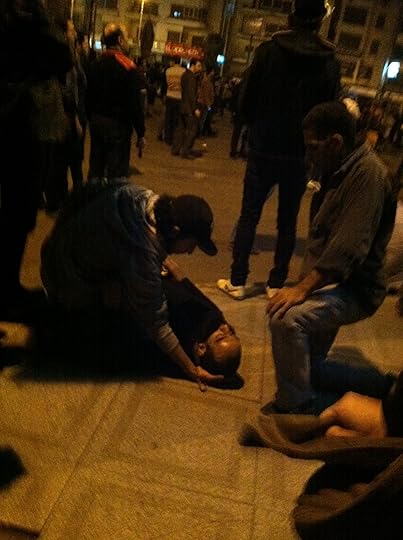
A man succumbs to teargas inhalation near a Roxy Square field hospital
Update: Video here shows a Muslim Brotherhood member firing what appears to be birdshot from a shotgun at anti-Morsi protesters; this video confirms rumors that state security bolstered Muslim Brotherhood lines, firing on anti-Morsi forces when MB members retreated. Finally, another video contains footage of fire apparently exchanged from both sides.
Last night, thousands of opposition protesters appeared in front of Egypt’s presidential palace in the Cairo suburb of Heliopolis to voice their anger with President Mohamed Morsi’s draft constitution. Influenced almost completely by Muslim Brotherhood officials and their Salafist allies, the proposed constitution is a divisive document. At the protest, the mostly secular, upper middle class crowd went well beyond the demand for a constitutional dialogue, denouncing Morsi as a dictator and calling for his ouster. “Erhal!” (“Leave”), they chanted; “Dictator, Dictator, Morsi, it’s your turn!” was another cadence that filled the air outside the palace.
Though I was unable to confirm reports that state security were driven away from the protest, forced to leave their helmets and even teargas shells behind, I saw them boarding buses and trucks by the hundreds on Salah Salem Boulevard. Soon after, Morsi evacuated the presidential palace, with protesters pelting his motorcade with stones as it pulled away. The protest was apparently seen by the Muslim Brotherhood leadership as a major transgression. A red line had been crossed. As Yasser Borhami, a Salafist preacher supportive of Morsi, told Al Jazeera, the opposition provoked violence by “saying words insulting of the president.”
This afternoon, the Muslim Brotherhood called for a million man march on the presidential palace, where opposition protesters were still encamped. The clashes that had been expected all week were now inevitable, as Morsi seemed determined to prove his political legitimacy through a massive display of street-level manpower. By 6 PM, streets near Heliopolis’ Roxy Square were lined with buses and vans used to shepherd in thousands of Brotherhood supporters from the countryside and the provinces. The details of what happened next may require another day to clarify, but what is clear is that the Brotherhood organized a march that was certain to spark violent clashes, and that the decision was made at the highest levels of the organization’s political echelon.
I arrived at Roxy Square around 7 PM with Cliff Cheney, a Cairo-based photojournalist and videographer covering the revolutionary tumult. By then the fighting was in full swing. Huge throngs of opposition demonstrators swelled towards the pro-Morsi crowds, pelting them with stones. Fusillades of teargas flew in return, possibly from state security bolstering the pro-Morsi lines. The sound of shotguns loaded with birdshot thundered from inside the melee, and molotov cocktails streaked above the crowd, lobbed from both sides. One by one, young men came stumbling towards a makeshift field hospital and crumpled onto the sidewalk, overcome by gas inhalation. Others suffering more serious injuries were loaded into ambulances roaring through the crowd every few minutes.
An opposition protester who had been in the thick of the fighting told me the Brotherhood mustered larger numbers but the anti-government forces were “more daring.” To make up for lost ground, he said the Brotherhood activists began firing rubber and possibly live bullets. “Everyone around me was falling,” he said. Wael Eskandar, an Egyptian blogger and opposition supporter present during the clashes, claimed firearms, including an automatic rifle, were used by pro-Morsi activists “early and with high frequency.” On the other hand, a reporter for the Egyptian daily Al Ahram reported seeing a man “recklessly” using a gun against pro-Morsi demonstrators.
As the night wore on, a spokesman for the Brotherhood appeared on a local Cairo radio show to dismiss claims that the march was a violent provocation. He insisted no opposition protesters were in their tents when the Brotherhood members arrived at the palace. However, other witnesses at the scene told me those who had encamped at the palace were badly beaten. By 9 PM, hundreds were reported injured and each side reported at least one fatality. Among those reportedly killed was Egyptian Popular Alliance activist Mirna Emad.
During the clashes, countless activists told me to leave for my own safety. “This is not a foreign friendly demonstration,” one told me. Indeed, Western reporters are not always welcome at such events, and in contrast to my experience at the popular protests in the West Bank, some demonstrators treat those who brandish cameras with extreme hostility. So I could not take photos or shoot video with the kind of frequency I’m accustomed to. When a wave of Brotherhood activists broke through opposition lines, pushing the crowd back and sending hundreds sprinting away from the square, I ran with them. And I did not return. I learned later that a Western photojournalist became trapped in a dress shop as the situation deteriorated.
Each side took casualties and neither appears ready to relent. The polarization is deepening with each passing day. It appears that the fighting will persist as December 15, the date of the constitutional referendum, draws closer. If Morsi’s legitimacy is contingent on his ability to maintain stability, he risks forfeiting it by allowing the kind of violence seen in Roxy Square tonight to occur on his watch.
Mazhar Shaheen, the famed imam known as the “Tahrir Preacher” for his role in the January 25 revolution, said tonight, “What is happening threatens to lead to a civil war… We should all be ashamed to participate in the collapse of the nation.”
Towards Civil War in Egypt?

A man succumbs to teargas inhalation near a Roxy Square field hospital
Last night, thousands of opposition protesters appeared in front of Egypt’s presidential palace in the Cairo suburb of Heliopolis to voice their anger with President Mohamed Morsi’s draft constitution. Influenced almost completely by Muslim Brotherhood officials and their Salafist allies, the proposed constitution is a divisive document. At the protest, the mostly secular, upper middle class crowd went well beyond the demand for a constitutional dialogue, denouncing Morsi as a dictator and calling for his ouster. “Erhal!” (”Leave”), they chanted; “Dictator, Dictator, Morsi, it’s your turn!” was another cadence that filled the air outside the palace.
Though I was unable to confirm reports that state security were driven away from the protest, forced to leave their helmets and even teargas shells behind, I saw them boarding buses and trucks by the hundreds on Salah Salem Boulevard. Soon after, Morsi evacuated the presidential palace, with protesters pelting his motorcade with stones as it pulled away. The protest was apparently seen by the Muslim Brotherhood leadership as a major transgression. A red line had been crossed. As Yasser Borhami, a Salafist preacher supportive of Morsi, told Al Jazeera, the opposition provoked violence by “saying words insulting of the president.”
This afternoon, the Muslim Brotherhood called for a million man march on the presidential palace, where opposition protesters were still encamped. The clashes that had been expected all week were now inevitable, as Morsi seemed determined to prove his political legitimacy through a massive display of street-level manpower. By 6 PM, streets near Heliopolis’ Roxy Square were lined with buses and vans used to shepherd in thousands of Brotherhood supporters from the countryside and the provinces. The details of what happened next may require another day to clarify, but what is clear is that the Brotherhood organized a march that was certain to spark violent clashes, and that the decision was made at the highest levels of the organization’s political echelon.
I arrived at Roxy Square around 7 PM with Cliff Cheney, a Cairo-based photojournalist and videographer covering the revolutionary tumult. By then the fighting was in full swing. Huge throngs of opposition demonstrators swelled towards the pro-Morsi crowds, pelting them with stones. Fusillades of teargas flew in return, possibly from state security bolstering the pro-Morsi lines. The sound of shotguns loaded with birdshot thundered from inside the melee, and molotov cocktails streaked above the crowd, lobbed from both sides. One by one, young men came stumbling towards a makeshift field hospital and crumpled onto the sidewalk, overcome by gas inhalation. Others suffering more serious injuries were loaded into ambulances roaring through the crowd every few minutes.
An opposition protester who had been in the thick of the fighting told me the Brotherhood mustered larger numbers but the anti-government forces were “more daring.” To make up for lost ground, he said the Brotherhood activists began firing rubber and possibly live bullets. “Everyone around me was falling,” he said. Wael Eskandar, an Egyptian blogger and opposition supporter present during the clashes, claimed firearms, including an automatic rifle, were used by pro-Morsi activists “early and with high frequency.” On the other hand, a reporter for the Egyptian daily Al Ahram reported seeing a man “recklessly” using a gun against pro-Morsi demonstrators.
As the night wore on, a spokesman for the Brotherhood appeared on a local Cairo radio show to dismiss claims that the march was a violent provocation. He insisted no opposition protesters were in their tents when the Brotherhood members arrived at the palace. However, other witnesses at the scene told me those who had encamped at the palace were badly beaten. By 9 PM, hundreds were reported injured and each side reported at least one fatality. Among those reportedly killed was Egyptian Popular Alliance activist Mirna Emad.
During the clashes, countless activists told me to leave for my own safety. “This is not a foreign friendly demonstration,” one told me. Indeed, Western reporters are not always welcome at such events, and in contrast to my experience at the popular protests in the West Bank, some demonstrators treat those who brandish cameras with extreme hostility. So I could not take photos or shoot video with the kind of frequency I’m accustomed to. When a wave of Brotherhood activists broke through opposition lines, pushing the crowd back and sending hundreds sprinting away from the square, I ran with them. And I did not return. I learned later that a Western photojournalist became trapped in a dress shop as the situation deteriorated.
Each side took casualties and neither appears ready to relent. The polarization is deepening with each passing day. It appears that the fighting will persist as December 15, the date of the constitutional referendum, draws closer. If Morsi’s legitimacy is contingent on his ability to maintain stability, he risks forfeiting it by allowing the kind of violence seen in Roxy Square tonight to occur on his watch.
Mazhar Shaheen, the famed imam known as the “Tahrir Preacher” for his role in the January 25 revolution, said tonight, “What is happening threatens to lead to a civil war… We should all be ashamed to participate in the collapse of the nation.”
Max Blumenthal's Blog

- Max Blumenthal's profile
- 273 followers

