
Max Blumenthal's Blog, page 5
March 8, 2012
AIPAC drives the US towards war on Iran

On RT, I discussed AIPAC's recent national convention and the Lobby's push for a US war on Iran:


Blackwashing Israeli Apartheid

On Al Jazeera's The Stream, I discuss the Israel Lobby's use of blackwashing tactics to stifle allegations that Israel engages in the crime of apartheid:
Zionist Hasbara, past and present: My presentation at Penn BDS

At Penn BDS, I discussed Zionist hasbara past and present during my panel with Sarah Schulman:
The Zionist Response to BDS from PennBDS on Vimeo.
1 State conference critic Foxman once suggested "fully integrating the Palestinian Arabs into the Israeli body politic"

This weekend's One State Conference at Harvard University has prompted predictable cries of outrage and calls for cancellation from the Israel lobby and its allies in Congress. Senator Scott Brown, a Republican from Massachusetts, is the latest Friend of Israel to join the chorus of condemnation, calling for Harvard to ban the conference altogether. The campaign of intimidation and smears highlights America's pro-Israel community as the political element most devoted to suppressing free speech and academic inquiry on campuses across the United States.
Abraham Foxman, the national director for the Anti-Defamation League, is at the helm of the campaign to censor the discussion at Harvard of equal rights in Israel-Palestine. In an op-ed for the Boston Globe, Foxman wrote, "Let's be frank. The term 'one-state solution'' is a euphemism for the destruction of the Jewish state of Israel." He attacked the conference participants for their " alleged concerns about Israel's 'occupation'' and treatment of the Palestinians," claiming that their true goal was to "make anti-Semitism more acceptable and more likely."
In light of Foxman's assaults on the academic discussion of equal rights for all living under Israel's control, it is worth recalling an angry letter he sent to the editors of the New York Times on June 20, 1984. In the letter, Foxman took issue with an editorial the Times published calling for a two state solution that would have required Israel to give up control of the West Bank. Foxman criticized the authors for casting Israel's undemocratic control of the West Bank in a negative light, insisting that Israeli control of the Palestinians was not "deleterious to [Israel's] well being." And in the end, he suggested that Israel should consider"fully integrating the Palestinian Arabs into the Israeli body politics." This is the very concept that will be discussed and promoted at the One State Conference this weekend at Harvard.
Below the fold is the full text of Foxman's letter, which I retrieved from Lexis-Nexis:
To the Editor:
The debate as to whether Israel's control over the West Bank is irreversible or not is a legitimate and important one. Unfortunately, the writers you chose to conduct that debate on your Op-Page, David Shaham and Geoffrey Aronson, share the assumption that Israel's control of the West Bank is bad.
The issue of reversibility aside, Times readers should not be given the impression that Israelis or those who write about Israel are united in thinking that Israeli control of the West Bank is deleterious to its well-being. Indeed, a vibrant and ofttimes emotional debate is taking place among the people of Israel as to what would be good for Israel – considering Israel's narrow security options in that small area, considering the arms buildup of its neighbors, considering Israel's historical and religious ties to the area and considering whether fully integrating the Palestinian Arabs into the Israeli body politic is the best thing for the country.
The tragedy of the West Bank has been the tragedy of the region for 35 years. While Israelis debate the wisdom of a particular regional policy, the Arabs continue to reject peace and negotiations, making the debate in Israel abstract rather than real.
Your biggest contribution would be to find people who would advocate that the Arabs finally come to the peace table. ABRAHAM H. FOXMAN New York, June 13, 1984
The writer is associate national director of the Anti-Defamation League of B'nai B'rith.
Progressive hero Elizabeth Warren tows AIPAC's pro-war line

Few congressional candidates have excited the progressive base of the Democratic party as much as consumer advocate Elizabeth Warren has. With her tenacious advocacy for a consumer protection agency to fight unfair lending practices and her consistent framing of economic issues in terms of structural inequality has earned her enthusiastic promotion from major progressive figures from Markos Moulitsas to Rachel Maddow to Michael Moore.
Warren has focused her race against incumbent Republican Senator Scott Brown almost entirely around issues of economic justice, placing her quixotic battle for the Consumer Financial Protection Bureau at the center of her campaign narrative. During an appearance on MSNBC's "Morning Joe," Warren boasted that she succeeded in creating the bureau despite opposition from "the toughest lobbying force ever assembled on the face of the earth."
While progressives celebrate Warren for her fight against the big banks and the financial industry's lobbying arm, they have kept silent over the fact that she has enlisted with another powerful lobby that is willing to sabotage America's economic recovery in order to advance its narrow interests. It is AIPAC, the key arm of the Israel lobby; a group that is openly pushing for a US war on Iran that would likely trigger a global recession, as the renowned economist Nouriel Roubini recently warned. The national security/foreign policy position page on Warren's campaign website reads as though it was cobbled together from AIPAC memos and the website of the Israeli Foreign Ministry by the Democratic Party hacks who are advising her. It is pure boilerplate that suggests she knows about as much about the Middle East as Herman "Uzbeki-beki-stan-stan" Cain, and that she doesn't care.
Warren's statement on Israel consumes far more space than any other foreign policy issue on the page (she makes no mention of China, Latin America, or Africa). To justify what she calls the "unbreakable bond" between the US and Israel, Warren repeats the thoughtless cant about "a natural partnership resting on our mutual commitment to democracy and freedom and on our shared values." She then declares that the United States must reject any Palestinian plans to pursue statehood outside of negotiations with Israel. While the US can preach to the Palestinians about how and when to demand the end of their 45-year-long military occupation, Warren says the US "cannot dictate the terms" to Israel.
Warren goes on to describe Iran as "a significant threat to the United States," echoing a key talking point of fear-mongering pro-war forces. She calls for "strong sanctions" and declares that the "United States must take the necessary steps to prevent Iran from acquiring a nuclear weapon" — a veiled endorsement of a military strike if Iran crosses the constantly shifting American "red lines." Perhaps the only option Warren does not endorse or implicitly support is diplomacy. Her foreign policy views are hardly distinguishable from those of her Republican rival, who also marches in lockstep with AIPAC.
The same progressives who refused to vet Barack Obama's views on foreign policy when he ran for president in 2008, and who now feel betrayed that he is not the liberal savior they imagined him to be, are repeating their mistake with Warren. With AIPAC leading the push for war at the height of an election campaign, there is no better time to demand accountability from candidates like Warren. Who does she serve? The liberal grassroots forces that made her into a populist hero or the lobby seeking to drag the US into a dubious, potentially catastrophic war? It is far better for progressives to grill her on her foreign policy positions before the campaign is over than after the next war begins.
Congress promises Iranian people strangulation and catastrophe

Yesterday, the New York Times reported on the depressingly predictable consequences of US-led sanctions against Iran: they have reinforced the regime's hold on power and enriched the elite while wrecking the lives of millions of middle and working class Iranians. The Times' Robert Worth made prominent note of the fact that sanctions were motivated at least as much by President Barack Obama's domestic political ambitions as they were by American foreign pollicy interests:
Yet this economic burden is falling largely on the middle class, raising the prospect of more resentment against the West and complicating the effort to deter Iran's nuclear program — a central priority for the Obama administration in this election year…
Ordinary Iranians complain that the sanctions are hurting them, while those at the top are unscathed, or even benefit. Many wealthy Iranians made huge profits in recent weeks by buying dollars at the government rate (available to insiders) and then selling them for almost twice as many rials on the soaring black market. Some analysts and opposition political figures contend that Mr. Ahmadinejad deliberately worsened the currency crisis so that his cronies could generate profits this way.
More pointless, politics-driven economic warfare is on the way. At the prompting of United Against A Nuclear Iran, a neocon front group whose board members have already urged "military action" against Iran, the Senate Banking Committee recently approved a new round of sanctions that would force the "Swift" telecommunications industry to expel Iranian banks. The New York Times noted that the Swift sanctions "would be financially catastrophic for Iran if carried out fully, according to proponents and sanctions experts."
One Democratic congressional aide who supports the Swift sanctions touted the Senate legislation as a collective strangulation of the Iranian population, remarking to the Jewish Telegraphic Agency, "every time that a new sanctions bill is passed, the noose gets tighter around the neck of the Iranian economy."
A co-sponsor of the Swift sanctions, Republican Senator Mark Kirk, has been the largest single recipient of AIPAC-related donations in Congress. Kirk's desire to collectively punish the Iranian people for anything their government might or might not have done is unconcealed. In an October 2011 appearance on a Chicago-area radio show, Kirk spent his time harumphing over a transparently trumped up Iranian government terror plot. But the host interrupted the senator with an important question: "Are you really going after the government of the country, or are you taking food out of the mouths of the citizens?'"
Kirk's reply neatly encapsulated the sadistic consensus in Washington: "It's okay to take the food out of the mouths of the citizens from a government that's plotting an attack directly on American soil."
Romney's Man on Iran

In 2005, a group of graduate students at Johns Hopkins University's School of Advanced and International Studies (SAIS) participated in the school's annual diplomatic simulation. The high-pressure scenario required the students to negotiate a resolution to a standoff with a nuclear-armed Republic of Pakistan. Mara Karlin, a student known for her hawkish politics on Israel and the Middle East, played President of the United States.
Though most of the participants were confident they could head off a military conflict with diplomatic measures, Karlin jumped the gun. According to a former SAIS student, not only did Karlin order a nuclear strike on Pakistan, she also took the opportunity to nuke Iran. Her classmates were shocked. It was the first time in 45 years that a simulation concluded with the deployment of a nuclear weapon.
That year, Karlin received a plum job in the Bush administration's Department of Defense where, according to her bio she was "intimately involved in formulating U.S. policy on Syria, Jordan, Lebanon, and Israel-Palestinian affairs." Lebanon was a special area of focus for Karlin. She claims to have helped structure the Lebanese Armed Forces and coordinated relations between the US and Lebanese militaries.
According to the former SAIS student, Karlin was a favorite of Eliot Cohen, an ultra-hawkish professor of strategic studies at SAIS, which is regarded in American foreign policy circles as a training ground for the neoconservative movement. Through Cohen's connections among the neocons occupying key civilian posts in Bush's Defense Department, the former student claims Cohen was able to arrange an attractive sinecure for Karlin. Besides Karlin, the ex-SAIS student told me Cohen has promoted the career ambitions of many former pupils, including Kelly Magsamen, who worked under Cohen in the Bush administration and now oversees the Iran portfolio in the Obama administration's State Department.
Today, Cohen is among Republican presidential front-runner Mitt Romney's top campaign advisers. He is the primary author of Romney's foreign policy which attacks Obama for "currying favor with [America's] enemies" and "ostentatiously shunning Jerusalem."
The paper urges a policy of regime change in Iran including possible coordination with Israel on military strikes to prevent the Iranian regime from developing a nuclear weapon. It is an aggressive Republican election season document presenting a concoction of post-9/11 unilateralism and unvarnished neo-imperialism as the antidote to a sitting president Cohen accused of "unilateral disarmament in the diplomatic and moral sphere." More importantly, it suggests that a Romney administration's foreign policy might look remarkably similar to – and perhaps more extreme than – that of the Bush administration.
Cohen rose through the ranks of the Republican foreign policy elite as a protégé of Paul Wolfowitz.Stephen Walt, a professor of international affairs at Harvard University's School of Government who has been on the receiving end of aggressive attacks by Cohen, called Cohen "a classic neoconservative." Walt said, "He is constantly fretting about alleged U.S. vulnerabilities, consistently supportive of increased defense spending, and generally inclined to favor U.S. intervention in other countries. Second, like virtually all neoconservatives, he is also deeply attached to Israel, as well as to the United States. I do not question his patriotism, but I think he tends to see U.S. and Israeli interests as more-or-less identical and doesn't see a trade-off between support for one and support for the other."
Cohen rose through the ranks of the Republican foreign policy elite as a protégé of Paul Wolfowitz, the former Assistant Secretary of Defense who is credited with playing a central role in the push for invading Iraq. In 1990, Wolfowitz secured a position for Cohen working beside him on the policy planning staff of the Office of the Secretary of Defense. Three years later, when Wolfowitz was appointed dean of SAIS, he began using his influence to propel Cohen's career. According to a former State Department official who graduated from SAIS, it was through the beneficence of Wolfowitz that Cohen earned an endowed teaching position at SAIS as the Robert E. Osgood Professor of Strategic Studies.
In 1997, Wolfowitz and Cohen joined forces to form the Project for a New American Century, a neoconservative umbrella group that served as the key non-governmental vehicle for promoting the case for invading Iraq after 9/11. In the immediate wake of al-Qaeda's attack on the World Trade Center in New York and the Pentagon in Washington, D.C., Cohen took to the media to map out the next phase of a grand global military venture that he coined, "World War IV."
Describing Iraq as "the big prize," Cohen urged a unilateral invasion of Iraq that would advance the ambitions of the now-discredited political charlatan Ahmed Chalabi and his Iraqi National Congress. Like so many of his neoconservative peers, Cohen claimed Saddam Hussein's regime maintained "a connection with the 9/11 terrorists." With the war deteriorating into a chaotic bloodbath and as his own son was called up for duty, Cohen criticized the Bush administration for "happy talk and denials of error." However, he refused to admit fault for his role in selling Americans on the invasion.
Despite mildly dissenting from the White House line, Cohen continued his ascent, replacing Philip Zelikow as counselor to then-Secretary of State Condoleeza Rice in 2007. According to the former State Department official, Rice had almost no role in Cohen's appointment. Instead, Cohen was recommended for the position by Vice President Dick Cheney and his daughter Liz. Cheney's daughter headed the Iran Syrian Operations Group, a newly created, neoconservative-inspired initiative burrowed within the State Department's Bureau of Near Eastern Affairs. At the time of Cohen's appointment, Rice was attempting to open diplomatic lines to Iran, North Korea, and Syria – a move Cohen and the Cheneys fiercely opposed.
A few months after Bush left office, the former State Department official said Cohen and Wolfowitz rewarded their neoconservative fellow traveler Eric Edelman – a former Defense Department official during the later Bush years – with a visiting scholarship at SAIS. In private, Johns Hopkins alumni expressed outrage at the installment of Edelman, a career diplomat with no academic background, accusing the neoconservatives of exploiting SAIS to create a system of political patronage.
Cohen advised that the "US actively seek the overthrow of the Islamic Republic…through every instrument of U.S. power, soft more than hard."Cohen's extensive web of foreign policy and military connections forms a seamless line to Tel Aviv. There, on the top floor of one of the office buildings known as "HaKirya," is the office of one of Cohen's former pupils, Aviv Kochavi. Kochavi is now the director of Israeli military intelligence, making him one of the most quietly influential figures in the country. In 2006, Kochavi, who also holds a philosophy degree, boasted to the Israeli architect and anti-occupation activist Eyal Weizmann about how he and his troops crushed Palestinian resistance cells in Nablus through the use of "inverse geometry" and "micro-tactical actions" inspired by the theories of post-structuralist philosophers like Deleuze and Guattari. On February 2, Kochavi appeared at the annual Herzliya Conference to issue grave warnings about the rapid progress of Iran's nuclear program, suggesting that sanctions and diplomacy have failed, and that more aggressive action might be required.
Despite Cohen's deep Israeli ties, he has proven extremely sensitive to critiques of the connection. When Stephen Walt and John Mearsheimer, the latter a professor of International Relations at the University of Chicago, published their widely debated paper on the Israel lobby in 2006, Cohen authored one of the first attempts to discredit their thesis about a loose coalition of individuals and organizations creating political pressure to move US foreign policy in a pro-Israel direction. In an op-ed in the Washington Post, Cohen accused the authors of "kooky academic work" and "obsessive and irrationally hostile beliefs about Jews."
"Cohen's rather hysterical reaction to our work was both typical and easy to explain," Walt remarked. "Given that he and other neoconservatives had played a key role in convincing George Bush to invade Iraq in 2003, he was understandably upset when we pointed this out and provided extensive documentation of their role in the run-up to this disastrous war. He could not refute our logic or our evidence, however, so he chose to misrepresent our views and smear us falsely as anti-Semites and conspiracy theorists."
With the last battalions of US troops preparing to redeploy from Iraq to other conflict zones, Cohen is homing in on Iran. In a September 2009 editorial for the Wall Street Journal, he dismissed diplomacy and sanctions as feasible means of curbing Iran's nuclear ambitions. "Pressure, be it gentle or severe, will not erase that nuclear program," he wrote. "The choices are now what they ever were: an American or an Israeli strike, which would probably cause a substantial war, or living in a world with Iranian nuclear weapons, which may also result in war, perhaps nuclear, over a longer period of time." While not ruling out the necessity of an American strike on Iranian facilities, Cohen advised that the "US actively seek the overthrow of the Islamic Republic…through every instrument of U.S. power, soft more than hard."
As tensions between Israel and Iran rise to unprecedented levels, and Israel's leadership beseeches the US to join a military strike on Iran, Cohen's visions of regime change seem closer to realization than ever before. For him and the neoconservative policy elite, a Romney victory in November might deliver the next "big prize."
The Bibi Connection

"US President Barack Obama is 'naïve' and needs to face up to the threat presented by the rise of the Muslim Brotherhood across the Middle East, Israel's National Security Council concluded during a strategic discussion several days ago," Israel Hayom reported.
The Israeli National Security Council consists of Benjamin "Bibi" Netanyahu's closest advisers. And Israel Hayom is not just another right-leaning Israeli tabloid. Referred to by Israelis as the "Bibiton," or Bibi's mouthpiece, the paper is an instrument that gives him extraordinary political leverage. The obviously planted article in Israel Hayom rang like a bell sounding the start of Netanyahu's own campaign in helping the Republican Party oust Obama from the White House.
Israel Hayom's genesis demonstrates the depth of Netanyahu's connections in Republican circles. It was created by one of Netanyahu's top financial supporters, a Las Vegas-based casino tycoon named Sheldon Adelson, who is also a major donor to the conservative wing of the Republican Party. Adelson's closest relationship is with former Speaker of the House Newt Gingrich, a longtime ally of Netanyahu who has been running a rancorous campaign for the Republican presidential nomination.
Netanyahu's less than subtle intervention has become an open issue in Israeli politics. Opposition leader Tzipi Livni of the Kadima Party has criticized Netanyahu for damaging the US-Israeli relationship. "Netanyahu spoke about consensus," Livni said in May, "and if there is a consensus in Israel, it's that the relationship with the US is essential to Israel, and a prime minister that harms the relationship with the US over something unsubstantial is harming Israel's security and deterrence."
But Livni's warning has been ignored. Rather than hesitating, the prime minister and his inner circle are moving full steam ahead in their political shadow campaign whose ultimate goal is to remove Obama. Bibi's war against Obama is unprecedented. While Israeli prime ministers have tried to help incumbent presidents, none have ever waged a full-scale campaign to overthrow them.
Netanyahu has engaged enthusiastic allies in the Republican Congress, led by House Majority Leader Eric Cantor, and within the right-wing media. His neoconservative allies in Washington are launching a "Super PAC" to generate emotional attack ads against Obama and any candidate that might be an obstacle to his policies. And his campaign has even broadened into an attempt to discredit The New York Times, whose editorial page and foreign policy columnists, Thomas Friedman and Roger Cohen, have been critical of him.
Netanyahu's shadow campaign is intended to be a factor in defeating Obama and electing a Republican in his place. He opposed Obama's early demand to freeze settlements on the West Bank as a precondition for reviving the peace process, a process since the Oslo Accord that Netanyahu has attempted to stall or sabotage, despite his signing of the Wye Agreement under pressure from President Clinton. Since his adamant stand against the settlement freeze, Netanyahu has undermined every effort to engage the peace process. He appears dead set on consolidating Greater Israel, or what many Israelis call "Judea and Samaria," and has signaled a strong desire to attack Iran.
By all accounts, Netanyahu's personal chemistry with Obama is toxic. Obama bristles at his belligerence. But Netanyahu's hostility has reaped rewards from him, having stopped the peace process in its tracks. The latest effort by the Quartet seems doomed to failure. And Netanyahu's rejectionism has put Obama on the defense. Most of the US Jewish establishment has remained a bulwark for Bibi's policies. Obama, meanwhile, has been forced to declare America's "unshakable bond" with Israel, even as Bibi thwarts Obama's initiatives and attacks him in the Israeli press.
As political strategy, by tainting Obama as less than full-throated in support of Israel, Netanyahu bolsters the Republican themes that the president "apologizes" for US power, is weak on national security, and is an agent of "decline." By depicting Obama as "weak" on Israel, Netanyahu's campaign excites right-wing Jews and evangelical Christians, who overwhelmingly accept the biblical claims of the Jewish state's historical right to Greater Israel, Judea and Samaria. Bibi's deepest attack line against Obama merges theology with ideology.
His campaign against Obama is a high-stakes gambit that will almost certainly color US-Israeli relations well past Election Day. Already, Netanyahu has succeeded in polarizing the political debate, as his agenda is singularly aligned with the Republican Party. Yet Bibi's short-term objectives are rapidly turning the US-Israel relationship, at least under his aegis, into a partisan issue, another litmus test of conservative ideology rather than national interest.
The personal connection
Netanyahu's American orientation is partly rooted in his personal history. Raised in suburban Philadelphia, his father, Benzion Netanyahu, was the former press secretary for the godfather of right-wing revisionist Zionism, Zeev Jabotinsky. Benzion Netanyahu (original name: Benzion Mileikowsky) spent his most consequential years in New York raising money for Jabotinsky and the rightist Irgun militia in Palestine. When he returned to Israel to launch a political career, the elder Netanyahu was rejected by Menachem Begin, the Likud Party leader, who, as right wing as he was, considered him dangerously extreme (Arabs are "an enemy by essence," the elder Netanyahu said recently). But the son triumphed where his father failed, rising at first on his fluency in American political culture, a frequent guest on ABC News' Nightline and other US broadcast news programs, eventually winning the chairmanship of the Likud Party in 1992.
The following year, Netanyahu published a political manifesto in the form of a memoir, A Durable Peace, edited with a helping hand from American neoconservative Douglas Feith. The book was tailored to the sensibilities of an American audience, particularly one with conservative Republican tendencies. In a revealing passage, Netanyahu warned readers that the creation of a sovereign Palestinian state could lead Latinos to establish a "second Mexico" in the American Southwest: "These [Latinos] would demand not merely equality before the law, or naturalization, or even Spanish as a first language," he wrote. "Instead they would say that since they form a local majority in the territory [which was forcibly taken from Mexico in the war of 1848], they deserve a state of their own."
In 1996, when Netanyahu launched an underdog bid for Prime Minister against the grand old man of the Labor Party establishment, Shimon Peres, he contracted the services of Arthur Finkelstein, a reclusive New York-based Republican political consultant. Finkelstein was infamous for orchestrating a come-from-behind victory in 1992 for Jesse Helms, a radical neo-Confederate senator from North Carolina, by race baiting Helms' black opponent. Finkelstein earned a fortune working for anti-gay candidates like Helms, even while planning to marry his long-term boyfriend.
Netanyahu's campaign against Peres was defined by Finkelstein's trademark slashing tactics. Frightening imagery flooded Israeli airwaves. Among Netanyahu's most successful Finkelstein-crafted attack lines was, "Peres will divide Jerusalem." Even the positive slogans had a negative subtext. "Bibi is good for the Jews," hinted darkly at the de facto coalition Peres had constructed with Arab-based political parties. Finkelstein's media assault on Peres, with its suggestion that he and his assassinated predecessor, Yitzhak Rabin, had stabbed Israel in the back, propelled his client to a narrow victory.
The new Prime Minister relied on a kitchen cabinet of advisers from neoconservative think tanks, especially the Washington-based American Enterprise Institute (AEI) and the Shalem Center. In 1996, two of these advisers, former Reagan administration Pentagon officials, Richard Perle and Douglas Feith, produced a document for Institute for Advanced Strategic and Political Studies, a once influential base of neocon activity, called "A Clean Break." The paper advocated overthrowing Saddam Hussein and attacking Syria "as a prelude to a redrawing of the map of the Middle East." (Feith was appointed a Defense Department official in the George W Bush administration and became a fervent defender of the Iraq invasion, leading the effort to fabricate evidence of Saddam Hussein's operational links with al-Qaeda. General Tommy Frank, who led the invasion, called Feith "the f**king stupidest guy on the face of the earth.")
Backing down to Clinton
President Bill Clinton was, according to the American Israel Public Affairs Committee (AIPAC)'s then-President Steve Grossman, "the most pro-Israeli [president] in America's history" – and he was committed to fulfilling the Oslo Accords on his watch. He developed an unusually close relationship with Prime Minister Yitzhak Rabin, coming to see him as something of a father figure. When Rabin was assassinated by a right-wing Orthodox Jewish extremist, Peres briefly took over, but was soon defeated by Netanyahu. Clinton demanded that Netanyahu begin to withdraw Israeli troops from small portions of land in the occupied West Bank. With pressure mounting, Netanyahu flung himself into the American political wars.
In January 1998, at the beginning of the impeachment scandal, Netanyahu appeared at a rally organized by Reverend Jerry Falwell, a right-wing evangelical Christian icon, who had produced an elaborate conspiracy video accusing Clinton of drug trafficking and complicity in the murder of Vince Foster, his White House deputy legal counsel and old friend, who had, in fact, committed suicide.
Standing beside Falwell before an audience of hundreds of evangelical activists and right-wing Jews, Netanyahu vowed in his signature basso profondo voice never to "divide" Jerusalem, and proclaimed that the "Jewish people" were being "vilified and scorned and misrepresented." After the rally, Netanyahu shuttled between meetings with conservative pundits and the broadcast studios of Fox News and right-wing Christian TV networks, stirring up his support among America's most zealous opponents of the peace process.
The most prominent among Netanyahu's newfound conservative allies was then-House Speaker Newt Gingrich, an instigator of the impeachment. That April, at a meeting of the Jewish Federation of Los Angeles, Gingrich condemned Clinton's attempts to pressure Netanyahu into land-for-peace concessions. "The idea that the President can propose a US map [regarding Israeli withdrawal from the West Bank] for a country he does not know is a disaster," Gingrich said. Then he complained, "The Clinton administration has not held [Palestinian Authority Chairman Yasser] Arafat's feet to the fire."
But, by October 1998, Netanyahu had all but caved to Clinton's pressure. The man who once mocked "advocates of capitulation" now clasped hands with Arafat after a protracted conference at Wye, Maryland. Netanyahu agreed to redeploy Israeli troops from 13 percent of the West Bank, including most of Hebron. His sudden turnabout cost him key support inside Likud, provoking a Knesset vote for early elections. His right-wing base shattered, paving the path for a decisive victory for the Labor Party's Ehud Barak, a former Israeli general favored and quietly supported by the Clinton administration.
Suddenly in the wilderness, Netanyahu plotted his path back by cultivating the right-wing in the US — the pundits, the Republican politicians, the big donors, Fox News. In 2007, he held a meeting with a small group of conservative activists emerging as key players in the conservative blogosphere. Among those present was Andrew Breitbart, who became a notorious hatchet man staging wild stunts and whose myriad websites routinely carry conspiratorial, racially charged attacks on Obama. Other figures at the meeting included conservative bloggers Scott Johnson, Jim Hoft and Jeff Emmanuel. "At our meeting we talked mostly about the dangers of the Iranian regime acquiring a nuclear bomb," Johnson recalled, revealing his newly acquired foreign policy expertise. "It was a subject to which Netanyahu had obviously devoted great thought."
Two years later, Netanyahu returned to the Prime Minister's office at the head of an even more decidedly right-wing coalition than before government and was determined not to repeat his previous mistakes of "capitulating" to the peace process at the behest of an American president. Now he turned to the movement he had courted to help him undermine and humiliate Obama.
Humiliating Obama
In March 2010, when Obama dispatched Vice President Joseph Biden to Israel in a futile attempt to restart negotiations between Israel and the Palestinian Authority, Netanyahu appeared in Jerusalem at a massive rally of 1,000 evangelicals organized by Texas mega-church Pastor John Hagee, a leading Christian Zionist and sometime Holocaust revisionist whose End Times theology committed him to the vision of Greater Israel. Seated onstage beside Netanyahu was Israel's Ambassador to the United States, Michael Oren (a neoconservative former Shalem Center fellow), and Deputy Foreign Minister Danny Ayalon, who had just snubbed a visiting delegation of leading Democratic members of Congress. Before the rapture-ready audience, Netanyahu proclaimed that Jerusalem would remain "the undivided, eternal capital of the Jewish people."
At once, he authorized the construction of 1,600 new settlement units in occupied East Jerusalem over the stringent objections from the Obama administration. Though the move angered the White House, Ron Dermer, a top Netanyahu aide with close ties to leading Republicans in Washington, the Prime Minister that Republicans would retake Congress. Netanyahu simply rejected Obama's plea to freeze settlements and then rejected overtures to restart the peace process. In the 2010 mid-term elections, Republicans gained control of the House of Representatives.
While on a trip to New York days after the Republican victory, Netanyahu authorized another 1,000 more settlement units in East Jerusalem, a direct rebuke of Obama. That same day, Netanyahu held a meeting with the incoming House Majority Leader Eric Cantor, the only Jewish Republican in Congress, and a leader of the right-wing in the House Republican Conference. Cantor's office produced a summary of the meeting for the media that contained the remarkably crude statement: Cantor promised Netanyahu that "the new Republican majority will serve as a check on the [Obama] Administration and what has been, up until this point, one party rule in Washington."
In April 2011, Republican Speaker of the House John Boehner personally invited Netanyahu to speak before a joint session of Congress. He was interrupted 36 times by standing ovations – more than Obama during his State of the Union address – despite making such mind-boggling false claims as that the "vast majority" of Israeli settlers live in "neighborhoods in Jerusalem and greater Tel Aviv."
With a rancorous, multi-billion dollar US presidential campaign certainly looming on the horizon, Netanyahu continued his pattern of making friends in the radical right's media machine. Among them was Glenn Beck, a Mormon convert and former Fox News host, who had compared a major liberal Jewish religious denomination to radical Islamists and claimed that Obama has "a deep-seated hatred for white people." Beck was admonished by the Anti-Defamation League and other mainstream Jewish groups for his anti-Semitic rants against George Soros, a major funder of liberal and Democratic Party-related organizations. In July 2011, Beck traveled to Israel to deliver a diatribe against liberal Israelis demonstrating against Netanyahu's economic policies, labeling them patsies in a secret Islamist-Communist plot.
When the right-wing Zionist Organization of America honored Beck this November with a prize named after Sheldon Adelson and his wife, Miriam, Netanyahu displayed his gratitude in a videotaped tribute. "Glenn, you can be sure that if Sheldon and Miri Adelson put their name to something, it must stand for a lot. You stand for a lot…And I want to tell you how deeply we appreciate this stand of courage and integrity."
Dear Sasha
In December, Thomas Friedman, the Pulitzer Prize winning former Jerusalem Bureau Chief for The New York Times and one of the few American columnists whose opinions seriously register in the Israeli media, published an uncharacteristically pointed critique of Netanyahu's leadership. In Friedman's column were two lines that incited the wrath and fury of the Prime Minister's office. "I sure hope that Israel's prime minister, Benjamin Netanyahu, understands that the standing ovation he got in Congress this year was not for his politics. That ovation was bought and paid for by the Israel lobby."
Neoconservative opinion makers exploded with orchestrated rage accusing Friedman of being a self-hating Jewish anti-Semite. In response, The New York Times gave Netanyahu an opportunity to respond on its opinion page.
But rather than accept the Times' offer, Netanyahu dispatched Ron Dermer, his key emissary to the American political scene, especially to the conservative movement, now serving as a senior advisor on his staff, to issue what amounted to a declaration of war against the American newspaper of record. Dermer's letter was extraordinary in its vitriolic, hostile and contemptuous tone. Nothing like it had ever existed before — a vicious official attack from the Prime Minister of Israel on the credibility of The New York Times. Perhaps only a little less surprising was that this major event received nearly no coverage in the American press.
In his scathing letter, Dermer accused the Times of "cavalierly defam[ing] our country," claiming that 19 out of 20 op-eds published in the Times were "negative" (Dermer did not challenge their factual basis). He concluded, "it would seem as if the surest way to get an op-ed published in The New York Times these days, no matter how obscure the writer or the viewpoint, is to attack Israel."
One of the remarkable aspects of Dermer's letter was that it was addressed, "Dear Sasha." Who is Sasha? Sasha Polakow-Suransky, a staff editor at the Times editorial page, is in charge of assigning pieces on foreign policy. Why did Dermer address his letter to Polakow-Suransky instead of to Andrew Rosenthal, the director of the Times editorial page? Was he singling out Polakow-Suransky because he revealed in his 2010 book, The Unspoken Alliance: Israel's Secret Relationship With Apartheid South Africa, that Israel offered to sell nuclear warheads to South Africa's apartheid government, a bombshell revelation that prompted furious denials from Israeli President Shimon Peres and Deputy Prime Minister Dan Meridor, embarrassing a country that still refuses to discuss its nuclear program in any public forums, and punishes those who do?
Netanyahu's attack on the Times represented a significant new stage in his shadow war. He was drawing sharp new lines. By rebuking the paper, Netanyahu attempted to define its liberal Zionist, pro-peace process editorial line as hostile to Israeli security needs. And by default, he positioned Rupert Murdoch's Wall Street Journal, with its relentlessly anti-Obama, pro-Bibi op-ed page, as the only respectable forum for true friends of Israel.
Bibi's man in Washington
More than any other candidate in the Republican presidential contest, Newt Gingrich has hewed to Netanyahu's line on the Israeli-Palestinian conflict. In an interview with the cable TV Jewish Channel, Gingrich declared, "We've had an invented Palestinian people who are in fact Arabs and are historically part of the Arab community and they had a chance to go many places." He added, "I see myself as, in many ways, to be pretty close to Bibi Netanyahu in thinking about the dangers of the world."
In May 2010, when Gingrich's presidential campaign was no more than the subject of guarded speculation, Israel Hayom, Bibi's house organ, provided Gingrich with a Hebrew-language forum to assail Obama's policies. The tabloid splashed a full page photo of a smiling Gingrich on its front page accompanied by the caption: "The former Chairman of the House of Representatives attacks the blindness of the Western Elites: 'Evading the confrontation with Evil may bring a second Holocaust, the mistakes made by the White House will exact a terrible price.'"
Israel Hayom's owner, Las Vegas Sands casino corporation chairman Sheldon Adelson, is America's eighth wealthiest man. At the same time he was bankrolling Netanyahu's career, Adelson also became Gingrich's leading financial angel. The casino kingpin was introduced to Gingrich in 1996 through George Harris, a right-wing anti-tax activist and Clark County, Nevada Republican chairman who helped Adelson block a unionization bid at one of his casinos. Gingrich resigned from Congress in disgrace in 1999, forced out by Republicans, hiding his extramarital affair with a congressional staffer. Adelson stepped in as his financial godfather, pumping millions into the coffers of American Solutions for Winning the Future, an independent political committee that covered Gingrich's extravagant travel expenses.
When Gingrich embarked on the presidential trail, George Harris became his campaign finance co-chair, representing Adelson by proxy. (Adelson's Sands corporation is currently facing a federal criminal probe for allegedly bribing foreign officials). And when Gingrich provoked a hailstorm of criticism for claiming the Palestinians were "invented," Adelson publicly defended him. "Read the history of those who call themselves Palestinians, and you will hear why [Newt] Gingrich said recently that the Palestinians are an invented people," Adelson told a group of American Jews visiting Israel on a program he funds, Taglit-Birthright Israel.
Despite Gingrich's dismal finish in the Iowa caucuses, the opening contest in the Republican contest, Adelson has staunchly remained on his side, donating US$5 million to a Super PAC created to support Gingrich's campaign in the key primary state of South Carolina, his Armageddon.
Bibi's Super PAC
When Gingrich quits the race, Netanyahu will not be without a candidate. He can count on former Massachusetts Governor Mitt Romney to carry the neoconservative banner all the way to Election Day. Of Romney's 22 campaign foreign policy advisers, 15 worked in the administration of George W Bush, and six were original members of the Project for the New American Century, the neoconservative group that called for regime change in Iraq.
Romney's own Super PAC, Restore Our Future, credited with destroying Gingrich's hopes in Iowa through a relentless barrage of negative ads, is financed in part by Mel Sembler, a Florida-based a multi-millionaire shopping mall developer and veteran Republican fundraiser, appointed the US ambassador to Italy by President George W Bush. Sembler was mired in scandal when the federal government revoked the license of a chain of adolescent treatment centers he founded after former teenage patients complained they were sexually abused, psychologically tortured and humiliated during sadistic behavior modification programs. Less well known is the financial largesse Sembler has bestowed on neoconservative outfits supporting Netanyahu's policies. He is also a close friend of Adelson.
In November 2011, President Obama and French President Nicolas Sarkozy commiserated about Netanyahu, unaware that their voices were picked up by a live microphone. "You're fed up with him, but I have to deal with him even more often than you," Obama complained to Sarkozy. Romney seized on the episode as proof of Obama's disqualifying leadership and proof of his own fitness for office. "We have here yet another reason why we need new leadership in the White House," Romney declared. (Joining the chorus of pro-Bibi attacks on Obama were the Netanyahu-approved bloggers Breitbart, Hoft, and Johnson).
In ramping up the effort to turn Israel into an anti-Obama wedge issue, a group of neoconservative Netanyahu allies have started a independent political committee called the Emergency Committee for Israel (ECI). The group's name was inspired by the Emergency Committee to Save the Jewish People of Europe, an organization that Netanyahu's father, Benzion, helped lead during World War II in part to raise money for the right-wing Irgun militia in Palestine. The group's board comprises a Who's Who of Washington neoconservatives. It is directed by Noah Pollak, a former assistant editor of Azure, the in-house journal of the Adelson-funded Shalem Center, several of whose fellows are now in Netanyahu's inner circle of advisers. Pollak was credited with helping the Israeli army launch a YouTube channel to rebut accusations that it committed war crimes in the Gaza Strip and elsewhere.
This month, the ECI established a Super PAC in order to use unlimited corporate contributions for political attack ads. The group's first major presidential campaign ad buy targeted Representative Ron Paul (R-Texas), a fervently anti-war libertarian candidate who has called for an end to the special relationship between Israel and the United States. Scheduled to air in the key primary state of South Carolina, where the Republican electorate is dominated by right-wing evangelicals, the ad features Gary Bauer, an ECI board member, Christian right leader and failed presidential candidate staring into the camera, warning that "Ron Paul's conservatism is isolationist and conspiratorial." (Bauer endorsed former Senator Rick Santorum, a right-wing Catholic, who has declared, "All the people that live in the West Bank are Israelis. They are not Palestinians. There is no Palestinian. This is Israeli land.")
Jewish concerns
While Obama and the Democratic Party elite have kept silent in the face of Netanyahu's American shadow war, its polarizing effects have prompted resistance from an unexpected place: the Jewish-American establishment. Weeks of Republican attacks on Obama for his supposed molly-coddling of Israel enemies caused deep discomfort in the offices of mainstream Jewish groups, which have lobbied for decades to consolidate support for Israel in both major American political parties. With Israel deliberately being shaped into a campaign wedge issue, some Jewish leaders worried that rank-and-file Democratic voters would begin to sour on the US-Israel special relationship.
In October, two of the US's oldest and most prominent Jewish organizations, the Anti-Defamation League and the American Jewish Committee, released a "National Pledge for Unity" urging politicians, religious leaders and other Jewish groups aimed at preserving bipartisan support for Israel. "We want the discourse on US support for Israel to avoid the sometimes polarizing debates and political attacks that have emerged in recent weeks, as candidates have challenged their opponents' pro-Israel bone fides or questioned the current administration's foreign policy approach vis-a-vis Israel," declared Anti-Defamation League national director Abraham Foxman. "The last thing America and Israel need right now is the distractions of having Israel bandied about as a tool for waging political attacks."
The Emergency Committee for Israel and the Republican Jewish Coalition, an Adelson-funded, pro-Netanyahu group that claims to raise "tens of millions" of dollars for Republican candidates each election cycle, not only rejected the unity pledge, but accused its authors of attempting to suppress pro-Israel activism. In a defiant statement by its chairman, neoconservative activist William Kristol, the ECI proclaimed, "This attempt to silence those of us who have 'questioned the current administration's foreign policy approach vis-a-vis Israel' will re-energize us." Thus the show went on. The effort to lower the temperature only became another occasion for the pro-Netanyahu operation to raise the heat. As their anti-Obama campaign intensifies, Israel is being merged seamlessly with traditional right-wing wedge issues such as abortion, gay marriage and the menace of immigration.
The deepening wedge
In his writings and in the company of his inner circle, Netanyahu has expressed almost as much disdain for liberal Jewish supporters of Israel as he has for the professed enemies of the Jewish state. His book, A Durable Peace, is filled with attacks on Israeli advocates of a negotiated peace with the Palestinians, accusing them of "cloying sentimentalism" and falling victim to the "relentless Jewish desire to see an end to struggle." Netanyahu was said to privately fume about Obama's Jewish senior advisor, David Axelrod, and his then-Chief of Staff, Rahm Emanuel, an ardent liberal Zionist whose father was born and raised in Israel. Netanyahu reportedly called them "self-hating Jews."
After two decades of cultivating the culture warriors of the American right as allies against those seeking "an end to struggle," Netanyahu is beginning to see results. He initiated and propelled a polarization process that has enabled Republicans to use Israel as a cudgel for attacking their opponents, and did so over the objections of powerful mainstream Jewish-American interests. Haim Malka, a senior fellow for the center-right Washington-based Center for Strategic and International Studies, predicted in a recent paper: "The partisan wedge is likely to deepen, posing considerable challenges to Israel and the US-Israeli partnership."
In the past, America's Israel lobby sold the US-Israel alliance as a marriage of two vibrant democracies united by shared liberal values. In the current environment of heightened polarization, the special relationship is increasingly marketed to Americans as a united front of besieged bastions of Western civilization against an incipient Islamic onslaught. Rapture ready evangelicals, right-wing ultra-nationalists, and Republican Jews are far more likely to be attracted to this sort of alliance than cosmopolitan liberals. And this may be exactly the way Netanyahu wants it.
But he is far from confident that he can dislodge Obama. Steeling himself for a possible second Obama term, Netanyahu has signaled his intention to move up the date of Israel's national election. Hanan Krystal, a political analyst for Israel Radio, explained Netanyahu's possible motives to Reuters: "At the highest echelons, they have long been saying that if Obama is elected for a second term, the carrot will be replaced by a stick."
October 23, 2011
Lifting the Hood Off Rick Perry: Was His Family In The Ku Klux Klan?

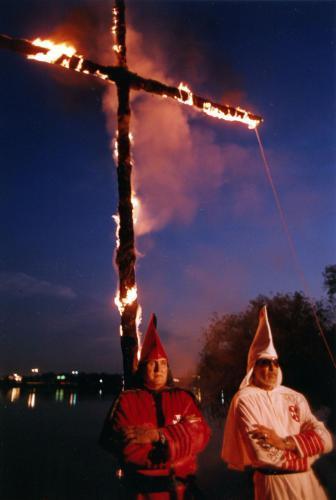
Members of Texas-based Klan chapters rally in 1992
Texas Governor Rick Perry has opened a new issue to try to lift his floundering campaign for the Republican presidential nomination, insinuating that President Barack Obama just might not be an American citizen. Asked if Obama was born in the United States, Perry told Parade Magazine, in an interview published on October 23, "I have no reason to think otherwise." But he then qualified his answer, stating, "Well, I don't have a definitive answer."
Perry's comments on Obama's background are puzzling, considering that the President has produced a long form birth certificate proving his U.S. citizenship. For those Republicans who have become known as "Birthers," Obama's documention is not enough. To them, he will always be under suspicion as an alien. Whether it is his brown skin, Arabic middle name, or African father that feeds the doubters, he remains the source of heavily publicized right-wing conspiracy theories, now given credence by Perry. According to an October 12 PPP poll, 39 percent of registered Republicans still do not believe Barack Obama was born in the United States.
But by channeling the paranoia, Perry may have opened himself up to unsettling questions about his own background and family history. In his stump speeches since announcing his candidacy, Perry almost invariably touts his humble roots, describing a hardscrabble but wholesome childhood in Haskell County, Texas, the origin of his small-town traditional values. Yet the New York Times has reported the pervasiveness of racist attitudes in Haskell County, where white residents referred to the segregated area on the other side of the tracks as "Niggertown." The Times story followed the in the Washington Post on the Perry family ranch in West Texas, where the governor often entertained guests, called "Niggerhead."
But both papers missed an additional important historical fact: Haskell County was home to an active, large and influential chapter of the Ku Klux Klan. The genealogy of a prominent farmer and longtime resident of Haskell County, Oran Ewan Webb, refers to the Klan as a central facet of life in the county, noting:"There was a meeting of the Knights of the Ku Klux Klan at the O E Webb farm four miles east of Haskell on Monday night September 29, 1924. Public lectures were given by speakers of state reputation. Every officer of the Haskell County Klan was present. (Notice from Haskell newspaper)."
During the 1920's, the Klan virtually controlled Texas state politics. According to the Texas State Historical Association:
"With a membership of perhaps as many as 100,000, the Klan used its united voting block to elect state legislators, sheriffs, judges, and other local and state officials. Its greatest success, however, was in securing the election of Earle Bradford Mayfield to the United States Senate in 1922. The following year the Klan established firm control of city governments in Dallas, Fort Worth, and Wichita Falls, and the order probably had a majority in the House of Representatives of the Thirty-eighth Texas Legislature, which met in January. By the end of 1922 the paid membership swelled to as many as 150,000, and Kluxers looked forward to even greater triumphs."
Though Klan membership declined steadily after the Great Depression hit Texas, local chapters remained active throughout the civil rights era. The Times reported that when Perry entered Texas A&M in 1968, some students posed for yearbook photos in Klan robes, while others formed a dairy group called the "Kream and Kow Klub" — KKK. Today, an underground Klan chapter operates in West Texas, and in 2010 its members left fliers in a parking lot at Texas Tech University.
Perry may continue to believe, or pretend, that he does not have a "definitive answer" to the question about Obama's citizenship — even though the state of Hawaii does. But he must have a "definitive answer" to another question closer to home — whether members of his family belonged to the Klan, or attended Klan rallies. It is an indisputable fact that the Klan was a central component of the cultural and political heritage of Perry's hometown. Were members of his family ever members of the Klan? The national press has begun to put Haskell Country's disturbing history of racism in the spotlight. Given Perry's gesture to the "Birthers," it is now time to learn more about his background. What exactly were his family's ties to the Klan, if any, and if so, why has he kept the information hidden from the public for his entire political career?
October 19, 2011

Max Blumenthal's Blog

- Max Blumenthal's profile
- 273 followers

