
Max Blumenthal's Blog, page 7
August 3, 2011
America's Breivik Complex: State terror and the Islamophobic right

This article was originally published at Alternet:
Few political terrorists in recent history took as much care to articulate their ideological influences and political views as Anders Behring Breivik did. The right-wing Norwegian Islamophobe who murdered 76 children and adults in Oslo and at a government-run youth camp spent months, if not years, preparing his 1,500 page manifesto.
Besides its length, one of the most remarkable aspects of the manifesto is the extent to which its European author quoted from the writings of figures from the American conservative movement. Though he referred heavily to his fellow Norwegian, the blogger Fjordman, it was Robert Spencer, the American Islamophobic pseudo-academic, who received the most references from Breivik — 55 in all. Then there was Daniel Pipes, the Muslim-bashing American neoconservative who earned 18 citations from the terrorist. Other American anti-Muslim characters appear prominently in the manifesto, including the extremist blogger Pam Geller, who operates an Islamophobic organization in partnership with Spencer.
Breivik may have developed his destructive sensibility in the stark political environment of a European continent riveted by mass immigration from the Muslim world, but his conceptualization of the changes he was witnessing reflect the influence of a cadre of far-right bloggers and activists from across the Atlantic Ocean. He not only mimicked their terminology and emulated their language, he substantially adopted their political worldview. The profound impact of the American right's Islamophobic subculture on Breivik's thinking raises a question that has not been adequately explored: Where is the American version of Breivik and why has he not struck yet? Or has he?
Many of the American writers who influenced Breivik spent years churning out calls for the mass murder of Muslims, Palestinians and their left-wing Western supporters. But the sort of terrorism these US-based rightists incited for was not the style the Norwegian killer would eventually adopt. Instead of Breivik's renegade free-booting, they preferred the "shock and awe" brand of state terror perfected by Western armies against the brown hordes threatening to impose Sharia law on the people in Peoria. This kind of violence provides a righteous satisfaction so powerful it can be experienced from thousands of miles away.
And so most American Islamophobes simply sit back from the comfort of their homes and cheer as American and Israeli troops — and their remote-controlled aerial drones — leave a trail of charred bodies from Waziristan to Gaza City. Only a select group of able-bodied Islamophobes are willing to suit up in a uniform and rush to the front lines of the clash of civilizations. There, they have discovered that they can mow down Muslim non-combatants without much fear of legal consequences, and that when they return, they will be celebrated as the elite Crusader-warriors of the new Islamophobic right — a few particularly violent figures have been rewarded with seats in Congress. Given the variety of culturally acceptable, officially approved outlets for venting violent anti-Muslim resentment, there is little reason for any American to follow in Breivik's path of infamy.
Before exploring the online subculture that both shaped and mirrored Breivik's depravity, it is necessary to define state terror, especially the kind refined by its most prolific practitioners. At the dawn of the "war on terror," the United States and Israel began cultivating a military doctrine called "asymmetrical warfare." Pioneered by an Israeli philosophy and "practical ethics" professor named Asa Kasher and the former head of Israeli military intelligence, Lt. Gen. Amos Yadlin, and successfully marketed to the Pentagon, the asymmetrical warfare doctrine did away with traditional counterinsurgency tactics which depended on winning the "hearts and minds" of indigenous populations. Under the new rules, the application of disproportionate force against non-combatants who were supposedly intermingled with the "terrorists" was not only justified but considered necessary. According to Kasher and Yadlin, eliminating the principle of distinction between enemy combatants and civilians was the most efficient means of deterring attacks from non-state actors like Hamas and Hezbollah while guarding the lives of Israeli soldiers.
Asymmetrical warfare has been witnessed in theaters of war across the Muslim world, leaving tens of thousands of civilians dead in Iraq, Afghanistan and the Gaza Strip. The strategy was formalized in the Dahiya district of southern Beirut in 2006, when the Israeli military flattened hundreds of civilian structures and homes to supposedly punish Hezbollah for its capturing of two Israeli soldiers.
From the ashes of the Israeli carpet bombing campaign emerged the "Dahiya Doctrine," a term coined by an Israeli general responsible for directing the war on Lebanon in 2006. "IDF Northern Command Chief Gadi Eisenkot uttered clear words that essentially mean the following," wrote Israeli journalist Yaron London, who had just interviewed the general. "In the next clash with Hezbollah we won't bother to hunt for tens of thousands of rocket launchers and we won't spill our soldiers' blood in attempts to overtake fortified Hizbullah positions. Rather, we shall destroy Lebanon and won't be deterred by the protests of the 'world.'" In a single paragraph, London neatly encapsulated the logic of state terror.
While Israel has sought to insulate itself from the legal ramifications of its attacks on civilian life by deploying elaborate propaganda and intellectual sophistry (witness the country's frantic campaign to discredit the Goldstone Report), and the United States has casually dismissed allegations of war crimes as any swaggering superpower would (after a US airstrike killed scores of Afghan civilians, former US CENTCOM chief David Petraeus baselessly claimed that Afghan parents had deliberately burned their children alive to increase the death toll), the online Islamophobes who inspired Breivik tacitly accept the reality of Israeli and American state terror. And they like it. Indeed, American Islamophobes derive frightening levels of ecstasy from the violence inflicted by the armed forces against Muslim civilians. The Facebook page of Pamela Geller and Robert Spencer's hate group, Stop the Islamicization of America (SOIA), is Exhibit A of the phenomenon.
During a visit to SOIA's Facebook page, which is personally administered by Geller and Spencer, it is possible to read rambling calls for killing "the diaper heads" and for Israel to "rule the whole Middle East." A cursory glance at the website will also reveal visual propaganda reveling in the prospect of a genocide against Muslims. One image posted on the site depicts American and British troops dropping a nuclear bomb in the midst of thousands of Muslim pilgrims in Mecca. "Who ya gonna call? Shitbusters," it reads.
A second image portraying a nuclear mushroom cloud declares: "DEALING WITH MUSLIMS — RULES OF ENGAGEMENT; Rule #1: Kill the Enemy. Rule #2: There is no rule #2." Another posted on SOIA's Facebook page shows the bullet-riddled, bloodsoaked bodies of Muslim civilians splayed out by a roadside. "ARMY MATH," the caption reads. "4 Tangos + (3 round burst x 4 M 4's) = 288 virgins." However pathological these images might seem to outsiders, in the subculture of Geller and Spencer's online fascisphere, they are understood as legitimate expressions of nationalistic, "pro-Western" pride. Indeed, none seem to celebrate violence against Muslims by anyone except uniformed representatives of Western armies.
The anti-Muslim fervor of Geller, Spencer and their allies reached a fever pitch during the controversy they manufactured in 2010 over the construction of the so-called "Ground Zero Mosque" in downtown New York City. Meanwhile, hundreds of miles away, in North Carolina, a right-wing Republican ex-Marine named Ilario Pantano made opposing the mosque the centerpiece of his campaign for Congress, proclaiming that New York was "forsaking Israel" by allowing the mosque's construction. During the height of the his campaign, a report relying on documented evidence and confirmed testimonies revealed that while serving in Iraq in 2004, Pantano had executed two unarmed civilians near Fallujah, firing 60 bullets into their bodies with his M16A4 automatic rifle — he even stopped to reload — then decorated their corpses a placard inscribed with the Marine motto: "No better friend, No worse enemy." The incident did not hinder Pantano's campaign, however. His Democratic opponent never mentioned it, Pam Geller hailed Pantano as "a war hero," and he swiftly became a cult hero of the Tea Party.
Pantano lost his bid for Congress, however, another US military veteran closely allied with the Islamophobic right won a surprise victory in Florida: Republican Representative Allen West. While serving in Iraq, West was discharged from the military and fined $5000 after he brutally beat an Iraqi policeman, then fired his pistol behind the immobilized man's head. As in Pantano's case, reports of the disturbing incident only helped propel West to victory. In fact, West boasted about the beating in his campaign speeches, citing it as evidence of how hard he would fight for his constituents if elected.
Though Breivik's hatred for Muslims clearly spurred him to violence, he wound up murdering scores of the non-Muslims. He believed they were enabling an Islamic takeover of Europe, or what he called the creation of "Eurabia," and that the "traitors" deserved the ultimate punishment. In homing in on liberal elements in Norway, Breivik borrowed from the language of right-wing figures from the United States, labeling his targets as "Cultural Marxists." Initially introduced by the anti-Semitic right-wing organizer William Lind of the Washington-based Free Congress Foundation, the term "Cultural Marxism" was a catch-all that defined a broad array of leftist types, but especially those who preached "political correctness" towards immigrants, homosexuals, and other oppressed groups including the Palestinians. "Let us fight together with Israel, with our Zionist brothers against all anti-Zionists, against all cultural Marxists/multiculturalists," Breivik wrote in his manifesto. The killer also sought to differentiate between good Jews (supporters of Israel) and bad Jews (advocates for Palestinian rights), claiming that "Jews that support multi-culturalism today are as much of a threat to Israel and Zionism as they are to us."
Breivik's characterizations of the left (and of left-wing Jews) echoed those familiar to right-wing bloggers and conservative activists in the US, particularly on the issue of Israel-Palestine. The only difference seems to have been that Breivik was willing to personally kill sympathizers with Palestinian rights, while American Islamophobes have prefered to sit back and cheer for the Israeli military to do the job instead. The tendency of the American right was on shocking display this June when the Free Gaza Flotilla attempted to break the Israeli siege of the Gaza Strip (during the previous flotilla in 2010, nine activists were killed by what a United Nations report described as execution style shootings by Israeli commandoes). As the debate about the flotilla escalated on Twitter, Joshua Trevino, a US army veteran and who worked as a speechwriter in the administration of George W. Bush, chimed in. "Dear IDF," Trevino tweeted. "If you end up shooting any Americans on the new Gaza flotilla — well, most Americans are cool with that. Including me." While Trevino hectored flotilla participants, Kurt Schlicter, a former American army officer and right-wing blogger for Andrew Breitbart's Big Peace site, joined the calls for bloodshed. "Sink the flotilla," Schlicter wrote on Twitter. "Enough screwing around with these psychos."
Neither Schlicter or Trevino saw any reason to apologize for inciting the murder of fellow Americans, nor did Trevino appear to face any consequences at the Texas Public Policy Foundation, where he serves as Vice President. Instead, Trevino earned a rousing defense from prominent conservative personalities like Erick Erickson, a paid CNN contributor who lauded "the correctness of Josh's opinion" that Israel should kill American leftists. Indeed, no one from inside the American right's online media hothouse condemned Trevino, Schlicter or Erickson, or even brooked a slight disagreement. Meanwhile, the incitement against Palestine solidarity activists has continued, with pro-Israel operatives Roz Rothstein and Roberta Seid writing this July in the Jerusalem Post that "Flotilla Folk are not like other people."
When the smoke cleared from Breivik's terrorist rampage across Norway, American Islamophobes went into intellectual contortions, condemning his acts while carefully avoiding any criticism of his views. While making sure to call Breivik "evil," the ultra-nationalist commentator and former Republican presidential candidate Patrick Buchanan insisted that "Breivik may be right" about the supposed clash of civilizations between the Muslim East and the Christian West. Pipes, for his part, accused Breivik of a "purposeful" campaign to discredit him by citing him so frequently in his manifesto, while a panicked Geller claimed that Breivik "is a murderer, a mass murderer. Period. He's not anything else."
The comically revealing reactions by American Islamophobes to Brevik's killing spree demonstrate the politically catastrophic situation they have gotten themselves into. All of a sudden, their movement was under intense scrutiny from a previously derelict mainstream media. And they were likely to be monitored to an unprecedented degree by federal law enforcement. These same figures who influenced Breivik had been printing open calls for terrorist violence against Muslims and leftists for years — while a few went a step further on the battlefield. Before Breivik killed 76 innocent people, they had generally gotten away with it.
Why were America's Islamophobes able to avoid accountability for so long? The answer is not that their yearnings for righteous political violence had not been fulfilled until Breivik emerged. The truth is far more uncomfortable than that. America's Islamophobic right was only able to make so much political headway because a broad sector of the American public had tolerated and even supported the kind of terror that they openly celebrated.


July 26, 2011
The Palestinian Authority's UN statehood bid: an exercise in futility?

Last week I attended a discussion on the Palestinian Authority's statehood bid at the UN by Susan Akram, a Boston University School of Law professor who is a leading expert on refugee issues and international law. Akram delivered a withering assessment of the PA's statehood campaign at the UN. She focused her lecture on contrasting the PA's strategy with Namibia's, demonstrating how Nambia managed to achieve independence despite its initial designation by the UN to be one of the least likely colonial mandates to attain the status necessary for statehood, and despite a prolonged occupation by apartheid South Africa. Nambia and its supporters filed a steady stream of submissions to the International Court of Justice, winning decisions that confirmed the illegality of South Africa's occupation while demanding sanctions on South Africa. Thus Nambia established a legal framework guaranteeing that any UN resolution granting it statehood would also establish its full independence.
In contrast, the PLO and PA accepted the formula of a negotiated land for peace, allowing the UN Security Council to relegate Resolution 194, the right of return resolution that guarantees individual, inalienable Palestinian rights, to "final status" talks (the UN's acceptance of Israel as a member state in 1949 was contingent on its fulfillment of Res 194). Since Israel's occupation of Palestine began, the Palestinian Authority has made only one request for an advisory opinion from the ICJ, when in 2004 it challenged Israel's right to build the separation wall across the Green Line. Though the PA received a favorable ruling, it did nothing to enforce the ruling — no mobilization of civil society or demand for sanctions. In fact, despite the ICJ's recommendation, the PA rejected the Palestinian civil society call to boycott, divest from, and sanction Israel.
Akram said the PA's failure to enact a strategy of "soft and hard law" had left an array of questions about the upcoming Palestinian statehood resolution unresolved, casting serious doubt on the whole endeavor. She enumerated some the key unresolved issues:
1. What do the 150 UN member states who vote for the resolution do with the recommendation? Do they afford Palestine full representation or representative status? Where will their embassies be? Since Israel will refuse to allow foreign embassies in East Jerusalem, will they instead be in Ramallah, and if so, does that mean that Ramallah is the future capitol of a Palestinian state? Will passports be issued to Palestinians and will they receive full consular intervention if they require it abroad?
2. What will be the recognized population of Palestine? Will it include Palestinians in the diaspora? In the West Bank and Gaza? Inside Israel? The refugees? If it does not include the refugees, do they then lose the legal right to return to their property and land confiscated by the state of Israel? None of these questions have been answered and the consequences are enormous.
3. If Palestine will be considered a legitimate state on the diplomatic front, it will not have relations with states that refused to recognize it. That means it would not have relations with the United States. How does that impact Palestine's status at the International Court of Justice or the UN, where the US and Israel could prevent its admission to the Human Rights Council?
4. What can Palestine do to enforce the withdrawal of Israeli settlements and its territorial integrity in the absence of Israeli withdrawal and the backing of the US? The issue of enforcement has not been addressed through the statehood resolution.
5. Even if new avenues open for legal recourse against the Israeli occupation, Israel does not recognize the International Court of Justice's authority and the United States will block any efforts to bring Israeli defendants to the ICJ for crimes they committed against Palestinians. So in real terms, what can Palestine do? Further, if Palestine becomes a member of the UN, it could table and introduce resolutions, but does this represent a change in the observer status the PLO has enjoyed since 1974? It does not.
6. Do Palestine's security forces become a legitimate military force with all the benefits that it entails? Can they purchase arms as all state military forces do? If Israel refuses to accept members of the Palestinian military as legitimate soldiers than the status quo of captured Palestinian soldiers being treated as terrorists remains.
The consequences of statehood without real independence are enormous, Akram said. In the absence of a strategy based on hard and soft law, the PA's statehood resolution bid could be an exercise in futility. While Namibia relied on a protracted legal battle for 40 years along with armed struggle and a political/media strategy to lay the foundation for its independence, Akram warned that the outcome for Palestine is highly uncertain.
July 23, 2011
Anders Behring Breivik, a perfect product of the Axis of Islamophobia

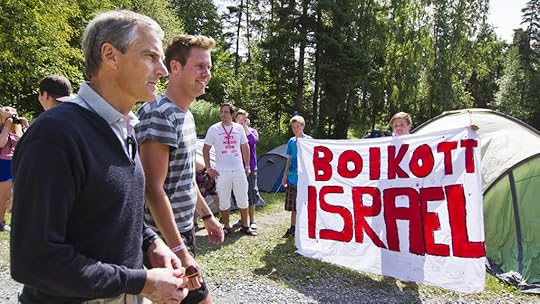
Norwegian Foreign Minister Jonas Gahr Store visits the Utoya Labor Youth camp a day before Breivik's killing spree. He earned loud cheers with an unapologetic call for Palestinian rights.
When I wrote my analysis last December on the "Axis of Islamophobia," laying out a new international political network of right-wing ultra-Zionists, Christian evangelicals, Tea Party activists and racist British soccer hooligans, I did not foresee a terrorist like Anders Behring Breivik emerging from the movement's ranks. At the same time, I am not surprised that he did. The rhetoric of the characters who inspired Breivik, from Pam Geller to Robert Spencer to Daniel Pipes, was so eliminationist in its nature that it was perhaps only a matter of time before someone put words into action.
As horrific as Breivik's actions were, he can not be dismissed as a "madman." His writings contain the same themes and language as more prominent right-wing Islamophobes (or those who style themselves as "counter-Jihadists") and many conservatives in general. What's more, Breivik was articulate and coherent enough to offer a clear snapshot of his ideological motives. Ali Abunimah and Alex Kane have posted excellent summaries of Breivik's writings here and here and a full English translation is here.
Breivik reportedly produced this video manifesto
From a tactical perspective, Breivik was not a "lone wolf" terrorist. Instead, Breivik appeared to operate under a leaderless resistance model much like the Christian anti-abortion terrorists Scott Roeder and Eric Rudolph. Waagner and Rudolph organized around the Army of God, a nebulous group that was known only by its website and the pamphlets its members passed around in truck stops and private meetings. If they received material or tactical support, it occurred spontaneously. For the most part, they found encouragement from like-minded people and organizations like Operation Rescue, but rarely accepted direct assistance. Breivik, who emerged from the anti-immigrant Norwegian Progress Party (which built links with America's Tea Party) and drifted into the English/Norwegian Defense League sphere of extremism, but who appeared to act without formal organizational support, reflects the same leaderless resistance style as America's anti-abortion terrorists.
While in many ways Breivik shares core similarities with other right-wing anti-government terrorists, he is the product of a movement that is relatively new, increasingly dangerous, and poorly understood. I described the movement in detail in my "Axis of Islamophobia" piece, noting its simultaneous projection of anti-Semitic themes on Muslim immigrants and the appeal of Israel as a Fort Apache on the front lines of the war on terror, holding the line against the Eastern barbarian hordes. Breivik's writings embody this seemingly novel fusion, particularly in his obsession with "Cultural Marxism," an increasingly popular far-right concept that positions the (mostly Jewish) Frankfurt School as the originators of multiculturalism, combined with his call to "influence other cultural conservatives to come to our…pro-Israel line."
Breivik and other members of Europe's new extreme right are fixated on the fear of the "demographic Jihad," or being out-populated by overly fertile Muslim immigrants. They see themselves as Crusader warriors fighting a racial/religious holy war to preserve Western Civilization. Thus they turn for inspiration to Israel, the only ethnocracy in the world, a country that substantially bases its policies towards the Palestinians on what its leaders call "demographic considerations." This is why Israeli flags invariably fly above black-masked English Defense League mobs, and why Geert Wilders, the most prominent Islamophobic politician in the world, routinely travels to Israel to demand the forced transfer of Palestinians.
Judging from Breivik's writings, his hysterical hatred of the Labor Party's immigration policies and tolerance of Muslim immigrants likely led him target the government-operated summer camp at Utoya. For years, the far-right has singled Norway out as a special hotbed of pro-Islam, pro-Palestinian sentiment, thanks largely to its ruling Labor Party. In 2010, for instance, the English Defense League called Norway a future site of "Islamohell," "where unadulterated political correctness has ruled the roost, with sharp talons, for decades." Yesterday, when the Wall Street Journal editorial page rushed to blame Muslim terrorists for what turned out to be Breivik's killing spree, it slammed the Norwegian government for pulling troops from Afghanistan and demanding that Israel end its siege of Gaza. For his part, Breivik branded the Labor Party as "traitors."
There is no clear evidence that Breivik's support for the Israeli right played any part in his killing spree. Nor does he appear to have any connection with the Israeli government. However, it is worth noting that in November 2010, the Israeli government joined the right-wing pile on, accusing the Norwegian government of "anti-Israel incitement" for funding a trip for students to New York to see the "Gaza Monologues" play. Then, the day before Breivik's terror attack, which he planned long in advance, Norway's Foreign Minister Jonas Gahr Stor visited the Labor Youth camp at Utoya. There, he was met with demands to support the global BDS movement and to support the Palestinian Authority's unilateral statehood bid. "The Palestinians must have their own state, the occupation must end, the wall must be demolished and it must happen now," the Foreign Minister declared, earning cheers from the audience.
Breivik's writings offer much more than a window into the motives that led him to commit terror. They can also be read as an embodiment of the mentality of a new and internationalized far-right movement that not only mobilizes hatred against Muslims, but is also able to produce figures who will kill innocent non-Muslims to save the Western way of life.
July 18, 2011
Being Jewish in Turkey, before and after the Mavi Marmara (part 2 of 2)

Yesterday I published the first of two interviews I conducted with Turkish Jews during a brief trip to Istanbul. The first interview is here. In the second, I spoke with "B," a media professional in her late 20's who studied at a liberal arts college in the United States. As with "E," B was adamant that I not reveal her identity, telling me that she was "really scared" of complicating her situation at work. In our interview, B expressed the same cultural outlook as E and a similar attitude to Israel: while she complained that its actions towards the Palestinians affect her negatively as a Jew in a Muslim majority nation, the situation remains abstract and disconnected from her identity. In both cases, I found my interview subjects to be wise beyond their years. "I never took security for granted," B told me. "I'm more ready for battle than [Americans]. So it's completely logical that I would survive more easily in a challenging situation."
Our interview follows:
MB: On a basic level what is it like being Jewish in Turkey and do you feel like you stand apart from the majority of Turks?
B: Being Jewish in Turkey has its ups and downs. Jews have an accent and when we speak in Turkish we stand out. I don't know where it comes from but probably from Ladino. In the last 70 years Jews were pushed to speak Turkish and were constantly told the slogan, "Citizens speak Turkish." At home the accent comes from your parents. It's like a whisper. In the US for Jews the accent comes out when you are upset. Imagine if it came out without being angry!
MB: So how does that affect you in your daily life?
B: In the social world you are aware that you are an other. You can't be sure what anyone's idea of the situation is. But in the social arena you're often surrounded by others like you. In the business world being Jewish is sometimes positive because we are seen as good at commerce and Jews almost always repay their debts here.
But to be honest I would say I'm putting in more effort than ever at work because the moment I slip up, I become the foreigner. At work there are always a few people I have to win over. I have to prove my Turkishness to them somehow. And then these people see me as "the good Jew." But they don't represent the general consensus. And I wouldn't say there is any anti-Jewish movement in the country even though we are an easy target when people look for someone to blame.
MB: Why don't you simply confront those people at work instead of trying to live up to their standards?
B: If someone came out and said, "the Jews are horrible," I would confront them for sure. But sometimes it's better to lead by example. Consistency will prove that I'm a good person.
MB: Yesterday "E" told me that Israel's actions sometimes cause problems for the Jewish community here. Do you agree?
B: Definitely. The big problem is that whenever something happens with Israel we automatically become "Israelites," not Jews. I don't see myself as an Israeli Jew — I'm Turkish. But whatever happens in Israel affects us here and safety becomes an issue. Some people here have fish minds and can't distinguish between Jews and Israelis.
MB: So how has the phenomenon played out in your personal life?
B: I can give you an example. I was importing lingerie for five years. When Israel began bombing Gaza, I was importing all these brands from the states. And a trade magazine for the lingerie retailers [in Turkey] put out a boycott list that focused on Jewish owned brands. My brands were on the list. I'm not a public person so it's hard to know that I'm Jewish at all. But my brands were listed because I'm Jewish. Who am I? How do you know who I am? The magazine was a small publication in some rural city. I only knew about the boycott list because some salesman found it and showed it to me.
The boycott also spread on Facebook. Who knows if it distinguished between Jewish and Israeli? The page said, "The owners of these brands help Israel in its efforts against Gaza." What the hell do I have to do with Israel? These people don't know the difference between Jews and Israelis. And the extremists take advantage of this [lack of distinction].
MB: What about after the Mavi Marmara incident? What was it like for you and other Turkish Jews?
B: Everyone was scared to go to malls or synagogue. Not that I ever go to synagogue but in times of trouble I limit my risks. During the crisis some protesters blocked the entrance outside the Israeli consulate and were waving flags and shouting. Even if I wasn't Jewish I would have been scared to go there. This wasn't a peace march. The crowd wanted blood. If it came out that I was a Jew, what they have done to me?
MB: Do you think the government played a productive role at all?
B: The Prime Minister [Recep Erdogan] took a stand saying Jews are not Israelis, they are Turkish. He made the differentiation clearly. That was a very positive thing for us.
MB: Are you a Zionist? It seems like Israel does not factor into your identity very much.
B: I'm not a Zionist. Israel is an abstract place for me just like France. But there is a connection as a Jew and it is a safe haven in a sense. They are welcoming you with open arms and there is a sense of community. At least it's better to be attacked as a community than on your own. Of course I'd rather go to London but if another Holocaust happens where will I go?
MB: Do you seriously think the Holocaust could happen again? It seems a little far-fetched to me.
B: Maybe? Who knows? It happened before and no one expected it.
MB: Do you have any interest in learning more about the history of the conflict in Israel-Palestine? Or what about taking a tour of the West Bank and seeing the occupation up close for yourself?
B: No, I don't think I'd be interested in something like that. Right now Israel's just an abstract place. I have been three times. Basically I go to the beach in Tel Aviv and come back.
MB: What do you think about anti-Zionist Jews and do you have any here in Turkey?
B: Whether a Jew is Zionist or not has nothing to do with their faith in Judaism. That's not the issue for me. The issue is non-Jews failing to distinguish between Jews and Israelis. And of course [in the Turkish Jewish community] anti-Zionists would be accused of being self-hating. But who would even take such a stand? We're not political here. Our only concern is self-preservation.
MB: When you studied in the US what were the principal differences you noticed between yourself and American Jews, and between you and Americans in general.
B: I went to a Bar Mitzvah in the US and it was like a Broadway show. It was for entertainment purposes and educational. For us in Turkey, Judaism is about religion. We get together for our ceremonies and in the synagogue, where many of our melodies come from traditional Ottoman songs, and I find solace in that.
On the more general question, the way I grew up is different from the way Americans grew up. I never took security for granted. I'm more ready for battle than they are. So it's completely logical that I would survive more easily in a challenging situation than an American. That's why America reacted the way it did to 9-11. Their whole naivete bubble popped in a day.
MB: What was is it like for you personally being in America right after 9-11?
B: For a long time I had worn a Chai necklace. But I eventually took it off, like I just didn't feel like wearing it anymore. But after 9-11, suddenly I wasn't Jewish enough because I wasn't Ashkenazi, I was Eastern, and I have an Arab sounding last name. At my college I had to advertise that I was Jewish so I wouldn't be seen as a Muslim. So I suddenly put my necklace back on and everything was okay. When I'm over there I feel a level of safety as a Jew.
MB: Your experiences remind me of a term that was used to describe Jews in the US but isn't really used much anymore: "insider-outsider."
B: Exactly. We are living with a foot in both worlds. But it's hard to get through the door when you can't use both feet.
July 17, 2011
Being Jewish in Turkey, before and after the Mavi Marmara (part 1 of 2)

During a brief trip I recently took to Istanbul, I had the chance to interview two members of the local Jewish community, which is one of the largest and most cohesive Sephardic communities in the Jewish diaspora. My primary interest was in how Jewish life has changed in Turkey since Israel's deadly raid on the Mavi Marmara, but we also discussed the social characteristics and history of Turkish Jews.
Numbering around 26,000, Turkey's Jews are guided by a constant focus on self-preservation. The community generally eschew collective political engagement and, in sharp contrast to the country's Kurdish and Armenian minority groups, avoid mounting any challenges to the Turkish state. "All we ask for is equal treatment and living well," said one of my interviewees. Though they are generally secular and liberal, intermarriage is considered out of bounds — even marrying an Ashkenazi Jew is suspect. Like other Sephardic communities throughout time, Turkish Jews have survived and prospered by relying on a simple formula of cultural assimilation and ethno-religious exclusivity.
The factor that most complicates Jewish life in Turkey (at least judging from my interviews) is Zionism. By now, most of the Jews who planned to emigrate to Israel have done so, either for ideological or economic reasons. Turkish Jews may privately support Israel, but unlike Jews in the United States, they make absolutely no show of it. However, both of my interview subjects told me that Israel's behavior has impacted their lives in an entirely negative fashion.
Turkish Jews experienced unprecedented levels of anxiety during Israel's assault on the Gaza Strip in 2008 and '09 and after Israel's killing of 9 passengers on the Mavi Marmara in 2010. After the Mavi Marmara incident, the Turkish Chief Rabbi issued a statement mildly condemning the Israeli raid. My interviewees told me that despite Prime Minister Recep Erdogan's declaration that "looking upon hatred at the Jews is…unacceptable," (which they considered helpful) extremists scapegoated local Jews. Though the reactionary mood has dissipated, the trauma of shrinking from public view for several days was an experience my interviewees have not forgotten.
Neither of my interview subjects objected to my opinion that Zionism imperils Jews around the world, and especially outside the West. Indeed, their testimonies were proof of the crisis Israel has created in Jewish diaspora life. At the same time they displayed a complete lack of interest in engaging with the situation, either by examining the roots of the Israeli-Palestinian conflict, understanding the occupation, or developing a clear position on the issue. While Israel's actions — and the reactionary tendencies of radical elements inside Turkey — undermine their sense of security, the Jewish state remains a distant abstraction that has only the most fleeting connection to their identity. And the Palestinians do not even merit a second thought.
My interview subjects both insisted I conceal their identities out of fear of upsetting their employers. Both are women in their late 20's who studied at Western universities and speak nearly fluent English. Like many Turkish Jews, they are upper middle class, however, I can hardly present them as representatives of the entire community. On the other hand, neither of them knew one another, but they expressed a remarkably similar outlook. My friend Duygu, who arranged the interviews, occasionally chimed in. Here is the first in the two part series, an interview with "E," a public relations consultant living in Istanbul:
MB: It seems like Jews in Turkey try to blend in or stay below the radar as much as they can, unlike American Jews who often advertise their Jewish identity.
E: I sort of disagree. On the one hand, we give our kids Jewish names but we also do our best to blend in. Our mentality is, yes, we are Turkish, but we have some differences.
MB: Is there any level of political engagement or lobbying on the part of Turkish Jews?
E: We are not political here. Not at all. We are scared to do it. In fact a lot of Jews voted for AKP [the Islamist party of Recep Erdogan] because they thought it was good for the economic situation. Ever since Ottoman times the Jewish community acted for the good of the community and never asked the government for anything. Which is completely different from other minority groups. All we ask for is equal treatment and living well.
MB: How much is the apolitical attitude driven by a survival instinct?
E: As a small community we try so hard to keep together. That's the way we survived for so long. It's our history. They teach it to us so much that the only way to survive is to stick together that we are almost programmed to believe it. We gather around marriages and holidays and slowly you start to develop a mindset where you want to preserve the culture. I'm really secular but I like the culture, the gatherings — it's about getting together and celebrating. Also when we get together it's an opportunity to gossip. Even in Turkish there's an expression to describe people who gossip a lot: "Like a Jewish synagogue."
MB: Do you see any discrimination against Jews by the state?
E: The discriminatory laws were all related to the Kurdish situation and the Muslim minorities. They never really applied to us. At the same time we are often seen as strangers, even in Istanbul. I sometimes will be asked, "Are you Turkish or not?" People would call my grandmother, "Madam," which is how you refer to a foreigner in Turkey, instead of calling her by the Turkish way, which is "Lady."
Another way discrimination plays out is through building laws. There was a rule — I'm not sure if it's still in effect — against building non-Muslim places of worship. So all the synagogues we have come from the Ottoman times. And if we fill up a Jewish cemetery the state will seize it on the grounds that it is no longer usable. So the Jewish community here never lets its cemeteries fill up. To get buried in one you have to pay 25 thousand liras. But that law seems to have changed — I'm not really sure.
MB: What about the relationship of Turkish Jews to Israel? Are they pro-Israel?
E: They are basically pro-Israel and believe Israel's side of the story, that Israel is defending itself and that the Palestinians use terror and provocations. But they don't like the trouble Israel causes them. When there were protests at the Israeli consulate [after the Mavi Marmara incident], I felt really scared. I worked right next door and I was sitting at my desk all day thinking, "What if they found out I was Jewish and killed me? Maybe they are angry and ignorant. What will they do to me?" People from the office were joking with me that they would throw me to the protesters — they meant it in a friendly way of course.
MB: What do you think motivated the protesters? Did they have any legitimate grievance as far as you could tell?
E: They were really a bunch of extremists. And their protest was not normal for Turkish culture. They were out there for days, all day, and for the Palestinians! Palestinians are the best friends of nobody. They fought against us during the Ottoman Empire.
The government even made people in the state schools pause for one minute to show respect to the Palestinian people. I don't understand why Turks care about Palestinians who used to be their enemies. Turkish people and Arab people are not usually friends. The relationship was always about profit. I don't see the direct relationship. Palestinians don't have money and Turkey doesn't want their land.
MB: But you can't understand why people feel angry about the way Israel treats Palestinians?
E: I understand they feel bad about the treatment of Palestinians. People in the world see us creating a Jewish nation that only benefits us at the expense of others. Sometimes I wonder why we can't be accepted as normal in the world.
MB: How has life been for Turkish Jews since the Mavi Marmara?
E: After the flotilla things got a lot worse here. The average level of hatred [for the Jewish community] increased. Between 1 and 5 it the level of anti-Semitism and anti-Israel feeling used to be 2. Now it's 4. It was really getting scary for a lot of us here after the Marmara [incident]. People were scared to go out for a few days. Outside the consulate there were fires, the burning of Israeli flags, lots of screaming. But [Recep] Erdogan made an important statement that the Turkish people are not against Jews; their problem was with the Israeli government.
We had another scary time in 2004 when Al Qaida placed bombs outside synagogues around Istanbul. All my friends were inside all day. When we heard the bombs go we actually thought the explosions were the sounds of celebrations at Bar Mitzvah parties. Now people are still afraid, but that doesn't stop them from going to these places. There are several levels of security in our synagogues today beginning with a security check at the beginning and then people come and ask you questions.
MB: What about you? Do you feel like Israel is part of your Jewish identity?
E: I don't see Israel as a holiday place like other Jews do. It's too much trouble and the food is horrible. I'm from here, I'm pretty much comfortable being Turkish, but that doesn't mean I'll be willing to cry out, "I'm Jewish!"
DUYGU: Do you think you could ever marry a non-Jew?
E: I dated Christian and Muslim men but parents want me to marry a Jew. An Ashkenazi Jew would be better than a non-Jew but they're not Sephardic and it really comes down to preserving our culture. The community is so small that a lot of people are having trouble finding someone to date. So a lot of them are going to the US or Israel to find someone.
D: So being half-Jewish is not acceptable then?
E: It's really not convenient to wind up with a non-Jew. It would be terrible for a child to be only half Jewish. They would have no community.
MB: Why couldn't they just belong to humanity?
E: Humanity? Humanity doesn't exist when you're a teenager!
D: But in our group of friends we just see you as people who pray in a different language. So it seems that you see yourselves as more foreign than we see you.
E: Well we are the ones who have to keep our community together, not you.
July 7, 2011
Inside Torat Hamelech, the Jewish extremist terror tract endorsed by state-employed rabbis


Religious ultra-Zionists attempt to storm the Supreme Court after the arrest of Dov Lior, a state-employed rabbi from Kiryat Arba who endorsed Torat Hamelech
Last year, I reported on a convention of top Israeli rabbis who gathered to defend the publication of Torat Hamelech, a book that relied on rabbinical sources to justify the killing of gentiles, including infants "if it is clear that they will grow up to harm us." The most prominent rabbinical endorsers, Kiryat Arba's chief rabbi Dov Lior and Yaakov Yosef, had dismissed police summons at the time, insisting that man's law could not touch the halakha. A year later, in late June, the Israeli police finally arrested Lior for his role in endorsing and promoting the book.
Riots broke out almost immediately in the wake of the arrest, with mobs of religious Zionists burning tires and attempting to storm the Israeli Supreme Court compound. Fearing more riots and with sales of Torat Hamelech surging, the police handled Rabbi Yosef with kid gloves, requesting he come in for questioning but not arresting him. In the end, the state neglected to remove Lior, Yosef, or any other state-employed rabbi from his position for endorsing Torat Hamelech.
Why is Torat Hamelech so explosive? Yuval Dror, an Israeli journalist and academic, excerpted some of the book's most incendiary passages. What appeared was Jewish exclusivism in its most extreme form, with non-Jews deemed permissible to kill, or Rodef, for the most inconsequential of wartime acts, including providing moral support to gentile armies. The book is a virtual manual for Jewish extremist terror designed to justify the mass slaughter of civilians. And in that respect, it is not entirely different from the Israeli military's Dahiya Doctrine, or Asa Kasher and Amos Yadlin's concept of "asymmetrical warfare." The key difference seems to be the crude, almost childlike logic the book's author, Rabbi Yitzhak Shapira, marshals to justify the killing of non-Jewish civilians.
Here are passages from Torat Hamelech, as excerpted by Dror and translated by Dena Bugel-Shunra:
II. Thou Shalt Not Commit Murder
Maimonides wrote in the Halachas of Murder, Chapter A, Halacha A:
He who kills one soul of Israel violates a prohibition, as it is said "thou shalt not commit murder, and if he committed murder maliciously, in front of witnesses, his death shall be by the sword…
It is therefore made explicit that the "thou shalt not commit murder" prohibition refers only to a Jew who kills a Jew, and not to a Jew who kills a gentile, even if that gentile is one of the righteous among the nations… we have derived that from the verse "thou shalt not commit murder", one cannot learn that there is a prohibition on killing a gentile.
(Page 17-18)
VIII. Conclusion
I. A gentile must not kill his friend, and if he has killed, he must die.
II. The prohibition "thou shalt not commit murder" refers to a Jew who kills another Jew.
III. A Jew who kills a gentile is not required to die.
IV. The prohibition on a Jew killing a gentile derives from the fact that a gentile is not allowed to kill a gentile.
(Page 27)
I. A gentile is killed for one death, and with one judge
A gentile who violates one of the seven rules [of Noah] must be killed, and he is killed based on the word of one witness and with one judge and with no warning.
II. A witness becomes a judge
For the Sons of Noah [gentiles] the witness can himself be a judge. This mean: if one person saw the other committing a crime – he can judge him and kill him for this, as he is the witness and he is the judge… Moses [moshe rabbenu] saw the Egyptian hitting a man of Israel, and killed him for that. So there Moses is the witness and is the judge, and this does not delay the carrying out of the law upon the Egyptian.
(Pp. 49-50)
What transpires from these matters is that when you judge a gentile for crimes that he has committed – you must also consider the question of whether he has repented, and if he has – he must not be killed… moreover: it is better that the gentile repent than that we kill him. If we come upon a gentile who does not abide by the Seven Laws [of Noah], and the importance of abiding by them can be explain to him, so he will repent – we would prefer to choose that path, and not judge an kill him.
(page 70)
It is explained in Yerushalmi [codex] that when a [child of] Israel [a Jew] is in danger of his life, as people tell him 'kill this particular gentile or you will be killed' – is permitted to kill the gentile to save himself… and the [interpreters of the law] Rashi and Maimonides say that the law of requiring to die rather than commit the crime is only valid in case of a Jew against another Jew, not in the case of a Jew against a stranger living among them… It is clear from these statements that when the choice is between losing the life of a stranger living among them and losing the life of a child of Israel [a Jew] – the simple decision is to permit [the killing].
(Pp. 157-158)
When the question is of a life of a gentile weighed against the life of a child of Israel [Jew], the initial proposal returns, which is that a Jew can violate law in order to save himself, as what is at stake is the soul [life] of a Jew – which supersedes the entire Torah [code of law] - in contrast with the life of a stranger living among us, which does not permit any Torah prohibition to be superseded.
(page 162)
To save the life of a gentile, one does not violate the Sabbath rules, and it is clear from this that his life is not like the value of the life of a child of Israel, so it may be used for the purpose of saving the life of a child of Israel.
(page 167)
An enemy soldier in the corps of intelligence, logistics, and so forth aids the army that fights against us. A soldier in the enemy's medical corps is also considered a "rodef" [villain who is actively chasing a Jew], as without the medical corps the army will be weaker., and the medical corps also encourages and strengthens the fighters, and helps them kill us.
A civilian who supports fighters is also consider Rodef, and may be killed… anyone who helps the army of the evil people in any way, strengthens the murderers and is considered to be Rodef.
(page 184)
III. Support and encouragement
A civilian who encourages the war - gives the king and the soldiers the strength to continue with it. Therefore, every citizen in the kingdom that is against us, who encourages the warriors or expresses satisfaction about their actions, is considered Rodef and his killing is permissible. Also considered Rodef is any person who weakens our kingdom by speech and so forth.
(p. 185)
We are permitted to save ourselves from the Rodef people. It is not important who we start with, as long as we kill the Rodef people, and save ourselves from the danger they pose. And see for yourself: if you say that the fact that there are many of them brings up the question of whom to start with, and that that question is supposed to delay us from saving for ourselves - why it stands to reason: the existence of any one of them postpones the salivation, and this is the reason to treat each and every one as a complete Rodef, and to kill him, so he will not cause this 'life-threatening' question…
Whoever is in a situation where it is clear that he will chase and danger us in the future - it is not necessary to give it fine consideration as to whether at this moment, exactly, he is actively helping the chasing [harassment?] of us.
(Pp. 186-187)
X. People who were forced to partner with the enemy
We have dealt, so far, with gentiles whose evil means that there is a reason to kill them. We will now turn to discuss those who are not interested in war and object to it with all force…
We will start with a soldier, who is party to fighting against us, but is doing so only because he has been forced by threats to take part in the war.
If he was threatened with loss of money and such things - he is completely evil. There is no permission to take part in chasing and killing due to fear of loss of money, and if he does so -he is a Rodef in every definition thereof.
And if he was threatened that if he would not participate in the war, he would be killed - according to the MAHARAL [rabbi]… just as he is permitted to kill others - so, too, can others (even gentiles)kill him, so we will not die. And for this reason, according to the MAHARAL, it is simply evident that such a soldier may be killed.
And according to the Parashat Drachim [rabbi? Or possibly book of law?] - he must not participate in the murdering even if he must give his life due to this. And if he does so [participates] - he is evil and may be killed, like any other Rodef.
We will remind, again, that this discusses all types of participation in the war: a fighter, a support soldier, civilian assistance, or various types of encouragement and support.
(P. 196)
XVI. Infants
When discussing the killing of babies and children - why on the one hand, we see them as complete innocents, as they have no knowledge, and therefore are not to be sentenced for having violated the Seven Laws, and they are not to be ascribed evil intent. But on the other side, there is great fear of their actions when they grow up… in any event, we learn that there is an opinion that it is right to hurt infants if it is clear that they will grow up to harm us, and in such a situation the damage will be directed specifically at them.
(Pp. 205-200)
IV. Killing the enemy like killing our own men
If the king is permitted to kill his own men for the purpose of war - that same opinion also holds with regard to people who belong to the evil kingdom. In a war of righteous people against evil people, we assume that the evil will eventually hurt us all, if we let it raise its head, and the people of the evil kingdom will also suffer from it.
We are, in fact, arguing to any person from the evil kingdom: if you belong to the evil king - you are liable to be killed for helping murderers; and if you do not help him - you should help us, and it is permissible to kill you as we kill our own people (as we are all in trouble together, and in such a situation it is permissible to kill the few in order to save the many.)
This theory also permits intentional hurting of babies and of innocent people, if this is necessary for the war against the evil people. For example: If hurting the children of an evil king will put great pressure on him that would prevent him from acting in an evil manner - they can be hurt (even without the theory that it is evident that they will be evil when they grow up.)
(P. 215)
VII. Revenge
One of the needs which exists, in the hurting of [Evil people?] is the revenge. In order to beat [win the war against] the evil people, we must act with them in a manner of revenge, as tit versus tat…
In other words, revenge is a necessary need in order to turn the evil-doing into something that does not pay off, and make righteousness grow stronger; and as great as the evil is - so is the greatness of the action needed against it.
(Pp. 216-217)
Sometimes, one does evil deeds that are meant to create a correct balance of fear, and a situation in which evil actions do not pay off… and in accordance with this calculus, the infants are not killed for their evil, but due to the fact that there is a general need of everyone to take revenge on the evil people, and the infants are the ones whose killing will satisfy this need; and they can also be viewed as the ones who are set aside from among a faction, as reality has chosen them to be the ones whose killing will save all of them [the others from that faction?] and prevent evildoing later on. (And it does indeed turn out that to this consideration, the consideration that we brought forth at the end of the prior chapter also definitely is added - which is, that they are in any event suspected of being evil when they grow up.)
July 6, 2011
Actor in Israel gov's new anti-flotilla vid said to be Haaretz employee (Updated)

Update: A second source inside Haaretz has confirmed for me that Neistat is a Haaretz employee.
A new anti-flotilla hasbara video surfaced this week, this time depicting a young woman in a psychiatrist's office describing her flotilla-related trauma and nightmares. The video is even more embarrassingly stupid than the pinkwashing hoax that Ali Abuminah, Ben Doherty and I exposed as a fraud promoted and possibly produced by the Israeli government. Using the female actor as a symbol for Israeli society, the video blames the flotilla for wounding the tender souls of hip Tel Avivians, turning sexy, innocent young people into paranoid trauma patients. At least, that was my reading of the otherwise incoherent video.
According to +972's Dimi Reider, the new anti-flotilla production has government fingerprints all over it. As Reider reported, "+972 was able to confirm through a source with knowledge of the actress' engagement that the gig was indeed described at the time as a Hasbara video commissioned by the government."
I made some calls about the female actor in the video, Aimee Neistat. A source who works inside Haaretz told me that Neistat is a Haaretz employee who translates Hebrew content into English (occasionally staffers at the translation desk produce original journalist content and editorials). Of course, everyone at Haaretz is entitled to their opinion, but Neistat's involvement in a government-sponsored propaganda campaign seems like an ethical breach. As appallingly bad as the video was, the fact that an apparent staffer for one of Israel's major newspapers played a starring role is far worse.
July 2, 2011
Yonatan Shapira held in Greek port: "I don't know if I'm detained or not"

I just spoke by phone with my friend Yonatan Shapira, an Israeli refusenik and activist who is among the crew of "The Audacity of Hope," the American boat currently being held by the Greek government. The captain of the ship has been jailed and will be formally charged this week. Meanwhile, Yonatan and the crew are being held by the Greek authorities, though he doesn't actually know if he's being formally detained. I encourage readers to call the Greek Embassy in Washington at 202.939.1300 and report what you've learned in my comments section.
My conversation with Yonatan follows:
MB: What's the situation?
Yonatan Shapira: We're on the boat right now and it's docked in this place guarded by the Greek Coast Guard. Basically they took us to this Coast Guard place and kept us in detention. And the crew was supposed to not leave the boat or this little compound. But the two British members of the crew were just told by the embassy that they could leave there — under the European Union law they could be free. So it's just me and the American crew members and it's not clear if we can leave. One of the guys form the crew tried to leave and they said he couldn't. Most of the passengers chose to stay with us. The press has all left. Democracy Now tried to come back today and they were not allowed in.
MB: Why have they jailed the captain?
YS: They can use him as an example for all the future flotillas and keep him in jail for a long time, to try to intimidate them. On Monday or Tuesday there will be a court hearing and the lawyers are preparing. But it's an obvious case of the Greeks trying to intimidate future flotillas and the current one because there are several vessels preparing to leave. The Canadians are still in port surrounded by Coast Guard vessels.
MB: Do you think there's any chance of the flotilla disembarking for Gaza?
YS: It's hard to believe that they will leave. It's all a political decision and how much pressure can we apply on a government that's under so much pressure, so hated by its own people? On the other hand, maybe we are just one fly on the back of this big cow.
MB: So are you officially a prisoner of the Greek government?
YS: I don't know if I'm detained or not but I'm going to check a bit later and see if I can just go out. They took our names and numbers. But I believe they are going to pursue the trial of the captain and let us go.
MB: It's kind of funny that Greece is holding Americans apparently on behalf of Israel and the US government doesn't seem to mind.
YS: It just shows how the US and Israel is becoming like one big distorted body.
MB: Maybe if you had Rabbi Dov Lior as a crew member the Israeli government would allow Greece to release the boat. [Yonatan laughs] Seriously though, do you think this latest flotilla has achieved at least a symbolic victory?
YS: We have generated a lot of media and the battle is still long. But personally I want to sail. Then again, it's a long sail that we're on and maybe this is just one stop on the journey.
June 30, 2011
Was Israeli unit Shayetet 13 behind the sabotage of Gaza-bound flotilla ships?

Shayetet 13, the Israeli naval commando unit, contains an underwater sabotage division
Two boats among the fleet of the Gaza Freedom Flotilla have been sabotaged. Passengers scheduled to sail on the second boat, the Saoirse, which hails from Ireland, discovered that the propelled had been cut and "dangerously bent." "If this boat would've gone to sea, it's almost certain we would've lost lives, this boat would've sank," said Fintan Lane, an Irish coordinator of the flotilla.
While Israel has not taken credit for the sabotage, all signs point in its direction. The Israeli military boasts an elite underwater sabotage division, Yaltam, that operates out of Shayetet 13, the naval commando unit that raided the Mavi Marmara last year and killed 9 of its passengers. According to SpecWarNet, an online database of international special forces units, "For underwater sabotage missions, each [Shayetet 13] diver can carry a limpet mine to attach to the hull of enemy watercraft or docks."
The Guardian reported on Shayetet 13's history of sabotaging civilian ships in international harbors:
[Shayetet 13], the Israeli naval commando unit that intercepted the Gaza Freedom flotilla, is one of the country's elite military formations, with rigorous selection and training procedures and a reputation for ruthless efficiency. It is known to have been involved in numerous clandestine seaborne operations, including many raids on neighbouring Lebanon. It works closely with the Mossad secret service.
It was also involved in a curious foreshadowing of the Gaza incident in February 1988, when Flotilla 13 is reported to have sabotaged an attempt by the PLO to highlight the issue of Palestinian refugees by sailing a ship to an Israeli port, forcing Israel either to sink it or board it or let it land the refugees. The night before the vessel, al-Awda ("The Return") was due to sail, it was blown up and sunk in Limassol harbour, Cyprus — with no loss of life or political embarrassment.
June 29, 2011
Israeli Army can't provide me evidence of flotilla's violent plans, story unravels (Updated)

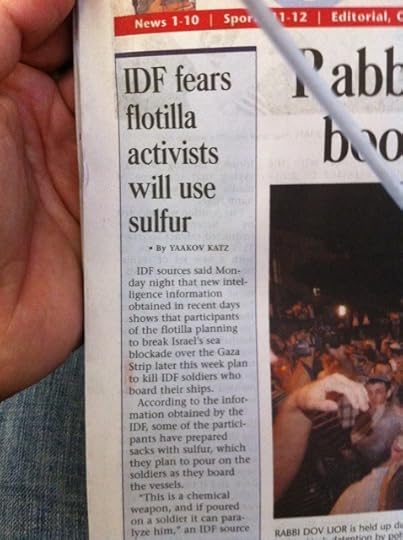
Israelis woke up to a front page Jerusalem Post story claiming flotilla passengers planned violence against soldiers. The story has completely unraveled.
Update: Neues Deutschland reported that chief army spokesperson Avital Liebovich claimed Israel infiltrated the US boat to Gaza with naval intelligence agents, who relayed the IDF with a report of the passengers' violent intentions. The passengers denied the claim as baseless and hysterical. The ludicrous nature of Liebovich's claim is underscored by my interview (below) with the IDF Spokesperson's Unit, where she works. A robot translation of the ND article is here.
On June 27, the Israeli army released a highly suspect claim that passengers on the flotilla planned to kill and maim Israeli soldiers. The claim looks like yet another anti-flotilla hoax emanating from Israeli government channels.
Today, I reached an official from the IDF Spokesperson's Unit after placing several calls and an email to the office requesting proof to support the army's claim. The official was unable to supply me with one piece of evidence. Instead, she said, "Basically there's a trust between the IDF and reporters. And like in any other army, you know, a senior IDF source says something, people are inclined to believe it because this is somebody high up, this is somebody that has a lifetime of experience and credibility and this is like any other army."
When I asked why anyone would report such a claim without seeing any firm evidence, the army spokesperson said, "If there were something we probably would give it but because of sensitivities we can't expand further."
Listen to the whole interview here:
Despite an apparent lack of evidence, the army's disinformation found its way into top Israeli newspapers through a select group of military correspondents including the Jerusalem Post's Yaakov Katz. Katz reported that flotilla passengers planned to kill Israeli soldiers and that they were bringing "bags of sulfur" to attack the soldiers. "This is a chemical weapon, and if poured on a soldier it can paralyze him," an unnamed army source told Katz. "If the sulfur is then lit on fire, the soldier will light up like a torch." Yedioth Aharanot's Hanan Greenberg also reported, "IDF fears flotilla activists will try to kill Israeli soldiers." And Haaretz hyped the claim in Hebrew.
Today, the army's story was exposed as disinformation. First, Yedioth Aharonot military correspondent Alex Fishman reported, "There is no information that there is going to be a group of radicals on board that will form a hard core of violent resistance against IDF soliders. Nor is there any clear information about live weapons that will be on board the ships." Then, a group of Israeli government ministers accused the army of "media spin" and "public relations hysteria" for claiming the flotilla passengers planned to attack soldiers with chemical weapons.
And now, an Israeli army official (who curiously did not want to give me her name) has refused to supply me with any evidence to support the army's wild claims. As I wrote during Israel's disinformation spree in the wake of last year's flotilla, nothing the Israeli army says can be trusted. Unfortunately, many reporters still accept the army's claims on trust, while others do not even bother to investigate.
Max Blumenthal's Blog

- Max Blumenthal's profile
- 273 followers


