
Max Blumenthal's Blog, page 6
September 16, 2011
Rick Perry distorted historian, who likened Texans' "inherent chauvinism," "belligerence" to Israel (Updated)

Update #1: Perry repeated his mis-citation of Fehrenbach in the Wall Street Journal today.
Update #2: A friend wonders if Doug Feith, who is now advising Perry on foreign policy, was the one who slipped Fehrenbach's quote in.
Yesterday, Republican presidential candidate and current Texas Governor Rick Perry attacked President Barack Obama and the Palestinian UN statehood bid in a foreign newspaper, the Jerusalem Post. Perry devoted most of the editorial to assailing Obama as anti-Israel. But buried in the op-ed, in a line intended to highlight the shared values of Texas and Israel, Perry quoted the historian T.R. Fehrenbach. "Historian T.R. Fehrenbach once observed that my home state of Texas and Israel share the experience of 'civilized men and women thrown into new and harsh conditions, beset by enemies,'" Perry wrote.
Fehrenbach published an authoritative book on the ethnic cleansing of the Comanche Indians by the Anglo settlers of Texas. He wrote with deep sympathy for the indigenous population, and though he expressed a strong identification with Texan culture, he was harshly critical of the settlers' cruely toward the native population. Perry's quoting of Fehrenbach seemed curious, so I opened up my copy of Fehrenbach's "Lone Star: A History of Texas and the Texans" to see if he cited the historian accurately. When I found the passage Perry had pulled from, my suspicions were realized: Perry (or more likely some half-wit speechwriter) had distorted Fehrenbach's original text and taken it wildly out of context.
The full passage Perry quoted from is on page 257 of Fehrenbach's "Lone Star:"
The Texan's attitudes, his inherent chauvinism and the seeds of his belligerence, sprouted from his conscious effort to take and hold his land. It was the reaction of essentially civilized men and women thrown into new and harsh conditions, beset by enemies they despised. The closest 20th-century counterpart is the State of Israel, born in blood in another primordial land.
Fehrenbach would have agreed with Perry that Texas shared values with Israel. But unlike Perry, he thought that those values were all the wrong ones: hatred of the other, a reliance on violence to seize land, and a legacy of ethnic cleansing. According to Fehrenbach, what Israel did to the Palestinians in 1947 and '48 — and continues to do — is analogous to the Texans' treatment of the Comanches and Mexicans during the 19th century. The comparison highlights Israel's distinction as the world's last settler-colonial state; a country based on an anachronistic system of ethnic exclusivism. It is hard to imagine that Perry would have scored any political points by quoting Fehrenbach accurately. So instead, in the name of his presidential ambitions, he distorted and abused the writing of one of the Lone Star state's most celebrated historians.


Rick Perry misquoted historian, who likened Texans' "inherent chauvinism," "belligerence" to Israel
Yesterday, Republican presidential candidate and current Texas Governor Rick Perry attacked President Barack Obama and the Palestinian UN statehood bid in a foreign newspaper, the Jerusalem Post. Perry devoted most of the editorial to assailing Obama as anti-Israel. But buried in the op-ed, in a line intended to highlight the shared values of Texas and Israel, Perry quoted the historian T.R. Fehrenbach. "Historian T.R. Fehrenbach once observed that my home state of Texas and Israel share the experience of 'civilized men and women thrown into new and harsh conditions, beset by enemies,'" Perry wrote.
Fehrenbach published an authoritative book on the ethnic cleansing of the Comanche Indians by the Anglo settlers of Texas. He wrote with deep sympathy for the indigenous population, and though he expressed a strong identification with Texan culture, he was harshly critical of the settlers' cruely toward the native population. Perry's quoting of Fehrenbach seemed curious, so I opened up my copy of Fehrenbach's "Lone Star: A History of Texas and the Texans" to see if he cited the historian accurately. When I found the passage Perry had pulled from, my suspicions were realized: Perry (or more likely some half-wit speechwriter) had distorted Fehrenbach's original text and taken it wildly out of context.
The full passage Perry quoted from is on page 257 of Fehrenbach's "Lone Star:"
The Texan's attitudes, his inherent chauvinism and the seeds of his belligerence, sprouted from his conscious effort to take and hold his land. It was the reaction of essentially civilized men and women thrown into new and harsh conditions, beset by enemies they despised. The closest 20th-century counterpart is the State of Israel, born in blood in another primordial land.
Fehrenbach would have agreed with Perry that Texas shared values with Israel. But unlike Perry, he thought that those values were all the wrong ones: hatred of the other, a reliance on violence to seize land, and a legacy of ethnic cleansing. According to Fehrenbach, what Israel did to the Palestinians in 1947 and '48 — and continues to do — is analogous to the Texans' treatment of the Comanches and Mexicans during the 19th century. The comparison highlights Israel's distinction as the world's last settler-colonial state; a country based on an anachronistic system of ethnic exclusivism. It is hard to imagine that Perry would have scored any political points by quoting Fehrenbach accurately. So instead, in the name of his presidential ambitions, he distorted and abused the writing of one of the Lone Star state's most celebrated historians.
September 15, 2011
Top media ethics expert: Times' Ethan Bronner is in "very dicey ethical territory"

Yesterday I reported for the Columbia Journalism Review that New York Times Jerusalem Bureau Chief Ethan Bronner is on the speaker's bureau of Lone Star Communications, an Israeli public relations firm that pitches him stories. Bronner has provided extensive coverage to several of the firm's clients, including those involved in major political controversies. What's more, the firm's CEO and founder, Charley Levine, is a settler, media advisor to several right-wing government ministers, and a Captain in the Israeli army Spokesman's Unit. Today, Ali Abunimah reported on Levine's casually racist attitude towards Arabs. So Levine and his firm — which yesterday removed all mentions of their connection to Bronner — have a clear ideological slant. I have trouble understanding how this relationship does not violate Times ethics guidelines.
The Times has been warned before about Bronner. When the Electronic Intifada reported that Bronner's son had joined the Israeli army, then-Public Editor Clark Hoyt recommended that Bronner be reassigned. As with his son's army service, Bronner did not appear to have disclosed to the Times his relationship with Lone Star Communications. When I asked the Times' Standards Editor Phil Corbett if Bronner's involvement with the PR firm violated Times ethics policy, he did not request further details or allow me to submit specific questions. Instead, I was informed through an intermediary, Times' VP for Corporate Communications Eileen Murphy, that the Times viewed Bronner's emailed response to me as sufficient, and had no doubts about his integrity. It seems fairly clear at this point, after two major conflicts of interest have been exposed, that the Times has afforded Bronner a level of impunity that no reporter should enjoy.
While reporting my story, I spoke to one of the country's leading experts on journalism ethics, Robert Steele, who directs De Pauw University's Janet Prindle Institute for Ethics. I described Bronner's relationship with Lone Star in detail to Steele. His comments did not make into my report for CJR, so I have reproduced them below. In short, Steele concluded "with confidence" that Bronner has waded into "very dicey ethical territory."
September 12, 2011
Meet the terror-linked political kingmaker who anointed Anthony Weiner's likely successor

Bob Turner, the Republican candidate campaigning to replace disgraced Democratic Rep. Anthony Weiner, picked up a crucial endorsement last week when Democratic Assemblyman Dov Hikind threw his support to him. Hikind is the former leader of the the Jewish Defense League (JDL), which the FBI lists as a terror organization. He was also a confidant of the fanatical Israeli settler leader Meir Kahane, who called for the "slaughter" of Palestinians. Under Kahane's direction, Hikind operated a front group with the JDL cadre Victor Vancier (aka Chaim Ben Pesach), who served 10 years in prison for carrying out numerous firebomb attacks on innocent people, and openly contemplated killing the renowned Palestinian professor Edward Said. According to journalists Michael Karpin and Ina Friedman, "Hikind had been suspected [by the FBI] of similar activities" including a string of six bombings against Arab-American targets across the United States.
Read the rest at Al Akhbar English.
September 7, 2011
My latest in Al-Akhbar English: Israeli politicians, media and intelligence push for more conflict with Turkey

The "Periphery Doctrine" has been a cornerstone of Israel's strategic approach to the Middle East since the state's foundation. Devised by David Ben Gurion and Eliahu Sassoon, an Israeli Middle East expert who became Israel's first diplomatic representative in Turkey, the doctrine was based on maintaining alliances with non-Arab states and ethnic minorities in the region as a counterweight to pan-Arabism. Though three countries — Iran, Ethiopia, and Turkey — became key regional allies of Israel, Ben Gurion was keenly aware that the relationships were temporary, and could not substitute for peace with Israel's Arab neighbors (something Ben Gurion ironically tried to manufacture through his "activist" foreign policy of unilateral military strikes and disproportionate force). From Turkey's perspective, the relationship with Israel was never a proper strategic alliance, but rather a means of establishing leverage against nationalistic Arab governments.
This week's events delivered the death knell to the terminally ill Periphery Doctrine. Following the Palmer/Uribe report's factually flawed claims about the legality of Israel's siege on the Gaza Strip and Israeli Prime Minister Benjamin Netanyahu's refusal to apologize for Israel's execution-style massacre of 9 activists on the deck of the Mavi Marmara — "We need not apologize!" the Prime Minister boomed three times during a recent press conference — the Turkish government significantly downgraded its relations with Israel. Turkey not only expelled Israel's ambassador from Ankara, it suspended all military relations between the two states. Turkish Prime Minister Recep Tayyip Erdogan has suggested further sanctions will follow, exposing Netanyahu's bravado as empty and self-destructive.
Read the rest here.
September 2, 2011
How an obscure conservative memo reveals the creeping Islamophobic threat to democracy

The following was originally published in Alternet.
The sudden rise of Islamophobia in the United States is alarming while the movement that advances anti-Muslim resentment seems bizarre and filled with eccentric, even dangerous characters. But when viewed in the context of a new, groundbreaking research document by the Center for American Progress and an obscure, decades-old political memorandum by a long-forgotten former Supreme Court Justice, the Islamophobic crusade raging across the country appears perfectly in line with longstanding goals and methods of conservative organizing, and is aimed at much more than demonizing Muslims.
In 1971, former US Supreme Court Justice Lewis Powell submitted a confidential memorandum to his friend, Eugene Sydnor, the chairman of the US Chamber of Commerce, an umbrella group representing American big business. Powell, who was serving on the boards of 11 corporations at the time, warned that America was suffering from a surplus of democratic freedom thanks to the legacy of the New Left and the countercultural revolt of the 1960's. He declared, "No thoughtful person can question that the American economic system is under broad attack." Powell warned that "Communists, New Leftists and other revolutionaries" were joining forces with "perfectly respectable elements of society from the college campus, the pulpit, the media, the intellectual and literary journals, the arts and sciences, and from politicians" to bring down American capitalism.
To roll back the surge of democracy that supposedly threatened corporate predominance, Powell urged the Chamber of Commerce to finance the creation of a new political and cultural infrastructure — a "counter-establishment" capable of unraveling the liberal establishment. The infrastructure would consist of pseudo-scholarly journals, "experts" promoted through speakers bureaus, campus pressure groups, publishing houses, lobbyists and partisan idea factories masquerading as think tanks. He wrote that operatives of the network would have to affect a "more aggressive attitude," leveling relentless personal attacks against the perceived enemies of big business. By the last days of the Nixon administration, Attorney General John Mitchell was boasting that his conservative friends were going to take the country "so far to the right we won't recognize it."
Though still obscure, the Powell' memo is one of the most important documents in recent American history. It was a blueprint for the creation of the American conservative movement, a political contingent that now controls the Republican Party and influences mainstream American opinion in ways Powell could have never imagined. Powell's vision came to life during the late 1970's, when neoconservative godfather Irving Kristol and former Treasury Secretary William Simon gathered together a small group of business tycoons concerned willing to lay down millions in seed money necessary to raise up a network of conservative think tanks, talking heads, and magazines capable of flooding the media with right-wing opinions, capturing the courts and taking control of Congress. Chief among the right-wing sugardaddies was Richard Mellon Scaife, a reclusive billionaire from Pittsburgh, Pennsylvania who controlled much of the Mellon oil fortune.
Through his various foundations, Mellon Scaife helped finance the creation of the pillars of the conservative movement, from the Federalist Society, which spearheaded the right's takeover of the federal court system, to the Heritage Foundation, a think tank that functions as the outsourced brain of the congressional Republicans, to the Media Research Center, a right-wing watchdog group that has helped manufacture the concept of "liberal media bias." The Tea Party, a far-right constellation of pressure groups bankrolled by extraction industry barons like the Koch Brothers, is the latest incarnation of the corporate funded conservative counter-establishment.
Scaife's name turned up again this month in connection with a familiar cabal of right-wing corporate moneymen financing a small and relatively new political network determined to promote Islamophobia throughout America. According to an authoritative 130-page report by the Center for American Progress, a progressive think tank based in Washington, Scaife and other conservative sugardaddies have pumped $42.6 million between 2001 and 2009 into the Islamophobic network. Most of the money has gone to five figures known for bigoted, extremist views on Muslims, Arabs, and people of color. They are: Daniel Pipes, a neoconservative academic who urged Israel to employ methods of terrorism against Palestinian civilians and "raze Palestinian villages;" Frank Gaffney, a rightist national security wonk who has called the practice of Shariah a form of "sedition;" Robert Spencer, a writer and activist who has said that "everyone knows" most or all terrorists are Muslims; Stephen Emerson, a self-styled terror "expert" who blamed Muslims for the bombing of the Oklahoma City Federal Building, which turned out to have been conducted by a right-wing white nationalist terrorist; and David Yerushalmi, a far-right legal activist who has argued that whites are genetically superior to people of color. Behind these figures lies a cadre of equally vitriolic activists like Pamela Geller and Brigitte Gabriel who hype their work. (Read more about the Islamophobic network in my piece, "The Great Fear."
The Islamophobic network has injected its paranoid vision of a Muslim plot to takeover the United States into the mainstream through the established conservative political apparatus, spreading anti-Muslim hysteria through right-wing radio and heavily trafficked websites like Andrew Breitbart's Big Peace, which boasts Gaffney as a key contributor. This year's Republican presidential primary campaign became a platform for Islamophobic conspiracy theories and attacks on Muslim-Americans in general, with candidates suggesting on national television that they might demand loyalty oaths for Muslims who want to serve in the federal government. But the Islamophobic crusade has had practical consequences as well. Mosque burnings are becoming a commonplace phenomenon and anti-Muslim attitudes have reached an all-time high among Americans; The most extreme byproduct of Islamophobic campaigning was, of course, the recent terrorist rampage by the Norwegian right-wing activist Anders Behring Breivik, who quoted Robert Spencer, Daniel Pipes and other Islamophobic ideologues scores of times in his manifesto.
While the anti-Muslim crusaders are fairly new to most observers of American politics, they are no more than cogs in a well-honed conservative political operation that functions in the top-down style that Powell envisioned. And like Powell, behind their empty rhetoric of freedom lies a deep seated contempt for democracy. The words of Yerushalmi, the extremist legal activist, expose the real sensibility and goals of his movement: "While our constitutional republic was specifically designed to insulate our national leaders from the masses, democracy has seeped up through the cracks and corroded everything we once deemed sacred about our political order," Yerushalmi wrote. "Prior to the Civil War, the electorate, essentially white Christian men, had access to local government. It was here, where men shared an intimacy born of family ties, shared religious beliefs, and common cultural signposts, that representative government was meant to touch our daily lives. With the social and cultural revolution which followed the emancipation, man's relationship to political order was radically nationalized and democratized. Today, there is simply no basis to resist 'democracy' and the 'open society.'"
The cadre of bigots bankrolled by corporate barons to stir fears of Islam may be focused on stigmatizing Muslims, but they are only a part of a much broader movement whose ultimate target is democracy itself.
September 1, 2011
J14 and the Calamity of Hope: a response to critics

On August 26, Joseph Dana and I published an article, "Israel's Exclusive Revolution," bringing extensive reporting together with an analysis of Israel's separation principle to describe the July 14 protest movement's (J14) cognitive dissonance regarding the occupation. So far, no one — not one single person I know of — has responded to our article about the ongoing July 14 protests with facts of their own or anything resembling a reality-based analysis. Instead, our critics have replied with a mixture of personal attacks and emotion-laden, dreamy visions of the way things could be.
Noam Sheizaf wrote in a piece criticizing our article, "The important issue is not where the movement starts but where it leads, and in my view, this is still an open question… So there could, potentially, be mass change. This is the reason for the relative hope I see in this protest." As with Obama's 2008 presidential campaign, which has left most of his formerly love-struck liberal supporters feeling angry and abandoned, hope was all you needed.
It is true that there could be mass change (I presume Noam was referring to a mass Israeli movement to end the occupation of Palestine and official discrimination against Palestinian citizens and non-Jewish residents of Israel), but Dana and I did not find very much evidence that it was on the way. So we reported what we learned based on our coverage of events and interviews with key players in the J14 movement, including Palestinians. We aimed to portray J14 — and by extension, Israeli society — as it was and not as it could be.
Sheizaf, who is not only a friend but one of the better journalists covering Israeli politics, responded to me and Dana's article by accusing us of "cherry-picking." He did not produce any reporting or factual analysis to set us straight, however. Most disappointingly, Sheizaf felt compelled to distort our conclusions, claiming that we said "J14 was some sort of right-wing movement." I challenge Sheizaf to produce any evidence that we wrote or even suggested that. If he can not, he should immediately retract his false claim.
On August 31, the normally insightful Gabriel Ash published a piece that read like a mimeograph of the criticisms that had already been leveled against Dana and I. After completely concurring with the substance of our analysis, writing, "Everything [Blumenthal and Dana] say about the limitations of the protest movement, I agree [with]," Ash lambasted us for not focusing on the supposed "process" of "changing Israeli consciousness." He pointed to nothing factual to support his claim that such a process was underway and did not attempt to explain what the process was. He did no reporting and offered very little reality-based analysis. In the end, the thrust of his criticism was that we did too much reporting, and not enough dreaming about the way things could be.
When Ash attacked our reporting, he did not do so by engaging with the substance of what our sources told us, but by complaining that we talked to the wrong sources. Never mind that we interviewed some of J14's original organizers, or that the mainstream of the protest is based on Tel Aviv's Rothschild Boulevard. And never mind what anyone actually told us. According to Ash, the people we interviewed were not valid sources because some of them were middle class Ashkenazim. Like other critics, Ash didn't like what we found, so he attacked us for not looking somewhere else. Then, after proclaiming his distaste for "pop psychology," Ash accused us without any factual basis of seeking to interview only "people who are like [ourselves]." This was a comical statement considering that we featured long quotes by Palestinian citizens of Israel and based our overarching analysis on countless conversations we had with Palestinians. So was Ash saying that Dana and I are Ashkenazi Palestinians? Or was he just refusing to acknowledge the substance of what our Palestinian sources told us about J14?
For those living in a region consumed with conflict and war, the tendency to cling to irrational hopes and evanescent solutions is completely understandable. But it is also dangerous, especially when utopian aspirations are projected onto a mass movement with deliberately vague politics and clear limitations. Not all social justice movements lead the way to progressive change. In fact, some ultimately produce the reverse effect. Saul Alinsky's Back of the Yards Neighborhood Council, which transformed into a base of support for the segregationist George Wallace's 1968 presidential campaign, is but one example of a dramatic social movement that turned reactionary. And after just a month and half of demonstrations, some of J14's liberal-left activists have revealed an ugly, parochial mentality that has brought the movement's latent ethno-nationalism closer to the surface.
Just weeks after the Israeli government detained scores of international Palestine solidarity activists at Ben Gurion International Airport for declaring their intention to volunteer in the occupied West Bank, the left-wing Israeli writer Yossi Gurvitz authored an uncharacteristically incoherent screed in which he declared that the "the ad hoc alliance" with "international left-wing activists…should end." Addressing his rant to me, Dana and Ali Abunimah (though he didn't mention us, we were the only J14 critics he linked to), Gurvitz claimed that "we're not dealing with leftist [sic], but Palestinian right-winger. [sic]" Gurvitz's broadside was an extension of his outbursts on Twitter, where he has attacked Abunimah, a Palestinian whose family was expelled from Lifta in 1948, as a "foreigner inciting natives," bizarrely comparing him to Avigdor Lieberman. When I informed Gurvitz that Abunimah's family was ethnically cleansed and that he is not allowed to return to their home, Gurvitz gloated, "If you ask Palestinians to reject moderate positions, you should be ready to pay the consequences." Then, stepping into the role of the New Jew who had demonstrated his authenticity by "redeeming" the land, Gurvitz tweeted at me that my criticisms were not valid because I was a "tourist." He thus appropriated the condescending talking point that has become a hallmark of Israeli hasbara: "You have to understand, it's very, very complicated."
While several other left-wing Israeli activists revealed ignorant, borderline racist views in Twitter exchanges with diaspora Palestinians, Gurvitz's outbursts were in a class of their own. Gurvitz has covered the conflict for years, garnering a sizable following of readers who enjoyed his trenchant critiques of Israeli politics and military affairs. He seemed enlightened, informed about the history of the conflict and fully aware of the oppression Israel meted out against Palestinians on a daily basis. But once the "process" of J14 began, another side of Gurvitz emerged. As soon as Abunimah and others reminded Gurvitz that a movement that officially ignored Palestinians living under occupation or in refugee camps could not expect their solidarity, Gurvitz lashed out at them with visceral, almost inexplicable loathing. How long had Gurvitz harbored so much resentment for Palestinians? No one besides him really knows. But what is clear — and utterly tragic — is that his feelings were always there, lurking just beneath the surface. And now the mask is off.
While the "process" J14 initiated may have generated positive results in some areas, it has clearly been painful for Israelis like Gurvitz. Through their interaction with activists from the outside world, Gurvitz and others have been reminded that they are not citizens of a normal society, but players in a system that dominates and oppresses millions of people. They can sense through these exchanges that the discriminatory ideology of the state of Israel is a stain on their identity, and it hurts them. But instead of casting it off and redoubling their efforts against it, they hold on to the ideology and deploy it as a weapon against those "foreign" Palestinians and "tourists" who have denied them the sense of normality they yearn for. They want the occupation to go away for a little while so they can wage their "internal" struggle in the city Gabriel Ash once labeled "Colonial Tel Aviv." But when Rothschild Boulevard empties out and the tents disappear, it will still be there. And then, they are going to have a whole lot of explaining to do.
August 26, 2011
The Exclusive Revolution: Israeli Social Justice and the Separation Principle

The following piece was co-authored by Joseph Dana. A shorter version recently appeared at Alternet.
The men and women who set out to build a Jewish state in historic Palestine made little secret of their settler-colonial designs. Zionism's intellectual author, Theodor Herzl, described the country he envisioned as "part of a wall of defense for Europe in Asia, an outpost of civilization against barbarism." "All the means we need, we ourselves must create them, like Robinson Crusoe on his island," Herzl told an interviewer in 1898. The Labor Zionist movement's chief ideologue, Berl Katznelson, was more blunt than Herzl, declaring in 1928, "The Zionist enterprise is an enterprise of conquest." More recently, and perhaps most crudely, former Prime Minister and current Defense Minister Ehud Barak described the goal of Zionism as maintaining "a villa in the jungle."
Those who dedicated themselves to the formation of the Jewish State may have formulated their national identity through an idealized vision of European enlightenedness, but they also recognized that their lofty aims would not be realized without brute force. As Katznelson said, "It is not by chance that I speak of settlement in military terms." Thus the Zionist socialists gradually embraced the ideas of radical right-wing ideologue Vladimir Jabotinsky, who outlined a practical strategy in his 1922 essay, "The Iron Wall," for fulfilling their utopian ambitions. "Zionist colonization, even the most restricted, must either be terminated or carried out in defiance of the will of the native population," Jabotinsky wrote. "This colonization can, therefore, continue and develop only under the protection of a force independent of the local population — an iron wall which the native population cannot break through. This is, in toto, our policy towards the Arabs." According to Jabotinsky, residents of the Zionist yishuv (community) could not hope to enjoy a European standard of life in the heart of the Arab world without physically separating themselves from the natives. This would require tireless planning, immense sacrifice and no shortage of bloodshed. And all who comprised the Zionist movement, whether left, right, or center, would carry the plan towards fulfillment. As Jabotinsky wrote, "All of us, without exception, are constantly demanding that this power strictly fulfill its obligations. In this sense, there are no meaningful differences between our 'militarists' and our 'vegetarians.'"
One of the greatest misperceptions of Israeli politics is that the right-wing politicians who claim Jabotinsky's writings as their lodestar perpetuate the most egregious violence against the Palestinians. While brimming with anti-Arab resentment, the Israeli right's real legacy consists mostly of producing durable strategies and demagogic rhetoric. The Labor Zionists who dominated Israel's political scene for decades bear the real responsibility for turning the right's ideas into actionable policies. The dynamic is best illuminated by the way in which successive Labor Party governments implemented the precepts outlined in Jabotinsky's "Iron Wall" under the cover of negotiations with the Palestinians. As early as 1988, the Laborites Yitzhak Rabin and Haim Ramon were advocating for the construction of a concrete wall to separate the Palestinians from "Israel proper." When Rabin declared his intention to negotiate a two-state solution with the PLO, his supporters adopted a slogan that had previously belonged to the right-wing Moledet Party: "Them over there; us over here." Then, when Rabin placed his signature on the Oslo Accords in 1993, Israel began surrounding the Gaza Strip with electrified fencing while revoking Palestinian work permits by the thousands.
The violence of the Second Intifada accelerated the process of total separation. Suicide bombing confirmed to average Israelis the Orientalist stereotype of the Arab native as inherently violent, incurable and culturally retrograde. By extension, the wave of terrorism ratified Jabotinsky's thesis. "Something like a cage has to be built for [the Palestinians]," Israeli revisionist historian Benny Morris declared in a 2002 interview. "There is a wild animal that has to be locked up in one way or another." As Israeli forces set about in tanks and combat jets to crush the Intifada, 709 kilometers of steel and concrete were erected around Jewish demographic enclaves, detaching Israel from the occupied population to its West while gobbling up over 180 thousand dunams of Palestinian land. Meanwhile, thousands of Jewish settlers were evacuated from the Gaza Strip, enabling the transformation of the coastal ghetto into an enormous holding cell that would be monitored, controlled and economically exploited from the outside by Israel. In short order, occupied Palestinians disappeared from Israeli life. If Israelis interacted with them, they did so with rifles in their hands, or at checkpoints from behind bulletproof glass.
By 2011, Israeli Prime Minister Benjamin Netanyahu was heralding what he called "The Big Quiet." Palestinian resistance flared up occasionally, but it was effortlessly suppressed. Inside the Green Line, terror against Jewish Israeli civilians was almost non-existent. What a Haaretz columnist described during the height of the Second Intifada as the "war over the morning coffee and croissant, over the evening beer" appeared to have been won. Cafe-goers in Tel Aviv finally enjoyed the fruits of a one-way peace guaranteed by the strategy of separation, domination and control. The status quo was now the ideal.
In the course of crushing Palestinian resistance, Israel's leaders exploited the nation's siege mentality to ram through a program of economic liberalization that ravaged the country's middle class. In 1986, the Labor Party's elder statesman Shimon Peres had initiated the economic reforms as a precursor to the Oslo Accords. But under Netanyahu's watch, the economic trend's most extreme manifestations exploded to the surface. An American-educated libertarian who could easily campaign on a Tea Party ticket, Netanyahu distilled his essence through the exploitation of all under Israeli rule, Jews included. Indeed, Netanyahu depended more on the beneficence of avaricious oligarchs like the diamond tycoon Lev Leviev, the late shipping baron Sammy Ofer, and the American casino billionaire Sheldon Adelson than the respect of any military chieftain. While authorizing new homes in the occupied West Bank by the thousands, Netanyahu slashed housing subsidies for working class residents of Israel proper. The American Israel lobbyist and former Pentagon spokesman Dan Senor had celebrated Israel's new economy in his bestselling book "Start-Up Nation," but behind the scenes, and far from the gaze of the international media, the Israeli middle class was seething with resentment. Soon, Netanyahu would feel their wrath.
*******
In July 2011, radical left-wing activists in Israel organized a Facebook event titled, "The Week of Rage" as a spontaneous demonstration against the skyrocketing price of rent and basic consumer goods. Also prominent in the activists' list of grievances were anti-democratic proposals of Israel's parliament, the Knesset, that were designed to stifle dissent against the occupation and Israel's repression of its own Palestinian citizens. The protests were characteristically theatrical, with demonstrators attacking the Likud Party headquarters with cottage cheese, a staple commodity that had become unaffordable for most. Enthusiastic as they were, the demonstrations were sparsely attended.
On July 14, another spontaneous protest developed in Tel Aviv. About a dozen young residents with scant experience in direct action protest pitched tents on Tel Aviv's Rothschild Boulevard. Months before, protesters in Greece had pitched their own tents in Syntagma Square directly in front of the Greek parliament to challenge their government with a display of people power. The location selected by the Israeli demonstrators was no less significant. Instead of setting up camp in front of the Finance Ministry or the Knesset, they chose a wide, grass-lined strip that mimicked Viennese strolling grounds. On one end of Rothschild Boulevard was the Dizengoff House where David Ben Gurion publicly declared the establishment of the "Jewish and democratic" state. On the other end was the recently refurbished Ha'Bima Theater, the symbol of the Zionist resuscitation of the Hebrew language.
As the protesters erected the first tents, we interviewed Stav Shaffir, a media professional in her late-20s. "We are a young group of Israelis and we feel we're unable to live in Tel Aviv because the prices of housing are going up," Shaffir told us. "We're fed up with having to always move between places and look for the cheapest housing solutions. It's now time to say enough so we've come out to the streets with our tents and we've also started in Jerusalem."
We asked Shaffir if the protest movement was connected in any way to the law passed five days before in the Knesset that criminalized speaking in favor of a boycott of settlement-produced goods, or to the constant stream of anti-democratic laws. "There are many things that are connected but here we protest against the housing costs," she insisted. "We are not a group. Everyone has their discretion to choose what is the most important issue."
What began as a small gathering of Tel Avivians built unexpected, immediate momentum. Shaffir and her friends struck a chord among the country's frustrated middle class. Three weeks after the first tents appeared, 300,000 demonstrators filled the streets of Tel Aviv in one of the largest protests in Israel's history. Chanting in unison, "The people/nation demand social justice!" Israelis of nearly all political backgrounds joined together as the voice of a disgruntled but suddenly hopeful people.
The protesters presented a smorgasbord of Israeli grievances, including more rights for the physically disabled, better care for the elderly, and the release of Gilad Shalit, a soldier held captive by Hamas since 2006. But everything seemed to center around the kitchen table demands originally outlined by Shaffir and her cadre. Polls taken a week after the protests exploded showed nearly 90 percent of Israelis approved of the demonstrations' demands.
The crisis no one was willing to mention, however, was the 44-year-long Israeli occupation of the West Bank and Gaza Strip. Demonstrators we interviewed from across the political spectrum deflected questions about the occupation — at times in an aggressive, resentful manner — by calling it a divisive "political" issue.
"I think the general public sees occupation as a security issue, a left-right issue that is not related to our cause for social justice," Hadas Kouchalevich, a leader of the Israel Students' Union, told us. Kouchalevich's organization has shepherded thousands of university students to the demonstrations, including students from Ariel University who study in a West Bank mega-settlement. When asked if she personally believed the July 14 movement could connect social justice to the issue of occupation, she replied, "No. Occupation is a security issue, not a social justice issue."
The decision to exclude the occupation from the grievances of the July 14 movement was entirely organic. No hired gun consultant advised movement activists to avoid the hot button issue in order to broaden the appeal of the demonstrations. The mainstream of the Jewish public decided on its own, and without much internal reflection, that social justice could exist alongside a system of ethnic exclusivism. Thus, while the July 14 movement proceeded through cities across Israel bellowing out cries for dignity and rights, Palestinians remained safely tucked away behind an elaborate matrix of control — the Iron Wall. Ten years of separation had not only rendered the Palestinians invisible in a physical sense. It had erased them from the Israeli conscience.
"It's very strange to see a social justice protest without mentioning occupation," Gidi Grinstein, a confidant of Defense Minister Ehud Barak, who heads the Reut Institute, a government-linked Israeli think tank remarked. "But most people in Israel don't even believe there is an occupation anymore. They see the Palestinian Authority in the West Bank, and think there is a functioning government. They hear about the Palestinian statehood resolution at the UN in September, and they think Palestine is a real state. So there is this cognitive dissonance among Israelis."
***********
For years Israel's tiny but intensely motivated left-wing tried to mobilize mass protests against the occupation, hoping they could shake Israeli society out of its slumber. But the settlements grew, and the occupation became more and more entrenched. Suddenly, with hundreds of thousands of their compatriots in the streets demonstrating against the most right-wing government in their country's history, some leftists began conjuring visions of a revolution.
"We have failed to end the occupation by confronting it head on but the boundary-breaking, de-segregating movement could, conceivably, undermine it," wrote Dimi Reider. Reider claimed the demonstrations could achieve dramatic change because they "may challenge something even deeper than the occupation." Hagai Mattar, a veteran anti-occupation activist and widely read journalist, echoed Reider's unbridled enthusiasm. "For the first time in decades, perhaps, we are witnessing the impossible becoming possible," Mattar wrote on the popular Hebrew website MySay. "What appeared to be a mere fantasy half a year ago… has become a vivid reality."
Many members of the Israeli left have suffered for their activism. Some have been injured by Israeli soldiers during protests in the West Bank, where they routinely dodge rubber bullets and high-velocity teargas projectiles. Others have served months in prison for refusing to serve in the Israeli Army. With a suite of anti-democratic laws passed by the Knesset, they fear a coming crackdown. But perhaps the greatest source of suffering for Israeli leftists is having been cast out of one of the most tribalistic societies in the world. Many are turned down for housing and employment on the grounds that they refused military service. The very word "leftist," or smolini, has become an insult in the Hebrew language. Hoping to replace the communal bond their society had denied them, the radical leftists who have not escaped to the squats of Berlin or Barcelona formed a tribe within the tribe.
As the July 14 protests gathered momentum and manpower, members of the radical left bolstered the movement with their tactical experience and fearlessness in the face of police intimidation. On July 23, when hundreds of thousands of protesters took to the streets of Tel Aviv, Israeli police forces arrested 43 demonstrators. Most of them were leftists who attempted to block a major intersection. The most prominent among them was Matar. Normally, the arrests of left-wingers at anti-occupation protests go unreported. In this instance, however, the arrests were broadcast to a national audience during the prime time news. After being released from their jail cells, the demonstrators were greeted by their fellow Israelis not as traitors but as heroic leaders.
"The radical left is no longer an outsider, but forms an important part of the mainstream," Matar wrote recently in an article celebrating the protests. If this new movement welcomed leftists, and upheld them as its vanguard, how could it not be revolutionary?
Born out of indignation and mired for years in malaise, radical leftists like Matar believe they have found the influence they always sought among mainstream Israelis. However, there was little evidence that the July 14 movement's rank and file had any interest in overthrowing the "system," or that they would ever be willing to acknowledge, let alone engage, the occupation. If anything, the demonstrations reflected the young urban class's yearning for early Zionist communalism, where everyone was guaranteed respect so long as they were part of the yishuv (community).
As Yehuda Nuriel, a columnist for the leading Israeli newspaper Yedioth Aharanot, wrote recently, "Here is the Zionism we almost lost. We found it in the tent." Indeed, July 14 seems to represent a remarkable reincarnation of the Zionist spirit that gave birth to the state of Israel, not the revolution that will "challenge something deeper than the occupation," as Reider wrote.
As during the glory days of early socialist Zionism, Palestinians are isolated and ignored. "It's a classic secular, Jewish and urban protest," Tamar Herman, a political scientist at the Israel Democracy Institute, told the Associated Press. "Arab participation would open the door to the divisive questions here."
*******
In mixed cities and in Palestinian communities inside the Green Line, a few Palestinian citizens of Israel are pitching their own tents. But on Tel Aviv's Rothschild Boulevard, the epicenter of the protest movement, there is only one tent representing Palestinian demands. It is "Tent 1948," a small encampment dedicated to promoting Arab-Jewish solidarity and reminding the mass of demonstrators of the dispossession of Palestinians in 1948. Left-wing Israeli writers Noam Sheizaf and Mairav Zonszein claimed that Tent 1948 was "challenging the protest movement from the left, by reminding people of land issues that followed 1948." Citing the presence of the Arab-Jewish tent and the inclusion of a single Arab speaker at the raucous July 23 rally in Tel Aviv (the speaker did not risk rankling his massive audience with any mentions of occupation), Reider opined that "the participation of Palestinian citizens of Israel in the protests has more bearing on the conflict than any concentrated attempt to rally the crowds against the occupation."
Palestinian-Israelis join the July 14 protests at great personal risk. They fear that by joining the movement their own national identity will be co-opted to advance a struggle that will betray them in the end. Boudour Youssef Hassan, a 22-year-old law student at the Hebrew University in Jerusalem, is among many young Palestinian citizens of Israel who looked upon the demonstrations with suspicion. "At first I thought it was a good thing that they were confronting the right-wing government," she said of the Jewish demonstrators. "But the longer it goes on the more I think they are simply using us Palestinians while their real goal appears to be the revival of the Zionist left."
Abir Kopty, a Palestinian rights activist from the northern Israeli city of Nazareth, is one the few Palestinians to have insinuated themselves into the main protest area on Rothschild. Kopty played a central role in the establishment of Tent 1948 and she is a major presence at Palestinian tent protests around the country. "I've been a part of Tent 1948 not because I wanted to be part of J14," Kopty told us. "My role there is to challenge J14 and to tell them they can't have social justice without addressing issues like occupation. So I refuse to be a part of J14. I'm only there to challenge and to assert my Palestinian identity."
Despite her prominent role, Kopty agreed with Youssef Hassan that the movement was exploiting her presence to burnish its social justice image. "I'm aware that they're using me but it doesn't matter because in the world [the July 14 movement] won't receive any real support unless they address the Palestinian issue and the occupation," Kopty said. "Palestinians aren't really a part of J14 anyway because they generally didn't go to Rothschild to set up tents. Instead they are setting up tents in their own neighborhoods just to say, 'Hello, we are here.'"
But could the July 14 protests initiate a process that will eventually lead to the unraveling of the occupation and discrimination against Palestinians, as many on the Israeli left have suggested? "The injustice will continue," Kopty declared flatly. "And I don't believe J14 will create changes that are socio-political. But our struggle is completely political. So when J14 finally explodes because the different internal groups have contradicting interests — and they can't remain apolitical forever — our struggle will go on."
As the July 14 movement grows, it is becoming more inclusive, but not of Palestinians. Instead, Jewish settlers of both the ideological and practical variety are now welcomed into the protest's big tent.
********
Ariel is the linchpin of the major settlement blocs Israel refuses to relinquish in final status negotiations. Built on hundreds of hectares of land confiscated from private Palestinian landowners and surrounded by the Israeli separation wall, which creates a wedge between seven nearby Palestinian villages, Ariel sits directly on top of one of the largest aquifers in the region. According to the Israeli human rights group B'tselem, Ariel residents receive 7.9 times more government subsidies than those who live inside Israel proper. This August, the Israeli government approved the construction of 277 new housing units in Ariel, including 100 for settlers evacuated from the Gaza Strip in 2005.
Ariel has become a symbol of the cognitive dissonance of Israel's occupation. While its borders stretch deep into the West Bank, consolidating Israel's domination over Palestinian life, its interior resembles a grassy bedroom community in Southern California, lined with neat rows of mission-style subdivision homes. From Ariel's new university to its state-of-the-art theater to the gleaming sports center built thanks to the generosity of American junk bond kingpin Michael Milken and Texas mega-church pastor John Hagee, the settlement contains all the trappings of a "normal" community. The majority of Israelis have bought into the image of Ariel as Israel's own Temecula — a suburb, not a settlement.
On August 13, when protest leaders declared an "expansion into the periphery" of Israel, Ariel held its first ever social justice demonstration, with hundreds of disgruntled residents demanding lower housing prices. Two days before, the July 14 movement endorsed the protest in Ariel, advertising directions to the demonstration on its official Hebrew website.
"This is the test," the July 14 website proclaimed. "Are we together or are we not?"
August 14, 2011
Israel's "social justice revolution" extends to illegal mega-settlement of Ariel

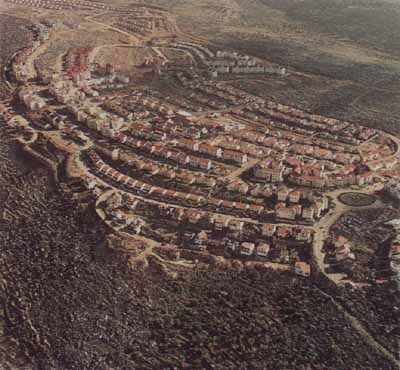
Rather than connecting occupation to social justice, Israel's July 14 protest movement has endorsed a protest in the illegal West Bank settlement of Ariel
Many observers of the massive July 14 "social justice revolution" sweeping through Israel have been wondering when the protest movement would deal directly with the occupation of Palestine, or whether it would it all. On August 14, a month after the demonstrations began, the movement finally tackled the situation across the Green Line. But instead of connecting the concept of social justice to the rights of everyone living under Israeli control, July 14 officially endorsed (website is in Hebrew) a tent protest for "social justice" in the illegal West Bank mega-settlement of Ariel.
There is a lot to say about this move, but I will keep it brief for now: By officially ignoring the occupation, the July 14 movement is behaving as though the two state solution is a current fact on the ground — they are living in a walled-off fantasy world. And by embracing Ariel, July 14 has tacitly proclaimed its support for keeping and subsidizing the main settlement blocs.
August 8, 2011
My Appearance on Lebanon's Future TV

I recently spent three weeks in Lebanon to research the Palestinian refugee situation and the effects of the uprising in Syria on the region. I will be writing extensively about my trip when I return from Israel-Palestine later this month. For now, I have posted my appearance on Transit, a current affairs/political interview program on Lebanon's Future TV (the official network of the Hariri family's Future Party). To my complete surprise, the producers decided to air the complete, uncensored "Feeling the Hate in Jerusalem" video in the middle of the interview. The video punctuated a lengthy discussion of issues ranging from AIPAC to the Tea Party to the Palestinian statehood resolution to Barack Obama's disappointing presidency. I appear at the 1 minute mark in the first clip:
Max Blumenthal's Blog

- Max Blumenthal's profile
- 273 followers

