
Max Blumenthal's Blog, page 9
June 12, 2011
Neocon Queen Bee: Weiner/Abedin marriage was a creeping Sharia conspiracy (and Breitbart blogger compares Weiner/Abedin to the Holocaust)

My friend Katie Halper just alerted me to a really remarkable screed about Anthony Weiner's marriage by the neocon queen bee Eleana Benador. Writing in the Washington Times, (the last time I picked up that paper was probably when I was working on my report about the white nationalist cabal that was running its newsroom at the time), Benador portrays Weiner's marriage to Huma Abedin as an Alinskyite union between a leftist (read: self-hating commie) Jew and a taqiyyah-practicing Muslim who are conspiring to put the United States under the control of Shariah law:
When looking broadly at the Anthony Weiner–Huma Abedin union, we have to wonder if the coupling of a Jewish American man and a Muslim woman of her pedigree was fostered by love or by a socialist political agenda…
Less than a year ago, in July 2010, Huma Abedin married Jewish U.S. Representative Anthony Weiner (D-NY). Attesting to the strength of her relationship with the Clintons, former President William J. Clinton officiated at the ceremony. Not unlike President Obama, the Clintons, as well as powerful politicos such as George Soros, are devotes of Saul Alinksy, who is considered "the founder of modern Community Organizing." From my position, I clearly see that the actions of this group signal their socialist agenda, which includes domination of the U.S. by a Muslim ruled world.
Which begs the question of whether Huma Abedin been groomed by family and political leaders to carry this agenda forward? It's noteworthy that Time Magazine listed Huma Abedin in its "40 under 40" list of the new generation of civic leaders and "rising stars in American politics." That certainly puts her in a position to move the Alinsky-group agenda forward.
The author of this piece, Benador, is not some Gellerite crank. She is the former CEO and founder of Benador Associates, an outfit that handled PR for a who's who of the neocon movement, from Richard Perle to James Woolsey to Frank Gaffney. Is this what Beltway neocons are saying about Weinergate?
Also at the Washington Times, Eric Golub, a professional nobody who says he "only dates Republican Jewish women" (unsurprisingly, he is also an Andrew Breitbart blogger), claims that Weiner hates Jewish women. Golub goes on to compare Weiner's marriage to the Holocaust, writing that Weiner and other Jews who marry non-Jews are doing "what Hitler failed to do." As pathological as Weiner's behavior might have been, the right seems determined to outdo him.


June 6, 2011
On Naksa Day, unarmed resistance sends Israel into violent contortions

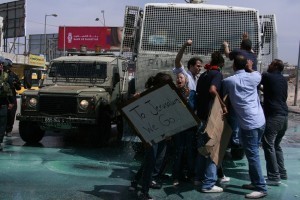
Demonstrators in Qalandia block an Israeli army vehicle on June 5 (photo by Ahmad al-Nimer)
Last week, I interviewed Rami Zurayk, an agronomist at the American University of Beirut and Palestinian refugee rights activist, about the planning of the May 15 and June 5 demonstrations in Lebanon. Zurayk described to me a meeting that took place in Beirut before the Fatah-Hamas unity deal took where the May 15 movement planned its strategy. All Palestinian factions were represented, however, each leader received only a single vote on the motions being deliberated. "It was unbelievable to see the Hamas guy who represents 100,000 people have the same power as an independent person from the camps," Zurayk told me. "In this setting, the lines began to blur and you could not tell who was from what faction any more. In the past, it was impossible to get people from the camps to agree on rallying under one flag and one symbol. But in this meeting everything changed."
Zurayk said the refugees and their Lebanese allies (the involvement of Lebanese youth and civil society also reflected a new trend) resolved to carry out a mode of resistance that was "pacifistic in nature." "Like the demonstrations in Tahrir Square and throughout Tunisia, the [May 15] demonstrators were audacious, tenacious and most of all, repetitive," he explained. "Repetition is why Tahrir worked — you put your body on the line against repression. So that became our modality." Zurayk described scenes he witnessed of refugee youth rushing the Israeli controlled frontier at Maroun al-Ras with nothing but Palestinian flags in their hands, and of the Israeli response: soldiers shot the youth dead, killing one almost every five minutes.
After an international outcry, Israel blamed the Syrian regime and Iran for the demonstrations at the frontiers (it had little to say about the killings it committed in Maroun al Ras, Lebanon, however). I asked Zurayk about the Israeli claim. He remarked, "No amount of Syrian money can make people run to a border knowing they will be shot at. If the Syrians are being clever, that is their consideration. But do you really think Palestinians need Syrians to make them want to return to Palestine? They are living in camps with sewage running openly, with no jobs and no opportunities."
While evidence that the Syrian regime directly organized the demonstrations is scant to non-existent, the regime clearly enabled the demonstrators to reach the fence by neglecting to repel them with its own troops. Not only does this fact fail to excuse Israel's wanton killing, it highlights the irony of Israel and its allies condemning the Syrian regime for its brutal repression of Syrian citizens rising up against it (of course, the whole world should deplore Assad's draconian rule), while at the same time demanding that the regime repress the Palestinian refugees who are protesting for their own internationally recognized rights.
Yesterday, on June 5, the commemoration of Naksa Day, Palestinian refugees and their supporters returned to the Israeli controlled frontiers to protest the 44th anniversary of the occupation. Protests swelled at the Qalandia checkpoint between Ramallah and Jerusalem, where according to Joseph Dana Israeli forces tested out new and unusual weapons on demonstrators, and spread to Nablus, where Israeli forces fired teargas shells at a group of people protesting the occupation by planting trees. The most intense protests took place at the Quneitra crossing near the occupied Golan Heights, where Israeli forces gunned down at least 20 unarmed demonstrators as they approached the frontier fence (be sure to watch the video at the link). "We could have taken the easier route of uncontrolled fire, but we decided to operate in a very limited manner," an army spokesman said afterward, reassuring the world that Israel could have killed hundreds more, but chose to pick off about 20 unarmed civilians in the name of restraint.
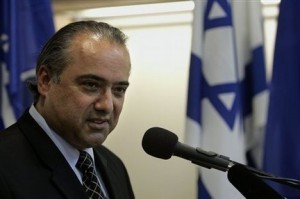
Would you buy a used car from this man? "The Syrian Chalabi" Farid Ghadry claims demonstrators at Quneitra were in fact "Syrian farmers" paid $1000 by Assad to show up
In the hours following the bloodshed, the Israeli response grew increasingly contorted. Army spokespeople claimed the demonstrators "were responsible for their own deaths," claiming they stepped on landmines. No evidence of landmine deaths was provided by the unnamed military sources, only conjecture. Next, Israel turned to its favorite Syrian cut-out in Washington, Farid Ghadry, an AIPAC member and discredited "serial entrepreneur" who is widely regarded as the Syrian version of Ahmed Chalabi — Ghadry actually met Chalabi in Richard Perle's living room. In a statement published on the website of his astro-turfed Reform Party of Syria, Ghadry claimed that the protesters at Quneitra were not actual Palestinian refugees, but impoverished "Syrian farmers" who had been paid $1000 each by the Assad regime just to show up, and $10,000 to die. Ghadry claimed he gleaned the information from "intelligence sources close to the Assad regime in Lebanon."
Israeli military spokespeople appear to be pushing Ghadry's press release, because the canard immediately showed up in a report by Yediot Aharnoth's Hanan Greenberg, one of the many military correspondents in the Israeli media who dutifully report any claim by any flack in an olive uniform as though it were a substantiated fact. "Syrian Opposition: Anti-Israel Rioters paid $1000," read the Yediot headline. But the story has not graduated beyond the pro-Israel blogosphere, probably because Ghadry and his shell of an opposition group — it is quite clearly a neocon front organization — have no credibility in Syria or anywhere else.
Leaving aside the allegations about Syria's role in the demonstrations on the Israeli occupied frontiers of Golan, it is worth questioning whether Israel actually wants to see Assad step down. Yaakov Katz, another military correspondent who serves as a tool for Israeli securitocrats and army spokespeople, making him occasionally useful as a window into the army's thinking, wrote in the Jerusalem Post in March:
As Israel watches the ongoing demonstrations in Syria against President Bashar Assad, its greatest concern for the moment is the uncertainty that change in Syria would bring to the region. Israel has gotten used to Assad and he is almost predictable.
A new regime, led by a new actor, would likely be unpredictable and when considering the large arsenal of long-range Scud missiles Syria has stockpiled over the years and the accompanying chemical warheads, Israel needs to be considered…
But when Israel looks at Syria it also sees the possible development of a new enemy, far more radical and extreme than the Assad they are familiar with. While not as strong and large as the Egyptian military, the Syrian military has obtained some advanced capabilities which, if the country falls apart, could fall into terrorist hands or be used by the country against Israel…
In the meantime, Israeli intelligence services are cautious in trying to predict how the riots in Syria will end and whether Assad will be prepared to cede power as easily as Hosni Mubarak did in Egypt.
By this logic, Israel is trying to calibrate its approach to the anti-Assad protests, taking into account the fact that the opposition movement is likely to be more antagonistic to it than Assad has been. The military-intelligence apparatus will determine how and when Israel responds, seeking to derive maximum gain from Syria's internal crisis. But since the Arab Spring arrived on Israel's doorstep, Israel's strategy has depended on lethal violence and little else. And it may be that it has no other strategy, that there is no Plan B. Meanwhile, as I write, the demonstrators who camped out at Quneitra are waking up.
May 24, 2011
Feeling the Ignorance at AIPAC 2011

On May 22, thousands of supporters of America's most powerful pro-Israel lobbying group, the America-Israel Public Affairs Committee, or AIPAC, converged on Washington for the group's annual conference. For two days they watched Democratic and Republican congressional leaders pledge their undivided loyalty to the state of Israel, and by extension, to AIPAC's legislative agenda. Speeches by President Barack Obama and Prime Minister Benjamin Netanyahu highlighted the conference, with Obama attempting to clarify his statement demanding that 1967 borders be the "starting point" for negotiations between Israel and the Palestinian Authority.
I interviewed several AIPAC delegates in the streets outside the conference. While few, if any, of them were able to demonstrate the slightest degree of sophistication in their understanding of the Israel-Palestine crisis, they had been briefed inside on how to respond to critics. No one I spoke to would concede that Israel occupied any part of Palestinian territory; none would concede that Israel had committed acts of indiscriminate violence or that it had transferred Palestinians by force; one interviewee could not distinguish Palestine from Pakistan. With considerable wealth and negligible knowledge — few had spent much time inside Israel — the delegates were easily melded by the cadre of neoconservative and Israeli "experts" appearing in AIPAC's briefing sessions.
As the day wore on, many delegates waded into confrontations with members of Code Pink and Palestine solidarity demonstrators who had set up a protest camp across the street. With conflict intensifying on the sidewalk, Code Pink's Medea Benjamin invited AIPAC delegates to express themselves from the protest stage. There, their most visceral feelings and deeply held views about Israel-Palestine crisis were revealed. See it for yourself.
May 19, 2011
Challenging Pastor Hagee on his home turf: "We caught him off guard…with just our thoughts and our courage."

On May 15, a group of San Antonio-based community organizers disrupted a service at Pastor John Hagee's Cornerstone Church dedicated to celebrating Israel. The Christian Zionist Pastor Hagee has sent tens of millions to Israeli organizations, including illegal settlements and the far-right McCarthyite student group Im Tirtzu. After the action, which was dispersed aggressively by members of Hagee's congregation, Glenn Beck posted an open letter from Hagee on his website. Incidentally, Beck will be delivering the keynote speech at Hagee's upcoming Christians United for Israel Washington-Israel Summit, an event I covered back in 2007. Following publication of the letter, an organizer of the action against Hagee, Genevieve Rodriguez, began received death threats by phone and email. I interviewed Rodriguez about the protest and its aftermath.
MB: Why did you decide it was necessary to protest Hagee from inside his church, and in such a confrontational way?
GR: First of all, we are a group of 24 who are community organizers working on a range of issues. We were not from any single organization, we are just people coming together. We were keeping up with what was going on in Palestine and the call from action from Palestinians on May 15. And for organizers here in San Antonio we feel the effects of the racism and Zionism and homophobia that comes out Hagee's church every day. The corporate executives that go to his church go downtown every day and carry out the message they get from his church. They treat people that work with them the way he teaches them to treat people — so they are treating gays a certain way or taking away the message that brown people should be persecuted. That gets carried out in the way working people are treated in this city. And all the while he's getting rich off a message of hate. So we decided that we couldn't sit here in our city and not hold this man accountable when what's happening here and what's happening in Palestine is atrocious. How can we sit here in the same city as him and not take action in a non-violent way? So in a matter of four days we came up with this action.
MB: Did any other actions by others inspire you, at least from a tactical point of view?
GR: One of the really recent actions that inspired us was by young Jewish people in new orleans who interrupted Netanyahu in New Orleans and told him that he delegitimizes Israel. It was really moving. We realized Hagee's sermon was being broadcast live to 35 countries on the web uninterrupted. So we realized we had to do it.
MB: How were you treated once the protest began? It seemed like things got pretty rough after it became clear you weren't going to stop.
GR: The EMS was called after I was dragged off the pew. An usher in front of me grabbed me and dragged me over a pew and I hit my head on the pew. Then 5 or 6 men were grabbing at all parts of my body and they lifted me up like a roasted pig and hoisted me in the air. It was all congregation members including a guest pastor — no security. A young white man involved in the action stood up and some woman said, 'Oh my God, he's a Palestinian!' Apparently these people didn't even know what palestinians look like. And they curse them every day. As a young woman was carried out shouting, 'Free Palestine!' she was slammed to the ground. Then she was getting dragged out. Several congregation members stood up and began accusing a group of brown women of being with the demonstrators. They were just singling out all kinds of brown people because of the way they looked.
MB: Was there any fallout after the action?
GR: John Hagee sent an open letter to Glenn Beck trying to give his version of the story, saying this is all the more reason to show support for Israel and that our congregation acted like it was the Super Bowl after this demonstration, they were so unified. beck is speaking at CUFI, coming up this year. There are infomercials inside Cornerstone for the CUFI conference that includes glenn beck highlights, really using the event to promote him. Our goal was to stand in solidarity with Palestine and tell San Antonio that we are not going to let this happen without Hagee being held accountable. He's doing this for profit, and we caught him completely off guard just entering there with just our thoughts and our courage. And they didn't know what to do, they were completely shaken.
MB: So how did the group feel afterwards? Did you feel like you had succeeded?
GR: It was really hard afterwards for us to hear that Israeli forces were opening fire on protesters after we got home. It was such a moment of righteous anger and feeling like we were right in our actions and that they [the congregation members] should be embarrassed for the comments they made about us. During the service people were literally being killed. And Hagee said, 'Isn't this exciting?' Well, we weren't there to have fun.
MB: Why do you think Hagee commands so much influence in San Antonio? And why besides the obvious theological reasons does his message resonate with people who apparently know very little about Israel and Palestine?
GR: There is so much fear of the other in this city and the fact that they live a different way. It sounds childish, I know. But all those people who go to that church have a much better economic reality than a lot of the other people on the other side of town. These people in this church are going to hold on to anything and stick to anything that's going to protect that because they don't want to face the reality on the other side. The israel issue has been cloaked in religion but with the settlements and Hagee, well, we're talking about money. This is about money and resources. And i feel bad for some of the congregation members who are kept in the dark and are so ignorant. They shouted at us stuff about us being Muslims. We didn't make a single reference to islam. We were Latino, white, queer, including brown queer women, people with Middle Eastern heritage, and almost all of us are young. Religiously, there were Christians among us and every other kind of religion including atheists.
MB: I heard you received death threats as a result of the protest. Is that true?
GR: I put my phone number out in the video because I believed there were people who were ready to do something about this racism that is taking over San Antonio. And we want people without access to internet can call in to join us. As a result we've connected with organizers who don't even live here. Then we also got death threats. one guy called me this morning and said he was going to rape me. I've received messages since my address is public that people from Dallas are going to come to my house and picket me. I got a phone call today from a man who said, 'I want to destroy arabs and i'm going to destroy you too.' A reporter from the San Antonio Express News was there and she recorded the whole call.
MB: Do you plan to do any similar actions in the future?
GR: We want to do more actions in solidarity with the Palestinians and we want to continue to expose Hagee financially. We have contacts inside his church and we want to set a serious campaign up that makes a dent into his support for the settlements and to Israel since they depend on people like Hagee. People inside Hagee's organization are starting to realize the hypocrisy that he represents and are starting to build relationships with us. As far as the way he handles business [our inside contacts have] hinted that he's corrupt, that he mistreats women and workers, and that there's a whole lot of evidence of it.
May 18, 2011
Confronting Memoricide and Minstrelsy at the JNF's "Broadway Sensation" Fundraiser

Pro-Israel commentators are generally loath to engage in discussions of the history surrounding Israel's creation. When they do, they generally resort to tired and discredited myths about the Palestinians running away at their leaders' behest, or about the Nakba being "self-inflicted," as Jeffrey Goldberg said recently. Nakba denial is an important feature of hasbara, not only because acknowledging the real history of Palestinian dispossession in 1947, '48 and in the years afterwards erodes the foundation of the Zionist narrative, but because the Nakba continues on both sides of the Green Line to this day.
Besides the Israeli army, there is no single organization more intimately involved in the ongoing Nakba than the Jewish National Fund. Originally called the Jewish Colonial Trust, the JNF was in charge of buying land from absentee landlords, then evicting thousands of tenants and residents in Palestine, transforming an entire agricultural class into landless peasants. In the 1930's, JNF director Yosef Weitz helped lead David Ben Gurion's Transfer Committee, which planned the widespread campaign ethnic cleansing that would take place beginning in 1947, one year before the foundation of Israel. After the state confiscated millions of dollars of Palestinian land and property, it began leasing it out through the JNF, which declares in its charter that it only leases to Jews. The JNF also planted non-native forests on top of dozens of destroyed Palestinian villages so their residents would have nothing to return to — greenwashing in its ultimate form. (Everything I have referenced is described in greater detail here).
Nowadays, the JNF is leading a violent campaign to expel the Bedouin residents of Al Arakib, a village in the Negev Desert so it can build a forest on behalf of GOD TV, an anti-Semitic evangelical broadcasting network that says it is planting trees in Israel to prepare the land for Christ's return. Talk about an unholy alliance. The residents of Al Arakib, who have been shot by rubber bullets, beaten, and jailed, have been ordered to move to a "development town" (read: Indian reservation) built by the Or Movement, a JNF subsidiary. For a comprehensive look at the JNF's seamy agenda and long record of human rights violations, go to the link above and check out the four volume JNF e-book series (my writing and reporting is featured in two editions).
On May 16, a day after worldwide Nakba observances, me and a few friends confronted attendees of a JNF fundraising event in New York's Lincoln Center called "Broadway Sensation." We handed out small trees planted next to small cards featuring the names of ethnically cleansed Palestinian villages. The prop allowed us to attempt to discuss the history of the Nakba and the JNF's role in it with some of the JNF's major donors. Their hostility to engaging with us was revealing. They knew nothing about the JNF's involvement in ethnic cleansing and didn't want to know. Before long we were asked to leave by security guards.
On our way out we noticed on a flier for the event that the JNF's donors were being entertained by the Scottsboro Boys, a Broadway show about a group of African-Americans wrongly convicted of rape. While some have hailed the show as humorous and well-choreographed, the African-American theater and arts critic Valerie Gladstone called it "a callous production in…questionable taste." It's hard to blame her for being so harsh. After all, the musical is a literal minstrel show that is performed during parts by black actors wearing blackface.
Here is a taste of the entertainment the JNF selected for its donors:
May 16, 2011
After 1948: How Israel stopped the "outcast race" from returning home

Yesterday, the Israeli army opened fire on unarmed demonstrators seeking to reach Majdel Shams, a village in the occupied Golan Heights. When the demonstrators breached a border fence, the army opened fire, killing several of them. Among those who made it through was Hassan Hijazi. Hijazi hitch-hiked and rode buses from the border to Jaffa, hoping to find his family's confiscated home. "It was always my dream to reach Jaffa," he told police after turning himself in.
At the Gaza border, the army opened fire on unarmed demonstrators with tanks, injuring dozens. Israeli forces fired unusually high amounts of teargas at protesters in Qalandiya, wounding scores in the West Bank city which was completely surrounded by the separation wall. Joseph Dana, who documented the Qalandiya protest, told me a group of shabab attempted to pull down a section of the wall but failed in somewhat comical fashion because their rope was too short.
Now that Israeli forces are conducting house-to-house searches for those who managed to surmount the Jewish state's demographic walls, the word "infiltrator" has retured to the Israeli vocabulary. The term was coined in the months and years after the Nakba when the Israeli military focused on preventing those it had expelled in 1947 and '48 from returning to their villages, their land and their families. Israel's search and expulsion operations, designed to maintain the demographic integrity that the Zionist militias established through ethnic cleansing, represent an under-acknowledged but absolutely crucial component of the history of the Nakba. Indeed, the Nakba did not end in 1948.
Perhaps the most comprehensive account of Israel's efforts to prevent the refugees from returning home is Benny Morris' 1993 book, "Israel's Border Wars: 1949-1956." Morris' flaws — his crude racism, rejection of Arab historians and sources, and allegiance to Zionism — are well known. As a pure archivist, however, he is among the best. The sections in his book on infiltration depict in cold, clinical detail the Israeli military's tactics against those who tried to return. They included detaining refugees in barbed wire enclosed camps that reminded some observers of Nazi German; the extraction of fingernails and other torture methods; and forced marches through the desert without food or water. Tawfiq Toubi, the first Arab to serve in Israel's Knesset, called the search and expulsion operations "pogroms."
Below, I have excerpted several testimonies about Israel's operations to stop "infiltration:"
In May 1950, a woman from a kibbutz in the South witnessed Palestinian refugees being packed into trucks and unloaded at a camp [pp. 147-48]:
We were waiting for a hitch beside one of the big army camps… Suddenly two large trucks arrived, packed with blindfolded Arabs (men, women, and children). Several of the soldiers guarding them got down to drink and eat a little, while the rest stayed on guard. To our question 'Who are these Arabs?' they responded: 'These are infiltrators, on their way to being returned over the borders.' The way the Arabs were crowded together [on the trucks] was inhuman. Then one of the soldiers called his friend 'the expert' to make some order [among the Arabs]. Those of us standing nearby had witnessed no bad behavior on the part of the Arabs, who sat frightened, almost one on top of the other. But the soldiers were quick to teach us what they meant by 'order. The 'expert' jumped up and began to…hit [the Arabs] across their blindfolded eyes and when he had finished, he stamped on all of them and then, in the end, laughed uproariously and with satisfaction at his heroism. We were shocked by this despicable act. I ask, does this not remind us exactly of the Nazi acts towards the Jews? And who is responsible for such acts of brutality committed time and time again by our soldiers?
In June 1949, Israeli forces rounded up 5000 accused infiltrators in Nazareth and imprisoned them in a barbed-wire compound. The episode disturbed then-Foreign Minister Moshe Sharett, who worried for Israel's international image. He complained to Ben Gurion [p. 149]:
The army did not allow anyone to remain at home. Among those incarcerated [behind the barbed wire] there were also pregnant women, babies, tired old people, and the sick. The army made no distinction between ordinary folk and notables, so that among those incarcerated was the Arab magistrate of Nazareth… All these people were held in the compound for several hours, in overcrowded conditions, and without food and water. There were outbursts of shouting and yelling by the prisoners and on one occasion the troops fired over the crowd's heads… I heard from a Jewish member of Knesset who visited Nazareth last Saturday that there had been thefts of money from [some] empty houses [during the round-up].
On May 31 1950, the Israeli army forced 120 Palestinian "infiltrators" into two crowded trucks and drove them to Arava, a point on the Jordanian border, then forced them to march across the desert, firing shots over their heads to urge them on. According to Alec Kirkbride, the British minister in Amman, over 30 died of thirst and starvation during the forced march. The group had spent the past weeks in a makeshift detention center in Qatra that Kirkbride described as " a concentration camp…run on Nazi lines." One survivor, according to Morris, had his fingernails torn out.
John Glubb, the latter-day Lawrence of Arabia who had trained the Jordanian army, witnessed the scene with horror. "The Jews want them all to emigrate," he wrote. "They therefore try to persuade them with rubber coshes and by tearing off their fingernails whenever they get the chance… I do not know whether this is the policy of the Israel cabinet, but it must certainly be known and winked at on a ministerial level… The brutality is too general to be due only to the sadism of ordinary soldiers."
On June 11 1950, the journalist Philip Toynbee (son of historian Arnold Toynbee) published an account on the front page of the Observer based on his interviews with the survivors of the Arava incident. Toynbee, whom Morris noted was "sympathetic towards Israel," implied similarities between Israel and Nazi Germany. He wrote [pp. 160-61]:
One member of the outcast race [the Palestinians], a heavy young man with the dull vacant look of Van der Lubbe [the Dutchman falsely arrested and executed by the Nazis for setting fire to the Reichstag in 1933], had been arrested while grazing a cow near the state frontier. The blue-uniformed [Israeli] police with almost incredible naivete…believed him to be a spy… and two of his fingernails were pulled out before they learned better. A young schoolmaster entered [Israel] illegally in order to be again with his family. He was…immediately arrested. One old mason, driven desperate by unemployment, tried to get out of [Israel] to escape. About a hundred of them collected from all parts of the State were taken from the prison camp, [and] herded into two motor trucks… The army blind[folded] them, barking at them and waving their rubber coshes.
On the long tedious journey through the burning countryside one of the victims would occasionally try to see but was hit over the face or back with a cosh…At last…they reached the remotest…part of the frontier. It was no eight o'clock in the evening and they had had nothing to eat and drink all day. A compassionate captain ordered two buckets of water to be brought, but as soon as his back was turned the soldiers spilled the water into the dust. The bandages were now taken from their eyes and they were told that three would be counted and anyone not running by then would be shot…As they ran Bren gunfire opened above and between them so that they were forced to split up into groups of three and four. This story, I know, is sickeningly familiar, and it is only the roles which have been changed. The outcast race is not the Jews and the state is not…Nazi Germany…
The frontier area is the terrible Wadi Araba…a desert valley far below sea level where only lizards and locusts can live, and where in the daytime the sand scorches the bare flesh. Since there was only moonlight when the prisoners were released, nearly all were hopelessly lost by the time the sun rose…The luckiest were picked up on the second day by friendly Bedouins… Others were wandering for four days, eating lizards and drinking stagnant water or their own urine… By the fourth day some 70 out of 1000 had been saved, but many had stories of others they had been forced to leave dying in the desert… I interviewed nine or ten of them separately…their stories coincided… I saw weals and sores caused by prison beating, scorched and swollen feet, and two almost nailless fingers of the young grazier… Nothing can excuse the inhuman brutality of their treatment.
Moshe Dayan, who was then the head of the army's Southern Command, blamed the atrocities at Arava on "Turkish and Moroccan [Jewish] soldiers" who "lack moral fiber." He added, "I hope that there will perhaps be another opportunity in the future to transfer these Arabs from the Land of Israel, and as long as such a possibility exists, we must do nothing to foreclose the option."
May 15, 2011
When the Shoah met the Nakba ("One group lost all…while the other found everything they needed")

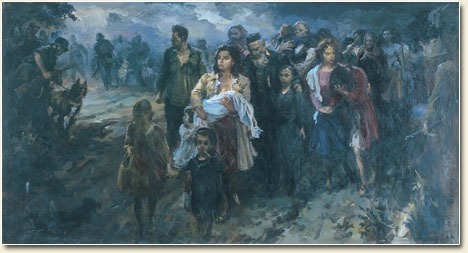
Joseph Kuzkovsky's painting, "Led to the Slaughter -- Baba Yar," hangs in a hallway in the Israeli Knesset
The Nakba briefly appears in Tom Segev's magisterial history of Israel and the Holocaust, "The Seventh Million." In a single (very long) paragraph, Segev tells the story of how survivors of a genocide were transformed by the Zionist enterprise into participants in a campaign of ethnic cleansing.
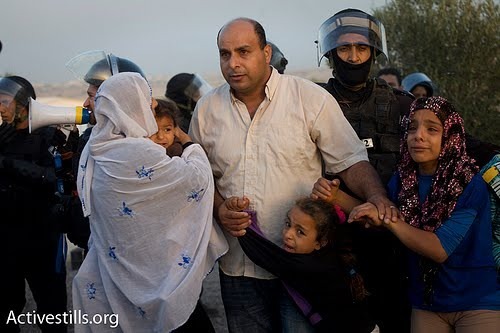
Photo by Oren Ziv of the initial expulsion and destruction of Al Arakib, a Bedouin village in the Negev that the state of Israel has destroyed 21 times in the past year
Segev writes on pp. 161-62: "Then the War of Independence broke out, and tens of thousands of homes were suddenly available. This was what Shaul Avigur called 'the Arab miracle': Hundreds of thousands of Arabs fled, and were expelled from their homes. Entire cities and hundreds of villages left empty were repopulated in short order with new immigrants. In April 1949 they numbered 100,000, most of them Holocaust survivors. The moment was a dramatic one in the war for Israel, and a frightfully banal one, too, focused as it was on the struggle over houses and furniture. Free people–Arabs–had gone into exile and become destitute refugees; destitute refugees–Jews–took the exiles' places as a first step in their new lives as free people. One group lost all they had, while the other found everything they needed–tables, chairs, closets pots, pans, plates, sometimes clothes, family albums, books, radios, and pets. Most of the immigrants broke into the abandoned Arab houses without direction, without order, without permission. For several months the country was caught up in a frenzy of take-what-you-can, first-come, first-served. Afterwards, the authorities tried to halt the looting and take control of the allocation of houses, but in general they came too late. Immigrants also took possession of Arab stores and workshops, and some Arab neighborhoods soon looked like Jewish towns in prewar Europe, with tailors, shoemakers, dry goods merchants–all the traditional Jewish occupations."
May 14, 2011
Did Bin Laden Borrow His Porn Stash From Manuel Noriega? (Updated)

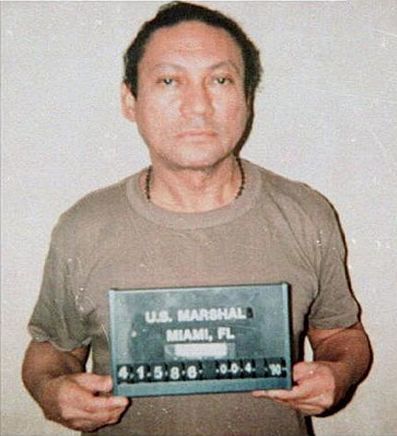
After the US captured Noriega, it claimed to have found porn, cocaine and "voodoo" materials in his home
Apparently it wasn't enough that Osama Bin Laden had spawned a movement of mass murdering fanatics who killed thousands of innocent people around the world, most of whom were Muslim. Now US "officials" speaking "on the condition of anonymity" are claiming that Bin Laden was a porn hound who kept an "extensive" stash of adult films in his home.
The US media has gone wild over the story: Lawrence O'Donnell led with it last night on MSNBC; Reuters reported on it; and the NY Post blared out the headline, "Osama Gone Wild." At the Daily Beast, Asra Nomani published a long think piece explaining how Bin Laden's supposed porn addiction "reveals the Muslim world's dirty secret."
The revelations about our latest national folk devil's perversions made me wonder if Bin Laden borrowed his porn stash from the jailed former Panamanian strongman and bygone boogeyman Manuel Noriega.
Back in 1989, after Noriega was captured by US forces in Panama, the press was given exclusive access to the dictator's inner sanctum. Time Magazine reported at the time:
But other evidence suggested that the dictator was losing control of himself: U.S. troops searching his various hideouts found, along with pictures of Adolf Hitler, collections of pornography and sophisticated weapons and more than 50 kilos of cocaine. In one Noriega guesthouse, searchers found a bucket of blood and entrails, which they said may have been used for occult rites to protect him. Was the accused drug trafficker deteriorating into a megalomaniac drug user?
As Michael Parenti later noted, the Hitler picture came from a Time-Life photo history of World War II, the only "voodoo" implements found were San Blas Indian carvings, and the cocaine was actually tortilla flour. The "evidence" appeared to have been planted by the US to destroy whatever was left of Noriega's reputation. "But," Parenti wrote, "these belated corrections received scant coverage."
Is it beyond the US to rehash the same tactics it deployed against Noriega, a former CIA asset, to discredit Bin Laden in the eyes of the world? Of course not, especially given Bin Laden's assiduously cultivated image of piety. The charge not only looks extremely shabby, it adds an air of silliness to an affair the US has otherwise presented as deadly serious. Bin Laden was the spiritual leader of a movement that murdered thousands of innocent people across the globe. That fact alone should be enough to discredit him.
Update: Grace D. reminds me of the following "discoveries" by US forces in the compound of Uday Hussein, the son of Saddam (as reported by AP): "In addition to finding a lot of liquor, electronics, Cuban cigars and porn — U.S. soldiers say they found pictures of President George W. Bush's twin daughters, Jenna and Barbara Bush."
Update #2: Bin Laden had weed! I wonder if he was posting #weedcommandments on Twitter.
Update #3: In 1992, Turkish police told the press they found a stash of caviar in the home of communist militant leader Dursun Karatas. They also claimed to have found "a stereo, large screen television with remote control, computer, fax, video, carpets, luxury items…"
May 9, 2011
On Israeli Memorial Day, Suicide, Fratricide And Accidents Remain Top Causes Of Soldier Deaths

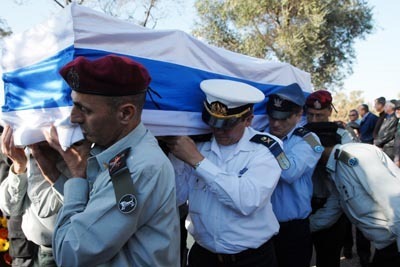
Despite declaring an "all-out war" on suicide, the Israeli army saw the epidemic rise in 2010
On Israel's Memorial Day observances for "fallen soldiers and victims of terror attacks," the Defense Ministry's commemoration unit claimed that 183 Israelis "were killed in the line of duty or in terror attacks since last year's Remembrance Day," according to YNet. The number appears to represent a wild exaggeration that is inconsistent with past statistics documenting the number of Israeli soldiers killed annually in combat operations versus those who died by suicide or in accidents. In recent years, suicide has been either the leading cause or among the leading causes of deaths in the Israeli army.
While I was having lunch in Tel Aviv last summer with my friend Ruth Hiller, a founder of the Israeli anti-militarization group New Profile, she told me that around 50 percent of Israelis buried in military cemeteries had died through suicide, accidents or fratricide. I asked my roommate at the time, Yossi David, a left-wing Israeli blogger who had served in occupied Hebron, if Hiller's figures were accurate. "All I know is that there were two suicides a month in my unit during training," David said. "It happened all the time."
In 1989, the Israeli army's personnel department put the rate of suicides at 35 a year. By 2003, during the height of the Second Intifada, 43 Israeli soldiers died by suicide, making it the leading cause of death in the army. By 2010, suicide was on the rise again. During the first seven months of the year, 19 soldiers had killed themselves, a ten percent spike from the previous year. That number exceeded the number of deaths that occurred that year in combat operations.
In 2008, an Israeli border policeman committed suicide in front of French Prime Minister Nicholas Sarkozy. A young soldier shot himself last year after learning that his friend had committed suicide moments before. The phenomenon continues to plague the Israeli army despite Brigadier General Avi Zamir's pledge in 2005 to "wage an all-out war on suicide by soldiers."
The suicide rate has been particularly high among Ethiopian members of the Israeli army. By 1997, six years after an airlift brought the second wave of Ethiopian immigrants to Israel, Ethiopian soldiers accounted for 10 percent of army suicides — but comprised only four tenths of a percent of the army. Racism was a key factor in the epidemic. One soldier's suicide note read: "Every morning when I get to the base, six soldiers are waiting for me who clap their hands and yell, `The kushi [black] is here.'"
During Operation Cast Lead, Israel's last major combat operation, the army suffered its largest loss of life in an accidental incident of fratricide, when a tank shell killed three members of the Golani Brigade. This year, several Israeli troops died at the Gaza border when their comrades accidentally rained mortars down on their position.
40 Israeli prison guard cadets died weeks before in the Carmel Wildfire when their bus was trapped in the flames. The cadets presumably comprised the majority of the 70 "soldiers and civilians" whom the Israeli Army spokesman claimed (via Twitter) were "killed in operational duty and terror attacks since last Memorial Day."
May 8, 2011
As Nakba Day Approaches, Israeli Troops "Conquer" Simulated Arab Village

63 years ago today, before the Arab armies had entered Palestine, and before Israel had declared its independence, Zionist militias were engaged in the conquest and ethnic cleansing of dozens of villages, from Abu al-Fadl near present-day Ramle to Akbara, which was 2 kilometers south of Safed. This week, as Palestinians plan to observe the formal anniversary of their dispossession on May 15, or "Nabka Day," the Jerusalem Post's Benjamin Speier reported that Israeli soldiers from the 202 paratrooper battalion "put their skills into action by conquering a simulation Arab village."
"Each platoon needs to likhbush [conquer] an area in the village, and we get to likhbush an area called Yassin, south Yassin," said company commander Matan Pelen. After the exercise was completed, Pelen commented, "This area is now ours, it's under our control."
Whether or not the Israeli army is training to literally seize a village and expel its residents, the reliance by modern day Israelis on a colonial vocabulary exposes the state's essential mission. When Israelis refer to the occupation of the West Bank, they use the term "kibush," or the conquest, underscoring the permanence of the settlement project across the 1949 Armistice Line and its connection to the military campaign of ethnic cleansing that enabled the Jewish state to emerge in 1948.
The early Zionists labeled their campaign to Judaize the marketplace by boycotting Arab businesses and terrorizing Jews who employed or patronized Arabs, "Kibush Ha'avodah," or the conquest of labor.
The Zionist internalization of anti-Semitic stereotypes of Jews as rootless cosmopolitans (or excessively contemplative Luftmenschen) prompted the "Kibush Ha'adamah," the conquest of the land, and "Likhbush et Ha'adamah ba'Raglyim," a phrase that means to conquer the land by foot. Besides expelling as many Palestinian Arabs as possible, these efforts were intended to encourage the New Jews to purge their diaspora contaminations through agricultural pursuits, physical labor and perpetual building.
Conquest is inscribed in the logic of Zionism. While Israeli political and military leaders resist any initiative to constrain the state's expansionist impulses, Palestinian villages quietly disappear from the landscape. Just as the "kibush" remains continuous, so does the Nakba.
Last week, on May 6, Israeli authorities ordered 50 Palestinian families to leave Jerusalem. A day later, Israeli forces expelled 110 Palestinians from Khirbet Umm Nir, a small village south of the occupied city of Hebron. The village was destroyed for the third time in two months.
Max Blumenthal's Blog

- Max Blumenthal's profile
- 273 followers

