
Max Blumenthal's Blog, page 10
May 3, 2011
Top Republicans to welcome Netanyahu, who called 9-11 attacks "very good," said anti-US terror helps Israel

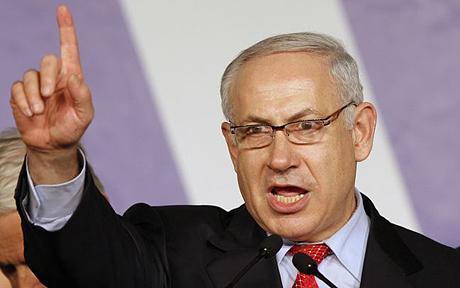
Bin Laden's death is bad news for Bibi, who called the 9-11 attacks "very good."
In three weeks, Israeli Prime Minister Benjamin Netanyahu will travel to Washington to address Congress at the invitation of Republican Majority Speaker John Boehner. The appearance was designed to undermine President Barack Obama, with Netanyahu, the ardent Republican from suburban Philadelphia, hectoring the Palestinians and the Iranian regime while pledging an eternal war against terror. Before a uniformly supportive Congress, the cocksure Netanyahu had hoped to present a stark contrast to Obama, the unpopular ditherer mired in bad economic news and a messy military stalemate in Libya.
With the assassination of Osama Bin Laden, a hit personally authorized by Obama, the tables have turned. Netanyahu rushed to complement the American president, and he will inevitably be compelled to praise him again and again when he arrives in Washington. This is one reason why Akiva Eldar wrote that Bin Laden's killing was "bad news for Bibi."
But even before he had announced his upcoming trip to Washington, Netanyahu offered evidence that he would prefer for Bin Laden to be alive and kicking. In the immediate wake of 9-11, the New York Times' James Bennett asked Netanyahu what the attacks would mean for Israel's relations with the United States. "It's very good," Bibi replied before quickly correcting himself. "Well, not very good, but it will generate immediate sympathy." Netanyahu said the attack would ''strengthen the bond between our two peoples, because we've experienced terror over so many decades, but the United States has now experienced a massive hemorrhaging of terror."
Before an audience at Bar Ilan University in 2008, Netanyahu restated his belief that 9-11 was, as he said, "very good." "We are benefiting from one thing, and that is the attack on the Twin Towers and Pentagon, and the American struggle in Iraq," Netanyahu said during a conference about re-dividing Jerusalem in the event of a peace treaty with the Palestinians.
Bibi's logic was clear: as long as Americans could be duped into believing Israel was fighting its battle, the United States would support Israeli expansionism and intransigence. Bin Laden was useful indeed.
With Bin Laden gone, Netanyahu will likely try to sell Americans on new folk devils, from Hamas in Gaza to the nuclearized "new Hitler" in Iran. But these evildoers have expressed little, if any, interest in attacking the United States. And judging from Netanyahu's past statements, he does not view this fact as "very good."


Popular Struggle Leader and Political Prisoner Bassem Tamimi: "It is our destiny to resist."

This interview was originally published at Electronic Intifada:
When I met Bassem Tamimi at his home in the occupied West Bank village of Nabi Saleh this January, his eyes were bloodshot and sunken, signs of the innumerable sleepless nights he had spent waiting for Israeli soldiers to take him to prison. As soon as two children were seized from the village in the middle of the night and subjected to harsh interrogations that yielded an unbelievable array of "confessions," the 44-year-old Tamimi's arrest became inevitable. On 25 March, the army finally came, dragging him away to Ofer military prison, a Guantanamo-like West Bank facility where he had previously been held for a 12-month term for the vaguely defined crime of "incitement." His trial before a military court that convicts more than 99 percent of Palestinians brought before it is scheduled to begin on 8 May.
Like nearly all of his neighbors, Tamimi has spent extended time in Israeli detention facilities and endured brutal treatment there. In 1993, he was arrested on suspicion of having murdered an Israeli settler in Beit El. Tamimi was severely tortured for weeks by the Israeli Shin Bet in order to extract a confession from him. Tamimi said that during the torture he was dropped from a high ceiling onto a concrete floor and woke up a week later in an Israeli hospital. In the end, he was cleared of all charges.
With his wife, Nariman, and his brother, Naji, Tamimi has been at the center of Nabi Saleh's popular resistance against the occupation since its inception in 2009. The village's unarmed struggle has brought hundreds of Israelis and international activists to participate each Friday in boisterous and theatrical demonstrations that invariably encounter harsh Israeli violence, including the use of live ammunition against children. While other villages involved in the popular struggle have seen their ranks winnowed out by a harsh regime of repression and imprisonment, Nabi Saleh's protests continue unabated, irking the army and frustrating the settlers of Halamish, who intend to expand their illegal colony further onto Nabi Saleh's land.
Tamimi and I spoke amid the din of a stream of visitors parading in and out of his living room, from international activists living in the village to local children to a group of adolescent boys from the nearby town of Qurawa, who told me they came to spend time with Tamimi and his family "because this is what the Palestinian struggle is about." Tamimi is a high school teacher in Ramallah and his professorial nature is immediately apparent. As soon as I arrived at his front door for what I thought would be a casual visit, he sat me down for an hour-long lesson on the history, attitudes and strategy that inform the brand of popular struggle he and his neighbors had devised during weekly meetings at the village cultural center.
Our discussion stretched from the origins of Nabi Saleh's resistance in 1967 to the Oslo Accords, when the village was sectioned into two administrative areas (Areas B and C), leaving all residents of the Israeli-controlled portion (Area C) vulnerable to home demolition and arbitrary arrests. Tamimi insisted to me that Nabi Saleh's residents are not only campaigning to halt the expropriation of their land, they seek to spread the unarmed revolt across all of occupied Palestine. "The reason the army wants to break our model [of resistance] is because we are offering the basis for the third intifada," Tamimi said.
A full transcript follows:
Max Blumenthal: There are rumors that the Israeli civilian administration will demolish your home if you continue the popular resistance. Is there any truth to that and on what grounds can they carry out the demolition?
Bassem Tamimi: My house was built in 1964 when this area was controlled by Jordan. Back then it was easy for me to get a permit to renovate. Now when I want to add a second level to the house for my family of course I can't get a permit from the Israelis so I am forbidden to build. In this way they are forcing the next generation of our village to move to Area B in the center of the village. Their goal is to carry out a form of indirect transfer that will make Nabi Saleh into a refugee camp in the near future. The village will then be nothing more than a hotel that provides workers for the Palestinian Authority, maybe with no school and definitely with no relation to our land, since we will be forced off of all the parts we can farm. In the future, Area C will be empty and all of us who live there will have to move to places like Birzeit which are located in Area A.
I wanted to build a wall around my garden and I didn't do it. The reason I didn't was that it would have only been demolished since I am not able to get a permit. I didn't want to risk them demolishing my house. All the new houses built after Oslo were in Area B but we have not been able to build a single new house in Area C.
MB: How has the expansion of the nearby illegal Jewish settlement Halamish influenced the popular resistance in Nabi Saleh?
BT: In 1976, the settlers came to an old British military camp on our land. The next year they built a settlement called Halamish. I asked one of them what right he had to the land. He told me his right was in the Bible. The Labor government blocked construction of the settlement, but a year later when Menachem Begin and Likud were elected, they allowed it to go ahead. During the second intifada, the army made the whole area around our village a closed military zone. This allowed Halamish to expand even more onto our land. Then in 2008 the army demolished the second fence around our village, another step for more expansion. So we see the steps they are taking to push us out of Area C and off our land.
Our problem is not just with the settlement of Halamish. Our problem is the whole occupation. The settlement is merely a face of the occupation. In Bilin and Nilin they set specific goals like moving the separation fence to the green line [Israel's internationally-recognized armistice line with the occupied West Bank]. That is a problem. Our only goal is to end the occupation. So if the American consul came to us and said, "I am Superwoman; I can immediately remove Halamish," I would say, "Fine, but we want to end the whole occupation."
MB: When did Nabi Saleh choose to wage an unarmed popular struggle and why?
BT: This village has a long history of resistance. It is part our culture. We have had 18 martyrs since 1967. Most of our youth are taken away to prison. I have been arrested ten times and placed under administrative detention.
We have experience in military resistance but we decided the best way to resist was nonviolent. We want to build a model that looks like the first intifada, an alternative to military resistance. Our village knows exactly what to do because we were involved in the intifada. And the reason the army wants to break our model is because we are offering the basis for the third intifada.
For my whole life most of the Israelis I met were soldiers and interrogators. But when we started the popular resistance in 2009 I began to see that there were some Israelis who had removed the occupation from their minds. Like Jonathan [Pollack], who was the main person to bring Israelis and internationals here in the beginning. So we became friends.
The occupation is continuous in Israeli society and this is why they lose — because they try to force us to accept them as an occupier, and that will never happen. We don't have any problem with Jewish people. Our problem is with Zionism. We don't hate them on the other side; we simply demand that they end the occupation of their minds. The separation between us is between different ways of thinking, not between land. If we change our ways of thought and remove the mentality of occupation from our minds — not just from the land — we can live together and build a paradise.
MB: Your demonstrations have been criticized by outsiders because the throw stones at the soldiers. Meanwhile, the Israeli army claims stone-throwing is an armed attack or a form of violence so the popular resistance is not really nonviolent. What do you make of these claims?
BT: We are building the popular struggle from our culture and our history. Only after we build an authentic struggle do we begin to debate our tactics. And throwing stones is a part of our culture. Historically we threw stones when something frightened us like a snake or a bear. Now, when a soldier comes into our village and shoots tear gas we won't just sit there like a victim. They are protected from live bullets so we're clearly not trying to take a life. With stones we are simply saying, "We don't accept you here as an occupier. We don't welcome you as a conqueror."
MB: What is your relationship with Fatah and the Palestinian Authority like?
BT: We had an intifada based on popular struggle but the Oslo accords crushed it. Now the people are tired after the second intifada was crushed. So Fatah talks and talks but they can't manage to bring [the popular struggle] across the West Bank. Fayyad wants to come here and be seen and use our struggle as a theater to have his picture taken. We know that Fatah could bring thousands of people here but they don't want to. They don't order their members to join the struggle. We want to ask them to make popular struggle everywhere. We do all that we can but without them, we can only do so much.
MB: Do you see any role for the peace process in ending the occupation?
BT: In thirty years the Europeans and the United States paid 5 billion dollars for normalization projects but they give us no steps towards a solution. If they want to do something to stop the occupation they should stop these initiatives that put people up in five star hotels to do dialogue. It's not common sense! And all these academics who come here to study us and then go and write about how throwing stones is violent — that means nothing to us! Popular resistance is a way of life that means being close to the ground. I've been in the dialogue workshops and they are a complete waste of money. Both sides are suffering under the occupation but in a different way. [Israeli soldier] Gilad Shalit was captured but who sent him to occupy and kill? The normalization initiatives never address questions like this.
MB: One of the key differences between the demonstrations in Nabi Saleh and in a place like Nilin is the role of women. Every time I come here on a Friday the women are at the front of the protest while in Nilin they are not always that visible. Is this deliberate?
BT: From the beginning of our struggle the Israelis targeted the women of our village. For example, my wife, Nariman, was arrested and jailed for ten days. The army targets the women here because they know our culture; they know that we see women as 50 percent of our struggle and no less. Women [raise] our children. Women can convince people more easily than men. When our men see the women being brave, they want to be more brave. Women are in the center of our struggle because we believe women are more important than men. It's that simple.
MB: What do you think army's long-term objective is?
BT: The army is determined to push us toward violent resistance. They realize that the popular resistance we are waging with Israelis and internationals from the outside, they can't use their tanks and bombs. And this way of struggling gives us a good reputation. Suicide bombing was a big mistake because it allowed Israel to say we are terrorists and then to use that label to force us from our land. We know they want a land without people — they only want the land and the water — so our destiny is to resist. They give us no other choice.
April 15, 2011
J Street's Ben Ami: "Our discussion" on BDS should stay "within the Jewish community" (Corrected)


Jeremy Ben Ami wants to clarify J Street's position on debating BDS
Correction: I had originally reported that Jeremy Ben Ami's email was forwarded to Rebecca Vilkomerson by a J Street staffer, and then on to me. In fact, it was sent to me directly by Vilkomerson, but I was confused about the email chain.
This week I reported Omar Barghouti's account of J Street's Jeremy Ben Ami refusing to debate him because he was Palestinian, and not Jewish. According to Barghouti, Ben Ami said that J Street preferred to keep the BDS debate "inside the Jewish community." Now I have Ben Ami's original email to Rebecca Vilkomerson, the executive director of Jewish Voice for Peace, in which Ben Ami rejected Vilkomerson's proposal to include Barghouti in a future debate on BDS.
Before I reproduce the email, here is the background: Ben Ami invited Vilkomerson to debate several BDS opponents at J Street's annual conference last February. Vilkomerson, who supports targeted BDS, told him in an email on Janurary 26 that excluding a Palestinian from a debate about Palestinian rights was problematic. "I think it is essentially important that this discussion not just be an intra-Jewish affair," she stated. Vilkomerson proposed scheduling a debate between Ben Ami (or someone representing J Street) and Barghouti, the intellectual author of BDS and one of its most articulate advocates, when he arrived in the States this April for his book tour.
Ben Ami responded as follows (I redacted the email addresses and personal banter):
From: Jeremy Ben-Ami
Date: Wed, Feb 2, 2011 at 7:07 AM
Subject: RE: BDS debate?
To: Rebecca Vilkomerson
Hi Rebecca.
My apologies for taking so long to get back to you. Obviously not an easy question – and not a lot of bandwidth at the moment for me to really engage people in discussion of a complex question related to after the conference!
As a general matter, I am open to participating in discussions of strategies for ending the conflict that would include me and someone who favors the use of BDS tactics.
I am not particularly likely to do that in a frame that is about the tactics themselves or even framed as being about the BDS movement. I'm really open to how to frame it, I just don't think it advances the ball for a broad enough community for it to be simply 'about BDS issues.'
I also am most likely – given J Street's mission within the Jewish community – to do such discussions with others in the Jewish community such as yourself – though again I don't rule out a discussion with Omar or other Palestinian activists. Our discussion as J Street in my mind is less with them – because they can choose whatever tactics they want, but within the Jewish community about how we run our communal conversation around these difficult questions.
Finally – again as a general matter I'd consider it a home run to do such a discussion including someone who thinks we're both wrong and who thinks that any of our efforts to change Israeli policy constitute de-legitimization…
Ben Ami's email was provided to me by Rebecca Vilkomerson. "Jeremy [Ben Ami] asked me to forward on exactly what he wrote because he believes this will clarify that his policy is not racist," she told me.
I am assuming that Rebecca made a mistake in calling Ben Ami's rejection of the offer to debate Barghouti a "policy." If J Street does have a policy of excluding Palestinians from debates relating to BDS, charges of racism would stick. However, Ben Ami emphasized that he is open to publicly engaging with Barghouti or other Palestinian activists at some point in the future. Only time will tell…
Judging from his language in his email to Vilkomerson about "how we run our communal conversation around these difficult issues," Ben Ami appears interested in containing J Street's involvement in the BDS debate to exclusively Jewish spaces. In such a situation, Palestinians are not only excluded from the debate, they are segregated from an audience primarily concerned about what is "good for the Jews."
If Ben Ami is reluctant to debate BDS in public with Palestinians, I imagine it is because he (or any self-proclaimed liberal BDS opponent, for that matter) would be uncomfortable looking a Palestinian in the eye and telling him or her that instead of campaigning for their rights through non-violent means, they should wait around quietly until Washington convinces Israel to enact a magical solution. "You're moving too far, too fast," as some said in the early 1960's.
April 12, 2011
Omar Barghouti: J Street's Ben Ami has Jews-only policy on BDS debates

Last night I went to Columbia University to see Omar Barghouti discuss his new book, "Boycott, Divestment, and Sanctions: The Global Struggle for Palestinian Rights." For those who don't know, Barghouti is one of the BDS movement's most effective strategists and promoters, basing his advocacy on a platform of human rights and international law while explicitly rejecting arcane ideology. His book offers the most in-depth and accessible analysis to date of the movement, its history, and why it is gaining so much momentum. Read an excerpt here.
During his talk, Barghouti mentioned that he had approached J Street President Jeremy Ben-Ami about arranging a debate on BDS. The response from Ben-Ami was as follows, according to Barghouti: "We want to keep this debate inside the Jewish community. So we won't participate in a debate with any Palestinians."
Barghouti joked, "Why would BDS have anything to do with Palestinians?" He went on to describe Ben-Ami's policy as racist.
Last December, I debated the issue of BDS against the director of J Street U, Daniel May. My debate partner was Rebecca Vilkomerson of Jewish Voice for Peace. Daniel May's partner was a Jewish student from Princeton also named Daniel May. Everyone involved in the debate was an Ashkenazi Jew, yet we were debating a movement founded and controlled by Palestinian civil society. If I had known at the time that J Street had an alleged policy of refusing to debate with non-Jews, especially Palestinians, I would not have participated at all.
Another person told me about J Street's "don't debate Palestinians" policy, but did not authorize me to report it at the time. The source explained that the policy resulted in the Jews-only debate at J Street's annual policy conference in February, where Rebecca Vilkomerson debated in favor of BDS against opponents Bernard Avishai and Ken Bob of Ameinu.
It is worth noting that after the debate, Bernard Avishai took to his blog to tell a certain member of JVP (he left the person unnamed) that "you remind me, forgive me, of the Tea Party." Avishai was apparently upset that the JVP member had asked him how he could argue against divesting from multinational companies and Israeli institutions that profit from the occupation while supporting a boycott of the settlements. It is unusual for someone of Avishai's intellectual caliber to stoop so low to rebut a simple question about tactics. His response makes me wonder if the opponents of BDS, especially those who define themselves as politically liberal, are simply overwhelmed by events in Israel and Palestine.
To J Street's credit, it is the only major pro-Israel group I know of that will debate BDS at all. None of the other established pro-Israel groups have participated in debates and none seem likely to do so in the near future. Last week, the Columbia University chapter of Students for Justice in Palestine (SJP) responded to a demand by the campus Hillel house for a "dialogue session" by requesting a debate instead. SJP's leadership told Hillel's director that he could choose the topic, time and place of the debate. Hillel refused the proposal. Besides international law and human rights, what do they have to be afraid of?
April 6, 2011
Akiva Orr: Juliano Mer Khamis was killed for "Alice in Wonderland" (Updated)

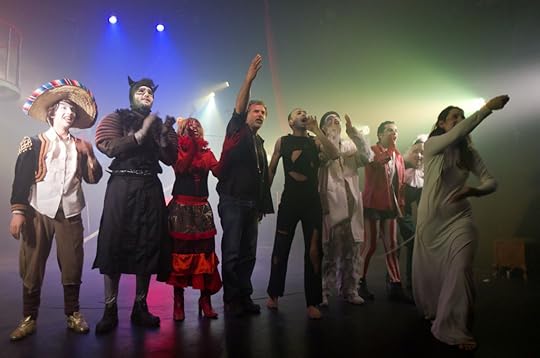
Juliano Mer Khamis with the cast of Alice in Wonderland, his final production at Jenin Freedom Theater
Update: Some have accused me on Twitter and elsewhere of being "irresponsible" for posting this. I assume they can't read headlines, because I printed it as Aki Orr's personal opinion — not mine. And if anyone is entitled to his opinion, it is Aki. He has seen and done more than all of them combined.
Adam at Mondoweiss reminded me about Udi Aloni's excellent review of Juliano's production of "Alice." Read it here.
After the killing of Juliano Mer Khamis, I asked my friend Akiva Orr (watch my interview with him here) to write something about the actor. As an activist and writer since the early 1950's, Akiva got to know Juliano and his mother, Arna. Akiva attended Juliano's funeral yesterday in Kibbutz Ramot Menashe, then wrote me the following:
Sad news
Yesterday the Israeli-Arab actor-director Juliano Mer-Khamis was shot dead by a hooded assassin near his Freedom Theatre in Jenin.
Juliano Mer-Khamis's funeral took place today in Kibbutz Ramot Menashe some 10 feet from his mother's grave (which he designed).
I knew his mother very well.
Arna (1930-1995) was a genuine humanist who could not remain quiet when she saw someone being wronged
It outraged her and she reacted vehemently.
It was a guts response, not a rational response.
Jules took after her but had the added complication that his Dad was a christian Arab (once the leader of the CP in Nazareth) whereas Arna was a secular Jew whose father founded the medical corps in the IDF was a world authority on Malaria, hated Ben-Gurion, and expelled her after marrying an Arab.
Jules had a cultural ID complex which he exploited through art. He was an excellent actor. He acted out his life.
About 800 people attended the funeral, two third Arabs one third Jews.
I met many old friends there.
Nowadays we are too old to meet in demos so we meet in funerals.
An Arab youth choir sang and many people said a few words.
Udi Adiv (who did 12 years in prison for trying [unsuccessfully] to set up a Jewish-Arab Israeli armed struggle group against Israel in 1971) told me he was in constant contact with Jules.
Jules complained about the the arch conservative leadership of the Jenin refugee camp and planned to move to Jenin town, which is more enlightened.
The older generation leadership (50% of the camp inmates are under 20) was worried that the youth followed Juliano and his "Freedom Theater".
He preached freedom not only from Israel, but also from Muslim tradition.
Many young girls, who rebel against the subservient role of women in the Palestinian society, were ardent actresses.
The oldies didn't like the fact that girls appear on stage, have roles, and act together with boys.
The theatre is located inside the camp.
There were two attempts to burn it down.
The latest play Jules staged was "Alice in wonderland"
Most theatres in the West Bank refused to show it because the major role of a clever girl outraged all oldies in the West Bank.
No newspaper in the West Bank mentioned the Alice play.
It seems this was too much for the oldies.
So Jules paid with his life for staging "Alice in wonderland" in Palestine.
He died for the cause of "women's liberation" … which goes much beyond "Palestine liberation."
Too much for some people.
MAY ALICE FORGIVE THE FOLLIES OF THE FOOLS
April 4, 2011
Remembering Juliano Mer Khamis

Juliano Mer Khamis was killed yesterday by a gunman in Jenin. I met him on a number of occasions. He exuded a unique charisma that was bound up with unpredictable rage and spontaneous joy. Gideon Levy has done justice to his legacy in a short but powerful obituary.
My friend Jen Marlowe helped create this video about Juliano's work with the Jenin Freedom Theater. Watching it is all anyone needs to do to understand how much of a void his murder has created:
Juliano's documentary, "Arna's Children," is the best film I have seen about the occupation. There is really no other film that approaches its emotional impact or captures the way in which the trasher of the occupation methodically destroys the lives of everyone in its path — and how those in its way resist it no matter what. So here it is, a testament to the genius of Juliano, the courage of his mother, who founded the Jenin Freedom Theater in 1988, and the humanity of the children of Jenin:
Juliano was born to a Jewish Israeli woman, Arna Mer, who dedicated the last years of her life to challenging the occupation, protesting at checkpoints and traveling to and from the Jenin refugee camp, even while in the terminal stages of breast cancer. His father was a Palestinian Christian bureaucrat, Saliba Khamis, who met Arna in the Israeli Communist Party, which was for decades the only party in Israel that promoted co-existence between Arabs and Jews. Mer and Khamis named their son after Salvatore Giuliano, a strikingly handsome, swaggering Italian bandit who led a small band of landless peasants against powerful oligarchs, earning himself a reputation as "the Italian Robin Hood" and eventual media stardom.
After making Arna's Children and appearing in films like Amos Gitai's "Kippur" (not the best Gitai film but still worth watching), Juliano set out to revive his mother's Jenin Freedom Theater. The theater had been in ruins since the Israeli army destroyed it while reducing Jenin to a post-apocalyptic moonscape of destruction. Once the Second Intifada was crushed, the camp was transformed into a laboratory for Tony Blair and General Keith Dayton's cynical security plan. Now Jenin was ringed by electrified fences, a virtual prison inhabited by thousands of children with post-traumatic stress disorder.
Juliano's return to Jenin was a rebuke to the promise of former Israel Labor Minister Shlomo Benizri to "convert the life of Palestinians into hell," as he restored a creative outlet for a generation the occupation had sought to demoralize and destroy. In turn, he brought young Israelis (including Palestinian Israelis) and international activists over the Green Line to help him build the theater, promoting a model of co-existence based on solidarity with the Palestinian grassroots.
With assistance from Zacharia Zubbeidi, a former leader of the armed insurgency during the Second Intifada, the theater allowed young people from the camp to take aim not only at the occupation, but at the internal problems plaguing Palestinian society. The next Intifada would consist of theater, music, poetry — the struggle of a dispossessed, dehumanized generation asserting itself through culture. That was Juliano's vision.
Through their work in the theatre, young Jenin residents challenged traditions and entrenched social mores like corporal punishment and the relegation of young women to secondary social roles. "For me freedom is the occupation ending and the army leaving," a young boy who participates in the theater said. "But it's also playing snooker and not having anybody hit me."
Juliano's final play, a production of "Alice in Wonderland," was filled with themes and symbols that explicitly challenged patriarchal authority. I wish I had traveled to Jenin with Matan Cohen when he invited me to see the play; the reviews I heard from those who attended it were glowing.
Was Juliano's murder motivated by religious extremism? For now no one knows. The theater has been attacked with molotov cocktails and Juliano has been denounced as a Zionist agent by militant elements. He knew the risks of his work and was committed enough to risk paying the ultimate price.
"At the end, there's a feeling that the spirit [of freedom] is already here, it's already seeded," he said during an interview in Jenin. "And I don't believe that someone or anyone can stop it."
Max Blumenthal's Blog

- Max Blumenthal's profile
- 273 followers

