
Rosanne Dingli's Blog, page 10
March 12, 2011
According to Luke appears on Amazon.com
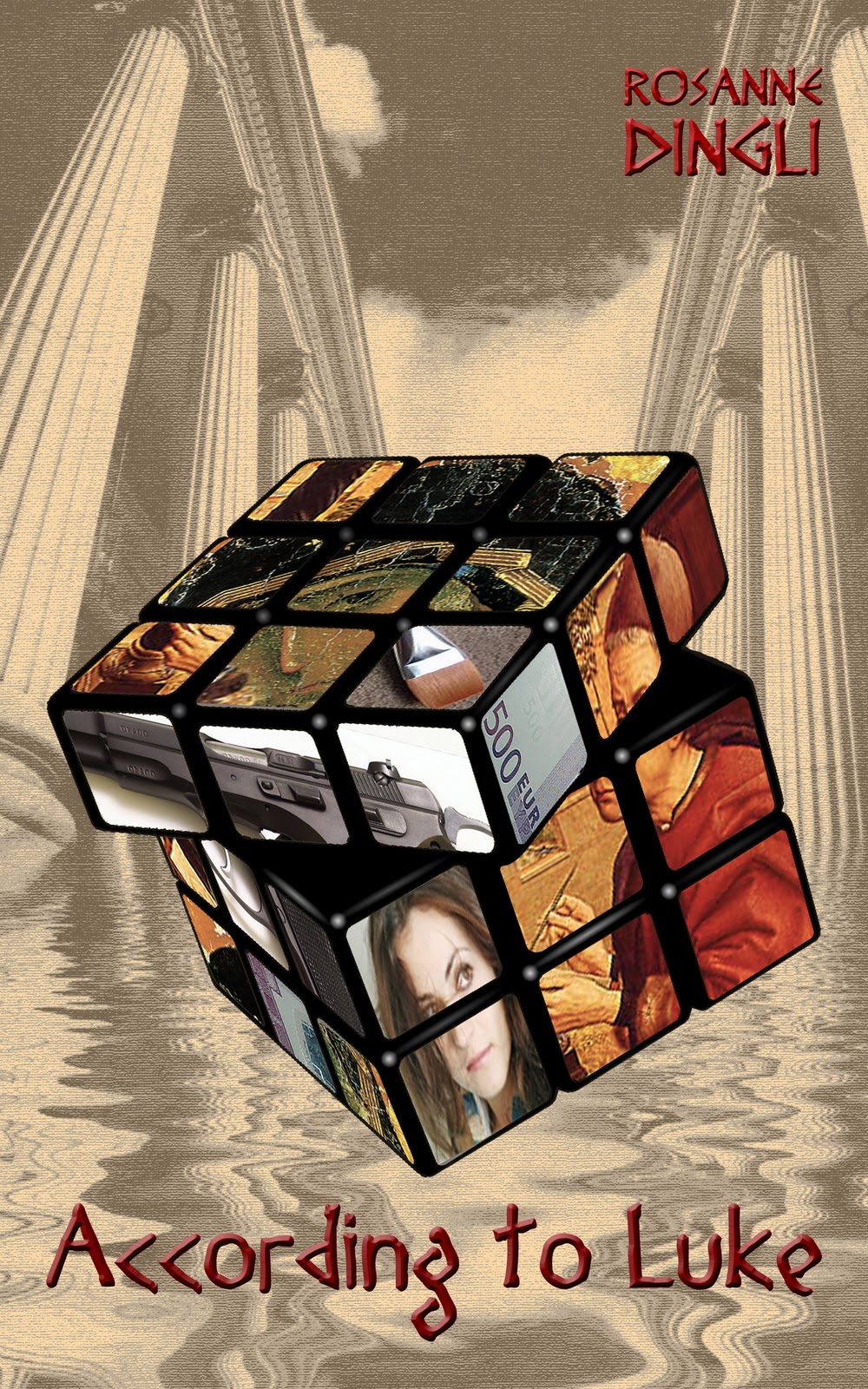 Two or more years' solid work culminates in a great deal of excitement when a book finally emerges into the real world. There! All the agonizing over characters, all the fiddling with plot and sub-plots. All the research into locations, artefacts, scriptures, names and procedures. All the fiddly decisions about adverbs and ellipses.
It has come to fruition, and According to Luke has emerged on Amazon.com
In the coming weeks, it will come up at all the other Amazon storefronts, many online bookstores such as the Book Depository, and the eBook will of course emerge as well. By March 29, the official launch day, it will be everywhere. There will also be a full front page dedication at BeWrite Books, the publishers.
This release sets off a mad media flurry, a number of reviews and interviews, and of course, a physical launch. All will be revealed in due course. I'll be writing about it as it happens.


March 9, 2011
Read an eBook week? Read an eBook YEAR!
 Image via WikipediaEveryone is reading more eBooks. It's a fact. Statistics keep surfacing about eBook sales. Better believe them. It's 2011, and it's happening now.
"...people are not only changing their reading habits – they're reading MORE than ever. That's good news." Neil Marr, BeWrite Books.
BeWrite Books always knew this revolution would come: since forever, they have simultaneously released paperbacks and eBooks for all titles, and the world has gradually caught up with this forward-thinking strategy. What's more, their eBooks are available for all formats, and are DRM free. That means you can switch them from one reader to another, including your phone, depending on where, what and how you want to read. Handy.
So this week, give it a whirl. Try an eBook, because it's eBook week. Try one of mine. Try one of any author's - it's quite an experience to be able to read at any angle, change your font size, change backgound colour, and look up unusual words without getting up from your favourite armchair ... or deck chair ... or bed.
One of the best things about eBooks is that they're green. No trees are sacrificed. Rather less energy goes into their making than any paper book. True, they are different, but never fear, paper books won't disappear that quickly. The zip did not kill the button, and the ballpoint pen did not kill the pencil. The tin can did not kill the glass jar. We have discovered, as inventive humans, that devices can live side-by-side.
Do it this week. Everyone's doing it (I know, because my eBook sales are going up).
Then answer this question: how do you think eBook reading will affect what, when and how often you read?


February 23, 2011
Where authors get their inspiration
Every now and then, I get visually inspired. It does not happen often, but it did just now, and I must tell everyone. I used to think I was only inspired by words. Most of my writing came from a line or two I read somewhere, or something somebody said.
I can write whole chapters from a line I find in a magazine, a poem, or even an advert. I don't use the words themselves, but they are what opens the floodgates for thousands of more words to come into my head. No, not even my head... sometimes I feel they are in my fingers, and just get typed out.
Today, a strange thing happened. I saw a picture by Rembrandt called The Philosopher's Meditation. It is one of those rare pictures of that great master's that are not very well known. Most people can conjure a mental picture of his self-portraits, but this one is a rare one. And it immediately gave me a trigger, a flow of words that would just come if I let them. I'll let them presently, after I finish this.
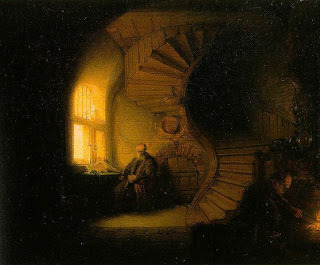 So please, imagine me writing, writing, writing - and have a look at what set it all off. Those stairs - those spiral wooden risers and treads - are so Dutch. One can imagine the tall narrow house in which they serpent upward and downward. It's a mysterious painting, and no doubt the piece I write will try to convey that sense of mystery. The sense of those times when nightfall brought the necessity of lighting one's way. The failing light coming through the window makes the woman on the right stir the fire and soon, she will be lighting yellow candles that smell of tallow and beeswax.
I must stop right there... this is not the right place to put it all down. Watch this space, and I shall tell you if I got anywhere with this visual prompt.
And do let me know what sets you writing. Are you blessed with visual ability, a nice link between your eyes and your creative brain? Or do you need music? Smells and tastes, we know - not only from Proust - are very powerful triggers. What are yours?


I can write whole chapters from a line I find in a magazine, a poem, or even an advert. I don't use the words themselves, but they are what opens the floodgates for thousands of more words to come into my head. No, not even my head... sometimes I feel they are in my fingers, and just get typed out.
Today, a strange thing happened. I saw a picture by Rembrandt called The Philosopher's Meditation. It is one of those rare pictures of that great master's that are not very well known. Most people can conjure a mental picture of his self-portraits, but this one is a rare one. And it immediately gave me a trigger, a flow of words that would just come if I let them. I'll let them presently, after I finish this.
 So please, imagine me writing, writing, writing - and have a look at what set it all off. Those stairs - those spiral wooden risers and treads - are so Dutch. One can imagine the tall narrow house in which they serpent upward and downward. It's a mysterious painting, and no doubt the piece I write will try to convey that sense of mystery. The sense of those times when nightfall brought the necessity of lighting one's way. The failing light coming through the window makes the woman on the right stir the fire and soon, she will be lighting yellow candles that smell of tallow and beeswax.
I must stop right there... this is not the right place to put it all down. Watch this space, and I shall tell you if I got anywhere with this visual prompt.
And do let me know what sets you writing. Are you blessed with visual ability, a nice link between your eyes and your creative brain? Or do you need music? Smells and tastes, we know - not only from Proust - are very powerful triggers. What are yours?
February 19, 2011
How to learn from other writers
You get to the point, as a writer, where you feel a bit jaded. You feel you have jumped through so many hoops that it's started to irk. You feel you have seen every version of a sentence... and daily writing starts to feel like a sentence. Of a very imprisoning kind.
 ANZauthors websiteThen you do something on a pure whim, and you are on a learning curve again. It happened this week. I volunteered to set up a website for the members at ANZauthors, a Yahoo discussion group that has been going strong for many years now. From the minute I dusted off my HTML tools, I started to learn. Not about how to make a website - I do it the easy way, and Yola helps with that. No, no - I started to learn from my writer friends. It was a refresher course in a way: a reminder about versatility, determination, novelty and guts.
Guts? Oh yes - one needs guts to be an author, especially today. My colleagues on ANZauthors showed me better than ever before how there are more than a dozen ways to approach the world of publishing. How one can never stop learning. How it's vital to understand what readers want. How one can never let go of empathy, understanding, generosity and purpose. How small egos matter in the world of big ideas and big money. How technology is a tool rather than an enemy. How family features in what a writer thinks and does.
I think I learned more this week than I had in the whole preceding year, and it's bound to get into my writing. It is bound to affect how I think about the human condition. As I slowly put the site together, I read each individual author's biography, blurbs, and helpful articles for writers, and I picked up tips any jaded writer would do well to read.
I learned how sometimes, being an author is something some people do DESPITE what is happening in their lives, to their families, or to their health. I also learned that some books are written BECAUSE of what some writers have experienced in a first-hand way. It is amazing how much fiction can come from a set of very real circumstances.
All the authors at ANZauthors are very busy people, and between them, they have published a number of great books (yes, and a great number of books). Do visit the new site: ANZauthors and witness, as I did, the incredible creativity that comes from applied determination, talent, and inspiration, which amounts to a lot of very hard work.
Let me know what you think below. What ingredients do you think are invaluable to an author?


ANZauthors websiteThen you do something on a pure whim, and you are on a learning curve again. It happened this week. I volunteered to set up a website for the members at ANZauthors, a Yahoo discussion group that has been going strong for many years now. From the minute I dusted off my HTML tools, I started to learn. Not about how to make a website - I do it the easy way, and Yola helps with that. No, no - I started to learn from my writer friends. It was a refresher course in a way: a reminder about versatility, determination, novelty and guts.Guts? Oh yes - one needs guts to be an author, especially today. My colleagues on ANZauthors showed me better than ever before how there are more than a dozen ways to approach the world of publishing. How one can never stop learning. How it's vital to understand what readers want. How one can never let go of empathy, understanding, generosity and purpose. How small egos matter in the world of big ideas and big money. How technology is a tool rather than an enemy. How family features in what a writer thinks and does.
I think I learned more this week than I had in the whole preceding year, and it's bound to get into my writing. It is bound to affect how I think about the human condition. As I slowly put the site together, I read each individual author's biography, blurbs, and helpful articles for writers, and I picked up tips any jaded writer would do well to read.
I learned how sometimes, being an author is something some people do DESPITE what is happening in their lives, to their families, or to their health. I also learned that some books are written BECAUSE of what some writers have experienced in a first-hand way. It is amazing how much fiction can come from a set of very real circumstances.
All the authors at ANZauthors are very busy people, and between them, they have published a number of great books (yes, and a great number of books). Do visit the new site: ANZauthors and witness, as I did, the incredible creativity that comes from applied determination, talent, and inspiration, which amounts to a lot of very hard work.
Let me know what you think below. What ingredients do you think are invaluable to an author?
February 8, 2011
Publishing with CreateSpace
Publishing is getting easier and easier. Writers everywhere are discovering that the interface between them and their readers is now more direct. It is possible to build a readership without the traditional expedients of agent or publisher.
 Even for traditionally published authors, this new directness has a number of benefits and possible uses. Out of print volumes can be resurrected, and short pieces can be published in slim volumes that used to be commercially not feasible.
For these easily-managed books, an author can resort to putting out self-published editions that do surprisingly well for some. Using CreateSpace, which is the self-publishing arm run by Amazon.com, is one option. Having tried it myself for a small volume, I can say that the experience is not unpleasant.
I took a novella, which I had already made available as an eBook, and added four bonus short stories which were compatible in theme, tenor and narrative style. I then spent a lot of time formatting the text and illustrations on MSWord. (I use the 2010 version). Using the page size I chose on CreateSpace, I worked to get each page as close to perfect as I could. I read advice about fonts, margins, using pictures and pagination on various sites I googled. There is a lot of information available, and most of it is useful. I then converted the pages into PDF format using the 'Save As' facility in Word. It worked! Proofing the PDF is essential: I had to do the conversion process three times before I was happy with the result.
 Designing the cover was also pleasantly simple. I chose one of the templates at CreateSpace and personalized it using the number of options offered. It took time, because I wanted a cover that would be compatible in colour and character with my other books.
I then let everything rest for a day, for two reasons. One was a raging head cold. The other was the necessity of viewing the manuscript and the cover with a fresh eye. Needless to say, I discovered half a dozen errors I could not have picked with streaming eyes, between sneezes. A pair of tired eyes 'used' to a manuscript will see what they want to see, not what's actually there.
I spent an enormous amount of time reading the benefits and disadvantages of self-publishing with Amazon's CreateSpace. It is not for every author, neither is it for every book. Decisions must be made about pricing, distribution and management of sales - not to mention royalties and taxes - that could be different for each individual book. So what seemed beneficial for me, and the title I was working with at the time, might not apply to my next book, or to another writer with a similar book. Each title must be considered carefully.
That is part of the advice I have that comes from my experience. Authors need to examine the benefits and options available, and apply them to each single and individual title. There are disadvantages tied in with every single choice one makes. Sometimes they are negligible, sometimes considerable. Caution, and reading fine print, are recommended. Just because I chose CreateSpace this time, for this title, does not mean I can do it again without thinking, for another book.
An author needs to ask: What do I want for this book? Who do I think will read it? Is it a book I want to make money from, or is it a potboiler? Does this kind of distribution fit my needs, and access my audience, wherever I think it is? Is tax an issue?
 The so-called revolution in publishing is doing a number of things. It is separating the concept we had of 'the book' into at least three streams. Books ain't books any more, just as oils ain't oils. All authors and readers ought to examine what they think they know, and how they think it's all changing, and take each step in the publishing journey as carefully as possible. The mistakes one makes can be written up as experience, because there is a lot to learn.


 Even for traditionally published authors, this new directness has a number of benefits and possible uses. Out of print volumes can be resurrected, and short pieces can be published in slim volumes that used to be commercially not feasible.
For these easily-managed books, an author can resort to putting out self-published editions that do surprisingly well for some. Using CreateSpace, which is the self-publishing arm run by Amazon.com, is one option. Having tried it myself for a small volume, I can say that the experience is not unpleasant.
I took a novella, which I had already made available as an eBook, and added four bonus short stories which were compatible in theme, tenor and narrative style. I then spent a lot of time formatting the text and illustrations on MSWord. (I use the 2010 version). Using the page size I chose on CreateSpace, I worked to get each page as close to perfect as I could. I read advice about fonts, margins, using pictures and pagination on various sites I googled. There is a lot of information available, and most of it is useful. I then converted the pages into PDF format using the 'Save As' facility in Word. It worked! Proofing the PDF is essential: I had to do the conversion process three times before I was happy with the result.
 Designing the cover was also pleasantly simple. I chose one of the templates at CreateSpace and personalized it using the number of options offered. It took time, because I wanted a cover that would be compatible in colour and character with my other books.
I then let everything rest for a day, for two reasons. One was a raging head cold. The other was the necessity of viewing the manuscript and the cover with a fresh eye. Needless to say, I discovered half a dozen errors I could not have picked with streaming eyes, between sneezes. A pair of tired eyes 'used' to a manuscript will see what they want to see, not what's actually there.
I spent an enormous amount of time reading the benefits and disadvantages of self-publishing with Amazon's CreateSpace. It is not for every author, neither is it for every book. Decisions must be made about pricing, distribution and management of sales - not to mention royalties and taxes - that could be different for each individual book. So what seemed beneficial for me, and the title I was working with at the time, might not apply to my next book, or to another writer with a similar book. Each title must be considered carefully.
That is part of the advice I have that comes from my experience. Authors need to examine the benefits and options available, and apply them to each single and individual title. There are disadvantages tied in with every single choice one makes. Sometimes they are negligible, sometimes considerable. Caution, and reading fine print, are recommended. Just because I chose CreateSpace this time, for this title, does not mean I can do it again without thinking, for another book.
An author needs to ask: What do I want for this book? Who do I think will read it? Is it a book I want to make money from, or is it a potboiler? Does this kind of distribution fit my needs, and access my audience, wherever I think it is? Is tax an issue?
 The so-called revolution in publishing is doing a number of things. It is separating the concept we had of 'the book' into at least three streams. Books ain't books any more, just as oils ain't oils. All authors and readers ought to examine what they think they know, and how they think it's all changing, and take each step in the publishing journey as carefully as possible. The mistakes one makes can be written up as experience, because there is a lot to learn.
January 28, 2011
Vision or Delusion
 I have done something I have always wanted to do: upload an eBook at Amazon.com. It was not as complicated as it might have been. Not fiddly at all. The Kindle guys have made it rather simple, and anyone can do it. It's a historical novella based on the history of photography in Belgium, titled Vision or Delusion. I researched it a long time ago, and it has undergone a number of rewrites.
Now that it's up and selling, I can sit back and think of other books I might put up. I have three collections of short stories whose rights have reverted to me, since they went out of print. But who buys and reads short stories these days? Well, apparently quite a few people. They go nicely with the eBook concept of being able to read a whole discrete story in one sitting.
It would be nice to hear from writers and readers alike what they think of short stories. What is the ideal number of stories to put in a collection, for example - and should they be thematically linked?
If you are a reader, tell me whether short stories are your thing. If you write, let me know whether literary short stories still go down well. Is there a readership for them?
You can also give me your opinion about my latest venture - do you like the cover of Vision and Delusion? Have you been to visit its page at Amazon.com?

January 16, 2011
How to Start A New Novel
 There is no easy way to start writing a new book. It is made even harder if the author embarks on a new project immediately after successful submission and acceptance of a book. With fiction especially, but even I suspect with factual material, the most recently finished book is still too fresh in one's mind.
When it is fiction, the characters and locations which were worked on so diligently keep coming back to mind. It is almost impossible to set them aside and start on new protagonists in a new place, with a brand new story and a feasible plot. How does one take up a whole new premise... just like that?
 Perhaps there are ways. It helps to start on a batch of research, because very often, inspiration, fascination and absorption come from there. There is nothing like researching a new location, for example - one where the author has been, but about which there is so much to delve into. It must ring true to the reader, so maps, guidebooks and pictures must be sought.
There's also the protagonist around whom the whole story is going to revolve. Male or female? Experienced or naïve? Good looking or homely? An author can spend literally hours dreaming up a character - and a novel needs several. True, they do not all need to be sketched finely, but they need some faceting.
What about a premise that can be put into one sentence? This is sometimes impossible early in drafting. A writer needs to chew at least four yellow pencils, eraser and all, before a strong premise unearths itself.
Then there's the story. Start at the beginning and work chronologically? Weave in a couple of flashbacks? How is the plot going to warp and weft through the narrative? The author must think up a number of devilish delays and devious devices. [I must stop that before I use all my Ds.] There must be intrigue, deception, heartbreak, confusion, and anticipation. And a few more sentiments thrown in for good measure.
A good way to start is to devise a plan - not necessarily an outline, but an author's plan. The first step in any plan is to make a decent list. List a plan of action. Make as few decisions as possible at this stage. Number one on the list could be: I must put myself in inspiring places and situations. Or, I must read inspiring material. Or, I must stay away from works in the projected genre (or the opposite).
 Inspiration comes in the form of words for me. A sentence can give me a story. A simple adjective can give me the personality of a bit player. A proverb can give me a premise. Other authors are inspired by pictures: a divine sunset, a yacht in full sail, a kookaburra with a worm in its beak. Or perhaps sounds: a car door slamming, a tap dripping, or the thrum-thump of an unwelcome teenagers' party next door.
The nice thing about sounds and pictures is that they punctuate streaming thought. They are like commas in the head. That is why I often put them into my narrative: they break up the monotony quite nicely. A bell rings, birds' wings flutter, or cutlery clatters against plates. Atmosphere is about one-fifth sounds.
Atmosphere! How does an author create that? With great difficulty and a lot of peace and quiet. Even to create a scene of chaotic confusion, such as a fist fight in a noisy warehouse full of buzzing forklifts, an author needs peace and quiet.
Concentrating about all these ingredients and strategies, devices and methods does have the ability to dim the long-lasting aftertaste (or afterglow if it was accepted) of the most recent book. A fresh place must be found from which to spring. It often takes organisation and stealth to find it.
I would love to hear how other authors manage to mentally leave their last book behind, and embark on a new one.


