Audrey Kalman's Blog, page 20
December 6, 2011
Why I don't write mysteries
As you'll recall from English class—or, as they like to call it now, at least until high school, "Language Arts" class—fiction has two major elements: character and plot (yes, style and point-of-view matter also, but today I'm talking about the two biggies).

What lurks beneath?
My major shortcoming as a writer, which also could be thought of as my major strength, is that I adore language—the power words have to evoke a feeling, to transport readers to another state of being and connect with the mysteries of the deep—while I detest plotting. Note that I did not say I detest "plot," for I love a good yarn, a well-plotted tale, one that keeps you going from page to page until the end. What I hate is wrestling with plot in my own work.
Consequently, my plots arise organically. I know it's ideal for plot to develop directly as a direct result of who the characters are. This method, however, can be tedious for the writer, involving many false starts and often requiring excision of great swaths of well-written prose that take the book nowhere.
At this point in my new novel I find myself at the uncomfortable juncture of not being able to write any more. It's not that I have writer's block. The problem is that I don't have the details on which to hang my words. I sit down to write and a passage find myself stuck asking "When exactly did he live in New York City? What does he do every day? What were the big cultural changes going on when she was growing up?"
So for now, instead of devoting my daily writing time to writing, I am devoting it to research and plotting.
It's frustrating, since all I want to do is pour out the words, connect with that cosmic energy that seems to fuel the best writing sessions. Instead I'm reading (currently Sisterhood Interrupted, by Deborah Siegel, for background on the women's movement in the '60s, '70s, and '80s) and trying to find a doctor who will talk with me for a little while about what it's like to be an anesthesiologist. (Any anesthesiologists out there reading this, please get in touch.)
Thankfully I've been through this before and have learned some patience. I know eventually I'll return to the fun part: putting the words down. I'm thankful, too, that I have chosen a genre that is compatible with my work style. I can't imagine the torment of having to figure out each twist and turn of the plot in advance of actually doing any writing. For me, the most satisfying mystery is not "whodunit?" but "what lurks beneath?"
Ruth Rendell* and Robert Parker*, your careers are safe.
*Two of my favorite mystery writers.



November 30, 2011
"Enter to Win"
After weeks of feeling as if I've been spinning my wheels in the publicity department, I'm starting to get a little traction.

© Paweł Szpytma | Dreamstime.com
I had joined Goodreads several months ago, in a tentative kind of way. I added Dance of Souls (so it would be there!) as well as some books I've enjoyed reading. This morning I discovered Goodreads' Author Accounts. Further, I discovered that it's easy to set up a book giveaway, which I've just done. If you'd like a free copy of Dance of Souls, you can check it out and enter to win. This may help in my quest for reviews, since it's suggested (though not required) that recipients of the free book write a review.
I also joined a Ning group, Bookblogs. I'm less sure about this, since many of the members and bloggers seem to lean toward the young adult, paranormal, and romance genres. It also seems a bit on the self-promotional side; for example, as soon as I joined I received "welcome" e-mails from several members saying hello and offering links to their book web sites and blogs. But I guess that's the way it works–you mention my book in your blog and I'll mention yours.
Needless to say, all this has been a bit of a distraction from the novel currently underway. If only there were a contest for working writers whose prize would be a fully realized set of characters and a compelling plot.



November 29, 2011
Cold turkey
The night before Thanksgiving, I pounded out a blog entry that I held off on posting. I was pretty ticked when I wrote it and I've discovered it's best not to share what you write (or say) in a moment of heat (I'm working on the keeping my mouth shut part).
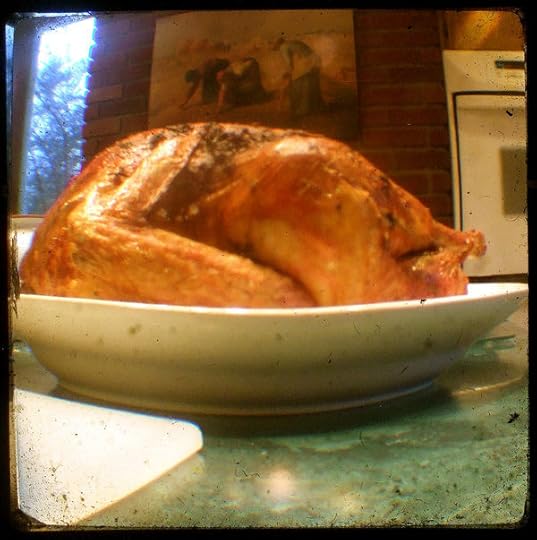
Now that most of the turkey, the thanks, and the weekend of mad consumerism are all behind us, I have revised the post, retaining the ideas, excising the vitriol, and reflecting on just what led me to get so angry.
For the past few weeks, as I mentioned in my post about paying for reviews, I have been diligently searching online for places/ways to publicize "Dance of Souls." Many of the links are dead ends, leading to content or opportunities that no longer exist. Many are not related to literary fiction. Many are interesting but when I click down to find out how to submit a book for review, I get to something like the FAQ from Mark Athitakis's American Fiction Notes, wherein he states unequivocally that he does not review self-published books and goes on to explain: "One must draw the line somewhere, and I'm drawing it there. I've tried, honest, but I've yet to encounter a self-published book that held my interest more than it loudly broadcasted its failings."
These, I'll admit, were the sentences that caused my hackles to rise.
Never mind what I initially wrote in response. I do understand why reviewers have to draw a line somewhere. Even I can see that the world of self-publishing is filled with loads of dreck, just as the Internet is filled with scams, bizarre ideas, and things that are downright dangerous. (Though I couldn't help thinking, in the case of the book reviewer, that perhaps the reason he hasn't yet encountered a self-published book worth reviewing is that he doesn't read them any more.)
Then I recalled a conversation I'd had with a friend earlier in the day. She asked how things were going with my book. I told her it was hard to find time to do all the necessary marketing activities and that many of them required money I wasn't sure I wanted to spend. "That's interesting," she said. "So, maybe the books that get published and sell well aren't necessarily better, they're just marketed better."
Bingo.
Juxtaposing her musing with my response to the reviewer's blog made me realize that what I'm really upset with is not the beleaguered book reviewer trying to keep from drowning in a sea of bad prose. I am angry at a world that doesn't consistently reward intelligence, talent, hard work, or skill–or recognize good writing. I'm angry that just because a book has been published by a major publishing company doesn't mean it's good, and I'm angry that the corollary is also true: just because a book hasn't been published by a major company doesn't mean it's bad.
And now we have arrived at the heart of my emotional reaction. To judge another's writing implies that there is an ultimate standard against which one measures "art." I've always been uncomfortable with that idea, believing (as the good moral and cultural relativist my parents raised me to be) that our upbringings and the times we live in necessarily color our values. I'm upset because I can't have it both ways. I can't live in an egalitarian world where everyone gets to have their say and also in a world that recognizes and rewards greatness.
The best revenge upon reluctant reviewers would be to become, like J.K. Rowling or Amanda Hocking, a runaway success. Yet that seems far from something I can simply decide to do. So here I sit, unreviewed, contemplating the last of the cold turkey in the fridge and wondering if it might taste better with a little revenge on the side.


November 21, 2011
Amazing new technology allows author to time travel!
I'm not yet ready to share many details about my new novel, but I believe I am over the first writing hurdle. I have passed that "stuck" place, usually occurring after about 50 pages, when the bloom is off the rose, so to speak, when the initial excitement of starting something new disintegrates into the drudgery of going back day after day and trying to figure things out. No–drudgery is too harsh a word; routine is more like it.
This book is taking me places I hadn't thought I would travel: to New York State in the 1970s and the nascent abortion rights movement; to a claustrophobic house in Streetsboro, Ohio; to a bonfire at Ocean Beach. The characters are making themselves known to me gradually, as if walking toward me across a field of fog. Some of them I embrace when they arrive. Others I wish would just turn around and walk away.

The house I grew up in, circa 1949 (before I grew up in it), available via a good old-fashioned method of time travel: the photo
My exploration of so many of these places would not be possible without two of my trustiest tools: Google (especially Google Maps) and Wikipedia (that's why I just donated to the fundraising campaign to help support Wikipedia).
There's part of me that feels a tad uncomfortable with this. Research that once would have required endless hours scouring the local library's card catalog (does anyone remember that?) and searching the stacks can now be done with a few keystrokes. Wondering when abortion became legal in New York? Just type a few words and scan the results. And we're not talking fly-by-night, suspect information here but solid sources, such as an article in New York Magazine. Wondering what the street looks like where your character lives? Type in an address, then switch to Street View. There you are, looking at the front door. Wondering what it's like to be a trucker? Take a look at the Wikipedia article on the U.S. trucking industry.
My discomfort is tempered by a belief that no amount of Googling will replace the writer's imagination or the ability of a well-crafted piece of prose to paint a picture of what it's like to be another person. I remain thankful that this research helps me fill in the details that bring the characters alive. It allows me to visit more locations, more quickly, than ever before–and it allows me to time travel!
All this adds up to stories far richer and more nuanced than they might otherwise be. And that must be a good thing.


November 14, 2011
Review-on-demand: judging the worth of a paid book review
Most of the time, the amount you pay for something is roughly commensurate with its value—or its perceived value.
A few very valuable things, however, you can't pay for (hence the aphorism, "The best things in life are free"). Into that category I now place book reviews.
 I would love nothing more than to have Dance of Souls reviewed by Janet Maslin of The New York Times or in The New Yorker. But who am I kidding? The chances that either of those publications, or a similar a venue like The New York Review of Books or Publishers Weekly, would consider reviewing my book, are about nil.
At the same time, I have found no shortage of places that will review self-published or print-on-demand books. Feathered Quill Reviews, Get Book Reviews, and Review the Book are more than happy to review my book—for a price. So, by the way, is Publishers Weekly, via Publishers Weekly Select, a pay site begun in response to the increasing popularity of print-on-demand books.
And herein lies the rub. What is the worth of a paid review?
To be honest, the payment is not explicitly for the review; it's to cover the costs of the web site so it can solicit and manage reviewers and post the reviews. But in my mind, at least, the value is diminished by the payment. If I have to pay—if any old body can pay—to get a review, then the review ceases to be about who has written a review-worthy book and becomes instead about who is willing to shell out some cash to get their book into the hands of a person who will write about it.
I'm painfully aware that this may be the only way I ever get my book reviewed. There simply isn't a formal channel for self-published authors to reach the major media outlets, though it sometimes it happens by luck and pure happenstance. I also realize that I have no right to complain. I chose to go outside the system and now I'm stuck here.
I haven't yet ruled out paying for reviews, but I'm doing my homework first, trying to figure out exactly where to put my energy. When I decide, I'll let you know.
P.S. The subject of reviews on Amazon.com is a topic for another blog. In the meantime, if you have read Dance of Souls and want to post a customer review on Amazon, please do!


November 7, 2011
A ship on the capricious sea: why I write
Someone I knew long ago suggested that the things we feel most repelled or unsettled by are the very things we should pursue. (I never figured out whether this person—a man—was genuinely attempting to share his wisdom or was trying to manipulate me into having a relationship with him. Either way, I was far too young at the time to appreciate his wisdom or relate to him as anything approaching an equal.)

In case you can't read it, the name of this boat is "The Anxiety." How fitting.
However, his idea returned to me this week as I found myself wandering in the undifferentiated soup of my new novel and wondering: why do I choose to torment myself by writing another novel? I have no cadre of readers eagerly awaiting my next book, no contractual obligation to a publishing company, nor even a naggy companion nudging me. And yet I try to carve time each morning to swim in this primordial stew of characters, plot, and structure.
I do it partly because—believe it or not—it's fun. In the same way some people enjoy Sudoku or crossword puzzles, I enjoy the challenge of seeing if I can solve the problems of the book in a satisfying way. But there's more to it than that, because writing is also agonizing.
The agony is both symptom and cure. I write because the process of writing throws me into one of the states of being I find most distressing: uncertainty. After all these years, I have finally embraced that long-ago suggestion to dive headlong into what makes me most uncomfortable, in this case, writing.
And each time I do, I find myself a little more at ease with the idea of not knowing what is going to happen to my characters or how I am going to resolve their conflicts… and a little more at ease as the "author" of my own existence, with an equal degree of uncertainty about—and much less direct control over—the vicissitudes of life. It's an ease sought after by one of the characters in Dance of Souls, Amy, who feels that even if she lived to be a hundred—and perhaps especially then—she would never get over her fear of death. She addresses it by creating sculpture; I address it by writing, and we are both a little freer as a result.


November 2, 2011
What do you love about reading fiction?
If you had asked me when I was in college or graduate school what I liked about writing, I would have said (a bit stuffily, I admit), "language." I didn't mean the language of R-rated movies but the language of William Faulkner or Jorge Luis Borges. I loved the complex ways the words fit together, the layers of meaning, the density of the prose.
If you ask me now what I love about writing—and reading—I will unabashedly say, "the stories." Though I do still appreciate a good turn of phrase, I no longer enjoy words just for words' sake. I want them to speak to me. Really, this is part of the age-old war between high culture and low culture, between art for the elite and art for the masses, a battle in which I'm idealistic enough to believe there's a middle ground.
The shift in my thinking became clearer over the last few weeks as I spent time reading a fellow author's manuscript. Her book is of a genre—young adult fantasy—that I don't usually read. And yet, by the second chapter, I was captivated. Had my younger self been reading, she no doubt would have deconstructed the sentences and would snootily have huffed that they were rather ordinary. Luckily, my older self was doing the reading. She was immediately drawn in to the lives of the characters, feeling affection for them and wanting to know what would happen to them next.
Rather than aspiring to be a writer, I now aspire to be a storyteller. That doesn't mean I need to write cliché-filled pulp or that my books must be filled with nonstop action, but it does mean I pay close attention to drawing readers in and giving them something to look forward to on every page.
What do you love most about reading? Take the poll:
View This Poll



October 25, 2011
Mishmash or Mischmetal?
Last week, while closing my eyes for a moment and waiting for a client's baby to be born, (for those of you who might not know, my day job—or, more aptly, night job—is that of birth doula here in the Bay Area) I had two inspirational ideas for my novel-in-progress.

Mishmash from the junk drawer: resembling my life
Reflecting on that moment of inspiration, which happened far from my desk, got me thinking about my life, which often feels like a mishmash. Here's a short list of what I might be doing in a typical week: attending births, following up with clients who have had babies, answering questions about breastfeeding, marketing my doula business, working on my next novel, critiquing fiction for my monthly writers' group, marketing my current novel, planning marketing communications for my consulting client… oh, and don't forget making sure everyone in my family is fed, overseeing homework, chauffeuring kids to activities, and, if I'm lucky, finding a few minutes to chat with my husband.
I am often surprised at how many passions I have been privileged to pursue. For a long time after I quit corporate marketing I thought I would leave that life forever; instead I continued that career (as a consultant) and added my birth doula career to it. Writing, my first true passion, has been with me since before I thought of the word career.
These assorted activities have come to seem not so much a mishmash as a mischmetal, a term Wikipedia defines as "an alloy of rare earth elements in various naturally occurring proportions." This fits much better than "mishmash," with its implication of chaos. The elements of what I do have been mined from my deepest self and alloyed over the years into this thing I call "my life."
For a writer, having a calling beyond writing can be a good thing. It keeps one fresh, keeps the mind from becoming too tangled in the minutiae of language, and yields a perspective that might be unavailable to an academic or someone who spends most of the day writing. (Wallace Stevens–lawyer/insurance executive and poet–has always stuck in my mind because of the seeming dichotomy between his two pursuits.)
My non-writing pursuits keep me constantly yearning, when I'm kept from my desk, to get back to the keyboard and write–and yearning is a great motivator.



October 19, 2011
The math of publishing—authors and independent bookstores on the same page
Yesterday, I visited Kepler's Books in Menlo Park, a wonderful local bookstore that, thanks to community support and local investment, came back to life after being shut down in 2005.
I was thrilled to discover that Kepler's had ordered several copies of "Dance of Souls" at the request of a local book club, which has chosen the book for its November selection.
In addition to the satisfaction of knowing the book would be in the store, I was thrilled to find out that it actually is available to bookstores to order through Ingram, the large book distributor. This means any bookstore that orders through Ingram now has access to my book. (This in itself is good to know; it has been hard for me, as a CreateSpace author, to determine whether the book was orderable. CreateSpace says only that "It may take up to six weeks for your title to begin populating in the distribution outlets you select," but doesn't notify you of availability.)
This morning, with mild trepidation, I posted a note on the Dance of Souls Facebook page about the book being available at Kepler's. Why the trepidation? Because despite my desire to support local bookstores, doing so comes at quite a hefty price to me as an author. Without going into great detail, suffice it to say that the royalty percentage degrades quite quickly the further away an author gets from orders made by buyers clicking directly through the CreateSpace eStore. The royalty I get when the book is ordered through Amazon is slightly less, but still respectable. By the time we get to the Ingram-purchased books, the royalty is down in the 6 percent range.
But the more I thought about it, the more okay I was with sending people off to the bookstore if that's where they want to buy the book. Six percent may seem paltry, but in fact it's not much less than authors have always received when publishing in the "traditional" way, especially if literary agents are involved.
 The bottom line: selling more books is better than selling fewer books. Since I don't have a direct channel to hundreds of thousands of potential readers who can order directly from the CreateSpace eStore, I'm willing to give up a percentage of potential royalties in exchange for the possibility of reaching more readers (e.g., I'd rather have 6 percent of 100,000 than 50 percent of 10,000).
This bottom line puts me and the independent bookstores on the same page. So by all means, go to your local independent bookseller (Newpages.com provides a handy listing) and request that they stock their shelves with "Dance of Souls."


October 14, 2011
Fiction, like beauty, is more than skin-deep
I don't wear makeup. That simple fact will save me, according to a 2010 survey, $13,000 over my lifetime.
Of course that makes me feel virtuous, as if I am not wasting time or money on something superficial and largely superfluous. But recently I've had some stabs of guilt over my chosen avocation—fiction writing—which will eventually, I hope, become my vocation.
Is fiction superfluous?
Especially now, when the down-and-out are finding their voices and occupying Wall Street, when my good friend Jennifer Browdy de Hernandez devotes herself to teaching and to waking up the world through her blog, Transition Times… isn't it just a bit self-indulgent for me to spend hours each day pondering the lives and fates of people exist only between my ears?
Here's the argument for why I believe, deep down, that fiction is neither superfluous or self-indulgent.
While I am not about to elevate myself to the height of such literary lions as Charles Dickens, Upton Sinclair, Harriet Beecher Stowe, or Margaret Atwood, there is no doubt that works of fiction can change the world. And becoming a well-known author gives you a platform for discussing issues that you might otherwise never be able to bring up. Just look one of my favorite authors, T.C. Boyle, and his books such as The Tortilla Curtain (illegal immigration) and When the Killing's Done (the environmental).
It's not always necessary to take our social and personal reform as dry, academic medicine. Sometimes we can take it in the form of a juicy, well-told story, and that's what I'm aiming for with my writing.
In the meantime, I can take the $13,000 I didn't give to the cosmetics industry and donate it to a worthy cause.