Audrey Kalman's Blog, page 17
May 2, 2012
Stepping in it, OR Further adventures in Facebook
I was so optimistic after posting about My Big Fat Platform Mistake a few days ago. I was all set to change “Dance of Souls” to “Audrey Kalman-Author” on Facebook and fix my mistake. Look, it says right here I can do that:
I forgot one very important thing. I also have a Facebook URL for the page. And that cannot be changed:

“We’re sorry for the inconvenience,” Facebook says.
Me too. As a result of attempting to make sound decisions about marketing my book and myself as an author, I now feel:
1) Stupid. I made assumptions (and statements about what I would do) based on incomplete information. Worse, I did it on my blog for the whole world to see. Thankfully I have forgiving blog followers, but who enjoys feeling stupid?
2) Paralyzed. Given the latest information, I resigned myself to the fact that my Dance of Souls Facebook page will remain Dance of Souls. I will continue to feed my blog posts to it and gather Likes. I decided that when my work-in-progress is ready for public consumption in some form—but before it’s formally published, in order to begin the all-important platform building—I’ll start using an author page.
Then I thought: perhaps I should at least create my author page now, just to have it. Easy enough: a few clicks and I’ll be there.
I got as far as this:

and there I stopped. Look what it says: “Once this is set, it can’t be changed.”
Hence my paralysis.
What if I make a mistake again? What if I am missing some big marketing/branding/platform “aha,” which I discover only six months from now?
Split-second decisions with life-altering consequences!
It sounds so irrevocable. Really, in this age of casual typing and twittering, you’re telling me that I am about to do something that can’t be undone? How is this in keeping with the free creative spirit of the Internet? Worse, it’s presented with none of the gravity of the decisions of old. This is as monumental as setting type and starting the offset presses rolling. But at least in those days, we deliberated. We had cadres of proofreaders, designers to do press checks, and vice presidents to sign off on things. If someone did manage to make an irrevocable mistake it was an unlikely result of multiple checkpoint failures—or willful ignorance of the checkpoints. There was redundancy and accountability.
Now a single individual can make irrevocable, career-altering mistakes in mere seconds!
With all this running through my head, is it any wonder I backed out of the whole thing by clicking BACK on my browser.
Then I discovered that even though I hadn’t clicked on anything that said “confirm” or “Are you sure?” I had ALREADY created my Audrey Kalman author page. Or had I? I’m really not sure where it stands. It appears on my personal page… but who knows if anyone else can see it? In any event, I haven’t yet picked a URL (I don’t think…)
Before going further, I plan to get together a committee and have everyone sign off in triplicate.
Don’t step here
One of my loyal blog followers praised my last post as helpful for those following in my footsteps along the publishing journey. In response, I promised I would try not to step in anything along the way. Well, I have. But at least now you’ll now know where NOT to step.
To recap, if you are going to create a Facebook presence for yourself, think very, very carefully about
whether you want an Author page, a Book page, or both;
what you want the name of the page(s) to be;
what you want to use as a URL.
It bears repeating: think long and hard because these decisions are harder to undo than saying “I do.”
You can consult Novel Publicity’s post on building a Facebook author page for more helpful tips. Wish I had found it sooner.
Nathan Bransford’s blog also has helpful Facebook information for authors, which I DID read before creating my book page those many months ago. Somehow, I didn’t grasp the intricacies of the process.
ROW80 Wednesday Check-In
This week’s marketing experience is making me wish I could just stick to the fiction writing. I have written every day since Sunday. More importantly, I have a map in my mind of the final sections I need to write.



April 29, 2012
My Big Fat Platform Mistake
The title of this post came to me last weekend. At the Fault Zone reading at Florey’s Books, I was discussing the topic of an author’s “platform” with a fellow author who told me you can only change the name of your Facebook page if the page has fewer than 100 Likes.
Oh no, I thought. I’m screwed.

Extensive scaffolding on a building in downtown Cincinnati, Ohio. (Photo credit: Wikipedia). I think of an author's platform kind of like scaffolding... something you need to build something else, but not necessarily the central focus.
After its launch, my “Dance of Souls” Facebook page hovered around 20 Likes for a long time. One of the goals on my marketing plan was to “increase Facebook Likes to 100.” (Whether or not that is a worthy goal is a subject for another post.) When I discovered Novel Publicity’s Author Karma, I was thrilled to see the Likes climbing and climbing over the weeks (154 as of this writing).
Then I began to think more about my platform and realized my big fat platform mistake.
I intend to be a more-than-one-book author.
This means that I need to brand myself, not my book. Having a Facebook page called “Dance of Souls,” devoted to a single title, is not the smartest marketing move. Kind of like Starbucks creating a page for its Mocha Frappuchino. Well, in fairness, that might work for Starbucks—or it might work for a bestselling author to have a page devoted to a single book—but for a new author with limited resources to invest in brand development, the smart thing to do is to brand me.
Hence, my sinking stomach when I heard that if I wanted to start an “Audrey Kalman-Author” page, I would have to create it from scratch and lose all the Likes and good will I have already generated through the “Dance of Souls” page.
Except the information I received was incorrect. I discovered that, according to Facebook, you can .
Dodged a bullet there. I’m on it this week.
Chickens, Eggs, and Other Conundrums
With other projectiles, I haven’t been so lucky. The nine months since I first put “Dance of Souls” into the world has been nothing but one long, steep learning curve.
In my harsher moments, I think, “I shouldn’t have rushed into releasing the novel.” Never mind that it didn’t feel like rushing after I had spent seven years writing it and six months editing it. What I should have done first was create something I wasn’t even aware of at the time. I should have started to build my platform.
When I step back and practice forgiveness, I remember that this would have been impossible, given what I knew at the time. During those fevered months last spring of finishing up the editing and proofreading and then attending my first California Writers Club meeting, which inspired me to take the route of self-publishing, I couldn’t have built a platform because I was paralyzed by the old chicken-egg conundrum.
How could I begin to market a “product” that didn’t yet exist?

Brown chicken eggs (Photo credit: Wikipedia)
Now, of course, I realize that the “product” is me, and I certainly could have started my blog before publishing my book. Live and learn. I had to pick something to be my egg, and I picked my novel, not my platform.
In doing so, I managed to avoid at least one of the mistakes highlighted by Marcie Brock in her guest post for Indie Author Counsel titled “Top Marketing Mistakes Indie Authors Make.” It’s #8: “Never getting started.”
If you are waiting around the hen house wondering whether to lay a novel or a platform, here are a few good places to go for platform advice.
Indie Author Counsel – Parts One and Two of Building Your Author Platform. Already implemented #1 from Part 1… great tip!
Jane Friedman – Should you focus on your writing or on your platform? As always, sage advice, characterized by this line: “But the truth is a little different for each of us, and that’s why it’s next to impossible to give general advice on platform.”
Kristen Lamb – Understanding Author Platform Part One. Beautiful discussion of why understanding your passion is the first (and perhaps most important) step in “building your platform.” In Part Two, you learn why writers should be more like The Dixie Chicks.
ROW80 Update
3,750 words this week. Unfortunately, I skipped two days of writing, one due to an all-day conference (not writing-related) and another because I attended Ellen Sussman’s Best American Short Stories Seminar (definitely writing-related). Goal for this week: Write every day, rain or shine, or, as my mother would have said, “Come hell or high water.”



April 22, 2012
Everything I know about writing I learned from watching TV
[If you're here just for the ROW80 update, skip to the bottom. Otherwise, enjoy.]
“Everything I know about writing I learned from watching TV.”
This may sound odd coming from someone who watched very little TV as a child. (Really. Walt Disney’s Wonderful World of Color was it.) Nor is the statement 100% true. I chose it as a title because it makes a point.
Good fiction writing is not the sole purview of novelists.

Family watching television, c. 1958. I am not among them. (Photo credit: Wikipedia).
I have never attempted to write a screenplay (the though scares the crap out of me, frankly). But recently, while pursuing my current series addiction, Breaking Bad, I realized that we novelists could learn a thing or two from well-written TV dramas. Since the advent of Netflix, first via DVDs and then as streaming downloads, I have enjoyed shows ranging from the The Sopranos and Six Feet Under to Mad Men and Weeds—almost always consuming multiple episodes in a sitting, often running through a series in a matter of weeks.
Here are a few things I think fiction writers can learn from TV dramas:
1. Make something happen. This, of course, is the ever-present drive toward plot. Contrary to popular belief, plot does not always—even in a mob drama—have to involve shootings or car chases. For example, Season 3, Episode 5 of The Sopranos is summarized this way by IMDB: “Tony and Carmela try a therapy session together, which ends in an angry dispute. Artie, meanwhile, tries to move in on Adriana.” That doesn’t sound like a nail-biter, but it works. Lesson 2 reveals why. Read on.
2. Make the reader care. By season 3 of The Sopranos, the audience has come to care about what happens to Tony Soprano. We care about his relationship with his wife and about what’s going on inside him, not just about what he’s doing as a mobster. Even secondary characters, like Artie and Adriana, have been rounded out to a degree that we care what happens to them. Notice, however, that caring doesn’t always start in Episode 1. See next point.
3. Reveal character slowly—but not too slowly. A pilot, like a good first chapter, shows you enough of the character and plot so you want to continue watching. Scene by scene, detail by detail, bits of the character’s life and motivations unfold. They’re not described in one big lump at the beginning. Leading us to…
4. Showing. I couldn’t bring myself to call this one “show, don’t tell,” since it has been done to death and is probably the first piece of advice most writers get and will continue to hear, ad nauseum. Nauseated or not, you’d better work at it, because showing-not-telling is hard. But think about your chapter as a TV show. Right there you have a clue: it’s called a show, not a tell. In any event, a show can’t interrupt the action and dialogue with a long introspective speech (by one of the characters or an omniscient narrator) about how the character feels sad because his mother just died but conflicted because of the way she treated him as a kid… You get the idea.
I’m willing to give novelists a little wiggle room here, since I believe there is a place in fiction for just a tad bit of exposition. But if you write fiction with the idea that you have to paint a picture in the reader’s mind and use exposition sparingly, you’ll have the kind of gripping prose we all want to read. For more on gripping and compelling, see the final lesson, No. 5.
5. Build tension through character. If you have already accomplished 1-4, this should come naturally. You have created characters the viewer cares about. Now put them in situations that make the viewer squirm. Squirm? Yes, I sometimes do find myself squirming as I watch. Because the character might be mortally wounded, or be jilted by the love of her life, or have his moral integrity challenged. But sometimes I also squirm watching a character sitting on his living room couch, staring at the son who will no longer talk to him, or answering the phone call from the nosy sister-in-law. When the viewer/reader cares about the character, you can build tension from seemingly small events because each one can carry a big emotional charge.
So there you have it: five lessons I have distilled from TV. While it might look to you as if I’ve been wasting my time staring at the boob tube, I’ve actually been working.
(I am not the only fiction writer to have taken a page (scene?) from TV. Anna Elliott recently shared what she learned from Season 4 of the show Castle at Writer Unboxed.)
What NOT to Read
This week I heard Crawford Killian, a Canadian author, interviewed on NPR talking about the 10 most harmful novels for aspiring writers. My ears pricked up and I actually sat in my car to finish listening. Once inside, I found he had also written a column on the same topic for The Tyee. I thought I’d pass the links along so you can see what to avoid reading while sitting on your couch watching TV. Plus I loved the last line of the article:
The bad novels give us at least this consolation: If those nincompoops could break into print, and even sell millions of copies, then we nincompoops ought to be able to do at least as well.
Sunday’s ROW80 Update
What I’m most proud of is that I wrote on 6 out of the last 7 days, and on both weekends, averaging 500 words a day. Having a late-waking family has its advantages.


April 18, 2012
Doxology was everywhere—touring the blogosphere
A little over a month ago, I felt I couldn’t go anywhere on the web without seeing something about Doxology.
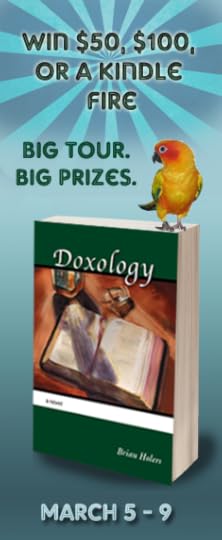
As seen on Novel Publicity's site and many of the sites along the tour.
What, you ask is Doxology? According to its virtual dust jacket, it’s a “blue-collar Southern tale of love, loss, and the healing power of community and family” in which “[f]athers, sons and brothers reconnect over tragedy.”
Hmmm. Might be something I’d read, and the excerpt was intriguing. To qualify for prizes that included $450 in Amazon gift cards, a Kindle Fire, and 5 autographed copies of the book, all you had to do was purchase a copy of the book on Amazon for $.99, fill out a form, and participate in a social media event.
I didn’t purchase the book or enter the giveaway, but the title, and the fact that the author had participated in a blog tour, stuck in my mind. The marketer in me (yes, there is one in there, though she usually doesn’t come out at the same time as the writer!) said, “Gee, that’s clever. Give away something people want in return for kick-starting your sales and gathering data on potential readers.” (The irony that I am sort of participating in the tour after the fact, albeit not officially, has not escaped me.)
I dug a little deeper and discovered that the tour was organized by Novel Publicity. I read on to find out that Novel Publicity offers its “traditional blog tour” at a cost of $1,000.
I’ll admit that my first thought was, wow, that’s a lot. Then the marketer in me began thinking more about it. While $1,000 might seem like an amount to take your breath away (and there are companies with less expensive options; see below), consider for a moment the time and energy that would be consumed by an author organizing something like this on his or her own. Having worked in marketing and PR, I can tell you that the hours add up quickly. Not to mention the fact that Novel Publicity maintains a database of bloggers who have high-traffic sites and matches them with authors in terms of interest/focus—something an individual writer would be hard-pressed to do, especially if he or she also were trying to find the time to actually write.
You might think that, after writing that last paragraph, I’ve sold myself on the idea of a blog tour and I’m ready to rush out and do one for Dance of Souls.
 Well, maybe. Then again, maybe not. Until now, I hadn’t considered the idea of investing actual cold hard cash in promotions. That’s something I’ll have to sit with for a while. If I think in terms of break-even costs, I’d have to sell an awful lot of copies to recoup $1,000. And if I’m not writing fiction to get rich, I’m certainly not writing fiction in order to drain my bank account.
What sayeth the blogosphere?
While sitting and thinking, I decided to do what I always do: a little more research. Here’s what some other indie authors have said about the value of blog tours:
Melissa Douthit (fantasy) – high praise for the author’s first blog tour.
Marie Lamba (young adult contemporary, humor, paranormal) – tips for DIY book blog tours.
M. Louisa Locke (mystery) – reflections of a “slow blogger” on the non-traditional blog tour.
Ron Vitale (young adult fantasy) – Great analysis of how he fared during three blog tours.
Brian Holers (literary) – no specific discussion of how the Doxology tour went, just thanks to participants. But since his blog tour sparked my thinking on the topic, I had to include him.
And here are a few places to find people or organizations that will help you arrange a tour.* (Many are less expensive than Novel Publicity’s package.)
AToMR
BubbleCow – links to 7 companies that arrange blog tours for various genres
Lightning Book Promotions
Novel Publicity
Pump Up Your Book
* DISCLAIMER: I have not evaluated the quality or value of any services listed here. They are provided purely for your convenience in conducting research!
I’d love to hear from other folks about whether they have done or considered doing a blog tour? Did you do it yourself or hire someone to help? If you did, was it worth it?
ROW80 Update
I am now tracking word count on a spreadsheet (yes, I am that geeky): 3,961 in the last week. Needless to say, this is a much better pace if I’m going to make it to 95,000 by the end of June.
I also came up with a plan for working through a sticky motivation issue for one of my characters. I wrote down an entire page of questions about one particular situation that’s been giving me trouble, questions like:
When/how does she meet him?
Why is she drawn to him?
When does she decide to…?
Does he know that she…?
Does he care that she…?
I figure if I can’t come up with good answers for those questions, whatever I write about the situation won’t ring true.
One more thing: Reading this Sunday
There’s another reading from the Fault Zone anthology this Sunday. I’m not reading, but several other fabulous authors are. If you’re in the San Francisco Bay area, join us at Florey’s Books in Pacifica on Sunday April 22 from 2 p.m. to 4 p.m. Should be fun!



April 12, 2012
IT’S-IT: a rant about ice cream and grammar
If you’re not from the West coast you may not know that IT’S-IT is the name of a delectable ice cream treat created in 1928 when, according to the company’s web site, “George Whitney began what is now a San Francisco tradition. He placed a scoop of vanilla ice cream between two large old-fashioned oatmeal cookies and then dipped the sandwich into dark chocolate.”
 I like the taste, texture, and high treat value of IT’S-IT as well as the next gal. But what I really love about IT’S-IT is that its [not it's] creator knew where to put the apostrophe in the name, thus demonstrating that an early 20th-century ice-cream maker knew more about grammar than many self-proclaimed and professional writers of the early 21st century.
(Disclaimer: The rant part of this has nothing to do with ice cream.)
I will admit to always having been a bit of a grammar and usage prude, which is, perhaps, why I enjoy copy editing. But “proper usage” is something about which I feel a bit ambivalent. (Or, in more relaxed parlance, that I feel ambivalent about.)
Since jumping into the world of self-publishing and blogging, I have thought a lot about the responsibility of writers to adhere to grammatical standards. I fully understand that languages are living things. What’s accepted as correct today may fall out of use and be seen as archaic 100 years from now. New ideas, new technologies, new ways of thinking come into being and beg for new terminology and new ways to use words.
However, I don’t believe in a language free-for-all. I have seen enough poorly written [not poorly-written], error-riddled copy to know that a writer serves no one when he or she [not they] can’t put together a sentence that makes no sense. But making sense is the least I expect. Professional writers—whether publishing on their own or through a more traditional publishing route—have an obligation to uphold the minimum standards of their times. Or, if they are going to break a rule, they ought to do it knowingly and for good reason.
I understand that blogging is different from producing a finished piece of work, so I shouldn’t be too disturbed when I find grammatical errors in blogs. (I’m sure I could find a bunch of typos and some grammatical mistakes even on—gasp!—this very blog.) But I am disturbed by grammatical errors.
Education through osmosis
From Amazon.com
One of the problems is that people sometimes don’t know what they don’t know. I was lucky enough to study writing in college and graduate school and to have been introduced to the mother of all language guides, “The Elements of Style.” However, most of my knowledge about grammar and usage I absorbed from reading well-written books. This is one of the reasons you must read well-written books in order to write well—and it’s one of the few cases where you can succumb to the dream of obtaining knowledge through osmosis. Read enough well-written books and your ear will know proper usage from improper, even if you can’t explain the rules.
I read “The Hunger Games” during my week of vacation. I found it a real page turner, but I can’t say the language was scintillating. It served its purpose to advance the plot and paint a picture of the characters. Nothing wrong with that. However, I found more than a few grammatical errors (this was in the Kindle version, not the printed version, but still, it was disappointing).
How, I ask, will the learn-by-reading approach survive if current writers don’t make sure their books adhere to some level of “correctness”—however that is defined?
A few good sites about good grammar
My plea to all writers out there who consider themselves professional: pay attention to the language. Even when you’re blogging. Hold your books to a higher standard. If you’re unsure about something, visit a grammar site and try to get your questions answered. Or just spend some of your spare time reading about grammar. Then reward yourself with an ice-cream treat.
If you think your grammar and usage are perfect already, well, I hope it you’re right, because you’re training the fiction writers of the future.
The New York Times FAQ on Style – A one-time compilation of frequently asked reader questions.
Grammar Girl – I love the name, but she (?) is actually a member of the Quick and Dirty Tips family (which also, interestingly, includes Legal Lad and the Math Dude. Hmmm… a bit o’ sexism here? Why not Math Gal and Grammar Guy?)
50 Best Blogs for Grammar Geeks – Tip of the hat to them; I found some of the ones listed here through this exhaustive list.
Motivated Grammar – The tagline says it all: “Prescriptivism Must Die!”
Language Log - More than just grammar, with multiple contributors.
Terribly Write – Focused on Web sites. I did a double-take on the entry for April 12 (“fewer” vs. “less”) because it’s something I thought I knew and realized I didn’t understand fully.
The Chicago Manual of Style Online – By subscription, but there is a free Q&A section.
Arrant Pedantry – Like Motivated Grammar, this one is written by a doctoral student in linguistics.
That should be enough to get you going. If you find others you like, comment and let me know.
ROW80 Update
I don’t seem to be able to remember to update on the designated days, Wednesdays and Sundays, so here we go, a day late. I have started tracking word count since April 1. Through my vacation and my period of malaise I managed to add 2,883 words to my manuscript in a little less than two weeks. That doesn’t put me at exactly the rate I’ll need to get to 90,000 by June 30, but some progress is better than none.



April 8, 2012
[Stopped here today]
Those three words are my cue. Each day when I finish writing, I type them in brackets wherever I have left off writing. The next morning, I search for [stopped here today] and go instantly to where I need to begin. (I also use [edit from here] so I know which sections need a going-over with the editing comb.)
 Most of the time I look forward to that moment when I do the search and find my place. But sometimes, when I feel stuck (as I have for the last few days), I search with as about much anticipation as I usually muster for cleaning the toilets (which is to say, not much). Right now, for example, I'm struggling to finish a chapter that has been resisting me. I know generally how I want it to end but the specifics are eluding me. In the past few days I've written and backspaced over hundreds of words.
This is when writing really isn't much fun. The old spark just ain't sparking. But I have kept at it. Finally, this morning, I wrote a few decent paragraphs. I now can see the proverbial light at the end of the tunnel.
I'm grateful, when encountering what could be described as writer's block, to be a more—ahem—mature writer. My younger writing self might have concluded any number of things from this frustration:
I'm no good
The story sucks
It's not worth going on
The current incarnation of my writing self knows that, as Clare De Boer so aptly pointed out, what's needed to be a writer is patience and perseverance.

St. Augustine writing, revising, and re-writing: Sandro Botticelli's St. Augustine in His Cell (Photo credit: Wikipedia)
Writing makes an apt metaphor for life (or is it the other way around?). Some days, just getting up seems like a lot of work. Much easier to lie in bed and not even bother. But with a little perspective, you know that all states of being are temporary. As my mother was fond of saying, "This too shall pass."
So I'll be back at it tomorrow, and the day after that, and the day after that. After all, I've promised myself another 40,000 words by June 30 (that's what I settled on for my ROW80 commitment).
Yikes!


March 30, 2012
ROW80 commitment
This is a short post to publicize my commitment to Round 2 of ROW80 (A Round of Words in 80 Days).
 I stumbled across ROW80 a few weeks ago and really liked the philosophy behind it. Instead of setting out an insane end point (like finishing a 50K manuscript in a month), it lets individuals set measurable, actionable goals that will move them forward.
So, I need to come up with a goal for the 80 days starting April 2 and check in regularly about my progress. There's also a Linky, which is a way for everyone to connect to other writers' blogs who are also participating, but I'm not quite sure yet how that works.
Since I'm about to get distracted by a week of spring break activities, I just wanted to voice my commitment here and let you know I plan to post my goals shortly after the April 2 start date.


March 29, 2012
The Lucky 7 gift: backing into editing
I have finally decided to participate in a blogging game/chain (thanks to Carrie Rubin of "The Write Transition" for passing it on to me). It's the Lucky 7 Meme, which turned out to be luckier than I might have thought.

Upon receiving a Lucky 7 designation, writers are asked to do the following:
1. Go to page 77 of your current MS/WIP
2. Go to line 7
3. Copy down the next 7 lines, sentences, or paragraphs, and post them as they're written.*
4. Tag 7 writers and let them know.
*My 7 sentences are at the bottom of this post; if you must read them this instant, go ahead.
As soon as I saw what was involved—before I had even decided to participate—I opened my novel in progress and went to page 77. I was just too curious about what I would find.
What I read did not particularly impress me. I thought to myself: "The sentences don't sound all that interesting. Playing with the idea of rectangularity as it relates to Sean's character might be intriguing… but I've overused the word 'rectangular.' And the sentences are way too long and convoluted, and–"
I decided to cut myself a little slack because, after all, this is a work in progress, not a work in bookstores.
Then I had a revelation.
While I had read these sentences several times before, I had never noticed how pedestrian they were because I had always read them from beginning to end, as part of the chapter they appear in.
Mix it up
Normally, when editing for style, one starts at the beginning of a section or a chapter and reads through to the end (at least, I do), noting stylistic glitches, overuse of adjectives, or whatever else one might be on the lookout for. This seems to make sense because it's the way a reader reads.
It's not, however, the way I was taught to proofread. The best way to proofread thoroughly is to go through a document backwards. You don't necessarily read individual sentences backwards, but you might start at the bottom of a page and work your way up, sentence by sentence.
Here's the important thing: in proofreading backwards, the altered context does not allow your eye to skip over things your brain thinks it already knows.

Book header/footer (Photo credit: Wikipedia)
Let's apply this to stylistic editing. Pulling seven sentences at random and reading them out of context gave my mind the kind of editorial clarity I couldn't achieve by reading a scene from beginning to end, a practice that lulls brain with the anticipation of the expected.
I'm excited to apply this method on my next editing round. So thank you, Carrie and the originator of the Lucky 7 Meme, for giving me a new editing approach to try.
The 7 writers
Here are my lucky seven writer picks, with, of course, no obligation on the part of the recipients to continue the chain:
Cynthia Robertson
Sarah Allen
Joanne Phillips
Danielle deValera
Lena Roy
Carrie Nyman
The Life of a Moomin
The 7 sentences
And now: the excerpt. Want to try your hand at the "editing backwards" game on this excerpt? Go ahead (but be kind).
Everything in the apartment was rectangular and occupied its space as if it had been placed there with a 3-D rendering program. I sat on the beige leather couch with brushed nickel feet. He served me Kir from a rectangular black lacquered tray and salted nuts from a rectangular dish. I felt as if I were at a hotel.
Not until weeks later, when I had spent many nights in Sean's rectangular platform bed and eaten many meals perched on rectangular bar stools before the polished marble counter top that separated kitchen from living room did I learn that he had spent much of his childhood in San Francisco, moving here from the east coast after his parents divorced. That revelation did not come easily, nor did the admission that his mother lived scarcely 30 miles away. Since the night at the beach when I had babbled on about everything, including my parents, Sean had not asked again about my family and I hadn't asked about his.
P.S./Clarification
Literature and Latte, which I referenced in my last post for its list of writing software, is actually the producer of Scrivener software. That's what I get for zeroing in on a search result that seemed to have exactly what I wanted without examining the context. (On the other hand, their site is useful and the name is clever, so one might be forgiven for mistaking it for a regular old blog.) And they do have Scrivener for PC, of which I have downloaded a trial version. I'll let you know what I think.



March 25, 2012
Outline Eureka!
I am a great outliner.
I've written marketing plans, communications plans, white papers, newsletter articles, and magazine articles. For almost all of them, I have used MS Word's outline feature to organize my thoughts and the flow of the piece—usually before I write very many words.
My fiction, on the other hand, I outline only after writing it—if at all. (This is rather odd psychologically, since in most of the rest of my life I like to know where I'm going and what to expect when I get there.) And yet, I always think, darn, I should be outlining.
Outlining in the third dimension
So I was pleased to read an eye-opening post by Keith Cronin that appeared a few weeks ago at Writer Unboxed, which validated my habit of outlining after writing AND went on to give me more helpful insight. His validation:
"And – this may surprise you – you don't need to do it [outline] before you write. In fact, I find outlining much more useful during the writing process and afterward, when editing and revising."
The additional insight:
"…let me assure you that I am NOT talking about those arduously complex multi-level lists that you were forced to learn in school, with all those Roman numerals and tricky formatting rules. No, I'm talking about an extremely simple tool you can put together in a matter of minutes."
He went on to describe how you can actually outline with—gasp!—nothing more high tech or complex than a pen and a piece of paper.
 I realized what has been holding me back from outlining more has been the tyranny of the tool, specifically, MS Word.
Now, I know there are all sorts of writing programs out there. Unfortunately, the people who create these programs seem to think that only Mac users are writers (or perhaps that all writers use Macs). It appears that a majority of writing software is available only for the Mac, as evidenced by listings such as that appearing on Literature and Latte; only one on the list, WriteItNow, also offers a PC version.
Perhaps I should look into writing software. But the more I think about it, the more I like the idea of getting out of the screen and outlining in three dimensions, using a good old-fashioned piece of paper. I didn't know it at the time, but Kourtney Heintz was speaking directly to me on March 13 when she described her revision process. Her accompanying picture says it all.
Eureka!
What are you trying to prove?
Much has been written on the differences between "pantsters" and "plotters,"* the former being those who write by the seat of their pants, the latter being those who plan everything out in advance. What I love about the idea of outlining ex posto facto is that it doesn't feel as if it stands in the way of a pantster like myself who prefers scenes to arise organically from the subconscious rather than to be written in response to a plot hole or missing character detail.

The pantster's pants
For the more organic writers such as myself, it also helps to think of outlining as part of the editing process, rather than the creation process. I have always enjoyed editing other people's work—not so much my own, to which I often feel too close and entwined to slash what needs to be slashed. But using the outline as a revision tool will help me to evaluate my own work more objectively.
Coincidentally, shortly after I stumbled upon the Writer Unboxed blog post, I attended the March CWC-SF/Peninsula meeting. The speaker was Nora Profit, founder of The Writing Loft as well as an award winning journalist, feature writer, columnist, and author.
Ms. Profit apologized in advance for condensing an entire day's worth of advice, usually dispensed as part of her workshops, into less than an hour. Nonetheless, I walked away with several extremely useful editing tools. They don't exactly fall in the category of outlining, but I put one of them into practice immediately as I worked on the first draft of the short story for submission to the San Mateo County Fair Literary Arts Competition. Ms. Profit suggested creating, for every piece you write, a focus statement in the form of filling in the blank in the following sentence: "I am writing this short story/novel/article/poem to prove that ______________________ ."
The statement then becomes a bellwether as you write. Not sure if a scene belongs? Check against the focus statement. Not sure if a character feels right? See if he or she fits in the context of the statement.
This is not nearly as easy as it looks. I'm still not sure I have the focus statement for the story exactly right, but it's a starting point and already seems helpful in guiding the writing.
Based on these experiences, I've decided to do something different during my writing time for at least the next week. Although I'm only what feels like about a third of the way through the first draft of my novel in progress, I'm going to take time off from writing new material. Instead, I'm going to work on getting the focus statement right, per Nora Profit, and I'm going to outline what I have, per Keith Cronin.
And for the first time, I'm viewing these organizational steps not as impediments to getting the writing done, but as enhancements to the process. I'll report back on the results in a few weeks.
Views from around the Web on pantsters vs. plotters
The Kansas Writer's Association discusses pantsters and plotters in this commentary on the creative process.
The Crowe's Nest blog post "Anatomy of a First Draft" is exactly that, with special notation of the respective troubles faced by pantsters and plotters.
Amanda of The Rubber Duck Brigade details her own process as a pantster.


March 21, 2012
Head down and dreaming
I took a break this past week from my novel-in-progress to finish up a short story for submission to the San Mateo County Fair Literary Anthology.
Pig races and high art
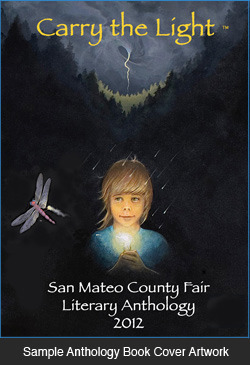
Courtesy of San Mateo County Fair Literary Arts Department
Now, who even knew that the San Mateo County Fair had a Literary Arts Department? Certainly I didn't. The last time I went to the fair, it was all about the pig races and fried dough. My, how times have changed.
For the last few years, a dedicated group of writers has been working hard to put together a mini writer's conference within the Fair. This year promises a great lineup of workshops, readings, and related events. (I should know; I offered to help out on the committee.)
Creativity on deadline
But back to the writing. I had started the short story almost five years ago and put it away in the proverbial bottom drawer. It consisted of a single scene, but upon rereading it, I felt immediately drawn into the world I had started to create. Then came the challenge. I had no idea who the characters were, what were their motivations, what the conflict would be—and I had given myself a deadline of one week to write the first draft so I could share it with my critique group and give myself enough time to polish it for the mid-April deadline.
I set out on a journey of faith. Every morning, before diving into e-mail or blog reading or paying work, I opened up the short story. I wrote another paragraph, and another. I still felt like I didn't know what the heck I was doing.
Then I began ruminating on the story during yoga class, when I woke up in the middle of the night, and on walks around the neighborhood.

Bikram Yoga (Photo credit: Wikipedia)
I went back at it the next morning, and the next. I tried not to muscle through. Instead, I tried to open up the space for the words to come into. And, lo and behold, they did!
This morning I finished it off. Or perhaps it would be more accurate to say that it finished itself off.
More to come on whether this approach yielded something worthy, and on the process of editing that will follow over the next week. One thing I've started to suspect, though, is that there might be something almost physically addictive about getting into that trancelike writing state I mentioned in an earlier post.
Ice sales update
Five weeks ago I wrote: "So, dear blog followers, you heard it here first: I am (re)committing to executing the marketing plan for Dance of Souls that I wrote up last fall…. If you don't hear about some marketing activity every few weeks, feel free to excoriate me!"
Let the excoriating begin. Well, maybe partial excoriation is in order. While I did not explore ads on Goodreads, I did, as promised, send books to the Goodreads giveaway winners.
And I did meet one of my marketing goals from early on: getting 100 Likes on Facebook. Questions remain about the value of such. (One of the blogs I found through the "karmic chain" reflected on the value—or lack thereof—inherent in these liking circles. Interestingly, I would never have discovered the blog had it not been for the chain.)
This marketing stuff, I'm realizing, is just like everything else: a practice requiring daily dedication and rededication.