Audrey Kalman's Blog, page 18
March 14, 2012
Get out the flak jacket, here come the big guns
I first wrote this post over the weekend, in, shall we say, the heat of the moment. I went back to it several times to make sure that it was more than just the cri de couer of a wounded author. After several edits, I think I have turned it into something reflective rather than reflexive.
Testing the authorial skin
I have a pretty thick skin, of necessity. I have collected scores of rejection letters; I regularly share my work in a critique group; and I had the unique and somewhat unsettling experience of sitting in on a book-club discussion about Dance of Souls.
This past weekend, however, I had to pull out the kevlar suit. My 87-year-old uncle called to tell me what he thought of Dance of Souls.
For 10 minutes, I listened to him enumerate, with no sugar-coating whatsoever, the novel's flaws. (I suppose he comes from a generation that did not learn to give criticism by first doling out a compliment.)
Ooooffff.
Once I hung up the phone, got over my sobbing fit, and convinced myself that I shouldn't abandon my writing career altogether, I realized something profound: He was right.
Where's the evidence?
Literary criticism is not evidence-based science. We can't design an experiment, holding all variables constant but one, to test whether our work is "good" or "bad." One reader's fatal flaw is another's beautiful gem.
When I looked at his criticisms in that light, I felt much better. Here are the main things he didn't like about the book. I can understand why he might not have liked them, but I also can see—and certainly hope—that others will find these very things appealing.
1) The book uses complex language and lots of similes.
Guilty as charged. But it is a purposeful guilt. I used language in the book the way I did because I believed it was integral to the story. There is a lot of discussion among writers about "voice." This book was the first one I have ever written in which the voice presented itself to me as part of the story. Apparently it was not my uncle's cup of tea. (See below for several excellent discussions of voice in fiction.)
2) The plot and the character's motivations were not clear.
Guilty as charged. Dance of Souls is not plot-driven. Part of the point of the book is to leave the reader unsettled and wondering: What actually did happen? Which events were real and which were created in the character's minds? I freely admit that using plot as a framework, rather than a driving force, is not to everyone's liking.
3) I got my facts wrong.
On this, I must plead not guilty. What he cited as "facts" were actually authorial interpretations of facts. In particular, he noted my description of a fire as making a wall not look like a wall any longer but "black swiss cheese with orange holes." Was that description a fact? No. Might the wall appear that way to one of my characters? I certainly thought so, especially if it looked anything like this:

Photo credit: Oregon Chapter of the Red Cross
He also pointed to a dog's behavior at the end of the book as something "a dog would never do." Perhaps a literal dog would not have done what the dog at the end did. However, see #2 above. Was it a literal dog or an allegorical dog? You'll have to read the book and draw your own conclusion.
Note that I do believe in fact-checking for novels. A big, checkable gaffe (for example, the wrong kind of gun in a war or a character using a microwave oven before it was invented) is a legitimate turnoff—unless, of course, you're writing fantasy or sci-fi and those "facts" are integral to the book.
What I learned from the bombardment
Well, I do feel better now, and never mind the irony that I have just given voice to negative comments about my book that would otherwise have remained safely within the four walls of my office.
Since my intention was not just to air my pain, I'd like to share what I learned from this—most of which is painfully obvious but is none-the-less easy to forget:
One reader's opinion is just that: one reader's opinion.
Do not give up your writing career based on the wounded heart you suffer from harshly delivered criticism.
Don't give your book to relatives to read. Tell them about it and let them buy a copy on their own if they're interested.
Cut your relatives a lot of slack if they're over 85. Listen graciously, thank them, and move on.
Readers will need to decide for themselves if what my uncle saw as flaws are actually what gives the book its appeal. I am thankful that at least one reviewer so far has seen things that way.
If you're a writer, what has been your experience in dealing with negative reactions to your work?
Writers on voice
Voice and character connectivity
Thoughts about finding your voice from writers on NaNoWriMo site
Voice in YA fiction
What makes up voice in fiction?
Write like a columnist
Crafting a great voice


March 8, 2012
Just a link in your chain?*
I'm trying, I'm really trying, to make this whole blogging/social media thing work for me.
Here are two social media occurrences of the past week:
Kourtney Heintz bestowed on me an ABC (Awesome Blog Content) award. (Thank you! and you should check out her blog.)
I joined the "Author Karma by Novel Publicity" Facebook Group and got involved with their Facebook Liking Chain.
Herewith, my thoughts on both.
Unchain my heart
My first thought upon receiving this "award" (and the earlier Kreativ Blogger Award I received from Carrie Rubin) was that it's a glorified chain letter. (Just so you know, if you ever forward me an e-mail that says, "Pass this along to 978 dear friends and don't dare break the chain because if you do you'll go straight to hell," I will immediately delete the e-mail. I expect I'll be going to hell at least 978 times over).

Image via Wikipedia
Then I thought, "What's so bad about this kind of chain letter?" By virtue of being mentioned as part of these awards, my blog has found new readers. And I have discovered blogs I really enjoy reading and people whose ideas resonate with me. So, if it's a chain, it's a chain with a purpose. And, thankfully, the givers of the awards bestowed them without the expectation of reciprocity.
That said, I look at some of the more professional blogs out there, and I see that they are not trading mentions of one another and offering lists of bizarre facts about themselves (which is a requirement of some of the awards). To put my marketing hat on for a moment, it's a question of positioning. Do I want my blog to fall into the category of an informal conversation among peers, or to be more the professional face of my writing business?
I haven't quite decided yet.
The karmic chain
Now to a chain of another sort. As best I can understand it, one way to describe the Karmic Fan Chain (first introduced on Goodreads) would be to say it's a big cluster f***. But that would be unkind. In the past couple of days, being part of the karmic chain on Facebook has netted my Dance of Souls page more Likes in a few days than it received since its launch last fall. (In some mysterious way I don't understand, having a lot of Likes is good for visibility and traffic—so that's a good thing.)

Image via Wikipedia
The problem is, collecting these Likes seems a bit like collecting Monopoly money or costume jewelry. It's easy, it's cheap, but what can I do in the real world with a big bag of Monopoly money or a wristful of paste diamonds?
What is the value of a Like from someone who doesn't know me and who has clicked the Like button merely because they saw me listed as part of the karmic chain and wanted me to do the same for them? By the same token, I suppose one could ask: what is the value of the Like you give to a big company in return for them entering you in a contest?
To address this—at least as far as my reaching out and Liking people goes—I have decided to try to be somewhat discriminating. Rather than clickety-click-click-click with wanton abandon, I've taken much of the afternoon and evening to view each Facebook page listed in the karmic chain and visit the author's blog or web site if they have one. I have Liked and posted only on pages that seem somewhat related to my genre of literary fiction. I stayed away from YA, teen paranormal fantasy, vampire fiction, and romance. Nothing wrong with them, of course, but there is something to be said for positioning.
And something remarkable has happened. I have found more voices in the wilderness, more kindred spirits. Maybe this was the intention of the karmic chain all along. Here are a few of my discoveries. (If I never get around to formally passing along the Awesome Blogger Award, consider this my link in that karmic chain.)
Elizabeth Lawrence
Anne Chaconas
Barbara Forte Abate
Lena Roy
Claire J. DeBoer
P.S. Just so we're clear, I won't be your friend on Facebook if I haven't met you in the world. You're welcome to be my fan, and follow me, and Like Dance of Souls, but unless we have a connection in real life, I'm going to keep it to that.
*with a nod to Aretha Franklin.


March 5, 2012
Spoken through
Sitting down to write this morning I felt lonely and, dare I say, jilted.
This has nothing to do with my loved ones from real life. Rather, I recently finished writing several sections of my novel-in-progress from one character's point of view. It's now time to give myself over to another character.
The problem is, I'm not ready to let him go, although he has nothing to contribute to the section I'm now writing. He doesn't even know the characters in the current section!

Irish immigrant who might have been my character's father (image from Wikipedia)
It seems odd that I would feel such a strong connection to him. When I started writing from his point of view, I felt tentative. He is about as unlike me as you can imagine. First off, he's male. While I've never had much trouble writing from a male perspective (thanks to non-stereotyping parents, a vivid imagination, and a belief that gender is a continuum largely influenced by social norms), this guy was a stretch: a Chicago native, the son of Irish immigrants, ten years older than I, blue-collar, a Vietnam vet.
At first I wondered how I could ever write from his perspective. After a few days, however, I experienced that amazing transformation all writers hope for. I was no longer speaking for him.
He was speaking through me.
This experience, I'm convinced, is why we continue to write. It's what a musician must experience when fully inhabiting the notes of Beethoven or Mingus (or, indeed, what Beethoven or Mingus themselves experienced creating their music); what a runner feels completing the 26th mile; what teacher sees reflected in the faces of students whose lives he or she touches.
Needless so say, it's hard to move from the transcendent to the everyday. But that's exactly what I'll have to do tomorrow. Maybe, if I'm lucky, my next character also will see fit to provide me with a window into the divine.
Fault Zone reading a success
 Thanks to everyone who came out yesterday to support the contributors to Fault Zone at the reading at Kepler's Books. If you missed the reading—I know some of you live in lands far, far away—check out an MP3 of me reading from my story, "Mistress Mine." To hear the rest (as FZ editor Lisa Meltzer Penn pointed out after every reading) you'll have to buy the book.
And finally…
… a big thank-you to Kourtney Heintz for awarding me a mention in her ABC Blog Award post today. She has released me from the obligation of continuing the chain, but I may just take up the challenge later this week.


March 1, 2012
Friend or foe or friendly foe?
It occurred to me this morning as I read through the several writing blogs I follow that many of the people writing these blogs are, technically, my competitors.
What, you say? Your dear writer friends, who prop you up when you're feeling down, leave comments of encouragement, and generally are the only ones rooting for you in the cruel world that is fiction-writing—they're your competitors?
Apparently, I am not the first to have asked this question.
Well, from a business perspective, that's what you'd have to call them. I'm trying to sell my product to an audience who has a need. My product is a book and the audience's need is to be entertained. My book competes with millions of other books already written, being written, and soon-to-be-written for the eyeballs and attention (and dollars) of the reading public.
This was brought into especially sharp focus when I realized that at least one of these writers had also entered Amazon's Breakthrough Novel contest—and advanced to the next round!
The odd thing is, I find myself excited for her rather than jealous. Maybe because there are so many writers out there and I know relatively few of them, it seems kinder and more helpful to think of the writers I know as friends rather than competitors, even if we are, on some level, competing with one another. Maybe I'd rather embrace the idea of "coopetition"—wherein companies in the same market cooperate on research and development while still competing to sell products—rather than looking at writing as a zero-sum game with a single winner.
Or maybe I'd just rather be part of a community of writers, even if it means remaining unknown, than to find myself all alone at the top. Other people seem to be thinking this way, too. Take a look at Novel Publicity's Karmic Fan Chain on Goodreads.
So, thanks to a few of the members of the community who have cheered me on and give me daily inspiration (alphabetically by first name in the great tradition of the Amazon contest winners announcement (link is a PDF)): August McLaughlin, Carrie Rubin, Catana, Cynthia Robertson, and Kourtney Heintz. I'm happy to count you among my friends.
Don't forget
If you're anywhere near Menlo Park, CA, on Sunday, March 4: top by Kepler's Books at 2 p.m. to hear authors (including me!) reading from the Fault Zone anthology of stories and poems.


February 24, 2012
Equine gymnastics and the true grit of the fiction writer
Maury Ballstein: [looking to supply finish] … we… get back on!
Derek Zoolander: Sorry, Maury. I'm not a gymnast.
From the 2001 movie "Zoolander" (courtesy of IMDB)
FALLING OFF THE HORSE…
Yesterday, Amazon reported which books made it through the first round of its Breakthrough Novel Award.
Dance of Souls did not make the cut.
I admit that as I wa ited for the PDF file of the 1,000 works of general fiction that had made it to open and then scrolled through the document, my heart was beating a little fast. Then, as I looked in vain for my name between Audrey Greathouse and Audrey RL Wyatt (yes, for some reason they arranged the list alphabetically by author's first name), I felt that familiar gut-twist of disappointment.
Rejected again.
Even though I had said to myself as the file was opening, "I'm sure you didn't make it." Even though I realized that 5,000 (five thousand) novels were entered in the first round. I allowed myself a half hour or so of angry self-pity. Then I set it aside and got back to work.
… AND GETTING BACK ON
Yes, that's how we fiction writers do it. The old fall-off-the-horse-and-get-right-back-on trick. It's really the only way we can write at all.
We've all heard about the 25, 50, or 100 rejection letters a first-time author receives before an agent or editor finally, finally recognizes the novel for the jewel that it is.
I've stopped counting, but I think I may be getting close to my rejection quota.
… AND CONTINUING THE RIDE
 I promised to let blog readers know how my marketing activities were going. I've done three of the five things on my to-do list for this week: 1) publicized my reading from Fault Zone that's happening on March 4; 2) sent books to the Goodreads giveaway winners; and 3) contacted blogger Rebecca Berto about a review. That leaves two things spilling over into next week: 1) choose pieces to submit for the San Mateo County Fair literary anthology and the Foster City International Writer's Contest; and 2) plan another KDP giveaway AFTER reading this advice from Emlyn Chand.
So there you have it. Now I'm ready to ride off into the sunset.


February 22, 2012
Fact, fiction, and the morass that is the Internet
I don't believe in divine intervention, but sometimes things happen that might fall into that category if I did.
For example, I wrote half of today's blog post yesterday morning. It felt unfinished and I wasn't quite sure what the point was. Then I went for a walk, during which I listened to the podcast of last week's On the Media. My ears perked up when I heard the segment "The Changing Nature of Knowledge in the Internet Age," in which author David Weinberger argues that the Internet has changed not only the means by which we assemble and assimilate knowledge, but the very definition of knowledge.
 As Weinberger pointed out, we are long past the days when a fact is a fact and when the taxonomy of knowledge is so certain that rather than accept something that didn't fit within the existing framework of facts—the platypus—people doubted the creature's very existence.
Books, once vital purveyors of facts, have the fundamental failing, in this internet age, that their links are broken—the footnotes don't lead you anywhere. (Weinberger's book is titled Too Big to Know: Rethinking Knowledge Now That the Facts Aren't the Facts, Experts Are Everywhere, and the Smartest Person in the Room Is the Room; I am not sure of the status of its footnotes.)
Lest book writers flee screaming from their keyboards, listen to Weinberger's next comment in the interview, "When you have a medium that is unrestricted in how much it can handle, as the Internet is, we are better able to investigate an idea without stopping points, we are able to get explanations at every level of expertise… the ecology of knowledge has filled out."
In practical terms, this means that there is no longer a barrier to research. I can find out with a few mouse clicks what it might have been like to live in Ireland in the 1940s or be drafted during the Viet Nam era. Better yet, I can see pictures taken by vets or read a narrative by someone who emigrated from Ireland.
And now that I can, I must! As fellow CWC member and Internet research guru Geri Spieler said at CWC's last meeting, factual errors can sink an otherwise commendable piece of fiction. It's almost as if fiction writers (except those writing fantasy or otherwise constructing worlds entirely of their own imaginations) must become journalists.
All of this leaves me, after a night of reflection, nearly as befuddled as I was yesterday. But my befuddlement didn't stop me from spending much of my "writing time" this morning reading about the history of the selective service in the U.S. and looking at one soldier's photos and recollections. At the same time, I kept a sharp eye on the clock. I had to make sure I wouldn't be wandering for eternity in that place where it's possible to investigate an idea without stopping points.
If I disappear, you'll know where to search for me… along with other writers who fear being sucked into the morass that is the Internet. Maybe you're wandering there, too.
Leila Gaskin – Write Am I
Nina Badzin – Nina Badzin's Blog
Denver Fiction Writers – Post by Rachel C. on real experience vs. Internet research
Cory Doctorow on "Writing in the Age of Distraction"
AbsoluteWrite – Interview with Kelly L. Stone


February 14, 2012
Report on ice sales
I've been a bad girl.
I've been sorely neglecting the promotional part of my writing life. Aside from running another Goodreads giveaway, I've done pitifully little in the last few months to promote "Dance of Souls." Instead I have been happily, deliciously, wiling away the hours working on my new novel.
That must change, but I'm not sure I have it in me.
 Even as a corporate marketer, I was never very good at blatant promotion. You know, sidling up to people at cocktail parties, sticking out my hand, introducing myself, and giving the elevator pitch for the product du jour. I was always more likely to… you know, stick my head in the sand.
I'm even worse at self promotion, at least as far as my fiction is concerned. For some reason, it's not hard for me to promote myself in my other career, as a birth doula—perhaps because I can clearly see and articulate the value of my services in helping families when they're having babies.
 At some level, most fiction writers may be this way. After all, if we were great promoters, we'd probably be out starting companies or selling ice to residents of Alaska.
I'm not naive enough to think that my book is going to sell itself. Still, when I consider the psychic pain of getting "out there" in all the ways that I should be—showing my face at local independent book stores, talking myself up in every conceivable social context, virtual and real—vs. the payoff of getting more readers, I usually find it easy to tell myself that I don't really need more readers.
So, dear blog followers, you heard it here first: I am (re)committing to executing the marketing plan for Dance of Souls that I wrote up last fall. It's not rocket science, as they say. I just need to start doing it. I'll keep you updated on what I'm trying out, and how it's working. If you don't hear about some marketing activity every few weeks, feel free to excoriate me!
First up: 1) sending books to the winners of the Goodreads giveaway and 2) exploring ads on Goodreads.


February 9, 2012
Tribute to a different kind of beauty
I've decided to participate in today's "Beauty of a Woman" BlogFest organized by Amber McLaughlin.
 At first, I had planned to repost a blog entry from last year, "Fiction, like beauty, is more than skin deep." The post discussed physical beauty only briefly, as a touchstone for a deeper discussion of writing as vocation and avocation.
However, when I reread the first sentence, "I don't wear makeup," I was struck by how tenaciously the influences of our upbringings cling to us (or we to them).
My mother never wore makeup. I think this had to do with her fierce (and I do mean fierce) independence and a furious desire to prove that her value to the world lay in her intellect, not her face or body. As an adolescent, I rebelled against my parents in all sorts of ways. I flirted (pun intended) with my physical body and with the idea that the the cerebral and the corporeal might co-exist. Interestingly, I never took to wearing makeup, even at my most rebellious (though I did once own a leather skirt).
 I'm not sure my mother ever felt completely at ease with being female, mostly because of the time and the culture she was rebelling against. But, as is so often the case, her discomfort led her to bring her gifts to the world: her patented research at Bell Laboratories in the early 1960s and her second career as a physics professor and administrator at Simon's Rock College.
Despite the fact that I have spent large portions of my life trying to differentiate myself from her, I am more like her than I usually feel comfortable admitting. And she was, I am happy to say, beautiful.



February 8, 2012
Doling out death
Here's another reason fiction writing can be so difficult: Often, as a character develops, you realize that flaws, conditions, or some other thing you thought was integral to the character's personality just doesn't make sense, and you have to kill it off.
This is not the same as killing off the character, which I don't tend to do since I'm not writing mysteries or thrillers. I'm talking about the hard—and very God-like—business of shaping a character into a believable person.
 I'm wrestling with this now in the case of one of the characters in my new novel. She grew up in rural New York State in the late 1960s. I had given her a psychological problem that I'm not sure fits either the times or her background. I would love to keep the problem, since I think it adds a dimension of depth and interest. But I'm just not sure it will be believable.
On the other hand, perhaps this problem will turn out to be just the quirk that does make her believable, since another writing trap we struggle to avoid is the clichéd character (the hard-drinking Irishman, the fluff-brained cheerleader, the overworked executive).
And so I'll tiptoe along the tightrope, imagining enough quirkiness to give my character depth and facets, but not enough so as to make readers shake their heads and say, "huh?"
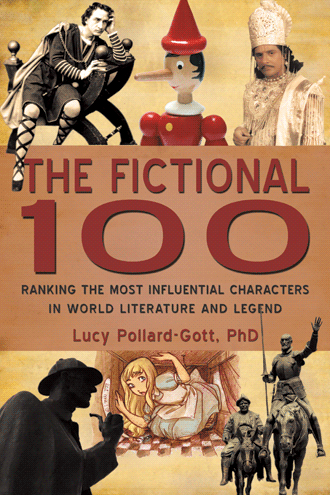 The literary lions of the 20th century seem to have gotten a handle on this, as evidenced by such tabulations as Book magazine's 2002 list, referenced on NPR's web site. Reaching beyond the English-speaking world and outside the 20th century is The Fictional 100, created by Lucy Pollard-Gott, author of a book of the same name. She surmises that the reasons behind the characters' appeal and endurance "may lie in a deep psychological or mythic resonance, the artistry of their presentation, or the special circumstances of time and society that brought them into being and sustain their popularity."
Whew. That's quite a tall order for a humble fiction writer. But it pays to keep in mind that producing such a character, like reaching enlightenment, is not achieved by conscious striving. Rather, it's done through the tiny, daily excisions and prunings, the deaths doled out to incongruent ideas whose demise makes way for a new and stronger character—one who just might, in future years, make a top-100 list.


January 30, 2012
Writing to live vs. living to write
In the case of food, eating to live is supposedly healthier than living to eat—an instruction attributed to Socrates. The latter implies an obsessiveness with food that borders on the unhealthy.
 When it comes to writing, though, I'd rather live to write. I've been thinking about this recently as I spend time doing my paid job: helping a client with marketing communications, part of which involves creating (writing, editing, sending) an e-mail newsletter every six to eight weeks.
I love my client, with whom I have worked for almost 14 years, and often am intrigued by the newsletter topics. However, this kind of writing doesn't beckon me in the same way my novel-in-progress does each morning. As challenging as the novel is (and this morning, believe me, it was gnarlier than a hungry caged lion), I can't wait to sit down with it. Even when I'm fighting with it. Even when it's coming after me with its teeth bared.
 By contrast, while the newsletter is often fun and challenging, it exists on a completely different plane. It has no teeth. It doesn't have a life of its own. Instead it waits for me breathe life into it. I write it to live (well, not completely, but to add a few dollars to the coffers).
I live to write my novel. If that makes me obsessed and a little neurotic, so be it. I'd venture to say it's a sentiment shared by many writers of fiction and poetry.