Audrey Kalman's Blog, page 16
August 8, 2012
A cat on a dog day (or, a writer in August)
Those of you who pay attention to such things may have noticed a radical slowing in my rate of posting.
It’s my son’s fault. He has infected me. With laziness.

Joshua setting an example for the rest of the household. (In case you are wondering, this is not my son.)
Next week, he starts school. (I know, it’s a cruel time to begin.) Over the last month, he has practiced the art of going to bed further and further past midnight, getting up later and later in the morning, and, in the interval when he’s awake, doing less and less.
Can I blame him?
No. I remember my own childhood, when the days of summer stretched out seemingly endlessly, filled with nothing but what I wanted to do. As the start of school grew closer, I wanted to savor every moment, not, as my parents might have suggested, “get myself in the swing of things for school.” Since he’s starting high school, this may be one of his last carefree summers.
The down side for me has been that his studied relaxation has infected the house with a kind of torpor I associate with sleeping sickness or chemically induced naps. Trying to execute my industrious plans—for finishing the first draft edit of my novel, for getting started on the next phase of marketing for Dance of Souls—suddenly feels like wading through peanut butter.
I’m not alone in these dog days of August. Several fellow bloggers (Tracking the Words, The Girl in the Cat Frame Glasses) have mentioned that they’re taking time off. So I’m not too worried. I have a short vacation coming up next week. When I get back, I’m anticipating that, even though the calendar will still say August, I’ll be in fall startup mode and back to my usual snap-to-it productivity.
P.S. The cats aren’t exactly adding to the energy level around the house.
ROW80 Update
My last update anticipated this slowdown. I said, “I am probably not going to make my goal of a complete edit before handing off to my writing partner, who wants to take the manuscript with her on vacation in early August. That’s okay. I will edit for the next week and print whatever I have for her at the beginning of August.”
When August rolled around, I wasn’t quite ready. Admittedly, part of this is wanting to do more. I finished the once-over edit of the entire manuscript. The problem is that I identified three chapters that need major additional writing. Sigh. Thankfully, she let me off the hook by letting me know she probably wouldn’t have a chance to look at it during her vacation.
Given the schedule challenges outlined above, my new goal is to finish by the end of August. That’s one chapter per week.
I can do that—as soon as I get up off the couch and rub the sleep from my eyes.



July 22, 2012
My quest for a universal book-assessment tool
I recently reviewed a couple of books on Amazon and Goodreads. Nothing so remarkable about that. But I found myself hesitating a long time before hitting the “submit” button on the Amazon reviews.
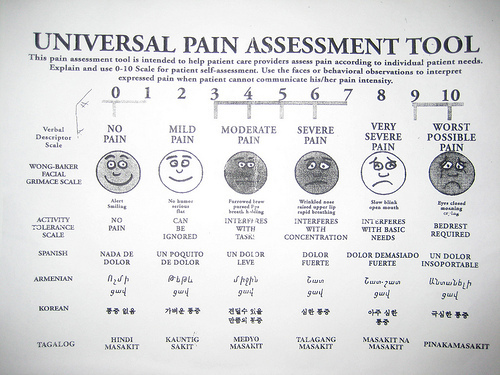
Universal Pain Assessment Tool (Photo credit: doublelibra)
What confounded me was not writing the reviews but choosing the accompanying star rating. I felt like a woman in labor who finds herself paralyzed by the nurse’s well-meaning question, “On a scale of 0 to 10, with 0 being no pain at all and 10 being the worst pain you have ever experienced, how do you feel?” (I have seen this happen in the course of my work as a birth doula.)
How can you even answer that question? What if you say 6 now, but the pain gets more than twice as bad later and you run out of numbers? How much worse is 4 than 2? Is the scale linear or exponential? Most important, does the number mean the same thing to the nurse as it means to me?
My nine is your three
In fairness to the medical profession, the universal pain-assessment tool is tremendously valuable in helping to alleviate suffering among people who are ill or injured. (The pain-scale question might be somewhat irrelevant for women in labor since labor pain is intermittent, temporary, and part of the normal process of giving birth.)
The star rating system is a different beast. How can you hand out stars when—at least in the case of Amazon—they mean different things to different people?
Goodreads, at least, gives some guidance about what each star indicates:
* didn’t like it
** it was o.k.
*** liked it
**** really liked it
***** it was amazing
Reviewing books by friends and acquaintances
I do agonize more when reviewing books by authors I know. I want to be honest, but I don’t want my input to hurt their sales. This is why I have decided to follow my father’s edict: “If you don’t have something nice to say, don’t say anything at all.” Not the best child-rearing motto, perhaps, but helpful in this situation.
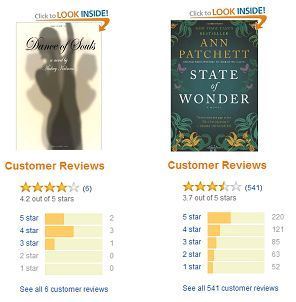
Just for kicks, I decided to look at Amazon star ratings for the latest novel from Ann Patchett next to mine. I have some selling to do to catch up.
That said, what if I really liked the book? Would it kill me to give it a 5-star rating? No… but I find myself unable to do that just because I know the author. Maybe I’m unusual, but to me, if 5 stars means “it was amazing,” it has to be amazing. And readers may be on to the possibility of star inflation. A friend’s publisher mentioned to her that five-star ratings often are looked upon with skepticism by readers.
I’ve decided to stick to my tough reviewer stance, in which five stars are reserved for absolute standouts. (I have given five stars to only three titles on Goodreads: William Faulkner’s “As I Lay Dying,” Norton Juster’s “The Phantom Tollbooth, and Tim O’Brien’s “The Things They Carried.”)
I’d love to hear from readers and writers: what do review stars mean to you? And if you’ve ever given birth, what was your pain level during labor? (Just kidding.)
Here are a few interesting discussions of ratings and reviews:
Article from Techcrunch on Amazon reviews
Goodreads forum discussion of star ratings
Discussion by Elle Lothlorian on Digital Book World about why authors SHOULD respond to negative reviews
Fascinating tale on the Conjugal Felicity* site about author Robert Stanek and his Amazon reviews
*I sincerely hope I never appear on this site, which is devoted to “the sporking (detailed, page-by-page, snarky critique) of poorly written books. We also chronicle the dubious promotional methods of certain self-published authors.”
ROW80 Update
I am plugging away. I have done paper edits on about half the book and entered about half of those. I am probably not going to make my goal of a complete edit before handing off to my writing partner, who wants to take the manuscript with her on vacation in early August. That’s okay. I will edit for the next week and print whatever I have for her at the beginning of August.
Look for some thoughts about the editing process in future posts.


July 8, 2012
Cutting without carnage—the adjectival challenge
A couple of weeks ago I attended a day-long fiction-writing boot camp with Nora Profit, who ”teaches writers to be authors” through her business, The Writing Loft.
Much of the information was review, but I took away two valuable lessons and one that must be applied judiciously.

The standard order of operations in arithmetic. In fiction writing, (1) should certainly be figuring out what you want to say and why you want to say it. (Photo credit: Wikipedia)
I wrote in a previous blog post about one of Nora’s teaching points: the value of coming up with a goal statement for every piece you write. I am still struggling to create this for “Dance of Souls,” which has been finished for almost two years and published for almost one. Needless to say, deciding why you are writing the book after publishing it is hardly the ideal order of operations. I’m working on a goal statement for my novel-in-progress that I can commit to before I finish the next draft.
The other valuable takeaway from the boot camp was the importance of scrutinizing every scene for its emotional impact on the reader by asking “What do you want the reader to think while reading the scene? What do you want the reader to feel?” I am asking these questions as I work on revising my first draft. It’s tedious work, but then, lots of writing is.
My faith in these two activities was bolstered by the fact that I employed both for the first time in writing “The Boy in the Window,” which won two awards.
Now for the third takeaway, imparted in the form of an imperative.
Do away with adverbs and adjectives.
To be fair, Nora conceded that maybe you don’t need to cut every one.
I understand why she admonishes writers, especially new ones, to stay away from these parts of speech. Too often, weak writing relies on strings of adjectives because the writer has not figured out what he or she wants to say. “Weak dialogue depends on adverbs, rather than the strength of the words or the character’s actions, to convey tone,” (she said censoriously).

Ernest Hemingway with American writer Janet Flanner. Appropriately for the boot camp metaphor, both wear U.S.A. military uniforms, as war correspondents in the liberation of Paris in the end of World War II. (Photo credit: Wikipedia)
But strip all qualifying words from your fiction and you end up as Hemingway (not a bad fate, perhaps). In the worst case, though, you might end up an emotionless writer without an identifiable voice.
I struggle with this issue as I revise the first draft of my current novel. How much do I strip away? What words are necessary to tell the story? Which are essential to convey the essence of a character? And can I find faith in my own abilities as a writer to answer these questions?
How do you walk the line between following the prescription for “good writing” and staying true to your voice? Comment and let me know.
If you’re interested in a peek into my editing process, see below. I reproduced the first draft of this blog post exactly as I wrote it, before any editing.
ROW80 Check-In
My commitment for the next round is to complete a second draft, which means editing for emotional impact (as described above) and line editing. There are 22 chapters, so that goal translates to a relatively blistering pace of two chapters a week. I have already done one; I am at work on another. Stay tuned.
First Draft of This Blog Post, If You’re Interested
I have had a busy two weeks. To be fair, my whole life always seems busy and I don’t think it is going to change much going forward.
A couple of weeks ago I took a day-long fiction-writing “bootcamp” with Nora Profit, whose business, The Writing Loft, “teaches writers to be authors.” Much of the information was review for someone who has a bachelor’s degree in creative writing and a master’s degree in magazine journalism.
I got two valuable things from the day, one of which I wrote about earlier after hearing Nora speak at a CWC meeting. The first is the importance of scrutinizing every scene for its emotional impact on the reader by asking “What do you want the reader to think? What do you want the reader to feel?” after reading the scene. I have folded those questions into the revision of my first draft.
The other valuable takeaway was coming up with a goal statement. This is something I am still struggling to create for “Dance of Souls,” which has been finished for almost two years and published for almost one. Needless to say, I don’t think that’s the ideal order of operations, so I’m working on something for my novel-in-progress that I can commit to before I finish the next draft. Thanks to my writing partner, I’m getting close.
My faith in these two activities was bolstered by the fact that I employed both for the first time in writing my prize-winning story, “The Boy in the Window.”
The third thing I took away was really more of a reminder of something I already knew, but it is a bit more troubling. It was Nora’s admonition to do away with adverbs and adjectives.
Now, to be fair, she did temper her admonition. Maybe not every one. And I understand exactly where she is coming from. Too often, weak writing is overly reliant on a string of adjectives to try to convey something: the old “tell” vs. “show.” But strip all qualifying words from your fiction and you end up as Hemingway or worse, a stilted, wooden-sounding writer without a voice of your own.
I am struggling with exactly this issue right now. How much do I strip away? What words are essential to tell my story? What are essential to convey the essence of a character? And can I find faith in my own abilities as a writer to know the answers to these questions?
Now, for an interesting exercise. Below, see the entire blog post as first drafted. You can let me know if I have edited wisely.



June 27, 2012
Stacked—or, the reader’s dilemma
No, I don’t mean that kind of stacked. (Perhaps you have grown accustomed to following the The Write Transition and now expect all writing blogs to effortlessly—and humorously—combine discussion of bodily functions and body parts with writing wisdom.)
 I’m talking about a stack that rises on the nightstand to a ridiculous height. Okay, maybe we shouldn’t go there, either.
Let’s try again. How about blog post headers piled atop one another to consume an entire in-box screen? Or the heap of unread New Yorkers on the floor beside my desk, a plight apparently shared by many and wittily described by Yuvi Zalkow on Writer Unboxed?
It’s great to be part of a writing community. I enjoy going to readings, celebrating the launches of fellow writers’ books, and following writing blogs. But I’m reaching my saturation point. When am I supposed to find time to read all these great new titles my friends have published? Not to mention review unfinished manuscripts, edit the next edition of the CWC’s Fault Zone anthology (still time for non-members to enter the Fault Zone contest!) and maybe, oh maybe, read a novel just because it looks interesting?
There is only one solution. I must ask my friends to stop writing.
Kidding. Instead, I’ll continue to do my best to plow through the stacks, piles, and heaps.
The dilemma of the expanding stacks has not only heightened my sympathy for the reader, it also has illustrated the importance of making my writing as compelling as possible. If a book is less than riveting, the reader can—and probably will—set it aside and move to the next one in the stack.
Do you have enough time to read everything on your “to read” list? (That’s a rhetorical question, but feel free to answer.) How do you prioritize?
If you’re a writer, do you find this problem overwhelming or motivating?
ReROWing
I haven’t checked in about my ROW80 goals since early in the month when I finished my rough draft.
 Thankfully, the next round starts July 2, because I am in serious danger of running off the rails. Sitting down and cranking out words every day seems easy. The hard part is going back and figuring out what is working or not working. Do I need to completely change the structure of the book? Possibly. Where are the plot holes? Everywhere. Which of the characters need stronger motivation for their actions? All of them.
But that work must be done. I’m looking forward to creating some measurable goals around those tasks and committing publicly to them for the next ROW80 round.



June 18, 2012
Day jobs that complement a writing career
I have two completely different personas. Those who know one side of me often have no idea of the existence of the other—something I have been working to change through confessionals like this.

Sidewalk Man or water service cover? Writer or birth doula? It depends on the time of day… and how you look at it.
One persona is that of the fiction writer. The other accompanies my “day job.” I put that in quotation marks since it’s more like an anytime-of-day-or-night job. Because, in addition to writing and editing fiction and non-fiction I also work as a birth doula.
A birth what?
That’s the typical reaction of most people who have not had children in the past 15 or 20 years. A birth doula is a professional who assists families with non-medical support during labor and birth. What that means in practice is that I hold hands, coach dads in what spots to massage on the laboring mom, run and fetch cool cloths, hold buckets while moms throw up, whisper words of encouragement, suggest when might be a good time to get in the shower, give parents permission to cry when things don’t go the way they had planned, and share the joy of a new life emerging into the world.
In other words, it is almost the complete opposite of my work as a writer: physical, unpredictable, and other-focused.
It is the perfect complement to my writing career.
While finishing my senior thesis in college, I also had a part-time job as different from writing as one could imagine. I worked at a restaurant as a “salad girl,” pastry chef, and short-order breakfast cook. It was the perfect complement to the cerebral work of finishing up my bachelor’s degree.
Some of the most interesting writers, past and present, have had day jobs that could not be more different from their work as writers. For two good roundups of the day jobs of some famous authors, check out a blog post from David Kubicek and a slideshow at Huffington Post. (William Carlos Williams was a pediatrician; John Steinbeck ran a fish hatchery.)
A couple of my fellow CWC members also have interesting day jobs. James Hanna, whose novel The Seige is scheduled to be published by Sand Hill Review Press, works in the criminal justice system. Max Tomlinson, author of Sendero, describes himself on his blog as “a software architect, which is a euphemism for an aging computer programmer.”
What about you? Does your day job merely put food on the table or is it something that balances and sustains your life as a writer? Or are you lucky enough to be a full-time writer of fiction?



June 10, 2012
My new book marketing strategy: Shut up about the rest
As a professional marketing consultant, I have written elevator pitches for products; I have relentlessly honed messages until they are crystal clear and easy to communicate; I have helped clients focus in with laser precision on their audiences.
Why, then, has it been so hard for me to do these things for my own fiction?
Yesterday at the San Mateo County Fair’s Literary Arts Stage, I finally realized why. It’s because authors, like parents, have an awfully hard time shutting up about their kids.
This revelation came during a workshop given by Beth and Ezra Barany called “How to Pitch to an Agent or Editor.” (Beth is an author as well as a creativity coach for writers and Ezra is author of the successful self-published thriller, The Torah Codes.) As I was working through one of the exercises we practiced during the workshop, it suddenly hit me. Here’s what’s been going on.
The art of not telling all

Focus, focus, focus. I don’t have to tell you about all the beautiful lavender flowers; just one will do.
Writing a novel is about about creating an emotional experience. Over hundreds of pages, you let readers inside your characters’ lives, make them care about what happens, give them a feeling of inhabiting a different world. You do this with scores of scenes, tens of thousands of words—all of which are vital to the telling of the story, or else they wouldn’t be there (you did edit ruthlessly, didn’t you?)
Describing your novel—whether at a cocktail party or in a pitch letter—is about promising an emotional experience using as few words as possible. You don’t have to give them the whole experience. Well, duh! But for someone who has spent years creating that emotional experience in the form of a book, it can be awfully difficult to say one thing, say it well, and shut up about the rest.
Pitch-craft: Leave it out!
One of the exercises we did yesterday was to create a pitch with five components, including: the initial premise; the main character; the primary objective of the main character; the antagonist or force preventing the main character from getting what they want; and the disaster that could happen.
For a few seconds, my mind was blank. I had written a whole book, but I didn’t know how to describe it because I was afraid of leaving something out. Then, because we only had a few minutes, I just went ahead and wrote something: “A middle school science teacher with a quiet, orderly life suddenly finds God. Struggling to reconcile his newfound faith with his belief in science, he becomes fixated on a sculptor whose blasphemous work drives him to an unforgivable act.”
The workshop audience (yes, I was brave enough to volunteer to read it aloud) “oohed” positively and Ezra Barany said it gave him a feeling of the emotional experience the book promised. Yay! Still, there was a little voice in my head saying, “But there’s so much more! It’s written from the points of view of various characters! I didn’t tell you about the runaway teen, or the documentary filmmaker, or the science teacher’s girlfriend…”
It doesn’t matter. Readers will find out all that when they read the book. I know I could hone the pitch further, but the main point is that it doesn’t tell all.
Beth did have a helpful tip for books with multiple characters/viewpoints (which all of mine seem to be). She suggested writing a pitch for each of the main characters, which I think is a brilliant idea and plan to do.
Best of all, now I know how to work on the pitch for my current novel while I’m still writing it. Maybe by the time it’s done I’ll actually be able to tell you what it’s about.
Have you learned the art of the pitch? How? Leave a comment and let me know what works for you.
An award-winning author—me!
I am thrilled to say that my short story, The Boy in the Window, won me the California Writer’s Club award for Most Promising Writer of the Year and also won second place in the San Mateo County Fair’s Short Story division.
I’m headed off in a few minutes to a giant autograph party and reading for the anthology Carry the Light, which contains my story along with hundreds of other stories, poems, and essays and is published by Sand Hill Review Press. If you’re at the Fair, you can purchase a copy for $10.



June 6, 2012
Hearing voices—getting characters to sound like themselves
You have to be a bit mad to be a writer. In fact, you even have to hear voices.

Where people who hear voices are sometimes sent. (Pälksaari Psychiatric Hospital. Photo credit: Wikipedia)
This has become clearer than ever as I reach a new phase in my current novel.
I had intended to continue with my plow-ahead writing on the way to reaching the 40,000 words promised as my ROW80 goal by the end of June.
My novel had other ideas. On May 24—11,278 words short of my goal—my draft declared that, with the exception of the crucial final chapter, it was done.
Because I am old-fashioned enough to require the tactile feedback of paper when doing certain kinds of editing, I printed the draft. I then discovered two problems.
The character who owns the final chapter isn’t talking.
Several of the characters sound suspiciously like the same person—me.
To understand the significance of these problems, you have to know that the novel is structured as six intertwined first-person narratives.
 I’m tackling problem #2 first by taking a purely technical approach. First, I’ll describe the type of language each character would use. Would the character use short, long, or run-on sentences? Many adjectives or few? Stay on point or ramble? Remain prim-lipped or swear like a sailor? Next I’ll list their interests and affinities. What would they focus on when describing a scene? Then I’ll edit each character’s sections according to these “rules.” I hope when I’m done that I’ll hear each speaking more clearly in his or her own voice, sounding more like themselves and less like me.
Despite these challenges, I am very glad to have made the decision back in October to go with a first-person narrative.
As for that reticent (recalcitrant?) character in the final chapter, I’m making him wait. Maybe when he sees how much time and attention I’m lavishing on the others, he’ll decide to speak up.
Here are a few interesting perspectives on first-person challenges:
The Bluestocking Blogger revisits a commitment to write in first person.
The Writer’s Craft introduces the pros and cons of writing in first person.
Ingrid’s Notes look at first-person advantages (one of a series).
Patricia Wrede thinks about first-person narratives.
Nathan Bransford describes POV as a prism.
If you write in first person, what are your tricks for capturing your characters’ voices?



May 30, 2012
Speak, memory (apologies to V. Nabokov)
Is there any life event more bizarre than a school reunion?
After spending Memorial Day weekend in the company of fellow Simon’s Rock alumni, most of whom I had not seen in decades (what, you think I’m going to say how many?), I can tell you definitively, no.
For a fiction writer who enjoys playing with the nature of time and memory, it was a rich, if weird, experience. (And I wasn’t the only one to appropriate a famous title in reflecting on the experience; my good friend, fellow alum, and now professor Jenny Browdy did the same in her post about the reunion, memory, and the passage of time.)
I can tell you one thing for certain: forget about self-improvement. Basic personalities remain remarkably consistent from decade to decade. The gossipers still gossip; the clueless remain clueless.

The grave of Vladimir Nabokov (Russian-American writer) and his wife Vera Nabokova in Cimetière de Clarens (Switzerland) (Photo credit: Wikipedia)
Simon’s Rock is where I began to learn to write. I say “began to learn” because I am still learning. It’s also where I encountered some of my earliest writing influences, including Vladimir Nabokov, author of the book from which I nabbed my blog title.
I well remember the environment of Simon’s Rock: the small, seminar-style classes and the one-on-one time with professors that got me so motivated. I also remember trying way too hard. In one of my first writing courses, my professor said something about avoiding use of the verb “to be.” I’m sure he was simply trying to encourage us to enliven our language. I took him literally, however, and there followed a year or so of tortured, unnatural-sounding prose. (Try it yourself and see!)
While on campus for the reunion, I visited the alumni library and pulled my senior thesis down from the shelf. Since I got my B.A. in creative writing, my thesis consisted of two short stories and an essay. I confess I had completely forgotten the content. So I spent some time reading through the first short story.

The first page of one of the short stories from my bachelor’s thesis.
This cemented my idea that we don’t change. It’s not that I haven’t grown as a writer, but I was amazed to see the common stylistic and thematic threads in the story. Even the way it begins, with the words, “I remember…”
I think someone once said that many writers have only one story in them, which they tell over and over. I am feeling rather that way.
If you’ve been writing for more than a decade (or even less), how has your writing evolved? Do you revisit the same themes and ideas from story to story or book to book? Comment, please!
ROW80 Update
Back from exploring my roots, I’m ready to return to the present and forge ahead. During almost a week without Internet access, I made good progress on my current novel. I’m up to about 84,000 words and have reached a point where I need to do a quick read over the whole manuscript in order to prepare to write the final chapter.
San Mateo County Fair Literary Arts Events
 I’ll be busy June 9 – 17 at the numerous literary arts events taking place at the San Mateo County Fair. If you’re in the area, please come by. In particular, look for me on the following days:
Sunday, June 10: 4:30 – 6:30 p.m., ANTHOLOGY LAUNCH PARTY
Tuesday, June 12: 7:00 p.m., FAULT ZONE READING
Saturday, June 16: 2:00 – 4:00 p.m., AUTHOR DAY



May 15, 2012
500 words of drivel a day
Dictionary.com definitions of drivel:
1. saliva flowing from the mouth, or mucus from the nose; slaver.
2. childish, silly, or meaningless talk or thinking; nonsense; twaddle.
When my I committed to my ROW80 goal at the beginning of April, my stated aim was to write 40,000 words of my novel-in-progress by July 1, what I estimate I need to finish a first draft.
 The good news: At the halfway mark in time I am only a bit shy of 15,000 words from my goal.
I have never written this way before: full steam ahead, plowing onward, plunging into the abyss, charging forth, a full-court press—however you might want to describe moving forward relentlessly without much regard to quality.
In other words, I’m a virtual crap-generating machine!
In the past, my writing routine included spending the first half of each day’s allotted time editing the previous day’s work before writing new material. Now, on my way to the goal, there’s no editing (well, maybe a tiny bit, now and then, when I just can’t help it.)
This approach has turned out to be both immensely satisfying and immensely anxiety-provoking. Satisfying because, at the end of each writing session, I tally up the word count and find myself closer to my goal. Anxiety-provoking because I hear a little voice in my head that says, “Don’t get too attached to all those words. You’ll be throwing half of them away when you go back and edit.”
But even the inevitable throwing away won’t be a bad thing. For the first time in my life I feel capable of jettisoning large passages that might not work (already I have chucked—well, cut and pasted into my save-for-some-other-time file—large sections of chapters that just didn’t fit). It’s much easier to toss a quickly scribbled passage than one I spent hours polishing until I fell in love with it simply because of how much time I’ve spent on it.

When I’m done shoveling in the garden I’ll come in and shovel through my manuscript.
The writing-to-goal approach also has kept me writing on days when I feel, shall we say, less than inspired. In the past I might have simply stopped after a few sentences in hopes that the muse would visit again tomorrow. Now I force myself to write on. Often what comes out seems like drivel (either definition 1 or 2 will do), uninspired prose that nobody would want to read. Yet often, by the third or fourth paragraph, something shifts, and I find myself in a groove, writing on past the 500-word mark to 1,000 or more. Even if I eventually throw away the first 500 words, I never would have gotten to the good part without first wading through the crap.
So I say, three cheers for drivel. And for the shovel I’ll use to toss it away when the time comes.
What about you? Do you edit-as-you-go or all at once? And where do you shovel all that stuff that doesn’t belong in the story?



May 9, 2012
Let the sun shine in–a (somewhat miscellaneous) weekly update
It has been a whirlwind of a week, consumed by many non-writing activities, the most annoying of which involved standing by while my extremely patient and long-suffering husband (who also happens to be our house’s IT department) got to the bottom of a virus problem that had been plaguing my computer.
You’d think that would make me feel gray and rainy, but it hardly put a dent in my good mood. Here are the sources of the sunshine.

The kind of partner I’d want if I were a car… a Peugeot Partner (Photo credit: Wikipedia)
1) I found a writing partner. Or, rather, she found me. This reminded me of one of those situations where an extremely skillful salesperson alerts you to a need that you didn’t even know you had.
When her e-mail arrived with the brief and intriguing title of “free?” I opened it immediately. It was to the point: “What are you up to for the next couple of hours? Do you want to meet somewhere to write and edit quietly together?”
The thought of sitting quietly with another writer and working on my craft had never even entered my mind. Writing has always been a solitary pursuit for me. Even when I was hired to do it and worked in an office, I would always shut my door when I had to get down to the actual writing. But something made me respond to this e-mail in the affirmative. While I wasn’t available right then, we decided to meet a few days later.
Before we settled down to write, we had lunch and talked a bit. We discovered that we share a fictional sensibility. We like many of the same authors. We enjoy the cadence and what I think of as the “taste” of language: the poetics, the feel of the words—sometimes at the expense of plot. About halfway through our salads she asked, “So… do you think we should exchange manuscripts?” Again, without knowing exactly what I was agreeing to, I answered definitely and immediately “yes.”
Hours later, she had e-mailed me a copy of her manuscript. She is further along with her work-in-progress than I and needs immediate feedback (for a publishing deadline!) What I have read so far confirms my intuition that we are well matched as readers and editors of one another’s work.
Having made this commitment gives me yet more momentum toward finishing my first draft. Which leads to ray of sunshine #2.
2) ROW80 update for the week: I didn’t miss a single day of writing Thursday-Wednesday and pumped out 6,100 words, whittling my goal amount down to about 20,000. And I wrote 1,500 of those 6,100 sitting across from my writing partner in a cafe… proving to myself that I don’t need to be in solitary confinement to work.
 3) Someone thought I was worthy of sunshine. Thanks to the delightful Joanne Phillips, who graced me and four others with a Sunshine Award. When she did this on May 3, I was feeling anything but sunshine-y, having just written two gnarly blog posts about my Facebook travails. The weather looks better all around now.
So here, briefly, is my tip of the hat to the award, which—in Joanne’s slightly shortened version, stipulates that a recipient should:
Write five things about yourself
Include the award’s logo in a post
Nominate 5 other bloggers
Link to your nominees
Link the person who nominated you
Five things about me: 1) I have a postcard of Picasso’s “Cat Catching a Bird” hanging on the wall in front of my computer; 2) I have a piece of paper that says “Not everything requires a response” hanging directly in front of me at my workspace; 3) I drink about 5 cups of really strong tea every day; 4) I become extremely irritable when overtired; 5) I usually experience a deep existential crisis every two or three years.
And now to spread the sunshine… wait, this is hard! Two of my favorite blogs, The Write Transition and Kourtney Heintz’s Journal have already won. Somehow passing the award back and forth like a cold sore doesn’t seem right. Can I get a break and list just three? Of course I can. Who’s going to slap my wrist?
TeacherWriter – Because: couldn’t we all use a good teacher… and she’s one of the “nice” ones
Cyd Madsen – Because: the blog subtitle is “Diggin’ Story, Lovin’ Language” AND Cyd has great taste in WordPress themes
Short Little Bits – Because: I wish I’d come up with this idea — “Five minutes of daily writing in the raw.”