Audrey Kalman's Blog, page 19
January 23, 2012
Seven billion and counting
Of the world's population in 2006, approximately 510 million spoke English.
R.R. Bowker's statistics on books in print projected 47,392 novels would be published (in print) in 2010 and electronic copies in all genres would exceed 1.5 million.
A recent blog post by Jane Friedman referenced e-book sales on Amazon, which are rocketing toward the million mark.
As a novelist (and, frankly, as a human being), I find those numbers more than a little daunting, because they bring two facts into stark relief:
There are so many people in the world (even narrowed down to those who speak my language) that only a very tiny fraction will ever read my books.
There are so many books in the world that I—or any other individual person—will never read even a fraction of them.
 Now, my attempt to talk myself down off the ledge of anxiety raised by thinking about the two facts above:
I don't allow the sheer volume of humans in the world to paralyze me in daily life. I don't curl up in a ball and retreat from human contact because there are so very many people in the world that I will only ever be friends with a fraction of them. I don't throw myself desperately at everyone walking down the street in hopes that someone will notice me. I don't survey the millions of people I've never met to find out what kind of friends they might like to have.
Instead, I figure out the places where people I might get along with hang out (whether real or virtual) and go there. I spend time getting to know these people, some of whom may become friends. I appreciate the serendipity that brings new people into my life. I remain true to myself, confident that potential friends will appreciate me for who I am.
Okay… translating into what this tells me I should do as a writer:
I should not toss my keyboard onto the floor in despair. I should continue to write what is true for me in the best way I know how. I should try to cultivate readers as I might cultivate friends (albeit a bit more broadly) by finding out where like-minded people congregate and offering them a vision of who I am and what I have to say.
In my non-writing life, I am content to have a few close friends and a slightly larger circle of acquaintances. I don't despair over the fact that I can't get to know even a small portion of the nearly 100,000 people who live in my city.
My goals as a writer have always been similarly modest. If I wanted a huge audience, I wouldn't be writing slightly offbeat literary fiction. So, really, I can ignore those astronomical numbers and just get back to my writing. Whew!
All the same, I'm not against having more readers—so if you'd like to become one (or recruit others), that's fine by me.



January 19, 2012
Fragmented
Fragmented. That's how I have felt this week—pulled in a thousand directions (all right, I exaggerate slightly), rushing from one activity to the next, answering e-mails and phone calls, trying to stay in control of my own agenda.
It's not a very fruitful state of mind for writing. It makes me nostalgic for my long-ago writing days. First, as a kid, working on wholesale plagiarisms of "My Friend Flicka" and other childhood faves. I remember writing those stories (longhand, of course, in pencil, in a series of spiral-bound notebooks) over endless summer days or on winter afternoons that would stretch before me with nothing more demanding than dinner waiting at the end.
Later, in college, I did a lot of writing late in the evening. Though I'm now a morning person, in those days it seemed right to stay up past midnight with a cup of tea and a cigarette (hand-slap; I quit many years ago). In my twenties, living with four housemates outside of Boston, I used to commandeer the kitchen after dinner and set up my typewriter there since I could type away into the wee hours without bothering anyone.
All those times were distinguished by a sense that I had the time to go on writing and writing until my ideas exhausted themselves. Now I'm always aware of the other demands lurking at the end of a writing session. I suppose this is why writers go on writing retreats. And yet, the thought of that—a day, a week, a month to do nothing but write—is also terrifying. What if I were to have all the time in the world to write, and suddenly find I had nothing to say?
At this point, it's a risk I'd be willing to take.


January 14, 2012
The eternal optimism of the writer
My week of blogging silence has been for a good cause.
I have been busy with lots of activities, both writing-related and not. One of the writing-related activities has been preparing to submit "Dance of Souls" to Amazon's Breakthrough Novel Awards. The submission period begins at midnight on January 23, and I'm set to hit "submit" at the first possible moment. Luckily, being on the West Coast, I can do that at 9 p.m. local time.
One reason I want to be so timely is that submissions are capped at 10,000. It might be hard to believe that 10,000 budding novelists are going to submit manuscripts, but I have no doubt that will be the case and that a delay might result in not being able to enter (more about this in a future post).

Looking at the sun set over the Pacific always makes me feel optimistic--and gives me some energy, too.
I am not sure where I get the energy to keep doing this. I don't remember the first rejection letter I received for my fiction or poetry but I must have been in my 20s (more than 20 years ago, for those counting), which was when I first created something I thought worthy of submission. For a while I kept a folder of rejection letters. I haven't looked lately, but I'll bet it contains more than 50.
In retrospect, as with so much writing, the work I submitted long ago seems jejune. (Interestingly, the first definition of "jejune" at Dictionary.com is "without interest or significance; dull; insipid: a jejune novel.") I felt that way about pretty much everything I wrote until "Dance of Souls." I would finish a piece and by the time I had set it aside for a few months or begun to investigate publishing options, I couldn't bear the thought of even re-reading it, let alone of editing and rewriting. (Maybe that's just how it is if one is growing as a writer. ) "Dance of Souls" was the first thing I felt I could live with and not cringe every time I did a reading or created an excerpt—which is one of the reasons I decided to put it out to the wider world. (Does this mean I'm no longer "growing as a writer?" I certainly hope not.)
So, yet again, I'll put my work out there, hoping that "Dance of Souls" miraculously survives what is sure to be some cutthroat competition. And if it doesn't, I'll keep marketing it, and keep submitting it, and, most importantly, I'll keep writing.


January 6, 2012
The other side of suffering
Sometimes writing is pure suffering.
For the last few days, although I have dutifully sat down to write at my appointed time, the words haven't flowed. I've written a sentence, then backspaced, written a few more words, stared at them, wiped them away. Nothing seems right. I can't get in the flow or fe el like I'm inhabiting my characters.
This morning was the same. After a half hour of working on my novel I opened up the document in which I keep notes about the writing process and moaned to myself about the difficulties I was having. (This document dates back to 1992, covering two complete novels and numerous incomplete ones, and chronicles the ups and downs and ins and outs of the process.) As I complained onto the page, I wrote a phrase that seemed as if it might fit in the section I was struggling with, so I pasted it into my novel draft. It sounded right. I went back to working on the novel—still feeling far from inspired but at least feeling that I could write a decent paragraph. Then I had a flash of insight about how to finish an earlier chapter that had seemed unresolved.
This is how it goes: On the other side suffering a small victory may await. Sometimes that has to be enough.


January 2, 2012
Irresolute
One of the party-ch atter subjects at a New Year's eve gathering I attended a couple of nights ago was, "Do you have any resolutions?"
I came up with nothing, partly because last year I achieved one goal that always seemed to top my list back when I regularly made resolutions: bring my writing to a wider audience.
After sleeping on it, though, I came up with one: Keep writing.
My Google calendar contains a block from 8-9 every weekday morning labeled "writing," just as it has had since last September. I intend to keep it that way. Sticking closely my daily writing regimen has propelled me through more than 30,000 words of my new novel in about six months. There's a nice utilitarian, workaday feel to blocking out time for being creative.
 Marking the passage of time, however, even with a rather arbitrary party and countdown, never fails to sharpen my sense of mortality. In this context, my 2012 resolution reminds me that I am, in some deep sense, writing against the void (I first mentioned this in my early November post about why I write). Looked at this way, my resolution is not so much a resolution as a statement of necessity. Given the role fiction writing plays in my life, I may as well have resolved to keep breathing.
Resolution also refers to what is supposed to happen to a plot at the end of a novel. All the bits of action and subplot are—at least in a traditional, plot-driven work—tied up in a satisfying way. Since I have a hard time with plot, maybe a better resolution for me would be: have a resolution.
On second thought (third thought?), maybe I'll just get more exercise, eat less chocolate, and spend more time with my family.



December 29, 2011
Goodreads: a breath of fresh air for a weary self-promoter
I have been digging deeper into Goodreads over the last few weeks and find a lot to like. (For those of you who aren't familiar with the site, it's kind of like Facebook for book lovers. Would that be "Bookbook?")
First, it seems to be a site populated by people who are genuinely interested in reading, along with authors who are genuinely interested in connecting with their readers. If you're wondering why I have used "genuinely" twice in the same sentence, it's for emphasis and to contrast Goodreads with some of the other blogs and discussion groups (including many on Amazon) whose sole purpose seems to be for authors to find a way to mention their most recent works.
Second, the creators of the site seem interested in helping authors who may not have huge marketing budgets behind them promote themselves. Authors may set up an author page and are then able to access a variety of free and paid promotional tools. One of the cleverest (and free, except for the cost of books and mailing) is the book giveaway. Pre-launch, or within the first six months of the book's publication, you can offer a number of copies that you're willing to give away. Goodreads handles the whole process, making it easy for people to enter and easy for you as an author—all you do is send copies to the selected winners when the giveaway is over. Giveaway recipients are asked, but not required, to review the book.
 To me, the great thing about the giveaway was that in the slightly more than two weeks that it ran, 474 people requested to be entered. That is 474 people who were exposed to the book. Although this hasn't yet translated into sales, it's far more people than I would otherwise have reached. (I also ran a Facebook ad targeting people who like Goodreads on Facebook, to encourage more entries and got a good number of click-throughs.)

Goodreads has been a breath of fresh air for a weary self-promoter. I'll probably do another giveaway in January before the six months post-publication is up and may even explore some of the site's paid promo opportunities.
Most telling of all, I have actually begun to use Goodreads myself to track books I have read and would like to read. You can see more of my literary tastes by visiting my bookshelf and checking out my ratings and reviews. (Don't worry, I have read more than the 19 books on my shelf as of December 29, 2011.) Oh, and feel free to ask to befriend me. I'm a little lonely at the moment with a grand total of 0 friends.


December 22, 2011
Update: Free is good (for now)
Shortly, Dance of Souls' brief run as a freebie will end for the time being.
In my last post I wondered how this experiment would go. The results are in.
In three days, 319 copies were downloaded. (Thank you, if you were one of the people who downloaded a copy.) That's 319 people who now have the opportunity to read the book, which far exceeds what I had hoped for when I first made it available. (How many actually read it remains to be seen.)
More exciting—though really just in a personal thrill kind of way, since this doesn't have much impact on anything—is the fact that Dance of Souls spent time in positive Amazon ranking territory as a result. Early in the offering, halfway through day one, it ranked #18 in Literary Fiction and #59 in Contemporary Fiction. It rose (sank?) steadily until late today, the first moment I thought to take a screen shot, it stood at #29 and #99.
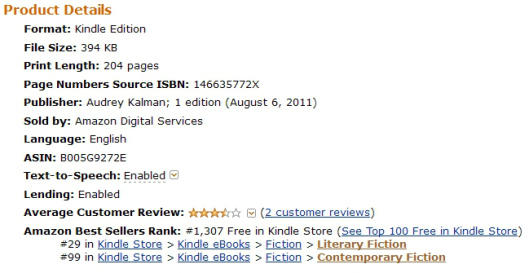
I also found that offering something for free through a Facebook ad, when targeted to the right people, does result in clicks. Notice the "Read it for Free" and "Win this book now" ads below, which resulted in respectable click-through rates. (As suggested by Facebook, I created multiple ads, monitored performance closely, and paused the ads that seemed not to be doing as well.)
 My hope is that with some reviews in the new year and some more traditional marketing—for example, to local bookstores—I'll start to rack up some sales.
Free is good as a marketing tool, but it won't work so well as a long-term business model.


December 20, 2011
Is "free" a four-letter word?
Starting today (December 20) Dance of Souls will be available for Kindle FOR FREE for three days.
 I'm taking advantage of Amazon's new KDP Select Program. To quote: "When you make your book exclusive to Kindle for at least 90 days, it will be part of the Kindle Owners' Lending Library for the same period and you will earn your share of a monthly fund when readers borrow your books from the library. You will also be able to promote your book as free for up to 5 days during these 90 days."
I have heard a lot of buzz and grumble about this, especially over the exclusivity requirement. For me, it was not an issue since I so far haven't made the book available anywhere else.
What's not clear to me is whether the "FREE" enticement will do anything at all to prompt more people to download a copy. At $7, it hardly seems that money could be standing in the way of people who want to read it. The problem is not cost but exposure. So the program will be helpful if it actually draws attention to books that might otherwise not be noticed. Apparently, though, so many people have joined the program that there's now the same problem of getting lost in the crowd that exists on Amazon as a whole.
I'm looking at this, as I look at most of my activities around marketing Dance of Souls, as an experiment. My marketing/pricing background tells me that cheap products tend to be valued as such. My mother told me, "You get what you pay for." Is advertising my book for free sending the wrong message?
Perhaps I am going about this all wrong. Instead of offering Dance of Souls for free, I should charge more. (Nathan Myhrvold's Modernist Cuisine lists for $625—$449.07 on Amazon—and currently ranks #1,221 in books, which beats mine by oh, a million and a half or so.)
So hurry up and get your free copy in the next three days, before I raise the price to reflect the true value of what you're buying.



December 14, 2011
While vacuuming
One of my most enduring insights into creativity came many years ago during a research methods course in graduate school at the S. I. Newhouse School of Public Communications at Syracuse University. By now I have forgotten the exact content of the course, although given the era it must have involved going to the library and searching through card catalogs.
 I do recall that we took notes on index cards (anyone remember those?) and grouped the cards into categories. The instructor then advised us to go home, toss the index cards into the air, and pick them up in whatever random order they landed on the floor.
That suggestion was the instructor's way of making the point that creativity is not a linear process. Sometimes the most fertile ideas grow out of absurd juxtapositions, out of letting the mind wander, or from thinking hard about a difficult problem and then forgetting it and going out for a beer.
 I don't use index cards any more, but all these years later I have internalized this approach. For example, before sitting down to write this morning I decided to vacuum the kitchen. While pushing the vacuum brush over the floor I suddenly realized that a major plot angle I am developing will require that I rethink (and inevitably rewrite) one of the chapters I have already written. This annoying insight might not have arisen had I been sitting at my desk reading over the chapter.
One does have to be careful, of course, not to devote the entire day to housework (or beer drinking) in the supposed service of creativity. But a few minutes or hours away from the keyboard, taken judiciously, often yield a flash of insight that might never have come simply from staring at the screen.
For the writers out there, what creative techniques work for you?
Me, I'm off to wash the dishes…


December 11, 2011
Hypocrisy, unmasked
I am probably the biggest hypocrite in the world. Why?
I don't read self-published books.
Upon realizing this sad fact, I set out to change my ways. I spent some time last week visiting Book Blogs and reading summaries and excerpts of some self-published books. After this experience, I can say to the reviewer I mentioned in one of my earlier posts, I feel your pain. It seems that 99% of self-published books really may not be worth opening.
Perhaps it's my undergraduate degree in creative writing or my master's degree in journalism or almost 30 years of professional writing experience, but there is one thing "up with which I will not put" (as my father was fond of saying). That thing is: prose full of misspellings and grammatical errors.
I'm sure I'm not perfect in this regard. I'll bet Dance of Souls contains a typo or two (and I'll send a free, autographed copy to anyone who can find one; just drop me a line). But how can people who call themselves writers put up error-ridden home pages describing their books or offer a sample with a typo in the first paragraph? Beyond the errors, many of the samples I read simply failed to make me want to keep reading. In other words, they didn't pass that very first test for any written work: is it engaging?

Mildred Steller's self-published book "The Stalk" (circa 1983)
This isn't, by the way, a new problem, just one that has grown more pervasive with the advent of technology that makes it all too easy to put your prose into the world. Years ago, if you wanted to publish but couldn't find a publisher, you went to a "vanity press," put up some money for production, and voila! you were a published author. But you usually had to shell out a fairly substantial amount of cash, meaning this option wasn't open to the masses.
A friend of my grandmother's self-published a book in 1983. I'll never forget my grandmother proudly presenting me with a copy, which was a history of Germany from the Stone Age to the late 17th century. Try as I might, even knowing it was a work undertaken with great passion, I could never bring myself to read more than a few pages.
So where does this leave me? Searching for a way out of my hypocrisy, and hoping to find that rare self-published work that I would actually want to read… because I know they're out there, somewhere.
Where do you stand on self-published books?
View This Poll