
Audrey Kalman's Blog, page 13
October 31, 2013
Short and scary
I don’t often share my poetry. But I recently came across two short poems from a while back that seem particularly appropriate to the dark mood I described in my last post, to All Hallows’ Eve, and to Day of the Dead.

Image credit: AlienCat – 123RF Stock Photo
Two Poems
An Invitation
Come, death
into this house
and linger
over coffee.
Open the door,
step in,
make yourself
at home.
Come on now,
be a friend.
Sit down here
with me in this chair
wreathed in light,
my light, my lamp.
Trace your bony fingers
here, softly,
over my heart.
Whisper to me
that you are no bigger
or smaller
than I picture you to be
when I close my eyes
and see the dark
under my lids
still patterned
with the wreath
of light.
—November 14, 2002
Before and After
First we are not here
then we are, for a while
then we are not again
forever.
—January 15, 2003
Halloween happenings in the SF bay area
I’m not planning to dress up this year but I will put on my witch hat and hand out candy at the door. If you’re in the San Francisco area and want to check out some nifty seasonal happenings, here are a few:
Halloween Nightlife – Courtesy of SF Station (Mostly October 31)
Truck or Treat – Halloween Food Truck Dance Party, San Francisco (October 31)
Day of the Dead Celebration – Mission Cultural Center for Latino Arts (MCCLA) (November 2)
Dia de los Muertos – San Francisco (November 2)
What will you be wearing—and over whose heart will you be tracing your bony fingers—this evening?


October 21, 2013
Dread and the married girl
You may want to head to another blog today if you’re in the mood for feel-good inspiration. What I offer here is a contemplation of existential angst, also referred to as existential anxiety or dread. I do promise some relief if you read—or skip—to the end of the post.
One of the most distressing characteristics of existential dread (only slightly mitigated by the fact that Tylenol will alleviate it) is that it’s a chronic condition.

Rehearsal photo for West Side Story (Photo credit: Wikipedia)
The first attack I remember occurred when I was about twelve. I had just watched the movie version of “West Side Story.” I went to bed and suddenly began crying uncontrollably. I wasn’t sure what I was crying about. Yes, the movie was sad, but what I felt was more than just garden-variety lamentation for star-crossed lovers.
The dread came and went through my teens and twenties. Sometimes I was able to put it at bay for months or even years. Sometimes it cropped up at predictable moments—as during some, shall we say, substance experimentation. Other times it appeared from nowhere, most upsettingly when I was physically surrounded by people I loved and cared about and who loved me. You can understand why the Sandra Bullock character in “Gravity” might feel utterly alone in the universe; it’s harder to fathom how a person could feel that way surrounded by family and friends.

We are not alone… in our aloneness. A collage of four precursors of Existentialism. From top-left clockwise: Søren Kierkegaard, Friedrich Nietzsche, Franz Kafka, Fyodor Dostoevsky. Public domain due to age of portrait/photography. (Photo credit: Wikipedia)
Finding and marrying my soul mate helped a little. Having kids helped for a short time, mostly because I was so overwhelmingly consumed by the relentless task of keeping them alive when they were babies that I had little time for even a decent meal or a shower, let alone existential contemplation. The thought that my genetic material will continue beyond my time on earth is amusing, but hardly an antidote for the dread.
Both my parents died within a few years of each other when I was in my forties. There’s nothing like the death of a parent to really shift your place in the universe. Suddenly, a protective layer between you and nothingness is ripped away. You become that protective layer for younger generations. Not to mention the fact that mortality, which the young are so brilliantly able to ignore, begins to occupy your thoughts daily, if not hourly.
I wish I could say I believe in a deity whose benevolence bestows my existence with meaning, or a religious framework in which physical death is not the end. Such a belief would likely alleviate my dread and probably explains most of organized religion.

Church of a different kind. Tate Lab of Physics at the University of Minnesota-Twin Cities. (Photo credit: Wikipedia)
As I continue to experience the waxing and waning cycles of existential dread, I realize I’m like my mother in more ways than I might have imagined. I don’t remember ever talking with her about this, but I can imagine that her religion—physics and chemistry—gave her comfort. What meager comfort I manage to wrap myself in these days comes from the idea that although humans are infinitesimal in the scale of the universe, we are nonetheless a part of it, so much so the physicist Lawrence Krauss says “the atoms in your left hand probably came from a different star than your right hand.”
I still contemplate the extinguishment of my particular consciousness with trepidation, but I try to remind myself that the molecules, atoms, and subatomic particles that have come together for this brief, brief moment to form me will one day coalesce into something else, with a different form and purpose—and, I hope, less of a penchant for self-reflective hand-wringing.
Now, where’s the Tylenol?
Links to sites/posts along similar lines
Angst and dread – the basics on About.com
Tracy Moore on Jezebel – a soul sister!
Philosophy Forums thread on existential anguish – yikes, anguish sounds worse than “dread”
An earlier post of mine – on why I write
Related Stories
Writing Beneath the Waves (presentsofmind.wordpress.com)
Blocking existential unease… (shannonturlington.com)
Death Don’t Have No Mercy (psychologytoday.com)
Uplifting links in case all this really got you down
The Oatmeal
Dog video
Cat videos
I can has cheezburger
What are your go-to distractions for existential anxieties?


October 8, 2013
The literary 1%
Regardless of your persuasions as they relate to the larger realm of politics and the social order, you have to admit that there is still something of a literary elite in this country.
I’m referring to the lucky people—of which I am nominally one—who can afford to spend many hours a day engaged in non-paying “work.” These people have the luxury of devoting themselves to something that will, in all likelihood, never earn them more than enough to cover contest entry fees and ink and paper for their printers.

A gathering of Chinese literati sitting in a banquet composing poetry, eating, and hearing music. Would I have been at home here? (Credit: Wikipedia)
I was reminded of an even more elite “elite” recently when I inquired about Narrative’s four-day intensive workshop. It sounded like a wonderful opportunity to dive deep into my next novel and get feedback from literary peers and professionals. Then I encountered the price, which is—to save you the bother of inquiring—$2,700, not including travel and lodging if you live outside the San Francisco Bay area.
I’m not saying the workshop isn’t a good deal. I have no doubt that attendees emerge from those four days inspired and with more finely honed manuscripts. But for me, other interests are competing for that $2,700. (Health insurance. My kids’ college funds. Car repairs. Groceries.)
It would be a different story if attending the workshop were an investment like that in a trade certificate program at the local community college, from which I’d emerge ready to take on a job as a tax preparer, say, or a green building engineer. The literary workshop offers no such official imprimatur.
And that’s what makes this workshop—and other, less expensive (because shorter) workshops in which I’ve participated over the years—seem not so much an investment in professional development as an indulgence for a pampered snob.
Am I, really?
I have seen the 1 percent, and she is me (I am she?)
I recently read an as-yet-un-but-absolutely-must-be-published memoir by a good childhood friend. I don’t want to reveal much about it here, but I can say that I found her story awe-inspiring. And it got me thinking about a schism I have always felt in my own life between my identity and my actions. I have never thought of myself as privileged. But thinking is not reality. I must admit I have lived—and continue to live—a privileged life.

A diagram of cognitive dissonance theory. Dissonance reduction can be accomplished in various ways, broadly including the addition of more, consonant elements, or else changing the existing elements. (Photo credit: Wikipedia)
My fiction has become the place where I wrestle with the cognitive dissonance between who I perceive myself to be and who I actually am. Rather than covet material things, I write about the dangers of materialism. Rather than attend $2,700 writing workshops, I blog about how they are only accessible to a small, elite cadre of writers.
My $6 investment
 In the spirit of keeping things egalitarian—and perhaps as a buffer to my cognitive dissonance—I have instead decided to spend $6 to join the next round of Sixfold’s completely writer-voted contest instead of attending the workshop. This investment promises to bring many comments on my writing from fellow writers and a corresponding amount of work for me; I will be reading a lot of manuscripts during November.
What about you? Are you a completely integrated person, or are there parts of you that clash dissonantly with the rest?


September 10, 2013
Dog stories

Tolstoi, my Samoyed, in his winter whites, circa 1977. Who can say no to such a face?
People say having a dog is like having a permanent toddler. (I say: better than having a permanent teenager.) But many people get a dog after the kids leave home. Even the Wall Street Journal has recognized the phenomena.
I might welcome the companionship of a dog in a few years when the human offspring depart—though I am not sure how the feline contingent would feel about that. And the spousal contingent already has voiced opposition.
Dogs and literature go way back. Old Yeller and Buck come immediately to mind. Wikipedia lists 30 pages of dogs in literature. Rin-Tin-Tin can have honorary membership in the club. And we can’t leave out Enzo, the hero of Garth Stein’s Racing in the Rain: My Life As a Dog. I don’t write much about dogs, but my first foray back into short story writing after a 20-year hiatus was Mistress Mine.
For anyone who longs to live more in the moment, dogs (and, we must admit, cats) are a tonic. Their concerns are elemental. In every way, they are creatures of few words. And, by example, they bring us back to our better selves.
Dog-ku
I had a dog, once.
Now I have only children.
My dog ran with me.
When my nest empties,
I’ll fill it with happy dogs
To frolic with me.
Who frolics with you? What are your favorite animal stories?


September 2, 2013
Laborious day reflections
I consider myself lucky…
… not to be working in a coal mine or on an assembly line or at any of hundreds of other dangerous and cripplingly repetitive jobs
… to have a writing-related job that supports my not-quite-profession of being a fiction writer
… not to have to punch a time clock (though perhaps I’d be more productive if I did).

Ford assembly line, 1913. (Photo credit: Wikipedia)
On this Labor Day, I recognize my own good fortune and salute the millions of workers who put in a long day’s labor for too little pay, only to go home exhausted—or, worse, on to a second job to try to hold their lives together. And I pay tribute to the labor organizers who fought for, among other things, the right of workers to paid time off—including three-day weekends.
Looked at from this perspective, a writer has little to complain about. From the outside, writing seems romantic and enticing, and yes, there are moments of romance and some enticements. But like electricians, doctors, lawyers, plumbers, and chefs, writers engage in the hidden humdrum of their profession far more than in the glamor. For every hour spent reading before an audience, the writer spends hundreds of hours alone, writing, editing, revising, doubting, and writing some more. And that’s not even counting the marketing part of the job.
Writing is, like most other jobs, WORK.
For me, the most painful part of the work of writing is the initial extrusion of the story onto the page. That’s what it feels like—extrusion. Merriam-Webster defines the root word, “extrude,” as “to force, press, or push out.” Something stirs inside me: an idea, a sensation, a feeling, a hope. I stare at the computer screen. My fingers rest on the keyboard. I listen to the rising and falling hum of my computer’s fan. I push out one word and then the next.

The extrusion process (Public domain; Photo credit: Wikipedia)
Occasionally, I hit a rhythm that makes this process, writing, feel almost pleasurable, like getting to the third or fourth mile into a five-mile run when endorphins take over. Mostly, though, it’s like a jog in the cold rain early in the morning. You know you should do it, but most of the pleasure comes afterwards, as a result of being done.
A New Yorker essay by John McPhee called “Draft No. 4” describes the work of writing in words more eloquent than mine. For a further peek inside the writing life, see the Brain Pickings article on the daily routines of well-known writers.
Who gives a crap?
But, as writers, should we share our work struggles with readers? Conventional wisdom says readers care nothing about the travails that produced the book. After all, a diner in a restaurant doesn’t give a damn that the chef had to get up at four in the morning to make it to the farmer’s market to select the ingredients for the day’s menu or that the pâtissier ruined an entire batch of custard because the eggs failed to emulsify. The diner just wants a tasty meal, artfully presented and graciously served.
I think the answer to the to-share-or-not-to-share question depends on the writer’s audience. The thriller junkie or murder-mystery buff might not care what labors produce their favorite books any more than the casual diner cares how the restaurant kitchen works. But if your readers are students of the world, people with a curiosity that goes beyond finding out what happens on the next page—if they are the literary equivalent of foodies—then by all means, throw back the curtain and reveal the machinations that take place to put a well-crafted page before them.
What are the hidden parts of your job? What do you wish you knew about how writers work—or do you prefer blissful ignorance?
Related articles
Writers and Other Laborers (marcysbookbuster.wordpress.com)


August 17, 2013
Three little words
One of the perks of growing older is that there are fewer things—like going to school—that you can be forced to do. The power of these three little words to strike terror in your heart recedes with age:

Still, I find myself with a certain nostalgia for the promise of a new school year. I remember getting on the yellow school bus that first morning, hoping that I’d get someone good for English, there wouldn’t be any bullies in my homeroom, and I’d land a spot in the school musical.

English: Kunkel Bus Lines yellow school bus (Photo credit: Wikipedia)
Even now, when my days look largely the same whether it’s August, September, or February, I find myself anticipating fall (such as it is here in Northern California). It’s a good time to revive old projects and recommit to goals abandoned in favor of the grill over the summer.
The panster blogger?
One project I’m considering is creating a publishing schedule for my blog. It’s something I ought to have done long ago, according to any number of consultants and other people interested in helping authors “create a brand” and “establish a platform.”
Without a pre-set schedule, the thinking goes, an author is apt to publish whenever fancy strikes, on random topics of personal interest—thus squandering an opportunity to create a loyal base of fans.
Have I really been such a self-absorbed blogger?

My platform. Really! (Photo credit: Wikipedia; Public domain)
I don’t think so. I have published WRITING OF MANY KINDS regularly (though not on a schedule) to the tune of two or three posts a month. I haven’t written about whatever strikes my fancy; I’ve stuck to writing- and reading-related topics. And, although I haven’t created a formal statement about my audience, I have a very clear picture in my mind of who you are.
I also have been thinking of this blog as an interesting conversation among curious and intelligent people—not as a “platform” for selling my “brand.” I have been thinking of you, dear readers, as fun people to talk with—not “targets” for my “product.”
Could it be that I’m a panster in my blogging as much as in my novel-writing?
Perhaps its time to reign in these tendencies and impose more order. To help me decide, I’ve created a little poll where you get to tell me what inspires you to click on a blogger’s “follow” button. Feel free to pass it along.
Take Our Poll
I’ll use the results to help me figure out where to take the blog over the coming year. Or perhaps I’ll sit alone and listen to the echo of three other scary little words:

I hope that’s not the case.
Related Articles
It’s Time for (Many) Experienced Writers to Stop Blogging – A guest post on Jane Friedman’s blog takes a contrarian view.
Do You Know How to Avoid These 3 Blogging Mistakes? – Joel Friedlander got me thinking about this topic in the first place.
The Importance of a Blogging Calendar – The title says it all.
How Often Should a Writer Blog? – The answer is “it depends.”


July 24, 2013
How Hollywood are you?
Raise your hand if you’ve heard of Italian neoealism.
Hand still in your lap? No shame—I hadn’t either, until last Saturday morning, when my go-to news source (NPR) ran a story about a new video essay on the topic by filmmaker Ernie Park.

David O. Selznick, World-Telegram photo by Edward Lynch. (Photo credit: Wikipedia)
Park highlighted the contrast between neorealism and the Hollywood blockbuster and discussed the interest producer David O. Selznick took in the genre in the 1950s, with fascinating results.
What struck me, though, was how you might substitute the words “literary fiction” for “neorealism” and “summer bestseller” for “Hollywood blockbuster.” In each case, the impetus driving the creation is completely different, as is the reason you choose to see or read the resulting product.
Neorealism—and the many variations of independent films that have followed, from French New Wave to film noir—de-emphasizes the star. It reveals the lives of minor characters as well as the celebrities. As in literary fiction, the plot often turns on small events, and dramatic tension arises from relationships among the characters rather than car chases or explosions.
Why would we want to sit through such a movie or wade through such a book? Not for a fast-paced thrill, surely. But perhaps some of us want more from our entertainment than escapism. We want to be reminded of what’s important in our lives. We want to revisit what causes us pain so we can understand it. We want to feel something deeply.

No car chases here. Carlo Dolci: St Catherine Reading a Book (Photo credit: Wikipedia)
Just as there’s room in the film world for more than “White House Down” and “Red 2,” there’s room in the literary world for more than big, sweeping books that steal your breath with page-turning excitement. Ernie Parks’s video essay, and the topic it looks at, is a good reminder of this.
As an author of the quieter kind of book, I’m hopeful that there are readers who look between the covers for something other than a thrill a minute. (Full disclosure: Dance of Souls contains a couple of conflagrations and my current novel contains some violent acts.)
Why do you read and go to the movies? Are you looking for escape, or something else?
Related articles
Neorealism Goes Hollywood (npr.org)
Discussion Topic: Breathless, Hollywood and Italian Neorealism (filmhistorytwo.wordpress.com)
The Space Between: Fascinating deconstruction of Italian Neorealism vs. Hollywood filmmaking (dangerousminds.net)


July 15, 2013
When opposites co… exist

Source: Wikipedia
The human mind is one of the few places where two opposing things can be true at the same time. The tension between opposites gives rise to what’s exciting about life.
Control – Surrender
Momentum – Stasis
Intellect – Heart
Masculine – Feminine
Strength – Flexibility
Communal – Individual
Gravity – Laughter
Life – Death
Subatomic – Cosmic
*********
I recently returned from a miniature vacation and feel ready to tackle what’s next, which will include the next step for my novel-in-progress (more on that in a future post).
While on vacation, a few more story ideas came to me in the form of single lines or titles, as they often do. My traveling companion (more familiarly known as my husband) and I also had a chance to talk about things we haven’t talked about in a while, including my writing career. As he has in the past, he counseled me to write something for a popular genre. I again demurred. No—more than demurred: I howled in protest.
“I don’t want to!”
I can think of few things less exciting than writing strictly to appeal to a “market.” Take this idea to its absurd end and you get something like professor Philip M. Parker, who has created hundreds of thousands of books using a patented computer program.
I write because I must, not to make money. Of course, I want people to read my work, which implies selling it to a market. And therein lies the root of my lifelong struggle.
But—and here’s where the co-existence of opposites comes in—who’s to say that writing for myself and writing for profit are mutually exclusive?
I have yet to discover the precise way these two impulses will work together. Nevertheless, as I reminded my husband, my fiction has been published—and paid for—a number of times in the last year or so.

Source: Wikipedia
And, if I remain attuned to the forces that turn inward and those that pulse outward, to stillness and action, to reflection and work, I can encompass these seemingly opposing tendencies.
After all, this co-existence of opposites is an old, old idea.
What opposing forces co-exist in your life?


June 24, 2013
Act like an actor when you read

I have a shocking confession: I love to read my work in front of an audience. Shocking, perhaps, because so many people hate to be on stage (fear of public speaking is said to loom larger than fear of death).
Maybe it’s the long-abandoned theater artist in me. Maybe it’s the thrill of knowing that at least the small number of people in the audience will hear my story.
Recently I gave several readings at the San Mateo County Fair and one at a CWC SF/Peninsula Open Mic. I enjoyed doing them and received compliments not only for the content of the stories but for the way I read them.
This got me thinking about what makes for a good fiction or poetry reading. I think the most helpful thing a reader can do to ensure a great reading is to act like an actor. I don’t mean dress up in costume and change your voice for each character (although, if you can pull it off, this can work really well). I take my inspiration from the read-aloud series Selected Shorts, which most often uses actors—not authors—to read well-known short stories for broadcast and on stage.

Edmund Lowe, American actor, standing at radio microphone (labeled for (NBC) Blue Network), holding script, 1942.
What do actors do that ordinary mortals don’t do?
Connect with the audience. Initially I thought my first recommendation would be “project your voice,” but after reading some tips for presenters from a presentation coach, I realized there is more to it than just making sure you speak loudly and clearly. Of course you need to articulate your words. But connecting with an audience also involves feeling comfortable on stage and making eye contact.
Consciously vary the volume, tone, pacing, and pitch of their voices. There is nothing more deadly than a fiction reader who sounds like a computer-generated voice. We’ve all heard them—the reader who places equal emphasis on every word and continues for the entire reading at the same volume. Take a listen to some of the Selected Shorts offerings to hear what the actors do with their voices.
Rehearse. Yes, you’re reading, not memorizing. But rehearsing—not just doing a single quick read-through—lets you hear where you can improve. And it helps you get comfortable enough with the material so you can lift your eyes from the page for a few beats every now and then to make that all-important eye contact with audience members.
Breathe. Of course you’re breathing; the alternative would be dire. But most of us, when anxious, breathe more quickly and shallowly. And we speak quickly, either because we’re nervous or in the mistaken belief that rushing through our reading will be less annoying if people don’t like our work. Speed is the enemy of a good reading. Ideally, your reading voice will be a bit slower than your speaking voice. Think of savoring the words. And if you’ve ever wondered what those commas and period are for, here’s your answer. They. Indicate. Pauses.
If you really want to get serious about improving your reading, record yourself and listen to the recording. I happen to detest the sound of my recorded voice (is there anyone who doesn’t?) but this exercise takes rehearsal to the next level. You can note the awkward passages; hear where the pacing drags; and catch where you stumble.
I urge all fiction writers to find opportunities to read to an audience. It will make you a better writer. Convoluted sentences or overwrought descriptions can easily slip by when they sit silently on the page. When read aloud for an audience, they will be revealed in all their tongue-twisting, plot-destroying glory, and you’ll be motivated to make your work better.
And here are a couple of tips for the listening audience:
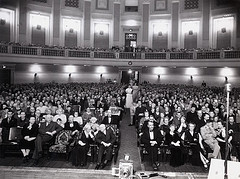
Audience at the Royal Geographical Society lecture at City Hall, Brisbane, November 1946 (Photo credit: State Library of Queensland, Australia)
Be courteous. Give your attention to the reader, not to your smartphone or the notes in your purse or the novel you happened to bring along.
If you’re a fellow reader, try (I know it’s hard) to resist the temptation to review your own piece while waiting your turn to read. Give your full attention to the reader on stage. If you’ve prepared well, you can forgo one more quick read-through in favor of listening to the other readers—and maybe learning something from their technique.
Be compassionate. Even if you’re listening to a well-known author, remember that person probably has anxieties, worries, and insecurities. Send a little love their way. You’ll appreciate when it comes back to you.
So, what has been your experience with fiction readings—in the audience or behind the mic? Any links to audio of great readings would be appreciated!
Related articles
Improve Your Public Reading: Breathe, Characterize, Involve your Audience (expertspages.com)
Conquer Anxiety Over Public Speaking (everydayhealth.com)
Tips for Stage Actors (fmlhyd.wordpress.com)
Conquering Stage Fright: What Opera Taught Me about Public Speaking (projecteve.com)


June 10, 2013
On storystorming, telepathy, and mothers as beta readers–an interview with Kourtney Heintz
And now for something completely different… a conversation! I’m excited to interview Kourtney Heintz, author of the recently published novel “The Six Train to Wisconsin.”
I’ve been following Kourtney’s blog for more than a year. I was honored that she chose to interview me about CreateSpace when she was deciding what publishing route to take.
But that’s old news. Today’s story is the intriguing world Kourtney has created in her book, so let’s dive in.
 AK: Welcome, Kourtney!
KH: Audrey, thanks for having me on your blog. I’ve been a fan for a while so it’s great to be here with you. And thanks for not only finding the time to interview me, but reading and reviewing my book too!
AK: You’re welcome. I try to review everything I read although it’s sometimes hard. But since I read the beginning of Six Train when it was a semi-finalist in Amazon’s Breakthrough Novel Award, I was anxiously awaiting its publication to find out what happened.
Once I read the whole book, I realized that it’s somewhat of a genre-bender. I am not one to get hung up on genres, but I noticed yours seems to draw on several—paranormal romance, thriller, family drama—without being bogged down by the conventions of any of them. What books or types of books have inspired your writing?
KH: I love books that defy genre. I’ve read a great deal of Charlaine Harris and Laurell K. Hamilton. I liked that they had a paranormal element but also an underlying mystery and sometimes thriller elements. I’m a huge fan of Sue Monk Kidd and Alice Sebold. You see elements of mystery, love story, and family saga playing out within their literary writing style.
AK: I like Alice Sebold, too, though I know many readers who consider her too “dark.” Your book definitely has some dark psychological elements, as well as a couple of main characters—husband and wife Oliver and Kai—who are both ordinary and extraordinary. I’m curious about how you developed them. Can you describe some of the things you did while you were writing to get—quite literally—inside their heads?
KH: I spent a lot of time storystorming. That’s where I play with the story and the characters in my mind. Daydreaming their lives. Sometimes talking to them. Knowing Oliver’s eye color is a good starting point, but I’m more concerned with what causes him to shut down emotionally. I want to understand the series of events that made him the way he is now.
AK: “Storystorming” is an interesting idea. I do the same thing but I never thought to put a name to it. What comes after the storystorming and first draft?
KH: Revision is where I deepen the characters and the conflicts. I want everyone to be gray. Just different degrees of gray.
AK: Let’s hope you’re not talking about “Fifty Shades of…”
KH: No, definitely not! I like to analyze people. It’s always been important for me to understand why they act the way they do. To understand when a turn of phrase is an intentional dig vs. an accidental slip. I used to be able to predict what my boyfriend would do before he did it. That kind of deep knowledge of another person and understanding of their motives helped me to craft real, conflicted characters.
AK: That skill must be a little unsettling for family and close friends, but very useful for an author.
You credit the Deer Haven Lodge in your acknowledgements, so I’m assuming you did some on-site research.

Interior of the Deer Haven Lodge — just as I pictured it! (photo credit: Kourtney Heintz)
KH: I did. I went out to Butternut, Wisconsin in 2010 to get a better feel for the setting of my story.
AK: How did you pick Butternut?
KH: I was very focused on creating conflict at every layer of the book. I wanted the setting to provide conflict. So I thought, where can you take two New Yorkers and drop them to create conflict? Answer: The Midwest.
AK: It’s great when the conflict arises naturally out of the setting.
KH: Wisconsin just felt right. I pored over maps and Butternut popped out at me. I also looked into the Apostle Islands. I thought an island would be isolated, then I read about how a hundred thousand tourists descend on the area. That was a bad fit for my story world. I needed somewhere off the beaten path. Small village. My eyes kept going back to Butternut and I researched it. It fit perfectly within my story world parameters.
[image error]
And this is why it’s called “Deer Haven”
AK: The black and white photographs that face the pages at many of the chapter beginnings function as a kind of scene-setting shorthand. What made you decide to use photographs?
KH: I like books with images and photos. I think it helps break up the text. I loved how the Harry Potter books had an illustration at the beginning. When CreateSpace told me I could have up to 10 images inside the book, I knew it would create a more personal experience for the reader.
With the e-book, I wanted to give my readers an inexpensive option to read a debut novel. With my paperback, I wanted to give them a personalized experience that made the extra cost worth it. In the paperback, I also included a book club Q&A and the original short story that became the novel. I thought people might enjoy seeing how much the story and my writing evolved over time.
AK: The paperback is a nice presentation. I didn’t get a chance to read the Kindle version because, as you know, my Kindle died right after I downloaded your book! So where did you find the photos?
KH: The photos are all shot by me, mostly at the actual locations that are talked about in that chapter. Chapter 1’s image was taken from atop the Empire State Building. The image for Chapter 6 is Dante’s View in Death Valley, CA—the exact spot where I pictured Oliver and Kai saying their vows.
The exceptions are Chapter 30 and Chapter 73. I didn’t have a good picture of a Wisconsin cemetery so I took one of my local cemetery. Those snowy trees are in my parents’ backyard.
AK: I’m curious about your intention in having Kai and Oliver not use each other’s first names until almost a quarter of the way through the book. I understand if you’d rather not answer since you pose this as a reader’s group question!
KH: Truth? The characters refused to tell me their names for the longest time. I agonized over what they were. But I kept writing.
Along the way, I realized I needed to know them in their relationship to each other before I could learn who they were individually. It went on for a long time.
Then one day, their names came to me. I wasn’t sure when to introduce their names into an actual scene. I’d gone a long time not using them there. The call to her parents was the first time not using their names felt clunky. I knew that was where the names needed to be introduced in the text.
AK: I remember following some of your editing agonies on your blog along the way. If it’s not too painful to revisit, can you talk about the editing process? Did you use beta readers?
KH: Early on, I had three betas, two close friends read the entire manuscript and gave me their feedback. One hates to read and the other is a big fantasy buff. My mom was the third. She wants me to be the best writer I can be, so she doesn’t hold back when something isn’t working.
AK: Wow, the fact that your mother could be a beta reader is a testament to your relationship with her. Did you also work with a paid editor?
KH: I worked with Katrina Bender as a critique partner on my YA novel. I completely trusted her instincts. She’s a brilliant writer and a meticulous reader. 98% of the time her feedback was spot on. Even if it took me a while to realize it. I asked her to be my editor on this manuscript. It was a massive undertaking. She provided me with over 1200 comments. I am so grateful she said yes.
AK: What is your process for receiving feedback and revising?
KH: I generally ask for feedback in the manuscript file via track changes comments. It’s easier for me to process if I have time to sit with feedback and digest it. My personal revision process involves reviewing the chapter over and over again. What I let slide on the first read will annoy the bejesus out of me by the fifth read.
My mom and I both copyedited the book as did my e-book formatter Rik Hall.
AK: Any chance that Oliver and Kai will go on to have future adventures in another book?
KH: I have yet to write a standalone novel. Every manuscript I’ve written has series potential. With Kai and Oliver I saw a couple more books. Definitely a sequel. I’m hoping to start drafting that this winter. But it will be a couple years before that book will be polished and ready for publication.
AK: That’s great to hear—I’ll look forward to it. Is there anything else you’d like to let people know about the book?
KH: I will be going on tour with Six Train this summer and fall, if people want to get an autographed copy, check out my upcoming events.
I also have Goodreads giveaways going on until July 1, people can enter to win an autographed copy of my novel.
Goodreads giveaway for US residents only
Goodreads giveaway for Canadian residents
Goodreads giveaway for other countries
AH: Thanks again, Kourtney, and I hope I’ll be in a position before too long to talk with fellow bloggers about my next novel.
The Six Train to Wisconsin Back Cover
Sometimes saving the person you love can cost you everything.
There is one person that ties Oliver Richter to this world: his wife Kai. For Kai, Oliver is the keeper of her secrets.
When her telepathy spirals out of control and inundates her mind with the thoughts and emotions of everyone within a half-mile radius, the life they built together in Manhattan is threatened.
To save her, Oliver brings her to the hometown he abandoned—Butternut, Wisconsin—where the secrets of his past remain buried. But the past has a way of refusing to stay dead. Can Kai save Oliver before his secrets claim their future?
An emotionally powerful debut, The Six Train to Wisconsin pushes the bounds of love as it explores devotion, forgiveness and acceptance.
 About the Author
Kourtney Heintz writes emotionally evocative speculative fiction that captures the deepest truths of being human. For her characters, love is a journey never a destination.
She resides in Connecticut with her warrior lapdog, Emerson, her supportive parents and three quirky golden retrievers. Years of working on Wall Street provided the perfect backdrop for her imagination to run amuck at night, imagining a world where out-of-control telepathy and buried secrets collide.
Her debut novel, The Six Train to Wisconsin, was a 2012 Amazon Breakthrough Novel Award Semifinalist.
Connect with the Author Online
Website
Blog
Facebook Page
Goodreads
Buy a Copy of the Book
Paperback available from:
Amazon
Barnes and Noble
Ebook available from:
Amazon
Barnes and Noble
Smashwords
Kobo
iTunes




![[image error]](http://audreykalman.files.wordpress.com/2013/06/butternut-deer.jpg)