Audrey Kalman's Blog, page 11
November 25, 2014
A canard to die for, and a recipe
Three somewhat related facts launched me into an examination of morality, belief, and Thanksgiving stuffing:
As I write this, a three-pound duck browns in the oven.
My son recently pasted a PETA sticker on his backpack, but he eats burgers.
I consider myself a sensitive person, yet I blind myself to the suffering of my fellow creatures so I may consume them.
The Canard
This tension between high moral principle and base need, and the inevitable capitulation of one to the other, drives most of human endeavor. The clash between aspired-to values and the way we live our lives gives rise to human progress: When the dissonance reaches a crescendo, we can no longer abide the long-tolerated social norm. We revolt.
![Foto: Jonn Leffmann [CC-BY-3.0], via Wikimedia Commons](https://audreykalman.files.wordpress.com/2014/11/revolution_-_2014.jpg)
Photo: Jonn Leffmann [CC-BY-3.0], via Wikimedia Commons
But I am not a revolutionary. I put duck (or non-sustainably raised beef or chicken not from the farmer’s market) on my plate because I have limited reserves of time and energy. I choose not to use these reserves to swim against this particular tide of culture.** To make a crusade of my dinner plate would require emotional and mental resources I don’t have to spare. (Of course, this is something of a circular argument. I don’t have time for this particular crusade because I choose not to prioritize it… and I choose not to prioritize it because I don’t have time for it.)
As the timer ticks down on the duck, I am driven to consider: what would I stand up and take a beating for?
Nothing beyond “my family” comes immediately to mind.
Put another way: what cause would feel so significant that the mere thought of working toward it would energize, rather than drain, my spirit?

I nibble at the edges of the blank space, sniffing around for what I value.
I value helping new families and aspiring writers find what is true for them. I value a well-constructed sentence, a paragraph, a page, a book that makes an emotional bridge between writer and reader. I value a lovingly cooked meal—even if it contains an animal. I value time spent with family and friends, which I will do during the holiday season that kicks off this week with another species of dead bird at its center.
I believe in—what? I have trouble completing that sentence. The space remains blank. I attribute this to my tendency toward nihilism, “a viewpoint,” according to Merriam-Webster, “that traditional values and beliefs are unfounded and that existence is senseless and useless.”
Well, then.
The timer is chiming; I must go rescue the duck.
You may consider this a deep meditation on human existence, or, if you wish, simply a canard.
**As I re-read this statement, it sounded so lame. How hard could it be to pick up a package of organic rather than conventional chicken? This turns out to be a more complicated question than you might think. As the sole grocery shopper for a family of four, I often find myself paralyzed in the aisles. What will I cook tonight? Does it meet the myriad standards we must achieve: healthful, good for the environment, palatable, enjoyable to everyone in the family? Am I supporting the Food Industrial Complex? Not to mention my personal issues. I’m a frugal shopper, often swayed by lower price-per-pound—even if I can afford the higher price and know that the low price results from farming practices I may not agree with. Old habits die hard. I try to be a thoughtful shopper and eater, but sometimes I say “f*ck it, I just want to have dinner!”
The Recipe
After all that, you probably weren’t expecting anything so mundane as a recipe. Well, it being almost Thanksgiving, I thought I would share my mother’s stuffing recipe. My mother definitely preferred the concoctions of the chemistry lab to those of the kitchen, but her stuffing is a little unusual and pretty darn good. I recommend foregoing the bird and cooking it in a big pan by itself.
The Chemist’s Stuffing
1 very large or 2 medium onions, finely chopped
1 small bunch of celery, diced
4 tbsp. butter
1/2 large loaf of sandwich-type bread*, cut in 1/2-inch cubes and dried in the oven
1-2 cups orange juice
Water
1/2 tsp. ground thyme
Salt & Pepper
*My mother may have used Pepperidge Farm Stuffing mix, since I can’t imagine her taking the time to cube and dry the bread. So I guess technically this should be called “The Chemist’s Daughter’s Stuffing.”
Melt 2 tbsp. butter and cook the onion over medium heat in a large saucepan until beginning to brown, about 5 minutes. Add the celery and cook another 5 minutes. Turn off the heat and add 1 cup of orange juice. Mix in the dried bread cubes and season with thyme, salt, and pepper. Add orange juice and/or water until desired moistness is reached (some people like it gooey, some people like it dry). Use less OJ and more water if you like it less sweet. Spread in a buttered dish, brush top with remaining 2 tbsp. of melted butter, and bake in a 400-degree oven until browned. Or, if you want to flirt with food poisoning, use it to stuff your turkey, though cooking stuffing inside the bird is no longer recommended for food safety reasons).

What would you die for? Silly or serious, I’d love to hear. Or share a favorite Thanksgiving recipe.



November 7, 2014
NaNoNotNow because ToMaNoExAl*
*Too Many Novels Exist Already
If you’ve ever written a novel, contemplated writing a novel, have a friend who has, or have looked at trending hashtags on Twitter recently, you are no doubt aware that November is National Novel Writing Month, NaNoWriMo for short.

Image courtesy of National Novel Writing Month.
National Novel Writing Month is also a non-profit, with a mission to organize “events where children and adults find the inspiration, encouragement, and structure they need to achieve their creative potential. Our programs are web-enabled challenges with vibrant real-world components, designed to foster self-expression while building community on local and global levels.”
That’s a noble mission. I’m happy for the 310,095 people who participated in NaNoWriMo in 2013 and realized their dream of getting 50,000 words down on paper or in pixels in thirty days. But it makes me wonder: does the world need more novels? Who will read them? Where will they end up?
Does the world need more stories?
This may seem an odd question 1) for an author who is 2) at work on a new novel 3) about a future society 4) in which storytelling is nearly extinct and only its revival can save humanity. But the question is evidence of the gnawing anxiety that materialized shortly after I published Dance of Souls and which fellow novelist Carrie Rubin explored in a recent blog post. We writers need to make peace with the wild proliferation of our form. Still, my feeling that the world is being overrun by stories may explain why I have never participated in NaNoWriMo.
(By the way, if you need reasons not to write a novel, read Javier Marias’s wonderful accounting in the Threepenny Review. He lists seven.)
If you’re a writer, it doesn’t matter what the world needs

I inherited this typewriter from my father. Well, not this exact one. Image courtesy of Machines of Living Grace.
I completed my first novel using a Royal typewriter, before there was a www to offer web-enabled challenges and before many people dedicated themselves to “fostering self-expression while building community.” Writing the novel was a solitary pursuit, despite the fact that I typed at the kitchen table of the Brookline apartment I shared with four other young adventurous souls. I wrote because something inside told me I must. I didn’t know if anyone would ever read the completed work (very few people have). I didn’t share my word count. I merely faced the blank page whenever I could and tried to dive deep into the minds and motivations of the people I was conjuring on the page.

Scene of the crime (where my first novel was written). I can’t be 100 percent sure, because it was a long time ago, but this may have been the very building. Image courtesy of Google Maps.
Why no?
I’m not sure the too-many-novels problem fully explains why I’ve never participated in NaNoWriMo. Nor is it that I’m against using technology to aid in writing, or that I can’t handle a deadline. I’ve written plenty of articles, blog posts, and even books to beat a date.
Here’s the truth about writers: Despite what we may say about wanting to find our audience, the hard core among us will keep writing whether or not we reach any readers. People who take up writing for the acclaim might want to do something easier, like walking on a tightrope between two buildings, blindfolded. And those who write a novel because it sounds like fun and everyone else is doing it this month—well, let me know how that goes, and, more tellingly, if you do it again next year.
I am not an extrinsically motivated writer. I write fiction at my own tempo. I write because I have no choice. I would write if I were the only writer in the world and, dare I say, if there were no readers in the world.
What is one thing you would do even if no one were paying attention?
After all of this, you may be surprised to hear that my writing partner and I have decided to participate in NaNoWriMo in 2015. Because the world really, really needs two more novels.


October 20, 2014
Playing the numbers game: how getting published is NOT like getting married

It’s a good guess that the submission process in 1903 did not resemble the process of today. (Public domain via Wikimedia Commons)
It’s no secret that the Internet has changed pretty much every facet of our lives over the last twenty years.
That’s just as true for writers as for everyone else. And it’s true not just in terms of how we research, write, and edit, and how our readers find and read our work, but in how we reach the organizations that publish it.
I invite you to take a trip down memory lane with me as a reminder of how much has changed. In the days before almost every aspect of our lives went online, here’s what a short-story writer would have done to try to get published in a literary journal.
The old way
Purchase, or find in the library, The 19xx Writer’s Market*
Make a list of publications that seem appropriate.
Track down copies of those publications, either by visiting a well-stocked local bookstore or (more likely) by writing away/calling to request a sample.
Wait for said copy to arrive in the mail.
Read the publication. Determine whether it is a fit. If no, repeat steps 2-5. If yes, proceed to step 6.
Prepare your manuscript by printing out a clean copy per the publication’s specifications.
Purchase two manila envelopes, one to include inside the other as an SASE (self-addressed-stamped-envelope—remember those?).
Trek to the post office to purchase appropriate postage for the SASE and the envelope.
Wait.
Wait some more.
Receive the SASE in your mailbox (your REAL mailbox). Pause for a moment before opening it to pretend that the publication would return the accepted manuscript marked up with suggested edits.
Open the envelope and read the letter informing you that “We regret that this piece is not right for us, but we wish you the best of luck with your writing.”
Repeat steps 2-12.
*I was amazed in researching this article to see that a printed version of The Writer’s Market is still being produced.
I’m exhausted just writing about it. But now there’s…
the new way
Duotrope, the submission management tool I’ve been using since January 2013, condenses—or completely eliminates—steps 1-8 and 10-12.
You still have to wait for a response. But now you can easily see exactly how long each piece has been out and estimate when, based on feedback from thousands of other writers, you might expect a response.
This new and radically easier method has, however, exacerbated a problem that always existed, but which some publications—especially those with roots in the print world—have not quite yet adapted to. It is…
“I don’t want to marry you. I just want you to publish my story”
You’ll often see the following rule in a publication’s submission guidelines: “Do not submit without reading a sample issue.”
In the days when you might, if you were industrious, submit to five or six or even twelve or fifteen publications a year, that rule was not unreasonable. But twenty, or thirty, or forty? At a cost of $10 to $15 for a back issue, plus the time involved (several hours per publication), the simple edict to “read a sample issue” becomes an investment plus another part-time job.

Copyright: olga_sweet / 123RF Stock Photo
The challenge is that the publication is acting as if it expects the writer to date it monogamously with the intention of marriage, researching its tastes and preferences, bringing roses to the first date, and never inquiring about its crazy mother. But to have a chance at publication, writers have to to put out to many publications. Simultaneously.
As an editor, I appreciate receiving submissions appropriate to my publication. It would be nice if writers could be on intimate terms with every publication they send a story to, the way I feel intimately familiar with the style and tone of New Yorker fiction because I’ve been a subscriber for many years. (Proving that deep understanding does not lead to consummation. My odds of winning the lottery are probably higher than those of having a short story published in the New Yorker.)
Let’s face it: as a writer, I’m not going to become as familiar with all the publications to which I submit as the publications would like me to be.
It’s like applying for a job or to college. Nobody expects you to apply for only one job or to a single college. The shotgun approach—blasting your resume to as many employers as possible—is not effective either, of course. There remains an expectation of due diligence on the applicant’s part. But it should be a two way street.
The few (publications) bear some responsibility to the many (authors). Please—make it easy to become somewhat familiar with your publication’s content without becoming a lifelong subscriber. Abandon the idea that even a well-informed fiction writer can subscribe to every worthy literary magazine. I applaud publications that are available electronically, that offer a free sample or several stories free on line, and especially those that provide editor interviews on Duotrope. I’m much more likely to submit to them than to publications that dispense copies only by mail or require registration and payment to read anything online.
Welcome to the new world
These new relationship tools, which replace the static and instantaneously outdated printed lists of the past, contain both the problem and the seeds of a solution. They multiply the reach of the many to the few while at the same time making it easier for the few to discover and evaluate the many.
In the end, we are still human beings trying to connect with other human beings. Our tools have not—yet—usurped the role of the individual in creation or the role of another individual in responding to that creation. I hope we can keep it that way.
How has technology changed the way you interact with institutions?


September 24, 2014
For going viral, naked flesh beats naked emotion every time
I recently began giving away Dance of Souls on Noisetrade, in the spirit of indie author experimentation.
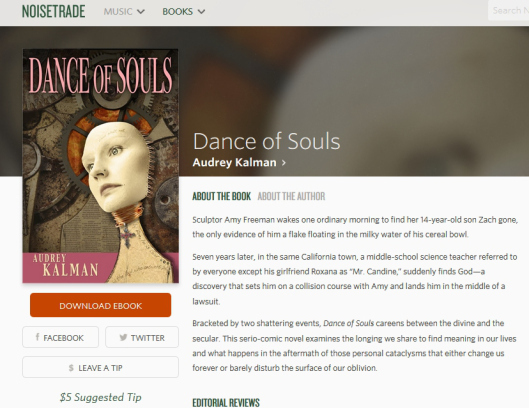
If you download a copy and leave a tip before September 30, I’ll send half of your tip to support the Berkshire Festival of Women Writers.
Also, as an experiment, I purchased a featured spot in the Noisetrade newsletter to promote it. (Sorry to disappoint, but those newsletters, like most in the publishing world, are curated not by editors but by money.)
The experiment was a success in that I made a start at building my e-mail list, albeit a very small start. The percentage of downloads compared to the size of the Noisetrade e-mail list was so small that my calculator insisted on displaying it in scientific notation. (I did the conversion; it was .1 percent, which as a download percentage is actually not too terrible. If you’re familiar with direct response e-mail you know that fractions of a percentage in terms of opening e-mails is considered normal.)
Getting taken
This experiment was going on around the same time the story broke about the celebrity-account-hacking-and-nude-photo-distribution scandal.
I mention this not to comment about the wisdom of taking nude photos of oneself or where the responsibility lies for the unauthorized access to such photos, about which you can read many accounts online, like this one. I mention it because the temporal juxtaposition of these two events—celebrity photo kerfuffle and the availability of my novel for free downloading—highlighted one of the cruel ironies of the publicity world today, one that is especially cruel and ironic for an indie writer.
If you are already famous, it’s easy to become more famous—even in ways you’d rather not.
If you are not famous, it’s really, really, hard to get anyone to pay attention to you.
The Internet is essential to this irony and to the celeb photo story, which wouldn’t be possible without digital media and a means of distribution. (Richard Heppner wrote an interesting reflection about fame on and off the Internet.)
Going viral
If only, I found myself thinking, my novel would gain such currency as the celebrity photos have. Because here’s the thing: I don’t want to be famous. I want my work to be famous.


A search for “nude celebrity photos leaked iphone” yielded 20 times more resluts (oops, results) than a search for “Audrey Kalman.” What am I doing wrong?
But then I might end up like J.D. Salinger, the famously reclusive author of The Catcher in the Rye, who detested the trappings of fame and stipulated that much of his work not be published until fifty years after his death (2060), although some will apparently be published between 2015 and 2020.
Putting out
Celebrity, fame, writing, and becoming known on social media all connect to the central theme of Dance of Souls and many of my other stories: Our abiding need, as human beings, for connection to other human beings.
Unlike personal connections—which so often are unsatisfying since real people are flawed and make emotional demands on us—the relationship of author to reader, celebrity to fan, Twitterer to follower, has none of the mess of real human relationships. You get admiration, approval, sometimes even adulation. And that feels good.
You also, of course, open yourself to the possibility of exploitation and cruelty, loss of privacy, and to hearing words spoken about you that people might never bring themselves to say face to face. And, as ardent as your readers or followers may be, they won’t get up with you in the middle of the night when you’re sick, or rub your back when it aches, or put an arm around you when you need a hug.
Am I putting my work out there just to feel good or fill some aching emptiness unfilled in my personal life? I think not. But, on some level, I do hope for a connection to my readers.
Would I want the kind of attention lavished on the truly famous? I think not. But I would like a few people to read and enjoy my work, and in the cacophonous world that passes for a public square these days, that’s becoming increasingly difficult.
Are you famous? Have any photos of you ever gone viral? How do you feel about “putting yourself out there“—whether it’s in the form of a work of art or something else?


September 1, 2014
Fruits of our labor
I am honoring Labor Day in typical U.S. fashion. By working.
Because I am self-employed, I can choose to work on any given day and take off some other day. This often results in my working longer hours than I would if I had a 9 to 5 job.
Hard work has brought me to a place of relative security and freedom—but not hard work alone. I was lucky. Lucky to be born to well-off parents. Lucky to have had educational opportunities. Lucky to have been born in a time when women can have careers beyond schoolteacher or nurse.
![By Teemu008 from Palatine, Illinois [CC-BY-SA-2.0 (http://creativecommons.org/licenses/by-sa/2.0)], via Wikimedia Commons](http://commons.wikimedia.org/wiki/File%3AHaymarket_Martyrs_Monument_(7402970314).jpg)
The Haymarket Martyrs’ Monument in Forest Park, a national landmark (1893). Read the history at Wikimedia Commons. By Teemu008 from Palatine, Illinois [CC-BY-SA-2.0], via Wikimedia Commons
Lucky, in other words, to be privileged.
Not so lucky are the millions of minimum-wage workers who must work when they can, often at more than one job. Not so lucky are the children of those workers, who may attend struggling schools and return home to parents too exhausted or busy to help with homework. Not so lucky are the people who work hard all their lives only to be wiped out by medical bills or a home loan gone bad.
Does work = worth?
Whether it’s the lingering influence of our Puritan ancestors or some other force, we seem to believe that more work translates into higher moral standing. Even among the a-religious, laziness is a major sin. I know, because there’s some of that belief in me. But carried to its logical conclusion, this belief leads to absurdities like only twelve weeks of unpaid leave for new parents and the idea (whether real or perceived) that using all your vacation time will be detrimental to your career.
I don’t consider myself a socialist or a Marxist, but I do like the statement “From each according to his ability, to each according to his need,” attributed by Wikipedia to the Frenchman Louis Blanc and popularized by Karl Marx.
Call me whatever names you want, but I hope that on this Labor Day you’ll contemplate your position in society, your relationship to work, the sacrifices of those who fought (and still fight) for better working conditions, and our responsibilities to one another as human beings.
In doing research for this post, I was fascinated to see the U.S. Department of Labor’s 2014 Labor Day page. They must have gotten some hot-shot new media designer to work on it because it looks about as unlike a government web page as anything I’ve ever seen. Check it out—there’s also some good information behind the pretty pictures.
Fruits of my labor
September is turning out to be a big month for me. Two seeds planted months ago in the form of short fiction submissions have sprouted. Both are free to read/listen to online.
Skyping With the Rabbi – To be published in the Available now in “The Jewish Literary Journal”
Back After a Break to Discuss the Decline of Civilization – To be published (Audio podcast) at Boundoff.com, September 3.
Watch Twitter and Facebook for an announcement of the Boundoff publication, and I’ll add both to my READ STORIES page.
Also this month, I am featuring “Dance of Souls” on Noistrade.com for free download.
What’s the catch? There is none. Please download—and tell your friends. The file is available as a .MOBI for Kindle or as a .PDF.
Noisetrade also allows you to leave a tip. I hope you will, especially because from now until September 17, half of all tips I receive from Noisetrade downloads will go to support the Berkshire Festival of Women Writers. BFWW is an amazing month-long celebration of writing sponsored by Bard College at Simon’s Rock and spearheaded by my good friend Jennifer Browdy de Hernandez. The festival will soon enter the planning stages for its fifth season in 2015.
The other half will help support my continued fiction writing: one novel under consideration by a publisher and another in progress.
It’s a cliché to say “win-win” and even more to say “win-win-win,” but I think this is just that.


August 13, 2014
Book review: “Enchanted Objects”
I don’t usually post book reviews, but I just finished reading Enchanted Objects, by David Rose, which I undertook as research for my speculative fiction work-in-progress.
 The book jacket copy describes Rose as “an award-winning entrepreneur and instructor at the MIT Media Lab, specializing in how digital information interfaces with the physical environment.” My brain began whirring the moment I heard about the book and I was excited to hear him speak at Kepler’s Books in Menlo Park in July as part of his book tour.
His talk both enchanted and disturbed me, as did the book itself. A few things I found enchanting:
that the book begins with the question “What makes something magical?”;
that smart people like David Rose are asking what relationship we want to have with technology;
that “the most promising and pleasing future is one where technology infuses ordinary things with a bit of magic to create a more satisfying interaction and evoke an emotional response”—and that this enchantment should be based on fundamental human drives that have their earliest expression in myths and storytelling;
that optimists like Rose see technology evolving beyond the “black-slab” so ubiquitous now in the form of our ever-proliferating screens.
I have a harder time articulating what disturbed me. Partly it was the obvious fact that any technology can be applied for good or ill. For example, cloud-connected objects open the door to hacking, government surveillance, and further erosion of the membrane between public and private life. (Just look at the potential problems inherent in unsecured devices like Fitbit or “smart” homes controlled by not-so-in-control software.)
A bigger and less specific discomfort arises from one of the questions that is sparking the research and writing of my current novel:
What is our relationship, as a culture, with the ideas and artifacts of progress?
Rose is an unapologetic technological optimist—as well he should be, given his work at MIT’s media lab and the many tech companies he has been involved with starting. To his credit, Enchanted Objects doesn’t ignore the potentially darker side of an Internet of Things. But—optimistically—he believes that humans’ desire for good will check and balance any Big Brother scenarios.
I’m not so sure. Perhaps it’s my pessimistic nature, or my fear of unintended consequences, or the creep-factor inherent in a world of inanimate objects that respond to you as if they were aware. Some of the worst problems in the world have arisen not from the actions of dedicated evil-doers or nefarious anti-heroes but from millions of small and seemingly inconsequential decisions by individuals. Each decision, on its own, seems benign and even positive, but the sum total of these decisions end up leading us down a garden path toward a future much darker than the one we envisioned.
Whether you are an optimist or pessimist, I recommend Enchanted Objects as a chronicle of the important work currently being done by leading technology researchers and thinkers. It’s written accessibly, without jargon, and holds together as a summation of the arc of Rose’s career to date.
We may wish to slow or even reverse humanity’s relentless pursuit of technology, but given the impossibility of that wish, I suppose we could do worse than to end up in the world Rose describes in Enchanted Objects.
What do you think? Would you be charmed or disturbed by an umbrella that tells you when it’s going to rain?


July 31, 2014
À la recherche du temps perdu*
Last month, I answered some questions about my writing, one of which was “Why do I write what I do?” My answer focused on the “what.” In the weeks since, I’ve realized there’s a deeper reason for the “why.”
Back in the days when photography required developing, a chemical fixative would stop the development of the image and preserve or fix it.

“DevelopingFilm1937″ by Flickr photographer dok1 / Don O’Brien – Flickr photo. Licensed under Creative Commons Attribution 2.0 via Wikimedia Commons
Writing, for me, has always been a fixative for time.
I’ve felt since my twenties that time was accelerating. Sometimes I joke that the reason bills go unpaid or food spoils in the fridge is that I cannot accurately perceive the elapsed time since I paid last month’s bill or stashed the yogurt on the second shelf. Of course, this is merely a perception—albeit a powerful and disconcerting one.
Ron Friedman, writing about the time acceleration phenomenon for Fast Company, cited a plausible explanation (apart from biology) for this feeling. The Habituation Hypothesis rests on the idea that as we get older, more and more of our daily activities become reflexive. This habituation causes an inattention that leads to the feeling that life is an ever-accelerating merry-go-round of repeated activity.
I’ve been experiencing this more lately as I pause before bed to reflect on the day in my journal (yes, I still keep a hand-written journal). My changing journal entries embody, with distressing accuracy, the crux of the Habituation Hypothesis. When I was younger, I wrote page after page about new experiences, new people, new emotions. Now I find it difficult to come up with anything that differentiates one day from another. With rare exceptions, each day resembles the one before, if not in content, then at least in form.
Oddly, I enjoy this repetition at the same time that I find it distressing. I enjoy my daily rituals: making a pot of tea each morning, taking a late afternoon walk, and cooking dinner each evening while listening to the news and sipping a glass of wine.
Embracing opposites
The real revelation is not that time seems to accelerate as we age. Instead it’s that, as we get older, our ability to embrace opposing ideas and emotions expands. We can love our habits while at the same time feeling distressed by how they make life seem to fly by. We can recognize that embracing the new may serve as an antidote to the acceleration of time, as Friedman suggests, but that new experiences make us anxious. And we can feel compelled to fix the moments of our lives on paper while knowing this fixative is as fleeting as any electrochemical flash of memory in the brain.
In contemplating all of this—which is, inevitably, tied up with feelings about mortality—I return to one thing that seems to function as an all-purpose salve for both existential and visceral woes, something that any of us can practice, at any time.
Mindfulness.
Paying attention to what is happening in the current moment is an anti-fixative. The purpose of mindfulness is not to hold on but attend to what is before you and then to let it go. Paradoxically, this focused attention and letting go can turn habituated moments into magical ones, a jumbled rush of frantic activity into a captivating tableau, or an ebbing life into a series of savored moments.
More on the perception of time
A brush with death slows time – Radiolab story
“Time Warped” – Claudia Hammond’s book
* Thanks to Marcel Proust for lending the title of his seven-volume novel to this post. The title is usually translated as “Remembrance of Things Past” but a closer translation is “In Search of Lost Time.”


July 13, 2014
Ask me anything (really)
Goodreads authors can now enable the “Ask the Author” feature, allowing readers to submit questions to their favorite (or maybe no-so-favorite) writers.
When I heard about this, the acronym “AMA” came to mind. AMA is Reddit’s “Ask Me Anything” open question forum where everyone from Guillermo Del Toro to President Obama can answer questions of all kinds.
When I started thinking about Reddit, I started thinking about Aaron Swartz, the prodigy/tech genius/hacker/activist/lead developer of Reddit who took his own life at age 26 in January, 2013.
The fact that it took me only two conceptual leaps to arrive at this place may be partially due to recently hearing
June 24, 2014
Bunny on the run reveals work in progress
One thing you learn about life after a while is that there is never a perfect time for anything.
A few weeks ago, my former doula client, Fault Zone assistant editor, fellow writer, and friend Dorcas Cheng-Tozun e-mailed me to ask if I’d be interested in participating in a “blog hop.”
![By Paulo Costa (Own work) [CC-BY-SA-3.0 (http://creativecommons.org/licenses/by-sa/3.0)], via Wikimedia Commons](https://audreykalman.files.wordpress.com/2014/06/bunny.png)
By Paulo Costa (Own work)”, via Wikimedia Commons
Flexing my haunches and wiggling my ears, I read on to see what was involved. (Forgive the tired metaphor; I cannot help but picture those small mammals of the family Leporidae whenever I hear the term “blog hop.”) Despite falling in the chain-letter category of online publicity, it seemed a worthy undertaking: women writers highlighting one another’s work by answering a few questions about their own work and then providing links to several other blogs. (Here’s how Dorcas answered the questions.)The one problem was the terrible timing. I would need to get my post ready for the week of June 23, and line up the other writers for the following week. Meantime, I was in the middle of organizing Fault Zone readings for the San Mateo County Fair, editing submissions for Fault Zone: Diverge (non-member entries open till August 1), and preparing for a week on the east coast.
But I said yes, and I’m glad I did.
Hopping in the real world
My east coast trip felt like a real-world manifestation of a blog hop. I spent time with two dear long-time friends: Jennifer Browdy de Hernandez, professor of gender studies and literature at Simon’s Rock College and founder of the Berkshire Festival of Women Writers, and Rochelle Nemrow, founder and CEO of FamilyID.
These are not the women to whom I passed the blog hop baton, but I wanted to recognize the extraordinary work both are doing. Jenny has created a community of women writers in the Berkshires that has spawned an annual month-long celebration of writing with readings, workshops, theater, and storytelling for women of all ages—and now an anthology. Rochelle has created a company that not only provides a valuable service to families but supports families in its business and hiring practices. I’m really proud to call them my friends—and to brag that I knew them when. (Jenny’s faculty bio mentions that our childhood friendship is partly responsible for her attending the college.)
Now on to the blog hop questions and answers. Get ready for a tiny bit of a “reveal” here as I discuss my current writing project—but very tiny, as I am one of those writers who doesn’t like discussing my work too early in the creative process.
What am I working on/writing?
The phrasing of this question allows me to brag about all the writing other people are doing since I’m in the middle of editing submissions for the next Fault Zone anthology, Fault Zone: Diverge (contributors, please be patient!)
I really love editing. I know some writers don’t—and I know it is easier to edit the work of others than to edit one’s own. But I gain enormous satisfaction from helping writers bring out the best in their words. (I wrote about this in a post in which I compared the joy I derive from editing to the joy I derive from supporting families during childbirth as a doula.)
I’m also trying to find the time to work on a new novel that popped up unannounced one day a few months ago. Here are a few things about it:
It’s a departure from my usual genre of literary fiction into speculative fiction, set in the near future.
Though the world of the book contains technology of the future, the focus is not on the gadgetry but on the human beings who are immersed in it.
The central idea of the book is that storytelling can save the world.
How does my writing/work differ from others in its genre?
After receiving degrees in creative writing and in journalism, I struggled for years with the question of popular vs. academic (or commercial vs. literary) fiction. Eventually I arrived at the conclusion that I wanted to combine the best of both.
![By Evan-Amos (Own work) [Public domain], via Wikimedia Commons](https://audreykalman.files.wordpress.com/2014/06/mms.jpg)
Guilty pleasure. By Evan-Amos (Own work) [Public domain], via Wikimedia Commons
In the literary tradition, I aim for language that is rich and appealing in its own right. But that appeal must never be for its own sake. The words must always reveal character or advance plot, even as they please the ear. I want to walk the tightrope between commercial and literary, offering books that people label pleasures rather than guilty pleasures. Kind of like dark chocolate sea-salt caramels rather than M&Ms.Writing in a new genre—speculative fiction—is humbling. I have enjoyed stories set in the future since I first read Margaret Atwood’s The Handmaid’s Tale. But realizing what a rich body of work exists in this area—and wondering how I will contribute anything original to this sea of stories—keeps me up at night. I’ve had to make a conscious decision not to think too much about existing books and established authors, but instead dig deeply into the world I’m imagining. I have to believe that my take on the world of the future won’t be exactly the same as someone else’s. In literature, after all, there are no original themes.
Why do I write what I do?
I still write fiction for the same reason I did when I was ten: “to find the answers to life’s persistent questions” (the raison d’être of the fictional detective Guy Noir in A Prairie Home Companion). Of course, the questions I worked out through writing in elementary school are vastly different from the ones I’m tackling in my current novel.
These days my questions are about culture, society, and technology. What are the unintended consequences of smart phones, driverless cars, wearable computers, computers you swallow—especially on creativity? Should I worry that my kids spend as many hours in interactive gaming as I used to spend with my nose buried in the pages of a book? What’s an older generation to do when it feels its core values are threatened by the evolution of technology and culture? Are there such things as universal cultural values? Is our society really going to hell in a handbasket?
How does my writing process work?
I write every day. I floss regularly, exercise 40 minutes 4 times a week, and get at least 8 hours of sleep.
One of those statements is true. Ask my dentist.
I do understand the value of maintaining a regular writing schedule. When I’m not on deadline for another project, I try to write in the morning, for at least a half hour. When I’m on deadline, I fall back on weekly dates with my writing partner, which guarantee at least two hours of writing. Since two hours a week is not sufficient to maintain momentum on a novel, I’ll be back to daily writing when my editing deadlines ease.
But my characters are with me throughout the day even if I’m not sitting down and typing. I collect scraps of ideas, images, and scenes. I often work out plot or motivation problems when walking, cooking, or practicing yoga.
I’m a firm believer in the power of the seeded unconscious to fuel creativity. That is, first tackling a problem head on, then letting it go and letting the mind to turn to other things, or to nothing, allowing solutions and ideas to arise from a place that is often inaccessible when you try to reach it directly.
And I edit as I go. I usually begin each writing session by reading over and lightly editing the previous session’s work to get me in the frame of mind to move ahead. As I’ve mentioned before on this blog, few things are more painful than putting down fresh words in a story.
Who’s next on this exciting blog hop?
Next up are two writers I know in different ways. I met Darlene Frank in person through the California Writers Club. I then had the pleasure of editing her work for the Fault Zone anthologies. I “met” Julia Whitmore by chance, stumbling on her blog in my many serendipitous journeys around cyberspace, and I’m glad I did. I can’t wait to hear what they both have to say in answer to these questions, and I hope you’ll check them out too.
 Darlene Frank is a writer, editor, and creativity coach who helps writers gain creative confidence and fulfill their artistic vision and dreams. She works with nonfiction authors especially in the self-help and memoir genres and with writers who have undergone a radical life transformation and want to create art from that experience. Several of her memoir stories about being raised as a Mennonite in Pennsylvania are published in literary anthologies, including Fault Zone and Times They Were A-Changing: Women Remember the ’60s and ’70s. As an editor and book consultant, Darlene guides first-time authors through the “indie” publishing route to create a book that shines. She is author of two business books, has written and edited thousands of pages of corporate training materials, and teaches workshops on how to navigate the writer’s journey. She lives by the ocean in the San Francisco Bay Area, her creative home for over 30 years. Visit her at www.DarleneFrankWriting.com.
 Julia Whitmore lives in the Pacific Northwest, and is a lifelong closet diarist. She came out (as a writer) three years ago, and now juggles the rocky business of learning to write fiction, with a host of interests and activities. She teaches yoga, plays in a band and enjoys travel, hiking, skiing, gardening and cycling. Over the years, her passion for politics has led her to school funding, environmental projects, helping out at the local library and youth symphony. Her first try at novel writing, which she describes as a classic beginner seat-of-the-pants effort, is tucked high in a dark closet. She hopes to finish draft one of novel two this summer. This second story might, she says, be read by more than her critique group, perhaps by her sweetie and an editor, before undergoing major surgery revisions. She and her husband are celebrating thirty years together this year, and have two children. Visit her at http://holdouts.wordpress.com.
Please stop by and visit them.


June 6, 2014
Where do your stories live?
As a Mother’s Day gift this year, I asked my family not for a thing but for an experience.
“Let’s get together once a week and read a book aloud.”
 With much grumbling—and some one-upsmanship involving my 16-year-old proving how much more mature he is than his 13-year-old brother by being more agreeable—the three men in my life concurred.
I loaded the book I’d like to start with, Karen Russell’s Sleep Donation, onto my Kindle. But as of today, nearly a month later, we have yet to engage in a single reading session. We almost pulled it off a few weeks ago, but Older Son informed me at the last minute that he was committed to walk his friend’s dog.
Honest misunderstanding… or passive-aggressive avoidance?
Either way, I’ve been thinking lately about the different ways we tell and listen to stories. Stories are everywhere: in TV dramas like Mad Men, Breaking Bad, and Orange Is the New Black. They’re in video games like Outlast and even Minecraft. They’re in 140-character conversations among friends and strangers. They’re in words spilled across a cafe table between near strangers who seem to share an outlook on life.
I’ve written before about the place of long-form fiction in this new world of stories. The arguments seem ceaseless about whether “the novel” is dead. All that hand-wringing used to worry me. What if I am a dinosaur, a dying breed, the last gasp of a civilization unraveling as a result of its addiction to brevity and technology?
Recently, though, I’ve concluded that I don’t care whether the novel is dead or dying, because storytelling is alive and well. It’s like that old business trope about the railroads being superseded by the automobile because the rail companies thought they were in the train business rather than the transportation business. If writers think of themselves as only about words on paper, then their work will be superseded by newly emerging art forms. But if we define ourselves as storytellers, we’ll endure no matter what the medium.
The impetus to share personal journeys, to shape the events of life into a comprehensible narrative, to turn tragedy into anecdote, to understand ourselves by speaking the truth of what we have experienced—these elements of story will only be extinguished with the last breath of human civilization.
This tension between old and new means of expression is part of the theme of my new work, which I am—somewhat ironically—conceiving of as a novel. Consider it the last gasp of a dying dinosaur.
Where do you get your story fix? Take the poll or leave a comment.
Take Our Poll