Audrey Kalman's Blog, page 9
February 4, 2016
My right brain, yearning to be free
Like most people, I conceive of myself as a unitary individual with a singular identity. That’s how the government—and my family—looks at me (one social security number, one wife, one mom).
But there may be more to me than meets the I.
Researching my novel-in-progress led me to the book “The Future of the Mind” by physicist Michio Kaku. In it, he explores, among other things, the plight of “split-brain” patients. Bear with me as I try to give a brief overview of what that means.
The most fundamental of questions. and good listening as you read—it will make your right brain happy.
You’re no doubt familiar with the idea of left-brain vs. right-brain. It has been part of pop culture for decades. As Kaku explains, “Dr. Roger W. Sperry of the California Institute of Technology won the Nobel Prize in 1981 for showing that the two hemispheres of the brain are not exact carbon copies of each other but actually perform different duties. This result created a sensation in neurology (and also spawned a cottage industry of dubious self-help books that claim to apply the left-brain, right-brain dichotomy to your life.)”*
Kaku goes on to describe studies of patients in whom the corpus callosum, which connects the two hemispheres of the brain, was surgically severed. (These were epileptics who had suffered life-threatening seizures caused by dangerous feedback loops between the two sides of the brain, so the severing served a purpose and had a benefit).
Interestingly, the studies showed that the two sides of the brain seemed capable of operating independently. When the two hemispheres are connected, the left brain (more analytical, the seat of verbal skills, often the final decision maker) dominates. But it turns out that the right brain, when liberated from the strictures of the left, may in fact have a mind of its own. “Dr. Sperry, after detailed studies of split-brain patients, finally concluded there could be two distinct minds operating in a single brain.”**
So where does that leave “me?”
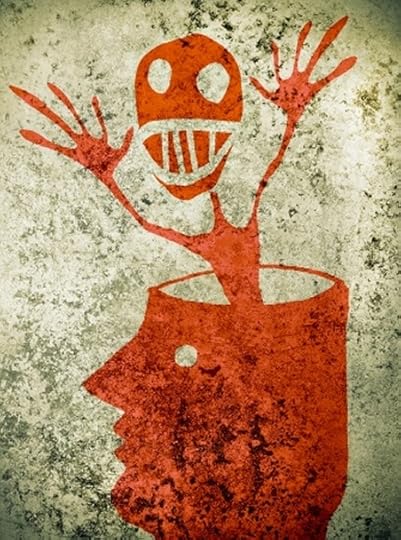
Listen to me!
What fascinates me most about this idea is the psychological comfort it provides me. I have written before on this blog of my struggles with anxiety and my search to feel less alone in the world. The thought that what I think of as “I” is not singular but composed of other consciousnesses makes me feel less alone. And it relieves “me” of complete responsibility for “my” well being. It means that there’s more than one way of being/doing/thinking.
The sad and terrifying thing is that my other brain’s voice may be completely drowned out by the somewhat commanding and authoritarian left brain, which makes me feel great compassion for the right brain. It also confirms my (?) intuition that intuition and non-verbal skills need more nurturing, particularly in myself but perhaps more generally in a population that values verbal gymnastics, rationality, and logic. So, recently, “I”—that is, the left-brained, dominant I—have begun consciously acknowledging the mute, imprisoned right-brained I. It has been a fascinating practice.
Given all this, perhaps the “editorial we” would be a more accurate voice to write in than first person.
We hope you’ve enjoyed this brief dive into neurobiology. We realize that talk of multiple consciousnesses in a single brain might be viewed in some quarters as cause for concern. We sincerely hope you won’t be calling the men in the white coats for us.
Interesting side notes
I am watching the fourth season of American Horror Story – Freak Show, which features the so-called Siamese Sisters: two heads who share a body (or a body with two heads, if you prefer).
A recent episode of the Hidden Brain podcast on keeping resolutions highlighted research showing that people did better at sticking with their commitments if they referred to themselves in the second or third person, rather than conducting their inner-voice discussions in first person. Related to the split-brain idea? You decide. Or you.
*Kaku, Michio, The Future of the Mind, 2015, p. 37
**Ibid., p. 38
And while you’re reading…
More new flash fiction shortlisted at Mash Stories: “So She Says.” Thanks for reading, and I’d love more kudos!


January 20, 2016
Gag order: finding the courage to speak

January 7, 2016
Word rot, waybacking, and betting on paper
According to Internet experts, both high art and mundane cultural artifacts may be more like Snapchat conversations than cave paintings. Snapchat is a mobile app designed to present photos or videos that disappear after seconds; the oldest cave paintings have endured for tens of thousands of years.
Vint Cerf, often credited as the “father of the Internet” and now vice president and Chief Internet Evangelist for Google, has been warning for years that if we don’t do something, huge portions of our cultural, business, and political history could fall away as technology makes obsolete the applications and hardware we use to chronicle every sphere of our lives.
I’ve already lost big pieces of my personal history. You probably have too if you’re over the age of twenty. Many of the media on which I recorded my thoughts and words have become unreadable, including:
Apple Writer documents (for the Apple IIe, from the early 1980s)
IBM Displaywriter disks (dedicated word processing machine from the mid-1980s)
WinWord 3.0 documents (Microsoft Word for Windows 3, early 1990s)
CompuServe e-mail (from the late 1980s/early 1990s)
AltaVista e-mail (from the early 1990s)
And then there’s the web site I worked on in the 1990s that’s visible now only because of the Internet Archive’s Wayback Machine.
What could we do to prevent our Windows 10 documents from going the way of IBM Displaywriter docs? Cerf is talking about the concept of “digital vellum.” Actual vellum, calfskin parchment believed to have been in use since the sixth century B.C., turns out to have tremendous longevity. Digital vellum might have similar utility in combating what Cerf refers to as “bit rot.”
This gives me newfound respect for paper as a technology. While I’ve lost electronic copies of my early writings, I still have paper printouts. I also have letters my grandfather wrote during World War I—actual handwriting on actual sheets of paper. I don’t need a fancy retro machine to get a look at his thoughts. We can go back even further and see some of the original writings of William Shakespeare, which have lasted for centuries on paper.
It remains to be seen how our efforts to preserve and protect digital culture will fare. Perhaps DNA data storage will be the answer, as discussed in one of these On the Media stories. But given the complexities—political and social as well as technological—of these solutions, I’m not going to bet my future on them. Sure, I’ll release my next books electronically for the Kindle and other devices. I’ll also publish them the old-fashioned way, on paper, as a hedge against word rot.
Or maybe I should get me some calfskin parchment…
What treasures have you lost to obsolete technologies? Do you care if humanity’s works of art (and cat videos) evaporate into nothingness?


December 22, 2015
Fifty Little Bits of Gratitude
I wasn’t planning to post again before 2016, but along came one of my favorite bloggers, Susie Lindau, with a great party participation idea (because she’s a party kind of gal). Set a timer for 10 minutes and write down 50 things you’re grateful for (or that made you happy in 2015). Share them in your blog and spread the word. The party is hosted by Dawn, who writes the blog Tales from the Motherland. So thanks to both.
Then I remembered that gratitude also has proven health benefits. All the better!
Herewith, fifty things for which I am grateful.
1. My cats, because they’re cats.
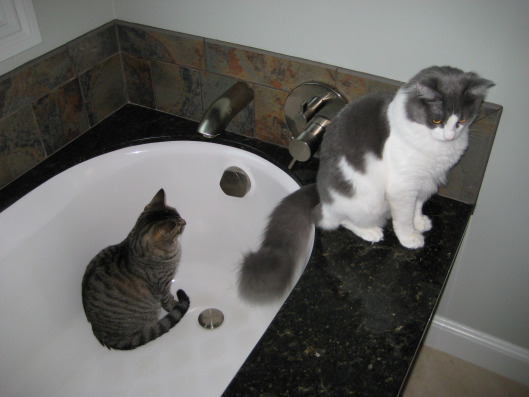
Joshua (in the tub) and Apache (on the edge).
2. Scrivener, because otherwise I could never have revised my novel without going insane.
3. My publisher and her editor, who insisted that I revise my novel although I kicked and screamed all the way.
4. Rain in California, because we really, really need it.

5. Coping mechanisms for anxiety. Without them, I’m a quivering mess.
6. Really good friends.
7. Getting together with really good friends.
8. Women having babies because it’s part of my livelihood as a doula. Also, helping support new families diverts my focus from self to other, which is always a healthy thing.
9. Chewing gum. (Noun phrase or verb phrase–you decide.)
10. Quiet in the morning while the rest of my family sleeps.
11. Equanimity (relative).
12. My spiritual adviser, because, though I’m not religious, wrestling with existential questions is part of who I am.
13. Dreams (the night kind).
14. Functional feet, because I love to walk.
15. Martinis. Straight up. With olives.
16. 25-plus years with my soul mate.
17. My kids. Of course.
18. Driving instructors, so I don’t have to be the first one to take my sons out highway driving.
19. My writing partner, for making sure I write at least once a week for a couple of hours, even when everything else is all gone to heck.
20. A roof over my head.
21. Books to escape into, and Goodreads to keep track of them.
22. The community I live in—pretty for suburbia, and safe.
23. Buffer, so I can tweet while I sleep.
24. The luxury of worrying about having too much stuff.
25. OnlineTimer.net. Without it, I couldn’t write and make dinner at the same time.
26. My slow cooker. Without it, I couldn’t write and make dinner at the same time.
27. EAT24, otherwise my family would starve when I can’t cook for them. And because their coupons make me laugh every Friday.
Not the actual EAT24 logo, but you get the idea.
28. Duotrope, which makes it possible to submit, submit, submit, and submit again.
29. Sixfold, because I finally ranked high enough for recognition.
30. Short stories, because they’re so much easier to finish than novels.
31. A teenage son who communicates.
32. A supportive husband who reassures me about the other son, who doesn’t.
33. Cheese. If forced to live in a world either without cheese or without chocolate, I think I’d have to let chocolate go.
34. A great primary care doctor.
35. Podcasts, because they are a window into the worlds of others. Especially: Hidden Brain, Serial, Radiolab, On The Media, The Moth Radio Hour, and This American Life.
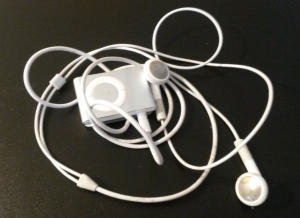
36. My ancient iPod, which still works (mostly) to listen to podcasts.
37. Real maple syrup.
38. Cinemark Platinum Supersaver prepaid movie admission tickets, otherwise I’d never spend $12 to go to a movie.
39. Bikram yoga.
40. My doula business partners, who not only let me live a relatively sane life despite being on call, but who are also good friends.
41. The T2 Mood Tracker Android app, because, for some reason, I find it comforting to track my anxiety levels.
42. Texting, because sometimes it’s the only way I exchange words with my kids.
43. The amazing women of Wingpact who invited me in to help them spread the word about their work through their forthcoming book.
44. My best friend of nearly 50 years, who is like a sister to me.
45. The perspective that comes with age.
46. Fellow travelers on this ridiculous journey of life.
47. Readers, because writing without them would be pretty dismal.
48. Tea, especially Darjeeling.
49. A really nice Sauvignon Blanc.
50. Susie Lindau, for posting about this blog-sharing idea and giving me something to say before the end of 2015.
How to share your own favorites
If you would like to participate, here are the rules. Dawn, who writes the blog Tales from the Motherland, is hosting this event.
Rules:
If you’d like to join in, here’s how it works: set a timer for 10 minutes; timing this is critical. Once you start the timer, start your list. The goal is to write 50 things that made you happy in 2015, or 50 thing that you feel grateful for. The idea is to not think too hard; write what comes to mind in the time allotted. When the timer’s done, stop writing. If you haven’t written 50 things, that’s ok. If you have more than 50 things and still have time, keep writing; you can’t feel too happy or too grateful! When I finished my list, I took a few extra minutes to add links and photos.
To join the bloggers who have come together for this project: 1) Write your post and publish it (please copy and paste the instructions from this post, into yours) 2) Click on the blue frog at the bottom of Dawn’s post HERE. 3) That will take you to another window, where you can past the URL to your post. 4) Follow the prompts, and your post will be added to the Blog Party List.
Please note that only blog posts that include a list of 50 (or an attempt to write 50) things that made you feel Happy or 50 things that you are Grateful for, will be included. Please don’t add a link to a post that isn’t part of this exercise.


December 16, 2015
I am going to gratify you instantly
First, I’m going to dance a jig.
My story, Before There Was a Benjamin, placed fifth (out of 387) in the November 2015 Sixfold competition. This is the fourth time I’ve entered Sixfold, and it yielded the best results so far. (See my previous thoughts about the competition.)
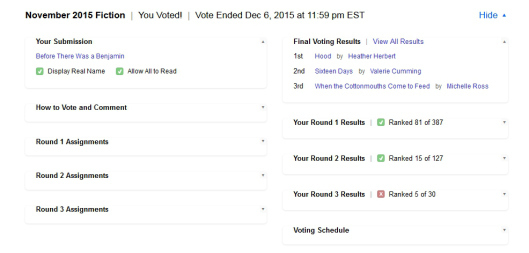
Sixfold ranking, November 2015
Previous rankings
2013 – 170 of 282 (round 1)
2014 (May) – 82 of 480 (round 1); 79 of 125 (round 2)
2014 (Nov) – 112 of 369 (round 1)
This makes me happy for many reasons, not the least of which is that the story will be published in the next edition of Sixfold Journal. I am even happier because a couple of clicks will bring readers right to a published story.
Flush with excitement, heart pounding from my jig-dancing, I’m trolling Duotrope for more submission possibilities. As I do, I find myself shying away from publications that categorize themselves as PRINT ONLY.
Even a few years ago, I would have preferred seeing my work in print. Now I’d rather be online. Why?
Print is too much trouble—for readers and for writers.
Many authors use social media to excite readers readers about their latest story or book. But, especially for short stories, being in print diminishes the potential audience. Unless you’re published in The New Yorker (lucky you), the audience you will garner in a literary print publication probably ranks in the thousands, or even hundreds. Moreover, it’s unlikely that someone who isn’t already a subscriber will buy a copy just to read your story. Whereas if you can entice a potential new reader to click a link, that reader arrives immediately at your work. Instant gratification.
Oh paper pages, we hardly knew ye.
This sums up how the world of reading, writing, and publishing is changing, as so many pundits have pointed out.
We writers can moan and groan about the death of print (which may or may not be happening). We can argue about whether the cultural shift toward preferring instant to delayed gratification is a good thing or a bad thing. Yet I can’t muster too much nostalgia for the old order, for a time when there was little possibility of having your voice heard by more than a few people, the days when gatekeepers controlled everything the public read, saw, or digested.
The floodgates have opened. It’s our job now to direct the flood—or build a boat to ride the waves.
The payoff
Now, please gratify yourself instantly with some of my previously published stories.
If Only You Weren’t So – Mash Stories Competition
Put the Sweater on the Dog – Sand Hill Review 2015
Back After a Break to Discuss the Decline of Civilization – (Podcast) Bound Off
Skyping With the Rabbi – The Jewish Literary Journal
Tiny Shoes Dancing – Sand Hill Review 2013
Now You Are a Public Nuisance – Every Day Fiction
Bad Luck With Cats – Every Day Fiction
Forget Me, Forget Me Not – Punchnel’s
And please share the gratification on whatever is your preferred word-spreading platform.
Happy holidays!


November 30, 2015
In which I ponder an unanswerable question
I had intended to write a different post for today (which I still may). But the topic gave me so much trouble, I fled to an easier one:
Is philosophy dead?
My as-yet-unfinished post talked about epistemology—the study of knowing—which is a philosophical concept. Then I began to think maybe I was disappearing down a rabbit hole having trouble because the entire framework in which I was trying to express my ideas is crumbling.
Hence: Is philosophy dead?
As usual, I find myself able to argue both sides.
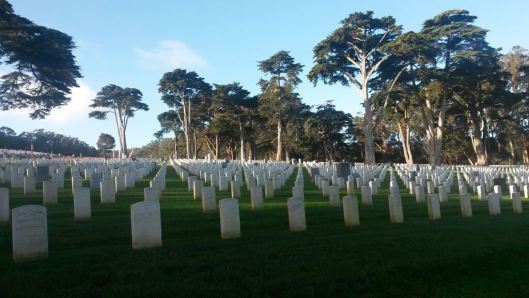
RIP, philosophy? Golden Gate National Cemetery (c) 2015 Audrey Kalman
YES, philosophy is dead BECAUSE:
Philosophy is a luxury of the well-off. Only those who have a roof over their heads and food enough on their tables have the leisure of contemplating the meaning of existence. In a time when we’re meeting to figure out how to mitigate the climate changes threatening the existence of life on earth, when one in nine people do not have enough food to lead a healthy life, and the list of ongoing conflicts (wars) in the world scrolls on for pages, we can’t afford to sit around contemplating our navels spend time on something as frivolous as philosophy.
Or not: What about Holocaust survivor Viktor Frankl, a neurologist, psychologist, and author of Man’s Search for Meaning? Far from being a frivolous pursuit, his search for meaning during the darkest hours of his imprisonment is what saved him. If we accept this, now is exactly the time we need to ask the very biggest and seemingly most unanswerable questions.
Stephen Hawking says so! In a 2010 lecture, the famous physicist declared that philosophy is passé, its function largely usurped by scientific inquiry.
But many disagree. Almost five years later, Times Higher Education covered a number of dissenting voices, many of which arose from a 2015 seminar organized by the Axel and Margaret Ax:son Johnson Foundation called “What is the Point of Philosophy?”
In fact, some argue that science depends on philosophy.
NO, philosophy is not dead BECAUSE:
Only certain types of philosophy are dead. In a 2013 opinion piece for Aljazeera, Santiago Zabala and Creston Davis argue that analytic philosophy may be dead, while “‘democratic’ philosophy is not dead but very much alive and well.”
Rumors of philosophy’s death have been greatly exaggerated. Philosophy has been declared dead for years. Quora has 23 answers to the question of how philosophers are reacting to Hawking’s declaration. Many point to previous declarations of philosophy’s demise and to the irony that physics itself was declared dead in 1900 by one of its leading practitioners of that day.
It depends on how you define death. In western culture, we tend to think of death as an ending, a finality. In fact, death is transformation from one state to another. In that sense, yes, the philosophies of Aristotle and Socrates and even Leibniz and Wittgenstein may be dead. In their place, we have something new that serves our time and our concerns. (Is that an argument for or against? I don’t know… my brain is starting to hurt.)
Which side are you on? Are you with the 34 percent who say yes, philosophy is dead, or the 66 percent who say no on Debate.org? Or do you think all of this is just so much hot air beside the point?
If you wish not to take all of this so damned seriously, check out Existential Comics.


November 1, 2015
I feel your pain: writing and the nature of experience
One of the things I loved about being a journalist was the excuse it gave me to dive deeply into subjects and lives I would never encounter otherwise.
In the name of “getting the story” I did such things as going on patrol with the coast guard (albeit in a relatively tame New England town), signing up with a dating service (long before online dating), and donning an early virtual reality head set (which is, in some ways, like getting inside someone else’s head).
As a writer of fiction, I long ago abandoned the simplistic notion of writing what I know. If authors took that literally, we would never have fantasy, sci-fi, or historical novels. Instead, I interpreted that advice, often given to beginning writers, to mean write what you understand emotionally.
Even that interpretation, however, raises questions. Every experience evokes an emotional response. How similar must two experiences be to evoke an identical response? Is grieving the loss of a dear friend the emotional equivalent of grieving the loss of a spouse? Is red-hot rage that results in screaming into a pillow equivalent to rage that leads to picking up a gun and killing someone?
My characters have committed arson and cheated on their spouses (actions, I hasten to say, I have never taken). But until recently, I felt I could write about those things because I believed I could understand my characters’ emotional response based on my own response to similar, though not identical, situations.
But can I?
The fallacy of emotional equivalency
Then, last year, my up-close-and-personal encounter with anxiety (which I wrote about here, though somewhat obliquely) made me begin to wonder: Can I do justice to an emotional state I have not directly experienced?
If you had asked me a few years ago whether I could write convincingly about a character suffering from anxiety, I would have said yes. I’m human; I know what it is to be anxious. I thought I had been anxious. Now I know two things:
I did not really understand the feeling of clinical anxiety until I went through it. My imagination of the sensation was only the palest imitation of the sensation itself.
Even knowing the feeling, I am at a loss to know whether any words I write about it could accurately convey it, either to those who have also experienced it or—and perhaps especially—those who never have.
In the same way, I recognized before I had kids that there is a fundamental difference between the emotional experiences of people who have had children and those who haven’t. Once I had children, I understood the spasms of doubt, the moral conundrums, and the completely illogical joys that parenthood brings in a way I never had before. And I began to doubt whether I could have done justice to writing about being a parent had I not been one myself.
Reading as escapism, but not the kind you thought
Where does that leave the writer? Must childless writers abandon family as a subject? Must well-adjusted writers forego the topic of depression? Must I give up writing about arsonists and philanders?

Source: gstockstudio via 123rf
Even given the challenges of really understanding another person’s emotions, I say no. I must—out of professional necessity as much as anything—believe in my powers of empathy and my writing abilities to overcome this challenge.
All of us are alone inside our skins and our brains. The only way to defeat this isolation is to try, however poorly we might do it or how miserably we might fail, to get inside the skins of other members of the human race.
It’s the only way out of the prison of our own brains. It’s why I write, and, I imagine, why many people read.
What about you?
More on connection from Aeon Magazine
Telepathy
The Empathy Machine
New Flash Fiction
If Only You Weren’t So is shortlisted in the Mash Stories Contest. (You have to scroll down the Mash Stories page to see it). I hope you’ll read it and give kudos if you like it.


October 21, 2015
Are you tweeting into the void?
In 2014, I wrote about how I became a reluctant bride of Twitter. These days, I spend the bulk of my social media time on Twitter. Social media mavens like Karma Bennett (coming to the CWC-SF/Peninsula Branch in November for a workshop) may scold me for focusing on a single platform, but so be it.
In the year-plus that I have been active on Twitter, I’ve gone from 100 followers to a little more than 700. It hasn’t exactly been a hockey-stick growth curve. I’ve been wracking my brains to figure out the secret behind the Twitter users whose accounts boast numbers with a K after them. I often feel I’m shouting into a vast canyon supposedly filled with eager hordes. “Hallooooo!!! Is anybody out there?”

At this rate, I’ll get to 10K followers sometime in the next 25 years.
After some research and reflection, I have concluded that there is no magic formula. In fact, it seems to come down to:
Tweet often
Tweet well
Like much good advice, this suffers a surfeit of detail. So, to figure out more about what’s working and what’s not for me on Twitter, I’ve written an open letter to my followers. After the letter, I offer some resources from those more expert than I.
Dear Twitter Followers,
I know you love me just as much as I love you. I mean, who wouldn’t fall in love based on a description that crams one’s entire life into a tiny block no bigger than a decorative postage stamp?
But please, if you love me, really love me. Don’t follow me one day just so you can wave your brand in front of my face and then unfollow me the next day because you don’t really care. You give me vertigo. My follower number surge and then decline. Who leaves me? @Get1000followersNow and @SpendMoneyFoolishlyWithUs and @WeDoNotCareAboutYouOnlyAboutOurselves.Should I do the same, just to put my mug in front of more people? I shall not. I shall follow only those whose profiles genuinely engage my interest.
Speaking of genuine engagement, please say something about yourself in the meager space provided. If you are Cher, Prince, or Madonna, your one name, alone, might be enough to entice me to follow you, as long as I know you are the GENUINE Cher, Prince, or Madonna (I can tell because you’re verified). But Mary? or LWM69503? Sorry.
Please don’t mention me by my Twitter handle just to get me to look and then do a “ha ha, fooled ya” with a message about how to buy Twitter followers or where to find the latest in swanky leather goods.
DO use it as @malie129 did, to invite me to the #cowrite, which is something that interests me. How can you tell if I’ll be interested in something? You might get a clue from actually reading some of my tweets (literature, science, psychology, writing, editing, technology, philosophy).
Be loyal and I shall be loyal in return. I have to send out a big, heartfelt thank-you to my Twitter tribe. Right now, it’s a handful of people. But we interact regularly. I retweet them, they retweet me. (Shout out to @CarrieRubin, @KM_Huber, @readinterrupt, @dorcas_ct, @AugstMcLaughlin, and @jbw0123. Send them some love.)
Oh, and cut me some slack if I don’t tweet as much as your average bear. I sometimes get caught up in… what is it? oh, yeah, life…
Sincerely,
A Willing Bride of Twitter
![Perhaps the stamp is not actually this size, but close enough. [Source: Public domain image via Wikimedia Commons]](https://audreykalman.files.wordpress.com/2015/10/twitterplusstamp.jpg)
Perhaps the stamp is not actually this size, but close enough. [Source: Public domain image via Wikimedia Commons]
How to go all in
All of this, of course, begs the question: Does Twitter matter? Does social media help your “author brand,” which in turn (we assume) helps you sell books?
I think the answer is a variation of the quote “Half the money I spend on advertising is wasted; the trouble is I don’t know which half,” usually attributed to marketing pioneer John Wanamaker. Half of everything we do involving social media is a waste; the trouble is that we don’t know which half.
If you want to get into the nuts and bolts, there’s lots of good advice about using Twitter to your advantage, especially as an author. Here are a few I found useful.
General
Kirsten Lamb – “3 Ways to Fire Up Your Writing Career Today“
Jane Friedman – “Feeling Like an Old Geezer at the New Social Media Party“
How-to (brand-related)
“How to Get More Twitter Followers–and Keep Them“
“How I Went From Zero to 380,000 Twitter Followers Without Spending a Dime“
“6 Research-backed Ways to Get More Followers on Twitter, Facebook, G+ and More“
“7 Ways I Accidentally Got More Twitter Followers (and 7 Ways You Can on Purpose!)“
How do you use Twitter? How have you gotten followers? Does having more followers = more happiness, more love, and more sales?


September 26, 2015
The great book extinction is coming. Or is it?
I loved reading cookbooks when I was a kid. We had The New York Times Cookbook and The Joy of Cooking as well as 365 Ways to Cook Hamburger and Men Cooking (it was the 1960s).

A cookbook reflects its times.
My best friend’s mom, who was much more into cooking than either of my parents, had books on Chinese cooking and Maida Heatter’s Book of Great Desserts. She also subscribed to Gourmet magazine. I spent hours reading lists of ingredients, thinking of meals I would make and ogling the few color photographs.
I even created my own recipe book.

The beginning of my writing career?
Oh, how the mighty have fallen. Or, perhaps, risen.
Now I have a Pinterest account. When I want inspiration, I look at my Recipes board. I can ogle endless, gorgeous, glistening photographs—food porn, anyone? I can instantly print any recipe I want. Or I can go on a treasure hunt, letting Pinterest lead me to other boards that share my Pins and to other recipe sites until I’m in danger of disappearing down a cooking rabbit hole.
Books vs. ?
The cookbook-vs.-Pinterest state of affairs strikes me as an apt parallel to what is happening in the world of fiction. When we say traditional book publishing is in trouble, the fiction writers among us fear the demise of the novel. But other segments of the book publishing world fear the same slow slide into oblivion. I looked for some expert opinion. It was as mixed as a chopped salad. Here are two:
The future of cookbooks—they’ll go extinct, and that’s okay (Slate)
The State of U.S. Illustrated Book Publishing – Part I (Publishing Perspectives)
Many of the pro-physical book arguments are strikingly similar, whether you’re talking about fiction or cookbooks.
Here’s my (only slightly tongue-in-cheek) take on the pros and cons of the physical book.
Pros
Physical books are beautiful objects that make memorable gifts.
Because of the resources required to produce them (especially illustrated cookbooks), the quality tends to be higher than online or electronic versions—better editing in the case of fiction, vetted and tested recipes in the case of cookbooks.
They’re nostalgia items for the aging among us.
Cons
Anybody under 25 doesn’t really care about the physical beauty of the object. They want the information, straight up.
Editing, vetting, and curating is overrated. Who cares if the recipes misspell ingredients or aren’t very clear on baking times? It’s fun to follow Bettie’s Baker’s Gluten-Free Baking Blog and participate vicariously in her baking experiences.
You’re killing trees, man!
It makes sense that the coverage of the cookbook market, like that of the fiction market, is mixed. I find my emotions mixed as well. There are pros and cons to both physical and e-books, to traditional publishing and self-publishing. Maybe we can celebrate the advantages of each and stop worrying so much about whether and when one will destroy the other.
BONUS TRACK: STEW 850
For those of you who remember vinyl record albums (which I believe have made something of a comeback in recent years), I offer a bonus track for reading to the end of this post: a recipe. I created this in early 1974 when the DJIA (Dow Jones Industrial Average) was around 850. My dad was a stock market investor, among other things, and the state of the was always big dinner conversation. Hence, the name: “Stew 850, for when the market is at that level.” Enjoy.
 What do you think? Do you like beef stew? Do you prefer getting your recipes in dead-tree form?


September 8, 2015
Ashley Madison, Robert Heinlein, and Me
I never thought I would write about Ashley Madison. After all, what could I say about a web site whose slogan is “Life is short. Have an affair.”?
Then I heard an On the Media interview with Gizmodo editor-in-chief Annalee Newitz and realized there is more to the Ashley Madison story than data breaches destroying marriages. There is a connection to my work as a writer.
Let me explain.

“They assured me my personal data was totally safe!” [Sigmund Freudenberger (Public domain via Wikimedia Commons)]
Le futur, c’est maitenant! (The future is now!)
My novel-in-progress is set in a near future where the line between human and machine is increasingly blurred. The question of what it means to be human is up for debate. Qualities once uniquely ascribed to homo sapiens are now apparent in silicon-based creations that run on electricity.
I’m interested in the idea that these changes are happening largely without our explicit knowledge and consent. And the nefarious actors, far from being sentient machines bent on overtaking the human race, are more often than not our fellow humans.
The real Ashley Madison story, it seems, is not that married people use a web site to seek affair partners. (That’s not even an innovation; it’s an incremental improvement over the old-fashioned cocktail-party dalliance.) Instead, it’s the revelation that an enormous amount of what appeared to be interaction between men and women on the Ashley Madison site was actually interaction between men and bots.

At least I knew I was talking to a bot.
“At last,” Newitz writes in her article on Gizmodo, “I was able to see how a group of engineers tried to create bots that would make men feel like they were in a world packed with eager, available women.” It turns out that, according to Newitz, the main business of Ashley Madison was not connecting people who wanted to cheat on their spouses. Instead, it was extracting money from men who wanted to buy into a fantasy, in much the same way FarmVille engages users in a fantasy that they play at with real dollars. Sadly, it was the human beings writing the code (or their bosses) who decided it would be a good idea to create this business model. Maybe we’re not so advanced as we think.
If Ashley Madison only shows us how everything old is new again, there are plenty of other examples of the future rushing toward us so quickly that speculative fiction has a hard time keeping up. How about treating depression with deep brain stimulation? Or an implant to cure paralysis? Or democracy under siege by an overreaching government enabled by technology? Or robots running a hotel?
Crossing the line
The Ashley Madison story made me wonder: how can I write a futuristic novel when the future is already here? And where exactly is the line between the present and future? If I want to comment on the present by spinning a tale that speculates about the future, how far ahead do I have to write before my story actually is speculation? Twenty years? Thirty? Fifty?
I’ll admit this threw me for a loop. For a few minutes, I contemplated abandoning my venture into futuristic fiction. Then I decided I don’t really care where the line is or whether the future will already have arrived by the time I finish writing my book (book! what a hopelessly antiquated form!). I’m going to focus on creating engaging characters and a consuming story, using the ideas and themes at my disposal, from the vantage point in time I now occupy.
That’s really all any writer can do, whatever the century in which we set our stories.