Audrey Kalman's Blog, page 8
July 21, 2016
The water’s fine but we are not


June 22, 2016
The novel, reduced to absurdity

June 3, 2016
Growing up, take 2

May 18, 2016
Recipes are just suggestions (writing, blogging, sourdough)

May 2, 2016
Where wrinkles are admired, tolerated, and required
It’s the fifth annual Beauty of a Woman Blogfest hosted by August McLaughlin. This year, I offer a meditation in pictures on something women have a big problem with, on our faces and sometimes other parts of our bodies.
Be sure to stop by the fest to read the posts and possibly win some prizes! But first, please continue reading mine. It’s short on words and long on pictures if you’re feeling verbally challenged.
Wrinkles are acceptable on many living creatures
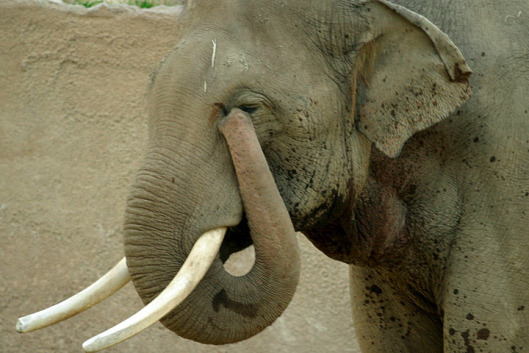 ELEPHANTS – By Aaron Logan via Wikimedia Commons

SHAR PEIS – By Dave from New York via Wikimedia Commons

TORTOISES – By Adrian Pingstone Public domain via Wikimedia Commons
AGING MALE ACTORS – Michael Keaton in Spotlight.
Even some inanimate objects are fine when wrinkly
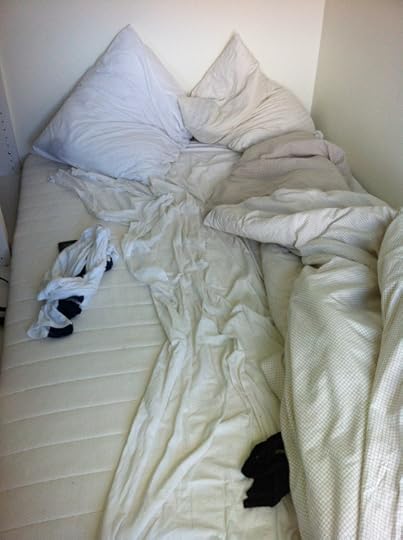
UNMADE BEDS – By maxronnersjo via Wikimedia Commons
One living thing is not culturally acceptable in a wrinkled state
.jpg)
OLDER WOMEN’S FACES – Via Wikimedia Commons
One part of our human anatomy absolutely must be wrinkled
This reinforces the old “beauty comes from within” adage. It turns out that these numerous wrinkles or folds are one of the human brain’s distinguishing characteristics. Mice, for example, have smooth brain surfaces. Now when I look in the mirror and notice the crow’s feet and crazed crackles on my cheeks I will think Hooray! Now my exterior matches my interior.
In case you are young and interested in preserving your smooth, elastic skin, here are some things you should avoid. Alas, in my youth, I slathered on the baby oil and sat in the noonday sun. And smoked.
Or I could just blame my mother.
Five years of beauty
This is the fifth year I have participated in August McLaughlin’s Beauty of a Woman Blogfest. I am honored to have the opportunity to write on a topic I might not otherwise consider, but which always causes me to reflect deeply. My posts from previous years:
2015: The beauty of embracing your opposite
2014: Three beauties and a redefinition
2013: I want to be like Carol Winfield even when I’m dead
2012: Tribute to a different kind of beauty


April 22, 2016
Princely: a salute to our lost musical storytellers
The e-mail notification popped up in the lower corner of my screen: “Rock Royal Prince Dead at 57.”
Oh no. Not another one.
This comes in a year when we have already lost more talented musicians than I can count on two hands. Some better known than others; some too soon (though is it ever late enough to lose a beautiful voice?); others after what we describe as “a full life.”
Sometimes a song is worth a thousand words. Listen up.
Many of these musicians—Prince, Bowie, Earth Wind and Fire, The Eagles, and of course The Beatles—provided the soundtrack for significant events in my life. Listening to their songs made me cry, but listening is the best shield against the Great Silence.
To those who tell stories and twang our heartstrings through music, I salute you.


April 11, 2016
500 reasons* to get out of bed
*Actually, more like five-ish. That headline is unabashed click-bait. Maybe readers will supply the other 495-ish.
Before we get started, why is having reasons to get out of bed important?

By Pnapora – Own work, CC BY-SA 3.0
Because having a purpose keeps you young. And who doesn’t want that?
Barbara Bradley Hagerty, in a recent KQED Forum interview about her new book, Life Reimagined: The Science, Art and Opportunity of Midlife, cited some interesting research. According to a Rush University Medical Center study, the plaques and tangles characteristic of Alzheimer’s were just as likely to be present (as confirmed by autopsy) in people with a sense of purpose as those without. But those with a sense of purpose did not show symptoms of the disease. Other research shows a sense of purpose may add years to your life and that meaning trumps happiness in keeping people healthy.
One important aside. I know from my experiences with depression and anxiety that these illnesses cause a terrible chicken-and-egg conundrum when it comes to living a meaningful life. When you’re depressed, it doesn’t matter how many reasons you have to get out of bed. None of them matter. So, if you are suffering, don’t bother reading this list. Please get help, or find a friend or family member to help if you can’t take the next step. Use a resource like mentalhealth.gov’s “Get Immediate Help” link. Take medication if you need to.
When you’re ready to read the list, it will be here.
1. The sun is shining (even behind the clouds).
On the face of it, this is kind of lame, so let’s unpack.
What is the sun? It is a star. One of who-knows-how-many gazillions in a galaxy among gazillions. It reaches temperatures as high as 27 million degrees Fahrenheit, and yet burns us only if we stay out too long without sunscreen. It—and our relationship to it—is responsible for nothing less than all life on earth. If you need anything more miraculous to get you out of bed, I’m hard-pressed to know what it might be.
2. You can get back into it (your bed) in 16 hours.
The tide is turning on sleep. Used to be we all boasted about how many hours we went without it. Now even a few enlightened high schools are considering changing their schedules so teens can get more of it. It keeps you thin, lowers blood pressure, and melts away wrinkles. Freakonomics Radio just rebroadcast an excellent two-part story on the economics of sleep (here are parts one and two).
3. You have another chance to practice.
Whatever path you’re on, whatever you’re trying to accomplish, wherever you’re trying to go or whatever you’re trying to be, the chances are good that you’ll fuck up a lot along the way. More than once. Get over it. You’re a human being. You’re allowed to make mistakes. You’re even allowed to make the same mistakes again and again. You don’t need to be perfect; you just need to keep working on it. It’s the journey, my friend.
Not only that, you have another chance to do good for someone else and the world. Have you spent the last 47 years, 16 weeks, 4 days, and 28 hours being a selfish ass? No matter. Today really is the first day of… no, we won’t go that far into cliche-land, and besides, the story of that tired phrase is not a happy one. But you can get out of bed and do something different today than you did yesterday.
It’s a process.
(If you’re spiritual but not religious—or even if you are religious—you owe it to yourself to check out Wait But Why’s post, Religion for the Nonreligious. It’s amazing.)
4. You won’t always be able to.
Did you think I could get through a whole list like this without the tiniest bit of morbid thinking?
One day—you never know exactly when—your number will be up and you’ll be down for the count. The long count. So, as long as the sun comes up, your cat jumps on your chest, you can feel the restorative power of sleep, and you can practice becoming a more enlightened human being: go for it.
Let’s end on a slightly lighter note:
5. Your [insert favorite pet here] is waiting for you.
What? Kids don’t come first? Well, when was the last time you received unconditional love from your kids?
5.a. You have to drag your sleeping teenagers from the sack.
5.b. You MUST put kibble in the cat’s bowl or risk evisceration by tooth and claw.
5. C. You can read my latest piece of flash fiction
“The Appointed Time and Place” – Shortlisted on Mash Stories (please give a kudo if you enjoy!)
Your turn
I’d love to hear what gets you out of bed in the the morning (or afternoon).
6.
7.
8.
9.
10.
…499.
500.


March 28, 2016
Doggy essence hinders novel’s progress
You can’t teach an old dog new tricks. Nature trumps nurture. [Insert cliche of your choice here.] You get the idea: it’s difficult if not impossible to change your beliefs, attitudes, temperament, essence, and—most significantly—your actions.
That doesn’t stop humans from trying. Billions go into self-help and self-improvement every year. Many of these dollars produce no tangible results. (Jessica Lamb Shapiro wrote about America’s self-help culture in her 2014 book Promise Land.)
I’ve never been big on self-help, at least not on the kind that requires adhering to a plan, attending a workshop, or purchasing a book. But recently, struggling to overcome my Pantser nature as a writer, I found myself casting about for a rescue line.
Over the last year I’ve written myself to the murky middle of a novel. I have a premise, characters, and about half a book’s worth of fairly well organized chapters that actually move the plot along.
The problem is: I don’t know where I’m going.
I hear the Outliners and Plotters howling. How can you not know? What about rising action? The characters’ main goals? How can you create dramatic tension when you don’t plan out where you’re going to end up? These are great questions. I wish I had answers.
Writing has always been about exploration for me. The process of writing leads to a book’s conclusion. Someone once compared writing fiction to feeling your way through a room of unknown size with a blindfold on in search of an exit, and that’s how it feels to me. No matter how hard I try, I can’t seem to rip off the blindfold or map the room in any sensible way. (At least I’m not alone in this. At a recent literary event, the acclaimed writer Joyce Maynard admitted to the same modus operandi. Like me, she writes to find out what happens.)
Still, this puts the writer in an uncomfortable place. So, recently, to try to dig myself out of this hole, I thought I’d take a look at the self-help writing advice of some savvy authors, including C.S. Lakin, Kristen Lamb, and James Scott Bell.
Using a few of the tips and techniques elucidated by these advice-givers, I spent the last month doing character sketches and making index cards full of plot points for the first half of the book. I examined scenes and free-wrote ideas about the fictional world I’m creating. None of this has done a lick of good in helping me answer that crucial question: How does the book end?

This is not to say that the advice wasn’t helpful. I’ve been subscribing to C.S. Lakin’s Live Write Thrive for years and to Kristen Lamb’s blog for nearly as long. I eagerly read Bell’s book Write Your Novel From the Middle. All of them have wonderful insights; I encourage both new and seasoned authors to check them out. It’s just that none of them solved the problem for me of figuring out anything about that room in which I’m stumbling around blindfolded.
So, this week, I’m going back to what I know. I’ll resume writing that scene in the middle where I left off. I’m going to apply my self-help method: discovering the story from the inside. I’ll put one word in front of the other. One action will lead to the next; one scene will end and another begins. My characters will get somewhere. From there, they’ll get somewhere else. Eventually, they’ll get to the end.
This is a messy way to write. It means lots of rewriting. It means I’ll have to throw away long passages and write new ones. (During a year and a half of revisions of my novel that’s scheduled for publication this year by Sand Hill Review Press, I tossed out a whole character and about 40 pages, or about 15 percent of the book). It means I’ll never crank out a book a year, like some super-prolific authors. But that’s okay. This is the way I write. Rather than fight it, I’ll embrace it. I’ll use the helpful plot and structure advice—but after I’ve gotten that first draft down. I might even write an outline—after the fact.
Working blindly through the mysterious room is the way I do things, and that’s okay. It’s my nature. I’m an old writing dog and I’m not gonna learn any new tricks. Even Seasick Steve says so.
Have you ever tried to change your basic nature? Is who you are standing in the way of what you want to do? If you’re a writer, has the way you write changed over the years?
In case you missed it
You can read my short story Before There Was a Benjamin in the Winter Fiction Issue of Sixfold.


March 11, 2016
Photo challenge: feeling the love in nature
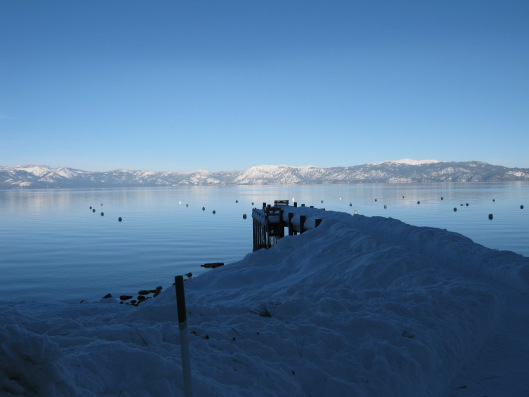
2011 Snow in Lake Tahoe
Five more photos and 149 words follow.
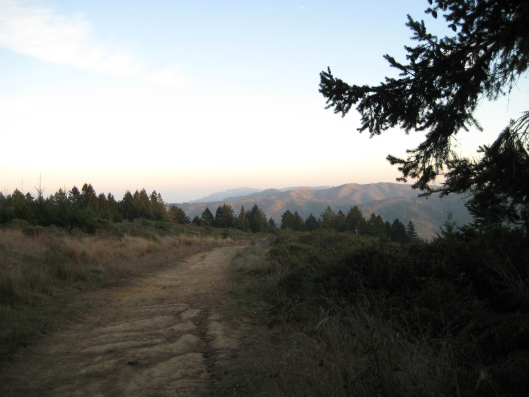
2012 The Dipsea Trail at Dusk
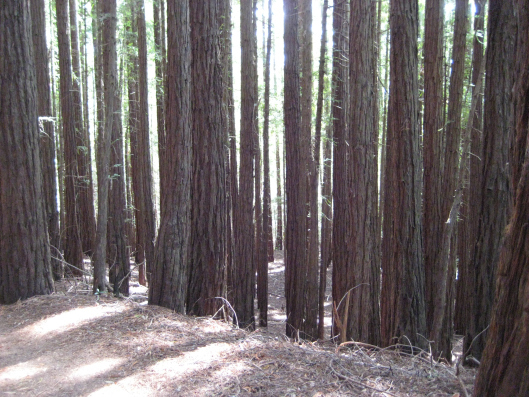
2013 Redwoods in Mill Valley
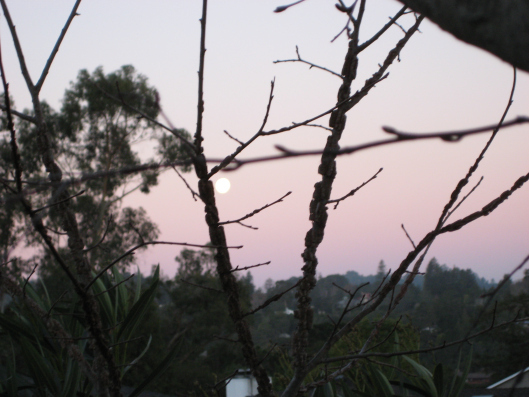
2014 Morning Moon in the Back Yard (San Mateo)
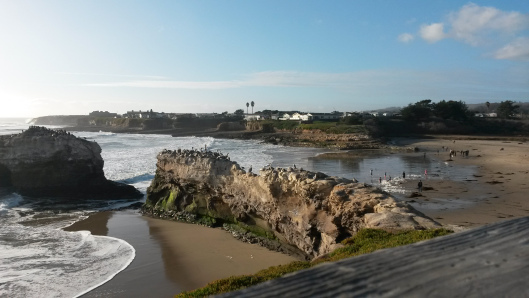
2015 Beach in Santa Cruz
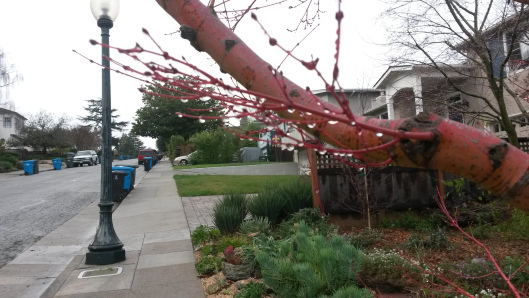
2016 Rain Returns to San Mateo
This is in response to the Weekly Photo Challenge. I have never participated before, but have admired those who do, including Susie Lindau and J.B. Whitmore.
My thinking brain has been feeling uninspired. Sifting through six years of photos and remembering times when I have been immersed in the natural world fed my imagination.
I know that nature cares not a whit for us humans and if she did would probably feel only contempt, but contemplating natural beauty summons an emotion that might be labeled love.
Where do you feel love?
Feeling the love from Sixfold
My short story “Before There Was a Benjamin,” the fifth-place winner of the recent Sixfold contest, just appeared in the Fiction Winter 2015 issue.


February 18, 2016
Not entitled to be untitled
Score: Title = 0, Me = 0. No winners here yet.
For the last few weeks, I’ve been wrestling with the title of my soon-to-be-published novel. (Although wrestling may be too genteel a word. It’s more like street fighting.)
Writers should spend a lot of time wrestling with this because a title, like a cover, conveys a powerful first impression.
Books
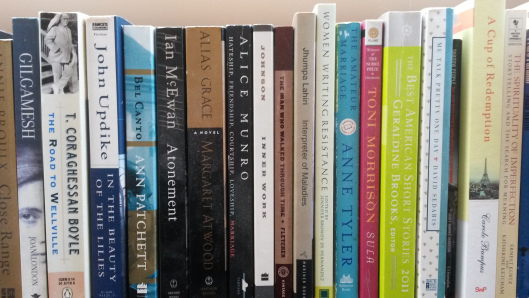
Do titles determine what makes it onto your shelf?
I’ve never had such difficulty with previous novels. Dance of Souls, published in 2011, was originally March of Souls, which some people thought evoked a doomsday feeling. But no wrestling was involved to come up with the final title. And I don’t remember agonizing much over titles for my three previous unpublished novels: All the Things They Gave in Love, Arbor Vitae, and The Enigma Variations—maybe because I didn’t have a publisher challenging me to find the best possible title.
It’s hardly surprising that finding the right title is so challenging. After all, a title has a lot to live up to. It must
Intrigue potential readers
Make a promise about the book’s content, genre, or emotional experience
Be memorable
Be (somewhat) original
Work for Amazon and Web searches
No wonder it’s taking some work. In the meantime, it helps to know I’m not alone. Just look at the list of now-famous works that originally had different titles.
Children, Cats
I have a mixed record when it comes to naming. I’ve had the honor of naming two people—my children—and I like to think my husband and I did a good job there. I don’t belong to the school of “I have to wait until the child is born and see if he/she looks like a so-and-so.” Honestly, all babies look pretty much alike. How can you possibly tell in the first few hours or days if you’ve got a Bob, Betty, Jane, or Thelonious on your hands?
You attach a moniker to your squalling bundle. Soon you can’t imagine calling your child anything else. . Although sometimes, when the child grows into an adult, . And you could be messing them up for life if you happen to give them the wrong name, as points out.
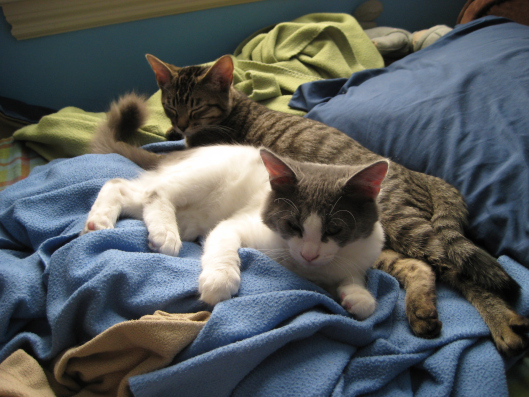
Apache and Joshua
My first cat was named Petunia. I have no idea why. We adopted our current cats from a rescue home when they were four months old. They came with their names—Joshua and Apache—which I never thought to change. In my mind, the creatures and their names had already fused. It seemed impossible to call them anything else. They, of course, wouldn’t have given two meows. I’ve never known a cat to identify with its name.
Resources for Writers
Writers, unlike parents, don’t have the luxury of waiting for their books to grow into their titles, or vice versa. The titles must do all the work from the start.
How Important Is Your Book Title?
How important is the title of a story?
Titles That Didn’t Smell as Sweet
Why Book Titles Are Important
7 Tips to Land The Perfect Title for Your Novel
How To Title Your Book
Picking the Perfect Book Title
Have you ever named something? A child, a pet, a book, a star, a nuclear power plant? How did you go about it?
What’s your favorite book title? Did the book live up to the title’s promise?