
Eugene Volokh's Blog, page 28
September 26, 2025
[Eugene Volokh] Friday Open Thread
[What's on your mind?]
The post Friday Open Thread appeared first on Reason.com.


September 25, 2025
[Eugene Volokh] I've Seen Fake Cites on Both Sides Now
From yesterday's decision by Magistrate Judge Elizabeth Stafford in Evans v. Robertson (E.D. Mich.) (both parties are pro se):
The Court notes that the parties' briefing contained multiple factitious citations and quotations, presumably a product of using artificial intelligence (AI) software. For example, Evans cites Aguirre v. Reese, No. 2:12-cv- 01837, 2013 WL 6577085, at *5 (D. Nev. Dec. 13, 2013). ECF No. 64, PageID.559. The citation is nonexistent, and the District of Nevada assigned that case number to Mazzorana v. Emergency Med. Phys. Grp., in which no filings were made on December 13, 2013. Next, Evans attributed the following quote to Doe v. F.B.I., 218 F.R.D. 256 (D. Colo. 2003): "Parties may not evade service by hiding behind pseudonyms while continuing to engage in legal actions using those same identities." ECF No. 64, PageID.561. That case contains no such language, nor has the Court found that language in any other case. Evans likewise misattributes quotations to two other cases. ECF No. 64, PageID.570-571 (citing United States v. Ziegler Bolt & Parts Co., 111 F.3d 878 (Fed. Cir. 1997); Sec. & Exchange Comm'n v. Knowles, 87 F.3d 413 (10th Cir. 1996)).
Robertson's filings also contain inaccurate citations. She cites Mickens v. 10th Jud. Dist. Ct., 460 F. App'x 728 (9th Cir. 2011), in support of her argument that courts may dismiss actions used to harass or intimidate rather than to vindicate legitimate claims. ECF No. 39, PageID.352. Although two cases by that title exist, Robertson's citation is inaccurate. See Mickens v. 10th Jud. Cir. Ct., 458 F. App'x 839 (11th Cir. 2012); Mickens v. 10th Jud. Cir., 181 F. App'x 865 (11th Cir. 2006). The cases were decided by the Eleventh Circuit and concern the application of the Rooker-Feldman doctrine and not dismissal of abusive litigation.
Robertson also cites McNair v. Everly, No. 18-12511, 2019 WL 2560069 (E.D. Mich. June 20, 2019), which does not exist. ECF No. 71, PageID.686. This district assigned that case number to Arnold v. Fresh Start Transitional Homes, in which no filings were made on June 20, 2019. Robertson's filings also contain other inaccuracies that the Court will not belabor here….
Pro se parties are expected to strictly follow procedural rules, and no authority suggests that those rules "should be interpreted so as to excuse mistakes by those who proceed without counsel." If an attorney had submitted a brief littered with inaccurate citations, Federal Rule of Civil Procedure 11 sanctions would have been appropriate.
The parties' pro se status offers no excuse for the factitious citations or quotations, and the Court will not tolerate this practice in future filings from either party. In each of their future filings, Evans and Robertson "must include a written representation that [they have] personally checked each legal citation and each citation is accurate and stands for its asserted proposition." Failure to do so may result in a recommendation to impose more stringent sanctions.
The song was written by Suno, in response to my short prompt that basically summarized the topic and provided the opening line; here are the resulting lyrics, with no edits on my part:
[Verse]
I've seen fake cites on both sides now
From phantom laws to ghostly vows
And still they stand
So bold
So proud
I really don't know truth at all
[Chorus]
Cites that shimmer
Cites that fade
AI dreams the rules it made
And both sides argue
Undismayed
But we don't know the law at all
[Verse 2]
They quote the case that wasn't there
With pages lost in digital air
A phantom judge
A ruling rare
I guess it's justice
Or a brawl
[Prechorus]
They cite the void
They cite the fake
A courtroom built on AI's quake
[Chorus]
Cites that shimmer
Cites that fade
AI dreams the rules it made
And both sides argue
Undismayed
But we don't know the law at all
[Bridge]
Oh
What a trial
Oh
What a scene
A war of ghosts in a world machine
Who holds the gavel
Who holds the blame
When truth and fiction play the same?
The post I've Seen Fake Cites on Both Sides Now appeared first on Reason.com.
[Eugene Volokh] Court Throws Out Case After Finding Plaintiffs Submitted Deepfake Videos and Altered Images
The case is Mendones v. Cushman & Wakefield, Inc., decided Sept. 9 by Judge Victoria Kolakowski (Cal. Super. Ct. Alameda County). Here's a short excerpt; the whole opinion (including copied images and detailed analysis) is worth reading:
The Court finds that Plaintiffs violated section 128.7(b) of the Code of Civil Procedure by submitting fabricated evidence in support of their motion for summary judgment….
The Court finds that exhibits 6A and 6C are products of GenAI and do not capture the actual speech and image of Geri Haas. In other words, these exhibits are deepfakes….
While the "person" depicted in exhibits 6A and 6C bears a passing resemblance to the person depicted in exhibit 36, they are not the same person. The accent, cadence, volume, word choice, pauses, gestures, and facial expression, among other characteristics, of the person depicted in exhibit 36 are vastly different from those demonstrated by the "persons" depicted in exhibits 6A and 6C….
The court also found other alterations, and concluded:
The Court finds that a terminating sanction is appropriate. This sanction is proportional to the harm that Plaintiffs' misuse of the Court's processes has caused. A terminating sanction serves the appropriate remedial effect of denying Plaintiffs— and other litigants seeking to make use of GenAI to submit video testimonials—of the ability to further prosecute this action after violating the Court's and the Defendants' trust so egregiously.
Further, a terminating sanction serves the appropriate deterrent effect of showing the public that the Court has zero tolerance with attempting to pass deepfakes as evidence.
This sanction serves the appropriately chilling message to litigants appearing before this Court: Use GenAI in court with great caution.
The plaintiffs were self-represented.
Louisiana Court of Appeal Judge Scott Schlegel ([Sch]Legal Tech) has more, with some warnings for the future; an excerpt:
The Mendones case is a warning shot. It shows the cost of letting AI forgeries seep into the system. The deepfakes in that case were crude enough that the judge could spot them, but the technology has already advanced to the point where many of us would struggle to tell the difference. Thankfully, Louisiana and the Federal Courts [details in Judge Schlegel's post] are beginning to sketch a better path, but we are racing the clock. Because once trust is broken, no amount of technology can put it back together again.
Deepfakes in the courtroom are no longer hypothetical. They are here. And the clock is ticking. The crude fakes of today will soon look primitive, yet they are already capable of wasting judicial resources and undermining trust.
Thanks to the Media Law Resource Center (MLRC) MediaLawDaily for the pointer.
UPDATE: Here's what the judge said to explain why she didn't refer the matter to the prosecutor's office:
The Court finds that referral for criminal prosecution is not appropriate. Plaintiffs' submission of fabricated evidence brings to the Court's mind two Penal Code statutes [concerning perjury and forgery]…. The Court finds that a sanction referring Plaintiffs for criminal prosecution is simultaneously too severe and not sufficiently remedial. The sanction is too severe as even being the subject of a criminal investigation may lead to social repercussions that persist after the criminal proceedings close.
This civil judicial officer does not have the expertise and experience to balance all relevant considerations to determine whether a matter should be referred to the District Attorney for a criminal investigation. At the same time, a referral would do little to address the harm that Plaintiffs have caused in this civil proceeding.
The post Court Throws Out Case After Finding Plaintiffs Submitted Deepfake Videos and Altered Images appeared first on Reason.com.
[Eugene Volokh] Second Circuit Allows Claim That "Implicit Bias Trainings" Constituted Racial Harassment
[The court concluded that the plaintiff, a former New York City educator and administrator, presented enough of a case to go to the jury.]
The decision in Chislett v. N.Y. City Dep't of Ed., decided today by Judge Pierre Leval, joined by Judges Joseph Bianco and William Nardini, dealt with a lawsuit brought by Chislett, a New York educator and administrator. Following a Department program of implicit bias trainings, and conflict that arose there, Chislett was demoted and then quit. The court rejected Chislett's claim of discriminatory demotion and constructive discharge, but held that Chislett's hostile work environment claim could go forward; here's an excerpt from the long opinion:
The test for a hostile work environment involves "both objective and subjective components: the conduct complained of must be severe or pervasive enough that a reasonable person would find it hostile or abusive, and the victim must subjectively perceive the work environment to be abusive." … Drawing all reasonable inferences in Plaintiff's favor, a rational juror could find that discriminatory conduct at the DOE was sufficiently severe and pervasive to have created a hostile work environment…. Chislett set forth sufficient evidence for a rational juror to find that she was repeatedly exposed to racial harassment at her workplace throughout 2018 and 2019.
First, Chislett presented evidence from which a rational jury could find that racist comments were expressed during bias trainings. For example, instructors mentioned several times that the "values of [w]hite culture are supremacist." Similarly, during one training session, Ababio-Fernandez, Senior Executive Director of the OEA [DOE's Office of Equity & Access], declared: "There is white toxicity in the air, and we all breathe it in." In the sessions, there was persistent messaging to the effect that white culture is generally "[d]efensive[];" "[e]ntitle[d];" "[p]aternalis[tic];" "[p]ower [h]oard[ers];" and "[p]rivilege[d]."
Further, there was physical segregation of white employees and singling out of staff by race during one training session as participants were ordered as to racial privilege associated with whiteness and physically "lined up to reveal the dividing 'color line of privileges that favored whites.'" Negative generalizations and stereotypes about white people were also targeted specifically at Chislett during the trainings. For instance, during a Q&A session, instructors told Chislett that her "interest in excellence was perfectionism and consistent with white supremacy." On the question of the objectivity of considering the training environment hostile and abusive, it is pertinent that one of Chislett's co-workers was similarly upset about the racial generalizations and that another regarded the DOE as "an extremely hostile environment for white individuals." {[And t]he fact that the purpose of the sessions was to combat race discrimination does not excuse the alleged presence of race discrimination in the conduct of the sessions.}
In addition, a reasonable juror could find from the evidence in the record that there were racialized comments expressed outside the trainings. As a spillover from the trainings, conversations took on a racialized tone, and OEA employees directed terminology from the trainings at Chislett. When Chislett disciplined or managed subordinates, she was allegedly called racist and labeled "white and fragile." Far from being "episodic" or isolated, these alleged comments were continuous and concentrated, especially given the frequency of the OEA's racial conversations. Construing the evidence most favorably to Chislett, a rational juror could find that there was a consistent "pattern" wherein Chislett "could expect [racist] remarks and other harassment at any time."
{We do not suggest that calling someone racist by itself constitutes racial discrimination or forms the basis of a hostile work environment claim…. "'Racism' is not a race, and discrimination on the basis of alleged racism is not the same as discrimination on the basis of race." … However, in the context of the profusion of remarks attributing numerous detrimental qualities to whiteness (including a sense of racial supremacy), there is at least a question of fact as to whether accusations that Chislett was "racist" were intended as identifying and disparaging a feature of her whiteness.}
For example, at an internal meeting on September 17, 2018, when Chislett asked her Black subordinate Renee why she was late to a meeting she was supposed to help lead (a question appropriately put by a supervisor to a subordinate), Renee told Chislett she was making a "race-based judgment" and could "not be trusted." The following week, Renee referred to the previous incident and admonished Chislett: "How dare you approach me out of your white privilege!" In or around November 2018, two Black subordinate employees on Chislett's team told her that "race is at the center of every conversation" they had with her.
Further, at one point, Chislett told her team that "this is becoming almost unbearable for me because there is increasing hostility." In response, Renee stated: "How dare you use the word unbearable, there is black people dying in the street, you don't have the right to use that term. You're coming from the position of white privilege and white supremacy." The presence of such racialized conflicts and the frequent accusations that Chislett was operating out of white privilege and supremacy for performing ordinary supervisory responsibilities further support her hostile work environment claim.
Third, Chislett presented evidence of comments expressed to another DOE employee of partially white parentage that a reasonable juror could find racially discriminatory. For instance, in February 2019, Chislett heard Renee use racialized sentiments when discussing a "white adjacent" colleague "from a mixed race family" who "adopted [B]lack daughters" and married "a white man." After the colleague attempted to monitor Renee's productivity, Renee called her "a slave master," and another employee labeled her a "white dominant leader."
While not directed at Chislett, these statements are pertinent for several reasons. First, discriminatory "conduct not directly targeted at or spoken to an individual but purposefully taking place in [her] presence can nevertheless transform [her] work environment into a hostile or abusive one." Furthermore, such discriminatory conduct by the same individual who directed similar conduct at a plaintiff may confirm the objective reasonableness of the plaintiff's perception of the conduct directed at her as racially discriminatory. Such conduct also tends to confirm that supervisory personnel are aware of and tolerate the alleged racial harassment, providing evidence of a municipal policy or custom of complicity.
From this "mosaic" of evidence, a rational juror could find that Chislett experienced a racially hostile work environment. Collectively, Chislett presented evidence of racially-charged statements expressed during trainings, in meetings, and about another employee in her presence, creating a genuine dispute of material fact about whether the workplace was racially hostile. As such, "whether the conduct taken together created a work environment that was sufficiently hostile to violate [§ 1983] is a question of fact for the jury." …
[* * *]
Here's the court's full statement of the alleged facts, though the key facts were quoted in the legal analysis quoted above:
Chislett is an educator who worked at the DOE. In 2017, she was asked to serve as the Executive Director of the "AP for All" program, an initiative of former Mayor Bill de Blasio to increase participation in Advance Placement courses by students in "underserved communities." "AP for All" was housed in the DOE's Office of Equity & Access ("OEA").
In her role, Chislett supervised fifteen employees and achieved success in expanding access to AP courses. However, there was early racial tension on her team. One subordinate, Akua Adefope, whom Plaintiff had criticized for "poor performance," reported her to the DOE's Office of Equal Opportunity and Diversity Management ("OEO") and accused her of "'microaggressions' toward people of color, such as ignoring, dismissing, avoiding, interrupting, and belittling them." The OEO found that although Chislett's comments did not rise to the level of discrimination, some of her statements were "inappropriate." Several of Chislett's subordinates also denounced her for allegedly "holding employees of color back," and when she objected, she was "accused" of being "'white and fragile.'" Chislett complained to the head of the OEA but was "scolded."
According to Chislett, racial conflict escalated when de Blasio selected Carranza as Chancellor of the DOE in 2018. Carranza implemented an "equity agenda" to tackle racial and economic disparities among students in their access to privileges within the school system. At the time, Carranza stressed the importance of his equity agenda, reportedly stating: "If you draw a paycheck from the DOE, you will either get on board with my equity platform or leave."
Both de Blasio and Carranza were intent on promoting racial diversity within the DOE. To this point, de Blasio was reportedly "fixated" on the diversity of candidates, and Carranza declared there was "no daylight" between their approaches. After becoming Chancellor, Carranza created nine Executive Superintendent roles. Seven of the nine roles were filled by Black employees. Additionally, Meisha Ross-Porter, one of the new Executive Superintendents and the person de Blasio later selected to succeed Carranza as Chancellor, declared: "When I am selecting principals, teachers, or leaders—after we make the list, we look at it and we count: how many women, how many people of color, and why…. I look at the makeup, and I literally count—and it's OK for us to do that."
During his time as Chancellor, Carranza mandated implicit bias trainings among DOE staff. The OEA was allocated $23 million and hired approximately twenty staffers to scale these trainings, which were "part and parcel" and a "'cornerstone'" of Carranza's equity agenda. Both DOE staff and outside vendors facilitated implicit bias workshops. As a member of the OEA, Chislett was required to participate in the trainings, which she claims "exacerbated the already racially-charged workplace." Some of the trainings Chislett attended were part of the DOE's formal implicit bias training initiative. Some were sponsored by specific DOE departments.
During the first bias training on May 4, 2018, the instructor told participants that "white colleagues must take a step back and yield to colleagues of color" and "recognize that values of [w]hite culture are supremacist." At the session, LaShawn Robinson, who led the OEA and would soon be promoted to Deputy Chancellor, told an employee, "We've all taken on whiteness." The training also included PowerPoint slides that described the traits of "internalized white superiority," including "individualism;" "denial;" "dominating space;" and "intellectualization."
On May 10, 2018, OEA employees attended an overnight retreat that included additional training. Speakers stated that "white culture's values" are "homogenous and supremacist" as well as that the "Protestant work ethic" and "devotion to the written word" are examples of "white supremacy." Once again, PowerPoint slides listed values associated with "white supremacy culture," including "Perfectionism;" "Sense of Urgency;" "Paternalism;" "Defensiveness;" "Individualism;" "Either/or thinking;" "Objectivity;" and "Power Hoarding." During a Q&A session, instructors told Chislett that her "interest in excellence was perfectionism and consistent with white supremacy."
At another mandatory training on June 21, 2018, instructors wrote aspects of "white culture" on four posters, including "Entitlement—access to everything;" "Need to feel validated in feelings;" and "Privilege to establish norms/'set the bar.'"Another poster was labeled, "The Haves … of white culture," and included traits such as "Individualistic;" "Privilege;" "Money;" and "Single Identity." Dr. Ruby Ababio-Fernandez, who developed the implicit bias initiative and became the OEA's Senior Executive Director, declared: "There is white toxicity in the air, and we all breathe it in." Participants were instructed to answer questions about themselves that would grade them on a scale of 0 to 130 "according to [their] white privilege like being able to buy products for [their] hair type at a typical drug store" and were physically "lined up to reveal the dividing 'color line of privileges that favored whites.'"
On day two of the training, participants were asked to break into small groups and list "white values" on a poster. Chislett felt uncomfortable and opted not to participate. In response, another participant told Chislett that she was a "horrible person" who "did not deserve to be working with children in New York City." Additionally, one of the facilitators told participants that if they did not learn to stand up to "people like [Chislett] who disagree with these views about white supremacist values, children's lives would be at stake." In no instance did a supervisor intervene.
After the implicit bias trainings, racial tensions simmered. On September 17, 2018, when Chislett asked a subordinate, Deonca Renee, why she was late to a meeting that she was supposed to help lead, Renee purportedly answered that Chislett was making a "race-based judgment" and could "not be trusted." In a meeting the following week, Renee referred to the previous incident and said to Chislett: "How dare you approach me out of your white privilege!" Chislett complained to her supervisors but did not receive support. In a meeting on November 6, 2018, Chislett's subordinate Adefope told her that she was "racist." Around the same time, Adefope and Renee told Chislett that "race is at the center of every conversation" they had with her.
At one point, Chislett told her team that "this is becoming almost unbearable for me because there is increasing hostility." In response, Renee stated: "How dare you use the word unbearable, there is black people dying in the street, you don't have the right to use that term. You're coming from the position of white privilege and white supremacy." Chislett again complained, but her supervisors did not intervene.
Content from the trainings also spilled over into workplace interactions. OEA employees directed terminology from the trainings at Chislett, for example telling her that she was "socialized as a white person to be defensive." In conversations, Chislett's subordinates frequently spoke of the stereotypical "presumed values" of Caucasians, a perception frequently expressed in the training sessions.
OEA employees were expected to have racial conversations in group settings approximately once a month. At an internal meeting on September 24, 2018, Shannon Maltovsky, Senior Director of Anti-Bias and School Support, shared PowerPoint slides listing ground rules for the office as they began to have "more conversations about race." Chislett described the rules as explaining that "whites who wanted to withdraw or not participate in order to be safe were demonstrating white fragility, and it was no longer [the] right [of white people] to be safe in the workplace."
Several of Chislett's Caucasian coworkers began to perceive the environment as hostile. One employee repeatedly stated that the workplace conduct was "unlawful." In a declaration, another employee described the "open hostility against Caucasian employees within the ranks of the DOE." Chislett and a coworker tried to meet with Ababio-Fernandez to discuss their concerns. However, Ababio-Fernandez "invited the very individuals" Chislett and her colleague hoped to discuss.
On November 30, 2018, Ababio-Fernandez assigned Chislett a leadership coach, OEA Senior Strategy and Policy Advisor Courtney Winkfield, who is also Caucasian. Winkfield offered Chislett insight into "what it means to be a white leader leading staff members of color." During a training on February 12, 2019, the facilitator told participants:
It's going to feel a little bit more uncomfortable when we get to inclusion because I'm going to ask you to talk about your power and your privilege. You are going to have to name that you have privilege. And then I'm going to ask you, while naming your privilege, to acknowledge that you may have to step back from some things, and that's not going to feel good. And you're probably going to question your job security. You're probably going to wonder how you feel you belong right now.
DOE employees made racist statements about a colleague of partially white parentage. In February 2019, Chislett heard Renee use racialized sentiments when discussing a "white adjacent" colleague "from a mixed race family" who "adopted [B]lack daughters" and married "a white man." After the colleague attempted to monitor Renee's productivity, Renee called her "a slave master," and another employee labeled her "a white dominant leader." Chislett complained about what she heard to Ababio-Fernandez and the Senior Director of Operations Shahzad Kazi, but they did not address her complaints.
On March 20, 2019, Ababio-Fernandez and Winkfield removed Chislett's supervisory responsibilities although her title and pay remained the same. They told Chislett that the team needed "time to heal." The decision was allegedly based on feedback from Chislett's team and other employees who reported that Chislett was an ineffective leader who caused "chaos" and "a negative work environment." Within two days, many of Chislett's duties were transferred to Adefope, her subordinate.
On April 3, 2019, Chislett complained to Ababio-Fernandez and Winkfield that meetings had become racially divisive. Kazi then stated: "I too am concerned about the tone of these conversations about race during team meetings. We need to make sure that we do not violate [the] Chancellor's Regulations or Union policy during OEA trainings." In response, OEA Executive Director of Educational Equity, Anti-Bias and Diversity Paul Forbes declared: "I am not concerned … because this Chancellor truly has our back."
On April 11, 2019, Chislett retained legal counsel who contacted the DOE about her "unanswered complaints regarding the hostile work environment she was forced to endure and the discriminatory manner in which … her role had been diminished …." The DOE "did not take any steps to address Chislett's complaint."
On April 16, 2019, Winkfield announced that the "AP for All" team would engage in eight weeks of "racial literacy training." Several weeks later, Chislett complained to Winkfield about a particular assigned reading, which she felt "stereotyped Caucasians." Chislett also reported that she had to "endure a colleague's offensive race-based accusations" during the trainings that her "lack of vulnerability in conversations was because [she was] white." Winkfield told Chislett that it was her "responsibility to ask people to stay in protocol" and stated that the "trainings [were] not going to change."
Around this time, several Caucasian DOE employees contacted the New York Post about Carranza's equity agenda. A reporter reached out to Chislett, who spoke anonymously about the implicit bias trainings. However, Chislett's supervisors were aware that she had spoken to the press because the New York Post reached out to the DOE to confirm her title. On May 18, 2019, the New York Post published an article titled "Schools Chancellor Richard Carranza accused of demoting admins because they were white." Two days later, the New York Post published another article titled "Richard Carranza held 'white supremacy culture' training for school admins," which contained a picture that Chislett took during an implicit bias training.
On May 23, 2019, Chislett attended an OEA staff training retreat. Conversation quickly turned to the New York Post articles. Forbes declared:
We see there are people within who already have views and say they are part of the equity excellence work and they're sitting amongst us, next to us, between us and alongside of whiteness. I keep saying, if you go to Tweed [the DOE headquarters], there are people there who say they have that title but they are not about this, but they don't know what that's about.
The room became very tense, and Renee stood up. She addressed Chislett by name and told her that she was "prohibiting this work from happening." Adefope stood up and called out Chislett as well. Other employees also stood up and told Chislett that she was "not willing to do the [equity] work" and that she "should just go." This continued for approximately fifteen minutes before Ababio-Fernandez terminated it. Chislett "tried to defend herself" and left the meeting "humiliated;" "frightened;" and "in tears."
Chislett left the retreat before the second day and required short term disability leave to seek medical attention for her emotional distress. After her leave, Chislett felt she could not return to the workplace. Consequently, Chislett resigned from the DOE in September 2019.
I'm generally pretty skeptical of imposing "hostile work environment harassment" liability on employers based on their or their employees' speech to the workplace at large (as opposed to speech targeted to a particular employee); see here for more. But while some judges have shared these First Amendment concerns, other judges (and other government actors) seem to be fine with such speech restrictions; and here there was indeed allegedly speech targeted at employees because of their race.
Brian Heller and Davida S. Perry (Schwartz Perry & Heller LLP) represent plaintiff. Thanks to Hans Bader (Liberty Unyielding) for the pointer.
The post Second Circuit Allows Claim That "Implicit Bias Trainings" Constituted Racial Harassment appeared first on Reason.com.
[Josh Blackman] The Heritage Guide to the Constitution: Essay Nos. 26–50
To continue my preview of The Heritage Guide to the Constitution, which will ship on October 14, here are the authors of essays 26–50.
Essay No. 26: The Rules Of Proceedings Clause —Paul TaylorEssay No. 27: The Punishment And Expulsion Clause —Michael SternEssay No. 28: The Journal Clause —C. Towner FrenchEssay No. 29: The Congressional Adjournment Clause —James Burnham & Louis J. Capozzi IIIEssay No. 30: The Congressional Compensation Clause —Giancarlo CanaparoEssay No. 31: The Privilege From Arrest Clause —Michael SternEssay No. 32: The Speech Or Debate Clause —Thomas G. Hungar & Michael BoppEssay No. 33: The Ineligibility Clause —Josh Blackman & Seth Barrett TillmanEssay No. 34: The Incompatibility Clause —Josh Blackman & Seth Barrett TillmanEssay No. 35: The Origination Clause —Andy GrewalEssay No. 36: The Presentment Clause —James Burnham & Louis J. Capozzi IIIEssay No. 37: The Pocket Veto Clause —Martin GoldEssay No. 38: The Order, Resolution, Or Vote (ORV) Clause —Seth Barrett TillmanEssay No. 39: The Taxing Clause —Andy GrewalEssay No. 40: The Spending Clause —James C. PhillipsEssay No. 41: The Uniformity Clause —Nelson LundEssay No. 42: The Borrowing Clause —James C. PhillipsEssay No. 43: The Foreign Commerce Clause —Eugene KontorovichEssay No. 44: The Interstate Commerce Clause —Randy E. BarnettEssay No. 45: The Indian Commerce Clause —Timothy SandefurEssay No. 46: The Naturalization Clause —Patrick GlenEssay No. 47: The Bankruptcy Clause —Todd J. ZywickiEssay No. 48: The Federal Money Clause —Todd J. ZywickiEssay No. 49: The Weights And Measures Clause —Eric ChiappinelliEssay No. 50: The Counterfeiting Clause —Judge Jay S. BybeeThe post The Heritage Guide to the Constitution: Essay Nos. 26–50 appeared first on Reason.com.
[Eugene Volokh] Religious Practices as Legally and Constitutionally Protected Against Regulations Aimed at Preventing "Addiction"
I'm serializing my forthcoming Emory Law Journal article titled Addiction to Constitutionally Protected Activity: Speech, Press, and Religion. In my first post, I argued that calls to regulate social media platforms and video games on the theory that they are "addictive" could equally plausibly be made with regard to various religious practices, which seem to share some of the supposedly "addictive" properties. But I follow this with an explanation that such regulations of religious practices would be unconstitutional. Here's the explanation as to adults; in the next post, I'll talk about how it also applies to attempts aimed at shielding children:
[* * *]
Yet I take it that our legal system wouldn't allow the government to regulate such religious practices in order to prevent people from making such unwise decisions. To be sure, religious institutions can be barred from engaging in physical abuse or physical coercion. They can also be barred from outright lies about specific and secularly determinable factual assertions (e.g., about where donations would be going, or about whether the speaker had witnesses a divine visitation or healed someone through prayer).
But the law can't prevent trying to play on people's emotions through religious leaders' sincerely believed theological claims about Heaven and Hell, or through the leaders' reliance on followers' desire for community acceptance or fear of excommunication. That is true of tort liability as well as of legislation.
And that is true in spite of the fact that some religious groups, belief systems, and practices may be genuinely psychologically harmful—or, as critics of various religions have argued for millennia, may be tools that some religious leaders use to cynically milk parishioners for money. Religion can damage or destroy some people even as it helps or rescues others. (My argument doesn't rest on the theory that religion is uniformly good or even good on balance, and I personally am not religious.) Yet secular legal rules generally aren't allowed to protect people from supposedly manipulative or even addictive religious practices.
That is so, I think, for several closely related reasons.
[1.] Many religious people appear to derive emotional reward from their religious beliefs. For instance, barring large donations to religious institutions, for fear that they are the result of emotional or mental pressure, would perhaps help some people but deny an emotionally important option to other people.
[2.] Religious practice is constitutionally protected. Even under Employment Division v. Smith, attempts to target religious practice because it's religious—and thus especially likely to involve psychological pressure and "addiction"—would be presumptively unconstitutional. American governments are thus generally not allowed to restrict people's religious choices on the grounds that they think those choices might be bad for them. And that remains so even if the restrictions are aimed at protecting others' ability to choose, unimpaired by psychological pressure or addiction.
[3.] People often value their own religiously motivated decisions very differently than other people might value those decisions. If we see someone giving all his money to a church, we may feel sympathy for what to us may seem like a foolish decision. What if the person ends up needing that money for living expenses, or medical bills? Even if the church promises to provide for that, isn't it sad to see someone become dependent on the church's mercy, which may in any event be withdrawn if the person moves away from his religious beliefs?
Or if the person is near the end of his life, isn't it sad to see the person unable to leave his money to his children? If something similar happened to us—if, for instance, we were psychologically manipulated into giving away our own money—we would feel very upset at the loss.
But of course the donor might take a very different view. He may think that his donation will give him eternal salvation, which he may see as infinitely more valuable than any value the money might have to him (or even to his family). And even setting aside such unknowable benefits in a future life, his belief that he will be saved—or just his belief that he is following God's will—may give him great joy and peace in his present life. One feature of American religious freedom is that secular authorities generally don't make fundamentally theological judgments about the spiritual or psychological value of perceived salvation.
Likewise, we may think that isolating oneself from friends and family—perhaps permanently severing most of the relationships that, to us, make life meaningful—is a very bad choice and perhaps even the sign of mental illness. Yet for millennia, some religions have honored and encouraged retreat into monasticism or even hermitry, as a means of focusing on what they think is their much more important relationship with the divine. Such isolating, relationship-severing choices—and religious institutions' promotion of such choices—are themselves protected by religious freedom.
[4.] To be sure, in some situations the harm to the religious observer may be so sharp and immediate—or the mechanisms of control may be seen as so obviously improper—that the law may indeed intercede. Courts have, for instance, denied religious exemptions from generally applicable bans on the handling of poisonous snakes or drinking poison, even under the Sherbert/Yoder approach which often called for such exemptions in less perilous situations (an approach that seems poised to return). Presumably that reflected the view that protecting people's lives justifies a restriction on people's religious practices, even if people may think they get more expected spiritual benefit from snake-handling than the expected temporal cost. Likewise, religious donations may be set aside based on a finding of outright mental incompetence, and religious organizations may be sued for luring members in through outright fraud.
But for such practices to be prohibited, there must surely be something more than some general claim of "addiction" to religious beliefs, or assertions of emotional harm or modest financial loss. More than that is required to interfere with willing people's exercise of First Amendment religious freedom rights, even when the goal is to protect those who are in some sense being manipulated through cunning psychological pressure.
Thus, to borrow an argument made as to social media addiction, say that a legislature tried to regulate certain religious practices on the grounds that the practices' "addictive design itself interferes with users' liberty—their freedom of thought when subjected to an unwanted and persistent compulsion, and their bodily autonomy when addictive design contributes to mental illness." That cannot be constitutional, I think: The law can't limit the liberty of those who want to embrace psychologically powerful religious practices (even when some nonbelievers view them as "manipulation") in order to protect the liberty of those who might find themselves "addict[ed]" as a result of those practices.
[* * *]
See, e.g., Paul v. Watchtower Bible & Tract Soc. of New York, Inc., 819 F.2d 875, 883 (9th Cir. 1987) ("The harms suffered by Paul as a result of her shunning by the Jehovah's Witnesses are clearly not of the type that would justify the imposition of tort liability for religious conduct. No physical assault or battery occurred.").
See, e.g., United States v. Ballard, 322 U.S. 78 (1944); In re The Bible Speaks, 869 F.2d 628 (1st Cir. 1989).
Cf., e.g., Marks v. Estate of Hartgerink, 528 N.W.2d 539, 544-45 (Iowa 1995) (rejecting liability for wrongful excommunication); Korean Presbyterian Church v. Lee, 880 P.2d 565, 569-70 (Wash. Ct. App. 1994) (same); Paul v. Watchtower Bible & Tract Soc. of New York, Inc., 819 F.2d 875, 883 (9th Cir. 1987) (rejecting liability for shunning of a member who had left the church).
494 U.S. 872 (1990).
See, e.g., Michael W. McConnell, Why Protect Religious Freedom?, 123 Yale L.J. 770, 781 (2013) ("In the liberal tradition, the government's role is not to make theological judgments but to protect the right of the people to pursue their own understanding of the truth, within the limits of the common good.").
Cf. Religious Addiction, supra note 9 ("[t]he symptoms of religious addiction include . . . neglecting personal and family commitments"; "[t]he effects of religious addiction include . . . isolation and strained relationships").
Christianity, Buddhism, Hinduism, and Sufism have encouraged monasticism. See, e.g., Mayeul de Dreuille, From East to West: A History of Monasticism (1999); Stephen J. Davis, Differences, in Monasticism: A Very Short Introduction 13 (2018) (surveying differences among monastic traditions in Buddhism, Jainism, and Christianity); David Cook, Mysticism in Sufi Islam, in Oxford Research Encyclopedia of Religion 1, 2–3 (2015); The Ties That Bind: Emotional and Social Bonds between Parents and Children, in Children and Family in Late Antique Egyptian Monasticism 160, 160 (2020) ("Monastic rules, handbooks, and literary texts testified to the distractions and even the dangers of maintaining familial attachments")
Catholic Canon Law continues to recognize hermitry: "In addition to institutes of consecrated life [in a religious order], the Church recognizes the eremitic or anchoritic life by which the Christian faithful devote their life to the praise of God and the salvation of the world through a stricter withdrawal from the world, the silence of solitude, and assiduous prayer and penance." Canon 603 § 1. See also, e.g., Bethan Bell, A Hermit's Christmas: Simplicity, Solitude and Silence, BBC, Dec. 23, 2016, https://www.bbc.com/news/uk-england-37431760.
To be sure, not all monastic lifestyles cause for complete isolation from family, and few successful religions encourage all their members to become monks or nuns: Indeed, a religion that did that would likely not survive into the next generation. But many religions do indeed valorize such behavior, which does involve some considerable degree of isolation, and which may appeal to those members of the religion that have suitable temperaments and attitudes.
See State ex rel. Swann v. Pack, 527 S.W.2d 99 (Tenn. 1975); Hill v. State, 38 Ala. App. 404 (1956); State v. Massey, 229 N.C. 734 (1949).
Fulton v. City of Philadelphia, 593 U.S. 522, 543 (2021) (Barrett, J., concurring); id. at 544 (Alito, J., concurring in the judgment).
See, e.g., Tallahassee Bank & Trust Company v. Brooks, 200 So. 2d 251 (Fla. Ct. App. 1967).
See, e.g., Molko v. Holy Spirit Ass'n, 46 Cal. 3d 1092, 1108 (1988).
Lawrence, supra note 12, at 349; see also Matthew B. Lawrence, Addiction and Liberty, 108 Cornell L. Rev. 259, 324–25 (2023).
See Lawrence, supra note 46, at 325.
The post Religious Practices as Legally and Constitutionally Protected Against Regulations Aimed at Preventing "Addiction" appeared first on Reason.com.
[Josh Blackman] Today in Supreme Court History: September 25, 1981
9/25/1981: Justice Sandra Day O'Connor takes the oath.
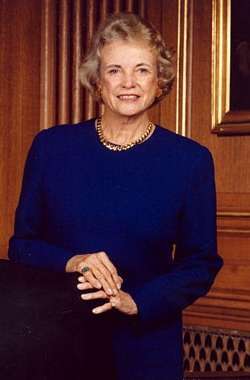 Justice Sandra Day O'Connor
The post Today in Supreme Court History: September 25, 1981 appeared first on Reason.com.
September 24, 2025
[Ilya Somin] Federal Court Rules Trump Can't Deny Federal Disaster Relief Funds to Sanctuary States
[Another in a long line of court decisions striking down Trump efforts to attach conditions to federal grants that were not approved by Congress.]
 NA
NA Earlier today, in Illinois v. FEMA a federal district court ruled the Trump administration cannot deny federal disaster relief aid to "sanctuary" states that limit assistance to federal efforts to deport undocumented immigrants. The suit was brought by twenty state governments, led by the state of Illinois, and by the District of Columbia. This is the latest in a long line of decisions striking down Trump Administration efforts to impose immigration-related conditions on federal grants to state governments, even though those conditions were never authorized by Congress.
Federal District Judge William E. Smith (a Republican George W. Bush appointee) ruled the Trump conditions violated the Spending Clause of the Constitution in three ways: the conditions are ambiguous, they aren't related to the purposes of the grants in question, and they are onerous enough to be coercive:
First, the Court finds that the contested conditions are not reasonably related to the purposes of the grants to which they attach. DHS justifies the conditions by pointing to its broad homeland security mission, but the grants at issue fund programs such as disaster relief, fire safety, dam safety, and emergency preparedness. Sweeping immigration-related conditions imposed on every DHS-administered grant, regardless of statutory purpose, lack the necessary tailoring. The Spending Clause requires that conditions be "reasonably calculated" to advance the purposes for which funds are expended, [South Dakota v.] Dole, 483 U.S. at 209, and DHS has failed to demonstrate any such connection outside of a few programs like Operation Stonegarden. The Court therefore concludes that the conditions are overbroad and unrelated to the underlying programs.
Second, the Court finds that the conditions are coercive. The record shows that states rely on these grants for billions of dollars annually in disaster relief and public safety funds that cannot be replaced by state revenues. Denying such funding if states refuse to comply with vague immigration requirements leaves them with no meaningful choice, particularly where state budgets are already committed. The financial pressure here goes well beyond the "relatively mild encouragement" approved in Dole, 483 U.S. at 211, and amounts instead to "economic dragooning" of the sort condemned in NFIB [v. Sebelius], 567 U.S. at 582. The coercion is even more pronounced because the threatened funds involve essential public safety responsibilities rather than optional or peripheral programs.
Third, the Court holds that the conditions are unlawfully ambiguous. The Spending Clause requires clarity so that states may exercise their choice knowingly. Here, DHS required states to provide "cooperation" and participate in "joint operations" and
"information sharing," but without defining what compliance entails. Likewise, the prohibition on operating programs that "benefit illegal immigrants" or "incentivize illegal immigration" provides no meaningful standards and is hopelessly vague. States cannot predict how DHS will interpret these vague terms, yet they risk losing billions in federal funding for any perceived violation. Such ambiguity deprives the states of the ability to make informed decisions, rendering the conditions constitutionally
invalid.
During Trump's first term, his administration lost numerous lawsuits over issues like this one. Last November, I predicted we would see a repetition of this pattern in his second term. It wasn't a hard prediction, and I don't claim any great credit for it. Sure enough, Trump 2.0 has indeed lost multiple cases over its attempts to impose grant conditions on sanctuary jurisdictions. Today's ruling follows a similar April decision addressing a variety of federal grants, and one in June dealing with transportation grants.
In the November 2024 post, I noted longstanding Supreme Court precedent holds that conditions on federal grants must 1) be enacted and clearly indicated by Congress (the executive cannot make up its own grant conditions), 2) be related to the purposes of the grant in question (here, transportation grants cannot be conditioned on immigration enforcement), and 3) not be "coercive."
In the disaster aid case, the court seems obviously right to conclude the Trump conditions violated the first and second of these requirements. I would add that, in addition to being ambiguous, the conditions also were never authorized by Congress. And, Congress, not the executive controls the spending power.
Whether the disaster aid conditions are also "coercive" is more debatable. The Supreme Court's jurisprudence on coercive grants is far from a model of clarity. NFIB v. Sebelius (2012), cited in today's ruling famously held that a condition onerous enough to be a "gun to the head" is coercive, but doesn't clearly explain exactly where the line between coercion and mere inducement is. I suspect that states actually vary as to the extent of their dependence on federal disaster aid, and therefore the conditions here may be coercive as to some states, but perhaps not others. Regardless, they were rightly invalidated on the other two grounds.
Today's ruling also holds that the disaster aid conditions violated the Administrative Procedure Act. I will leave that issue to others with greater expertise. I will also pass by the procedural mootness issue addressed by the court.
There is, I think, a good policy argument for reducing federal disaster aid to state governments, and leaving most disaster relief to state, local, and private initiative. But that doesn't mean the executive should be able to use disaster relief as leverage to control state policy on unrelated issues. More generally, as I have long argued, executive-imposed spending conditions are a major threat to both federalism and separation of powers. Today's ruling, and others like it, help stave off that danger.
They also reinforce Steve Vladeck's point that the judiciary is resisting Trump's power grabs more effectively than many think. The second Trump Administration, like the first, keeps losing sanctuary city cases, and so far they have not tried to get them to the Supreme Court (probably because they know they are like to lose there, too). Because the issue has not reached the Supreme Court, and because there is so much else going in the news cycle, these cases have not attracted much public and media attention. But they nonetheless have substantial real-world effects. Had they gone the other way, Trump would have many more levers to compel state and local governments to do his bidding. That doesn't mean courts are doing everything right (they aren't), or that they can curb Trump's illegal policies entirely on their own (the latter requires a strategy combining litigation and political action). But they are making a real difference.
For more on the issues at stake in these sorts of conditional spending cases, see my Texas Law Review article assessing litigation arising from Trump's first-term attacks on sanctuary jurisdictions. In that article and other writings, I also explain why immigration sanctuaries (and conservative gun sanctuaries) are beneficial, and help protect our constitutional system.
The post Federal Court Rules Trump Can't Deny Federal Disaster Relief Funds to Sanctuary States appeared first on Reason.com.
[Eugene Volokh] Court Blocks Impending Firing of South Dakota Art Professor for Vulgar Tweet Calling Charlie Kirk a "Hate Spreading Nazi"
From today's decision by Judge Karen Schreier (D.S.D.) in Hook v. Rave:
Hook is a tenured Professor of Art at the University of South Dakota. He has taught at the University since 2006.
In the late afternoon on September 10, 2025, while at home and off work, Hook posted the following message concerning the recent shooting and killing of Charlie Kirk to his private Facebook account:
Okay. I don't give a flying f*** [the original reads "fuck" -EV] about this Kirk person. Apparently he was a hate spreading Nazi. I wasn't paying close enough attention to the idiotic right fringe to even know who he was. I'm sorry for his family that he was a hate spreading Nazi and got killed. I'm sure they deserved better. Maybe good people could now enter their lives. But geez, where was all this concern when the politicians in Minnesota were shot? And the school shootings? And Capitol Police? I have no thoughts or prayers for this hate spreading Nazi. A shrug, maybe.
Approximately three hours later, while still at home and off work, Hook removed the above message and made a second post. The second post stated:
Apparently my frustration with the sudden onslaught of coverage concerning a guy shot today led to a post I mow [sic] regret posting. I'm sure many folks fully understood my premise but the simple fact that some were offended, led me to remove the post. I extend this public apology to those who were offended. Om Shanti.
Around noon on September 12, 2025, South Dakota Speaker of the House Jon Hansen [and] {also a 2026 candidate for South Dakota Governor} shared a screenshot of Hook's first post and included the following message:
Yesterday, I was made aware of these hateful and vile comments made by a University of South Dakota professor regarding the death of Charlie Kirk and Charlie's family. I am disgusted by his remarks, and think they are unbecoming of someone who works for and represents our University. Yesterday, after seeing the post, I immediately reached out to USD President Sheila Gestring and called on the professor to be fired. I understand that the professor is likely to be terminated from his position. I will keep you posted on the final decision. That kind of disgusting rhetoric from an employee and representative of our university directed toward a good man's family who was recently assassinated will not be tolerated.
A few hours later, South Dakota Governor Larry Rhoden also shared a screenshot of Hook's first post and included the following message:
When I read this post, I was shaking mad. The Board of Regents intends to FIRE this University of South Dakota professor, and I'm glad.
This individual stands in front of South Dakota students to educate them. We must not send the message to our kids that this is acceptable public discourse.
We need more Charlie Kirks on campus and less hatred like this.
Around the same time, Hook received a letter from Kelley notifying Hook of Kelley's "intent to terminate [Hook's] contract as Professor with The University of South Dakota." The letter explained that the reason for Hook's termination was due to violations of SDBOR Policies 4.4.8 and 1.6.1. SDBOR Policy 4.4.8 provides:
Neglect of duty, misconduct, incompetence, abuse of power or other actions that manifest an unfitness to discharge the trust reposed in public university faculty members or to perform assigned duties.
SDBOR Policy 1.6.1 provides:
Faculty members are members of a learned profession. When they speak or write as private citizens on matters of public concern, they must be free from institutional censorship or discipline, but their special position in the community imposes special obligations. As learned people and as educators, they should remember that the public may judge their profession and their institution by their utterances. Hence, they should at all times be accurate, show respect for the opinions of others and make every effort to indicate when they are not speaking for the institution.
The court concluded that Hook had a "fair chance" of prevailing on his First Amendment challenge to the impending firing, and therefore issued a temporary restraining order reinstating Hook from administrative leave (and blocking his firing for the next two weeks):
Because Hook spoke as a citizen and on a matter of public concern, [his speech protected unless] defendants have "produced evidence to indicate the speech had an adverse impact on the efficiency of the [University's] operations." If the court determines there is an adverse impact, then the court applies the balancing test laid out in Pickering v. Board of Education (1968). But "[w]here there is no evidence of disruption, resort to the Pickering factors is unnecessary because there are no government interests in efficiency to weigh against First Amendment interests."
At this stage, defendants have failed to put on evidence that Hook's "speech had an adverse impact on the efficiency of the [University's] operations." Defendants allege that in the days following Hook's post, "hundreds of calls and message were made to the Board of Regents and/or the University of South Dakota commenting negatively regarding the comment or calling for the removal of Professor Hook." But "[m]ere allegations the speech disrupted the workplace or affected morale, without evidentiary support, are insufficient." See also Melton v. City of Forrest City, Ark. (8th Cir. 2025) (finding insufficient evidence of disruption where defendants only alleged that "'several' police officers and city-council members were upset and 'phone lines [were] jammed' with calls from concerned citizens"). Defendants have not demonstrated that there was any disruption to on-campus activities, Hook's teaching lessons, or the University's operations. And without more, "such 'vague and conclusory' concerns … runs the risk of constitutionalizing a heckler's veto." Thus, because defendants have failed to demonstrate any evidence of disruption, the court need not consider the Pickering factors at this stage….
Defendants are required to temporarily set aside their determination to place Hook on administrative leave. Defendants shall reinstate Hook's position as a Professor of Art at the University of South Dakota, retroactive to September 12, 2025, to remain effective until the preliminary injunction hearing on Wednesday, October 8, 2025, at 9:00 a.m. in Sioux Falls Courtroom 2.
Here's a similar, though not identical, analysis from the Third Circuit two weeks ago in the Jason Jorjani case (though at a different stage of that lawsuit), which I blogged at the time:
New Jersey Institute of Technology declined to renew a lecturer's contract based on his private comments about race, politics, and immigration. But NJIT's regulation of speech outside the classroom and off the campus is subject to the restraints of the First Amendment, and the school documented no disruption to its educational mission….
NJIT hired Jason Jorjani in 2015 to teach philosophy, and twice renewed his contract in 2016 and 2017. During this time, Jorjani "formed the Alt Right Corporation," to "widen the message of his philosophy, which he describes as an affirmation of the Indo-European Tradition" and "the idea that European cultures are intimately related to those of Greater Iran and the Persianate World, Hindu India and the Buddhist East and are the sources the [sic] world's greatest scientific, artistic and spiritual developments." He spoke at conferences and published an essay titled "Against Perennial Philosophy" on "AltRight.com," a website he helped found. In the essay, he argued that "human racial equality" is a "left-wing myth" and that a great "Promethean" "mentality" rests on a "genetic basis" which "Asians, Arabs, Africans, and other non-Aryan peoples" lack.
The essay also argued that, through "genetic engineering" and eugenic "embryo selection," Iran could produce great philosophers by "restor[ing] the pre-Arab and pre-Mongol genetic character of the majority of the Iranian population within only one or two generations." Jorjani did not discuss these outside associations with his students or colleagues, nor did he disclose them as required by NJIT policy.
Then, in 2017, a person posing as a graduate student contacted Jorjani to discuss "how the Left persecutes and silences Right wing thought in academia." But he was working with a group called "Hope Not Hate," whose goal is to "deconstruct[ ]" individuals it deems "fascist" or "extremist." The two met at a pub where the undercover operative recorded their conversations, at first with Jorjani's consent. But later, apparently assuming the recording had stopped, Jorjani commented on matters concerning race, immigration, and politics.
The meeting became a piece published by the New York Times featuring a video excerpt from Jorjani's remarks at a conference characterizing "liberalism, democracy, and universal human rights" as "ill-conceived and bankrupt sociopolitical ideologies," before cutting to the secretly recorded portion of Jorjani's conversation where he predicts "[w]e will have a Europe, in 2050, where the banknotes have Adolf Hitler, Napoleon Bonaparte, Alexander the Great. And Hitler will be seen like that: like Napoleon, like Alexander, not like some weird monster, who is unique in his own category."
The day after the Times piece was published, NJIT's President emailed all faculty and staff, denouncing Jorjani's statements as "antithetical" to NJIT's "core values." NJIT's Dean of the College of Science and Liberal Arts sent a separate email echoing those sentiments. In the following days, NJIT received some unverified number of calls and, at most, fifty emails expressing concern about Jorjani's recorded comments and his membership on the faculty. Faculty chimed in too, highlighting the content of Jorjani's "Against Perennial Philosophy" essay.
Six days after the New York Times posted the article, NJIT sent a letter to Jorjani placing him on paid leave, explaining the article 1) "caused significant disruption at the university" that NJIT believed would "continue to expand," and 2) revealed "association with organizations" that Jorjani did not disclose on his outside activity form, despite prior direction to fully update the form the preceding Spring. The letter advised Jorjani that NJIT planned to investigate whether he had violated university policies or State ethics requirements.
Fallout continued with NJIT's Department of Biology penning a statement published in the student newspaper asserting "Jorjani's beliefs, as revealed by his remarks, cannot help but produce a discriminatory and intimidating educational environment for [NJIT's] diverse student body." The Faculty Senate followed suit, releasing an "Official Faculty Senate Statement," explaining that "NJIT is a university that embraces diversity and sees that diversity as a source of strength. The NJIT Faculty Senate finds racist pronouncements made by University Lecturer Jason Reza Jorjani to be morally repugnant. Hate and bigotry have no place on the NJIT campus." The Department of History also joined the fray, demanding Jorjani's termination and asserting his "published beliefs create a hostile learning environment for students of color in particular." …
Jorjani was eventually fired, and the District Court "conclude[d] that Jorjani's speech was not protected by the First Amendment because 'Defendants' interest in mitigating the disruption caused by Plaintiff's speech … outweighs Plaintiff's interest in its expression.' Seeing error in that conclusion, we will vacate and remand."
The Court of Appeals in Jorjani articulated the legal standard for when the government may discipline or fire employees based on their speech (even if it couldn't imprison or fine ordinary citizens for their speech), pretty much the same standard as the one the District Court just applied in Hook:
"[T]o state a First Amendment retaliation claim, a public employee plaintiff must allege that his activity is protected by the First Amendment, and that the protected activity was a substantial factor in the alleged retaliatory action." If those two requirements are satisfied, the burden shifts and the employer must show "the same action would have been taken even if the speech had not occurred."
A public employee's speech is protected if 1) "the employee spoke as a citizen," 2) his "statement involved a matter of public concern," and 3) "the government employer did not have 'an adequate justification for treating the employee differently from any other member of the general public' as a result of the statement he made." In assessing the third prong, we "balance … the interests of the [employee], as a citizen, in commenting upon matters of public concern and the interest of the State, as an employer, in promoting the efficiency of the public services it performs through its employees." Pickering v. Bd. of Ed. (1968). So "the more substantially an employee's speech involves matters of public concern, the higher the state's burden will then be to justify taking action, and vice versa." …
This standard leaves considerable room for a version of the "heckler's veto," under which someone's speech may be punished because it causes a hostile reaction by offended listeners. (So does the District Court's opinion in Hook, since it prevents a "heckler's veto" only if the hecklers are heckling only slightly, and thus in a way that doesn't cause "any disruption to on-campus activities, Hook's teaching lessons, or the University's operations.")
When the government is administering the criminal law or civil liability, such a "heckler's veto" is generally not allowed: The government generally can't shut down a speaker, for instance, because his listeners are getting offended or even threatening violence because they're offended. But in the employment context, the Pickering balance often allows government to fire employees because their speech sufficiently offends coworkers or members of the public. Perhaps this stems from the judgment that employees are hired to do a particular job cost-effectively for the government, and if their speech so offends others (especially clients or coworkers) that keeping the employees on means more cost for the government than benefit, the government needn't continue to pay them for what has proved to be a bad bargain.
Still, when it comes to public university professors, especially as to their off-the-job speech, courts have often applied the Pickering balance in a way that deliberately offers more speech protection (though perhaps not the same speech protection as ordinary citizens enjoy when it comes to the criminal law). That is what the Third Circuit did in Jorjani (though the District Court didn't see the need to formally consider any possible special rule for university professors, since its holding as to lack of disruption would prevent the firing of pretty much any government employee). To illustrate the Third Circuit's reasoning, I underline the passages supporting such extra protection, and italicize the passages that seem to leave open room for some sort of heckler's veto:
NJIT's actions do not pass the ordinary Pickering analysis on this record. The parties agree that Jorjani spoke as a private citizen on a matter of public concern. So we consider only whether the distractions NJIT identified as flowing from Jorjani's speech outweigh interest in his discussion. They do not….
Begin with interest in Jorjani's speech, which cannot "be considered in a vacuum" as "the manner, time, and place of the employee's expression are relevant." Jorjani's speech occurred entirely outside NJIT's academic environs. His theories, even if lacking in classical rigor, remain of public import. It matters not that his opinions do not enjoy majoritarian support, since "the proudest boast of our free speech jurisprudence is that we protect the freedom to express 'the thought that we hate.'" Matal v. Tam (2017)….
Against that interest, we weigh NJIT's need "as an employer" to promote "the efficiency of the public services it performs." NJIT points only to the "disruption" that followed the publication of Jorjani's remarks consisting of certain students' disapproval of Jorjani's speech, disagreement among faculty, and administrators fielding complaints. We "typically consider whether the speech impairs discipline or employee harmony, has a detrimental impact on close working relationships requiring personal loyalty and confidence, impedes the performance of the speaker's duties, or interferes with the enterprise's regular operations." And we focus mostly on what happened, not what might have been, because although NJIT can act to prevent future harms, and need not "allow events to unfold to the extent that the disruption of the office and the destruction of working relationships is manifest," it must ground predictions in reason, not speculation. The minimal evidence of disruption that NJIT cites differs little from the ordinary operation of a public university and therefore cannot outweigh interest in Jorjani's speech.
First, there is no support for NJIT's contention that student disapproval of Jorjani's speech disrupted the administration of the university. Some students and alumni disagreed with Jorjani's views. But NJIT never identified the exact number of calls or complaints made in person or writing, nor any details about the students' concerns. And although Jorjani said that he perceived a "huge change in attitude toward [him] on the part of [his] students," NJIT points to no objective evidence that students questioned Jorjani's ability to teach, grade, or supervise his classes evenly, beyond one administrator recalling a student dropped Jorjani's class. Entirely absent is any evidence of specific student protests, upheaval, or unwillingness to abide by university policies. But "in the context of the college classroom," students have an "interest in hearing even contrarian views." Meriwether v. Hartop (6th Cir. 2021); see also Blum v. Schlegel (2d Cir. 1994) (explaining that "the efficient provision of services" by a university "actually depends, to a degree, on the dissemination in public fora of controversial speech"). NJIT's theory that student dissent rose to the level of disruption is simply speculative.
Second, the cited disputes among Jorjani and his colleagues are not disruption. NJIT cites the pointed letters denouncing Jorjani published by faculty in the pages of the student newspaper, but that is precisely the sort of reasoned debate that distinguishes speech from distraction. And there is no allegation these editorials, or Jorjani's belief they were defamatory and warranted suit, interfered with the ability of other faculty to fulfill their responsibilities in research, teaching, or shared governance, or otherwise thwarted the university's efforts to educate its students. So although challenges to "employee harmony" might pose disruption when disagreements disturb "close working relationships," that concern is irrelevant inside the university where professors serve the needs of their students, not fellow academics. {Bauer v. Sampson (9th Cir. 2001) ("[G]iven the nature of academic life, especially at the college level, it was not necessary that Bauer and the administration enjoy a close working relationship requiring trust and respect—indeed anyone who has spent time on college campuses knows that the vigorous exchange of ideas and resulting tension between an administration and its faculty is as much a part of college life as homecoming and final exams.").}
That leaves only NJIT's ordinary obligation to field calls and emails, routine administrative tasks that, conceivably, might become so overwhelming in number or nature as to disrupt. But not here. The record reveals that throughout this occurrence there were "[p]ossibly" fifty emails received about Jorjani. Calls were so few that NJIT's witness was "not sure what the number is," and only knew "by reading some emails that so-and-so called the mother, and so-and-so called, former student called, things of that nature." All a most minor uptick in communications, if at all, and one that required no additional staffing to support the single administrator who handled these inquiries.
While NJIT raises an "interest in providing a non-denigrating environment," and appeals to the notion that Jorjani's views could, theoretically, undermine the pedagogical relationship between a teacher and student, it has not pointed to anything in the record that indicates its determination was based on competence or qualifications. In essence, NJIT posits that because Jorjani offered views it disliked, the First Amendment should not apply, and it is entitled to summary judgment. We cannot agree, lest we permit "universities to discipline professors, students, and staff any time their speech might cause offense." {And this case does not implicate a university's "discretionary academic determinations" that entail the "review of [ ] intellectual work product" or "the qualifications of faculty members for promotion and tenure."}
Back in the South Dakota case, James D. Leach represents Hook.
The post Court Blocks Impending Firing of South Dakota Art Professor for Vulgar Tweet Calling Charlie Kirk a "Hate Spreading Nazi" appeared first on Reason.com.
[Eugene Volokh] Should "Plaintiff … Have to Travel from Mauritania to Louisville … for His Deposition"?
From Sidya v. Kmache, decided today by Magistrate Judge Regina Edwards (W.D. Ky.) (see this recent news story for more on Sidya and this Facebook page that appears to be Kmache's, and which reports 284K followers):
Plaintiff Yacoub Ould Sidya resides in Mauritania in Western Africa. But he initiated this defamation lawsuit in the Western District of Kentucky. The question before the Court is whether Plaintiff should have to travel from Mauritania to Louisville, Kentucky for his deposition….
On March 17, 2024, Defendant Sidi Mohamed Kmache, a social media influencer from Mauritania that resides in Louisville, Kentucky, published a Facebook post ("the Post") about Plaintiff Yacoub Ould Sidya. The Post stated that police had surrounded Plaintiff's home, that Plaintiff owns an insurance company and "a plane to transport gold," and that the police entered his home to search it. According to Plaintiff, the information in the post is false.
The aftershock of the Post, Plaintiff explains, resulted in his house and phone being flooded with concerned visitors and callers, his sister getting into a car accident on her way to his house, his brother "also narrowly escaping bodily injury," and his son being bullied at school. Per Plaintiff, Defendant perpetuates this type of illegal scheme against other Mauritanians, by manufacturing defamatory fiction, posting about it on Facebook, and then offering to remove the content for a ransom payment.
One month after the Post, Plaintiff initiated this action in the Western District of Kentucky, alleging defamation and intentional infliction of emotional distress against Defendant….
A plaintiff is generally required to travel to the district where his lawsuit is pending for his deposition. The basis for this rule is practical —in most cases, the plaintiff "has selected the forum."
A plaintiff wishing to deviate from this general policy may bring a motion for protective order, pursuant to Federal Rule of Civil Procedure 26(c), demonstrating good cause for protection against "annoyance, embarrassment, oppression, or undue burden or expense[.]" To establish good cause, the moving party must demonstrate "specific prejudice or harm will result from the absence of a protective order." As the Eastern District of Michigan recently explained:
The fact that depositions by remote means may be an economical and appropriate tool in some instances, at least where the parties agree on the means, or where extraordinary circumstances such as the medical infirmity of a deponent make an in-person examination unreasonably risky, does not mean that good cause has been shown to compel the taking of depositions by remote means across the board for all plaintiffs, based merely on the routine convenience and expense that is incident to participation in litigation by any party who chooses to file suit in a forum distant from their residence.
… Plaintiff offers four reasons for why he should receive protection from appearing in the United States for his deposition. He first alleges he is physically not permitted to enter the United States based on his citizenship and immigration concerns. Second, Plaintiff claims he is afraid of flying. Plaintiff thirdly asserts the travel costs would be unreasonable. And lastly, Plaintiff asserts Defendant will face no prejudice from a remote deposition.
Plaintiff's CitizenshipFirst, Plaintiff alleges that he is not a U.S. citizen, that his green card expired in July 2025, and that he has no visa or paperwork allowing his entry to the United States. Nor can he apply for a travel visa, Plaintiff claims, because "there is a long waiting list for appointments" and even if approved, "there is a long processing time for tourist visas." As set forth in Mr. Raft's Declaration [Raft is defendant's former immigration lawyer -EV], Plaintiff believes he has abandoned his legal permanent resident ("LPR") status in the United States due to his extensive absence. He claims to have not entered the United States since sometime in 2020 or longer. Mr. Raft opines that Plaintiff would face a substantial risk of potential detention upon his arrival in the United States and placement in removal proceedings were he to attempt entry based on his likely abandoned LPR status. Plaintiff relies on another case from this District, Murillo v. Dillard, to argue that a lack of immigration paperwork is the type of difficulty or expense warranting protection from conducting a deposition in the United States.
Defendant responds that Mr. Raft's Declaration, while informative, does not accurately portray Plaintiff's immigration status because he is only offering opinion on what could happen if Plaintiff returned to the United States using his LPR status. The Declaration, Defendant argues, is silent on whether Plaintiff could apply for a returning resident visa or travel visa even if his LPR
status is abandoned. Defendant also emphasizes that Plaintiff has strong ties to the United States, specifically owning a home in Northern Kentucky and having affiliations with organizations there, as well as strong business ties in other countries, including Niger, Senegal, Mali, and the United Arab Emirates. Plaintiff's connections and financial circumstances, Defendant explains, set him apart from other foreign nationals seeking to enter the United States. To conclude, Defendant states Plaintiff has provided speculation but no concrete evidence on his ability to travel to the United States.
A plaintiff's ability to secure a visa for travel does not necessarily constitute good cause for avoiding an in-person deposition. For instance, in Charr v. King, the Southern District of Florida found that the plaintiff should have "foreseen and appropriately managed the visa requirements in light of him initiating this litigation …." Likewise, in Azizpur v. AAA Life Insurance Company, the Central District of California found plaintiff had not established good cause to prevent travel from Iran to the United States for his deposition where the plaintiff did not "show any diligence in trying to enter the United States." Like the plaintiffs in Charr and Azizpur, Plaintiff has not attempted to obtain a visa to enter the United States for purposes of his deposition.
Murillo v. Dillard, relied upon by Plaintiff, is distinguishable. In that case, the court ordered defense counsel to travel to Mexico to take the depositions of the plaintiffs, a group of twenty-four impoverished migrant farm workers with expired H-2A visas. Based on the plaintiffs' declarations, the court determined their current immigration status made travel to the United States for the depositions "potentially impossible."
Plaintiff here is a single individual, with no financial hardship, that has only speculated as to his current citizenship. Mr. Raft's Declaration states what could happen if Plaintiff attempted to reenter the United States using his possibly abandoned LPR status. But Plaintiff has not shown, by Mr. Raft's Declaration or otherwise, that he is ineligible to apply for a travel visa or to enter the United States. Troubling, also, is Plaintiff's representation during the hearing that he plans to travel to the United States for trial in the case. If his LPR status is abandoned, as he alleges, he will have to obtain a travel visa that he currently claims would take many months and would be an undue burden. Since filing this action nineteen months ago, Plaintiff has known that he would need to physically appear in the United States for trial and for his deposition yet made no attempts to secure the required citizenship and travel documents. Without demonstrating diligent efforts, the Court cannot find good cause for protection on these grounds.
[B.] Plaintiff's Fear of Flying
Plaintiff alleges a "documented fear of flying" due to his witnessing two colleagues being badly burned in an airplane crash in 2012. Plaintiff accuses Defendant of exploiting this fear and inflicting further emotional distress by requiring Plaintiff to take flights that could total "well over 24 hours." To challenge Plaintiff's purported fear of flying, Defendant produces an article from the African Leadership Magazine, reporting that Plaintiff was flying to London in June 2025 for a summit.
Defendant's production of the article from the African Leadership Magazine calls into question the extent and effect Plaintiff's purported fear of flying has on his ability to travel internationally. As do Defendant's unrebutted allegations that Plaintiff owns a private plane. Additionally, Plaintiff does not provide, and the Court has not independently located, any case law where a plaintiff's fear of flying has qualified as good cause for protecting Plaintiff from traveling for his deposition. {On the contrary, at least one court has recognized that a party's fear of flying should not "require someone else to take to the skies[.]"}
[C.] Travel Costs
Based on internet searches, a roundtrip ticket from Mauritania to Louisville would cost nearly $5,000.00, which Plaintiff characterizes as "significant and unnecessary." Plaintiff believes being forced to shoulder such travel expenses amplifies the damage inflicted by Defendant's publication of false statements on Facebook. Defendant responds that Plaintiff is a multi- millionaire, perhaps billionaire, who owns multiple international businesses, including an airline. And Defendant argues that even if Plaintiff cannot use his private aircraft to travel for his deposition, commercial flights are available from Mauritania to Louisville for as low as $1,300.00.
A plaintiff attempting to avoid an in-person deposition due to financial hardship must submit pertinent information about his financial circumstances. Whether flying from Mauritania to Louisville is expensive and whether Plaintiff can afford such an expense are separate inquiries. Plaintiff must prove he is unable to afford the expense of the travel.
But Plaintiff only vaguely claims the travel costs are unreasonable. He does not state he cannot afford such an expense. And Plaintiff did not rebut Defendant's allegations from either the pre-conference memorandum or during the hearing regarding his substantial wealth. Because Plaintiff submits no information regarding his financial circumstances to prove hardship, the expense of travel does not constitute good cause for protection from an in-person deposition.
[D.] Prejudice to Defendant
Finally, Plaintiff argues that conducting his deposition remotely would not prejudice Defendant. Plaintiff emphasizes the issues in the case are straightforward, the deposition would be limited in scope, and Defendant has not served any discovery in this case thus far. Defendant, on the other hand, maintains prejudice a remote deposition is prejudicial because nuances in the Plaintiff's behavior and demeanor would not translate over virtual platforms.
Other courts have recognized that remote depositions preclude "assessment of a deponent's demeanor, affect, non-verbal responses, and facial expressions." The credibility of the plaintiff, as the initiating party to the litigation, is "presumably critical," heightening the need for accurate assessment. Beyond credibility issues, a remote deposition can present additional logistical challenges, including adapting to time differences, ensuring the deponent's appropriate behavior, and translation issues.
Even though the issues in this case are relatively straightforward, Plaintiff will be providing testimony critical to the emotional distress and reputational harm he endured from the Post. This could result in emotionally charged testimony, heightening the need for Defendant to assess Plaintiff's credibility in person. The Court, therefore, finds the prejudice Defendant could suffer from Plaintiff's remote deposition counsels against entry of a protective order.
Rania Abdulla Attum (Attum Law Office) represents defendant.
The post Should "Plaintiff … Have to Travel from Mauritania to Louisville … for His Deposition"? appeared first on Reason.com.
Eugene Volokh's Blog

- Eugene Volokh's profile
- 7 followers

