
Eugene Volokh's Blog
November 30, 2025
[Jonathan H. Adler] McCarthy: "'We Intended the Strike to Be Lethal' Is Not a Defense"
[NRO's Andrew McCarthy on why strike on defenseless survivors of strike on drug boat was "at best, a war crime under federal law."]
Over at NRO, Andrew McCarthy largely agrees with Jack Goldsmith's conclusion that the the reported attack on survivors of a drug boat strike was unlawful. According to McCarthy, "If this happened as described in the Post report, it was, at best, a war crime under federal law." He writes further:
even if we stipulate arguendo that the administration has a colorable claim that our forces are in an armed conflict with non-state actors (i.e., suspected members of drug cartels that the administration has dubiously designated as foreign terrorist organizations (FTOs)), the laws of war do not permit the killing of combatants who have been rendered hors de combat (out of the fighting) — including by shipwreck.
To reiterate, I don't accept that the ship operators are enemy combatants — even if one overlooks that the administration has not proven that they are drug traffickers or members of designated FTOs. There is no armed conflict. They may be criminals (if it is proven that they are importing illegal narcotics), but they are not combatants.
My point, nevertheless, is that even if you buy the untenable claim that they are combatants, it is a war crime to intentionally kill combatants who have been rendered unable to fight. It is not permitted, under the laws and customs of honorable warfare, to order that no quarter be given — to apply lethal force to those who surrender or who are injured, shipwrecked, or otherwise unable to fight.
A key point here is that McCarty is not relying upon UN-affiliated entites nor unincorporated international law for his conclusion. Rather, he is resting his contentions on federal law (including those portions of the laws of war or international law that have been formally ratified by the Senate).
The laws of war, as they are incorporated into federal law, make lethal force unlawful if it is used under certain circumstances. Hence, it cannot be a defense to say, as Hegseth does, that one has killed because one's objective was "lethal, kinetic strikes."
And, it is worth noting, that federal law imposes the most severe penalties on war crimes.
McCarthy also highlights the fundamental irrationality of the Administration's policy, particularly given the constraints of federal law
. . . if an arguable combatant has been rendered hors de combat, targeting him with lethal force cannot be rationalized, as Bradley is said to have done, by theorizing that it was possible, at some future point, that the combatant could get help and be able to contribute once again to enemy operations. . . .
if the Post report is accurate — Hegseth and his commanders changed the protocols after the September 2 attack, "to emphasize rescuing suspected smugglers if they survived strikes." This is why two survivors in a subsequent strike (on October 16) were captured and then repatriated to their native countries (Colombia and Ecuador).
This was a ludicrous outcome: under prior policy, the boat would have been interdicted, the drugs seized, and the operators transferred to federal court for prosecution and hefty sentences. Under the Trump administration's policy, if the operators survive our missiles, they get to go back home and rejoin the drug trade. But put that aside. The point is that, if the administration's intent to apply lethal force were a defense to killing shipwrecked suspected drug traffickers, the policy wouldn't have been changed. It was changed because Hegseth knows he can't justify killing boat operators who survive attacks; and he sends them home rather than detaining them as enemy combatants because, similarly, there is no actual armed conflict, so there is no basis to detain them as enemy combatants.
The post McCarthy: "'We Intended the Strike to Be Lethal' Is Not a Defense" appeared first on Reason.com.


[Josh Blackman] Today in Supreme Court History: November 30, 1981
11/30/1981: Harlow v. Fitzgerald argued.
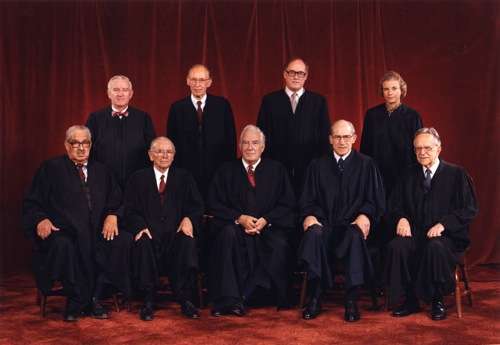 The Burger Court (1981)
The post Today in Supreme Court History: November 30, 1981 appeared first on Reason.com.
[Eugene Volokh] Open Thread
[What’s on your mind?]
The post Open Thread appeared first on Reason.com.
November 29, 2025
[Jonathan H. Adler] "Killing Helpless Men Is Murder"
[Jack Goldsmith on "A Dishonorable Strike"]
The Washington Post reported yesterday that Secretary of Defense Pete Hegseth did not merely order the initial strike on a boat off of believed to be transporting drugs, but gave the specific order to kill those on the boat. After the first strike hit the boat, a second strike was ordered to take out two survivors "clinging to the smoldering wreck" caused by the first.
Jack Goldsmith posted on this report yesterday at Executive Function. His essay, "A Dishonorable Strike," begins:
One can imagine stretching Article II of the Constitution to authorize the U.S. drug boat campaign. The wildly overbroad Office of Legal Counsel (OLC) precedents, as I have written before, provide "no meaningful legal check on the president." And there are dim historical precedents one could cite. Arthur Schlesinger Jr. noted in The Imperial Presidency that in the 19th century presidents unilaterally engaged in "[m]ilitary action against Indians—stateless and lawless by American definition—pirates, slave traders, smugglers, cattle rustlers, frontier ruffians [and] foreign brigands."
One might also, possibly, stretch the laws of war to say that attacks on the drug boats are part of a "non-international armed conflict," as OLC has reportedly concluded. This line of argument likely draws on a super-broad conception of the threat posed by the alleged drug runners as well as the expansive U.S. post-9/11 justification for treating as targetable (i) dangerous non-state actor terrorists off the battlefield; (ii) those who merely "substantially support" the groups with whom one is in an armed conflict; and (iii) activities that provide economic support to the war effort, such as Taliban drug labs or ISIS oil trucks. I don't think this argument comes close to working without deferential reliance on a bad faith finding by the president about the non-international armed conflict and much greater stretches of precedent than the United States previously indulged after 9/11. Still, the unconvincing argument is conceivable.
But there can be no conceivable legal justification for what the Washington Post reported earlier today: That U.S. Special Operations Forces killed the survivors of a first strike on a drug boat off the coast of Trinidad who, in the Post's words, "were clinging to the smoldering wreck."
Whether Hegseth was aware of this second strike, or his initial order was properly interpreted to direct it is unclear, but it does not change the bottom line. Goldsmith writes:
In short, if the Post's facts are correct, it appears that Special Operations Forces committed murder when the "two men were blown apart in the water," as the Post put it.
The post concludes:
Hegseth has emphasized that he wants to restore the "warrior ethos" in the U.S. military. In the hours after the story, he signaled generic support for the boat strike campaign and chest-thumped that "We have only just begun to kill narco-terrorists."
Yet the warrior ethos has always demanded honorable conduct in warfare. The Navy Seals, for example, describe themselves as "a special breed of warrior" but the Seal Ethos thrice emphasizes the importance of honor, including "on . . . the battlefield." And surely the warrior ethos, whatever else it means, doesn't require killing helpless men clinging to the burning wreckage of a blown-up boat. The DOD Manual is clear because the law here is clear: "Persons who have been incapacitated by . . . shipwreck are in a helpless state, and it would be dishonorable and inhumane to make them the object of attack."
Read the whole thing.
The post "Killing Helpless Men Is Murder" appeared first on Reason.com.
[Josh Blackman] Today in Supreme Court History: November 29, 2004
11/29/2004: Randy Barnett argues Gonzales v. Raich.
 Randy Barnett argues Gonzales v. Raich
The post Today in Supreme Court History: November 29, 2004 appeared first on Reason.com.
[Eugene Volokh] Open Thread
[What’s on your mind?]
The post Open Thread appeared first on Reason.com.
November 28, 2025
[Eugene Volokh] $115K Defamation Verdict Over Workplace Accusations of Domestic Abuse
From the Joint Pre-Trial Memorandum in McQuade v. UMass Memorial Health Care, Inc., the plaintiff's position:
In the summer of 2020, a position at UMass Memorial's Heart Vascular Interventional Lab commonly known as the Cath lab opened. Mr. McQuade and Andrews both applied for the Cath lab position. Ms. Andrews was awarded the Cath lab position. Once Mr. McQuade learned that Ms. Andrews was awarded the Cath lab position, he reached out to his union representatives for advice. Mr. McQuade's Massachusetts Nurses Association ("MNA") union representatives … both advised that Mr. McQuade should file a grievance because he had seniority over Andrews, and had the requisite experience to work in the Cath lab.
Ultimately, on September 11, 2020, Mr. McQuade was successful in his grievance and was awarded the Cath lab position. This, in turn, caused Andrews to leave the Cath lab position and return to her previous position in the float pool. Andrews was angry that she had to return to the float pool. Andrews desperately wanted to stay in the Cath lab and filed her own counter grievance that was eventually denied at the "step 3" stage by UMass Memorial. Therefore, the only way Andrews could be able to return to the Cath lab would be if a position opened by resignation or otherwise, including the resignation of Mr. McQuade….
The Nurse Defendants are all friends and would frequently socialize outside of work together. Mr. McQuade expects the evidence will show that, the Nurse Defendants did the unthinkable, and started a vile, and frankly evil slander campaign against Mr. McQuade, in an effort to have him resign from the Cath lab, so the Nurse Defendants could all work together again. Specifically, the Nurse Defendants began spreading defamatory rumors around UMass Memorial that stated Mr. McQuade abused his wife and child and had an open DCF investigation against him. Further, Clark stated that Mr. McQuade "created a farm in [his] back yard in order to lure in children as [his] prey."
{Q: "Okay. And the allegations concerning Mr. McQuade were a child abuse and spousal abuse. By spousal abuse, specifically, did you mean that he hit his wife?" Mr. Spezzaferro: "I think the way it was put to me was that he hits his wife."
Q: "Were you aware of any statements circulating around the hospital relating to Mr. McQuade and child abuse? Ms. Baer: Objection. Ms. O'Rourke: Yes." … Ms. O'Rourke: "Basically that there are statements being made by Ms. Andrews, and Ms. Clark, and Ms. Spratt while—about Patrick's child being taken away by DCF and the alleged child abuse."}
The abhorrent slander became widespread throughout UMass Memorial…. Because Andrews was in the float pool, the defamation was easily spread as she "floated" from unit-to-unit slandering Mr. McQuade….
The rampant defamation became so widespread that Ms. Champagne, took a huge professional risk and decided she needed to go to HR. Accordingly, Ms. Hiza met with Ms. Champagne and Mr. Spezzaferro on the afternoon of November 19, 2020. Ms. Hiza took contemporaneous notes of the meeting, as part of the regular course of her job, that stated, in pertinent part, the following:
… [Andrews] said fuck him—he took my job—he's big and scary
He's [Mr. McQuade] lazy a hard piece of shit
He's [Mr. McQuade] abusive and knows how to use guns
DSS [DCF] case—abusive daughter—he's abusive Yeah, she keeps—about this within 7ICU. They are her friends.
Character assassination
She [Andrews] was on 3ICU all weekend carrying on about Patrick.
After the meeting with Ms. Champagne, fully aware of the extent of the defamation, Ms. Hiza and other UMass Memorial HR staff investigated the defamation. Eventually UMass Memorial HR staff and Ms. Hiza met with the Nurse Defendants. Aware of the slander campaign, UMass Memorial, during work hours, instructed each Nurse Defendant to stop the defamation. Importantly, after the investigation, Ms. Hiza and UMass Memorial HR could not conclude that defamation was not occurring….
UMass terminated him for alleged sexual misconduct against another nurse, … McCarthy … who was friends with the Nurse Defendants. UMass Memorial had a written investigatory report when it terminated Mr. McQuade. In the written report Mr. McQuade complained thathe believed he was retaliated against by McCarthy because of the defamation.
McCarthy also brought criminal charges against Mr. McQuade. At trial, Mr. McQuade was found not guilty of a sexually related felony against McCarthy.
The defendants' position:
Defendants respectfully submit that Mr. McQuade has no admissible evidence that will show that he was the subject of any defamatory statements by any of the Nurse Defendants. Specifically, Plaintiff has no admissible evidence to prove: when the alleged defamatory statements were made, how the alleged defamatory statements we made, where the alleged defamatory statements were made, or to whom the alleged defamatory statements were made. Moreover, Plaintiff has waivered on what he has alleged to be the contents of the allegedly defamatory statements.
The reason for Plaintiffs lack of evidence is clear: no statements were made. Rather, Plaintiff—who was mentally "spiraling" in 2020—was the one who told multiple people working for UMass Memorial that there were defamatory statements said about him (i.e., he was the one that spread stories of the alleged defamatory statements). Not one person can or will testify that they heard any of the Nurse Defendants make any statement about Plaintiff. After Plaintiff brought his accusations to UMass Memorial's Human Resources, the allegations were promptly investigated and not substantiated.
The evidence will show that Plaintiff's employment was terminated because he sexually assaulted a nurse (not one of the Nurse Defendants) and was criminally charged and convicted for the conduct. Plaintiffs relocated by his own choice after he was criminally charged, which is unrelated to Plaintiff's claims of defamation and intentional infliction of emotional distress. [According to a Nov. 21 article about the defamation case in the Worcester Telegram & Gazette (Toni Caushi), McQuade had been fired "following sexual allegations by a nurse; he was found guilty in October 2022 on an annoying and accosting charge—a non-sexual misdemeanor" and "found not guilty for an 'indecent assault and battery charge.'" -EV]
Earlier this month, the jury concluded that plaintiff hadn't proved his case against Clark (which I assume means it didn't believe she made the "created a farm in [his] back yard in order to lure in children as [his] prey" claim), but did prove that Andrews had defamed him. The jury awarded McQuade $100 in actual damages against Andrews, and $75K against UMass Memorial, to which the court added $40K in interest.
The post $115K Defamation Verdict Over Workplace Accusations of Domestic Abuse appeared first on Reason.com.
[Eugene Volokh] "Arizona Man Sentenced to Six Years in Prison for Plot Targeting Christian Churches"
From a Justice Department statement issued Nov. 7, but just posted on Westlaw:
Zimnako Salah, 46, of Phoenix, Arizona, was sentenced today in the Eastern District of California to six years in prison in connection with his plot targeting Christian churches.
In March 2025, a jury in Sacramento convicted Salah of strapping a backpack around the toilet of a Christian church in Roseville, with the intent to convey a hoax bomb threat and to obstruct the free exercise of religion of the congregants who worshipped there. The jury's verdict included a special finding that Salah targeted the church because of the religion of the people who worshipped there, making the offense a hate crime.
According to the evidence at trial, from September to November of 2023, Salah traveled to four Christian churches in Arizona, California, and Colorado, wearing black backpacks. At two of those churches, Salah planted those backpacks, placing congregants in fear that they contained bombs. At the other two churches, Salah was confronted by security before he got the chance to plant those backpacks.
While Salah had been making bomb threats by planting backpacks in Christian churches, he had been building a bomb capable of fitting in a backpack. During a search of his storage unit, an FBI Bomb Technician seized items that an FBI Bomb Expert testified at trial served as component parts of an improvised explosive device (IED).
A search of Salah's social media records revealed that he had consumed extremist propaganda online. Specifically, those records showed that Salah had searched for videos of "Infidels dying," and he had watched videos depicting ISIS terrorists murdering people. In a cellphone video taken days before the crimes of conviction, Defendant Salah declared, "America. We are going to destroy it." …
"Salah's seeming ultimate goal to bomb a Christian church would have resulted in many deaths and injuries if his plan had not been thwarted," said U.S. Attorney Eric Grant. "Thanks to the action of church security, local law enforcement, and the FBI, this defendant was stopped before he had a chance to carry out the crimes he sought to commit. Today's sentence is justified by the history and characteristics of this defendant and serves to protect the public from this defendant. And it affirms that people of all religions should be able to worship freely and exercise their First Amendment rights in this country without fear of violence." …
From the government's Sentencing Memorandum:
A cellphone video, dated November 10, 2023—two days before the crimes of conviction in Roseville, California—shows Defendant Salah outside a Christian church in San Francisco, California, with a black backpack. Defendant Salah points to an American flag and says, "Fuck that flag," and "America—we're going to destroy it."
His statements on that video are consistent with statements he made to another witness, A.R., months earlier. When Defendant Salah observed A.R. wearing a hat with the American flag on it, Defendant Salah exclaimed "fuck this country" and "I hate America," elaborating that he was angry with the U.S. military for bombing and killing Iraqis. A cellphone video taken during that period shows an American B52 bomber, with Defendant Salah commenting: "Idiots, what is this you are displaying? All the world got killed by this U.S. Air Force airplane! You must remove it, otherwise I will remove it. There is no God but Allah."
You can see more details in the Criminal Complaint.
The post "Arizona Man Sentenced to Six Years in Prison for Plot Targeting Christian Churches" appeared first on Reason.com.
[John Ross] Short Circuit: An inexhaustive weekly compendium of rulings from the federal courts of appeal
[Debtors' prisons, evil schemes, and the Pottery Barn rule.]
Please enjoy the latest edition of Short Circuit, a weekly feature written by a bunch of people at the Institute for Justice.
Lawyers! IJ is hiring, including this exciting new gig: Assistant General Counsel. If you're an experienced attorney who thrives in a fast-paced environment, enjoys tackling a wide variety of legal questions, and wants your work to support a powerful mission, this could be the perfect fit.
New on the Short Circuit podcast: Did an Ohio man need a permit for people to come to his house and pray?
Who owns a rhinestone-adorned piano that was once the property of Liberace? The First Circuit sees no reason to disturb the jury's breach-of-bailment verdict: It belongs to the charitable foundation of the Gibson guitar company and not to the Rockland, Mass. piano retailer who says the foundation gave, rather than lent, it to him.District court (w/o a hearing and via one-paragraph order): This California-based cannabis entrepreneur lacks standing to challenge Rhode Island's licensing rules requiring majority in-state ownership/control and reserving social-equity slots for businesses majority-owned by people with Rhode Island-specific ties. First Circuit: The claims are ripe, not moot, she has standing, and similar Maine and New York laws have been invalidated on dormant commerce clause grounds in the meantime. Reversed and remanded for further proceedings—with haste!Luckily this newsletter is coming out the day after Thanksgiving, so none of you savages will be tempted to ruin family dinner by recounting the facts of this Second Circuit decision involving a (recently indicted) investment banker found liable under the Trafficking Victims Protection Act for committing extreme, non-consensual BDSM acts on women lured to his penthouse sex dungeon.Whoa Nelly! When it comes to antitrust the Sherman Act is the granddaddy of them all. But does it apply to the NCAA rule applying junior college years to Division I eligibility, nullifying that "restraint of trade"? In the case of a star defensive back Jett Elad—who entered the transfer portal and ended up at Rutgers U—that's a $500k name-image-and-likeness question. District court: Preliminary injunction and a first down! Third Circuit: Actually, it depends on the market, and everything's different after NCAA v. Alston (2021), so you need to run the new numbers. Penalties offset; replay the down on remand.Afghan vet suffering from PTSD goes on a bender in Roanoke, Va., shoots and severely injures a woman, breaks a guy's ankle, and is prosecuted in state court. A sentencing report and a hearing get a bunch of facts wrong about those incidents and his history but his counsel fails to object. Fourth Circuit: Sounds like ineffective assistance of counsel. Have a habeas. Remanded for resentencing. Dissent: Guys, habeas is harder than this.Under the Prison Litigation Reform Act, preliminary injunctions automatically expire after 90 days. Which is a bummer for the plaintiffs in this lawsuit against the Angola state penitentiary, who have now had a third consecutive appeal mooted by the automatic expiration of their preliminary injunction regarding the conditions under which they are forced to pick vegetables in the brutal Louisiana summer. Fifth Circuit (unpublished): We recognize it's not great, but at least the case is going to trial in February, before temperatures start rising in the spring.Sixth Circuit (majority): The Supreme Court has held that it's not a taking when the gov't takes pre-condemnation steps that happen to reduce the value of your property. Case dismissed! Dissent: Right, but it's never held that it's not a taking when the gov't undertakes an evil scheme to get your property on the cheap, and the complaint is squarely in evil-scheme territory.Allegation: Nashville city councilman, hoping to scuttle a tax-revolt referendum, gets a law firm that does business with the city to fire one of its lawyers in retaliation for his activity on the county election commission related to the referendum. Fired lawyer sues councilman and the law firm for First Amendment retaliation. Sixth Circuit: It's clearly established gov't officials can't try to get people fired for exercising their speech rights; no qualified immunity for councilman. But the law firm gets QI since the premise of the claim is that it's acting at the gov't's behest, and there's no clearly established law against firing somebody to placate a powerful client. Dissent: Private law firms shouldn't get QI.Lake County, Ind. probation officer rapes probationer (and later pleads guilty to one count of "official misconduct," yielding three years of home detention). Seventh Circuit: And in the civil litigation that ensued, summary judgment was rightly entered in favor of the officer's chief and the local supervising judge. Yes, those officials allowed the officer to resume supervising female probationers after learning of a different incident of alleged sexual misconduct. But they didn't know he was likely to escalate to full-on rape. (Separately, a jury returned a $750k verdict against the officer himself.)When a voting-information group asked New Mexico for voter rolls to post online, the state instead referred it for prosecution under a law restricting use/sharing of voter data and then denied further requests. The group sued, arguing, inter alia, that the law is preempted by the National Voter Registration Act. Tenth Circuit: Indeed. The NVRA authorizes the public to obtain, copy, and republish voter-list-maintenance records, including data extracted from the statewide database.In the 19th century, Alabama enshrined in its state constitution the elimination of its debtors' prisons. But lo! People are being locked up for falling behind on their garbage collection bills. Eleventh Circuit (unpublished): But the plaintiffs here challenged their jailing and the amount of bail, which were under the state's purview, not the city's, and you can't really sue the state under § 1983.Turns out the "Pottery Barn rule" is not actually that venerable tat-shop's policy. Who knew? The Eleventh Circuit, which mixes that apparent invention of Tom Friedman's with Monell liability. A mother alleges her son died of septic shock in jail due to an incompetent private contractor. Several other inmates died similarly. The sheriff even eventually tried to fire the contractor. But the county "doubled down and renewed" the contract. Those facts would constitute a policy making the county itself liable. Check out, and a jury trial, at register 4.Between his presidential terms, Donald Trump filed a lawsuit against dozens of defendants—including Hillary Clinton, the DNC, and the law firm Perkins Coie—raising a slew of claims related to the so-called Steele Dossier. The case is dismissed. But was it so frivolous that Trump and his lawyers should have been assess nearly $1 mil in sanctions? Eleventh Circuit (by a panel featuring G.W. Bush, Biden, and Trump appointees): Indeed it was.Law students! Come work at IJ next summer. Applications are open and being reviewed on a rolling basis for the Dave Kennedy Fellowship, which gives a unique opportunity to dive into high-stakes civil rights litigation. As a Fellow, you'll help develop litigation strategies, draft critical legal documents, and even assist with U.S. Supreme Court petitions! With weekly programming, mentorship from top IJ litigators, and career-boosting opportunities, this is your chance to make a real difference. Applications are due by February 6th, with interviews starting soon! Apply today to one of our five offices in Arlington, Va.; Miami; Austin; Phoenix; or Seattle. These competitive, paid fellowships offer $8,000 for the 10-week program, so apply now and take the next step in your legal career!
The post Short Circuit: An inexhaustive weekly compendium of rulings from the federal courts of appeal appeared first on Reason.com.
[Eugene Volokh] Journal of Free Speech Law: "The Enigma of Gitlow: Positivism, Liberty, Democracy, and Freedom of Speech," by Robert Post
[The keynote address from the "Gitlow v. New York at 100" symposium, held this year at the Arizona State University Sandra Day O'Connor College of Law; other papers from that symposium will be published here in the coming weeks.]
The article is here; here's the Introduction:
The centennial of Gitlow v. New York is upon us. Gitlow is typically praised as an essential step in the development of modern First Amendment doctrine, so that it is said that "[f]ew individual stars shine as brightly in the constellation of American civil liberties cases." Yet, closely examined, Gitlow seems a puzzling choice for constitutional canonization.
Decided at a time when there were virtually no First Amendment protections for speech, Gitlow held that government could punish mere abstract advocacy of violent revolution. Over the dissenting votes of Oliver Wendell Holmes, Jr. and Louis Brandeis, Gitlow stood for the proposition that "a State in the exercise of its police power may punish those who abuse" freedom of speech "by utterances inimical to the public welfare, tending to incite to crime, disturb the public peace, or endanger the foundations of organized government and threaten its overthrow by unlawful means." It would not be too much of an exaggeration to characterize Gitlow as "the clearest expression of the Supreme Court's acceptance of seditious libel."
Modern First Amendment doctrine, by contrast, is founded on the fundamental axiom that the state may not punish seditious libel. If we now celebrate Gitlow, therefore, it is certainly not for its articulation of the substance of First Amendment protections. It must rather be because Gitlow construed the liberty interests protected by the Due Process Clause of the Fourteenth Amendment, which apply as against the States, to include free speech protections analogous to those protected by the First Amendment, which apply as against the federal government. "The precise question presented, and the only question which we can consider under this writ of error," Gitlow states, is "whether the statute, as construed and applied in this case, by the State courts, deprived the defendant of his liberty of expression in violation of the due process clause of the Fourteenth Amendment."
We are now apt to interpret this language through the lens of incorporation doctrine, which conceives the Due Process Clause of the Fourteenth Amendment as transparently reproducing the exact doctrines of the First Amendment "jot-for-jot and case-for-case." But any such conception of incorporation developed well after Gitlow, which understood itself instead to be explicating the specific nature of the liberty protected by the Fourteenth Amendment. The question in Gitlow was not what the First Amendment required; it was instead what was required by the liberty interests safeguarded by the Due Process Clause.
We should be clear that these same liberty interests also underlay Lochner v. New York. These same liberty interests fueled the Court's use of the Due Process Clause to strangle social and economic legislation. In the decade before Gitlow, for example, the Court had invoked these same liberty interests to strike down state efforts to protect union members and to regulate the fees of employment agencies. Determined to resurrect and expand the reach of Lochner, the Taft Court during the 1920s was vilified as "the zenith of reaction." Enlarging Fourteenth Amendment liberty to include freedom of speech threatened to enlarge the scope of judicial control over all state regulation.
Seen from this perspective, Gitlow can suddenly come to seem deeply enigmatic. We might ask why the Court bothered to extend free speech protections to states when its understanding of the substance of these protections was so stunted and feeble. What was actually at stake for the Court majority when it decided to interpret the liberty interests protected by the Due Process Clause of the Fourteenth Amendment to include freedom of speech?
Conversely, why did Holmes and Brandeis, who were strongly opposed to the Court's resurgent Lochnerism, nevertheless join the Court in holding that the "general principle of free speech … must be taken to be included in the Fourteenth Amendment, in view of the scope that has been given to the word 'liberty' as there used." How were Holmes and Brandeis able to interpret the word "liberty" in the Due Process Clause so that it might entail strict and independent judicial review of state censorship of speech, but nevertheless require deference to ordinary state social and economic regulations?
To unravel these questions, we must make a strenuous effort of historical imagination. We must put Gitlow back into the context of its time. The effort will prove rewarding. We shall learn, for example, that no Justice in the 1920s interpreted the word "liberty" in the Due Process Clause in anything like the manner of the contemporary Court in a case like Dobbs v. Jackson Women's Health Organization. So far from viewing the scope of constitutionally protected liberty as a "fact" determined by the historical data of history and tradition, all Justices in the 1920s understood liberty interests to be defined by values they perceived as immanent in the Constitution.
For the majority of the Court, these values centered around protecting the constitutional "right of the citizen to be free in the enjoyment of all his faculties," a libertarian constitutional vision first articulated at the start of the Lochner era in Allgeyer v. Louisiana. Both Holmes and Brandeis strongly objected to this constitutional vision, which they condemned as inconsistent with the proper role of Article III courts. In Gitlow, Holmes and Brandeis instead interpreted Fourteenth Amendment liberty in light of their commitment to the specific constitutional value of freedom of speech.
Because they so often joined each other's opinions on this subject, we often imagine that Holmes and Brandeis supported freedom of speech for the same reasons. But the history of Gitlow illustrates that this was not the case. Whereas Holmes believed that freedom of speech was necessary to sustain the authority of positive law, Brandeis believed that freedom of speech was the lifeblood of a democracy whose purpose was to empower citizens to develop their own autonomous faculties. Freedom of speech was for Holmes a jurisprudential necessity, whereas for Brandeis it was "both … an end and … a means." In contrast to Holmes, Brandeis was prepared to read democratically required liberties other than freedom of speech into the Due Process Clause.
Modern First Amendment doctrine has descended from Brandeis, not from Holmes. But Holmes's brief dissent in Gitlow nevertheless contains an important lesson for contemporary constitutional theorists. Holmes was the founder and most analytically powerful practitioner of positivism in the history of American jurisprudence. Holmesian positivism has recently been revived by originalists and by those committed to interpreting the Constitution in light of a factually based account of history and tradition. Yet Holmes's short opinion in Gitlow illustrates that even rigorous positivists cannot ultimately interpret the Due Process Clause solely in terms of facts, whether the facts of original public meaning or of history and tradition. An internally consistent positivism must instead find its ultimate ground in fundamental constitutional values.
The post Journal of Free Speech Law: "The Enigma of Gitlow: Positivism, Liberty, Democracy, and Freedom of Speech," by Robert Post appeared first on Reason.com.
Eugene Volokh's Blog

- Eugene Volokh's profile
- 7 followers

