
Eugene Volokh's Blog, page 24
October 1, 2025
[Josh Blackman] Starlink WiFi in the Air is a Game Changer
United Airlines is installing Starlink WiFi on its fleet. Today, my flight from Indianapolis to Houston has Starlink. It is an absolute game changer. I had download speeds in excess of 250 Mbps, and upload speeds of nearly 30 Mbps.

When I have a flight, I deliberately schedule activities that do not require accessing the internet, as connectivity may be slow or non-existent. But now with Starlink, I can do anything in the air that I could do on the ground. Indeed, it should be possible to listen to Zoom calls, aided by closed captioning.
The post Starlink WiFi in the Air is a Game Changer appeared first on Reason.com.


[Josh Blackman] A Fifth Circuit Disgrantle in the Alien Enemies Act Case
[Judge Southwick dissents from the grant of rehearing en banc, Judge Ho cites his Abbott concurrence on the Invasion Clause.]
Yesterday, the Fifth Circuit granted rehearing en banc in W.M.M. v. Trump. This case, formerly known as A.A.R.P. v. Trump, presents a challenge to President Trump's use of the Alien Enemies Act to remove certain aliens. On September 2, the merits panel opinion ruled against Trump. Judge Southwick wrote the majority opinion, and he was joined by Judge Ramirez. Judge Oldham wrote a blistering dissent.
At the time, I wondered whether the Solicitor General would simply seek certiorari, or seek rehearing en banc. The former option would get a resolution sooner, but the government may have worried that the Court would not grant review in the absence of a circuit split. So filing an en banc petition was probably the safer bet. And indeed, the government sought rehearing en banc, which was granted.
The Fifth Circuit has seventeen active members, which means that at least nine members voted to rehear the case. There are decent odds that if nine members vote to rehear the case, then nine members will vote to reverse the panel opinion, but those sorts of predictions are tough to make. And as often happens on the Fifth Circuit, the en banc court may fracture, and there will be a judgment, but not a single controlling opinion. One judge usually simply concurs in judgment, making a majority even tougher to cobble together.
After the court granted rehearing, Judge Southwick issued an unusual opinion: he dissented from the grant of rehearing en banc.
A prompt, final resolution of this case is in the legitimate interests of all parties, whatever lesser interests of either side of the litigation might be served by the delay of en banc in this court. It is, I believe, also in the country's best interest that additional, necessarily inconclusive, inferior-court determinations not delay the Supreme Court's reclaiming this case. I therefore respectfully dissent from the grant of rehearing en banc.
We all know what a dissental is. There is also a disgrantle, as Judge VanDyke explained: a dissent from the grant of rehearing en banc. My colleague Eugene Volokh described the disgrantle as a "nonce word," which is a "on one specific occasion or in one specific text or writer's works." Well, I'm using disgrantle here.
I searched the Fifth Circuit database for the phrase "dissenting from the grant of rehearing en banc." No other hits came up. I know of at least one instance in which this mechanism was used. Way back in 2008, Judge Smith dissented from the grant of rehearing en banc, though he styled his opinion as just a dissent: United States v. Seale, 550 F.3d 377 (5th Cir. 2008). I'm sure there are other such cases, but they are rare.
I am aware of one case where four members of the Supreme Court dissented from the grant of certiorari: American Tradition Partnership v. Bullock (2012)
I also want to flag Judge Ho's brief concurrence in W.M.M.:
Our colleague opposes rehearing en banc on grounds of delay. But the burden of any delay falls on the Government. And the Government asked for rehearing en banc, rather than seek certiorari in the Supreme Court. Perhaps we could have minimized delay by declaring last year in United States v. Abbott, 110 F.4th 700 (5th Cir. 2024), that the Judiciary has no business telling the Executive that it can't treat incursions of illegal aliens as an invasion. [FN1] But we are where we are. The issue is obviously compelling. I concur in the grant of rehearing en banc.
FN1: As the Government points out in its petition for rehearing en banc, "[t]he border crisis grew so dire that Texas invoked the constitutional promise that the federal government 'shall protect each of [the States] against Invasion.'" Pet'n for Reh'g En Banc 4, W.M.M. v. Trump, No. 25-10534 (5th Cir. Sep. 22, 2025) (quoting U.S. Const. art. IV, § 4, and citing Letter from Governor Abbott to President Biden 1-3 (Nov. 16, 2022)) (cleaned up).
Well before Trump came into office, Judge Ho opined that determinations under the Invasion Clause were not justiciable. (See Rob Natelson's post on this opinion.) Judge Ho was well ahead of the curve. If Judge Ho was right, then W.M.M. becomes a much easier case. Ho's view did not receive any other votes in 2024. And I was surprised that Judge Oldham's dissent in W.M.M. did not cite Ho's concurrence. We will see what happens on the en banc court this time around.
The post A Fifth Circuit Disgrantle in the Alien Enemies Act Case appeared first on Reason.com.
[Josh Blackman] Reversing The Burger Court
[The Supreme Court has largely left Warren Court precedents in place, but is consistently undoing precedents from the Burger Court.]
In my new Civitas column, I explain how President Trump is, in many regards, refighting the war that was waged against President Nixon. In the process, Trump is butting against many precedents of the Burger Court, including United States v. Nixon and Train v. United States. I suspect that both of these cases would no longer command a majority of the Court.
Taking a step back, it is striking how many of the decisions by the Burger Court have been overturned in recent years, even as precedents of the Warren Court remain inviolable.
Consider some highlights (or lowlights, depending on your perspective).
Roe v. Wade (1973) was reversed by Dobbs v. Jackson Women's Health Organization (2022). Board of Regents of California v. Bakke (1978) largely upheld the use of affirmative action policies. This decision was (basically) reversed by Students for Fair Admission v. Harvard (2024). Lemon v. Kurtzman (1971) prohibited any "entanglement" between church and state. Kennedy v. Bremerton School District (2022) effectively overruled the Lemon test. Abood v. Detroit Board of Education (1977) upheld the power of public sector unions to mandate certain dues from employees. Janus v. AFSCME (2018) overruled Abood. Chevron v. NRDC (1984) ruled that courts should defer to administrative agencies when a statute is "ambiguous." Loper Bright v. Raimondo (2024) overruled Chevron deference. Ramos v. Louisiana (2020) overruled Apodaca v. Oregon (1972).Franchise Tax Board of California v. Hyatt (2019) overruled Nevada v. Hall (1979).Knick v. Township of Scott (2019) overruled Williamson County (1985).Rucho v. Common Cause (2019) overruled Davis v. Bandemer (1986)Most of the current Justices came of age when the Burger Court was in power. They perhaps see this Court as prone to reversal. I think Justice Thomas stated the issue well:
"At some point we need to think about what we're doing with stare decisis," Thomas said Thursday, referring to the legal principle of abiding by previous decisions. "And it's not some sort of talismanic deal where you can just say 'stare decisis' and not think, turn off the brain, right?"
The Court's senior conservative suggested that some members of the Court over the years have blindly followed prior judgments, comparing them to passengers on a train.
"We never go to the front see who's driving the train, where is it going. And you could go up there in the engine room, find it's an orangutan driving the train, but you want to follow that just because it's a train," Thomas said.
"I don't think that I have the gospel," he said, "that any of these cases that have been decided are the gospel, and I do give perspective to the precedent. But it should — the precedent should be respectful of our legal tradition, and our country, and our laws, and be based on something, not just something somebody dreamt up and others went along with."
So who is the "orangutan" driving those trains?
I've heard it said that Chief Justice Burger could have done more on the Court if he had more conservative votes. I'm not so sure. Burger was in the majority of most of the overruled cases. He assigned Roe to Justice Blackmun and wrote the majority opinion in Lemon. Justice Rehnquist, appointed around the same time, was often the lone voice of reason.
To pile on a bit more, former-Chief Justice Burger described an individual Second Amendment right as "one of the greatest pieces of fraud, I repeat the word fraud, on the American public." The Supreme Court emphatically rejected Burger's glib comment in District of Columbia v. Heller (2008).
Chief Justice Burger stepped down from the Court in September 1986. His resignation allowed President Reagan to promote William Rehnquist to Chief Justice, and appointed Antonin Scalia to the Supreme Court. In many regards, Burger's departure ushered in the modern originalist revolution. If only Justice Powell had stepped down earlier, we would likely have never known of a Justice Kennedy.
The post Reversing The Burger Court appeared first on Reason.com.
[Eugene Volokh] Repeated Sex Assault Accusations Can Lead to Washington "Antiharassment Protection Order" even Without Court Finding They're False
From Bobick v. Fernandes, decided yesterday by the Washington Court of Appeals Judge Janet Chung, joined by Judges Michael Diaz and Lori Smith; I'd love to hear what others think about this:
In December 2023, Bobick petitioned for an antiharassment protection order protecting him from Fernandes. Bobick alleged that Fernandes, whom Bobick did not know personally, had been making false claims online that Bobick sexually assaulted a woman named R.H. in 2015. He also alleged that Fernandes had been "harassing [him] online for more than one year."
Bobick specifically described two recent incidents. First, on November 27, 2023, Fernandes published a petition on the Change.org website targeting the Mountaineers, a Seattle-based climbing organization. According to Bobick, the petition demanded that the Mountaineers "change their policies in vetting volunteers and how they handle behavior complaints." Bobick provided a screenshot with text from the petition, which included the following statement: "Documents from a former member of the Mountaineers reported two sexual assaults in 2016. Stephen Bobick was accused of touching a woman inappropriately as she slept in a tent on a Mountaineers Climb." Second, Bobick alleged that Fernandes and R.H. collaborated on two public events to show a video that included a photograph of Bobick and R.H. with the caption, "Was sexually assaulted twice … by leaders in The Mountaineers I trusted." According to Bobick, Fernandes "rang a bell and yelled 'shame' repeatedly as the image … was on screen" and later published the video online.
The superior court issued the antiharassment protection order based on findings that (I combine here rulings from the superior court judge and a superior court commissioner):
"… Fernandes wants to make her accusations of sexual assault against … Bobick to the public as a warning to other people who may have any type of social relationship with [him] now or in the future." …
"[B]ased on a preponderance of the evidence … Bobick has offered sufficient evidence to support his request for a protection order." …
"… [T]here is a basis for a protection order in this matter … [a]nd … there is not an appropriate use of free speech by [Fernandes]." …
"[Bobick] supports [his] account of events with a sworn declaration that [Fernandes] made unproven accusations of sexual assault against [him] using his name and photograph for over 12 months. [Fernandes] agreed—or did not seriously dispute—[Bobick]'s description of her activities and time frame is accurate, and that [Bobick] has experienced substantial emotional distress…."
"[T]he actions of [Fernandes] constituted harassment … and [are] not protected free speech. [Fernandes]'s actions may, per her perspective, constitute[ ] a legitimate purpose—this Court disagrees…."
The appellate court affirmed:
Under [Washington law], a court "shall issue a[n antiharassment] protection order if it finds by a preponderance of the evidence … that the petitioner has been subjected to unlawful harassment by the respondent." "Unlawful harassment" means, as relevant here, "[a] knowing and willful course of conduct directed at a specific person that seriously alarms, annoys, harasses, or is detrimental to such person, and that serves no legitimate or lawful purpose." "The course of conduct must be such as would cause a reasonable person to suffer substantial emotional distress, and must actually cause substantial emotional distress to the petitioner." … In determining whether a course of conduct serves any legitimate or lawful purpose, a court should consider whether
(i) Any current contact between the parties was initiated by the respondent only or was initiated by both parties;
(ii) The respondent has been given clear notice that all further contact with the petitioner is unwanted;
(iii) The respondent's course of conduct appears designed to alarm, annoy, or harass the petitioner;
(iv) The respondent is acting pursuant to any statutory authority including, but not limited to, acts which are reasonably necessary to:
(A) Protect property or liberty interests;
(B) Enforce the law; or
(C) Meet specific statutory duties or requirements;
([v]) The respondent's course of conduct has the purpose or effect of unreasonably interfering with the petitioner's privacy or the purpose or effect of creating an intimidating, hostile, or offensive living environment for the petitioner; or
(vi) Contact by the respondent with the petitioner … has been limited in any manner by any previous court order.
"Constitutionally protected activity is not included within the meaning of 'course of conduct.'" …
Fernandes argues that her activities that were the basis for the protection order were constitutionally protected, citing Catlett v. Teel (Wash. App. 2020)…. Here, unlike in Catlett, Fernandes did not merely publish public records about Bobick. Instead, … Fernandes accused Bobick of sexual assault and did so repeatedly in online forums for a period of more than 12 months…. Fernandes asserts that the burden falls on Bobick to show that Fernandes's statements were false …. [But precedents involving defamation] are inapposite and Fernandes cites no other authority for the proposition that Bobick was required to prove defamation to obtain an antiharassment protection order ….
The appellate court noted that:
Fernandes raises only a "backward looking" constitutional argument that her complained-of activities were protected speech and, thus, could not properly serve as a basis for the protection order. She does not argue that the restraints imposed going forward are unconstitutional. Accordingly, we do not consider this issue.
I don't think this is constitutional: Injunctions against libel, following a finding at a full trial that statements are indeed false and defamatory, are indeed permissible (see Anti-Libel Injunctions). But, given the First Amendment, such public accusations generally remain protected until there's proof that they are indeed false; and anti-harassment injunctions shouldn't be used against such accusations as a means to avoid the proof that defamation cases require (see Overbroad Injunctions).
The post Repeated Sex Assault Accusations Can Lead to Washington "Antiharassment Protection Order" even Without Court Finding They're False appeared first on Reason.com.
[Josh Blackman] New in Civitas: Trump Is Refighting The "War" That Congress and the Burger Court "Waged" Against President Nixon
["The Burger Court approved this war. Trump is now successfully refighting that war."]
Civitas has published my new essay, titled Trump Is Refighting The "War" That Congress and the Burger Court "Waged" Against President Nixon. This essay brings together several threads about Trump, the Roberts Court, the Burger Court, and the fallout from Watergate.
Here is a snippet:
The epochs of constitutional law in the twentieth century are well known. During the so-called Lochner Era in the early twentieth century, the Court carefully scrutinized federal and state economic regulations. The New Deal Court reversed course and largely deferred to these laws. The Warren Court is well known for expanding civil and criminal rights, while reinforcing democratic processes. The Burger Court, if it is remembered at all, unleashed Roe v. Wade (1973) on our polity. But over the ensuing three years, the Burger Court decided three landmark cases that drastically and hastily transformed the structure of the federal government. All of these decisions resulted directly from the Watergate scandal. First, United States v. Nixon (1974) permitted a federal prosecutor to issue a subpoena to President Nixon to produce the Watergate Tapes. Second, Train v. City of New York (1975), found that President Nixon could not "impound," or withhold certain funding. Third, Buckley v. Valeo (1976) largely upheld the Federal Election Campaign Act, as well as the Federal Election Commission that enforces the Act.
There is a fourth decision that bears mentioning. The Ethics in Government Act (1978) created the independent counsel statute as a means to prevent future Watergates. This provision empowered a prosecutor to investigate the executive branch with sweeping authority and broad independence. The Rehnquist Court upheld this statute in Morrison v. Olson (1988) over the vigorous and legendary dissent of Justice Antonin Scalia.
The Supreme Court has already taken steps to deconstruct many of these precedents. Citizens United v. FEC (2010), followed by McCutcheon v. FEC (2014), more or less rendered Buckley a nullity, as vast amounts of money can now indirectly flow to the political process. Both Republican and Democratic politicians have benefited from these rulings. Trump v. United States (2024) granted President Trump broad immunity from criminal prosecutions and scaled back the import of the Watergate Tapes case. I have called on the Court to reconsider United States v. Nixon, which was an early manifestation of lawfare. And this term, the Supreme Court is poised to undermine Morrison by overruling Humphrey's Executor v. FEC, a New Deal era precedent that upheld so-called "independent" agencies.
I write that the Supreme Court's recent decision in the AIDS Vaccine Coalition case should not be viewed as a narrow, one-off. Rather:
This ruling is part of a series of cases in which the Court is scaling back Congress's efforts to control the presidency in the wake of Watergate. An entire structural edifice of government was created to constrain the executive. And the Roberts Court is now dismantling those structures.
I think this framing helps to understand why Justice Kagan referred to Congress as waging a "war" against President Nixon:
In dissent, Justice Kagan charged that the majority misread the Nixon-era statute. But more importantly, Kagan faulted the conservatives for ignoring the context in which the Impoundment Control Act arose. She reminded everyone that the "ICA [was] enacted after Congress waged war with President Nixon over impoundments." Kagan added that "Congress w[o]n its confrontation with the President." It is unconventional for a Supreme Court opinion to describe Congress as waging a war and winning a confrontation with the president. Supreme Court Justices are not political commentators. Yet Kagan, perhaps unintentionally, identified the reason why so much of constitutional law went awry.
Trump is now successfully refighting that war.
The post New in Civitas: Trump Is Refighting The "War" That Congress and the Burger Court "Waged" Against President Nixon appeared first on Reason.com.
[Mark Movsesian] Jefferson, Wine, and the Wall of Separation
[The Dangers of Amateur History at the Court]
Many people know Thomas Jefferson's phrase about a "wall of separation between church and state." Fewer know how that phrase entered constitutional law. It's a curious story, which I discuss in a new Legal Spirits podcast with historians Don and Lisa Drakeman.
The story begins with Jefferson's 1802 letter to the Danbury Baptists, written to reassure them that he shared their view of church-state relations. In that letter, Jefferson wrote that the First Amendment had built "a wall of separation between church and state." The metaphor was memorable, but the letter was not widely circulated and largely disappeared from public memory.
This was not surprising. Jefferson played no direct role in drafting of the Constitution or the First Amendment. Although he wrote the Virginia Statute for Religious Freedom in the 1780s, which influenced American thinking about liberty of conscience, he was abroad during the Philadelphia Convention and, by the time Congress proposed the Bill of Rights in 1789, he was serving as Secretary of State. The Religion Clauses were the product of Madison and the First Congress, not Jefferson.
The Danbury letter might have remained obscure but for a rediscovery in the 1870s. Chief Justice Morrison Waite, with the help of his neighbor, historian George Bancroft, came across the letter and cited it in Reynolds v. United States (1879). The Court in Reynolds upheld the federal government's prosecution of a Mormon defendant for practicing polygamy, despite his claim of religious obligation. Waite distinguished between belief and conduct: Congress could not legislate about belief, but it could regulate conduct that violated social duties or threatened public order. To support this distinction, Waite quoted Jefferson's Danbury letter, treating him as an authoritative interpreter of the First Amendment.
But Waite didn't stop there. He also invoked an earlier piece of Jefferson correspondence, a letter to a Virginia wine merchant, in which Jefferson remarked that the Constitution should be ratified and then amended to add an express protection for religious freedom. That letter was largely about Jefferson's views on wine, not constitutional design, yet Waite used it to suggest that Jefferson was an "acknowledged leader" of the movement for a bill of rights. By relying on this passing aside, buried in a letter on an entirely different subject, Waite sought to link Jefferson directly to the First Amendment.
The move was "stunningly flimsy," the Drakemans argue. Jefferson's letters were written in contexts removed from the adoption of the First Amendment. Yet Waite elevated them into constitutional law, where they would play an outsized role for more than a century.
Indeed, Jefferson's metaphor of the "wall of separation" dominated the Court's Establishment Clause jurisprudence in the twentieth century. Although the Court has stepped away from the metaphor in recent decades, preferring instead a "history and tradition" approach, Jefferson's words remain influential in law and politics. Few metaphors in American constitutional history have had greater staying power.
This curious episode illustrates both the power and the risks of judicial reliance on history. Offhand remarks in private correspondence—about constitutional law, but mostly about Bordeaux—became touchstones for constitutional doctrine. The episode reminds us that history can take on a life of its own in ways the Founders themselves never imagined.
In the podcast, the Drakemans and I discuss Jefferson, Waite, and Bancroft, the risks of amateur history at the Court, and Jefferson's other writings on religious freedom. You can listen to the full conversation here.
The post Jefferson, Wine, and the Wall of Separation appeared first on Reason.com.
[Eugene Volokh] Minors and Addiction to Speech and Press
I'm finishing serializing my forthcoming Emory Law Journal article titled Addiction to Constitutionally Protected Activity: Speech, Press, and Religion. In my earlier posts, I argued that concerns about psychological addiction can't justify restrictions that interfere with behavior presumptively protected by the Free Exercise Clause. I then turned to arguing that these concerns likewise generally can't justify restrictions with behavior presumptively protected by the Free Speech or Press Clause. Today, I close with the question whether some such restrictions may be upheld when focused on speech that reaches minors.
[* * *]
Perhaps because of the First Amendment concerns mentioned above, much of the discussion of regulating addictive technologies has focused on regulating use by minors, not by adults.
The Court has generally concluded that minors have largely the same First Amendment rights as adults, with the historically grounded exception of access to sexually themed material. Justice Thomas has recently taken the view that the Free Speech Clause "does not include a right to speak to minors (or a right of minors to access speech) without going through the minors' parents or guardians"; but no other Justices have joined him.
In particular, the Court has held that minors have the same rights as adults to engage in political speech, including campaign contributions. Presumably that would extend to consumption of political commentary and other opinion on public issues on social media. Minors also have the same rights as adults to access nonsexual entertainment, including supposedly harmful material such as violent video games:
Minors are entitled to a significant measure of First Amendment protection, and only in relatively narrow and well-defined circumstances may government bar public dissemination of protected materials to them. No doubt a State possesses legitimate power to protect children from harm, but that does not include a free-floating power to restrict the ideas to which children may be exposed. Speech that is neither obscene as to youths nor subject to some other legitimate proscription cannot be suppressed solely to protect the young from ideas or images that a legislative body thinks unsuitable for them.
This logic would presumptively extend, I think, to attempts to protect the young from social media or video game design features that a legislative body (or a court applying common law rules) "thinks unsuitable for them."
To be sure, this caselaw was developed with regard to content-based restrictions, which the Court has long viewed especially skeptically. Perhaps the analysis may differ as to modest content-neutral "manner" restrictions that leave open ample alternative channels. In particular, perhaps the objection to free speech paternalism should be less when we're dealing with attempts to protect minors from their risky choices than with attempts to protect adults.
Still, paternalism—especially when it comes to the First Amendment—is generally the province of the pater (and of course, today, equally the mater). And while the Court has been open to the view that the law may try to facilitate parental control over their children's exposure to speech, it has stressed that this can only support parents' authority, not substitute the state's decision for such authority. To again quote the violent video game case,
[W]e note our doubts that punishing third parties for conveying protected speech to children just in case their parents disapprove of that speech is a proper governmental means of aiding parental authority. Accepting that position would largely vitiate the rule that only in relatively narrow and well-defined circumstances may government bar public dissemination of protected materials to minors. . . .
[T]he Act's purported aid to parental authority is vastly overinclusive. Not all of the children who are forbidden to purchase violent video games on their own have parents who care whether they purchase violent video games. While some of the legislation's effect may indeed be in support of what some parents of the restricted children actually want, its entire effect is only in support of what the State thinks parents ought to want. This is not the narrow tailoring to "assisting parents" that restriction of First Amendment rights requires.
As with the violent video game case, this suggests that the government might need to use a less restrictive alternative, such as requiring parental controls, or expecting parents to use (if they want to) the parental controls that social media platforms and video game provides already include:
California cannot show that the Act's restrictions meet a substantial need of parents who wish to restrict their children's access to violent video games but cannot do so. The video-game industry has in place a voluntary rating system designed to inform consumers about the content of games. . . . This system does much to ensure that minors cannot purchase seriously violent games on their own, and that parents who care about the matter can readily evaluate the games their children bring home. Filling the remaining modest gap in concerned parents' control can hardly be a compelling state interest.
To be sure, the focus on what minors "bring home," from an era where games were bought in stores, needs to be updated to a time when everything is downloaded. But the basic point remains: Because of the diversity in parental views, laws aimed at shielding minors from constitutionally protected speech have to focus on promoting parental control mechanisms, not on categorically limiting access by minors.
Indeed, the Court held this in Brown while striking down a law that merely limited sales of violent video games to children, and left parents free to buy the games themselves. That law thus already left open room for expressly parentally approved consumption of speech—yet it was still held to be unconstitutional. The Court expressly rejected the view that "the state has the power to prevent children from hearing or saying anything without their parents' prior consent." That suggests that categorical bans on minors' access to certain social media or video game features would be even more clearly unconstitutional.
Of course, none of this is certain. Perhaps the Court will conclude that content-neutral restrictions on, say, infinite scroll are so modest that they pass intermediate scrutiny, even though the content-based restrictions on violent video games failed strict scrutiny.
Or perhaps the 15 years since the violent video game cases have provided, in the Justices' view, more evidence that communications technology poses real threats to children. Maybe the Court today will therefore be more convinced of the need to shield children from supposedly addictive expression than the 2011 Court was as to supposedly violence-promoting expression.
Indeed, three of the Court's currently sitting Justices (Thomas, Roberts, and Alito) were open in Brown to restrictions on minors' access to violent video games, and only two (Sotomayor and Kagan) were in the Brown majority. Maybe some of the new conservative Justices (Kavanaugh, Gorsuch, Barrett, or Jackson) will take the Thomas/Roberts/Alito view from Brown rather than the Scalia/Kennedy view. Likewise, maybe Justice Jackson will side more with her former boss, Justice Breyer, who dissented in Brown, than with the other liberal Justices (Ginsburg, Sotomayor, and Kagan).
Still, there is reason to doubt that the Court—or lower courts, following Brown—will be willing to uphold restrictions on supposedly addictive communications design features, even as to minors, and even as to the content-neutral restrictions.
Conclusion
The government's power to restrict liberty—the liberty of both providers and consumers—in order to prevent addiction has to be sharply limited when the supposed addiction is to First-Amendment-protected material. I have argued that this is true even when speech, press activity, or religious practice is seen as manipulative or fostering of compulsion. And it is true even when the actions affect people's neutrotransmitter systems, as much speech and religious activity likely does.
The matter is especially clear as to religion. It may involve all sorts of techniques and practices that "foster compulsion" to continue in the faith, and to do things that outsiders may see as psychologically and even physically harmful. But the government generally cannot try to restrict such techniques in order to prevent "addiction to religion."
And I think the same is true as to social media platforms' and video games' speech or press activities. There may be some latitude for content-neutral restrictions on some such techniques, especially when the users are minors. But even that is far from certain.
[* * *]
Lawsuits that sought modifications to the game for all users, including adults, have at times been rejected precisely on the grounds that the government lacks an adequate basis for regulating adult access. See, e.g., Courtright v. Epic Games, Inc., No. 2:24-CV-04055-BCW, 2025 WL 2319148, at *8 (W.D. Mo. Aug. 11, 2025) ("Preventing future addiction in children is compelling, yet the changes that are requested would apply to all users of the games and is therefore not narrowly tailored for children.").
Brown v. Ent. Merchants Ass'n, 564 U.S. 786, 794–75 (2011) (noting that "only in relatively narrow and well-defined circumstances may government bar public dissemination of protected materials to them," and citing Erznoznik v. City of Jacksonville, 422 U.S. 205, 212–13 (1975), which made clear that those circumstances related to sexually themed material).
Free Speech Coalition, Inc. v. Paxton, 145 S. Ct. 2291, 2303 (2025).
Brown, 564 U.S. at 821 (Thomas, J., dissenting).
McConnell v. FEC, 540 U.S. 93, 231–32 (2003).
Erznoznik v. City of Jacksonville, 422 U.S. 2015, 212–13 (1975).
Brown, 564 U.S. at 794.
Id. (cleaned up) (largely relying on Erznoznik).
See, e.g., NetChoice v. Carr, No. 1:25-CV-2422-AT, 2025 WL 1768621 (N.D. Ga. June 26, 2025) (striking down a law regulating children's access to certain social media that use supposedly addictive techniques, on the grounds that it "would dramatically curb minors' ability to speak and access to speech" and that "[t]he Supreme Court has, for decades, affirmed the importance of the First Amendment rights of young people"), appeal pending; see also Computer & Commc'ns Indus. Ass'n v. Uthmeier, No. 4:24CV438-MW/MAF, 2025 WL 1570007, at *16–17 (N.D. Fla. June 3, 2025) (applying much the same logic, even under intermediate scrutiny).
See, e.g., Langvardt, supra note 103, at 148; Computer & Commc'ns Indus. Ass'n, 2025 WL 1570007, at *15.
Brown, 564 U.S. at 802–03 (cleaned up).
See, e.g., In re Soc. Media Adolescent Addiction/Pers. Inj. Prods. Liab. Litig., 702 F. Supp. 3d 809, 836 (N.D. Cal. 2023) (allowing addictive design claim to go forward based on a theory that the products hadn't provided adequate parental controls).
Brown, 564 U.S. at 803 (cleaned up).
Id. at 795 n.3. The Court concluded that the state may have "the power to enforce parental prohibitions—to require, for example, that the promoters of a rock concert exclude those minors whose parents have advised the promoters that their children are forbidden to attend." But it concluded that it could not, for instance, be made criminal to admit persons under 18 to a political rally without their parents' prior written consent." Id.
The post Minors and Addiction to Speech and Press appeared first on Reason.com.
[Eugene Volokh] Wednesday Open Thread
[What's on your mind?]
The post Wednesday Open Thread appeared first on Reason.com.
September 30, 2025
[Josh Blackman] Judge William Young Should Retire
Last month I wrote a post about Judge William Young of the U.S. District Court for the District of Massachusetts.
I offered this unsolicited advice:
Judge Young turns 85 later this month. He has had a distinguished judicial career spanning half a century. A lot has changed since he graduated law school in 1967. Perhaps this apology provides a moment to reconsider where his talents and efforts are best suited.
Judge Young did not take my advice. Instead, he styled a judicial decision as a 161-page letter to an anonymous postcard writer. It began in this fashion:
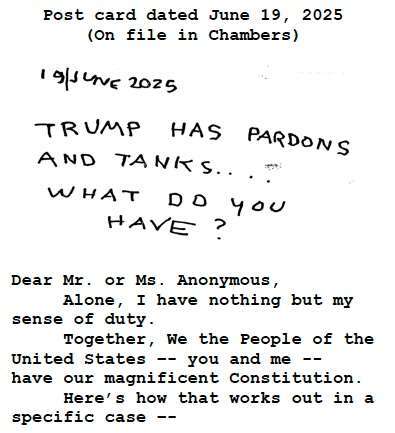
And closed like this:
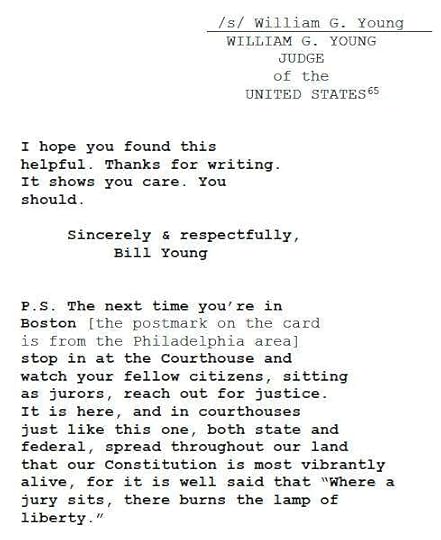
I offer no comments on the merits here. Instead, I see the case of a judge who has forgotten what the judicial role is. Perhaps Judge Young has been led astray by zealous clerks who are taking advantage of the situation. Perhaps Judge Young is ignoring advice from friends and colleagues, and wrote this decision himself. Or perhaps there is some other situation at hand. I don't know.
Judge Young should step down. Article III offers life tenure, not a life sentence. Judge Young already took senior status during the early Biden Administration, so Trump cannot name his replacement. And Young's absence would have no negative impact on restraining President Trump. Indeed, quite the opposite would be true. Any other judge in Boston could reach the same result, with an opinion that is far less likely to be reversed. To paraphrase William F. Buckley, I would rather be governed by the first 2,000 people in the Boston telephone directory than by Judge Young.
Let this 161-page decision be Judge Young's magnum, and farewell, opus.
The post Judge William Young Should Retire appeared first on Reason.com.
[Ilya Somin] Federal Court Rules Speech-Based Deportations of Non-Citizen Students and Academics Violate the First Amendment
[The decision is the most thorough in a line of recent court decisions reaching similar results.]
Today, in AAUP v. Rubio, federal district Judge William G. Young (appointed by Ronald Reagan) ruled that speech-based deportations of foreign students and academics violate the First Amendment. Here is his summary of his long and detailed ruling (which runs to 161 pages in all):
This case -– perhaps the most important ever to fall within the jurisdiction of this district court –- squarely presents the issue whether non-citizens lawfully present here in United States actually have the same free speech rights as the rest of us. The Court answers this Constitutional question unequivocally "yes, they do." "No law" means "no law." The First Amendment does not draw President Trump's invidious distinction [between citizens and non-citizens] and it is not to be found in our history or jurisprudence… No one's freedom of speech is unlimited, of course, but these limits are the same for both citizens and non-citizens alike.
With this constitution ruling firmly undergirding its approach, the Court here held a full hearing and a nine-day bench trial on the issue of whether the rights of these
plaintiffs to constitutional freedom of speech have been unconstitutionally chilled by the deliberate conduct of any or all of these Public Official defendants. The Court heard 15 witnesses and admitted 250 exhibits consisting of documents, photographs, and video clips.Having carefully considered the entirety of the record, this Court finds by clear and convincing evidence that the Secretary of Homeland Security Kristi Noem and the Secretary of State Marco Rubio, together with the subordinate officials and agents of each of them, deliberately and with purposeful aforethought, did so concert their actions and those of their two departments intentionally to chill the rights to freedom of speech and peacefully to assemble of the non-citizen plaintiff members of the plaintiff associations. What remains after issuing this opinion is to consider what, if anything, may be done to remedy these constitutional violations.
Much of the opinion is a long detailed recitation of the extensive evidence showing that the administration does indeed have a policy of targeting non-citizen students and university employees for deportation based on their anti-Israel or pro-Palestinian speech. One can quibble with some of the details here. But the combined weight of evidence is overwhelming, in so far as high officials from the president on down have openly said that is what they are doing. In several cases, such as that of Tufts graduate student Rumeysa Ozturk, they have indeed tried to deport people whose only offense was to engage in speech disapproved of by the administration. Thus, Judge Young is right to conclude there is a basis for a lawsuit by the AAUP and the Middle East Studies Association, both of which have members vulnerable to deportation under the policy.
The latter part of the opinion (beginning at pg. 116) has a solid explanation of why the First Amendment's protection for freedom of speech applies to non-citizens present in the US, and why Supreme Court precedent supports that position, or at least does not preclude it. Here is one key point:
Lastly,…. this Court observes that, on its face, the First Amendment does not
distinguish between citizens and noncitizens; rather, it states simply, "Congress shall make no law . . . abridging the freedom of speech[.]" U.S. Const. amend. I. As the Supreme Court's now frequently cited statement in Bridges v. Wixon confirmed, this text at least arguably implies that "[f]reedom of speech . . . is accorded aliens residing in this country." 326 U.S. 135, 148 (1945). It also suggests something a little less obvious, but still worth saying, which is that its chief concern is with the character and quality of the "speech" that occurs on American soil, in what Justice Holmes called "free trade in ideas," which is "the best test of truth," Abrams v. United States, 250 U.S. 616, 630 (1919), and ensuring that Congress may not twist that speech in the federal government's preferred direction….
As I have pointed out previously, the First Amendment, like most constitutional rights is phrased as a generalized limitation on government power, not a privilege limited to a specific group, such as citizens. A few rights, are explicitly confined to citizens (such as the Privileges or Immunities Clause of the Fourteenth Amendment) or to "the people" (such as the Second Amendment right to bear arms), which may be a euphemism for citizens. But that makes it all the more clear that rights not explicitly limited to citizens apply to everyone, without exception.
I have defended applying the First Amendment to non-citizens in greater detail elsewhere (e.g. here and here), including responding to the view that speech-based deportations are permissible because non-citizens have no inherent legal right to be in the US:
The text of the First Amendment is worded as a general limitation on government power, not a form of special protection for a particular group of people, such as US citizens or permanent residents. The Supreme Court held as much in a 1945 case, where they ruled that "Freedom of speech and of press is accorded aliens residing in this country."
A standard response to this view is the idea that, even if non-citizens have a right to free speech, they don't have a constitutional right to stay in the US. Thus, deporting them for their speech doesn't violate the Constitution. But, in virtually every other context, it is clear that depriving people of a right as punishment for their speech violates the First Amendment, even if the right they lose does not itself have constitutional status. For example, there is no constitutional right to get Social Security benefits. But a law that barred critics of the President from getting those benefits would obviously violate the First Amendment. The same logic applies in the immigration context.
While Judge Young's ruling - following Supreme Court precedent - applies a distinction between speech-based initial exclusions and speech-based deportations (allowing greater scope for the former), I would argue both are equally unconstitutional.
As Judge Young notes, today's ruling follows a number of previous court decisions reaching similar conclusions about Trump's speech-based deportations. But his analysis is particularly thorough and compelling.
Judge Young's opinion includes a number of rhetorical flourishes that some might consider inappropriate for a judicial ruling. For example, the beginning and end are framed as a response to an anonymous postcard sent to the court:
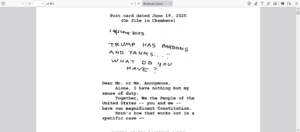
If I were in the judge's place, I probably would not have done this. While I share Judge Young's dismay at the administration's illegal actions, these remarks are unlikely to persuade readers who aren't otherwise inclined to agree with his reasoning. And the predictable controversy they engender could divert attention from the substantive reasoning underlying the court's ruling. They might also provide critics with an excuse to dismiss that reasoning without seriously engaging with it, by claiming that the judge was acting inappropriately.
That said, the debate over the appropriateness of some of the rhetoric in the opinion should not detract from the substance of Judge Young's reasoning, which is strong, and a good model for future court decisions on this issue.
In addition to the factual record and the constitutional questions, the ruling also covers claims under the Administrative Procedure Act, and a number of procedural questions (e.g. - associational standing for the plaintiffs), which I will not attempt to assess here.
The legal battle over speech-based deportations will continue. I hope higher courts will follow Judge Young's and other district courts' lead, and hold there is no immigration exception to the First Amendment.
The post Federal Court Rules Speech-Based Deportations of Non-Citizen Students and Academics Violate the First Amendment appeared first on Reason.com.
Eugene Volokh's Blog

- Eugene Volokh's profile
- 7 followers

