
Eugene Volokh's Blog, page 29
September 24, 2025
[Irina Manta] "Public Health Policy as Public Choice Failure" in Print
[We trace how things went South]
My coauthors Cassandra Robertson, Zoe Robinson, and I have published a symposium piece entitled "Public Health Policy as Public Choice Failure" in the Houston Journal of Health Law & Policy, in which we use a public choice lens to examine the United States' often-unfortunate public health journey. Here is the abstract:
The COVID-19 pandemic has wrought a devastating toll, causing over a million deaths in the United States along with widespread disability and economic disruption. Yet the magnitude of these costs was not inevitable—it was shaped by the policy choices made in response to the crisis. This Article argues that the U.S. pandemic response suffered from public choice dynamics that systematically skewed policymaking away from the public interest. Examining three key policy areas—vaccine rollout, mask mandates, and ventilation standards—the Article demonstrates how misaligned political incentives led officials to prioritize short-term appeasement of a pandemic-weary public over science-based strategies that would maximize long-term welfare. In each domain, political actors faced strong incentives to downplay risks, overpromise solutions, and delay difficult decisions, resulting in a pandemic response that was often too little, too late, and too beholden to partisan interests. The Article concludes that reckoning honestly with these failures is a crucial first step toward reforming our public health institutions and ensure a more effective response to the next crisis. It offers recommendations for rebuilding public trust, depoliticizing public health communication, and institutionalizing science-based policymaking. More broadly, the Article underscores the urgent need to realign political incentives with the public interest in the prevention of and response to public health emergencies.
The post "Public Health Policy as Public Choice Failure" in Print appeared first on Reason.com.


[Eugene Volokh] Over $24K in Sanctions for Alleged AI Hallucinations in Case Against FIFA
For more on the underlying errors in the plaintiffs' brief, see here. An excerpt from yesterday's sanctions order, in Puerto Rico Soccer League NFP, Corp. v. Federacion Puertorriquena de Futbol:
Plaintiffs' motions included at least fifty-five defective citations, requiring hours of work on the Court's end to check the accuracy of each citation. Plaintiffs' counsel never offered a satisfactory explanation for why their citations in multiple motions were so severely flawed. Plaintiffs denied using generative artificial intelligence. But the sheer number of inaccurate or nonexistent citations suggests otherwise. And in any event, the violations of Fed. R. Civ. P. 11 and applicable ethical rules occurred regardless of whether they were caused by misuse of generative artificial intelligence or other means. This behavior stands in contrast to several of the cases [that imposed much lower sanctions], where various attorneys facing sanctions offered an explanation as to how they erred.
Defendants actually asked for $60K in compensation for the attorney fees and research costs expended to deal with the incorrect citations, but the court reduced that by 60%:
The Court is aware that the errors committed by Plaintiffs' counsel received national attention, and that given both attorneys work for small firms and describe themselves as solo practitioners, the initial lodestar amount would prove a heavy financial burden. Furthermore, it is well-known that "an appropriate sanction should be no more severe than necessary to assure the deterrent objective" of Fed. R. Civ. P. 11…. [T]he Court is aware of no cases where a sanction approaching sixty thousand dollars for the misuse of artificial intelligence has been applied.
Salvador J. Antonetti-Stutts and Aníbal A. Román Medina (O'Neill & Borges LLC) and John J. Kuster, Jon Muenz, and Amanda M. Blau (Sidley & Austin LLP) represented defendants on the sanctions motion.
The post Over $24K in Sanctions for Alleged AI Hallucinations in Case Against FIFA appeared first on Reason.com.
[Eugene Volokh] Addiction to Constitutionally Protected Activity: Speech, Press, and Religion
I have a forthcoming article with this title in an Emory Law Journal symposium issue, so I thought I'd serialize it here; there's plenty of time to improve it, so I'd love to hear people's feedback.
The background is, of course, the calls to regulate social media platforms and video games on the theory that they are unduly addictive. You'll see I'm skeptical about that. I start by arguing that similar arguments could be made as to religious practice, but that we should reject such regulations of "addictive" religious practice as violating religious freedom. I then argue that, analogously, we should reject regulations of "addictive" communicative products as violating the Free Speech and Free Press Clauses.
[* * *]
Introduction
Most behavior that is potentially addictive to some people is also pleasant and largely harmless to others. Gambling is a classic example: It seriously harms some people, but provides fairly inexpensive pleasure to others. Indeed, this is true even for some physiologically addictive substances, such as alcohol and likely some other drugs. There are many alcoholics, but many more nonaddicted social drinkers who genuinely enjoy moderate drinking.
Of course, for many behaviors, this effect just requires legislatures to ask a familiar regulatory tradeoff question: When should the freedom of some (even of many) be restricted to prevent harm to others? Different legislatures may answer this question differently as to different activities.
But when the behavior is also constitutionally protected, the problem becomes more difficult: Restricting the constitutional rights of some in order to prevent harms—especially self-inflicted harms—to others generally requires much more justification. This short essay will delve deeper into this question, focusing especially on free exercise rights and free speech/free press rights.
I. Religion
A. Adults
Religious practices as addictiveMany of the arguments that label certain interactions with speech products as "addiction" would apply much the same way to religious practices (whether or not the arguments' supporters would seek to so apply them). Yet I take it—and I will defend this in more detail below—that few of us would accept such arguments as a basis for restricting such religious behavior.
a. Harm
To begin with, religious practice, like supposedly addictive speech, can lead to economic loss and physical and mental harm. Some people may join religious groups that pressure them to donate substantial sums—perhaps as recurring 10% tithes, or as occasional larger contributions—with the pressure coming from the threat of social ostracism or eternal damnation, or from the promise of community or eternal salvation. That is presumably more serious pressure for most people than the pressure to make more in-game purchases.
Some people may adopt religious beliefs that are bad for their physical health, for instance if the beliefs counsel in favor of faith healing rather than modern medical treatment. Some people may adopt religious beliefs that are bad for their mental health, for instance if the beliefs make them feel guilty because of their sexual preferences or desires.
Some may be drawn to practices that damage their relationships with family members or cause them to "neglecting personal and family commitments." Certain religious practices expressly call on people to set aside "family commitments," for instance by joining monastic orders or by choosing to break off relationship with family members who are seen as sinful or unbelieving.
Some religious people may take life paths that are hard for them to leave, for instance if a woman joins a religious community that frowns on women's educational or professional advancement, and therefore faces a much reduced set of life options if she were to leave the community. Likewise, if they choose to have children—which the religious group may pressure them into doing, or into doing earlier or more often that they might like—they may find themselves locked in to the community, for fear of losing their relationship with the children if they lose their relationship with the community. And some may indeed exhibit psychological withdrawal symptoms, such as "experiencing distress when unable to engage in religious activities."
b. Nonrational decisions and emotional vulnerability
What's more, people may join religions not because of rational choice—much religious belief, after all, stems from nonrational causes—but in large part because of techniques used by religious leaders. Those techniques might not be the result of recent intense market research, but they have been carefully honed over centuries or millennia of institutional experience.
The techniques may appeal to people's most basic fears and hopes. The techniques may rely on social pressure to which the target is highly vulnerable, perhaps because of loneliness, sadness, physical illness, mental illness, or consciousness of impending death. Indeed, one might characterize them, borrowing a term from an article that urges regulation of addictive social media and gaming technologies, as "exploit[ing] weaknesses in human psychology."
c. Fostering intrusive urges and compulsions through techniques of reinforcement and habit formation
The religions' techniques may operate gradually, by getting people slowly lured into a community and a belief system that they may eventually find emotionally hard to leave, even if they feel some desire to leave. The techniques may thus be labeled "addictive," in the sense of being "techniques that foster persistent, intrusive urges"—here, urges to pray, to follow religious leaders' teachings, to feel guilt over perceived sin, and the like—and that "foster compulsion" to engage in various religious behavior.
The techniques might likewise be described as "contribut[ing] to behavioral addiction through 'operant conditioning' techniques such as intermittent reinforcement and variable reward." To quote an article describing addiction as to speech, "operant conditioning research has long focused on content-neutral techniques for fostering compulsion, techniques like . . . pushing repeated, daily interactions." Praying three (Judaism) or five (Islam) times a day, or saying blessings (Judaism) or grace (Christianity) before each meal would presumably qualify.
Likewise, the techniques will usually operate through positive feedback. If a "like" button on social media makes people "kind of addicted to the feedback," one might equally say that the positive reinforcement that formerly lonely people get from a new religious community would make them "kind of addicted to the feedback" as well.
Those techniques may end up especially influencing a small subgroup of people who are especially deeply committed to the religion, or especially committed to the religion's message of contribution and self-sacrifice. If "most revenue from micropayments" in video games "is highly concentrated among a small group of apparent addicts who individually spend thousands of dollars on in-app purchases," I expect one can also find that the contributions to many religious groups are highly concentrated among a small group of people who individually donate thousands of dollars—sometimes millions of dollars—to the group.
Indeed, it's striking just how applicable so many of the discussions of alleged addiction to speech are to religion. Consider, for instance, this passage
But gaming companies often have a collateral interest in addicting nonpaying players as well. First, a player who keeps playing might pay later on; a player who walks away will not. Second, many mobile games contain a social dimension that is enhanced by widespread participation. . . . Nonpaying players who participate in these activities enhance the games' allure for the whales and potentially promote the games to others.
Change a few words (gaming to religion, players to congregants, and the like), and you have something a cynic may easily say about religious institutions. Indeed, this could be seen as an accurate description of how religious institutions operate even by a noncynic who views the institutions' seeking of contributions as a laudable tool for doing good deeds.
Likewise, religions seek to form habits of religiosity, another item that is sometimes given as a hallmark of "addictive" speech products. Consider one passage about the supposedly addictive nature of certain social media platforms or video games,
"The ultimate goal of a habit-forming product," [Nir Eyal, author of Hooked: How to Build Habit Forming Products] writes, "is to solve the user's pain by creating an association so that the user identifies the company's product or service as the source of relief." The ideal is "unprompted user engagement, bringing users back repeatedly, without depending on costly advertising or aggressive messaging."
Or another: "Simple habit formation may do the job, as the user comes to rely on a phone app as a quick cure for boredom." Those skeptical about religion—or about particular religions—can equally suggest that religion promotes itself "by creating an association so that the [congregant] identifies the [religion's practices] as the source of relief" for the congregants' "pain" (such as the pain of loneliness, lack of felt meaning, or fear of death): "By its very nature, religious addiction, as with other addictions, allows the addict to escape from painful realities and/or feelings." Indeed, some go so far as to say that "religion is the opium of the masses."
d. Reliance on people's neutrotransmitter system
The religious leaders' practices likely also rely on people's neurotransmitter system, for instance by using—even if based on ancient experience rather than modern medical knowledge—the tendency of some religious practices to release dopamine, which is also the chemical involved in drug addiction. Religious practice has also been shown to engage the same reward circuits in the brain as drug use.
This should be unsurprising: Many of the things that most affect us emotionally involve neurotransmitters. It may be very hard (or even impossible) to distinguish purely "mental" behavior, such as decisions about religion, from the "physical" parts of our body: The brain, after all, is itself a physical organ that operates using electrical and chemical processes.
e. The presence of "addictive" features in mainstream religions
Nor are these just the properties of small and fringe religious groups sometimes derided as "cults." The behaviors and appeals that I described above have long been practiced within some of the largest and best-established religious groups. Indeed, it may well be that the religious groups that have most thrived have thrived in part because of these very sorts of practices.
[Tomorrow: Religious Practices as Legally and Constitutionally Protected.]
[* * *]
See, e.g., Tithing, The Church of Jesus Christ of Latter-Day Saints, https://www.churchofjesuschrist.org/study/e... (last visited Sept. 10, 2025).
Or they may join groups—such as monastic orders—that promise salvation in a future life, peace in the current life, or both but require that they take a vow of poverty. This need not mean that they are expected to give away all their money to the group, but they may be expected to give away all their money to family or to charitable causes, which will make it much harder for them to return to their old lives if they choose to leave the monastic life.
See, e.g., Shawn Francis Peters, "Does the Science Kill a Patient Here and There?": Christian Science, Healing, and the Law, in When Prayer Fails: Faith Healing, Children, and the Law 89 (online ed., 2008) (describing Christian Scientists' belief that sickness is an illusion curable through embracing Christ's teachings, and surveying cases where reliance on faith healing rather than medical care led to preventable deaths).
E.g., Religious Addiction: Definition, Symptoms, Causes, Effects, And Treatment, Valley Spring Recovery Center (Oct. 5, 2024), https://valleyspringrecovery.com/addiction/....
See infra notes 39–40.
The Book of Matthew, after all, characterizes Jesus as saying, "Do not think that I have come to bring peace to the earth. I have not come to bring peace, but a sword. For I have come to set a man against his father, and a daughter against her mother, and a daughter-in-law against her mother-in-law. And a person's enemies will be those of his own household." Matthew 10:34-35. Naturally not all Christians take that seriously, but some do; and some may more generally be pushed into rifts with family members over theological disagreements that some religiously minded people may see as deeply important. See, e.g., Bryan Fischer, Jesus Came to Divide Families, AFA [American Family Ass'n] The Stand, Aug. 14, 2019 ("Quite simply, Jesus is saying that He is the dividing line in every family. Those who are unreservedly dedicated to following Him are on one side, those who reject His offer of salvation and the call to take up His cross are on the other. There is a chasm between them that can grow by the day until it becomes impossible to cross."). See also, e.g., Paul v. Watchtower Bible & Tract Soc. of New York, 819 F.2d 875, 877, 883 (9th Cir. 1987) (discussing Jehovah's Witnesses' practice of "shunning" people, including family members, who have been excommunicated, and holding that the practice is protected by the First Amendment).
See, e.g., Ginia Bellafante, In Brooklyn, Stifling Higher Learning Among Hasidic Women, N.Y. Times, Sept. 2, 2016; Susan Henking, Religion vs. Girls' Education, Religion Dispatches (July 2, 2009), https://religiondispatches.org/religion-vs-g....
See, e.g., Larissa MacFarquhar, When One Parent Leaves a Hasidic Community, What Happens to the Kids?, New Yorker, Nov. 30, 2020, https://www.newyorker.com/magazine/2020/12... (documenting the struggles of Hasidic parents to maintain a relationship with their children after leaving their faith, including one mother isolated after her children were pressured to choose the community over her); Samantha Raphelson, When Leaving Your Religion Means Losing Your Children, NPR, June 14, 2018, https://www.npr.org/2018/06/14/619997099/... (reporting on an ultra-Orthodox mother who nearly lost custody when she removed them from Hasidic life, after a lower court had enforced a religious-upbringing agreement later overturned on appeal).
Religious Addiction, supra note 4. For examples of claims of such distress, see, e.g., Muniz v. McCall, no. 23-cv-4224 (DEH) (VF), 2024 WL 3522680, at *2 (S.D.N.Y. 2024) ("Because of the denial of his orisha beads [part of his religious practice], Plaintiff has suffered emotional and psychological harm and feels spiritually disconnected from his religious practice. He has also lost weight, has had trouble sleeping, and cannot concentrate"); Ackerman v. Washington, 16 F.4th 170, 177 (6th Cir. 2021) ("Shaykin explained that when he can't eat meat and dairy as required [by Jewish law] he is 'empty of everything.'"); Complaint at ¶ 72, Pawochawog-Mequinosh v. R.I. Dep't of Corr., No. 1:24-cv-00036-WES-PAS (D.R.I. Jan. 24, 2024) ("Defendants' denial of Wolf's requests to obtain and wear an Apache headband has caused Wolf severe and daily distress, as he is unable to express his religious traditions and beliefs as he sincerely understands them.").
Kyle Langvardt, Regulating Habit-Forming Technology, 88 Fordham L. Rev. 129, 143–44 (2019).
Id. at 142.
Matthew Lawrence, Public Health Law's Digital Frontier: Addictive Design, Section 230, and the Freedom of Speech, 4 J. Free Speech L. 299, 309 (2024).
See, e.g., Cheryl Zerbe Taylor, Religious Addiction: Obsession with Spirituality, 50 Pastoral Psychol. 291 (2002). Cf. also Robert N. Minor, When Religion Is an Addiction (2007); Leo Booth, When God Becomes a Drug: Breaking the Chains of Religious Addiction and Abuse 2 (1991); Stephen Arterburn & Jack Felton, Toxic Faith: Understanding and Overcoming Religious Addiction (1991).
See Lawrence, supra note 12, at 301.
Id. at 303.
Id.
See, e.g., Nissan Mindel, The Three Daily Prayers, Chabad.org, https://www.chabad.org/library/article_cdo/....
See, e.g., Azhar Goraya, Why Muslims Pray 5 Times a Day, Rev. of Religions, Feb. 26, 2020, https://www.reviewofreligions.org/20026/why....
See, e.g., Food Blessings (Brachot), Chabad.org, https://www.chabad.org/library/article_cdo/....
See, e.g., Angelo Stagnaro, How to Develop a Daily Prayer Routine, Nat'l Catholic Reg., July 24, 2020, https://www.ncregister.com/blog/how-to-deve... (discussing both grace and other prayers).
Variable reward likewise appears to be a regular feature of religious experience: Much religious practice is regularized, such as daily prayer, weekly attendance at communal services, and the like. But religious experience varies, with religious believers reporting occasional experiences of especially intense connection with the divine or transcendent, or with one's religious community. Cf., e.g., How You Can Use Behavioral Design to Create Any Habit You Want with Nir Eyal, Science of Success, Oct. 26, 2017, https://www.successpodcast.com/show-n... ("My book is mostly around technology products, but the same exact rules by the way apply to all sorts of things. If you think about spectator sports, if you think about what makes books and movies interesting, why we watch the nightly news, why we subscribe to a particular religion. They all have hooks embedded in them. They all have these elements of variability.").
Langvardt, supra note 10, at 142 (quoting Leah Pearlman, inventor of the "Like" button).
Id. at 140.
Id. at 142.
Id.
Id. at 143.
Taylor, supra note 13, at 292.
Karl Marx, Introduction to A Contribution to the Critique of Hegel's Philosophy of Right, quoted in Mike King, Secularism: The Hidden Origins of Disbelief 145 (2007).
See, e.g., Paul M. Butler et al., Disease-Associated Differences in Religious Cognition in Patients with Parkinson's Disease, 33 Journal of Clinical and Experimental Neuropsychology 917 (2011) (finding that Parkinson's disease patients exhibit diminished religiosity and hypothesizing that the link is due to dopamine loss); Ed Ergenzinger, Faith, God, and Dopamine, WebMD (May 30, 2025), https://www.webmd.com/bipolar-disorder/2025... (providing a first-person account linking religious delusions during bipolar manic episodes to dopamine production).
See, e.g., How an Addicted Brain Works, Yale Medicine (May 25, 2022), https://www.yalemedicine.org/news/how-an-ad... (explaining how addictive substances operate by flooding the brain's reward pathway with dopamine).
See, e.g., Michael A. Ferguson et al., Reward, Salience, and Attentional Networks Are Activated by Religious Experience in Devout Mormons, 13 Social Neuroscience 104 (2018) (reporting fMRI study of devout Mormons showing religious experience is correlated with activation of the nucleus accumbens and ventromedial prefrontal cortex, reward regions also implicated in drug use); Patrick McNamara, The Motivational Origins of Religious Practices, 37 Zygon 143 (2002) (arguing that religious practice is linked to activation of the frontal lobes, also associated with addiction).
See, e.g., Fushun Wang et al., Editorial: Neurotransmitters and Emotions, 11 Frontiers in Psychol. 21 (2020).
The post Addiction to Constitutionally Protected Activity: Speech, Press, and Religion appeared first on Reason.com.
[Josh Blackman] Today in Supreme Court History: September 24, 1755
9/24/1755: Chief Justice John Marshall's birthday.
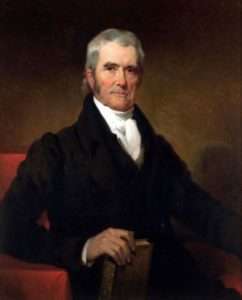 Chief Justice John Marshall
The post Today in Supreme Court History: September 24, 1755 appeared first on Reason.com.
[Eugene Volokh] Wednesday Open Thread
The post Wednesday Open Thread appeared first on Reason.com.
September 23, 2025
[Eugene Volokh] Avoid Super-Embarrassing Redaction Failures
[I just saw one in a recent filing from an AmLaw top 20 law firm (by gross revenue rankings).]
[I posted a version of this post in 2020 and 2024, but I've seen the problem enough since to think it was worth mentioning again.]
I have often run across documents written by lawyers that looked redacted—but all the supposedly secret information in them could be extracted with literally three keystrokes (ctrl-A, ctrl-C, ctrl-V). One was a court filing that was filed pursuant to a court order authorizing the redaction; but the material so carefully marked secret proved not to be secret at all.
Another carefully tried to hide the real name of a litigant whom the lawyer was trying to keep pseudonymous; but the name was one copy-and-paste away from being visible. What's more, when the documents were posted online in searchable spaces, search engines indexed the supposedly hidden material, so searching for the real name would find the document in which the lawyer had been trying to redact the name.
For at least one of the documents, I know what improper redaction mechanism was used: The lawyer used Google Docs to highlight passages using black highlighter, and then saved the document as a PDF. That looked blacked out on the screen; but the underlying text still remained in the PDF document—as far as the software was concerned, the text wasn't removed but was just set in a different color. (Something similar would happen with Microsoft Word.)
By clicking ctrl-A in PDF, I selected the whole document. (You can also just select the passage that contains the redactions.) By clicking ctrl-C, I copied the selected text to the clipboard. And then by clicking ctrl-V in another app, I pasted it with all the formatting, including the highlighting, removed. (In some situations, it takes a ctrl-shift-V.) The text was then completely visible. Commenter anorlunda on an earlier post explained the problem well:
Users are trained WYSIWYG. What you see is what you get. That's brilliant marketing, but when you make black text on a black background, what you see is nothing, but what you get is something else. So redaction contradicts our training.
To the best of my knowledge, Adobe Acrobat Pro redaction actually deletes the underlying text, if you mark the text for redaction and then apply the redactions. I'm sure there is other software available to do this, including free software. Just make sure that whatever you do, the redaction is actually complete.
The post Avoid Super-Embarrassing Redaction Failures appeared first on Reason.com.
[Eugene Volokh] On Free Speech, "I Choose Low Expectations"
From an excellent N.Y. Times op-ed by Greg Lukianoff (FIRE):
If you're a free-speech lawyer, you face a choice: Either expect to be disappointed by people of all political stripes — or go crazy. I choose low expectations.
Again and again, political actors preach the importance of free speech, only to reach for the censor's muzzle when it helps their side. If, like me, you defend free speech as a principle rather than invoke it opportunistically, you get distressingly accustomed to seeing the same people take opposite positions on an issue, sometimes within the space of just a few months….
And he closes (after offering a good deal of detailed evidence),
I don't like having to make a case for human rights such as freedom of speech by appealing to self-interest; these are supposed to be rights whose importance transcends one's personal needs. But for political partisans, it's often the only argument that cuts through. So here's my practical warning: The weapon that you reach for today will be used against you tomorrow…. [T]he point of the principle of free speech is that how we respond to ideas we don't like is ultimately not about our opponents' rights — it's about ours.
The post On Free Speech, "I Choose Low Expectations" appeared first on Reason.com.
[Eugene Volokh] Free Speech Unmuted: Kimmel, the FCC, and the Government's Power Over Broadcast Speech, with Prof. Ash Bhagwat (UC Davis)
[Ash Bhagwat is an expert on federal communications law, as well as on the First Amendment; he is also Jane Bambauer's and my co-Executive-Editor on the Journal of Free Speech Law.]
Our past episodes:
A Conversation with FIRE's Greg LukianoffFree Speech Unmuted: President Trump's Executive Order on Flag DesecrationFree Speech and DoxingThe Supreme Court Rules on Protecting Kids from Sexually Themed Speech OnlineFree Speech, Public School Students, and "There Are Only Two Genders"Can AI Companies Be Sued for What AI Says?Harvard vs. Trump: Free Speech and Government GrantsTrump's War on Big LawCan Non-Citizens Be Deported For Their Speech?Freedom of the Press, with Floyd AbramsFree Speech, Private Power, and Private EmployeesCourt Upholds TikTok Divestiture LawFree Speech in European (and Other) Democracies, with Prof. Jacob MchangamaProtests, Public Pressure Campaigns, Tort Law, and the First AmendmentMisinformation: Past, Present, and FutureI Know It When I See It: Free Speech and Obscenity LawsSpeech and ViolenceEmergency Podcast: The Supreme Court's Social Media CasesInternet Policy and Free Speech: A Conversation with Rep. Ro KhannaFree Speech, TikTok (and Bills of Attainder!), with Prof. Alan RozenshteinThe 1st Amendment on Campus with Berkeley Law Dean Erwin ChemerinskyFree Speech On CampusAI and Free SpeechFree Speech, Government Persuasion, and Government CoercionDeplatformed: The Supreme Court Hears Social Media Oral ArgumentsBook Bans – or Are They?The post Free Speech Unmuted: Kimmel, the FCC, and the Government's Power Over Broadcast Speech, with Prof. Ash Bhagwat (UC Davis) appeared first on Reason.com.
[Eugene Volokh] "An AI Fail by an Elite Litigation Firm"
David Lat (Original Jurisdiction) has the story. A brief excerpt:
AI mistakes are no longer the province of the wantonly stupid. They can even be committed by leading litigators at famous firms.
The firm is Boies Schiller Flexner, "one of the most prestigious and profitable law firms in the nation. It's currently #55 in the Vault 100, the nation's 100 most prestigious law firms, and #118 in the Am Law 200, the country's 200 largest law firms based on revenue." Big firm lawyers (like all lawyers), take note.
Here's the declaration from the partner involved, filed together with a brief correcting the hallucinations:
I was and am the sole Firm partner with responsibility for overseeing the preparation and filing of the Filed Response Brief in this action. Under my direction, and with consent of the individual Respondents, the preparation of the Filed Response Brief included the use of artificial intelligence tools. The Firm is committed to the responsible use of artificial intelligence and has adopted policies and implemented trainings intended to protect against the risks of the improper use of artificial intelligence. Independent of the use of artificial intelligence tools, Firm lawyers are always expected to scrupulously proofread and cite check the accuracy of the factual and legal claims in court filings.
Notwithstanding these controls, the Filed Response Brief included material citation errors, including those identified in Appellants' Reply Brief. As the attorney and partner in charge of the Filed Response Brief, I am embarrassed by and very much regret these errors. The Firm is undertaking an investigation to determine why its controls failed and to ensure appropriate corrective action is taken. However, as the supervising attorney ultimately responsible for signing and submitting the Filed Response Brief, I bear the responsibility for failing to personally verify the citations included in the brief.
Lat notes:
To his credit, John Kucera [the lawyer involved] fully and freely admitted the errors, and he didn't throw any colleagues under the bus—even though I'm guessing the brief was prepared in the first instance by associates, whom Kucera did not name. No associates' names appeared on the original response brief. The only lawyers on the brief besides Kucera were two partners, Alison Anderson and Max Pritt—and in the proposed corrected brief submitted along with his motion, Kucera removed the names of Anderson and Pritt, presumably because they had little or no roles in this mess….
Read the full article for more; as usual with David Lat's work, which I like a great deal, it's substantive, readable, and fair-minded.
The post "An AI Fail by an Elite Litigation Firm" appeared first on Reason.com.
[David Kopel] Refereeing the Debate over the 2021 National Firearms Survey
[Critics of Prof. William English's survey sometimes miss the mark, but also raise valid questions.]
George Washington professor William English conducted a "2021 National Firearms Survey," which is available on SSRN.com. The latest version, the "expanded report," was published in 2022. In 2024, five professors, led by Harvard's Deborah Azrael authored a critique of the survey, forthcoming in the SMU Law Review. Her coauthors are Joseph Blocher (Duke, law), Philip J. Cook (Duke, public policy), David Hemenway (Harvard, public health), and Matthew Miller (Northeastern & Harvard, public health). In November 2024, English published a detailed response to the critique, as a working paper for the University of Wyoming's Firearms Research Center, where I am a senior fellow. Then in December 2024, Azrael et al. revised their article to include an addendum (pages 24-26) responding English's November paper. In this Post, I will evaluate the pro/con arguments presented by the various authors. [Bracketed inserts] in summaries of what the authors said are by me.
In short:
English's estimate of a 32% individual adult gun ownership rates is consistent with other surveys.His estimates of defensive gun uses (DGUs) — 1.67 million times a year, with a shot fired in about 300,000 — is credible, if one believes that DGUs can be measured at all.His age distribution of DGUs seems counterintuitive, and might be contradicted by further studies.His estimates of a total national stock of about 44 million rifles that are inaccurately called "assault weapons" could be too high or too low, because of the phrasing of his question. However, other research, when combined with known data other firearms in this category, leads to a minimum national supply easily over 30 million.English's estimate that 48% of gun owners own a magazine with 10 round capacity is undisputed.Estimates of gun ownership
English: "an overall rate of adult firearm ownership of 31.9%."
Azrael: You undercounted people with incomes over $150,000, who are 20% of the population but only 8% of respondents.
English: The "missing rich" are a well-known problem in all surveys. I weighted the results to account for this. The weighting has very little effect on the overall results. E.g., Unweighted: 82.7% of gun owners own a handgun. Weighted: 83.7% own a handgun. Besides, my survey got 1,493 responses from people with incomes over $150,000, whereas Cook's 1994 survey had only 197 responses from people with incomes over $75,000.
Azrael: Your survey may have included "yes" responses from people, particularly females, who live in a household with a gun, but who do not personally own the gun.
English: The question was specifically to individuals, "Do you own any of the following?"
Azrael: Overall ownership rates are consistent with "the high end" of prior surveys. [E.g., Pew Research 2023 = 32%, Gallup Poll 2020 = 32%, Gallup Poll 2021 = 31%, U. Chicago General Social Survey 2021 = 24.5%.] But your female rate is 5% above prior surveys. Maybe that's because you didn't ask a separate question about household rather than individual ownership, and so some females in houses with male-owned guns incorrectly answered "yes."
English: Research indicates there is a large problem of false denial of gun ownership in surveys. [Allison E. Bond et al., Predicting potential underreporting of firearm ownership in a nationally representative sample, 59 Social Psychiatry and Psychiatric Epidemiology 715 (2024).] The Bond article reported a gun ownership rate of 34.6%, and, estimated that false denials (75% chance of actually owning a gun based on demographics) accounted for 6.3% more. Females accounted for over 90% of the false denials. Unlike other surveys, mine used anonymous responses, so that an individual would not be divulging gun ownership at a known address, and my survey didn't mention university affiliation, since respondents may guess that universities are affiliated with a gun control agenda. [Which Harvard, Northeastern, and Duke certainly are, although Duke's Center for Firearms Law does publish guest pieces from diverse perspectives, as does Wyoming.] Also, I included "attention check questions" to weed out respondents who weren't reading the questions carefully.
Azrael reply: "He claims, without evidence, that his survey will encourage more female gun owners to respond honestly. Perhaps, but we might be more convinced if he had eliminated the more compelling explanation for his results by simply asking the single question [household rather than personal ownership] that virtually everyone else has."
Kopel: English did provide an explanation: most importantly, anonymity in responses so that the respondent would know that her home address was unknown to pollster. Plus non-inclusion of university affiliation, which is, in my view, often and accurately perceived as an indicator of anti-gun agenda on the part of the surveyor. The total individual ownership rate is consistent with other surveys, and a mere +5% in the female rate is plausible as a result of survey design. Indeed, it's less than the variation in overall individual rates between other surveys.
"Assault weapons"
English survey question:
"Some have argued that few gun owners actually want or use guns that are commonly classified as 'assault weapons.' Have you ever owned an AR-15 or similarly styled rifle? You can include any rifles of this style that have been modified or moved to be compliant with local law. [E.g., replacing a telescoping stock with a fixed stock.] Answering this will help us establish how popular these types of firearms are."
As English admits, this was a leading question, which he justifies as useful in getting potentially reluctant respondents to disclose ownership: the wording "provided an intelligible explanation to respondents as to why sensitive questions were being asked and avoided language that could alienate respondents in a context where the overriding methodological concern in the literature is under reporting by firearms owners."
The results were: 30.2% of gun owners said that they had ever (not necessarily at present) owned such a gun. This leads to an estimate of 44 million such guns having been owned.
Azrael: The term "assault weapon" is vague [citing Wikipedia]. "The term usually refers not only to certain semi-automatic rifles, but also pistols and shotguns that are able to accept detachable magazines and possess other features. Good surveys make it very clear what they are asking about."
Kopel: Very true. "Assault weapon" bills have covered almost every type of gun, including paintball guns, air guns, most handguns, most rifles, all semiautomatic rifles, most shotguns, and all slide action guns — indeed, almost everything except machine guns. See Kopel, Defining "Assault Weapons", The Regulatory Review (Univ. of Pennsylvania), Nov. 14, 2018.
But, English didn't merely ask about "assault weapon." The specific question was "an AR-15 or similarly styled rifle." This wording addressed Azrael's concern about shotguns and handguns, so it is surprising that she raises this as a rebuttal.
English: "The list of similarly styled rifles that are commonly classified as 'assault weapons' is extensive and would include, for example: AK-47 designs, FN FALs, M1 carbines, M1A's, HK 91/93/94s, SKSs, Kel Tec rifles, Thompsons, and even Ruger 10/22s in certain configurations.
Azrael: "The problem is that while English may know what he meant, many respondents and those relying on his survey may not."
Kopel: Fair point. But the phrasing may well have led to an underestimate of the total ownership rates. For example, the semiautomatic M1 carbine (adopted by U.S. military 1941) and the semiautomatic Thompson rifle (patented 1920) were invented long before the AR-15 (base patent 1956), and look nothing like an AR-15, except in that they are rifles.
Azrael: The 44 million is too high based on other sources: 1. The National Shooting Sports Foundation [trade association for the firearms industry] estimated 24.4 million AR and AK platform rifles manufactured between 1990 and 2020. 2. Washington Post/Ipsos survey of ownership of "AR-15 style rifles" and rifles "built on a common AR-15 platform." 3. Azrael et al. 2023 survey.
English: All the above use narrower definitions. NSSF was solely AR and AK, did not include imports, and did not include the approximately two million homemade AR rifles. [Number estimated by ATF.] Washington Post was solely AR. Both these data sources exclude many models that I included; for example, after World War II, the U.S. government, through the Civilian Marksmanship Program, sold millions of M1 carbines to the American public. Azrael 2023 incorrectly created the mutually exclusive categories of "semi-automatic military-style rifles" and "semi-automatic hunting rifles."
Kopel: And the 2023 Azrael survey would seem to incline respondents to classify a firearm they own for hunting as not being a "military-style" rifle, even though so-called "assault weapons" are commonly used for hunting. Overall, estimates in the low 20 millions are certainly undercounts. Whether 44 million is the correct figure is uncertain. Azrael is right that "Good surveys make it very clear what they are asking about," and the criticism can be applied equally to the English question and to her own question inaccurately proclaiming that "military-style" and "hunting" are two mutually exclusive categories. One of the most popular hunting rifles in American history is the bolt-action .30-'06 caliber, which was the American military service rifle for the most of the first four decades of the twentieth century; surplus rifles were widely sold to the public via the federal government's Civilian Marksmanship Program.
Defensive gun use
English: My survey indicated that guns are used defensively around "1.67 million times a year: about 300,000 times a shot is fired, about 852,000 times the gun is only brandished, and about 518,000 times neither happens (e.g., someone said they had a gun and that made an aggressor flee)."
Azrael: You should have asked separate questions about DGUs against humans and against animals. Combining the two in one category makes it hard to compare your findings with prior surveys that asked only about use against humans.
Kopel: Fair point.
Azrael: "English includes a type of defensive gun use that is almost always excluded—did you just say you had a gun. He can include these if he wants, but if he wanted his results to be comparable to the many other surveys, all he needed was one question to separate those out."
Kopel: Incorrect. First, English did ask "one question to separate those out." On page 13 of his study, there is the question "Did you fire your gun, show it, or neither." Fired was 18.1%; showed was 50.9%, and neither was 31.0%.
Moreover, Azrael is wrong to claim that English's approach was not "comparable to the many other surveys." The leading prior survey, Gary Kleck 1995, counted a DGU if "the gun was actually used in some way — at a minimum it had to be used as part of a threat against a person, either by verbally referring to the gun (e.g., 'get away — I've got a gun') or by pointing it at an adversary." Gary Kleck & Marc Gertz, Armed Resistance to Crime: The Prevalence and Nature of Self-Defense with a Gun, 86 Journal of Criminal Law and Criminology 150, 162-63 (1995). Kleck found a range of 2.1 to 2.5 million DGUs annually, and those included verbal references. Kleck found that only 24% of DGUs involved firing the gun. This would leave 76% as brandishing or verbal. English went further than Kleck, by asking a question that distinguished brandishing from verbal. Because crime was higher at the time that Kleck conducted his survey, English's 1.67 million DGU figure is consistent with Kleck.
Azrael's co-authors Cook and Hemenway spent years writing journal articles sparring with Kleck about his survey, so they are quite familiar with it. Thus, it is astonishing that an article of which they are coauthors claims that English is an outlier for including verbal references as DGUs. And the claim that English did not ask a question to "separate out" raises concerns about whether the authors of the critique carefully read the paper they are critiquing.
Azrael: English's DGU results are 20 times higher than those reported in the National Crime Victimization Survey. [The NCVS is conducted annually by the Census Bureau in conjunction with the Department of Justice, and is based on in-person interviews.]
English: The NCVS doesn't even ask about DGUs. It just allows persons who have already identified themselves as crime victims to volunteer a DGU in response to an open-ended question about whether they did anything in response to the crime. Even this question is asked only for some crimes. Contrary to Azrael's article, the NCVS does not offer respondents an "option" to indicate a a DGU. [E.g., something such as, "Did you do any of the following: 1. Run away, 2. Use a gun, 3. Use a knife, 4. Try to reason with the attacker."] A RAND Corporation analysis specifically called out these problems with the NCVS as a means of estimating DGUs. "The Challenges of Defining and Measuring Defense Gun Use," Gun Policy in America, Mar. 2, 2018.
Additionally, the NCVS surveyors are specifically identified as working for the U.S. Department of Justice. Respondents may be chary of disclosing DGUs to the federal government.
Kopel: The Azrael NCVS point is preposterous, and at least some of her coauthors can be presumed to be aware of its severe limitations. Notably, those limitations are not mentioned in their article.
The stronger point would have been to adopt the argument in coauthor Cook's 1998 article. There, he conducted a survey that remedied various alleged methodological flaws in the Kleck survey. The data seemed to indicate there were over a million DGUs annually. However, Cook and his coauthor stated, "We find that estimates from this new survey are apparently subject to a large positive bias [i.e., false reporting of a DGU], which calls into question the accuracy of DGU estimates based on data from general-population surveys." Philip J. Cook & Jens Ludwig, Defensive Gun Uses: New Evidence from a National Survey, 14 Journal of Quantitative Criminology 111 (1998).
Thus, one can argue that general population surveys — such as those conducted by English, Kleck, and Cook — are incapable of accurately estimating DGU, and one can also admit that the NCVS, which is also a general population survey that only asks follow-ups to persons who first identify as having been a crime victim, has unique flaws that prevent it from providing a valid estimate of DGUs. Hence, total DGUs are unknowable. This would have been a stronger critique than the one presented by Azrael et al.
Azrael: You asked about lifetime DGUs rather than about DGUs in a specific time period, such as within the last year, or within the last five years.
English: I asked lifetime because Azrael's coauthor Hemenway specifically criticized time-bounded DGU questions as producing artificially high numbers because of the problem of telescoping. That is, if the DGU occurred 13 months ago, it may be such a vivid memory that the respondent recalls it as having happened within the past year. David Hemenway, The Myth of Millions of Annual Self-defense Gun Uses: A Case Study of Survey Overestimates of Rare Events, 10 Chance 6 (no. 3, 1997).
Azrael: "18–20-year-olds in his sample reported more than half (54%) of the total number of lifetime DGUs reported by all age groups combined."
English: Not so. Here are the tables by age: 9,534 total DGUs, with 590 by ages 18-20. English, A Response to Critics, at 18.
Azrael: You're right. We correct the latest version of our article and admit the error in the prior version. (Dec. 5, 2024, version at 19, n.75).
But, your DGUs per respondent are "not credible" because young people have so much higher rates than older people. [DGUs per respondent are .88 for ages 18-20, .90 for ages 21-25, and decline thereafter. Ages 51-55, are .47, and ages 80+ are .15.] "In particular, the 51-55 year olds report only half as many lifetime defensive gun uses as the 21-25 year olds, despite the fact that the older group were young during the most violent period in US history (circa 1990) and have had 30 additional years to add to their experience since then…. Again, if he wanted his to be comparable to all the other surveys, all he needed was one question to ask about whether the most recent defensive gun use was in the past 5 years."
English. "[I]t appears that 80-year-olds passed through their 'most active DGU years' during a time when crime was extremely low, and therefore they accumulated fewer DGU's. Thus, the average of the old and the young taken together approximates the average of the middle aged."
Kopel: It's odd for a paper coauthored by Hemenway to criticize an author for not using the exact technique (asking only about DGUs within the last five years) that Hemenway said should not be used. Damned if you do (Kleck, time-limited), and damned if you don't (English, lifetime).
However, I agree with Azrael that the age distribution of DGUs doesn't make sense. A 75-year-old in his 2021 survey would have been born in 1946, and lived through three major crime waves: The first began in the mid-1960s, began declining after 19800, and surged again starting in the latter 1980s. Another crime decline began in the mid-1990s, and continued through the mid-2010s, by which time crime had fallen to the low levels of the early 1960s. Thereafter, crime sharply increased.
Moreover, according to English, about 25.2% of DGUs occurred inside the home, and 53.9% occurred outside on the home but on the victim's property. English 2022, at 14. Thus, even though today's 70-year-olds would have, in many states, been prevented from carrying a defensive handgun in public for much of their lives, and thus been unable to defend themselves against criminal attackers in a parking lot, those 70-year-olds still would have been able to possess a firearm for defense of their homes, which per English accounts for 79% of DGUs.
Part of the explanation for the higher rates of DGUs reported by young adults in the English survey can be attributed to the fact that violent crime victimization and perpetration is higher for people in their teens and twenties than for older groups. One reason is that they are out and about more, and another reason is their social interactions are more varied. A third reason is younger people are less risk-averse, which makes some of them more likely to perpetrate crimes, and more of them more likely to put themselves in sketchy situations, such as walking around dark city streets very late at night. Conversely, if you're married, in your forties, and living at home with three small children, you're probably don't go out as much at night as you used to, and the people with whom you interact are probably mostly close to your age, which makes them less likely than younger people to perpetrate interpersonal crimes.
Additionally, the younger persons are, the more likely they are to have spent all their adult lives living in jurisdictions where the carrying of defensive arms outside the home is lawful.
As for the upper part of the age cohorts, they entered adulthood at a time when American gun ownership for sport was relatively more common compared to defensive ownership than today. The gun-owner who in 1967 kept an unloaded hunting rifle in a safe in the basement simply might not have been able to access that rifle when burglars broke into his home to take the jewelry and television.
The above analysis is only a partial explanation of what might account for the age skew reported in the English survey. It will be interesting see whether future surveys of DGUs have, like English did, large enough sample size to report results by age, and whether those surveys violate Hemenway's First Law (don't ask time-bound DGU questions) in order to comply with Hemenway's Second Law (don't ask lifetime DGU questions).
Magazines
English: 48% of gun owners have owned a magazine that holds 11 or more rounds. Of them, 62.4% says that home defense is a reason for a choice of a magazine that size.
Azrael: That doesn't prove that "large" magazines are useful for defense. The free-form section of the responses, in which respondents could describe their DGUs, did not include information about how many shots were fired.
English: True, but "Plenty of cases do describe multiple, violent criminal assailants… I leave it for the judicious reader to consider whether being able to fire more than 10 rounds without reloading would or would not be useful in defending against multiple violent assailants.
Kopel: If Azrael et al. sit down next you at a coffee shop and start giving you advice about to weight subgroups in a survey, listen to every word and take copious notes. If they start advising you how to use your firearm defensively, run away as if your life depended on it.
Next time you see a police officer or sheriff's deputy, take a look at what handgun they are carrying. It will very likely be a pistol with a magazine capacity over 10 rounds. They're not carrying that handgun to shoot woodchucks. They're bearing the gun for the sole purpose of defending innocent lives, including their own. As they well know, most defensive shots, even when fired by law enforcement miss. Further, as they also know, one or two hits usually does not immediately stop an assailant. Additionally, a standard capacity magazine (such as the 11-20 round magazines sold with many pistols) has deterrent value.
Other issues
Kopel: This post discussed the leading issues in the Azrael v. English dispute, but not all of them. I urge readers to read the English survey, the Azrael et al. rebuttal, the English reply and make up their own minds. I have omitted discussion of separate criticism of English's estimate of "assault weapon" prevalence by professor Louis Klarevas, of Columbia Teacher's College, because Klarevas evidently misread the English paper. A few respondents had claimed to own an implausible number of "AR-15 style" rifles, such as 1,000. English dropped these responses from his estimates, but Klarevas believed that these numbers were included. English 2024, at 20-23.
The post Refereeing the Debate over the 2021 National Firearms Survey appeared first on Reason.com.
Eugene Volokh's Blog

- Eugene Volokh's profile
- 7 followers

