Alexander Billet's Blog, page 8
September 21, 2023
The Moment Doesn't End
Brian Eno’s genius is unassailable by now. Everyone knows that this is a man who, quite without regard for any supposed convention, does what he wants with whatever recorded sound strikes his fancy and frequently manages to turn it into something transcendent. So when he calls another soundsmith a genius, one takes notice. Enter record producer Fred again..
Looking through the latter’s resume, it’s surprising that Fred again.. should get this kind of praise from Eno. Much of Fred’s most recognized work has been with the likes of Rita Ora and Demi Lovato. Not exactly the most commonsense collaborator for the father of modern ambient music. But then, anyone who leaves it at this is ignoring that Eno has also produced for Coldplay, Toto, and U2. If Eno contains multitudes, then why not Fred?
It should be mentioned that the 30-year-old Fred and 75-year-old Eno have a prior relationship, going back almost fifteen years. A 16-year-old Fred Gibson’s parents were in fact neighbors with Eno at the time, and the young Fred ended up joining an a capella group at Eno’s studio. He later also collaborated with Eno and Underworld’s Karl Hyde on the albums Someday World and High Life.
So here we are. Brian Eno and Fred Again.. released Secret Life in early May, and it is one of the most enigmatic works I’ve encountered in some time. If Protomartyr’s Formal Growth In the Desert was the aggressive album I kept returning to all summer, a distillation of the coming seasons’ anxiety and pessimism, then Secret Life was the counterweight, providing something like solace and comfort.
The album was compiled, composed, and recorded slowly, over a relatively long period of time: “4th April 2020 - 23rd December 2022” say the credits. We know the mass global event that these dates roughly bookend. Pandemic, lockdowns, large swathes of daily life made inaccessible, off and on, up until around the end of last year. (It would be irresponsible to say last December is when the pandemic “ended” or “things went back to normal,” which we’ll touch on later.)
We all remember that feeling of everything simultaneously grinding to a halt and speeding to an uncontrollable whirlwind. Where, either permanently holed up in our homes or having our existence shrunk down to nothing more than home and work, we watched as events spun in myriad directions and tried to maintain sanity amid news of sick loved ones, even as, outside our window, everything had taken on an eerie stillness. Everything was quiet and deafening. We all remember feeling that we were losing something, though not fully grasping what.
Fred evidently took this amorphous feeling seriously. Secret Life should be considered a companion piece to the three Actual Life albums he released from 2020 to 2022. These were impressive EDM albums, capturing both the exciting energy of city life and the strange intimacy of isolation. If someone were looking for a musical work that effectively mapped the peculiar experience of disconnection-induced panic and sorrow that descended on us during lockdown, they could do a lot worse than the Actual Life albums. The uninitiated will also get a good sense of Fred’s particular expressive modes as a composer.
Secret Life lowers the energy. Musically, it is very much a downtempo album. It is also very minimalist. Most chord progressions – normally rendered on keyboard – are simple and repetitive. The album is 44 minutes long, but after being drawn into its soft, undulating rhythms, its delayed and reverbed keys and faint echoes, you emerge wondering how much – or how little – time has passed.
In vocals of opening track “I Saw You,” emphasize this feeling of being stuck in a flash-brief moment that somehow won’t end. Frequently they are treated like instruments themselves, brief phrases looped and repeated, as if the speaker is quietly trapped in their own mind, whispering panic because they know there’s no way out, no way to protect themself or others.
Can’t shake this… this… this… can’t shake this… please be okay… please… please… please… you were real… real… real… real… (mind… mind…) please… please… please be okay… kay… kay… can't face this… can't face this… face this… face… face this… face this… face this… face this… face this…
The vocals, normally provided by Fred, often have a kind of alt-pop lilt to them. They are also often manipulated, filtered through delay or surrounded by static. As if something from the previous decade is calling over to us.
It’s not just nostalgia, or even something as broad as longing. At their most extreme, these processed and re-processed vocals sound eerily inhuman, similar to early Burial or Tricky. As if, in trying to persist past its appointed existence, the specific point in time is turned into something else entirely.
“Don’t you even think of giving up,” sings a spectral, digital voice on “Enough,” a sparse brassy keyboard part playing in the background. The voice repeats it, in various iterations, over and over. Twice, the song’s structures deteriorate and break down, at least once giving way to joyous, distinctly human laughter, before it is abruptly cut off.
In “Cmon,” a similar voice intersperses over ethereal synths and a light, tapping beat. Once again, the voice has been heavily processed and manipulated. There aren’t even any discernable words, nor anything else to mark it as human. Except, that is, for the longing, plaintive and unmistakable.

In “Ghosts of My Life,” his long, winding essay on the music of Goldie, Japan, and Tricky (included in the book of the same name), Mark Fisher dissects the temporal frictions of these artists’ work. Though all three artists are notably different, all seem to be identifying a generalized social unmooring, an estrangement sonically manifested across different post-70s moments.
For Goldie, in particular his work with Rufige Kru, it was cyberpunk-esque soundscapes, populated by voices and noises stripped of their humanness. For Japan, it was a melancholy artificiality, best personified in David Sylvian’s highly trained, almost plastic vocal work. For Tricky, it was a perpetual outsiderness, an identification with the alien captured in his raspy, mumbly delivery. All were, in their distinct ways, the neoliberal subject cut adrift, speaking from somewhere that is nowhere. The essay is, understandably, a cornerstone of Fisher’s particular notion of hauntology.
One hears the same thing in the echoes and quasi-human longing in Secret Life. There’s no doubt that this is a profoundly hauntological album. But while the artists Fisher examines are all navigating a lonely crowd of sorts, grasping for something that might link the individuals together into a renewed cosmopolitanism, Eno and Fred appear to be sketching a markedly different kind of melancholy. In some ways, it is that of ultimate separation, when we were all denied even the option of wading through the muck to connect with each other. Isolate us for long enough, and we start to wonder if we even have a solid metric to determine whether we are still human.
What most of us fell back on, indeed, had no choice but to fall back on, was our internal lives. Our thoughts and the possibilities that emerged from them. Many of us didn’t really know that we had such rich internal lives until separation and boredom forced us to regard them. The feverish pace of living and working and trying to survive really hasn’t let us. At the same time, all there was to think about was the looming uncertainty. The devastations that seemed to never end, marking themselves apart from the delicate scenes we discovered in our imaginations, biding their time until they could completely overtake us.
Whether we can call the eerie melancholy and extreme isolation of lockdown a new phase in the alienations of late capitalism is hard to tell at this point. It’s true that most governments aren’t operating on what we could call a strict neoliberal model any longer. Most, be they led by the desiccating center or the far-right, are imposing a stronger guiding hand back on the so-called free market. If this translates into a difference in subjectivity — collective or individual — we haven’t really noticed it yet.
If anything, there’s been an undeniable struggle to reconnect since things “opened up.” Partly because the few meager social welfare programs that popped up during lockdown, which might have provided a sense of stability and social space, have been more or less eliminated. Tragically, our more resilient and imaginative “post-Covid” selves would make for stronger bonds and visions of the future. If only we had the room to forge them.
It is also worth remembering that Covid has not in fact gone away. In fact, cases are climbing again, and with nothing to cushion the blow from the havoc it will bring to our lives. Again, the hope for connection is thwarted. It is unlikely that things will get quite as bad as they were in 2020, but again, this is hard to tell. Indeed, the “hard to tell” is part of the anxiety and frustration that continues to break down social cohesion. In this respect, severe diseases and pandemics are almost incidental to the broader ill.
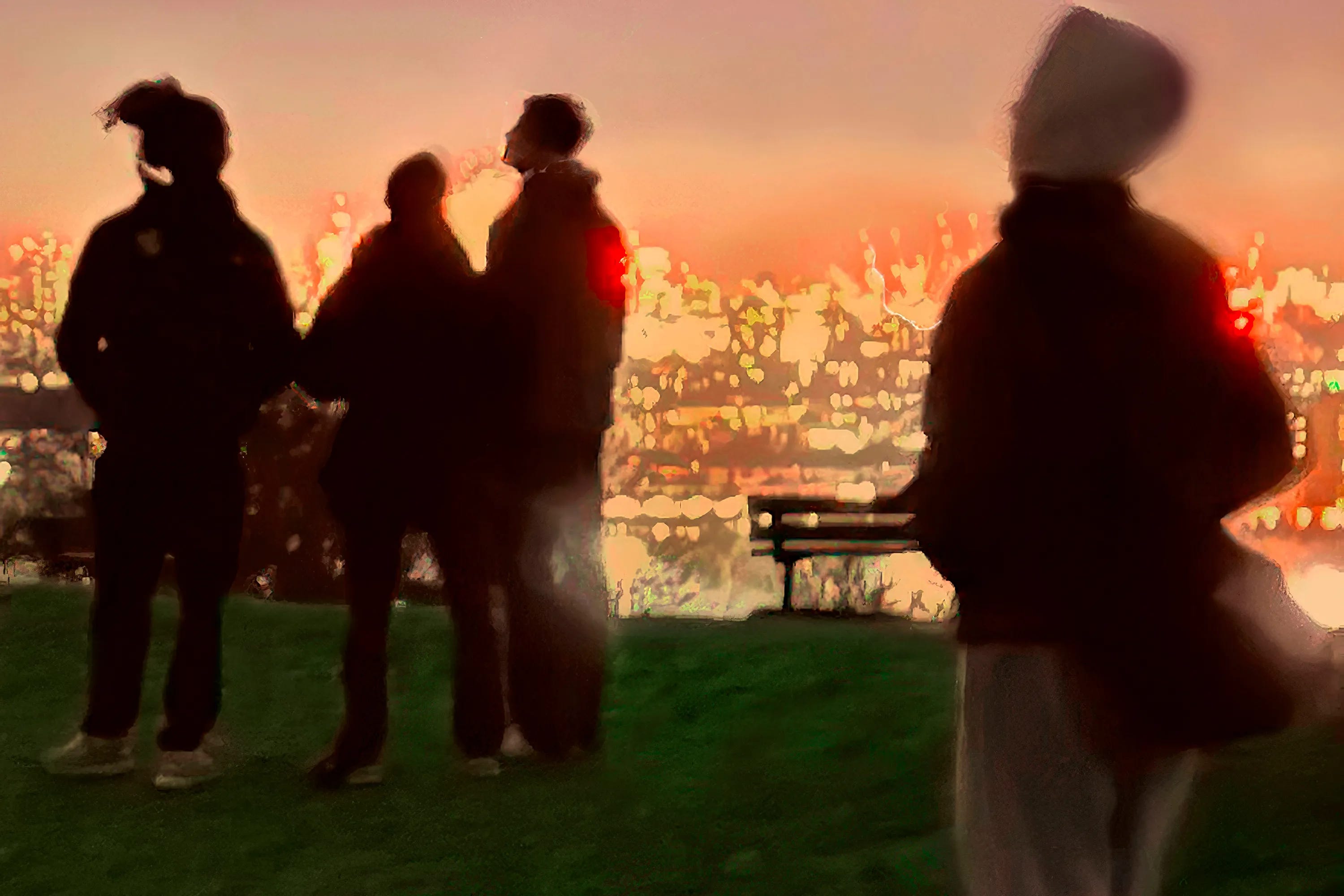
The cover for Secret Life shows a scene probably familiar to many of us. It is night in London, and a small group of people look down from Hampstead Heath. Some of them know each other. Others seem drawn to reach out, communicate, though something, a staticky malaise in the air, prevents them from doing so.
But the city below glows in the night sky. Countless windows are lit up, each one representing a human being who flipped the switch. They are in there, working, cooking, reading, watching television, scrolling on their phone, sleeping, laughing, weeping, hoping, grieving. We are there, waiting to connect. We even have an inkling of what connection once felt like.
To receive new posts and support That Ellipsis… consider becoming a free or paid subscriber.


September 19, 2023
Just Vicious

Genres are slippery things. What felt like a horror movie from about 2016 to 2021 has given way to mere suspense. With the 2024 elections approaching, something is coming back around again.
Observe Donald Trump’s mugshot. The menacing stare, like a wolf bluffing an injury, counting on liberalism’s utter and certain ineptitude, communicating to his supporters, with the promise of climate collapse and an armed militia guarding every gated community backing him up, “this is how I win.” We watch, helplessly, as suspense gives way to horror, though this time of a more cosmic variety.
As frontman for Protomartyr, Joe Casey has always been good at homing in on these shifts. His lyrics, along with the band’s chaotic cacophony, capture a fundamental friction of modern life: on the one hand, the cruel forward plod of history; on the other, the successful repackaging of that cruelty into shiny progress. Locating the nexus of that friction can be an exacting task, but as was shown by Protomartyr’s previous effort – 2020’s Ultimate Success Today – they have an uncanny ability with it.
Compared to previous releases, Formal Growth In the Desert is a relatively stripped-down affair. Gone are the experiments with cello, viola, and woodwinds that we heard on Ultimate Success Today and the Consolations EP. There are a few faint lap-steels, but they’re mostly in the background.
Consequently, Formal Growth sounds less absurdly vicious and more just vicious. There’s a lot more empty space here, and something with far greater force and menace is coming to fill it. Simpler and stripped down, but also chillingly familiar.
That shape has never left us
So you better save the date
An invitation to the feast
We’ll be polishing the plates
Gathering up all the small things
and salt to taste
You can grieve if you wanna
But please don’t ruin the day
When Formal Growth was first released in June, depending on the headspace you were in as a listener, you might wonder whether Casey and the rest of Protomartyr were missing the mark, leaning on their old gestures and habits of pessimistic anxiety. The mistake here is that many headspaces are in the sand, disavowing so much of what has exhausted and terrified us over the past few years. Who can blame us? We’ve needed a break. It has been easy for many of us to convince ourselves that the pandemic is over, that the courts will punish the January 6th conspirators in a just and orderly manner.
And yet. Canada burns. Pakistan and Libya flood. On a long enough timeline, all of us are expendable. Some, however, seem hell-bent on speeding up the process, harnessing cosmic indifference into dividends. That’s what seems to be the theme of Formal Growth In the Desert. That the mercilessness of deep time is somehow converging with the banality of human evil. On Ultimate Success there were human faces hovering over the misery and destruction. Formal Growth sees them fade into the background, loosening the reins as something more ineffable takes over.
It's evident in the title: the progress is formal, measured on spreadsheets, but on a landscape that couldn’t care less. The concept of the desert – inhospitable, deadly, existing over eons – also shows up in one of the album’s lead singles, “Elimination Dances.” According to Casey, while speaking with Flood magazine, the lyrics struck him while on a trip to the desert, “and felt meaningless next to the ancient rock.”
This isn’t to say that the cruelty of time’s march is acting on its own. There have been plenty of reminders that deliberate sadism — the kind that revels in oncoming catastrophe — hasn’t gone anywhere. Musk. Zuckerberg. Bezos. People who enabled the unbridled insanity but somehow managed to skate by, only to play key roles in the full automation of art and leisure. Casey’s lyrics reference Zuckerberg and Musk – albeit obliquely – in “Let’s Tip the Creator.”
Oaker Ruiksleg in the triumphal car
Appreciating the beauty of outsider art
While his sycophants burn in a lithium fire
Sugar Mountain was imagining a space
Sending a link of aesthetic graves
To his array of disappointing nephews
As for Bezos, he’s less a target than a hovering presence in “Fulfillment Center,” a relatively short song (under two minutes) about two young people in love – Dismas and Dawn – unable to locate the titular Amazon warehouse. Why do they need to get there? It’s unclear. But, realizing they are trapped in someone else’s dream, their car out of gas, they sit and let themselves freeze to death. Love collides with time refusing to deliver salvation.
Casey has said himself that love is another recurring theme on Formal Growth In the Desert. Partly, this is because he found love himself (or at least claims he did) before the album’s release. This may seem drastically out of character, until one remembers that Casey’s isn’t the sappy kind of love that “conquers all.” Rather, it endures, often taking quite the beating in the process at the hands of time. Nor is it just romantic love that concerns Casey. Two of the album’s songs – “Graft vs. Host” and “The Author” – focus on the memory of his mother, who suffered from dementia before her recent death. Both songs are, appropriately, dirge-like: methodical, relatively subdued, with searing codas driven by rusty razor guitars.
Of course, our love will always be nothing next to the swirling cosmos. Considering, however, the central role it plays in humans’ best achievements, one must wonder why some are so enthusiastic about burying it beneath so much sand and stone and scrap.
Summer is over. Covid cases are rising, by some estimates to the highest level since lockdown. It all somehow sounds so much more on point, more description than warning. Perhaps it’s because the world caught up with Protomartyr. Perhaps it’s because the boogeymen in our lives never really went away. They’ve just been in the wings, practicing their dance moves.

To receive new posts and support That Ellipsis… consider becoming a free or paid subscriber.