Alexander Billet's Blog, page 4
November 25, 2024
On Soundtracks and Change

The Portuguese translation of Shake the City has been available in Brazil for about six months and appears to be selling well. There is also possibly some news in the post regarding the original English version, though it may be a bit until we can be public about it.
This is an interview I did with Arthur Dantas for Jacobina (the Brazilian version of Jacobin) and was published on November 22. Naturally we covered a lot of ground having to do with the book. He also, unexpectedly, asked well more about my own background and how the intersection between music, space, and politics came to be such a fascination. The English version is below.
You certainly share a point of view very similar to Mark Fisher's. And the first decades of the millennium produced a lot of critical cultural theory. I would like you to tell us a little about your political and intellectual career, what was the intellectual landscape that shaped you, etc.
I suppose my preoccupations with art and radical politics simply comes down to a matter of timing. I grew up in the 1990s. The Cold War was over, capitalism was triumphant, the American empire was more or less entirely unopposed. The idea that you could experience anything outside of the market was dying out entirely. So it was a profoundly alienating and confusing time to grow up, but if you tried to understand this alienation the explanation you would get was that you were irrational and crazy. This was years before we had any terms like capitalist realism on offer to help explain what was going on.
Nonetheless, there were ruptures, signs that something was starting to shift politically and culturally. I was just lucky enough to discover my obsessions with music and the performing arts right around the time of a renewed wave of activism against the World Bank, the WTO, and corporate globalization. The links and interactions between art and radical politics started to fascinate me. It would take me several years to finally make my way to the theories that would illuminate these connections. Walter Benjamin, John Berger, much of the Frankfurt School, the Situationist movement. I didn't have anyone walking through these thinkers with me, so much of my intellectual training (if we can call it that) was done by trial and error, searching and seeing what works for me.
Naturally, a lot of my thinking has changed over time. When I think back to what I wrote or thought twenty years ago, I shake my head. What has kept me fascinated, why I keep investigating these connections, is the fact that we keep making art. We live in end times. The planet's climate is retching us up and society is behaving accordingly. But we keep making art. We keep painting and performing and creating music, regardless of whether these works and gestures are viewed by massive audiences. There is something about our existence that necessitates it. It isn't fanciful to believe, as I do, that there is something deeply anthropological but also unavoidably utopian about this impulse.
As a cultural researcher and writer, I like to think of books that, by affinity, influence or even dialectical opposition, form a gang. What works would form a good gang with Shake the City ?
There is, of course, most of Mark Fisher's work, and I would in particular name Ghosts of My Life as a major influence on the content of this book. I've also been deeply influenced by Simon Reynolds, especially his book Rip It Up and Start Again. Some of my affinity for their work simply comes down to shared taste. Like them, I am enamored with the constellation of bands and artists that wind up lumped into that vague category of "post-punk," which was a descriptor Reynolds and Fisher both argued could be applied broadly, encompassing everyone from Gang of Four and Siouxsie and the Banshees to the ambient work of Brian Eno. Reynolds' work on electronic dance music and the rave scene, in books like Energy Flash, were also a big influence on me.
There were and are plenty of philosophical and aesthetic characteristics that draw these artists together, but what interests me most is the belief that music can play an active role in reimagining the physical shapes and contours of the world around us. Understanding how hauntology works as a framework for understanding music, how lost futures are brought to bear on different modes of sound and space. That is a central part of Shake the City.
I would also like to think of Shake the City as being in dialogue with most of the writings that are its influence. Benjamin's "On the Philosophy of History," Henri Lefebvre's work on the production of space and his concept of rhythmanalysis. I do think there is a lot of more recent work that is attempting to push the left toward a deeper understanding of arts and culture, including music. I've just finished Toby Manning's book Mixing Pop and Politics: A Marxist History of Popular Music, which was recently published by Repeater Books. It is an ambitious book, and very impressive. Manning has set out for himself to essentially lay out a Marxist understanding of how all popular music in the US and UK evolved, from the end of the Second World War through to today. He's very flexible and thorough with the thinkers he cites, most of them of course Marxist. How do you use Gramsci to understand Fifty Cent? Or Herbert Marcuse to understand the music of Kate Bush? It's rather stunning in its scope, and I would hope that Shake the City shares a continuum with it.
You say you grew up in the 1990s in the United States. The end of that decade saw a lot of protest music in the English-speaking world and beyond (I think of names like Rage Against The Machine, The Coup, Asian Dub Foundation, Chumbawamba, Levellers, Chris Liberator, Atari Teenage Riot, among others). What was the music from that period that captured your imagination?
Many of those acts you just mentioned were influential for me. At the time they were at their most popular, Rage Against the Machine were sonically and politically mind-blowing. The blending of rap and metal and funk, Tom Morello's guitar work, Zach de la Rocha's lyrics, they all combined to sound like the insurrectionary worldview and ideas they were putting out there. That was significant because, as I said, in the 1990s, it became very difficult to conceive of what revolution would look like, sound like, feel like. RATM answered that, at least in the sound department.
Today, however, their music doesn't have that same resonance. Maybe it's because the act is regarded as part of "nu metal" and all the embarrassment that comes with that label. Maybe it's because I'm old now. But I'm sometimes taken aback by the gap between how RATM could be experienced then and how they sound now.
Chumbawamba I actually think are a band who, musically and politically, managed to capture my attention for far longer, and not just because they continued making new music well beyond the 90s. This often puzzles my British friends; I've learned that much of the UK left, for whatever reason, find Chumbawamba incredibly annoying. But they were always willing to experiment and further explore the intersection between their beliefs and their art, reaching backwards and forwards, pulling from all manner of influences, positing new fusions of riot and dance, even as they struggled with fame for those years immediately after Tubthumping. I'd like to think history will ultimately look at them in a far more favorable way.
When I first started to identify as a socialist, I was primarily into punk and post-punk. Ironically, most of these groups that shaped my politics had either broken up or peaked several years before I started listening to them. It didn't take me long to get into hip-hop, though: Jurassic 5, Black Star, Digable Planets, a lot of the rap that was starting to come out of the UK. Then from there it was anything with a beat that either put itself in opposition or explored alternative ways of thinking and being. When I discovered Tricky, Massive Attack, and trip-hop, that was another revelation for me, another step in understanding how sound and content could merge into something that told a story different from the one we're taught to take for granted. And I'll always wish I had been around for the height of the rave scene.
At one point in Shake the City , you say that the relationship between space and time, between being and becoming, is also the main locus between music and protest, and you specifically use the Black Lives Matter movement as an example of this. From the 1990s onwards, what other moments in the English-speaking world were fertile ground for this relationship?
I think we are only just starting to understand just how radically neoliberalism changed our relationship to time and space. There have been those studying it for a long time of course — David Harvey's The Condition of Postmodernity, in which he dissects the way finance capital has revamped public space, came out in 1989 for example. But we may only fully grasp the scope of this in hindsight.
That said, it's not particularly surprising that struggles over public space and the right to exist in that space generally have been a major feature over the past twenty or so years. Big, central workplaces, which would in the past provide a locus of struggle for working people — factories, steel mills, auto plants and the like — are simply less prevalent than they once were. Which is concomitant with the shuttering of these workplaces, the casualization of labor, and its diffusion through our spaces and our lives through the "gig economy" and platform capitalism. Meanwhile, the steady privatization of services, increasing surveillance and policing of public space; these have translated into an urban commons that isn't really a commons. It's space we are nominally allowed to exist in, but only on the terms of capital.
In the book, I look to Lefebvre's rhythmanalysis to illustrate this, because most of the time, as we exist in this space, it's in the form of being ushered through it — on the way to work, returning home from work, or going to spend money and consume. All require us moving through space rather than stopping and really occupying it on our terms, individually or collectively, and normally there are specific times during the day or night that we are to do this. If you look at the Occupy movement in the early 2010's, which was the first big explosion of protest in the wake of the 2008 financial crisis, this was a movement that pointedly refused to be in urban spaces on the terms of capital. To occupy Zuccotti Park in New York City, right there in the financial district; this exposes how we take for granted the current configurations of public space. It invites us to ask why there aren't other uses for it, and in whose interest it is that we don't avail ourselves of these alternatives. And of course, when the police show up to force protesters out, it further forces these questions.
I would posit that this relationship between space and capital and protest can be seen going back ten years before too. The biggest protest of the global justice movement in the late 90s was the Battle in Seattle, where the World Trade Organization met in 1999 and was met with about 25,000 activists and trade unionists. Seattle as a city was notably more liminal before the 90s. This isn't to romanticize it, but there were far more spaces you could exist and interact in if you were broke or on the edges of society. Cheap bars and music venues, parks that the cops wouldn't go to. It was exactly the kind of city that could give rise to these weird indie bands that we now lump into the grunge movement: sludgy, aggressive, crude but musically experimental and angry as hell. Then by the end of the 90s, Seattle is the playground of Microsoft and Starbucks. So there's ultimately a connection between the global financial institutions that the global justice movement is protesting and the progressive homogenization of the city they're meeting in. It's no wonder Starbucks windows were getting smashed up.
How harmful is the platformization of music by streaming apps and how does this current dynamic, where playlists made according to algorithmic measures, undermine the relationship between music and rebellion?
I think we need to be careful with this, as it's easy to fall into a technophobic stance. It's not so much streaming itself that is the problem, but the way that capital has shaped our experience of streaming. This becomes a tricky distinction to make, because capitalism has been the driving force behind most changes in the way we relate to culture for at least the past century. Headphones, which essentially start us on this track toward mitigating music as a social experience, became commercially available in the wake of World War II, transitioning war production of what was at the time a military technology into consumer production. Most innovations in how we interact with music come bearing the mark of the society that produced them.
That is certainly true with streaming. We've all learned recently how toxic the algorithm is on social media, that it's designed to drive traffic based on outrage, acrimony, controversy, and, most importantly, the oversimplification and flattening of content. You could argue that the algorithm is merely following the logic of what a certain style or genre or theme sounds like when it is compiling these playlists, but who determines the standard of what a style or genre "should" sound like? But because most streaming services pay artists next to nothing, getting onto a playlist can potentially make a real difference. So we have artists' own styles and songs being shaped by the same logic of marketability that have always driven the music industry, only now on a much more granular level, and even enforced on artists who may exist well beyond the reach of any of the major record labels.
What this does to an artist's output is almost a cliche by now. The room for experimentation and difference and variance is narrowed over time. That has happened most notably on Spotify, and that influence has spread to other streamers. It is an accelerated version of what Theodor Adorno described as the standardization of music in his famous essay "On Popular Music." While I don't think Adorno gets everything right in this essay — for example, I strongly disagree with the assertion that all possibility for sonic dissent is eliminated in popular music -- I think he got this aspect more correct than even he could have known at the time.
What does this mean for how we relate to the world? The interaction of a song's rhythm with the rhythm of public space — as systematized by Lefebvre — is a preoccupation of mine. When music is performed or amplified in any space, it has a tendency to transform the way we experience it. Music has the potential to expand our imaginations as they pertain to the environment in which it is experienced. But capital has shaped our generalized experience of music in two ways that mitigate this imaginative participation. First, it has made it possible to listen to music without the participation of anyone around us, specifically through the ubiquity of headphones. Second, this standardization of music output itself means the pallet of our imagination is impoverished. The irony then is that while it is now feasible to travel through shared and/or public space — town squares, train or bus stations, streets, parks, playgrounds, offices, workplaces — with the entire history of recorded sound at our fingertips, the way we interact with this expansive catalog actually aids our atomization within that space, cutting away at our impulse to change it.
I certainly don't think that all streaming has to be this way, and there are attempts on the part of some artists to invent alternative models, but if we want to transform music streaming entirely, then it means also the transformation of music and the way we interact with it. This itself requires a transformation of our relationship to our built environments, and, I would argue, time itself.
Finally, it is hard not to ask: Brazil being the first country to translate your book must have been quite a surprise, right? Who is your book aimed at and more: what do you expect from the Brazilian public in order to engage in an active dialogue with the work?
It certainly was a surprise when sobinfluencia reached out to me. I'm honored and thrilled to have my work in front of eyes that wouldn't necessarily have seen it otherwise, and I'm very grateful to the sobi crew for the passion and intelligence and sensitivity they brought to the translation. This is a tricky question for me to answer though, and it's one I've been turning over in my head for some time now, simply because I am not intensely familiar with the lay of the land in Brazil. I know the general thrust of things, and know which side I am on. I know you have just come out of years facing down that far-right thug Bolsonaro, and that the threat of fascism is far from pacified. I heard when Marielle Franco was murdered six years ago and it sent chills up my spine. I have been lucky enough during my time on the Left to speak with a handful of Brazilian trade unionists and socialists, brief as those conversations were. But in terms of knowing exactly who needs to hear this book's arguments, I can't say specifically. This is a case in which I am very much trusting and following the lead of my publishers, who undoubtedly have a stronger grasp on where the left-wing Brazilian audience is.
At the same time, I suppose I do know who I want to read Shake the City, because I believe that, in some sense, this audience exists everywhere. Every city has a contingent of the disaffected and struggling, young people working jobs that feed their bodies just enough and feed their minds very little. These are the people who should be making a city vibrant and interesting, and will if they have the space and resources to create, to make their ideas real. The current organization of the city — from the privatization of space to how expensive everything is, particularly rent — makes that more difficult than ever and downright impossible for so many. It's not just that our lives are more boring and alienated than they have ever been, but there is a direct corollary between this and the level of exploitation we're expected to endure.
As always, these are the people with the most potential to change this dismal set of circumstances. In Shake the City, I talk about the mass protests in the UK back in 2010 and 2011 against education reform. Given that these reforms made higher education unreachable for a large portion of the poor and working class, it makes sense that kids from the housing estates, mostly youth of color, played a key and often leading role in these protests. These were also the people who, at the height of those protests, turned Parliament Square into something of a rave. They blasted dubstep over the speakers, and transformed one of the most heavily orchestrated public spaces in London into a site of mass catharsis, even with cops circling around them. It was temporary, but powerful.
What do we learn from this? Most of all, that the rhythms of mass produced music and the neoliberal city isn't just about domination and the repression of creativity. They aren't merely a confirmation of what Adorno wrote about popular music helping extend exploitation into leisure time. It seems that way on the surface, and the longer capitalism is dominant, the harder we have to search for it, but every manifestation of exploitation also contains the potentials for liberation so long as they are seized on by the masses of people directly exploited by them. It's as true for gig economy workers as it is for those in heavy industry, and for culture industry workers as it is people overburdened by rent. These moments give us a chance to glimpse a fundamentally different arrangement of our constructed spaces, our cities, and our lives.
Header image is from Pixabay.
That Ellipsis... is a reader-supported publication. To receive new posts and support my work, consider becoming a free or paid subscriber.


November 19, 2024
Vanishing in Sintra (Iberian Daydream, part 2)
For most of November, I will be on my honeymoon in Spain and Portugal. You would think that means I take a break from the obligations of writing and cultivating an audience, but no. I cannot, for whatever reason, tear myself away from this toxic need for a forum. The upshot of that is you get to watch me attempt a travel journal as I journey from Porto down to Lisbon, into Spain by way of Seville, up the eastern coast and into Barcelona. Castles. Cobblestone streets. Public toilets you have to pay to use. The first in this series can be read here. Also, if you haven’t subscribed or upgraded to a paid subscription, this is your cue.
VI.
If you didn’t know that Portugal had been a preeminent world power before arriving here, the country’s buildings and monuments leave no doubt. Most statues are of men on horses, and are positioned on pedestals so impossibly high that they can only be regarded as saints or conquerors (sometimes they’re both). An absurd number of buildings in the cities qualify as some kind of world heritage site. They include grand palaces and promenades and lavish cathedrals. This is a place that once, before the dictators and economic crises, before the financial collapse, before any of us had ever heard of the European Central Bank or the PIIGS countries, possessed an astounding amount of wealth. The kind that could only be pillaged.
The armillary sphere, the golden navigational tool symbolizing world dominance, is on the country’s flag. It’s at the top of many buildings, particularly those associated with the former royalty. Like most historical empires, Portugal had its monarchs, though only until 1910. Unlike, say, Spain, or the United Kingdom, Portugal ultimately preferred to abolish its royal family entirely rather than reduce it to an ostensibly ceremonial role.
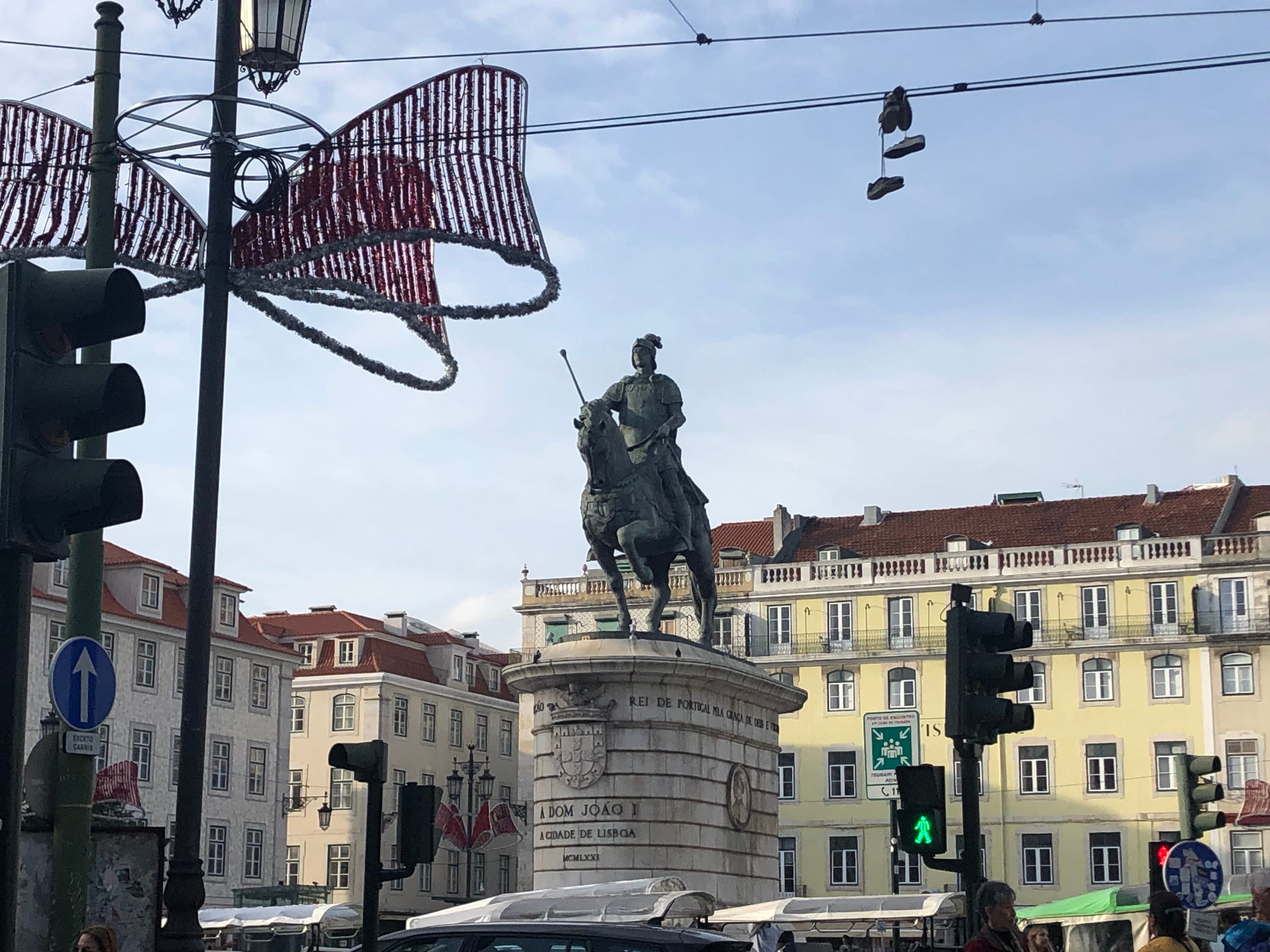
This didn’t mean that Portugal had rid itself of a ruling class, of course. Only that a new one had taken its place. The traditional narrative, the one taught in AP Modern European History, was that the old ideas of inherent nobility that kept all the inbred dynasties in power had given way to the Enlightenment notion of universal right and earned greatness. The merchants and artisans who a few hundred years before wouldn’t have been good enough to wipe shit from the kings’ boots were now your new boss.
This may be a controversial thing to write, but I happen to think that there’s another reason that the royals and aristocracies lost power, or at least why the less careful ones wound up in assassins’ crosshairs. Everyone knew who they were. They were easy to spot, and, therefore, to pick off. Say you’re a disgruntled peasant or merchant (as most were by then). Say you have rudimentary knowledge of using gunpowder or bladed weapons. All you really had to do was wait for the next gilded coach to roll by. Even if you had no idea who was coming through, you’d figure it out from the size of the entourage. You would have to make your way through the personal guards, and you were almost certain to die, but it’s not like you’re making it past thirty anyway.
That’s not the case today. Our current ruling class is for the most part unrecognizable. This is one of the strengths of the bourgeoisie, during its rise, its height, and its later iterations. Sure, we all recognize Elon Musk and Jeff Bezos; we fixate on them a lot. Do you know who Amancio Ortega is? Could you pick Sergei Brin out of a lineup? Be honest. I rest my case.
The fact is that if Musk and Bezos were to disappear tomorrow, someone else just like them would step into their place. It would be their wealth we create in soulless warehouses and data mines. Their shitty decisions turning our zeitgeist into a tasteless, watery gruel. Their names we curse and their faces we dream of spitting in. It’s a clever sleight of hand. We turn a few individuals into avatars for our suffering when it is in fact the result of a highly intricate and highly structured system in which they are mere players.
The problem with the Portuguese monarchy was that after centuries of building palaces and obscene wealth around the globe, everyone knew who they were. What’s worse, they had gotten lazy in their impunity. By the time Carlos I’s sedentary ass was capped in 1908, people were offing Russian tsars and Italian kings left and right. Their kind had outlived their usefulness, and history’s needs must.
VII.
Still, the grandeur of Portugal’s royal past makes for easy tourist dollars. It is essentially the lifeblood of the economy in places like Sintra. Forty minutes outside of Lisbon, this is a town whose entire existence revolves around the bygone years of Portuguese monarchy. About five hundred years ago, kings and queens started spending their summers in Sintra’s cooler temperatures. Thanks to the mountainous Portuguese terrain, the Lisbon area is prone to microclimates, and Sintra is often a full ten or fifteen degrees below what prevails in Lisbon.
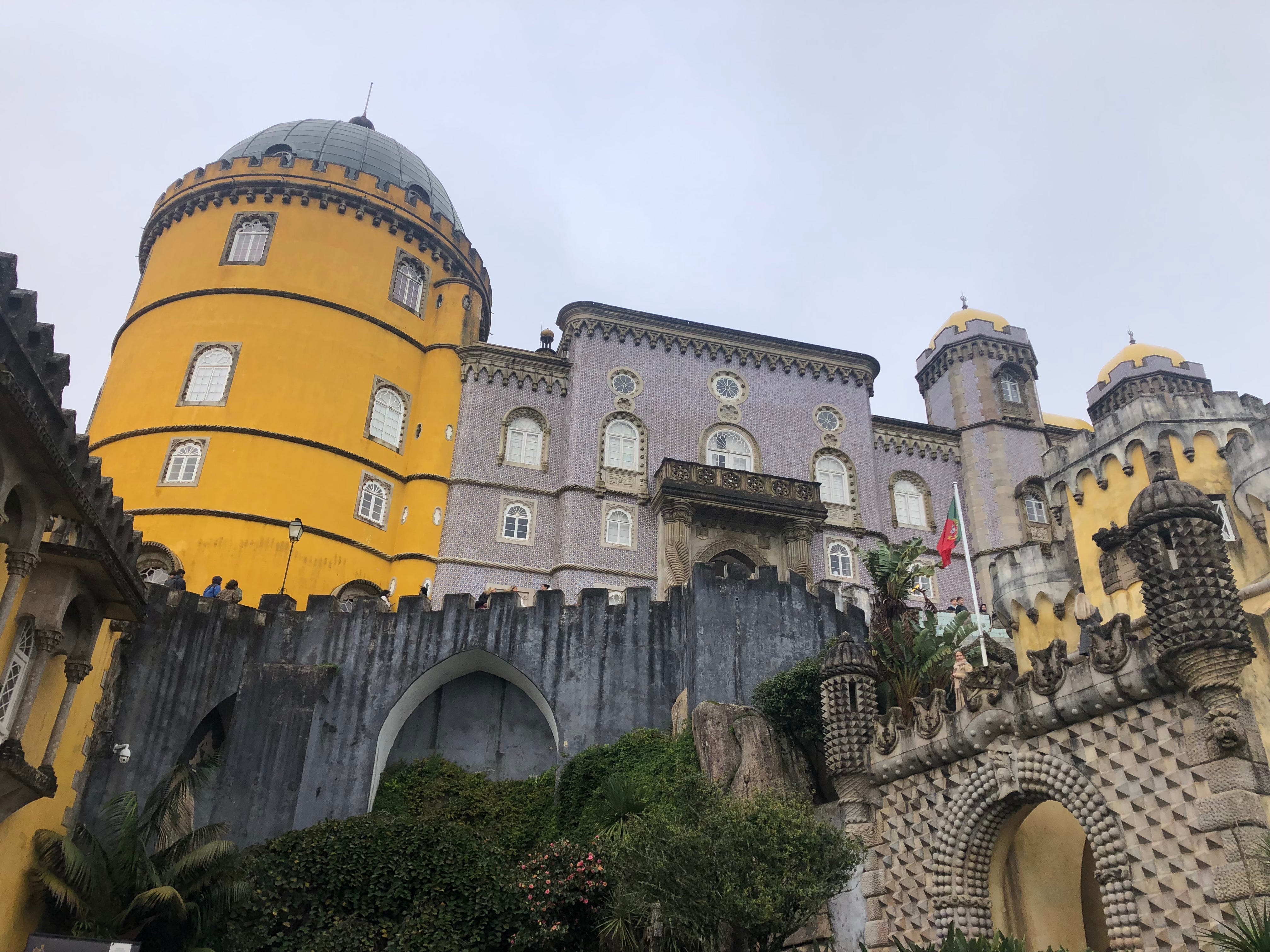
These royals also, predictably, started building massive homes for themselves here. A National Palace was in what is now Sintra proper in the 1400s. It was inhabited more or less continuously until the 19th century. More impressive is the Pena National Palace, whose construction was initiated by King Ferdinand II in 1838 to supplant the original Sintra palace.
He needed something to do. Four years prior, the powers of the Portuguese monarchy had been greatly diminished in the Portuguese Liberal Wars, which was the closest thing he country ever had to a bourgeois revolution. The liberal constitutionalists backed Ferdinand’s wife, Maria II, the traditionalists her uncle, Miguel. Miguel had tried to declare himself sole ruler in 1828 and take Maria, his niece, as his fiancée, and nullify the new constitution. Maria would have none of it, and neither would the liberals.
In 1834, Miguel relinquished his claim to the throne, and Maria II was once again and unthreatened queen. The constitution remained. Armies continued to roam the mountains, periodically carrying out attacks in Miguel’s name for a decade hence. Whether anyone had informed them of their figurehead’s surrender isn’t known.
Maria married Ferdinand in 1836. Unlike Miguel, he never aspired to be the one calling the shots. He couldn’t even claim the title of King until he and Maria produced an heir, Pedro V, in 1837. If was going to be more ornamental, then he was going to make for some very shiny ornaments. Pena was finished in 1854. Standing at the top of the mountain overlooking Sintra, the estate spanned 200 hectares, including a large number of small parks and fountains scattered throughout. The palace itself was a magnificent, colorful building with six turrets and seven floors, encompassing sensibilities that touched on gothic, Renaissance, romantic, and Islamic influences. Several other structures, from greenhouses to chapels, were also constructed on the estate.
It was a stunning palace, dwarfing most others in the country in terms of size and spectacle. Clearly, this was a perfect home for any royal family, but not long after Pena was completed, that family was greatly diminished. Maria died in 1853, one year before Pena was completed. Rule passed to Pedro, though Ferdinand would continue as regent until 1855 when Pedro turned 18.
Pedro would only rule for six years. In 1861, he and several other royals died of cholera. Rule passed to his brother Luis, by which time Ferdinand had mostly outlived his usefulness. He was still a member of the royal family, though, and continued living periodically at Pena. In 1869, he remarried, taking Swiss-American opera singer Elise Hensler, as his new bride.
This union ruffled some feathers at court. It was bad enough he was remarrying, and bad enough she was commoner. But an American? And an entertainer to boot? A shifty, low-life opera singer? These were people worthy of tossing a few coins to, in appreciation for amusement, but never to bring into the nobility’s inner sanctum.
If Ferdinand was violating one of the unspoken cardinal rules of Portugal’s old ruling class, then some part of him also understood that those rules were quickly becoming outdated. How could he not? He was only in his position thanks to the support of a gaggle of merchants and industrialists who wanted his wife to have less power. As for Elise, she was clearly ambitious and talented. While these weren’t necessarily traits that made for a good hereditary monarch, they were undoubtedly valued in the emerging capitalist order.
Ferdinand’s pragmatism apparently extended both ways. As a compromise, he agreed that Elise would not live in Pena National Palace. He constructed a chalet on the estate grounds, where she would dwell when the family was at the palace. Whether they were allowed to fuck in the palace, or only in the chalet, has been lost to history.
Ultimately, the next fifty or so years only brought a more radical decline to the Portuguese monarchy. Luis reigned until his death in 1889. His successor was the same Carlos I who was gunned down in 1908. After Carlos’ death, his mother, Maria Pia of Savoy, locked herself up in Pena National Palace until the liberals found the last of their spine and overthrew the monarchy entirely in 1910. Ferdinand died in 1885. Elise died in 1929, the commoner outliving the monarchy by 19 years.
VIII.
Mrs. Elliipsis and I traveled to Sintra from Lisbon in a small tour van. The other people in our little group were an older American couple, two college-aged women from Italy, and a British couple who very clearly couldn’t stand each other. We walked through the town of Sintra first, grabbing some pastries gawping for a while at the first National Palace built in the town. There is a vague, Old World charm to the place, and you can see why some people fell in love with it. Byron did, and is on record calling Sintra “the most blessed spot on the whole inhabitable globe.” There’s a cafe named after him.
Pena, several hundred feet up the mountain, was completely obscured by fog. After we drove there, it became clear just how massive and intricate this estate was. You could just make out the top of the palace itself, but it was also obscured by huge trees and hills, even the top of other structures that peeked through the canopies. We were told that, given the size of the estate — the sheer number of gardens and paths and other buildings — and the size of the palace — a rather large number of rooms and items to take in, we had little chance of taking in both before we had to be back at the van.
Most people opted to see the palace. That didn’t interest me or my wife. We wanted to go see this chalet where Elise had lived. How grand would this place be, and how pointedly less-grand than the palace? Would there be any evidence that Elise felt slighted being exiled to the chalet? Or did she make the best of it, dismissing the concerns of both court and her feeble husband? What kinds of parties did she have? Lovers? Orgies? How easy was it to simply live the life of insane wealth and privilege? Did she know that, even as Portugal’s nobility thought her lesser, she would in the end have the last laugh?
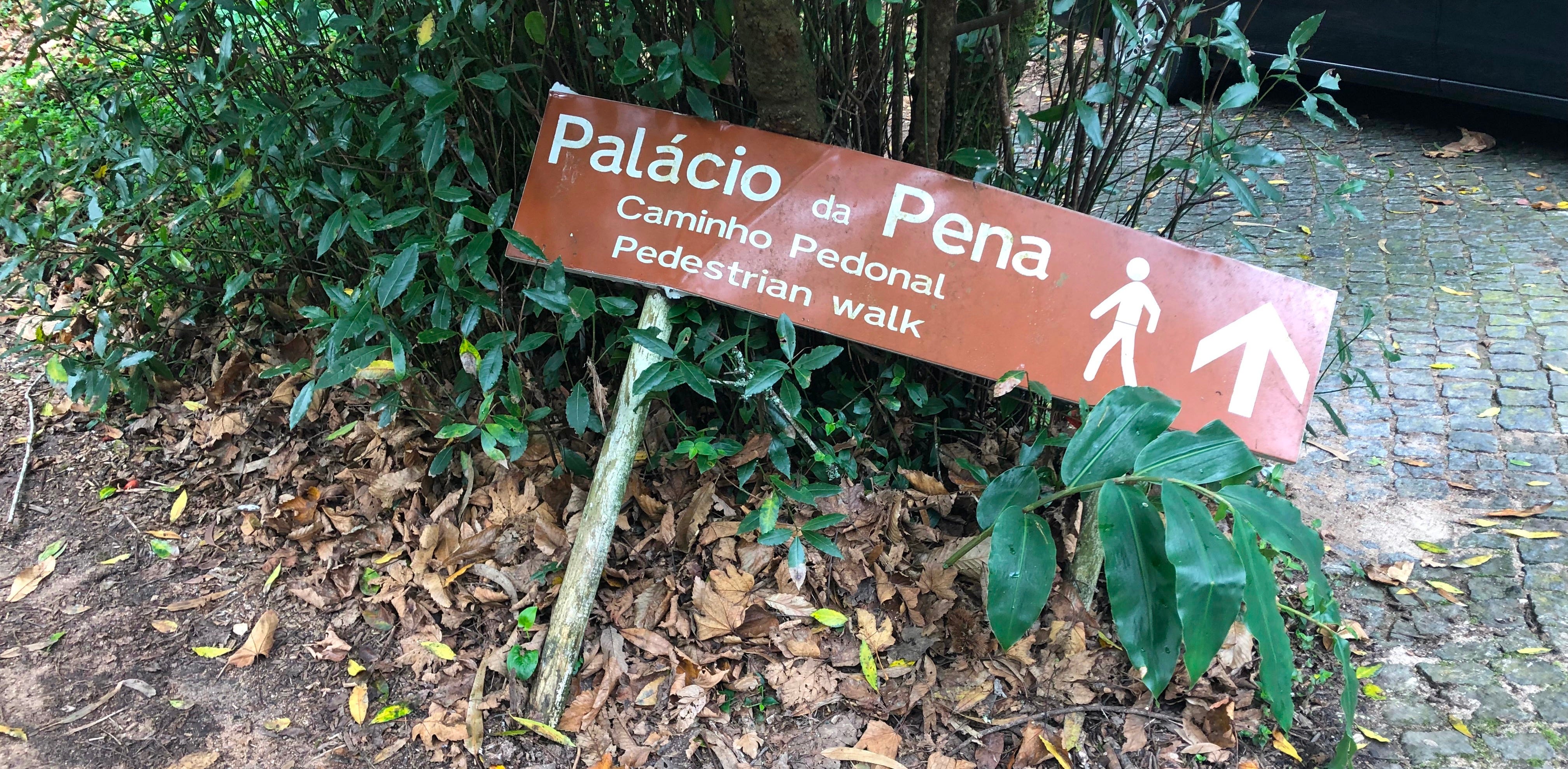
The map etched out a massive, sprawling estate with winding paths that twisted in every direction before turning back into each other. Given how literally mountainous the grounds could be, it was often difficult to tell which way one was headed without signs. Luckily, there were plenty of these.
And so we familiarized ourselves with them the map as much as we could and set off in the direction the sign pointed us toward the chalet. The walk was long, lush and woodsy. It was also vigorous, filled with steep inclines that left us out of breath.
All the more reason to follow the signs. When one of the arrows pointed us back the way we came, we naturally thought we had missed a turn and doubled back. We didn’t find a missed path. Only the previous sign pointing us right back where we had just come from.
We stood in place, dumbfounded and confused. Again, there has been no missed path, no trail with a sign we should have followed. Just two arrows, pointing at each other, about a hundred yards apart. And in between? Nothing but trees, grass, and plant life.
We were determined to find this chalet, however. So we doubled back yet again, looking for alternate routes, thinking perhaps one of the signs was mistaken, throwing off the carefully plotted path of the rest. We mixed turns we hadn’t taken with those we had, second-guessed whether we had been at a specific fork before, and tried to peer through the trees for anything that looked like a chalet. At one point, we went through a row of stone columns, past a pair of greenhouses and by a stable of horses. The chalet must be close we thought. But no. We were taken in a circle back to the columns.
Around this time, two explanations occurred to us. The first was that we had fallen through a wormhole of some sort. A fold in space-time. An impossible overlap of two universes: one in which the chalet exists, one in which it doesn’t. The slip between the two happens at the exact spot the chalet should be. Meaning the signs pointed to something that is there but isn’t.
The other explanation was that the chalet had never existed in any universe. Ferdinand had Elise killed rather than deal with the unfolding embarrassment of having married an opera singer. He told everyone she had retreated to a chalet to live out her days hoping nobody woul care enough to look. The Portuguese trust that took over Pena National Palace had put a chalet on the map, with nobody having ever been there, hoping in Ferdinand’s footsteps that nobody would bother to look. And nobody did. Until now.
On balance, the first explanation seemed more plausible. Everyone knows by now that alternate universes exist. And making up a chalet seemed a rather elaborate ruse, even for a regent.
What’s more, we were starting to get a distinct Narnia vibe from these paths. Not only were we enclosed in a verdant canopy that invited you to get lost in the fertile tangles, but we would frequently encounter lampposts like these along the path. Elise mostly achieves a status in the history books just barely above footnote, though she probably understood how elastic her time had become. She stretched it to her advantage. When you stretch time, those who believe themselves its masters don’t approve. They’re likely to cast you out, disappear you. But someone like Elise clearly saw how feeble their chess moves had become, how inconsequential the game was when you could live on your own terms. It’s as good as hiding in time itself, and damn anyone who tries to find you.
Not that we didn’t find anything of interest. The horses at the stable were gentle and friendly, and well taken care of. Periodically we would encounter a clearing with a small man-made pond, a fountain in the center, exotic plants from around the world standing stolidly nearby, beckoning us into a thick world of rich moss and leaves reaching ever upward. It was an enticing invitation, but not one we were searching for.
And so we wandered. Searching for… the chalet? A way back to the tour van? We weren’t sure. Perhaps this is what the Miguellist militias felt as they roamed the mountains in the decade after their figurehead conceded. Or maybe this was the fate of innumerable peasants exiled from their lands in the tumults of rising capitalism, wandering aimlessly in the cracks of civilization, bound for the doldrums of repetitive wage labor or the invisibility of vagrancy. The detritus of history can only float until someone or something pulls it out of the torpor.
IX.
It was quite late until we found our way back, but we eventually came across others, including others in our group. We were sweaty and in desperate need of wine and food. We joked that if you told us we were gone for ten years we would believe you, but it wasn’t as much of a joke for us. We told the tour guides that the chalet doesn’t exist. They showed us pictures. Clearly they were from this dimension, but that’s not the one from which we had returned.
We piled back into the van, exhausted, disoriented, convinced that we had seen something just beyond convention’s understanding of space. Everyone else had opted for Pena Palace. The older American couple smiled, satisfied with the trinkets and furniture they’d seen inside. The Italian students were polite and mildly interested. The dissastisfied Brits just looked disgruntled. Mrs. Daydream and I, however, had escaped the oblivion of what Marx described as capital’s ability to annihilate space with time.
The next stop was another forty minutes away, in Cascais. As our guide told us, Cascais is the contemporary jewel of the Portuguese Riviera. Lots of rich people live here, including some of the country’s most powerful CEOs. It even, for a time, became a place into which other displaced royals could vanish. In 1946, King Umberto II of Italy, a man described by one historian as having a less “compromising” fascist past than his father Victor Emmanuel III, abdicated after the country voted for a republic. He had reigned for a month. The new constitution forbade all male former heirs from returning to Italy. Portugal took him in, and he lived, very comfortably but also obscure, in Cascais, until he died in 1983.
Fulgencio Batista, exiled Cuban dictator deposed by the 1959 revolution, also lived I the town for a while. The Casino Escorial in Cascais was the inspiration for Ian Fleming’s first James Bond novel, Casino Royale. It is one of the wealthiest cities in Portugal, with one of the most expensive real estate markets in the country.
Cascais is pretty, idyllic even. It is right next to the ocean, and a large handful of quaint sailboats are anchored in the harbor. All the buildings are pink or cream. The commercial district is all that kind of rustic artisanal that is only possible when profit margins don’t matter, when you can run your shop as a hobby. This was the only place where we felt we had to double check the prices, to make sure we didn’t overspend our vacation budget. It is for these people that taxes are cut, that wages stay stagnant. For the most part, they are as unremarkable as they are unrecognizable. Another nameless toff in a pastel sweater. They like it that way.
Mrs. Daydream and I stopped for lunch at a sidewalk restaurant. It was delicious. We gazed at the ocean. It was gorgeous. We walked the town streets, listened to a guitarist troubadour with a portable sound system that probably costs more than our rent. It was fine.
Even with so many older buildings and cobblestone streets, there was something generic about Cascais. It could have been Calabasas or Cape Cod or any other super-affluent seaside suburb. Tranquil. Smooth. Nondescript. Anesthetic.
A place whose history sits in the folds of time. The kind of town that disappears into the background of people’s consciousness, mostly set apart from anything like strife or consequence. At least that was how we felt as we looked at the town’s roundabout.
“I think we found the chalet,” I told her. She agreed.
All photos by the author or Kelsey Goldberg.
That Ellipsis... is a reader-supported publication. To receive new posts and support my work, consider becoming a free or paid subscriber.
Vanishing in Sintra (Iberian Ellipsis, part 2)
For most of November, I will be on my honeymoon in Spain and Portugal. You would think that means I take a break from the obligations of writing and cultivating an audience, but no. I cannot, for whatever reason, tear myself away from this toxic need for a forum. The upshot of that is you get to watch me attempt a travel journal as I journey from Porto down to Lisbon, into Spain by way of Seville, up the eastern coast and into Barcelona. Castles. Cobblestone streets. Public toilets you have to pay to use. The first in this series can be read here. Also, if you haven’t subscribed or upgraded to a paid subscription, this is your cue.
VI.
If you didn’t know that Portugal had been a preeminent world power before arriving here, the country’s buildings and monuments leave no doubt. Most statues are of men on horses, and are positioned on pedestals so impossibly high that they can only be regarded as saints or conquerors (sometimes they’re both). An absurd number of buildings in the cities qualify as some kind of world heritage site. They include grand palaces and promenades and lavish cathedrals. This is a place that once, before the dictators and economic crises, before the financial collapse, before any of us had ever heard of the European Central Bank or the PIIGS countries, possessed an astounding amount of wealth. The kind that could only be pillaged.
The armillary sphere, the golden navigational tool symbolizing world dominance, is on the country’s flag. It’s at the top of many buildings, particularly those associated with the former royalty. Like most historical empires, Portugal had its monarchs, though only until 1910. Unlike, say, Spain, or the United Kingdom, Portugal ultimately preferred to abolish its royal family entirely rather than reduce it to an ostensibly ceremonial role.
This didn’t mean that Portugal had rid itself of a ruling class, of course. Only that a new one had taken its place. The traditional narrative, the one taught in AP Modern European History, was that the old ideas of inherent nobility that kept all the inbred dynasties in power had given way to the Enlightenment notion of universal right and earned greatness. The merchants and artisans who a few hundred years before wouldn’t have been good enough to wipe shit from the kings’ boots were now your new boss.
This may be a controversial thing to write, but I happen to think that there’s another reason that the royals and aristocracies lost power, or at least why the less careful ones wound up in assassins’ crosshairs. Everyone knew who they were. They were easy to spot, and, therefore, to pick off. Say you’re a disgruntled peasant or merchant (as most were by then). Say you have rudimentary knowledge of using gunpowder or bladed weapons. All you really had to do was wait for the next gilded coach to roll by. Even if you had no idea who was coming through, you’d figure it out from the size of the entourage. You would have to make your way through the personal guards, and you were almost certain to die, but it’s not like you’re making it past thirty anyway.
That’s not the case today. Our current ruling class is for the most part unrecognizable. This is one of the strengths of the bourgeoisie, during its rise, its height, and its later iterations. Sure, we all recognize Elon Musk and Jeff Bezos; we fixate on them a lot. Do you know who Amancio Ortega is? Could you pick Sergei Brin out of a lineup? Be honest. I rest my case.
The fact is that if Musk and Bezos were to disappear tomorrow, someone else just like them would step into their place. It would be their wealth we create in soulless warehouses and data mines. Their shitty decisions turning our zeitgeist into a tasteless, watery gruel. Their names we curse and their faces we dream of spitting in. It’s a clever sleight of hand. We turn a few individuals into avatars for our suffering when it is in fact the result of a highly intricate and highly structured system in which they are mere players.
The problem with the Portuguese monarchy was that after centuries of building palaces and obscene wealth around the globe, everyone knew who they were. What’s worse, they had gotten lazy in their impunity. By the time Carlos I’s sedentary ass was capped in 1908, people were offing Russian tsars and Italian kings left and right. Their kind had outlived their usefulness, and history’s needs must.
VII.
Still, the grandeur of Portugal’s royal past makes for easy tourist dollars. It is essentially the lifeblood of the economy in places like Sintra. Forty minutes outside of Lisbon, this is a town whose entire existence revolves around the bygone years of Portuguese monarchy. About five hundred years ago, kings and queens started spending their summers in Sintra’s cooler temperatures. Thanks to the mountainous Portuguese terrain, the Lisbon area is prone to microclimates, and Sintra is often a full ten or fifteen degrees below what prevails in Lisbon.
These royals also, predictably, started building massive homes for themselves here. A National Palace was in what is now Sintra proper in the 1400s. It was inhabited more or less continuously until the 19th century. More impressive is the Pena National Palace, whose construction was initiated by King Ferdinand II in 1838 to supplant the original Sintra palace.
He needed something to do. Four years prior, the powers of the Portuguese monarchy had been greatly diminished in the Portuguese Liberal Wars, which was the closest thing he country ever had to a bourgeois revolution. The liberal constitutionalists backed Ferdinand’s wife, Maria II, the traditionalists her uncle, Miguel. Miguel had tried to declare himself sole ruler in 1828 and take Maria, his niece, as his fiancée, and nullify the new constitution. Maria would have none of it, and neither would the liberals.
In 1834, Miguel relinquished his claim to the throne, and Maria II was once again and unthreatened queen. The constitution remained. Armies continued to roam the mountains, periodically carrying out attacks in Miguel’s name for a decade hence. Whether anyone had informed them of their figurehead’s surrender isn’t known.
Maria married Ferdinand in 1836. Unlike Miguel, he never aspired to be the one calling the shots. He couldn’t even claim the title of King until he and Maria produced an heir, Pedro V, in 1837. If was going to be more ornamental, then he was going to make for some very shiny ornaments. Pena was finished in 1854. Standing at the top of the mountain overlooking Sintra, the estate spanned 200 hectares, including a large number of small parks and fountains scattered throughout. The palace itself was a magnificent, colorful building with six turrets and seven floors, encompassing sensibilities that touched on gothic, Renaissance, romantic, and Islamic influences. Several other structures, from greenhouses to chapels, were also constructed on the estate.
It was a stunning palace, dwarfing most others in the country in terms of size and spectacle. Clearly, this was a perfect home for any royal family, but not long after Pena was completed, that family was greatly diminished. Maria died in 1853, one year before Pena was completed. Rule passed to Pedro, though Ferdinand would continue as regent until 1855 when Pedro turned 18.
Pedro would only rule for six years. In 1861, he and several other royals died of cholera. Rule passed to his brother Luis, by which time Ferdinand had mostly outlived his usefulness. He was still a member of the royal family, though, and continued living periodically at Pena. In 1869, he remarried, taking Swiss-American opera singer Elise Hensler, as his new bride.
This union ruffled some feathers at court. It was bad enough he was remarrying, and bad enough she was commoner. But an American? And an entertainer to boot? A shifty, low-life opera singer? These were people worthy of tossing a few coins to, in appreciation for amusement, but never to bring into the nobility’s inner sanctum.
If Ferdinand was violating one of the unspoken cardinal rules of Portugal’s old ruling class, then some part of him also understood that those rules were quickly becoming outdated. How could he not? He was only in his position thanks to the support of a gaggle of merchants and industrialists who wanted his wife to have less power. As for Elise, she was clearly ambitious and talented. While these weren’t necessarily traits that made for a good hereditary monarch, they were undoubtedly valued in the emerging capitalist order.
Ferdinand’s pragmatism apparently extended both ways. As a compromise, he agreed that Elise would not live in Pena National Palace. He constructed a chalet on the estate grounds, where she would dwell when the family was at the palace. Whether they were allowed to fuck in the palace, or only in the chalet, has been lost to history.
Ultimately, the next fifty or so years only brought a more radical decline to the Portuguese monarchy. Luis reigned until his death in 1889. His successor was the same Carlos I who was gunned down in 1908. After Carlos’ death, his mother, Maria Pia of Savoy, locked herself up in Pena National Palace until the liberals found the last of their spine and overthrew the monarchy entirely in 1910. Ferdinand died in 1885. Elise died in 1929, the commoner outliving the monarchy by 19 years.
VIII.
Mrs. Elliipsis and I traveled to Sintra from Lisbon in a small tour van. The other people in our little group were an older American couple, two college-aged women from Italy, and a British couple who very clearly couldn’t stand each other. We walked through the town of Sintra first, grabbing some pastries gawping for a while at the first National Palace built in the town. There is a vague, Old World charm to the place, and you can see why some people fell in love with it. Byron did, and is on record calling Sintra “the most blessed spot on the whole inhabitable globe.” There’s a cafe named after him.
Pena, several hundred feet up the mountain, was completely obscured by fog. After we drove there, it became clear just how massive and intricate this estate was. You could just make out the top of the palace itself, but it was also obscured by huge trees and hills, even the top of other structures that peeked through the canopies. We were told that, given the size of the estate — the sheer number of gardens and paths and other buildings — and the size of the palace — a rather large number of rooms and items to take in, we had little chance of taking in both before we had to be back at the van.
Most people opted to see the palace. That didn’t interest me or my wife. We wanted to go see this chalet where Elise had lived. How grand would this place be, and how pointedly less-grand than the palace? Would there be any evidence that Elise felt slighted being exiled to the chalet? Or did she make the best of it, dismissing the concerns of both court and her feeble husband? What kinds of parties did she have? Lovers? Orgies? How easy was it to simply live the life of insane wealth and privilege? Did she know that, even as Portugal’s nobility thought her lesser, she would in the end have the last laugh?
The map etched out a massive, sprawling estate with winding paths that twisted in every direction before turning back into each other. Given how literally mountainous the grounds could be, it was often difficult to tell which way one was headed without signs. Luckily, there were plenty of these.
And so we familiarized ourselves with them the map as much as we could and set off in the direction the sign pointed us toward the chalet. The walk was long, lush and woodsy. It was also vigorous, filled with steep inclines that left us out of breath.
All the more reason to follow the signs. When one of the arrows pointed us back the way we came, we naturally thought we had missed a turn and doubled back. We didn’t find a missed path. Only the previous sign pointing us right back where we had just come from.
We stood in place, dumbfounded and confused. Again, there has been no missed path, no trail with a sign we should have followed. Just two arrows, pointing at each other, about a hundred yards apart. And in between? Nothing but trees, grass, and plant life.
We were determined to find this chalet, however. So we doubled back yet again, looking for alternate routes, thinking perhaps one of the signs was mistaken, throwing off the carefully plotted path of the rest. We mixed turns we hadn’t taken with those we had, second-guessed whether we had been at a specific fork before, and tried to peer through the trees for anything that looked like a chalet. At one point, we went through a row of stone columns, past a pair of greenhouses and by a stable of horses. The chalet must be close we thought. But no. We were taken in a circle back to the columns.
Around this time, two explanations occurred to us. The first was that we had fallen through a wormhole of some sort. A fold in space-time. An impossible overlap of two universes: one in which the chalet exists, one in which it doesn’t. The slip between the two happens at the exact spot the chalet should be. Meaning the signs pointed to something that is there but isn’t.
The other explanation was that the chalet had never existed in any universe. Ferdinand had Elise killed rather than deal with the unfolding embarrassment of having married an opera singer. He told everyone she had retreated to a chalet to live out her days hoping nobody woul care enough to look. The Portuguese trust that took over Pena National Palace had put a chalet on the map, with nobody having ever been there, hoping in Ferdinand’s footsteps that nobody would bother to look. And nobody did. Until now.
On balance, the first explanation seemed more plausible. Everyone knows by now that alternate universes exist. And making up a chalet seemed a rather elaborate ruse, even for a regent.
What’s more, we were starting to get a distinct Narnia vibe from these paths. Not only were we enclosed in a verdant canopy that invited you to get lost in the fertile tangles, but we would frequently encounter lampposts like these along the path. Elise mostly achieves a status in the history books just barely above footnote, though she probably understood how elastic her time had become. She stretched it to her advantage. When you stretch time, those who believe themselves its masters don’t approve. They’re likely to cast you out, disappear you. But someone like Elise clearly saw how feeble their chess moves had become, how inconsequential the game was when you could live on your own terms. It’s as good as hiding in time itself, and damn anyone who tries to find you.
Not that we didn’t find anything of interest. The horses at the stable were gentle and friendly, and well taken care of. Periodically we would encounter a clearing with a small man-made pond, a fountain in the center, exotic plants from around the world standing stolidly nearby, beckoning us into a thick world of rich moss and leaves reaching ever upward. It was an enticing invitation, but not one we were searching for.
And so we wandered. Searching for… the chalet? A way back to the tour van? We weren’t sure. Perhaps this is what the Miguellist militias felt as they roamed the mountains in the decade after their figurehead conceded. Or maybe this was the fate of innumerable peasants exiled from their lands in the tumults of rising capitalism, wandering aimlessly in the cracks of civilization, bound for the doldrums of repetitive wage labor or the invisibility of vagrancy. The detritus of history can only float until someone or something pulls it out of the torpor.
IX.
It was quite late until we found our way back, but we eventually came across others, including others in our group. We were sweaty and in desperate need of wine and food. We joked that if you told us we were gone for ten years we would believe you, but it wasn’t as much of a joke for us. We told the tour guides that the chalet doesn’t exist. They showed us pictures. Clearly they were from this dimension, but that’s not the one from which we had returned.
We piled back into the van, exhausted, disoriented, convinced that we had seen something just beyond convention’s understanding of space. Everyone else had opted for Pena Palace. The older American couple smiled, satisfied with the trinkets and furniture they’d seen inside. The Italian students were polite and mildly interested. The dissastisfied Brits just looked disgruntled. Mrs. Ellipsis and I, however, had escaped the oblivion of what Marx described as capital’s ability to annihilate space with time.
The next stop was another forty minutes away, in Cascais. As our guide told us, Cascais is the contemporary jewel of the Portuguese Riviera. Lots of rich people live here, including some of the country’s most powerful CEOs. It even, for a time, became a place into which other displaced royals could vanish. In 1946, King Umberto II of Italy, a man described by one historian as having a less “compromising” fascist past than his father Victor Emmanuel III, abdicated after the country voted for a republic. He had reigned for a month. The new constitution forbade all male former heirs from returning to Italy. Portugal took him in, and he lived, very comfortably but also obscure, in Cascais, until he died in 1983.
Fulgencio Batista, exiled Cuban dictator deposed by the 1959 revolution, also lived I the town for a while. The Casino Escorial in Cascais was the inspiration for Ian Fleming’s first James Bond novel, Casino Royale. It is one of the wealthiest cities in Portugal, with one of the most expensive real estate markets in the country.
Cascais is pretty, idyllic even. It is right next to the ocean, and a large handful of quaint sailboats are anchored in the harbor. All the buildings are pink or cream. The commercial district is all that kind of rustic artisanal that is only possible when profit margins don’t matter, when you can run your shop as a hobby. This was the only place where we felt we had to double check the prices, to make sure we didn’t overspend our vacation budget. It is for these people that taxes are cut, that wages stay stagnant. For the most part, they are as unremarkable as they are unrecognizable. Another nameless toff in a pastel sweater. They like it that way.
Mrs. Ellipsis and I stopped for lunch at a sidewalk restaurant. It was delicious. We gazed at the ocean. It was gorgeous. We walked the town streets, listened to a guitarist troubadour with a portable sound system that probably costs more than our rent. It was fine.
Even with so many older buildings and cobblestone streets, there was something generic about Cascais. It could have been Calabasas or Cape Cod or any other super-affluent seaside suburb. Tranquil. Smooth. Nondescript. Anesthetic.
A place whose history sits in the folds of time. The kind of town that disappears into the background of people’s consciousness, mostly set apart from anything like strife or consequence. At least that was how we felt as we looked at the town’s roundabout.
“I think we found the chalet,” I told her. She agreed.
All photos by the author or Kelsey Goldberg.
That Ellipsis... is a reader-supported publication. To receive new posts and support my work, consider becoming a free or paid subscriber.
November 14, 2024
See Like a Fish (Iberian Daydream, part 1)
Greetings from Portugal. What follows is the first in a series of entries in my attempt at a travel journal. Over the next two weeks, Daydreams & Paving Stones will be bringing you nonsense from Lisbon, Sintra and Cascais, Seville, up the devastated eastern coast of Spain, and finally from the streets of Barcelona. History. Architecture. Clean public toilets. For now, though, take a glimpse into my jet-lagged brain as I try to cobble my impressions of Porto into something coherent.
Also, I am obliged to let you know that I am writing these while on my honeymoon. I got married a month ago. My wife and I are traveling through the Iberian Peninsula as a way to celebrate our love before attempting to build a life in the gathering hell of the United States.
To reiterate, I am sacrificing sections of what may be one of the few moments of unadulterated beauty and joy my wife and I will be getting in the imminent future in order to provide you with a brief moment of entertainment. You’re welcome. Now subscribe, and pay me if you haven’t already.
I.
“Grant me, O fishes, clear instruction, lest I forget this lesson on the second stage of my journey into Portugal: may I learn in passing from one land to the next to pay the closest attention to the similarities and differences, whilst not forgetting something in common to both humans and fishes alike, namely that a traveller has preferences and sympathies unconstrained by the obligations of universal love, never hitherto required of him. To you, then, I at length bid farewell, O fishes, until a future day: may you follow your own course out of the sight of fishermen. Swim joyfully on, and wish me a safe journey. Farewell, farewell.” – Jose Saramago, Discovering Portugal
Jose Saramago was a magnificent writer, as close to a titan of 20th century literature as Portugal ever produced, but his Discovering Portugal is a perplexing work. Not because it is difficult per se, but because it isn’t difficult. There isn’t much in the way of heft or knotty language to grapple with. Rather, it presents itself as a fairly aimless and meandering travelogue. It’s difficult to find anything to grab onto.
Or at least it is for the outsider. For while the tiny churches and old homes and villages he encounters rarely show up in a typical tourist guide, he isn’t writing for tourists. Saramago always treated the thorny with a sense of play. He also, as a committed communist, deeply loved his country. This did not make him a patriot, though he did sometimes use the word. But all the chest-thumping chauvinism that tends to come with patriotism is very much anathema to Saramago’s love of Portugal.
Perhaps it’s the result of living his first fifty years under autocratic rule, the way this pushes someone to find a kinder and more just mode of living in the cracks of a harsh reality. In any event, Saramago wrote Discovering Portugal for the Portuguese. The text is full of conversations with villagers, fishermen, farmers. People who, even if mentions of this or that church didn’t bring a specific image to mind, would still somehow know, intrinsically, what he’s writing about.
It is also full of strange interactions with demons, ghosts, Satan himself, and a humble school of fish. A long time ago, we believed that places could tell us things without words. Then the Enlightenment came and fouled it all up, and ever since people like Saramago have been trying to rediscover these numinous ways of seeing and listening.
II.
The first section of Saramago’s book takes place in the north. But it takes him over a hundred pages to get to Porto, the largest in the region, and Portugal’s second city. There is a huge amount of history here: eight hundred year-old cathedrals and stone fortresses and modernist bridges spanning the river.
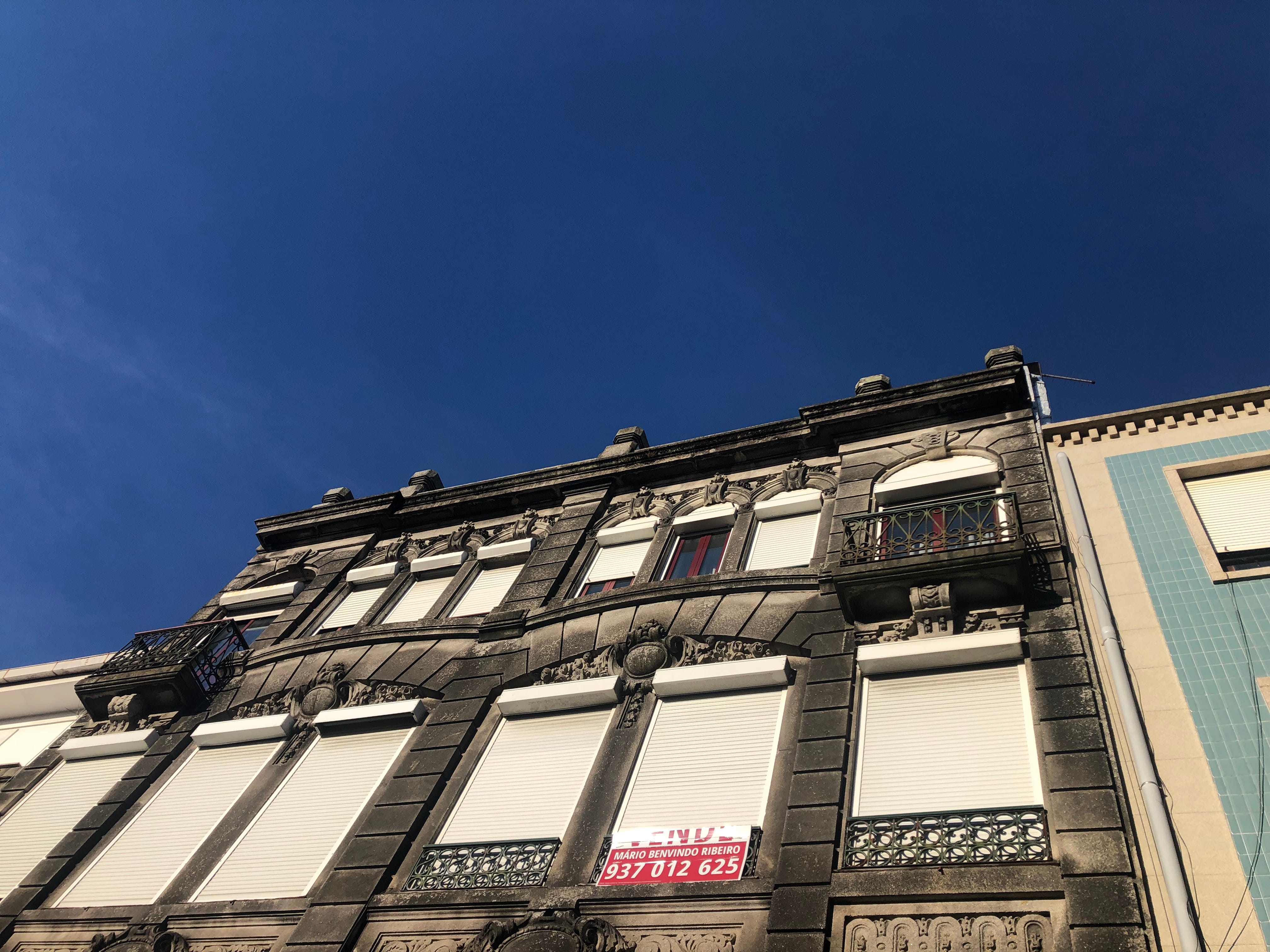
Urban geographers love to talk about the past and present colliding in the contemporary cityscape. In Porto, it is unmistakable. One of the first things you notice upon entering this city is that, emerging from the tight cracks between slick storefronts and stone apartment-buildings covered with lichens is the sheer amount of construction that always seems to be happening. Cranes towering over the Old World skyline. Massive pits of dust and lime plunging into the cobblestone streets.
Much of this is for the expansion of Porto’s Metro system. It’s a good thing, as allowing a city’s citizens a communal form of travel can only be. But it moves at a snail’s pace, as each construction dig inevitably uncovers some previously unknown set of ruins. A Roman aqueduct. A Visigothic settlement. Construction halts. Archeologists descend. No word on when progress gets to restart.
The rest of the construction seems to come from a familiar adversary: developers. A lot of hay is made out of the respect shown for the 200-year-old building facades as the interiors are spruced up. But there is an unanswered question. Who, exactly, is all this development for?
All over Porto, there are flyers and stickers demanding more affordable housing. And there is undoubtedly a housing crisis in this city, much as its centrist mayor will equivocate over it. Like most other European cities, Porto has seen its tourism boom in recent decades. Its strange, unique architectural interweavings of past and present swarmed by gawking, dead-eyed foreigners. I’m one of them.
Most travelers of the left-wing or progressive bent would love to believe we are somehow different, more considerate of the locals and the preservation of the places in which they live. We aren’t. We can’t be. Nobody lives at the places that draw the most tourism, but more and more, cities’ whole economies are being bent around these sites. They make locals’ lives more expensive, more inconvenient, more alienating. Those of us who flock to visit them can’t reverse what’s been done to roll out the red carpet for us. Most of us are hypocrites.
This doesn’t make us all that unique, or even uniquely annoying. Most everyone, at one time or another, is a guest in someone else’s home, trying and likely failing to show deference and respect. It’s not like we asked them to punch a giant hole in their street before we came over. If everyone is a hypocrite, maybe our standards for hypocrisy are a bit skewed?
III.
I’ve been thinking a lot lately about the feeling of futurelessness. I’m not exactly alone in this regard. Mark Fisher seems to have popularized these considerations among the English-speaking left, but really they’ve been bouncing around our cultures since at least the fall of the Berlin Wall.
Before coming to Portugal, I spent a week in London at the Historical Materialism conference, which is exactly where weird obsessives like me come to obsess over these questions alongside others just like us so we can, for a weekend, not feel so insane in our obsessions. One of the more standout papers I listened to came from Phoebe Braithwaite (whose work you may know from The New Statesman, Wired, or Tribune) on the thought of Caribbean radical thinker Sylvia Wynter and — wait for it — the wisdom of frogs. Turns out there’s a lot that frogs, with their almost zen-like presentism and view from below, can tell us about searching for an opening toward liberation.
Having recently read Saramago’s words, I naturally thought of these ideas’ proximity to the fishes’ sermon. The act of going someplace new isn’t just, as cliche will tell us, to experience being a fish out of water. It is to see everything “from below,” half or wholly submerged beneath layers of misunderstanding, trying to find some way to communicate across these layers but ultimately unable to be heard as anything other than gurgling gibberish.
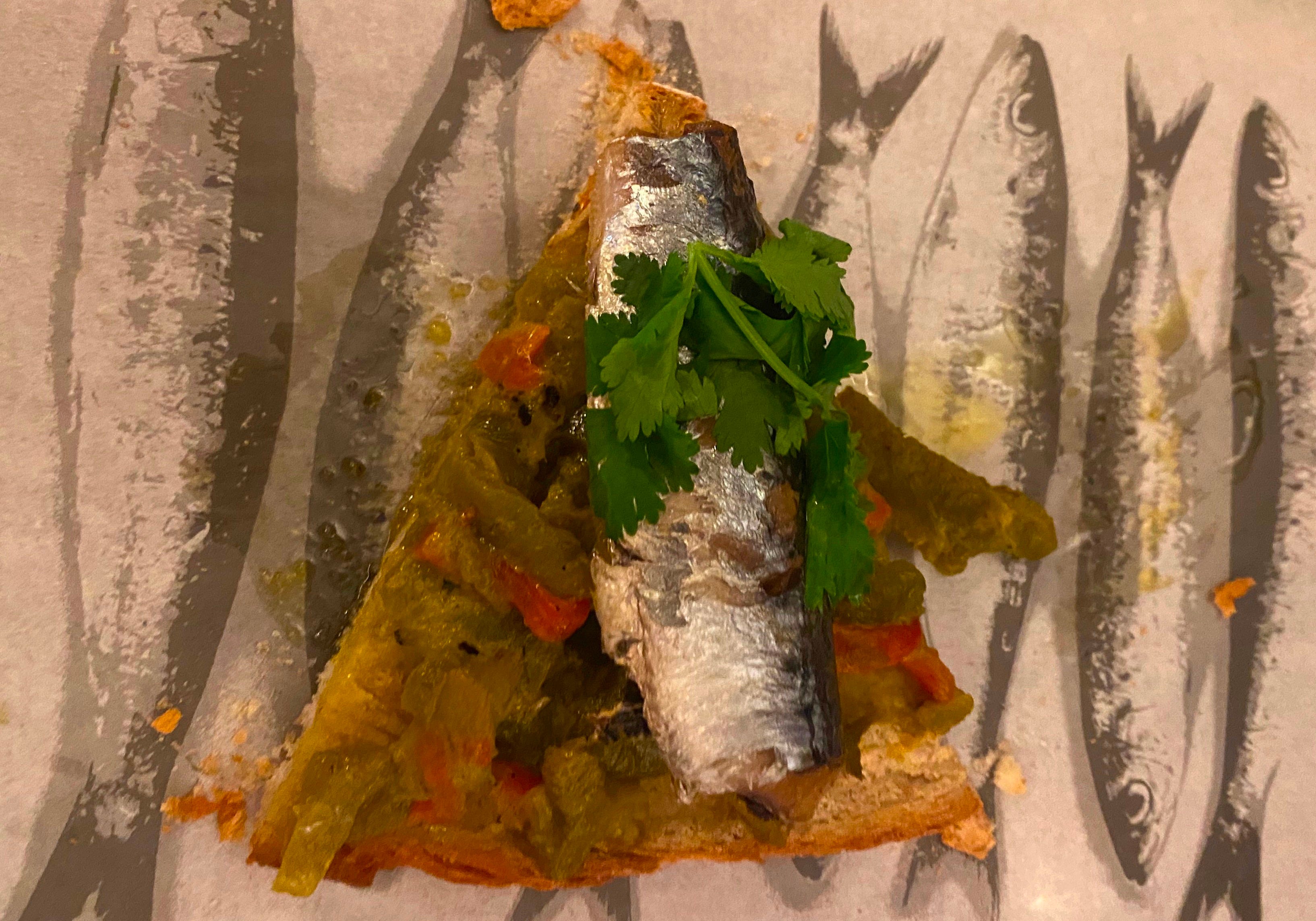
All the ideological faff of the tourism industry is dedicated to cutting against this reality. It can only do so much. One of the bests thing about Porto, what I truly loved about the city, was its ability to cut through all the static of tourism, to hope against hope for some kind of communication to be discovered. To see like a fish.
IV.
Freed by fish-vision, Mrs. Daydream and I spent our first day in Porto drifting through the city on a big tourist bus. The double-decker kind without a roof. They hand you headphones you are to plug into a small console on your seat to hear a polite voice tell you a few random facts about passing landmarks.
The headphones were old, and so was the recording. It was fuzzy and had a tone of resignation to it. The person who recorded these tidbit factoids was either roped into it by their boss or crestfallen that all the work they had put into their voiceover career had led them here. Often you couldn’t even make out what they were saying about the landmarks. The gaggle of tourists riding the top level with us would crane our necks and gawp desperately, trying to catch the statue or church we were being described before it disappeared entirely from view. Just in the nick of time we would realize that we were meant to be staring at a church facade that was under construction, hidden behind scaffolding and tarpaulins.
It was fine. If you know a few things about the history of Portugal, its conquests and religious fanaticisms and modernist dalliances, then you may get something out of of having the basics of the Batalha or the Casa da Musica or Forte de São João Baptista da Foz.
What you won’t get is the story of the young and depressed fisherman who left the Batalha with his prayers unanswered, the skaters who use the slopes the Casa courtyard to do tricks on, the drunken student who swore he saw the ghost of São João Baptista da Foz skulking the grounds of the fort.
V.
The place we stayed was on Santa Catarina Street. It is a wide road, is traffic tightly controlled and open to pedestrians, sloping down then up, peppered with restaurants, hotels, stores. Most are aimed in the direction of what will attract tourists to Porto, which means projecting an idea of Porto that most residents wouldn’t fully recognize. Or if they do, it would be in that uncanny valley kind of way. The hotels are comfortable and bland. The restaurants, like Cafe Majestic, have that generic Old World charm to them, their fades and scratches around the edges painstakingly places.
The shops are perhaps the most egregious. Zara. Benetton. Levi’s. H&M. Retailers you can find in just about any city in Europe, Asia, or the Americas. Certainly nothing specifically “Portuguese” about them.
There were also buskers, local musicians who astutely recognized there was a bit of coin to make off tourists. Most were guitarist-singers, wailing third-rate folk rock or acoustic emo. Truly something you can hear anywhere else, and not worth stopping for.
The fourth or fifth busker we encountered was a young violinist. He mostly played contemporary pop redone for his instrument. Then he played “Bella Ciao.”
Maybe he played it because he’s a fan of Casa de Papel. Maybe he played it because he thought all the tourists would recognize it. I would like to believe that, in a country which is now celebrating fifty years since the fall of its dictatorship, which now faces — like most European countries — an insurgent far-right, there was a bit more intent behind playing an Italian partisan anthem. It’s likely many of us wouldn’t get it, but he wasn’t playing it for us.
All photos by Kelsey Goldberg and the author.
That Ellipsis... is a reader-supported publication. To receive new posts and support my work, consider becoming a free or paid subscriber.
See Like a Fish (Iberian Ellipsis, part 1)
Greetings from Portugal. What follows is the first in a series of entries in my attempt at a travel journal. Over the next two weeks, That Ellipsis… will be bringing you nonsense from Lisbon, Sintra and Cascais, Seville, up the devastated eastern coast of Spain, and finally from the streets of Barcelona. History. Architecture. Clean public toilets. For now, though, take a glimpse into my jet-lagged brain as I try to cobble my impressions of Porto into something coherent.
Also, I am obliged to let you know that I am writing these while on my honeymoon. I got married a month ago. My wife and I are traveling through the Iberian Peninsula as a way to celebrate our love before attempting to build a life in the gathering hell of the United States.
To reiterate, I am sacrificing sections of what may be one of the few moments of unadulterated beauty and joy my wife and I will be getting in the imminent future in order to provide you ungrateful toads with a brief moment of entertainment. You’re welcome. Now subscribe, and pay me if you haven’t already.
I.
“Grant me, O fishes, clear instruction, lest I forget this lesson on the second stage of my journey into Portugal: may I learn in passing from one land to the next to pay the closest attention to the similarities and differences, whilst not forgetting something in common to both humans and fishes alike, namely that a traveller has preferences and sympathies unconstrained by the obligations of universal love, never hitherto required of him. To you, then, I at length bid farewell, O fishes, until a future day: may you follow your own course out of the sight of fishermen. Swim joyfully on, and wish me a safe journey. Farewell, farewell.” – Jose Saramago, Discovering Portugal
Jose Saramago was a magnificent writer, as close to a titan of 20th century literature as Portugal ever produced, but his Discovering Portugal is a perplexing work. Not because it is difficult per se, but because it isn’t difficult. There isn’t much in the way of heft or knotty language to grapple with. Rather, it presents itself as a fairly aimless and meandering travelogue. It’s difficult to find anything to grab onto.
Or at least it is for the outsider. For while the tiny churches and old homes and villages he encounters rarely show up in a typical tourist guide, he isn’t writing for tourists. Saramago always treated the thorny with a sense of play. He also, as a committed communist, deeply loved his country. This did not make him a patriot, though he did sometimes use the word. But all the chest-thumping chauvinism that tends to come with patriotism is very much anathema to Saramago’s love of Portugal.
Perhaps it’s the result of living his first fifty years under autocratic rule, the way this pushes someone to find a kinder and more just mode of living in the cracks of a harsh reality. In any event, Saramago wrote Discovering Portugal for the Portuguese. The text is full of conversations with villagers, fishermen, farmers. People who, even if mentions of this or that church didn’t bring a specific image to mind, would still somehow know, intrinsically, what he’s writing about.
It is also full of strange interactions with demons, ghosts, Satan himself, and a humble school of fish. A long time ago, we believed that places could tell us things without words. Then the Enlightenment came and fouled it all up, and ever since people like Saramago have been trying to rediscover these numinous ways of seeing and listening.
II.
The first section of Saramago’s book takes place in the north. But it takes him over a hundred pages to get to Porto, the largest in the region, and Portugal’s second city. There is a huge amount of history here: eight hundred year-old cathedrals and stone fortresses and modernist bridges spanning the river.
Urban geographers love to talk about the past and present colliding in the contemporary cityscape. In Porto, it is unmistakable. One of the first things you notice upon entering this city is that, emerging from the tight cracks between slick storefronts and stone apartment-buildings covered with lichens is the sheer amount of construction that always seems to be happening. Cranes towering over the Old World skyline. Massive pits of dust and lime plunging into the cobblestone streets.
Much of this is for the expansion of Porto’s Metro system. It’s a good thing, as allowing a city’s citizens a communal form of travel can only be. But it moves at a snail’s pace, as each construction dig inevitably uncovers some previously unknown set of ruins. A Roman aqueduct. A Visigothic settlement. Construction halts. Archeologists descend. No word on when progress gets to restart.
The rest of the construction seems to come from a familiar adversary: developers. A lot of hay is made out of the respect shown for the 200-year-old building facades as the interiors are spruced up. But there is an unanswered question. Who, exactly, is all this development for?
All over Porto, there are flyers and stickers demanding more affordable housing. And there is undoubtedly a housing crisis in this city, much as its centrist mayor will equivocate over it. Like most other European cities, Porto has seen its tourism boom in recent decades. Its strange, unique architectural interweavings of past and present swarmed by gawking, dead-eyed foreigners. I’m one of them.
Most travelers of the left-wing or progressive bent would love to believe we are somehow different, more considerate of the locals and the preservation of the places in which they live. We aren’t. We can’t be. Nobody lives at the places that draw the most tourism, but more and more, cities’ whole economies are being bent around these sites. They make locals’ lives more expensive, more inconvenient, more alienating. Those of us who flock to visit them can’t reverse what’s been done to roll out the red carpet for us. Most of us are hypocrites.
This doesn’t make us all that unique, or even uniquely annoying. Most everyone, at one time or another, is a guest in someone else’s home, trying and likely failing to show deference and respect. It’s not like we asked them to punch a giant hole in their street before we came over. If everyone is a hypocrite, maybe our standards for hypocrisy are a bit skewed?
III.
I’ve been thinking a lot lately about the feeling of futurelessness. I’m not exactly alone in this regard. Mark Fisher seems to have popularized these considerations among the English-speaking left, but really they’ve been bouncing around our cultures since at least the fall of the Berlin Wall.
Before coming to Portugal, I spent a week in London at the Historical Materialism conference, which is exactly where weird obsessives like me come to obsess over these questions alongside others just like us so we can, for a weekend, not feel so insane in our obsessions. One of the more standout papers I listened to came from Phoebe Braithwaite (whose work you may know from The New Statesman, Wired, or Tribune) on the thought of Caribbean radical thinker Sylvia Wynter and — wait for it — the wisdom of frogs. Turns out there’s a lot that frogs, with their almost zen-like presentism and view from below, can tell us about searching for an opening toward liberation.
Having recently read Saramago’s words, I naturally thought of these ideas’ proximity to the fishes’ sermon. The act of going someplace new isn’t just, as cliche will tell us, to experience being a fish out of water. It is to see everything “from below,” half or wholly submerged beneath layers of misunderstanding, trying to find some way to communicate across these layers but ultimately unable to be heard as anything other than gurgling gibberish.
All the ideological faff of the tourism industry is dedicated to cutting against this reality. It can only do so much. One of the bests thing about Porto, what I truly loved about the city, was its ability to cut through all the static of tourism, to hope against hope for some kind of communication to be discovered. To see like a fish.
IV.
Freed by fish-vision, Mrs. Ellipsis and I spent our first day in Porto drifting through the city on a big tourist bus. The double-decker kind without a roof. They hand you headphones you are to plug into a small console on your seat to hear a polite voice tell you a few random facts about passing landmarks.
The headphones were old, and so was the recording. It was fuzzy and had a tone of resignation to it. The person who recorded these tidbit factoids was either roped into it by their boss or crestfallen that all the work they had put into their voiceover career had led them here. Often you couldn’t even make out what they were saying about the landmarks. The gaggle of tourists riding the top level with us would crane our necks and gawp desperately, trying to catch the statue or church we were being described before it disappeared entirely from view. Just in the nick of time we would realize that we were meant to be staring at a church facade that was under construction, hidden behind scaffolding and tarpaulins.
It was fine. If you know a few things about the history of Portugal, its conquests and religious fanaticisms and modernist dalliances, then you may get something out of of having the basics of the Batalha or the Casa da Musica or Forte de São João Baptista da Foz.
What you won’t get is the story of the young and depressed fisherman who left the Batalha with his prayers unanswered, the skaters who use the slopes the Casa courtyard to do tricks on, the drunken student who swore he saw the ghost of São João Baptista da Foz skulking the grounds of the fort.
V.
The place we stayed was on Santa Catarina Street. It is a wide road, is traffic tightly controlled and open to pedestrians, sloping down then up, peppered with restaurants, hotels, stores. Most are aimed in the direction of what will attract tourists to Porto, which means projecting an idea of Porto that most residents wouldn’t fully recognize. Or if they do, it would be in that uncanny valley kind of way. The hotels are comfortable and bland. The restaurants, like Cafe Majestic, have that generic Old World charm to them, their fades and scratches around the edges painstakingly places.
The shops are perhaps the most egregious. Zara. Benetton. Levi’s. H&M. Retailers you can find in just about any city in Europe, Asia, or the Americas. Certainly nothing specifically “Portuguese” about them.
There were also buskers, local musicians who astutely recognized there was a bit of coin to make off tourists. Most were guitarist-singers, wailing third-rate folk rock or acoustic emo. Truly something you can hear anywhere else, and not worth stopping for.
The fourth or fifth busker we encountered was a young violinist. He mostly played contemporary pop redone for his instrument. Then he played “Bella Ciao.”
Maybe he played it because he’s a fan of Casa de Papel. Maybe he played it because he thought all the tourists would recognize it. I would like to believe that, in a country which is now celebrating fifty years since the fall of its dictatorship, which now faces — like most European countries — an insurgent far-right, there was a bit more intent behind playing an Italian partisan anthem. It’s likely many of us wouldn’t get it, but he wasn’t playing it for us.
All photos by Kelsey Goldberg and the author.
That Ellipsis... is a reader-supported publication. To receive new posts and support my work, consider becoming a free or paid subscriber.
November 7, 2024
A Party of None

For the second time in eight years, I’ve taken red-eye flight to London on the night of the presidential election. The first time, part of my reasoning was pure naivete. I thought I knew what to expect. So did most everyone.
The first time, I was one of several Americans wandering around an academic conference in central London with a stunned-dazed-terrified look on our face. We made anxious jokes about declaring refugee status in the United Kingdom. Some of us just got blind stinking drunk.
Not now. Those of us who thought we knew just how bad things could get in the United States have by now been disabused of our complacency. There’s a certain stoicism among the Yanks here this year. It’s neither resignation nor defiance, just an acknowledgement that this kind of thing is part of American life now.
If only American liberals had learned the same lessons. The 2016 election should have been the moment when everyone learned just how vapid and useless the pollsters had become, how contingent numbers are when you can game an outdated electoral system. Clinton voters who had clung fiercely to Nate Silver’s tea leaves suddenly wondered how their faith could have been so gravely betrayed.
You would think this would give them a playbook of what not to do. The only change was the addition of vibes. But “brat summer” is not politics. They are evidently enough to blind you to your own lack of strategy however. To make you think that you don’t need to deliver substance after the glare of the vibes fade and everyone can see a lot more clearly. To give the same stale and empty rhetoric the illusion of meaning.
Donald Trump had no such trouble. Spectacular and cynical as his behavior was, we knew what he meant. And either he or the people around him knew there would be enough precarious middle-class in the United States for their weaponized instability to matter. Around this center of gravity, everything else would fall into place. In particular the support of younger males, black, white, and brown. And it was enough for Trump to win the popular vote for the first time ever. All that ranting and raving about stopping a second steal for nothing.
All of this was enough to drag along the Democrats, and its cutting edge, the Harris/Walz campaign, let it. Last night, our cab driver asked my wife and I what exactly Kamala Harris stood for. We had no answer. He said all he could hear from her was how she wasn’t Trump. That was all we had heard too, and we pay closer attention than most.
Yes, there would be an occasional talk from Harris about housing policy or tax credits. But for the most part, it was all about the dangers of Donald Trump, how this man who had survived two assassination attempts was out to undermine American democracy. Turns out he had no need to.
It will be worse this time around, make no mistake. Both Harris and Biden have essentially paved the way for it to be like this. Which raises a question. What exactly are the Democrats for? What is this party, which can only define itself against the clearly defined barbarism of the right, and has spent just as much time and effort exiling or taming its left in recent years? For whom have they been sicc’ing the cops on campus Palestine solidarity protesters, other than to completely fumble the college-aged vote?
The canned answer is that the Democrats are first and foremost a party of neoliberal capital, adept at speaking to identity and all-thumbs when it comes to bettering working lives. But with neoliberalism morphing into its more vicious variant, possibly something entirely different, capital is learning not just to make its peace with the far-right but to outwardly embrace it. If we might manage to look beyond the cognitive limits of American exceptionalism, to see what plays out in Hungary, in Argentina, in France, we’ll see the empty space that awaits American liberalism.
Header photo is by the author.
That Ellipsis... is a reader-supported publication. To receive new posts and support my work, consider becoming a free or paid subscriber.
October 25, 2024
That Stranger Hope
How to describe the indescribable? What to do when there aren’t words precise enough to neatly label and understand? I’ve written before about this frustrating paradox in any kind of creative process, and I’ve known enough other writers and artists and musicians and actors to know that anyone half decent at their craft grapples with it too.
The indescribable is, after all, just about the only thing worth making art about: these gaps and caesuras in our comprehension. Sometimes we are lucky enough for these to be joyous and wonderful. More often than not, it’s a level of dread we hoped we’d never have to face. Godspeed You! Black Emperor come honest by this, at least on the musical front.
No Title as of 13 February 2024 28,340 Dead. That’s the name of their new album. Most anyone familiar with the collective’s politics can surmise this number refers to the Palestinians killed during Israel’s assault on Gaza as of that day. We know that the number has increased since then, and that the range of Israeli guns and missiles has expanded into Lebanon. Most of the dead are civilians. Why bother trying to come up with some opaque title? The horror, banal as it is, supersedes literature.
This is one of the reasons that Godspeed’s music has so frequently managed to capture a moment’s structure of feeling. They acknowledge words’ failure, and pour the uncertainty into the swirling anarchy of their compositions. No Title succeeds as well as any of their previous efforts, which is to say brilliantly.
It takes a while for this recognizable chaos to show up on No Title. It’s disorienting. So is the long time it takes for the music to build up to its catharsis. I dare say the melancholy of this album is far more pronounced. The music isn’t any more sparse, but it often feels that way. There’s less that begs for familiarity.
Which isn’t to say the album is missing a throughline. There is one, but rather than bringing us back, it takes us further and further out, refusing to bring us home. This is music that deliberately leaves us stranded someplace strange and unforgiving. “Raindrops Cast In Lead,” “Broken Spires at Dead Kapital,” “Grey Rubble — Green Shoots.” These are the kinds of places No Title is dropping us.
There’s something else going on here, though. The reverb, the warbling and over-fuzzed guitars, the pounding drums, the strings moving between sweetness and aggression; these are, again, all still there and – again! – recognizably Godspeed’s. And there is plenty of doom still present on No Title, probably no more so than in the stumbling-yet-hypnotic thumps of “Pale Spectator Takes Photographs.” But elsewhere, these are brought together in a mode that is far more deliberate, more patient, perhaps even gentler? It’s chilling, but somehow comforting. Through most of their catalog, their compositions have occupied the epistemological gap as a kind of warning. Uncaring imperial hubris, an unraveling climate, state violence, collapsing worlds beyond any kind of pleacable grief. All of these are prelude to something far worse, or at least worse incarnations. This time around, there’s a sense the worst is already here.
No Title isn’t a warning. It’s a witness. We are already living in the wreckage, facing its weird aftermath, asking if something can be built. Maybe it can. That would account for some of the moments here that sound almost like hope or elation. Like the final track reminds us, with its swirling, long-delayed catharsis: “Grey Rubble – Green Shoots.” If it feels indescribable, then that’s probably the point.
Header image is from the album’s artwork.
That Ellipsis... is a reader-supported publication. To receive new posts and support my work, consider becoming a free or paid subscriber.
September 26, 2024
History is What Hurts
A quick note: Verso Books, Jameson’s publisher and the most important producer of left-wing books in the English-speaking world, is in dire financial straits. I encourage readers to donate to their fundraising campaign.
This summer was one of the most dismal in recent memory. We may not want to acknowledge it, but Fredric Jameson reminded us all by dying. The titan of Marxist cultural criticism passed away on the first official day of autumn, right at the end of Kamala’s Brat Summer. This man, whose writing never flinched from difficulty or pessimism, who held out through decades of facile postmodern dross and managed to make it to the age of 90, couldn’t bear to see what came after. And really, can you blame him?
I am being facetious writing this, but not by much. Jameson’s entire oeuvre was dedicated to understanding how inane our erstwhile culture had become. How this mush of vague signifiers, seemingly floating independent of each other, begging us to grip onto one of them out of hope for some sort of traction and meaning, in fact just denies us any way of understanding the world. When Charli XCX tweeted “Kamala is brat,” thus merging the Democrats’ electoral fortunes with #bratsummer and kicking off a season of cathartic enthusiasm, it was yet another instance of Jameson proven painfully right.
It has all been very annoying, but also understandable. Kamala Harris has a much better chance of beating Donald Trump than the slowly crumpling Joe Biden had. I’ve argued as much elsewhere, and it should be obvious to anyone paying even the most cursory attention. If nothing else, Harris and her running mate Tim Walz have a more canny understanding of the current social industry and cultural lay of the land. They know how to post, how to meme-ify themselves, and how to sum up their positions coherently and relatably.
Those several weeks when Kamala came to embody the summer’s zeitgeist – or at least when it became possible to insist as much – was probably inevitable. In any event it was necessary to reinvigorate a base that hasn’t had the momentum of Trump’s embattled but mobilized hard core. That nobody caught in the fervor was bothering to ask what it actually means that Kamala is brat was besides the point. What did it mean for anything to “be brat” in the first place?
“You’re just like that girl who is a little messy and likes to party and maybe says some dumb things some times,” Charli explained online. “Who feels like herself but maybe also has a breakdown. But kind of like parties through it, is very honest, very blunt. A little bit volatile. Like, does dumb things. But it’s brat. You’re brat. That’s brat.”
A few of these – blunt honesty, for example – are things we ostensibly want in a president. But volatility, saying stupid things, having a breakdown? These are, ostensibly, exactly what the Democrats are warning of, and indeed, what we’ve seen, in Donald Trump.
But no matter. The important thing is that everyone feels better. Worried about the repression of pro-Palestine protests? You’re a hater. What about her track record of locking up black teens? Don’t kill the vibe!
Now, the weather is getting cooler, election day is drawing near, and reality is sinking in: Trump’s base is, a few small exceptions notwithstanding, intact and committed. While you’ve been vibing, their chief ideologues have been chipping away at any safeguards against election fraud. The polls, their reliability already called into question by the experience of 2016, aren’t as encouraging for Harris as they should be. For the most part, Democrats have no idea what to do about it. Materiality always manages to take its revenge.

It is increasingly difficult to ignore how static and passive culture has become, how overtaken it is by the vibe, the mood, the experience, handed down readymade rather than actively participated in. The commodity’s logic of reification, privileging the self-contained and motionless over the dynamic, finds new ways to worm its way into our daily lives and dispositions.
When he published his landmark Postmodernism, or, the Cultural Logic of Late Capitalism in 1991, Jameson called this “a new depthlessness.” It’s not so new anymore, but has gotten a lot shallower. It also, as he warned, obscures the very real and very powerful, often intricate movements of capitalism itself. Whether we call it aestheticization, the spectacle, hypermediation, or any number of other Very Smart Terms, its effect is essentially that of hiding or mystifying the machinations of events in such a way that our alienation from them is crystalized and understood as normal.
This is not a phenomenon isolated to politics. Still, that it has reached as far as it has into political culture does reveal some dismal realities of our moment. First, that the commodity form and democracy are ultimately incompatible and irreconcilable. The more broadly this commodified cultural mode disseminates, the more it enables the most fiercely undemocratic elements in any society. Feels overcome meaning, with isolated individuals declaring their experience trumps the hard facts of social reality. (Adam Johnson breaks down the ramifications for this in a recent post whre he describes the ascendancy of JD Vance as “the grim rise of conservative standpoint theory.”)
Second, if this is what a flat and commodified culture does to democracy, then looking in the other direction, we must wonder how undemocratic our culture has already become, even leaving aside voting booths, news organization polling, and the other trappings of bourgeois democracy. How many expressions are smothered in their crib by an avalanche of hot takes and manufactured outcry, boosted by the tiresome algorithm?
Much of Jameson’s work elsewhere seems to have been dedicated to digging beneath this kind of detritus. Though it was published an entire decade before Postmodernism, his book The Political Unconscious seems to cut through all the mystification he identifies. Perhaps it is because there is so much more loose ideological garbage to heap on everything, the insistence that it can be part of a unified totality that much stranger and unbelievable. But the critical ethic he insists upon – “Always historicize!” – both provides graceful simplicity and presents a monumental challenge.
Particularly because it requires taking psychoanalysis seriously. The default setting for most of the Left these days is to analyze everything through a historical lens that is sheerly historical. What I mean by that is that it doesn’t look at the life and machinations of our damaged minds as a part of the historical process. The problem this presents is that we are left with a manichaean, paint-by-numbers understanding of history. We talk of how people can change history and how people’s consciousness can be changed to make these radical transformations possible. We also talk about changes in culture and politics impacting our worldview. But when it comes time to explain how those changes in consciousness take place, we end up mostly insisting on the why. The very thing that helps us map the totality of the world – the mind – is treated like a passive object.
Jameson doesn’t do that. In that respect, The Political Unconscious isn’t merely a book about how bourgeois ideology brings itself to bear on literature and art, but a suggestion that the Left must understand consciousness as a collective project, and therefore an active one. If Raymond Williams (with whose work Jameson always seems to be in conversation) wrote that feelings were components of a structure rather than something to be lazily inhabited, then Jameson asked, quite incisively, how those feelings might be structured, and by whom.
The “by whom” does a lot of work here, and that’s rather the point. We are only ever rarely conscious of the ideas that guide our artistic and aesthetic expressions – depthless, individualistic, often cruel and cynical. Though this goes just as much for those who own the means of cultural production, this does not negate that they benefit from these ideas far more than your average painter, musician, actor, writer, or audience member.
To become conscious of this process then is a radical potential, opening up chances to reimagine our entire way of life more democratically. We can be in active control of these structures of feeling. Understanding this, grasping this potential, we start to see how the prefabricated vibe, the feeling inhabited rather than forged, is a dismal kind of pacification.

His solutions to instilling a radical democratic ethos were certainly original, if not downright controversial. One of his later books, An American Utopia, holds up the US Army as a model of socialist dual power and starting point for mass democracy:
So the first step in my utopian proposal is, so to speak, the renationalization of the army along the lines of any number of other socialist candidates for nationalization (some of which I mentioned above), by reintroducing the draft to transform the present armed forces back into that popular mass force capable of coexisting successfully with an increasingly unrepresentative ‘representative government,’ and transforming it into a vehicle for mass democracy rather than the representative kind.
It is, needless to say, a provocative take. Some might read Jameson’s lauding of this “universal army” as out-of-step with the Left’s anti-militarism. He never suggests that this army would look anything like the current American one, with its outward disdain for just about any democratic norms, its violent machismo, and, more recently, its teeming with white supremacists. Rather, he looks with great interest at the historical peculiarities of the American military.
“[F]or in America,” he writes, “wars are the moral equivalent of collective action.” He’s not entirely wrong to point to World War II and the Popular Front as an example, taking into consideration the laboring of American culture that came with it. At the same time, Jameson references the draft as a key rallying point for opposition to American empire during the Vietnam years. By this token, we can also point to the anti-war GI movement – ranging from troops coming home to join the demonstrations to shooting a commanding officer – as being spurred by particular class formations of the military itself.
Though it may start in the conservative, hierarchy of the modern army, it is a model that relies, crucially, on transformation, on dialectical pivots from the fissures in our current reality. Jameson’s universal army is not one taking orders to slaughter brown kids halfway around the world, but of a whole subaltern polis mobilized around a common ideal of equality and mass democracy. Not unlike the National Guards of the Paris Commune, or the anti-fascist International Brigades of the Spanish Civil War.
There are plenty of reasons to disagree with the conclusions asserted here. But a generous reading would be to understand his entire argument as a reflection of Jameson’s socialism: far-reaching, thoroughgoing, unafraid to look for solutions through unorthodox angles, unsatisfied with building at the margins, dedicated to transforming everything from art to work to Engels’ infamous “bodies of armed men.”
Above all else, it is a socialism that rejects shallowness, that sees the world around us as made of moving parts full of possibility. It takes nothing for granted, and refuses to confuse appearance with truth. It is a socialism of active political engagement and dynamic cultures that, in self-renewing turn, demand participation. Life as a collective project, complicated and vivid, pushing through shared pain rather than avoiding it, all for the knowledge that there’s something better on the other side. It is several worlds away from the passive excuses for democracy and mass culture we’re forced to live with now, and it has little time for your silly vibes.
Header image is Andy Warhol’s Diamond Dust Shoes (1980), which features on the cover of Jameson’s Postmodernism.
That Ellipsis... is a reader-supported publication. To receive new posts and support my work, consider becoming a free or paid subscriber.
September 18, 2024
Fashy Feast

Consider the following. It may yet bring a smile to your lips. But first, the bad news. For the past week, the far-right message boards have been lit up with news and speculation about happenings in Springfield, Ohio.
There is, of course, no proof that Haitian immigrants have been eating the city’s pets. Nor will there likely ever be. The statements from the mimic JD Vance and others are more shaped by decades of awful voodoo films than any of Haiti’s real history. But truth has never really stopped them before, and anyway it is considerably less interesting than ideology.
The mind of the American right is feverish. Even when it gets what it wants, it can’t help but feel deprived. More importantly, this deprivation is the greatest injustice in the history of our beleaguered Civilization (always with a capital C). The worst thing that can happen to this particular genus of mind is getting what it wants. And what it wants is to be disagreed with.
We know what this looks like. For the time being, the best way to spread slander is online, but it is also a realm where you can be endlessly trolled, mocked, disproven and contradicted. The peak of this is far in the rear-view (thank you, Elon), but it persists, and likely will for a long while. In fact, the more isolated this ecosystem finds itself, the more desperate and unpredictable it becomes in the world generally.
Some decide to up the ante, joining fascist or neo-Nazi groups (the kind which unfortunately are now rampaging through Springfield) or going lone wolf. They’re already calling in bomb threats to schools. Hopefully they won’t do worse.
Many others will never gather the spine, frustrated and insecure, unable to step out from behind their laptops. Soft and sun-deprived, they nonetheless believe they’ve been denied their rightful place at the front of the pack. They all hate themselves, which isn’t particularly unique. The depth of their masochism is.
And isn’t it fascinating how often they come back to cats? Before Vance was accusing Haitians of eating them, he was blaming them – or at least their female companions – for the fictional decline in birth rates. Predictably, the shrieking mobs followed suit, as they do now.
Which may be only fitting for our friend felis catus. As avatars for American decline, they are an interesting one. Maybe it’s because they were domesticated relatively recently, but these are creatures that weave in and out of civilization as they please. They’ve been portrayed as witches’ familiars, and shown up as sacrificial ingredients in the potions of made-up voodoo priestesses. They’ve even been deployed against the suffragettes. So here we are now. The childless cat lady is only a few steps up the ladder from the cat-eating immigrant, but whichever one needs to be protected depends on the context. Which anxiety will win out this week? It’s a familiar brand of selective outrage.
There’s another irony at play. Many of these people lighting up the online world’s passageways with colonial-era tantrums are cat owners themselves. And given their spotty health record, it isn’t out of the question that some of them have spent the past week whipping themselves into such a frenzy that their soggy sack hearts have decided it’s time to call it quits. Driven to a sweaty fever-pitch of indignation, their arteries finally collapsed in on themselves, and they collapsed on their keyboards.
Friendless and forgotten, they now molder and desiccate in their dark apartment. But their neglected kitty still has to eat. Which means that somewhere, almost certainly, there is someone who, having spent the last week of their life arguing that Haitians are eating cats, is now having their face devoured by a cat. The arc of history may not always bend toward justice, but it does have a deliciously petty sense of humor.
Header image is from Pet Sematary (1989).
That Ellipsis... is a reader-supported publication. To receive new posts and support my work, consider becoming a free or paid subscriber.
September 11, 2024
Soon it Will Be Too Hot
Another Southern California heat wave has come and gone. More days of record temperatures broken. Another string of heat-related deaths – the very old, the unhoused and exposed – dutifully related to us in journalism’s most withdrawn tones.
At the back of your throat, the taste of smog – once so bad that public school days would be regularly canceled, more recently near-eliminated due to stricter emission standards. But now it’s back, albeit briefly, clinging to and thriving in the high temps. Wildfires, always inevitable this time of year, are aided by the dry heat. They are surrounding Los Angeles and San Diego.
These emphasize the extreme danger inherent in just stepping out your front door during these events. We hear a lot about “wet bulbs,” the temperature at which your body loses its ability to cool itself. But most of us must go outside, even in these conditions, at least for a little bit. Work, the ability to keep ourselves in housing, depends on it for most of us.
On the way to work, at work, and on the way back, all we can think about is returning home, escaping inward. Those of us with air conditioning (recent ordinances mandating Los Angeles landlords provide it to tenants are slow to be enforced) will crank up our window units as high as they can reasonably go when we walk in the door. We’ll do quick math in our heads, considering which future purchases we’ll have to forego to pay next month’s inflated electric bill.
We’ve gotten used to this, if not coping with the heat then at least coping with the news of it. Just as we have the wildfires, the floods, the mudslides and droughts. It is easier to picture and compartmentalize than it is to imagine its amelioration. Though some have had an easier time of it than others. “Getting used to” is easy when all you have to experience is through your screen, which is already the preferred mode of experience for the denizens of the Hollywood Hills, Brentwood, and Malibu.
The myth of a middle-class America was to a great degree built on the postwar proliferation of consumer goods (including air conditioning). No place where people needlessly struggle could have so many creature comforts. When the consumer boom proved fleeting, when the postwar boom finally came to an end, people were shocked, though it was always a severely myopic belief. The prosperity was supposed to last forever, but commodities are, by their nature, fleeting, designed to last a blink in time. All the more likely you’ll need to buy another one.
We know that the cold freezes things in place, but it’s heat that stops time. Terms like “heat dome” are apt, capturing the way extreme temps seem to seal us off from the rest of existence. In the Inland Empire, temperatures are consistently ten degrees hotter than in Downtown Los Angeles. Pull over on the road somewhere between San Bernardino and Redlands, or between Victorville and Palm Springs, and you can see what I mean.
Out here, several sideroads in, it’s not difficult to find the kind of space that removes you from civilization, from cities, from any oncoming cars; just you and a dirt road, surrounded on all sides by rocks, sand, and heat. The stillness, the quiet, the unrelenting weight of the air. You can easily feel how inconsequential this spinning rock is to the cosmos. It’s like watching the abyss imagine us.
But then, the abyss has always been in control. The flora and fauna of these regions have survived and evolved over millions of years not through craft and guile, but through slow, unmoving persistence. Even quick lizards know to spend most of any given day motionless on their rock. The lizards, the snakes, the cacti and succulents, the ancient soils; these understand deep time in a way we can only conceptualize.
Recent events have shown how futile it is to carry on as normal in all this. The basic functions of society – government, religion, culture – can’t push forward in time in such unrelenting heat. This year’s Hajj became a death march, with dozens of pilgrims to Mecca succumbing to heat stroke. The same happened to poll workers in India’s elections.
This summer was the hottest on record. Just like the one before that, and before that, and the one before that. We should expect next summer, and the one after, to be even worse. And so on and so on. More days searching for shelter inside, cut off from everyone. More days trudging through the sweat and hoping nobody touches you or talks to you, gets between you and the shelter where you don’t have to acknowledge them either. Most of our walls are relatively thin, though. Collapse can’t keep out forever.
In JG Ballard’s The Drowned World, characters theorize how humans might adapt to inhuman temperatures. In Ballard’s story, the icecaps have melted, most cities have been reduced to a series of wild lagoons, and what’s left of civilization has retreated to the poles.
Robert Kerans, an army scientist cataloging the environmental changes of what used to be London, is increasingly drawn to the surrounding ecosystem. Air conditioning is unable to cool the regular temps of 120 degrees down to anything less than 80 or 90, but no matter. More and more, Kerans prefers the heat. He’ll stand for hours in its atemporal glare. When he sleeps, he dreams of running toward the sun. Another soldier has already made this escape, dashing into the swamps and toward the equator.
“That wasn’t a true dream, but an ancient organic memory millions of years old” says the expedition’s Dr. Bodkin. “The innate releasing mechanisms laid down in your cytoplasm have been awakened. The expanding sun and rising temperatures are driving you back down to the spinal levels into the drowned seas of the lowest layers of your unconscious, into the entirely new zone of the neuronic psyche. This is the lumbar transfer, total psychic recall. We really remember these swamps and lagoons.”
It is a bizarre, fascinating notion, exemplary of Ballard’s work. Like most of his books, The Drowned World is – in both its strengths and its notable flaws – a portrait of bourgeois neurosis. That he pictures the middle class evolving – or perhaps, more accurately, devolving, re-metabolizing themselves into the sways of evolutionary time – is brilliantly in character. While the piratical underclasses busy themselves with looting the treasures of an extinct society, the “civilized” become truly primitive.
It may yet prove prophetic. Amidst a mass die-off, the most sheltered and resourced shuffle through the ruins of the high-rises and gated communities. They’ve spent all of their sultry energies stocking their townhomes and condos with their wet bars and leather-bound books, evening wear and jewelry. But they don’t provide much comfort anymore, and finery starts to look like just another form of cloth, the gems like useless trinkets. A new-old habitat beckons: the swamps and sands of a newly primordial planet.
Is this what our extinction will look like? It will be some time until we find out, though not as much as we hope.
Header image is a house in a 1950s nuclear test village.
That Ellipsis... is a reader-supported publication. To receive new posts and support my work, consider becoming a free or paid subscriber.