Alexander Billet's Blog, page 3
January 24, 2025
Bad Shifts

That sinking feeling you have? Focus on it. Don’t push it away. Don’t reach for your phone or for some other quick distraction. Face the feeling. Breathe it in. Let it gnaw at you. Now, isn’t it interesting that it doesn’t sting the way it once did? Isn’t it interesting how used to it you’ve become?
Insofar as we think about history, we would like to believe that when one epoch jumps to the next, we experience a kind of release, a catharsis, perhaps even a sense of joy. In the US, our collective memories tend to cling to moments like the end of World War II, the mass celebratory outpourings on city streets, elated that the killing has ended and that fascism has been defeated. In Europe, it signalled rebuilding and the advent of the welfare state. In the US, an industrial boom, and, for a short time at least, an explosion of militancy in workplaces and unions. The tyrants abroad had been defeated. Now it was time to conquer the ones at home.
A different era could be signaled by a change in the confidence and direction of that category we called “the masses.” But the timbre of January 20th shows that these shifts can just as easily instill dread and torpor. It isn’t just in what Donald Trump said, though his belligerence is chilling. Neither is it just the knowledge that, unlike last time around, he will have capable loyalists around him who can carry out a profoundly reactionary agenda. Not to mention the support of the richest tech barons on the planet.
It is that, perhaps for the first time, he was able to say “I won” and mean it. By more than two million votes, he won. This was no Brumaire in the style of Louis-Napoleon. There was no coup. Trump’s margin of victory may have in the end been far slimmer than initially thought, resulting more from an exhausted and demoralized electorate than wide approval for his policies, but it was still a very real and very thorough victory.
Though there is sure to be plenty of bluff and bluster during the second Trump administration, as there was before, Trump’s inaugural address required far less of it than the first time around. Which made it all the easier to outline the horrors of (at least) the next four years and put them in motion with impressive speed. Most hoped the events of 2016 to 2021 would be a blip. Instead, they were a prelude.
A prelude for what? The details will of course make themselves clear in the coming weeks and months, but mass deportations, attacks on trans people, belligerence abroad that may or may not include full-on invasion are all on the table. There’s been plenty of back-and-forth about Elon Musk’s gesture and whether it was a full-on Roman salute (it quite obviously was, no matter what the spineless ADL says), but there is a tendency to get so wrapped up in the aesthetics of Trumpism that we weirdly miss the substance such gestures stand in for.
In terms of characterizing the next four years (at least), John Ganz’s description is probably the most sensible:
If you want an analogy for the present state of America it’s perhaps not an out-and-out fascist regime, but a Vichy regime. It’s partly fascist but mostly just a reactionary and defeatist catch-all. It’s a regime born of capitulation and of defeat: of the slow and then sudden collapse of the longstanding institutions of a great democracy whose defenders turned out to be senile and unable to cope with or understand modern politics. It’s a regime of born exhaustion, nihilism, and cynicism: the loss of faith in the old verities of the republic… It’s a hybrid regime: a coalition that includes the fascist far right, of course, but also technocratic modernizers who might have once called themselves liberals, the big industrialists, and old social conservatives.
It is worth considering Ganz’s mention of defeat. If you question whether the liberal center has been defeated, then I question whether you paid attention at all in the last election. Liberalism clearly had no clue how to oppose Trumpism. It had no agenda, no vision, not even a viable candidate able to articulate anything of substance. It leaves behind no meaningful legacy likely to withstand the next several years. Its major figures, those who spent Trump’s first term at the self-appointed leaders of #resistance, who called him a fascist during the election season, are now bending the knee to him. Pathetic.
To liberalism’s left is mostly confusion. It’s evident in the response to the inauguration itself. No protests, no demonstrations, no marches. The one rally that did happen on the same day as the inauguration itself in DC was a collection of the same anemic clusters of leftist groups, gathering far away from the inauguration itself, unable to do much more than scream.
Compare these to the demonstrations eight years ago during Trump’s first inauguration, the utter pandemonium that protesters were able to produce. Entrances to the National Mall were blockaded by protesters. Richard Spencer got slugged. Or, going even further back, the chaos at the inauguration of Bush the Younger. Eggs lobbed at the motorcade, so much uproar that Bush himself cowered in his limo. Neither stopped a new president from being elected, but they did hit home that their legitimacy was shaky at best. No such protests this time around. Say it’s because of the cold. Fine. It’s a comforting excuse.
 Source: ABC News Australia/YouTube
Pull back the scope. On the other side of the country, a large swathe of Los Angeles is ash. Halfway around the world, Gaza is in ruins. Trump takes credit for the ceasefire between Israel and Hamas, but Netanyahu is already seeing to it that the peace will be brief. Even if the war in Gaza is over, the war against Palestine will take other forms, likely worse than what we’ve already seen. You can get away with genocide now. In both cases – LA and Gaza – large numbers of people cheer, seeing the carnage as some sort of just dessert for the undeserving.
Something sadistic and cruel has been unleashed, and it doesn’t turn on the victory of one man. Trump may be incapable of seeing himself as “part of” anything bigger. But on some level, he understands the same wave that installed the likes of Orban, Modi, Netanyahu, Milei, Meloni, Bongbong Marcos. It allows the Freedom Parties of both Austria and the Netherlands to participate in government. It has the far-right waiting in the wings in France, Germany, and the UK while their governments falter. The traditional parties, including those nominally associated with the left and workers movements, are directionless, falling apart, sometimes devouring themselves rather than turning outward and taking the risk of reinvention.
Three things are certain. First, the age of neoliberalism is over, at least as it has been a project of the political center. Second, whatever comes next will be the initiative of some of the most venal and merciless people to collectively occupy the world stage in some time.
Finally, if both of these are true, then that means we have failed. We have lost. It may not be a permanent defeat, but it is a defeat: pronounced and deep. Let that sink in. And that feeling? The sinking? The certain dread? It doesn’t feel quite as sharp or painful because we’ve been losing and failing for some time. On some level, we expect it.

We’ve heard a lot about dealignment lately, normally in relation to the collapse of the traditional mainstream parties or the mass abandonment of their voter base. It’s a useful concept, though it has its limits in explaining the why behind it. Class, as E.P. Thompson and others remind us, is not a thing or a position. It is a process, and an unstable one at that. Classes and masses are assembled through broader social phenomena that push and pull on the shape of our lives. We are constituted, rearranged, smashed, scattered to the wind, and reconstituted as those phenomena also change and shift.
We often forget just how radically this amorphous thing we call neoliberalism has reshaped life. The privatization and commodification of anything that does or does not move. The remaking of government and state toward the maximization of profit. These have real implications for our livelihoods of course, but we have a tendency to think of “livelihood” sheerly in terms of our ability to put a roof over our heads. We don’t think of our livelihoods as social, possessing psychological valances that cripple us if they aren’t collectively met. If we are all entrepreneurs, if our lives are to be increasingly lived through an online second life that helps us monetize every aspect of ourselves, if this is how we derive meaning for ourselves, then the need to actually reach out and touch someone else, to see them for who they are, is negligible. The consequences to our mental health are just collateral damage.
It was only a matter of time until this decay in social cohesion allowed for all manner of historical detritus to (re-)emerge. The social landscape is filled with figures as lonely and isolated as they are dangerous. Dishonest and desperate influencers. Conspiracy theorists. Lone wolf shooters. Stochastic terrorists.
Even the trope of the Great Man, long out of fashion in serious historical inquiry, seems to be making a return. A recent online essay in The Point illustrates how many Trump supporters – particularly young men from varying class backgrounds – project their own aspirations for success and greatness onto him.
“And then this guy comes on to the stage,” says one, “eschewing all of these norms that people expected him to follow, just going out there and saying, ‘I’m a winner, the people who are running this country are doing a bad job, I’m the only one who can fix it, put me in there and I can make America great again.’ I looked up to Trump when I was little in the same way that maybe a kid in France might’ve looked up to Napoleon two hundred years ago.”
This is, to be clear, pure ideological nonsense, another iteration of what Walter Benjamin described as the aestheticization of politics. It is potent nonetheless. In a world where meaning itself seems to collapse, the idea of history’s strongman, a hero for the ages, someone able to singularly bring themselves to greatness, is an attractive one. Next to this, the liberal appeal to statistics and expertise doesn’t have a shot.
The question now is as follows. If every social, economic, political, and cultural development over the past forty years has aimed to lionize the individual, to atomize, to dissolve the very bonds of what we understand as society, then are collective ideas, solutions that foment solidarity and cooperation, possible? A simple answer to this is they have to be. Particularly in the face of an unravelling climate and the very real possibility of the planet no longer able to sustain a complex human society. As we’ve already seen, it will be the most deprived and destitute who will be the most vulnerable as wildfires, floods, extreme temperatures and crop blights become a daily feature. Staving off climate catastrophe is inextricably bound up with eliminating inequality.
In absolute material terms, there are more people working for a wage than ever before, even if that dismal wage is scattered through a thousand different apps and algorithms that label us associates or partners or independent contractors. Despite and because of all this, the idea of a “masses” seems relatively abstract. Marx wrote about the difference between a “class in itself” and a “class for itself,” the first being a class that shares a common outlook and rough set of grievances, the second being a class able to actively pursue its interests through struggle. The first is rudimentary, the second more advanced, more able to vie for its vision. The fact is that, at this moment, we barely have a class in itself, let alone one for itself.
This is not to say that the class doesn’t exist in objective terms, or that there aren’t significant pockets of class consciousness in American society. Undeniably, there are more leftists and socialists – in the United States and around the world – than there were a decade ago. But we are operating in a context without our own rudders and moorings, a context of social and ideological desiccation that exists well beyond mere membership lists, one that it has taken us thirty years to fully face.
Decades that might have been spent actually fighting have instead been spent coming to grips with how cosmically fucked we are, how unprepared for the monumental challenges. It’s not just sinking. It’s the feeling of having a cannonball chained to your waist.

When we say that our sense of possibility has become unmoored, we mean it. The massive shifts in economic and social life brought on by neoliberalism were also accompanied by geopolitical changes, most significantly the collapse of “actually existing” socialism. By the time the Soviet Union had dissolved, its stodgy model of socialism had ground to a moribund halt. Same with its Eastern Bloc satellites.
Nonetheless, their end, as Enzo Traverso put it, “broke the dialectic of the twentieth century.” Whatever massive flaws and inequities the Soviet model had at its core – and they were indeed massive – they kept alive the idea of a more equal and egalitarian vision that could viably push against the wars and deprivations of capitalism. The present, however imperfect, managed to be incomplete, built from the past but pointing to something as yet fulfilled.
In other words, past and future interact, related by a symbiotic link. Instead of being two rigorously separated continents, they are connected by a dynamic, creative relationship. At the beginning of the twenty-first century, nevertheless, this dialectic of historical time seems exhausted. The utopias of the past century have disappeared, leaving a present charged with memory but unable to project itself into the future. There is no visible “horizon of expectation.” Utopia seems a category of the past — the future imagined in a bygone time — because it no longer belongs to the present of our societies. History itself appears as a landscape of ruins, a living legacy of pain.
Our directionlessness, our torpid and melancholy attachment to old formulae, are borne of these ruins. It wasn’t just an alphabet soup of different left groups kept alive and vibrant, each with differing and sometimes silly distinctions of socialism. It was unions, solidarity networks, clusters of anti-racist and feminist groups, anticolonial movements. Spend even a cursory amount of time with any group of people working for liberation, and there was a very good chance that their idea of a better world involved some version of socialism. It may be a wildly different understanding of socialism than the next person’s version, but they would at least hold the principle in common. What’s more, they would be able to enter spaces and grasp infrastructures where they were able to act on that vision.
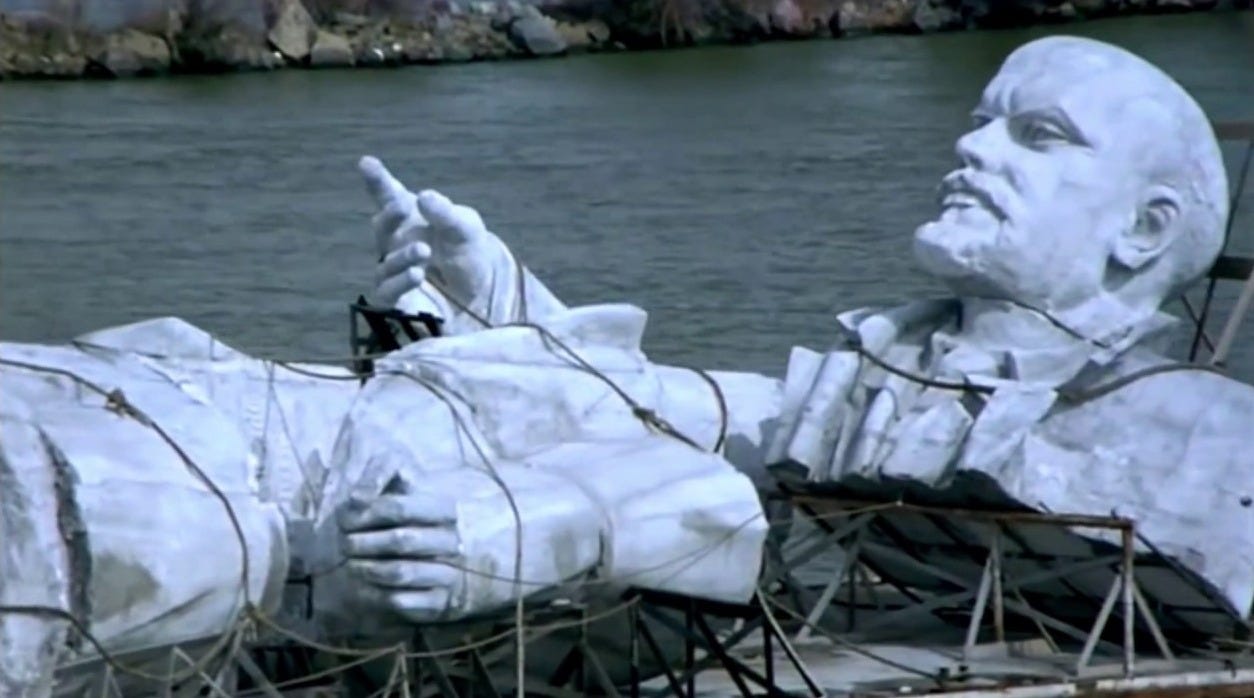 Source: Theo Angelopoulos’ Ulysses’ Gaze/YouTube
Those exist today, but they are smaller, shallower, more disconnected and less effective than they were even in the Bad Old Days of the 1980s. It was during that same decade that the ideological coordinates of neoliberal capitalism were diffused farther and wider. Thatcher and Reagan’s attacks on the very idea of a collective public good were thorough. Thorough enough to leave entire cities and nations stripped bare, and to be embraced by the rest of the political mainstream. There was no alternative, no future outside of capitalism. After the fall of the Berlin Wall, our historical horizons were curtailed even further: the end of history. In the following decades, with the climate fraying at the edges, “no future outside of capitalism” came to be a fait accompli, easily shortened to “no future.”
The much-mourned Mark Fisher also saw this. The “slow cancellation of the future” he called it, evident in mainstream politics, privatized social life, and a culture bereft of new ideas. It was a hallmark of his Capitalist Realism, the enclosure of our political and social imaginations, cutting us off from a utopian horizon.
But Capitalist Realism was published fifteen years ago. Since then, futurity has returned to the public discourse, kept buoyant by the gleeful cruelty of the rising far-right. Its visions of shuttered borders, hoarded resources, vast wastelands populated with the exiled and locked out: to many, these are indeed utopian. As China Mieville points out, utopia for some can be dystopia for others.
This is not to say that the thrust of Fisher’s argument has gone out of date. Our imaginations are still stunted. Yes, there are visions of the future on offer, but if anything they are even more shaped by the primacy of profit, by fear of the unwashed horde rather than the promise of the masses, by Great Men and sacred individuals. If anything it is a future more thoroughly shaped by the logic of capitalism.
In the midst of this, today’s anti-capitalist left is profoundly disoriented, our sense of proportion and continuity thrown off. Between immediate action and vision, there seems to be a complete divide, embodied in the orientation of different groups and organizations, sometimes within different wings of the same group, and even in the same individual.
On one end, the compulsion to zoom intently on the immediate horror. Don’t you see how bad it already is? it implores you. We must act now! All action, no thought. Just the hope that a radical enough gesture might shake everyone out of their complacency, without any consideration for their ideas or the slightest notion of what we might take action for.
On the other end, only an allegiance to the magnificent ends, less a utopian vision than a static fetish. The impulse to write off any rupture as too safe or too reformist. To apply litmus tests to allies and comrades. It is striking how alike these two ends are, for they both have no patience, no willingness to get entangled in the messiness of people’s ideas as they struggle to understand an existence that doesn’t make sense. Neither seem to provide people with much in the way of a meaningful place in history.
How, we might ask, does vision inform strategy? And vice versa? How does the smallest scale of fight reflect back to us the possibility of a fundamentally different order? It wouldn’t be the first time we’ve had to ask these questions.

At the risk of stating the obvious, the era of Bernie Sanders and Jeremy Corbyn is over. So is the effervescent space provided by these electoral movements, essential though they were in injecting talk of socialism back into the culture. We are left no option but to start over, to go back to the drawing board, to take fearless inventory of the gaps in our praxis hitherto filled by their momentum.
What we lack, more than anything, is a long memory. Generations of leftists and revolutionaries knew how to nurture their visions of socialism through their actions and interweave their most fulsome hopes into their daily lives whenever possible. If capitalism has a longue duree, then people’s sense of historical purpose was able to both encompass and transcend their individual lives.
This includes their defeats. The history of the left is full of them. Crushing, brutal defeats, far greater than the ones that we can remember. The kinds that leave people broken. Mass revolts failed, communes fell, global wars and waves of repression shattered millions of lives. And somehow, they managed to carry on, to rebuild lives and relationships, to find new places to plant flags and foster belief in liberation.
The most successful of these efforts would keep whole communities, even whole classes, together. They kept the defeated sane and comfortable in the knowledge that they might have the strength to push back once again. Sometimes these later struggles even won. Many did so without the buoyancy provided by an actually existing example of communism.
They also, quite often, did so without much of any social infrastructure other than the ones they made. Reading groups, social clubs, sports leagues, arts and culture groups – all of which naturally required a face-to-face interaction separate from any algorithmic mediation – had to be built from scratch. Little wonder that many of them carried with them an implicit, albeit frequently vague and sometimes contradictory, shared belief in the necessity for socialism. Though anyone who considered these formation the actual motor of social change was sorely mistaken, they nonetheless played an essential function in providing an incomplete experience of a way of life far more cooperative and rewarding. They were an essential part of the class’s infrastructures of dissent. They also provided places to reflect and heal during times of retreat. This is how a class isn’t merely articulated from the outside, but articulates itself.
In a recent post on the rise of Nigel Farage’s Reform Party in the UK, Jonas Marvin argues that without these kinds of cultures and infrastructures providing much in the way of ballast or counterbalance, we are lost. “We need an agenda that is not simply reactive but begins to rebuild politics, a sense of counterculture and organising habits in our communities,” he argues. He is also unequivocal that a new party of some sort – a mass vehicle that is able to coalesce the imagination of a class. Notably, he stresses that this organization, whatever shape it may take, cannot survive on dry materiality alone.
Forging a new political vehicle may also offer us an opportunity to do something that the right, both here and in the US, has proven so scarily successful at: remaking humans, or providing working class people the structures, tools and ideas to remake themselves and their lifeworlds around them. To sustain this, we must take seriously what the right does so well. We must reckon with the reality that people’s understanding of the world and how they relate to one another is increasingly mediated by the raw materials of culture that are unevenly scraped together to cultivate one’s sense of self, one’s subjectivity.
Meeting this psychic need is something the left has neglected or dismissed for way too long. It’s understandable why this has happened. For decades, it’s been all we can do to keep the most threadbare shadows of organization intact. That hasn’t been enough. While we’ve harped on the most material, often mind-numbing (though undoubtedly necessary) questions of political economy, the different sectors of the far-right have learned how to echo people’s desires in a grotesque but palpable way.
This is what’s going to characterize the coming years. The political force such visions are able to muster have started to answer the question of what comes after neoliberalism. Hence the defeat. Again, there is no reason to regard this defeat as inevitable or permanent, but we must at the very least acquaint ourselves with it. It has, after all, already acquainted itself with us.
As for the sinking feeling, it’s just history. We can participate in it or not, and it’s going to hurt either way. The only difference is whether the hurt proves worth it.
Header photo is sourced from National Archives and Records Administration.
Daydreams & Paving Stones is a reader-supported publication. To receive new posts and support my work, consider becoming a free or paid subscriber.


January 17, 2025
October in January
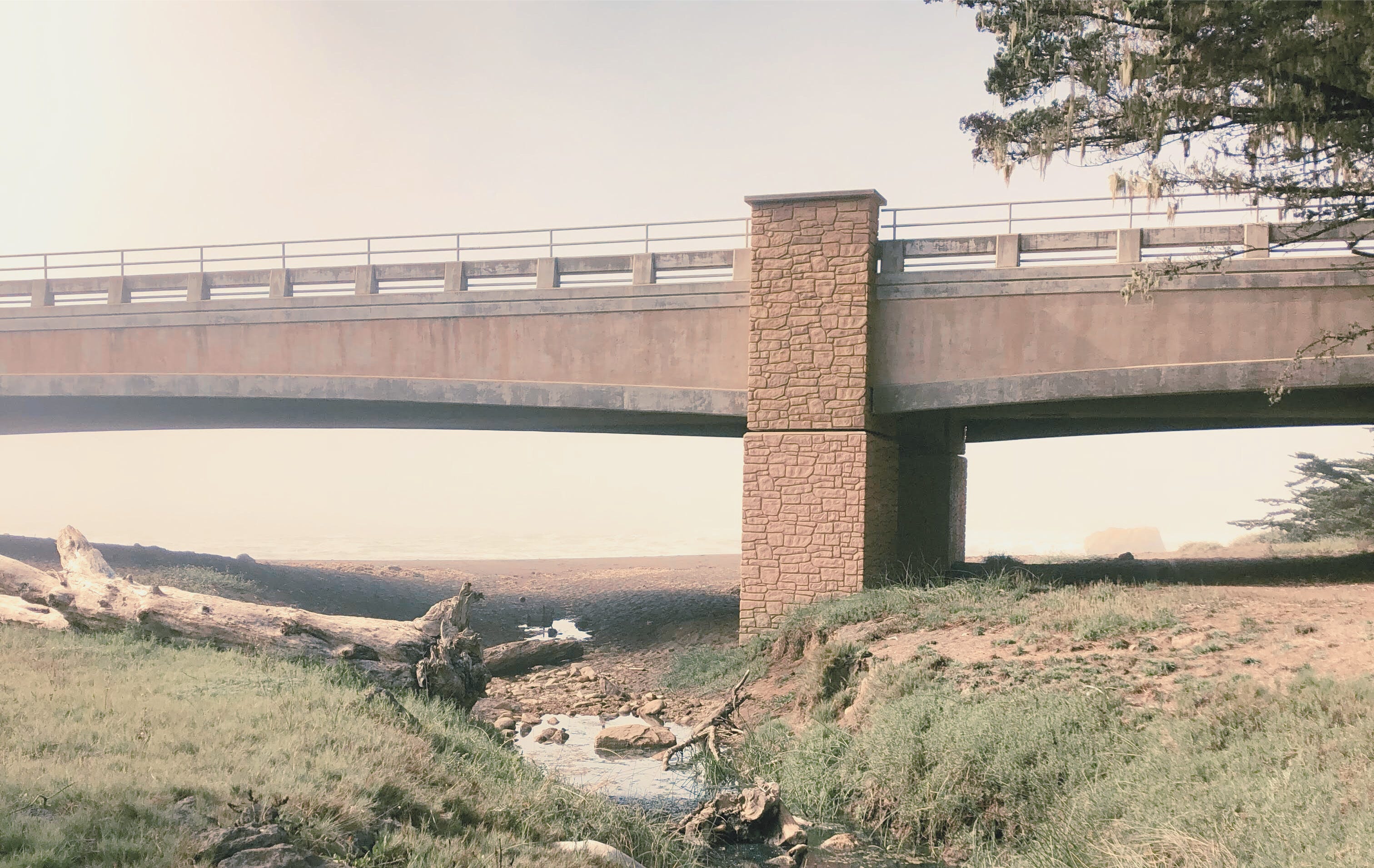
It was somewhere north of Santa Barbara.
We stood on the beach,
fog draped over the water,
sand collecting in our boots.
In our hands,
we each held a brick.
Then, winding back,
we heaved them into the ocean.
January 11, 2025
How to Charge Your Phone in a Disaster
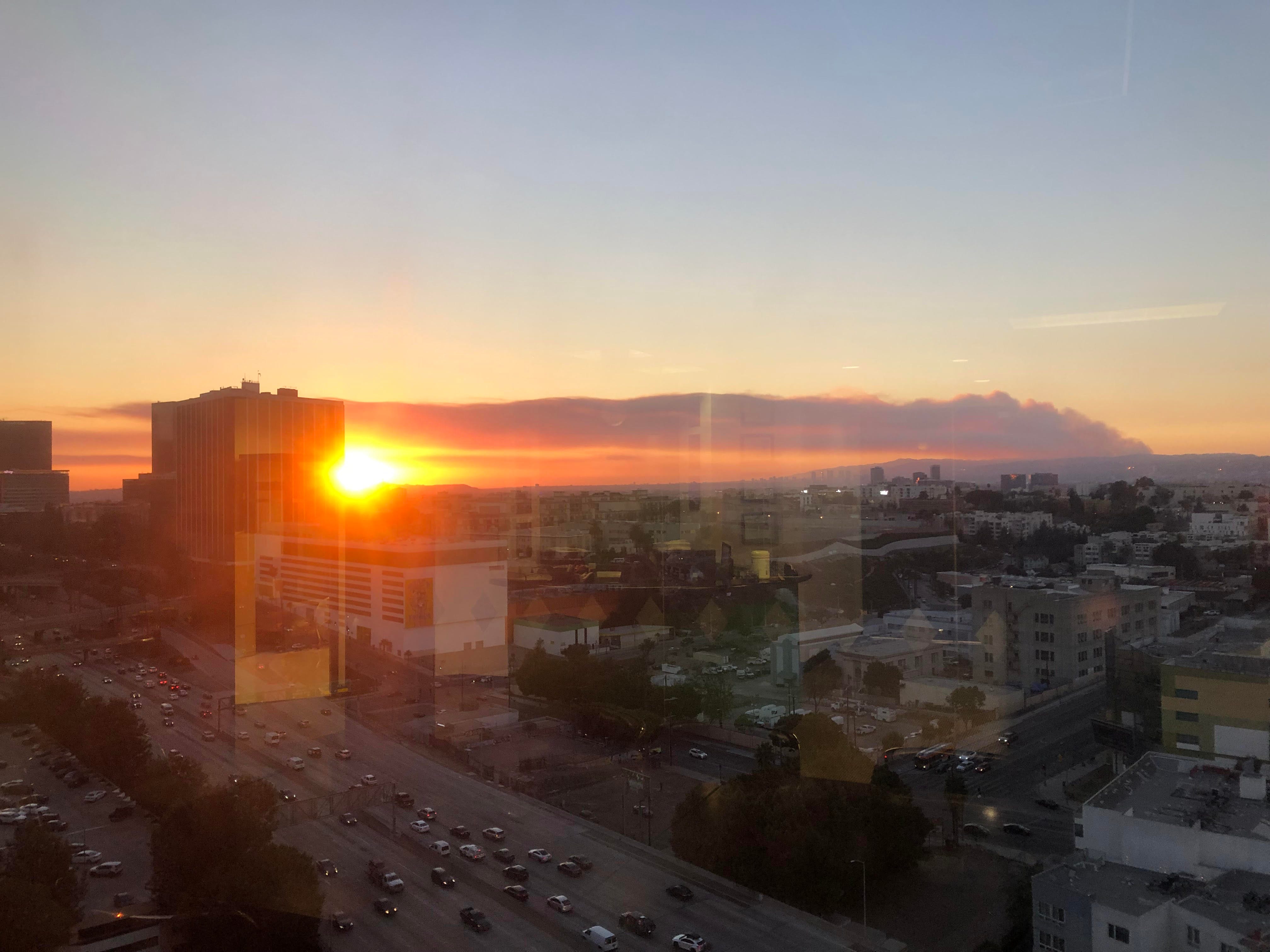
First of all, yes I’m fine. We’re fine. We have friends who aren’t, but we are fine. I am writing something far longer and more comprehensive about these fires and what they mean for the future of this fascinating, uncanny city. In due time. Meanwhile, I won’t ask you to sign up for a paying subscription like I normally do in these preambles. I will, however, ask you to look over some good and honest relief funds, like those being organized by the LA labor movement. This city’s going to need it.
On Tuesday night, our electricity went out. With winds up to a hundred miles per hour, we knew it could be in the cards. We swerved a couple of times during the drive home to avoid flying palm fronds and downed power lines. There are worse things than dealing with a power outage for a day or two.
It wasn’t back on the next morning, and our phones were on their last legs. In any other situation, a relief. A reprieve from the constant barrage of algorithms and comments and notifications, each one latching itself onto my brain, derailing every delicate train of thought and precious moment of psychological peace? Sounds fucking great.
On Wednesday, however, it was cause for concern. Everyone knew about the gathering inferno in Pacific Palisades on Tuesday evening. Given the speed of the Santa Ana winds, how quickly the Pacific Fire had grown to thousands of acres, it was clear this was going to be a big one. Still, living in the stretch of concrete and asphalt known as North Hollywood, it felt like one of the many disasters that happened to Los Angeles but not necessarily to us.
Like many wildfires over the past several years, this was clearly going to be one of those problems borne by LA’s better-heeled sections. The kinds of people we tend to associate with tony Pacific Palisades and Malibu. Judging from the number of people sharing “The Case For Letting Malibu Burn” online, I wasn’t the only one who thought that.
It does, however, seem that many of them are completely missing the point of Davis’ provocative piece, slinging it round with a sense of gleeful schadenfreude. His argument, for anyone who reads the full essay, wasn’t one borne of simple class spite, though he rightfly had plenty of that. It was far broader and more humanistic: it is the poor who ultimately bear the biggest brunt of natural disaster, and the very shape and design of Los Angeles ensures that.
Speaking of the poor, we had to go to work on Wednesday, even if the morning’s news greeted us that the Palisades Fire had spread, that the Eaton Fire had grown, that there was now a blaze in Sylmar, along with a smaller one at the Sepulveda Basin Wildlife Preserve just 3.5 miles away from us. I also needed my phone charged if I going to receive evacuation orders. Unfortunately, our building’s garage door was electric. This wouldn’t have presented a problem if there was another way in; we could simply go in and open the door manually. As it was, we had to wait for help to unlock and disconnect everything. No work for me today.
We got everything opened up a few hours later, with the help of a neighbor. By then, the Woodley Fire in Sepulveda Basin had been controlled. All others were spreading. This we learned with quick and efficient glances at our phones, either through friends’ and family’s texts, or through the Watch Duty app. At least we now had a car, and therefore a way to charge our only reliable connection to emergency news.

The past several days have left everyone speechless. The only word I can think of to describe all this is “awesome,” though even in its most cosmic-numinous sense, this falls short. In my long essay on Covid-era Los Angeles for Salvage a few years ago, I wrote “The city of late-late capitalism – of which LA is a prime example – plays a role less Promethean and more Lovecraftian: prone to release forces utterly indifferent to human life through its recklessness and myopia.”
That comes a lot closer. Wildfires spread with magnificent speed and unpredictability. That something without aim and purpose is capable of such absolute devastation doesn’t feel correct to the modern human mind. What arrogance. What foolishness. What better tragic display of how disconnected civilization is from the metabolic substrates that make life possible.
Now, instead of taking the necessary pause to ponder the series of utter travesties that brought us to this point, we are forced to think of the piddliest and most mundane matters for the sake of our survival. Charging our phones. Going to work. Past generations had air-raid sirens, could rely on neighbors and community to bang on their doors if things went too far sideways. They also had as many employers who couldn’t have cared less if our houses burned down, who would fire back their own versions of “but you’re still coming in, right?”
That anyone has to continue working at all through this, instead of finding safety for themselves, their families and neighborhoods, should be a ludicrous notion. Amazon is getting its share of PR by setting up relief centers, while still sending its drivers out as the fires rage. There are even reports (albeit unsubstantiated) of drivers discovering that the address their delivering to is in an evacuation zone. Given that some waited so eagerly for deliveries even after the evac orders had gone out, this may have been inevitable.
Not that I necessarily blame everyone who willingly went into work on Wednesday. Were my wife and I not a one-car couple, I might have been tempted to go in myself just to have something to occupy my mind. Our world makes it incredibly easy to bore ourselves to death. It’s why we tear each other apart so easily online. Not only do we have nothing else to do, our specific, algorithmic mode of existence has made it so we wouldn’t know how to do it if we did.
Conventional knowledge tells us that if we were somehow able to stop doing what we’re doing, then nothing would work. Ipso facto, the people who need the most help wouldn’t get it. Thinking of this, I find myself returning to the work of Max Horkheimer – who himself lived for a brief spell in Pacific Palisades during World War II, before the area was transformed into a wealthy enclave. Here he is in Eclipse of Reason:
The very idea of truth has been reduced to the purpose of a useful tool in the control of nature, and the realization of the infinite potentialities inherent in man has been relegated to the status of a luxury. Thought that does not serve the interests of any established group or is not pertinent to the business of any industry has no place, is considered vain or superfluous.
Another way to put this is that everything that serves a purpose must serve the purpose of the society that produces it. If that society deems it a waste of resources to stop everything and help everyone in the midst of a disaster, then the sane question would be to ask how worthwhile that kind of society has become. But then maybe I’m just vain…

My phone is several years old. It doesn’t hold a charge like it used to. I have an external battery, but even with, even with a few hours after spending all day in the car with the engine running (because that seems fucking safe in a fire), it didn’t take long for it to drain back down. With the sun setting and our power still out, and about to crawl out of our own skin from anxiety, Mrs. Daydream and I decided to head to a bar just a ten-minute drive away to get some warm food and find a free outlet. By this time both the Eaton and Palisades Fires had grown to well over 10,000 acres, but the evacuation watch for much of central LA was just lifted.
It turns out we had breathed too soon. The Sunset Fire had just sparked in the Hollywood Hills, growing from just 10 acres to almost a hundred within a couple of hours. In the heart of the San Fernando Valley, we were now surrounded on all sides by fire. While keeping our phones plugged in, we did what we could to make sure friends and family were safe. Many had to evacuate. We finally caught up with some friends who, as it it turns out, had already lost everything.
Still, they were alive, and for the time being had a place to sleep. Between this and the knowledge of our own apartment’s relatively safe location, we felt relatively lucky. And we probably still are. Still, we now know that we’re in the middle of “the Big One.” Los Angeles seems to live in a constant state of vigilance the Big One. Historically, the Big One has been an earthquake. After the heavy rains of 2018-2019, we were reminded of the floods in our past. I suppose the Big One in fire form was always in the back of our minds.
In other words, we’re in uncharted territory. Climate change is seeing to it in its cosmically horrific instincts. Then the news came in of a house fire in Studio City, just a couple miles from us and from our apartment. Embers? Arson? Who cares? Maybe the likelihood of it finding its way to us was still low. Again, who the fuck cares? We unplugged, ran to the car, and set off back to our dark apartment.
On the way we passed the new fire, now being referred to as the Sunswept Fire. It was about fifty feet up a steady incline, right as the Hollywood Hills first start to remind the Valley of their existence. The house was already starting to collapse. At home we threw clothes into bags, grabbed our box of important documents (passports, birth certificates, marriage license and the like), and pulled out the cats’ carriers.
We knew it wasn’t time to leave – and in any event, where could we go on such short notice that wasn’t equally vulnerable? All there was to do was sit and wait in the dark, and, eventually, try to fall asleep.
You might think it would be easy to feel sheepish the next morning. The Sunswept Fire had been easily contained, though not before it damaged several other houses nearby. The spread of the Sunset Fire had been stopped, and the Hurst Fire had shrunken down. Both the Palisades and Eaton blazes were more or less the same size. Our electricity had even come back on. There was no excuse to stay home from work, though driving into Downtown over the Hill, a thick canopy of orange-gray haze hanging overhead, was eerie. Perhaps the worst was behind us.
At work, it was difficult to focus. My gaze kept finding its way to the red-purple plume surging up from the northwest. The Palisades and Eaton Fires had started growing again. Combined, they had consumed almost 40,000 acres. That’s more than 60 miles, almost three times the size of the island of Manhattan. The deathtolls have started to come in.
As I write this, the Palisades Fire has extended into Brentwood, and evacuation zones into Encino and Tarzana. The Santa Anas have picked up again, and are expected to intensify in the coming days. Some friends have been able to return to their homes. Others have had to prepare to leave. Our car remains packed.
One wonders if today’s Big One is tomorrow’s new normal. Some say it’s vain to wonder if there’s a better and more rational way to run a city at a time like this. Personally, I think it’s unforgivably stupid not to.
Header photo is of the smoke from the Palisades Fire, taken by the author from Downtown Los Angeles.
Daydreams & Paving Stones is a reader-supported publication. To receive new posts and support my work, consider becoming a free or paid subscriber.
December 29, 2024
Worms of the Senses (December 2024)
Welcome to the second edition of “Worms of the Senses,” a monthly feature at That Ellipsis… where I reflect on the most notable things I’ve seen, heard, read, and thought in the past month. Last month’s “Worms” was for paid subscribers only. Maybe it’s the holiday spirit grasping my shriveled heart, but this month I’m giving you a sense of what you’re missing. That said, if you haven’t yet signed up for a paid subscription, now’s your cue.
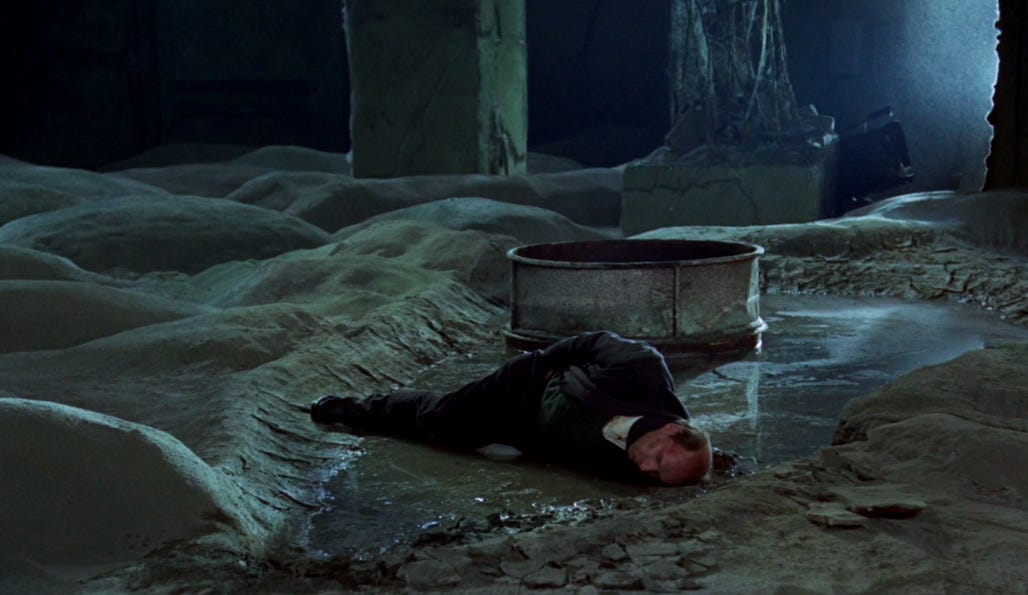
Seeing…Stalker, directed by Andrei Tarkovsky, screenplay by Boris and Arkady Strugatsky (1979). In retrospect, it’s rather surprising it took me this long to watch Stalker. Not only is it universally acclaimed as one of the greatest science fiction films ever, made by one of the undisputed masters of Soviet cinema, but Roadside Picnic (on which it is based) has had a fairly significant impact on my own writing.
Better late than never. Yes, Stalker is a masterpiece of modern sci-fi cinema. It belongs up there with A Clockwork Orange, Metropolis, Blade Runner, the first two Terminator films. There has already been so much written and said about it. How its story and tone seemed to predict the Chernobyl disaster. How effectively human ontology is rendered as something that can be estranged in odd, eldritch ways. I won’t rehash it here.
I will however say that making a three-hour film about our constant cosmic frustration with our human limitations should be easy. Not hard. Easy. Particularly when you embrace the slow pace of this melancholia. Yes, I know what I’ve written, and I stand by it. There is nothing more human than frustration with being human. It sounds trite for a reason.
But because most of us barely admit these thoughts to ourselves, effectively collectivizing them is a clumsy affair. It requires three hours of film. It requires sparse dialogue. It requires long and pensive shots. And through all of it, you need to be entertained, enthralled, mesmerized by your own boredom. What should be easy becomes near impossible. Tarkovsky pulled it off probably better than anyone else could have.
Say Nothing, created by Joshua Zetumer, airing on Hulu (2024). Even at the center of controversy, this series ran the risk of being utterly unremarkable, another transformation of history into moralistic finger-wagging about “the futility of violence.” Thank fuck it wasn’t. There is a real sensitivity and complexity brought to the (real) characters and to the (very real) terrorism they carried out as part of the IRA in the 1970s.
Calling it terrorism seems apt here, but only in its most descriptive, diagnostic sense. The starting point is that Northern Ireland was occupied, its Catholic citizenry discriminated against, and their right to resist it isn’t called into question. The efficacy of the means used to do so are a constant point of contention, but it never devolves into trite, boring “a plague on both their houses” territory.
 From Say Nothing (Hulu).
Speaking with friends, I’ve compared it with The Battle of Algiers. Not in terms of the level of brilliance, but in terms of its willingness to portray brutal realities of resistance in a manner that neither romanticizes nor villainizes nor questions on which side you the viewer should ultimately fall. Given Gaza, given the controversial fanfare that continues to swirl around Luigi Mangione (more on that below), it is worth watching. I’ll also recommend this interview with showrunner Joshua Zetumer that appeared in Jacobin to further dig into it.
Wicked, directed by John M. Chu, screenplay by Winnie Holzman and Dana Fox, music by Stephen Schwartz (2024). I mostly despise musical theatre. Not because of what it intrinsically is but because of the role it’s come to play in our culture: a whole lot of singing and dancing designed for synthetic joy rather than the deep probing of human existence. The heightened psychological state of “I can only express this through song” makes for great opportunities, but most composers and writers fail to take advantage of them. They should be looking to work in the oeuvre of Threepenny Opera or Assassins. Instead they just want to emulate Andrew Lloyd Webber. Or at least that’s what Broadway producers choose to fund. Another reason Broadway is dying. Particularly now that Hollywood has rediscovered the musical format.
I assumed my experience of Wicked would mostly confirm this. Something about the amount of time during theatre school spent forced to listen to “Defying Gravity,” usually in that cloying, insipid, “please admire me” tone really soured me to it. Tragic. Mostly because it biased me against what is ultimately a very sharp and intelligent piece of theatre. In terms of the film, it's executed very well. The acting and singing are strong – including Ariana Grande but especially Cynthia Erivo. The art direction, costuming. and scene design are close to perfect, despite some unnecessary use of CGI. There are further, somewhat tangential thoughts on it in the “Thinking” category below.
Hearing…Music for Psychiatric Wards and Fluid Structures by ADRA (2024). When we talk about how music changes space in a literal sense, this is a pretty good example. Andy Abbott made these compositions playing once a week in psych wards across Yorkshire over the course of 2023. He would walk in with an instrument or two, and, taking a cue from the mood, improvise. It’s eclectic, frequently relaxing, but also spiky and playful.
If we are used to thinking of ambient music as primarily electronic, this album challenges this notion. Some tracks, such as the one featuring the ambient music board (which, from what I can tell, is something Abbott built on his own), fall squarely in that colloquial definition. Others are more “organic,” using little more than a slide guitar.
Think back to Satie’s musique d’ameublement experiments, often viewed as the beginnings of what we now call “ambient.” No less a figure than Brian Eno sees the genre as continuing what Satie started. His intent was to spur different impulses in the listener, how they interacted with the room. Of course there were no synthesizers or effects because they didn’t exist in Satie’s day, but there is essentially no difference in aim. If Abbott walked into the ward and saw things too morose, he would improvise something more upbeat. If the energy was more chaotic or frenzied, he would play something to calm things down. Change the mood of the people occupying a space, change the space. Simple.
Mondo Decay by Nun Gun (2021). Nun Gun is a side-project of Ryan Mahan and Lee Tesche from the band Algiers and visual artist Brad Feuerhelm. It also invited guest collaborations from Adrian Sherwood, Mark Stewart (RIP), as well as a variety of other illustrators and artists. As you expected, it is one of those projects that really requires the full visual and audio to actually experience; Feuerhelm’s full 144-page photo book and the video for “Stealth Empire” are absolutely worth getting immersed in. Even without those, you’re still left with a strong example of harsh, dissonant/dissident industrial dub. Sherwood’s presence on the remixes of “Stealth Empire” is prescient in this regard; fans of his Dub Syndicate and Tackhead will probably dig this.
Nothing Can Stop Us by Robert Wyatt (1982). Is this Wyatt’s least cohesive album? Probably. But there’s a certain infectious charm to listening to him reinterpret some of the classics: “Strange Fruit,” “The Red Flag,” “Caimanera,” Elvis Costello’s “Shipbuilding,” Violetta Parra’s “Arauco.” Just about the only really unlistenable track is “Stalin Wasn’t Stallin’,” and not just for political reasons. That said, ending the album with Peter Blackman reading his poem “Stalingrad” is a quietly brilliant move.
Reading…“The Tale of the Unknown Island” by Jose Saramago (1997). An impulse buy while at the Saramago Foundation in Lisbon last month. A puckish satire about rulers and dreamers masquerading as a lovely, whimsically mischievous fairy tale. Saramago is deft at the more surreal iterations of satire, reflected in his short-story collection The Lives of Things. “Unknown Island” is a bit more subdued at first than those works, but the story’s bite – a plain suggestion that kings and their courts are puzzled by nothing so much as their own self-knowledge – steadily comes into focus. This edition also has some lovely illustrations by Peter Sís.
Left-Wing Melancholia by Enzo Traverso (2017). This book has had more impact on me than probably 95% of the books I’ve read over the past decade. Adam Turl and I wrote a long essay that reviews and pivots from its arguments back in 2018. Most of those arguments, and those of the essay, are even more relevant now. Its core assertion, that the collapse of “really existing socialism” essentially broke the utopian dialectic of the 20th century, has only become more prescient in the years since its publication. Traverso never gives up on the communist ideal, or suggests that we should. But with no idea of a better world held out for us, the aims and strategies of the left have been unmoored. We have no choice but to try to cobble it together out of the wreckage.
It’s not altogether unlike the observations of Mark Fisher in Capitalist Realism: the elimination of an alternative from our sense of possibility, turning Thatcher’s adage into a self-fulfilling prophecy. It’s also an argument that holds a lot in common with the editorial outlook of Salvage (in fact, if I’m remembering correctly, Salvage ran an excerpt from the book not long after its debut).
The difference between when the book was published and now is obvious. It’s one of the reasons I thought now was the right time for a reread. There is, in a way, a viable competitor to the dead ends of neoliberalism. It will inevitably reveal itself as a mirage, though there’s no guarantee it will do so before it’s too late. But there’s no denying that Trump, whose reelection is indicative of the far-right’s undeniable and ongoing ascendance, has seized the imagination of a sizable portion of the world’s population. Its utopia is a sick one, depraved even, but it is creating its own dialectical pull against the deadening drone of late-late capitalism.

This isn’t to say it’s impossible for a renewed socialist vision to enter into this landscape. It will, however, be facing a more venal and unhinged version of capitalism than has possibly ever existed. In this regard, it is worth considering the melancholy of not just the subject matter, but its author. Traverso spends much of the book exploring how much of the socialist vision of the future pivots from the memory of defeats. Given the viciousness of the capitalism we’re about to face, it’s likely we’ll have no shortage of defeats to nurse. Whether we are able to cultivate an actual vision from them is an open question.
Profane Illumination by Margaret Cohen (1993). Rather a surprise it took me this long to read this book, but after being asked to write the piece on surrealism at 100 for Against the Current, I realized there was no further waiting. It is, bluntly, the best book written on the theoretical base of early surrealism.
Despite the subtitle, large parts of Profane Illumination are more preoccupied with the thought of Andre Breton than they are Walter Benjamin. Breton is universally recognized as the primary early surrealist thinker, but short shrift is normally given to the actual substance of his thoughts. His Marxism held much in common with that Benjamin’s: bristling at the hidebound, paint-by-numbers thought of the official communist movement, less concerned with the realities of labor than by the various psychological repressions that would be eased by the end of work, curious about the histories hidden by the geographies of the modern city.

Cohen examines all of this, aiming to shed light on the meaning of gothic Marxism and the adjacent surrealist concept of “modern materialism.” Many of the conceptual spaces she opens up along the way probably merit their own book. There’s a chapter that relates the interaction between conscious and subconscious to the framework of base and superstructure. Other sections use Breton’s own books – Nadja, Communicating Vessels, Mad Love – to better illustrate place, person, and the strange psychological phenomena that emerge from their chance encounters. She also draws lines between these and thinkers who have rarely been considered in the same breath as surrealism or Walter Benjamin, in particular Louis Althusser.
Reading Profane Illumination in tandem with Left-Wing Melancholia also produces some interesting affinities. If we are, as I mentioned above, going to cobble together a viable socialist utopian vision that can vie for influence with capitalism at its most unconscionable, then we are going to have to grasp the histories of defeats, their lessons, and their redemption far more concretely. This, in turn, means walking down a city street and seeing the battles that took place there, even the ones that were never recorded. It also means seeing ourselves as more pliable: susceptible to these same defeats, and capable of new syntheses between us and these chaotic, ongoing and unfolding teloi.
Thinking…On Syria. I find myself surprisingly numb to the fall of Assad. He’s gone. Good. He is a vicious, authoritarian monster who tried to drown every inkling of democracy in blood. A more just world would have him sitting in the dock at the Hague rather than cavorting round Moscow. That his brittle regime fell so easily after all this time attests to this. Celebrations are warranted. Not that any of the countless who have lost family and comrades, or the thousands of prisoners who have spent years being tortured and starved, need my sign-off.
In another respect, the joy around Assad’s fall feels like a faint echo. I am not the only one who feels it like this. Tunisia, Egypt, Yemen, Syria: these were places that, fifteen years ago, piqued hopes around the world for people who’d had the bottom dropped out from under them by the 2008 crisis. They provided the beginnings of a schematic for something better, an actual alternative. Those of us who had been around for the global justice movement ten years prior were excited to see some veracity brought back to the idea that another world is possible. That it was the Arab world putting it in practice, pushing back on a decade of War on Terror Islamophobia made it all the more poignant.
Looking back on these revolts now drums up a distinct mix of pride and regret. Pride because of the above. For many of us, it felt like our 1968. Regret because we failed. Yes, in the telos of socialism and liberation, all failures should be seen as temporary. We don't have a choice. But we still failed. So did all the upsurges that came out of ‘68.
In Egypt, the fall of Mubarak led to democratic elections and a flourishing of popular protest before El-Sisi’s coup. He’s been in power for ten years, and his rule hasn’t been much different from Mubarak’s. Many Tunisians fear, not without reason, that current president Kais Saied is simply a new Ben Ali. Yemen’s civil war has transformed the country into a charnel house. Israel’s pulverizing of Gaza plods along; it’s extended into Lebanon, and now, further into Syria’s Golan Heights.
So yes, the ouster of Assad can only be a good thing. But the context is starkly different. Many of the diasporic Syrian left seem to feel the same way. In all the various factions now angling for control, the lack of a strong and vibrant left is noticeable. A notable exception is in the Kurdish northeast, though even its radical democratic experiments have foundered for some time thanks to its internal contradictions and external isolation. Given the patronage of Turkey, it is highly unlikely that Hayat Tahrir al-Sham will simply leave the Kurds be. Ultimately, we have no idea what comes next. It highlights how big of a watershed moment this is for the Levant and the Middle East. Jamie Allinson of Salvage has some words about it that are far more incisive than mine.
More on Luigi Mangione. I’ve said most of what I have to say on the matter in this post from earlier in the month. In that piece, I allude briefly to how Mangione’s arrest will complicate the narrative of those sympathizing with him. That’s happened, but in a manner far stupider than what I predicted. It’s rather pathetic to see Fox News, Marjorie Taylor Greene and Ben Shapiro paint Mangione as some Marxist wacko when his very syncretic beliefs were so amply broadcast after his arrest. I’m not sure how effective it’s going to be in hiving off sympathy with him.
I’m also not sure it matters that much. This whole episode has been notable for how divergent most arguments in the mainstream media are from the broad sympathy Magione has elicited, and yes, that sympathy spans the political spectrum. But the past several years have shown how little public opinion matters when the right is able to construct even the most tenuous narrative against something. It matters far less in terms of the outcome of Mangione’s case and far more for the people who identify with him and are already political targets. The left already has a huge target painted on it, particularly on college campuses. All the more reason to go onto the offensive, to politicize this moment. To argue – if you’ll excuse the flagrant sloganeering – that the healthcare system should be on trial.
More on Wicked. Wicked is a reimagining of The Wizard of Oz, a kind of alternate history of the tale. But what of the alternate-alternate histories? What I mean by this confusing question is that from its inception, all of the Oz properties have been highly mediated ruminations on the notion of utopia. To reinterpret them – be that through film or further books (original author L. Frank Baum wrote 14 in total) – is itself to unavoidably add something to this contemplation. And it is one of the reasons that the story of Oz continually returns to the cultural landscape, from the beloved 1939 film adaptation through to today.
To reimagine is a necessarily utopian act. It starts with the idea of creating a world discrete from our own. Baum’s ideas about how the world “should be” were at best contradictory: he was a broad populist and women’s suffragist who voted Republican and occasionally defended the genocide of the indigenous. Gregory Maguire’s 1995 novel Wicked (on which the musical is based) builds on Baum’s tropes and ideas and reworks them to home in on themes of conformity and repression.
You could argue – and many have – that these kinds of subversive reinterpretations are there in the best-known reimaginings of Baum’s universe. The lyrics to “Over the Rainbow” were written by socialist librettist Yip Harburg. Dorothy’s family’s struggling Kansas farm – and the desire to escape it – was bound to read a very specific way in 1939 at the height of the Great Depression and with the Dust Bowl in very recent memory. In other words, there is something very particular and very interesting happening with the film Wicked that far supercedes what is happening in the film or its source materials, that contrast the 20th and 21st century notions of utopia running parallel to “the real world.” I’m not sure a full essay on the matter is merited (or particularly interesting) but my interest is piqued just enough that it might be the center of a future writing project. Of some kind. Maybe.
Header image is from Tarkovsky’s Stalker (1979).
That Ellipsis... is a reader-supported publication. To receive new posts and support my work, consider becoming a free or paid subscriber.
December 17, 2024
Inquisition Disneyland (Iberian Daydream, part 4)
For most of November, I was on my honeymoon in Spain and Portugal. Thanks to my incessant graphomania, you get to see my attempt at a travel journal as I journeyed from Porto down to Lisbon, into Spain by way of Seville, up the eastern coast, into Barcelona. Cathedrals. Narrow, winding streets. Historical episodes trivialized. The first and second in the series can be read here and here and here. Also, if you haven’t subscribed or upgraded to a paid subscription, do it now.
XVII.
We were staying near the Catedral de Sevilla, so we shouldn’t have been surprised. We had drinks at a small cafe, and were walking back to the hotel. A lot of people seemed to be wearing suits or formal dresses, but this is one of the more conservative parts of Spain, and there were plenty of commercial districts nearby.
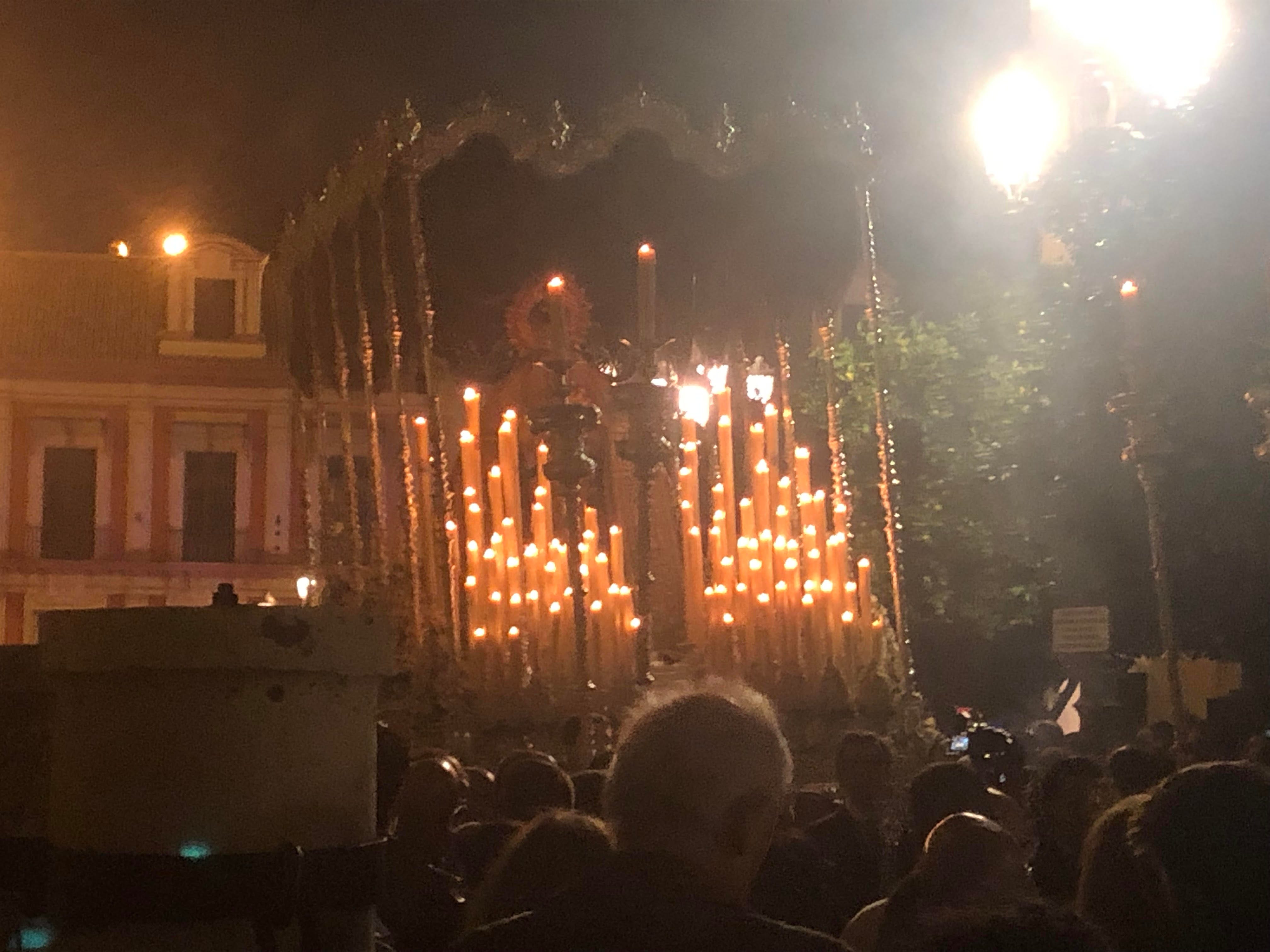
Passing by the cathedral, the crowds got thicker. They were watching a line of young men in suits carrying large walking sticks with candles at the end of them. Most of them had a haunted look in their eyes, glazed but somehow determined.
I was uncomfortable. Mrs. Daydream was just curious. Using her rusty Spanish (still better than mine), she asked someone passing by. “Excuse me, sir. What is this procession?” He looked at her like she had asked what continent we were on.
“It’s a procession,” he answered.
“Yes, but what for?”
He spoke slower. “It’s… a… procession.”
The idea of a procession being for a procession was certainly novel. Also depressingly nihilistic. It had the ring of a practice whose origin had been obscured by the millennia but no one dared stop. No meaning, no resonance, no poignancy. Just the inertia of ritual for ritual’s sake. Why do we do this? We do this because we do this.
She did her best to clarify. Finally, either feeling sorry for these poor curious souls or simply wanting to get the hell away from us, he did his best to answer. “The procession… is for Jesus.”
It was an underwhelming answer. This was clearly a Catholic procession. Just about everything they do is for Jesus, but normally it goes through one of a whole constellation of saints, martyrs, and apostles. One of the reasons I’ve always been puzzled by the stark division between monotheism and polytheism. Isn’t it all one? And isn’t that one so multifaceted?
As it turns out, the frustrated passerby was only half correct. We turned and saw a massive canopied platform, again carried by a few dozen young men, adorned with lit candles and a large Virgin Mary figure in the center. It was stunning. It was awe-inspiring. It was also terrifying, for reasons I couldn’t fully articulate.
Back at the hotel, the scenes on TV provided a better explanation. Inside the cathedral, hundreds of beefy men vaulted themselves over each other, completely indifferent to injury or to damaging their Sunday best, all to get a chance at touching the figure of the Virgin Mary. Pulling, pushing, climbing, occasionally throwing punches just to get a single foot closer.
From what I could tell, nobody was doing anything to allow for cooler heads. To suggest a nice orderly line so that everyone could get a chance to show their devotion and be blessed by Jesus’ mom. I felt like I was watching scenes from the Hillsborough Disaster. Only this time it wasn’t people panicking beneath the weight of the human crush, but eagerly participating. This wasn’t a scene of mass devotion. It was a scene of unbridled frenzy: a crowd of individuals showing dangerous indifference to others’ safety to be most blessed.
Only at the end of the news segment did it become clear that this footage was from a different procession, in a different part of Andalusia. From the sound of it, it is easy to confuse them. We learned the next day that Seville has more Catholic processions than any other city in Spain. During Holy Week, in the lead-up to Easter, there are often several a day. Organizers and city planners do their best to ensure their routes don’t collide, but it is frequently futile. Scenes of iron-faced church members, some in elaborate costumes, entangled at corners and intersections, unsure which direction to go, fearing that if they guess incorrectly they’ll wind up at the wrong destination. I wondered if brawls ever broke out in these situations, like they did on the TV.
XVIII.
Spain’s reputation is often that of a crazed Catholic nation, but the fact is that only about 50 percent of the country identifies as part of the faith, with only about a third of them identifying as practicing. Percentage-wise, there are more Spanish atheists and agnostics than there are devoted Catholics.
Still, that 50 percent stands, in part, thanks to a rather unsavory past. During the Franco years, the Church worked hand-in-glove with the regime to strengthen its legitimacy, and Catholicism was the preeminent spiritual force in public life. Which isn’t to say that every practicing Catholic was happy with the level of political and cultural repression in Spain. Far from it. The Catalan, Galician, and Basque languages were legally banned from being spoken in public. Predictably, any opponent of fascism – be they anarchist, communist, liberal, or nationalist, and no matter what faith – was imprisoned, and often executed.
Forty years of this kind of governance can warp memory quickly. Under Franco, the Spanish Inquisition – hundreds of years of forced conversion and medieval torture – was viewed as a positive, a necessary purge of heretics and dissenters to preserve Spain’s cultural purity. It even produced its own form of denialism, roughly akin to the kind we’ve increasingly seen around the Holocaust in recent decades. According to some thinkers, including those with jobs at serious academic institutions, the Inquisition is nothing more than a “black legend” perpetuated by nefarious Protestants to defame Catholic Spain.
Seville holds a notable place in the history of the Spanish Inquisition. It was here in 1481 that Spain’s first auto-da-fé took place. Twelve men and women were accused of practicing Judaism, and burned at the stake. We say “accused of practicing Judaism” because by that time there was for the most part no real way to pick out a Jew in public. The phenomenon of the converso already existed by this point: Jews who had, willingly or otherwise, converted to Catholicism. There was always the possibility of practicing in private, though, and many did.
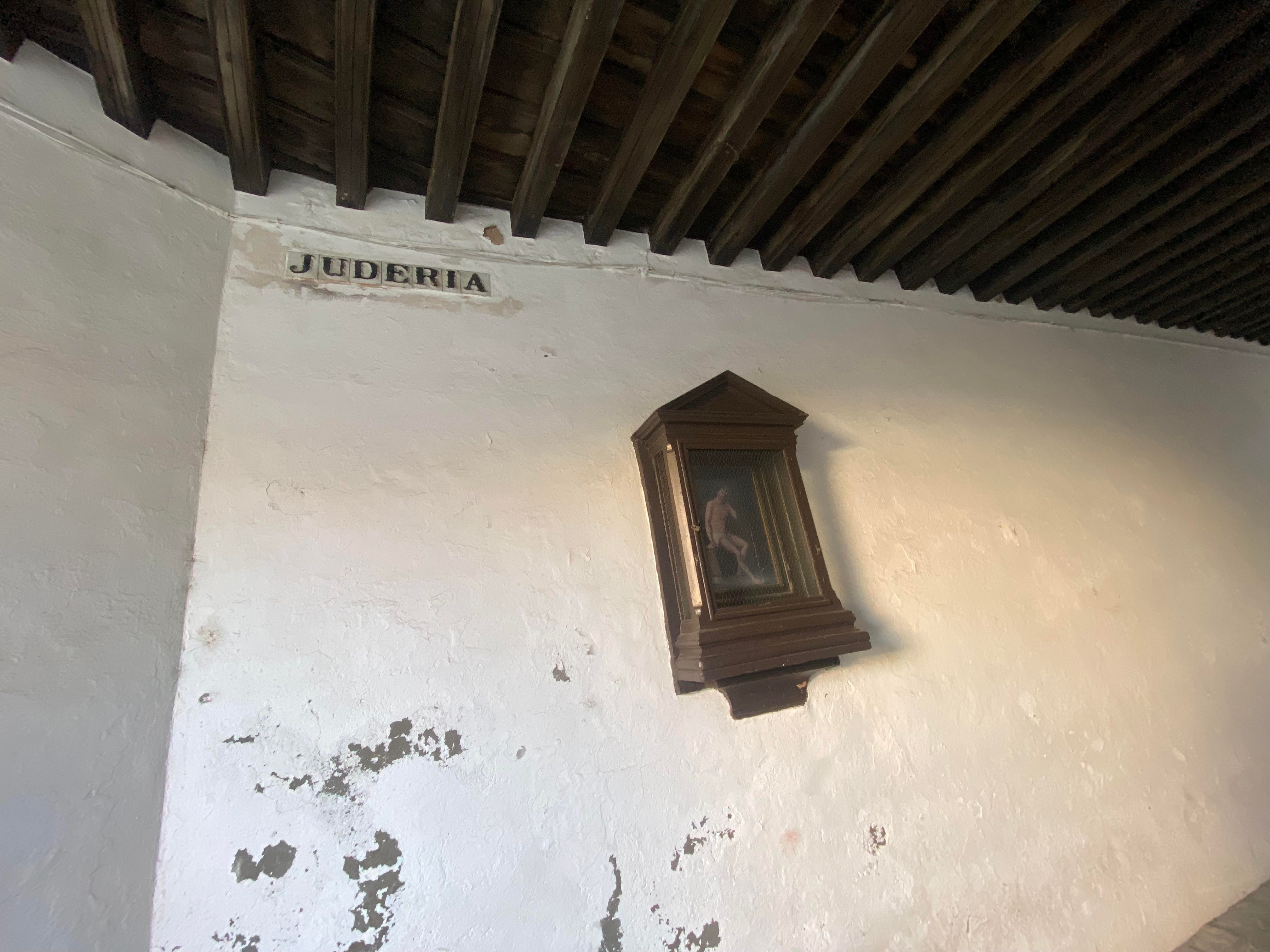
In 1391, ninety years before the first auto-da-fé, with the Black Plague slithering its way across the continent, residents of Seville and other Spanish towns rampaged through their Jewish Quarters, massacring Jews left and right. In Seville, the pogroms were aided by the architecture. In 1248, after Ferdinand III seized the city from the Muslim Almoravid dynasty, Jews were moved into what became the Juderia, right next to the palace. Many affluent Jews aided in trade and money-lending, and the nobility wanted them easily accessible.
Only a few small entrances allowed entry into the area. Any army trying to invade the Jewish Quarter would be slowed, as they would by the narrow, winding streets. During the 1391 massacre, these defenses turned the Juderia into a death trap for its residents. Four thousand Jews were killed.
XIX.
You can see the various layers of history in Seville. It’s well known that before all this was Andalusia, it was Al-Andalus, passing through a succession of Islamic dynasties. Prior to that it was briefly ruled by the Visigoths and Vandals. Before them, it was a Roman province, and before that, it was the Phoenecians. When entering an old enough building, you step down from the doorway of one epoch onto the floor of another. The Catedral de Sevilla started as a mosque. It took a few hundred years to be completed and added onto. You can see Islamic, Gothic, and Renaissance eras on its facade.
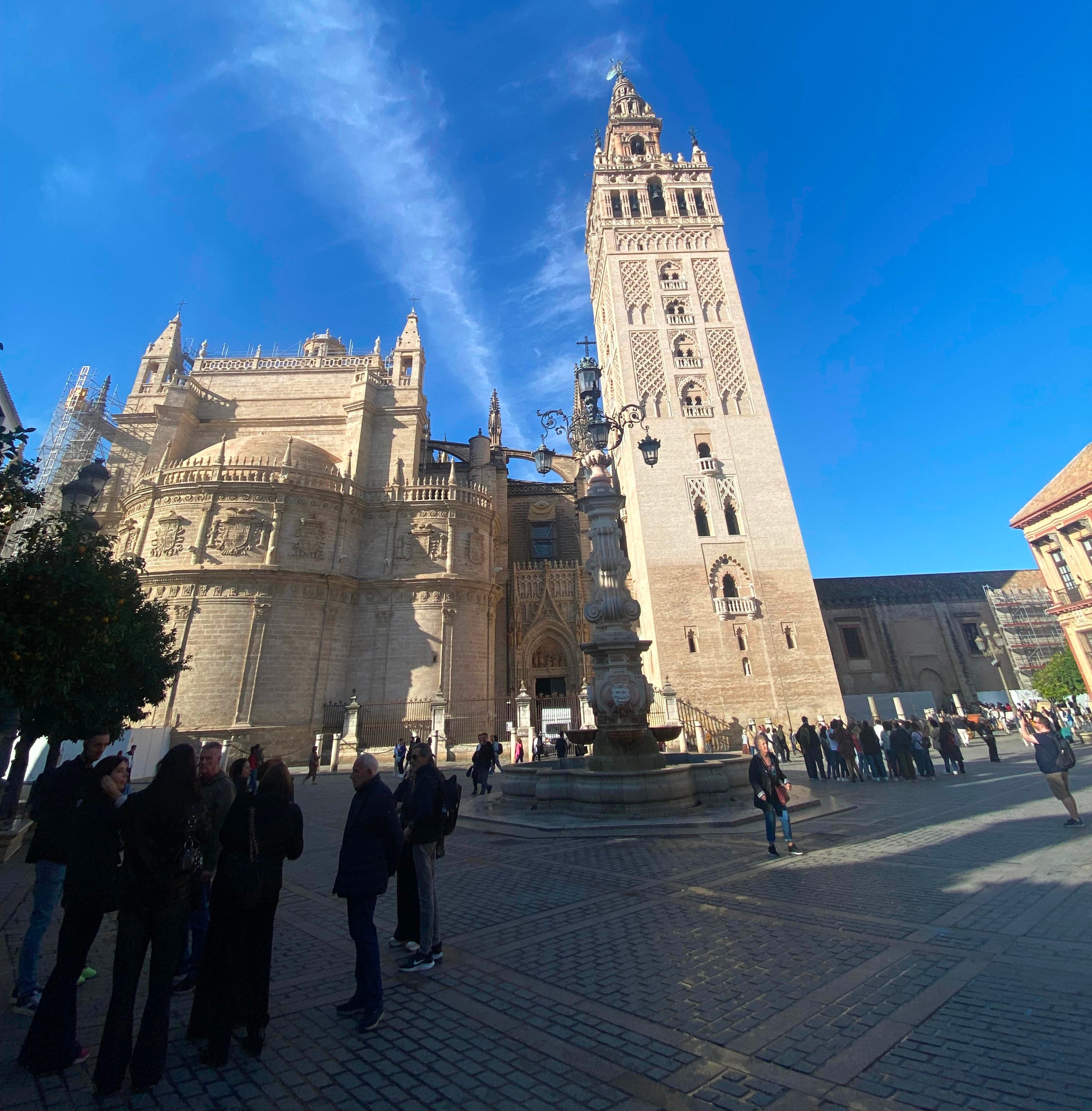
Not all these layers so graciously make way for each other. Case in point: there is almost nothing Jewish remaining in the Juderia. After the massacre of 1391, any Jews left were now publicly Christian, though many continued to practice their culture and spirituality behind closed doors. This Jewish Quarter came to be known as Santa Cruz.
In fact, there’s very few of anyone living in the area. According to our tour guide, most of the homes there are empty, often rented out as AirBnB’s. Every building there is protected by the Spanish government, but from the sound of it, they are only periodically occupied by affluent globetrotters who want to pretend they are living in the Old World. Residency in the area is so sparse that local schools are trying to convince people who work nearby to send their kids there. If that doesn’t work, the schools will likely close.
In Santa Cruz, the synagogues have been converted into churches. Frequently, our guide would point to a crucifix or a fresco of the Virgin Mary, and say that there probably used to be a Jewish symbol of some kind; a hamsa or Magen David. It was about this time that this song popped into my head. It stayed there for the duration of our time in Seville:
There is one reminder of the Juderia that stands out, but it is rather cryptic, and in more than one sense. At the corner of Calle Agua and Calle Vida, over the door of one of the apartment buildings, there is a tile painted with the image of a human skull. The skull belongs to a young woman named Susona, and the legend goes that this was once her house.
She came from a prosperous converso family, and was engaged to a young Christian whose father was of the nobility. In 1480, one year before the first auto-da-fé in Seville, her father Don Diego got word that the Church was looking to root out the conversos that still held on to their Jewish faith and practices. In other words, the Inquisition was in the air.
Don Diego did the sensible thing. He convened a secret meeting of other converso patriarchs to discuss the possibility of an armed uprising against the Christians. Susona overheard the details of this meeting, however, and it made her fear for her betrothed. So she told him. He told his father, who had Don Diego and his co-conspirators arrested. They were tried and executed.
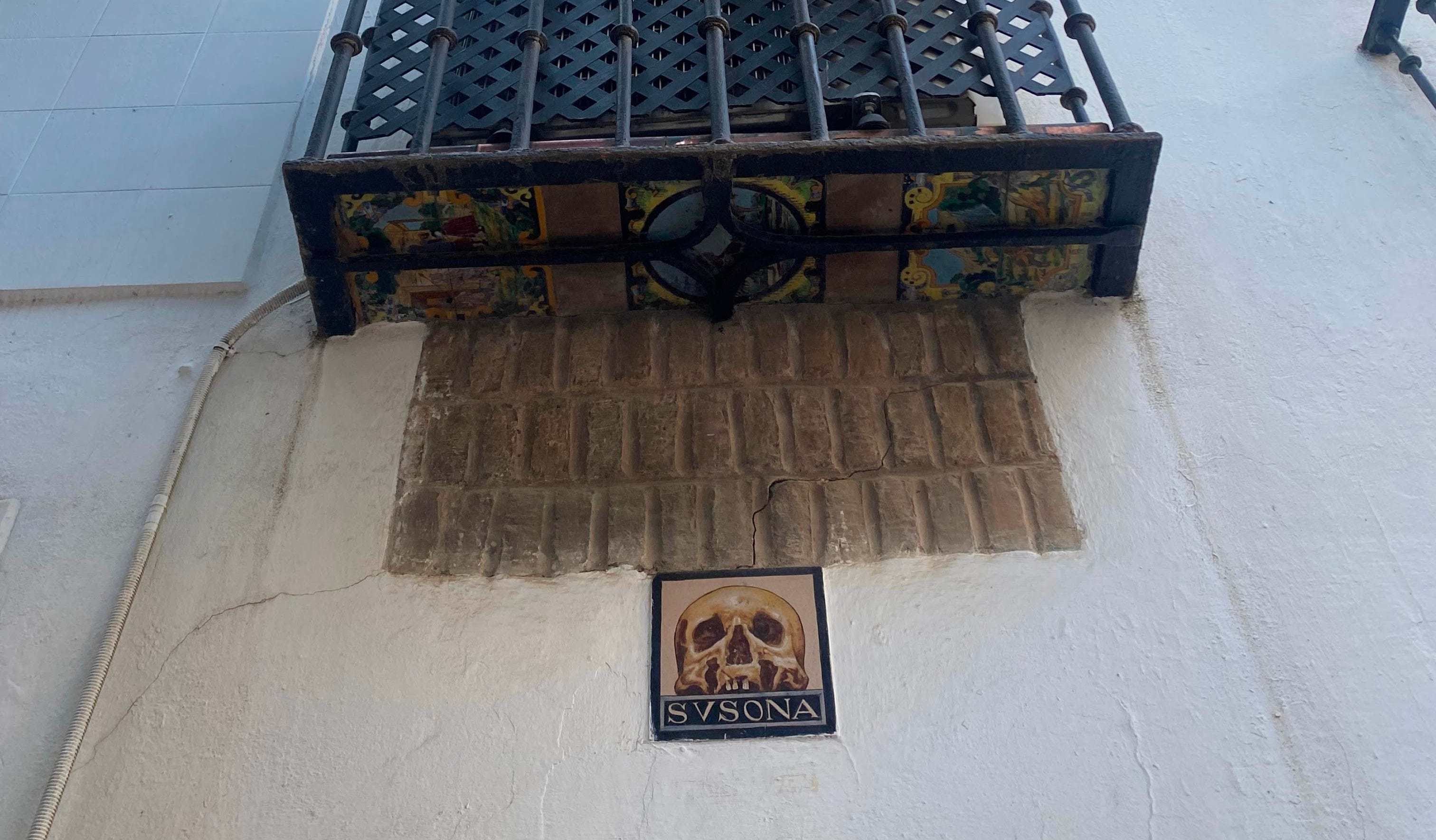
Susona, overwhelmed with grief, retreated to a convent. She spent the rest of her life there. After she died, she had her skull hung over the front door of her house as a reminder: don’t trust the Christians. The skull hung for more than a hundred years, rotting and festering. Eventually, it was switched out for the tile.
XX.
Listening to this recounted, underneath this very tile, I found myself shook. Or at least I should have. I was not born Jewish. I converted as an adult. Some people say that makes me “less of a Jew.” True, I don’t keep kosher, and I have no truck with the state of Israel. But I’ve argued my case in front of a panel of rabbis, and they agree I’m a Jew, so take it up with them. Before that, I was Catholic, though like many other Catholics around the world (especially those who identify as communists) I was long lapsed. I’d gone through communion and first confession and confirmation and after that, all the things I’d been taught suddenly felt like more of a threat than anything like what I might call an ontological grounding. Every ceremony and ritual, every mass and prayer, felt like a bulldozer.
The legend of Susona is chilling. It’s got all the emotional makings of a great tragedy. Romance. Heartbreak. Betrayal. Deep and conflicting familial ties. Death. Self-exile. It’s dramatic, operatic even, and it was adapted into an opera that premiered in Spain earlier this year. I haven’t seen that opera, but if it’s any good then I’d imagine it makes you feel the flawed humanness of all involved, whether you in the audience are Jewish, Catholic, atheist, or Muslim. We are all, without exception, marched through time by inertias masquerading as “who we are.” That’s the tragedy, and it’s universal. Some would say that a person with my specific history should be particularly touched by it.
Should is once again the key word here. But as this legend was being told to us, I couldn’t stop the melodic refrains of Mel Brooks and company rattling in my brain. The Inquisition (Let's begin!) / The Inquisition (Look out, sin!) / We have a mission / To convert the Jews (Jew-jew-jew-jew-jew-jew-jews)...
XXI.
Only later was I struck with the contrast between the muted impact of the legend of Susona and the profundity of what I felt watching the candlelit dreadnought of the Virgin Mary coming towards us the night before. Maybe it was just my sick sense of humor hitching a ride on invasive thoughts. Maybe Brooks just knows how to write one hell of an earworm. Or maybe it was that everything and everyone seemed so damn nonchalant about what had taken place in the Juderia. This was the site of a full-on pogrom: beheadings, disembowelings, mass rapes, skulls caved in, throats and chests ripped open, thousands killed in front of their own children before the children were also slaughtered. It was a human erasure in the most literal and extreme sense.
What exactly is the cut-off point for telling jokes about a tragedy? I make Holocaust jokes; it became my sacred right after I converted. The past few years have seen us finally lighten up about 9/11. Jokes can be mean-spirited and nasty and serve the purpose of a veiled threat. They can also be a way of relieving tension around something unhealed.
There is a difference between a joke, however, and not taking something seriously. You might say we make jokes about tragedies because we feel the wounds left by them. Because the human brain is always looking for a way to make sense of the senseless and contradictory.
No, this nonchalance made it seem like these stories, these pogroms and mass executions, occurred in only the most abstract way. It wasn’t necessarily in the tone of our tour guide. The built environment itself failed to remember, like it was under airtight glass of some kind. Save for the small skull tile and the occasional sign reading Juderia, there was little indication of what had once been here. Even the process of abstraction — the decision to cover up with only the most cursory acknowledgment of that decision — is a decision in itself, and also goes unacknowledged.
Why it was made is subject to speculation. Was it for the comfort of the last few residents in Santa Cruz? Or for the tourists? It is difficult to imagine people wanting to holiday on a site that feels the ghosts of its crimes so unmistakably, let alone live there. In any case, for as narrow and overshaded and quiet as these roads were, they felt unbound by the horrible things that had been done on them.
Here’s the rub. When the history of a place is flattened, so is your personality within it. You’re let off the hook from asking where you fit into it. What you would have done. What you would do now. All the cracks and fissures and stitched together experiences that make you you are dulled and smoothed. And you become unbearably light, in all the senses Kundera meant it. You, the tumultuous events of past and future, none of them matter.
Most everywhere else on this peninsula, you can feel time surrounding you. Part of it is anchored by the people who live on it. They know what happened, so we do too. Here, though, in what used to be the Juderia and is now known as Santa Cruz, where nobody lives but everything is preserved, it feels like an entertainment. The story of Susona’s skull may as well have been a sequence on the Haunted Mansion ride.
XXII.
Seville’s Juderia is hardly unique in this respect. In every place humans have existed in modernity’s longue duree, people, cultures, and histories are displaced. Just across the Guadalqivir River in Seville is the Triana neighborhood. Historically, it’s been populated by potters, sailors, construction workers, and Flamenco dancers. Today, you’ll find none of the above. There’s a smattering of Flamenco performers, but they’re here mainly for the tourists. Few, if any, live nearby. The large Romani population that used to be here was driven out during the neighborhood’s redevelopment in the 1970s. Riverside apartments are just too expensive for most people who work for a living.
You can probably guess what remains after that redevelopment. The aesthetic, the look and feel of the salty, vaguely gritty neighborhood, familiar with hard labor, remains intact. It meshes well with the haute riverside restaurants, which is to say it doesn’t mesh at all. In the area around Santa Cruz, you step from the Kingdom of Castile into the Umayyad Caliphate. In Triana, you step out from the cold, clean angularity of the early 2000’s onto the earthy cobblestones that someone from the early 2000’s thinks look like a pre-war barrio.
It doesn’t strike with quite the same drama – you’re still conscious something has happened, is happening here – but it’s made from the same stuff as the Inquisition Disneyland. Say what you will about those willing to throw hands to touch an effigy, at least they are acting out an actual, genuine moment. Which is more than you can say for some people in Triana. Unlike most of the Anglo-American world, Spain’s middle class hasn’t fully escaped the trappings of hipsterism. There are plenty of checked shirts and clunky workboots and knit fishermen’s caps here. I’m sure they cost more than anyone should reasonably pay. You can feel history thinning out here, its consequence disintegrating, rendered unburdensome and frivolous. And people seem willing to act their part in it. The only thing separating Triana from Santa Cruz is that in Santa Cruz the process has had more time to work itself out.
There are places in Seville where this dreadful telos gets tangled and confused. And as we all know, tangled and confused is the best thing that can happen to an urban environment. The Setas de Sevilla are ugly as sin, like most postmodern architectural sculptures. A street market once stood on this spot, but the last of it shuttered in the ‘70s. The land sat undeveloped until 1990, when the city started digging to build an underground parking lot. Roman and Islamic ruins were discovered, and construction halted.
The decision was made in 2004 to open up a competition for a structure to be built on the site. This is what won. Because architecture is full of losers. It has six “parasols” spreading up into the sky and convening into one large platform. Its honeycombs are made from wood, and the Setas are promoted by the city as the largest wholly wooden structure in the world. Locals affectionately refer to them as “the mushrooms.”
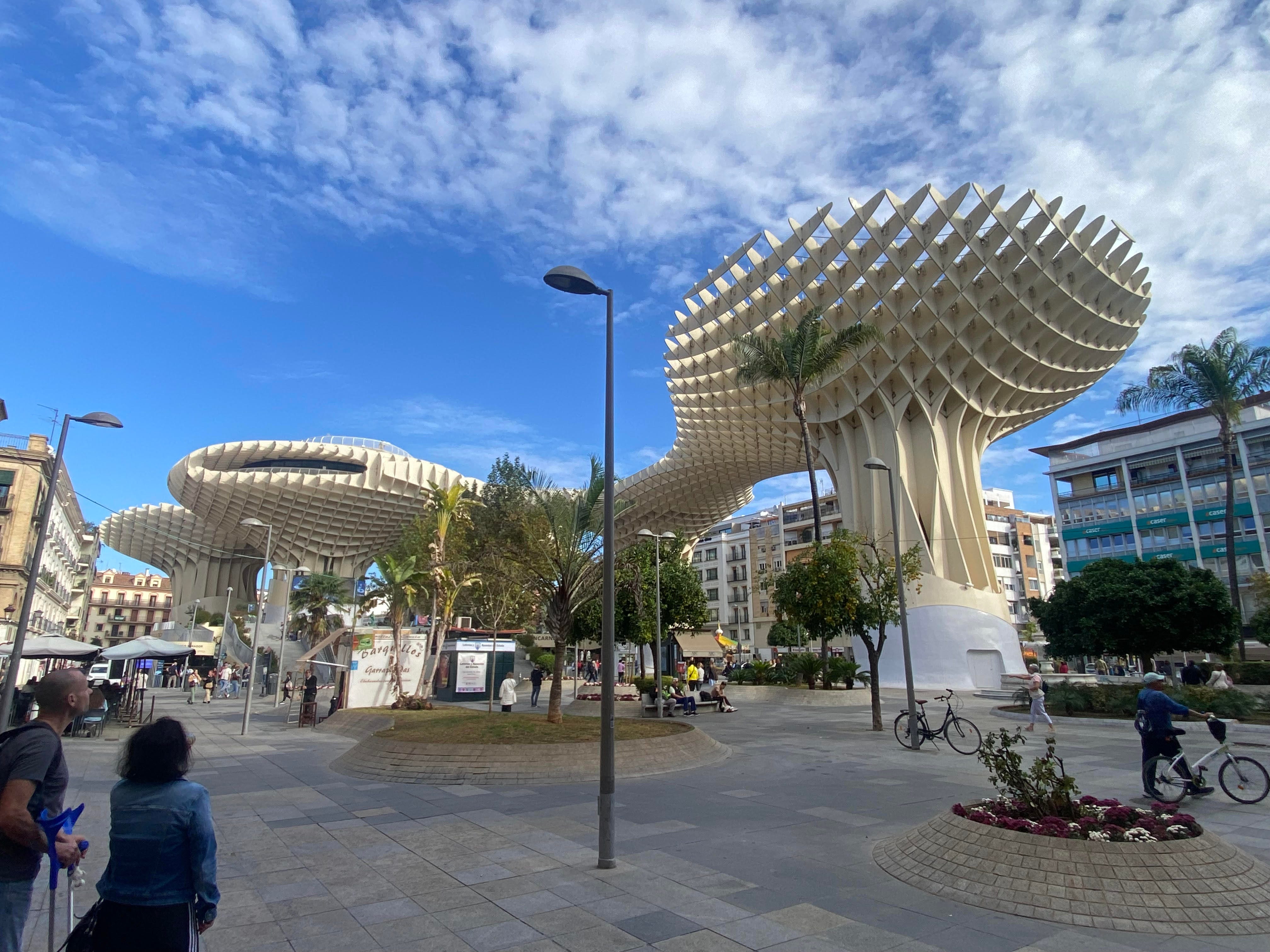
Underneath, the ancient antiquarium is perfectly preserved. And in between, at the base of the Setas, a few cafes and shops. Some of them are shuttered permanently, driven out by high rents. Those remaining try to keep up the pretense of trendiness, but are inevitably undermined by the grime and litter scattered everywhere, the dirty pigeons and their shit.
From the top platforms, you can see the chaos of Seville is more of this same. Everything is utterly mismatched, feebly attempting to create a greater whole and dismally succeeding. I loved it. Accidentally or on purpose, it lets the time periods collide and mutate into each other. It makes the city look like what it is: improvised. If big and important architects can improvise a city, why can’t anyone with a sense of imagination?
XXIII.
It’s not supposed to rain in Andalusia, at least not this time of year. Before the deluge that hit two weeks before we arrived, it hadn’t rained since June. The damage was minimal in Seville. It was worse in other parts of Andalusia, far worse up the coast in Valencia. As the storm closed in on the peninsula, Prime Minister Pedro Sánchez called the Valencian provincial president Carlos Mazón to offer humanitarian and evacuation assistance. Mazón, a member of the conservative People’s Party, whose provincial administration is supported by the far-right Vox Party, dismissed the offer. The storms and the floods they caused swept away more than 200 people. Thousands more were left homeless.
In the days after, 130,000 Valencians demonstrated, many of them still without a livable home, demanding Mazón’s resignation. Trying to contain the crowd, police brutalized protesters, many of whom fought back. In his closing remarks at the Historical Materialism conference in London, Andreas Malm called this “the first climate riot in Europe,” and indeed the first in what we call the Developed World.
As climate change warps weather patterns, making them more volatile and unpredictable, some truly heinous questions about who gets to live where will follow. We only need to look to New Orleans for a sense of what that looks like. It’s been almost 20 years since Hurricane Katrina. Bourbon Street is still there, catering to out-of-towners’ ideas of what Bourbon Street “should” be. The Lower Ninth Ward, its decades and centuries of roots weaving between homes and catacombs, is infested with condos and corporate headquarters.
A more immediate example may come out of Gaza. Brochures with plans for beachside properties were being drafted by the time the first bombs began to fall. National Security Minister Ben Gvir is wailing at rallies about the need to “resettle” Gaza. Whether it’s human-made or natural, disaster can get you some great real estate.
In both examples, note that there is a faultline between who “deserves” to come back and who doesn’t. So it was in the Juderia. There is also an unstated hope that with enough time, with enough people tiring of talking about it, all the ruptures and traumas will cease mattering, letting history drift through its own ether.
Will some come back? Certainly. History is full of conversos of one kind or another. Some choose it, believing they are better for it. Some do it because they want to be part of the attraction. Some do it because they think it will help keep their heads down, hoping those marching through the town’s center won’t single them out. Because, in the words of Torquemada, it’s better to lose your skullcap than your skull.
All photos are by Kelsey Goldberg and the author.
That Ellipsis... is a reader-supported publication. To receive new posts and support my work, consider becoming a free or paid subscriber.
Inquisition Disneyland (Iberian Ellipsis, part 4)
For most of November, I was on my honeymoon in Spain and Portugal. Thanks to my incessant graphomania, you get to see my attempt at a travel journal as I journeyed from Porto down to Lisbon, into Spain by way of Seville, up the eastern coast, into Barcelona. Cathedrals. Narrow, winding streets. Historical episodes trivialized. The first and second in the series can be read here and here and here. Also, if you haven’t subscribed or upgraded to a paid subscription, do it now.
XVII.
We were staying near the Catedral de Sevilla, so we shouldn’t have been surprised. We had drinks at a small cafe, and were walking back to the hotel. A lot of people seemed to be wearing suits or formal dresses, but this is one of the more conservative parts of Spain, and there were plenty of commercial districts nearby.
Passing by the cathedral, the crowds got thicker. They were watching a line of young men in suits carrying large walking sticks with candles at the end of them. Most of them had a haunted look in their eyes, glazed but somehow determined.
I was uncomfortable. Mrs. Ellipsis was just curious. Using her rusty Spanish (still better than mine), she asked someone passing by. “Excuse me, sir. What is this procession?” He looked at her like she had asked what continent we were on.
“It’s a procession,” he answered.
“Yes, but what for?”
He spoke slower. “It’s… a… procession.”
The idea of a procession being for a procession was certainly novel. Also depressingly nihilistic. It had the ring of a practice whose origin had been obscured by the millennia but no one dared stop. No meaning, no resonance, no poignancy. Just the inertia of ritual for ritual’s sake. Why do we do this? We do this because we do this.
She did her best to clarify. Finally, either feeling sorry for these poor curious souls or simply wanting to get the hell away from us, he did his best to answer. “The procession… is for Jesus.”
It was an underwhelming answer. This was clearly a Catholic procession. Just about everything they do is for Jesus, but normally it goes through one of a whole constellation of saints, martyrs, and apostles. One of the reasons I’ve always been puzzled by the stark division between monotheism and polytheism. Isn’t it all one? And isn’t that one so multifaceted?
As it turns out, the frustrated passerby was only half correct. We turned and saw a massive canopied platform, again carried by a few dozen young men, adorned with lit candles and a large Virgin Mary figure in the center. It was stunning. It was awe-inspiring. It was also terrifying, for reasons I couldn’t fully articulate.
Back at the hotel, the scenes on TV provided a better explanation. Inside the cathedral, hundreds of beefy men vaulted themselves over each other, completely indifferent to injury or to damaging their Sunday best, all to get a chance at touching the figure of the Virgin Mary. Pulling, pushing, climbing, occasionally throwing punches just to get a single foot closer.
From what I could tell, nobody was doing anything to allow for cooler heads. To suggest a nice orderly line so that everyone could get a chance to show their devotion and be blessed by Jesus’ mom. I felt like I was watching scenes from the Hillsborough Disaster. Only this time it wasn’t people panicking beneath the weight of the human crush, but eagerly participating. This wasn’t a scene of mass devotion. It was a scene of unbridled frenzy: a crowd of individuals showing dangerous indifference to others’ safety to be most blessed.
Only at the end of the news segment did it become clear that this footage was from a different procession, in a different part of Andalusia. From the sound of it, it is easy to confuse them. We learned the next day that Seville has more Catholic processions than any other city in Spain. During Holy Week, in the lead-up to Easter, there are often several a day. Organizers and city planners do their best to ensure their routes don’t collide, but it is frequently futile. Scenes of iron-faced church members, some in elaborate costumes, entangled at corners and intersections, unsure which direction to go, fearing that if they guess incorrectly they’ll wind up at the wrong destination. I wondered if brawls ever broke out in these situations, like they did on the TV.
XIX.
Spain’s reputation is often that of a crazed Catholic nation, but the fact is that only about 50 percent of the country identifies as part of the faith, with only about a third of them identifying as practicing. Percentage-wise, there are more Spanish atheists and agnostics than there are devoted Catholics.
Still, that 50 percent stands, in part, thanks to a rather unsavory past. During the Franco years, the Church worked hand-in-glove with the regime to strengthen its legitimacy, and Catholicism was the preeminent spiritual force in public life. Which isn’t to say that every practicing Catholic was happy with the level of political and cultural repression in Spain. Far from it. The Catalan, Galician, and Basque languages were legally banned from being spoken in public. Predictably, any opponent of fascism – be they anarchist, communist, liberal, or nationalist, and no matter what faith – was imprisoned, and often executed.
Forty years of this kind of governance can warp memory quickly. Under Franco, the Spanish Inquisition – hundreds of years of forced conversion and medieval torture – was viewed as a positive, a necessary purge of heretics and dissenters to preserve Spain’s cultural purity. It even produced its own form of denialism, roughly akin to the kind we’ve increasingly seen around the Holocaust in recent decades. According to some thinkers, including those with jobs at serious academic institutions, the Inquisition is nothing more than a “black legend” perpetuated by nefarious Protestants to defame Catholic Spain.
Seville holds a notable place in the history of the Spanish Inquisition. It was here in 1481 that Spain’s first auto-da-fé took place. Twelve men and women were accused of practicing Judaism, and burned at the stake. We say “accused of practicing Judaism” because by that time there was for the most part no real way to pick out a Jew in public. The phenomenon of the converso already existed by this point: Jews who had, willingly or otherwise, converted to Catholicism. There was always the possibility of practicing in private, though, and many did.
In 1391, ninety years before the first auto-da-fé, with the Black Plague slithering its way across the continent, residents of Seville and other Spanish towns rampaged through their Jewish Quarters, massacring Jews left and right. In Seville, the pogroms were aided by the architecture. In 1248, after Ferdinand III seized the city from the Muslim Almoravid dynasty, Jews were moved into what became the Juderia, right next to the palace. Many affluent Jews aided in trade and money-lending, and the nobility wanted them easily accessible.
Only a few small entrances allowed entry into the area. Any army trying to invade the Jewish Quarter would be slowed, as they would by the narrow, winding streets. During the 1391 massacre, these defenses turned the Juderia into a death trap for its residents. Four thousand Jews were killed.
XX.
You can see the various layers of history in Seville. It’s well known that before all this was Andalusia, it was Al-Andalus, passing through a succession of Islamic dynasties. Prior to that it was briefly ruled by the Visigoths and Vandals. Before them, it was a Roman province, and before that, it was the Phoenecians. When entering an old enough building, you step down from the doorway of one epoch onto the floor of another. The Catedral de Sevilla started as a mosque. It took a few hundred years to be completed and added onto. You can see Islamic, Gothic, and Renaissance eras on its facade.
Not all these layers so graciously make way for each other. Case in point: there is almost nothing Jewish remaining in the Juderia. After the massacre of 1391, any Jews left were now publicly Christian, though many continued to practice their culture and spirituality behind closed doors. This Jewish Quarter came to be known as Santa Cruz.
In fact, there’s very few of anyone living in the area. According to our tour guide, most of the homes there are empty, often rented out as AirBnB’s. Every building there is protected by the Spanish government, but from the sound of it, they are only periodically occupied by affluent globetrotters who want to pretend they are living in the Old World. Residency in the area is so sparse that local schools are trying to convince people who work nearby to send their kids there. If that doesn’t work, the schools will likely close.
In Santa Cruz, the synagogues have been converted into churches. Frequently, our guide would point to a crucifix or a fresco of the Virgin Mary, and say that there probably used to be a Jewish symbol of some kind; a hamsa or Magen David. It was about this time that this song popped into my head. It stayed there for the duration of our time in Seville:
There is one reminder of the Juderia that stands out, but it is rather cryptic, and in more than one sense. At the corner of Calle Agua and Calle Vida, over the door of one of the apartment buildings, there is a tile painted with the image of a human skull. The skull belongs to a young woman named Susona, and the legend goes that this was once her house.
She came from a prosperous converso family, and was engaged to a young Christian whose father was of the nobility. In 1480, one year before the first auto-da-fé in Seville, her father Don Diego got word that the Church was looking to root out the conversos that still held on to their Jewish faith and practices. In other words, the Inquisition was in the air.
Don Diego did the sensible thing. He convened a secret meeting of other converso patriarchs to discuss the possibility of an armed uprising against the Christians. Susona overheard the details of this meeting, however, and it made her fear for her betrothed. So she told him. He told his father, who had Don Diego and his co-conspirators arrested. They were tried and executed.
Susona, overwhelmed with grief, retreated to a convent. She spent the rest of her life there. After she died, she had her skull hung over the front door of her house as a reminder: don’t trust the Christians. The skull hung for more than a hundred years, rotting and festering. Eventually, it was switched out for the tile.
XXI.
Listening to this recounted, underneath this very tile, I found myself shook. Or at least I should have. I was not born Jewish. I converted as an adult. Some people say that makes me “less of a Jew.” True, I don’t keep kosher, and I have no truck with the state of Israel. But I’ve argued my case in front of a panel of rabbis, and they agree I’m a Jew, so take it up with them. Before that, I was Catholic, though like many other Catholics around the world (especially those who identify as communists) I was long lapsed. I’d gone through communion and first confession and confirmation and after that, all the things I’d been taught suddenly felt like more of a threat than anything like what I might call an ontological grounding. Every ceremony and ritual, every mass and prayer, felt like a bulldozer.
The legend of Susona is chilling. It’s got all the emotional makings of a great tragedy. Romance. Heartbreak. Betrayal. Deep and conflicting familial ties. Death. Self-exile. It’s dramatic, operatic even, and it was adapted into an opera that premiered in Spain earlier this year. I haven’t seen that opera, but if it’s any good then I’d imagine it makes you feel the flawed humanness of all involved, whether you in the audience are Jewish, Catholic, atheist, or Muslim. We are all, without exception, marched through time by inertias masquerading as “who we are.” That’s the tragedy, and it’s universal. Some would say that a person with my specific history should be particularly touched by it.
Should is once again the key word here. But as this legend was being told to us, I couldn’t stop the melodic refrains of Mel Brooks and company rattling in my brain. The Inquisition (Let's begin!) / The Inquisition (Look out, sin!) / We have a mission / To convert the Jews (Jew-jew-jew-jew-jew-jew-jews)...
XXII.
Only later was I struck with the contrast between the muted impact of the legend of Susona and the profundity of what I felt watching the candlelit dreadnought of the Virgin Mary coming towards us the night before. Maybe it was just my sick sense of humor hitching a ride on invasive thoughts. Maybe Brooks just knows how to write one hell of an earworm. Or maybe it was that everything and everyone seemed so damn nonchalant about what had taken place in the Juderia. This was the site of a full-on pogrom: beheadings, disembowelings, mass rapes, skulls caved in, throats and chests ripped open, thousands killed in front of their own children before the children were also slaughtered. It was a human erasure in the most literal and extreme sense.
What exactly is the cut-off point for telling jokes about a tragedy? I make Holocaust jokes; it became my sacred right after I converted. The past few years have seen us finally lighten up about 9/11. Jokes can be mean-spirited and nasty and serve the purpose of a veiled threat. They can also be a way of relieving tension around something unhealed.
There is a difference between a joke, however, and not taking something seriously. You might say we make jokes about tragedies because we feel the wounds left by them. Because the human brain is always looking for a way to make sense of the senseless and contradictory.
No, this nonchalance made it seem like these stories, these pogroms and mass executions, occurred in only the most abstract way. It wasn’t necessarily in the tone of our tour guide. The built environment itself failed to remember, like it was under airtight glass of some kind. Save for the small skull tile and the occasional sign reading Juderia, there was little indication of what had once been here. Even the process of abstraction — the decision to cover up with only the most cursory acknowledgment of that decision — is a decision in itself, and also goes unacknowledged.
Why it was made is subject to speculation. Was it for the comfort of the last few residents in Santa Cruz? Or for the tourists? It is difficult to imagine people wanting to holiday on a site that feels the ghosts of its crimes so unmistakably, let alone live there. In any case, for as narrow and overshaded and quiet as these roads were, they felt unbound by the horrible things that had been done on them.
Here’s the rub. When the history of a place is flattened, so is your personality within it. You’re let off the hook from asking where you fit into it. What you would have done. What you would do now. All the cracks and fissures and stitched together experiences that make you you are dulled and smoothed. And you become unbearably light, in all the senses Kundera meant it. You, the tumultuous events of past and future, none of them matter.
Most everywhere else on this peninsula, you can feel time surrounding you. Part of it is anchored by the people who live on it. They know what happened, so we do too. Here, though, in what used to be the Juderia and is now known as Santa Cruz, where nobody lives but everything is preserved, it feels like an entertainment. The story of Susona’s skull may as well have been a sequence on the Haunted Mansion ride.
XXIII.
Seville’s Juderia is hardly unique in this respect. In every place humans have existed in modernity’s longue duree, people, cultures, and histories are displaced. Just across the Guadalqivir River in Seville is the Triana neighborhood. Historically, it’s been populated by potters, sailors, construction workers, and Flamenco dancers. Today, you’ll find none of the above. There’s a smattering of Flamenco performers, but they’re here mainly for the tourists. Few, if any, live nearby. The large Romani population that used to be here was driven out during the neighborhood’s redevelopment in the 1970s. Riverside apartments are just too expensive for most people who work for a living.
You can probably guess what remains after that redevelopment. The aesthetic, the look and feel of the salty, vaguely gritty neighborhood, familiar with hard labor, remains intact. It meshes well with the haute riverside restaurants, which is to say it doesn’t mesh at all. In the area around Santa Cruz, you step from the Kingdom of Castile into the Umayyad Caliphate. In Triana, you step out from the cold, clean angularity of the early 2000’s onto the earthy cobblestones that someone from the early 2000’s thinks look like a pre-war barrio.
It doesn’t strike with quite the same drama – you’re still conscious something has happened, is happening here – but it’s made from the same stuff as the Inquisition Disneyland. Say what you will about those willing to throw hands to touch an effigy, at least they are acting out an actual, genuine moment. Which is more than you can say for some people in Triana. Unlike most of the Anglo-American world, Spain’s middle class hasn’t fully escaped the trappings of hipsterism. There are plenty of checked shirts and clunky workboots and knit fishermen’s caps here. I’m sure they cost more than anyone should reasonably pay. You can feel history thinning out here, its consequence disintegrating, rendered unburdensome and frivolous. And people seem willing to act their part in it. The only thing separating Triana from Santa Cruz is that in Santa Cruz the process has had more time to work itself out.
There are places in Seville where this dreadful telos gets tangled and confused. And as we all know, tangled and confused is the best thing that can happen to an urban environment. The Setas de Sevilla are ugly as sin, like most postmodern architectural sculptures. A street market once stood on this spot, but the last of it shuttered in the ‘70s. The land sat undeveloped until 1990, when the city started digging to build an underground parking lot. Roman and Islamic ruins were discovered, and construction halted.
The decision was made in 2004 to open up a competition for a structure to be built on the site. This is what won. Because architecture is full of losers. It has six “parasols” spreading up into the sky and convening into one large platform. Its honeycombs are made from wood, and the Setas are promoted by the city as the largest wholly wooden structure in the world. Locals affectionately refer to them as “the mushrooms.”
Underneath, the ancient antiquarium is perfectly preserved. And in between, at the base of the Setas, a few cafes and shops. Some of them are shuttered permanently, driven out by high rents. Those remaining try to keep up the pretense of trendiness, but are inevitably undermined by the grime and litter scattered everywhere, the dirty pigeons and their shit.
From the top platforms, you can see the chaos of Seville is more of this same. Everything is utterly mismatched, feebly attempting to create a greater whole and dismally succeeding. I loved it. Accidentally or on purpose, it lets the time periods collide and mutate into each other. It makes the city look like what it is: improvised. If big and important architects can improvise a city, why can’t anyone with a sense of imagination?
XXIV.
It’s not supposed to rain in Andalusia, at least not this time of year. Before the deluge that hit two weeks before we arrived, it hadn’t rained since June. The damage was minimal in Seville. It was worse in other parts of Andalusia, far worse up the coast in Valencia. As the storm closed in on the peninsula, Prime Minister Pedro Sánchez called the Valencian provincial president Carlos Mazón to offer humanitarian and evacuation assistance. Mazón, a member of the conservative People’s Party, whose provincial administration is supported by the far-right Vox Party, dismissed the offer. The storms and the floods they caused swept away more than 200 people. Thousands more were left homeless.
In the days after, 130,000 Valencians demonstrated, many of them still without a livable home, demanding Mazón’s resignation. Trying to contain the crowd, police brutalized protesters, many of whom fought back. In his closing remarks at the Historical Materialism conference in London, Andreas Malm called this “the first climate riot in Europe,” and indeed the first in what we call the Developed World.
As climate change warps weather patterns, making them more volatile and unpredictable, some truly heinous questions about who gets to live where will follow. We only need to look to New Orleans for a sense of what that looks like. It’s been almost 20 years since Hurricane Katrina. Bourbon Street is still there, catering to out-of-towners’ ideas of what Bourbon Street “should” be. The Lower Ninth Ward, its decades and centuries of roots weaving between homes and catacombs, is infested with condos and corporate headquarters.
A more immediate example may come out of Gaza. Brochures with plans for beachside properties were being drafted by the time the first bombs began to fall. National Security Minister Ben Gvir is wailing at rallies about the need to “resettle” Gaza. Whether it’s human-made or natural, disaster can get you some great real estate.
In both examples, note that there is a faultline between who “deserves” to come back and who doesn’t. So it was in the Juderia. There is also an unstated hope that with enough time, with enough people tiring of talking about it, all the ruptures and traumas will cease mattering, letting history drift through its own ether.
Will some come back? Certainly. History is full of conversos of one kind or another. Some choose it, believing they are better for it. Some do it because they want to be part of the attraction. Some do it because they think it will help keep their heads down, hoping those marching through the town’s center won’t single them out. Because, in the words of Torquemada, it’s better to lose your skullcap than your skull.
All photos are by Kelsey Goldberg and the author.
That Ellipsis... is a reader-supported publication. To receive new posts and support my work, consider becoming a free or paid subscriber.
December 10, 2024
On Pain and Privilege

For those interested, my piece on the 100th birthday of the surrealist movement in the most recent issue of Against the Current is available to read online. Also, subscribe if you haven’t yet.
In another life, I might have been Luigi Mangione, though writing this feels like bullshit. From what I can tell, I have very little in common with the man. I’m a generation older, and from markedly more humble origins. According to the headlines, and the interviews with friends, he’s always excelled academically, and in no field more than maths and sciences. The humanities are my love, and past literature, history, art, music, and theatre, I can’t be bothered. He’s handy with a firearm. That’s not my skillset. He has allegedly killed the CEO of UnitedHealthcare. I allegedly have not.
Mangione is from a prominent family, had every advantage handed to him, and came up through the Ivy Leagues. I didn’t. There is, however, one thing I have in common with him, other than a seething disgust with the American healthcare system. We went to the same high school.
You may have heard a bit about Gilman School lately, though it is mostly being referred to as a “private primary and secondary school.” Just about every article on Mangione’s arrest mentions his attendance there. Most observers would see this as strange, and they are probably right. None of the reporters who covered the Beltway shooters mentioned the high school attended by John Allen Muhammad. Nobody really cares that David Berkowitz went to Columbus High School or Bronx Community College.
No, Gilman School has been mentioned so much because Mangione’s attendance there adds to the flavor of shock and scandal. Gilman is an elite, all-boys preparatory school, one of the oldest in Maryland. Its alumni includes senators, governors, publishing magnates, CEOs, and hedge fund managers, to say nothing of the large number of star athletes. Mangione didn’t just attend Gilman, he thrived there. He graduated valedictorian. There is video of him delivering a speech at the school’s Founder’s Day celebrations.
From there, he went to the University of Pennsylvania, earning bachelor’s and master’s degrees. Then onto the tech industry. Reporters have zoomed in on his measured words for the Unabomber, but they aren’t focusing as much on his admiration for Elon Musk and Peter Thiel. The Mangione family is a prominent one in Baltimore society. They own country clubs and nursing homes. For all the younger Mangione’s spite toward private healthcare, his family has famously built and owned several private hospitals. Naturally, they have the politics to back it up. They own at least one local right-wing talk radio station. Luigi’s cousin Nino is a Republican member of the Maryland House of Delegates.
In other words, mention of Gilman is intended to paint this whole episode – from the murder of Brian Thompson to the sensational trial the media is hoping for – as an episode of pure madness and absurdity. No more raw, gleeful class spite. No more contrasts between the murder of one CEO and the tens of thousands who died because of his company’s decisions. Sorry, but the Healthcare Hitman is a rich kid. A boy whose silver spoon came courtesy of private healthcare. A hypocrite. Liberal papers like The New York Times are swooning with feigned confusion – He had everything he could ever want! – while outlets straining for a more populist posture like the New York Post are hinting at East Coast elite depravity. What just a few days ago was the sharpest edge of discussions about inequality is now being respun into “it’s more complicated than that.”

It would be both lazy and dishonest to lay Mangione’s actions at the door of Gilman School. The temptation is there, though. How did I wind up there? It’s a long story, but a lot of it comes down to my father — native of a small autoworking town in Pennsylvania — being one of the first in his family to go to college, and riding it all the way through to a PhD. It was a classic case of a parent wanting their kid to have opportunities they didn’t, even if it meant going without in other respects to pay for those opportunities.
I’m ambivalent about my years at Gilman. My first year there was the hundredth anniversary of its founding. The celebrations were as magnetic as they were alienating. The schedule at Gilman was demanding, including two hours of mandatory sports after regular classes. All in all, there wasn’t time to breathe in much of anything other than the knowledge that you were under a lot of pressure.
Plenty of the students tried hard, but the most visible ones were those who didn’t have to. Those who very likely would never have to worry or want, who could have any door opened by simple dint of who their parents were. The administration would do everything they could to obscure this fact, to create the sense that we were all on a level plain, but it didn’t take much to remember that the rest of us were there at the leisure of powerful and respected family names.
Like any American school, public or private, there was bullying. The all-boys environment made the insecure machismo and homophobia rather stultifying. There was also a kind of not-so-subtle, WASPy, blue-blooded distrust of the different that was intrinsic to the student body’s worldview. A tendency to equate respectability with a certain amount of wealth and a certain kind of whiteness. The first time I was on the receiving end of antisemitism – fifteen years before I mulled converting to Judaism – was at Gilman. A classmate told me he had always assumed I was Jewish because I hung out with the theatre kids (a group which at the time included the one openly gay student) and because I have a nose that is, ahem, prominent.
My years at Gilman were not hell, however. Many of those who taught me were doing it because they loved it (they had to, given how little they were being paid). I spent months on end in the art room on the top level of the main building, looking out over the impeccably maintained football and track fields. After spending much of the day feeling like I didn’t belong down there, it was nice to find a refuge up here among the paint stains, charcoal smudges, and the faint smell of turpentine. I was taught how to appreciate and understand literature. I discovered an affinity for theatre and history. Not bad for the son of an autoworker.
Every institution like this is bound to produce a handful of misfits. Yes, the politics of this sheltered world tended rather heavily to the right. But every graduating class seemed to have two or three students who had stuck their noses in Chomsky and Zinn long enough to at least dip their toes in the far-left. Some of us even stuck with it. So here I am.
In fact, there seems to have been an odd, unacknowledged undercurrent of radicalism in the place. A few of the history or English teachers would identify themselves as lefties in trusted company. For my senior speech, I spoke about Elisabeth Woolsey Gilman: daughter of school co-founder (and founding president of Johns Hopkins University) Daniel Coit Gilman. Elisabeth was a candidate for senator and governor on the Socialist Party ticket in the ‘20s and ‘30s. She also founded a precursor to the American Civil Liberties Union, fought against racial segregation, and for the freedom of jailed union militants. The socialist movement in the first half of the 20th century had a long list of class traitors. People from privileged backgrounds who, horrified by the level of social deprivation, and influenced by old American utopianism of Paine and Emerson and Whitman, threw their lot in with the reds and a restive labor movement. Elisabeth Gilman was one of them.

Why go through all this? Why, if we cannot blame a school like Gilman for the actions of Luigi Mangione, am I subjecting us to this tortured trip down the memory hole? It’s not so much Gilman itself as the world it tries to fit into. A world that, ultimately, doesn’t exist. When we call an institution like this conservative, we aren’t just talking about its politics. We are talking about its deep philosophical inertia. And it weighs down just about every institution dedicated to reproducing America’s elite.
Private schools that aspire to this much prestige ultimately need the world to remain static. Or to at least change at such a glacial pace that they can always position themselves at a safe distance above and in front. That distance is necessary to mold these young men into what the school hopes will be the next generation of leaders.
Luigi Mangione was clearly on that path. Watch his Founder’s Day address. It’s not particularly remarkable, though it is clearly being delivered by a highly intelligent, well-mannered, and eloquent young man. How, in the span of eight years, does he go from this to a man willing to plan and carry out the murder of a CEO?
The simple answer is that the world doesn’t stay still, and change is painful. It can be traumatic, in fact. Novara Media, along with some other observers online, are suggesting that Mangione was “radicalized by pain.” The spondylolisthesis that had ailed his back since he was a kid, aggravated by a 2022 surfing injury, caused him an immense amount of pain. He had metal plates and screws put in the base of his spine. And yet, no relief.
We will probably get more details in the coming days, but Mangione’s actions draw a clear link between his own debilitating health problems and a system that failed to address them. Like all his friends have said, he had everything going for him. A wealthy, well-connected family. Direct connections to the healthcare industry. Still, he couldn’t get the care he needed. How dysfunctional is the healthcare infrastructure in this country that someone with every advantage can be driven to revenge?
Privilege doesn’t protect you from pain. Just like going to Gilman didn’t protect me from the 2008 crash, from the deprivations of chronic unemployment, from the indignities of food pantries, or having my electricity cut off. Going to school with the rich does not make you rich. And while some newspapers are signaling shock at the who and the why, I don’t think I’m off-base arguing that Mangione's background does go some way to explaining the how.
Look at the mishmash of intellectual influences in this man’s life and you see a lot of ideas and thoughts at odds with each other: Musk and Thiel on one end, Alexandria Ocasio-Cortez on the other. And of course a dash of Unabomber thrown in, as the press is eager to remind us. What there isn’t is a sense of what is to be done.
That’s not just down to the world that shaped Mangione's ways of thinking, but the one outside it too. There isn’t much on offer in the way of alternative models, collective solutions. Without those, there’s no real framework to fall back on other than the one he’s used to. It’s the undercurrent of everything they teach you in economics, behind every push to succeed in business, the ambition of the teenager who’s never had to work. Turn someone’s life into a receptacle of numbers and cost-benefit analyses, and a simple act of revenge becomes feasible: another life rendered as disposable as the rest. If it can happen to Luigi Mangione, what’s to prevent it from happening to Brian Thompson?
Only the will to make it happen. Whatever contradictions there might have existed in Mangione’s beliefs, there was almost certainly, mixed with his rage at the healthcare industry, a curiosity to see if he could actually get away with murder. Part Alexander Berkman, part Leopold and Loeb.
There ultimately isn’t much stopping the chaos of climate change or the upshots of violent repression from arriving at the gates of Gilman. Ten years ago, while most of downtown Baltimore erupted over the police murder of Freddie Gray, the prep school set in tony Roland Park obliviously cooled its heels at the Maryland Hunt Cup equestrian event.
I wonder how much longer something like this is going to be possible. American affluence doesn’t shield like it once did. Same with American exceptionalism. Donald Trump, whose return to the White House is no doubt greeted with excitement by many in Gilman’s halls, is sure to destabilize the world at large to enough of a degree that acting like it will never touch you becomes foolhardy.
The more myopic a ruling class is, the less effectively it can rule. The blinders have been closing in for some time. This current generation of the most powerful seems to fear nothing more than being subjected to the same forces that make everyone – poor and rich alike – human. Of course, it’s never the most powerful who suffer the worst consequences. The notion of a world without pain is precisely what has millions of Americans currently hooked on opioids. They are predominantly working class, while the Sackler children almost definitely go to schools in the vein of Gilman.
They’ll likely grow into the task of trying to scrub clean their tarnished name, maybe playing leading roles in philanthropy and charity. But the belief that we can be engineered toward a world of security by a privileged few isn’t just wrong, it’s dangerous for all involved. Including the self-appointed engineers. No matter how tall you build a wall, you will never be able to keep yourself wholly safe. If nothing else, someone inside is bound to see you for what you are.
As for Gilman, if it really wanted to play a role in making the world safer, it would do what every other privately run school and college and healthcare company needs to do. Liquidate itself, its land and resources and endowments turned over to its anemically-funded public counterparts. Make privilege a right, and you’ll find very few of you get hurt. Go Greyhounds.
That Ellipsis... is a reader-supported publication. To receive new posts and support my work, consider becoming a free or paid subscriber.
December 6, 2024
The Things of Lives (Iberian Daydream, part 3)
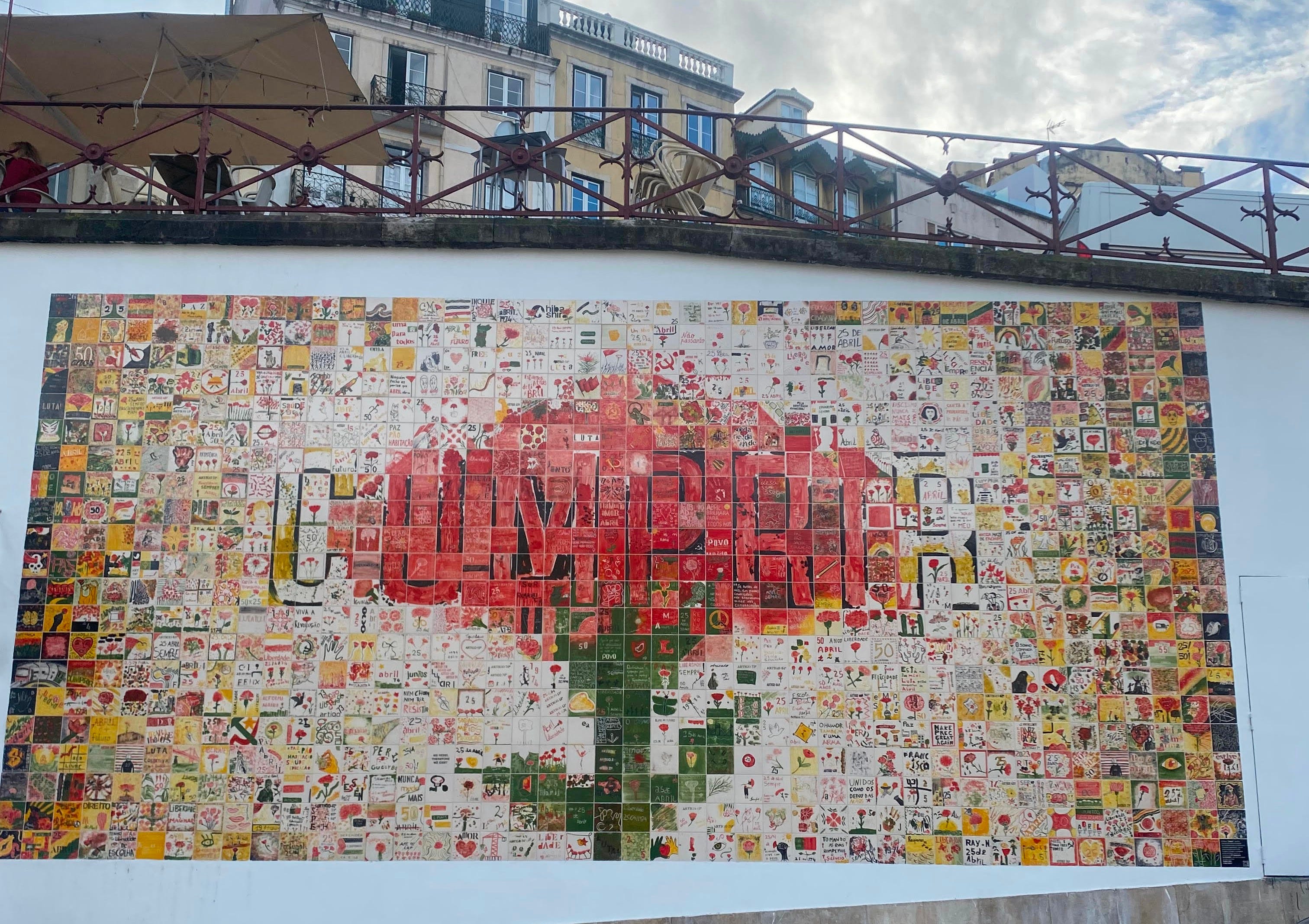
For most of November, I was on my honeymoon in Spain and Portugal. You would think that means I take a break from the obligations of writing and cultivating an audience, but no. I cannot, for whatever reason, tear myself away from this neurotic need for a forum. The upshot is you get to watch me attempt a travel journal as I journey from Porto down to Lisbon, into Spain by way of Seville, up the eastern coast, into Barcelona. Old buildings. Efficient trains. Conversations with total strangers. The first and second in the series can be read here and here. Also, if you haven’t subscribed or upgraded to a paid subscription, this is your cue.
X.
The story goes like this. She worked as a coat checker at a Lisbon restaurant. On the morning of April 25, 1974, she showed up for her shift, which was expected to be busy. It was the first anniversary of the restaurant’s opening, and the dining room was bedecked with red and white carnations. But when she arrived, she was sent home by her boss.
He had been listening to the radio, and word was spreading fast that something big was happening. The kind of event that would make doing business impossible. So he sent her home. On her way out, he shoved a bunch of the red carnations into her arms. He didn’t want them going to waste.
Walking back to her apartment, she saw what was happening. It was no longer just on the radio, but in the streets, flowing out of homes and businesses. A row of tanks and armored cars headed toward Largo do Carmo, where Marcelo Caetano, head of the far-right authoritarian Estado Novo regime, was holed up with loyal generals. This was the Armed Forces Movement (MFA), who had been planning a coup against the Estado Novo for more than two years.
Citizens poured out of their homes waving flags, cheering the MFA on as word spread that the government was about to fall. She cheered them on too. This was a hated, rickety regime. Literally rickety. Caetano’s predecessor, Antonio de Oliveira Salazar, the cold and venal man who had ushered in and overseen the Estado Novo for forty years, had been incapacitated when he sat on an unstable chair in 1968. The chair collapsed, and Salazar had a cerebral hemorrhage. He died in 1970.
Caetano took over, but nothing in the Estado Novo stabilized. Portugal’s colonies on the African continent – Mozambique, Angola, Cape Verde – were in open armed rebellion against Portuguese rule. By some estimates, 40 percent of the country’s budget was being poured into suppressing these movements. Everyone, especially the poor, had known someone drafted and sent to shoot at other poor people. Likewise, everyone had known someone disappeared by the country’s hated secret police, the PIDE.
As the tanks and soldiers passed by, one of them asked her for a cigarette. She said she didn’t smoke, and gave him one of the red carnations instead. He chuckled and put the flower in the barrel of his rifle. Soon, other soldiers were approaching her, asking for their own carnation to carry with them on their way to topple a government. Hours later, Caetano and his generals had fled, and the military was in charge.
The democratic outpouring was massive, seeping into every facet of daily life. The next eighteen months would see thousands of mass strikes and demonstrations. Factories were occupied, rural farms taken over by employees. There were experiments in workers’ control and self-management, communist and socialist parties flourished. Laws established a thorough welfare state, guaranteeing healthcare as a right and nationalizing whole industries. It was a fulsome revolutionary process, radical and far-reaching.
It was only halted by a right-wing counter-coup in November of 1975, led by more conservative members of the MFA, known as the “Group of Nine.” Elections were held the following year. The Carnation Revolution, named for her flowers, came to be trapped in amber, mythologized into a more or less orderly transition to representative democracy, minus the insignificant flurries of chaos. A blueprint for the velvet revolutions that came fifteen years later.
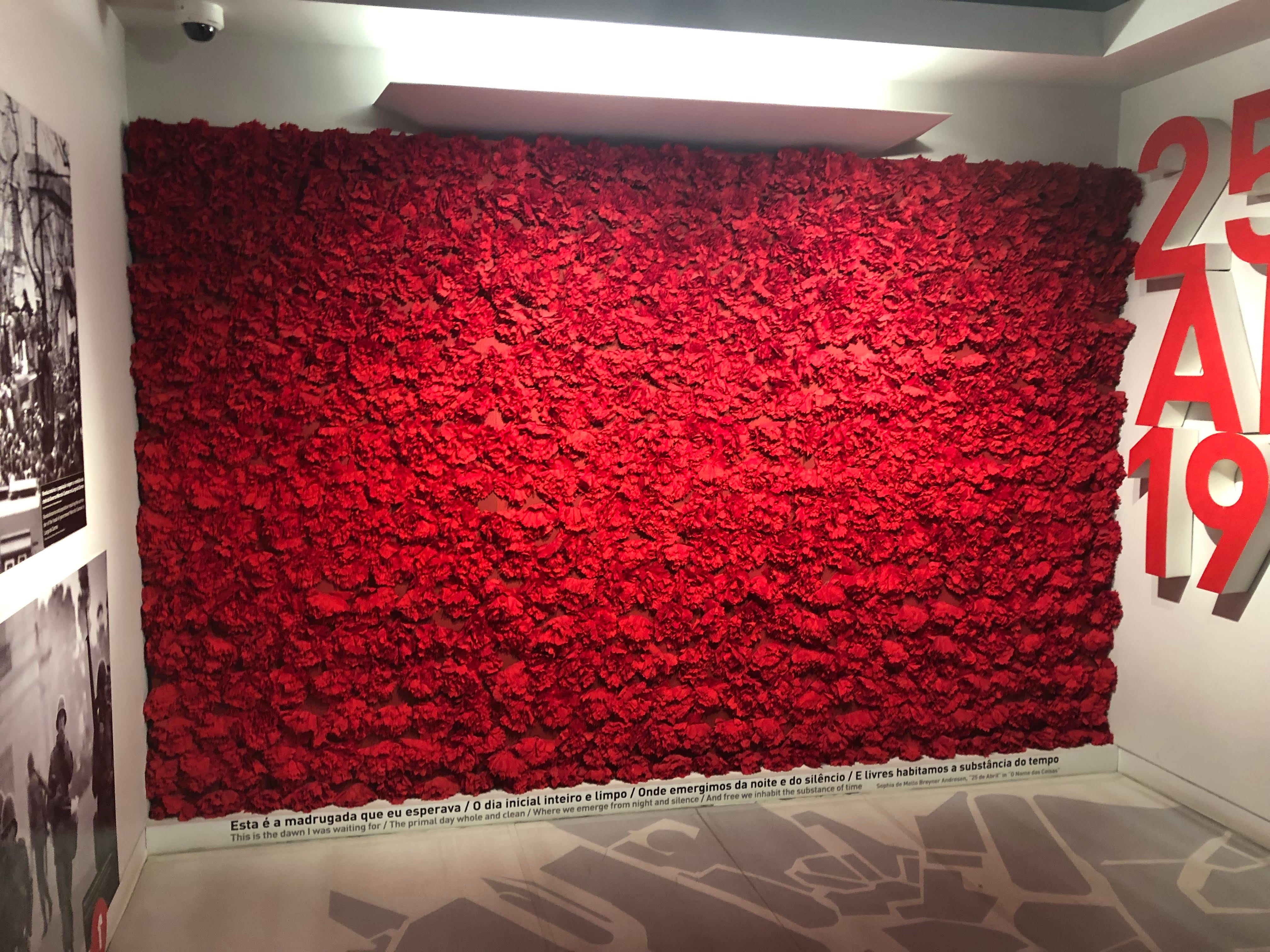
Her name was Celeste Caeiro. She died on November 15th, the day after we arrived in Lisbon. Though she hadn’t been directly involved in the planning of April 25th, she had aided resistance to the regime. When she was a teenager, she discovered clandestine leftist meetings had been taking place at her uncle’s house, and joined in. She smuggled banned books into the country in packets of tobacco. On the day of her death, the Portuguese Communist Party – of which she was a member – released a tribute to “Comrade Celeste.”
Her children and grandchildren reported that she often felt overlooked for the role she played, though she was center-stage at some of the official 50th anniversary commemorations of the revolution this past April. Now 90 years old and wheelchair-bound, she was accompanied by her daughter and granddaughter. That same day, in the Assembly, deputy Rui Tavares of the left-wing LIVRE party suggested erecting a statue in Lisbon in Celeste’s honor.
XI.
Whenever I go to a new city, I read as much as I can of its literary legends. In Prague, I read loads of Kafka. He is everywhere in the city: plaques, sculptures, at least one museum. These feel like invitations to converse with the city’s layers of history.
For Lisbon, I went back and read Jose Saramago. He loved the city dearly, and lived there most of his life. In 1978, he published “The Chair” as part of his collection The Lives of Things. The story homes in on a specific mahogany chair that, through generations of woodlice, has become unstable. It tells the story of the chair’s slow decay until, one not so very special day, it is sat on by a certain dictator.
A sick but happy accident of history? Or did the chair know something? Perhaps it conspired with the bugs that were slowly chewing its wood to pulp? Either way, the clear takeaway is that a human being can only stay in place for so long.
Saramago’s stories are filled with these kinds of moments, and characters prone to them. People touched by the absurdities and happenstance of history who either decide to use it to their advantage or are completely inundated by them.
There are no statues of Saramago in Lisbon’s public squares. It might be just as well; Lisbon is already full of statues. Still, save for the small, unassuming tree where some of his ashes are scattered, Saramago doesn’t show up much in the city’s public life. This man, for whom memory was something sacred, is relatively tucked away. The one notable exception is the Jose Saramago Foundation, just across the square from his ashes, housed in Casa dos Bicos in the Alfama neighborhood. Constructed in the 16th century and rehabbed in the 20th, its thick glass floors gaze down into the ruins of an ancient Roman fish processing site, thought to be the first place that garum was made in Portugal.
The Saramago Foundation occupies the upper floors of Casa dos Bicos. It houses a permanent exhibition on his life and work, featuring, among other things, walls covered in different editions of his books, in countless languages. It is remarkable to think that Saramago, who in 1998 won a Nobel Prize for Literature, only published one novel before his fifties. Prior to the Carnation Revolution, he had worked primarily as a journalist and newspaper editor.
A year after the fall of the Estado Novo, amid the ongoing revolutionary process, Saramago was promoted to assistant director at Diário de Notícias, one of Portugal’s oldest and most respected newspapers. Saramago guided Diário in a strong pro-communist direction, though this line was halted after the right-wing counter-coup of November 1975. Saramago was sacked. He returned to writing novels, and in 1988, his Baltasar and Blimunda made him an internationally recognized author. Four years later, Portuguese Prime Minister Aníbal António Cavaco Silva had Saramago’s The Gospel According to Jesus Christ removed from consideration for the Aristeion Prize, arguing it offended Catholic sensibilities. Saramago moved to Spain in protest, and stayed there until his death.
Saramago’s face and name may not be scattered around Lisbon, but Fernando Pessoa’s is. I’ve never read a word of Pessoa. I know he was a massive influence on Saramago, along with most other Portuguese writers from the mid 20th century on. The titular character in Saramago’s The Year of the Death of Ricardo Reis is named for one of the many pseudonyms Pessoa used.
After a few days in Lisbon, Mrs. Daydream and I figured it was time for us to familiarize ourselves with Pessoa’s work, and to see if there were any other Lisbonian poets or novelists who merited our attention. We went to Livraria Bertrand, which markets itself as the world’s oldest bookstore. That title is held only by the flagship location, though. We went to one of its chain locations near our hotel.
There, we met Ines and Camila, two young Bertrand employees eager to talk literature and politics with us. They recounted the huge celebrations and festivities held in April on the 50th anniversary of the MFA’s coup. They went on for days — parties in the streets.
Prior to this, I had been struck by the lack of interest in discussing the Carnation Revolution. Yes, posters and artworks celebrating the 50th anniversary were everywhere, but nobody seemed interested in talking about it. Not that it’s the responsibility of a city to rehearse its history for tourists. I’m not sure what I had expected. Nonetheless, it made me wonder if the event had been so quickly sanitized of meaning and relevance, another day off work (if you’re lucky enough) without much in the way of substance. Like the Fourth of July back in the States.
It was Ines that informed us of Celeste Caeiro’s death earlier that day. She also spoke about how expensive Lisbon had become for its residents. We mentioned Donald Trump’s reelection and the high cost of living in the US had prompted many of the country’s older, more comfortable and more liberal residents to consider living abroad. Portugal had become an attractive option. It’s cheap and has a high standard of living.
While it might be cheap by American standards, the influx of well-off ex-pats had driven up the cost of rents across Portugal, particularly in Lisbon. Wages, meanwhile, had stagnated. For most Portuguese, living standards have been essentially frozen since the debt crises of the late aughts and early 2010s.
Ines was quick to say that she thought everyone who wanted to live in Lisbon should be able to, but allowing landlords to take advantage of the fact was making life impossible for residents, including people who had lived there their whole lives. I was struck by how open and frank she was. During our conversation, I kept looking over my shoulder to ensure her supervisor wasn’t skulking around.
XII.
Americans with an interest in the lusophone world love to talk about saudade. Part of it is that we love words that don’t have a direct translation into English. Makes it feel exotic and mysterious. It’s more than a bit infantilizing too, which no traveling American is really able to avoid. Nor will we be able to until our own empire has been thoroughly cowed.
There’s a further reason Americans love the idea of saudade. The word is roughly defined as a feeling of incompleteness, a longing for something or someone that is absent. Naturally it’s a mood colored by nostalgia and melancholia. It naturally provokes some obnoxious reactions. This dipshit is complaining about how sad everyone seems to be in Portugal, bemoaning the fact that there’s even a music genre (fado) dedicated to themes of loss and longing. One wonders if he has ever lost or longed for anything or if, like most dipshits, is either too privileged or stupid to know the feeling.
For the most part though, the reaction of Americans is one of romanticization. And why not? The idea of absence as an ontological state is a very familiar one by now. It is also a handy aid in subjugation, a way of naturalizing the voice in your head that says you’ll never have this. It’s a perfect state of mind for the post-neoliberal subject. Nostalgic, resigned to deprivation, vulnerable to bouts of anxiety and manic accumulation where, try as we might, we only end up enriching someone else. The frustration turns to melancholy. Rinse and repeat.
Except that this doesn’t actually capture the full implications of saudade. It doesn’t capture the frame of mind of people like Ines, or Saramago, or Celeste Caeiro. The tourist-friendly version of the term is solipsistic. This may be unavoidable; saudade is, after all, derived from the Latin word for isolation. But this understanding effectively erases the context necessary for these feelings. To feel incomplete, one must have at least a vague understanding that they can be made complete.
In this respect, saudade is defined as much by what is absent as it is by the feeling of absence itself. A feeling brought on when events decide to reach down and touch you with their cruel denial. And so you wait, longingly, hopefully, for the next time they touch you, when you might have a chance to regain what you lost.
XII.
The Aljube Museum of Resistance and Freedom – or, in Portuguese, Museu do Aljube Resistência e Liberdade – is housed in what used to be a prison. Dating from the Moorish era, its name is derived from the Arabic al jubb, roughly translating to “dungeon.” Up until the 1500s, it was an ecclesiastical prison, where the Catholic Church would lock up misbehaving monks and priests. In the 1800s, it became a women’s prison. After the Estado Novo came to power, it was where political prisoners were incarcerated.
A relatively small building, its permanent exhibits are extremely well-curated and relatively claustrophobic. This is apt. Its first floor features recreations of the tiny cells prisoners occupied. When walking into the exhibit, a harsh alarm bell sounds. Testimonials from former inmates play on monitors. The effects of their trauma are evident. Recounting their stories, it is all too easy to see their eyes glaze over in bewilderment and awe that time had selected them to endure such madness and cruelty.
Another floor chronicles the rise and rule of the Estado Novo. The bullet points of Salazar’s 1936 “great certainties” speech are displayed. They paint a bleak picture of the kind of repression and censorship, the kind of cultural forgetting, that his regime enforced in public life. “We do not discuss God and his virtue.” “We do not discuss the homeland and its history.” “We do not discuss authority and its prestige.” “We do not discuss the family and its morality.” “We do not discuss the glory of work and its duty.”
Further rooms and corridors are dedicated to the persecution faced by trade unionists, women, intellectuals, and artists. Several rooms specifically chronicle the torture methods used by the regime against dissidents. A long hallway features walls of logs and files emulating those kept by the PIDE. By some accounts, the secret police had as many on its payroll as the East German Stasi did. An entire floor profiles the Estado Novo’s severe repression and exploitation of Portugal’s colonies abroad.
However, this is a museum dedicated to resistance. Rebellions among sailors, peasants, industrial workers, women, and students are recounted. Anticolonial organizations like Angola’s MPLA, FRELIMO in Mozambique, and Cape Verde’s PAIGC play a large role in the floor dedicated to the colonies. Walls are filled with copies of underground newspapers opposing the Estado Novo.
Then there is the special exhibit on April 25, less a recollection than a celebration. The room is painted a bright turquoise. Some banners and placards are suspended from the ceiling. Others are painted on the wall. Some read “25 de Abril Sempre! Fascismo nunca mais!” “Unidos contra o fascismo,” “Liberdade!” Slogans directly related to the overthrow of the Estado Novo, though some, pointedly, could just as easily show up today. Others are more directly related to the activism of the 21st century: “Capitalismo nao e verde,” “Girls just want to have fundamental rights.” There’s one that reads, pointedly in English, “Fuck your tourism fetish.”
In one corner, there is a steel frame with large canvas flaps that can be flipped through, recounting the events around and relevant to April 25. This includes many of the strikes and demonstrations, and a few of the factory occupations. It also includes the defeat of the revolutionary process on November 25, 1975. In another corner, the more interactive part of the exhibit: a metal grille with pieces of paper bearing slogans and drawings made by visitors. Nearby is a table with paper and markers. Some of the papers are of red carnations and mention April 25 specifically. Others are relevant to housing rights. Several mention a free Palestine.
It’s all very nifty. If nothing else, the vibrant colors manage to contrast with the dark blacks, browns, and grays that seem to predominate in the rest of the museum. The switch from bleak and repressive to free and colorful is no doubt intentional. Likewise, the curators clearly aim for attendees to draw parallels between yesterday and today. It is quite explicit that they believe that contemporary struggles around climate change, housing, and economic justice are a kind of continuation of the overthrow of the dictatorship 50 years ago.
The deliberate inclusion of the events after April 25, the protests and fights around exactly what future lay ahead for Portugal now that it had been opened up, is in this regard crucial. In general, the Aljube goes to great pains to emphasize that the people of Portugal and its colonies weren’t passive victims. They resisted. They fought. They did their best to live with dignity, and when the regime denied them that dignity, they sought ways around or through.
Better than a statue. Still, exiting through the gift shop (I bought a poster and a keychain) and into the Atlantic sunlight, being immediately confronted with ugly billboards prying cash from our hands, lines of tourists braying for a taxi, you are reminded how insufficient it all is. Maybe that’s on purpose, but it’s certainly unavoidable.
XIV.
In the conclusion of her book A People’s History of the Portuguese Revolution, Raquel Varela asks why it is that Chile weighs more heavily in the left’s imagination than Portugal. The coup and massacres that toppled Salvador Allende’s democratic socialist government had taken place just six months prior to April 25. Satisfied as Kissinger and others in the American and Western European political establishment were with the results, they looked to Portugal with massive anxiety. Writes Varela,
The Portuguese Revolution was a social explosion that US president Gerald Ford considered capable of transforming the entire Mediterranean into a ‘red sea’ and causing the downfall of all of the regimes of southern Europe like dominos. We can argue today that it began a wave of resistance in southern Europe that delayed the implementation of neoliberal plans attempted from 1973-1975 until the crisis period of 1981-1984.
This may help explain the prevalence of Chile over Portugal in the conventional imagination. Chile needs to be remembered as not just a failure but a bloody massacre, a cautionary tale of what happens when you reach for something better. Yes, the US eagerly backed the Group of Nine in Portugal and their designs for November 25, but they did so knowing that the Group would not be able to pull off the same bloodbath as had been seen in Chile (nor did they particularly want to).
On the other hand, even in its defeat, the Portuguese revolutionary experience had been more successful. Not only was there an aversion among the Group of Nine against repeating what Pinochet had done, there was also the distinct fear of backlash. The committees of workers and soldiers were simply too strong, the possibility of an open rebellion, possibly even a civil war, too great. The process of winding down radical workers' organizations had to be done carefully, and elections of some sort couldn’t be far behind the coup itself. Even so, the massive gains of the revolutionary months – universal health care, housing as a right, a certain amount of deference to unions – were considered untouchable by policymakers of all stripes. Some The economic crises of the 1980s started to change that, but only in a limited capacity.
The crisis following the 2008 economic collapse provided far more room to attack this robust welfare state. Hence the skyrocketing rents, the deteriorating hospitals, the same anxieties and malaises we hear from all over Europe and the world right now. Every single thing having to do with this city reified, turned into its most sellable self. Buildings and objects moving in place of people.
Hence the worrisome, almost amnesiac backsliding. All over Portugal you can see this man’s stupid mug:

That’s André Ventura, a far-right politician with kind things to say about the Estado Novo. His Chega party, promoting itself as the party of “God, fatherland, and family,” achieved a stunning breakthrough in the most recent elections, gaining 50 seats in the national Assembly. The parties of the left – LIVRE, the Communist Party, and Bloco de Esquerda – hold a combined 13. There is a palpable nostalgia for Salazarismo. Perhaps it was always there. Most statues of the man have been brought down, but that doesn’t seem to matter right now.
XV.
The past weighs like a nightmare on the present, but the opposite is also true. A broad survey of the world now seems to reveal nothing but foreclosures on the possibility of revolution. The rise of Chega in Portugal happens in context. Meloni in Italy. Milei in Argentina. Modi in India. Orban in Hungary. Trump. In both France and Germany, the far-right waits in the wings while the liberal establishment totters. The list goes on. It would appear that the side of reaction and counterrevolution has a decisive upper hand right now.
Richard Seymour, in his new book Disaster Nationalism, argues that the far-right, in its current phase, has figured out better than any other political current at this moment how to mobilize people’s minds: their emotions, their passions, their fears, their deepest psychological compulsions. Whatever you call it, the apocalyptic revenge fantasies of this not-quite-fascism are able to speak to it.
In the face of this, mere bread and butter fall short. The left, such as it is, doesn’t just need to offer more. It needs to offer something paradigmatically different: a life beyond isolation and domination by things. That is, something utopian. At least that is what the left has had to offer at its most successful, and it can happen quite organically.
“I think there is a legitimate, innate striving toward transcendence that is immanent to life as such,” Seymour tells Jacobin. “In other words, to be alive is to be striving toward ever another situation.” Later, he continues:
Karl Marx and Friedrich Engels talked about this dialectic where you join a union initially for something like higher wages, a shorter working day, things that you basically need, but then you develop other, richer needs. Quite often workers will go on strike to defend their union even if they’ll lose wages and their objective material conditions will get a bit worse. They need one another, they need their union. It can go further; it can be politicized in a much deeper way. The most radical need is the need for universality, in a Marxist sense.
That vision, practical and unsentimental, can also be utterly awe-inspiring, a glimpse at levels of fulfillment currently foreign to us. Without it, there is no worthwhile strategy for a future. The crashes of history create desires that can either be diverted or redeemed through experiences of concrete solidarity, of which these bonds and connections are the atomic unit.
This is not for a moment to suggest we do not need history – histories from below, people’s histories or histories of struggle. But envisioning forward and learning to see history clearly are inextricable. It’s through them that the unmovable objects of our lives, the impenetrable walls of our surroundings, become movable.
The signal for the beginning of the MFA’s coup against Caetano, the alarm bell that initiated the whole process, was a song. The officers had recruited a late-night radio host to their cause. At midnight on April 25, he played "Grândola, Vila Morena." It was the signal for the tanks to roll.
This is not an outwardly “political” song, though Zeca was a musician of the left. The officers of the MFA opted against playing one of his more strident songs because they thought that would arouse suspicion. In any event, most of those songs had been banned. Why this specific song was chosen is a matter of debate, but it is a very simple one, with a straightforward narrative.
It is sung a capella, in the style of Cante Alentejano. Other than Afonso’s voice and the backing vocals, the only sound is boots walking on gravel in a steady rhythm. Afonso was moved to write the song after performing in Grândola in 1964. The town had a reputation for protest against the Salazar regime, and a certain resilience among its residents in supporting each other. That is what Zeca wrote about. There are no slogans in this song, no grand political pronouncements, calls to arms, stories of strikes or protests. Just a simple melody telling a simple ode to a place where there is “On each corner, a friend. In each face, equality.”
Walking around Lisbon makes for an uncanny experience with all of this mind. It isn’t easy to look at the Avenida de Liberdade, the grand boulevard of Lisbon, without picturing tens of thousands of soldiers and civilians marching on it, banners unfurling across the wide streets. Now, the street is populated by some of the most decadent names in luxury goods. Givenchy, Yves Sain Laurent, Dolce & Gabbana, Armani. The Lisbon headquarters of the Portuguese Communist Party is here. It’s next to a Gucci store.
XVI.
At the top of the Avenida is Eduardo VII Park, an ample, sprawling green space of more than 60 acres. Named for the British King during his 1903 visit, it is imposingly formal. People walk their dogs and play with their children on the manicured lawns and stately terraces, but it feels like we are here at someone else’s leisure.
Until we get to the top of the park. Here is the Monumento de Evocação ao 25 de Abril, a large, mostly abstract sculptural monument to April 25, constructed by the artist João Cutileiro. Large slabs of roughly cut marble jut from the ground. Two small pillars stand on either side, as if something else had just been there. In between, a large carnation carved from red Negrais and green Viana marbles. Normally, it operates as a fountain. When Mrs. Daydream and I arrive, it is surrounded by a chain link fence, the water turned off, awaiting proposed structural renovations.
This only adds to the feeling that something is unfinished here. We have to acknowledge it. We may well have had to even if the monument weren’t cordoned off. The sculpture has long been controversial. No doubt some in the city would prefer something less interpretive, more conventional, a direct representation rather than a symbol.
It’s not just that it feels incomplete, it’s that it invites you to impose yourself upon it, playfully opening the door for you to walk through. Here, at what feels like the top of Lisbon, you are compelled by what is essentially a scatter of oddly arranged rocks. If you didn’t know better, you would almost say that it’s asking you a question. Does this stone pile know something? Or is it simply waiting for the rest of us to understand? If only there were some exotic word for the feeling these kinds of thoughts provoke…
There is a quote from Saramago’s short story “Raised From the Ground” at the Aljube Museum. It is featured in the section of the museum examining the regime’s torture and interrogation methods. It reads thus:
Joao Mau-Tempo will stand still like a statue for seventy-two hours. His legs will swell up, he will become dizzy, he will be beaten with a ruler and with a baton, not that hard, but enough to hurt him, every time his legs gave way. He did not cry, but there were tears in his eyes, his eyes swam with tears, until even a stone would have taken pity on him. After some hours the swelling went down, but under the skin his veins stood out, almost as thick as fingers. His heart moved, turning into a thudding, deafening hammer, echoing inside his head, and then, finally, his strength totally abandoned him, he could no longer remain on his feet, his body bending over without him even realising it, and now he is crouching, he is a poor farm labourer from the estates, squeezing out one last feeble turd, Get up, you swine, but Joao Mau-Tempo could not get up, he was not pretending, this was another of his truths.
It is a harrowing passage. But note the way the narration switches, almost imperceptibly, between future, past, and present tenses. That’s not bad translation into English. Saramago’s stories frequently move like this. To him, temporality is pliable, at once immanent and grand historic.
Move time and you can easily move space. Like most imperial capitals, Lisbon’s rulers fancied the city the most important on earth, the hub around which the rest of the globe turned. Given its place on the westernmost tip of Europe, gazing out over the Atlantic, this was an easy belief to have. Riches literally floated their way into the city. To those on the African continent or Southeast Asia whose lives were torn apart in order to get those riches, this faraway Lisbon must have seemed a vortex, a gaping maw that devoured people’s lives. The end of all things. But no matter. The kings and dukes and burghers of the Age of Discovery built up their city with an eye to eternity.
Never mind that the city had been Moorish and Muslim just a few hundred years before. Never mind that a couple hundred years later, Lisbon would be almost completely leveled by a massive earthquake. The city would need to be entirely rebuilt. It was never the quintessential global city under capitalism the way it was during the mercantile age. It didn’t stop Lisbon’s architects from insisting upon it. Hence the statues.
There are, naturally for this year, red carnations everywhere, on walls and lapels and streets. Many of them will likely vanish in the next several months. But the winding roads and telephone poles and ancient churches and graffiti’d walls make clear the ability and necessity for things to change and reinvent in this city.
Time doesn’t stand still. Neither should any human being. Some part of us bristles at being turned from a being into a thing. We long to move. It’s the only way to be made whole, to be redeemed. Not in any mystical, spiritual sense. Not handed down by any sort of ineffable force, but discovered when we realize the motions of history can belong to us. Fifty years ago, this was a city where that happened, on a tremendous scale. Maybe it can happen again. Maybe not. It was. It is. But it never simply is because it was.
All photos by Kelsey Goldberg and the author.
That Ellipsis... is a reader-supported publication. To receive new posts and support my work, consider becoming a free or paid subscriber.
The Things of Lives (Iberian Ellipsis, part 3)
For most of November, I was on my honeymoon in Spain and Portugal. You would think that means I take a break from the obligations of writing and cultivating an audience, but no. I cannot, for whatever reason, tear myself away from this neurotic need for a forum. The upshot is you get to watch me attempt a travel journal as I journey from Porto down to Lisbon, into Spain by way of Seville, up the eastern coast, into Barcelona. Old buildings. Efficient trains. Conversations with total strangers. The first and second in the series can be read here and here. Also, if you haven’t subscribed or upgraded to a paid subscription, this is your cue.
X.
The story goes like this. She worked as a coat checker at a Lisbon restaurant. On the morning of April 25, 1974, she showed up for her shift, which was expected to be busy. It was the first anniversary of the restaurant’s opening, and the dining room was bedecked with red and white carnations. But when she arrived, she was sent home by her boss.
He had been listening to the radio, and word was spreading fast that something big was happening. The kind of event that would make doing business impossible. So he sent her home, and on her way out shoved a bunch of the red carnations into her arms. He didn’t want them going to waste.
Walking back to her apartment, she saw what was happening. It was no longer just on the radio, but in the streets, flowing out of homes and businesses. A row of tanks and armored cars headed toward Largo do Carmo, where Marcelo Caetano, head of the far-right authoritarian Estado Novo regime, was holed up with loyal generals. This was the Armed Forces Movement, who had been planning a coup against the Estado Novo for more than two years.
Citizens poured out of their homes waving flags, cheering the MFA on as word spread that the government was about to fall. She cheered them on too. This was a hated, rickety regime. Literally rickety. Caetano’s predecessor, Antonio de Oliveira Salazar, the cold and venal man who had ushered in and overseen the Estado Novo for forty years, had been incapacitated when he sat on an unstable chair in 1968. The chair collapsed, and Salazar had a cerebral hemorrhage. He died in 1970.
Caetano took over, but nothing in the Estado Novo stabilized. Portugal’s colonies on the African continent – Mozambique, Angola, Cape Verde – were in open armed rebellion against Portuguese rule. By some estimates, 40 percent of the country’s budget was being poured into suppressing these movements.
Everyone, especially the poor, had known someone drafted and sent to shoot at other poor people. Likewise, everyone had known someone disappeared by the country’s hated secret police, the PIDE. The cheers were not incidental. Most people despised the regime as much as the officers who had organized the MFA.
As the tanks and soldiers passed by, one of them asked her for a cigarette. She said she didn’t smoke, and gave him one of the red carnations instead. He chuckled and put the flower in the barrel of his rifle. Soon, other soldiers were approaching her, asking for their own carnation to carry with them on their way to topple a government. Hours later, Caetano and his generals had fled, and the military was in charge.
The democratic outpouring was massive, seeping into every facet of daily life. The next eighteen months would see thousands of mass strikes and demonstrations. Factories were occupied, rural farms taken over by employees. There were experiments in workers’ control and self-management, communist and socialist parties flourished. Laws established a thorough welfare state, guaranteeing healthcare as a right and nationalizing whole industries. It was a fulsome revolutionary process, radical and far-reaching.
It was only halted by a right-wing counter-coup in November of 1975, led by more conservative members of the MFA, known as the “Group of Nine.” Elections were held the following year. The Carnation Revolution, named for her flowers, came to be trapped in amber, mythologized into a more or less orderly transition to representative democracy, minus the insignificant flurries of chaos. A blueprint for the velvet revolutions that came fifteen years later.
Her name was Celeste Caeiro. She died on November 15th, the day after we arrived in Lisbon. Though she hadn’t been directly involved in the planning of April 25th, she had aided resistance to the regime. When she was a teenager, she discovered clandestine leftist meetings had been taking place at her uncle’s house, and joined in. She smuggled banned books into the country in packets of tobacco. The day of her death, the Portuguese Communist Party – of which she was a member – released a tribute to “Comrade Celeste.”
Her children and grandchildren reported that she often felt overlooked for the role she played, though she was center-stage at some of the official 50th anniversary commemorations of the revolution this past April. Now 90 years old and wheelchair-bound, she was accompanied by her daughter and granddaughter. That same day, in the Assembly, deputy Rui Tavares of the left-wing LIVRE party suggested erecting a statue in Lisbon in Celeste’s honor.
XI.
Whenever I go to a new city, I read as much as I can of its literary legends. When I went to Prague, I read loads of Kafka. He is everywhere in the city: plaques, sculptures, at least one museum. These feel like invitations to converse with the city’s layers of history.
For Lisbon, I went back and read Jose Saramago. He loved the city dearly, and lived there most of his life. In 1978, he published “The Chair” as part of his collection The Lives of Things. The story homes in on a specific mahogany chair that, through generations of woodlice, has become unstable. It tells the story of the chair’s slow decay until, one not so very special day, it is sat on by a certain dictator.
A sick but happy accident of history? Or did the chair know something? Perhaps it conspired with the bugs that were slowly chewing its wood to pulp? Either way, the clear takeaway is that a human being can only stay in place for so long.
Saramago’s stories are filled with these kinds of moments, and characters prone to them. People touched by the absurdities and happenstance of history who either decide to use it to their advantage or are completely inundated by them.
There are no statues of Saramago in Lisbon’s public squares. It might be just as well; Lisbon is already full of statues. Still, save for the small, unassuming tree where some of his ashes are scattered, Saramago doesn’t show up much in the city’s public life. This man, for whom memory was something sacred, is relatively tucked away. The one notable exception is the Jose Saramago Foundation, just across the square from his ashes, housed in Casa dos Bicos in the Alfama neighborhood. Constructed in the 16th century and rehabbed in the 20th, its thick glass floors gaze down into the ruins of an ancient Roman fish processing site, thought to be the first place that garum was made in Portugal.
The Saramago Foundation occupies the upper floors of Casa dos Bicos. It houses a permanent exhibition on his life and work, featuring, among other things, walls covered in different editions of his books, in countless languages. It is remarkable to think that Saramago, who in 1998 won a Nobel Prize for Literature, only published one novel before his fifties. Prior to the Carnation Revolution, he had worked primarily as a journalist and newspaper editor.
A year after the fall of the Estado Novo, amid the ongoing revolutionary process, Saramago was promoted to assistant director at Diário de Notícias, one of Portugal’s oldest and most respected newspapers. Saramago guided Diário in a strong pro-communist direction, though this line was halted after the right-wing counter-coup of November 1975. Saramago was sacked. He returned to writing novels, and in 1988, his Baltasar and Blimunda made him an internationally recognized author. Four years later, Portuguese Prime Minister Aníbal António Cavaco Silva had Saramago’s The Gospel According to Jesus Christ removed from consideration for the Aristeion Prize, arguing it offended Catholic sensibilities. Saramago moved to Spain in protest, and stayed there until his death.
Saramago’s face and name may not be scattered around Lisbon, but Fernando Pessoa’s is. I’ve never read a word of Pessoa. I know he was a massive influence on Saramago, along with most other Portuguese writers from the mid 20th century on. The titular character in Saramago’s The Year of the Death of Ricardo Reis is named for one of the many pseudonyms Pessoa used.
After a few days in Lisbon, Mrs. Ellipsis and I figured it was time for us to familiarize ourselves with Pessoa’s work, and to see if there were any other Lisbonian poets or novelists who merited our attention. We went to Livraria Bertrand, which markets itself as the world’s oldest bookstore. That title is held only by the flagship location, though. We went to one of its chain locations near our hotel.
There, we met Ines and Camila, two young Bertrand employees eager to talk literature and politics with us. They recounted the huge celebrations and festivities held in April on the 50th anniversary of the MFA’s coup. They went on for days — parties in the streets.
Prior to this, I had been struck by the lack of interest in discussing the Carnation Revolution. Yes, posters and artworks celebrating the 50th anniversary were everywhere, but nobody seemed interested in talking about it. Not that it’s the responsibility of a city to rehearse its history for tourists. I’m not sure what I had expected. Nonetheless, it made me wonder if the event had been so quickly sanitized of meaning and relevance, another day off work (if you’re lucky enough) without much in the way of substance. Like the Fourth of July back in the States.
It was Ines that informed us of Celeste Caeiro’s death earlier that day. She also spoke about how expensive Lisbon had become for its residents. We mentioned Donald Trump’s reelection and the high cost of living in the US had prompted many of the country’s older, more comfortable and more liberal residents to consider living abroad. Portugal had become an attractive option. It’s cheap and has a high standard of living.
While it might be cheap by American standards, the influx of well-off ex-pats had driven up the cost of rents across Portugal, particularly in Lisbon. Wages, meanwhile, had stagnated. For most Portuguese, living standards have been essentially frozen since the debt crises of the late aughts and early 2010s.
Ines was quick to say that she thought everyone who wanted to live in Lisbon should be able to, but allowing landlords to take advantage of the fact was making life impossible for residents, including people who had lived there their whole lives. I was struck by how open and frank she was. During our conversation, I kept looking over my shoulder to ensure her supervisor wasn’t skulking around.
XII.
Americans with an interest in the lusophone world love to talk about saudade. Part of it is that we love words that don’t have a direct translation into English. Makes it feel exotic and mysterious. It’s more than a bit infantilizing too, which no traveling American is really able to avoid. Nor will we be able to until our own empire has been thoroughly cowed.
There’s a further reason Americans love the idea of saudade. The word is roughly defined as a feeling of incompleteness, a longing for something or someone that is absent. Naturally it’s a mood colored by nostalgia and melancholia. It naturally provokes some obnoxious reactions. This dipshit is complaining about how sad everyone seems to be in Portugal, bemoaning the fact that there’s even a music genre (fado) dedicated to themes of loss and longing. One wonders if he has ever lost or longed for anything or if, like most dipshits, is either too privileged or stupid to know the feeling.
For the most part though, the reaction of Americans is one of romanticization. And why not? The idea of absence as an ontological state is a very familiar one by now. It is also a handy aid in subjugation, a way of naturalizing the voice in your head that says you’ll never have this. It’s a perfect state of mind for the post-neoliberal subject. Nostalgic, resigned to deprivation, vulnerable to bouts of anxiety and manic accumulation where, try as we might, we only end up enriching someone else. The frustration turns to melancholy. Rinse and repeat.
Except that this doesn’t actually capture the full implications of saudade. It doesn’t capture the frame of mind of people like Ines, or Saramago, or Celeste Caeiro. The tourist-friendly version of the term is solipsistic. This may be unavoidable; saudade is, after all, derived from the Latin word for isolation. But this understanding effectively erases the context necessary for these feelings. To feel incomplete, one must have at least a vague understanding that they can be made complete.
In this respect, saudade is defined as much by what is absent as it is by the feeling of absence itself. A feeling brought on when events decide to reach down and touch you with their cruel denial. And so you wait, longingly, hopefully, for the next time they touch you, when you might have a chance to regain what you lost.
XII.
The Aljube Museum of Resistance and Freedom – or, in Portuguese, Museu do Aljube Resistência e Liberdade – is housed in what used to be a prison. Dating from the Moorish era, its name is derived from the Arabic al jubb, roughly translating to “dungeon.” Up until the 1500s, it was an ecclesiastical prison, where the Catholic Church would lock up misbehaving monks and priests. In the 1800s, it became a women’s prison. After the Estado Novo came to power, it was where political prisoners were incarcerated.
A relatively small building, its permanent exhibits are extremely well-curated and relatively claustrophobic. This is apt. Its first floor features recreations of the tiny cells prisoners occupied. When walking into the exhibit, a harsh alarm bell sounds. Testimonials from former inmates play on monitors. The effects of their trauma are evident. Recounting their stories, it is all too easy to see their eyes glaze over in bewilderment and awe that time had selected them to endure such madness and cruelty.
Another floor chronicles the rise and rule of the Estado Novo. The bullet points of Salazar’s 1936 “great certainties” speech are displayed. They paint a bleak picture of the kind of repression and censorship, the kind of cultural forgetting, that his regime enforced in public life. “We do not discuss God and his virtue.” “We do not discuss the homeland and its history.” “We do not discuss authority and its prestige.” “We do not discuss the family and its morality.” “We do not discuss the glory of work and its duty.”
Further rooms and corridors are dedicated to the persecution faced by trade unionists, women, intellectuals, and artists. Several rooms specifically chronicle the torture methods used by the regime against dissidents. A long hallway features walls of logs and files emulating those kept by the PIDE. By some accounts, the secret police had as many on its payroll as the East German Stasi did. An entire floor profiles the Estado Novo’s severe repression and exploitation of Portugal’s colonies abroad.
However, this is a museum dedicated to resistance. Rebellions among sailors, peasants, industrial workers, women, and students are recounted. Anticolonial organizations like Angola’s MPLA, FRELIMO in Mozambique, and Cape Verde’s PAIGC play a large role in the floor dedicated to the colonies. Walls are filled with copies of underground newspapers opposing the Estado Novo.
Then there is the special exhibit on April 25, less a recollection than a celebration. The room is painted a bright turquoise. Some banners and placards are suspended from the ceiling. Others are painted on the wall. Some read “25 de Abril Sempre! Fascismo nunca mais!” “Unidos contra o fascismo,” “Liberdade!” Slogans directly related to the overthrow of the Estado Novo, though some, pointedly, could just as easily show up today. Others are more directly related to the activism of the 21st century: “Capitalismo nao e verde,” “Girls just want to have fundamental rights.” There’s one that reads, pointedly in English, “Fuck your tourism fetish.”
In one corner, there is a steel frame with large canvas flaps that can be flipped through, recounting the events around and relevant to April 25. This includes many of the strikes and demonstrations, and a few of the factory occupations. It also includes the defeat of the revolutionary process on November 25, 1975. In another corner, the more interactive part of the exhibit: a metal grille with pieces of paper bearing slogans and drawings made by visitors. Nearby is a table with paper and markers. Some of the papers are of red carnations and mention April 25 specifically. Others are relevant to housing rights. Several mention a free Palestine.
It’s all very nifty. If nothing else, the vibrant colors manage to contrast with the dark blacks, browns, and grays that seem to predominate in the rest of the museum. The switch from bleak and repressive to free and colorful is no doubt intentional. Likewise, the curators clearly aim for attendees to draw parallels between yesterday and today. It is quite explicit that they believe that contemporary struggles around climate change, housing, and economic justice are a kind of continuation of the overthrow of the dictatorship 50 years ago.
The deliberate inclusion of the events after April 25, the protests and fights around exactly what future lay ahead for Portugal now that it had been opened up, is in this regard crucial. In general, the Aljube goes to great pains to emphasize that the people of Portugal and its colonies weren’t passive victims. They resisted. They fought. They did their best to live with dignity, and when the regime denied them that dignity, they sought ways around or through.
Better than a statue. Still, exiting through the gift shop (I bought a poster and a keychain) and into the Atlantic sunlight, being immediately confronted with ugly billboards prying cash from our hands, lines of tourists braying for a taxi, you are reminded how insufficient it all is. Maybe that’s on purpose, but it’s certainly unavoidable.
XIV.
In the conclusion of her book A People’s History of the Portuguese Revolution, Raquel Varela asks why it is that Chile weighs more heavily in the left’s imagination than Portugal. The coup and massacres that toppled Salvador Allende’s democratic socialist government had taken place just six months prior to April 25. Satisfied as Kissinger and others in the American and Western European political establishment were with the results, they looked to Portugal with massive anxiety. Writes Varela,
The Portuguese Revolution was a social explosion that US president Gerald Ford considered capable of transforming the entire Mediterranean into a ‘red sea’ and causing the downfall of all of the regimes of southern Europe like dominos. We can argue today that it began a wave of resistance in southern Europe that delayed the implementation of neoliberal plans attempted from 1973-1975 until the crisis period of 1981-1984.
This may help explain the prevalence of Chile over Portugal in the conventional imagination. Chile needs to be remembered as not just a failure but a bloody massacre, a cautionary tale of what happens when you reach for something better. Yes, the US eagerly backed the Group of Nine in Portugal and their designs for November 25, but they did so knowing that the Group would not be able to pull off the same bloodbath as had been seen in Chile (nor did they particularly want to).
On the other hand, even in its defeat, the Portuguese revolutionary experience had been more successful. Not only was there an aversion among the Group of Nine against repeating what Pinochet had done, there was also the distinct fear of backlash. The committees of workers and soldiers were simply too strong, the possibility of an open rebellion, possibly even a civil war, too great. The process of winding down radical workers' organizations had to be done carefully, and elections of some sort couldn’t be far behind the coup itself. Even so, the massive gains of the revolutionary months – universal health care, housing as a right, a certain amount of deference to unions – were considered untouchable by policymakers of all stripes. Some The economic crises of the 1980s started to change that, but only in a limited capacity.
The crisis following the 2008 economic collapse provided far more room to attack this robust welfare state. Hence the skyrocketing rents, the deteriorating hospitals, the same anxieties and malaises we hear from all over Europe and the world right now. Every single thing having to do with this city reified, turned into its most sellable self. Buildings and objects moving in place of people.
Hence the worrisome, almost amnesiac backsliding. All over Portugal you can see this man’s stupid mug:
That’s André Ventura, a far-right politician with kind things to say about the Estado Novo. His Chega party, promoting itself as the party of “God, fatherland, and family,” achieved a stunning breakthrough in the most recent elections, gaining 50 seats in the national Assembly. The parties of the left – LIVRE, the Communist Party, and Bloco de Esquerda – hold a combined 13. There is a palpable nostalgia for Salazarismo. Perhaps it was always there. Most statues of the man have been brought down, but that doesn’t seem to matter right now.
XV.
The past weighs like a nightmare on the present, but the opposite is also true. A broad survey of the world now seems to reveal nothing but foreclosures on the possibility of revolution. The rise of Chega in Portugal happens in context. Meloni in Italy. Milei in Argentina. Modi in India. Orban in Hungary. Trump. In both France and Germany, the far-right waits in the wings while the liberal establishment totters. The list goes on. It would appear that the side of reaction and counterrevolution has a decisive upper hand right now.
Richard Seymour, in his new book Disaster Nationalism, argues that the far-right, in its current phase, has figured out better than any other political current at this moment how to mobilize people’s minds: their emotions, their passions, their fears, their deepest psychological compulsions. Whatever you call it, the apocalyptic revenge fantasies of this not-quite-fascism are able to speak to it.
In the face of this, mere bread and butter fall short. The left, such as it is, doesn’t just need to offer more. It needs to offer something paradigmatically different: a life beyond isolation and domination by things. That is, something utopian. At least that is what the left has had to offer at its most successful, and it can happen quite organically.
“I think there is a legitimate, innate striving toward transcendence that is immanent to life as such,” Seymour tells Jacobin. “In other words, to be alive is to be striving toward ever another situation.” Later, he continues:
Karl Marx and Friedrich Engels talked about this dialectic where you join a union initially for something like higher wages, a shorter working day, things that you basically need, but then you develop other, richer needs. Quite often workers will go on strike to defend their union even if they’ll lose wages and their objective material conditions will get a bit worse. They need one another, they need their union. It can go further; it can be politicized in a much deeper way. The most radical need is the need for universality, in a Marxist sense.
That vision, practical and unsentimental, can also be utterly awe-inspiring, a glimpse at levels of fulfillment currently foreign to us. Without it, there is no worthwhile strategy for a future. The crashes of history create desires that can either be diverted or redeemed through experiences of concrete solidarity, of which these bonds and connections are the atomic unit.
This is not for a moment to suggest we do not need history – histories from below, people’s histories or histories of struggle. But envisioning forward and learning to see history clearly are inextricable. It’s through them that the unmovable objects of our lives, the impenetrable walls of our surroundings, become movable.
The signal for the beginning of the MFA’s coup against Caetano, the alarm bell that initiated the whole process, was a song. The officers had recruited a late-night radio host to their cause. At midnight on April 25, he played "Grândola, Vila Morena." It was the signal for the tanks to roll.
This is not an outwardly “political” song, though Zeca was a musician of the left. The officers of the MFA opted against playing one of his more strident songs because they thought that would arouse suspicion. In any event, most of those songs had been banned. Why this specific song was chosen is a matter of debate, but it is a very simple one, with a straightforward narrative.
It is sung a capella, in the style of Cante Alentejano. Other than Afonso’s voice and the backing vocals, the only sound is boots walking on gravel in a steady rhythm. Afonso was moved to write the song after performing in Grândola in 1964. The town had a reputation for protest against the Salazar regime, and a certain resilience among its residents in supporting each other. That is what Zeca wrote about. There are no slogans in this song, no grand political pronouncements, calls to arms, stories of strikes or protests. Just a simple melody telling a simple ode to a place where there is “On each corner, a friend. In each face, equality.”
Walking around Lisbon makes for an uncanny experience with all of this mind. It isn’t easy to look at the Avenida de Liberdade, the grand boulevard of Lisbon, without picturing tens of thousands of soldiers and civilians marching on it, banners unfurling across the wide streets. Now, the street is populated by some of the most decadent names in luxury goods. Givenchy, Yves Sain Laurent, Dolce & Gabbana, Armani. The Lisbon headquarters of the Portuguese Communist Party is here. It’s next to a Gucci store.
XVI.
At the top of the Avenida is Eduardo VII Park, an ample, sprawling green space of more than 60 acres. Named for the British King during his 1903 visit, it is imposingly formal. People walk their dogs and play with their children on the manicured lawns and stately terraces, but it feels like we are here at someone else’s leisure.
Until we get to the top of the park. Here is the Monumento de Evocação ao 25 de Abril, a large, mostly abstract sculptural monument to April 25, constructed by the artist João Cutileiro. Large slabs of roughly cut marble jut from the ground. Two small pillars stand on either side, as if something else had just been there. In between, a large carnation carved from red Negrais and green Viana marbles. Normally, it operates as a fountain. When Mrs. Ellipsis and I arrive, it is surrounded by a chain link fence, the water turned off, awaiting proposed structural renovations.
This only adds to the feeling that something is unfinished here. We have to acknowledge it. We may well have had to even if the monument weren’t cordoned off. The sculpture has long been controversial. No doubt some in the city would prefer something less interpretive, more conventional, a direct representation rather than a symbol.
It’s not just that it feels incomplete, it’s that it invites you to impose yourself upon it, playfully opening the door for you to walk through. Here, at what feels like the top of Lisbon, you are compelled by what is essentially a scatter of oddly arranged rocks. If you didn’t know better, you would almost say that it’s asking you a question. Does this stone pile know something? Or is it simply waiting for the rest of us to understand? If only there were some exotic word for the feeling these kinds of thoughts provoke…
There is a quote from Saramago’s short story “Raised From the Ground” at the Aljube Museum. It is featured in the section of the museum examining the regime’s torture and interrogation methods. It reads thus:
Joao Mau-Tempo will stand still like a statue for seventy-two hours. His legs will swell up, he will become dizzy, he will be beaten with a ruler and with a baton, not that hard, but enough to hurt him, every time his legs gave way. He did not cry, but there were tears in his eyes, his eyes swam with tears, until even a stone would have taken pity on him. After some hours the swelling went down, but under the skin his veins stood out, almost as thick as fingers. His heart moved, turning into a thudding, deafening hammer, echoing inside his head, and then, finally, his strength totally abandoned him, he could no longer remain on his feet, his body bending over without him even realising it, and now he is crouching, he is a poor farm labourer from the estates, squeezing out one last feeble turd, Get up, you swine, but Joao Mau-Tempo could not get up, he was not pretending, this was another of his truths.
It is a harrowing passage. But note the way the narration switches, almost imperceptibly, between future, past, and present tenses. That’s not bad translation into English. Saramago’s stories frequently move like this. To him, temporality is pliable, at once immanent and grand historic.
Move time and you can easily move space. Like most imperial capitals, Lisbon’s rulers fancied the city the most important on earth, the hub around which the rest of the globe turned. Given its place on the westernmost tip of Europe, gazing out over the Atlantic, this was an easy belief to have. Riches literally floated their way into the city. To those on the African continent or Southeast Asia whose lives were torn apart in order to get those riches, this faraway Lisbon must have seemed a vortex, a gaping maw that devoured people’s lives. The end of all things. But no matter. The kings and dukes and burghers of the Age of Discovery built up their city with an eye to eternity.
Never mind that the city had been Moorish and Muslim just a few hundred years before. Never mind that a couple hundred years later, Lisbon would be almost completely leveled by a massive earthquake. The city would need to be entirely rebuilt. It was never the quintessential global city under capitalism the way it was during the mercantile age. It didn’t stop Lisbon’s architects from insisting upon it. Hence the statues.
There are, naturally for this year, red carnations everywhere, on walls and lapels and streets. Many of them will likely vanish in the next several months. But the winding roads and telephone poles and ancient churches and graffiti’d walls make clear the ability and necessity for things to change and reinvent in this city.
For time doesn’t stand still. Neither should any human being be made to do so. Some part of us bristles at being turned from a being into a thing. We long to move, to transcend. It’s the only way to be made whole, to be redeemed. Not in any mystical, spiritual sense. Not handed down by any sort of ineffable force, but found in the motions of history when people realize it can belong to them. Fifty years ago, this was a city where that happened, on a tremendous scale. Maybe it can happen again. Maybe not. It was. It is. But it never simply is because it was.
All photos by Kelsey Goldberg and the author.
That Ellipsis... is a reader-supported publication. To receive new posts and support my work, consider becoming a free or paid subscriber.
November 29, 2024
Worms of the Senses (November 2024)
Welcome to a new feature here at That Ellipsis… At the end of each month, I’ll be providing for paid subscribers a summation of what I’ve been seeing, hearing, reading, and thinking. Much of what I took in during the month of November was shaped by the fact that I was out of the country for most of it, jaunting from London down through Portugal and back up through Spain to Barcelona. And of course, I would be lying if I said the results of the election aren’t weighing on my mind…
Three more travel journal posts through Portugal and Spain are still to come. You can read the first two installments here and here. In the meantime, if you’d like to be invited into the worms of my senses, you’ll have to sign up for a paid subscription below.