Alexander Billet's Blog, page 6
May 23, 2024
The Sound Man, or, the Music Outlives All of Us

It is difficult to write about Steve Albini. Partly because most of what’s worth saying about the man was written and committed to the net within hours of his death, and partly because when I try to imagine someone asking me genuine questions about why they should care, my instinctive answer echoes in my skull: “What the fuck do you mean you fucking plebe?”
Of course, I don’t answer that way because I want to believe that the world deserves to be better than it is. But my instinct isn’t entirely unjustified.
So much of what characterized the “underground rock” scene (as it’s understood in most credible rock histories) was this same gap, between what is and what should be. The 60s and 70s were a near-miss encounter between the aesthetic urge for life to be more just and meaningful and the material forces that might have made them so (see, for example, Jefferson Cowie’s Stayin’ Alive, the late work of Mark Fisher, or more recently Joe Molloy’s Acid Detroit). The best of the 80s and 90s indie scene was the fallout from that encounter failing to consummate, of the culture industry regaining its footing as it figured out how to substitute form for substance. It sounded angrier, more cynical, often embracing an absurdism that could edge into the nihilistic. You can say a lot of things about the directionlessness of this rage and disaffection. You cannot say that it was without reason.
Nor can you say that some of these groups didn’t capture the anger incredibly well, even as the 90s spilled into the aughts and beyond. Point to any sterling example of this, and there’s a very good chance that Steve Albini’s fingerprints are on it, as a musician or an audio engineer (as he famously hated being called a producer). PJ Harvey’s Rid of Me, Pixies’ Surfer Rosa, the early output of Jesus Lizard, the Breeders’ Pod, Low’s Things We Lost In the Fire, Jawbreaker’s 24 Hour Revenge Therapy, Godspeed You! Black Empreror’s Yanqui U.X.O., and yes, Nirvana’s In Utero. Albini didn’t see a single penny in royalties from any of these albums, as he refused on principle to charge more than his base rate. He left a fortune on the table with In Utero alone.
“The recording part is the part that matters to me — that I’m making a document that records a piece of our culture, the life’s work of the musicians that are hiring me,” he told The Guardian. “I take that part very seriously. I want the music to outlive all of us.”
In other words, Albini believed in music because he also, through all the cynicism and proto-edgelordism, believed that most of us deserve better, that we deserve to leave something behind. It was why he warned young musicians of the music industry’s predatory nature, why he came to reassess and apologize for his earlier, more deliberately offensive artistic choices, and why he kept beavering away doing what he did.

All of this is preamble to taking up what is likely Albini’s last work as a musician. Plenty has been said — and rightly so — about the radical democratic valence of his work as an audio engineer. If the infamously tyrannical and abusive Phil Spector’s “wall of sound” sought to turn the artists’ work into an obstacle to communion with the listener, then Albini was an absolute opposite in terms of ethics and sonic results. He didn’t produce; that’s the artist’s job. He facilitated, sussing out the best qualities and dynamics of a song and positioning them to speak for themselves.
How does this apply when he was on the other side of the audio booth? There’s been far less said about this, though the respect afforded to both Big Black and Shellac is significant. Whatever we might think about some of the provocative lyrics that Albini would end up shrieking as part of these projects – lyrics which, again, he would come to regret down the line – it’s difficult to ignore the sentiment behind it: it’s not about the language but the behavior, not the symbols of how we live our lives, but how we actually live our lives.
In this regard, both projects can and should be seen not dissimilar from the Jungian shadow. All of the guilty, ugly and shameful acts of daily life brought out into harsh light. As such they are confrontational, dissonant, contemptible toward aesthetic convention, and often as sonically egalitarian as his production work. Take a look at this video from Shellac’s performance at the 2018 Primavera Festival in Barcelona and you can see it clearly.
Naturally, nobody knew that To All Trains would prove to be Albini’s swan song or Shellac’s last album, that we would all be listening to this album in an entirely different light. But here, obviously, we are. The symbolism is annoying.
Particularly because it’s a remarkable album: tight, exacting, stripped down to Shellac’s most basic elements. Opening track “WSOD” is heavy like an inert caustic gas, driven by Bob Weston’s crumpled bassline, Albini’s spiky noodling clawing its way in. There is no clear verse-chorus-verse structure, though the song’s chord patterns don’t deviate much.
As for the lyrics, they are pointedly opaque, sometimes surreal, characteristically never lending themselves to easy interpretation while still being somehow relatable, as if the human voice is merely another instrument wielded by the absurd chaos. “Get that man a medal,” Albini deadpans. Who is this man who deserves this ironic medal? It isn’t clear, but we all know him. Then about thirty seconds of a cinder block rock-out, then it’s done.
That’s more or less the pattern of To All Trains, but this doesn’t mean that it ever gets tedious or boring. Shellac find a groove, they play with it, kick and punch at its edges, leaving it unrecognizable without obliterating it. We may get a bit brutalized along the way ourselves, but that doesn’t mean we can look away. Nor do we really want to.
Even in this mode, there are still high points. “Chick New Wave” is loud and manic, the kind of song you cannot listen to while driving without accidentally speeding (I can personally attest to this). “Wednesday” is a punishing, doomy, thousand-yard stare of a song (also probably the closest any of these tracks’ lyrics come to a discernable plot). “Scabby the Rat” is a punchy, surreal ode to everyone’s favorite giant inflatable rodent labor mascot and his ability to impregnate a whole room.
I ended up listening to the closing track “I Don’t Fear Hell” repeatedly. It’s the longest song on To All Trains – though still relatively brief at under four and a half minutes. Compared to the rest of the album, it takes its time, plodding through jerky riffs disassembling themselves to the point of almost incoherence.
“Something something something when this is over,” drolls Albini. “Leap in my grave like the arms of a lover / If there's a heaven, I hope they're having fun / Cause if there’s a hell, I'm gonna know everyone”
Again, the symbolism is annoying. It also leaves the listener with a very clear understanding of a basic truth. If the music outlives us all, then its survival is going to leave us bruised.

Last month, when every music writer was falling over themselves (including me) to observe the thirtieth anniversary of Kurt Cobain’s death, referenced Steve Albini’s notorious essay in The Baffler “The Trouble With Music.” It seemed appropriate at the time not just because of the In Utero connection, but because everything he described in that article played an unmistakable role in Cobain’s mental decline and suicide. Not that Cobain’s immortalization ever acknowledges this. Doing so might be a real risk to the interested parties.
Albini knew these forces better than most. He also knew that none of them had really gone away, they had merely changed form. It’s why for the most part he never changed what he did, just occasionally how he did it.
Until a few days ago, Shellac’s music had, for the most part, stayed gloriously off of Spotify. So had Big Black’s catalog. Neither act needed it. When you make music that good, and aim to get it in the ears of people just as dedicated, there is no need for algorithmic distribution. Some of the more interesting and savvy contemporary artists understand this: Cindy Lee’s Diamond Jubilee is already one of the most talked about indie albums of the year and it’s nowhere near Spotify.
Cranky and elitist? Maybe. But consider for a moment the calculation and deliberation this implies. Most music today is put on streaming as a matter of course. As if to say the only way a song can be heard is to risk its mixture into an already overflowing cacophonous slurry. Hopefully it makes its way to a playlist where its similarities to others in its genre make it more easily consumed, another penny in the pocket of the artist who wrote and recorded it.
Consider the content of To All Trains, the way it demands and defies you to find meaning in it. For music to place itself deliberately outside this distribution model is to demand a certain level of concentration and respect, amplifying the shrieks and dissonance. This isn’t to insist that the medium is the message, but rather to acknowledge that if you sought these sounds out, if you wanted them enough to go beyond the usual channels, then it’s because these words and sounds make that much more sense to you than the slurry of the algorithm’s faves. Almost as if a different and more purposeful conception of music — its composition, its form and content, its place in the world and in our notions of it — is feasible.
Now, both Shellac and Big Black are on Spotify. We certainly can’t begrudge any act for wanting to reach a wider audience at a time like this, and if anyone deserves this credit, it’s Steve Albini. Still, we can’t help but ask if it exacts a price on his ethos, his belief that the best songs can speak for themselves and include us in something as unsparing as he was.
It’s a worthy vision. Whether it has any chance of winning out is another matter entirely. Particularly with so much pressure to drown every sound in pretense and fool’s gold glamor. Still, I’d like to believe there will be many others like Albini in our future. Just like I want to believe the world and our lives deserve to be better than they are.
That Ellipsis... is a reader-supported publication. To receive new posts and support my work, consider becoming a free or paid subscriber.


May 9, 2024
Some Place

On the subject of capitalism’s nonchalant and everyday violence, my obituary of socialist playwright Edward Bond was published recently at Locust Review. And now on with the show…
“A carbon dioxide pipeline rupture in the small village… sent nearly 50 people to the hospital with “zombie”-like conditions in 2020, and now another major leak from a pipeline in Sulphur, Louisiana, has once again exposed the risks carbon dioxide pipelines pose to communities in their path… Soon, pipelines like this could be coming to cities and towns throughout the country.” – Emily Sanders, Jacobin
“no one leaves home unless
home is the mouth of a shark.” – Warsan Shire, “Home”

It had been in the news before it happened. Not a warning exactly. Nothing so straightforward as that. Had it been, maybe we’d have listened. But when the air was poisoned, plenty of us must have thought back to those headlines, the ghastly pictures of children crying next to rubble. And – for those who had dared to read on – the devastating words from those who had lost everything, framed by chilly, matter-of-fact prose. The kind of presentation that distances. Lives flattened onto our screens.
On some level, we were correct when we thought it couldn’t be us. Why would it be? Could any of us remember a war on our own soil? Those of us who served abroad might have recounted what these missiles and bombs looked like. Seeing one crashed into your driveway? The corner shop? Or where the bus stops every day to take your children to school?
Somewhere, people are preparing these kinds of explosives, mechanisms capable of bringing down whole buildings, leveling residential blocks, obliterating the places someone is so used to seeing every day that it never occurs to them they might not be there. Someone builds this thing for the expressed purpose of destroying itself and everything around it. Someone does this, but nowhere near here.
Everyone around here knows our history. A small town we certainly are, humble even, but there’s plenty to know, to remember, to learn and pass on. The archeologists and historians tell us that someone has been some settlement here for at least 2,000 years. We know about the Niutachi of course. If anyone who came before ever went by a different name, we do not know it. Isn’t it bizarre how a whole people can be lost, even as their place remains?
The Niutachi had their own appreciation for the beauty and fertility of this place. So did the Europeans – of a kind – when they showed up. They also thought they had more right to the land than the people who were here first. You know the rest of that story. If you didn’t, there wouldn’t be much of anything around here to teach it to you.
In any case, as our farms grew, so did we. We fed ourselves and other towns. Many across state lines. It was only natural that so many of their residents would find their way here. When the Farmall plant opened in 1926, fortunes turned again. Every home had a picture of a tractor in the kitchen or living room, normally with a family member standing next to it, beaming with pride.
I would sit on the hilltops and look down at what used to be that plant. It still stood, still stands. You could still see the faded letters of the International Harvester logo on the building’s side before the sunset. Broken windows, weeds growing and winding their way through the brick The silence, where once you’d have heard the faint rhythms of coming and going and working and building, was fitting.
Most of us still had memories of our fathers – and more than a few of our mothers – heading here in the morning before we went to school. Sometimes, when production was especially demanding, they’d be gone before we even woke up. Nobody could ever have said we were happy – at least not as happy as all the pictures with tractors made us seem – but it was something.
Something. Not the nothing my friends and I would be looking down at from the hills. It had become a regular happening by the time most of us were done with school. The bars wouldn’t serve us, still underaged and all. But we knew where to get something cheap, something that would let us forget the weights that were growing in our chests, something that would let us laugh for a bit. Even if the laughter could only be ironic, a short reprieve from the constant Sunday we now woke up to. Everyone needs their rituals, even if they bear no resemblance to the ones our parents performed.

Compressed tightly enough, any gas is a bomb. That was, naturally, the biggest fear, the most persistent whispers and worried rumblings when the Kinder Morgan men started poking around the town. Maybe there were a few passing thoughts about the eyesore of the dull gray pipes jutting out of someone’s back yard, but by then we had been so used to the abandoned IH plant that saying something seemed silly. What’s a bit more ugliness? Especially when it had been so long since anyone had been willing to write a check for any portion of our property.
The Kinder Morgan men were most reassuring that the likelihood of a fiery eruption was quite low. An eruption would never be their word. What we didn’t consider was that the gas wouldn’t need to explode to kill, to take apart a human being, to drive people from their homes. A weak point in the pipe, a bit of rust, a microscopic twist or blemish; these would do the job. Quiet, small, minute even, leaving no sense that something foul was slowly creeping into the air, crawling into our mouths and lungs, making our brains slow and our hearts fall off beat.
Nobody knew it was happening. How could we? Everybody gets headaches and sore throats. Tired? Everybody is tired; everybody is stressed. Blurry vision? It can be written off, not even worth mentioning to your neighbor. You have trouble reading your mail; so what? Time to stop putting off your eye exam. No reason to make a fuss.
Only when I realized I hadn't seen her come out of her house in a couple days, when I knocked on the door and saw a pale and sweaty and confused imitation of my neighbor answer the door; only then did it occur to me that something is very wrong. Several homes on my street hadn’t opened their front doors for days, several kids absent from the bus stop.
I stood in the road, my vision reeling, unfocused as it tried to take in the rows of houses and what might have been in them. Kids unable to wake up. Parents dry-heaving into the sink. You could always tell the homes from the empty houses – and there were a few on my street, like most others. It wasn’t just the overgrown lawns and dark windows, but something about the movement in them that you could sense outside as you walked past. An unpresent presence, as imperceivable as the vapor wafting up from the ground.
It took the people from Kinder Morgan far longer to show up than the ambulances. Far longer than FEMA. Several days longer. By then it was clear that other streets and neighborhoods had been affected. We were told to stay in our homes, wait for a knock from the paramedics or emergency workers. It seemed a suicidal prospect, but who were we to argue, even if most of us had had the strength?
It wasn’t even the same Kinder Morgan men who finally arrived. These ones wore suits, and kept their distance on the town’s outskirts. We only knew they were here because we saw on our news feeds or TVs. Those of us who managed to stay conscious and coherent watched their words of practiced concern and measured promises; real and unreal, here and nowhere.

The bus lurches forward, jolts me awake. It’s the first time I’ve slept in days. Mostly I’ve been too anxious, too scared I won’t wake up again. I don’t know how exactly long it had been since I dozed off, but it couldn’t have been more than a few minutes. The emergency workers had been as serious getting us out of our homes as they had when they told us to stay in them. Only this time there was real urgency, speed, even efficiency. Clearly they were in a rush to evacuate, which to me meant something was about to happen that they wouldn’t tell us about.
Outside the window, my street slides away. The houses seem strange now, no matter if they’ve been empty for five years or five minutes. All of them stare back at me, like they might unhook their jaws at any moment. None of them do, but it’s enough to make everything around them feel dead and dangerous. The light from the lampposts is dull and inert, almost bouncing off the window, leaving the bus dark and quiet, sealed off. And as we wind through the streets of the industrial sector, the grand void of the International Harvester plant looms imposingly, as if its own darkness has finally had the chance to stretch out and feed itself.
You always picture disaster as cataclysm. An explosion, or the ground opening up. Buildings swallowed whole. But right now I’m watching a father scream and cough, his sick body writhing while the emergency workers take away his son’s body. Behind him, his home is still intact, though on the most technical sense, it’s not his home anymore. Very likely it never will be again.
Somewhere the faceless are crammed into a room hovering high above their own landscape. The view extends for miles over city streets, apartment building and office complexes, even across rivers and forests, but not to us. They talk of a kind of damage control. Not how to minimize the damage itself, rather how to control the awareness of damage. Thus the carefully phrased statements, the photographs intended to tug at the heartstrings, the assurances of help and relief.
You’ll see all of these. For most of you, it will be the first time you’ve ever heard of what was once this town. Maybe you’ll know our history too now. Will it matter? With nobody here to remember, is it even a history? Or is it just a story, another collection of lives and events, flattened onto your screen?
That Ellipsis... is a reader-supported publication. To receive new posts and support my work, consider becoming a free or paid subscriber.
April 15, 2024
No Permanent Spring: Notes on War

I.
What made you declare the dead body dead?
Did you declare the dead body dead?
How well did you know the dead body?
How did you know the body was dead?
Did you wash the dead body
Did you close both its eyes
Did you bury the body
Did you leave it abandoned
Did you kiss the dead body
– Harold Pinter, “Death (Births and Deaths Registration Act 1953)”
II.
The drones and missiles have, mercifully, been shot down. No deaths came from Iran’s retaliation against Israel. And yes, it was very much a retaliation. So much breath and ink are expelled on Israel’s right to defend itself, but what self-respecting government would allow another country to bomb its consulate?
From the outside, it would seem that Iran’s response was more for show than a direct preamble to a wider war. That is still in the works. Everyone knows it. We may comfort ourselves with Biden urging restraint from Netanyahu, and this time around it may serve to temporarily cool tensions. Without a comprehensive political solution that centers the rights of the displaced and subjugated, the slow sleepwalk toward a wider conflict that engulfs the entire region is surely inevitable.
Consider the long memory of this region. As the refrain from the Palestine solidarity movement has gone, the roots of instability go back well before October 7th. There are more than a hundred years of imperial meddling thrumming underneath the region: borders arbitrarily redrawn by colonial authorities, sectarianism stoked, undemocratic regimes propped up, democratic ones overthrown, power vacuums that have been filled by truly horrifying figures and political parties.
Between Israel and Iran are at least two countries – Syria and Iraq – whose landscapes have been utterly ripped apart by civil strife and foreign intervention. As for Jordan, its own modus vivendi with Israel has never been particularly solid. A monarchy whose parliamentary powers exist on nothing more than paper can declare alliances with whomever it pleases, but this hasn’t stopped pro-Palestine sympathies from flourishing in the country. Particularly given the presence of at least 2 million Palestinian refugees within Jordan’s borders.
Iranian officials had said that they would forgive the strike against its consulate if Israel withdrew from Gaza and put a permanent ceasefire in place. Who knows whether this was an offer made in good faith, but the refusal of Netanyahu to even countenance the offer is in keeping with his and Likud’s longstanding refusal to allow an independent Palestine. Such an independent state did not fit into Israel’s designs as part of a constellation of regimes rapidly developing and flush with oil money. The notion that this can be established on any kind of stable basis has always been fantasy.
Funny thing about geopolitical fantasy: the more material force is put behind making it real — the more money and resources and bombs and bullets — the more vicious the reality that overtakes it.
III.
When the rockets destroyed the world everything whistled
Every hard surface and hard edge whistled
Mouths of medicine bottles and whiskey bottles
Cornices of law courts and office blocks
Cracks in rocks
Whistled in derision
As the tyres stopped screeching the winds whistled in the broken windows
Doors and wheelchairs – some empty, others carrying sick and maimed – whistled as they flew high over the great plains
The mountains whistled
The last breaths whistled from dead mouths
And as the flesh burned from faces the skulls whistled
Surfaces too soft to whistle burned and the fires whistled
The heart leapt like a bird in its burning cage and the ribs whistled
The earth whistled in derision
In final derision at the lord of creation
In derision derision
That drowned the sounds of explosions and the last screams of the world’s masters
The whole earth whistled in derision against the lord of creation
– Edward Bond, The War Plays
IV.
When it first aired on the BBC in 1984, Mick Jackson’s Threads unsettled and disturbed audiences. This was the first film to realistically portray the immediate and long-term aftermaths of nuclear armaggeddon. Cities aren’t leveled so much as turned into mass warehouses of the dead and soon-to-be dead. People watch loved ones succumb to radiation sickness. Culture and government disintegrate, civilization is sent back to the Middle Ages. Survivors, staring into a bleak future, come to see those killed as the lucky ones. It is a devastating watch, graphic and unforgiving.
One of the film’s often-overlooked strengths is in its first twenty-odd minutes, before the ICBMs launch. The film’s narrative in these minutes revolves around a young couple, Ruth and Jimmy, planning to marry after Ruth discovers she’s pregnant. The geopolitical tensions that turn the Cold War hot are told through cold title cards and news broadcasts. Interestingly enough, one of these catalysts is a Soviet incursion into Khomeni-era Iran, soon followed by a US occupation of the country’s southern region.
What is so haunting about the domestic, kitchen sink plotline, however, is its illustration of how easy it is to push the run-up to apocalypse into the back of our minds, even as we grasp the essential danger of the situation. Powerless to change things in the immediate, we go about our lives as normal. Only in the final cataclysm does the impossibility of this clear.
“How could it have come to this?” we ask. Actually, how could it not? Read the accounts of even the most politically savvy observers in the run-up to both World Wars, and you find a kind of double consciousness: a resigned understanding of all signs pointing to catastrophe, mixed with disbelief that it could really and truly happen.
V.
The difference between you and your government is much bigger than the difference between you and me. And the difference between me and my government is much bigger than the difference between me and you. And our governments are very much the same.
– Marjane Satrapi
VI.
Asaf Elia-Shalev’s recently-published Israel’s Black Panthers deserves to be widely read for a variety of reasons. It’s not just that the book tells a much-ignored story about a protest movement that was considered one of Israel’s worst enemies within during a key moment in its history. It’s that in doing so, Israel’s Black Panthers complicates the false binary between Jews and the “darker” countries Israel claims to protect them from.
Israel has always conceived of itself as a project more European in nature than Middle Eastern. That most people in Europe and North America think of a white person when they think of a Jew is testament to how successful that project has been on an ideological level. That’s not to say that the modern state has been a bastion of raw Ashkenazi experience, lifted wholesale from the Pale of Settlement and transplanted into the desert of the Levant. Much of what characterized Eastern European Jewishness – speaking Yiddish, Bundism and socialist ideas, a prioritization of intellectual curiosity over physical toughness – had to be sidelined or purged from memory for modern Zionism to take root. At its core, the Zionism of Herzl and Jabotinsky was an attempt to save Jews from the worst of European imperialism by emulating it, proving that the children of Israel could dominate alongside rather than be dominated by.
This meant that, in its earliest years, the Israeli state had no idea how to handle Jews that arrived from surrounding countries rather than from, say, Poland, Russia, or the United States. Frequently they were shoved into isolated camps, far from the major urban centers. Or they were housed in the poorest parts of Jerusalem, normally into neighborhoods that had until recently been predominantly Palestinian, where they could be easily neglected and deprived of basic education and even sanitation services. These Jews, now mostly referred to as Mizrahi, were viewed as at best a nuisance and at worst a menace to be put in their place by the authorities.
Barely a decade into Israel’s existence, more non-white Jews were leaving the fledgling nation than arriving. Many were simply disillusioned, hoping to return to countries where, whatever faults and risks might await them, they would at least be able to find a Jewish community that accepted them as Jews, including in places like Iran.
We don’t hear about this often. Just as it’s rarely acknowledged that Iran contains the second-highest number of Jews in the Middle East to this day. Just as we so rarely hear about the history of Jews in Arab countries not related to their aliyah. Nor do we hear much about the treatment of Persian or Moroccan or Iraqi Jews after arriving in Israel: the racism and discrimination, the enforced poverty, the abject violence, the ghettoization. We certainly never hear of how, for a time, this meant that many Jews of non-European extraction felt more in common with the Palestinians, with Black militants in America, than with their Ashkenazi counterparts.
Why do you think that is?
VII.
Who’s going to mobilise darkness and silence? that’s what I wondered in the night. By the third day I could hardly walk but I got down to the river. There was a camp of Chilean soldiers upstream but they hadn’t seen me and fourteen black and white cows downstream having a drink so I knew I’d have to go straight across. But I didn’t know whose side the river was on, it might help me swim or it might drown me. In the middle the current was running much faster, the water was brown, I didn’t know if that meant anything, I stood on the bank a long time. But I knew it was my only way of getting here so at last I put one foot in the river. It was very cold but so far that was all. When you’ve just stepped in you can’t tell what’s going to happen. The water laps around your ankles in any case.
– Caryl Churchill, Far Away
VIII.
Spring has been slow to arrive in Los Angeles this year. When news broke that Iran had launched drones in the direction of Israel, the rain had become a chilly sluice, the kind that you expect to see making pulp of people’s newspapers in London in November rather than mid-April in Southern California.
In the minds of most Angelenos, the rain should be done by now. And that’s only accounting for winters when there’s any rain to speak of. Most of us are used to the idea of only occasional blips in what is otherwise constant sun. Increasingly, though, the winter has gone from a short interruption of autumn-like mildness to a long reminder of California’s status as one of North America’s climate chaos bellwethers. The kind of place that can somehow be flooded, on fire, and in a drought all at the same time.
In much the same way that it has become impossible to disentangle climate change from the machinations of capital, so too is it more and more difficult to avoid implicating imperialism, the crude violence and dispossession that allowed for resources to be extracted and markets to spread. It was at work when the west overthrew Mohammad Mossadegh after he dared to nationalize Iran’s oil in 1953. It is certainly moving and shifting underneath the current anxieties over how a new phase in this war might further impact the price of oil, this resource that probably should have never been siphoned from under the ground in the first place.
Shifts in history are never fully foreclosed. They can, however, be minimized, made less plausible against other outcomes as certain phenomena move in a certain direction. The inertias of empire are quite real, and the longer they persist, the harder it is to see beyond a cold, bleak sky.
That Ellipsis... is a reader-supported publication. To receive new posts and support my work, consider becoming a free or paid subscriber.
April 11, 2024
A Great Composer of Time

One of the themes in my ongoing work on the music of Jóhann Jóhannsson is the difference and overlap between diegetic and non-diegetic music. That is, music that characters in a film or television show can hear — played through a radio or performed in front of them — and that which can only be heard by the viewer.
Though this paper — presented at Historical Materialism in London on November 10th, 2023 — doesn’t take up that specific topic, in writing it, I realized that I would be unable to do what is commonly done in most presentations on the politics of music: play a part of a song, then talk about it, followed by another song and yet another block of spoken text. I would need to play the music as I spoke about it. So, I invite you to play the audio (which includes samples of Jóhannsson’s work) and read along as you listen.
I have no idea whether this successfully communicates the brilliance of Jóhannsson’s music, but am comfortable leaving that for readers/listeners to judge for themselves. Text and audio are available to paid subscribers below.
April 5, 2024
We Like All the Pretty Songs
 Cobain walks offstage. From 1991: The Year Punk Broke.
“In his dreadful lassitude and objectless rage, Cobain seemed to have given wearied voice to the despondency of the generation that had come after history, whose every move was anticipated, tracked, bought and sold before it had even happened. Cobain knew he was just another piece of spectacle, that nothing runs better on MTV than a protest against MTV; knew that his every move was a cliché scripted in advance, knew that even realising it is a cliché. The impasse that paralysed Cobain is precisely the one that Fredric Jameson described: like postmodern culture in general, Cobain found himself in ‘a world in which stylistic innovation is no longer possible, where all that is left is to imitate dead styles in the imaginary museum’.” – Mark Fisher, Capitalist Realism
I find it difficult to listen to Nirvana. Not because the group’s music makes me feel painful memories, but because it makes me feel nothing. More than that, the fact that it makes me feel nothing makes me feel out of step, like everyone else is laughing and I don’t get the joke.
I do though. I really do. I know, understand, and remember the monumental importance of this band. I remember the feeling when hearing of Kurt Cobain’s suicide — which happened thirty years ago today, as most publications and news outlets are noting. I recall the disbelief, mixed with the strange recognition that this bit of news may have been inevitable. I remember thinking that the songs will never sound the same again. I wouldn’t have guessed that they would sound like this, though. I didn’t anticipate hearing them so often, in so many scenarios, so thoughtlessly thrown into whatever setting just because they were there. Until any and all power and pathos is robbed of it. That’s what happened though, and it makes the strange numbness standing in for rage even more numb.
Listening to Nirvana in 2024 feels like a tragic non-gesture. It’s like listening to a placeholder, a copy of a copy of a copy. I own all of the primary albums on vinyl: Bleach, Nevermind, and In Utero. I suppose one of these days I’ll get Unplugged in New York just to have. Just about the only one I can bring myself to put on and enjoy without discomfort is Bleach. It’s their first release, the one that put them on much of the Seattle scene’s radar before that scene was on anyone’s radar, before Nirvana put it on everyone’s radar.
It’s a truly brilliant record: raw, discordant, angry but acerbically funny, its wry lyrical absurdism bouncing gleefully over the sharp chaos of incendiary punk musicianship. And I’ll be the first to admit that I find joy in Bleach because few of its songs found their way into regular radio rotation.
Even so, I can only put the record occasionally. It is still, after all, written and performed by that same group whose everywhere-ness has become unbearable, made their music milquetoast.
Every adult has some expression or gesture from their youth that they scratch their head at in retrospect, but this is different. I know very well that Nirvana’s songs are still good, remarkable even. All of the characteristics that made them so when I was in my pre-teen years are still there, and I still recognize them as such. But now it’s like they are wrapped in gauze, dulling their sharp edges. By no means does Cobain’s music sound like the countless lesser copycats that have been shoved down our throats. But somehow, through sheer force of glut, that’s how it feels.

Yes, in many ways, this is exactly what Cobain feared would happen to his music, even if he couldn’t have possibly anticipated the ways it manifested. He could not have, for example, expected his songwriting mimicked by a computer program, or his likeness virtually projected over the river near where he grew up. My piece for Real Life a few years ago aimed at both of these, but what’s still most risible to me is the suggestion that Cobain’s music wouldn’t have evolved, would have stayed the same so it could fit the mold that had been shaped around it.
That, however, seems to be the fate of most music. Lately, for work purposes, I’ve been driving quite a bit, and listening to old-fashioned terrestrial radio rather than streaming just to change things up. A lot of my dial’s time is spent on KROQ, proudly touted as a “world famous” alternative station. Listening to the station’s output more or less confirms what a meaningless designation “alternative” is.
It used to be that when a station played songs from thirty years ago, they were understood as an Oldies station, or maybe just classic rock. On KROQ you hear them all the time; not just Nirvana but Alice In Chains, Gorillaz, Eminem, Dookie-era Green Day, and so on. Along with plenty of contemporary bands that are playing in more or less the same sonic sandbox. If nostalgia for the 1990s is so enthusiastically in among the youth, then this may go some way toward explaining that.
Despite insistence to the contrary, this is a very different KROQ from the one that made the callsign famous. That KROQ prided itself on playing music that was very different from most typical rock stations, the station that employed Rodney Bingenheimer – arguably one of the greatest radio DJs of all time – and let him play pretty much whatever he wanted. It was this kind of station that first exposed many Southern Californians to punk rock, back when the style was still seen as an actual threat to public morals and decency.
It is difficult to imagine a station hiring a DJ like this today, let alone giving him such free reign. Much in the same way it is difficult to imagine a major label taking such a financial risk on an artist that broke with convention in the same way Nirvana did. A couple of years after Cobain’s suicide, the 1996 Telecommunications Act allowed for the consolidation of radio into the hands of just a few corporations. The craft of the rock and roll DJ was now on notice. It also granted private telecom companies far more reach into the nascent internet. We often talk of cancelled futures, that culture seems stuck in a cul-de-sac, but we sometimes neglect the very real and very venal history underpinning it.

Kurt Cobain and the rest of the indie rock ecosystem knew just how much they were already this fucked. It would be both insulting and frankly incorrect to say that it’s what led to his depression and profound disillusionment. It’s clear that, particularly in his last months, Cobain was in an immense amount of pain, the kind that those closest to him desperately tried to pull him out of. That can’t be chalked up to one single issue, important as music was to him. Still, a human is a whole creature, their psychology never neatly divided into so many categories, particularly when the act of creation and art are involved.
Today, there are plenty of tributes floating through the air. Many of them have this distinct but vague air of longing to them. It could be easily written off as nostalgia, but it might be something else. The 70’s and 80’s gave rise to a crude but very savvy “us vs. them” viewpoint in most local music scenes, an instinct that the major labels were out to scam both artist and listener, to make art sterile and easily marketed. In a nebulous way, this instinct is still there, though there are far fewer local scenes vibrant enough to anchor an nurture it. The most sure cultural scaffolding is Big Data and the algorithm, ever-present, hegemonic, and nearly impossible to grab onto.
Nobody needs to make an actual decision that culture will be a parade of sameness. Even the suits have less influence than they once did. Inertia is a powerful thing, and it has certainly become more of a thing than a process. With no one able to push art and culture toward innovation, the spectacle gets more and more spectacular, even as it also gets emptier and emptier.
Two days ago, Kiss – a band that Cobain may or may not have been a big fan of – sold their entire catalog and IP to Swedish company Pophouse Entertainment Group for an unreal $300 million. This includes the digital avatars of the band’s members, which were revealed last winter and will be part of a “live” music “experience.” News is it will be going “on tour” in 2027.
Kiss have always been notorious for their shameless licensing, and Gene Simmons in particular is a right-wing shill. That a company is giving this impulse new space to roam seems to be creating a trickle-down effect among more mid-level bands, though in a more analog guise. In November, the Hives put out a call for cover bands to officially affiliate to the group’s brand. “Help us create a world where the Hives are playing in every city, all the time,” read the release. The fact that it won’t actually be the Hives is inconsequential. Simulation is reality, and commerce is the only art that matters.
What this signals is that music is no longer an event or an experience. Gone are the days when heading to a show was a sort of transgressive ritual, an act through which one forged an identity apart from a world that, for a variety of reasons, left us feeling cut adrift. Fans of Kiss or the Hives who go to one of these shows will in fact not be going to have an authentic moment. Not when everything is so staged or (literally) pre-programmed. Rather, they will go to these shows the same way we might go to a movie, albeit a far more expensive movie.
There’s no use trying to exit this reality. It is full-spectrum, and as of now, there is no evident egress. The budding musician or composer has far fewer opportunities to expose themselves to the grand variety of sonic modes and the emotions they invoke. Even Bandcamp, once one of the most hopeful spaces providing an exception to the online rule, seems to be heading in the same direction.
What this means for our sense of possibility – our sense of hope – is bleak, and unfortunately very familiar. All of us are already this fucked. If we want to change it, first we have to face it.
That Ellipsis... is a reader-supported publication. To receive new posts and support my work, consider becoming a free or paid subscriber.
March 6, 2024
A World of Pure Invalidation

If the good parents of Glasgow wanted to do right by their children, they wouldn’t have called the police on Willy’s Chocolate Experience. Granted, the image of cops confronting a bunch of underpaid actors dressed in cheap Oompa Loompa costumes, all to the tune of sobbing kids; this is enough to tickle our thirst for the absurd. When pictures of a drab warehouse decorated with oversized lollipops and candy canes rocketed round the internet, it was guaranteed we would squeal with schadenfreude.
As it looks now, Willy’s Chocolate Experience is bound to be a minor entry on the growing list of spectacular events that fail spectacularly in the post-Fyre Fest cultural landscape, another experiment in real-life world-building down in flames. It’s got all the hallmarks: a production company in way over its head (as if anything named House of Illuminati could ever know what it’s doing), a reliance on internet buzz that outweighed any ability to deliver on its promise, hired staff that can see the train crash coming a mile away, viral images of a final product that leaves us asking how the organizers thought they would ever get away with it.
It is still unclear which angry mom or dad called the fuzz, but officers didn’t show up until after Willy’s Chocolate Experience had been abruptly shuttered. Most everyone had gone home, which must have been a relief for the actors. Dealing with irate parents is harrowing enough.
Nobody likes to see children cry, much less their own. But one must wonder what exactly parents thought they were getting their kids when they shelled out £35 for each ticket to Willy’s Chocolate Experience. That the organizers very pointedly left off the “Wonka” should tell us everything we need to know about legal permissions and, ergo, the budget House of Illuminati was likely working with.
Then again, the whole idea of selling experience has always involved a certain amount of hucksterism. As Benjamin Schneider wrote for Real Life in 2019, the whole notion of an “experience economy” brings with it unsettling implications. Namely, unless we are prepared to part with a certain amount of cash, we will be deprived of the very essence of experience. Philosophically and psychologically speaking, experience is not something that starts and stops, but in the context of the attention economy and virtual reality, production companies see an opportunity “to lay claim to our sense of having lived.”
Even as this economy branches out, worming its way into our lives via social media and apps, the “immersive experience” continues to play a central role. The prospective audience for companies like Meow Wolf, Factory Obscura, and Otherworld are prime examples of manufactured desire, but it’s hard to imagine that audience being so large if everyday life were satisfying on any emotional, intellectual, or creative level. The sticking point is that in seeking to meet the needs of us disaffected masses, they rely on the most generic and watered-down versions of the experience they are attempting to produce.
That’s the nature of the commodity. Its subjects and meanings are abstracted and decontextualized – even (and especially) when rooted in real history, as with the immersive experiences of artists like Vincent Van Gogh or Frida Kahlo. Our physical senses and grasp of the possible are more assuaged than expanded, let alone challenged.
That’s what’s so maddening about parents’ reactions. Unlike so many others, Willy’s Chocolate Experience actually challenged its attendees’ preconceived notions. When families showed up to the event site in Glasgow, they were no doubt expecting something that riffed off all the contemporary stories of Willy Wonka the kindly eccentric chocolatier who thrilled and dazzled children with his magical concoctions, beloved character of several movies and other intellectual properties. What insipid dross.
Go back and read the original Charlie and the Chocolate Factory: you’ll see that Willy Wonka is a textbook megalomaniac. It’s not that he doesn’t like children. He doesn’t think about them enough to have much of an opinion at all. All Wonka cares about is candy, and in a perfect world, he would be able to hawk it with no consideration for the youth. But because kids are always the prime market for sugary treats, he has to deal with them somehow. That Veruca Salt and Augustus Gloop are maimed and tortured by his factory is utterly incidental to him.
Roald Dahl was and is notorious for the way his children’s books treat children. They’re full of adult characters who delight in abusing and torturing kids.1 Moral crusader types would have us believe that these portrayals should be softened or removed altogether because cruelty toward children isn’t funny.2 What they seem to deliberately sidestep is that there is nothing more cruel than false hope. Refusing to let kids reckon with the sheer harshness of life, depriving them of the unique experience of laughing at its worst excesses; this not only insults children’s intelligence, it denies them a chance to use their imaginations to reckon with the world.
Willy’s Chocolate Experience didn’t do this. It doesn’t matter that it was by accident. If most immersive experiences temporarily soothe the pain of a disappointing world with cheap tricks and shallow pabulum, then the Chocolate Experience showed these tricks require more disappointment, more bleakness, more of that empty feeling. You want magic? Here’s two jellybeans and a half cup of lemonade. Try not to drop them in the parking lot.
There is, of course, nothing out of pocket about wanting to inhabit a world different from our own. Children’s imaginations are wondrous, vivid places. Letting them be captured by slick imitations is a travesty because it forecloses the possibility of turning one reality into another.
This isn’t just the purview of children, or at any rate, it shouldn’t be. Just outside Glasgow is the village of New Lanark, a cotton mill town of 2,500 founded in the 1780s by the industrialist David Dale. Operated by utopian socialist and philanthropist Robert Owen, New Lanark reinvested all its profits into compulsory education for workers’ children (child labor was banned) and provided free medical care. Sprawling garden cities were planted, providing workers with spaces to enjoy ample free time. Say what you will about the paternalistic shortcomings of the utopians, but the mere example of New Lanark refutes, on a very practical level, that the world necessarily be a nasty and brutish place.
Back up the River Clyde, Scotland’s once-prime industrial hub shares the fate of many cities like it. Most of the old ironworks are gone, as are the steel mills, shipbuilding operations, and warehouses. Many sat empty for a long time before being torn down. Others were converted into trendy lofts or offices.
Two weeks ago, one of them was rented out by a band of unscrupulous producers, who thought they could transform it into a world of cheap wonder that would wow stupid children and their equally stupid parents. It didn’t work. Not just because nobody is that stupid, but because there’s no level of futurelessness and devastation you can cover up with brightly-colored candy floss.
Don’t cry, children. Just learn to point and laugh.
That Ellipsis... is a reader-supported publication. To receive new posts and support my work, consider becoming a free or paid subscriber.
1There is, of course, plenty to be disgusted by in Roald Dahl the man. He was an inveterate colonial racist, misogynist, and antisemite. But despite what many argue about his portrayals of abuse and cruelty, this is not someone with a flippant regard for these. While at boarding school, he was bullied and physically beaten by classmates and teachers daily. To take the humorous portrayals of a man like this at face value seems, at best, hasty.
2The most annoying and stupid aspect of this argument is that it assumes representation equals endorsement, a logic that, should we take it to its conclusion, essentially makes all art impossible. Along those same lines, it insists that to make something funny is to make light of it. Anyone who has spent any amount of time with comedians will confirm that they are some of the most tortured human beings on the planet, staring into the void in the futile hope that maybe the void will understand. The comedic and cathartic live far closer to each other than we might assume.
February 27, 2024
In Flames

He positioned himself under the office window of the secretary of state, climbing to the top of the retaining wall. It is still unknown why he had brought his infant daughter with him, but before dousing himself in kerosene, he had placed her a safe distance away.
By the time onlookers and passersby registered what was happening, Norman Morrison was wrapped in fire twelve feet high. It was November 2nd, 1965, and the Baltimore resident and devout Quaker had made his way to the Pentagon to protest the escalating US war in Vietnam in a chilling, devastating manner. Later, investigators at his home would find a leaflet for a meeting titled “How Can We Prevent World War III.” According to his wife Anne, Norman had become increasingly distraught about what the American government was up to in Vietnam.
Six months prior, at the urging of Secretary of State Robert McNamara, President Lyndon Johnson had authorized the use of napalm in the region. Armed forces contracted with Dow Chemical to manufacture it. The effects of napalm were already well-known by then. Jellied gasoline mixtures had already been used by Allied and Axis forces during World War II.
Adhering to any surface, napalm can burn at temperatures up to 5,000 degrees Fahrenheit. Even slight contact with the substance can cause second-degree burns. Sticking directly to human skin, as it is designed to do, it effectively incinerates the victim’s flesh, all the way down to the bone if given the chance. Not unlike what happens when someone soaks themselves in fuel and lights a match.
Norman Morrison wasn’t the first to light himself on fire to protest the Vietnam War. Fellow Quaker Alice Herz had self-immolated in Detroit in March of 1965. Both Morrison and Herz were in part taking a cue from Vietnamese Buddhist monk Thích Quảng Đức, who had lit himself on fire in 1963, protesting the American puppet government of Ngô Đình Diệm. Morrison was the first to set himself aflame in the hub of the American war machine.
Aaron Bushnell wasn’t a Quaker. He was an airman in the US Air Force. A military spokesperson has confirmed it, though they haven’t commented on his motivations for setting himself on fire in front of the Israeli embassy on Sunday. Neither have any of the major newspapers, at least not directly. Discourse Blog’s Jack Mirkinson points out that none of the headlines covering Bushnell’s death mention Gaza. The story of his self-immolation and death floats amidst so many others. The connection between what the 25-year-old airman called “an extreme act of protest” and the reality for around 2 million Palestinians is obscured. Just another senseless act in a world that lost its sense a long time ago.
For an increasingly disillusioned and horrified public, napalm practically became a stand-in for the American war in Vietnam, an avatar for the utterly inhuman and literal immolation of human life. Morrison’s actions helped dramatize this, a process that snowballed over time. Pictures of napalm victims comingled with those of flag-draped coffins. It took several years, but enough American GI’s came home with their own horror stories — their own refusal to be part of a genocide — for the empire to finally cut its losses and pull out. For a time, the flames died in that part of the world.
It is difficult to picture events playing out in such a way today. Not because mass revulsion to this atrocity doesn’t exist, but because the glut of disposable content is too overwhelming, the lines between righteousness and sadism too blurred. The tweet that smugly sneered “our enemies kill themselves” wasn’t in fact from Mossad, but like all shitposts, it expresses what some desire but can’t express with a straight face. Some, of course, are expressing their most sadistic impulses, and indeed are publicly reveling in them. The words of official spokespeople – of the IDF, the Israeli state, the Biden administration – serve as superego giving carte blanche to the id. The dancing in empty schools, the children’s books celebrating the bombardment of ancient cities; these are allowed persist because they aren’t sanctioned, coming as they are from “the world’s most moral army.”
Words may be disconnected from reality, but they can still sub in for it. Everything else, including cities burning – actually burning – becomes mere abstraction. Not even worthy of explaining away. Barely intelligible.
When Norman Morrison lit himself on fire, onlookers could hear him speaking, but could not make out what he was saying. Whether it was a final plea to withdraw from Indochina or how to reach his soon-to-be widow is something we will never know. Aaron Bushnell left no ambivalence: “Free Palestine.” If there is any hope to be had in this desperate act, it is that, underneath all the meaninglessness, something remains eminently real and immediately human.
That Ellipsis... is a reader-supported publication. To receive new posts and support my work, consider becoming a free or paid subscriber.
February 20, 2024
Building Lives, and/or the Lives of Buildings
The rake of progress is devious in London. There’s a full 2,000 years of history here, and much of it has been bulldozed. But there are enough examples of 300, 700, 1500 year-old structures still standing, places the rake has purposefully dragged around. Not so that they can be remembered, their layers of history comingled with our own, but so they can be flattened and recontextualized, their events made safe and predictable.
London’s hidden architectures, its neglected spaces begging to be reclaimed from the bottom up; most are, predictably, smoothed over. Like New York and Paris and most other Euro-American metropolitan hubs-turned-tourist-traps, what made London a city of difference and discovery has been turned into a copy of a copy, easily integrated with the Costa Coffees and “Keep Calm” t-shirts.
Still, there is something vibrating under its winding streets, something that can’t be erased, vibrating underneath the layers of anodyne. Something that still allows works like From Hell or the zine visions of Laura Grace Ford to land, to strike the reader with uncanny familiarity. One gets the sense that, were the word “psychogeography” not coined by the Lettrist-Situationist set, it would have come to be called something more British in tone.
There are pitfalls in designating one’s self as a psychogeographer, particularly regarding social class. Experiencing a place, pondering its angles and contours, it is tempting to feel as if you are somehow discovering it. The fact is that you are simply feeling what countless others have felt before. The rub, the wrinkle, is that what we feel is obscured by how we are taught to think about our built environments. Or, perhaps more accurately, the way we are taught to not think about them. To take them for granted, to accept them as mundane, to assume them as alienated.
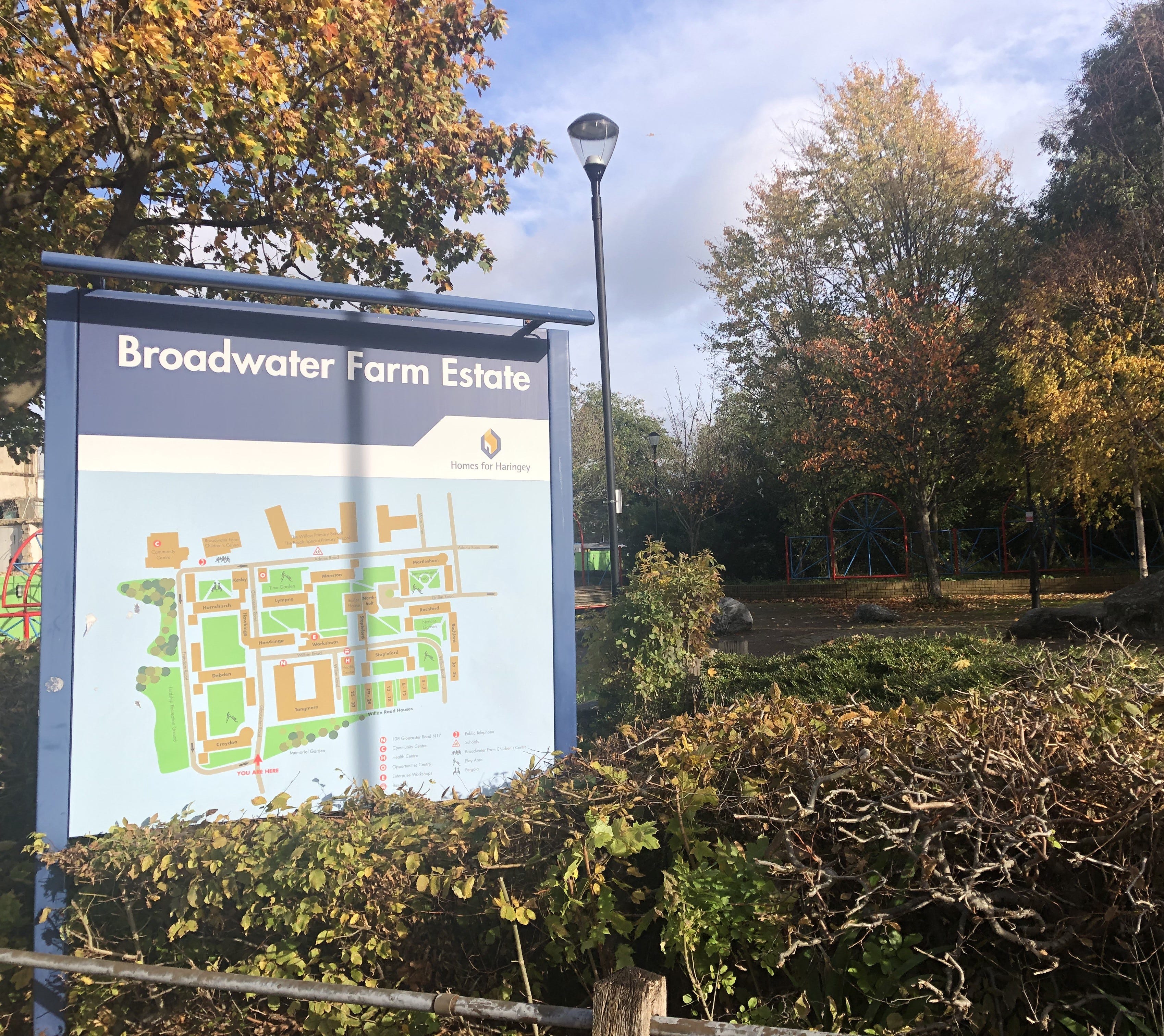
Always implied here are two unasked questions. Who builds the built environment? And for whom is it built? On the surface, these are straightforward questions, but the experience of Broadwater Farm in Tottenham highlights how complicated their answers can be.
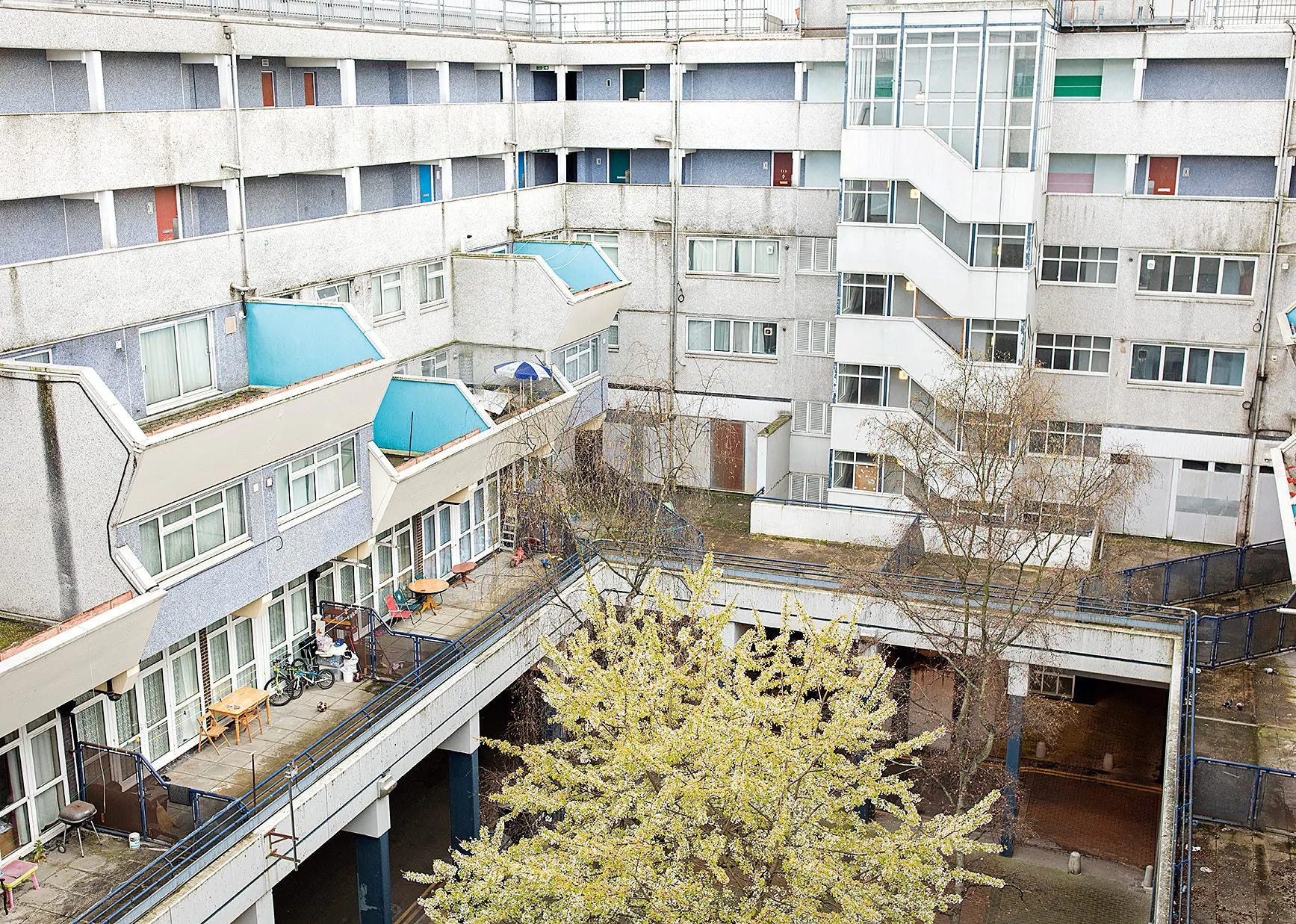
So much has already been observed and written about Broadwater, including by its residents. Still, it is difficult to walk through the estate and not be impressed by its utopian ambition. Even with the original futuristic raised walkways long gone, you can see its practical humanism borne out in the estate’s shape. Large towers and greenspaces at Broadwater provide thousands not just with housing, but with the possibility of connection and social cohesion, building blocks of what is nebulously called “community.” Playgrounds, a nursery school, an employment office, a community center.
Then there are the murals. Three of them. All were commissioned in the wake of the notorious riot that gripped the estate in 1985, and created by residents of Broadwater. One, on the side of the Rochford tower, depicts John Lennon, Bob Marley, Gandhi, and Martin Luther King in a bucolic scene. Another depicts a waterfall on the side of the Debden building. The third is a mosaic. It’s more abstract, but clearly communicates a vision of harmony and peace.
Murals like these flourished across London in the 1980s, funded and encouraged by the city’s left-wing Greater London Council before it was abolished by Margaret Thatcher. Owen Hatherley calls these murals “the capital’s last surviving remnants of municipal socialism.”
It is also difficult to ignore Broadwater Farm’s location, right next to the absolutely gorgeous expanse of Lordship Recreation Ground. The juxtaposition between concrete brutalism and verdant idyll brings to mind all manner of leisurely possibilities, long airy walks with friends and kids’ football games without having to trek to another neighborhood.
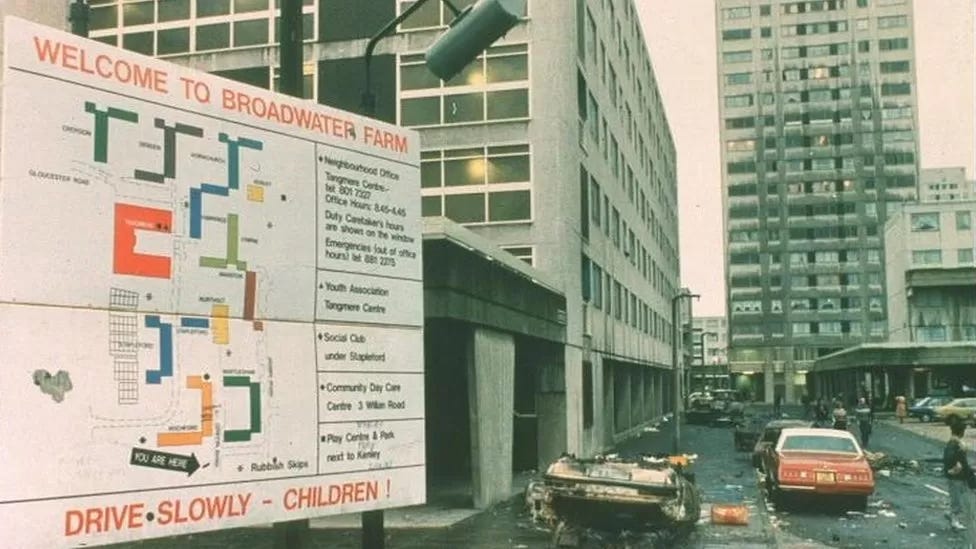
But letting your eyes focus past the shapes of the towers, homing in on the corners of mundane disrepair, noting the heavy presence of CCTV cameras, and the unavoidable ongoing demolition of some of the tower blocks; all reveal how easy it is for places like Broadwater to be used as a human warehouse, a facility for social control and systematic deprivation. Different moments and image layers bleed into each other, each permutation a new trajectory. Understanding this jumble can only be accomplished — appropriately, and like so much else in the apparent futurelessness of late capitalism — by looking at it out of order.
 Middle-ground: the human dump
The broad strokes of the Broadwater Farm riots are a part of Britain’s collective memory. In October 1985, London Metropolitan Police kicked in the front door of Cynthia Jarrett’s flat. Jarrett didn’t live at Broadwater, but her son Floyd did. Floyd had been arrested earlier in the day, and the cops decided his mother’s home was fair game.
Cynthia had a heart attack from the shock and died on the spot. In the days following, the estate’s Black and Afro-Caribbean residents erupted in an all-out rebellion against the cops. A local newsagent’s shop was set on fire, dozens were arrested, and one police constable — Keith Blakelock — was killed. Three residents — Mark Braithwaite, Winston Silcott, and Engin Raghip — were later convicted for Blakelock’s murder on specious evidence. Two were released after four years, following a public defense campaign. The third was finally released in 2003.
Though Broadwater wasn’t the catalyst, by the end of 1985 there had been similar eruptions across London and the UK. Brixton, Peckham, Liverpool, Birmingham. Yes, these rebellions were primarily a response to racist police violence and intimidation. Yes, police and state violence is often the most unmistakable and pointed manifestation of racism. A government inquiry explicitly insisted that policing, not housing, was at the root of the uprising. But we would be careless to dismiss the role that the more quotidian instances play in compounding the experiences of racialization and oppression. The contours of daily life, lived in constant reminder that this country will always view you as “less than.” These unavoidably tie in with heavy-handed policing, always the sharpest edge of contemporary racism.
One resident, interviewed years later, said that the local housing authority had come to view Broadwater as a “dumping ground,” a place to house the citizenry a crumbling empire would rather not regard. The buildings at Broadwater and their units were poorly maintained. Leaks and faulty electrical went un-repaired. There were rats and cockroaches. The crime rate was high, but the heavy police presence circling the estate was more concerned with harassing youth.
Organs that might have otherwise provided a way for tenants to fight back ended up further entrenching racial divisions. The estate’s Tenants’ Association deliberately excluded Black residents, and even white residents who might be associating too closely with their Black counterparts. One particularly wretched but telling moment highlighting this was a television appearance made by the elected heard of the association in 1974, where he voiced full-throated support for the National Front.
Not only did this disenfranchise residents of color at Broadwater, it effectively undermined white residents’ ability to advocate for themselves. Which, of course, is the point of racism: to redirect the inevitable pushback that comes from the downward pressures of systemic neglect.
Considering only this, it would seem that the “experiment” of social housing would be successful only if it aimed to shove the unwanted into the cracks of city life. That was essentially the argument, applied to social housing in general, made by Alice Coleman’s book Utopia On Trial. Released the same year as the Broadwater rebellion, its arguments were enthusiastically applied to the estate in its aftermath. By insisting that “lapses in civilised behaviour” were inevitable in these planned environments, Coleman was taking aim not just at the architectural foci of 1960s idealism, but the whole idea of housing as a public right.
No surprise then that Coleman’s words found resonance in Margaret Thatcher’s government. Any social provision, of any kind, will wither in a context where the idea of the social is anathema. Thatcher was already tearing away at the fabric of council housing through schemes like Right to Buy, setting in motion a process by which the number of publicly-owned residential units would decline from 6.5 million to just over 2 million.
Thatcher’s initial response to the Broadwater rebellion was predictable. Her advisors urged her to ignore calls for improved conditions on the council estates, claiming that better funding would simply end up in the “disco and drug trade.”
In the days after the rebellion, Bernie Grant, the Guyanese-born head of the local Labour-controlled council of Haringey, spoke in front of Tottenham Town Hall, describing the understandable anger among Broadwater residents. He was quickly denounced as celebrating P.C. Blakelock’s death. To demand a better life was clearly to encourage the enemy within.
Foreground: saving BroadwaterEventually, the calls for more funding won out. An additional £30 million was plowed into Broadwater Farm in 1986. Concierge services were put in the lobby of each building to increase security and prevent crime. As one proponent put it, the effect of this was to ensure that the street started at the street, rather than at tenants’ front doors.
Improvements were also made to the environments between buildings, the courtyards and green spaces. Playgrounds were installed. In 1993, the aforementioned raised walkways were demolished. Long-needed repairs were finally made.
Then, the cruel twist. Land is money, and if people can live on that land, then any money spent on it inevitably raises the specter of seeing how much more money you can get back for the investment. A nicer, safer housing estate inevitably translates in the minds of modern London developers into other “opportunities.”
Tottenham, along with most of Northwest London, along with most of virtually every contemporary city, has had to deal with this kind of pressure. In some places, residents end up displaced, uprooted, scattered. In others, they push back. That’s why the Haringey Development Vehicle (HDV) scheme went down in flames.
Had the HDV succeeded, it would have been one of the biggest handovers of public facilities into private hands that London had seen since Thatcher. Housing estates, parks, libraries, schools, council offices; all would have had their management handed to a £2bn private fund. But in the wake of the Grenfell fires, when private management of public housing was under intense scrutiny, a movement of local Haringey residents was able to take on the HGV. In early 2018, the New Labour council head who had stumped for the scheme stepped down. Since then, the HDV plan has basically been on life support.
This hasn’t stopped life at Broadwater Farm from being uprooted under the guise of improvement and development. Two of the blocks on Broadwater were found to be structurally unsound in the wake of Grenfell, and have since been demolished. Residents were promised that their lives would not be significantly disrupted by rehoming. That has not proven to be the case across the board. At least one resident has been forced into financial ruin as a result of the demolitions and forced evictions. Given this, the question of whether residents will be allowed right-of-return to the new flats built at Broadwater — as they have been promised. Past and present residents of the housing estate, and Tottenham more broadly, have been organizing around exactly that.
Background: utopia is ordinaryWho builds the built environment? And for whom?
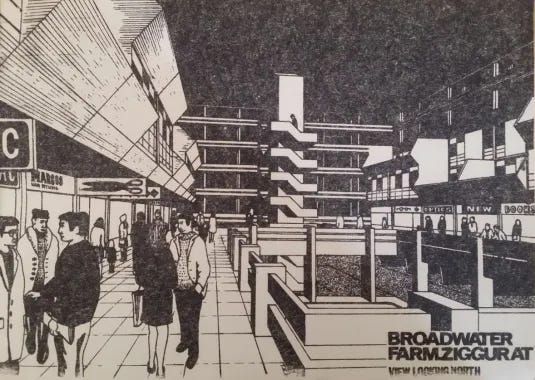
Who… As Coleman’s shady title suggests, the architects of Broadwater Farm were indeed driven by a utopian impulse. At least of a sort. There is much to say about Le Corbusier, how his designs were explicitly intended to head off revolution. If council architects were inspired by Le Corbusier — and perhaps shared his motivations — then the upheavals of 1985 revealed how, ultimately, architecture cannot stanch urban revolt.
Still, it doesn’t take much to see that there was something genuinely democratic in Broadwater’s utopian designs. The idea of a complex that can provide not just the comfort of dry and warm living quarters with all the modern conveniences, but grocery shops and newsagents, community centers, even schools; this is borne of a belief that life can and should have a meaning and, therefore, a sense of order at the service of making that life better.
Planned? Yes. Perhaps even orchestrated, to a degree, from the top down. But such a measure of comfort and accessibility also frees up time for residents to have greater participation in public life: advocacy, community, art, even something as simple (but foreign by our standards) as getting to know and trust one’s neighbors. It isn’t altogether unlike the impetus behind the 15-minute city, and can also be suited to the same ecological ends.
One has to remember the state of most working-class housing in London before these kinds of estates went up. These were crowded flats in old buildings, often improvised, leaky and damp, with no modern conveniences to speak of. Many didn’t even have running water. In light of this, the first wave of residents at Broadwater Farm were understandably quite happy with what the estate provided them. “We came from a house that was built in 1816,” said one of these early residents, “so when we first arrived here it was like a holiday camp. There were bathrooms, indoor loos, you didn’t have to go out in the freezing cold anymore.”
For whom… This is a thornier question. Or at least a more open-ended one.
Yes, the Tenants’ Association of Broadwater Farm was intractably racist, but this didn’t stop tenants of color from organizing along more equitable, democratic lines. Cynthia Jarrett’s son Floyd was a founding member of the Broadwater Farm Youth Association, which sought to provide an organizing and advocacy space for younger residents of color and their allies.
One of its leading members was Floyd Jarrett, and some have speculated that it was his visible advocacy that made him a target for police in 1985. Before the rebellions, the BWYFA had managed to successfully mobilize for basic services and repairs to be addressed. They had also managed to chip away at some of the bad reputation the estate had garnered as crime-infested and dangerous. More recent organizing — say, against the HDV, or to keep residents in their homes — clearly take a cue from the efforts of the BWYFA.
Walking through Broadwater today — winding between half-demolished buildings and those that still stand, watching residents come in and out of their residences, seeing kids play on the playgrounds — you can sense a tension between competing visions of the housing estate. The first vision is, of course, that of neoliberals and developers. It’s probably the most unmistakable. Naturally there’s no tolerance in this framework for anything smacking of equitability, let alone democracy.
As for what might provide a corrective to this hostile mode of life, these are fractured and refracted, corresponding to the different histories jockeying and bumping into each other in this estate. It’s more than a bit of a stretch to say that the utopian designs of Broadwater’s architects are what has motivated bottom-up organizing and rebellion among the estate’s residents, and not just because I can’t insist I know residents’ thoughts.
It would, however, seem appropriate to say that, whatever utopian impulse Broadwater’s designers had, they are incomplete and unrealized without their residents. No matter how high-minded or noble the aims of a building’s shape, it cannot be put into practice without the active engagement of those who live in it.
This is, it merits saying, an experimental process, and necessarily collective. Human substance often molds to its surrounding form, but sometimes these same humans force the form to yield. So much so that it cannot be limited to one housing estate. Governments, housing boards, property developers, police; these specialize in imposing confines. But history rarely regards them with reverence.
That Ellipsis... is a reader-supported publication. To receive new posts and support my work, consider becoming a free or paid subscriber.
An announcement I’ve been sitting on for some time: Brazillian publisher sobinfluencia edições has translated my book Shake the City into Portuguese. If you read Portuguese, you can find more info here.
February 5, 2024
Terrible Beauty
When Cathy Porter asked me to join her for this online launch of her two books — the first a paperback edition of her Reisner biography, recently published by Haymarket Books, the second a translation of Reisner’s writing now on sale from Brill as part of the Historical Materialism book series — I was flattered of course. But I was also confused.
Flattered, because a more accomplished peer thought my words would well accompany her own. Confused, because I am by no means an expert on Larisa Reisner. I am not alone in this regard. Despite a dazzling life spent agitating and writing from the frontlines of the Russian Revolution and Civil War, Reisner is often missing from the short list of truly great socialist authors. That is part of the tragedy.
For my own part, I had rarely thought to engage with Reisner’s work until Porter and I became acquainted at Historical Materialism in London. Thus my surprise when she asked me to speak at her book launch. I am, however, grateful I said yes. Reading the galleys Porter sent me of her and Richard Chappell’s translations of Reisner’s work, I encountered a writer unafraid to raise a red flag at the abyss. To my mind, there are far too few of these writers on what we call the modern radical left. Too few writers willing to stare the realities of disaster capitalism square on and ask what we might salvage as a weapon, more contented with the same half-honest bromides and truisms. Too few writers acknowledging that the promise of socialism is in fact a gamble.
So that’s what I spoke about, alongside Porter and Sezgin Boynik of Rab-Rab Press. Paul Reynolds of HM chaired. It’s in the video above, and my remarks are in the lightly edited text below.
It is often forgotten that the Russian Revolution took place in the midst of apocalypse. Even the revolution’s defenders – stubborn though we may be – have a tendency to downplay this reality. Perhaps it is an attempt to refute the arguments of the establishment that the revolution was itself an apocalypse. It is understandable that we might want to overadjust, eliding the desperation and social decay. We diminish the degree to which events that surrounded the revolution made most of Russia, Europe, and the rest of the world, tremble at the prospect of oblivion.
It wasn’t just the profound inequality, the unrelenting poverty and horrendous working conditions. It wasn’t just that working people daily confronted starvation, disease, destitution, maiming, or early death. These were, well before 1917, commonplace. Rather, it was how industrialized war and empire seemed to accelerate these in the form of collapsing stability and wholesale slaughter.
Before the Second World War, the First World War was simply called “the Great War,” and it was a fitting appellation. This was, after all, not only the first war to involve virtually every known nation and territory on what was by then a thoroughly globalized and integrated planet. The Great War was the first “modern war.” Technological and industrial marvels were directed toward making mass murder more efficient than ever before. Telegraph and newspapers ensured that most people knew about the latest massacre within days, each report describing yet another town or field reduced to a stretch of mud, corpses, and barbed wire.
The end of the world, therefore, seemed quite possible, indeed more likely than most people could ever remember. Events in the weeks leading up to the Bolsheviks’ seizure of power in Petrograd confirm as much. China Mieville, in his October: The Story of the Revolution, chronicles the breakdown of order, the chaos that gripped the cities as the provisional government’s authority deteriorated.
It is important to keep this in mind because otherwise we risk forgetting just how much was at stake to the revolutionary workers who took over their factories, the peasants who rose up in the country, the soldiers and sailors who turned their rifles on their commanding officers. Yes, these were people for whom history had left no choice, but they were also gripped by the idea that they could make the future into something so much better. In other words, the Russian Revolution forged one of the primary dialectics of the 20th century: the idea that utopia could be snatched from the jaws of apocalypse, Rosa Luxemburg’s “socialism or barbarism” made vividly real.
This dialectic infuses the poetics of Larisa Reisner’s writings. We know of course that Reisner was not just a writer, but a revolutionary activist and diplomat, someone who put the survival of the revolution first, and clearly put her writing toward that task too. But Reisner doesn’t merely recount events, crucial though that is to any revolutionary history, as borne out in John Reed’s Ten Days That Shook the World or Leon Trotsky’s own The History of the Russian Revolution.
No, what Reisner’s reports convey is a specific structure of feeling, the way in which revolutionary situations tightly wind together hope and despair, destruction and creativity, the beauty and heroism of self-sacrifice, and the devastating losses of battle.
This is easily dramatized in her work at the front of the Civil War, when a dozen-plus imperialist armies attempted to smother the revolution under the same tank treads and ordnances that had already mowed down millions. Reisner’s description of the Red Army’s defense of towns like Kazan and Svyazhsk, of a rural village reduced to what she called “a Goyaesque vision of hell,” the contrast between blown up railroad trains and the shores of the Caspian Sea, the magnificent architecture of Astrakhan towering over nearby steppes and swamps; these all paint us a picture of a massive and ancient region in dramatic flux, thrust from backwardness into a struggle between radically different and competing visions of the future.
Trotsky — an effusive public admirer of Reisner’s work — would no doubt find resonance in these scenes. It was his specific formulations of uneven and combined development, built on those of Marx and Alexander Parvus, that explained how Russia had become ripe for socialist revolution, not despite its temporal juxtaposition, but because of it. How modernity had thrust itself on an empire of illiterate and isolated peasants, jarring them into the conditions of cosmopolitanism and collective struggle; these are well-documented in Russia. They set the stage for history’s most anachronized and “left behind” to step into the vanguard of history.
Reisner’s writings highlight these dizzying contradictions and the fierce struggles that they produced. She noted them across Russia, Ukraine, and beyond. She hinted at these same potentials when she described Afghanistan, during her time as a diplomat there. She described workshops and mills carved into the sides of mountains, where iron looms drowned out the sound of nearby bazaars through stone walls hundreds of years old. Conditions were cruel and oppressive, more akin to indentured servitude.
Even here, though, we see Reisner observe hope in the cracks of uneven and combined development. Again, she uses the dark works of painter Francisco Goya to describe these conditions. Again, she sees them as yielding revolutionary-utopian possibility. For sure, these are the kinds of conditions that can just as easily pave the way for fascism, particularly pivoting from the examples of British colonialism, as Reisner argued in her essay “Fascists in Asia.” But this same, wildly contradictory reality also creates fractures and gaps through which mass movements for liberation can pass.
“Yet here in in Kabul’s old fortress,” Reisner wrote, “where workers are beaten with sticks, and the living corpses of children and old men cut the cloths of their shrouds with the scissors of Goya’s devils, the proletarian yeast is rising… If possessions could bring happiness or unhappiness, I wouldn’t envy the owners of the cloaks and blankets made from this cloth, steeped in healthy class hatred.”
It is, however, worth stressing that Reisner didn’t just identify these frictive histories in the underdeveloped nations. Her time in Germany, then the most advanced industrial power in Europe, found these same patterns. Here, in the Weimar Republican interregnum between the fall of Kaiser Wilhelm and the rise of Nazism, German society buckled under its own weight. The contrast between industrial strength and urbanization, cultural decadence, and abject deprivation is again illustrated as backdrop for revolutionary possibility.
“Berlin is starving,” she wrote in 1923. “Starvation haunts the buses, shutting its eyes on the spinning upper decks to the advertisements, desolation and motor horns reeling past like drunks.” In Hamburg, meanwhile, overcrowded dormitories and dreary town squares – miles from the factories and shipyards – serve as the setting for fierce debates between workers and union bureaucrats, communists and social democrats.
It’s not just that Reisner’s eye wasn’t merely keen for the contradictions of uneven and combined development as well as the more catastrophic, ruinous, Goya-esque characteristics of post-Great War capitalism. Rather, she rightly sees them as dialectically inextricable. Not altogether unlike Evan Calder Williams’ notion of combined and uneven apocalypse, theorized in his 2011 book of the same name. Just as capitalism’s spread will leap over and subsume in its path everything it has yet to devour, so will its collapse give way to tears in the fabric of daily life. That which was once paradise is now host to wreckage.
If this is true, then there is another heuristic stalking Reisner’s poetics: that of redemption. Not in the biblical sense, but in the sense of a kind of secular theology, akin to Walter Benjamin’s concept of history. This is redemption as making whole, a bringing together of the fragments left behind by the catastrophe of unilinear progress, history’s detritus suddenly seizing and reshaping what had once shaped them.
Walter Benjamin and Larisa Reisner never crossed paths. Benjamin did visit Soviet Russia in 1926, but it was several months after Reisner’s untimely death from typhoid fever at the age of 30. We do know that Benjamin had at least a passing familiarity with Reisner’s work; she was one of many topics related to Soviet culture introduced to him by his lover, the Latvian Bolshevik, actor, and avant-garde theatre director Asja Lacis. If Lacis is understood as the decisive influence in Benjamin’s conversion to Marxism, then those familiar with both his work and that of Reisner may be able to pick out where their preoccupations overlap, despite very different approaches to the principles of materialism and socialist revolution.
Both were acutely aware of the catastrophes that lay in front of them, even more aware than most other Marxists, it would seem. Both were also aware, however, that capitalism’s catastrophes made history incredibly contingent. Though events may bring us to the precipice of several specific outcomes, no one outcome is guaranteed. Whether the prospect of apocalypse, of mass collapse and extermination, comes in the form of barbed wire and mustard gas, or through an ecological balance popping at the seams, it is only by facing the reality of these catastrophes that we can hope to suss out the edges and contours of a socialist future. That future is, as always, a gamble, though a surprisingly resilient one.
“Once in a century people discover a new truth, which they defend to the last drop of their blood,” wrote Reisner. “And mixed with these beautiful words, terrible in their beauty, is the smell of sweat, the living breath of those sleeping next to each other on the floor. No nightmares, no sentimentality… Tomorrow someone will die, knowing in their last moments that death is only one of many possibilities, not the main one at all, and that [the city] still hasn’t been taken, and that the message scribbled in chalk on the dirty wall, ‘Workers of the World Unite,’ is still there.”
That Ellipsis... is a reader-supported publication. To receive new posts and support my work, consider becoming a free or paid subscriber.
January 19, 2024
Nihil Americana

There is no denying it now. He was always going to win Iowa handily. Just like he will win most primaries handily. The only question was whether those who would oppose him were going to face reality so that they could, well, oppose him. Thus far, they haven’t.
Instead, we’ve seen delusional editorials and commentaries celebrating the idea that Nikki Haley – of all fucking people – might have a chance of giving Donald Trump a run for his money. Some are still writing these editorials, only now shifting their sights to New Hampshire, finding futile hope in the fact that a win from Haley might change the overall trajectory. Others are picking apart the results in Iowa and finding whatever morsel they can that will allow them to actually argue that “this is not good for Donald Trump.”
If what they say is true, and we can now essentially start the general election, then that should be cause for concern on their end, not relief. For sure, fourteen percent is a dismal turnout for the Iowa caucuses, but the Democrats gloating about this are laughing in the mirror. Given Biden’s resolute support for the flattening of Gaza, given the blank check he has written Israel, given his refusal to call for a ceasefire despite a decisive majority of voters supporting one, the incumbent is facing his own imminent enthusiasm gap. It’s sure to grow with US engagement in Yemen, as Israel turns its attention to Lebanon and Syria, not to mention Ukraine, or everyone’s stagnant standards of living.
This is how American politics work now, both at home and abroad. It’s not reliant on drumming up excitement or mobilizing supporters, but simply a contest of who is more demoralized. It’s not necessarily a new development, but it is reaching a culmination of sorts.
Nor is it unique to the political realm. About thirty years ago, Very Smart People started insisting that we were at the end of history, that all the old coherencies and predictabilities no longer applied. But if this was the case, if we were now in an era more defined by what isn’t, then we were naturally compelled to wonder what is. So we all stared hard into the small nothing at the center of the new everything.
Over time, that nothing grew. Over decades, it was like we were staring into the sun. Trump himself got a lot of flak for just that while he was in office, but it’s essentially what all of us have been doing since the end of the Cold War. The difference is that, while it’s left most of us with blinding sunspots, stiff necks, and exhausted spirits, the lumbering meatsack that is Donald Trump can walk away unscathed, just as he does every scandal and lawsuit, just as he likely will every federal charge he is facing. Nobody embodies the durable nothing of late-late disaster capitalism like him.
The rest of us aren’t so lucky. Exhaustion is how most things are accomplished today. Bombard us enough with a New Thing over a long enough time and we’ll eventually relent, no matter how empty or dangerous it might be. It’s how we’ve all been conditioned to accept artificial intelligence as an inevitability, and why we’ve embraced Taylor Swift as a pop genius. It’s why we continue to go to our shitty jobs, and why news of a mass shooting feels less like a shock and more like a dull pang.
It also may be why we aren’t seeing the social media panic from liberals we might have expected to see following Iowa, or at least why that panic isn’t engulfing our feeds the way it has in previous years. For all the pundits clinging to the hope of some kind of miracle that wipes Trump from contention, be it in the form of another Republican nominee or the idea that he might actually go to jail, the response from online liberalism has been comparatively muted.
(You might argue that this is down to general fatigue and fracture in social media, but this only underlines my point. With Facebook and the former Twitter having played a central role in squeezing apart the dominant narratives of traditional media, their own downfalls have left even more of a void, each fact and argument floating aimlessly. Grab onto it, oppose it in any way, you’ll still find yourself adrift.)
But then, malaise and complacency have always been akin; 2016 should have been enough proof. There is still a very real danger waiting in the wings. A big enough gap in support will allow well-organized (and well-armed) minorities of true believers to march through and seize the moment. This means that, as global conflict escalates, the presidential candidate most likely to press the big red button is also the one with the most momentum. The horror persists, but so does the horror.
That Ellipsis... is a reader-supported publication. To receive new posts and support my work, consider becoming a free or paid subscriber.
Two notes:
I’m well aware of the Nazis on Substack debacle — the Substackers Against Nazis petition, the weak responses from Substack’s honchos, and the now very real exodus of people from the platform for various reasons of principle and safety. I’m currently weighing my own options. It’s not unlikely that I’ll be migrating this newsletter elsewhere, but what that looks like and when that will happen will take some time. Bear with me…
February 1, 11:30am GMT, I will be speaking as part of an online launch for Cathy Porter’s new book, Larisa Reisner: A Biography , alongside Porter and Sezgin Boynik of Rab-Rab Press. The launch is part of the HM Broadcasts series, hosted by Haymarket Books. More information here.