Gretchen Rubin's Blog, page 28
April 15, 2021
Kristin van Ogtrop: “When I’m Going to Have a Tough Day, I Make Myself Run First Thing in the Morning.”
Interview: Kristin van Ogtrop.
Kristin van Ogtrop is the former editor-in-chief of Real Simple. Under her stewardship, Real Simple became the #1 American women’s lifestyle magazine brand and was nominated for 15 National Magazine Awards.
Her blog, “Adventures in Chaos,” was nominated for a Media Industry Newsletter “Best of the Web” award; in 2014, she was named by Fortune magazine as one of the “55 Most Influential Women on Twitter”; and she's the author of Just Let Me Lie Down (Amazon, Bookshop).
She now works as a literary agent, where she represents memoir, commercial women’s fiction, humor, lifestyle and big idea books driven by counterintuitive thinking.
Her latest book just hit the shelves: Did I Say That Out Loud? Midlife Indignities and How to Survive Them (Amazon, Bookshop).
I couldn't wait to talk to Kristin about happiness, habits, and creativity.
Gretchen: What’s a simple activity or habit that consistently makes you happier, healthier, more productive, or more creative?
Kristin: Running. (Or, I should say, jogging. I run a slow 10-minute mile, much to the amusement and derision of my children, but I try to tell them it's not the speed that matters.) I run outside in all seasons, and the combination of fresh air, forward movement, and having a quiet half hour to myself does wonders for my well-being. I don't run with headphones—I've tried that, and found listening to music or a podcast is too distracting. As I run, I think to myself, Be here now. When I know I'm going to have a tough day, I make myself run first thing in the morning and somehow that clears a path forward for me through the rest of the day, no matter what I encounter along the way: I feel more centered, I have more energy, and I'm better able to handle any obstacles in the road.
What’s something you know now about happiness that you didn’t know when you were 18 years old?
In my kitchen, I have a cabinet with glass doors, right above the bowl where we keep our car keys, so it's a highly-trafficked spot in the house. A few years ago I opened a fortune cookie to find this fortune: HAPPINESS IS AN ACCOMPLISHMENT. I taped the little slip of paper to the glass and now I see it whenever I grab the keys. And I agree with the sentiment—if you are happy, you have achieved something. In fact, on many days, you have achieved enough. I didn't know that when I was 18. The other thing I've learned about myself, at least so far in my 56 years of life, is that happiness always comes back to me. Sometimes it leaves for a while, but it will always come back.
Have you ever managed to gain a challenging healthy habit – or to break an unhealthy habit? If so, how did you do it?
I used to be a terrible fingernail biter, well into my 20s. At a certain point it just became so ridiculous and unattractive that vanity trumped compulsion, and I stopped. In my experience, vanity can be a very powerful motivator when it comes to shaping habits.
Would you describe yourself as an Upholder, a Questioner, a Rebel, or an Obliger?
I am an Upholder, full stop. I like clear expectations, I don't like to break the rules, and my family would definitely describe me as rigid, particularly in the pandemic when we are all working from home together and I really just want everyone to put their own dishes in the dishwasher (see next question)!
Does anything tend to interfere with your ability to keep your healthy habits or your happiness?
Honestly, there are two things in my daily life that directly impact my happiness, and they are so basic. The first is sleep: if I get less than 7 hours, it's like all the lights are dimmer, all the surfaces are harder, everyone around me is annoying and everything on my to-do list is insurmountable. And the second is clutter or, specifically, the amount of stuff the 4 other members of my family leave lying around for someone (read: me) to pick up—dirty dishes, homework sheets, dog leashes, shoes, shoes, shoes. I've spent the pandemic working from home with my husband and three sons, and so the days of clutter-free happiness do indeed feel like an accomplishment.
Is there a particular motto or saying that you’ve found very helpful?
"Three things in human life are important. The first is to be kind. The second is to be kind. And the third is to be kind." Everybody knows this Henry James quote, but I still feel like it's something we all need to live by. Particularly now. And so when I am wrestling with a decision vis-a-vis another human being (or, uh, even my dogs), I ask myself, "What is the kind thing to do?"
Has a book ever changed your life – if so, which one and why?
I feel like every book I read changes my life in some way. But two that changed the way I think are The Spirit Catches You and You Fall Down (Amazon, Bookshop) by Anne Fadiman, and Far from the Tree: Parents, Children, and the Search for Identity (Amazon, Bookshop) by Andrew Solomon. Both brilliant examinations of communities that look very little like my own.


April 13, 2021
Julia Pimsleur: “Just Like You Build Muscle at the Gym, You Can Strengthen Your Mindset.”
Author interview: Julia Pimsleur.
Julia Pimsleur is the author of the bestselling Million Dollar Women (Amazon, Bookshop). She is the founder of the Million Dollar Women social venture helping one million women get to $1M in revenues, and she also built the #1 language teaching company for kids, Little Pim, into a multi-million dollar business.
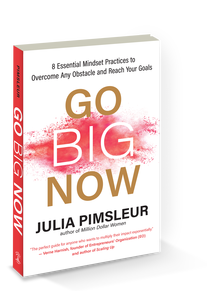
Her new book is Go Big Now: 8 Essential Mindset Practices to Overcome Any Obstacle and Reach Your Goals (Amazon, Bookshop).
I couldn't wait to talk to Julia about habits, happiness, and mindfulness.
What’s a simple activity or habit that consistently makes you happier, healthier, more productive, or more creative?
I learned how to interrupt my thoughts that don’t lead to good results and replace them with ones that serve me better and lead to results I like. This took a few years of practice! Now it’s something I teach through an acronym I created called T-BEAR.
T-BEAR makes it clear exactly how thoughts become results. It stands for Thoughts becomes Beliefs, which have an Emotion attached, which lead to Actions which lead to Results. If you have a Thought over and over again, it becomes a Belief. All Beliefs have a positive or negative emotion attached to them. If your belief has a negative emotion attached to it, you will take very little Action, which is the A (Imagine someone who has belief with a negative emotion attached it about selling—like “I hate selling” and “I am bad it.” They won’t send out very many emails or make many cold calls. Very little Action will get taken). The Actions you take (or don’t take) lead to your Results. If you want to change your Results you need to go back to the Thoughts and start your changes there. (I share more on T-BEAR in my new book, Go Big Now: 8 Essential Mindset Practices to Overcome Any Obstacle and Reach Your Goals.)
You’ve done fascinating research. What has surprised or intrigued you – or your readers – most?
In researching Go Big Now, I took a deep dive into learning about the brain’s epicenter, called the Reticular Activating System (RAS). We have an astonishing amount of data coming at us through our five senses in any one moment: 11 million bits of info per second, in fact. But we can only process 110 bits of information per second. Our brains must constantly make decisions about what to filter out and what to keep. This is the job of the RAS. We get a tidal wave of information, and we can’t keep up. It’s sort of like trying to pour a gallon of milk into a glass. Most of it will end up on the floor.
The RAS saves the day. It’s a tiny filtering device located at the base of the brain, at the top of the spinal cord. It acts as the gatekeeper of information transmitted from your sensory system to your conscious mind. Without our RAS deciding what to focus on, we’d go crazy.
Once you understand that your RAS is feeding you biased information, you know that your reality does not match anyone else’s. Think about that for a minute. Everyone you know is living in their own unique version of reality. It’s kind of freeing, isn’t it? Your job is to focus on making sure your reality is as close as possible to your vision of your optimal life — and not to try to match other people’s, which would be impossible anyway.
Does anything tend to interfere with your ability to keep your healthy habits?
Lack of sleep is at the top of the list! I don’t function as well if I don’t get seven hours of sleep and I also tend to eat more when I haven’t slept well. Also, if I get off my exercise routine, everything goes wonky. I work out 3-4 times a week. If I miss a workout, I feel the difference in energy and happiness level right away.
Is there a particular motto or saying that you’ve found very helpful?
There’s a quote by Rumi I love and cite often: “What you seek is seeking you.”
Many women suffer from discomfort at putting themselves “out there.” This quote reminds me that my job is to be findable so that the women seeking me can find me. I do that by sending out newsletters, getting on social media, hosting events, etc. I coach the women I work with on this too: You are a problem solver and people are looking for you. If you don’t make yourself visible, you can’t help as many of your clients and customers.
Would you describe yourself as an Upholder, a Questioner, a Rebel, or an Obliger?
I love this framework and I use it and teach it all the time! I’m an Upholder, which means if I set a rule for myself, I observe it without any need for external motivation. For example, I workout 3-4 days a week, no matter what. And I always thought everyone was like that. Knowing about these Tendencies has helped me be a better coach because I can create accountability for people who are Obligers and have answers at the ready for Questioners!
Have you ever been hit by a lightning bolt, where you made a major change very suddenly, as a consequence of reading a book, a conversation with a friend, a milestone birthday, a health scare, etc.?
Yes! After I got divorced, everything felt so hard. Suddenly I could only see my children half the week and my identity as part of a couple was gone after being central to who I was for eleven years. It was very disorienting. My coach, Gina, gave me great advice. She said, “If you want something you haven’t had, you have to do something you’ve never done.”
I put that quote up in my kitchen as a visual reminder of why I needed to make all these big changes.
Has a book ever changed your life—if so, which one and why?
Books change my life regularly! I love to reread my favorite mindset books, because different passages resonate with me each time. My top ten favorite are:
Danielle LaPorte, The Desire Map (Amazon, Bookshop)Stephen R. Covey, The 7 Habits of Highly Effective People (Amazon, Bookshop)Brené Brown, Daring Greatly (Amazon, Bookshop)Gay Hendricks, The Big Leap (Amazon, Bookshop)Rachel Hott and Steven A. Leeds, NLP: A Changing Perspective (Amazon)Mike Dooley, Leveraging the Universe (Amazon, Bookshop)Jen Sincero, You Are a Badass (Amazon, Bookshop)Christopher K. Germer, The Mindful Path to Self- Compassion (Amazon, Bookshop)Dean Burnett, Idiot Brain (Amazon, Bookshop)Gretchen Rubin, Better Than Before (Amazon, Bookshop) [awww, thanks Julia!]In your field, is there a common misconception that you’d like to correct?
Yes. I think there is a misconception that mindset work has to be woo woo and involve crystals and a 10-day silent meditation retreat.
A lot of people also think of mindset work as going hand in hand with religious epiphany or faith. But anyone can do mindset work whether you're Christian, Buddhist, agnostic or anything else. There are tools anyone can use to build what I call “mindset core strength.” Just like you build muscle at the gym, you can strengthen your mindset.
I encourage anyone to at least try to learn a few things that can help you in difficult times. We know life will throw challenges at you, so why don’t we train our minds to be ready? If you decided to run a marathon, you wouldn’t sign up for one that happens in a few days and buy a pair of sneakers and start running! You would train. You would talk to other runners about their best practices. When you work on your mindset, you are training for life’s challenges in the same way.

April 8, 2021
Jon Acuff: “I Need Endorphins Like Fish Need Water.”
Interview: Jon Acuff.
Years ago, I met Jon Acuff when we were speaking at the same conference. We had time to talk as we waited backstage, and I really enjoyed getting to know him. Then, because he spoke right before I did, I had the chance to listen as he gave his presentation. (I remember that he got a lot of laughs.)
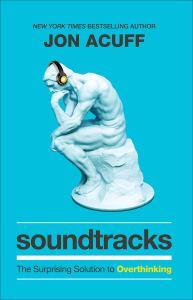
He's the New York Times bestselling author of seven books, including his latest, Soundtracks: The Surprising Solution to Overthinking (Amazon, Bookshop).
He also has a podcast, All It Takes Is a Goal: "The future belongs to finishers. Join New York Times bestselling author and speaker Jon Acuff as he explores the best tips, tricks and techniques to getting from where you are today to where you want to be tomorrow. All it takes is a goal."
I couldn't wait to talk to Jon about happiness, habits, and writing.
Gretchen: What’s a simple activity or habit that consistently makes you happier, healthier, more productive, or more creative?
Jon: I need endorphins like fish need water. When I got serious about working on my happiness, I got more serious about running. A few miles alone does wonders for my head and my heart. I don’t get to do it every day, but if I go three or four days without getting at least a little bit of exercise, my stress gets a lot louder.
What’s something you know now about happiness that you didn’t know when you were 18 years old?
Happiness is a choice, not a feeling. That’s the biggest thing I’ve learned about it over the years. I thought it was something that happened organically or accidentally, tied to whatever circumstances I experienced that day. Now that I’m in my mid 40s, I really feel like happiness is something I get to choose and something I get to practice.
You’ve done fascinating research. What has surprised or intrigued you – or your readers – most?
My new book is about overthinking. (You can read the first chapter for free here.) During the research process, Mike Peasley PhD and I asked 10,000 people if they struggle with overthinking and 99.5% of people said, “Yes.” That was the first surprise. Everyone overthinks and everyone thinks they’re the only one who does.
The second surprise was that no one overthinks compliments. There wasn’t a single person we talked to who said, “My big issue is that I’m too kind to myself internally. I’m constantly giving myself compliments like, ‘You’re a great mom! You’re doing an awesome job!’”
Nobody had too much self-compassion.
The problem was just the opposite. A mom would be five minutes late to pick up her kid from school and instantly play internal soundtracks that trumpeted her failure. “You’re always late! Every other mom is on time. Every other mom makes their kid elaborate, healthy meals for school with asparagus and dragon fruit and you feed your kid Lunchables.”
Does that sound familiar? Maybe not because most of us have never stopped long enough to listen how we talk to ourselves. Life’s just too busy and so our internal soundtracks, or repetitive thoughts, get to play in the background unchecked. That was the third surprise, how few people know that a thought isn’t something you have. A thought is something you hone. You can choose what you think.
Have you ever managed to gain a challenging healthy habit – or to break an unhealthy habit? If so, how did you do it?
I didn’t write any books for the first 34 years of my life. I wrote seven books in the last 11 years, so I had to work on establishing several writing habits. One of them is that I learned to write in layers.
My first drafts aren’t funny.
My first drafts aren’t particularly positive.
My first drafts don’t have the right words.
My first drafts are written in passive voice, since I failed to learn how to beat that in the 7th grade and have simply trudged along since.
My first drafts don’t make sense.
My first drafts are only a connection of ideas loosely strung together with the thinnest of thread. That used to drive me crazy. I’d look up from a few hours of writing and pace around my office in anxious frustration. Then, I decided to admit something.
I write in layers.
The first layer is just a sketch. All I’ve done is taken a bunch of ideas that feel related and put them on the same page. The transitions are flimsy, the logic is fuzzy, the cohesiveness is none existent, but that’s OK. That’s how the first layer ALWAYS is.
I don’t even care about the words in the first draft. I’ll type NEED BETTER WORD and then just keep going. This isn’t the good words layer. This is the concept layer. Then, once I’ve spent enough time away from the first layer to be somewhat objective, I’ll come back and do the second layer. Now, I care a little more about the words. I care about the transitions. I care about the flow.
That’s better, but it’s still not very positive. I can be pretty negative and a smidge sarcastic. With that sarcasm comes some negativity. My initial drafts are so mopey. They’re dark little storm clouds best suited for the liner notes of a Cure album.
So, I work in more positivity. It has to be honest, it has to be genuine. It can’t be sappy. If I Def Leppard the whole thing and just pour sugar over it, I won’t hit the mark.
Once I get the positivity on point, I amplify the humor. In the movie industry, they often hire comedians to “punch up” a script with more jokes. That’s what I’m doing with this layer. I’m going back through the entire piece and making sure there are some genuine laugh out loud moments. I look for the ridiculous and then turn it up a few notches.
The next layer I add on is to make sure it’s helpful. I like ideas that move me to action. I don’t just write to write, I want to inspire you to do something. So I read what I’ve written with a filter of, “What’s in it for me?” I want you to learn something practical that you can use today.
When I’m done with those layers, I finally make sure I’ve got the right words in place. In some ways I’m doing that all along, deciding that Def Leppard is a funny band name to turn into a verb, for instance. But during this final layer I meticulously go through every sentence to decide if I have my favorite words.
I don’t write drafts, I write layers and that word distinction matters. The names we give our work have weight. “Drafts” is too serious for me. A draft is a complete work. That word awakens my perfectionism and makes it hard to move beyond the first rendition of my work.
The word “Layers” gives me more freedom. It’s just a layer. Other layers will come. Other layers will do their job. An architect would never stand on a muddy job construction site and say, “Why did you only do the foundation? What a failure of a first draft!” Instead, they’d recognize that big projects come in layers. The foundation was just the start. There’s an electrical layer and a plumbing layer and a framing layer.
If you ever have a hard time finishing a first draft, try a layer instead. I’ve found them to be a really helpful habit.
Have you ever been hit by a lightning bolt, where you made a major change very suddenly, as a consequence of reading a book, a conversation with a friend, a milestone birthday, a health scare, etc.?
When I was researching my new book Soundtracks, I had the opportunity to interview David Thomas. He’s the director of family counseling at Daystar, a center for kids in Nashville. He’s the author of six books and an accomplished public speaker, but it was an offhand comment he made over coffee that changed what I believed about negative thinking.
In the middle of a long list of questions I was asking him, David said, “The problem with the internal voices inside is that we want a switch.” I hadn’t heard thoughts described that way, so I asked him to explain what he meant.
“We think that there’s a switch out there and if we can just find it, we can turn off the background noise completely. We only have to do it one time and we’ll never hear it again. People want there to be a switch.”
“Those people are crazy,” I replied, having spent the last few years of my life looking for that exact thing.
“It’s not a switch, though,” he continued, “it’s a dial. The goal isn’t to turn it off forever, the goal is to turn down the volume. It’s going to get louder sometimes. That’s how dials work. But when life turns up the negative thoughts, we get to turn them down. That takes a lot of the pressure off because when you hear one again, it’s not a sign that you’ve failed to shut it off and need to go find a different switch. It’s just time for an action that will turn it back down.”
I wanted to jump on top of the table in the diner and shout, “It’s a dial! It’s a dial!” and then throw a sixpence to a street urchin like I was Ebenezer Scrooge so he could buy his family a fat Christmas goose. Seeing stress as a dial instead of a switch has been really helpful to me.
Is there a particular motto or saying that you’ve found very helpful?
Author Dorothy Parker once said, “Creativity is a wild mind and a disciplined eye.” The wild mind means you give yourself permission to put a thousand different ideas in your head. You notice a song lyric, a comment from the mailman, a sign at a coffee shop, a question your curious toddler asked, and an article in the New York Times. You collect anything that is remotely interesting to you.
Then you look at that vast collection of unrelated ideas and have the discipline to see the connection between them in a way no one has before. I use this approach to write books, articles, and speeches. For example, one of the topics I talk about a lot to companies like Microsoft, FedEx and Walmart is empathy. In my speech, I share a story a chimney sweep told me in Branson, Missouri, a marketing principle I learned working for Bose, and a rap lyric from Dr. Dre. Those three ideas had nothing to do with each other when I initially collected them, but when I connected them they turned into a highly memorable idea for audiences.
Has a book ever changed your life – if so, which one and why?
Orbiting the Giant Hairball by Gordon MacKenzie (Amazon, Bookshop). That book taught me how to maintain my creativity while working inside a massive corporate environment. It’s beautifully designed and full of the kind of stories that stick with you for years.

April 6, 2021
Jessica Lahey: “A Winding, Meandering Path May Well Take Me Someplace Even More Interesting Than I Ever Anticipated.”
Interview: Jessica Lahey.
Jessica Lahey is a teacher and writer. Over twenty years, she’s taught every grade from sixth to twelfth, in both public and private schools. She writes about education, parenting, and child welfare for publications such as The Atlantic, Vermont Public Radio, The Washington Post, and the New York Times. She's the author of the New York Times bestselling book, The Gift of Failure: How the Best Parents Learn to Let Go So Their Children Can Succeed (Amazon, Bookshop).
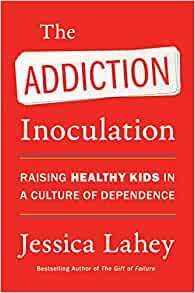
Her new book just hit shelves: The Addiction Inoculation: Raising Healthy Kids in a Culture of Dependence (Amazon, Bookshop).
If all that's not enough, she also co-hosts the excellent #AmWriting podcast with writer KJ Dell’Antonia, author of The Chicken Sisters (Amazon, Bookshop) and How to Be a Happier Parent (Amazon, Bookshop). I love their podcast—it's all about the work of being a writer.
I've known Jess for years, and couldn't wait to talk to her about happiness, habits, and writing.
Gretchen: What’s a simple activity or habit that consistently makes you happier, healthier, more productive, or more creative?
Jessica: In the summer, weeding. When I get stuck, I walk outside and just start weeding whatever garden bed, patch of lawn, or sandy driveway edge close by. My nemesis at both my old residence and my new one is Aegopodium podagraria (or Bishop’s Weed, ground elder, goutweed, and, prettily enough, snow-in-the-mountain) but removing that horrid plant is perfect for working out ideas. The roots spread far from the mother plant, white tendrils that, if you commit to sitting down and loosening the ground gently and carefully enough, can be eased out in long, satisfying pieces. In the winter, any mundane, repetitive task like cleaning or painting baseboards works great to engage the default mode network in my brain that allows my creative mind to flow where it likes. That’s when the most interesting connections, insights, and ideas happen for me.
What’s something you know now about happiness that you didn’t know when you were 18 years old?
That I don’t have to get to my literal and metaphorical destinations as quickly as possible. In fact, I may think I’m headed one place but a winding, meandering path may well take me someplace even more interesting I never even anticipated. I thought I had to know what I wanted to be when I grew up, then get there as quickly as possible in order to be successful, but the opposite has been true for me. As long as I’m open to the learning, I’m happy to drift from one place to another in the pursuit of goals.
You’ve done fascinating research. What has surprised or intrigued you – or your readers – most?
We tend to teach and parent the way we were taught and parented, and we tend to feel defensive about that path, as if questioning our methods – and by proxy, our own teachers’ and parents’ – is an attack on the people we love and respect. If anything, learning how to do better, to be better is a testament to our teachers and parents, evidence that they gave us the tools to learn from our mistakes and our continuing education.
Have you ever managed to gain a challenging healthy habit – or to break an unhealthy habit? If so, how did you do it?
By building habits. Starting new habits is so hard, but once I’m in that habit, I’m good at maintaining it. Unfortunately, much of my time as an active alcoholic was a result of falling into destructive habits and it took a loving intervention by my dad to help me take the first step toward making not drinking my new habit.
Would you describe yourself as an Upholder, a Questioner, a Rebel, or an Obliger?
I’m a Questioner, which is not surprising at all to me. I always meet expectations and deadlines, but what matters most to me is that I find those expectations and deadlines worthwhile and relevant. If not, I will still get it done, but I hate every second of it while it’s in progress.
Does anything tend to interfere with your ability to keep your healthy habits or your happiness?
I love my work and that often edges out exercise and eating. I tend to forget to eat during the day, and despite my best intentions to stop working in time to work out, I usually keep working when I’m on a roll.
Have you ever been hit by a lightning bolt, where you made a major change very suddenly, as a consequence of reading a book, a conversation with a friend, a milestone birthday, a health scare, etc.?
My best changes in professional directions have happened thanks to lightning bolts, when ideas fall into place all at once. So often that lightning bolt happens, though, because the wandering (reading, thinking, musing) came first, and I’ve had time to percolate on disparate ideas and disciplines and how they all work together. It took me four years of working, reading, thinking, pitching and getting pitches rejected to land on the idea for The Addiction Inoculation, and when it hit me (at the Hooksett Tolls on I-93 in New Hampshire) it fell into my lap fully formed, title and all.
Is there a particular motto or saying that you’ve found very helpful?
"I decided to make my life my argument.” Albert Schweitzer. I find when I follow that lead, I stay truest to myself.
Has a book ever changed your life – if so, which one and why?
Reading Song of Solomon by Toni Morrison (Amazon, Bookshop) helped me understand what great writing can be, the words and ideas below the words and ideas, flowing along like a deep river of ideas. Once I realized that river was there, my love of books transformed into an obsession.
In your field, is there a common misconception that you’d like to correct?
Writing isn’t romantic with curtains fluttering in the breeze and the muses speaking directly to your soul, it’s messy, and ugly, and hard. It’s also the best job in the world once your butt is in the chair and the music playlist is just right, and the ideas are flowing. That’s when I forget to eat, or move, or pick my kid up at school. That’s where I’d live if I could.

April 2, 2021
My New April Fool’s Day Prank: “Gelling Joke” Turns a Beverage into Sludge (Non-Toxic).
In my book The Happiness Project, I write about one of my favorite resolutions—to celebrate minor holidays—and Elizabeth and I have also talked about this resolution many times on the Happier podcast. Valentine's Day, St. Patrick's Day...and of course, April Fool's Day.
This year, for April Fool's Day, I played a trick on my daughter Eleanor.
In my research for my book about my five senses, I'm always looking for ways to trick or confound my senses. Helium balloon, Newton's cradle, that sort of thing.
When I read about this "Gelling Joke," I was intrigued. I wanted to see how it worked, and I wanted to use it for a prank. Usually I rely heavily on food dye on April 1, and I've been wanting to branch out.
The product description explained that I'd get a little bottle of something to tip into someone's drink that would instantly change the beverage into "non-edible sludge" (important: non-toxic).
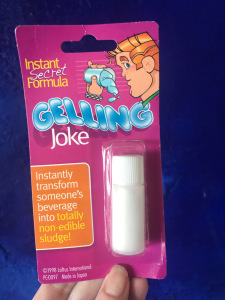
So on April Fool's Day, I dumped the contents of the bottle into Eleanor's coffee when she stepped away from the breakfast table. I had to act quickly, because I knew she'd be back soon.
Here's my report and advice:
Before you use Gelling Joke for a prank, experiment with it, to get a sense of how it works. My prank would've worked much better if I'd known exactly what to expect.
For instance, I dumped the whole container in, and I don't think I needed that much. It acts very quickly, so I would've known when I'd put in enough.
I assumed the Gelling Joke substance would be a liquid, but it's a white powder that has to be stirred in, and as the "sludge" forms, the former liquid starts to hold a shape, so it doesn't look liquid anymore. So if possible, add to a glass or cup that has room left, to be able to pour in some liquid to disguise the surface. Eleanor's coffee cup was almost full, so the minute she glanced at the cup, she could see that something was wrong.

That said, she was astonished! "What happened to my coffee?" she demanded. So it worked well just to mystify her.
I can never hold back a secret long, so I immediately said, "April Fool's!" But someone else could've kept up the mystery longer.
Do you pull April's Fool's Day jokes? What are some of your favorites? I really love this family tradition.
And in fact, I love any kind of easy, fun tradition. They build happiness because they mark the passage of time in a special way, they're memorable, they're a source of whimsy, and they contribute to a sense of connection. And they don't take a lot of time, energy, or money!
Here are some of my previous April Fool's Day pranks, if you're looking for future ideas...
Blue water from the tapA toilet full of fishGreen milk in the cereal
April 1, 2021
Ximena Vengoechea: “Technology Is a Brilliant Communication Tool, But It Will Never Be a Replacement for Real, True Human Connection.”
Interview: Ximena Vengoechea.
Ximena Vengoechea is a user researcher, writer, and illustrator whose work on personal and professional development has been published in many publications; she's a contributor at Fast Company and The Muse; and she writes Letters from Ximena, a newsletter on tech, culture, career, and creativity. She's best known for her project The Life Audit. She's worked at Pinterest, LinkedIn, and Twitter.
Now she has a new book: Listen Like You Mean it: Reclaiming the Lost Art of True Connection (Amazon, Bookshop). It's a guide to becoming a better listener and draws from Ximena's expertise as a user researcher and manager in Silicon Valley.
I couldn't wait to talk to Ximena about happiness, communication, and creativity.
Gretchen: What’s a simple activity or habit that consistently makes you happier, healthier, more productive, or more creative?
Ximena: I find a walk outside does wonders for my well-being and creativity. If I am stuck on a problem, taking a break to stretch my legs gives my brain a break, too. Sometimes I will call a friend or family member to catch up during this time, and other times I’ll walk in silence — it depends on whether I’m looking to ground myself and clear my mind or if I am seeking energy through conversation with others. For me, this habit works well whether I’m in nature or an urban setting — simply changing locations from wherever I am working and taking in my surroundings helps. Usually, I am able to make progress on whatever challenge I’m thinking through after a walk. Walks have been especially sanity-making during the pandemic.
What’s something you know now about happiness that you didn’t know when you were 18 years old?
That a good conversation can vastly improve my happiness. At that age, you hear a lot about the “big things” that impact your happiness, like finding a career you’re passionate about and falling in love. Of course, those help. But the micro moments matter just as much. A good conversation with a friend or loved one can lift me up when I am down and supercharge me when things are going well. These kinds of conversations can be deep, intimate, inspiring, supportive, encouraging, motivating, or even funny, depending on the person and the topic. I can find great joy in solitude, too, but knowing the pleasure of a quality conversation is priceless. Realizing how much a simple conversation contributes to my happiness is a large part of what drew me (perhaps subconsciously) to become a user researcher, a job that entails interviewing strangers in order to understand their needs, motivations, and selves more deeply, and eventually write a book about how to be a better listener.
You’ve done fascinating research. What has surprised or intrigued you – or your readers – most?
My book, Listen Like You Mean It, explores how we can become better listeners — whether that’s in the workplace, at home, with friends, or even among strangers — and build stronger relationships as a result. It often feels like good conversations happen by chance, but conversations are less random than they appear — in every conversation there is a need waiting to be deciphered. As a UX researcher, the idea that hidden needs are everywhere is a common one — it’s just that we tend to uncover those needs in the context of a product, and how we can ensure it works for users. But it’s just as true that hidden needs exist in every conversation: We might want to be supported and validated, or simply seen and understood. We might want a sounding board to help resolve a tricky problem, or encouragement that our ideas are worth pursuing. If you can uncover what someone’s need is in conversation (and also learn to express your own) you can better empathize with them as a result, and meet them where they are. When that need comes to the surface — and we help to meet it — we tend to have much more satisfying and deeper conversations. These moments make up our more memorable conversations, where we feel we are getting somewhere together with our conversation partner.
Have you ever managed to gain a challenging healthy habit – or to break an unhealthy habit? If so, how did you do it?
A few years ago I set out to develop one habit each month, for a year. I focused on one habit at a time to keep things manageable, and I gave myself a month to establish a steady routine. Of the habits I worked to foster, the ones I most successfully cultivated were those I was self-motivated to pursue— like waking up early (I am a natural early bird, but had somehow forgotten that), and developing a daily writing practice (which I still do years later)— rather than those I thought I should develop (like meditating). For me, consistency has also been key — focusing on something I can reinforce day after day helps accelerate that habit formation and sustain it over time. Also, being kind to myself and practicing self-compassion when a habit is difficult to maintain or achieve. Some habits are harder to develop than others, but judging myself for my failures isn’t helpful motivation — it’s just discouraging. With each habit I work on, I try to find joy in it, practice it daily, and celebrate my progress (no matter how small) to keep me going.
Would you describe yourself as an Upholder, a Questioner, a Rebel, or an Obliger?
I’m an Upholder, for sure. I’ve always been self-motivated and disciplined, which is how I’ve been able to generate and maintain so many side projects over the years in addition to my day job — like writing a book while working my 9-5, dabbling in audio storytelling, and taking care of a newborn. The downside is that there is always something else I want to do that I am ready and willing to put work into, which can make it hard to rest. I suppose I need to learn to apply more of that discipline to taking naps!
Does anything tend to interfere with your ability to keep your healthy habits or your happiness? (e.g. travel, parties, email)
The pandemic has been difficult for so many reasons. For me, one of the hardest changes to manage has been the lack of in-person contact and conversation. Knowing how much a deep one-on-one conversation can lift me up, pre-pandemic, I intentionally scheduled a regular mood-boosting conversation or friend catch-up each week. Now, of course, that’s no longer possible or so straightforward — what was once a simple in-person ritual is now ridden with negotiations, compromises and what-if tradeoffs and calculations. Going virtual hasn’t helped much either, at least not for that deep one-on-one — no amount of Zoom calls can ever replace the warmth and affection of being in person. I’ve turned to the humble phone call instead — I find it to be much warmer than trying to connect over a video call, and it allows both parties to be mobile (great for fitting in my mood-boosting walks), so we each get to take in our surroundings (or, you know, run an errand or two) while still connecting with a friend. As a bonus, there’s no awkward image freezing or audio lags, and no need to compete with our own reflections (since most of us are often guilty of checking ourselves out on a video call, leaving authentic eye contact hard to come by).
Have you ever been hit by a lightning bolt, where you made a major change very suddenly, as a consequence of reading a book, a conversation with a friend, a milestone birthday, a health scare, etc.?
I think even things that look like lightning bolts were a long time coming for me. For example, there have been numerous times in my life where I’ve picked up and moved cities without a job (Boston > Paris, Paris > NYC, NYC > SF, all in the last 12 years), sometimes without knowing the language, or having any connections in the field, following a hunch that something compelling was out there for me. From the outside, these moves seemed very sudden, almost impulsive, and improbably successful. But they were actually the result of ideas percolating and marinating for some time — even if I wasn’t explicitly engaging with them — which is what made them exactly the right move for me.
In my book I talk about using your "informed intuition" in conversation to understand your conversation partner, which is really just a way of saying that we are picking up on cues from each other all the time, logging away "data" even if we aren't aware of it. We get to know someone — their tics, their habits, their pressure points — and can better read their reactions. We also understand that certain situations come with particular norms, allowing us to make meaning of a variety of moments (like knowing how to interpret someone’s behavior in the context of a job interview versus a dinner party). A lot of it is information that builds over time, so that we can call upon our intuition in the moment. Similarly, though my lightning bolt moments may look random, sudden, or even purely intuitive, they're actually informed over time — they are decisions based on a mix of knowledge, experience, personality, and gut feeling— the result of thoughtful consideration (sometimes subconscious) over time.
Is there a particular motto or saying that you’ve found very helpful?
There’s an oft-cited Maya Angelou quote (also attributed to Carl Buehner) that says, “People will forget what you said, they will forget what you did, but people will never forget how you made them feel.” It reminds me that so much of emotional connection comes through in ways far beyond what we see or do at the surface— in what is unsaid, and in how we listen. Every conversation is a chance for that feeling and emotional connection to come through if we can do our part as empathetic listeners.
Has a book ever changed your life – if so, which one and why?
I would have been 8 or so when Walk Two Moons by Sharon Creech (Amazon, Bookshop) found its way into my hands. The title is based on the saying “Don't judge a man until you have walked two moons in his moccasins," a message that appears in various forms throughout the book. It instilled in me at an early age the idea that there is always more to someone's experience than meets the eye — that we never know what someone else is experiencing at a given moment — and the importance of practicing empathy in understanding others. It’s been decades since I read it, but the book’s message has stuck with me. In a way, my book and my work on listening is a way to get closer to understanding others’ experiences and empathizing with them. [Gretchen: I also love this book, and just re-read it recently.]
In your field, is there a common misconception that you’d like to correct?
There’s a common misconception that because we are connected all the time — through social media, email, mobile apps, and the like — we are connecting. But true connection comes from doing the hard work of putting down our phones and other competing priorities to be present, open, curious, and empathetic in conversations with others. Technology is a brilliant communication tool, but it will never be a replacement for real, true human connection.


March 30, 2021
What I Read This Month: March 2021
For four years now, every Monday morning, I've posted a photo on my Facebook Page of the books I finished during the week, with the tag #GretchenRubinReads.
I get a big kick out of this weekly habit—it’s a way to shine a spotlight on all the terrific books that I’ve read.
As I write about in my book Better Than Before, for most of my life, my habit was to finish any book that I started. Finally, I realized that this approach meant that I spent time reading books that bored me, and I had less time for books that I truly enjoy. These days, I put down a book if I don’t feel like finishing it, so I have more time to do my favorite kinds of reading.
This habit means that if you see a book included in the #GretchenRubinReads photo, you know that I liked it well enough to read to the last page.
When I read books related to an area I’m researching for a writing project, I carefully read and take notes on the parts that interest me, and skim the parts that don’t. So I may list a book that I’ve partly read and partly skimmed. For me, that still “counts.”
If you’d like more ideas for habits to help you get more reading done, read this post or download my "Reading Better Than Before" worksheet.
You can also follow me on Goodreads where I track books I’ve read.
If you want to see what I read last month, the full list is here.
And join us for this year's new challenge: Read for 21 minutes every day in 2021!
A surprising number of people, I've found, want to read more. But for various reasons, they struggle to get that reading done. #Read21in21 is meant to help form and strengthen the habit of reading.
March 2021 Reading:Lost Time: Lectures on Proust in a Soviet Prison Camp by Józef Czapski (Amazon, Bookshop) -- I heard about this extraordinary book during an episode of a podcast I love, Backlisted, about Proust. I had my summer of Proust in 2019, and I'm very interested in Proust and his work.
Professional Troublemaker: The Fear-Fighter Manual by Luvvie Ajayi Jones (Amazon, Bookshop) -- A compelling, honest, useful, and often very funny, call to courage.
Sensehacking: How to Use the Power of Your Senses for Happier, Healthier Living by Charles Spence (Amazon) -- I'm writing a book about my five senses, so of course I loved this book!
Hamnet by Maggie O'Farrell (Amazon, Bookshop) -- National Book Critics Circle Award for Fiction 2021; Women's Prize for Fiction 2020; Waterstones Book of the Year 2020. So many people told me to read this novel.
The Blue Sword by Robin McKinley (Amazon, Bookshop) -- Newbery Honor Award, the Horn Book Fanfare award, the ALA Best of the Best Books for Young Adults award, the ALA Notable Children's Book award and the ALA Best Fiction for Young Adults award. I love the work of Robin McKinley, and I assumed I'd read this book—but realized that somehow I missed it. Loved it, next will read its sequel, The Hero and the Crown (that one, I've already read, but a long time ago).
Notes on the Cinematographer by Robert Bresson (Amazon, Bookshop) -- I do love aphorisms and proverbs of the professions, and this book is aphorisms of a cinematographer.
Little Heathens: Hard Times and High Spirits on an Iowa Farm During the Great Depression by Mildred Armstrong Kalish (Amazon, Bookshop) -- Iowa Reader Literary Award for Non-Fiction for 2007. My daughter Eliza recommended this book to me after she was assigned it for her college class. Wonderful.
The Actual by Saul Bellow (Amazon, Bookshop) -- My mother-in-law often describes a person as a "first-class noticer" and finally I got curious about the phrase and decided to re-read the novel in which it appears.
The Diamond in the Window by Jane Langton (Amazon, Bookshop) -- I re-read this children's novel that I hadn't read since childhood. It's always interesting to see how a book strikes me differently at different ages.
On Chapel Sands: The Mystery of My Mother's Disappearance as a Child by Laura Cumming (Amazon, Bookshop) -- Nominated for the 2019 National Book Critics Circle Award for Autobiography; Shortlisted for the Baillie Gifford Prize for Nonfiction; Shortlisted for the Rathbones Folio Prize; Longlisted for the RSL Ondaatje Prize. Originally titled Five Days Gone. Haunting, powerful memoir and a search for the truth about the past.
Notes from a Young Black Chef by Kwame Onwuachi, Joshua David Stein (Amazon, Bookshop) -- I don't cook, and I'm not a foodie, but I do enjoy books by chefs and by foodies. This is a fascinating account of getting a start in the extraordinarily intense and challenging world of the culinary.
They Came Like Swallows by William Maxwell (Amazon, Bookshop) -- A beautiful novel that I read in a single sitting. Appropriately for our own time, it takes place at the time of the influenza pandemic.
Dag Hammarskjold: Strictly Personal, A Portrait by Bo Beskow (Amazon) -- An unusual, personal portrait of Hammarskjold, a figure who interests me.
Memorial Drive: A Daughter's Memoir by Natasha Trethewey (Amazon, Bookshop) -- Finalist for the 2021 Andrew Carnegie Medals for Excellence in Fiction and Nonfiction. Thought-provoking, deeply moving memoir about confronting the facts of a painful past.
Alibis: Essays on Elsewhere by André Aciman (Amazon, Bookshop) -- Nominated for the PEN/Diamonstein-Spielvogel Award for the Art of the Essay. I love essays, and loved this collection.
Here Is New York by E.B. White (Amazon, Bookshop) -- I've probably read this essay five or six times. A beautiful tribute to New York City—and to the yearning that New York City inspires.
Who Will Run the Frog Hospital? by Lorrie Moore (Amazon, Bookshop) -- A re-read. The story of a friendship.
Sunshine Girl: An Unexpected Life by Julianna Margulies (Amazon, Bookshop) -- A page-turning account of the actor's early life, which meant dealing with two very challenging parents.
The Phantom Tollbooth by Norton Juster (Amazon, Bookshop) -- George C. Stone Centre for Children's Books Award. Towering classic of world literature. So wonderful. If you haven't read it since you were a child, re-read it.
A Deadly Education by Naomi Novik (Amazon, Bookshop) -- How I love the work of Naomi Novik! Now I'm counting the days until September when the next book in this trilogy will appear. An intriguing magical world, big cliff-hanger.
The Hall of Uselessness: Collected Essays by Simon Leys (Amazon, Bookshop) -- Shortlisted for the Victorian Premier's Literary Awards; shortlisted for the NSW Premier's Literary Awards. In this collection, I read the essays on subjects that interested me--and those were fascinating.
Me Me Me Me Me: Not a Novel by M.E. Kerr (Amazon) -- I've recently rediscovered the work of M. E. Kerr, and I loved this first-person account.
De Profundis by Oscar Wilde (Amazon, Bookshop) -- Another re-read. Hmmm, I didn't realize that this was a big month for re-reading. Anyway -- Oscar Wilde! I love his work. This is the moving letter that he wrote from prison.
The Art of Memoir by Mary Karr (Amazon, Bookshop) -- A fascinating look at the memoir by a masterful writer.
This Is the Voice by John Colapinto (Amazon, Bookshop) -- For my book about my five senses, I've been thinking a lot about talking, listening, and silence. I found this account fascinating.
Us by David Nicholls (Amazon, Bookshop) -- winner of the the Specsavers "U.K. Author of the Year" award; longlisted for the 2014 Man Booker Prize. A terrific novel with great characters. Also, an interesting, subtle portrait of the Obliger Tendency, and how the world looks to an Obliger. (Don't know about Obligers—or Upholders, Questioners, or Rebels? Read here.)
Witchmark by C. L. Polk (Amazon, Bookshop) -- A fascinating magical world. When I finished, I learned that it's the first in a trilogy. Wonderful.
Let's Talk About Hard Things by Anna Sale (Amazon, Bookshop) -- I'm a huge fan of the podcast Death, Sex, and Money, so of course I was eager to get my hands on this terrific book.

March 29, 2021
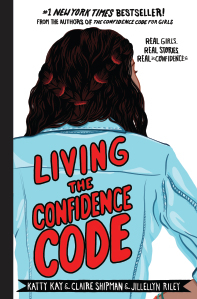
Living the Confidence Code: “You Don’t Need to Please Everyone. It’s Exhausting and Doesn’t Work Anyway.”
Interview: Katty Kay, Claire Shipman and JillEllyn Riley.
Katty Kay is a longtime journalist, now anchor for the BBC World News America.
Claire Shipman is a longtime journalist for outlets such as Good Morning America, NBC News, and CNN.
They're the co-authors of the New York Times bestsellers Womenomics: Work Less, Achieve More, Live Better (Amazon, Bookshop) and The Confidence Code: The Science and Art of Self-Assurance—What Women Should Know (Amazon, Bookshop).
JillEllyn Riley is a writer and editor for fiction and non-fiction, for both children and adults.
Together, the three wrote their new book Living the Confidence Code: Real Girls. Real Stories. Real Confidence. (Amazon, Bookshop). This book was an instant New York Times bestseller, and collects stories of thirty girls pursuing their own aims.
I couldn't wait to talk to the authors about happiness, habits, and self-knowledge.
Gretchen: Which aspect of your confidence code do you struggle most with (risk more/think less/be yourself)?
Katty: Taking risks. Always hard for me.
Claire: All of it. I ruminate, which can be paralyzing, and I also really suffer from people-pleasing, which means sometimes it's hard to figure out where others end and I begin.
JillEllyn: Overthinking. I tend to catastrophize, assuming the worst and imagining disaster around every corner.
What's your favorite confidence hack?
Katty: Do it afraid. It's something we've realized only recently but I love it. It helps me with my #1 problem!
Claire: I have a phrase I say to myself, especially when I'm sending emails, reaching out to people and I'm nervous. I tell myself: who cares? Who cares whether they like it or whether there is a typo, etc. That is super-duper frightening for me, but also kind of liberating.
JillEllyn: Me to We Thinking. It gets me out of my head & helps curb my overthinking. When I focus on other people & bigger issues that I care about—it's a huge motivator.
What’s something you know now about happiness that you didn’t know when you were 18 years old?
Katty: You don't need to please everyone. It's exhausting and doesn't work anyway.
Claire: I find happiness in two places I never imagined: in micro-everyday interactions and in flow, when my brain is engaged in something I find exhilarating and everything fades away.
JillEllyn: I used to think happiness was something you had to deserve, something to be worthy of having.
Have you ever managed to gain a challenging healthy habit – or to break an unhealthy habit? If so, how did you do it?
Katty: I used to be an erratic eater, especially when I was stressed. I seem to have broken the habit—now I just eat normally, stress or no stress.
Claire: I don't talk about anything hard after 8 pm or even get on the phone. It revs me up too much. That was hard, but it's such a relief to just understand myself.
JillEllyn: I always had a tendency to step in and "fix" problems, even when nobody asks me for help. I've had to work hard to tamp that down.
Would you describe yourself as an Upholder, a Questioner, a Rebel, or an Obliger?
Katty: Questioner: I do what I think is best, according to my judgment. If it doesn’t make sense, I won’t do it.
Claire: Questioner/Rebel I'm always curious, I question everything, and I like to make my own decisions. And even though I like to please, I also rebel in crazy ways—I'm an unexpected rule breaker. I've always felt like a puzzle piece that doesn't quite fit where it should.
JillEllyn: Rebel: I'm not motivated by expectations or authority, I do things in my own way, according to my values and my sense of what's right. I'm a bit of an outlier, but that's ok with me, too.

March 25, 2021
John Lee Dumas: “Happiness Isn’t Handed to You by Someone Else.”
Interview: John Lee Dumas
When I first got into the world of podcasts, John Lee Dumas was one of the podcasters whom I met in real life. I remember talking to him in a hallway between sessions at the Podcast Movement Conference.
He's the founder and host of Entrepreneurs On Fire, an award-winning podcast where he interviews inspiring entrepreneurs to help others along their entrepreneurial journeys.
He also has a new book, The Common Path to Uncommon Success: A Roadmap to Financial Freedom & Fulfillment, (Amazon, Bookshop). In it, he offers a 17-steps roadmap to financial freedom and fulfillment.
I couldn't wait to talk to John about happiness, habits, and entrepreneurship.
Gretchen: What’s a simple activity or habit that consistently makes you happier, healthier, more productive, or more creative?
John: Happier? Smiling. Smile more! and smile with your eyes, not just mouth :-)))))
Healthier? My daily 30-minute infrared sauna...sweat out those toxins!
More productive? Pomodoro method, aka Time-blocking. Specifically 42-minutes of FOCUS on a SINGLE task, 18 minutes of REFRESH time. No distractions, massive progress. It's how I wrote 71,000 words of my book in 8 months happy and stress free!
More creative? My daily walks! I love brainstorming and dreaming up big ideas and possibilities on my daily walks. Something about the fresh air, breeze, sun, and blue sky.
What’s something you know now about happiness that you didn’t know when you were 18 years old?
That I am in control of my happiness. Happiness isn't handed to you by someone else. It doesn't appear out of thin air based on your job title or salary. It's not something you can purchase at the store. And it's certainly not something to ever take for granted. Go out and create a world that makes you happy, and practice gratitude for that world daily.
You’ve done fascinating research. What has surprised or intrigued you—or your readers—most?
In 2015—after having interviewed over 1,000 successful and inspiring entrepreneurs—I was on a mission to find out what made them different. How had they found success and freedom? The answer: because they know how to set and accomplish goals. Sounds a little too simple, right? That if you know how to set and accomplish a goal, you can find success? It's true if you're working on the right goals, and this discovery is what led me to create The Freedom Journal: Accomplish Your #1 Goal in 100 Days.
Have you ever managed to gain a challenging healthy habit – or to break an unhealthy habit? If so, how did you do it?
A challenging healthy habit I've gained is being disciplined. It's so easy to get distracted or chase after shiny objects. They're everywhere! Gaining this healthy habit—which allows me to continue running a location independent business that generates 6-figures in net income every single month—simply took practice. Anyone can do it, but not many put in the reps and practice it enough times that it actually becomes a habit. My direct advice is this; become a disciple to a plan of action you create each day. Let nothing distract you from executing that plan. Discipline will hand you freedom and happiness.
Would you describe yourself as an Upholder, a Questioner, a Rebel, or an Obliger?
I am an Upholder [Gretchen: Note that in the answer above, John wrote a version of the official Upholder motto—unprompted, I swear! That motto? "Discipline is my freedom." Wow.]
Does anything tend to interfere with your ability to keep your healthy habits or your happiness? (e.g. travel, parties, email)
Sure. I'm only human! Every fall my fiance and I travel for 3 months internationally. We love experiencing new cultures, places, and exploring our world's history. When we're traveling, there are some health and wellness-related habits that aren't as strong as they would be if I were at home living my daily routine. However, my happiness factor doesn't fade. I absolutely love travel, and I know myself well enough to be able to take my foot off the gas for a few months (so-to-speak) in order to embrace living in a new and different way. Everything in moderation—even moderation 
Have you ever been hit by a lightning bolt, where you made a major change very suddenly, as a consequence of reading a book, a conversation with a friend, a milestone birthday, a health scare, etc.?
My lightning bolt came when I was driving in the car listening to podcasts—and I ran out of episodes to listen to. In fact, it was my aha moment to start my podcast and business, Entrepreneurs On Fire! I knew I couldn't be alone. There were certainly other people commuting to and from work who loved listening to inspiring interviews with entrepreneurs who had "made it", right? RIGHT!
I very abruptly quit my partnership-track job in commercial real estate and was set on launching my own podcast—with zero online presence and zero broadcasting experience. You can imagine that didn't go over so well with my parents at the time  However, here we are, 9 years later, 100 million listeners of the podcast and over 20 million in revenue generated from that single lightning bolt moment. Oh, and my parents are now the biggest fans and supporters of Entrepreneurs On Fire!
Is there a particular motto or saying that you’ve found very helpful?
There are two I remind myself of often: the first helped encourage me to take my entrepreneurial leap and get started creating what I felt was missing. It's a quote from Ghandi: "Be the change you wish to see in the world."
Second is one that I've reminded myself of since the beginning of my entrepreneurial journey—it helps me stay on track and focus on the right things. It's a quote from Albert Einstein: "Try not to become a man of success, but rather try to become a man of value."
Has a book ever changed your life – if so, which one and why?
Think and Grow Rich (Amazon, Bookshop) gave me a new perspective of how to learn from others, surround yourself with the right people and have those you know like and respect hold you accountable for your big life goals.
In your field, is there a common misconception that you’d like to correct?
There is a misconception that the path to success is hidden, secret and complicated. It's not. I've interviewed over 3000 successful Entrepreneurs (Gretchen included!) and the path to YOUR version of uncommon success is a common one, and I created a 17-step roadmap to prove it

March 23, 2021
Lisa Cron: “If We Couldn’t Feel Emotion, We Couldn’t Make a Single Rational Decision.”
Interview: Lisa Cron.
Lisa Cron is a story coach and the author of Wired for Story: The Writer’s Guide to Using Brain Science to Hook Readers From the Very First Sentence (Amazon, Bookshop) and Story Genius: How To Use Brain Science to Go Beyond Outlining and Write a Riveting Novel (Before You Waste Three Years Writing 327 Pages that Go Nowhere) (Amazon, Bookshop).
She's worked in publishing at W.W. Norton, as an agent at the Angela Rinaldi Literary Agency, as a producer on shows for Showtime and CourtTV, and as a story consultant for Warner Brothers and the William Morris Agency. Since 2006, she's been an instructor in the UCLA Extension Writers' Program and she's on the faculty of the School of Visual Arts MFA program in visual narrative.
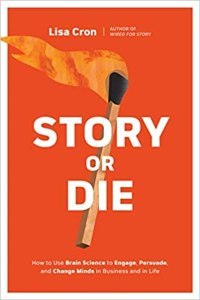
Now she has a new book called Story or Die: How to Use Brain Science to Engage, Persuade, and Change Minds in Business and in Life (Amazon, Bookshop). (You can also click here to learn about her video class Wired for Story, and find her video tutorial Writing Fundamentals: The Craft of Story here.)
I couldn't wait to talk to Lisa about happiness, habits, and creativity.
Gretchen: What’s a simple activity or habit that consistently makes you happier, healthier, more productive, or more creative?
Lisa: Strong coffee, first thing in the morning. I started drinking it in college because it made me feel like a genuine grown up. It still does.
What’s something you know now about happiness that you didn’t know when you were 18 years old?
I know that being older holds way more happiness than I thought possible when I was a kid. Both the giddy kind and a deeper layer that isn’t as fragile or fleeting as the happiness I experienced when I was younger.
You’ve done fascinating research. What has surprised or intrigued you – or your readers – most?
I love this question. It leads to something that almost always surprises people, because it flies in the face of what we’ve been taught. It sure surprised me. It’s about the role emotion plays in every decision we make.
Like so many of us, I was taught that when I wanted to make a decision, I should marshal all the facts, all the figures, all the data, and then analyze it dispassionately, in the cold light of objective reason. And there was always a caveat: during the process it was imperative that I keep emotion at bay, lest it sneak in and cloud my judgement, and I really would buy that pony.
That’s why the most surprising – and liberating – thing I’ve learned is that not only is emotion the most critical element of every decision we make, but if we couldn’t feel emotion we couldn’t make a single rational decision. That is not a metaphor or a theory, it’s a biological fact.
I’ll never forget reading about a man named Elliot in neuroscientist Antonio Damasio’s Descartes’ Error (Amazon, Bookshop). Elliot had been a successful family man who, after losing part of his prefrontal cortex when surgeons removed a benign brain tumor, lost the ability to feel emotion. Although he still tested in the 97th percentile in intelligence, he couldn’t make a single decision – he’d go from restaurant to restaurant at lunch but he never went in, because he didn’t know what he felt like eating. Can you imagine?
Emotion lets us know what things mean to us, instantly. We don’t make decisions based on our rational analysis of the situation, we make decisions based on how that rational analysis makes us feel.
This is not to say that logic – rational analysis – doesn’t play a part. It does (hopefully). But it’s not emotion vs. reason, as we’ve been led to believe since the time of Plato. It’s not either/or, it’s both/and. And after all the logical analysis, emotion is the ultimate decider.
As Maya Angelou so sagely pointed out, “I've learned that people will forget what you said, people will forget what you did, but people will never forget how you made them feel.” The point is – and I admit I’m an evangelist on this – when you’re trying to persuade anyone of anything, emotion isn’t the monkey wrench in the system. Emotion is the system.
Have you ever been hit by a lightning bolt, where you made a major change very suddenly, as a consequence of reading a book, a conversation with a friend, a milestone birthday, a health scare, etc.?
It was my eighteenth birthday. The year before, I’d dropped out of high school for good. I’d left public school after tenth grade and gone to a very small private high school, thirty-two kids total, with classes held in a suburban house in the San Fernando Valley. Yeah, it was a hippie school – the kind that used to be called a “free school” – although of course there was tuition. I loved it. We did things like stay up all night then go downtown to the flower market at dawn to watch them unload the trucks, we had classes with titles like “Nonverbal Communication,” and once we dissected a mail-order cat cadaver.
But by my senior year, the school had splintered and fallen apart. So I dropped out, got a job, and didn’t think about the future at all. I spent my free time talking philosophy with my best friend, who was in college, and going to every movie that came out.
But then, on the morning of my eighteenth birthday, I woke up thinking about the philosophical argument I’d had with my friend the day before, and suddenly I wanted to study philosophy too. And then it hit me: I wanted to go to college. I remember sitting up and breathing it in. I was hungry for learning in a way I had never been – school hadn’t interested me before. But this time no one was forcing me to go, making me study things I had no interest in. This was my choice. And, I realized, on a deeper, scarier level, I’d been afraid I didn’t have the self-discipline to stick to, well, anything. Now, for the first time, I had the drive, and the agency, to take that risk.
It turned out, by compete coincidence (probably), that eighteen was the very age at which a person could enroll in community college without a high school diploma. So I did. I threw myself into my classes, did well, and after two years transferred to U.C. Berkeley, where I graduated.
I’ve never told this story before. Because it makes me feel vulnerable. I have always been inordinately proud of having graduated from Berkeley, and I’ve been afraid that if I admitted I’d dropped out of high school and then gone to community college for two years in order to get there, it would somehow diminish the accomplishment.
It never once occurred to me that the opposite might be true. The fear of being vulnerable, of being seen as different (read: lesser than) runs surprisingly deep. Even when, like me, you’ve called yourself a nonconformist since grade school. And even though research proves that it’s only when we allow ourselves to be vulnerable that we have a chance of actually connecting with other people. And you know what? Having now told this story publicly, the fear be damned, has made me happier. A lot happier, and more comfortable in my own skin. Which, maybe, is the same thing.
Is there a particular motto or saying that you’ve found very helpful?
I have a motto that gets me through times when what I’m trying to accomplish begins to feel impossible, and giving up and taking a nice nap starts to feel like the perfect solution. It’s a military motto, and it’s this: “You gotta love the suck.” Because, let’s face it, there’s always going to be that slog, when that mean voice we all have in our head (right, it’s not just me?) starts to tell us that if we keep going, we’ll just be making a fool of ourselves. Reminding myself (and that pesky voice) to embrace how hard it is rather than bail, is what keeps me going. That, and of course, the caffeine.
In your field, is there a common misconception that you’d like to correct?
I would love to correct the completely understandable (but dead wrong) myth that stories are just for entertainment, and thus serve no genuine purpose other than offering us a delicious reward after having spent a hard day doing real things in the real world. Which has led to the belief that sure, life would be far duller without stories, but we’d have survived just fine.
That could not be less true. Story is built into the architecture of the brain: we think in story, and we make sense of everything thorough narrative.
And because we’re wired for story, we decode every fact that’s thrown at us through our own subjective narrative, our own personal story – always tacitly asking, How will this fact affect me? Will it help me, or will it hurt me? This is not a choice, nor is it a failing. It’s biology, and it’s how we got here.
Turns out that story was more crucial to our evolution than our much touted (and beloved) opposable thumbs. All our thumbs do is let us hang on – story tells us what to hang on to. The takeaway is: we don’t turn to story to escape reality, we turn to story to navigate reality.
In your latest book, you explore how to use brain science to engage, persuade, and change minds. What’s your number one takeaway from this book for people who want to improve their lives and be happier?
This is such an important question now, given the divisive times we live in. So often these days families are torn apart by deeply conflicting beliefs, and so many of us are hoping to use facts to get our loved ones to see the light. But often that only inflames them. And when it’s the other way around, the facts they throw our way tend to inflame us. The truth is, no one listens until they feel heard. Heard, without judgment, counterarguments, or eye rolling (yep, it’s hard).
The goal shouldn’t just be to find out what someone believes, it should be to find out why they believe it – what it really means to them – given their story. And the good news is, as Mr. Rogers said, “It’s hard not to like someone once you know their story.”
Plus, by listening, not only will you have disarmed the person whose mind you’re trying to change, you’ll have reached a place of empathy and calm, which will help you find the place where your story speaks to theirs – and that’s way easier when your hair isn’t on fire. Trust me on this.