Gretchen Rubin's Blog, page 26
June 8, 2021
The importance of passion for a happy life—my thoughts then and now.
What I used to think, and what I think now, about the importance of passion for a happy life.
Back in 2007, I wrote this post, which is one of the most read posts on my site.
What I wrote then:
Because of The Happiness Project, I spend a lot of time wondering, “What elements are necessary for a happy life?”
I’ve become convinced that one of the greatest supports to a person’s happiness is passion—whether for musical theater, video games, constitutional history, camping, stamps, shoe-shopping, teaching English as a second language, or whatever.
Now, it might seem that some passions are “better” than others—they help other people, or they’re of a “higher” nature, or they’re more healthy or wholesome. Maybe. But any passion is a great boon to happiness.
A passion gives you a reason to keep learning and to work toward mastery. It can often give you a reason to travel, and therefore to have the new experiences so key to happiness. It gives you something in common with other people, and so fosters social bonds. It gives you purpose. It often has a satisfying physical aspect—rock-climbing, fly-fishing, knitting. It gives meaningful structure to your time. It makes the world a richer place. When you’re in pain, it can be a refuge, a distraction, a solace.
One of my struggles to “Be Gretchen” is to identify and pursue my passions—my real passions, not the passions I wish that I had—and also to acknowledge when I don’t share a passion.
It’s a little sad to admit that a common passion isn’t a source of joy to me. Like food. I wish I appreciated food more, but I don’t. (This doesn't mean that I don't love to EAT—I do. I have an incredible sweet tooth and snack constantly. I just don't have a refined palate. I want to eat Snackwell's cookies, breakfast cereal, and candy all day long. And while that stuff is great, there's not much sophisticated pleasure to get from it.)
I’ve been thinking about this because I just finished Molly O’Neill’s fabulous memoir, Mostly True: A Memoir of Family, Food, and Baseball (Amazon, Bookshop).
She shows how important passion was to her and her brothers—hers, for cooking, theirs, for baseball.
Cooking keeps one in the present. It is a thing that has a beginning, a middle, and an end. If you don’t pay attention, you can cut off your finger, burn yourself or your meal. You can’t lie about cooking. You either do it well or you don’t. You are fast or you are slow. You are neat or you are sloppy. You have taste or you don’t. It’s only dinner, but cooking makes honest people of liars, realists of dreamers, and well-ordered minds out of chaotic and impulsive ones. Baseball saved my brothers but cooking saved me.
Reading about her enjoyment of food—the enormous efforts she took to educate herself in all aspects of food, cooking, and restaurants—the depth of her discernment—the crazy adventures she had along the way—made me feel wistful.
I love the idea of going down to little markets in Chinatown to shop for fish, or making a reservation at a great New York City restaurant, or learning to make some lovely, special dish—I love the idea of doing it, but really, I don’t want to do it. Really, I’d rather stay home and eat one-minute oatmeal while reading the newspaper. That seems limited and joyless—but that’s Gretchen.
So food isn’t my passion—what is? Can I find overlooked passions that I can stoke? I’m trying to pay more attention. It can be surprisingly hard to identify your passion. My college roommate, for example, has a Ph.D. in anthropology and never took one class in anthropology in college.
Passion doesn’t just bring happiness to the person who enjoys that passion—it also brings a vicarious pleasure to onlookers.
I’m not interested in food or baseball, but I loved reading about Molly O’Neill’s passion. I have a friend who is an enthusiast for practically everything. She loves her job. She loves to read. She loves baseball. She loves video games. She loves to travel. She loves to learn to do new things. She loves clothes. I don’t share most of these passions, yet I find her such a happy, energizing person to be with.
I’m almost ready to unveil my “Four Pillars of Happiness,” also known as “The four things you must have in your life in order to be happy,” and passion fits right in to that…
What I’d change now:
These days, I’d use the word “enthusiasm” instead of “passion.” The term “passion” gets thrown around so much, and seems to suggest such a high bar of commitment, that people get discouraged. People often confess, “I don’t really have a passion,” and feel bad about it.
I prefer the word “enthusiasm” because it’s a term that can encompass either a mild or wild level of commitment. To me, enthusiasm sounds less intimidating and more fun. All enthusiasms (that aren’t actively harmful) add richness to our lives and usually bring us closer to others. I’m not sure whether I agree with Ralph Waldo Emerson, who wrote in his essay “Circles” that “Nothing great was ever achieved without enthusiasm”—but enthusiasm certainly helps.
In 2010, I wrote a post about one of my spiritual masters, Julia Child, and how much I admired her tremendous enthusiasm (of everything I’ve ever written, this is one of my favorite little pieces). With her enthusiasm for French cooking, she changed the way people thought about food, cooking, ingredients, and hospitality.
It’s funny to see myself writing about my nagging sweet tooth. In 2012, to defeat that sweet tooth, I quit sugar—really, I quit most carbs—so I no longer eat candy, oatmeal, or Snackwell’s cookies.
Given that I’m not much of a foodie, it’s interesting that in my discussion of passion/enthusiasm, I identified two people with an interest in food.
Now that I’m working on my book about the five senses, however, I’ve thought a lot about the sense of taste, and all the pleasure and enthusiasm it can bring.
What about you—do you prefer the term “passion” or “enthusiasm?” Whatever term we use, it’s a vital element to a happier life.


June 4, 2021
The Next Choice for the Happier Podcast Book Club: “Crying in H Mart” by Michelle Zauner
We've picked our next book for the Happier Podcast Book Club: Crying in H Mart, the brilliant memoir by Michelle Zauner (Amazon, Bookshop).
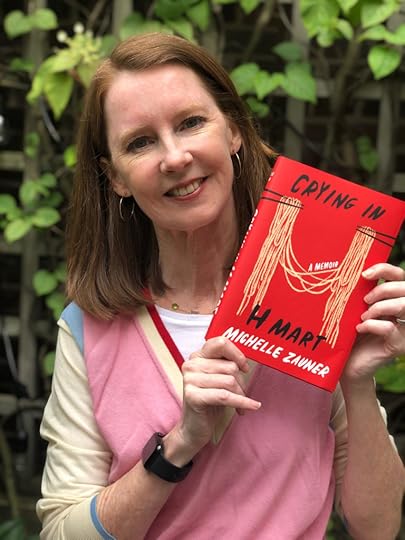
Michelle Zauner is well-known as the indie rockstar of Japanese Breakfast fame. In 2018, she wrote a New Yorker essay, "Crying in H Mart," that generated a tremendous amount of buzz.
Crying in H Mart was an instant New York Times bestseller and named a "best book" by many publications. Here's the official description:
In this exquisite story of family, food, grief, and endurance, Michelle Zauner proves herself far more than a dazzling singer, songwriter, and guitarist. With humor and heart, she tells of growing up one of the few Asian American kids at her school in Eugene, Oregon; of struggling with her mother's particular, high expectations of her; of a painful adolescence; of treasured months spent in her grandmother's tiny apartment in Seoul, where she and her mother would bond, late at night, over heaping plates of food.
As she grew up, moving to the East Coast for college, finding work in the restaurant industry, and performing gigs with her fledgling band--and meeting the man who would become her husband--her Koreanness began to feel ever more distant, even as she found the life she wanted to live. It was her mother's diagnosis of terminal cancer, when Michelle was twenty-five, that forced a reckoning with her identity and brought her to reclaim the gifts of taste, language, and history her mother had given her.
By the way, “H Mart” is the name of a very popular Korean-American supermarket chain.
These days, of course, we won't be able to meet in a studio, but through the wonders of technology Michelle Zauner will join Elizabeth and me to talk about her memoir for episode 334 of the Happier podcast airing July 14, 2021. So get reading!
Or listening. Do you love audiobooks? Elizabeth has been listening to a lot of audiobooks lately.
What are your questions or insights about the book? Add them in the comments, or share them on social media using #happierpodcastbookclub, and we'll incorporate them into the interview.
And remember, #Read21in21! It's been thrilling to hear from so many people who have reestablished a habit of reading.
Remember: whenever it is and wherever you are, there's always a book waiting for you.

June 3, 2021
Uju Asika: “When You Raise a Kind Human, You Are Raising a Brave One Too.”
Interview: Uju Asika.
Uju Asika is the founder and voice of the popular, award-winning family, lifestyle, and travel blog Babes About Town. It's a guide for families who want to have fun together in London—and beyond.
Now she has a book that just hit the shelves: Bringing Up Race: How to Raise a Kind Child in a Prejudiced World (Amazon, Bookshop). In it, she blends personal stories and research to explore how race impacts us from birth and what we can do to build fairer, anti-racist societies.
I couldn't wait to talk to Uju about happiness, habits, and parenting.
Gretchen: What’s a simple activity or habit that consistently makes you happier, healthier, more productive, or more creative?
Uju: Hula hooping! I’m not a pro by any standards, more of an enthusiast. Hooping is such an instant mood lifter. As a lifetime habit, what has most enhanced my happiness, health and productivity is reading books. My parents were voracious readers and we grew up surrounded by books. As a child, I read everything from Winnie the Pooh to Simone de Beauvoir. One of their best friends, the late Flora Nwapa, was a celebrated Nigerian author. Auntie Flora was the sweetest lady with dimples when she smiled and an infectious giggle. I thought she was magical because she wrote stories. She was one of my earliest inspirations for becoming a writer.
A love of reading is something I wanted to pass on to my own kids. My eldest inhales books but my youngest takes a little nudging. In Bringing Up Race, I wrote a chapter on the importance of reading diverse books with your children. It’s titled "Books Will Save The World." I really believe they can.
What’s something you know now about happiness that you didn’t know when you were 18 years old?
That happiness is about the daily hum not just the high notes. You can keep chasing those big milestones but true happiness comes in the everyday moments. Jokes and banter with my husband as we watch TV. Or when my teenager comes in for an unexpected hug. Also, at 18, I wish I understood fully that my happiness didn’t depend on any boy or what/whether he was thinking about me.
You’ve done fascinating research. What has surprised or intrigued you – or your readers – most?
Discovering that babies notice race from as young as three months old. Most people expect this to happen with school age kids or even toddlers but not tiny babies! However, several studies have shown three-month-old infants reacting to people with different skin tones from their primary caregivers. I must emphasise that they don’t react negatively in any way at that age. So no, your baby is not racist! They’re simply absorbing information and learning about the world. We’re born curious. It’s one of the reasons parents need to talk about race with their kids from a young age. It’s never too early or too late to start a conversation.
Have you ever managed to gain a challenging healthy habit – or to break an unhealthy habit? If so, how did you do it?
I used to be obsessed with women’s lifestyle magazines. I would sneak off with my mum’s and older sister’s magazines until I was old enough to buy my own. I’d read them cover to cover, from the editorial letters to the tiny back page print. You might say this was part of my formative training as a journalist. However, it was unhealthy because there was so much pressure from these magazines to act and look a certain way. Most of them didn’t feature people who looked like me. It’s nuts that in 2021 it’s still a rare and precious sight to see a Black woman on the cover of a mainstream magazine.
One day, we were decluttering our flat and I decided to chuck out most of the magazines I’d hoarded over the years. By then, I was getting most of my information online and preferred reading blogs. So I quit the habit altogether (apart from the odd collector’s edition). It took me 20 years but I’ve never looked back.
Would you describe yourself as an Upholder, a Questioner, a Rebel, or an Obliger?
I would describe myself as a Rebel but having read The Four Tendencies and taken the test twice, it turns out I’m an Obliger. It’s all about inner motivation. I am much more inclined to get things done when I’m given a push or there’s a deadline to meet. Otherwise, I can be distractible and daydreamy. My head is filled with too many ideas, not enough time to make 10,000 of them happen. I do have Rebel tendencies though. I also lean towards Questioner as it’s in my nature to research and overanalyze everything!
Does anything tend to interfere with your ability to keep your healthy habits or your happiness?
My biggest issue is with my phone. I’m trying to stop reaching for my phone every spare minute when there are more creative ways to spend my time. I never imagined that one day I would need to practice the art of staring into space instead of staring at my phone. But it’s something I’m actively working on. I worry that children these days don’t spend enough time getting lost in their own thoughts.
Is there a particular motto or saying that you’ve found very helpful?
One of my personal mottos is ‘Be Cool, Be Kind, Be You’. It’s the title of the last chapter in my book and it’s inspired by my parents who were the essence of coolness, kindness and individuality. I teach my kids that you don’t have to be trendy to be cool. You don’t have to be a pushover to be kind. And you don’t have to be anyone but you.
Has a book ever changed your life – if so, which one and why?
I Know Why the Caged Bird Sings (Amazon, Bookshop). It introduced me to my mentor, Maya Angelou (I never knew her personally but that’s how she feels to me). I went to school in Britain where we studied mostly White male authors. So discovering the works of Maya Angelou, Toni Morrison, Alice Walker and other Black female authors truly changed my life. Reading Maya’s autobiographies inspired me to share my own stories in my own voice. Before then, I went through a phase of writing about vegetables, animals or White characters. Maya Angelou taught me that you could take the things that happened to you, even the worst things, and make it art. I read the whole series but the first book is my favourite.
In your field, is there a common misconception that you’d like to correct?
It’s interesting. As someone writing about race, I’ve noticed we’ve swung from a false notion that racism is a Black and Brown people problem to books mainly aimed at telling White people what to do. This can feed into a misconception that, when it comes to race, Black and Brown people know exactly how to act and what to say. However, from my research and personal experience, people of color don’t have it all figured out. It’s just that we don’t have a choice in engaging on these issues. We can’t sit back and let our children wander into the world without preparing them for what’s coming.
No matter your race, these conversations can be painful and laden with fear. I wrote Bringing Up Race to empower people of all ethnicities with the confidence to talk about race in a way that’s honest, inclusive and affirming. In the book, I talk about kindness a lot too. Some people think being kind is weak or passive but that’s another misconception. Niceness is weak but kindness takes courage. It’s about doing the right thing even if it’s way outside your comfort zone. When you raise a kind human, you are raising a brave one too.

June 1, 2021
What I Read This Month: May 2021
For four years now, every Monday morning, I've posted a photo on my Facebook Page of the books I finished during the week, with the tag #GretchenRubinReads.
I get a big kick out of this weekly habit—it’s a way to shine a spotlight on all the terrific books that I’ve read.
As I write about in my book Better Than Before, for most of my life, my habit was to finish any book that I started. Finally, I realized that this approach meant that I spent time reading books that bored me, and I had less time for books that I truly enjoy. These days, I put down a book if I don’t feel like finishing it, so I have more time to do my favorite kinds of reading.
This habit means that if you see a book included in the #GretchenRubinReads photo, you know that I liked it well enough to read to the last page.
When I read books related to an area I’m researching for a writing project, I carefully read and take notes on the parts that interest me, and skim the parts that don’t. So I may list a book that I’ve partly read and partly skimmed. For me, that still “counts.”
If you’d like more ideas for habits to help you get more reading done, read this post or download my "Reading Better Than Before" worksheet.
You can also follow me on Goodreads where I track books I’ve read.
If you want to see what I read last month, the full list is here.
And join us for this year's new challenge: Read for 21 minutes every day in 2021!
A surprising number of people, I've found, want to read more. But for various reasons, they struggle to get that reading done. #Read21in21 is meant to help form and strengthen the habit of reading.
May 2021 Reading:It's Not How Good You Are, It's How Good You Want To Be by Paul Arden (Amazon, Bookshop) -- A very thought-provoking book about creativity.
Jay-Z: Made in America by Michael Eric Dyson (Amazon, Bookshop) -- I don't know much about music, but this portrait of an American icon was fascinating nevertheless.
The Wreckage of My Presence: Essays by Casey Wilson (Amazon, Bookshop) -- A hilarious, surprising memoir by an actor whose work I love. Also, Kansas City connection.
Super Senses: The Science of Your 32 Senses and How to Use Them by Emma Young (Amazon) -- I love everything about the five senses, so of course I couldn't wait to get my hands on this book; it covers many of the senses that I don't write about it in my book, but nevertheless find very interesting.
Touching the Rock: An Experience of Blindness by John M. Hull (Amazon, Bookshop) -- A very interesting and moving account of losing sight.
Dark Harbor: Building House and Home on an Enchanted Island by Ved Mehta (Amazon) -- About home, family, place, sight, sound, and much more.
Three Rings: A Tale of Exile, Narrative, and Fate by Daniel Mendelsohn (Amazon, Bookshop) -- Fascinating, ambitious, thought-provoking.
Bringing Up Race: How to Raise a Kind Child in a Prejudiced World by Uju Asika (Amazon, Bookshop) -- A practical and hopeful guide.
Why Startups Fail: A New Roadmap for Entrepreneurial Success by Tom Eisenmann (Amazon, Bookshop) -- Fascinating and written with such clarity that it was easy for a non-business-type person like me to understand.
Brat: An 80s Story by Andrew McCarthy (Amazon, Bookshop) -- An absorbing memoir.
Crying in H Mart by Michelle Zauner (Amazon, Bookshop) -- New York Times Bestseller; named a Best Book of April 2021 by many publications. Profound memoir about the relationship between a mother and a daughter, identity and place, coming into a vocation, food and memory, and much more.
Meander, Spiral, Explode: Design and Pattern in Narrative by Jane Alison (Amazon, Bookshop) -- A very interesting look about forms of narrative.
The Lean Startup: How Today's Entrepreneurs Use Continuous Innovation to Create Radically Successful Businesses by Eric Ries (Amazon, Bookshop) -- I've been meaning to read this book for years. Practical, informative, a great read.
Train Go Sorry: Inside a Deaf World by Leah Hager Cohen (Amazon, Bookshop) -- A very interesting memoir of a woman who spent much of her childhood growing up in New York's famous Lexington School for the Deaf.
Dept. of Speculation by Jenny Offill (Amazon, Bookshop) -- Shortlisted for the Folio Prize, the Pen Faulkner Award and the International Dublin Award. One of the New York Times' best books of 2014. In the book Meander, Spiral, Explode, I learned the word "crot," and this novel is written in crots. I love crots!
One Crazy Summer by Rita Williams-Garcia (Amazon, Bookshop) -- John Newbery Medal; Coretta Scott King Award for Authors. A book about three sisters, their difficult mother, and the eventful summer they spent together.
Shadows of the Past by Sharon Shinn (Amazon, Bookshop) -- I love Sharon Shinn's work, and I raced through these short stories.
Something of Myself and Other Autobiographical Writings by Rudyard Kipling (Amazon, Bookshop) -- I can't remember where I heard a discussion of this memoir—was it on a podcast?—but I was intrigued, so hunted it down to read.
El Deafo by Cece Bell (Amazon, Bookshop) -- 2015 Newbery Honor; 2015 Eisner Award for Best Publication for Kids. A graphic novel about growing up, grappling with hearing aids, dealing with friends and a crush.

May 27, 2021
Alison Bechdel: “I’ve Always Known Physical Exertion and Movement Are Vital Somehow for My Creative Process.”
Interview: Alison Bechdel.
I'm a huge fan of the work of memoirist and cartoonist Alison Bechdel, which I only recently discovered (though people had been telling me to read her books for years). I love her two graphic memoirs: Fun Home: A Family Tragicomic (Amazon, Bookshop) which was adapted as a musical that won a Tony Award for Best Musical, and Are You My Mother?: A Comic Drama (Amazon, Bookshop). She was a 2014 recipient of the MacArthur "Genius" Award.
Now she has a new book, The Secret To Superhuman Strength (Amazon, Bookshop), a graphic memoir of her lifelong love of exercise, set against a hilarious chronicle of various fitness fads.
I couldn't wait to talk to Alison about happiness, health, and creativity.
Gretchen: What’s a simple activity or habit that consistently makes you happier, healthier, more productive, or more creative?
Alison: Running. Going for regular runs achieves all of those things for me. And nothing could be simpler. Just put on your sneakers and head out the door. (Well, okay, you also have to put on your sports bra, which can be its own workout sometimes.) I ran a lot when I was younger, but quit in my thirties. Then several years ago, in my mid-fifties, I got back to it and it was really salvational for my mental health during the chaotic news cycle of recent years.
Gretchen, I’ve heard you talk about how one way to give yourself a jolt of instant happiness is to just jump up and down a bit. I love that! And I think that’s the secret of why running is such a transformative experience—running is really just a process of leaping, with both feet off the ground at the same time, over and over again.
What’s something you know now about happiness that you didn’t know when you were 18 years old?
You can’t be happy unless you can also be sad. If you’re defended against feeling pain, those same defenses shut down your access to joy. You have to let everything in.
You’ve done fascinating research. What has surprised or intrigued you – or your readers – most?
As a memoirist, my research has been pretty much all about my own life—I’ve spent a lot of time reading my old journals and datebooks, for example. As I worked on this book about my exercise history, it was interesting to see what was else was going on in my life as I went through various fitness phases, particularly my creative life. I’ve always known physical exertion and movement are vital somehow for my creative process, but it was interesting to see the patterns: When I was studying karate, I became committed to cartooning as my calling. When I was studying yoga, both my writing and drawing got more realistic. When I undertook a bodyweight exercise regimen, I was finally able to begin the family memoir I’d been wanting to write for many years. In recent years, learning to walk on a slackline with confidence and flow feels like it has directly fed into my ability to experience those things in my work.
Have you ever managed to gain a challenging healthy habit – or to break an unhealthy habit? If so, how did you do it?
Getting back to the healthy habit of running helped me to break the grip of a bad habit: drinking. That wasn’t my intention when I took up running again in my fifties. And it was not an overnight change—it took several years. But slowly I noticed that my general level of tension was going down, as if my idle speed had lowered. I no longer needed a slug of scotch to calm down at night. Eventually I was even able to stop drinking wine with dinner every evening. Over the years, that had become a habit I didn’t think it was possible to break. But I did, and it was hugely liberating.
Would you describe yourself as an Upholder, a Questioner, a Rebel, or an Obliger?
I’m definitely an Upholder. At first I wasn’t sure about the “making a commitment to myself” part. I certainly have written up my goals, and made mission statements at certain points in my life, but I haven’t thought of those things in terms of commitments to myself. But maybe that’s because the behavior is ingrained so deeply that I don’t see it. My unrelenting expectations of myself are the air I breathe, invisible. I like the word “relentless” in the description of Upholders. I also relate to the word “rigid.” I wish I could be more easygoing about plans changing, or trying new things. I should add that unlike the typical Upholder, I have a real problem with procrastination.
I don’t think I’ve ever finished a deadline early in my life.
Does anything tend to interfere with your ability to keep your healthy habits or your happiness? (e.g. travel, parties, email)
Travel has been a big problem for me. In order to quiet my mind down enough to think and write and draw, I need wide swaths of time in which nothing is expected of me. The constant upheaval and uprooting that travel entails just wrecks me, and even after I get home again it takes a while to recover. It’s like a silty sediment gets stirred up, and there’s no way to rush the process of it settling back down.
I went through a phase when I was traveling a lot, and struggling with my work. Then at a certain point I felt my concentration returning. After studying my datebook, I could see that my newfound focus coincided with the first time in several years that I’d been home for longer than thirty consecutive days. The pandemic has actually been a kind of boon for me because of the impossibility of travel. It’s been amazing to just stay put for a whole year straight. I’m hoping that with Zoom and all the other online meeting tools we have now, I won’t have to go back to being on the road quite so much.
Have you ever been hit by a lightning bolt, where you made a major change very suddenly, as a consequence of reading a book, a conversation with a friend, a milestone birthday, a health scare, etc.?
Reading Diet for a Small Planet (Amazon, Bookshop) when I was 21 made me immediately go vegetarian. The author talks about how it’s easy to feel powerless in the face of global problems, to just disengage because it seems like change is impossible. Then she writes, “Changing the way we eat will not change the world, but it may begin to change us, and then we can be part of changing the world.” That kind of stunned me, that link between personal change and societal change.
I have to confess that after two decades of being a vegetarian, I lapsed back into eating meat (albeit local and humanely raised) for a decade and a half. But when the pandemic hit, my partner and I used the general upheaval as a prod to clean up our act and get back to a more plant-based diet. I feel really good about that, not just physically, but knowing that I’m living in a more sustainable way. It’s even been helping me to face some of my grief about what’s happening with the climate. I feel like I’m less in denial, less checked out, because I know I’m at least doing this one small thing.
Like I said above, if you can’t feel joy if you can’t feel grief. I think really letting in the pain of what we’re losing as the planet warms oddly makes room for joy. And if we can savor all the beauty that’s still here, we’ll take more active steps to save it.

May 25, 2021
When Facing a Strong Temptation, Are You an “Abstainer” Like Me, or a “Moderator?”
I work constantly to try to know myself better. Why is it so hard to know myself? I hang out with myself all day long! Yet it's hard to see myself clearly.
Often, my self-understanding is boosted by other people. The better I understand others, the better I understand myself. When I hear others reflect on their own experiences, the more insight I get into myself.
For instance, when I was grappling to understand the differences among people that later became my Four Tendencies personality framework, one important clue was my realization that with habit-formation, I was different from most other people. Now I know why: because I'm an Upholder. (Want to know if you're an Upholder, Questioner, Obliger, or Rebel? Take the free, quick quiz here. More than 3.2 million people have taken it.)
I got another huge insight into my own nature when I read a passage about my patron saint Samuel Johnson. When a friend asked Dr. Johnson if he would "take a little wine," he responded, "I can't drink a little, child, therefore I never touch it. Abstinence is as easy to me as temperance would be difficult.”
Ah ha! The minute I read that line, I thought, "That's me, I'm just like Dr. Johnson! I’m an 'abstainer.'” When I'm facing a strong temptation, moderation is hard but abstinence is easy.
Abstainers like me find it far easier to give something up altogether than to indulge moderately. Years ago, I quit sugar, and I love not eating sugar. It's so much easier and more pleasant for me to have none. If I try to be moderate, I exhaust myself debating, “Today, tomorrow?” “Does this time ‘count’?” "Don't I deserve this?" etc. If I never do something, it requires no self-control for me; if I do something sometimes, it requires enormous self-control.
By contrast, moderators do better when they indulge in temptations sometimes, or a little bit. For years, I was puzzled by the people who kept a bar of fine chocolate in their desk drawer for weeks, and could be satisfied by just one square every once in a while—now I understand that that approach works for a moderator. (If you want to read a hilarious account from a moderator, the writer Delia Ephron describes her "Discardia.")
In practice, most of us are a mix. For one thing, the abstainer/moderator distinction applies only to strong temptation. It's not hard to resist a weak temptation. I'm a moderator when it comes to wine; I don't care much for wine, and I can drink just half a glass. But a friend told me, "I can have no wine, or four glasses of wine. I can't have just half a glass."
For me, sweets are my kryptonite. For others, it might be salty snacks, chocolate, peanut butter—for my sister Elizabeth, it's French fries. After she realized she'd find it easier to abstain about French fries, I asked her, "How do you say 'no' to yourself about fries?" She said, "Now I tell myself, 'Now I'm free from French fries.'" That's exactly how I feel.
And while some things require an all-or-nothing approach from abstainers, some don't. I really love roasted cauliflower, but I can eat roasted cauliflower in moderation.
There’s no right way or wrong way—it’s just a matter of knowing which strategy works better for you. If moderators try to abstain, they feel trapped and rebellious. If abstainers try to be moderate, they spend precious energy trying not to over-indulge.
In my experience, both moderators and abstainers try hard to convert the other team. A nutritionist once told me, “You should follow the 80/20 rule. Be healthy 80% of the time, indulge within reason 20% of the time. Listen to your body, don't be rigid.” I absolutely acknowledge that this advice was right--for her. But she didn't understand my point of view—that a 100% rule might be easier for someone like me to follow. Moderators do better when they avoid absolutes and strict rules, but I do much better when I follow absolutes and strict rules.
It's natural that when a particular approach works well for us, we try to convince other people to give it a shot. We're eager to share, we want to help! I constantly (and I must confess, sometimes unsuccessfully) resist the urge to explain to people why I eat low-carb. And it's true that we can learn from each other. But it's also true that just because something works for me, doesn't mean it works for you. And something can work extraordinarily well for you but not work for me.
People can be surprisingly judgmental about which approach you take. As an abstainer, I often get disapproving comments like, “It’s not healthy to take such a severe approach” or “It would be better to learn how to manage yourself” or “You should be able to have a brownie.” On the other hand, I want to tell moderators, “You can’t keep cheating and expect to make progress” or “Why don’t you just go cold turkey?” But different approaches work for different people. (Exception: with some temptations, like alcohol or cigarettes, people generally accept that abstaining is the only solution.)
You’re a moderator if you…
– find that occasional indulgence heightens your pleasure–and strengthens your resolve
-- can feel satisfied by having a little something
You’re an abstainer if you…
– have trouble stopping something once you’ve started
– aren’t tempted by things that you’ve decided are off-limits
Sometimes people tell me, "I'm an abstainer, but I don't want to abstain for the rest of my life. Is there a way for an all-or-nothing abstainer to enjoy the occasional treat?"
Absolutely! We abstainers can use a planned exception, when we can mindfully choose to make an exception to a usual habit by planning a limited exception in advance.
When we plan an exception we feel in control of ourselves—we're not breaking a habit willy-nilly, or invoking one of the 10 categories of loopholes at the last minute, to give ourselves excuses. And we feel happier when we feel in control of ourselves and our actions.
For abstainers, planned exceptions should be limited, and they should be exceptions. "A slice of cake for Thanksgiving dessert," not "the holiday season"; "When we go to dinner to celebrate our anniversary," not "when we spend a week in San Francisco."
This is the test for a successful planned exception:
you anticipate the exception in advance (which means it must be clearly defined)you relish it in the momentyou look back on it with pleasureMy father has the "grandchild exception"—when he's around his grandchildren, he eats whatever treats they're eating. A friend went on vacation and had a "pie policy."
So…do you identify as an abstainer or a moderator? Do these categories ring true for you?
If you want to read more about this distinction, read about the Strategy of Abstaining and the Strategy of Distinctions in Better Than Before, my book about how to make and break habits.

May 20, 2021
Pete Davis: “Everything That Matters Takes Time—There Are No Shortcuts.”
Interview: Pete Davis.
Pete Davis is a writer and civic advocate who works on projects aimed at deepening American democracy and solidarity. He's the co-founder of the Democracy Policy Network, a state policy organization focused on raising up ideas that deepen democracy, and is currently co-producing a documentary on the life and work civic guru Robert Putnam. His Harvard Law School graduation speech, “A Counterculture of Commitment,” has been viewed more than 30 million times.
He's the author of Our Bicentennial Crisis: A Call to Action for Harvard Law School’s Public Interest Mission (Amazon, Bookshop), and the co-author of How To Get Away: Finding Balance in our Overworked, Overcrowded, Always-On World (Amazon).
His new book is Dedicated: The Case for Commitment in An Age of Infinite Browsing (Amazon, Bookshop).
I couldn't wait to talk to Pete about happiness, habits, and relationships.
Gretchen: What’s a simple activity or habit that consistently makes you happier, healthier, more productive, or more creative?
Pete: Every few months, I take a day to leave the bustle of daily work life and think about the larger story of what I am doing. It’s a day when I don’t think about the what or even the how of my work life, but rather the why. Remaining close to my why helps give meaning to my difficult moments, helps keep me on the path of purpose when boredom, distraction, and uncertainty are getting the best of me, and even helps me make wiser decisions at forks in the road. Whenever I take time away to sit with my why, I always return to daily work life feeling energized.
What’s something you know now about happiness that you didn’t know when you were 18 years old?
I have always been told that “life has many chapters” — that you can wake up in five years and be in a totally different (perhaps even unimaginable) place than you are now. But when I was young I never really believed it — I thought now was forever. But as I have grown older, I have witnessed how true “life has many chapters” is—and it has been a hopeful idea to internalize, especially during hard times. It reminds of the great Rabbi Abraham Joshua Heschel quote: “We must learn to be surprised.” Over the past decade, it’s been a joy to have learned a bit more about how surprising life can be.
Have you ever been hit by a lightning bolt , where you made a major change very suddenly, as a consequence of reading a book, a conversation with a friend, a milestone birthday, a health scare, etc.?
There’s a short poem by the farmer-philosopher Wendell Berry that really distilled for me the most important lesson about both social and personal change: “In the dark of the moon, in flying snow, in the dead of winter, war spreading, families dying, the world in danger, I walk the rocky hillside, sowing clover.”
The poem hit me — in such a concise and deep way — with the message: Things can be very dark, but you can always start planting the seed of an alternative. And that humble sowing of life in a situation devoid of it is not a small thing — it is perhaps the most powerful thing we can do.
In your field, is there a common misconception that you’d like to correct?
I work in politics. I think many people think of politics as a series of random clashes, one after another — and the work of politics to be about brawling well in these various clashes. That’s what cable news and twitter drama makes us believe. But underneath the surface of all these one-off clashes is actually a series of long-haul projects: dedicated people and groups cultivating ideas, building coalitions, and advancing causes over decades. The public at large may only see the endgame of these causes—when an issue finally breaks through to the public consciousness—but most of the work happens before these breakthroughs.
When you understand this, you start seeing that the people who have the most impact in politics are not the cable news brawlers or clever tweeters, but those doggedly engaged in causes over the long term. And, most importantly, you start seeing that the skills and virtues needed in long-haul cause work are different, too. Remember that old mantra: “First they ignore you, then they laugh at you, then they fight you, then you win”? Each of those phases lasts a while—and to move through them requires a whole lot of imagination, patience, collaboration, creativity, and dedication.
And this isn’t just the case with politics. Everything that matters takes time—there are no shortcuts. Teaching a student, advancing a cause, healing a divide, rectifying an injustice, revitalizing a town, solving a hard problem, getting a new project off the ground—they all take time. If change happened quickly, we wouldn’t need commitment—our initial elation or anger would be enough. But when change takes time, we need something more—a deeper spirit that can get us through the boredom, distraction, exhaustion, and uncertainty that can plague any long-haul effort.
What has surprised or intrigued you – or your readers – most?
I study civic organizations—what makes people join up with others to work on shared projects. One of my favorite counterintuitive observations in the study of civic life is that the groups that demand more of their members often do better than those that ask less. You would think that the groups that make it easier to be a member—the ones that say “come whenever you want and do whatever you can, no problem”—would have more engagement than those that give members big, hard responsibilities. But the group flourishing most are in fact those that say to volunteers “we need you, we’re ready to put you to work, and we are all relying on you.”
You can see a similar phenomenon in school. It’s often the case that the teachers and coaches who are the biggest sticklers—the ones who have the highest expectations for their students—have the most devoted followings.
Why is this the case? People want expectations to meet, aspirations to seek, and honor to earn. Accountability—to a community, to respected mentors—gives us meaning.
Has a book ever changed your life – if so, which one and why?
I love Lewis Hyde’s The Gift: How the Creative Spirit Transforms the World (Amazon, Bookshop). It’s an exploration of two types of relationships: gift relationships and market relationships. Market relationships, Hyde writes, are based on short-term, one-off exchanges. You get something, I get something, immediately. These exchanges can be made between strangers, because they don’t require commitment. But gift relationships have a different set of rules: They involve the circulation of goods around long-term communities. They require trust and commitment. To receive a gift leaves you closer, perhaps more obligated, to the gift-giver than you were before. And unlike market transactions, gifts have a synthetic power: When gifts are exchanged between strangers, they tend to establish lasting relationships.
The book gave me this new lens through which to see all the relationships around me. One of my neighbors has a contractor friend who helps fix things around her house. Their relationship is a complicated dance. He never accepts payment, so she bakes for him, gives him elaborate Christmas and birthday presents, has him and his wife over for meals, and hires (and overpays) some of his friends for other odd jobs. The whole exchange would be simpler if she just used a handy-man app. But that’s not the point. Their complex exchange keeps gifts circulating and deepens their relationship over time. You’re not going to get that from an app. And when it comes to happiness, I’ve seen a pretty strong connection between daily joy and the number of gift relationships you are in.
Is there a particular motto or saying that you’ve found very helpful?
One of the people I interviewed for Dedicated, the Texas developer Monte Anderson, shared some simple, wise advice about how to keep an even keel throughout a long haul: “When you’re down, get grateful; when you’re up, get humble.” It’s like a spiritual version of an HVAC device that turns up the air conditioner when it’s too hot and turns up the heat when it’s too cold. I love how simple and actionable it is: When things are going bad, count your blessings; when things are going good, remember the warning that ‘glory fades.’

May 18, 2021
Use the Post-Pandemic “Clean Slate” to Improve Your Habits.
Many of us are starting to return—more or less, in some fashion—to work, after staying away for a long time.
This is a valuable opportunity for habit change, so be sure to use it! And you have to use it immediately.
Because our old daily habits around the work day have been disrupted, we have a clean slate. That fresh start means that we’ll have an easier time creating better habits around work routines.
In Better Than Before, my book about how we make and break our habits, I identify the 21 strategies we can use to master our habits.
The "Strategy of the Clean Slate" is a strategy where we take advantage of the fact that when we go through a big transition, old habits get wiped away, and new habits form more easily.
The slate may be wiped clean by a change in personal relationships: marriage, divorce, a new baby, a new puppy, a break-up, a new friend, a death.Or the slate may be wiped clean by a change in surroundings: a new apartment, a new city.Or some major aspect of life may change: a new job, a new school, a new doctor.Even minor changes can amount to a clean slate—a change as seemingly insignificant as taking a different route to work, or watching TV in a different room.A milestone in time can also act as a clean slate: a significant birthday, the new year, an important anniversary—or September.The Clean Slate is so powerful that we don't want to miss the chance to exploit it. For example, in one study of people trying to make a change—such as change in career or education, relationships, addictive behaviors, health behaviors such as dieting, or change in perspective—36% of successful changes were associated with a move to a new location.
The pandemic period forced dramatic disruptions to our habits. We can exploit that disruption to our benefit.
So reflect on the habits you want going forward, and make specific plans for them. Research shows that making concrete plans helps people meet their goals.
As you return to the office, be sure to start the way you want to continue. Think ahead, plan what you won’t or will do—to put those new, better habits in place right away. New habits will start to form immediately; make sure you're forming the habits you want.
As you consider the possibilities of your clean slate:
You might decide what you won’t do, going forward. You haven’t visited that vending machine in a year; decide that you’ll never use it again.You might decide what you will do, going forward. You’ve been enjoying a mid-day walk with your spouse, so you text a co-worker to suggest to start taking a lunchtime walk together when everyone's back in the office.You might look for ways to adapt positive habits that you've adopted over the past year. If you’ve had more time to read, because you didn’t have a commute, try listening to audio-books in the car.This massive disruption has led to enormous hardship, but it also gives us some opportunities. We can take advantage of this clean slate, to start off on the right foot as we move forward.
Can you imagine some ways that you'll create healthier habits around a clean slate?

May 14, 2021
I Want More Laughter and Light-Heartedness in My Life. Any Suggestions?
In my study of my five senses, I'm exploring how our five senses keep us attuned to other people. Nothing matters more to us than other people! Other people are safety—and danger.
For one thing, we’re always listening for people. From the moment of birth, we prefer sounds that are like speech, and in the brain, vocal sounds generate more neuronal activity than non-vocal sounds.
We learn a lot from listening to a voice. From a brief listen, we can make good guesses about a stranger’s age, health, education, background, personality, and social status; we can tell if that person is tired or drunk. We recognize hundreds of voices, and with people we know well, we recognize their voices after just a few words, and whether they’re in a good or bad mood, sick or in good health.
For connecting with other people, we have conversation, and we also have laughter. I’m surprised by how often laughter is ignored in works that examine speaking and listening, because laughter is a universal human behavior—and it’s all about engaging with others through sound.
It turns out that the main purpose of laughter is to bind people together. We’re far more likely to laugh when we’re with other people, and we’re more likely to laugh when we’re with friends than with strangers. Alone, we might smile or talk to ourselves, but laughing is something we do to send a signal to others. It's highly contagious.
Shared laughter strengthens relationships, breaks tension, makes people feel included, and creates a warm emotional tone—but every medicine can become poison, and sadly laughter is also an instrument of ridicule, humiliation, and exclusion.
When we think of laughter, we might imagine a comedian cracking jokes from a stage to an appreciative audience, but this isn’t how laughter usually works.
Laughter is mostly a sign of connection rather than humor, and most laughter comes not in response to jokes or formal attempts to be funny, but during ordinary, not-particularly-funny conversation. I was surprised to learn that in ordinary life, speakers laugh far more than the spoken-to; speakers laugh almost 50% more than their audiences.
Because laughter is a such an important form of engagement, I'm very interested in bringing more laughter into my life.
I've read two fascinating books on the subject, The Levity Effect: Why It Pays to Lighten Up by Adrian Gostick (Amazon, Bookshop) and Humor, Seriously: Why Humor Is a Secret Weapon in Business and Life by Jennifer Aaker and Naomi Bagdonas (Amazon, Bookshop). (You can listen to the interview that Elizabeth and I did with Aaker and Bagdonas in episode 314 of the Happier podcast.)
Now I'm trying to devise exercises for myself. What can I do to bring more laughter, more light-heartedness, into my life—and in this way, engage better with the people around me? (And by "around me," I meaning talking to me over Zoom or sitting next to me at the kitchen table.)
There's a theme here. Every year, I pick a one-word theme for myself, and one year I chose "Lighten Up," and Elizabeth's choice last year was "Lighter."
To raise the amount of engaged laughter in my life, I'm trying to follow several strategies:
point out the ridiculous (never in a mean way)cultivate inside jokes—as writer, actor, and director Mindy Kaling points in Why Not Me? (Amazon, Bookshop): “The private joke would get boiled down to a simple phrase…the phrase alone could uncork hours of renewed laughter. And as everyone knows, the best kind of laughter is laughter born of a shared memory.”make callbacks, that is, make an illusion to a previous comment or jokejoin in when someone else laughs, or at least show some responsedon't rush to continue a conversation if people are laughing; linger in the momentWhat are some other concrete strategies for cultivating a light-hearted spirit and more laughter? What works for you?

May 13, 2021
Greg McKeown: “What If, Instead of Pushing Ourselves Past the Point of Burnout, We Took the Opposite Approach?”
Interview: Greg McKeown.
Greg McKeown is a CEO, author, and social innovator. He has dedicated his career to discovering why some people and teams break through to the next level—and others don’t.
He's written for many publications, and is the author of the bestselling book Essentialism: The Disciplined Pursuit of Less (Amazon, Bookshop). He also hosts the podcast What's Essential with Greg McKeown.
Now he has a new book that just hit the shelves: Effortless: Make It Easier to Do What Matters Most (Amazon, Bookshop).
I couldn't wait to talk to Greg about happiness, habits, and creativity.
Gretchen: What’s a simple activity or habit that consistently makes you happier, healthier, more productive, or more creative?
Greg: For more than 10 years, I have kept a journal. It’s a small practice that has paid huge dividends for me. Journaling gives me the opportunity to reflect on my day and allows me to see much of the otherwise invisible progress that I have made. It helps me recognize what I am most grateful for. And it gives me something that I can look back on every so often so I can recall many of the important moments, insights, or lessons I have learned along the way.
Perhaps more importantly, it will be something that my children and grandchildren can have one day when I am gone. Hopefully, they will be able to see, through my writing, what my experiences were like and what was most important to me.
What’s something you know now about happiness that you didn’t know when you were 18 years old?
Here’s a truth that took me far too long to realize: When you focus on what you lack, you lose what you have. When you focus on what you have, you gain what you lack. The importance of gratitude cannot be overstated. Gratitude is a powerful, catalytic thing. It starves negative emotions of the oxygen they need to survive. It also generates a positive, self-sustaining system wherever and whenever it is applied.
It’s easy to complain. Misfortune happens to us all. But over time, the toxicity of these negative emotions builds up robbing us of peace and contentment. On the other hand, when you focus on something you are thankful for, the effect is instant. It immediately shifts you from a lack state (regrets, worries about the future, the feeling of being behind) and puts you into a have state (what is going right, what progress you are making, what potential exists in this moment). It reminds you of all the resources, all the assets, all the skills you have at your disposal—so you can use them to more easily do what matters most.
Have you ever managed to gain a challenging healthy habit – or to break an unhealthy habit? If so, how did you do it?
One of my family’s favorite rituals is having dinner together every evening. It allows us to connect and reflect upon our day. It strengthens our relationships and brings us closer.
One of my children’s least favorite tasks was helping to clean up after dinner was over. It was amazing to see how quickly they could vacate the room, leaving my wife and me alone to clean up. Obviously, we determined that this habit could not continue. We wanted our children to learn responsibility and Anna and I didn’t want to be left a giant mess to clean up every night.
So, we turned after-dinner clean-up into a ritual. When it came time to clean up we turned on our favorite Disney soundtrack and we turned doing the dishes into a nightly dance and karaoke party. We combined something no one liked to do (but had to be done) with something everyone enjoyed. Now the kitchen gets cleaned up faster and everyone has a good time doing it.
We turn habits into rituals by pairing them with something we love to do. When we do this, we have the power to transform a tedious task into an experience that creates joy.
Our rituals are habits we have put our thumbprint on. Our rituals are habits with a soul.
Have you ever been hit by a lightning bolt, where you made a major change very suddenly, as a consequence of reading a book, a conversation with a friend, a milestone birthday, a health scare, etc.?
A short time ago, my wife, Anna, and I had an incredibly frightening health scare with my daughter, Eve. Eve is a slim, brown-eyed, blond-haired girl with a mischievous grin. She simply cannot stay cross. Even when she tries to be grumpy, she can do it for only a few seconds before bursting into laughter.
But when Eve turned 14, things began to change. Our good-natured, fun-loving girl was replaced with one who was more sullen, had little energy, and didn’t seem to enjoy the things she used to. At first, I dismissed it as age-appropriate behavior. But, on a routine doctor’s visit, the doctor noticed Eve did not respond properly to basic reflex tests. He suggested we see a neurologist. We didn’t have to be told twice.
Her symptoms worsened on a daily basis. Within just a few weeks she could answer only in one-word sentences, speaking in a slurred and monotone voice. We noticed that the right-hand side of her body responded at a slower speed than the left-hand side. It took her two full minutes to write her name and hours to eat a meal. The light, once so vibrant and bright in Eve, dimmed. Then it seemed to go out entirely when she was hospitalized after a major seizure.
What made the situation worse was that the doctors couldn’t explain any of it. They could not offer us even the beginning of a diagnosis.
All we wanted in the world was for Eve to get better. That wasn’t just the most important thing. It was the only thing. What came into view for me was two paths for getting there. One made this challenging situation heavier. The other made this challenging situation lighter. And we had to choose which path to take. Maybe this choice seems obvious. But it wasn’t. As parents, our instinct was to attack the problem, with full force, from all directions: worrying about her 24/7, reaching out to every neurologist in the country, meeting with doctors one after the other, asking them a million questions, pulling all-nighters poring over medical journals and googling for a cure or even just a diagnosis, researching alternative medicine as a possible option. What the gravity of the situation called for, we assumed, was near-superhuman effort. But such an approach would have been unsustainable, while also producing disappointing results.
Mercifully, we took the second path. We realized that the best way to help our daughter, and our whole family, through this time was not by exerting more effort. In fact, it was quite the opposite. We needed to find ways to make every day a little easier. Why? Because we needed to be able to sustain this effort for an unknown length of time. It was not negotiable: we simply could not now or ever burn out. If your job is to keep the fires burning for an indefinite period of time, you can’t throw all the fuel on the flames at the beginning.
It’s been two years now. Eve continues to get better. She still has some ways to go, but as I write this we have reason to believe she will be completely healed. She smiles, laughs, and jokes. She walks, runs, and wrestles. She reads, she writes. She is thriving again.
What did I learn from this experience? Whatever has happened to you in life. Whatever hardship. Whatever pain. However significant those things are. They pale in comparison to the power you have to choose what to do now. You can make the choice to continue to work harder and harder, wearing yourself out in the process. Or, you can choose a more effortless path. One where you try and make each day a little easier.
In your field, is there a common misconception that you’d like to correct?
One of the greatest misconceptions we live with today is that the only path to achieving great results is by working harder.
It doesn’t help that our culture glorifies burnout as a measure of success and self-worth. The implicit message is that if we aren’t perpetually exhausted, we must not be doing enough. That great things are reserved for those who bleed, for those who almost break.
Strangely, some of us respond to feeling exhausted and overwhelmed by vowing to work even harder and longer. It is true that hard work can equal better results. But this is true only to a point. After all, there’s an upper limit to how much time and effort we can invest.
But what if, instead of pushing ourselves past the point of burnout, we took the opposite approach? What if we sought out an easier path? I truly believe this to be the antidote to the epidemic of exhaustion so many of us are facing.