Gretchen Rubin's Blog, page 30
February 23, 2021
Twenty Delightful Aphorisms About Eating from 1825. What Would You Add?
I. The universe would be nothing were it not for life and all that lives must be fed.
II. Animals fill themselves; man eats. The man of mind alone knows how to eat.
III. The destiny of nations depends on the manner in which they are fed.
IV. Tell me what kind of food you eat, and I will tell you what kind of man you are.
V. The Creator, when he obliges man to eat, invites him to do so by appetite, and rewards him by pleasure.
VI. Gourmandise is an act of our judgment, in obedience to which, we grant a preference to things which are agreeable, over those which nave not that quality.
VII. The pleasure of the table belongs to all ages, to all conditions, to all countries, and to all areas; it mingles with all other pleasures, and remains at last to console us for their departure.
VIII. The table is the only place where one does not suffer, from ennui during the first hour.
IX. The discovery of a new dish confers more happiness on humanity, than the discovery of a new star.
X. Those persons who suffer from indigestion, or who become drunk, are utterly ignorant of the true principles of eating and drinking.
XI. The order of food is from the most substantial to the lightest.
XII. The order of drinking is from the mildest to the most foamy and perfumed.
XIII. To say that we should not change our drinks is a heresy; the tongue becomes saturated, and after the third glass yields but an obtuse sensation.
XIV. A dessert without cheese is like a beautiful woman who has lost an eye.
XV. A cook may be taught, but a man who can roast, is born with the faculty.
XVI. The most indispensable quality of a good cook is promptness. It should also be that of the guests.
XVII. To wait too long for a dilatory guest, shows disrespect to those who are punctual.
XVIII. He who receives friends and pays no attention to the repast prepared for them, is not fit to have friends.
XIX. The mistress of the house should always be certain that the coffee be excellent; the master that his liquors be of the first quality.
XX. To invite a person to your house is to take charge of his happiness as long as he be beneath your roof.
Which one is your favorite? What aphorism would you add?
I do love an aphorism! Especially one about the five senses.


February 18, 2021
Deepa Iyer: “People Think That Those of Us Involved in Social Change Are Always Resilient and Strong…But We Too Need Care.”
Interview: Deepa Iyer
Deepa Iyer is a South Asian American writer, strategist, lawyer, and racial justice advocate. She's a Strategic Advisor at Building Movement Project and Director of Solidarity Is, a project that provides trainings, narratives, and resources on building deep and lasting multiracial solidarity. Deepa’s areas of expertise include the post 9/11 America experiences of South Asian, Muslim, Arab and Sikh immigrants, immigration and civil rights policies, and racial equity and solidarity practices.
Deepa’s first book, We Too Sing America: South Asian, Arab, Muslim and Sikh Immigrants Shape Our Multiracial Future (Amazon, Bookshop), received a 2016 American Book Award and was selected as a top 10 multicultural non-fiction books of 2015 by Booklist. She also hosts a podcast called Solidarity Is This.
I'm very interested in the framework outlined in Deepa Iyer's "Social Change Ecosystem Map."
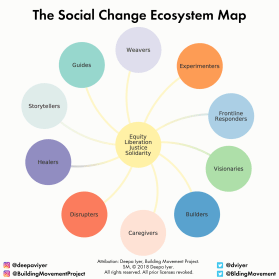
By giving a name for the ten roles played by people involved in social changes, her framework clarifies how we each might play a role: Weavers, Experimenters, Frontline Responders, Visionaries, Builders, Caregivers, Disrupters, Healers, Storytellers, and Guides.
I couldn't wait to talk to Deepa about happiness, habits, and human nature.
Gretchen: What’s a simple activity or habit that consistently makes you happier, healthier, more productive, or more creative?
Deepa: Spending time by myself with a journal. That isn’t as easy during the pandemic with a 10-year-old coworker at home with me, but I’ve found that if I can find a quiet space and time to center myself by listening to my inner voice and by journaling, it makes me much happier and healthier.
What’s something you know now about happiness that you didn’t know when you were 18 years old?
That it isn’t any one thing that brings happiness - i.e. a job or a relationship or a material object - but that it’s about figuring out what I’m good at, being in service to the world, and finding communities where I belong. This understanding anchors the social change ecosystem framework that I developed as well - to utilize our roles in service of social change values and as part of ecosystems.
Would you describe yourself as an Upholder, a Questioner, a Rebel, or an Obliger?
In taking the quiz, I found myself to be an Upholder.
Does anything tend to interfere with your ability to keep your healthy habits or your happiness?
Yes! There are so many reasons to feel jarred or off course these days. The news, the pandemic, family expectations, and the fast-paced nature of life all interfere with my ability to stay steady and grounded.
Have you ever been hit by a lightning bolt, where you made a major change very suddenly, as a consequence of reading a book, a conversation with a friend, a milestone birthday, a health scare, etc.?
I would say that the events of and after 9/11 became watershed moments for me. It became clear to me that I should use the privileges I had to work on behalf of my community. At the time, South Asians, along with Muslims and Arabs, were experiencing high levels of hate violence, discrimination, and profiling. The events of 9/11 and after forged a path that I’ve been on for 20 years now.
Is there a particular motto or saying that you’ve found very helpful?
There are many but one that I’m sitting with right now is “Start close in” which is the beginning of a poem by David Whyte. It is a reminder to have a conversations with myself, to follow my own voice, to listen closely to myself - so that I can also do the same with the people I care about in my life.
Has a book ever changed your life – if so, which one and why?
bell hooks’ book, All About Love: New Visions (Amazon, Bookshop), is always on my bedside table. It has helped me understand the complexities of various forms of love, and made me braver.
In your field, is there a common misconception that you’d like to correct?
People think that those of us involved in social change are always resilient and strong because we are working for causes in which we believe. But we too need care, understanding, appreciation, and time to check out, reflect, and rejuvenate.


February 16, 2021
Is There a Place You’d Like to Visit Every Day? I Visit the Metropolitan Museum
As an experiment, I wanted to visit the same place every day, for an entire year, to see how that experience affected my perceptions—I would see how the place changed over time, and how each of my senses revealed different aspects of it, and how making a daily visit changed me.
Research shows that people who try new things and go to new places tend to be happier, but I think that the pleasure of doing the same thing, every day, shouldn’t be overlooked. I agree with writer Gertrude Stein, who wrote: “Anything one does every day is important and imposing.” [From Paris France (Amazon, Bookshop)].
I can be rigid—I am an Upholder, after all—and often often my rigidity makes it hard for me to lighten up. With this exercise, however, my rigidity works to my benefit, because for me, doing something every day is much easier than doing it “whenever I felt like it” or “some days.”
For this challenge, I needed a place I could easily visit, day after day. A large place, a beautiful place, and an inexhaustible place. And so I decided on the Metropolitan Museum of Art.
The Met is a treasure house within walking distance of my apartment—seven minutes, I timed it.
Of course I realize how utterly fortunate I am to be able to do this project. Sheesh, I live five blocks from the Met! And I have the time and the freedom to spend my time visiting it! I'm so grateful for that.
But here’s the thing: I’ve lived within walking distance of the Met for years. The fact that I could visit was no guarantee that I would visit. The museum had always been there, waiting, but I’d mostly ignored it.
For me, the Met was an untapped possibility that I was eager to explore, and I wondered if other people felt the same way. I asked on social media:
This year, I’m visiting the Metropolitan Museum every day. For me, the Met was an untapped resource—now I’m taking advantage of it. Do you have a similar place you’d love to visit daily? An interesting neighborhood nearby, a park, a campus, a road? Or a place you already do visit every day? Not everyone is lucky enough to have a place like this, of course. I’m grateful every single time I go.
I was astonished by the flood of answers I received. I’d assumed that my desire to visit the same place every day was fairly idiosyncratic, so I was surprised by how enthusiastically people embraced this idea. I heard from many people who already made daily visits, or who liked the idea of making daily visits, to places such as:
the beachMount Auburn CemeteryDenver Botanic Gardenhorse barnWimbledon Commonpublic libraryreservoirlocal parkGrand Central Terminalneighborhood pathway systemvarious riverfronts and lakefrontszooMorton ArboretumGreat Smoky Mountains National Parkgrounds of the National Museum of Koreahiking trailsa castle!Of course, COVID-19 changed my original plan. For months, the Met was closed, and now it's open five days a week (with all sorts of safety measures in place) instead of the usual seven days. I've been going every day that I can go. For the rest of my life, I'll be able to summon up the particular scent of the hand sanitizer that the Met makes available at every turn...If you'd like to read more about my Metropolitan Museum daily visit, I go into more detail here.
When I started this experiment of making a daily visit, I had no idea what to expect. Spoiler alert: I love this visit. It's a highlight of my daily schedule. I may visit the Met every day for the rest of my life. I'm reminded of one of my favorite quotations:
Everything gains in grandeur every day, becomes more and more unknown, more and more beautiful. The closer I come, the grander it is, the more remote it is.
-- Alberto Giacometti, Giacometti: A Biography
Do you have anything similar in your life? A place that you’d love to visit daily?

February 11, 2021
Tim Harford: “Science and Long Experience Has Taught Me that Our Emotional Reactions Influence What We Believe More Powerfully than Any Expertise.”
Interview: Tim Harford.
Tim is an economist, journalist, and broadcaster. He's author of Fifty Inventions That Shaped the Modern Economy (Amazon, Bookshop), Messy (Amazon, Bookshop), and the bestselling The Undercover Economist (Amazon, Bookshop). He's also a senior columnist at the Financial Times and the presenter of Radio 4’s More or Less.
I discovered Tim Harford through his brilliant podcast, Cautionary Tales. I highly recommend it—full of information and told in a very engaging, accessible way. I just learned that he hosts another popular podcast, 50 Things That Made the Modern Economy, which I'm eager to listen to.
Now he has a new book that just hit the shelves: The Data Detective: Ten Easy Rules to Make Sense of Statistics (Amazon, Bookshop).
I couldn't wait to talk to Tim about habits, happiness, and human nature.
Gretchen: What’s a simple activity or habit that consistently makes you happier, healthier, more productive, or more creative?
Tim: A pandemic habit has been, every Monday morning, to cycle several miles to the top of a nearby (steep) hill, practice Tai Chi with my teacher, and then cycle home again. What a treat to have that opportunity! We all need exercise, tranquillity, and time outdoors – and these past few months have challenged us to be more determined and more creative in our search for those things.
What’s something you know now about happiness that you didn’t know when you were 18 years old?
Being kind to other people doesn’t just make them happy, it makes me happy too.
You’ve done fascinating research. What has surprised or intrigued you – or your readers – most?
I’m trying to help my readers think more clearly about the claims they read in the media or on social media, and what surprises people is that I start by asking them to focus on their own emotions: how does this headline make you feel?
I do this because both the science and long experience has taught me that our emotional reactions influence what we believe more powerfully than any expertise. That is true whether the emotion is negative (‘it can’t be true’; ‘fake news!’) or more positive (‘this shows I was right all along’; ‘what an inspiring photograph!’).
While The Data Detective does offer advice about how to think critically about evidence and particularly about numbers, it all depends on that visceral reaction. If you simply take a few moments to notice your own emotions, you are immediately more likely to think calmly and wisely about what you are reading.
Have you ever managed to gain a challenging healthy habit – or to break an unhealthy habit? If so, how did you do it?
Spreadsheets! I’m a geek, after all.
More seriously: I decided to track my physical exercise. I gave different activities a little score – quite arbitrary. So 50 points to do a full set of press-ups, or 100 points to follow a 10 minute exercise video. 100 points for a long walk. And I just tracked it. The details have varied over time; the habit of being deliberate about physical activity has lasted for more than a decade.
Would you describe yourself as an Upholder, a Questioner, a Rebel, or an Obliger?
The quiz says I am an Upholder, and who am I to argue?
Does anything tend to interfere with your ability to keep your healthy habits or your happiness? (e.g. travel, parties, email)
Overwork, and information overload.
I feel pretty disciplined about both. I don’t check Facebook – my posts there are automated feeds from my website. I avoid Twitter except while promoting books. I am an email ninja. And yet… there are always moments when it gets a bit too much.
Have you ever been hit by a lightning bolt, where you made a major change very suddenly, as a consequence of reading a book, a conversation with a friend, a milestone birthday, a health scare, etc.?
More than once! A recent example: I heard an interview with Gregg Krech about something called the ‘Naikan method’. It involves reflecting on three questions. First: what have I received from others? Second: what did I give to others? Third: what trouble or inconvenience did I cause others?
The moment I heard these I realised that I had been feeling rather sorry for myself about a particular situation. I had failed to appreciate my good fortune simply I was focused instead on a small recent setback.
But there is a broader point about lightning bolts of realisation: I think they strike fairly often. But you need to notice them – blink, and you miss it – and you need to be able to hold onto the insight. It’s not easy to capture lightning in a bottle, but we need to try. Write down the insight and act on it!
Is there a particular motto or saying that you’ve found very helpful? (e.g., I remind myself to “Be Gretchen.”)
“Be curious.”
Has a book ever changed your life – if so, which one and why?
It will seem like a strange choice, but I would nominate Dragon Warriors, a book by Dave Morris and Oliver Johnson. It’s a book that describes a fantasy world and explains how to play imaginative games set in that world. (A better-known parallel is the Dungeons & Dragons game.)
Why pick Dragon Warriors? Because I love playing imaginative games: they encourage active creativity, and they’re a social activity – you play them with friends. I still play most weeks, and some of my oldest and dearest friends are gamers. And, the icing on the cake: these days I play with Dave and Oliver, the gaming gods who helped introduce me to the hobby.
In your field, is there a common misconception that you’d like to correct?
Yes: the idea that “there are lies, damned lies and statistics.” We focus too much on people who lie with statistics, and too much on correcting those lies with fact-checking. That’s important, of course, but if we obsess about it to the exclusion of everything else, we’re making a serious mistake. We contribute to the idea that everything is ‘fake news’; we let healthy scepticism curdle into toxic cynicism.
So I think that we – all of us, but particularly my friends and colleagues in the fields of journalism and statistics – need to concentrate not just on what is a lie, but on what is true. It may be easy to lie with statistics but it’s even easier to lie without them.
Author photo by Fran Monks.

February 5, 2021
7 Quick, Easy Gestures I Use to Show Love to My Sweetheart.
Some people dismiss Valentine's Day as a consumerist holiday pushed by marketers, but I like seeing milestones throughout the year; they remind me to think about changes I might undertake to make myself happier, healthier, more productive, or more creative.
Sure, January 1 or my birthday is an arbitrary date, but it helps nudge me to reflect and to plan.
I use Valentine's Day to remind me to think about ways to show more love toward the people in my life, and in particular, my husband Jamie. The fact is, research shows that married people often show more consideration to others than they do to each other. I can do better!
Our dog Barnaby is always so excited to see Jamie walk through the door—I might not be able to match that level of enthusiasm, but I do want to demonstrate my love and attention.

And I want to include efforts that are manageable, that don't take a lot of time, energy, or money. Of course, sometimes it's important to make a big gesture, but I think that a lot of tiny, quick gestures go a long way to showing affection.
I don't always follow through with these intentions, but I try to...1. Snap to attention. I find it hard to drag my attention away from my book, my phone, the newspaper, a TV show...but when Jamie talks to me, I remind myself to pay attention, and to show that I'm paying attention by putting down my book, muting the TV, or whatever.
2. Help with a chore. Sometimes, I help out when he's doing a chore, even when it's "his" chore. Jamie and I have a tacit agreement: the second person out of bed makes the bed. That means that he's almost always the one making the bed. Sometimes, when I walk into the bedroom while he's doing it, I start helping without saying a word. Or if he's unpacking groceries, I fight my urge to skulk out of sight and instead pitch in. This shows a cooperative, helpful spirit.
3. Send fun photos and updates. Jamie loves to know what everyone's doing, so I take photos of our daughters, Barnaby, or anything else that I think he'd like to see, and I text little notes about something that's happening—even something like "Your package arrived." Super-quick, and he gets a big kick out of it. (I do the same thing for our daughter Eliza when she's away at college.)
4. Respect his Tendency. As I write about in The Four Tendencies, in my personality framework of the "Four Tendencies," Jamie is a Questioner. I try to respect his Tendency in two ways:
Explain why I'm asking him to do something. Like all Questioners, he doesn't like to be told without explanation, "Please buy a highlighter on your way home." He needs to understand why. So I take a few extra moments to give an explanation: "Please buy a highlighter on your way home, Eleanor needs it for her homework."
Don't ask unnecessary questions. Many Questioners—and Jamie is very much in this camp—don't like to answer questions, especially questions that they deem pointless. (Yes, it's ironic that Questioners resist answering questions, but what can I say, it's a very common pattern.) While asking questions is a popular way to start a conversation or to show that you want to connect with someone, I've learned to avoid this strategy with Jamie. It doesn't open up a good conversation; it puts him on edge.
(Want to know if you're a Questioner like Jamie—or an Upholder like me, or an Obliger, or a Rebel? Take my free, quick quiz to find out. More than 3.2 million people have taken this quiz.)
5. Respond quickly to his questions or requests. It's so draining when people don't answer, don't send necessary information, say they'll do something but then forget, and so on. Jamie is so important to me; I try to demonstrate that by being as responsive to him as possible.
6. Look for opportunities to be thoughtful. I try to remember to say, "I'm going to the drugstore, do you need anything?" "I'm going to the library, want me to pick up any books for you?"
7. Accommodate his quirks, when possible. Sometimes, a little thing matters more to Jamie than to me. For instance, when we travel (remember when people traveled?), he always wants to unpack right away. This isn't important to me, but hey, I have to unpack sometime, so I do it right away because he cares. Also, I tend to leave items out on various counters to remind me to deal with them, and after a while, this starts to bother Jamie. He's funny like that. So I've become much better about moving things along quickly, or at least putting them out of sight until I can deal with them. Bonus: this increased outer order gives me more inner calm, too.

You might think, "This all sounds good, and I wish my sweetheart would make these gestures to me!"
One truth about happiness is that we can't change other people; we can only change ourselves. But when we change, a relationship changes, and when we change, the atmosphere of our household changes. I've seen that by acting in a loving way, I inspire Jamie to behave more lovingly too.
Of course, there are more significant things we can do to show love. But it's also good to have a bunch of little gestures as well.
What easy, quick ways have you found to show love to your sweetheart?
If you're looking for ideas to boost connection and fun in your romantic relationship, join my 30-day Relationship Challenge. Each day, you’ll receive a text message to your mobile phone, with an audio message from me, with that day’s challenge. Use promo code SHOWLOVE to get half off when you join this month.

February 4, 2021
Logan Ury: “While Love May Be a Natural Instinct, Dating Isn’t.”
Interview: Logan Ury
Logan Ury is a Harvard-educated behavioral scientist turned dating coach, and the author of How to Not Die Alone: The Surprising Science That Will Help You Find Love (Amazon, Bookshop). As the Director of Relationship Science at the dating app Hinge, Logan leads a research team dedicated to helping people find love.
How to Not Die Alone is a guide to modern dating, designed to help the reader overcome their bad habits and find the relationship of their dreams, using lessons from behavioral science. Each chapter focuses on a different decision along the dating journey, from "Am I ready to date?" to "Should we get married?"
I met Logan Ury years ago, when I visited Google to talk about my book about habit change, Better Than Before, and we had a conversation about habits and happiness.
I couldn't wait to talk to Logan about happiness, human nature, and relationships.
Gretchen: What’s a simple activity or habit that consistently makes you happier, healthier, more productive, or more creative?
Logan: Taking control of my calendar. I am a morning person by nature. A few years ago I recognized that my creativity and productivity peak in the morning and decrease slowly over the course of the day. Empowered by this realization, I now block off 7:30 - 9:30 a.m. on my calendar to do my most important work, especially writing. I am fiercely protective of this time slot.
I am less productive in the afternoons, so I schedule workouts and one-on-one meetings during that block. I prefer phone meetings to Zoom so that I can get fresh air and walk around during the chat.
I also know that Fridays are lower energy days for me. Since I’m an extrovert, I get energy from being around others. Therefore I plan upbeat, brainstorming-type meetings on Fridays, instead of trying to force myself to eek out solo work that I will have trouble focusing on.
What’s something you know now about happiness that you didn’t know when you were 18 years old?
Happiness is a plant. My current model of happiness is influenced by the great Jonathan Haidt, who writes: “Happiness is not something that you can find, acquire, or achieve directly. You have to get the conditions right and then wait.” He sees happiness as a plant that you can water with love, work, community, etc.
I love this analogy because it means that even if I’m cursed by some biological predilection to be anxious, or maybe I’ve developed a bad pattern along the way, I can foster more happiness in my life by getting the basics right. For me that means sleeping, exercising, spending time with energizing people, limiting my social media intake, and doing meaningful work.
You’ve done fascinating research. What has surprised or intrigued you – or your readers – most?
The Three Dating Tendencies: As a dating coach, I discovered that while all of my clients are unique, many of them suffer from dating blind spots—patterns of behavior that hold them back from finding love, but which they can’t identify on their own.
Inspired by Gretchen (who was inspired by Freud!), I’ve categorized the most common blind spots into a framework called The Three Dating Tendencies. Each group struggles with unrealistic expectations.
"The Romanticizer" has unrealistic expectations of relationships. "The Maximizer" has unrealistic expectations of their partner. "The Hesitater" has unrealistic expectations of themselves.
The Romanticizer: You want the soul mate, the happily ever after—the whole fairy tale. You love love. You believe you are single because you haven’t met the right person yet. Your motto: It’ll happen when it’s meant to happen.
The Maximizer: You love doing research, exploring all of your options, turning over every stone until you’re confident you’ve found the right one. You make decisions carefully. And you want to be 100 percent certain about something before you make your choice. Your motto: Why settle?
The Hesitater: You don’t think you’re ready for dating because you’re not the person you want to be yet. You hold yourself to a high standard. You want to feel completely ready before you start a new project; the same goes for dating. Your motto: I’ll wait until I’m a catch.
On my website you can take a quiz to determine your dating tendency. It will help identify what’s holding you back, so you can break your bad habits and develop new ones. Your tendency impacts your behavior at every stage of the relationship, so it’s crucial to learn yours as the first step along your journey to finding love.
Would you describe yourself as an Upholder, a Questioner, a Rebel, or an Obliger?
The quintessential Obliger. I honestly don't think I could have written my book without understanding my Obliger tendency. I used this knowledge to create accountability structures along the way. My best hack was accountability dinners: every three weeks a different friend would host me and nine other people for a dinner in which we'd discuss two chapters of my book. This helped me write consistently throughout the year, and because 10 other people were involved, I never missed a deadline.
Have you ever been hit by a lightning bolt , where you made a major change very suddenly, as a consequence of reading a book, a conversation with a friend, a milestone birthday, a health scare, etc.?
Behavioral science: Discovering the field of how we make decisions felt like being hit by a lightning bolt.
I remember this very specific incident at the Fort Lauderdale airport about ten years ago. When I checked in at the Delta counter, the machine said: “Your flight is overbooked. Would you be willing to take a later flight in exchange for money?” I pressed “yes” because I could easily return home to my parents. Then it said “How much would you be willing to accept? $50? $100? $200?” This fascinated me. I was so curious about how others would respond. Would most people press $200 for the biggest possible payout? Or would the majority select “$50” thinking that some money was better than not being selected?
When I came upon the work of Dan Ariely, I realized there was an entire academic field dedicated to studying questions like this. I feel so lucky that I got to partner with Dan running Google’s behavioral science team, thinking about how other people think and decide. And best of all, I get to study that in the context of dating and relationships.
Is there a particular motto or saying that you’ve found very helpful? (e.g., I remind myself to “Be Gretchen.”)
“Meaning heals all wounds." Psychologists refer to “meaning-making,” the process through which people come to understand a life event, a relationship, or themselves. In his landmark book Man’s Search for Meaning (Amazon, Bookshop), Viktor Frankl, an Austrian neurologist and psychiatrist who survived the Holocaust, explained that meaning-making allows us to move from suffering to growth: “In some way, suffering ceases to be suffering at the moment it finds a meaning.” [Gretchen: I also love this quotation, and if you want to hear a "Little Happier" where I talk about it, you can listen to the one-minute audio-clip here: "Finding Meaning, Such as Sacrifice, Can Transform Suffering."]
Has a book ever changed your life – if so, which one and why?
Better Than Before. In 2015 I was lucky enough to have the opportunity to interview Gretchen for a Talks at Google event for Better Than Before. Learning about the Four Tendencies changed my life. As I mentioned before, I truly don’t think I could have written my book without this self-knowledge. It helped me develop better habits, create accountability systems, and most importantly — stop blaming myself for not being as disciplined as my Upholder husband! [Awwww, that's so nice to hear!]
In your field, is there a common misconception that you’d like to correct?
Dating is a skill. Some people think they shouldn’t have to buy a book on love. Love is something effortless, natural, organic. You fall in love, you don’t think your way into it. It’s a spontaneous chemical reaction, not a calculated decision.
But here’s the truth: While love may be a natural instinct, dating isn’t. We’re not born knowing how to choose the right partner.
And if we were, I wouldn’t have a job.
Great relationships are built, not discovered. A lasting relationship doesn’t just happen. It is the culmination of a series of decisions, including when to get out there, whom to date, how to end it with the wrong person, when to settle down with the right one, and everything in between. Make good decisions, and you propel yourself toward a great love story. Make bad ones, and you veer off course, doomed to repeat the same harmful patterns over and over.
But often we don’t understand why we make certain decisions, and that leads to mistakes. And those mistakes thwart our quest to find love. Behavioral science can help.
Behavioral science is the study of how we make decisions. It offers a way to peel back the layers of our mind, peek inside, and see why we tend to make certain choices. Spoiler alert: We’re irrational. We often make decisions that are not in our own best interest.
This happens in all realms of life. It’s why we say we want to save for retirement and then max out our credit cards on decorating our apartments. Or tell ourselves we’ll exercise more, then use our treadmill as a clothing rack. No matter how often and or how earnestly we set goals, we get in our own way.
We can apply insights from behavioral science to understand our own faulty decision making, and then use tools from the field to help us overcome our bad habits.
Yes, dating is a skill, and yes, it can be taught.

January 28, 2021
What I Read This Month: January 2021
For three years now, every Monday morning, I've posted a photo on my Facebook Page of the books I finished during the week, with the tag #GretchenRubinReads.
I get a big kick out of this weekly habit—it’s a way to shine a spotlight on all the terrific books that I’ve read.
As I write about in my book Better Than Before, for most of my life, my habit was to finish any book that I started. Finally, I realized that this approach meant that I spent time reading books that bored me, and I had less time for books that I truly enjoy. These days, I put down a book if I don’t feel like finishing it, so I have more time to do my favorite kinds of reading.
This habit means that if you see a book included in the #GretchenRubinReads photo, you know that I liked it well enough to read to the last page.
When I read books related to an area I’m researching for a writing project, I carefully read and take notes on the parts that interest me, and skim the parts that don’t. So I may list a book that I’ve partly read and partly skimmed. For me, that still “counts.”
If you’d like more ideas for habits to help you get more reading done, read this post or download my "Reading Better Than Before" worksheet.
You can also follow me on Goodreads where I track books I’ve read.
If you want to see what I read last month, the full list is here.
And join us for this year's new challenge: Read for 21 minutes every day in 2021!
The year of 2020 was a tough year, so as a treat, this 2021 challenge is a delightful challenge. If you read for 21 minutes per day for 365 days, that's 7,665 minutes, or almost 128 hours of reading. You can read a lot of books in 128 hours!
A surprising number of people, I've found, want to read more. But for various reasons, they struggle to get that reading done. #Read21in21 is meant to help form and strengthen the habit of reading.
January 2021 Reading:Heating & Cooling: 52 Micro-Memoirs by Beth Ann Fennelly (Amazon, Bookshop) -- I love essays, and I loved the idea of "micro-memoirs." A very interesting structure.
The Corner That Held Them by Sylvia Townsend Warner (Amazon, Bookshop) -- A fascinating historical novel where nothing much happens at a Benedictine convent in the late 12th century through 1382.
K-Pop Confidential by Stephan Lee (Amazon, Bookshop) -- A wonderful YA novel that shows that if you tell a classic story in a fresh way, it's as compelling as ever.
Circe by Madeline Miller (Amazon, Bookshop) -- Indies Choice Best Adult Fiction of the Year Award; Red Tentacle Award, American Library Association Alex Award, and Elle Big Book Award; shortlisted for the 2019 Women's Prize for Fiction. People have been telling me forever to read this book—I loved it. I've been reading a lot of things classical lately, not sure why.
The Informed Air: Essays by Muriel Spark (Amazon, Bookshop) -- I love the work of Muriel Spark so was very eager to read her essays.
Lost in the City by Edward P. Jones (Amazon, Bookshop) -- Pen/Hemingway Award for Best First Fiction Finalist, shortlisted for National Book Award. A thought-provoking collection of short stories—I've found myself reflecting back on several of them. Really creates a sense of place.
Secrets by Nancy Hale (Amazon) -- A wonderful novella about a family, a place, and a time.
The Case for Keto: Rethinking Weight Control and the Science and Practice of Low-Carb/High-Fat Eating by Gary Taubes (Amazon, Bookshop) -- We interviewed Gary Taubes in episode 308 of the Happier with Gretchen Rubin podcast. As I write about in my book about habit change, Better Than Before, Taubes's work changed my life (and my father's life).
Little, Big: Or, The Fairies’ Parliament by John Crowley (Amazon, Bookshop) -- Winner of the World Fantasy Award and Mythopoeic Fantasy Award. I heard about this book because it was recommended by Ted Chiang, and I love the work of Ted Chiang. I was astonished that I'd never heard of this novel before, let alone read it; it's exactly the kind of thing I like. A true fairy tale for adults.
The Cancer Journals by Audre Lorde (Amazon, Bookshop) -- The American Library Association's Gay Caucus Book of the Year Award. Short, powerful, meditative.
Winterkeep by Kristin Cashore (Amazon, Bookshop) -- I'm a huge fan of Cashore's work so have been eagerly awaiting this novel.
Searching for Whitopia: An Improbable Journey to the Heart of White America by Rich Benjamin (Amazon, Bookshop) -- A fascinating look at demographic change, real estate, and racial attitudes in the United States.

January 26, 2021
Therese Huston: “We All Remember Praise that Lifted Us Up…Let’s Lift One Another Up More Often.”
Interview: Therese Huston.
Therese Huston is a cognitive scientist at Seattle University who studies, among other things, how people can give feedback so the other person can actually hear it. In her latest book, Let’s Talk: Making Effective Feedback Your Superpower (Amazon, Bookshop), she blends rigorous research with eye-opening stories to help you say what needs to be said and, even more importantly, say it in a way that can be heard.
Therese Huston also founded the Center for Excellence in Teaching and Learning at Seattle University and speaks frequently on feedback, decision-making, gender, and unconscious bias.
I couldn't wait to talk to Therese about happiness, habits, and work.
Gretchen: What’s a simple activity or habit that consistently makes you happier, healthier, more productive, or more creative?
Therese: I love my daily yoga practice. When I first started this habit back in 2015, I did 10 minutes every night. I was going through a stressful period at the time and needed some routine to calm my nerves before bed. It simply became what I did after I brushed my teeth. After a few years, I realized I should add a morning practice to launch my day, so I added another 10 minutes. Now I’m up to 30 minutes a day. No matter where I am in the world, no matter how good or bad the day has been, I have this practice, and it’s a surefire way to lift my mood.
What’s something you know now about happiness that you didn’t know when you were 18 years old?
Looking back, I was such a troubled 18-year old. I had an eating disorder in my late teens, so I had a very distorted view of what would make me happy. One thing that’s clear to me now, something that’s taken me years to grasp, is the beauty of self-compassion. For the longest time, I believed I had to be hard on myself. Now I know I can be gentle with myself and still accomplish great things, perhaps even greater things, because my self-talk is much more like the way I’d talk to a close friend. We all need close friends, and who better than the person you spend all of your time with?
You’ve done fascinating research. What has surprised or intrigued you – or your readers – most?
For my most recent book, Let’s Talk: Make Effective Feedback Your Superpower (Amazon, Bookshop), there’s one finding that still baffles me. Roughly one out of every three managers (37 percent) admits that they don’t praise employees for their good work. I find that so puzzling. It should be so easy when the message is “That’s brilliant!” yet so many of us still find it hard to do. It’s such a simple way to make someone’s day. We all remember praise that lifted us up, that made us try even harder. Let’s lift one another up more often.
Have you ever managed to gain a challenging healthy habit – or to break an unhealthy habit? If so, how did you do it?
My daily yoga practice has been a game-changer. I gained that healthy habit by starting small and by using guided instruction (in my first year or so, I followed a video on YouTube). My other healthy habit is that I keep a one-sentence journal. I got that idea from you, Gretchen! I bought your little blue, one-sentence journal years ago, and once I filled it up, I got another. What helps me keep that habit is that I keep the journal on a shelf right next to a bottle of melatonin. When I go to take melatonin before bed, I also grab the journal and add a line or two. Stacking those habits into a single routine makes it easier.
Would you describe yourself as an Upholder, a Questioner, a Rebel, or an Obliger?
I’m an Upholder, all the way. I have all the advantages of an Upholder (you can count on me to meet expectations and I’m incredibly disciplined) but I also have all the annoying disadvantages of an Upholder (some people find me rigid and wish I’d stop asking for expectations to be spelled out in advance). Take podcasts, for example. I have the good fortune of being a guest on several podcasts as I promote my new book, Let’s Talk, and some podcast hosts send out some sample questions in advance. I adore those hosts. The expectations are clear, and after I prep my answers, I can relax and smile through the experience. Other podcast hosts say, “Let’s keep it spontaneous!” and don’t send out questions ahead of time. That pains me! What are you expecting? How should I prepare? What if you ask me a question from my work 5 years ago and I can’t remember that statistic? I don’t sleep the night before those shows.
Incidentally, it was a lot of fun to complete that self-assessment to learn that I’m an Upholder. If you’re reading this and haven’t tried it yet, take 5 minutes and complete Gretchen’s quiz. You’ll get some customized tips for changing your habits! [Aww, thanks Therese! I'm so happy that you find the framework useful.]
Does anything tend to interfere with your ability to keep your healthy habits or your happiness? (e.g. travel, parties, email)
I find it hard to keep my healthy habits when I’m exhausted. Even that one-sentence journal feels like too much on a day when I’m strung out, on those nights when I’m brushing my teeth way past my normal bedtime and I’m setting my alarm for an ungodly hour the next morning. On occasion, I’ve almost fallen asleep when I’m doing my evening yoga practice, and it’s a sure sign that something needs to change. Immediately.
Is there a particular motto or saying that you’ve found very helpful? (e.g., I remind myself to “Be Gretchen.”) Or a quotation that has struck you as particularly insightful?
There’s a question I like to ask myself and it comes from Dr. Carol Dweck’s fabulous book, Mindset (Amazon, Bookshop). Dweck writes about the difference between having a growth mindset, where you see your basic qualities as something you can nurture and grow, and having a fixed mindset, where you see your basic qualities as set in stone. When you have a fixed mindset, you always feel like you have something to prove. So when I’m feeling a lot of pressure to do incredible work, I’ll ask myself, “Therese, are you in the learning room or the proving room?” I always, always want to be in the learning room, and asking myself that question takes the pressure off. I’m here to learn and grow, and whatever the experience is, even if it’s standing up and giving a talk to 1500 people, I can learn from it. I believe that all too often, we put pressure on ourselves to do our “best work.” I strive to always be doing better work. I can always do a little better, and that’s where I try to live.

January 21, 2021
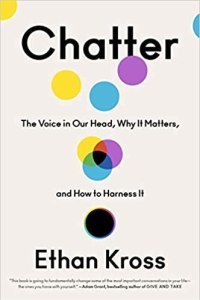
Ethan Kross: “It’s Much Easier to Advise Other People on Their Problems Than It Is to Advise Ourselves.”
Interview: Ethan Kross.
Ethan Kross is an author, scientist, and teacher, and one of the world’s leading experts on controlling the conscious mind. An award-winning professor in the University of Michigan’s top ranked Psychology Department and its Ross School of Business, he studies how the conversations people have with themselves impact their health, performance, decisions and relationships.
His new book is Chatter: The Voice in Our Head, Why it Matters and How to Harness It (Amazon, Bookshop).
Gretchen: What’s a simple activity or habit that consistently makes you happier, healthier, more productive, or more creative?
Ethan: Going for a walk, bike ride or run. I try to get a walk or ride in everyday regardless of the weather. Doing so doesn’t just feel good. It clears my head and helps me generate new ideas.
What’s something you know now about happiness that you didn’t know when you were 18 years old?
That it’s much easier to advise other people on their problems than it is to advise ourselves, but that we can benefit from this by making a conscious effort to coach ourselves through our problems like we're talking to a friend.
You’ve done fascinating research. What has surprised or intrigued you – or your readers – most?
The idea that small linguistic shifts can reroute our internal dialogues in ways that improve our happiness. For example, when you’re anxious about an upcoming date or presentation, try silently coaching yourself through the problem using your own name. Science shows that doing this (we call it distanced self-talk) improves the way people think, feel and perform under stress, allows them to reason wisely, and is linked with less activation in brain networks that support rumination.
Have you ever managed to gain a challenging healthy habit – or to break an unhealthy habit? If so, how did you do it?
About six years ago I bought a pedometer and discovered how much time I was spending sitting at my desk. So, I decided to start walking to work. To break my driving habit, I reminded myself each morning about my goal to increase the number steps I took each day. It worked! My new walking habit quickly took, and I’ve stuck with it to this day.
Does anything tend to interfere with your ability to keep your healthy habits or your happiness? (e.g. travel, parties, email)
I conduct research on how people can manage their inner voice to be happier. But that doesn’t mean that my inner voice doesn’t get the best of me at times and I find myself worrying or ruminating or feeling stuck (what I call chatter). When that happens, I rely on a cocktail of science-based tools. For instance: I use distanced self-talk, organize the physical spaces around me, and turn to trusted friends for support and advice.
Is there a particular motto or saying that you’ve found very helpful? (e.g., I remind myself to “Be Gretchen.”)
It’s so interesting that you use that phrase. Reminding yourself to, “be Gretchen” is an example of distanced self-talk! I do something similar when I’m stumbling. I say, “Come on Ethan. Let’s do this.”
Has a book ever changed your life – if so, which one and why?
Reading Viktor Frankl’s Man’s Search for Meaning (Amazon, Bookshop) in college was transformational. Here was a guy who lost everything in the Holocaust and still managed to thrive. His book introduced me to the idea that we possess the capacity to change the way we think about our circumstances to influence how we feel even under the most dire situations.
In your field, is there a common misconception that you’d like to correct?
Some people think it’s weird to “talk to yourself.” As I explain in my new book, Chatter, we all talk to ourselves at times. Doing so provides us with an incredible tool that can make us happier, healthier and more productive. Of course, our inner voice can also run astray and lead us to ruminate, worry, and catastrophize. Fortunately, science-based tools exist to help us reroute our inner dialogues when we find them running off course.

January 19, 2021
An All-Too-Common Challenge: How Can We Love and Support to Someone Who Is Far Away?
In episode 302 of the Happier podcast, a listener asked for suggestions for ways to show love and support for her mother, who lives across the country and is dealing with radiation and chemotherapy. We turned the question to listeners, and received so many wonderful responses that I wanted to collect them here.
One particular challenge is that because of the pandemic, we're unable to do many of the things that we'd usually be doing, like visiting, dropping off food, traveling from out of town, etc. It's easy to feel helpless and anxious.
Listener ideas for showing love and support to someone far away:have a "book club" where a friend reads a book aloud, and they discuss itorganize a cleaning service, such as Cleaning for a Reason, which provides cleaning for cancer patientssend flowers and cards, and arrange simple mealsmake a playlist of music the person would love, or recommend specific episodes of a podcast (for happy music, check out the Happier 911 playlist on Spotify, with songs suggested by listeners)remember that you can't take away the burden of being sick; also, there's great happiness in giving, so could the sick person help in some way? by helping children with homework, documenting old family photographs, or being a good listener.don't forget the person's caregiver. I mention the terrific podcast Everything Happens with Kate Bowler .contact friends and family to encourage them to send handmade or handwritten cards in the mailread a book to your loved one over the phone or Zoommake a paper chain with links that correspond to the days of chemo or radiation, and ask friends and family to write supportive messages on each chain, so that for each day of treatment, the person can take off a link and read it.use TouchNote (also an app) to send postcards or cards your own photos or their art from your phonesend regular emails updating the person about the little things going on in your life—Elizabeth and I talk about our family tradition of the "update" email in episode 2ask family and friends to send videos that the person can watch in tough times, such as getting chemosend a succulent from Lula's Garden -- the container can be personalized, and they don't need much caresend a Skylight frame so you can email photos directly to the picture frameWhat ideas do you have for showing love and support to people from far away? This is such a pressing issue these days.