Gretchen Rubin's Blog, page 25
July 20, 2021
To Research the Five Senses, I Visited the “Immersive Van Gogh Exhibit.”
One of my favorite things about working on my book about the five senses is that so many enjoyable activities count as "research." Flavor University? Yes! Sound bath? Absolutely. Cheese-tasting class? Sure.
On my most recent assignment, I took myself to Pier 36 here in New York City to go to the Immersive Van Gogh Exhibit.
My rule: if it's billed as "immersive," I try to go.
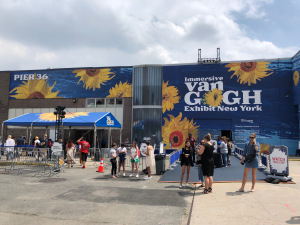

I wasn't exactly sure what to expect.
I walked into three huge interconnected rooms which displayed the same giant moving images of Van Gogh's work, repeated; images were projected onto the floor as well. The ceilings remained dark, but visible and unadorned (which did detract from the immersiveness of the experience).
The rooms were full of people sitting on the floor, on cushions, or walking around. Each room had large silvered shapes which reflected the walls in an interesting way.

For a few minutes, I looked out from the second-story viewing platform—from that vantage point, the images on the floor had a much greater impact.
During the show, I recognized many of Van Gogh's most famous works: Starry Night (probably Van Gogh's most famous painting), Sunflowers, The Bedroom, The Potato Eaters, Irises, and several of his self-portraits (including one which showed his bandaged ear—I think perhaps that image was shown reversed).

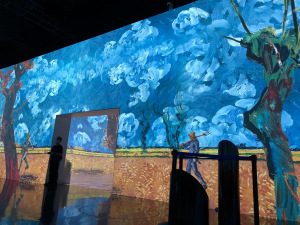


Of course, olive trees, so closely associated with Van Gogh, made an appearance. Also his famous signature.
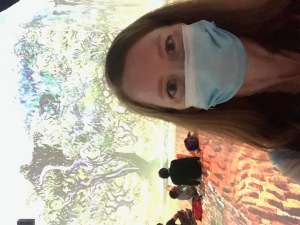

I also saw appearances of my own two favorite paintings by Van Gogh, "Almond Blossoms" and "Flowering Plum Tree."
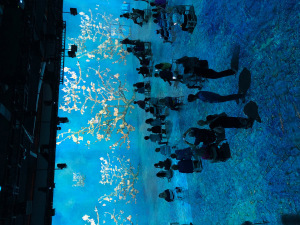
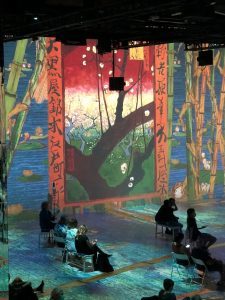
The images were in motion. The flames of his painted candles burned, the wings of insects flickered, clouds and water moved, birds flew, flowers blossomed, paintings burst into view and faded.
The part of the show that I found most beautiful, ironically, was when the images didn't show Van Gogh's paintings, but showed grass, from ground level; it was beautiful.
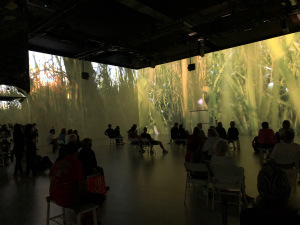
Music played throughout—for instance, Edith Piaf’s “Non, je ne regretted rien,” Modest Mussorgsky’s “Pictures at an Exhibition," Thom Yorke’s “Dawn Chorus,” and several pieces by Luca Longobardi.
I was surprised that the exhibit had no text, no chronology, no narration, and no explanation—not even a perfunctory "Life of Vincent Van Gogh" plaque as we waited to show our tickets. We looked at projections, we listened to music.
Also, because of the way the images were spliced, animated, and repeated, for the most part, viewers didn't get a sense of the composition of a particular painting. We saw sunflowers, but not the painting Sunflowers.
It was a very thought-provoking and unconventional way to engage with an artist's work.
After watching the projections from beginning to end, I exited through the enormous gift shop. Posters, mugs, plates, yoga mats, iron-on patches, books, key chains, candles, water bottles, all decorated with Van Gogh's work.

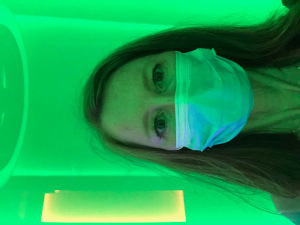
Plus there was a snack shop and some "Chromesthesia Booths" that I couldn't quite figure out.


In writing about making my daily visits to the Met as part of my research into the five senses, I write about the gift shop. I used to wonder: Does a plate printed with Almond Blossoms trivialize that masterpiece? Did a Van Gogh knitted key-chain insult the artist’s dignity?

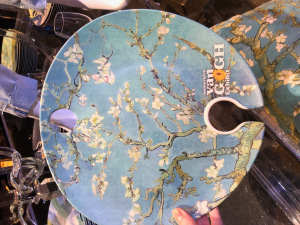
My own view is: no. Material desires have a spiritual aspect, and the gift shop is an expressions of the human desire to touch, to hold, to buy. When we see something we admire, we want to hold it, or take a photo of it, and show it to others.
When I left the exhibit, once outside I had beautiful view of water and bridge—and far in the distance, the Statue of Liberty. I'm always happy to glimpse the Statue of Liberty (if you want to hear a three-minute "A Little Happier" episode where I talk about that, it's here.)


I'm always happy to experience an experiment meant to gladden the senses. I'm glad I went.
Have you been to any interesting immersive experiences? A few years ago, I went to Color Factory—also a lot of fun. I read about the "Madcap Motel" in Los Angeles, and am intrigued to visit the next time I'm in L.A.
Recommendations welcome! Especially for any experience in the New York City area.


July 15, 2021
Deborah Copaken: “Every Book…Ushered in Some Change in Me, Whether Minor or Profound.”
Interview: Deborah Copaken
Deborah Copaken is the New York Times bestselling author of Shutterbabe (Amazon, Bookshop), The Red Book (Amazon, Bookshop), and Between Here and April (Amazon, Bookshop), among others. She’s also been a war photographer, TV producer, screenwriter, and performer.
Her New York Times Modern Love column, "When Cupid is a Prying Journalist," was adapted for the Modern Love streaming series.
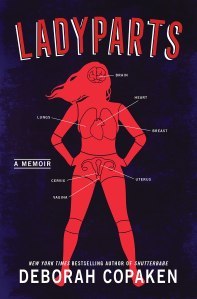
Her new memoir, Ladyparts (Amazon, Bookshop), "a frank, witty, and dazzlingly written memoir of one woman trying to keep it together while her body falls apart," will be published in August. You can pre-order Ladyparts here and watch the book trailer here.
I've known Deb for years—now I don't even remember what mutual friend introduced us—and couldn't wait to talk to her about habits, happiness, and health.
Gretchen: What’s a simple activity or habit that consistently makes you happier, healthier, more productive, or more creative?
Deborah: It really depends on when you ask me that question. In the past, I would have said my morning walk, which still is an important and happy-producing part of my day. Right now? Mid-summer? I moved to Red Hook, Brooklyn, in March—a forced move, when our landlord wanted his apartment back mid-pandemic—and what felt like the end of the world, losing our home, turned out to be the happiest setback of all.
Our new place has a roof, which we tricked out with some Ikea decking and several raised garden beds I built out of wood. I’ve never had outdoor space before, and I was determined to grow a garden for the first time in my life, using Youtube as my teacher. Why? Who knows? I think it was my reaction to the PTSD of COVID, which I caught in March of 2020 and am still dealing with the long-haul remnants. In any case, every morning I wake up, make my coffee, haul a watering can up and down the stairs three times, and as I drink my coffee, I also water and sit with my plants, checking out the new growth that happened overnight, pulling off brown leaves, deadheading my roses, harvesting fruits and vegetables that are ready to be picked. The tiny joys of gardening have been such a blessing, and now the science says so, too: small moments of joy every day create long-lasting feelings of well-being.
What’s something you know now about happiness that you didn’t know when you were 18 years old?
That it cannot be forced. It must be cultivated through actions and deeds, through loving and being loved, through seeking and finding what makes you, individually, happy. Moreover, it is, by design, fleeting: tiny bursts of awe or joy or transformation or whatever you want to call it.
Have you ever managed to gain a challenging healthy habit—or to break an unhealthy habit? If so, how did you do it?
New Year’s Eve, 2009 into 2010, I vowed to start doing yoga every day. Had I ever done yoga before? No. Did I have the money to go to classes in a yoga studio? No. But I had a videotape of Rodney Yee doing an hour long series of yoga poses, and I bought a mat, and I decided it was either a daily at-home yoga or my sanity. But really? There was no choice. My marriage was crumbling, I had a book I was contracted to write, I was still mourning the death of my father, and I’d stopped taking the anti-depressants which kept me un-sad but never made me happy either. I wanted to find joy. Balance. Strength. Flexibility. It was my GP who suggested yoga to fulfill all of these, and at first I said no, I’m not a yoga person, but then he wrote a prescription with the word yoga on it, and I agreed to try. My doctor was right! Yoga provided all of those happiness-inducing things and then some. Unusually, except when I was undergoing my various surgeries, I kept my promise of yoga every day for seven years, until knee surgery really put the kibosh on any kind of movement for an extended period of time. I still do yoga, but now I mix it up with morning walks and the occasional pilates class and a seven-minute Zoom workout I’ve been doing with a bunch of friends since the beginning of the pandemic.
Would you describe yourself as an Upholder, a Questioner, a Rebel, or an Obliger?
Well, I took your quiz, and it says I’m a Rebel, and I can’t say this surprised me, but it did make me realize why I’m poorly suited for corporate jobs.
Does anything tend to interfere with your ability to keep your healthy habits or your happiness?
Yes: my health. I’ve had, well, a ton of bad luck with my health over the past decade, and when you live in the United States, where we don’t value health insurance, women, or health...let’s just say it’s been extremely challenging just to survive some days, let alone thrive.
Have you ever been hit by a lightning bolt, where you made a major change very suddenly, as a consequence of reading a book, a conversation with a friend, a milestone birthday, a health scare, etc.?
Yes. I dropped acid in college and realized that my plan to go to law school was all about pleasing my parents, not about doing what I wanted to do or was called to do. I also stared at my made-up face in the mirror and thought, “Why do you do this to yourself? Put paint on your face every morning?” From that moment on, I vowed to stop wearing make-up and to work in a creative field. I’ve kept those vows for for the past 35 years. (Well, except when I go on TV, and they make me put on make-up, or when I have to get my author photo taken.)
Is there a particular motto or saying that you’ve found very helpful?
When my dad died young, of pancreatic cancer, a friend sent me a letter that Proust wrote to a young man who’d just lost his mother, and a phrase from that letter has stayed with me ever since. “Let yourself be inert.” This sentiment is particularly important in the grieving process, but it can be equally important during other moments of trauma, like those I detail in Ladyparts. So often, we try to put a salve on hurt by keeping ourselves busy. Allowing ourselves to be inert is what allows us to feel hard feelings and move through them, instead of pushing them aside. On the lighter side of things, that same beloved father once told me, “Never turn down an opportunity to go to the bathroom, even if you think you don’t have to.” That, too, has served me well.
Has a book ever changed your life—if so, which one and why?
I think the better question would be: Has any book not changed your life, and the answer would be no. Each book I read changes me, whether a tiny bit or profoundly. Reading Little House on the Prairie (Amazon, Bookshop) made me yearn to be a writer. Reading On the Road (Amazon, Bookshop) made me want to head out on my own adventures. Reading Angela’s Ashes (Amazon, Bookshop) lead directly to writing my first book, Shutterbabe. Reading To the Lighthouse (Amazon, Bookshop) helped me manage that first summer at the shore with the family, without our father. In fact, I could literally point out something about every book that ushered in some change in me, whether minor or profound.
In your field, is there a common misconception that you’d like to correct?
As a frequent patient who’s often been misdiagnosed or disbelieved—a former doctor once stood over my body, after I’d just passed out from pain in his waiting room, and said, “Come on, it’s just gas! It can’t be that bad…” three hours before my appendix burst—what I want to say to women is to please advocate for yourselves. Science shows us that women’s pain is not believed, that we are not studied, that the data they have for us is often wrong, and that we are often told terrible information and advice about our own health. Make it your job, when given a diagnosis or when dealing with a new health wrinkle, to learn everything you can from the scholarly articles available online. Become an expert in your disease. Get a second opinion. If a doctor isn’t listening to you, change your doctor.

July 13, 2021
Battling Procrastination? Use the Four Tendencies to Get Started, Especially When Working from Home
How often do we try and fail to work ourselves up to tackle some undesirable task? Nothing is more exhausting than the task that is never started, so dealing with procrastination frees up our energy and time, and gives us a big boost in mood.
Procrastination is always a challenge, but it's perhaps more difficult, or at least different, now that so many more people are working from home. For many, it's still not clear exactly what their future schedules will look like—all remote? all in person? hybrid?—but across professions, working in an office isn't the same automatic, five-days-a-week assumption that it once was.
And when we're working from home, instead of from an office, challenges change. Things may be better, they may be worse, but they're different.
I have all kinds of tricks and hacks to help myself with procrastination, and I wrote 8 Tips to Stop Procrastinating, but since I wrote that list, I've created my "Four Tendencies" personality framework, which is another tool to use in fighting procrastination.
All these procrastination problems and solutions can be experienced by any of the Tendencies, but some are particularly attractive to Upholders, or Questioners, or Obligers, or Rebels.
In a nutshell, the Four Tendencies personality framework sorts people into four categories, based on how they tend to respond to expectations: outer expectations (a deadline, a request from a friend) and inner expectations (write a novel in your free time, keep a New Year's resolution).
Your response to expectations may sound slightly obscure, but it turns out to be very, very important.
In a nutshell:
Upholders respond readily to outer and inner expectations Questioners question all expectations, and they'll meet an expectation if they think it makes sense; they respond to inner expectations Obligers meet outer expectations, but struggle to meet expectations they impose on themselvesRebels resist all expectations, outer and inner alike(Want to know your Tendency? Take the quick, free quiz here. More than 3.2 million people have taken the quiz.)
The Four Tendencies influence the kind of procrastination people tend to experience, and the strategies that are most helpful in battling it.
Upholders:
A favorite procrastination technique among Upholders—though all Tendencies use it—is working. Working is one of the most dangerous forms of procrastination!
As an Upholder, when I’ve got a big task that I'm reluctant to start, I get a very strong urge to tackle my email inbox or to make a dentist’s appointment.
I’m not slacking off, I reassure myself—I’m not reading in bed or watching TV. I’m working, I’m being productive!
But the fact that I’m busy doesn’t necessarily mean that I’m using my time well. In fact, I’m often wary when I get a sudden urge to do a certain kind of work—like re-organize the books in my office. In my book Outer Order, Inner Calm, I write about "procrasticlearing," when we get the very strong urge to clear clutter—not from the true desire for outer order, or to prepare to focus, but from the desire to delay work on some unpleasant task.
Because when I have an important looming task, that’s what I should tackle. Other work, even if "productive," is just procrastination.
Questioners:
Analysis-paralysis is a big challenge for Questioners. That's when Questioners' desire for perfect information makes it hard for them to make a decision or move forward. They want more, more, more information. It's not true procrastination, perhaps, but it has the same effect of causing delay in the accomplishment of important tasks.
Questioners can remind themselves that most decisions don’t require extensive research. Don’t get it perfect, get it going. Remind yourself that usually, it's more efficient to get started than to delay indefinitely. Use deadlines, limits, and trusted authorities to help arrive at a decision so you can start. (In my book The Four Tendencies, I explain these strategies in greater detail.)
Obligers:
For Obligers, the solution always comes down to the same thing: outer accountability. Get a form of outer accountability. One classic technique: Set a deadline. Things that can be done at any time are often done at no time. Decide by what date a task needs to be completed—then tell other people, so that they’re counting on you to have completed it, and if possible, create other external consequences.
But really, any form of outer accountability is useful.
For instance, Obligers might think of their duty to be a role model for others, or their obligation to their future-self. "Right now, I feel delaying making this appointment, but future-Gretchen will be so happy that this task is accomplished."
Rebels:
Rebels can think about their identity: “I’m creative,” “I'm reliable, and other people can count on me to keep my commitments,” “Nothing stops me from doing my best work.” Or they can challenge themselves: "No one believes I can get this task done by the end of the week, but I'll show them." Or they can think about how they want to be free from control. "The big tech companies are trying to keep me scrolling for hours, so I can't work on my report, but no one hijacks my mind."
Work from Home and ProcrastinationFor each of us, understanding ourselves, and our own particular challenges related to procrastination, is more crucial than ever before, because so many more people will be working from home post-pandemic.
Working from home, working from the office...there are pros and cons for both, and different people experience the situations differently.
It's important to notice ourselves. Are we procrastinating more, now that we don't have a co-worker on either side of us? Now that we're not running into our boss by the coffee machine? Or are we procrastinating less, because the lack of commuting hassle gives us more emotional wherewithal to tackle demanding tasks?
Obligers, if you're having trouble completing tasks because no one's around, consider giving yourself new forms of accountability.Questioners, if you find yourself spinning off into research into the best brand of standing desk, give yourself limits on research time.Rebels, if you're finding it more tempting to goof off, remind yourself of your work goals—what do you want? Good numbers, respect from your colleagues, the appreciation of your manager, proof to yourself of what you're capable of?Upholders, if you find yourself spending too much time working on jobs that don't really matter, remind yourself of what your true priorities are.For more discussion of procrastination:
Do You Struggle with Procrastination Now that You’re Working From Home? How to Get Things Done During COVID-19.Are You a Marathoner, a Sprinter, a Procrastinator? Weigh In.8 Tips to Stop Procrastinating.A Little Happier: Working Is One of the Most Dangerous Forms of Procrastination.Beware of Fake-Work and Make-Work.How do you fight procrastination? Have you found ways to tap into your Tendency to help overcome it?

July 6, 2021
Are You Experiencing the Happiness Challenge of “Drifting?” People Are More Aware of It Than Ever.
I've written before about the happiness challenge of "drift."
Drift is the decision you make by not deciding, or by making a decision that unleashes consequences for which you don’t take responsibility. Maybe you're not sure what to do, so you make the default decision. Maybe a particular decision would make someone else very happy—or keep them from being angry—so you do it. (“Drift” isn’t an actual psychological term, like situation evocation or emotional contagion; it’s a term I invented).
I fear drift. Drift feels small, but once unleashed, drift is a powerful, often almost unstoppable, force.
Drift can show up in our work lives.
You go to medical school because both your parents are doctors. You take a job because someone offers you that job. You go to graduate school as a kind of holding pattern.
I drifted into law school. I didn’t know what else I wanted to do, it seemed like a legitimate, useful way to get more education, it would keep my options open…I didn’t really think much about the decision. As it turns out, I’m very glad I went to law school—drift sometimes does lead to a happy result, which contributes to its dangerous appeal—but I didn’t approach law school mindfully. And many, many people who go to law school aren't happy they went.
Just taking one drifting step can you set you in a course that’s very hard to stop. In my case, I drifted into taking the LSAT (the law-school application test). “Why not, might as well, could come in handy, maybe I’ll be glad I did,” etc.
Drift can also show up in our personal lives.
You get married because all your friends are getting married. You move to the suburbs because everyone your age is moving to the suburbs.
An engaged friend made it very obvious that she didn't want to get married. I asked her, “Imagine that something happened, and you couldn’t get married next month. Your fiancé absolutely had to move to China for a year, alone, immediately. How would you feel?” “Relieved,” she said. And yet she went through with the wedding, and got divorced a year later.
Drift is different from mindfully deciding not to decide.
Some situations look like drift but aren’t. You may be following a pathless path—and that's fine, if that's what you intend to do. Or you may need to choose between multiple courses, with their pros and cons, and you're still deciding. This isn’t drift, because you’re actively weighing your options. However, if this goes on too long—and it’s hard to know what’s too long—it can become drift.
The word "drift" makes drift sound like the easy path, but it's not.
The word “drift” has overtones of laziness or ease. Not true! Drift is often disguised by a huge amount of effort and perseverance.
For me, following the path of law was hard—from studying for the LSAT, to getting through law school, to clerking for Justice Sandra Day O'Connor.
The pandemic period has revealed to many people that they're drifting.
Over and over, people have told me that the pandemic period has made them seriously re-evaluate their lives.
When life is racing forward, and we're managing the calendar and the to-do list, it's hard to step back to consider the big picture. For many people, the disruptions of the last year—though they've brought so much suffering and hardship to the world--have also brought an opportunity for self-reflection. Sometimes difficult self-reflection.
Many people are asking themselves, "Is this what I want to be doing?" "Is this how I want to spend my life?" "Why am I spending so much time on this, but not nearly enough time on that?" "How did I get here?" These questions often arise when a person has been drifting.
How do you figure out if you're drifting? To find out, click here and download the short, free quiz I put together. The more checks you make, the greater your risk for being adrift.
Hoping that a situation will be shaken up from the outside is a sign of drift—and guess what? We just experienced that kind of catastrophe.
So the question becomes: Now what?
To end drift, we must recognize that we're drifting. It can be painful to contemplate, but valuable. If this pandemic period has prompted you to reflect on your life, your values, and your interests, take advantage of the moment to think about what steps would help you to create the life you want.

July 1, 2021
Review your “21 for 2021” List Now That We’ve Reached the Midpoint of 2021.
For the last several years, on the Happier with Gretchen Rubin podcast, we've talked about why we make an annual list, tied to the year, of all the things we'd like to get done during that year.
In episode 149, we talked about our "18 for 2018" lists; in episode 203, "19 for 2019" lists; in episode 255, “20 for 2020” lists. Most recently, in episode 307, we revealed our "21 for 2021" lists.
Research shows that making a concrete, specific list, and referring back to it, really does help people achieve their aims. And for many people, this approach seems more fun than make traditional new year's resolutions.
Now that 2021 is about half-way finished, it's time to review our "21 for '21" lists.Gretchen's "21 for '21":
Make a list of friends and colleagues I want to connect with by phone or Zoom - STARTED BUT NEED TO UPDATEMake two plans a week to connect with the people on that list - SORT OFFigure out the light-bulb question - SO CONFUSING THAT I STARTED THEN STALLED
Have a scent party
Have a taste partyTry cryotherapy - WAITING FOR THE WEATHER TO GET HOT
Make an Album of Now - UNDERWAY
Get my Real I.D. (Good news: the Department of Homeland Security extended the deadline to May 3, 2023)Practice my driving (as I wrote about in Happier at Home , I'm a fearful driver) - UNDERWAYRead a Summer of Virginia Woolf - UNDERWAYMake an appointment to help me make better outfits from my own clothesDo 30 minutes of "review" each work dayAdd photos to my address book - UNDERWAYWatch Mad Men - DONE (listen to our bonus episode recap of the series)Look at old photo albums and home videos with my familyReview my giant “happiness” catch-all documentPlay around with well-being appsGet our big red chair recovered - DONEDeal with my sent/trash folders - DONEShine a spotlight on work I admire; amplify the work of others - UNDERWAYAdd one new item!
Elizabeth's "21 for '21":
Get the vaccine - DONEGet a Real I.D.Celebrate her friend Mike’s 50th birthday with friends - UNDERWAYGet FraxelSell two TV pitches - SOLD ONE
Eat lots of vegetables, and to help with that, avoid using Postmates at night during the week - SORT OF
Do another “sober month” - DONE
Get through her giant book pile for #Read21in21 (if you want a don't-break-the-chain sheet for #Read21in21, it's here) - UNDERWAYGet a will
Educate herself about investing in propertyDo a Happier in Hollywood meet-up (post-vaccine)Walk to Malibu - UNDERWAYContinue #Walk20in20 (if you want a don't-break-the-chain sheet for #Walk20in21, it's here)Weigh herself daily - STOPPED IN PUERTO RICOUse her Waterpic at least three times a week - DITTO
Create a fiction podcastTrust her gut, especially at work - COULD BE BETTER
Go to DisneylandVisit Miraval for a friend’s birthdayTake Jack boogie-boarding at least 5 timesIn making hiring decisions for Fantasy Island , put her actions behind her intent to provide opportunities for all - DONE
Bottom line: both Elizabeth and I have many items that remain to be checked off!
I find it very useful to review the list. I keep it posted on the bulletin board next to my desk, but it's easy to let my gaze slide over it, without getting reminded of what I want to accomplish.
When I remember all the things I want to get done, I feel inspired to add new tasks into my daily routine. After all, all the items on my list are things that will make me happier.
Anything is useful that prompts us to reflect on our lives, and what we want, and what changes we might undertake to make ourselves happier, healthier, more productive, or more creative. That prompt could be a date (like January 1 or a birthday), an event (like a medical diagnosis or a job change), or a new idea (like an idea from a book or someone's comment).
Along the same lines, I choose a one-word theme each year. It's another way to push myself to reflect and act. And like the "21 for 21 list," it somehow feels more creative and fun than the traditional New Year's resolution (which I also enjoy).
Did you make a "21 for '21" list? Have you made much progress? We still have a lot of time left, before the year comes to an end.
If you'd like a sheet on which to record your "21 for '21" list, you can download a free PDF here.

June 29, 2021
What I Read This Month: June 2021
For four years now, every Monday morning, I've posted a photo on my Facebook Page of the books I finished during the week, with the tag #GretchenRubinReads.
I get a big kick out of this weekly habit—it’s a way to shine a spotlight on all the terrific books that I’ve read.
As I write about in my book Better Than Before, for most of my life, my habit was to finish any book that I started. Finally, I realized that this approach meant that I spent time reading books that bored me, and I had less time for books that I truly enjoy. These days, I put down a book if I don’t feel like finishing it, so I have more time to do my favorite kinds of reading.
This habit means that if you see a book included in the #GretchenRubinReads photo, you know that I liked it well enough to read to the last page.
When I read books related to an area I’m researching for a writing project, I carefully read and take notes on the parts that interest me, and skim the parts that don’t. So I may list a book that I’ve partly read and partly skimmed. For me, that still “counts.”
If you’d like more ideas for habits to help you get more reading done, read this post or download my "Reading Better Than Before" worksheet.
You can also follow me on Goodreads where I track books I’ve read.
If you want to see what I read last month, the full list is here.
And join us for this year's new challenge: Read for 21 minutes every day in 2021!
A surprising number of people, I've found, want to read more. But for various reasons, they struggle to get that reading done. #Read21in21 is meant to help form and strengthen the habit of reading.
June 2021 Reading:Everything Sad Is Untrue: (A True Story) by Daniel Nayeri (Amazon, Bookshop) -- 2021 Michael L. Printz Award for Excellence in Young Adult Literature. A powerful, compelling autobiographical novel.
Jacob's Room by Virginia Woolf (Amazon, Bookshop) -- This novel is the first one for my Summer of Virginia Woolf. A haunting, experimental way to create a portrait.
Stardust by Neil Gaiman (Amazon, Bookshop) -- A modern fairy tale. How had I never read this before?
I Know Why the Caged Bird Sings by Maya Angelou (Amazon, Bookshop) -- A classic which I hadn't read in many years. Several months ago, I read some of Angelou's memoirs, so I was interested to see how the novel reflects her own experiences.
The Great Godden by Meg Rosoff (Amazon, Bookshop) -- Terrific new young-adult novel. Summer adventures, secrets revealed (and not revealed), visitors disrupting the usual family dynamic.
The Big Sleep by Raymond Chandler (Amazon, Bookshop) -- How had I never read this classic? Suddenly so many parodies and rip-offs became clear to me.
Unpacking the Boxes by Donald Hall (Amazon, Bookshop) -- I've read several of Hall's memoirs—most recently, String Too Short to Be Saved (Amazon, Bookshop)—and very much enjoyed this one, too.
The Sisters Antipodes: A Memoir by Jame Alison (Amazon, Bookshop) -- A fascinating memoir about two families that split and recombine.
The Longest Way Home: One Man's Quest for the Courage to Settle Down by Andrew McCarthy (Amazon, Bookshop) -- I recently read Brat (Amazon, Bookshop) , and that made me curious to read this memoir.
No Cure for Being Human by Kate Bowler (Amazon, Bookshop) -- A beautiful, candid, insightful memoir (not available until September). I love the work of Kate Bowler—both her book Everything Happens for a Reason: And Other Lies I've Loved (Amazon, Bookshop) and her podcast Everything Happens.
The Joy Luck Club: A Novel by Amy Tan (Amazon, Bookshop) -- I've been reading a lot of Amy Tan's non-fiction lately, so of course I wanted to re-read her first and fabulously successful novel.

June 24, 2021
A Silver Lining to the Safer-at-Home Period: My Daughters Strengthened Their Sisterly Relationship.
This pandemic period has been a time of tremendous suffering, hardship, loss, and grief.
At the same time, this period has taught us important lessons. Last spring, at a (Zoom, of course) meeting for my daughter's school, an administrator said, "We've tried to identify anything that might be working better. What can we learn from this experience that will help us improve school in the future?"
I know that I've been looking for these kinds of lessons, and I've heard from many other people who have also been searching for possible silver linings.
For instance, while many people's habits have grown worse over this period, some people's habits have grown better—and they're planning ways to maintain those good habits when former routines resume.
In my own life, as I think about silver linings, one thing stands out: my daughters' relationship.
My daughters are six years apart in age. Because I'm five years older than my sister Elizabeth, that age gap doesn't seem unusual to me.
 Eleanor and Eliza.
They've both always been nice sisters. Eliza has always been kind to her little sister and let her hang around with the big kids, within reason. Eleanor was an adoring little sister who wasn't a pest. They share similar interests.
But when you're a child, six years makes a big difference. They grew closer once they were both on the same side of puberty.
Now, however, they're extremely close. They talk and text frequently, they spend time together, they goof around and also talk seriously to each other.
I'm very close to my sister—my relationship with her is one of the very most crucial in my life—so their closeness makes me very happy.
And I'm convinced that the pandemic helped forge this tight bond. As close as they were, Eliza had been off in college, and when she was home, they were both busy with their own activities.
But—Eliza came back home, and we all had an intense period of togetherness, for months.
I asked Eliza and Eleanor separately, "Do you think that the safer-at-home period helped you become closer as sisters?" and they both agreed that it did.

It makes me happy to think that, out of the hardship of this time, something good was created. A closer relationship is something that can sweeten their entire lives.
My own relationship to my sister Elizabeth also grew stronger. I haven't seen her since the winter holidays of 2019—which is by far the longest time we've gone without seeing each other—but I talk to her more frequently.
Have you found that you, or people you know, have become closer to family members as a result of this pandemic period?

June 17, 2021
I Embrace Anything That Helps Me to Experience the World More Deeply.
I'm writing a book about the five senses, and I was drawn to this subject, in large part, because I'm so unaware of what's going on around me. I very easily get lost in my own thoughts, and I don't notice the sights, sounds, smells, tastes, and textures of the world.
As Andy Warhol observed, “Nobody really looks at anything; it’s too hard.”
In the book, I'm writing about exercises I've tried to help myself wake up. For instance, I now visit the Metropolitan Museum every day and I attended Flavor University.
I embrace anything that helps me to pay attention. Sometimes, I've found, a person's offhand comment will help me to experience the world more vividly.
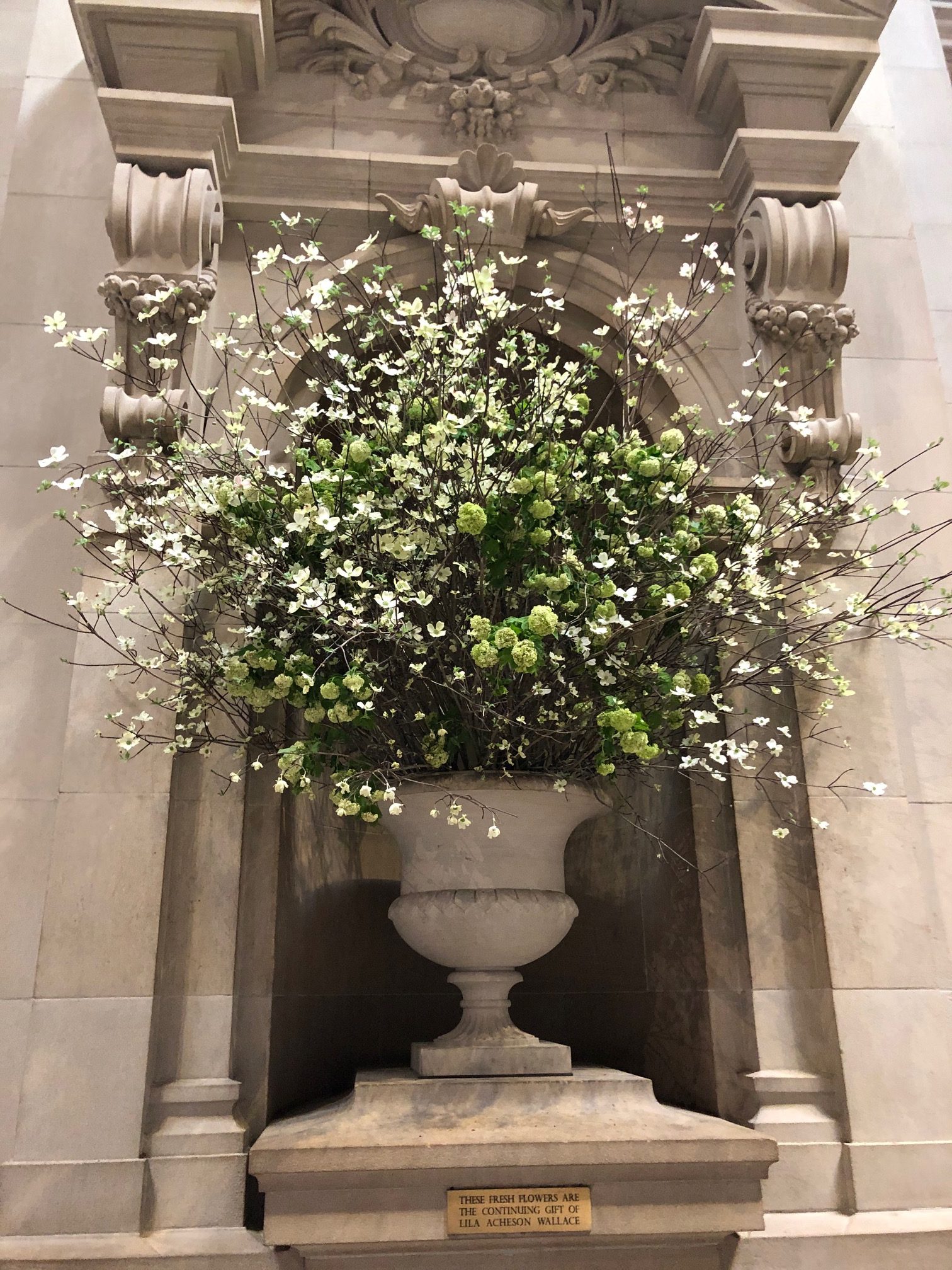
In the Great Hall of the Met, in five giant urns, towering twelve-foot-high flower arrangements change every Tuesday. These beautiful flowers add a lot of color and life to the museum.
I often text a photo of the arrangements to my mother. In response to one photo, my mother replied, "I love flowering branches."
When I read that, I thought, "I love flowering branches!" Of course, I knew I loved flowering branches...in the spring, I made a special point of visiting Central Park to look at the crab-apple trees, the cherry trees, the magnolia trees. But somehow I'd never really quite noticed that I loved them—I'd never identified and articulated that love.
Knowing "I love flowering branches" makes me experience the world in a different way.
Years ago, my daughter Eliza and I went to Bloomingdale's together. As we walked through the doors, she inhaled deeply and said, "I love that department-store smell." And I realized, "I love that department-store smell!" I loved it, but I'd never noticed it.
Now I try to pinpoint any aspect of my experience that I particularly enjoy.
I love miniatures. I love twinkle lights. I love saffron. I love walls of books. I love gardenias. These days, I push myself to explicitly notice these loves, rather than take them for granted.
I like any exercise that helps me to notice. Every year the color company Pantone identifies its "Color of the Year"—or, as they did in 2021, two colors of the year (Ultimate Gray and Illuminating [yellow]).
Some people dismiss this yearly announcement as a stunt that doesn't mean much, but I like being reminded to appreciate the power of color. Just as Valentine's Day reminds me to appreciate my sweetheart, and Labor Day prompts me to reflect on my work life, Pantone's announcement of the Color of the Year reminds me to contemplate my love of color.
Has anyone or anything helped you notice something—that you love? Am I the only one who finds this challenging?

June 11, 2021
Tell Me: What Are Famous Fictional Examples of My “Four Tendencies” Framework?
I'm collecting examples of my Four Tendencies framework, in fiction. Please send me your examples from books, movies, and TV shows!
If you want to know your own Tendency, to find out whether you're an Upholder, Questioner, Obliger, or Rebel, you can take the quick, free quiz here. (More than 3.2 million people have taken it.) Or read my book The Four Tendencies.
If you want a quick overview of this personality framework, read here.
Here are some examples that I've identified in my own reading and watching:Game of Thrones (for more discussion, read my post here)
Upholder: Brienne, Tywin, StannisQuestioner: TyrionObliger: Daenerys, Jon, JaimeRebel: Cersei, AryaBrooklyn 99
Upholder: Captain Raymond Holt, Sargent Amy SantiagoParks and Recreation
Upholder: Leslie, ChrisQuestioner: RonObliger: Andy, JerryRebel: AprilHarry Potter
Upholder: HermioneQuestioner: Fred, GeorgeObliger: HarryRebel: SiriusMad Men
Upholder: JoanQuestioner: ?Obliger: BettyRebel: DonThe Office
Upholder: DwightQuestioner: ?Obliger: Pam, RyanRebel: CreedSome other notable examples from books:
Upholder: William Laurence in His Majesty's Dragon by Naomi Novik (Amazon, Bookshop)Questioner: Temeraire in His Majesty's Dragon (Amazon, Bookshop); Jane Eyre in Jane Eyre by Charlotte Bronte (Amazon, Bookshop)Obliger: Stevens in The Remains of the Day by Kazuo Isiguro (Amazon, Bookshop); Katniss Everdeen in The Hunger Games (Amazon, Bookshop)Rebel: surely there are dozens of obvious examples, but what are they?Please send me all the Tendencies you've spotted! I have a long read-and-watch list of suggestions that people have made. For instance, I just checked out the library book Light a Penny Candle by Maeve Binchy (Amazon, Bookshop), because someone told me it contains a spectacular Obliger-rebellion.
And I haven't spent enough time watching The Simpsons! How about the Simpsons characters? Is Bart a Rebel? Is Lisa an Upholder?
If you can think of real-life examples, of actual people, send those along as well. For instance, Picasso was a Rebel.
Do you think that we particularly enjoy seeing depictions of our own Tendency? As an Upholder, I do think that I get special pleasure from seeing my Tendency in action.

June 10, 2021
Matthew Barzun: “An Idea Is an Unlit Lightbulb. You Need Two Things: a Source of Power and a Connection.”
Interview: Matthew Barzun.
Matthew Barzun served as the United States Ambassador to the United Kingdom and to Sweden, and in business, he helped build CNET Networks. Now he has a new book out: The Power of Giving Away Power: How the Best Leaders Learn to Let Go (Amazon, Bookshop).
I couldn't wait to talk to Matthew about happiness, habits, and productivity.
Gretchen: What’s a simple activity or habit that consistently makes you happier, healthier, more productive, or more creative?
Matthew: We live next to the biggest cemetery in Louisville, and every morning I take a half-hour walk along its winding roads. Muhammad Ali is buried there as is my wonderful deceased father-in-law and the twin sisters who wrote “Happy Birthday.” When the leaf blowers are farther in the distance and the Canada geese are not feeling particularly aggressive, it’s a contemplative and calming ritual.
What’s something you know now about happiness that you didn’t know when you were 18 years old?
I’ve learned that happiness is a lot like friendship. It’s best to let it emerge from other activities and efforts and not pursue it too directly. If you meet someone for the first time and say, “I really want you to be my good friend,” they might very well block your number. Happiness comes as a by-product and is never an achievement like climbing a mountain.
You’ve done fascinating research. What has surprised or intrigued you – or your readers – most?
Well, it’s not scientific, but when I was ambassador to the UK I spoke to more than 20,000 British students in schools all over. I would ask them what their biggest frustration or confusion about the U.S. was. There were plenty of hot international issues they could have brought up—climate, Middle East, surveillance and privacy, etc. But the most common answer by a great deal about what frustrated them was none of those things. It was guns. Second was police brutality. The lesson is that our domestic policy is also our foreign policy.
Have you ever managed to gain a challenging healthy habit – or to break an unhealthy habit? If so, how did you do it?
I quit debating. I stopped trying to win arguments. I mean, who likes to lose them? No one. So what are we trying to win, exactly? Instead I learned (through mentors like Senator-and-then-President Obama) to listen first. I learned to ask about hopes and fears and to link them to my own. I even thought up an acronym to try to do it more: a.l.s.o. stands for ask, listen, serve and open up. So often in the work world we are taught to do the opposite, what I think of as the capital ALSO: Argue, Lecture, Strategize, and Organize.
Would you describe yourself as an Upholder, a Questioner, a Rebel, or an Obliger?
I took the test twice and got same answer both times: Rebel. I didn’t agree. I am rebelling against the label rebel…so I guess it must be on to something. If it must be so, then what I am rebelling against is what I call the “Pyramid mindset” – the perspective that it always looking to assess who or what is higher or lower, who is winning or losing, or who is in or out of what group. I want us all to rebel against that.
Does anything tend to interfere with your ability to keep your healthy habits or your happiness? (e.g. travel, parties, email)
Someone once told me to imagine the following: You are commuting on a crowded subway or bus or you’re on a flight and there is someone next to you manically sorting and sifting through a huge pile of postal mail—opening up bills, junk mail, catalogs, letters, postcards. You would try to sit a bit further away from that anxious, self-absorbed energy. Well, too often that is me. That is so many of us. So, the long-winded answer to what interferes with happiness: email.
Have you ever been hit by a lightning bolt, where you made a major change very suddenly, as a consequence of reading a book, a conversation with a friend, a milestone birthday, a health scare, etc.?
I’ll save readers the longer story, but I had been asked for the first time in my like to raise money for a presidential campaign. I was awful. I’d been taught never to discuss religion, politics or money and fundraising in Kentucky was, at a minimum, two out of three. Then I was seated next to a remarkable woman named Lynne Twist at a dinner and I shared my woes with her. She listened and nodded and then gave me three pieces of advice: 1) Money is like water; when it flows it heals and when it’s stagnant it kills; 2) Only ask people who want to use money for a cause greater than themselves; 3) Ask everyone. This changed my whole perspective. Asking is about working with people and not getting something from them.
Is there a particular motto or saying that you’ve found very helpful?
“Metaphors are misleading, but they are the least misleading things we have,” from the writer Samuel Butler. I love thinking and writing with them because I think they lurk behind so much of how we see the world. Many of us have inherited from our religions or our various ancestries a view of the world that is ordered by rank and segmented into discrete parts. But that all springs from a metaphor what I call the pyramid—one that not everyone shares, believe it or not. In fact, the idea of America (if not the reality) was meant to buck that metaphor for a more naturalistic one. They used the metaphor of a Constellation, which signified interdependence. You are star, but not a star that other planets revolve around like the sun (we all know those types). You are a star among other stars and you can make new connections to make something bigger than you ever could alone.
Has a book ever changed your life – if so, which one and why?
“Our political life is stagnating, capital and labor are virtually at war, the nations of Europe are at one another’s throats—because we have not yet learned how to live together…Crowd philosophy, crowd government, crowd patriotism must go. The herd is no longer sufficient to enfold us.” Sounds pretty familiar today but it was written nearly 100 years ago after our last global pandemic. The author is Mary Parker Follett and the book is Creative Experience. Follett came to me almost like a talisman in a mythical story as I was in the middle of writing my book. Many of the ideas I had been wrestling with had been articulated beautifully a century before by this genius who was one of the biggest names on the lecture circuit in the 1920s before her legacy was totally erased by men with competing ideas.
In your field, is there a common misconception that you’d like to correct?
If I asked you to draw or doodle an image that conveyed “new idea,” what would you draw? Was it a lightbulb? Google the word “idea” in google images and you will see thousands of lightbulbs and they are nearly all identical - they are all alone, floating mysteriously in space, disconnected to anything and yet illuminated with little yellow lines radiating to indicate this. That is a visual cliché we all have in our minds. And it is deeply misleading about the true power of ideas and the nature of innovation. It makes it seem as if you wait there alone for the magic to strike and then—voila—you get an idea and the light comes on. That’s not true. An idea is at best an unlit lightbulb. You need to add two things—the same two things that it takes to light up a real lightbulb. First a source of power and second a connection.