
Gretchen Rubin's Blog, page 14
September 20, 2022
How Well Do You Know the People Around You? Can You Identify Their Tendency?
Most of us love to take a good self-knowledge quiz—even something as silly as "Which 'Friends' character are you?" (I'm "Phoebe," by the way.)
I'm sure that this love of quizzes is one reason that so many people have taken my "Four Tendencies" quiz. This quiz tell you whether you're an Upholder, Questioner, Obliger, or Rebel. More than 3.5 million people have taken this quiz.
My Four Tendencies quiz, however, is quite serious. It took me more than a year to craft the language to distinguish accurately among the four types of personalities.
It's very useful to know your Tendency, because that knowledge lets you make habits more effectively, experience less frustration with yourself and other people, and work and live more harmoniously at work and in life.
Of course, you can take the quiz yourself, and if you're curious about other people's Tendencies you can suggest that they take it.
But I've noticed that, even without the quiz, people can usually predict the Tendencies of important people in their lives. For instance, writer Zibby Owens told me that she thought that each of her four children was a different Tendency. Later, she asked them to take the quiz, and sure enough, she was right.
When I talk about the Four Tendencies at conferences, I notice that as I describe each Tendency, people will often start laughing and pointing to someone in the audience; they recognize a co-worker's Tendency immediately.
So if you know the Four Tendencies, test your knowledge! Choose some family members, friends, or co-workers, and try to identify their Tendency. Then ask them to take the quiz, and see how well you scored.
The quiz is free and quick to take.
If you can't persuade someone to take the quiz, you can consult my "Flash Evaluation." (Click here and you'll find it under "The Four Tendencies.")
You can also try to identify the Tendencies of the Game of Thrones characters.
Let me know how you do! I'd be very curious to hear. I'm guessing that certain Tendencies—Rebels and Upholders—are particularly easy to spot.
[image error]
Now you may be asking—and if you're a Questioner, you're certainly asking—"Why should I bother to try to figure out someone else's Tendency?"
Because knowing someone's Tendency makes it much easier to communicate effectively.
Talking to a Questioner? Be sure to explain why you're asking—why should this person do this task, in this way, by this date?To a Rebel? Include language such as, "If it works for you," "If this sounds like fun," "If this is something that interests you," "If you feel like it, please feel free to join us..."To an Obliger? Show that you're paying attention to whether that thing gets done, and that it matters to you.To an Upholder? Be clear about what you're asking for, and by when.The Four Tendencies can also reduce conflict. I've talked to so many couples, parents, doctors and nurses, teachers, and coaches who have used the framework. When we ask or tell someone to do something, if we frame it in the way that makes sense to them, they're far more likely to cooperate.
It's remarkable to me how a simple change in language can make it so much easier for people to live and work together in harmony.
If you'd like to learn more about the Four Tendencies, how to apply them in different situations, and watch fascinating interviews with each Tendency, click here.


How Well Do You Know the People Around You? Can You Identify Their Tendency?
Most of us love to take a good self-knowledge quiz—even something as silly as “Which ‘Friends’ character are you?” (I’m “Phoebe,” by the way.)
I’m sure that this love of quizzes is one reason that so many people have taken my “Four Tendencies” quiz. This quiz tell you whether you’re an Upholder, Questioner, Obliger, or Rebel. More than 3.5 million people have taken this quiz.
My Four Tendencies quiz, however, is quite serious. It took me more than a year to craft the language to distinguish accurately among the four types of personalities.
It’s very useful to know your Tendency, because that knowledge lets you make habits more effectively, experience less frustration with yourself and other people, and work and live more harmoniously at work and in life.
Of course, you can take the quiz yourself, and if you’re curious about other people’s Tendencies you can suggest that they take it.
But I’ve noticed that, even without the quiz, people can usually predict the Tendencies of important people in their lives. For instance, writer Zibby Owens told me that she thought that each of her four children was a different Tendency. Later, she asked them to take the quiz, and sure enough, she was right.
When I talk about the Four Tendencies at conferences, I notice that as I describe each Tendency, people will often start laughing and pointing to someone in the audience; they recognize a co-worker’s Tendency immediately.
So if you know the Four Tendencies, test your knowledge! Choose some family members, friends, or co-workers, and try to identify their Tendency. Then ask them to take the quiz, and see how well you scored.
The quiz is free and quick to take.
If you can’t persuade someone to take the quiz, you can consult my “Flash Evaluation.” (Click here and you’ll find it under “The Four Tendencies.”)
You can also try to identify the Tendencies of the Game of Thrones characters.
Let me know how you do! I’d be very curious to hear. I’m guessing that certain Tendencies—Rebels and Upholders—are particularly easy to spot.
[image error]
Now you may be asking—and if you’re a Questioner, you’re certainly asking—”Why should I bother to try to figure out someone else’s Tendency?”
Because knowing someone’s Tendency makes it much easier to communicate effectively.
Talking to a Questioner? Be sure to explain why you’re asking—why should this person do this task, in this way, by this date?To a Rebel? Include language such as, “If it works for you,” “If this sounds like fun,” “If this is something that interests you,” “If you feel like it, please feel free to join us…”To an Obliger? Show that you’re paying attention to whether that thing gets done, and that it matters to you.To an Upholder? Be clear about what you’re asking for, and by when.The Four Tendencies can also reduce conflict. I’ve talked to so many couples, parents, doctors and nurses, teachers, and coaches who have used the framework. When we ask or tell someone to do something, if we frame it in the way that makes sense to them, they’re far more likely to cooperate.
It’s remarkable to me how a simple change in language can make it so much easier for people to live and work together in harmony.
If you’d like to learn more about the Four Tendencies, how to apply them in different situations, and watch fascinating interviews with each Tendency, click here.
The post How Well Do You Know the People Around You? Can You Identify Their Tendency? appeared first on Gretchen Rubin.
September 15, 2022
Author Interview: Catie Marron
Catie Marron’s career has encompassed investment banking at Morgan Stanley, magazine journalism as Senior Features Editor for Vogue, and serving as Chairman of the Board of Trustees for the New York Public Library. She’s the creator and editor of two anthologies which explore the value and significance of urban public spaces: City Squares: Eighteen Writers on the Spirit and Significance of Squares Around the World (Amazon, Bookshop), and City Parks: Public Places, Private Thoughts (Amazon).
Catie has been a friend of mine for years, and I’m a big fan of her other work, so I couldn’t wait to get my copy of her latest book. Becoming a Gardener: What Reading and Digging Taught Me About Living (Amazon, Bookshop) chronicles her experiences creating her first garden, and how gardening can enrich our lives.
Oddly, though I don’t have any urge to garden myself, I love reading books about it. Plus, this book is gorgeous, with beautiful photos of her garden and art related to gardens.
I couldn’t wait to talk to Catie about happiness, habits, and the joys of gardening.
Gretchen: What’s a simple activity or habit that consistently makes you happier, healthier, more productive, or more creative?
Catie: Gardening! It certainly makes me happier, and it’s not just me. It’s stunning to think of the volumes of books and articles over the last couple of years, and for centuries before, stating the value of gardening to our well-being, our health (both physical and mental) and our pleasure. An ancient Chinese proverb says: “If you want to be happy for a lifetime, be a gardener!”
What’s something you know now about happiness that you didn’t know when you were 18 years old?
At 18, I didn’t realize that the state of happiness comes and goes, and is certainly something to savor when you have it. Yet, while it isn’t a constant in life, and some people have so much hardship that it’s hard to imagine how they have any sense of happiness, many still do. I think this is due to appreciation of the simple ways you can find happiness, and that in fact, you do have some control over this.
You’ve done fascinating research. What has surprised or intrigued you – or your readers – most?
What surprised me most is how deeply gardens have been valued for thousands of years. For instance, I was surprised to learn that in 2,000 BC Cicero said that “If you have a garden and a library, you have all you need.” The word “paradise” derives from an ancient Persian word meaning an enclosed garden. Much more recently, E. O. Wilson created the term biophilia, which identifies humans’ innate desire and affection for nature. We have an essential need to be in contact with the natural world. In gardens, we can be in direct, deep contact with nature.
Have you ever managed to gain a challenging healthy habit – or to break an unhealthy habit? If so, how did you do it?
A challenging, healthy habit that I’ve developed and adhere to most of the time is a Scottish shower, which is defined as finishing a warm shower with a brisk cold water rinse. Summer or winter, I always love a hot shower, but the cold ending, which sometimes lasts seconds, sometimes minutes, is definitely easier in the summer and always wakes my whole body up.
Would you describe yourself as an Upholder, a Questioner, a Rebel, or an Obliger?
Hands down, an obliger. When I started the questionnaire, I hoped I might be a mix, but it quickly became clear that I am an obliger through and through.
Does anything tend to interfere with your ability to keep your healthy habits or your happiness?
Daily day-to-day stuff — all those odds and ends that go into running my family’s and my life — take over too often. I haven’t yet figured out how to pare them down. When writing my book, I would get to my desk early, say to myself, I’ll just get this, this, and that done and then start on my book, but so often those odds and ends would last the day.
Is there a particular motto or saying that you’ve found very helpful? Or a quotation that has struck you as particularly insightful?
A quote I read a few years ago, by Iris Murdoch, has stuck with me: “One of the secrets of a happy life is continuous small treats.”
In your field, is there a common misconception that you’d like to correct?
For decades I’ve had the misconception that I needed a green thumb to successfully garden. I’ve learned that many people feel this so it’s a misconception I’d really like to dispel. It stopped me from enjoying this wonderful pursuit for years, and I hope it won’t slow down others. Many writers address this green thumb debate head-on and have convinced me that it doesn’t matter.
The post Author Interview: Catie Marron appeared first on Gretchen Rubin.
Author Interview: Catie Marron
Interview: Catie Marron
Catie Marron's career has encompassed investment banking at Morgan Stanley, magazine journalism as Senior Features Editor for Vogue, and serving as Chairman of the Board of Trustees for the New York Public Library. She's the creator and editor of two anthologies which explore the value and significance of urban public spaces: City Squares: Eighteen Writers on the Spirit and Significance of Squares Around the World (Amazon, Bookshop), and City Parks: Public Places, Private Thoughts (Amazon).
Catie has been a friend of mine for years, and I'm a big fan of her other work, so I couldn't wait to get my copy of her latest book. Becoming a Gardener: What Reading and Digging Taught Me About Living (Amazon, Bookshop) chronicles her experiences creating her first garden, and how gardening can enrich our lives.
Oddly, though I don't have any urge to garden myself, I love reading books about it. Plus, this book is gorgeous, with beautiful photos of her garden and art related to gardens.
I couldn't wait to talk to Catie about happiness, habits, and the joys of gardening.
Gretchen: What’s a simple activity or habit that consistently makes you happier, healthier, more productive, or more creative?
Catie: Gardening! It certainly makes me happier, and it's not just me. It's stunning to think of the volumes of books and articles over the last couple of years, and for centuries before, stating the value of gardening to our well-being, our health (both physical and mental) and our pleasure. An ancient Chinese proverb says: "If you want to be happy for a lifetime, be a gardener!"
What’s something you know now about happiness that you didn’t know when you were 18 years old?
At 18, I didn't realize that the state of happiness comes and goes, and is certainly something to savor when you have it. Yet, while it isn't a constant in life, and some people have so much hardship that it's hard to imagine how they have any sense of happiness, many still do. I think this is due to appreciation of the simple ways you can find happiness, and that in fact, you do have some control over this.
You’ve done fascinating research. What has surprised or intrigued you – or your readers – most?
What surprised me most is how deeply gardens have been valued for thousands of years. For instance, I was surprised to learn that in 2,000 BC Cicero said that "If you have a garden and a library, you have all you need." The word "paradise" derives from an ancient Persian word meaning an enclosed garden. Much more recently, E. O. Wilson created the term biophilia, which identifies humans' innate desire and affection for nature. We have an essential need to be in contact with the natural world. In gardens, we can be in direct, deep contact with nature.
Have you ever managed to gain a challenging healthy habit – or to break an unhealthy habit? If so, how did you do it?
A challenging, healthy habit that I've developed and adhere to most of the time is a Scottish shower, which is defined as finishing a warm shower with a brisk cold water rinse. Summer or winter, I always love a hot shower, but the cold ending, which sometimes lasts seconds, sometimes minutes, is definitely easier in the summer and always wakes my whole body up.
Would you describe yourself as an Upholder, a Questioner, a Rebel, or an Obliger?
Hands down, an obliger. When I started the questionnaire, I hoped I might be a mix, but it quickly became clear that I am an obliger through and through.
Does anything tend to interfere with your ability to keep your healthy habits or your happiness?
Daily day-to-day stuff — all those odds and ends that go into running my family's and my life — take over too often. I haven't yet figured out how to pare them down. When writing my book, I would get to my desk early, say to myself, I'll just get this, this, and that done and then start on my book, but so often those odds and ends would last the day.
Is there a particular motto or saying that you’ve found very helpful? Or a quotation that has struck you as particularly insightful?
A quote I read a few years ago, by Iris Murdoch, has stuck with me: "One of the secrets of a happy life is continuous small treats."
In your field, is there a common misconception that you’d like to correct?
For decades I've had the misconception that I needed a green thumb to successfully garden. I've learned that many people feel this so it's a misconception I'd really like to dispel. It stopped me from enjoying this wonderful pursuit for years, and I hope it won't slow down others. Many writers address this green thumb debate head-on and have convinced me that it doesn't matter.
September 12, 2022
Hard to Believe! It’s the Fifth Anniversary of “The Four Tendencies” Book.
Wow, it's hard to believe that my book The Four Tendencies came out five years ago. As is so often the case with milestones, it feels like it just happened last year, and also that it happened long ago.
I remember when I got my first clue into the existence of the Four Tendencies. I was at lunch with someone I didn't know well. At that time, I was deep into the research for Better Than Before, my book about habit change, so I was quizzing everyone about their habits.
She told me, "The weird thing is that in high school, I was on the track team, and I never missed track practice, but I can't go running now. Why?"
I had no idea at the time that her simple question would end up changing the entire course of my intellectual life.
I couldn't stop thinking about what she'd said, and how it fit with other things people had told me—like "I never make New Year's resolutions, because January 1 is an arbitrary date" or "Sometimes I won't do something that I want do do, because someone told me to do it"—until I figured out the Four Tendencies framework.
I'll never forget my feeling of euphoria when I had my huge conceptual breakthrough and was able to envision the four interlocking circles. (The actual names of the Four Tendencies came much later.)
[image error]
In my book Better Than Before, I outlined the 21 strategies we can use to make or break our habits, and using the Four Tendencies framework became strategy #1.
After Better Than Before hit the shelves, I did a lot of speaking about habits, and I noticed something that surprised me. I'd talk about many fascinating aspects of habits—the Four Tendencies, abstainers vs. moderators, the power of pairing, why and how people influence each other's habits, and so on—but almost all the questions were about the Four Tendencies. People really wanted to know more about the Tendencies.
I kept answering questions, and responding to emails, and creating PDF resources, until finally I realized, "Hey, maybe I should write an entire book about the Four Tendencies."
This idea came as a huge relief, because I'd become increasingly filled with regret that I'd learned so much more about the Tendencies after the publication of Better Than Before. If I wrote a book, I could develop those ideas thoroughly.
For instance...
I understood better why, for Upholders like me, the advice to "Give yourself a break" can lead to more anxiety, not less.I noticed that Questioners often don't like to answer questions. Ironic, but true.I learned a lot more about the important (and puzzling, if you don't know about it) phenomenon of Obliger-rebellion.I heard about many imaginative, ingenious ways to create outer accountability.I learned more strategies for ways Rebels can stick to their aims for themselves. (Rebels have to do this in a specifically Rebel way, and that's different from the other Tendencies.)I heard countless stories from people about how they've used the Four Tendencies at work, in romance, in healthcare, with kids, and more.Even to this day, I keep learning more about the Tendencies. I have a giant document where I add anything relevant to the framework: great examples of how to harness your Tendency, examples of famous people and their Tendencies (or fictional characters, for instance from Game of Thrones and Mad Men), great stories.
Over the last five years, it has been gratifying to see how many people have taken the free, quick Four Tendencies quiz. More than 3.2 million people have taken this quiz! It has gone through several iterations, and was refreshed just a few weeks ago.
Note: The quiz is great for telling you about yourself, but many people find the Four Tendencies more useful for understanding other people. In that case, it's helpful to read the book The Four Tendencies.
Every year, I keep creating more resources. For instance—and this is huge undertaking—I launched the award-winning Happier app. It offers several tools to help you keep your habits, as well as know-yourself-better questions, tips and hacks, everyone's favorite, "Spin the Wheel," and more.
The app uses the Four Tendencies to suggest the tool that’s likely to work for you. When you sign up, you take the quiz to learn whether you’re an Obliger, Questioner, Upholder, or Rebel (or, if you already know it, you can select it). Then, when you set up a new aim, the app suggests a tool that’s likely to be useful based on your Tendency. For instance, “Obligers” excel at meeting their promises to other people, but they struggle to meet their promises to themselves. To meet their aims, they need outer accountability, so Happier suggests using the “Accountability Partners” tool. By contrast, an Upholder would get the suggestion to use “Don’t Break the Chain.”
To celebrate the fifth anniversary, I've created the Four Tendencies "Gift Boxes" in the Happiness Project Shop. A box includes:
a new Four Tendencies Companion Guide, exclusive to these Gift Boxes, which includes revealing interviews with people of each Tendency, as well as reflection questions and space to writea Tendency mug and sticker—display your Tendency with pride!a Tackle Box—a set of five sticky pads with different approaches to tackle your day, with pads designed with the Four Tendencies specifically in mind (if you're curious about the logic, read here)This box is great way to explore your own Tendency more deeply, or to share the Tendencies with someone else.
I've heard about teams and entire companies that do Four Tendencies exercises together—I've even heard from families spent their Thanksgiving dinners discussing their Tendencies!
To give a very small, recent example of how I've used the Four Tendencies framework, myself: The other night, my husband and I had a great time when an old friend invited us over for dinner. I don't know that person's email address, so, a few minutes ago, I texted my husband: "What's XYZ's email address?" I hit "Send," then remembered to send another message: "I'm going to write a thank-you note."
As I know, Jamie is a Questioner, and he'll bother to send me that information only if he understands why I'm asking. By understanding that aspect of his nature, I've avoided a little moment of frustration.
What are some examples of how you've used the Tendencies to understand other people better? Or to understand yourself better? I remain fascinated by hearing people's experiences.
Hard to Believe! It’s the Fifth Anniversary of “The Four Tendencies” Book.
Wow, it’s hard to believe that my book The Four Tendencies came out five years ago. As is so often the case with milestones, it feels like it just happened last year, and also that it happened long ago.
I remember when I got my first clue into the existence of the Four Tendencies. I was at lunch with someone I didn’t know well. At that time, I was deep into the research for Better Than Before, my book about habit change, so I was quizzing everyone about their habits.
She told me, “The weird thing is that in high school, I was on the track team, and I never missed track practice, but I can’t go running now. Why?”
I had no idea at the time that her simple question would end up changing the entire course of my intellectual life.
I couldn’t stop thinking about what she’d said, and how it fit with other things people had told me—like “I never make New Year’s resolutions, because January 1 is an arbitrary date” or “Sometimes I won’t do something that I want do do, because someone told me to do it“—until I figured out the Four Tendencies framework.
I’ll never forget my feeling of euphoria when I had my huge conceptual breakthrough and was able to envision the four interlocking circles. (The actual names of the Four Tendencies came much later.)
/*! elementor - v3.7.7 - 20-09-2022 */.elementor-widget-image{text-align:center}.elementor-widget-image a{display:inline-block}.elementor-widget-image a img[src$=".svg"]{width:48px}.elementor-widget-image img{vertical-align:middle;display:inline-block}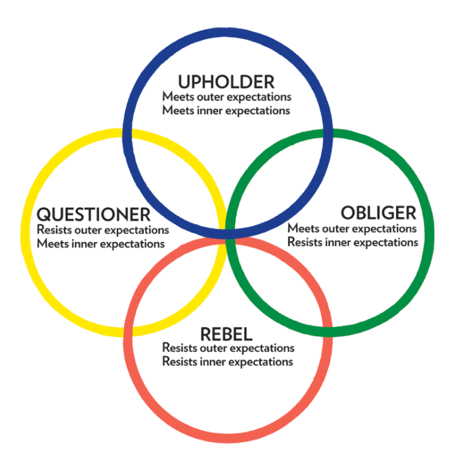
In my book Better Than Before, I outlined the 21 strategies we can use to make or break our habits, and using the Four Tendencies framework became strategy #1.
After Better Than Before hit the shelves, I did a lot of speaking about habits, and I noticed something that surprised me. I’d talk about many fascinating aspects of habits—the Four Tendencies, abstainers vs. moderators, the power of pairing, why and how people influence each other’s habits, and so on—but almost all the questions were about the Four Tendencies. People really wanted to know more about the Tendencies.
I kept answering questions, and responding to emails, and creating PDF resources, until finally I realized, “Hey, maybe I should write an entire book about the Four Tendencies.”
This idea came as a huge relief, because I’d become increasingly filled with regret that I’d learned so much more about the Tendencies after the publication of Better Than Before. If I wrote a book, I could develop those ideas thoroughly.
For instance…
I understood better why, for Upholders like me, the advice to “Give yourself a break” can lead to more anxiety, not less.I noticed that Questioners often don’t like to answer questions. Ironic, but true.I learned a lot more about the important (and puzzling, if you don’t know about it) phenomenon of Obliger-rebellion.I heard about many imaginative, ingenious ways to create outer accountability.I learned more strategies for ways Rebels can stick to their aims for themselves. (Rebels have to do this in a specifically Rebel way, and that’s different from the other Tendencies.)I heard countless stories from people about how they’ve used the Four Tendencies at work, in romance, in healthcare, with kids, and more.Even to this day, I keep learning more about the Tendencies. I have a giant document where I add anything relevant to the framework: great examples of how to harness your Tendency, examples of famous people and their Tendencies (or fictional characters, for instance from Game of Thrones and Mad Men), great stories.
Over the last five years, it has been gratifying to see how many people have taken the free, quick Four Tendencies quiz. More than 3.2 million people have taken this quiz! It has gone through several iterations, and was refreshed just a few weeks ago.
Note: The quiz is great for telling you about yourself, but many people find the Four Tendencies more useful for understanding other people. In that case, it’s helpful to read the book The Four Tendencies.
Every year, I keep creating more resources. For instance—and this is huge undertaking—I launched the award-winning Happier™ app. It offers several tools to help you keep your habits, as well as know-yourself-better questions, tips and hacks, everyone’s favorite, “Spin the Wheel,” and more.
The app uses the Four Tendencies to suggest the tool that’s likely to work for you. When you sign up, you take the quiz to learn whether you’re an Obliger, Questioner, Upholder, or Rebel (or, if you already know it, you can select it). Then, when you set up a new aim, the app suggests a tool that’s likely to be useful based on your Tendency. For instance, “Obligers” excel at meeting their promises to other people, but they struggle to meet their promises to themselves. To meet their aims, they need outer accountability, so Happier suggests using the “Accountability Partners” tool. By contrast, an Upholder would get the suggestion to use “Don’t Break the Chain.”
To celebrate the fifth anniversary, I’ve created the Four Tendencies “Gift Boxes” in the Happiness Project Shop. A box includes:
a new Four Tendencies Companion Guide, exclusive to these Gift Boxes, which includes revealing interviews with people of each Tendency, as well as reflection questions and space to writea Tendency mug and sticker—display your Tendency with pride!a Tackle Box—a set of five sticky pads with different approaches to tackle your day, with pads designed with the Four Tendencies specifically in mind (if you’re curious about the logic, read here)This box is great way to explore your own Tendency more deeply, or to share the Tendencies with someone else.
I’ve heard about teams and entire companies that do Four Tendencies exercises together—I’ve even heard from families spent their Thanksgiving dinners discussing their Tendencies!
To give a very small, recent example of how I’ve used the Four Tendencies framework, myself: The other night, my husband and I had a great time when an old friend invited us over for dinner. I don’t know that person’s email address, so, a few minutes ago, I texted my husband: “What’s XYZ’s email address?” I hit “Send,” then remembered to send another message: “I’m going to write a thank-you note.”
As I know, Jamie is a Questioner, and he’ll bother to send me that information only if he understands why I’m asking. By understanding that aspect of his nature, I’ve avoided a little moment of frustration.
What are some examples of how you’ve used the Tendencies to understand other people better? Or to understand yourself better? I remain fascinated by hearing people’s experiences.
The post Hard to Believe! It’s the Fifth Anniversary of “The Four Tendencies” Book. appeared first on Gretchen Rubin.
September 8, 2022
Author Interview: Cassie Holmes
Interview: Cassie Holmes
Cassie Holmes, Ph. D., is a professor at UCLA’s Anderson School of Management and an award-winning teacher and researcher of time and happiness. Her new book, Happier Hour: How to Beat Distraction, Expand Your Time, and Focus on What Matters Most (Amazon, Bookshop), just hit shelves.
I couldn't wait to talk to Cassie about happiness, habits, and time management strategies.
Gretchen: What’s a simple activity or habit that consistently makes you happier?
Cassie: Habits are useful because they help us consistently engage in behaviors that are good for us without having to apply much thought. The problem from a happiness perspective is that not thinking about our behaviors as we engage in them can also mean not paying attention to the many moments that might bring us joy. We risk missing out on a lot of potential happiness that is already right there in our daily lives.
In one of my favorite chapters of my new book Happier Hour: How to Beat Distraction, Expand Your Time, and Focus on What Matters Most, I describe this psychological tendency to adapt to life’s good stuff and, more importantly, provide strategies to offset it so that you can savor and continue to delight in those joyful moments.
One of these strategies is to turn routine into ritual. For example, when I turned my daughter’s and my routine stop at the coffee shop into a treasured ritual, this weekly activity became special. It took on greater meaning—demanding our attention and providing increased happiness. Years into repeatedly doing this activity, our “Thursday Morning Coffee Date” (which has since moved to Sunday mornings to accommodate current scheduling demands) continues to be a half-hour that we protect for just the two of us to revel in each other’s company over warm beverages and flakey croissants. Earlier in the week, we eagerly anticipate this time, and throughout the week, we can fondly revisit this time in our minds when we’re apart. This shared ritual keeps us connected amidst our harried weeks and passing years.
You’ve done fascinating research. What has surprised or intrigued you – or your readers?
As a mother of young kids, I have often felt extremely time poor—having too much to do and not enough time to do it. And, unfortunately, I know I’m not alone in this. I conducted a national poll showing that nearly half of Americans suffer from time poverty. Even though moms tend to feel more time poor than dads, and even though working parents tend to feel particularly impoverished, our data shows that all types of people lack for time, including those without kids and those who are not working for pay. This pervasiveness is bad because our results also show that people who feel time poor are less healthy, less kind, and less happy. There have even been points when I’ve felt so time poor that I’ve considered quitting my career as a professor. I believed that if only I had more hours in the day to spend how I wanted, I’d be happier.
Yet, additional research my team has conducted suggests this isn’t necessarily true. We analyzed data from the American Time Use Survey to figure out the relationship between the number of discretionary hours people have in the day and their happiness. The robust pattern of results that came out of our analyses revealed an upside-down U-shape—like an arc or a rainbow. Though one tip of the arc validated my unhappiness from having too little time, the other tip (and similarly low point) surprised me and cautioned me not to quit. It showed that there is such thing as having too much time. But why? Through additional studies and analyses, we learned that people are averse to being idle, and having too much discretionary time undermines our sense of being productive and having purpose.
So, despite my belief that having more time would be better, this research shows that for happiness, it’s not just about the amount you have. It’s also about how you invest what you have. And that’s what Happier Hour is all about: it’s an empirically-based guide for how to spend time so that your days aren’t just overly full, but feel fulfilling.
What’s something you know now about happiness that you didn’t know when you were 18 years old?
I’ve learned that much of happiness is a choice, and that research can help inform the many little and simple choices we make in our days to experience greater happiness with our lives. That is, it’s not just our inherited temperament or the lucky (or unlucky) circumstances we find ourselves in that determine our life satisfaction. (I can now assure my 18-year-old self that my cheeriness was not merely charmed naiveté.) Rather, how we choose to spend our time has a significant influence on how happy we feel.
To inform your choices, time tracking studies offer useful guidance. In addition, I suggest you conduct a bit of your own research by tracking your time for at least one week (but ideally two)—writing down what you’re doing, and rating how happy you’re feeling while doing it. This will lead you to discover which activities actually produce the greatest and least amount of happiness (and they aren’t always the ones you’d predict!). There’s a helpful worksheet on my website—www.cassiemholmes.com—and more detailed instructions in Happier Hour. From this, you’ll have the personalized data you need to reallocate some of your hours to make more of them happier hours.
Does anything tend to interfere with your happiness?
The thing that interferes most with my happiness is that I am so often distracted—in particular, by the running to-do list in my mind and the constant planning that’s required to check off its items. Indeed, research shows that we are distracted (i.e., not thinking about what we are currently doing) almost 50% of the time. Furthermore, we are significantly less happy during these times when our minds are wandering away from our present activity. Not wanting to mentally miss out on so much potential happiness, I have to be diligent about shifting from my typical doing mode so that I can spend more time being. To more fully enjoy my activities (especially those I identified from my time tracking exercise as the happiest), I follow my strategies in Happier Hour, including carving out times as “no phone zones” and treating the weekend like a vacation.
In your field, is there a common misconception that you’d like to correct?
For happiness and satisfaction in life, our most critical resource is time (not money).
Author photo credit: Diana Henderson
Happiness Isn’t One-Size-Fits-All, Neither is Financial Planning
Over the past two years, we’ve lived through an extraordinary number of challenges—recession; a global pandemic; social, political, and environmental instability—which can leave us feeling uncertain about our future.
In response, many Americans are having a collective moment of redefining what’s important, rewriting the rules, and taking action to create the life they want.
Within this new cultural shift, which many are calling “The Great Realization,” now more than ever, people are deciding to re-architect their lives to reflect their values better. In response to the upheaval and uncertainty in the world, people ask: “What’s really important to me?” “Instead of dreaming about something I want to do someday, how can I make that dream come true today?” “How should I balance my short-term goals against my long-term goals?”
In fact, in the 2022 Northwestern Mutual Great Realization study, 95% of respondents said that the past two years have shown them the importance of pursuing their dreams now—rather than waiting for “someday.” At the same time, however, many survey respondents say there’s at least one factor holding them back from this pursuit. The biggest of these factors? Finances — cited by 57%. If this resonates with you, a financial plan can help.
In the study of happiness, money is one of the most complex and emotionally charged issues that people face. Money can’t buy happiness, but financial freedom can buy lots of things that contribute mightily to happiness.
When we have the ability to spend on (or save toward) things that matter to us, it can help us boost our happiness. My experience with a trusted advisor from Northwestern Mutual helped me see this connection in a new way. No matter where you are in your financial planning process (even if that means you haven’t yet begun), an advisor can help you navigate uncertainty. Identifying what’s important to you can be an important first step.
For this reason, a solid, well-considered financial plan means that we can work toward creating a life that reflects our values—both for now and for the future. For example, philosophers and scientists agree that having strong ties to other people is a key to happiness. One way that having a financial plan could account for this value might be enabling an opportunity to pay for a plane ticket to visit your sister in the near term or for savings to pay for education or special care for someone we love in the future.
Adventure, travel, and challenge can also make us happier. Financial planning might support a trip to California, a drawing class, or a mountain bike. It might also help with realizing a dream to move to a different city or switch careers. When we have a plan in place, we feel a greater sense of security, clarity, and control.
Is financial planning essential for developing strong ties to other people or having an adventure? No. But it can make it easier. Some of the best things in life aren’t free.
Each of us is unique. We have our own values, our own interests, our own circumstances. So for each of us, a financial plan looks different. A friend told me, “My top priority is protecting my family. I wanted to know I’m prepared for anything unexpected that might come up.” On the other hand, a different friend said, “I had all these plans for great things I’d do in the future, like traveling, and I realized that I want to start doing these things now.”
Many people don’t want to think about their finances. Some feel intimidated or bored by unfamiliar vocabulary and confusing concepts. Some feel embarrassed about the current state of their affairs. Some people feel so anxious about money that they can’t bear to think about it at all. Some people have trouble sorting out what’s most important to them. Some feel worried about trusting an “expert” with such important decisions. For all these difficulties, consulting with a Northwestern Mutual financial advisor can help. Working with an advisor not only helps with achieving financial security, but it can also help with alleviating that stress and feeling a greater sense of control.
Even so, it can be difficult to take that first step toward a consultation. A question I often asked myself is, “Why is it so hard to ask for help?” I find it hard—yet over and over, I’ve found that when I do ask for help, I get tremendous benefit from working with people who have the skills and experience to advise me. This is true in many areas, including financial planning.
In the financial area, an advisor can help you figure out what’s important to you and how to work toward those aims, with a comprehensive plan that balances the short-term and the long-term. Are you more focused on security? Freedom? A sense of control? A comprehensive financial plan can help you achieve it all.
An advisor can explain unfamiliar concepts, and help you understand the pros and cons of different approaches—so you know that you’re making the right decisions for you. Your advisor knows, so you don’t have to be an expert! When I spoke to a Northwestern financial advisor, she told me, “Some people want a lot of explanation, and some people don’t. So sometimes I ask, ‘Do you want the high-level overview, or more detail?’ I customize the conversations to what they want.”
When we know ourselves—our own nature and our own values—we can make decisions that reflect what’s most important to us.
Another important way to know yourself? Consider your “Tendency.” In my Four Tendencies personality framework, people typically fall into four Tendencies: Upholders, Questioners, Obligers, and Rebels. (Don’t know your Tendency? Take my free, quick quiz here. More than 3.2 million people have taken this quiz.)
The differences among the Four Tendencies crop up in the financial arena. While the Four Tendencies have different perspectives, a financial advisor can be helpful to all four:
If you’re an Upholder, it’s useful to have a concrete plan with clear expectations and outcomes. Get a list of things you need to do, and start checking items off the list. A financial advisor can provide that list and as well as any help that’s needed to accomplish those tasks.If you’re a Questioner, it’s important to understand why you’re doing certain things. What’s the rationale behind this plan? What’s the most efficient way to achieve a goal? How can a plan be customized to your specific aims? Questioners need to know why, and a financial advisor can give that expertise.If you’re an Obliger, outer accountability is essential. You can benefit tremendously from working with an advisor who can set expectations, impose deadlines, and create accountability.If you’re a Rebel, it’s helpful to reflect on how financial security brings freedom and choice. You can move! You can travel! You can quit your job and try a new career! A financial advisor can figure out how to make those things possible.Paradoxically, some people find it hard to start dealing with their finances now, because they wish so strongly that they’d started earlier. When I feel that kind of anxiety, I remind myself of the old proverb: “The best time to plant a tree is twenty years ago. The second best time is now.”
Thinking about a financial plan can feel overwhelming; it can be hard to know where to start. Action can be an antidote to anxiety. Connecting with a financial advisor can show you how to put a plan into place so that you’re achieving the life you want. I found it so simple to set up that first meeting with a Northwestern Mutual advisor—and once I made that connection, it was surprisingly easy to begin a conversation.
The time to start building the life we want is now.
Northwestern Mutual is the marketing name for The Northwestern Mutual Life Insurance Company and its subsidiaries in Milwaukee, WI. Not all Northwestern Mutual representatives are advisors.
Author Interview: Cassie Holmes
Cassie Holmes, Ph. D., is a professor at UCLA’s Anderson School of Management and an award-winning teacher and researcher of time and happiness. Her new book, Happier Hour: How to Beat Distraction, Expand Your Time, and Focus on What Matters Most (Amazon, Bookshop), just hit shelves.
I couldn’t wait to talk to Cassie about happiness, habits, and time management strategies.
Gretchen: What’s a simple activity or habit that consistently makes you happier?
Cassie: Habits are useful because they help us consistently engage in behaviors that are good for us without having to apply much thought. The problem from a happiness perspective is that not thinking about our behaviors as we engage in them can also mean not paying attention to the many moments that might bring us joy. We risk missing out on a lot of potential happiness that is already right there in our daily lives.
In one of my favorite chapters of my new book Happier Hour: How to Beat Distraction, Expand Your Time, and Focus on What Matters Most, I describe this psychological tendency to adapt to life’s good stuff and, more importantly, provide strategies to offset it so that you can savor and continue to delight in those joyful moments.
One of these strategies is to turn routine into ritual. For example, when I turned my daughter’s and my routine stop at the coffee shop into a treasured ritual, this weekly activity became special. It took on greater meaning—demanding our attention and providing increased happiness. Years into repeatedly doing this activity, our “Thursday Morning Coffee Date” (which has since moved to Sunday mornings to accommodate current scheduling demands) continues to be a half-hour that we protect for just the two of us to revel in each other’s company over warm beverages and flakey croissants. Earlier in the week, we eagerly anticipate this time, and throughout the week, we can fondly revisit this time in our minds when we’re apart. This shared ritual keeps us connected amidst our harried weeks and passing years.
You’ve done fascinating research. What has surprised or intrigued you – or your readers?
As a mother of young kids, I have often felt extremely time poor—having too much to do and not enough time to do it. And, unfortunately, I know I’m not alone in this. I conducted a national poll showing that nearly half of Americans suffer from time poverty. Even though moms tend to feel more time poor than dads, and even though working parents tend to feel particularly impoverished, our data shows that all types of people lack for time, including those without kids and those who are not working for pay. This pervasiveness is bad because our results also show that people who feel time poor are less healthy, less kind, and less happy. There have even been points when I’ve felt so time poor that I’ve considered quitting my career as a professor. I believed that if only I had more hours in the day to spend how I wanted, I’d be happier.
Yet, additional research my team has conducted suggests this isn’t necessarily true. We analyzed data from the American Time Use Survey to figure out the relationship between the number of discretionary hours people have in the day and their happiness. The robust pattern of results that came out of our analyses revealed an upside-down U-shape—like an arc or a rainbow. Though one tip of the arc validated my unhappiness from having too little time, the other tip (and similarly low point) surprised me and cautioned me not to quit. It showed that there is such thing as having too much time. But why? Through additional studies and analyses, we learned that people are averse to being idle, and having too much discretionary time undermines our sense of being productive and having purpose.
So, despite my belief that having more time would be better, this research shows that for happiness, it’s not just about the amount you have. It’s also about how you invest what you have. And that’s what Happier Hour is all about: it’s an empirically-based guide for how to spend time so that your days aren’t just overly full, but feel fulfilling.
What’s something you know now about happiness that you didn’t know when you were 18 years old?
I’ve learned that much of happiness is a choice, and that research can help inform the many little and simple choices we make in our days to experience greater happiness with our lives. That is, it’s not just our inherited temperament or the lucky (or unlucky) circumstances we find ourselves in that determine our life satisfaction. (I can now assure my 18-year-old self that my cheeriness was not merely charmed naiveté.) Rather, how we choose to spend our time has a significant influence on how happy we feel.
To inform your choices, time tracking studies offer useful guidance. In addition, I suggest you conduct a bit of your own research by tracking your time for at least one week (but ideally two)—writing down what you’re doing, and rating how happy you’re feeling while doing it. This will lead you to discover which activities actually produce the greatest and least amount of happiness (and they aren’t always the ones you’d predict!). There’s a helpful worksheet on my website—www.cassiemholmes.com—and more detailed instructions in Happier Hour. From this, you’ll have the personalized data you need to reallocate some of your hours to make more of them happier hours.
Does anything tend to interfere with your happiness?
The thing that interferes most with my happiness is that I am so often distracted—in particular, by the running to-do list in my mind and the constant planning that’s required to check off its items. Indeed, research shows that we are distracted (i.e., not thinking about what we are currently doing) almost 50% of the time. Furthermore, we are significantly less happy during these times when our minds are wandering away from our present activity. Not wanting to mentally miss out on so much potential happiness, I have to be diligent about shifting from my typical doing mode so that I can spend more time being. To more fully enjoy my activities (especially those I identified from my time tracking exercise as the happiest), I follow my strategies in Happier Hour, including carving out times as “no phone zones” and treating the weekend like a vacation.
In your field, is there a common misconception that you’d like to correct?
For happiness and satisfaction in life, our most critical resource is time (not money).
The post Author Interview: Cassie Holmes appeared first on Gretchen Rubin.
Happiness Isn’t One-Size-Fits-All, Neither is Financial Planning
Over the past two years, we’ve lived through an extraordinary number of challenges—recession; a global pandemic; social, political, and environmental instability—which can leave us feeling uncertain about our future.
In response, many Americans are having a collective moment of redefining what’s important, rewriting the rules, and taking action to create the life they want.
Within this new cultural shift, which many are calling “The Great Realization,” now more than ever, people are deciding to re-architect their lives to reflect their values better. In response to the upheaval and uncertainty in the world, people ask: “What’s really important to me?” “Instead of dreaming about something I want to do someday, how can I make that dream come true today?” “How should I balance my short-term goals against my long-term goals?”
In fact, in the 2022 Northwestern Mutual Great Realization study, 95% of respondents said that the past two years have shown them the importance of pursuing their dreams now—rather than waiting for “someday.” At the same time, however, many survey respondents say there’s at least one factor holding them back from this pursuit. The biggest of these factors? Finances — cited by 57%. If this resonates with you, a financial plan can help.
In the study of happiness, money is one of the most complex and emotionally charged issues that people face. Money can’t buy happiness, but financial freedom can buy lots of things that contribute mightily to happiness.
When we have the ability to spend on (or save toward) things that matter to us, it can help us boost our happiness. My experience with a trusted advisor from Northwestern Mutual helped me see this connection in a new way. No matter where you are in your financial planning process (even if that means you haven’t yet begun), an advisor can help you navigate uncertainty. Identifying what’s important to you can be an important first step.
For this reason, a solid, well-considered financial plan means that we can work toward creating a life that reflects our values—both for now and for the future. For example, philosophers and scientists agree that having strong ties to other people is a key to happiness. One way that having a financial plan could account for this value might be enabling an opportunity to pay for a plane ticket to visit your sister in the near term or for savings to pay for education or special care for someone we love in the future.
Adventure, travel, and challenge can also make us happier. Financial planning might support a trip to California, a drawing class, or a mountain bike. It might also help with realizing a dream to move to a different city or switch careers. When we have a plan in place, we feel a greater sense of security, clarity, and control.
Is financial planning essential for developing strong ties to other people or having an adventure? No. But it can make it easier. Some of the best things in life aren’t free.
Each of us is unique. We have our own values, our own interests, our own circumstances. So for each of us, a financial plan looks different. A friend told me, “My top priority is protecting my family. I wanted to know I’m prepared for anything unexpected that might come up.” On the other hand, a different friend said, “I had all these plans for great things I’d do in the future, like traveling, and I realized that I want to start doing these things now.”
Many people don’t want to think about their finances. Some feel intimidated or bored by unfamiliar vocabulary and confusing concepts. Some feel embarrassed about the current state of their affairs. Some people feel so anxious about money that they can’t bear to think about it at all. Some people have trouble sorting out what’s most important to them. Some feel worried about trusting an “expert” with such important decisions. For all these difficulties, consulting with a Northwestern Mutual financial advisor can help. Working with an advisor not only helps with achieving financial security, but it can also help with alleviating that stress and feeling a greater sense of control.
Even so, it can be difficult to take that first step toward a consultation. A question I often asked myself is, “Why is it so hard to ask for help?” I find it hard—yet over and over, I’ve found that when I do ask for help, I get tremendous benefit from working with people who have the skills and experience to advise me. This is true in many areas, including financial planning.
In the financial area, an advisor can help you figure out what’s important to you and how to work toward those aims, with a comprehensive plan that balances the short-term and the long-term. Are you more focused on security? Freedom? A sense of control? A comprehensive financial plan can help you achieve it all.
An advisor can explain unfamiliar concepts, and help you understand the pros and cons of different approaches—so you know that you’re making the right decisions for you. Your advisor knows, so you don’t have to be an expert! When I spoke to a Northwestern financial advisor, she told me, “Some people want a lot of explanation, and some people don’t. So sometimes I ask, ‘Do you want the high-level overview, or more detail?’ I customize the conversations to what they want.”
When we know ourselves—our own nature and our own values—we can make decisions that reflect what’s most important to us.
Another important way to know yourself? Consider your “Tendency.” In my Four Tendencies personality framework, people typically fall into four Tendencies: Upholders, Questioners, Obligers, and Rebels. (Don’t know your Tendency? Take my free, quick quiz here. More than 3.2 million people have taken this quiz.)
The differences among the Four Tendencies crop up in the financial arena. While the Four Tendencies have different perspectives, a financial advisor can be helpful to all four:
If you’re an Upholder, it’s useful to have a concrete plan with clear expectations and outcomes. Get a list of things you need to do, and start checking items off the list. A financial advisor can provide that list and as well as any help that’s needed to accomplish those tasks.If you’re a Questioner, it’s important to understand why you’re doing certain things. What’s the rationale behind this plan? What’s the most efficient way to achieve a goal? How can a plan be customized to your specific aims? Questioners need to know why, and a financial advisor can give that expertise.If you’re an Obliger, outer accountability is essential. You can benefit tremendously from working with an advisor who can set expectations, impose deadlines, and create accountability.If you’re a Rebel, it’s helpful to reflect on how financial security brings freedom and choice. You can move! You can travel! You can quit your job and try a new career! A financial advisor can figure out how to make those things possible.Paradoxically, some people find it hard to start dealing with their finances now, because they wish so strongly that they’d started earlier. When I feel that kind of anxiety, I remind myself of the old proverb: “The best time to plant a tree is twenty years ago. The second best time is now.”
Thinking about a financial plan can feel overwhelming; it can be hard to know where to start. Action can be an antidote to anxiety. Connecting with a financial advisor can show you how to put a plan into place so that you’re achieving the life you want. I found it so simple to set up that first meeting with a Northwestern Mutual advisor—and once I made that connection, it was surprisingly easy to begin a conversation.
The time to start building the life we want is now.
This is a sponsored post in partnership with Northwestern Mutual. All reviews and opinions expressed in this post are based on my personal view.
Northwestern Mutual is the marketing name for The Northwestern Mutual Life Insurance Company and its subsidiaries in Milwaukee, WI. Not all Northwestern Mutual representatives are advisors.
 /*! elementor - v3.7.7 - 20-09-2022 */.elementor-column .elementor-spacer-inner{height:var(--spacer-size)}.e-container{--container-widget-width:100%}.e-container>.elementor-widget-spacer{width:var(--container-widget-width,var(--spacer-size));-ms-flex-item-align:stretch;align-self:stretch;-ms-flex-negative:0;flex-shrink:0}.e-container>.elementor-widget-spacer>.elementor-widget-container,.e-container>.elementor-widget-spacer>.elementor-widget-container>.elementor-spacer{height:100%}.e-container>.elementor-widget-spacer>.elementor-widget-container>.elementor-spacer>.elementor-spacer-inner{height:var(--container-widget-height,var(--spacer-size))}
 The post Happiness Isn’t One-Size-Fits-All, Neither is Financial Planning appeared first on Gretchen Rubin.



![[image error]](https://gretchenrubin.com/wp-content/uploads/sites/2/2022/07/Screen-Shot-2022-07-25-at-10.18.10-AM.png)
![[image error]](https://gretchenrubin.com/wp-content/uploads/sites/2/2022/07/Happier-Hour.jpg)
![[image error]](https://gretchenrubin.com/wp-content/uploads/sites/2/2022/09/GR_NWM_partnerhsip_full_logo_lockup.png)