
Mark Anthony Neal's Blog, page 1079
June 14, 2011
Black Music Month 2011: Urban Soul | "Whitney, Bobby & LaFace" 1990-1991"
Tags: VH1 Rock Docs, Reality TV Shows, Reality TV Shows 6
Urban Soul: The Making of Modern R&B
A film by John Akomfrah
Part Three: "Bobby, Whitney & LaFace, 1991"


Exercising Locally, Connected Virtually--The B. Hurt 30 for 30 Community Fitness Challenge

Exercising Locally, Connected Virtually--The B. Hurt 30 for 30 Community Fitness Challenge
by David Leonard | special to NewBlackMan
It is easy to hate on new media technology these days. Next to politicians (and teachers of late) and hip-hop, new media is consistently demonized and scapegoated for everything from obesity to social isolation. According to Ray Oldenburg, in the United States "citizens are encouraged to find their relaxation, entertainment, companionship, even safety, almost entirely within the privacy of homes that have become more a retreat from society than a connection to it" (qtd. in Watkins 2009, p. xix).
Don't tell that to Byron Hurt. This filmmaker, who received national acclaim for his brilliant 2006 documentary, Hip Hop: Beyond Beats and Rhymes, initiated the "B. Hurt 30 for 30 Community Fitness Challenge" after he completed his own exercise challenge in April 2011. Noting that his cousin Shawn Hurt started an exercise group on Facebook, Hurt saw the power in creating a community committed to active living. "The inspiration came from Friends on my Facebook page," Hurt explained. "I posted my daily workouts in my Facebook status for 30 days, and it seemed to inspire many of my Friends." The goal of the group is very simple: workout for 30 minutes or more for 30 straight days. The mission of the group – to "inspire, motivate, and supporting willing participants" – has captured the attention of a number of people, attracting over 100 members to this Facebook group as of June 2011. Minus the fact that she is married to Byron Hurt, Kenya Crumel, the director of program management and technical assistance at a consulting firm, is typical of the group. Between job and family, she often struggled to find the time and energy to exercise on a consistent basis. Her background as an athlete, having run the New York City Marathon in 2007, did not make this any easier. With the "B. Hurt 30 for 30 Community Fitness Challenge," she not only found motivation, but a community that inspires and helps her achieve her goals. "Being a member of the group gives me a community that helps me be accountable for taking care of myself. Seeing everyone post everyday inspires me," notes Crumel "I get new ideas about exercise routines from other members. And I feel proud when I finish exercising and I get to post on the board, knowing that I might be inspiring someone who isn't feeling motivated."
She is not alone. Participants cite the challenge of working out for 30 consecutive days, the instruments of accountability, and the knowledge gained from learning about the exercise routines of others as why the group is so effective. "I read posts from people with many of the professional and personal responsibilities that I have and they manage to find time to take care of their bodies" writes Lori Martin, an assistant professor at John Jay College of Criminal Justice. "I am reminded that we make time for the things that are important to us by being a member and that fitness should be a priority for us all." The group is not simply a space of education, where participants learn what others are doing, gaining ideas as to new ways to exercise, but gain knowledge of how to integrate exercise and health consciousness into their daily life. Exercise is an immense commitment and what this group reveals is that by joining others, by committing to not only the task of the 30 in 30 but to a community, the exercise becomes both easy and enjoyable.
Yet, more than anything else, the "B. Hurt 30 for 30 Community Fitness Challenge" is about creating a community of strangers committed to helping and assisting others reach their potential. It is about camaraderie and community. Rhea Combs, a freelance art producer at an advertising agency in Portland, Oregon, describes the power of the group in the following way: "Even the phrases like 'get it in, fam,' reiterate the notion that this is community/family, not just a group of strangers." In isolation, the group has become connected by their commitment to exercise, to being health, and to each other.
What is beautiful about the group is how it utilizes competitive spirit to empower rather than isolation and discourage its members. Participants compete against the challenge and against them, both of which is made that much easier because you are competing alongside of others. "The potential of a group like this is enormous because when you have a positive group of people pushing for one goal at the same time but at your own pace -- it's a genius idea," notes Derrick Anthony, a filmmaker who lives in Bedford-Stuyvesant. "Working out is like fishing, you want somebody there when you catch the big fish. And if no one is there when you catch it, you will most definitely tell them about it. Working out makes you feel great and you want to tell the world." This space not only provide a means to "floss" a bit about one's accomplishments but to do so in a way that encourages others to get their work in each and every day. It is harder to be lazy when your phone keeps announcing how much work your peers are getting done in the gym, on the track, and wherever they can exercise.
Having joined the group myself, I have seen its power, its beauty and the inspiration that comes through the establishment of a community bound together by a shared identity and goal. In March, I completed by 2nd marathon, only to find myself physically lost without a clear goal to guide my exercise routine. Joining the group has rekindled this focus, finding power in the determination of others. My hope to inspire others and my yearning to fulfill my commitment has provided the needed push to get me back on track. It has reminded me of the bigger picture for myself and from society at large.
Hurt, who acknowledges how "fitness is a big part of my life," sees the "B. Hurt 30 for 30 Community Fitness Challenge" as part of a larger struggle " to get people to start thinking more about health, nutrition, and wellness." His efforts to bring people together are but one example of his commitment to educating and inspiring people to be healthier. His forthcoming film, Soul Food Junkies, examines his own relationship to soul food, "the positive and negative aspects of soul food, and how soul food is a major part of black cultural identity. As a community, we need eat better, work out more, and be more in tuned with our bodies." This group, like his film, shows the power new media technology as a source of community, intervention, and personal/communal transformation.
S. Craig Watkins, in The Young and the Digital, argues that "social and mobile media" are "bring people together across the longstanding barriers of race class." Summarizing the work of Marshall Van Alstyne and Erik Brynjolfsson, he notes how "increased connectivity has the potential to create diverse communities by providing individual the opportunity to come together across social as well as geographical boundaries" (2009, p. xx). The "B. Hurt 30 for 30 Community Fitness Challenge" demonstrates the power and potential here, illustrating how new media technology not only brings together a diverse group of people but does so in a way to create a community based on a shared identity, a collective goal, and a willingness to be both encouraging and inspiring.
"I think this group speaks to the power and influence that new media has on our daily lives. Social media creates a whole new kind of space for people to interact and engage with one another. In many ways it's such a brand new world that we are living in," notes Hurt, "So I think new media is a great way to organize people and create groups like mine, where people can feel like they are part of a like-minded community and they can be challenged and motivated to get fit in a safe space." As a group member, I cannot agree more because without the support and inspiration of my new fitness family, I would have clearly taken a day off. Connected to them, I remain committed to my exercise routine and myself.
***
David J. Leonard is Associate Professor of Comparative Ethnic Studies at Washington State University, Pullman. He has written on sport, video games, film, and social movements, appearing in both popular and academic mediums. His work explores the political economy of popular culture, examining the interplay between racism, state violence, and popular representations through contextual, textual, and subtextual analysis. He is the author of Screens Fade to Black: Contemporary African American Cinema and the forthcoming After Artest: Race and the War on Hoop (SUNY Press).

Thinking About Gil Scott-Heron

Thinking About Gil Scott-Heron by Joe Schloss | special to NewBlackMan
Gil Scott-Heron's passing is hitting me almost like the death of someone I knew personally. I guess what I mean is that his influence in my life was so broad that it wasn't really possible to comprehend its magnitude until I had time to move through different aspects of my daily experience and notice how many of them suffered from his absence. I've been thinking about why that should be the case, and the answer certainly includes all the things others have noted: the politics, the humor, the style, the attitude, the voice, the influence.
But there's something else, too, and I think it's this: It's easy to write positive songs if you believe the world is all sunshine and roses. What's hard is to write positive songs when you know better.
Don't get me wrong: I love purely optimistic music…It's just that sooner or later I always start to feel like I'm lying to myself.
But I never felt that way when I listened to Gil Scott-Heron.put on a color show just for me. (I appreciate it.)
Shadows dark and gloomy,
I told them all to keep the hell away from me.
Because I don't feel like believing
everything I do gon' turn out wrong.
When vibrations I'm receiving
say "hold on, brother, just you be strong."
Yes, and all I really wanna say
Is that the problems come and go
but the sunshine always seems to stay.
Just look around.
I think we found
A lovely day.
The only people who can choose not to believe that everything's going to turn out wrong are the people who suspected it might in the first place.
And a person who would tell the shadows to "keep the hell away from me" has a very different outlook from a person who lives in a world without shadows.
Gil Scott-Heron lived in a world that was full of shadows. A world that was full of grey areas and second-guessing and backsliding, of both the personal and political varieties. But that's precisely why you could trust his songs. Because that's the world.
Even the song "Peace Go With You Brother" - which so many of us posted to eulogize him - is full of ambivalence when you really listen to the lyrics:
Peace to you, brother
Don't seem to matter much now just what I say.
Peace go with you, brother
You the kind of man who think he got to have his own way.
You're my father; you're my uncle and my cousin and my son.
But sometimes, sometimes…
I wish you were none.
But I'll manage to smile
and I'll say, "Peace go with you, brother".
But Gil managed to smile. He transcended his own ambivalence.
My favorite Martin Luther King quote doesn't even address civil rights directly. It comes from the first speech he made opposing the Vietnam War…a speech that, coincidentally, was given at Riverside Church, the same church that hosted Gil Scott-Heron's funeral:
Nor does the human spirit move without great difficulty against all the apathy of conformist thought within one's own bosom and in the surrounding world. Moreover, when the issues at hand seem as perplexing as they often do in the case of this dreadful conflict, we are always on the verge of being mesmerized by uncertainty. But we must move on.
As someone who is "mesmerized by uncertainty" pretty much on a daily basis, I know what he was talking about. And so, clearly, did Gil Scott-Heron. He didn't ignore that. He didn't minimize it. He didn't make you feel like there was something wrong with you for not being completely sure about things. But he didn't let you off the hook, either. Finding that balance, after all, is not only the essence of being an effective activist. It's the essence of being a decent human being.
Gil Scott-Heron made music for decent human beings and, by doing so, he encouraged each of us to become one.
Let me put it this way: it's pretty much impossible to write a song advocating increased government regulation of the coal mining industry - one that criticizes the Taft-Hartley Act by name - without seeming pedantic, or at least extremely boring. Nevertheless, he did it:
Here come the mine cars, and it's damn near dawn.
Another shift of men, some of them my friends, coming on.
Hard to imagine, working in the mine.
Coal dust in your lungs, on your skin, and on your mind.
I've listened to the speeches,
and it occurs to me politicians don't understand.
Thoughts of isolation, ain't no sunshine underground.
Feels like working in a graveyard three miles down.
The first time I saw him perform this song, someone yelled out from the audience, "We don't need coal! We need revolution!" To which Gil immediately responded: "Yeah, but you still need something to keep you warm while you're revolutin'!"
That was almost twenty years ago, and the older I get, the more I understand the truth of those words. Lots of people sing about revolution, and some of them even do something about it. But how many of them keep you warm?
***
Joseph Schloss, Ph.D. is the author of Foundation: B-boys, B-girls and Hip-hop Culture in New York (Oxford University Press, 2009), and Making Beats: The Art of Sample-Based Hip-Hop (Wesleyan University Press, 2004). He is a Visiting Scholar in Music at New York University and Adjunct Assistant Professor of Black and Latino Studies at Baruch College of the City University of New York.

June 13, 2011
The Rituals of Sports and Politics

The Unnecessary Ritual of Athletes' Visits To The White House by Mark Anthony Neal | Atlanta Post
In the coming days, the National Basketball Association will crown a new champion. Someone will be crowned "MVP," somebody's "legacy" will be assured and still others will thank God, their mothers and their therapists in nationally televised post-game interviews. And of course there will be the endless self-congratulations on Twitter. It is all seemingly choreographed and no more so than with the eventual visit to the White House and photo-op with President Obama, who we all know is a big sports fan. Seems a win-win for all involved.
The practice of bringing sports champions to the White House became particularly noticable during the Presidency of Ronald Reagan, also a big sports fan, during the 1980s. Reagan's administration was as astute as any, in taking advantage of such publicity opportunities. In an era defined by the global expansion of America's symbolic power, what better opportunity is there than the President of the so-called most powerful nation in the World, meeting with the "champions" of the world. It most cases visits to the White House illicit very little reaction except when it's somebody's favorite team.
Six years ago, though, traditionalists were up in arms when members of the Northwestern University Women's lacrosse team, wore flip-flips—albeit designer ones—to their visit to the White House. The subsequent brouhaha, known at the time as "Flip-Flop-gate," seemed perfectly pitched for one of the most timeless of political faux-pas, the political flip-flop. The Chicago Tribune, reported the story with the headline, "You Wore Flip-Flops to the White House?," while pundit after pundit opined about the diminishing values of American Youth. By the summer of 2007, the White House had an official dress-code policy for visitors, specifically stating "no flip-flops."
Read the Full Essay @ The Atlanta Post

Black Music Month 2011: Urban Soul | "other cookies in the jar" 1986-1990"
Tags: VH1 Rock Docs, Reality TV Shows, Reality TV Shows 6
Urban Soul: The Making of Modern R&B
A film by John Akomfrah
Part Two: "Other Cookies in the Jar, 1986-1990"

The Heart and the Mind Sports: What Drives (me) Sports Fans
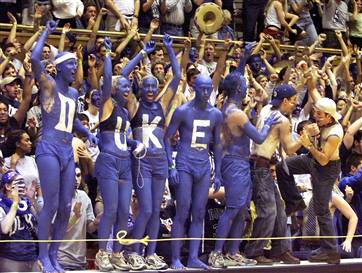
The Heart and the Mind of Sports: What Drives (me) Sports Fans by David J. Leonard | special to NewBlackMan
In the legendary Thanksgiving scene from She's Gotta Have it, Jamie (Tommy Hicks), Greer (John Canada Terrell), and Mars (Spike Lee) take time away from talking trash, flirting with Nola Darling (Tracy Camilla Johns), and eating their thanksgiving dinner to discuss basketball. Debating who is the best player in the NBA, Mars questions the celebration of Larry Bird by NBA commentators alike. Jamie responds, "Say what you want, the white boy is the best player in the NBA," to which Mars retorts, "The best? The best? He's the ugliest m'f'er in the NBA!" Five years later, Spike Lee once again took up the issue of race, basketball and fandom with Do the Right Thing. In this instance, Buggin Out (Giancarlo Esposito) confronts Clinton (John Savage), a white male wearing a Larry Bird shirt, who accidentally scuffs his brand new air-Jordans, leading to the following exchange:
BUGGIN' OUTNot only did you knock me down, youstepped on my new white Air Jordansthat I just bought and that's allyou can say, "Excuse me?"
BUGGIN' OUTI'll fuck you up quick two times.Who told you to step on my sneakers?Who told you to walk on my side ofthe block? Who told you to be inmy neighborhood?
CLIFTONI own a brownstone on this block.
BUGGIN' OUTWho told you to buy a brownstone onmy block, in my neighborhood on myside of the street?
While exploring racial identity, race relations, and the issue of gentrification, Lee uses each characters' relationship to Larry Bird (and the racial signifiers attached to him as player and narrative script) to explore these issues. In each instance it is Lee at his best, pushing viewers to think about the meaning of/behind our choices as fans.
At an intellectual level I find both these fascinating because of the ways in which Lee connects race, sports fandom, and identity. Yet, my affection for both scenes isn't simply about Lee's artistry here or the ways in which he thinks about sports as a racial project/teller of identity, but his visible contempt for Larry Bird and the Boston Celtics. You see, I am Lakers' fan. I don't even think fan captures my relationship with the Lakers. I am miserable during the playoffs (especially this year), mentally exhausted before each game in anticipation of my misery during the game. Victories only provide a temporary respite, at least until the next game. In spite of the lack of enjoyment, I still watch each and every game. I am a fan – an irrational person who watches sports. My love for the Lakers is simple at a certain level. Born and raised in Los Angeles, the Lakers represent my city. In the years since leaving Los Angeles, my relationship to the Lakers has grown as this relationship provides one of the most salient connections to home. First as a graduate student living in the Bay Area (especially during a year living in Davis, CA surrounding by Sacramento Kings fans) and now as a professor in Eastern Washington, my repping the Lakers reflects my desire to establish my geographic identity, to tell others where I am from and who I am.
Yet, at another level, my passion for the Lakers is about my childhood, nostalgia, my relationship to my father, and even my identity. Irrespective of the year or the players on that particular team, the Lakers elicit happiness because of the childhood memories that I associate with them: going to the Great Western Form with my father, the time I met Pat Riley at a wedding, that day I waited for almost an hour at the Apple Pan just so I could get James Worthy's autograph. At an emotional levels, the Lakers embody the purity and innocence of childhood; the joy that came about with every spectacular play and monumental victory.
Yet, the nature of my relationship to the Lakers and the fandom in general illustrate the daily reconciliation and compromises endured because of sporting cultures. Some weeks back, after my Lakers lost to Dallas in four games (I have finally recovered), I had a brief exchange with Jeff Chang where he explained the basis of his disdain for the Lakers: "I want to qualify that I have loved the Lakers--esp. the glory days of Abdul-Jabbar. (Tho I did root for the Celts during that era, I watched the Lakers with the awe of an admirer," he wrote. "But my hate for *these* Lakers is deep—more for who Jackson, Bryant, and Gasol have been off the court than for anything else. I've just been aghast at Jackson's vocal support of 1070, Gasol's anti-Asian racism, and Kobe's man issues and that's I guess how I express myself. It's no judgment on any Lakers fan at all . . . because again I definitely know how fandom."
His comments really struck a chord with me: how could I support a team or players who had done things that in other circumstances I would condemn. His thoughts challenged me not only because it demonstrates the complexity that surrounds why people love and hate teams, how politics, ideology, narrative, and broader issues impact how we approach the game, but how as fans we negotiate these inconsistencies. I continually find myself defending the Lakers (and its players) even when the behavior is indefensible. Whether Phil Jackson's often troubling comments, Kobe Brant's past, Pau Gasol or Shaquille O'Neal connection to anti-Asian prejudice, I often find myself reconciling my heart – driven by sense of self, identity, nostalgia – with my critical understanding, politics, worldview, and moral values.
In recent weeks, I have written on the power of sporting narratives as they relate to both Dirk Nowitzki and LeBron James (with Bruce Lee Hazelwood). In both cases, I sought to emphasize the media representations of both players and how the media discourse, alongside of nostalgia, race, and larger social forces impacts the consumption of/reaction to these players (and others).That is, we as fans don't simply love or hate players, root for or against teams, in a vacuum. Yet, there is an emotionality in sports, not only for what happens on-the-field but the narratives that transcend the sporting arena. It has personal meaning and it has a connection to something bigger. While difficult at times, we, as sports fans, must continually negotiate the emotional appeals of sports even while we seek to critically understand its broader meaning. Despite the appeals to do so, to be a fan should not mean to turn away from critical thinking, self-reflection, and a moral compass.
Evident in these two articles, it is easy for me to think critically about sports away from the Lakers; reflecting on the demonization directed at LeBron James, Barry Bonds, Tiger Woods or Ricky Williams or the narratives associated with Dirk Nowitzki, Lance Armstrong, Michael Jordan, Marion Jones, Tiger Woods, and Michael Vick is easier to achieve because I don't necessarily have to navigate the complex and competing relationship between commentator and fan. That doesn't mean that I don't navigate this complexity with these athletes (and others) I don't root (in many instances I root for players who unfairly becomes villains in the national imagination), but my relationship is different. With the Lakers, whether talking about politics, ideology or even their on-the-court performance, I still am burdened by the emotionality, the connection, and the fan in me. I am still able to think critically, but often find myself compromised, forced to think about how I approach the subject, how I don't want to be critical of their on-the-court or off the court performances because their failure hurts. Isn't that what being a fan is about?
Being a fan is never just about the heart or even the mind but the ways in which sporting emotions intersect with the more cerebral beauties and ugliness of sports. While writing about food Brillat-Savarin once noted: "tell me what you think you eat, and I will tell you who you think you are." Taking this a step further, Belasco argues: "If we are what we eat, we are also what we don't eat…Food choices establish boundaries and borders." The same is true in the world of sports: tell me who you root for, and I will tell you who you think you are. Or better said, if we are who we root for, then we are all what teams and players root against. Sports fandom establishes boundaries and borders for who we are and what we want to be yet in many instances we are forced to cross and navigate those boundaries and borders on a daily instance. Some days, this is easier than others. As I watched the finals, my lack of emotional connection to each team (and its players) – the disconnect between them and me as fan – allows for a critical gaze that would be otherwise difficult to secure if the Lakers weren't on vacation.
Postscript
I want to give a S/O to Oliver Wang, Jeff Chang, Mark Naison, Wayne Moreland, and the many others whose responses to my past pieces both challenge me and led to this new piece. Thanks as always to Mark Anthony Neal for this amazing platform and space.
***
David J. Leonard is Associate Professor of Comparative Ethnic Studies at Washington State University, Pullman. He has written on sport, video games, film, and social movements, appearing in both popular and academic mediums. His work explores the political economy of popular culture, examining the interplay between racism, state violence, and popular representations through contextual, textual, and subtextual analysis. He is the author of Screens Fade to Black: Contemporary African American Cinema and the forthcoming After Artest: Race and the War on Hoop (SUNY Press).

June 12, 2011
Critics Miss the Mark on Rihanna's Video

With her new controversial video "Man Down," Rihanna defies stereotypes about rape victims.
Critics Miss the Mark on Rihanna's Video by Mychal Denzel Smith | The Root.com
The music video for pop star Rihanna's latest single starts off with a literal bang. In "Man Down," a visibly distraught Rihanna is seen raising a small gun and killing a young man with a shot to the head in broad daylight on a crowded Jamaican street. We later learn that the young man had sexually assaulted her in an alley. It's the ultimate revenge story set to a reggae-tinged sound track -- and a far cry from anything else Rihanna has done in her short career.
I'm not typically a fan of Rihanna's music, but this particular piece and accompanying video have won me over. Her willingness to tackle a topic of gravity and importance, often absent from the pop-music landscape, without sensationalizing or making light of the emotional turmoil that accompanies sexual assault is commendable. But I'm on one side of what has become a very heated debate.
Read the Full Essay @ The Root.com

Did Malcolm X Hate Women?

Manning Marable's controversial book takes a hard look at Malcolm's complicated relationship with women.
Did Malcolm X Hate Women? by Natalie Hopkinson | The Root.com
Malcolm X was furious to learn at the last minute that a speaker had decided not to appear at a rally at the Audubon Ballroom in Harlem, N.Y., on Feb. 21, 1965. A flustered aide said that he'd phoned Malcolm's wife, Betty, with the information, according to Manning Marable's controversial biography, Malcolm X: A Life of Reinvention.
Malcolm exploded: "You gave that message to a woman?! ... You should know better than that."
The remarks, hours before he was assassinated, capped off a lifetime of frustration with, dependence on and anger at the women in his life. The fact was, Betty, pregnant with twins, did not know how to reach him. She and her four daughters had been living with friends since they were evicted from their former Nation of Islam-owned home -- which had just been firebombed. Malcolm kept his distance from the family to keep them safe.
Read the Full Essay @ The Root.com

Black Music Month 2011: Urban Soul | "it was the fabric our lives" 1978-1982"
Tags: VH1 Rock Docs, Reality TV Shows, Reality TV Shows 6
Urban Soul: The Making of Modern R&B
A film by John Akomfrah
Part One: "It Was the Fabric of Our Lives, 1978-1982"

Neil deGrasse Tyson on Innovation
Scientist Neil deGrasse Tyson tells CNN's Soledad O'Brien what he believes will drive tomorrow's economy.

Mark Anthony Neal's Blog

- Mark Anthony Neal's profile
- 30 followers
Mark Anthony Neal isn't a Goodreads Author
(yet),
but they
do have a blog,
so here are some recent posts imported from
their feed.

