
Barbara Rainey's Blog, page 23
July 22, 2021
Forgiveness to Cover All Wounds


Note from Barbara: Today’s post is from an author new to me but perhaps not to you as she writes regularly for The Gospel Coalition and desiringGod.org. I read her new book, Glimmers of Grace , in one weekend. Her stories of patients and those who wait and pray with them spoke to me on many levels. I’ve been a patient more times than I’d like and I’ve waited for those I love to recover. Not all have. As a critical care doctor Katie Butler has seen so much more suffering than most of us ever will. And for that alone we can be grateful for her. But she’s given more by writing about the ways she’s seen the hand of God at work in these dark difficult moments and days of our lives. I highly recommend her book to all of you. I know you will enjoy this post from her; a taste of the stories she tells and the glimpses of our very present God she’s seen.
For months she’d sat daily at her teenage daughter’s bedside in the ICU, and grieved as illness swept over her little girl in waves. Hour after hour, she fought against the tide. When the girl’s skin sallowed to mustard color, she massaged her hands with jasmine-scented lotion. As delirium fogged her daughter’s mind, she papered the walls with photographs of amusement parks, prom nights, and Christmases with grandparents. When the girl shivered with fever, her mother wrapped her arms around her, enfolding her in the same warmth she’d known during her first moments on earth.
Then, after so many long months, an infection we couldn’t treat took hold. The girl’s blood pressure plummeted, and her oxygen levels soon followed. I found her mother crumpled in a chair, her head in her hands, tears dampening her hair. Although she’d seen her daughter’s stability falter so many times before, maternal instinct told her this time was different.
I put a hand on her shoulder, and felt her tremble. “She’s not going to make it, is she?” she said, her face still hidden in her hair.
My throat tightened. “I’m so sorry.” I squeezed her shoulder, and knelt beside her. I hated the failure of my hands to cure, and the inability of my words to comfort.
Finally, she raised her head, and her reddened eyes met mine. “I keep begging God to take out my heart, to keep it from breaking,” she said. “But I don’t even know if he’s listening anymore. My family says this happened to her because I stopped going to church. They say God’s punishing me.” Her voice cracked, and tears flowed anew. “What if this is all my fault?”
When the guilt overwhelms
Although her anguish was uniquely her own, this dear mother’s question is one that haunts so many of us who’ve walked with the sick. If you’ve interfaced with the hospital in any way, chances are high that you, too, have known deep remorse, and have wrestled with guilt. The problem of our sin nature snaps into sharp relief in the hospital, where grief and tragedy abound, yet where few converse in a language of atonement. We witness evil, cower from our failings, and search the halls for forgiveness, but find only white coats, monitors, and more questions in the dark. We study our hands, scrub them, and can’t scour away our errors.
Perhaps you’re a loved one caring for the dying. As you cradle a mottled hand, do you worry about decisions you’ve made? Do memories break through the sterility of the room, and trouble you with words you should have said? Words you shouldn’t have said?
If you’re a provider in the hospital, guilt likely constricts your heart like a vice. The threat of inadvertently hurting people stalks your thoughts. When you lose a patient, you consider your inadequate books, your hands that couldn’t deliver—and you despair.
Lord, have mercy. How can we weather such storms? How can we surface from such floods of guilt?
A gracious God, and merciful
And yet, even as we despair, and even as our guilt swallows us into darkness, our loving God remains faithful, and forgives us through his grace.

God is holy. He is just, perfect, and will not abide evil (Psalm 5:4). Yet God is also merciful. Jonah, the worst prophet in the Bible, who ran from God, knew him to be “a gracious God and merciful, slow to anger and abounding in steadfast love” (Jonah 4:2). And God poured out his mercy upon Jonah in abundance. He churned up a storm to thwart Jonah’s retreat, but didn’t permit the ship to break up or those aboard to perish (Jonah 1:4). He quieted the storm when Jonah plunged into the deep (Jonah 1:15). He appointed a fish to rescue Jonah, and restore him to dry land (Jonah 1:17). He lavished Jonah with mercy, even as the prophet rebelled, fled, and raged.
So, too, does the Lord pour out mercy upon us. When we profess faith in his Son and confess our sins, “he is faithful and just to forgive us our sins and to cleanse us from all unrighteousness” (1 John 1:9). Through Christ, he removes our transgressions from us as far as the east diverges from the west (Psalm 103:12).
When we flounder in our sin, whether amid storms of our own making or those imposed upon us, according to his mercy, God delivers us to dry land, and guides us back into his loving embrace.
You brought up my life from the pit
When memories of mistakes you’ve made, people you’ve hurt, and lives you’ve damaged with words, scalpel, or syringe storm you with guilt, remember Jonah flailing in the sea. In his mercy, God appointed Jonah to save the Ninevites, and a fish to save Jonah. So also, he appointed his one and only Son, whom he loved, to reside in the belly of the earth for three days, to redeem us from our sins and to gather us into his glorious presence forever.
When your loved one’s eyes close before you’ve said all you must, and remorse throbs within you, remember how God held back the raging waves from Jonah’s boat.
Above all, when the blemishes upon your hands will not scrape away and you languish beneath the weight of your sins, remember the sign of Jonah: “For just as Jonah was three days and three nights in the belly of the great fish, so will the Son of Man be three days and three nights in the heart of the earth. . . . And behold, something greater than Jonah is here” (Matthew 12:40-41).
Sin plunges us into a pit from which we cannot escape. Guilt swallows us whole. But God does not abandon us in those depths. In Christ, “he has delivered us from the domain of darkness and transferred us to the kingdom of his beloved Son, in whom we have redemption, the forgiveness of sins” (Colossians 1:13-14).
Ours is a gracious God, and merciful. And in Christ, we are forgiven.
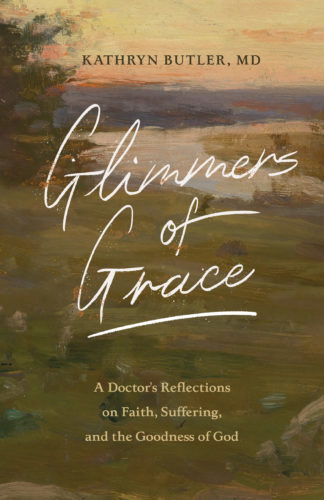
Kathryn Butler (MD, Columbia University) trained in surgery and critical care at Massachusetts General Hospital and Harvard Medical School, where she then joined the faculty. She left clinical practice in 2016 to homeschool her children, and now writes regularly for desiringGod.org and The Gospel Coalition on topics such as faith, medicine, and shepherding kids in the gospel. She is also the author of Glimmers of Grace.
The post Forgiveness to Cover All Wounds appeared first on Ever Thine Home.


July 19, 2021
My Favorite Summer Treats


The lyrics, “These are a few of my favorite things” sunk deep roots into my memory when I first heard Maria sing the catchy song in “The Sound of Music.” While I love “raindrops on roses and whiskers on kittens” there are other treats that make summer’s heat more bearable and delicious. Like:
Le Pops on Kavanaugh
and
bushels of peaches,
BLT sandwiches
and
Sweet corn’s gold goodness
If any of you are traveling by car on interstate 40 this summer through Little Rock it would be worth the time to stop for the best frozen treats in the South at Le Pops.
Le Pops makes the yummiest popsicles … actually that’s a misnomer for these iced lollies are nothing like the kid version from the grocery store. Our favorite, salted caramel dipped in dark chocolate, is lined up with colorful choices like Blueberry Lemonade, Coffee with Coconut Milk, Mint Chocolate, and a dozen more with new flavors offered daily. Laura and I always go when she’s in town from Memphis!


 (Dennis and Laura’s fave: Salted Caramel Pop dipped in Dark Chocolate Rolled in praline almonds!)
July in Arkansas is the beginning of peach season. Annually for years I loaded our van with my kids, bottles of water and baby wipes to clean hands of itchy peach fuzz and off we drove for a morning of peach picking at many of our state’s “pick your own” locations. We always came home with bags and bags of the deliciousness and ate them with every meal for weeks, with plenty more to give away to friends. I love peaches so much I’ve painted them several times.



Summer would not be complete at our house without a few juicy BLTs. The Natural State is home to famous Bradley Pink tomatoes and a huge selection of other varieties at farmer markets all across the state … if you don’t grow your own which half the population probably does!




Finally from my sappy little rhyme are only-found-in-the-summertime ears and ears of sweet corn, peaches and cream being our favorite brand. Dennis is so funny. Every time we get really good fresh ears of corn he says over and over how it’s his favorite. But he says the same thing about fresh locally-grown tomatoes, peaches, strawberries, and blueberries in the spring and more. He likes his food!


I’m sure you have your seasonal favorites too and we’d love to hear.
The post My Favorite Summer Treats appeared first on Ever Thine Home.
July 12, 2021
Heart Identity Matters


Opening an old journal I read some words I had written many years before:
“I really wanted to go to the meetings this morning, but here I am in our apartment being a mother. Mothering doesn’t stop. Children’s needs don’t stop. Sick kids can’t be delegated. So once again I’m isolated and he, my husband, is not.”
My words sprawled over the pages, laced with emotion, with loss as a result of my children’s needs.
Even as I reread them—my children all parents themselves now—I could feel the constant on-call responsibility, smell the diaper pail, remember the stress from drinks spilled, kid squabbles, childish messes. Our six, between the ages of six months and ten years old the summer I wrote those words, sent me to the brink of exhaustion … daily.
But there in the journal, I also found a prayer I wrote that same day. My heart was pleading, meet me here God, care for me as I care for my children.
“Father, I pray you will teach me more about my identity and my call as a mom. Teach me too the value of that call because so much of my work is inside these walls—unseen and immeasurable.”
Watching eyes
On New Year’s Day this year I read Jesus’ words about our Father who sees in secret. His words, “beware of practicing your righteousness before men to be noticed by them” (Matthew 6:1) shouted at me that day. I needed that reminder. That centering, grounding me to what matters.
The scrolling urge of social screams: Be seen. Be photogenic. Be appreciated.
Instead, the Spirit my Friend whispers, “Your Father who sees in secret will repay you.”

That unsettling, chaotic day decades ago sent me to His throne to ask and beg for Him to confirm purpose for me in my days void of accolades or measurable value or even seemingly simple household accomplishments.
I needed to hear Him say, “ You matter! Even though no one else sees what you do.”
I did not hear an audible voice giving me the affirmation I longed for, but the knowledge that I was giving my children the love and security and stability that no one else could give was enough to keep me going.
Instant connections
Texts have been plentiful in the last two months as my youngest is adjusting to first-time motherhood. This morning her newborn spit up all over her shirt and it ran down her chest into her bra. Children will never know or appreciate the sacrifice and love of a mother until they become one. More than once Laura has said, “I don’t know how you did this six times.”
Repeatedly I’ve texted her: “I remember … I understand … You are doing a great job.”
To all of you moms who are losing sleep, staying home with sick kids, giving the best years of your life to your children and wondering if you will ever have time to yourself again hear me say,
YOU MATTER!

Believe God sees and is taking account of your labors of love. Believe my word of encouragement and belief that your investment in your kids, even though you are unseen and have no great following, is more important that likes.
“And your Father who sees in secret will repay you!”
Count on it. It’s a promise from the One who cannot lie.
The post Heart Identity Matters appeared first on Ever Thine Home.
July 8, 2021
Ten Words to Live By


Note from Barbara: This summer I’m going to be sharing some books with you that will feed your own soul, help you invest spiritually in your kids or benefit your marriage in some way. The change of pace in the summer is a good time to make reading a priority.
The first of these recommendations is Bible teacher Jen Wilkin’s newest book, Ten Words to Live By, a fresh look at the centrality and eternality of the Ten Commandments. These words spoken by God to Moses are reflected throughout the Bible in the writings of Paul, Peter, and the other authors of the 66 books. Understanding God’s heart and desire behind His Words reveals His love for us His children and motivates us to want to please Him more.
The post below is an excerpt from her book, a taste to better understand these ten essentials for the Christian life. — Barbara
“Rules enable relationship.” The Ten Words graciously position us to live at peace with God and others. The Great Commandment, the one which Jesus says sums up all 611 of the general and specific laws of the Old Testament, bears this out:
“You shall love the Lord your God with all your heart and with all your soul and with all your strength and with all your mind, and your neighbor as yourself” (Luke 10:27).
The Great Commandment is the underlying principle for all right living.
Not surprisingly, the Ten Words follow the same pattern of Godward lawfulness first, and manward lawfulness second. The Ten Words are encouraging words, meant to give us hope—hope that we will live rightly oriented to God and others, hope that we will grow in holiness. They are not given to discourage but to delight. They are no less than words of life.”
A closer look at the first commandment
The first commandment, “You shall have no other gods before me,” is spoken in the language of a sovereign to a servant. There can be no dual allegiances when it comes to serving Yahweh. By commanding a singular allegiance, God does not merely assert that he is superior to other gods. Nor, in the plagues, does he merely demonstrate that he is stronger than other gods. He declares that they do not exist. They are nothing more than the vain imaginings of a darkened mind. The first word is more than a prohibition against worshiping lesser gods; it is an invitation into reality. “I am the Lord, and there is no other, / besides me there is no God” (Isaiah 45:5).
Why should Israel worship no other gods before God? Because there are no other gods.
Maybe that seems obvious. God has just routed his people’s greatest enemy and put their nonexistent gods to shame. But the truth that there is only one God to be worshiped must settle deep into the bones of the people of Israel, for God has brought his children victoriously out of polytheistic Egypt for the purpose of leading them victoriously into polytheistic Canaan.
After four hundred years in Egypt, polytheism would be more familiar to Israel than the monotheism the first word expresses. It would feel more natural than the singular worship God commands, as sin in comparison to righteousness so often does. The land just across the Jordan beckons with the comfortable familiarity of many-god worship. The likelihood that Israel would return to the familiar is high.
The call to monotheism would not be a new idea to Israel at the foot of Sinai. The creation account of Genesis 1 contains the implicit command to worship only God. Like the ten plagues, the six days of creation are purposely worded to topple any notion of worshiping sun, moon, stars, earth, sea, sky, plants, animals, or humans. All of the heavens and earth are shown to be derivative, dependent upon, and in service to the God without origin who effortlessly speaks them into existence.
But God’s people forget that pretty quickly. As early as chapter 35 of Genesis, we encounter a cautionary tale of divided worship among the children of God. It seems that between his exile in Paddan Aram and his return to Bethel, Jacob and his family had picked up a few household idol stowaways in their saddlebags. Though God has not explicitly commanded it, Jacob knows the idols must go:
So Jacob said to his household and to all who were with him, “Get rid of the foreign gods you have with you, and purify yourselves and change your clothes. Then come, let us go up to Bethel, where I will build an altar to God, who answered me in the day of my distress and who has been with me wherever I have gone” (Genesis 35:2-3, NIV).
The presence of idols among Jacob’s family points to the operation of a “both-and” mentality: yes, we will serve Yahweh, but also, just in case, we will offer devotion to these other gods, as well.
Dual allegiance. Can you relate?
This mentality hides in the baggage of believers today just as it did in Jacob’s family three thousand years ago. It’s an age-old expression of what James 1:8 refers to as double-mindedness. Double-mindedness occurs not because we replace God with an idol, but because we add an idol to our monotheon so that it becomes a polytheon. The repeated refrain on idolatry throughout Israel’s history will not be that she ceases worship of God entirely, but that she ceases worship of God alone.
An expansive obedience
The children of Yahweh today are not so different from the children of Yahweh then. Like Israel, we affirm that there are no other gods verbally and intellectually, but not practically.
Practically, we live as polytheists. Our idolatry is a “both-and” arrangement: I need God and I need a spouse. I need God and I need a smaller waist size. I need God and I need good health. I need God and I need a well-padded bank account.
In our minds, we rationalize that the “both-and” still offers God some form or degree of worship, so everything must be okay. Yet, according to Genesis and Exodus, to cease to worship God alone is to corrupt any worship still offered to him.
In Matthew 6:24, Jesus teaches us that “no one can serve two masters, for either he will hate the one and love the other, or he will be devoted to the one and despise the other.” We may think dual allegiance is desirable, but Jesus assures us it is not even possible. We are created for single-minded allegiance. We are designed for it. We are made in the image of one God, to bear the image of one God. We cannot conform to both the image of God and the image of an idol.

We are not designed to be polytheists, nor can we sustain the weight of a many-God lie in our minds. When we cling to God- and-______, we become “unstable in all [our] ways” (James 1:8).
It often takes a crisis to point out our folly. There is nothing like a financial crisis to teach us our worship of money and comfort in addition to God. There is nothing like a wayward child or a divorce to teach us our worship of having a perfect family in addition to God. There is nothing like the aging process to teach us our worship of health and beauty in addition to God.
It is at just such a crisis point that we find Jacob ready to expel the household idols. Penitent, he has just come face-to-face with his own failures. His daughter had been violated, and his sons had responded with terrible vengeance when he himself failed to seek justice. Jacob is a man broken of his self-reliance and soured on his own cunning. He is a man familiar with crisis. He is a man at last learning to pledge allegiance to God alone.
Whatever instability may be needed to bring us to repentance, the final solution to our practice of polytheism is found in Jacob’s story: “So they gave Jacob all the foreign gods they had and the rings in their ears, and Jacob buried them under the oak at Shechem” (Genesis 35:4, NIV).
Jacob could have destroyed the idols in any way. He might have burned them, thrown them in a lake, or hacked them to bits. Instead, he buries them under a landmark tree known as a place of idol worship. Determined to put the past behind him and live in the truth that God is his only hope, Jacob symbolically holds a funeral for the idols in the very place they were typically worshiped. With pointed irony, the place for idol worship symbolically becomes a burial ground for it.
Do not miss the moral of the story: to rid ourselves of our idols, we must put them to death.
*Bill T. Arnold, Encountering the Book of Genesis (Grand Rapids, MI: Baker, 2004), 137.
Content taken from Ten Words to Live By by Jen Wilkin, ©2021. Used by permission of Crossway.
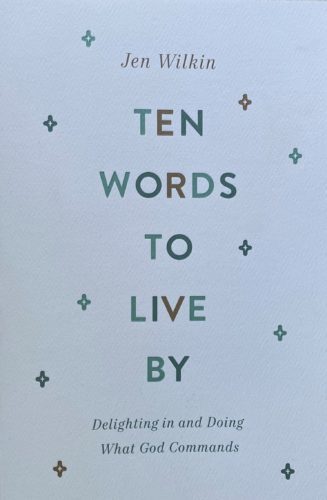
Jen Wilkin is a Bible teacher from Dallas, Texas. As an advocate for biblical literacy, she has organized and led studies for women in home, church, and parachurch contexts and authored multiple books, including the best seller Women of the Word. You can find her at JenWilkin.net.
The post Ten Words to Live By appeared first on Ever Thine Home.
July 5, 2021
Set Free to Free Others: The Bob Fu Story


He was born in China to a woman who was a street beggar in 1968. Extreme poverty and extreme injustice, not a safe home and stable parents, helped shape the childhood of Bob Fu and his sister. Despite overwhelming obstacles, Bob graduated from high school with hope of a better life as one of the millions of Chinese students who gathered in Tiananmen Square in June 1989 to peacefully protest against the Communist government by asking for more freedom and democracy.
When the shooting began Bob was absent, having left the city to be with his girlfriend—who later became his wife—because she was suddenly hospitalized from illness. Though his life was spared in the Tiananmen massacre that June, he was subjected to hours and hours of interrogations and interviews, some instigated by friends who betrayed him for their own favors with the government. Bob was disillusioned, disappointed, and full of hatred for many. In those days any flickering hope was lost.

Then Bob Fu read the biography of a Chinese pastor and soon after acquired his own copy of the Bible. Reading it voraciously he discovered, “If anyone is in Christ he is a new creation.” Immediately he received Christ and was born again.
Watching the wondrous hand of Providence at work in the stories of others has grown my faith since my college days when, as a new follower of Jesus, I read the miraculous stories about a man called Brother Andrew. Seeing Him guide, protect, rescue, supply, and provide for others helps me realize He must be doing that for me, too … only it’s not as easy to see in my own life from my up-close vantage point. Nothing is better than a first-hand account of an encounter with Jesus to remind me that He is at work and He knows what He is doing.

Bob says, “In China there is a saying that if you want to be a faithful follower of Jesus Christ … the first theological course you need to take is prison theology.” Like many Chinese believers, Bob and his wife spent time in prison for their faith. “After I was forbidden to share the gospel in prison, I started to sing every day, and everybody would sing, ‘Give thanks to the Lord.’ Then I was forbidden to sing so I started humming and others followed.”*
I love hearing this story of boldness. I always wonder if I would have the courage to do the same, but I trust God will give me what I need should I face what Bob and his wife faced.
Today Bob leads an organization called China Aid, formed in 2002 in the United States, whose goal is to help the persecuted church in China.
I love learning about God’s people all over the world who are working in thousands of ways to be the hands and feet of Jesus. They will probably never make headline news, but their names are written in the Lamb’s book of life, the only words that matter.
If you want to learn more about Bob Fu, read God’s Double Agent , published by Baker Books.
The post Set Free to Free Others: The Bob Fu Story appeared first on Ever Thine Home.
June 28, 2021
How Long Is an Age?


Last words are important. They’re meaningful.
Spoken before death or by a soldier leaving for deployment, parting words are memorable. Often those words keep the left-behind ones getting up each morning, counting the days as they wait for the anticipated reunion.
So the last words Jesus, before He ascended to heaven, are some of the most influential words ever uttered … they were remembered by His disciples both in the first century and by we His disciples in the 21st century.
Jesus charged His followers to make disciples in all nations. Then, with risen-from-the-dead authority, Jesus said, “… behold I am with you always, to the end of the age” (Matthew 28:20). Those who heard this promise believed it. Jesus had never lied.

Like all of us, I think of Jesus being with me always very personally; with me only, in my circumstances, in my world today. But I forget He has been with millions of His disciples for 2,000 years! His presence is never ending. It lasts beyond our lifetimes, “to the end of the age.” We today know what the disciples couldn’t have imagined: “to the end of the age” has been a very long time.
His disciples had wondered out loud, “Tell us, when will these things be, … and the end of the age?” In reply Jesus gave warning signs, vivid descriptions of days to come and told multiple parables. Though much is still unclear, two of his direct commands are unmistakable. “Be on the alert, be ready,” … “as you did it to the least of these my brothers, you did it to Me” (Matthew 24:42 and 25:40).
Our commission is to be ready and to be servants.
His promise is to be with us always.
From our first breath to our last, His presence has been and always will be with us. Psalm 139:16 describes it: “In your book were written, every one of them, the days that were formed for me, when as yet there was none of them.”
His presence spans farther still, not just the length of my life and yours but to the end of the age when He will be physically on earth again. “Be on the alert, for you do not know which day your Lord is coming” (Matthew 24:42).
During the days after His Resurrection, Jesus was with His disciples and hundreds of followers for 40 days, reminding them that He was both alive and present with them.
Though we cannot see His physical form as did the 12 disciples and others, He is with us even more closely. We who believe and follow Him today are indwelt by His Holy Spirit. This is astounding news. Jesus was only physically present with His people when He was on earth. At Pentecost His Spirit came to live, to dwell, to inhabit our physical bodies so that Jesus’ with-us presence is multiplied around the globe!

No matter how long it is until the end of the age comes, God is with us. That is the good news every day of our lives. We will never outlive His abiding presence!
Give thanks today for His with-you presence no matter what your world feels like today.
HE IS WITH YOU!!! Always!!!
Please click the link below to download and print:
The post How Long Is an Age? appeared first on Ever Thine Home.
June 25, 2021
Friends & Family Fridays #6


Happy Summer everyone!
Summer for me means early morning walks because it’s too hot later in the day, staying on top of the weeds which grow too fast, picking blueberries and peaches, and making lots of BLTs with farmers market Arkansas tomatoes. Seasons do seem to be defined around favorite foods and activities which gives life a satisfying rhythm.
Early June was very full for us. Week one was filled with the ongoing still unresolved situation we are in personally, (which I can’t yet share but thank you for your prayers), followed by week two and an RV vacation with our son Samuel and his family.

Dennis and I flew to blazing hot Phoenix AZ, arriving at sunset with the temp still 105 or more. We landed about the same time as Samuel and Stephanie’s three kids, all of us meeting at baggage claim. We loaded our bags in the rental car and drove to the hotel where Samuel and Stephanie were speaking at a Weekend to Remember.
Sunday morning Dennis and I delighted in listening to them speak and conclude the conference. They do such a great job! I know I’m biased. 

Then we got our rented RV and took off for Sedona, AZ, followed by days at the Grand Canyon and other sites, and ending at Zion National Park where we met up with our daughter Ashley and her family in their rented RV. We had spaces in the same campsite so the nine cousins had a great time playing games of all kinds and the six of us adults enjoyed our meals together and conversations by the campfire. We went on long hikes both days and enjoyed the beauty and glory of God’s creation.


Everyone enjoyed it so much plans are already being discussed for next summer!
After we returned I began a project I’ve been anticipating for a while; sorting through all my product samples and product archives. Now that we have closed the store it was time to organize and simplify all that remained. Since I enjoy organizing and making sense out of piles of things it was a satisfying accomplishment.


As June ends I’m looking at the rest of the summer as a time to refocus and hear from God about what He has for us. Dennis and I will be taking some days off to reconnect and be refreshed and to plan for the next year. In this season of life I’m more determined than ever to do only those things God clearly gives us to do.
The days ahead could be very short. No one knows God’s plans.
I’ve said before we need to be watching the sky … anticipating as never before the certain promised return of Jesus. I want to live ready to meet Him at any minute. Paul wrote to Timothy “there is laid up for me the crown of righteousness which the Lord, the righteous judge, will award to me on that day, and not only to me, but also to all who have loved His appearing” (2 Timothy 4:8).
No doubt all will be surprised in the moment of His return. But some will not be ready and might wish they’d paid more attention to His command to watch. I want to be in the company of those who have been watching, eagerly waiting and who “have loved His appearing.”
I hope you will be too.
The post Friends & Family Fridays #6 appeared first on Ever Thine Home.
June 21, 2021
50 Character Qualities We Hoped to Teach Our Children


Y ou’re getting your child’s classroom syllabus for all the benchmarks he’ll be required to know over the next months for science, math, art, and history. Wouldn’t it be nice to know what you needed to teach him for knowing God better?
Dennis and I made a list of 50 qualities we hoped to teach our children before they left home at 18. We worked on our list over many years and in the end didn’t accomplish all of them. But having a list of values, a vision for what we believed was crucial, kept us more focused on what mattered most.
Consider this post a parent curriculum … your teaching syllabus with one lesson plan tucked in to get you started. The course goal is to answer the question, How will you be your child’s primary influencer?
Dennis and I will never forget that incredible moment when our daughter Ashley was born. The doctor cleaned her up and handed her to us. Dennis said he wanted to blurt out, “Thanks for the gift, but where are the instructions?”
When we started this journey, we had a few ideas of what it meant to be a parent and raise children. We also had lots of idealistic resolutions about what we’d never do! In conversations short and long we talked randomly about what we hoped for: children who respected authority, who knew the value of work, and kids who were kind to others, especially those considered unlovable.
As a way to capture the hopes and vision we had for our children, we began to write our desires on paper. We knew releasing godly, mature children who could stand on their own at 18 would take intentionality from us.
Modeling was crucial, but so was instruction, as Solomon wrote to his son, “Listen my son to your father’s instruction, and forsake not your mother’s teaching” (Proverbs 1:8).
Raising children requires huge chunks of time, prayer, discipline, involvement, and relationship-building. To make the most of all of this parenting love, effort, and privilege, it’s best to know where you’re headed.
Here’s our list of the 50 character traits we wanted to teach our children. It is presented here pretty much as it appears on a now-tattered 8.5 x 11 piece of yellowed notebook paper. It’s not fancy, but it is a glimpse into our God-focused values for our kids.
At the at the end of the list, I’ll give you a practical way or two to begin to teach a few of these concepts to your children.
Above all, fear God.Respect authority—trust and obey your parents.The importance of friendships.Be in love with Christ and focus on your relationship with Him, not just on doctrine or on biblical principles.Have compassion for the poor and orphans.Believe God for too much rather than too little.Real strength is found in serving, not in being served.The power of moral purity and a clean conscience.How to motivate people without manipulating them.How to handle failure.Keep your promises.The power of the tongue for good or evil.Give too much rather than too little.The importance of manners and common courtesies.View life through God’s agenda—the Great Commission (Matthew 28:16-20) and the Great Commandment (Matthew 22:37-38). Give thanks to God in all things.The importance of prayer.The art of asking good questions and carrying on good conversation.How to grow as a Christian.How to handle temptation.By faith, trust Christ as your Savior and Lord, and share with others how to become a Christian.Seek wisdom—skill in everyday living. Knowing how to make good decisions.Gain a sense of God’s direction and destiny for your life.Stay teachable and do not become cynical.Obtain godly counsel.The importance of flexibility and adaptability to cope in life.Truth is best passed on through relationships.Leave a legacy of holiness.Keep life manageable. Prioritize decisions.Tame selfishness—you can’t always get your way.Choices are yours to make and results are yours to experience.Respect the dignity of other people—all people.Be faithful in the little things.Character is the basis of all leadership.Life isn’t fair—don’t compare with or be jealous of others.Live by commitments, not by feelings.Express grace and forgiveness.A strong work ethic.Surrender to the authority of Christ.How to handle your finances.Major in the majors, not in the minors. The principle of remembrance: milestones and landmarks. Importance of accountability or the deadly nature of isolation.How to motivate people without manipulating them.The importance saying no often to keep life manageable.Respect the dignity of all people.How to lead and how to follow.Mediocrity is a reproach against God.Assume nothing and regularly inspect critical areas in your life. Love conquers all—better to be kind than to be right.Does the list feel overwhelming? It did to me too. It would have helped if Dennis and I had taken the time to synthesize the list, edit it down to the essence, or prioritize the top 10 or even 20. But we were too busy keeping our family afloat to fine-tune this list. Still it was a reminder of our goal and that was its purpose: to keep us going in the right direction.
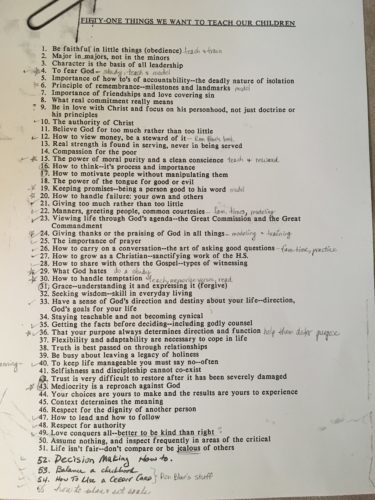
One of the most important of these for us was #37: Express grace and forgiveness. It’s a value that can be taught to children from ages 2 to 18.
Dennis and I had learned in our marriage the importance of naming our offenses when we hurt one another and then asking for specific forgiveness. So we taught our children the same.
As soon as they could talk and purposefully hurt a sibling, we coached our children to repeat after us: “I’m sorry I [hit you … took your toy … etc.]. Will you forgive me?” We then coached the offended sibling to say sincerely: “I forgive you for [hitting me … taking my toy…].” Then we made them hug each other.
No parent can change a child’s heart, but we can train our children in the right way to resolve conflict and pray for God’s heart-changing power to work in them. This quality was a must for us because relational conflict will be with all of us for life. Helping our children be specific and name their sin sets them on the pathway to understanding their need of a Savior and establishing healthy relationships.

This lesson on forgiveness was one we repeated thousands of times, and sometimes the lesson got complicated. When one of our sons was about 10, he took his brother’s prized penny from his penny collection. Our first challenge was to confirm that he in fact stole the penny and not someone else, because he denied being the thief. Then we had to deal with his lying about it. Then we had to teach restitution after he’d finally confessed, apologized, and asked for forgiveness. Clearly this instruction elevated to more than “repeat after me.” And it took hours of our time one evening to get the facts and teach the lessons.
Relentless is a good word to describe the work of parenting. Too often parents give up or let situations like this one with our son slide by because they are too tired to deal with it. We understand. We felt the same way most every day.
But if you choose to ignore these offences you are missing crucial teaching opportunities God is giving you. And you are undermining another key value, the fear of God. If your child believes he can get away with sin, there is little reason for your child to avoid it. If you don’t pursue the truth and hold her accountable for her actions, all motivation for doing good evaporates.
No, we didn’t perfectly teach each and every one of these lessons to our kids, but we were committed to being intentional about reinforcing these qualities every time we had the opportunity. For 28 years we never stopped training, teaching, and cheering our children on. As Galatians 6:9 tells us, “And let us not grow weary of doing good, for in due season we will reap, if we do not give up.”
How about writing your own list? What character qualities and values do you want to teach your children before they leave home?
In our book, The Art of Parenting , Dennis and I write more about the process of writing your own list of values to teach your children. This will make a huge difference in your marriage and in your parenting. If you take the time to create a unified list of values, you will be operating literally off the set of blueprints And nothing is more important for kids than unified parents. If you are a single mom this will be easier for you but especially important because you need their help and working with them as a team for the good of your family will instill great character qualities that will last a lifetime.
The post 50 Character Qualities We Hoped to Teach Our Children appeared first on Ever Thine Home.
June 17, 2021
Summer Bucket List: 30 Ideas to Try This Summer


Janel is a dear friend to Ever Thine Home and has contributed many blog posts over the years. Her writing is very whimsical and yet also full of wisdom. She is a mom to four kids so she is no stranger to the challenges of summer and the pressure to keep little ones entertained. She is finishing up her first book, Permanent Markers: Spiritual Life Skills for Work-in-Progress Families that releases later this year. Enjoy these fun ideas and I hope you are able to incorporate these into your summer plans. — Barbara
Has your family started the summer break countdown? It’s important to make your time with your kids as intentional as possible. But knowing where to start isn’t easy. Here are 30 ideas to try this summer.
Ideas to do with younger kids:
Have a marathon story time. Pile together on the couch or on the bed and snuggle into an adventure — or a lot of little adventures.Grab the roll of art paper and let your kids draw a table-length network of roads for their Matchbox cars, complete with buildings, trees, or whatever — or let them draw a house that their dolls can sit in. Take a few minutes to get down and draw with them.Put a “do nothing” day on the calendar. Purchase fun snacks and veg doing stuff together all day: playing games, watching movies, going to the park — whatever a fun day looks like for your family.Let ‘em camp in the backyard. Make s’mores over the grill for an authentic-feeling (and tasting!) snack.Make a heap of creative greeting cards to send to people you love. As a bonus, take pictures of each other (maybe as you make the cards!), print them, and stick them in the envelope with your works of art.Pick a Scripture verse or passage you think they can handle, and memorize it together. Decide on a reward if you can both do it!Let them write, direct, costume, sell tickets for, and otherwise plan a play in the backyard. If they need starters, let them act out a favorite storybook or Bible story. Your role: the audience.Have a sleepover with that friend they’ve been missing. Or, challenge your son or daughter to invite someone over who might be feeling lonely.Get your heads together to plan one act of service every week — maybe as a surprise.Have an ice cream sundae night.Help them choose one thing they’d love to do this summer (like sleep in, or have a friend over) and one project to tackle that they’ve been putting off (like cleaning the closet). Then develop a plan for both.Take them out to lunch or breakfast, just the two of you.Fly kites together.Make sock puppets, and then put on a show. Or do the old-fashioned draw-on-your-hand and turn your hand into a puppet. Duck behind the couch and use the top of the couch as the stage. Have them act out a story they already know from a movie or something you’ve seen or read recently.Sing old camp songs and teach the kids how to sing them.
Ideas to do with older kids:
Pick out a book you both want to read this summer so that you can talk about it together.Learn something new together. Maybe they’d like to learn how to sew, put together a model, bake bread, carve something, make candles, build something in the shop, scrapbook — or even take a one-time class with you somewhere around town.Put a “do nothing” day on the calendar. Purchase fun snacks and veg doing stuff together all day: playing games, watching movies, going to the park — whatever a fun day looks like for your family.Pick a room to repaint and/or, within a budget, redecorate together.Go local. Do something around your town that you haven’t done before!Pick a night to plan and make a meal together.Have a game night, but make it a tournament with a prize everyone wants: a day with no chores, a gift certificate to the movies, or a “date” with a family member of choice.Go on a spontaneous road trip, just the two of you.Get your heads together to plan one act of service every week — maybe as a surprise.Let them have friends over to make their own personal pizzas in cake pans and watch a good movie.Take them out for lunch or coffee, just the two of you.Go to a park with a picnic, a camera, and maybe a good book. Relax, chat, and shoot photos of one another.Drive down a country road with Vivaldi’s Four Seasons blaring out your rolled-down windows.See an Independence Day Parade. Then teach your children about Independence Day.Go on a picnic.Okay, your turn: What are you doing this summer? And do you have any ideas for the rest of us?
 Janel Breitenstein is an author, freelance writer, and speaker. After five and a half years in East Africa, her family of six has returned to Colorado, where they continue to work on behalf of the poor with Engineering Ministries International. Her first book, Permanent Markers: Spiritual Life Skills for Work-in-Progress Families (Harvest House) releases October 2021. You can find her—”The Awkward Mom”—having uncomfortable, important conversations at JanelBreitenstein.com and on Instagram @janelbreit.
The post Summer Bucket List: 30 Ideas to Try This Summer appeared first on Ever Thine Home.
June 14, 2021
Dear Barbara: Do Second Marriages Matter?


Dear Barbara: Do second marriages matter? You talk so much about staying together and making marriage work. What if my first marriage didn’t and now I’m trying again? Can I honor God with a new marriage?
I appreciate the honest question. When we added an official ministry to stepfamilies several years ago at FamilyLife, we received a lot of comments on both sides of this question. Many asked how we can be for blended families, second marriages, and subsequent families if we are against divorce. Especially since God is so adamantly against divorce.
It’s a fair concern if we look only at what God is against. So instead of starting with what God hates, let’s go to the beginning and look at what He is for. God designed marriage. It was His grand idea. Therefore, He is for marriage. The reason He is so against divorce is because He loves marriage and what it represents so much!
So I’ll let you help me answer your question, “Do second marriages matter?” by asking another question. “Does marriage matter?”
YES! Resoundingly yes. And since marriage matters, every marriage matters: first marriages, remarriages, second marriages, subsequent marriages.
Every marriage matters to God. So if you’re in a wedded covenant relationship with your spouse and God, then your marriage matters. Your current covenant is held in absolute equal honor, value, and esteem as any marriage covenant.
Ron Deal, head of FamilyLife Blended, says many in second marriages feel like second-class citizens. That’s not what God intends. Ron suggests that even though you may not live in an “ideal” family configuration, Christians in stepfamilies certainly aren’t second-class Christians in God’s kingdom.
In our own way, each of us has fallen short of God’s glory, and each of us needs His grace. God’s plan of one man and one woman in marriage for life does bring greater harmony to the home, but living in an intact family does not determine worth in God’s eyes, nor ability to receive God’s forgiveness.
To prove it, let’s look at one stepfamily found in the Bible. Look at Abraham. He lied on two occasions, saying Sarah wasn’t his wife. He was afraid for his life so he publicly disowned her.
As women living in a multiple-marriage household, Sarah and Hagar fought over which of their sons would be the most important in Abraham’s family. Much like a modern-day stepfamily, there was jealousy, bitter rivalries, and loyalty conflicts between Abraham and his two wives (see Genesis 16 and 21). And the problems didn’t stop with his generation.
If we analyze the families of Abraham, Isaac, and Jacob, often referred to as the “family of promise,” we see power struggles, family secrets, exploitive and coercive relationships, marital game-playing, manipulation, and parent-child alliances for selfish reasons.
Apparently, according to these stories God wanted us to know about in His Word, you can have a less-than-ideal family and still be acceptable to God. Ron draws the obvious conclusion: God loves stepfamilies and the individuals who live in them, too.
There are no second-class citizens in God’s kingdom simply because there are no first-class citizens. Equally, there are not important marriages worth fighting for, and unimportant marriages that don’t matter because others didn’t work out.
We’re all just sinners in need of a Savior. If God could use imperfect men like Abraham and David with complicated family households for His purposes, why can’t He use people in stepfamilies? If God can bring redemption to the houses of Isaac and Jacob, can’t He bring redemption to yours?

The exciting message of the cross is this: God loves and forgives the imperfect people in stepfamilies and subsequent marriages just like He loves and forgives the imperfect people in first marriages with biologically intact families.
Do you know another reason second marriages matter? They model marriage to the next generation. Even if a first marriage failed, this marriage can last. You have a renewed chance to leave a legacy of commitment and family health for your children and grandchildren.
Future generations are influenced by preventing redivorce and strengthening stepfamilies to improve the environment in which the children grow up. Children from healthy stepfamilies have healthier attitudes about marriage, make better choices, and are more likely to remain in one marriage for life. All it takes is one generation and the generational cycle of divorce is broken to redeem a family legacy.
Again, be assured. Your second marriage matters: in covenant to God, to your own personal health, to the future history of your family. We’re here to help you make your marriage last.
For more, check out Ron Deal’s post God Loves Stepfamilies Too.
Visit FamilyLife Blended online.
Go to a Weekend to Remember.
The post Dear Barbara: Do Second Marriages Matter? appeared first on Ever Thine Home.
Barbara Rainey's Blog

- Barbara Rainey's profile
- 24 followers

