Tim Calkins's Blog, page 9
August 18, 2022
The Hearing Aid Branding Battle

Hearing aids are in the news this week, as the FDA announced new rules allowing people to buy some of the devices over the counter. Previously you needed a prescription.
This simple rule change will transform the industry.
Hearing Aid BrandingHere is a simple quiz about hearing aid brands.
1. How many brands of hearing aids can you recall?
2. What is the premium brand of hearing aids? What is the discount brand?
3. Who owns these brands?
If you didn’t do very well on that unaided quiz, let’s make it easier and consider aided brand awareness.
Which of these hearing aid brands are you familiar with? Jones, Anta, Widex, Ramya, Oris?
I suspect you didn’t do very well on the unaided quiz questions. On the aided quiz, only Widex is actually a brand of hearing aids. Hopefully you at least got that one right.
A Strange WorldHearing aids are a strange industry. It is a huge market; sales in the U.S. alone exceed 4 million units, often at a price of $3,000 to $5,000. Four million units at a price of $4,000 each would give total revenues of $16 billion.
The primary target base is older people, a group that is often overlooked when it comes to trendy marketing. A few huge companies dominate the industry. In a curious twist, many of them are based in Denmark. The big Danish players include Demant (Oticon brand), GN Store Nord (Resound brand) and WS Audiology (Widex and Signia). Starkey is a large U.S. based player.
Historically, hearing aids were sold through audiologists, a group of trained and licensed medial professionals. Indeed, the only way someone could buy a hearing aid was with a prescription. As a result, companies focused on professional marketing since audiologist recommendations counted more than consumer preference. There has been very little consumer brand building or marketing in the industry.
The focus on professional marketing limited competition. The barriers to entry were enormous, and motivation to switch was low. All the players manufactured good products and adopted new technology as it came along.
The New RulesThis week the FDA announced that consumers could soon purchase some hearing aids over the counter. It would no longer require a visit to an audiologist for a test and fitting.
This changes the situation dramatically. Now someone will be able to simply walk into a Walgreens, buy a hearing aid and start it up.
It is a new game.
The OutlookDoes this mean you should run out and start a hearing aid company? Perhaps.
I suspect it would not be difficult to manufacture a decent hearing aid. Many companies do it, and the world is presumably full of people who used to work at these firms and are familiar with the technology. It would also be easy to assemble an advisory board of respected audiologists and develop an innovative brand. A strong spokesperson, some social media influencer support, and off you go.
But the big question is this: how will the existing players respond? Will they defend?
If the established players defend their business, they could block new entrants. Remember, these are huge, immensely profitable companies. WS Audiology, for example, has over the 2 billion euros a year in revenues and over 400 million euros in profit. The companies have deep expertise in the industry and strong connections with key players. If the established players are aggressive, they could easily protect their business.
Indeed, while some say the new rules will lead to more competition, it might have the opposite effect. The industry might consolidate, and just one large player takes over. This is what happened with glasses and Luxottica.
But if the established players don’t defend, then there is an opportunity for new entrants and innovation. An intriguing, fun brand could fundamentally change the industry. Why are hearing aids just for older people? What is the difference between an ear bud that plays music and a hearing aid? When you look at the amazing range of innovative new direct to consumer brands on the market, it is easy to see the opportunity.
So, will the established players defend? I suspect not. These are old, privately owned companies. Consumer marketing is intimidating. These firms have never been great at consumer branding. The required spending will seem unreasonable.
As HBS professor Clay Christensen warned, there is a huge incentive for established players to focus on the existing business, even if that means not investing in innovation.
Call MeIf you’d like to start a new entrant in the space, give me a call. I suspect this could be great fun and a big opportunity.
The post The Hearing Aid Branding Battle appeared first on STRONGBRANDS.


August 3, 2022
Marketing Lessons from a Market Pig Auction

Last weekend my daughter Anna and I headed up to the Racine County Fair. We enjoyed seeing all the animals and exhibitions, including the first placed pies and tomatoes. The highlight was the 4-H livestock auction; we watched the end of the steer auction and most of the market pigs.
I was once again impressed by how much you can learn about marketing and business from the event.
The AuctionsThe livestock auction is the culmination of a much longer program: kids buy young animals and then raise them for several months. In the market hog program, someone buys a piglet weighing about 30 lbs and then cares for it five months or so. By the time it gets to the local country fair, the animal might be 280 lbs.
During the auction, each 4-Her comes out with the animal while the audience bids. Prices far exceed the market price. Live market hogs are selling these days for $1.20 per pound but prices at the Racine County Fair on Saturday were $3 and up.
The prices were all over the board. Bidding for most pigs started at $2.50 per pound, and then went up to $3.50 or $4.00. But some really took off, selling for $11 or $12 per pound. That is a lot of money for 275-pound hog.
In total, buyers purchased 77 steers and 241 hogs on Saturday. A lot of kids and animals!
The LessonsHere are four things one can learn from the 4-H auction.
Relationships Matter
Most of the buyers were local businesses: Fox River Home Care, Wilco Excavating, George’s Grating, and Kevin Schmidt Siding all purchased animals as we watched. These businesses are supporting the community and their customers. This is the sort of thing that creates real value.
I sat next to a nice fellow at the auction who was a local electrical contractor. He was watching for several kids, hoping to support one of his customers.
This makes perfect marketing sense. If you show up at an auction and buy the pig raised by your customer’s child, you build that relationship. You were there for your customer. They, in turn, will likely be there for you. They aren’t going to go to another provider with a slightly lower price. They will give you a referral. They will support you.
Let People Know
The hogs that went for a lot of money had several bidders running up the price. The buyers were motivated and ready.
This means, of course, that someone let them know in advance. The odds that one of your suppliers will happen to be at the auction and recognize your kid and connect the dots is very low; it all moves too quickly. You have to give people a heads-up.
The learning: let people know when your kid is selling their pig, or when you are running a marathon for a cause, or raising money for a charity you care about. If you give people a chance to help, they will likely show up. More important, they will be thankful for the opportunity to help.
Enthusiasm Is Key
One of the factors that seemed to lead to higher prices was the kid. Younger kids generally did better than older kids, which makes sense. The more powerful factor: attitude. Some kids were smiling and cheerful and positive. They had dressed up for the occasion. They seemed happy to be there. These animals went for high prices.
Take Care of Your Customers
The Racine County Fair team rolled out the red carpet for buyers. They sent free passes to the fair to prior buyers, reminding them of the time. At the check-in, there was free coffee and donuts. A local store was sampling sausages and cheese (this is Wisconsin, after all). The check-in team was super organized and positive.
All of these things put the buyers in a good mood. By the time they settled down, the buyers were ready to bid.
An OpportunityThere is still time to get to a county fair this year and watch the auction. I recommend it. You can also buy an animal and help a young person.
Last weekend Anna and I ended up buying a hog from a boy named Connor. We donated the meat to the local food bank and walked away feeling great about the day and rural America.
The post Marketing Lessons from a Market Pig Auction appeared first on STRONGBRANDS.
July 20, 2022
Interlochen’s Debatable Decision

There are a lot of big issues in the world. There is a war in Ukraine. Global warming is changing our environment in profoundly negative ways. The U.S. is battling inflation and fractured over abortion. It is exhausting.
So, this week, I’d like to focus on a very small issue: the tradition of not clapping after the playing of the theme song at Interlochen Music Camp. In a small way, this issue represents the challenges many brands are now navigating.
Interlochen and the ThemeInterlochen is a famous music camp and school outside of Traverse City, Michigan. The camp was founded back in 1928, and over the years many of the most gifted musicians in the world have studied and performed there. It is a place where musicians, artists and writers gather to study and learn from each other. Nestled in the woods, it is a magical place.
One of the most interesting traditions at Interlochen has been the playing of its theme song after every concert. Once the main performance is over, after all the clapping and bows, the concert master conducts the theme: a short section from Howard Hanson’s Symphony No. 2, which was composed in one of the camp’s cabins. You can hear it here.
After the theme, according to tradition, there is no applause. The lights come up and the audience quietly exits. Often it isn’t perfectly executed; a few people clap, not aware of the tradition, and are shushed by the audience.
Apparently, the tradition started when the concerts were broadcast on the radio; the silence was necessary to transition to the next program. It is a tradition lasting many decides.
A ChangeThis year, however, things are different. Instead of asking the audience to be silent, people are asked to remain seated. So, people applaud, as they might after any piece, and eventually leave.
I asked Trey Devey, the President of Interlochen, about the change. He wrote back and explained the move:
In recent years, however, we noticed that rather than this being an inclusive tradition in which the entire audience took part, the silence was confusing and exclusionary for new attendees. As much as we tried to communicate the practice of not clapping, many in the audience clapped. When new audience members were shushed or gestured at for clapping as they would at the end of concerts in other venues, it was off-putting. Some indicated that they did not want to return to our campus.
When you look at this situation with a marketing lens, you quickly realize the team at Interlochen has made a very debatable decision. Here is my analysis, and why I think it was an unfortunate move.
Any business decision needs to consider benefits and costs of a policy change. First, what are the benefits? What is the upside in a particular decision? Second, what are the costs? Costs can be financial but also might include customer happiness and social good.
Of course, this tradeoff is only relevant when the matter at hand isn’t about legality or ethics. If something isn’t legal or ethical, then an organization shouldn’t do it. The question of costs and benefits must be set aside.
For Interlochen, this is a costs and benefits decision. There is nothing legal or ethical in question. It isn’t illegal to ask people not to clap, nor is it unethical.
The Benefits
Being inclusive is a noble thing; I think we can all agree this is important. Certainly, for Interlochen and the broader world of classical music, expanding the audience is essential.
The benefit of the policy change is that some people won’t be shushed at the end of a concert.
Now, I would love to see data on the number of people who were deeply offended by this tradition, especially the number of people who abandoned either Interlochen or classical music as the result of that moment. Still, I am sure it has happened.
Of course, if the data showed that a significant number of people really find the silence after the theme off-putting, there are ways to address it. Perhaps someone could explain the tradition each evening. Perhaps there could be signs. At some game shows there are “clap now” signs for the audience. Maybe Interlochen could install a “don’t clap” sign.
The Costs
The reality is that changing the treatment of the theme seems easy, but it is not a cost-free move.
First, the move is annoying at least some supporters. Interlochen is a place that relies on a core group of advocates and champions. Generations of students know the theme and the tradition. In cluttered, busy, stressful world that moment of quiet has huge impact. Some of these supporters will not be happy to learn that the tradition was abandoned due to inclusivity.
The inclusive argument raises complex questions. If Interlochen wanted to be more inclusive, it could do many different things. One easy change: reduce the price of tickets or move to a “pay what you can” model. A more interesting change would be eliminating auditions. Requiring people to compete for spots at the camp and in certain ensembles is not inclusive.
Second, there is a broader cost in terms of the brand. Traditions are hard to create. One of things that makes organizations and brands special are the quirky and unexpected behaviors and design elements.
The OutlookI suspect the team at Interlochen didn’t do a lot of research on this decision. I am sympathetic; it would be a difficult question to study. I think it was the wrong decision.
The good news is that Interlochen can easily reverse the policy. There is no financial cost. A simple explanation would be fine.
In the end, it might all be for the best: the team at Interlochen has learned one thing that people care about. One could consider this inexpensive market research on its brand. If, of course, the team at Interlochen listens to the feedback.
If you want to email Trey Devey, his email is presidentsoffice@interlochen.org
The post Interlochen’s Debatable Decision appeared first on STRONGBRANDS.
July 13, 2022
Airbnb’s Incentives Problem

Airbnb’s stock is way down this year. Back in November, the stock was trading over $205. Today it is less than $95.
So, should you invest? The price is down much more than the stock market overall, so perhaps this is the moment.
While Airbnb is a remarkable brand, it is facing some complex incentive problems: the stakeholder groups Airbnb relies on are not always motivated to help the company.
Understanding stakeholder incentives is critical. In general, when all the players involved in a brand have an incentive to support it, the organization will flourish. Everyone works together in a positive cycle.
Take my institution: Northwestern University’s Kellogg School of Management. Professors have a big incentive to teach well: everyone likes having happy students and positive evaluations. The school administrative team has an incentive to create a great experience for students. Students have an incentive to make the most of their time, creating programs, making improvements, bringing excitement and enthusiasm. The alumni have an incentive to support the school however they can. Everyone has a reason to work together to make Kellogg a special place.
When people have mixed incentives, things become more challenging.
The OpportunityOn the surface, Airbnb looks like a supremely promising company. First, it is an exceptionally strong brand. People know Airbnb, and the overall proposition is clear. Second, the business in on-trend. Travel is rebounding, and home stays have an edge over hotels in a world of remote work and social distancing. Third, Airbnb provides a service people want. Owners need to find travelers, and Airbnb fills that need. Travelers want to identify places to stay, and Airbnb fills that need, too.
Airbnb also benefits from network effects and limited competition. It would be very difficult for a new entrant to enter the market in a significant way.
What could go wrong?
The Incentives ProblemThe issue is that Airbnb has a massive incentives problem. Travelers, owners, local governments: These key stakeholders are not incented to help Airbnb succeed.
Owners
Property owners have a big incentive to deliver a great experience. One thing that works well on Airbnb is the traveler review process. Owners often focus on the customer reviews and want travelers to be happy. This incentive is critical to Airbnb’s promise and success to date.
The problem is that owners don’t have an incentive to flag the problem renters. There are some terrible renters out there – people break things, hold massive, wild parties, and disturb the neighbors. I rent a place in Colorado and this winter had one set of renters depart leaving all the doors and windows wide open. Apparently, this isn’t uncommon behavior – the fresh air blows away the cannabis smoke. The house was scheduled to be empty for several days, so I was very lucky that I saw the problem and all the pipes didn’t freeze.
But why would an owner post a bad review on a guest? There is no immediate benefit for being honest. Helping the community is of course great, but that is a fairly intangible benefit. There are some very real costs, however. If you go after a bad renter, they won’t be happy. They also know where to find you. They know your house. They can post a bad review, or worse. A motivated renter is dangerous. Remember: we’ve established that this is not a good person. Why annoy someone like that?
As a result, many of the bad guests don’t get flagged. They just move on. A bit like when people behave inappropriately at a firm; the company usually just lets the person leave to “pursue other opportunities.”
These bad renters are hard to catch and make people reluctant to list their houses.
Travelers
One would think travelers have a big incentive to help Airbnb. But this isn’t really the case. Travelers want to minimize their expenses and maximize their experiences. There aren’t many downsides for misbehavior.
Have a big party? This might not be approved behavior but what is the worst thing that will happen?
Put 20 people in a house limited to 5 people? Sure.
Play music late at night in a quiet neighborhood? Why not?
Two things protect the traveler. First, the owner isn’t likely to report bad behavior; the traveler can always threaten to post a bad review “A nice place but the bed bugs were bothersome.” Second, Airbnb doesn’t have great options. Kicking someone out of a property in the middle of their stay? That would be complex to execute. How do you do that? Ban someone from Airbnb? Perhaps. But the traveler can get a new email address and show up as a different person.
Travelers have an incentive to take full advantage of a property, not to treat it with the care the property owner wants.
Local Governments
A growing threat to Airbnb and other short-term rental firms is regulation. More and more communities are taking steps to limit the number of licensed properties, impose onerous fees and create massive administrative hurdles for owners.
The issue here is that local governments have a huge incentive to do this. Who are the voters? The people who live in the community. These are usually not the property owners. They certainly aren’t Airbnb employees.
Even people who have rental properties have an incentive to support regulations. If you currently have a short-term rental property, what is your incentive? You likely want to create regulations that block additional properties. The more competition, the lower the prices. For existing property owners, regulations make a lot of sense.
The OutlookPut it all together, and Airbnb is facing a tough future. The number of new properties isn’t likely to grow, due to local regulations and nervous owners. If anything, the number of properties might fall. Stories of terrible renters will drive away your casual renter. Who wants that risk for a few thousand dollars?
Prices will go up, as the robust demand reaches a shrinking supply.
Travelers might then feel more entitled than usual. If you are paying a huge amount, why not fully enjoy the setting?
The question for Airbnb is this: how do you reshape some of these incentives? How do you encourage owners to post honest reviews? How do you encourage travelers to behave responsibly? How do you make short-term rentals a positive for local towns?
I would like to provide a solution, but I’m stumped. Any ideas? Without solutions, Airbnb is facing a bumpy future.
Maybe that lower stock price isn’t such a bargain after all.
The post Airbnb’s Incentives Problem appeared first on STRONGBRANDS.
June 30, 2022
Rebranding the Abortion Debate

The big news this month, of course, has been the Supreme Court’s ruling overturning Roe vs. Wade. This is the first of two articles I’ll be writing about the ruling.
This week’s theme: both supporters and opponents need words. We need to rebrand the abortion debate.
Brand Choice vs. Brand LifeIt used to be easy to communicate someone’s position on abortion. If you generally supported a woman’s right to an abortion, as defined by Roe vs. Wade, you were Pro Choice.
If you were against the idea of choice as defined by Roe vs. Wade and wanted tighter restrictions, you were Pro Life.
It was easy: two options, well defined. The brands were clear. One could argue that the abortion opponents had the higher ground in terms of wording. Life trumps Choice.
Today’s Complex WorldNow that Roe vs. Wade has been struck down, things aren’t so simple.
What does Pro Life now mean? It isn’t clear. It can’t be opposition to Roe vs. Wade since that is no longer a factor. Is it opposition to any abortion, even if the mother’s life is in danger? How about in cases of rape and incest?
Maybe being Pro Life means that contraception isn’t ok since there is the potential for life.
In terms of enforcement, what do Pro Life supporters believe? Should local police officers be able to search a house looking for abortion medications, or seize an iPhone looking for search terms? How should law enforcement deal with women who suffer from a miscarriage, when the cause isn’t entirely clear? Should physicians who treat women who have side effects after taking abortion medication be sent to jail?
Should police officers battling drug use and violent crime be redirected to finding women who take abortion medications or have a miscarriage?
Being Pro Life isn’t defined anymore – the brand has lost its meaning.
How about Pro Choice? What does that mean? Is that favoring no restrictions at all? Or is it supporting abortion in limited circumstances? Is 16 weeks a magic number? How about 8 weeks?
Polls tell us most people fall in the middle, supporting some restrictions but not too many. There are no words for this middle ground.
RebrandingWe need new brands that communicate more precisely in this fluid world. Choice and Life are binary and far too blunt. We need to rebrand the discussion.
Supporters of various positions might create these brands, using positive words that have broad support. Maybe Freedom, Independence, Balance, Liberty, Family, Faith, Child.
More likely, perhaps, political opponents will create them, using negative words. Crazy, Extreme, Rabid, Dictator, Czar, Terrorist.
Defining these brands early is critical. People against abortion are at risk of being labeled extremists or dictators. People supporting some abortions are at risk of being defined as anti-family, anti-child, crazy-choicers.
Looking AheadWatch for the brands to catch on as we head into the elections. Maybe: Crazy Lifer, Balanced Freedom, Independent Thinking, Reasonably Restricted.
Which terms will stick? Which brands will emerge? This will be interesting to watch, and profoundly important.
The post Rebranding the Abortion Debate appeared first on STRONGBRANDS.
June 13, 2022
Advice for Graduates

Today is Commencement Day at Kellogg! This is one of the best days of the year on campus. Graduates are taking pictures, visiting the Global Hub with family, and getting ready to walk across the stage.
Marking these moments in life is important. This is a particularly happy milestone, full of hopes and anticipation. It is bitter-sweet, too, as a memorable phase of life ends.
I traditionally post some financial advice to the graduates, but this year I will focus on broader career suggestions instead. If you want financial advice, you can take a look at my posts from 2021 or prior years. With the stock market bouncing around the advice to live a modest life, consistently save and invest for the long-term is more important than ever.
So, graduates, here are four things to keep in mind as you launch the next phase of your career.
Get Off to a Quick StartIn the next few weeks, you will start working, now as a Kellogg graduate. For most of you, this will be a new company or position.
As you start, focus on making a good impression. Your personal brand – your reputation – matters. If people think you are smart, enthusiastic and a great team-player, good things will happen. You will get opportunities and promotions. If you make a mistake, people will forgive you.
People form impressions quickly. Research tells us that people make judgements in just a few seconds. By the time your first month has gone by, you will have established your brand.
Start strong! Get in early. Dress well. Create powerful presentations. Look for ways to be helpful. If someone needs a report copied, make the copies. Be super enthusiastic. Don’t complain. If you end up with a desk in the furnace room in the basement, say “Wow! I love this; I’m so happy to actually have a desk, and this will be warm in the winter months!”
Most important – double check your work. Read your emails three times before sending them. Look for typos. Consider asking a colleague to review a document before giving it to your boss.
This is particularly true with the numbers. Check things twice. Make sure you are using the right numbers. Ask people around you to review the calculations.
Don’t say too much! You will be tempted to provide your opinions, “In business school, we talked about the Quad 7-Z model, and I think it fits this situation.” This won’t go over well. Remember that you are new, and you don’t know a lot. So, you should watch, listen, and learn. And ask questions outside the big meeting.
If you get off to a solid start, you will be well on your way.
Focus on the Long-TermCareers are long. You will start working this summer and begin your post-Kellogg career. This career will likely go on for fifty years.
Fifty years.
That isn’t an exaggeration at all. If you are 25 today, then there is a good chance you will be working in some fashion or other at age 75. The Rolling Stones are performing as they close in on 80. People are living longer and longer.
When you realize it is a 50-year journey, you will look at things differently. What is two years? Not much. It is just a small piece of the puzzle, just one short chapter in the book.
So, as you consider career moves, think about where things are heading. The question isn’t: “Will I like this new job?” The question is: “Will I like the job I will get after this job?”
Be careful about jumping too quickly to the next job. Remember that nothing is perfect, and you can learn things anywhere. If you don’t like your job, sometimes the best thing to do is hang in there for a while. Learn what you can. Get some time on the resume. In some ways, it is a liberating situation; if you don’t like your job, you won’t be too concerned if you get canned.
Invest in RelationshipsOver the years, you will accumulate skills, experiences, and assets. These are all good things. But they aren’t as important as relationships.
For a successful career and life, you need quality relationships. Connections matter.
In your personal life, this is of course true. It is also important in your professional life. If you form a relationship based on trust and respect and friendship, you have an incredible asset. This person will be there for you when you call. This person will help you. And you will help them.
There are colleagues I worked with at Kraft Foods that I interact with now twenty years later. I think they are fabulous people. If they asked me to fly to Los Angeles tomorrow, I would fly to Los Angeles.
Prioritize relationships.
The first step is creating them. Learn about people as people. Then help them succeed. Cheer them on. I love seeing musicians singing along while a bandmate takes center stage. Or the gymnasts watching and cheering as a team-mate does their routine.
And then keep in touch! Write down the names. You will think you won’t forget them, but if you aren’t careful, you will.
Diversify Your LifeOne of the most powerful exercises I did at Kraft Foods was at an off-site on work-life balance. The facilitator had everyone take a test before the session, and the results showed how you were doing in twelve or so different aspects of life. How was the career going? Your personal life? Your friendships? Your financial life? Fitness? Spirituality? Service? Interests?
It highlighted two things. First, that there are many parts of life. It isn’t just about work, or family. A full life is a mix of many different things. Second, nobody is strong in every area. We all have things to work on, all the time.
Keep that in mind. Don’t just focus on work. If work is your only thing, then when work goes poorly – and it will sometimes – your life goes poorly. It is easy to get discouraged, and this sprit won’t turn things around. If you have other things, you will find it easier to balance, “Yes, work isn’t going well, but I have my activities and my friends and my faith.” You will be better at work, too, if you don’t expect work to provide all your fulfillment.
Best of luck, keep in touch and do good things.
The post Advice for Graduates appeared first on STRONGBRANDS.
June 2, 2022
Fixing Peloton
[image error]
Things are not going well for Peloton, one of my 2022 Brands to Watch. The stock is trading at about $13 a share, a remarkable fall from its peak of over $160. The company lost a staggering $757 million in the latest quarter. Perhaps more concerning, the company has a vast amount of inventory and the firm is now scrambling to raise funds. You can read about the dismal results here.
The inventory situation is particularly stunning. As of March 31, Peloton had $1.4 billion in inventory. Sales of products were $594 million in the latest quarter, or about $200 million per month. This means Peloton has over 7 months of inventory if sales continue at the current pace. Of course, this seems optimistic since sales are dropping like a stone, down 42% since last year.
It is hard not to wonder: Can Peloton turn things around?
The Amazing Peloton BrandWith all the bad news, it is easy to forget that Peloton is a truly remarkable brand. The firm has 3.0 million subscriptions and 7.0 million members. Measures of customer loyalty are absurdly strong: churn rate is low, net promoter score is high.
The Peloton instructors are remarkable brands, too. Each one has a personality and style. Leanne Hainsby has 314,000 followers on Instagram. Cody Rigsby, just back from an appearance on Dancing with the Stars, has 1.2 million.
People don’t just like Peloton. People love Peloton.
A New CourseCan Peloton find its footing? I think it can, but it won’t be easy. One question is whether the firm can come up with enough money to simply survive the next year or two. Finding cash is job one.
Four moves seem particularly important right now.
Focus on Existing Customers
There is a basic model for business creation: you attract new customers and then, over time, these customers generate cash. The first part of this, attracting new customers, is difficult and expensive. Profit comes from existing customers.
A simple way for Peloton to improve financially is to scale back new customer acquisition. If the firm stopped losing money on new customers, it would start making money from existing customers.
This wouldn’t mean giving up on new customer acquisition forever. Once the company has stabilized it can resume investing money in growth.
At the moment the new CEO Barry McCarthy is sticking with the goal of getting to 100 million members. The quicker he lets go of this wishful thinking the quicker Peloton will get back to health.
Stick to the Core
Peloton’s core business is the bike. The firm has expanded to other types of classes in recent years and added a treadmill.
One of the reasons Peloton has struggled is that it expanded too far. Launching a clothing line, for example, was just a bad idea. Athletic clothing is a complex and challenging market and Peloton was just not ready for the expansion.
At this point, Peloton should focus on its existing offerings. Promote and support the core products until things have stabilized.
In terms of innovation, the focus should be on finding ways to keep the platform engaging for current users. People have to keep using Peloton!
Reduce Expenses
There is no question that Peloton needs to dramatically cut back on expenses, and the new CEO is working on this. The cuts should impact every part of the company.
Quite simply: a company supporting 3 million subscribers just doesn’t need the same level of spending as a company on its way to 100 million subscribers.
Some of these cuts might hurt. Does Peloton really need more than 50 instructors? Can the company trim back the number? How about slowing the pace of content creation? A ride created two years ago isn’t dramatically different than a ride created yesterday. Most Peloton rides have no reference to current events. They are timeless, so old content is cheaper than new content.
Perhaps some cutbacks could be positioned as benefits. How about the Top 25 rides of all time? Or Cody’s Classics?
Now you might worry that paying instructors less will cause them to leave and take users with them. But where are they going to go? I can’t imagine that Olivia, Emma, or Cody wants to start teaching at the local Orange Theory.
Perhaps the first, obvious move is stopping all production and furloughing all factory workers as the company works through its massive inventory.
The key is to cut spending without degrading the user experience.
Roll Back the Planned Price Increase
Peloton recently announced plans to increase the monthly subscription fee from $39 to $44.
This move makes perfect sense on the surface. Customers are loyal, and most won’t drop the subscription with a $5 increase.
But when your business is in trouble, a price increase isn’t going to help customer retention. Peloton’s biggest asset is its base of existing users. Is now the right time to risk retention with a price increase? No.
I also worry about threshold pricing. With a monthly fee of $44, a Peloton costs more than $500 per year. It technically rounds to $1,000. I worry that there is a symbolic level for some riders.
Better Days AheadIf Peloton takes these steps, things should improve. Cash flow should get better. The number of subscribers will level out, but profits will appear. The company will become sustainable.
Then Peloton can focus again on growth.
Some rough number show the upside. Peloton had subscription revenue of $370 million in the latest quarter. On an annual basis this would be $1.5 billion. How much does it cost to support the existing subscriptions? How much does it cost to create and offer the classes? Perhaps $500 million? This would leave profit of $1 billion per year. At a 15x multiple, that would be a $15 billion company, almost 4x the current company value. That is with no growth and no price increase.
One good thing about the current situation, and perhaps the best thing about Peloton’s position, is that expectations are low. When your stock is quickly closing in on being completely worthless, there is a lot of room on the upside.
Even a small improvement would be refreshing and a dramatic change of pace.
There are better days ahead for Peloton if the firm abandons dreams of becoming the next Nike and the focuses on the basic tasks of running a profitable business and building a brand over time.
The post Fixing Peloton appeared first on STRONGBRANDS.
May 18, 2022
United’s Lovable New Campaign

The world is full of mediocre advertising. There are commercials that simply deliver a product message, and many of these are perfectly fine. There are spots that promise a happy family and life, and these can work ok. Most advertising just does what it is supposed to do: slightly increase purchase interest.
On occasion, however, a campaign hits the right note. It somehow brings together a truth with events in the world. It transcends the pedestrian business of marketing.
The new campaign from United is one of those efforts. You can watch it here.
United’s ChallengeIt is a difficult time for airlines. Travelers are coming back as people head out to visit friends and family and see the world after years of staying home. Planes are full.
This is all good news, but staffing is an enormous problem. There aren’t enough ramp workers and customer service agents and flight attendants. The ones who haven’t quit are feeling stressed and irritated.
Things are particularly challenging because the travelers are leisure flyers, and these people often need more guidance and help. The business traveler who knows the routine, quietly takes her seat, and goes to sleep after a long day, is still working from home.
On top of this, fuel prices are soaring, and this is creating financial pressure. Fares are going up.
So pretty much everyone at United is stressed: the flyers, the flight attendants, the ramp agents, the pilots, the senior executives, everyone.
In some ways this is the state of the country. We are all happy to have summer coming, but there is stress all around: financial worries, COVID uncertainty, Roe, climate change, violence.
What do you say at a time like this?
The CampaignThe solution: tell people that United is a cute, lovable airline that does good things in the world.
United’s new marketing blitz puts forth the simple argument: we should all love United because at United, Good Leads the Way. The airline’s 80,000+ hero characters (also known as employees) bring us together, overcoming all sort of challenges along the way. The airline is environmentally friendly, too, and promotes diversity. It isn’t just about the United employees; the campaign makes a very deliberate attempt to connect with travelers and let them know that they are part of the story, too. United is a team effort.
According to the spot, we are all “On a mission to do good in the air and beyond, making the world a happier, friendlier, safer, greener, more inclusive, more fascinating place.”
The serious, focused airlines committed to excellence? Gone. The soaring company inspired by Rhapsody in Blue, and the business tool that lets people succeed in a competitive world? Gone. The elegant business class with nice champagne? Gone, or at least not featured in this campaign.
Does it work? Does United make the case that it is a lovable brand? I think it does. The tonality is light and casual, but not flippant. The proof points seem believable.
The AppealUnited’s campaign is the perfect message for the moment, a call for positivity.
The team behind this campaign understood an important insight: branding matters. If people love your brand, all sorts of good things happen. People will want to work for the company. It will be easier to recruit and retain employees, and they will feel good about their jobs. Travelers will make the brand their first choice and, more important, be forgiving when things to wrong. If prices go up, people will stick with it.
With this new campaign, United is building good will and positive feeling for its brand.
Perhaps there is a bigger message in this campaign. As we go through difficult times, we should not lose sight of the good things that are happening, and we should support brands that are trying their best to help us on our journey.
The post United’s Lovable New Campaign appeared first on STRONGBRANDS.
April 28, 2022
Student Loans and Good Decisions

Last week I moderated a panel discussion at Kellogg on personal finance with three successful Kellogg alumni. It was a great session; the panelists shared their learnings about saving, spending, working with a partner and making career shifts.
For me, the most surprising part of the discussion was about student loans. All three panelists had taken out loans to pay for their Kellogg MBA. They were still paying off the loans, some years later. And all three had no regrets.
The Power of Student LoansEducation loans get a lot of attention these days, and many people lament that students have to use debt to fund their education.
But as my panelists illustrated, there is nothing wrong with student loans. In a sense, a student loan is like investing in technology or capital equipment; it is an upfront financial commitment that will yield positive results for years to come.
The panelists I spoke with were all nervous about the loans, but they were convinced that a Kellogg MBA would add value, and that over the years they would recoup the cost. For all three, this is what happened; the degree led to opportunities that generated funds and returns.
Having loans isn’t a bad thing. The panelists were steadily paying them off. They weren’t obsessed with them, in a Dave Ramsey fashion, living on rice and beans and beans and rice. The loan payments were just one part of their financial situation. They balanced vacations and house purchases and retirement saving and loans. It all worked fine.
The ProblemThe problem, of course, is that people often make bad decisions when it comes to taking on education debt.
Does it make sense to get some loans to fund a Kellogg MBA? Probably. The MBA degree generally leads to great financial returns.
Should a student take on $100,000 in debt to become an artist? That is more debatable. Artists sometimes don’t make a lot, and an art degree won’t necessarily change the situation.
Is a college degree worth $150,000 in debt? That is debatable, too. It is possible to get a college degree at a very modest cost. Is a particular school worth the extra spending? That is a tough decision.
Who Is to Blame?Now it is easy to blame the student for poor decision-making. Some people say, “Why did you take on all the debt, anyway? This is all your fault.”
I think this is not fair. Expecting a high school student to make a complex, long-term financial decision just isn’t reasonable. Financial literacy is low across age groups, and the idea of $100,000 in loans is hard to grasp for a teenager who hasn’t ever made more than $200 a week.
Colleges certainly deserve some of the blame. Admissions and financial aid officers have a big incentive to get students to enroll and take on debt if necessary to cover the tuition. Ultimately, the college is rarely responsible for the loans; the U.S. government now holds most student loan debt.
The U.S. government has responsibility, too. By making loans readily available, the federal government makes it easy for students to take on too much debt. It enables the process.
SolutionsSo how do we solve the student loan problem?
A few things clearly won’t work. Making loans more available is the wrong move. Shifting all the loans to the federal government is a bad idea, too. When the people making the loans aren’t responsible for them being paid back, loan quality will suffer.
Talking about loan forgiveness isn’t helpful, either. What is the best way to get someone to take on too much debt? Suggest that maybe the loans will be forgiven one day.
The recent government move to pause loan payments is a debatable idea, too. It encourages people to take on debt and not pay it back. It also helps people who clearly don’t need the help, like my panelists. They are all doing just fine financially, and presumably now even better with the pause in loan payments.
The best approach? Help people make better decisions. One way is to share accurate salary data. What do people who graduate from the film or social work program typically earn? How does this compare with the cost of the degree? What do students from one college make compared to another?
Another useful piece of information concerns colleges. What share of students take on debt? What percent of these students struggle to pay back the loans?
If students made more financially driven decisions, schools would need to respond. A school might decide to reduce tuition. This might require some cost-cutting by the school, which wouldn’t be so bad.
Ultimately, student loans aren’t evil. Education is an investment that pays off. But the system will only work if people make good decisions, and they have access to information that will help them do that.
The post Student Loans and Good Decisions appeared first on STRONGBRANDS.
April 14, 2022
Evaluating the 2021 Annual Reports
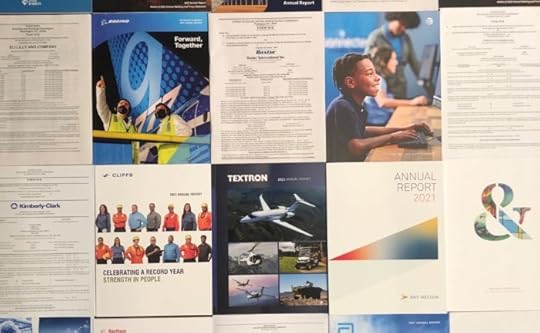
It is annual report season. If you own individual stocks, this is the time of year when annual reports and proxy statements arrive in your mailbox.
I like to dabble in stocks and I’ve been reviewing this year’s mailings. It is amazing how some companies invest in their annual report and mail out a well considered update on the firm. Other companies do the absolute minimum required by law.
Public companies are obligated send out a certain amount of information. The two required things are a 10-K and a Notice of Annual Meeting and Proxy Statement. The 10-K is a financial document that starts off with a long list of risks and then goes deep into financial details. The Proxy Statement outlines matters up for vote at the annual meeting, like the routine appointment of an auditing firm and election of directors.
Beyond that, the annual report is up to the company. Some firms create insightful reports and others do the absolute minimum.
Saving MoneyThere is a temptation to save money on the annual report. Many investors don’t review the documents, and index funds don’t care. Big stock analysts are not an important audience, either; they can just meet with the executives or listen to presentations at analyst meetings.
Still, while it is tempting do the minimum, this seems like a poor decision.
Reasons to InvestThere are compelling reasons to invest in a quality annual report.
- Build connection with investors
This is perhaps the most important reason: an annual report is a chance to inform investors about the company and encourage them to stick with the investment. Many executive lament that there are fewer and fewer patient, long-term investors. A good way to get more of them is to keep them posted about what you are doing.
- Enhance the company brand
An annual report can play an important role in building the brand. A company that invests in an annual report sends a branding signal: the firm is confident, has a story to tell, is committed to quality and is eager to engage.
A firm that just sends the 10-K printed on wafer thin papers sends a different message: the company doesn’t invest in quality, doesn’t have a story worth telling and doesn’t care about investors.
- Strengthen employee relations
People want to work for company they are proud of, and company that is doing good things in the world. Employees can look at a thoughtful annual report and feel a sense of pride. When executives recognize employees in the document it further strengthens relations.
- Help the CEO
Communication is a critical part of being an effective CEO. It isn’t enough to set the strategy; you need to constantly communicate it to be sure people are clear. The annual report can help with this. The annual report is also a chance for the CEO to build their personal brand.
The BestThe best annual reports do three things.
First, the report should have a credible discussion of the results. How did the company do? Was it a good year or not? Why?
Second, the annual report should talk about how the company is contributing to society. This is a chance for a firm to rise above the short-term numbers. Is the company helping the environment? How so? Is the firm embracing inclusion and diversity? In what ways? Recognizing employees is a critical part of this section.
Third, the report should discuss plans for the future. What are the big focus areas? Annual reports are public documents, so sharing specific details is not smart: competitors read these documents, along with everyone else. Still, in general terms, what is the path forward?
2021 Highs and LowsHere is my assessment of some of the annual reports I’ve received this year. I’m using the grading scale we employ at Kellogg: A, B, C, D
Abbott: A
Medical-device giant Abbott created a beautiful 2021 annual report. There is a letter from the CEO, a review of the businesses and a financial report. Abbott clearly wants to communicate with investors and cares about their views.
AT&T: C
This company gets a well-deserved C. The annual report is an attractive document, with quality production. The problem here is the content: AT&T has delivered terrible results for investors, and the annual report fails to respond to the issues. Instead, it starts off with corporate-speak: “The Dawn of a New Age of Connectivity.” That is an empty phrase. A better start might be this: “Wow. Just terrible results but don’t give up all hope. We aren’t dead yet.”
Baxter: C
This large healthcare company another example of a company doing just about the minimum required. The only good news is that the proxy statement starts off with relatively informative letters from the CEO and the lead independent director.
Boeing: A
It is hard to find a company that has had more trouble in recent years than Boeing: a massive COVID downturn and safety issues with the 737 Max. Boeing doesn’t dodge this bad news in its annual but the report has a hopeful feel: the well-constructed update has a tone of humility and resilience. It is appropriately positive.
BNY Mellon: A
Sometimes a firm gets the balance right: just enough polish and detail. BNY Mellon achieves this. The annual report features a fairly long letter from CEO Todd Gibbons. He discusses results, the BNY business and the firm’s contributions to society. This is a well done report.
CSX: A
A great annual report should feel significant. The CSX annual delivers on all fronts; it is a polished document. It is clear and easy to follow. The design is lovely. The paper is thick. It feels like the annual report from a company that invests in quality and customer service.
Cleveland-Cliffs: A
This booming steel producer sent a quality update for investors. The annual report consists of about 10 glossy pages, followed by the usual 10-K material printed on thin paper. The combination works: the first section simply summarizes what the business is focused on. The following detail then develops the story. Bravo.
Eli Lilly: C
This large pharma company has taken a step back in recent years, at least in terms of its annual report. The company used to create an impressive report. This year it sent the minimum. It gets a C only because there is a short letter to investors from the CEO and independent director.
GE: B
General Electric has had some difficult financial times, so it isn’t a surprise that its annual report has been scaled back from the glory days of Jack Welch and Jeff Immelt. Still, this year the company sent a thoughtful, in-depth business review.
Kimberly-Clark: D
You would think a paper company would understand that there is something powerful in printed documents. Sadly, that isn’t the case for Kimberly-Clark. KC gets a well-deserved D for a terrible packet with no message at all for investors.
Surely a marketing company like Kimberly-Clark can do better than this.
KraftHeinz: C
Given Kraft’s reputation for saving money, it isn’t a big surprise that the company doesn’t spend a dollar more than necessary on the annual report.
The firm narrowly avoids a D with a very short letter from the Lead Director.
KraftHeinz has had some difficult times. Instead of saving money all the time, the firm should invest in telling its story.
That is true when it comes to managing its brands as well.
M&T Bank: A+
A few companies really embrace the power of the annual report. The most impressive report I received in recent weeks is from M&T Bank. This Buffalo-based regional bank sent a beautiful Message to Shareholders. It includes financial results and a discussion of the economy, what it means for the company, and how the firm is responding. The company clearly cares about this document: the colors are vibrant, the paper is thick, the content is thoughtful.
Raytheon: A
Defense-giant Raytheon sent a respectable annual report: a business update followed by the 10-K. This approach works well.
Stryker: D
Boo, boo, tomatoes, tomatoes. This medical device firm did absolutely nothing in terms of an annual report. The mailing was a 10-K and a Notice of 2022 Annual Meeting. Stryker’s mailing is completely disappointing. It is an insult to investors and employees.
The executive team at Stryker should be embarrassed.
Textron: B
Textron is a complex company; the firm makes everything from golf carts to business jets. This report works well; it reviews the different business segments, provides a financial update, and outlines in general terms the road ahead.
Verizon: D
Verizon started 2021 with a stock price of $59 and ended the year at $52. A basic 500 index fund increased in value almost 30% during the same period. Verizon had a terrible year.
How does the company explain the year? Nothing. There is no annual report to speak of, no explanation, just a short letter from the CEO and lead independent director that starts off: “Verizon’s corporate purpose to create networks that move the world forward has never felt so vital.”
Really?
Waste Management: D
The people who put together this annual report seem to think the only thing that matters is the cover. The firm took the 10-K and the annual meeting notice, bound them into one document and put an attractive picture on the front. It is labeled “2021 Annual Report” but that is a very generous description of the document. There is no letter to shareholders, nothing about the company, no comment on strategy or ESG. This is a disappointing report.
Zimmer Biomet: C
There is a lot that Zimmer Biomet could discuss in its annual report: key investment areas, efforts to rebound from COVID, the spin-off of ZimVie. None of these issues gets any real attention, however. The report is modest, a few pages tacked onto the front of the 10-K. Is it better than some? It is. But it is not even close to sufficient.
The post Evaluating the 2021 Annual Reports appeared first on STRONGBRANDS.