Allen White's Blog, page 10
November 3, 2020
Are Small Groups the Last Thing People Need Right Now?
Some people think that small groups are about the last thing that people need right now. With so much going on in people’s lives and so much turmoil in the world, forming groups for some seems like an uphill battle. But, when you look at the needs in people’s lives, it seems like a time to lean into groups rather than pull away.
 Image by Pexels from Pixabay
Today is Election Day in the U.S. This will be regarded as a historic election in many ways. Chances are no one will know the result of the election at the end of the day or the wee hours of tomorrow morning. There are a lot of absentee ballots to count. If you haven’t voted, then stop reading and go vote!
Tomorrow life will be very similar to what it is today. As over 100 countries of the world have issued mask mandates, many European countries are locking down and implementing tighter restrictions to address the Coronavirus pandemic. For most people this all feels enormous – economic uncertainty, political unrest, racial injustice, and a health crisis. On top of all of this, the things in people’s lives that were already breaking – marriages, finances, jobs, parenting, etc. – are closer to broken than they’ve ever been. I don’t mean to be all doom and gloom, but real or imagined, people are facing a level of anxiety unlike most have experienced in their lifetimes. What can you do?
People Need Connection
What does your screentime look like on your iPhone? You will probably immediately go to “I use it for work.” I know that you do, but let’s face it that handy little device is a friend and a foe. The “friend” part keeps us distracted from what’s going on. (I’ll admit that I’m playing a lot of Boggle with Friends these days). It’s also a foe, because your connected device is disconnecting you. A wise person once said (my wife), “People have more means of connecting than they’ve ever had, yet they are more disconnected than they’ve ever been.” And, that was said before the pandemic.
People are made to connect. This is why you and I do what we do with groups. But, groups have gotten weird in 2020. People are tired of looking at screens, but they aren’t tired of relationships. What if you encouraged your people to use that ever present device in their hands to “encourage one another daily?”
People Need Conversation
The church has excelled in developing online content in the last eight months. While much of it was better when worship services were online only, the church is putting out a ton of content – services, Bible studies, video devotionals, and so much more. It’s a lot. The problem is that it’s only one-way communication. In most cases, people can’t talk back or interact. (There are a few exceptions).
You’re well aware of Zoom fatigue, but there are many other ways for people to have conversations online. Ideally people will meet in groups on a familiar online platform to discuss the sermon topic from Sunday or something else they are interested in. If they don’t, your people need some way to process what they’re dealing with and talk to another person. Cable news is not a comfort. And, they need more than teaching videos. They need more talking.
You Have an Opportunity
In many ways the world has been turned upside down in 2020. More than a few of you have posted memes about foregoing the time change to avoid an extra hour of 2020. I’m not a fan of the time change anyway. But, what does God intend for the Church in 2020?
If you believe that God is Sovereign, then you have to admit that 2020 was not a surprise to God. The Church has faced much more dire circumstances throughout history, yet the Church has moved forward. This is the time to rethink what your church is doing. This is the time to reach people whose lives have been disrupted. This is the time to reach people who are far from God with a message of hope.
Last week, I gave you the “because of COVID” excuse for making changes. It’s not a bad one. While it’s easy to starting thinking about all of the negative things that happened to your church “because of COVID,” have you thought about the opportunities? The effectiveness in the Church during this season is not the status quo, which one author defines as “the mess we are in.”
But, in 2020, I’m hearing pastors talk about great things that are happening “because of COVID:”
“The size of our groups were limited by COVID restrictions, so every group became two groups.” Who wouldn’t want to double their groups?
“I connected with some old high school friends including one who was far from God to form a multi-state online group.”
“Our groups increased by 211% over last year.”
“Our church formed book clubs by asking any willing person to gather a group of friends.”
What is happening in your church “because of COVID?” Let us know in the Comments below.
The post Are Small Groups the Last Thing People Need Right Now? appeared first on Allen White Consulting.


October 27, 2020
The Struggle to Form Groups in 2020
Do you have more groups today than you did a year ago? Let’s ask an even scarier question: at this point do you know what groups you have? Since either many churches have not regathered for worship services or a significant number of folks haven’t returned, I’m hearing a lot of pastors who don’t really know who’s still in their churches and who has left. Some have lost contact with their group leaders. Where did they go? It’s a strange year.
 Image by Gordon Johnson from Pixabay
You might be tempted to hit pause for this next ministry season. While you hope that 2021 will be better, for some it’s starting to look like a continuation of 2020. You might be waiting for all of this to blow over so you can start fresh next year. But, here’s the bad news – this doesn’t seem to be blowing over any time soon. This is a great time to reevaluate your approach to groups for 2021. Since nothing that’s worked in the past is guaranteed to work in the future, let’s get back to the basics of what you’re doing.
What is the definition of a group in your church?What is the purpose of groups in your church?Do you and your senior pastor agree on the purpose of groups in your church?How quickly do you want to grow groups in your church?What obstacles are you facing in growing your groups?What are your people willing to do?How can your groups help your members and your community through this confusing time?How are groups actually more important than worship services right now?
This year has produced a significant curve ball. Churches had to scramble to put worship services online. Now that some are regathering for in-person services, not everyone is regathering. The challenge today is hybrid services, hybrid ministries, and hybrid groups. Everything is in-person and online, or it’s in-person and waiting for things to get back to normal.
While no one can accurately predict the future, I’ve had the opportunity to work with 64 churches in 2020. I’ve followed them in their journey to move services and groups online, bring back in-person services and groups, and for some to go back online again already. A few churches have never regathered for in-person services. (A few others never closed. Shhh.) The problem with being a church consultant in 2020 is that all of one’s experience prior to March 15, 2020 essentially became irrelevant. But, the great thing about being a church consultant in 2020 is tracking with churches of different sizes and denominations across North America and working out how to launch groups in 2020. In one of those churches, their groups have grown by 211% this year.
This is not a time for you to step back and take a break from groups. This is the time for you to step up and lean into groups like never before.
On November 9-13, 2020, I am offering the Small Group Reset: Five Days to Reframe Your Ministry. We will meet every day for five days in a row from 2-2:30 pm Eastern to wrestle with some fundamental questions about small group ministry in 2021.
Here’s what I know – you are working much too hard for the results you are getting. Knowing what most small group pastors and directors have invested, you should have far more groups and leaders by now. Let’s put our heads together and strategize for the opportunity that 2021 presents.
What are you learning about small groups in 2020? Let me know in the comments.
The post The Struggle to Form Groups in 2020 appeared first on Allen White Consulting.
October 20, 2020
Some Great Church Experiments in 2020
If you’ve been waiting to start something new, 2020 is a great year to experiment. Some might say that 2020 is an experiment gone wrong, but with life so some completely disrupted, you should embrace this as an opportunity to launch new things or end things that need to go away. Blame it on the pandemic! As difficult as this year has been, the healthy crisis, economic crisis, racial crisis, and political crisis are breaking up some very hard ground in the world, in the church, and in the hearts of individuals. There couldn’t be a better time to innovate. What needs to change in your church? Here are a few things that I’m seeing right now.
 Image by Arek Socha from Pixabay
Start eGroups.
In my recent Small Group Network huddle, Bill Cleminson from the Church at the Mill (a.k.a. The Mill) in Moore, SC shared an experiment their senior pastor, Dr. D.J. Horton, launched this fall – they launched egroups. An egroup is five people or fewer who commit to meet together for 13 weeks. The group views a 15-minute teaching video from the pastor, then uses a sermon discussion guide for their meetings. In addition, the egroups journal daily based on a reading plan provided by the church or something else they choose. For accountability, the egroup members are asked to share a picture of their journal with their group with the words blurred out. This increases participation.
The Mill intentionally chose a new name for these groups to avoid confusion with their other small groups and discipleship groups. eGroups are a short-term trial run at groups, but more importantly, they give their members an opportunity to connect and process life together. It’s a great combination of both communication and content. After the first 13 weeks, eGroups may have served their purpose at The Mill, but depending on how 2021 looks, they could certainly serve an extended purpose. As with most churches, planning is in pencil and prayer.
Find Your Loopholes.
Some churches have rather rigid leadership requirements for small groups. While the bar for leadership should be high, the issue comes down to two things: (1) How many years will it take for you to connect people into groups? and (2) Do you really need a “leader” to make disciples?
Recently I talked to a pastor whose church leadership was leery of inviting people they didn’t know into small group leadership. I understand that feeling. That’s how my church got stuck at 30% in groups years ago. I understand that every church has an acceptable level of risk. There is a line they are reluctant to cross for a variety of reasons. I can’t force anyone to cross that line, but I can work to convince them.
I asked this pastor, “What’s too small to be a group in your church?” He said that three people was too small to be a group. Then, I challenged him to form some non-groups of three people. He just needed to ask people to invite two friends to discuss the weekly sermon questions. These non-groups won’t be advertised or acknowledged anywhere, but they will do two things for the church: (1) It will prove to the pastor there isn’t as much to worry about as he once thought, and (2) the non-groups will give people confidence to expand their group and eventually become a recognized group in this church.
Level Up Your Online Services.
Most churches did better with online services before anyone regathered in the building for worship. When the house was empty, pastors looked directly at the camera. Pastors got up close and personal with the online audience. Some even created interactive experiences to field questions during the message. But, then people started coming back into the building, things got weird.
When people are in the room, most pastors want to talk to the people in the room. I do! But, there are more people “out there” than there are “in here.” Yet, you can’t look over people’s heads and only look at the cameras. The churches who understand this are producing separate online services and in-person services to meet both needs. It’s more work, but it’s certainly worthwhile since so many unchurched people are looking in on online services. After all, streaming video is NOT church online.
Put Everything Online.
Some aspects of life have permanently changed amid the pandemic. I don’t know that I’m ever going to pile items into a grocery cart again, when we can order everything online for pickup or delivery. Going to the bank has been replaced by an app. I’m reconsidering whether I still need two cars in my driveway. Online group leader training has gone so well, I’m not sure I need to fly to you to train your leaders (but after the pandemic I might consider it).
In a world where people can do a doctor’s appointment online, they could take your membership class online. They could go through your Growth Track online. You no longer have to limit these to a Sunday afternoon. People can participate anytime over 168 hours per week. Potentially, they could become a member of your church at 2 am!
Concluding Thoughts
Practice these phrases with me:
We stopped doing [Insert Ministry Name] because of COVID.
We started doing [Insert Ministry Name] because of the pandemic.
Allen White gave us that idea, but now we realize it’s really stupid. LOL
This is a great year to experiment. Don’t waste your time waiting for things to get back to normal. Normal is gone. To quote Jason Caston, “The church was moving slow because they thought the world would stay the same.” Nothing is the same. Get moving!
Tell me how your church is innovating in 2020 in the comments below.
The post Some Great Church Experiments in 2020 appeared first on Allen White Consulting.
October 13, 2020
Tribute to a Reluctant Leader: Lorraine DeMarco
My friend, Lorraine DeMarco, passed from this life on October 8, 2020. She was a friend, a coach, a cheerleader, my hairstylist, and a reluctant leader. She taught me many important lessons. She was a reluctant leader. In fact, she wouldn’t have lead a group if our pastor hadn’t recruited for multiple weeks.

The following is a story about Lorraine taken from Exponential Groups: Unleashing the Church’s Potential:
To capture the most new leaders possible, a longer promotional period followed by a short registration period is key. In addition, registering for three weeks is also a major factor. If the church registers new leaders for more than three weeks, then the invitation becomes “Yada, yada, yada,” and everyone waits until the last week to sign up anyway.
I was talking to the gal who cuts my hair about this one day. Why was I talking to her about this? Well, we talk about everything, and I have a captive audience. She’s not a barber, and I don’t like having a “stylist,” so we’ll just call her “Lorraine,” since that’s her name. Lorraine is retired, but she still has mercy on my hair. She is also a member of Brookwood Church, where I served. As I was spinning the tale of two churches with group launches and the importance of recruiting for three weeks, Lorraine spoke up, “I’ll tell you why it’s important to recruit for three weeks. That’s how Rich and I ended up leading a group.” (Lorraine is Italian and grew up in New Jersey. Do you have that picture in your mind?) She spun me around in the chair and started telling me her story, brandishing the comb toward my face for emphasis. (I was looking out of the corner of my eye to locate the scissors. I was safe.)
Lorraine went on, “The first week when our pastor from the stage invited us all to lead groups, I said, ‘Nope, there is no way I’m going to do that. No way!’ ” The comb wagged faster. “ ‘Then, the next week, he invited us again. I thought, ‘Hum, maybe I should think about this?’ When he invited us the third time, I said, ‘That’s it, Rich, we’re leading a group.’ See if the pastor didn’t ask three times, I wouldn’t be leading.”
I would have offered a high five, but I still wasn’t sure of where the scissors were located, so we just had some congratulations and a little laughter instead. Then, the haircut resumed.
If you only recruit leaders for one week amid many other announcements, you’ll miss the Lorraines who might lead if you asked them again. Lorraine led that group for 6-8 years, then she and Rich started attending a church closer to their home. The first thing Lorraine did was to start a new small group in her new church.
I miss you, Lorraine. I’ll see you in Heaven.
The post Tribute to a Reluctant Leader: Lorraine DeMarco appeared first on Allen White Consulting.
October 6, 2020
Video: Get People to Show Up in Online Groups
Believe it or not, it’s harder to get people to show up in online groups than in-person groups. Are you seeing this? We explored the problem in a post a few weeks ago: Why are People Ghosting Online Small Groups? But, what’s the solution?
It’s not as difficult to get people to online small groups as you might think. Those who are successfully connecting people in online groups are using the active recruiting strategies I talk about in this video I created for the recent Success with Groups Online conference.
For more videos like this, subscribe to Allen’s YouTube Channel:
https://www.youtube.com/channel/UCeiO...
How are you faring with online small groups? How is your group launch going? If you have found something that works, or if your struggling in this unusual ministry season, please leave your comment below.
The post Video: Get People to Show Up in Online Groups appeared first on Allen White Consulting.
September 29, 2020
2020 – Your Year of Opportunity?
Would you regard 2020 as a year of opportunity? It feels more like a year of loss and disruption. How can we see a blessing in something that feels like a curse?
Children have lost close contact with their classmates. Adults have lost the feeling of getting ready to go to work in the morning. Parents have lost their sanity. Believers have lost their ability to gather in-person in some places. People have lost their jobs and lost income. As a society we’ve lost the sense of safety. We’ve lost the carefree ability to do anything we want whenever we want. We’ve also lost the notion that racism is not our problem. People have experienced a great deal of loss. You’ve lost too. Yet, there is something quite hopeful about 2020.

Back in the 80’s I attended a church growth workshop with Dr. Elmer Towns in Kansas City. The main crux of his talk was that people are open to change in periods of transition. When people graduate from high school, college, or grad school, they are open to change. When people get married, have a baby, change careers, or move to a new city, they are open to change. When people go through a divorce, become widowed, or retire, they are open to change. Dr. Towns encouraged us to figure out ways to connect with people during these times of transition and disruption in their lives. Do you see the gift of 2020? Everyone’s lives have been disrupted in some way.
All of this disruption – as painful and scary as it’s been – has made people ripe for the Gospel. Nothing in their lives is working exactly the way it used to work. Everyone has transitioned from the life they were used to, and the fact of the matter is that they will never see that life again. Some say the effects of Coronavirus on health and the economy will have implications for five years or more. People are ready for a change. You have the answer. But, if people weren’t going to church before COVID-19, why would they risk going now?
Finding the Solution in an Accident
On April 11, 1970, three brave astronauts launched into space aboard Apollo 13. Not long into their mission an accident caused damage to the capsule which compromised the ship’s cabin which began to fill with carbon monoxide. The astronauts wouldn’t make it back to earth. Engineers met in a conference room at mission control. In the movie with Tom Hanks, one of the engineers dramatically spills a box of supplies on the conference table and announces, “This is everything the astronauts have in the capsule. We have to figure out how to build the CO2 filter out of this.” They got to work. Using only what was available to the astronauts, the engineers created a CO2 filter. The astronauts arrived back to earth alive.
You as a pastor don’t have all of your normal resources at your disposal. While the church relied heavily on the weekend worship service to do more than it was capable of doing, quarantine quickly revealed that the church had to be more than a weekend service or a building. What do you have to work with? If you took the resources of your members’ lives and dumped them out on a conference table like those engineers from Apollo 13, what do they have at their disposal?
Most have a computer, a smartphone, social media, email, text messages, phones, pen and paper, and maybe a little time on their hands (maybe not). How can your church reach people whose lives have been disrupted and frankly are more than a little scared? (HINT: It’s not what most Christians are doing on Facebook and Twitter right now).
Reaching Your Community Digitally
How can you and your church staff equip your members to spread hope amid all of this disruption? Here are a few thoughts for you to bat around:
Create social media and email invitations to online services.Offer Instagram and Pinterest posts with encouraging Bible verses or quotes from the sermon.Write sermon discussion questions so anyone can invite their Facebook friends into a Facebook group.Put your membership process or Growth Track online.Offer online small groups.Offer online on-demand training to equip people to serve.Encourage your members to find a need and fill it.Encourage members to offer their experience from online school or homeschooling to parents who are new at it.Offer support groups online – Celebrate Recovery, DivorceCare, GriefShare. Substance abuse and pornography use are at an all-time high.Offer online budgeting classes, marriage seminars, parenting courses, and stress management workshops to invite the community.Ask your members to record a short version of their testimony. Share these in your church’s social media and website.Create interactive online experiences – Bible studies that are a discussion rather than a lecture. Use Facebook Live and respond to the comments and questions.
Concluding Thoughts
Don’t waste the opportunity of 2020. Don’t sit around waiting for things to get back to normal. Normal is gone. Normal isn’t coming back. Embrace the disruption of 2020. The field is plowed. It’s time to plant.
For more information on using media to influence your community, I am hosting a webinar with Phil Cooke on October 1, 2020 at 2 pm Eastern. Phil is a PhD in Theology, a filmmaker, author, and media producer. His skill set is unique, and he has much to share with the church on getting the message of the Gospel out and maximizing your influence. Register Here [Here]
Tell me what your church is using to connect with lost people. Please share your comments below.
The post 2020 – Your Year of Opportunity? appeared first on Allen White Consulting.
September 22, 2020
Digital Thinking by Phil Cooke [Guest Post]
“The digital revolution is far more significant than the invention of writing or even of printing.”
—Douglas Engelbart
It’s no secret that reaching a congregation, community, or media audience in today’s distracted and disrupted world is a real challenge. Although we have more channels for reaching them than ever before, those very channels slice up the audience, making it more difficult than ever to actually connect.
 Phil Cooke is a filmmaker, media consultant, and founder of Cooke Media Group.
It all starts with strategy, which is the art of discovering what sets you apart and who would care most about your message, cause, or story. Today it takes more than someone with a video camera, a social media director, or a graphic designer to communicate your message. Before any of those team members start working, it’s critical to find the answer to “why,” and that is a leader’s job.
It’s been said that any soldier can take the hill, but a leader knows which hill to take and why it needs to be taken in the first place. Far too many churches allow the big picture decision making to be made by other members of the staff. In a large church or ministry with an experienced, high level communication or media team, that can be a good thing, but with less experienced members it could be a disaster. And in either case, it should never happen without the input and insight from the pastor or ministry leader.
The Big Picture Matters
Whatever you do in media—build a website, produce a video, launch a marketing campaign, publish a book, or whatever—understand that each of those elements are part of a much bigger story and strategy. In today’s distracted world, where people are being overwhelmed with communication and media messages, anything you create has to be part of a bigger, multi-platform strategy to maximize those opportunities.
Talented video, social media, and communication teams with brilliant ideas are a great start, but until they understand the bigger strategy of how to reach your audience, you’ll never make an impact. It’s been said that if you want to know which road to take, it helps to first know where you’re going.
Think Before You Produce.
Ask the “why” before you explore the “how.”
Then, once we define your why, we bring that to life with messaging— clarifying exactly what your message or story should be at this moment. Oddly enough, most of our clients try to communicate too much—largely because they’re thinking of themselves, and not the audience they want to reach.
In a cluttered world, simplicity and clarity are what get people’s attention.
Certainly many organizations and visionary leaders have much to share, but in today’s hypercompetitive world, most people respond to too much information by shutting down and turning off. So it’s essential that we streamline the message and focus on what matters from the audience’s perspective.
Speaking of clutter, identity development is a key step in our process since “perception” is so important in a distracted world. We’ll discuss branding and positioning in a later section, but it’s important to know how sensitive perceptions are in a distracted world. Positioning is essential to help your message rise above the noise because it focuses on what your audience thinks, what they need, and how you fit into their lives. This goes beyond your brand and is often overlooked by many organizations.
Finally, deciding how to share your ministry or organization’s message is vital, via social media, short video production, broadcast radio or TV, movie, live events, blogging, podcasting, live streaming and more.
It’s not how you want to reach them, it’s how they want to reach you.
There’s no point in creating the best podcast ever produced if your audience is somewhere else. That’s why finding the right platforms are so important for connecting with your audience.
These steps aren’t designed to overwhelm you or make you think that engaging media is too complex or difficult. My purpose is to remind you that a high school kid with a video camera isn’t enough. A talented graphic designer isn’t enough. Even a well-intentioned communication director isn’t enough—if you haven’t spent time thinking about the bigger picture.
These days, a great number of leaders and teams recognize the power of media, but don’t understand the best way to leverage that power. There was a time when sharing a message meant standing on a soapbox and talking to people passing by, preaching in a pulpit, or printing a book or newspaper. But today with an almost endless number of media options, making the right decision about the what, when, where, how, and why of your message can be the difference between success and failure.
The stakes are high, and your message matters. Choose carefully.
To hear more from Phil Cooke, register for the Digital Ministry Webinar on Thursday, October 1, 2020 at 2 pm ET.
Phil Cooke has produced TV and film programming in more than 60 countries around the world, and in the process, been shot at, survived two military coups, fallen out of a helicopter, and in Africa, been threatened with prison. And during that time – through his company Cooke Media Group in Los Angeles, California – he’s helped some of the largest Christian and nonprofit organizations in the world use the media to tell their story in a changing, disrupted culture. This post is an excerpt from Maximize Your Influence: How to Make Digital Media Work for Your Church, Your Ministry, and You by Phil Cooke (Burbank CA: Cooke Media Group, 2020, pages 19-22). All of the proceeds from this book go to The Innovation Lab.
The post Digital Thinking by Phil Cooke [Guest Post] appeared first on Allen White Consulting.
September 15, 2020
The Dreaded Question – Where Did They Go?
Your members are not watching your online services. Well, at least not all of them are. According to a recent survey by the Barna Group, in the past four weeks, churchgoers have:
Streamed My Regular Church Online: 40%
Streamed a Different Church Online: 23%
Neither: 48%*
Where did they go?
A pastor friend of mine told me last week that he just discovered that two core, committed families had left their church – 5 months ago! He just found out. Their senior pastor had taken a stand that they disagreed with, so they “left” the church. No one knew because churches in their state have not been allowed to meet in-person for worship since March 2020. These members didn’t need to move to the church down the street. They just changed the channel.
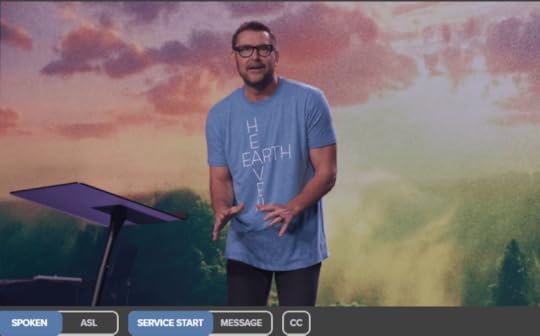 Mark Batterson and National Community Church have perfected online worship services.
Most churches who are regathering for worship are only seeing about 30% of their attendance from 12 months ago. Most are continuing to see high levels of streams for their online services, but every pastor has to admit that there are a fair number of people in the “Neither” category.
While I believe this season presents a great opportunity for the church to reach people far from God, the church also has to change how they serve in this season. Most pastors have counted on the sermon and the weekend service to accomplish far more than it’s capable of doing. [LINK] As Andy Couch said, the church should keep the Who and Why, but change the What and How.** Here are the key areas to lean into in this season:
Create an Interactive Worship Experience
Just because it’s online doesn’t mean people are really watching. Three of our four children are doing online school this year. Our oldest graduated from high school this year. (What a bummer of a year to graduate, right?) Our daughter attends a charter school with about half the students in the physical classroom and the other half watching the stream of the class at home. She has to have her camera on. She has to wear her school uniform. She has to do her assignments. Mostly she sits bored in front of a Chromebook all day, but as she says, “It’s just like going to school in person except I have a more comfortable chair.”
Our two sons attend a completely online school. The classes are intended for an online-only classroom. They interact with their teachers. The lessons are taught for the small screen. While school is still school and still boring, our sons’ school does a much better job of keeping them engaged than our daughter’s streaming school.
Now, do you see your church’s online worship services in that example? Are you streaming the in-person service or are you creating an online experience? There’s a difference. Here’s an example. Morningside Baptist Church in Columbus, Georgia was a legacy church of about 400 members pre-COVID. When their services went online, their online attendance jumped to 800 views overnight. While the church has started to regather on Sunday morning, only about 120 people are attending in-person, but another 1,600 are viewing online. But, the innovation I would like for you to see is what they are doing with their midweek service called The Living Room.
The pastor and two of the staff appear on a living room set that they built. They bring in a guest via Skype and then take questions from Facebook and Instagram DURING the service. It’s a digitally, interactive service. Now, The Living Room is a work in progress, but it’s developing into something very interesting. Check it out (They’ll be thrilled with the views!).
There are better preachers online. There are more interesting services online. What is unique about what you are putting online? How do you build a relationship with your online audience? How do you KEEP a relationship with your members? Eventually your church will regather if it hasn’t already, but what is your responsibility to your online congregation?
Don’t Leave Kids Behind
Church online is great for adults, but it’s a bummer for kids. It’s like we’ve gone back 50 years when there was only a nursery on Sunday morning and no children’s church. As my wife and I have been watching church online for 26 weeks now, our kids are not interested. Our 7-year-old will join us for the singing, but exits when the preaching starts. But, kids engage online just not with the same things as adults.
My 7-year-old is a loyal viewer of Ryan’s Toys Review and the Izzy’s on Youtube. It’s almost like they’ve become part of the family. While we limit his viewing, their Youtube shows have sparked his creativity in building intricate Thomas the Train tracks, unique Lego projects, and his own DIY set pieces for these creations. He can’t get enough of it. Recently, he got hooked on new Youtube videos – Saddleback Kids (Early Childhood and Elementary). Taking cues from these other Youtube sensations, Saddleback has entered my 7-year-old’s world, and he loves it!
Connect Them into Groups
Your Fall 2020 Small Group Launch could be the MOST IMPORTANT LAUNCH you’ve ever had. (YES! I’M YELLING.) As far as fall group launches go, it’s a bummer. Many people are tired of Zoom. (There are other ways to meet online). Many people are not showing up to the online groups they joined. (There are better ways to get them there). People, including small group pastors, are ready for things to get back to normal, but normal may not be here for a while.
Churches can pivot toward digitally, interactive worship services, but if your people are not connected to each other, they have fewer reasons to stay loyal to your church. People need biblical content, but they also need conversation.
Resist the temptation to write your Fall 2020 launch up as a loss. There are new online followers who need a group. There are faithful members who need community and conversation amid the pandemic. Your calling and your mission did not stop because there’s a pandemic. The church has been through far worse and thrived.
Check Your Giving Records
I don’t want to sound crass, but I hope someone on your team has compared the current individual giving records with those from a year ago. Since pastors can’t count noses, you can still count nickels. This isn’t about money. This is about your people. If your people have stopped giving, it’s probably for one of a handful of reasons:
They are no longer financially committed because they left your church. You’d better find out why.They no longer see the perceived value of giving to your church. You’d better talk about how your church is serving the less fortunate in your community and how many you’re reaching.They have experienced a significant drop in income or a job loss. How can you help them?
I really don’t even like suggesting this, but how else do you know who’s still around? This leads to the last point.
Get on the Phone
Whether your staff is five or 500, every staff member should be on the phone with a dozen or more church members EVERY DAY. (I also think every staff member should be leading a small group. After all, what else are they doing right now? They’ve got time on their hands.) In one very large church I’m working with, the staff members were tasked with making 160 calls per day! Why?
People need to know their church cares about them. The call isn’t to ask why they stopped giving or serving, but it could certainly be triggered by that information. The call is to see how they are doing. The call is to offer help. The call is to offer connection.
Smaller churches have the advantage. The average church in America is 90 people. By calling three people per day, a pastor could connect with every member of the congregation over a 30 day period.
Call every giver. Call every core member. Call every leader. Call everyone who’s not attending in-person. Pick up the phone so your sheep can hear your voice!
Concluding Thoughts
The American Church is at the crossroads of opportunity and extinction. As David Kinnaman said, 1 in 5 churches will permanently close in the next 18 months. Some estimate there are 300,000 churches in the U.S. That means 60,000 churches will close! This isn’t “waiting until things get back to normal.” This is an emergency! How is your church connecting with your people?
If you are ready to up your game with digital ministry, I am hosting a webinar with Phil Cooke on Thursday, October 1 at 2 pm Eastern. Phil has a PhD in Theology and is an active media producer. He is saying some things about the church that you need to hear. Registration is limited. In fact, registration is not even set up yet, so if you’re interested email me at allen@allenwhite.org ASAP.
*The Original 2020 is History by Carey Nieuwhof
** This is a gem of a podcast with Andy Couch, Leading Beyond the Blizzard, from 3/20/20.
The post The Dreaded Question – Where Did They Go? appeared first on Allen White Consulting.
September 8, 2020
Big Ideas from the Online Groups Roundtable
Regathering for worship services and for small groups is proving in many ways to be more difficult than going online was in the first place. I recently met with a gathering of small group pastors from across North America to talk about what they are facing in terms of government regulations, church directives, and individual willingness to gather in-person and online. Here are the big ideas from that conversation.

Let people use the platforms they are familiar with and invite people they already know.
Every online group doesn’t need to meet on Zoom. There are many other platforms to host live and asynchronous online groups meetings. By encouraging people to use platforms they are familiar with like Facebook Groups, Google Meets, or even Slack and group texts, they will feel more comfortable with the concept of online groups. If they will invite people they know to join the online groups, chances are more people will show up. There is a very real dynamic of people ghosting online small groups. If people form groups on the platforms they know with people they know, the rate of ghosting online groups goes way down. But, even better, online groups offer the opportunity to include people who are far from God spiritually and people who are far from the group leader geographically.
Let kids get back into school BEFORE you start groups.
School districts are all over the map with their approach to the 2020-2021 school year. Some schools are online only. Others are in-person only. And, other schools are alternating on-campus and online days. Some are even varying the approach to school depending on the latest Coronoavirus statistics. It’s confusing. In my house, our three students (elementary, middle school, and high school) are all doing online school in different schools! It’s been a learning curve. If you can delay your small group startup until after the dust settles with the start of school, you will be better off.
Encourage the senior pastor to promote online groups.
In the middle of the summer, in the middle of a pandemic, in the middle of racial tensions and political chaos, Rock Church in San Diego started 119 new online book groups in July 2020. The senior pastor, Miles McPherson, invited people to gather their friends to discuss a relevant topic with an easy-to-use format to start groups. Mark Richardson, Small Group Pastor, lead the implementation of Pastor Miles’ invitation by offering training and support to these new group leaders as they launched their groups. You can read the full case study about Rock Church here.
Give groups guidelines for meeting in person, but let them make their own decisions about how to meet.
The church should offer some sort of written guidelines for regathering amid the pandemic. This helps people feel safer about meeting in-person, if they’re willing, and it covers any liability for the church. The bottom line is that the church shouldn’t dictate to the groups what to do. If they want to meet online, then meet online. If they want to meet in-person, then meet in-person. If they want to do both, or as someone have called these phygital groups (physical and digital), then do that. The main thing is for the group to be in agreement about what to do. For a group agreement exercise, click here.
Biggest Thought: “What COVID gave me was an excuse to multiply groups.”
This pastor’s town/state was limiting the size of in-person gatherings in homes. No more than eight non-family members could meet in a home, so every group became two groups! The idea of churches splitting, multiplying, or “birthing” is not a very popular idea in North America. As much as pastor try to use another word for “dividing,” with the way it feels, you might as well call it getting a small group divorce! The idea finds resistence in most groups. But, if the circumstance called for smaller groups, then rather than waiting until the whole group could meet together again, why not use this to multiply your groups? If you see this as an opportunity for every small group in your church to become two groups, wouldn’t you jump on that?
Concluding Thoughts
These are strange times for the church. Regathering for worship has been in fits and starts. Some churches who reopened in May 2020 are now reclosing in September 2020 due to new outbreaks of Coronavirus. But, the weekend worship service is only one dimension of the church. This is a time to decentralize, because the church has been forced to. But, it’s not the first time the church was forced to decentralize.
In Acts 1:8, Jesus told the disciples, “But you will receive power when the Holy Spirit comes on you; and you will be my witnesses in Jerusalem, and in all Judea and Samaria, and to the ends of the earth” (NIV). Do you know when the church became Jesus’ witnesses in Judea and Samaria? The initial fulfillment of Acts 1:8 is found in Acts 8:1, “On that day a great persecution broke out against the church in Jerusalem, and all except the apostles were scattered throughout Judea and Samaria.” The church didn’t enter Judea and Samaria because of a strategic plan or based on their vision and values statement. They were forced into their calling because of persecution. In 2020, the church was forced into a situation.
How are you going to make the most of this opportunity? Comment below.
For more information on online small groups, visit onlinegroups.US.
The post Big Ideas from the Online Groups Roundtable appeared first on Allen White Consulting.
September 1, 2020
Streaming Video is NOT Church Online!
Church online is direct-to-camera. Church online is interactive. Church online is an intentional effort to disciple a growing online congregation. Streaming video is passive. With streaming video (live or recorded), the viewer is an observer, not a participant.
The church has got to get this right, because according to some estimates getting back to “normal” could take up to three to four years (if it ever does). From recent conversations with pastors, the average church has about 30% of their people attending in-person. But, there are far more people joining for worship online. In fact, most churches are seeing larger online attendance than their normal worship numbers. One pastor I spoke to yesterday said that a year ago, they had 550 in worship. Today, there are 200 worshipping in-person and over 1,600 worshipping online. How are churches discipling their online congregations?
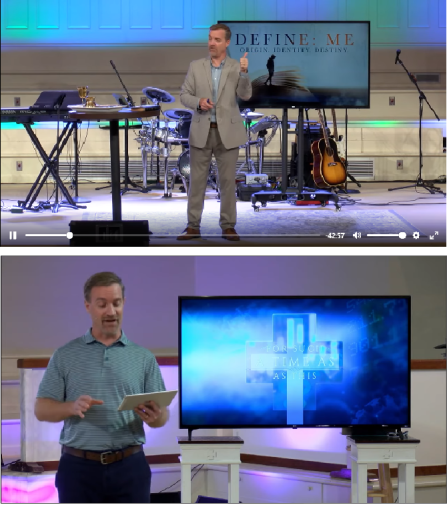 Screenshots Courtesy of Morningside Baptist Church, Columbus, Georgia.
Church Online is NOT Merely Streaming an In-person Worship Service.
Online worship services require a tighter shot. The services are shorter. Sermons are more like 20-30 minutes than 45 minutes. The pastor needs to speak direct-to-camera because the sermon is going to the living room. There’s a big difference between speaking to a big room and speaking to a small screen. The church, in general, did a better job at church online before people started regathering for in-person services.
But, as people are coming back, even just a small percentage of the congregation, the temptation is to speak to the few that are gathered and ignore the online worshippers. This is both rightly and wrongly so. A pastor cannot ignore the people gathered in the room, but a pastor also cannot create a passive experience for the larger group who are watching at home.
This reminds me of a moment about 30-40 years ago when churches were transitioning from traditional worship services to contemporary worship services. Many churches could not immediately make the jump. After all, if you alienate the base, then the giving goes down, and the pastor gets fired. So, churches offered separate services for traditional worship and for contemporary worship. A few tried “blended” worship, but was Stuart Briscoe once said, “If you blend contemporary and traditional, you end up with contemptible!”
By streaming in-person worship services, you end up with contemptible. If you speak direct-to-camera and ignore those gathered in-person, your people will think that they’re watching a TV preacher. But, if you speak only to the room and ignore the online congregation, you’ll lose them. I believe it’s time for churches to adopt two worship styles: an in-person service and an online service. The in-person service isn’t streamed. It’s created specifically for the people in the room. The online service is created specifically for the online congregation. It’s direct-to-camera. It’s shorter. It’s more interactive. The online service moves people from observing to participating. Why do this? There are more people “out there” than there are “in here.” This will be the case for a long while.
Church Online Needs Next Steps
A year ago online ministry was just a novelty, but in 2020 online ministry became a necessity. For a few months, the church regarded online services as a band-aid until things returned to normal. Today, no one knows when normal will return or what normal even is. And, that’s okay, because there is a larger opportunity online. Just look at your metrics.
How are you connecting with your online congregation? What next steps are you offering them? Do you even know who they are? Every weekend, you need to welcome visitors. Every weekend you need to collect their information by email or text. Then, you need to challenge them in their next steps just like you would an in-person guest.
Put your membership class online. There are no more excuses for not being able to attend. When your membership class goes online, people have 168 hours per week to participate. Put your growth track online. Saddleback Church just put CLASS 101-401 online after doing it live and in-person for 40 years! (and as of 8/30/2020, Saddleback added 600 new members through online CLASS 101).
How are you capturing information? How are you offering next steps? Church online is no longer just a stop gap, it’s church.
Church Online Needs Small Groups
While content is great, people need conversation and community. Whether groups meet in-person or online, or whether groups are made up of your church members or people you’ve never met, there is an opportunity to serve. Don’t take sign-ups for online groups. People will ghost your online groups that way. Instead, invite people to meet with people they know on platforms they know. There are many ways for groups to meet online, you just need to give them opportunity and permission along with some training and support to get started. Give these new groups a copy of my book, Leading Online Small Groups, which helps groups get started and helps established groups go online.
Churches with online small groups in place are faring far better than churches without online groups. There is a lot to process. There is a lot of fear and confusion in the world. People need to gather with others who will listen, care for them, and point them back to God in a personal, individual way. Online groups can accomplish this for those who are not ready to meet in-person yet.
Church Online Needs Opportunities to Care and Serve
People need an outlet for ministry. The Coronavirus pandemic has forced people to mostly stay home and to venture out very little. This isolation is taking a toll on people’s mental health. It’s not good to be alone thinking only about yourself.
Years ago a prominent psychiatrist, Dr. Karl Menninger, was asked a question by an audience member at a conference, “If you knew someone was suicidal, what would you recommend for that person to do?”
They audience expected Dr. Menninger to recommend immediate and intense psycho-therapy. Instead, Dr. Menninger replied, “I would tell them to go over to the other side of the tracks and help someone in need.” It’s healthy to help others. It’s unhealthy to be overly focused on oneself. (If you or someone you know is suicidal: 1-800-273-8255).
There are many needs in our communities. People need food. Parents need childcare. People need to know that someone cares. Encourage your online audience to participate with the church in serving your community or to just find a need a fill it.
Early during the pandemic, I came up with a list of ways people could practice the “one anothers” of Scripture digitally. Smartphone usage is WAY up. Why not use your phone to encourage others? You’re on it anyway.
Church Online Needs Reasons to Give
In a recent interview with NPR, David Kinnaman, president of the Barna Group, said, “I think also it’s really going to change the way people think about their donation relationship with local churches as well. There’ll have to be an even greater demonstration of the value that a church brings not just to those who attend but also those who are part of this community.”
While all of the things listed above will certainly add value to your online congregation, churches must show how they are helping the community. Where are these dollars going? After all, those who are worshipping at home aren’t receiving the benefit of the building or the staff. But, beyond this, people need teaching about giving. Generosity is a spiritual discipline. It’s a sign of spiritual maturity. As your people grow, they will also grow in giving.
Concluding Thoughts
The American church is in a precarious moment. “As many as one in five churches could permanently close as a result of shutdowns stemming from the coronavirus pandemic,” according to Kinnaman. “Obviously, there will be a lot more online attendance than ever before, even after all churches reopen. I think this digital church is here to stay.”
I see two camps in the church right now. There are those who’ve been hunkering down and waiting for Coronavirus to blow over so things can get back to normal. These are the churches that are in the most danger right now. Then, there are those churches who are embracing this disruption as an opportunity to meet the practical needs of people, re-evaluate their current ministries, reposition themselves for digital ministry, and embrace the opportunity of reaching a lost, hurting, and broken world online.
Which camp is your church in?
The post Streaming Video is NOT Church Online! appeared first on Allen White Consulting.