Allen White's Blog, page 12
June 16, 2020
[Video] A System Solution for Groups (3:16)
Get your copy of the Exponential Groups Workbook for only $12 plus free U.S. Shipping. Or, get both the Exponential Groups book and workbook for only $25 plus free U.S. Shipping. Canadian churches can order from the Durham Christian Bookstore.
Exponential Groups Workbook
By Allen White; Foreword by Chip Ingram
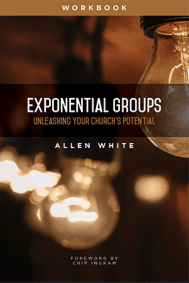
The Exponential Groups Workbook is a helpful tool for pastors and church staff to act on the principles of the Exponential Groups book. With the original book, readers learned how to connect their “unconnected” members into community, recruit small group leaders, maintain current discipleship strategies, and implement new strategies to keep their churches strong and healthy. Now with this workbook, they can continue this work and take it to the next level.
This workbook contains updated material, church success stories, and practical exercises to plan and execute these proven methods. In an effort to help take the guesswork out of groups, the workbook contains samples and actual examples of job descriptions, timelines, leader recruiting tools, promotional materials, and other pieces essential to a successful group launch. This workbook can be used as a self-study tool for pastors and church staff, or as a companion to Allen White’s online courses and live in-person training events. Move from inspiration to implementation with this helpful workbook.
CLICK HERE TO VIEW A SAMPLE OF THE WORKBOOK
Get your copy of the Exponential Groups Workbook for only $12 plus free U.S. Shipping. Or, get both the Exponential Groups book and workbook for only $25 plus free U.S. Shipping. Canadian churches can order from the Durham Christian Bookstore.
What Pastors are Saying about the Exponential Groups Workbook:
“Allen White stands at the forefront of small group ministry. His coaching brings you to the cutting edge of small group ministry and helps you connect countless people to authentic Christian community.” — Michael Hayes, St. John’s Lutheran Church, Orange, CA
“If you are looking to expand your knowledge about small groups and breathe new life into your small group ministry this is the workbook you have been waiting for! Not only will Allen give you the tools you need to be successful in your ministry, but he will also walk you through the process step by step. Thank you, Allen, for changing our small group approach and for your expertise.” — Jerry McQuay, Christian Life Church, Tinley Park, IL
“I’ve been a pastor in the Miami area for nearly forty years, and in that time, I have had the great honor to be trained by Allen White in coaching exponential groups. Allen is extremely professional and strategic in his approach to coaching, and my time with him was instrumental in the growth of our groups as well as our recruiting of new group leaders.” — Rudy Rivero, New Dawn Church, Miami, FL
Get your copy of the Exponential Groups Workbook for only $12 plus free U.S. Shipping. Or, get both the Exponential Groups book and workbook for only $25 plus free U.S. Shipping. Canadian churches can order from the Durham Christian Bookstore.
The post [Video] A System Solution for Groups (3:16) appeared first on Allen White's Blog.


June 9, 2020
What is the Goal for Your Groups This Fall?
When you think about your group goal for this coming fall, what comes to mind? You might think about the number of people you would like to connect into groups. You might focus on the number of new groups you need to start or the open groups you need to fill. You might begin to feel the dread of how many new leaders you will need to pull this off. You might even feel some uncertainty about the implications of Coronavirus on your plans. But, before you go to these questions, there is a larger question of goals that you need to address.
 Image by Free-Photos from Pixabay
What do you hope to accomplish with groups?
What purpose do you want to fulfill? Do you want groups to help people become better connected and more “sticky”? Do you want groups to help people grow deep in their faith and live out what they’re learning? Do you hope that groups will train evangelists to win the lost? Do you want to turn your groups loose to serve in the community? Maybe you’re not sure what you want.
There are group models for creating all of the different types of groups listed above. You could even launch groups that will do a little of all of those things, but the reality is that some of those purposes will get overlooked. What type of groups do you want to start? But, there’s a better question to ask here.
Where is your senior pastor headed this fall?
What is your pastor passionate about? Does your pastor want to connect the congregation, make disciples, reach the community, raise up leaders – where is your pastor headed? The answer can’t be that your pastor wants to do all of that. Where is your pastor headed? As soon as you find out, get in front of that theme with groups.
If your pastor is passionate about evangelism, then find or create a curriculum that your groups could use to attract their unchurched friends and introduce them to the Gospel. If your pastor is passionate about leadership, then find or create a leadership curriculum. You get the drift. Small groups can intersect with whatever need your pastor is the most passionate about. Research tells us this.
Why can’t groups do something else?
Groups could be launched on topics that are completely different from where your senior pastor is going this fall. You will experience some success just in promoting and launching groups. In my experience, your success will amount to about 30% of what could happen if your senior pastor was engaged with groups. Here’s what I mean: when groups connect with the theme your pastor is passionate about – your pastor will be more excited about groups and will promote them. Your people will follow where your pastor leads them.
The first time we did this in our church, I started with where my pastor was headed. Now, this was way back in 2004, and my pastor was passionate about The Passion of the Christ. The film was about to be released. My pastor knew that people would have spiritual questions after they saw the movie. He had planned a sermon series and even purchased some advertising. Knowing this, I walked into his office and asked, “Pastor Dave, what if we launched groups about The Passion of the Christ.” He thought that was a great idea. Well, it was his idea! The end result is when he invited people to open their homes for the Passion series, we doubled our groups in one day! It had taken seven years to get 30% of our adults into groups through my own efforts. When my pastor made the invitation, things dramatically changed. (We also created our own video-based curriculum for this series). If you feel your groups are stuck, aligning your group launch and curriculum with your pastor’s passion and theme will ignite your small group ministry.
Concluding Thoughts
These are uncertain times. At this point, I’m tired of saying that and you’re tired of hearing it. We don’t know how Fall 2020 will be. Will schools reopen, then revert to online learning later in the fall due to Coronavirus? Will churches reopen only to re-close? I know of one church that has already re-closed. You don’t know what the circumstance will be, but you do know one thing for sure – You WILL launch groups this fall somehow and in some way – on-campus, off-campus, online, offline, or all of the above –it will happen.
Regardless of the form groups will take, the key to attracting more people to groups and recruiting more leaders lies in the alignment with your senior pastor. Get ahead of where your pastor is going. Find resources that will align. If you start now, you have time to create your own video-based curriculum for the fall. If you need help, just let me know.
The post What is the Goal for Your Groups This Fall? appeared first on Allen White's Blog.
June 2, 2020
When Should Groups Meet in Person?
When churches should regather for worship is one question, but an equally challenging question is when groups should meet in person. The issue of COVID-19 has not been solved. In fact, several states are now reporting more cases of Coronavirus than ever before. Just when you thought it was safe for groups to meet in person, the pandemic seems to be flaring up again in many places.
 Image by Free-Photos from Pixabay
As people are becoming weary of quarantine and some despair of another online meeting, directing groups to meet too soon could only add to the problem. But, eventually groups will meet. When they do, how should you guide them? Here are some things to consider as you direct your groups:
1. What are the restrictions or recommendations of your local government?
State and local governments all have common, yet unique challenges. The Coronavirus pandemic seems to have no rhyme or reason. At first, the pandemic seemed more of a big city problem, but over time it has shown up in more rural areas. It’s hard to predict. While guidance and restrictions related to COVID-19 have unfortunately become politicized in some areas, this is a time to heed the counsel of government in directing your groups and especially observe restrictions on meetings and meeting sizes.
2. What are the recommendations from medical authorities?
While opinions vary among medical experts (and I’m not talking about your Facebook friends), there is some common agreement regarding the spread of disease. COVID-19 is a respiratory illness, so breathing it out while talking, singing, shouting, coughing, sneezing, or breathing spreads the disease. It seems to enter the body through the eyes, nose, or mouth. It would make sense to cover the body parts that spread the disease as well as those that serve in contracting the disease. Here is a description of how viruses spread from an immunologist.
There is debate over other issues. Can the virus be spread on surfaces? Clean them. Can the virus be spread through food? Avoid refreshments for now. Can the virus be spread through human contact? Maybe go “touchless” for a while in the group, even though group members will be desperate to give and receive hugs. Here are the guidelines from the CDC.
3. What should groups do over the summer?
Summer tends to be a challenge for groups anyway. People plan vacations or weekends at the lake. The rhythm of the public school calendar comes into play. Even though people are still working (hopefully), alarm clocks don’t ring. Longer evenings lead to more leisure. Warmer weather calls people outdoors. For places with long winters and/or long quarantines, once people can get out, my sense is that they will be gone. Don’t fight that.
In a normal year, I usually advise groups to meet as often as they would like, but at least once per month. They can meet socially. They could serve together. Some might want to meet for a Bible study. The bottom line here is that a group is not just a meeting just like a family is not just dinner. Groups also need group life together.
Summer is not the time to launch a new study or a new series. Churches that do a big push in the summer usually lose momentum when it comes to the fall launch. It’s better to embrace the typical rhythm of summer and gear up for a big fall. Even if the fall may bring a resurgence of Coronavirus and a second quarantine, people need a break in the summer. We will talk about fall planning in another post.
4. What do the groups want to do?
Even if the church gives groups the blessing to meet in person again, some people will be reluctant to meet for fear of exposure to COVID-19. Others will differ on what precautions to take. I’ve already heard of churches dealing with mask wearers and non-mask wearers. It hasn’t quite taken on the proportions of the circumcised and the uncircumcised in the book of Galatians, but the spirit is there.
With any small group dilemma, groups need to form their own group agreements going into this next season of meeting (or not meeting). A discussion of the group agreement will help everyone to feel heard and hopefully will lead to agreement on how the group will proceed in the summer or fall semester. For more information on forming a group agreement, click here.
While the church can offer some overall guidelines for groups, it’s really the decision of each group. Encourage your coaches to engage with the group leaders to help them navigate this issue. If you don’t have coaches, first, you need to think about starting your coaching structure. Second, if you don’t have coaches, then you need to talk to your leaders individually and help them.
5. Create Some Group Guidelines.
Groups will need some overall guidance from the church. These should be general guidelines based on the best medical and governmental information you can access with the understanding that groups and their members will have different opinions and feelings about this. Personally, I would avoid making the guidelines too directive, in that, you don’t want to put the church in a place where they might be liable for a group’s actions.
Eastside Christian Church in Anaheim, CA published guidelines for groups at one of their campuses in Minnesota. Bear in mind as you read their guidelines that to date this county in Minnesota has had no reported cases of Coronavirus.
Group Grand Opening Guidelines by Will Johnston and Cheri Liefeld
We recognize that some of you may be nervous about meeting at all—and that’s okay, you don’t have to—and others of you may feel like any sort of meeting restrictions are unnecessary. We’ve adopted these guidelines because we want to preserve our witness for Jesus to our communities by following our local, state, and national leaders, and because we don’t want to be responsible for an outbreak that could devastate lives.
Illness – Group members should stay home if they or anyone in their household is sick.
Location – Select a gathering place where you can safely distance. Meeting outside is encouraged when possible.
Masks – We are asking group members to wear masks, especially in the time people are arriving and socializing. Once group members are safely distanced, masks may be removed at the discretion of the leader and participants.
Food – We are big proponents of food at small group gatherings, but during this season we are recommending that groups not eat together. If you do choose to eat, encourage members to bring their own beverage and snack.
Greetings – As much as some will miss hugging or shaking hands with other group members, for now it is wise to avoid physical contact.
Cleaning – The host should be prepared to clean and disinfect surfaces and objects that are frequently touched both before and after group (Door handles, chairs, restrooms, etc.).
Virtual Option – Not everyone will feel comfortable attending in person at first. Consider setting up a computer in your meeting area so group members can join in via video conference.
Childcare – Due to the challenge of having young children practice distancing, at this time we are asking groups not bring children to meetings at this time.
High Risk Individuals – Those who are 65+ or who have serious underlying health conditions are strongly encouraged to join an online small group rather than an in-person one. Groups comprised largely of high risk individuals are encouraged to continue meeting virtually.
Group Size – Groups of more than 10 people that choose to meet in person should divide the group up and meet in different places or at different times.
Concluding Thoughts
Guidance for groups regathering is not a simple cut and paste. While I feel that the guidelines from Eastside are thorough, you need to come up with what’s right for your small groups. And, then encourage each group to determine what’s right for them. Online groups may not feel perfect to some, but they may need to be an option for a while.
In all of this, don’t forget why we’re doing this. Groups are not for the sake of groups, but for the sake of disciples making disciples and practicing the one another’s (which can be done in ways other than meetings). Groups are one method of making disciples. Group meetings are one component of groups. Don’t limit yourself with in-person meetings.
Join a Conversation about Regathering on Thursday, June 11, 2020 at 1 pm Eastern. To register, click here.
The post When Should Groups Meet in Person? appeared first on Allen White's Blog.
May 27, 2020
When Should Churches Reopen?
I don’t think “When Should Churches Reopen?” is the correct title. After all, the church is a body of believers, not merely a building or a worship service. The church never closed, but the building and the gatherings did. But, when and how should the church start gathering again?
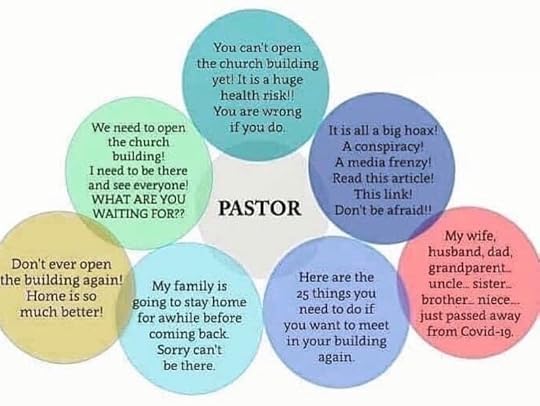 Borrowed from every pastor on Facebook.
This is THE big question. Trying to plan during a continually ambiguous crisis with conflicting information and political agendas is nearly impossible. While churches in some parts of the U.S. have begun meeting on-campus with certain guidelines in place, churches in other states cannot open their doors for the foreseeable future. Some are hesitant even when restrictions are lifted. And, a few churches never actually closed. The best that any pastor and church can do is to make the best decision based on the available information. That might not seem very reassuring.
What Will State Governments Allow?
It would be easy to launch into a standup comedy routine about all of the conflicting regulations and guidelines across the great U.S. of A. It would be TOO easy (not to mention unhelpful). But, here is what I am seeing. Churches in states that are currently allowing worship services are proceeding with caution. Even in states that are wide open to shopping, dining, recreation, and worship, not every church is meeting onsite and in-person. Some states limit gatherings of more than 100. Other states restrict gatherings of more than 10. The decision is easy if the state says “No” — you don’t meet. But, when the decision is up to the church’s leadership, there are many factors to consider.
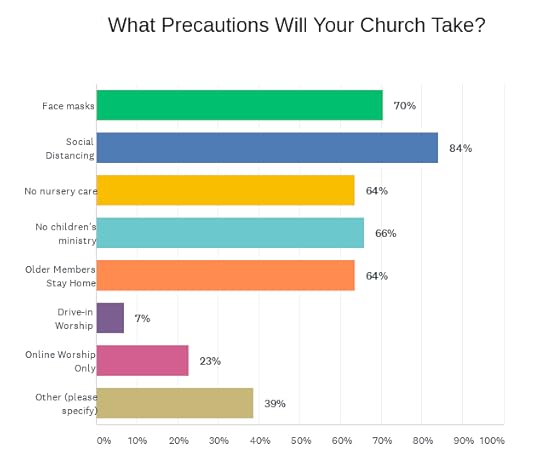
What Precautions Will Your Church Take?
Most churches anticipate using social distancing in their seating and common areas or what Life.Church calls a Touchless Service. Other precautions mentioned in a recent survey conducted by this blog include requiring congregants to wear face masks, not offering nursery care, encouraging older members to stay home, and waiting to reopen their children’s ministries. A handful is planning drive-in or outdoor worship services.
Several churches will start offering additional worship services in order to provide more space for social distancing. Additional cleaning can also add to preparation. One pastor mentioned moving the singing to end of the service, so those who didn’t wish to participate and broadcast germs could leave. There are many factors to consider in fighting the spread of disease. Read the post listed below by Erin Bromage, an immunologist, for a scientific explanation.
Can you kill every germ? Can you prevent every asymptomatic carrier from spreading the disease? How much preparation and prevention is sufficient? This are big questions to weigh.
Should You Just Wait to Open Everything All at Once?
A third set of churches don’t see in-person services happening for a while still. Similar to North Point Ministries in Atlanta, these churches want to wait until they can offer everything to everyone, so in the meantime they will stay with online services only.
I just found out that this is also the case for our church in South Carolina, NewSpring, who plans to open all campuses and all ministries on Sunday, July 12, 2020. NewSpring is going with a strategy of opening up everything — Worship Services, nursery, Kidspring, and Fuse (student ministry) all at once. Notice the timing here. The state of South Carolina has gradually been opening up week by week for the last six weeks or so: Retail stores, then Outdoor Dining, then Indoor Dining, and this past week: personal contact (haircuts, nails salons, etc). But, NewSpring won’t open for another two months. This is not a criticism, but a case in point.
Rick Warren says that Saddleback will reopen when Disneyland reopens. If your church opens with missing pieces like no nursery or children’s ministry, then your young families will stay at home. If your church discourages those who are vulnerable from attending, then your older people and others will stay home. Who will attend if you partially reopen? What will you have accomplished?
Create a Hybrid Small Group – Online Service
Awaken Church, San Diego is combining their small groups with their online services to create watch parties for their weekend worship services. If you think about this, most people only connect with a handful of other people on Sunday anyway. They don’t have to meet in a large worship center to participate in the service and engage in personal interaction with other members. For more information on what Awaken Church is doing, click here.
Now, to pull this off, you need more small groups ASAP. If you’ve ever wanted to experiment with a new group’s strategy, this is the time for experimentation. The Leading an Exponential Groups Launch course can help you quickly create new small groups, recruit the leaders you need, supervise the new leaders, and train them for success.
The Biggest Fear in Reopening
Some people bristle when fear is addressed. After all, we are a people of faith, not a people of fear. But, we feel fear. Maybe we shouldn’t be afraid of the Coronavirus, because if that’s what might take us from this life to the next, then we receive our reward in Heaven. But, there are other fears to consider.
The fear of reopening in the extreme is exposure to liability. What if someone gets sick at your church? Could your church be sued? Will your church be held liable? Granted people were invited and were never forced to attend. They may not have a case. But, this is not the true fear.
The underlying fear for most churches is the fear of blame and losing trust. If the church opens too early, even if their state allows, but they are unprepared and people get sick, how do you live that down? This is already happening. How soon will that congregation return? How likely will a new family visit that church where a bunch of people got sick? If a church executes a careful plan of cleaning, social distancing, mask wearing with no touching whatsoever, can they say they took every precaution? Can they say they did everything humanly possible? Will that response be good enough?
I hate to disappoint you. I’m not saying whether or not your church should reopen its building, but this has been on my mind like it’s been on yours. I have four children at home. I am weighing out when to take them back. (Our family has lived in quarantine for 73 days. We haven’t been outside of the house except for trips to the grocery store and a very few other places. One of our children especially would be drastically impacted by COVID-19, so we’re staying in). Going out and going back to church services is not an easy decision.
Overall, the country still has more questions than answers. Good answers are harder to come by especially now that things are so politically entrenched. But, reopening the church building is not the most important mission today. It’s time to rethink how the church is doing church. There are things to start doing and keep doing digitally. There are things to stop doing and leave behind. How has this season helped to redefine the ministry of your church?
The decision to open for worship services is met with overwhelming uncertainty. Once churches reopen their buildings for worship will they have to close them again in 2020? A church in South Carolina has already re-closed. What can you do now to prepare for the next crisis? What does your church need to know before you reopen your worship services? What can you do without a worship service to serve your people in the meantime?
For further insights on preventing the spread of the disease from surfaces or singing, please consult these posts by an immunologist, the CDC, and a DJ/Pastor from Minneapolis:
The Risks – Know Them – Avoid Them by Erin Bromage, Comparative Immunologist and Professor of Biology at the University of Massachusetts Dartmouth
Interim Guidance for Communities of Faith from the CDC
The Joys and Germs of Singing in Church: The Fascinating Science Behind Reopening Churches by Peter Haas, Lead Pastor, Substance Church, Minneapolis, MN
A few other leading voices on reopening the church building:
Please Don’t Kill Me with Your Church by Ralph Moore
180 Churchgoers Exposed to COVID-19 by Asymptomatic Member by Stephanie Martin
9 Concerns Pastors Have About Their Church Gathering Again by Aaron Earls
Reopened SC church closes again after members exposed to coronavirus at services – 5/27/2020
The post When Should Churches Reopen? appeared first on Allen White's Blog.
May 19, 2020
The Chocolate Hummus of Ministries Got Left Behind
The Coronavirus pandemic has created some interesting times for life and ministry. Back in March 2020 toilet paper disappeared from the store shelves along with hand sanitizer. While the second one made sense in combating a virus, the first one was a bit of a puzzle.
 Courtesy of Traderjoes.com
What also seemed curious were the items left behind on store shelves. Items that didn’t appear on anyone’s shopping list included things like chickpea-based linguine, chocolate hummus, dryer sheets, obscure canned veggies like artichokes and asparagus spears, plant-based proteins, and oddly enough, Dasani bottled water. “Chocolate hummus is the canary in the coal mine. If you see it selling out, it’s time to start fleeing into the woods,” according to Aaron Mak in a post on Slate.com.
What are Churches Leaving Behind?
Once stay-at-home orders too place, churches went online. Worship services went online. Small groups went online. Giving went online. But, some things got left behind.
In a recent survey of churches across North America, pastors reported not only what they stopped doing, but also what they’re not bringing back. This included things like the church bulletin, working at the church office, tons of physical meetings, large group speaking events, and too much programming.
One shift is to stop gauging the church’s success on Sunday worship attendance. One pastor wrote, “We need a more unified and thoughtful approach going forward.”
Scarcity brings clarity. What will your church leave behind?
What are Churches Starting and Keeping?
Every church represented in the survey reported a much stronger online worship attendance after March 1, 2020 than their average weekend attendance in February 2020. While some churches just expanded the reach of an existing online campus or streaming service, others have discovered that through online services, they are engaging a larger part of their congregations and attracting people outside of their church (often outside of their state!).
Churches are also engaging in an uptick of personal ministry. Pastors are using text messages, phone calls, personal emails, handwritten notes, and of course, Zoom meetings. The overall tone of ministry has become more informal and more experimental. Restrictions have forced churches to rethink the methods in fulfilling their mission.
This is a time of learning. The church is learning what to do and what not to do. The church is discovering what really matters, what doesn’t seem to matter, and what used to matter. And, of course, the church is waiting. Waiting on the Lord is a good thing.
The church is discovering that it’s much more than a Sunday service in a building. We’ve all said that, but now we’ve lived it. As Alan Hirsch says the church is playing chess without the queen. With the queen of the worship service gone, it’s a chance for the church to see what all of the other chess pieces can do without her. That’s not saying the on-campus worship service shouldn’t come back. But, it is causing everyone to look at what is working during a crisis.
A while back someone said, “Right now everything is a startup.” How is your church a startup? How are you innovating? What have you discovered?
And, most importantly, what is the chocolate hummus in your church? Give your answer in the comments below.
Click here to take the anonymous survey.
Other posts in this series:
Part 1: How Quarantine Changed the Church
Part 2: Conversation Trumps Content Alone
The post The Chocolate Hummus of Ministries Got Left Behind appeared first on Allen White's Blog.
May 12, 2020
Conversation Trumps Content Alone
During the Coronavirus pandemic, pastors have become online content machines. Pastors have always been content machines, we’re just seeing more of it. Phil Cooke said that the church is currently producing more media than Hollywood. How about that?
 Image by klimkin from Pixabay
Our faith is multifaceted. God gave us a book and a brain, so there is no coincidence there. We are people of the Book, the Bible. After all, we are transformed by the renewing of our minds. But, that transformation involves a few other things like our experiences and our relationships, our attitudes and our actions. While nothing supersedes what the Bible gives us, transformation is not merely a knowledge-based enterprise. As pastors continue to pump out content, we must also realize that people don’t grow by content alone.
People are Inundated with Content.
From newsfeeds to blogs to everyone starting a podcast right now, there is content for days. For a society that was already on information overload, quarantine has caused the overload to level up several times over. In addition to content, people need a place to process all of this content and do life together, even while they’re apart.
New Facebook devotionals and midweek services are great, but how can your people talk back? Actually they can. People can join in Watch Parties and message each other. People can communicate with the presenter. Give people time to interact with you and with the content. Offer a question time, or give a question for the group to discuss. Using these simple tools you can turn your content into a conversation. I watched one group of pastors online last Sunday night reading and answering their congregations questions from the chat. Your people need conversation, not just content.
Smaller Churches have the Advantage.
If you pastor a smaller church, you can actually call every one of your members on a regular basis. You can have an actual conversation with them. While you still have the deadline of the Sunday sermon and Zoom meetings, the schedule has shifted. A pastor serving a regular sized church of 90 people could actually have a personal conversation with every member over a 30 day period by just calling three people per day. Pastors with 1,000 or 10,000 can’t do that. While online services are a necessity these days, personal touches count more than ever.
In larger churches, staff and church leaders should be enlisted to make similar contacts. Call all of your leaders. Call all of your regular givers, if you aren’t already. While you should have started this 60 days ago, you can still start now. There are lots of ways to reach out to folks and even practice the “one anothers” amid social distancing.
Small Group Churches have an Advantage.
Online worship services only go so far. While worship and the Word is vitally important during these days of isolation and fear, the reality is that once people go online, they will find a better online worship service out there. That’s okay. These are unusual times.
Small groups, however, are the glue that holds the church together. Many churches are starting significant numbers of new online groups. Remember, people need conversation and not just content. The format of groups is changing. I’ve done online coaching groups with pastors from across North America for years. My online coaching has changed. Rather than just diving into the topic, we take a little time to debrief our current situation. The pastor in Washington talks about quarantine life and ministry over the last two months. The pastor in Nebraska is just now getting into the thick of it. There is a need to talk about what we’re going through.
There is also much to learn as churches are innovating ministry right now. One church developed an online small group study called Cabin Fever to help people deal with living, working, and schooling in quarantine. Another church developed an online resource for members of their community to post practical needs. They are then matched up with a church member or a group who can meet that need. Another very large church has tasked their staff to call 160 church members per week. They are also making N95 masks for medical personnel. If pastors ever wanted to experiment, this is the time. No one is looking for perfection these days.
New Online Groups are Adding up to 50% More Groups in Some Churches.
Sure there are excuses about Zoom fatigue, but there used to be excuses about not having enough time for a group. Some people will always have reasons why they can’t join a group or just don’t want to. That’s okay. Move with the movers. If you make the offer, there are folks who would love to connect with others. Read more on starting online groups.
What is not working right now is assigning people to groups. Let’s face it this has never worked very well. When starting new groups online or offline, the leaders should start by making a list of people they know. They can invite a couple of people, then ask their new members to invite a few people they know. Before they know it, they have a group.
Now, there may be people who want to be in a group but aren’t invited. Normally, I would recommend creating an environment where prospective members can meet group leaders in person, then decide whose group to join. While you can’t do this at a physical location, you could do this online. Host an online meeting where leaders can introduce themselves and talk a little about their groups. Prospective members can listen, then indicate which group they want to become a part of. Everyone knows what they’re getting into.
Concluding Thoughts
Content is great. The Word of God is powerful. But, the reality is that people need each other in addition to needing your teaching. Try different ways to help them connect online and offline during this time. Get on the phone and give your people a call. Send them a handwritten note in the mail. Create new online groups. We don’t know when restrictions will end. Every state has a different opinion. We also don’t know if and when another outbreak may occur. If you learn what to do during this crisis, you will be better prepared for the next one.
How is your church innovating during the COVID-19 pandemic?
TAKE OUR SURVEY: Ministry Amid the Pandemic
Next Week: Part 3 The Chocolate Hummus of Ministries Got Left Behind
The post Conversation Trumps Content Alone appeared first on Allen White's Blog.
May 5, 2020
How Quarantine Changed the Church
This is a three-part series about how the church is changing during the pandemic and discovering new paradigms of ministry. This week we will explore worship services. Next week, we will cover small groups. Then, in the third installment, we will consider the “chocolate hummus” of ministries and what should be left behind.
Part 1: Online Services are Bigger Than Ever
Church went online, and everyone showed up. Churches across the country have reported online attendance that is double their average weekly adult attendance or more. I see a few reasons for this happening. I also see a few opportunities moving forward.
The Easter Phenomena
Easter is typically the highest attended Sunday of the year. While we’d love to think that our congregations have done a great job inviting unbelievers to Easter and that our advertising really paid off, the reality is that Easter is the one Sunday of the year when everybody who is a part of your church shows up (along with some visitors and invited guests). Don Corder in his book, Connect: Grow Your Church in 28 Days – Guaranteed, uses a formula based on his work at The Provisum Group, which demonstrates that an actual congregation is more or less five times the size of the weekend attendance. You can read more here about the True Size of Your Church. Your church database will testify to the fact that you have a lot more people associated with your church than regularly attend.
As online services got rolling everybody showed up, and that’s a good thing. Now, the challenge is to change your thinking from online services as a necessity during quarantine to online services as a necessity to connect more regularly with your congregation and your community. Online services shouldn’t be a temporary stop gap. This is the gateway to a new way to serve your people.
Church Shopping and Hopping (and Other Pastors Lurking)
I have to confess: I haven’t been watching my church’s online services. I’ve been watching Saddleback Church, where I used to be a member. Last Sunday, we “visited” Hillsong California. All of this happened from our living room in South Carolina. Church shopping and hopping has never been easier! I know I’m not the only one.
Now, smart pastors are looking at a lot of online services to pick up tips on improving their own online services. Also, for the first time, pastors are at home on Sunday and have time to relax and watch online services. This is all factoring into online attendance, even in a small way.
New Online Attenders
After 9/11 churches were packed. The United States faced a catastrophic attack unlike anything since Pearl Harbor. It shook people to their cores. They turned to the church. In this pandemic there were no churches to pack.
Churches were closed, but online services were open. People went online to find help and hope during the uncertainty of this latest catastrophic event. Rock Church in San Diego saw their Easter attendance increase from a regular worship attendance of 10,000 to an Easter 2020 attendance of 200,000. They received the largest offering in the history of their church.
For the church, this is an event unlike any other in recent history that will launch new forms of ministry to reach an online audience. Prior to the pandemic, people were jaded and content. Life was pretty comfortable. Everyone was riding high on the S&P 500. Coronavirus has shaken everything. Over 30 million people are out of work. Tens of thousands have died. People are tired of sitting at home, but uncertain about their future. While they can rail against politicians and process the anger stage of grief, the reality is the world has become unstable. The church, however, is built on a rock.
Online Campuses Might Have Replaced Multisite Campuses.
If people will worship and respond in their living rooms, then why go to the trouble of maintaining multisite campuses? Many multisites are essentially hosting online services in a group of hundreds or thousands. Yet, online services during the pandemic have demonstrated that families, small groups, and watch parties have become a much larger audience than all of a church’s multisite campuses combined. Some churches discovered the exponential potential of microsite campuses sometime back. You can read more here.
We understand that an online campus is more than just streaming the video from a weekend service. It’s a campus. There is a service host. There are next steps. And, the coffee is better than it is at the multisite campus I attend! Why go back when multisite campuses are reopened? I’m not saying people shouldn’t. I’m just asking if multisite campuses are still necessary.
The Format of Online Services Matters
With online services there is a vast difference between streaming your regular service and creating an online service format. Why split the hair? Streaming regular services creates online viewers. Offering a unique online format creates participants. A church service shouldn’t be something that people merely watch, but something they engage in. If they are not engaging, it’s not their fault. The format makes the difference.
Online services that work honor the principles of other online content. First, tighten up the shot. Think about how newscasters talk directly into the camera. They’re not standing on a stage in an empty auditorium looking elsewhere. Newscasters look directly into the camera. Their audience is on the other side of that lens. So is yours. Use a low cost teleprompter for your notes or manuscript so you’re looking at the camera and not looking down. Tighten up the shot.
Next, personalize the background. Think of Jimmy Fallon creating the Tonight Show in his home with his kids climbing all over him. It’s personal. It’s warm. Let your people into your home. Sit in your favorite chair like you are sitting with your people in their living rooms. Use multiple cameras to add visual interest from different angles. And, while you’re at it, you could pre-record your service to edit in your main points, Bible verses, and next steps.
Lastly, tighten up the sermon. People are used to watching 30-minute sitcoms and 60-minute dramas. Anything over an hour is a movie, which requires millions of dollars and a captivating plotline to keep people’s attention that long. Think TED Talk. It’s harder to prepare shorter talks, but it’s important to keep people’s attention. Don’t let your pride get the best of you here. Going forward, consider using a format like LifeTogether’s Conversation Service which is built entirely for an online audience.
How Will You Disciple Your New Online Congregation?
Now that you’ve engaged with more of your congregation on a regular basis online and attracted a multitude of people outside of your congregation, how do you help them take next steps in their faith? What should you offer to people who come to Christ through an online service? How can they connect with the church through a small group or a membership class? How are you discipling your online followers?
By streaming your Growth Track, membership class, and other core components of connecting people into your church, you will not only include your new online followers, but you will also create a more convenient format for busy people who can never make it to the classes. The message is the same, but the methods have to change. That’s what we said when we went from traditional services to seeker services 30 years ago. Welcome to a new era of ministry. Quarantine is producing some new ways of doing ministry. It gives the church permission to experiment. It also gives the church an opportunity to launch new initiatives to reach people with the Gospel and disciple them.
What is your church learning about the future of ministry during Quarantine 2020? Leave your comments below.
Next Week — Part 2: Conversation Trumps Content Alone.
The post How Quarantine Changed the Church appeared first on Allen White's Blog.
April 28, 2020
Should Online Groups Move Offline?
This post starts with a question rather than a statement because everything seems to be a question amidst the Coronavirus outbreak. Our lives have been defined by phrases like “in an abundance of caution,” “reopening,” and “Zoom fatigue.” I wonder if that last one is just the updated version of “I don’t have time for a group,” but I digress.
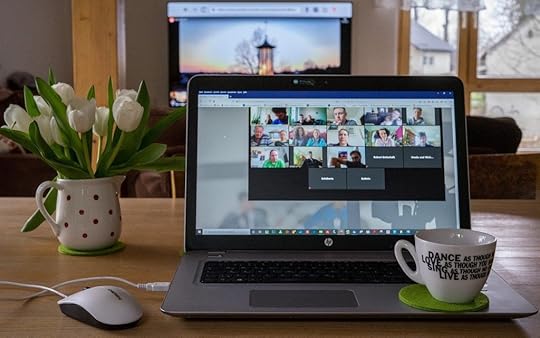 Image by Armin Schreijäg from Pixabay
Sometime in the future, which hopefully means in year 2020, things will go back to “normal” whatever that may mean. For some normal simply means pre-shelter-in-place life and ministry. But, for others, it’s embracing a new normal of on-campus and online ministry. Some churches have witnessed an online worship attendance that’s 20 times as large as normal on-campus worship. Other churches have increased their small groups by 50% during quarantine. What’s next for those groups? How will they continue, if they continue?
Online to Offline is Awkward
In another post I mentioned my online small group on CompuServe in 1994. You can read it here. Great things happened in that group. Greg got saved. Tricia met her future husband. Allen got married, but not to Tricia. While we knew each other well online, until we converged on Greg’s house in southern California, we had never met face-to-face.
The date was set. I was going to baptize Greg in his Jacuzzi. (It’s the California way). Our online group that met only by message board and chat was going to meet in person. Our joke was that we would all have to sit in a circle with our backs to each other and communicate through our laptops. It’s one thing to take an offline group online, but moving an online group offline is another thing. It was a little awkward at first, but we had some big enough personalities in that group that our online friendship easily transferred. I don’t think that every online group can accomplish this, so don’t expect every online group to become an offline group. Our CompuServe group continued to meet as an online group for one practical reason: We lived in four different states!
Online and Out of State
On a coaching call with a pastor the other day, he mentioned that his new online group was made up of members from Washington, California, and New York. They had agreed to meet temporarily for the Cabin Fever study, but they were unsure of what they would do after that. A lot depended on what the group members needed.
With the church staying at home, ministry has gone from normal office hours to ministry 168 hours per week. (Pastors were already serving on evenings and weekends). Boundaries for small groups expanded from counties to countries and cities to states. As long as the group could figure out the time zone formula, they could meet. Now what? Groups are no longer limited to one locale, so what does the group do after the restrictions are lifted?
Possible Next Steps
There are several options for groups to choose from as they move forward. (1) Groups could move completely offline. Once groups no longer have to stay-at-home, (and provided members live within reasonable driving distance of each other), they could endure that first awkward in-person meeting and meet offline permanently. (2) Groups could stay online. If group members live long distances from each other, then an online group would be the only option. But, some groups might appreciate the convenience of meeting online. They could just put their children to bed and meet online. They’ll have to bake their own brownies, but their meetings could continue. (3) Groups could meet mostly online but also meet in-person occasionally. Groups could gather socially or to serve together on a regular basis, but continue to meet for Bible study online.
What’s the best option for online groups? Whether groups meet online or offline, the bottom line is to let the new groups decide for themselves. They should receive the same coaching and training as any other small group leaders. The only difference is the format. Welcome to the 21st century and your new online small group ministry. You certainly have better tools now than we had in 1994. Use those tools to expand the reach of disciple-making in your church. While online groups may not be your personal preference, they will work for some of your people. Not only did our CompuServe group work, we are still friends today.
Related Posts on Online Small Groups:
Promoting Community While Social Distancing: Moving Your Small Groups Online
Suddenly, Everybody has Time for a Small Group
Leave Quarantine with a Stronger Small Group Ministry
The post Should Online Groups Move Offline? appeared first on Allen White's Blog.
April 21, 2020
5 Questions to Ask Before You Exit Quarantine
Sheltering-in-place has dragged on. Many church services have been online exclusively for a month or more. Federal and state directives seem to change daily. We don’t know when things will go back to normal (or whether they should go back to normal). In this video, I ask five questions for you to consider personally and to consider with your team.
I’m not scolding you in this video. This screen capture just made me laugh.
Here are a couple of resources that might help you:
Are You Discipling Your Online Followers? (Posted 1/15/2011)
Leave Quarantine with a Stronger Small Group Ministry
Promoting Community While Social Distancing
The post 5 Questions to Ask Before You Exit Quarantine appeared first on Allen White's Blog.
April 14, 2020
Leave Quarantine with a Stronger Small Group Ministry
The Coronavirus outbreak has produced some unlikely consequences. Who would’ve thought that something that was meant to keep us apart is actually pulling us closer together? Well, forward-thinking small group pastors thought that!
 Image by Tony Prats from Pixabay
Churches around the country are reporting a 50% increase in small groups since they started new online groups. Even though people have to stay apart, there is a definite need to be together. These groups are coping with this new normal.
But the problem with any significant uptick in small groups, whether it be a church-wide campaign or the response to a pandemic, is keeping the groups going once the initial effort has subsided. Don’t look at this as a temporary response to a temporary situation. Look at the new online groups as an opportunity to build on something going forward. Here are some things that you can do right now that will help your groups continue once social distancing has been relaxed:
Give Your New Groups a Next Step.
Most groups fail because they are not offered a next step. Whatever series your groups are doing right now, give them something new to start immediately. Quarantine in most places will continue for another 30 days, so groups still have both the time and the need to gather.
When you offer a next step, give new groups one choice. Don’t let them get lost in the choices online. Your goal here is to get them to continue. The only decision you really want the groups to have to make at this point is whether or not they will move forward. Don’t add choosing a study to that decision. You want to keep this simple. If it becomes too complex, then the groups will stop.
Support Your New Leaders with a Coach.
Recruit your best group leaders to look in on a couple of new leaders each and see how they are doing. There will be a lot of ups and downs with groups. Some people are busier than ever, while others are bored as ever. Groups are experiencing various stages of grief: denial, anger, depression, bargaining, and acceptance. How are your leaders navigating this? People are dealing with a great deal of stress. Some have lost their jobs. Others are going crazy with their kids at home. Still others are essential workers who are putting it on the line every day. This is an intense time. How are your leaders handling it?
You have to be proactive. But, there’s not enough of you to go around. So, you have to multiply yourself if you want your groups to continue. Otherwise, these big group numbers you’re posting will slip away week by week until everything goes back to “normal.” Why waste the opportunity to keep these groups going? Give them a coach ASAP!
Strategically Plan for Fall.One significant next step for all of your groups is a fall launch or campaign. Give them a heads up now. Tell them where you’re headed in the fall and when groups are going to start. Even if you only have a series title and a start date, this is enough to keep your groups moving forward.
No one is 100% certain how the summer is going to go. My suspicion is that when the weather is nice and the stay-at-home orders are lifted, people will be gone. They will head to the beach, to Disneyland, to the great outdoors — basically any place that isn’t their house. While groups should try to connect in-person or online at least once a month over the summer, your fall series will be the glue that keeps these groups together.
Use the new planning tool, the Exponential Groups Workbook, to map out your fall. This workbook is loaded with templates, exercises, and examples that I use in my coaching. Just having a few of these templates is well worth the cost of the book. By working through these chapters, you will develop a strategic plan for content, leader recruiting, group formation, coaching, training, tracking, and envisioning where your groups can go.
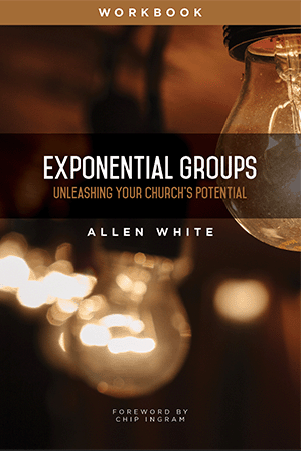
You can preorder the Exponential Groups Workbook for $12 with free U.S. shipping through Friday, April 17, 2020. When you preorder, you will receive access to the Exponential Groups Summit and downloads of the most popular tools in the workbook.
The Exponential Groups Workbook contains the following charts, exercises, examples, and templates (by chapter):
Launching – What is a group? exercise, Discipleship Ministry Evaluation, Setting God-Sized Goals, Exponential Groups Launch Timeline.Aligning – Seasonal Strategies, Navigating Obstacles to Alignments, Nonalignment Season Exercise, Curriculum Production TimelineWeighing Risk – Risk, Requirements, and Rewards Exercise, Who Qualifies to Lead? Exercise, Mindset Exercise.Coaching – Coach Job Description, Sample Coaching Timeline and Scripts, Series Sneak Peek Slide Presentation, Sample Sneak Peek Invitations, Prospective Coach Sign-Up Form, Recruiting Leaders – Sharing Group Ownership Exercise, Coaching Scripts, Breaking Connection Barriers: 30%, 60%, 100%, Leader Recruiting Timeline and Scripts for Senior Pastors, New Leader/Host Sign Up Card Sample, Sample Series Promotion Script, Initial Training – New Leader Briefing Agenda, New Leader Briefing Presentation, New Leader Briefing Packet, New Leader Information Form, New Leader Briefing Sign-In Sheet, Connection Strategy – Lego Exercise, Relationship Lists Exercise, Active and Passive Recruiting Strategies Examples, Sample Connection Night Ad, Connection Night Picture, Connection Event Layout and Photo, Sample Small Group Invitation, Small Group Connection Instructions for Group Leaders, Small Group Sign-Up Sheet, Sustaining Groups – Next Steps Flyer, Sample Mid-Series Survey, Leadership Track – Bringing Back the Requirements Exercise, Small Group Basic Training Outline, Small Group Leader Job Description, Coaching and Training – Sample Weekly Training email, Sample Leader Retreat Agenda, Coaching & Leadership Phases Exercise, Tracking Growth – Sample Survey to Collect Group Rosters, Sample Meeting Report Reminder, Meeting Report Form, Meeting Report Summary, Monthly Group Summary Report, Coaching Report, Coaching Summary, Beyond Alignment Series – Disciple-making Phases Exercise,
Appendix – Sermons on Community by Dr. Tony Evans and Pastor Don Wink.
You will read case studies from these churches who have successfully implemented the Exponential Groups strategies.
Ward Church, Northville, Michigan
Vertical Church, West Haven, Connecticut
New Dawn Church, Miami, Florida
Connect Church, Lawrence, Kansas
Hoboken Grace Church, Hoboken, New Jersey
Christ Church, Fairview Heights, Illinois
Rivertown Community Church, Marianna, Florida
LifeBridge Christian Church, Longmont, Colorado
Contributors to the workbook include:
Bay Hope Church, Lutz, Florida
Connect Church, Lawrence, Kansas
Calvary Christian Church, Winchester, Kentucky
Ward Church, Northville, Michigan
Brookwood Church, Simpsonville, South Carolina
Manna Church, Fayetteville, North Carolina
Olive Branch Community Church, Corona, California
Northwoods Church, Peoria, Illinois
ChurchTeams.com
Lutheran Church of the Atonement, Barrington, Illinois
Oak Cliff Bible Fellowship, Dallas, Texas
Ready to Jump In? Click Here.
The post Leave Quarantine with a Stronger Small Group Ministry appeared first on Allen White's Blog.