Jean Collen's Blog, page 20
December 27, 2017
THE WEBSTER BOOTH-ANNE ZIEGLER APPRECIATION GROUP
[image error]Shortly after Anne Ziegler’s death in October 2003, I started work on my first book, Sweethearts of Song: a Personal Memoir of Anne Ziegler and Webster Booth. I published this book in 2006 and resolved to try to keep their names and voices before the public. I started a Yahoo Group which did not attract many members so after a few years I closed it and started on Facebook in October of 2014. Some members from the original Yahoo group joined the present one and the group grew in size as Facebook users joined it. I have since changed the name of the group to The Webster Booth-Anne Ziegler Appreciation Group.
We were very lucky indeed when Mike Taylor joined the group. He has a vast collection of 78rpms and had recently developed an interest in Webster’s voice and began to collect his recordings. Not only did he share these recordings with us but he also restored them to pristine condition. He has found many rare recordings which he was kind enough to share with us over the years the group has been running. Here is an example of one of the recordings:[image error]
He also introduced us to other singers of the same period. My favourite singer from that period is Maurice Elwin (née Norman Blair). Under the pseudonym of Donald O’Keefe he also wrote some charming ballads – Webster recorded three of them.
[image error]
Play to me Gypsy (Maurice Elwin)
At the End of the Day (Webster Booth)
Between Mike and me we have managed to find all the duet recordings by Webster and Anne and are just short of 20 solo recordings by Webster out of the many hundreds he recorded. Whether these missing recordings, made in the thirties, forties and fifties of the twentieth century, will ever be found remains to be seen but Mike assures me that he is still on the look-out for them.
The late John Henderson often shared recordings and information with us, and a few other members have played an active role in the group even if it is just by liking or commenting on the various posts. It certainly makes a difference to me to have some kind of reaction to what is posted to the group. I am grateful that John Marwood has become our third administrator and I hope he and Mike will carry on the group if I anything should happen to me.
I have been looking through the Radio Times from the 1920s and1930s. The complete magazines from those decades are available online on the BBC Genome site. Webster started broadcasting in 1927 and after he introduced Anne to the powers-that-be at the BBC at the beginning of 1935 she was in great demand on the radio too. In these early editions of the Radio Times, I have seen names of many artistes I recognise, but there are also many more artistes who must have been equally popular in their day but whose names are completely unknown to me.
Webster and Anne were extremely popular in those far-off days but not many people remember them today. In comparison to other groups on Facebook, our membership is small but I prefer to have a small group of enthusiasts rather than a large group of people who have no idea who Anne and Webster were.
If you would like to join the group, have a look at the following link:
The Webster Booth-Anne Ziegler Appreciation Group
Jean Collen – 27 December 2017



THE GOLDEN AGE OF WEBSTER BOOTH-ANNE ZIEGLER AND FRIENDS
[image error]Shortly after Anne Ziegler’s death in October 2003, I started work on my first book, Sweethearts of Song: a Personal Memoir of Anne Ziegler and Webster Booth. I published this book in 2006 and resolved to try to keep their names and voices before the public. I started a Yahoo Group which did not attract many members so after a few years I closed it and started on Facebook in October of 2014. Some members from the original Yahoo group joined the present one and the group grew in size as Facebook users joined it.
We were very lucky indeed when Mike Taylor joined the group. He has a vast collection of 78rpms and had recently developed an interest in Webster’s voice and began to collect his recordings. Not only did he share these recordings with us but he also restored them to pristine condition. He has found many rare recordings which he was kind enough to share with us over the years the group has been running. Here is an example of one of the recordings:[image error]
He also introduced us to other singers of the same period. My favourite singer from that period is Maurice Elwin (née Norman Blair). Under the pseudonym of Donald O’Keefe he also wrote some charming ballads – Webster recorded three of them.
[image error]
At the End of the Day (Webster Booth)
Between Mike and me we have managed to find all the duet recordings by Webster and Anne and are just short of 20 solo recordings by Webster out of the many hundreds he recorded. Whether these missing recordings, made in the thirties, forties and fifties of the twentieth century, will ever be found remains to be seen but Mike assures me that he is still on the look-out for them.
The late John Henderson often shared recordings and information with us, and a few other members have played an active role in the group even if it is just by liking or commenting on the various posts. It certainly makes a difference to me to have some kind of reaction to what is posted to the group. I am grateful that John Marwood has become our third administrator and I hope he and Mike will carry on the group if I anything should happen to me.
I have been looking through the Radio Times from the 1920s and1930s. The complete magazines from those decades are available online on the BBC Genome site. Webster started broadcasting in 1927 and after he introduced Anne to the powers-that-be at the BBC at the beginning of 1935 she was in great demand on the radio too. In these early editions of the Radio Times, I have seen names of many artistes I recognise, but there are also many more artistes who must have been equally popular in their day but whose names are completely unknown to me.
Webster and Anne were extremely popular in those far-off days but not many people remember them today. In comparison to other groups on Facebook, our membership is small but I prefer to have a small group of enthusiasts rather than a large group of people who have no idea who Anne and Webster were.
If you would like to join the group, have a look at the following link:
The Golden Age of Webster Booth-Anne Ziegler and Friends
Jean Collen – 27 December 2017
November 25, 2017
THE VAGABOND KING (1943)
THE VAGABOND KING (1943)
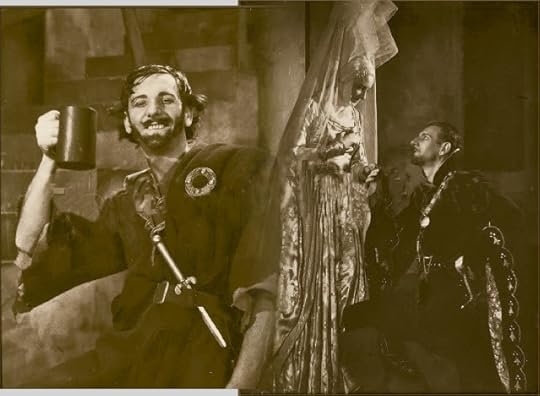

THE WINTER GARDEN THEATRE

Collage by Charles S.P. Jenkins

Anne Ziegler and Webster Booth as Katherine and Francois Villon in the revival of The Vagabond King (1943). A duet from The Vagabond King:
TOMORROW
Webster Booth pointed out in his joint autobiography with Anne Ziegler, Duet, that the Winter Garden had been in the hub of theatre land in the 1920s, but by the time Tom Arnold’s revival of The Vagabond King opened there in 1943, theatre land had moved west and not many people (including taxi drivers) knew where the theatre was any more.
The Tom Arnold production went on an extensive tour of the United Kingdom before it opened at the Winter Garden on 22 April 1943. The production was devised and supervised by Robert Nesbitt, the dialogue was directed by Maxwell Wray, and the and the conductor of the orchestra was Bob Wolly.
The name part of the Vagabond King, Francois Villon was a strenuous one. There was a lot of robust singing and a a sword fight. Unfortunately, on the first night of the tour in Blackpool, Webster was struck on the throat during the sword fight on stage with John Oliver. He lost his voice and his part was taken temporarily by Derek Oldham, who had played Villon in the original production in 1927 with his wife Winnie Melville playing Lady Katherine.
Anne Ziegler played the part of Lady Katherine de Veucelles in this production and she had three excellent duets with Francois Villon in the show: Love Me Tonight, Tomorrow, and Only a Rose. The last duet became the Booths’ signature tune in their variety act:
Only a Rose (Friml)
The part of Huguette was taken by Tessa Dean, while Lady Mary was played by Sara Gregory. Henry Baynton, an elderly Shakespearean actor took the role of Louis XI.

Webster and Tessa Dean (Huguette)


Cartoon of Anne and Webster in the show (June 1943)

On the cover of Theatre World (July 1943)


The King makes Villon Grand Marshall of France.
The show received excellent notices, but Webster complained about the theatre being very uncomfortable. Anne was so concerned with the sanitation that she called in a sanitary inspector! Despite the success of the show it closed in July. Webster was sure that the show closed prematurely because the Winter Garden Theatre was no longer in theatre land. He realised that the role was too heavy for his light tenor voice and thought the early closure was a blessing in disguise as he might have ruined his voice had he continued singing it for a longer time.
Song of the Vagabonds (Friml)


Here is the duet which stopped the show: Love Me Tonight
Addendum
Judging by the photos of the 1943 Tom Arnold production of elaborate sets, large chorus and the sword-fight scene, The Vagabond King would be extremely expensive to mount today.
Although Webster considered the role of Francois Villon his favourite part, it took a toll on him, not so much because of the singing which he could manage perfectly well, but because the part itself is a strenuous one. He was on stage most of the time rallying the masses to turn against the Duke of Burgundy and lead the mob into battle. The sword fight must have been quite challenging too – he probably thought he had lost his voice forever when his opponent John Oliver “was so realistic that I received the full force of his arm with his sixteen stones behind it right across my throat…. By the end of that first night’s show… I could hardly speak. A specialist was sent for, and he diagnosed a badly bruised larynx.”
Victor Standing took over the part for a few nights and Derek Oldham (who had played Villon in the original London production) took over from him until Webster’s larynx had recovered from the blow. After the first night of the London opening he was due to sing in the Good Friday performance of Messiah at the Albert Hall, which he considered “the very height of the oratorio profession”.
When he was 71 he told me that oratorio singing had meant far more to him than anything else he had done in his varied singing career, so he must have felt torn between everything he did in the nineteen-forties – musicals, films, and part of a double act with Anne on the variety stage. I dare say if he had stuck to singing oratorio he would be remembered today as one of the great British tenors of the twentieth century instead of one half of “Sweethearts of Song” duettists’ act on the variety stage.

The sword fight. Villon fights with Captain of the Archers (John Oliver).

Jeannie C 23 November 2012
Revised 25 November 2017 ©


October 13, 2017
SWEETHEARTS OF SONG
[image error]Four years ago, I received a lovely letter about the book from a gentleman in Ireland. I share it with you on the fourteenth anniversary of Anne’s death.He had recently read my book, Sweethearts of Song: A Personal Memoir of Anne Ziegler and Webster Booth. He attached various photos of Penrhyn Bay, North Wales which he had taken during his trip. [image error]


Part of his note reads as follows:
“All thanks to you, I spent a really moving day rambling the highways and byways of Penrhyn Bay. To be standing outside Anne and Webster’s house was an extraordinary feeling and for me a real privilege. Looking at the house, and then walking on the beach, all the time internally hearing their wonderful music, and feeling a real sense of gratitude to them both for all the joy they brought to countless millions over the years with their unique gifts, their unique talents. And yes, as I looked out on Penrhyn Bay, and then further East to Rhos on Sea, Colwyn Bay, Llanddulas and Abergele, I would see in my mind’s eye, the beautiful Anne in her youth, as well as her undoubted beauty in her later years. It is, as you well know, a spectacular landscape: Snowdonia to the South, the Ormes to the West, and to the North the Irish Sea stretching as far as the eye can see—–all quite something, and a beautiful and moving backdrop to remember both Anne and Webster.
So once again, many thanks, not only for your wonderful book but also for a memorable windswept day in Penrhyn Bay.”
It was good to know that my book had given him pleasure and had motivated him to pay a visit to Webster and Anne’s final home.
Jean Collen 13 October 2017.


October 4, 2017
A Scattered Garland: Gleanings from the lives of Webster Booth and Anne Ziegler
By Jean Collen View this Author’s Spotlight
I published A Scattered Garland: Gleanings from the Lives of Webster Booth and Anne Ziegler in one volume in 2006. Because I found out so much more additional information I have updated the book which now extends to four volumes. These books are available as paperbacks and ebooks:
Volume 1: Early days (1920s – 1939) 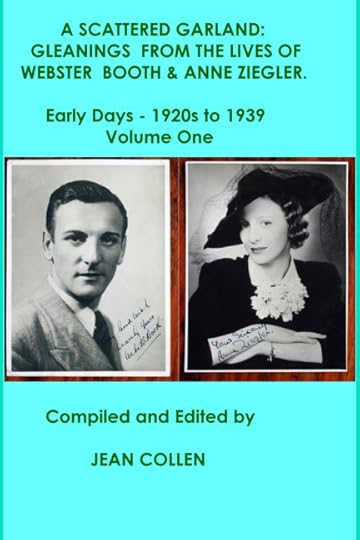


Volume 2: Years at the top in the UK (1940 – 1956)
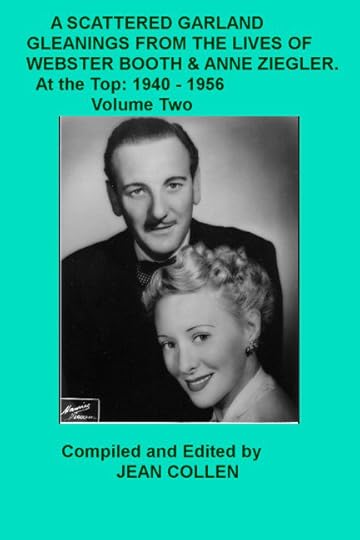 At the Top
 Volume 3 South Africa (1956 – 1977)

 The Booths in South Africa
Volume 4: Back in the UK (1978 – 2003) and additional information
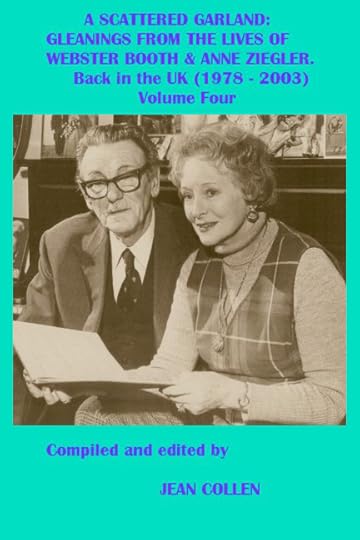
These volumes include articles, criticisms, cuttings, and extracts from the online archives of The Times, The Scotsman and The Stage, and other newspapers. In Volume 3 I have included material from New Zealand and Australian newspapers and in Volume 4 there is material from South African newspapers. Occasionally I have supplemented this material with my own notes. All my own writing is italicised.
[image error]
Author of “A Scattered Garland”.
Advertisements


July 23, 2017
JEAN BUCKLEY (26 May 1930 – 20 July 2017)
In 1943, Jean Buckley (née Newman) was thirteen years of age, living in wartime Manchester. Jean, an only child, was originally from London and the family had lived in Brighton for a time. When the war came her father decided that they might be safer living in Manchester. This did not prove to be the case. Jean spent many nights in a damp air raid shelter as German bombs fell on the city.
Jean had always loved Anne Ziegler and Webster Booth’s singing. She had a clear memory of hearing Webster singing Phil, the Fluter’s Ball with Fred Hartley and his quintet on the radio when she was a young child. As light relief from the sleepless nights in the damp air raid shelter, she and her mother attended many of their concerts and broadcasts in the city. They went backstage to see the couple and Jean saved her pocket money and collected coupons so that she could buy gifts to present to Anne when they went backstage. Anne and Webster saw Jean so often that they sent them complimentary tickets for broadcasts of Variety Bandbox and Variety Fanfare. She remembers Webster coming into the dressing room and greeting them with, “How are my two lovelies this evening?”
When Jean left school she went to work for Singer’s Sewing Machines and became a top sales woman with the company. Unknown to Anne and Webster she began to take singing lessons on a part time basis at the Northern School of Music and managed to obtain a few engagements. She told me that she did not mention this to the Booths in case they felt obliged to use their influence to advance her singing career.
Jean married Maurice Buckley in 1956 but was very upset when Anne and Webster decided to move to South Africa in the same year. They kept in touch with the Booths and she sent them copies of The Stage and other British newspapers while they were living there.
[image error]Maurice and Jean Buckley (1956)
When they returned to the UK in 1978 they lived near Jean and Maurice, and spent a lot of time with them. Jean said that Webster always enjoyed watching cricket on TV with Maurice. Jean baked a cake for Anne and Webster’s fortieth wedding anniversary in 1978.[image error]
[image error]Jean and her poodle, Trixie
A few years later, Jean and Maurice celebrated their Silver wedding anniversary. Here is a lovely photograph of Anne and Webster on that happy occasion. I used this photo as a front cover to my book, Sweethearts of Song: A Personal Memoir of Anne Ziegler and Webster Booth.
[image error]Anne and Webster (1981)
When Webster became ill and was admitted to a nursing home, Jean visited him regularly and took him out for a drive or for tea occasionally to give him a break from the nursing home. She put a tape recording of his records on the car radio. He disliked the nursing home and never wanted to return after his outing with Jean.
After his death, Jean did a great deal for Anne in one way and another. Jean was very hurt when Anne’s friend, Babs Wilson Hill introduced her to someone as “Anne’s greatest fan.” Jean replied, “I think I might be considered Anne’s greatest friend by now.”
The first time I heard of plans to establish a scholarship in Webster Booth’s name at the Royal Northern College of Music was in a letter from Anne Ziegler, dated 20 November 1985, just over a year after Webster Booth’s death on 21 June 1984.
Anne mentioned that a coffee morning had been held in the local church hall in aid of the Webster Booth Memorial Fund. Jean had proposed the idea of providing a scholarship in Webster’s name for a tenor to attend the RNCM for a year’s post-graduate study. Jean and her husband, Maurice worked hard to raise money for the Fund and by the time Anne wrote to me £1,600 had been raised towards the initial goal of £3,500. Anne’s letter continued:
[image error]November 20 1985 Anne to me
I wondered why the scholarship was to be awarded at the RNCM as Webster had studied singing with Dr Richard Wassall at the Midland Institute in Birmingham, fitting in lessons after he finished work at a firm of accountants. I knew that conductor Sir Charles Groves was chairman of the RNCM council at that time and Webster had often referred to him affectionately as “Charlie Groves” who had often conducted him in radio broadcasts, so I though that perhaps this was why Jean had chosen the RNCM for the Award.
Many years later, Jean told me why she had chosen the RNCM. In her late teens, she had studied singing part-time at the Northern School of Music, Manchester. This school and the Royal Manchester College of Music amalgamated in 1975 to form the Royal Northern College of Music, which was producing singing graduates of a very high calibre. Manchester was not too far from North Wales where Anne, Jean and Maurice lived. The trip to the College for the annual competition would not be too onerous for Anne as she grew older and it would not be necessary to stay overnight in the city after the Award had been presented.
Jean’s friend, journalist and broadcaster Natalie Anglesey, interviewed her on the BBC about the Webster Booth Memorial Fund, bringing news of it to a wider radio audience. Jean’s interview with Natalie
Jean continued to raise funds by making things to sell, doing clothing alterations for a small fee, organising raffles, and collecting donations to the Fund from friends, fans, relatives of Webster and Anne, and local neighbours. Donations were often as little as £1 or £2, but occasionally bigger donations were made by societies such as the Sir Arthur Sullivan Society. Webster’s older brother, Edwin Norman Booth, his wife Annie and daughter Margaret took great interest in the progress of the Fund and helped Jean with fund-raising. Annie made beautiful rag dolls to sell, and each member of the family made regular substantial donations. Jean’s early singing training at the Northern College also benefited the Fund in a round-about way. She and her accompanist, Maureen, began entertaining at hotels around Llandudno and all the money Jean earned in this way went towards the fund. To publicise the Award she gave talks to various societies and clubs about Anne and Webster’s career.
Anne and Jean in Penrhyn Bay before going to the Royal Northern College, Manchester for the prize winners’ concert for the Webster Booth prize.[image error]
I did not meet Jean when I visited Anne in Penrhyn Bay in 1990, although Anne told me a great deal about her while I was there. Jean had even made a cake for our tea! Jean and I began our correspondence in 2007 and we often said how sorry we were that we had not met each other in 1990 as we could have become good friends.
After Webster’s death, Anne went on holiday with the Buckleys every year. They usually took self-catering accommodation and Jean did all the cooking.
Maurice and Jean on holiday with Anne and Bonnie in the 1990s.[image error]
Jean did a great deal to help Anne as she got older. She and Maurice created an en suite room in their home and would have been happy to have Anne to live there if ever she felt unable to continue living in her own home. Even when Maurice became ill, Jean still took Anne shopping, to doctor’s appointments and to the annual prize winners’ concert at the RNCM. When Anne’s gardener could not continue working Jean even helped Anne with the gardening!
Sadly, Anne and Jean fell out over a trivial matter several years before Anne’s death and they were never reconciled. I corresponded regularly with Jean for over ten years and I was sad when she lost her sight and had to move to a frail care home. She developed Alzheimer’s disease and I cannot imagine how difficult it must have been to be in strange surroundings, unable to see and not remembering very much. She was an only child and had no children of her own. I was sad to hear that she died on 20 July 2017 at the age of eighty-seven. I hope she is now at peace. I will treasure the letters and emails she wrote to me, and the photos and memorabilia she sent to me. She will be sadly missed, but fondly remembered by me and friends who loved her.
Jean Collen ©
23 July 2017


July 12, 2017
ORATORIO
Webster Booth and oratorio
Although Webster Booth is remembered today as a romantic duettist in partnership with his third wife, Anne Ziegler, he told me that oratorio had given him the greatest satisfaction in his singing career. He was certainly a renowned oratorio singer in his day but this has been forgotten by most people who know more about him singing We’ll Gather Lilacs than tenor solos in various oratorios.
Two of my most cherished possessions are Webster’s Messiah and Elijah scores. The Messiah score had belonged to his father, Edwin Booth, whose name is written in the score, followed by Webster’s own name.
[image error]Webster’s Messiah score
In the two front pages, he listed some of his Messiah dates from 1928 when he sang at the Birmingham Town Hall on 3 November 1928 with the Choral and Orchestral Union, to performances of various oratorios in Port Elizabeth, Eastern Cape, South Africa with Robert Selley at the Oratorio Festivals there in 1961. The list includes a performance at the Royal Lodge Chapel on 15 February 1948 in the presence of King George VI, Queen Elizabeth and Princess Margaret, performances with the Huddersfield Choral Society, the Royal Choral Society and the Hallé Concert Society. Several Good Friday Messiahs at the Albert Hall where the entire work is performed without any cuts are listed. His first Good Friday Messiah was on the 10 April 1936 when he was 34 years of age. The Royal Choral Society concerts were usually with his champion, Malcolm Sargent as conductor, but he also sang with Sir Thomas Beecham at the Queens Hall on 17 December 1938.
[image error]21 December 1938 Messiah
He sang in many performances of Elijah, The Creation, Joshua, Judas Maccabeus, The Creation and Elgar’s Dream of Gerontius. It was after an afternoon performance of this last work at the Queen’s Hall on 10 May 1941 that this beautiful hall, Webster’s favourite concert hall, was destroyed by an incendiary bomb that night. Webster preferred Handel to Bach, but I see that he did sing in a performance of the latter’s Christmas Oratorio in South Africa in 1960.
[image error]December 1938 Messiah
Another Good Friday Messiah in April 1943
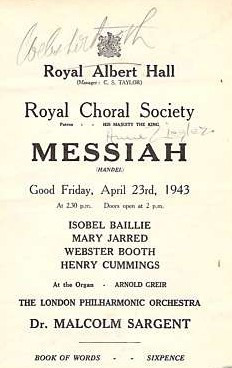
I think it is sad that he did not make a recording of the Dream of Gerontius as he was renowned for his performance in this work. Neither did he take part in complete recordings of Messiah or Elijah. When I was studying with him and Anne Ziegler I learnt the part of the Angel in The Dream of Gerontius and he sang the tenor part with me – how I wish I had a recording of it now! He sang in the first performance in South Africa of the work with the young Keith Jewell, Cape Town’s city organist (then aged 27) in 1957, the year after the Booths arrived in South Africa.
People in South Africa were inclined to think that the Booths had been out of favour in the UK and that was the reason why they moved to South Africa in 1956. This was far from the case. Admittedly their recording contract with HMV had been cancelled in 1951 and I have never been able to work out why the contract was cancelled as they were both in excellent voice at the time. But they had plenty of theatre, television, radio and concert engagements in the 1950s. Webster sang his last Messiahs with the Huddersfield Choral Society in December 1955 and January 1956. They moved to South Africa because of increasing problems with the Inland Revenue rather than because they were not as popular as before.
Anne Ziegler sang in exactly one first class performance of Messiah in Blackpool in January of 1944. Doctor Malcolm Sargent (as he was at that time) conducted the performance with the Huddersfield Choral Society.
[image error]1944 Blackpool Messiah
As a thirteen-year-old girl, I heard Webster and Anne sing in a performance of Messiah at St James’ Presbyterian Church which was then situated in Mars Street Malvern. Even at that young age, I was aware that it must have been a come-down for Webster to be singing this work in a suburban church in South Africa after he had been singing at the Albert Hall not very long before. While Anne sang in the performance at St James under the musical director of the main Presbyterian Church in Johannesburg, Drummond Bell, she was not asked to sing in more important oratorio performances, such as the one at the Johannesburg City Hall a month later, or with Robert Selley at the Port Elizabeth Oratorio Festival.
Webster’s oratorio recordings include the arias from Handel’s Messiah, Judas Maccabeus, Samson, and Acis and Galatea, Mendelssohn’s Elijah and St Paul, and Haydn’s Creation.
Jean Collen
12 July 2017.


June 23, 2017
FANS
Webster Booth and Anne Ziegler were very popular and attracted a legion of fans who followed them for a variety of reasons.
Before he began working with Anne, Webster attracted many female fans who admired him, not only for his beautiful voice, but for his smouldering good looks. He told me that he often singled out the most attractive girl in the audience and sang for her alone. Invariably she would be waiting at the stage door after the show, either to ask shyly for his autograph, hoping for a few kind words from her hero, or hoping, better still, that he would ask her out for a drink! He had attractive photos made to hand out to his fans, such as this one, signed at Shanklin in 1931, and the same photo later signed to Elaine in 1933.
[image error]Autographed photos
His practised seduction technique led directly to his second marriage with soubrette, Paddy Prior. He had been singing at a Monday evening concert at the Concert Artistes Association when he noticed an attractive young woman sitting in the audience obviously enjoying his singing. When he sang One Alone he directed his attention to her alone. After the concert, he was introduced to her and they were married after his divorce from his first wife, Winifred Keey, was finalised. Sadly, his marriage to Paddy did not last very long after he met Anne Ziegler during the filming of the Faust Fantasy at the end of 1934.
In July 1934, Madeleine wrote a note to her friends, Lily and Phil, from Shanklin on the Isle of Wight where Webster was appearing in the Sunshine summer show there.
[image error]From Shanklin
He valued his fans and treated them with kindness and consideration.He answered fan mail himself, such as in these letters, dated September and December 1936:
[image error]1936 letters
During the 1990s Anne wrote to me and told me that her very first fan had visited her recently in Penrhyn Bay. The girl had been fifteen years of age in 1935 and saw Anne in a summer show in Ryde when Anne herself was only twenty-five years of age. She had been a fan of Anne’s ever since and kept in touch with her over the years.
Even before Webster’s divorce to Paddy Prior was finalised, he and Anne began singing together on the concert platform. They were an instant success. Both were very attractive with charming personalities. He wore an evening suit with a gardenia in his lapel; Anne was beautifully dressed. As their popularity grew, she had crinoline gowns designed for her, some by the Queen Mother’s dress-designer, Norman Hartnell.
They attracted a legion of adoring fans. Many followed them ardently from one engagement to another and listened to all their broadcasts on the radio. One of their fans was Gladys Reed, seen below with Anne at the stage door of the London Palladium in 1942. You can see how delighted she was to have her photo taken with her idol! Anne wrote a letter to Gladys telling her to give their regards to the “gang” – probably referring to the devoted fans who followed them around from one engagement to the other.
[image error]Letter to Gladys 1943
[image error]North British Station Hotel
[image error]
Imagine how Anne and Webster’s fairytale act must have lightened the lives of their fans during the difficult war years. No wonder they attracted so many people at that time.
In 1943, Jean Buckley (née Newman) was thirteen years of age, living in wartime Manchester and she and her mother spending many nights in an air raid shelter with bombs dropping around them, keeping them from sleep. She and her mother attended many of their concerts and broadcasts in the city for Jean was enchanted by their act. She and her mother always went backstage to see the couple and Jean saved her pocket money and collected coupons so that she could buy gifts to present to Anne whenever they went backstage after a show. Anne and Webster saw Jean so often that they often sent her complimentary tickets for their shows.
Jean was very upset when they decided to move to South Africa in 1956 but they kept in touch and she sent them copies of The Stage while they were living there. When they returned to the UK in 1978 they lived near Jean and her husband Maurice and spent a lot of time with them. Jean said that Webster enjoyed watching cricket on TV with Maurice.
When Webster became ill and was admitted to a nursing home, Jean visited him in the afternoon when she finished work and took him out occasionally to give him a break from the dull routine of the nursing home. After his death, Jean did a great deal for Anne in one way and another. She and Maurice raised money to inaugurate a prize in Webster’s name at the Royal Northern College of Music in Manchester. Jean was very hurt when Anne’s friend, Babs Wilson Hill condescendingly introduced her as “Anne’s greatest fan.” Jean replied, “I think I might be considered Anne’s greatest friend.” Sadly, Anne and Jean fell out over a trivial matter several years before Anne’s death and they were never reconciled. I corresponded with Jean for over ten years and I am sad that she has lost her sight and is now living in a frail care home at the age of eighty-seven.
Anne and Jean in Penrhyn Bay before going to the Royal Northern College, Manchester for prize winners’ concert for the Webster Booth prize.
[image error]Before attending the RNCM concert (1990s)
Another fan was Pamela Davies (née James). She mentioned in her book Do You Remember Anne Ziegler and Webster Booth? that she and her fellow teaching students gathered round the radio to listen to the Victory Royal Command Performance in November 1945 to hear Anne and Webster singing. She made extensive notes of all their radio appearances.
[image error]
When Anne and Webster returned to the UK in 1978 she wrote to them to say how pleased she was that they had returned to the country. Thus began a regular correspondence which resulted in Pam and her husband Walter taking Anne out to lunch whenever they went to North Wales.
Anne and Webster went on an extensive concert tour of New Zealand and Australia in 1948. Anne wrote in Duet: “I had an admirer in Christchurch who brought me flowers every day we were there. They were freesias, of the beautiful big New Zealand variety. Her name was Margaret Richardson, and she has since come over to England and obtained a job in New Zealand House.”
Margaret Richardson returned to New Zealand and she and Anne kept in touch over the years. Unfortunately, Margaret died shortly before Anne, so she did not receive the photos Anne had allocated to her in her will.
[image error]John Bull 1952
I wonder where these children are now and what they thought of their mother’s choice of names for them!
When they returned to the UK in 1978, aged 68 and 76, they expected to lead a quiet life in semi-retirement. They had been doing very little work in South Africa for years so it came as a surprise to them to find that they were in great demand in the UK. Many of their fans from the good old days were still alive. Soon they were travelling around the country, singing in concerts, giving talks, appearing on TV and presenting radio programmes. In 1975 they had given a farewell concert in Somerset West and they had not intended to sing again, but they gave in to public demand when they went back to the UK. Anne was still in fairly good voice but Webster’s voice had deteriorated and I thought it was very sad that he should have had to sing in public again when he was past his best. But they needed the money and their performances continued longer than they should have done. I don’t think their elderly fans were very critical – they were only too happy to see their favourites on stage once again.
[image error]On TV 1980
Joan Tapper, a piano teacher, had been a life-long fan of the couple and when they sang in Mold, North Wales, she presented them with a gift after the concert. This led to a friendship which lasted until Anne’s death in 2003.
[image error]Anne and her fan and friend, the late Joan Tapper.
Webster’s health deteriorated and after a disastrous performance in Bridlington when he forgot the words of one of their most popular duets, Anne realised that this had been their swansong and they would never be able to sing together again.
Webster died in 1984, and Anne lived alone in the bungalow in Penrhyn Bay, North Wales for another nineteen years. The bungalow was owned by Babs Wilson Hill, who had been Anne’s friend and admirer since they appeared in pantomime together in Liverpool in 1935, although by the end of their lives they were not as close as they had been in earlier times. They died within a few weeks of one another.
[image error]Happier times – Jean, Anne and Babs
Jean Collen © 22 June 2017


May 23, 2017
WEBSTER BOOTH/ANNE ZIEGLER AWARDS AT ROYAL NORTHERN COLLEGE OF MUSIC, MANCHESTER

Webster Booth (1957)
The first time I heard of plans to establish a scholarship in Webster Booth’s name at the Royal Northern College of Music was in a letter from Anne Ziegler, dated 20 November 1985, just over a year after Webster Booth’s death on 21 June 1984.
In a letter, Anne mentioned that a coffee morning had been held in the local church hall in aid of the Webster Booth Memorial Fund. Jean Buckley, Anne and Webster’s friend and fan of 42 years standing had proposed the idea of providing a scholarship in Webster’s name for a tenor to attend the RNCM for a year’s post-graduate study. Jean worked hard to raise money for the Fund and by the time Anne wrote to me £1,600 had been raised towards the initial goal of £3,500. Anne’s letter continued, “The place was packed – which delighted us. Everyone local turned up and it was a great success and we raised £400 towards the Fund.”
I wondered why the scholarship was to be awarded at the RNCM as Webster had studied singing with Dr Richard Wassall at the Midland Institute in Birmingham, fitting in lessons after he finished work at a firm of accountants. I knew that conductor Sir Charles Groves was chairman of the RNCM council at that time and Webster had often referred to him affectionately as “Charlie Groves” who had often conducted him in radio broadcasts, so I though that perhaps this was why Jean had chosen the RNCM for the Award.
Many years later, Jean Buckley told me why she had chosen the RNCM. In her late teens she had studied singing part-time at the Northern School of Music, Manchester. This school and the Royal Manchester College of Music amalgamated in 1975 to form the Royal Northern College of Music, which was producing singing graduates of a very high calibre. Manchester was not too far from North Wales where Anne, Jean and her husband, Maurice lived. The trip to the College for the annual competition would not be too onerous for Anne and it would not be necessary to stay overnight in the city after the Award had been presented.

Anne and Bonnie with Jean and Maurice Buckley on holiday in the nineties.
In 1985 Jean wrote to The Stage, as follows:
“Close friends and relations of the late Webster Booth are anxious to provide a yearly scholarship for a tenor student at the Royal Northern College of Music in Manchester. Any admirers of Webster Booth and the contribution he made to music world, who wish to join in this tribute, can send cheques or money orders to the Webster Booth Memorial Fund….Llandudno, Gwynedd.”
There was little response to her letter, but, undaunted, she continued to raise funds by making things to sell, doing clothing alterations for a small fee, organising raffles, and collecting donations to the Fund from friends, fans, relatives of Webster and Anne, and local neighbours. Donations were often as little as £1 or £2, but occasionally bigger donations were made by societies such as the Sir Arthur Sullivan Society. Webster’s older brother, Edwin Norman Booth, his wife Annie and daughter Margaret took great interest in the progress of the Fund and helped Jean with fund-raising. Annie made beautiful rag dolls to sell, and each member of the family made regular substantial donations. Jean’s early singing training at the Northern College also benefited the Fund in a round-about way. She and her accompanist, Maureen, began entertaining at hotels around Llandudno and all the money Jean earned in this way went towards the fund. To publicise the Award she gave talks to various societies and clubs about Anne and Webster’s career.
South Africa’s prime minister, P. W. Botha’s disappointing “Rubicon” speech saw the South African Rand rapidly lose value, but my husband and I were determined to make a donation although Anne discouraged me from doing so. Our R100 realised nearly £30 in 1986. At the time we thought the Rand was worthless but now, in 2017, R100 would exchange at less than £6!
Sir David Scott had been the British Ambassador to South Africa in the 1970s and Anne and Webster had been invited to the Embassy in Cape Town with the Kings’ Singers after one of their concerts. Brian Kay had persuaded them to sing The Keys of Heaven to his accompaniment at the gathering.
In the meantime, a friend of the Buckleys, music critic, John Robert Blunn suggested that they should contact the Palace Theatre, Manchester, managed by Bob Scott – later Sir Bob Scott – the son of Sir David. In turn, Sir Bob sent Mrs Buckley’s letter on to his father. Not only did Sir David make a generous personal donation but the New Moorgate Trust, a charitable fund based in London, which he managed, made a donation of £5000.00, giving a welcome boost to the Fund. Sir Bob also suggested that Jean should contact the Granada Trust and this Trust made a donation of £1000.00. Companies and deceased estates made substantial donations, including Lloyds Bank, N Smith Charitable Settlement, Tom Chandley Limited, and the Estate of Mary Paine. The Bramley Trust gave a generous donation to the Fund and Mrs Bramley made a personal donation to Jean to thank her for all her hard work. Needless to say, Jean added this amount to the Fund.
Jean’s friend, journalist and broadcaster Natalie Anglesey, interviewed her on the BBC about the Webster Booth Memorial Fund, bringing news of it to a wider radio audience. Jean’s interview with Natalie
On 6 June 1986 Jean was able to take a cheque for £3250.00 to the RNCM. The first Webster Booth Award was finally presented on 10 December 1986. Jean and Maurice had donated £500 for the prize rather than deplete the £3250.00 which Jean had given to the RNCM earlier that year.
The Duchess of Kent had presented diplomas to RNCM students at a graduation ceremony earlier that day so Jean and Anne were presented to her before she left the college. Later that evening Anne gave the cheque for £500.00 to tenor, Geraint Dodd, the first winner of the Webster Booth Award. There had been no time to hold a competition but the RNCM named Geraint Dodd as the most promising tenor of that year. In turn Geraint Dodd handed Anne a rose as he sang Only a Rose to her. Anne joined him in the singing and the audience, which included Joseph Ward (then head of Vocal Studies) and important guests who had attended the earlier graduation ceremony were touched and delighted. Anne was a STAR on that memorable night. Geraint Dodd joined the Welsh National Opera immediately after his graduation.
The following year, the prize money was increased to £750.00. The adjudicators of the competition were Alexander Young, Sylvia Jacobs and Caroline Crawshaw. Stephen Rooke, a Welsh tenor won the award and received his prize from Anne. It was hoped that the prize money the following year would increase further to £1000.00.
Maurice Buckley typed hundreds of letters to big business and in 1988 Esso plc became a sponsor for the Webster Booth Award. The RNCM also found an additional anonymous sponsor. With this sponsorship the award became much bigger in scope. Esso agreed to sponsor public concerts for the fund the following year. There would be three finalists competing for the award. In 1988 Anne was one of the three judges and presented the prize to New Zealander, Paul Whelan, then a bass baritone. Later Paul Whelan became a baritone and won the Song Prize in the Cardiff Singer of the World competition in 1993.
The prize was not awarded in 1989 but in 1990 the competition for the Webster Booth/Esso Award was held once again and this time the prize money was £5000.00. It had been decided that the competition would no longer be limited to tenors and that all male singers could enter the competition. In 1990 the panel of judges for the final were Ryland Davies (chairman), Anne Ziegler and Ava June.
At the end of 1990, at the suggestion of Joseph Ward, head of Vocal and Opera Studies, the College and Esso decided that a similar award should be made in Anne Ziegler’s name and the first Anne Ziegler/Esso Award for outstanding merit was made to Scottish soprano Rosalind Sutherland in 1991. This Award of £1000.00 was to be used towards the winner’s postgraduate studies at the RNCM. Prospective candidates were asked to perform works, including a duet, which reflected “the wide-ranging repertoire of the legendary tenor Webster Booth and his widow Anne Ziegler, whose remarkable partnership is commemorated in these awards”. By 1992 the competition was open to all suitably qualified singers regardless of gender.
The winner of the Webster Booth/Esso Award would receive £5000.00 for one year’s postgraduate study at the college, a stage audition at the Royal Opera House, Covent Garden, and have engagements with the Hallé orchestra and the Camerata Orchestra. Under Esso sponsorship, the two prizes were awarded each year. Anne no longer judged the competition but continued to present the prizes and address the audience. Although she was over eighty and not in the best of health she continued to delight audiences with her charming speech at the finalists’ concerts. Anne was no longer performing so attending these concerts and presenting prizes to the winners gave her many more years of direct involvement with music than she would otherwise have enjoyed. She always said that on these wonderful occasions she and Jean were “treated like royalty” by everyone associated with the presentation at the RNCM.
Because of changes in company policy Esso terminated its sponsorship of the Webster Booth/Anne Ziegler awards in 1996. Esso gave a year’s notice about this change in order to give the Buckleys a chance to find new sponsors for the awards. In the interim period it was decided that the College would find £1000.00 for the Webster Booth Award while the original money raised by the Buckleys would yield £1000.00 for the Anne Ziegler Award.
Once again, the Buckleys began writing to various institutions hoping to find new sponsorship, including Arts for Everyone and the National Lottery, but unfortunately their appeal was turned down by both these institutions. The College in 2001 and 2002 found a generous sponsor in Chartered Accountants Lloyd Piggott.
In 2000, the year of Anne’s ninetieth birthday, the RNCM hosted a luncheon party for Anne at Bodysgallen Hall Hotel, Llanrhos. The RNCM was represented by Christopher Yates and Eileen Henry. Jean and Maurice Buckley and the winners of the Webster Booth and Anne Ziegler awards for that year, Sarah Cox (soprano) and Tom Raskin (tenor) were guests at the lunch. In 2001 the judges were Adele Leigh, John Savident and Caroline Crawshaw. Unfortunately Anne was unable to attend the competition. Her health was failing and she died two years later on 13 October 2003.
Sadly, the Webster Booth Award was discontinued after 2002 when soprano Lee Bissett from Helensburgh, Dunbartonshire, won £2000.00. She went on to represent Scotland in the Cardiff Singer of the World Competition in 2005.
Earlier winners of the Webster Booth and Anne Ziegler Awards who also represented their countries in the Cardiff Singer of the World Competition, included:
Paul Whelan WB Award 1988 (baritone): New Zealand, 1993, Song Prize winner
Ashley Holland WB Award 1994 (baritone) England 1995
Rosalind Sutherland AZ Award 1991 (soprano) Scotland 1995 Finalist
Roland Wood WB Award 1998 (baritone) England 2003
The College continues to present the Anne Ziegler Award each year. When asked by the late Eileen Henry, Development Manager of the RNCM in 2002, Jean agreed that the Anne Ziegler Award should continue, funded by the remaining money she and her husband Maurice had helped to raise. I am not sure if Anne’s award continues as I have lost contact with the RNCM and Jean Buckley is no longer in good health. The winner in 2009 was tenor Sipho Fubesi from Centane, Eastern Cape, South Africa, which would have pleased Anne since she and Webster had lived and worked in South Africa for 22 years.
The names of Webster Booth and Anne Ziegler might have been forgotten historical musical figures today, but thanks to the efforts of Jean and the late Maurice Buckley, and the generosity of the RNCM in creating and staging the awards, Anne and Webster’s names and voices are known to many professional singers of the present generation. It would be wonderful if a new sponsor could be found to restore the Webster Booth Award so that the names of Webster Booth and Anne Ziegler, so closely associated in their professional and personal lives, could be re-united at the RNCM in the form of the two awards.
WEBSTER BOOTH AWARD WINNERS
1987 Stephen Rooke, tenor, Wales
1988 Paul Whelan, Bass baritone. (Represented New Zealand in Cardiff Singer of the World Competition and won the Song Prize 1993)
1989 No prize awarded
1990 Brendan McBride tenor
1991 Yu Ji Xing – tenor
1992 Kathleen Wilkinson – mezzo soprano (shared)
1992 Richard Coxon-tenor – (shared)
1993 Claire Bradshaw – mezzo soprano
1994 Ashley Holland –baritone (Represented England in Cardiff Singer of the World Competition 1995)
1995 Darrell Babidge – baritone (shared)
1995 Andrea Creighton (shared)
1996 Mari-Kjersti Tennfjord – soprano
1997 Antonia Sotgiu – mezzo soprano
1998 Roland Wood –bass-baritone (changed to baritone) (Represented England in Cardiff Singer of the World Competition 2003)
1999 Toby Stafford-Allen – baritone
2000 Sarah Cox – mezzo soprano
Lee Bissett–soprano. (Represented Scotland in Cardiff Singer of the World Competition 2005)
ANNE ZIEGLER AWARD WINNERS
1991 Rosalind Sutherland –Soprano (Represented Scotland in Cardiff Singer of the World Competition 1995 and was a finalist in the competition)
1992 – Claire Bradshaw – mezzo soprano
1993 Riccardo Simonetti baritone
1994 Andrea Creighton – soprano
1996 Zoe Willis (Todd) – mezzo soprano
1997 Daniel Broad baritone
1998 Charlotte Ellett soprano
1999 Darren Jeffery – baritone
2000 – Tom Raskin – tenor
2001 -Alexander Grove – tenor
2002 Stephen Pascoe – baritone
2003 Flora McDonald – mezzo soprano
2004 Mario Solimene – baritone Brazil
2005 Simon Buttle – tenor England Simon Buttle was the last singer to win the Anne Ziegler Award by competition.
After 2005 the concert was no longer held and the award was made to a promising singer by the Head of Vocal and Operatic Studies in consultation with departmental staff.
2006 Sarah Lawson
2007 Cressida van Gordon – soprano
2008 Carolina Krogius – mezzo soprano – Finland
2009 Sipho Fubesi – tenor –South Africa
2010 Andrew Fellowes – ANDREW FELLOWES – BASS
2011 Colin Brockie COLIN BROCKIE – BASS-BARITONE
Jean Collen
© December 2009
Updated January 2017.

Join: The Golden Age of Webster Booth-Anne Ziegler and Friends on Facebook.


May 20, 2017
GRAND OPERA AND SAMUEL COLERIDGE-TAYLOR
Webster Booth had always hoped to sing in Grand Opera despite Malcolm Sargent’s advice that unless he had a private income it would be best to leave opera alone. In 1938 he was asked by Sir Thomas Beecham to go to Covent Garden and sing for him. By that time he was already an established singer on the radio, on record, in oratorio and lighter forms of entertainment and was rather affronted that he should have to audition at all. Sir Thomas and Lady Emerald Cunard were seated in the middle of the empty auditorium and chatted to one another while he sang Your Tiny Hand is Frozen from La Bohème and The Flower Song from Carmen. To add insult to injury Sir Thomas offered him two very small parts – one in The Magic Flute, the other as the tenor singer in Rosenkavalier at the princely sum of £10 per performance and nothing for rehearsals.
Unlike Sir Thomas’s disdainful attitude towards Webster, Erich Kleiber, who was conducting Der Rosenkavalier was most impressed with his voice and congratulated him on his performance of the aria before the whole company. It was during the first performance of Rosenkavalier that the famous soprano, Lotte Lehmann, who was playing the role of the Marschallein, stopped singing in the middle of the performance and walked off the stage. She had been informed before the performance that her husband had been arrested by the Nazis.


Early in 1939, Webster appeared in Rosenkavalier at Sadler’s Wells and accepted no fee. Miss Lilian Baylis could only afford to pay him £4 per performance. Webster wrote in his autobiography, Duet: “I laughed and replied, “Don’t bother with the £4. I’ll sing four performances for you anyway!”

Although Webster was offered the part of Lohengrin and other roles at Covent Garden in 1951 during the Festival of Britain, he turned it down. People often question why he “wasted so much time” singing duets in Variety, but one of the reasons he did this was because Variety paid a great deal more than Opera and required far less hard work.
September 1 2012 is the
centenary of the death of the composer Samuel Coleridge-Taylor, who died
at the early age of 37 on September 1 1912. Despite his early death he
left a legacy of fine music behind him. I have many of his piano solos
in my possession and get much pleasure in playing them.

Webster Booth was associated with Samuel Coleridge-Taylor because of his many appearances in Hiawatha,
Coleridge-Taylor’s best known and most popular work. He made his first appearance in this work at the Royal Albert Hall in May 1936 with Harold Williams and others and made another appearance in Hiawatha in June 1937, shortly before he sailed for New York the following month.

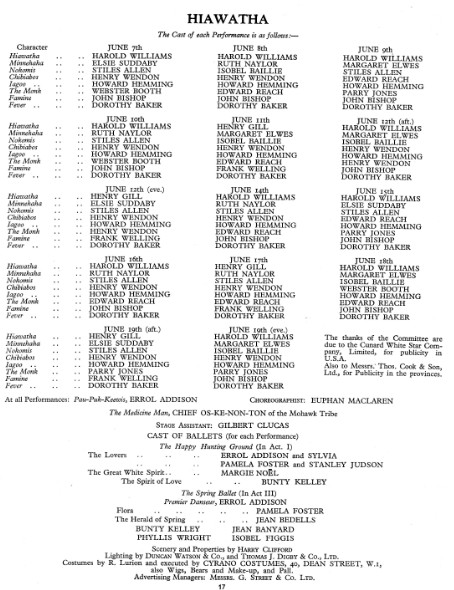

Before the war, the work was presented in full native-American costume and
here is Webster in his costume below. Dr Malcolm Sargent (as he was
then) conducted the work and continued to present it with the Royal
Choral Society and Royal Philharmonic Orchestra many times.


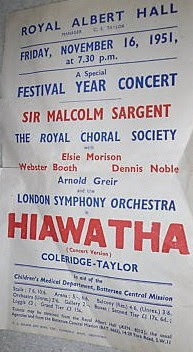
Webster appeared in many other performances of Hiawatha, including one presented at Kenilworth Castle in 1952. I have included a few of the advertisements below:
[image error]Hiawatha at Kenilworth Castle 1952

Webster Booth appeared in the Jubilee concert of Hiawatha to commemorate the fiftieth anniversary of the concert which was first presented in March 1900. 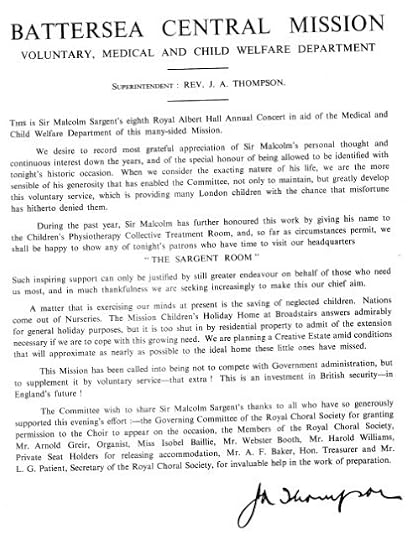

May 1951. Croydon, Davis Theatre.
As part of the Festival of Britain celebrations a concert mainly devoted to the works of local composer, Samuel Coleridge-Taylor was held in the Davis Theatre on 31 May 1951, part of a series of concerts sponsored by Croydon Corporation for the Festival. Parts One and Two of Hiawatha were presented by the Croydon Philharmonic Society, conducted by Alan J. Kirby. Gwen Catley, Webster Booth and Dennis Noble were the soloists.
.
14 Ju

Although
the planned presentation of Hiawatha in 1954 was called off at the last
minute because of poor ticket sales, Sir Malcolm Sargent asked that
Webster should be the soloist in the work at his sixtieth birthday
concert on 29 April 1955 at the Royal Festival Hall, where his fellow
soloists were Jennifer Vyvian and Australian baritone John Cameron.
Perhaps because the performance was associated with Sir Malcolm’s
birthday, tickets were in great demand.

Here is a photograph from the defunct magazine, Music and Musicians where Webster and Anne are speaking to John Cameron after the performance.

His last performance in the work was at the Promenade Concert in August 1955, where he also sang the song cycle To Julia by Roger Quilter.
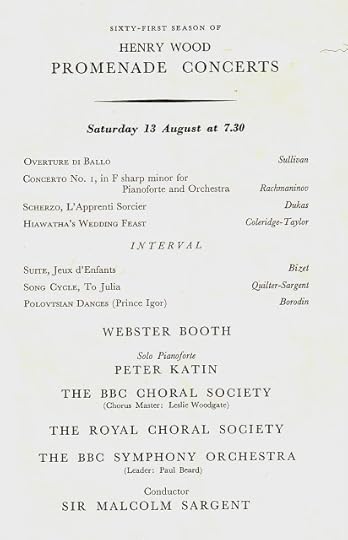
In July 1956 he and Anne Ziegler moved to Johannesburg South Africa. He never sang in another performance of this work.
Webster Booth recorded several songs by Samuel Coleridge-Taylor below:
Unmindful of the Roses/Life and Death
Jean Collen 2012 Updated May 2017

Join: The Golden Age of Webster Booth-Anne Ziegler and Friends on Facebook.