
Jean Collen's Blog, page 18
January 22, 2019
EXTRACTS FROM MY TEENAGE DIARIES – February/March 1961
2 February – Work hard at the library – the hours are unbearable so I may be going to business college instead.
3 February – Am definitely going to business college! Have lunch in town with Mum and Dad and then wander around and look in the Belfast – I meet Inge Alexander there and we talk for a while. Practise my piece at night.
4 February – I go for my lesson today. First, I miss the tram and then the lift in Polliacks Building leaves without me and I have to wait for ages for it to return to the ground floor. I imagine I shall be frightfully late, but when I arrive at the studio Webster answers the door with their little Maltese poodle (Lemon) in his arms and he asks me to have a seat. I pet Lemon, and Webster warns me that he goes for ankles. I sit in the kitchen and play with Lemon and listen to them teaching a girl to sing. They all sing together and this make me giggle with Lemon.
Girl – all these other girls seem elusive and nondescript – goes and Anne calls me in and we discuss Lemon. She says that he’s the loveliest pet she’s ever had – she’s crackers over him.
Webster goes out for a while and Anne says to Lemon, “Now come and sit down at my feet and be obedient.” For a moment I forget that Lemon is there and then I realise who she was talking to! I tell her my mistake and we have a good laugh.
Anne says that my diction in the poem is now perfect, but everything must be a hundred percent, “So use yer face and yer eyes!” I endeavour to do this to the best of my ability – impossible! Anne says, “A smile lifts the voice and gives it light and shade.” Webster comes back and she calls to him, “Oh, Boo, this is much better!” and he replies, “Yes, I could hear she was smiling.”
We start on the movement again. 1) Move from waist down. 2) Move knees (flexibility) and 3) Know every move. She asks, “Did you see Lock Up Your Daughters, Jean?”
Feel grim at this and have to lie, “No, I would have loved to of course but we just didn’t seem to find the time.” What a whopper! How could I have told her, “My father didn’t approve of this risque play!” She talks and demonstrates different movements such as the “Cor blimey cockney movement” (as she calls it), the burlesque movement and others. She says, “Come with me towards the mirror, Jean, dear!” Talks about the way Indians and Africans walk. “You must enter a room, stage, anywhere without apologising for living. Even if old Dr Verwoerd comes in, still feel that you are just as good as him!” Yay for Anne’s attitude. Wish I could do all this.
Says I must work out every move beforehand because for two minutes everybody’s attention will be focused on me and the adjudicator will be waiting for me to make a mistake. Says that dozens of people have said to them, “But you and Webster are so natural on stage.” She takes me by the hand and we stand in some corny position in front of it (like foxtrotting at the rink) and she says that they might appear natural but every move is planned and they even know exactly where they will put their feet.
They are going on holiday soon and will be back about the 5 March and she will phone me on the Monday after they get back to make an arrangement for lessons. However, I’m still going to her on Monday afternoon. Shall have to work hard tomorrow.
Anne says she gets rheumatism in her neck – that must be grim. She is wearing exactly the same shoes I bought the other day – I shall never be able to wear them to the studio. Webster says goodbye to me and Anne comes with me to the door, and Lemon is in the offing. Webster says, “The whole family is here today.” They give me practically a whole hour today. They are honeys. Webster looks rather grim in a light white sports jacket.
Meet Mummy and buy a briefcase for college – Harvard Commercial College in Pritchard Street under the direction of Mr Pelkowitz, then we have lunch with Dad and see Make Mine Mink with Terry Thomas and Hattie Jacques which is good!
6 February – I start my commercial course at Harvard Commercial College in President Street, near the library today. I find Jill Harry from school there, so there is a known Jeppe face amongst the other girls who are mainly from the northern suburbs, putting in time until they find a suitable husband. When we come out of college in the afternoon I moon around for an hour, walking round and round the block between John Orrs and Polliacks. I get tired of doing this so I go up to the Booths – terribly early but desperate.
Webster answers the door and takes me into the waiting room cum kitchenette while he dries the dishes. He asks me about college and the brief job in the library and is hang of a sweet. He tells me that he has been walking around town for hours this afternoon in sweltering heat. I ask whether I can help him dry the dishes, but he says resignedly, “No, I’m used to it.” He offers me a cup of tea but I refuse – I’m too tired to live, far less drink tea. While sitting there I think how sweet they are and how horrible everyone else is to be so nasty about them.
I go in at Anne’s bidding – I feel at times as though she’s the Queen granting an audience to a very lowly subject, and she says, “How are you?” I say, “Tired,” which makes a change from “Fine”.
She gets me to do Shall I Compare Thee? and tells me that it is absolutely perfect and she wouldn’t interfere with it in any way. Praise indeed. She spends ages going through the book to find some new ones for me to do while she is away on holiday. Eventually, after a long search – in which time I realise that the photo on the table is of Leslie Green – she chooses three poems – one Scots one – To a Field Mouse, and she makes me read them, sits next to me and listens, then criticises, reads them over herself and says my Scots accent is so cute.
Gets Webster to put the poems on tape – they sound ghastly and she had said, while tape was still running, “Oh, darling, I’ll read this poem too!” We practically kill ourselves when it is played back. Anne says I pitch my voice too high when I start. She says it’s like some of their early speeches where they sounded quite burlesque because of the high pitch of their voices. Webster calls through asking for something. She looks at me in such a puzzled fashion and asks what he said. I say, “Something about ink.” and she calls, “Oh, Boo, we haven’t any.” Poor old Boo!
Anne makes arrangements for my next lesson. I am in credit and she owes me a lesson – 10 March, a whole month away – boo-hoo (no pun intended) and she makes me write down the times. Webster hands me a pen. He checks my phone number and asks what suburb the number stands for – I say Kensington, and he looks enlightened and says, “Oh, of course, Kensington!”
I wish them a lovely holiday and they are pleased. I hope they do have a lovely holiday. They deserve it.
8 February – Listen to Leslie Green and Marjorie Gordon and do homework. Play piano and sing (seriously in both cases) at night. Have worked out three poems starting on Friday thus giving me a week each for two short ones and two weeks for long one. All during this time must keep up Shall I Compare Thee.
9 February – Webster and Anne leave on holiday. Very miserable and rainy but dare say they would leave anyway.
Spend lunchtime on the college veranda with Jill H, Audrey and Lynnette and we consider whether it would be a good idea to spend our lunchtime in the bar across street – decide against it!
Learn Fair Daffodils We Weep to See on tram in about ten minutes – good, eh?
10 February – Meet Doreen Craig on the bus and we discuss the guild outing at the old age home. I am to play a selection of songs. Perhaps I can wangle We’ll Gather Lilacs (Webster and Anne’s song!)
At guild at night we go to Rosettenville church and have mock Olympics which is quite fun. Doreen and I go and return with Mr Russell, the minister. We talk – or gabble would be a better name for our conversation!
18 February – I go to the rink and I’m delighted to see Kay Tilley there after a long absence. Kay is still at college in her second year. She says she thinks Anne is not as good as Webster – the first approving opinion of him I have heard for a long time…
20 February – College once more. Jill tells me that Colleen O’Donaghue has got into varsity. We sit on library steps at lunch. Listen to Leslie Green in the afternoon. He’s sweet.
22 February – I am absent from college today because I still feel ill. It’s worth it thought because I hear Sweethearts sung in Afrikaans (very well) by Webster and Anne. I feel really proud of them. They have wonderful voices no matter what people say.
I was thinking yesterday that the present generation of performers don’t really have much talent – Elvis Presley, Tommy Steele, Cliff Richard etc. earn much more money than Mr MacMillan (British PM) yet they’re positively amateurish compared with the Booths. Even now, in middle age, they are wonderful. Britain doesn’t know what they’re missing not to have them living there any more. It is sad that they should have had to come to South Africa to make a living – and even here they are constantly criticised by ignorant people.
23 February – I practise for our concert at the Old Folks Home. Doreen phones to talk about this and I feel as though I’m preparing for a first night at the London Palladium.
24 February – College goes well as always. At home I read the autobiography of Noel Coward which doesn’t cheer me up any owing to talk of bad performances of his which took place in London theatres, and don’t really apply to playing at old folks’ home!
Go up to guild at night feeling vaguely theatrical. I am first, with Doreen a close second. We speak to Peter Casteling and he agrees to lead the singing and is very affable. Doreen organises lifts for us – Peter, me, and Doreen go with Mr Russell. At OPH we hear great hilarity – old people are already singing to the accompaniment of an old lady who plays extremely well. Peter C leads the singing. When singing Roamin’ in the Gloamin’ he says, “Now lets give it big licks for the benefit of our Scottish pianist!” Dave shows slides; Kippy gives a talk, and I play hymns. Then, while we are having tea, the old lady plays again – a bit loudly, but still very well indeed. Peter asks me to play again. I do so because of vague recollections that an artist must never play hard to get, and also because I want to shove all the songs the Booths sing down their ears! Play We’ll Gather Lilacs, Operette, and Only a Rose (Webster and Anne’s signature tune).
Joan and Doreen tell me with great surprise, “You played so well tonight.” Obviously a good piano and a lively imagination contributed to that. Peter says, when he introduces me for a second time, “I don’t think I’ve introduced you properly to our Scottish pianist, born at the bottom of the banks of Loch Lomond – Miss Jean Campbell!” All very nice in a terribly small way I know, but how I’d love to revel in things like that often. I wouldn’t be a pianist of course, but an actress – professional at that! But these are dreams that will probably never come true. In the meantime, I shall have to make do with giving speeches at guild, playing at old folks’ homes, spouting poetry at eisteddfods (if I don’t go dry-mouthed) and doing speech with Anne. Webster and Anne are the luckiest people I know. They have had world-fame and respect, and now they are still great celebrities over here.
March Ann, Brian and Mr and Mrs Stratton come at night. Mr S goes back home to fetch music and comes back with it to sing for us while I play. He has a lovely baritone voice. When Ann is in my room she sees picture of Anne and says, “What a lovely picture of Anne Ziegler!” She has never mentioned Anne before – except with derision!
MARCH
3 March – I get Gill McDade home on the tram. We talk theatre. I am put off when she tells me that Lock Up Your Daughters was wonderful except for Anne who gave her the shivers because she yelled far too much. I tell her that I expect the play was terrible and that Anne is sweet and a real darling. I should like to know how they achieved such fame and popularity when everybody I know seems to have terrible vindictive downs against them.
4 March – Go to the ice rink today and Susan comes. I skate for a time and then get the shock of my life when I see Gwyn Jones arriving, complete with Springbok colours blazer – whew! I go in and tell Sue about his arrival and we both talk to him for ages. He was allowed into the rink again on Tuesday. I’m glad to see him back. Says he had a gorgeous time in Scotland and at the Olympics and didn’t need any oxygen. He shows us various routines – very good, considering how long he’s been away from skating. We talk about the Goon Show and Peter Sellers. I mimic his Scottish accent in recent film – terrific fun. Gwyn carries on madly on ice.
5 March Booths are back from their holiday today!
7 March – George Formby dies.
8 March – Sir Thomas Beecham dies. Wendy phones at night about Cliff Richard and so does Peter (hymns – 4!).
9 March – Cliff Richard arrives today – mobbing outside Carlton in evidence from the morning.
10 March – After college I come home in terrible rain and then – the time I have looked forward to for a month arrives – I go for my lesson with the Booths. When I arrive I bang on the door and nobody answers. I begin to think vile thoughts, thinking they have forgotten me again, and decide to wait until five past five and then leave. A number of prospective models arrive for Madge Wallace’s modelling school next door and they eye me and I eye them with mutual disdain. Madge Wallace comes out and asks whether I’m waiting for her.
I say, “No, actually I’m waiting for the Booths, but as it’s five I doubt whether they’ll come now.”
She says, “Yes, they will, but they’re always late. Why not take a seat in my studio until they arrive and watch the models.” I do this – models are still extremely disdainful, but the seat is very welcome. Eventually I see Anne at the door of her studio and forget all social graces and go out to Anne who was looking a bit worried. Maybe she thought I had changed studios and was going to take up modelling instead!
Anyway, she is a honey as always – quite brown after holiday and wearing sunglasses. She says their holiday was gorgeous. I go into the studio and sit on studio couch and look at these infernal pictures. I say infernal because they all reflect their fame which I shall never achieve! I hear someone clearing their throat at the door – Webster Booth!
Never in all my living experience can I describe what a shock I receive when I see him – he has grown a beard! I ask you – a beard! A horrible bristly beard, very grey which clashes with the colour of his hair, and moustache. I hope I didn’t let my feeling of horror show. I ask him how he enjoyed his holiday and he talks through his teeth with ecstasy, “It was wonderful,” he says.
[image error]1961 Advertising Skol beer – Webster with beard!
Anne and I start on Shall I? and she says it is good but I must have no inhibitions, shyness, or embarrassment of any kind. (Q. Am I showing all those negatives?) We do the other Shakespearean sonnet, Being Your Slave and suddenly she decides that I do that far better than the other. She says, “I’m almost tempted… What do you think Boo, don’t you think Jean could do this better for the eisteddfod?”
He says, “Is it a sonnet?”
“Yes, it’s got fourteen lines.”
“But Anne, are you sure it hasn’t got fourteen lines by accident?”
She asks me what I think – I don’t really mind. She says, “It’s much less hackneyed, but I must smile when I do it. She makes me walk into the room smiling and makes me look at myself in the mirror – I always look vile in their mirrors! She says, “Walk on your toes, head up, shoulders down, and a slight movement of hips wouldn’t go amiss!”
Begins to wax eloquent and continues, “There’s nothing so attractive as seeing a beautiful girl walking on to a stage with a lovely smile. Even if the adjudicator doesn’t smile back, don’t worry – he won’t be in the Profession. A person in the Profession would always smile back at you. In Springs when I was adjudicating I smiled at every contestant just to cheer them up!”
At the end of my lesson she says to me, “You have a lovely face, so smile!” Gives me a big grin which I reciprocate in practised manner and feel quite touched at her good acting. During the whole session Webster chipped in once to say I must clip off “world-without-end-hour”. She says that my diction is good but I can afford to be less pedantic now. Both come with me to the door. A rather nice chap is waiting for his lesson – gives me a grin – sweet! Say bye-bye about a dozen times. (Must remember to say cheerio) and then get lift and come down.
See their car with its GB plate – after five years one would think they might remove it. It’s a green Zephyr – that is, it isn’t a Jag, Rolls or a Mercedes like Daphne Darras’s father, but still, its theirs!
11 March Go to rink. Sue comes and while she, I and Carol Ann (little American) are sitting in cloakroom Mrs Nicholls (Denise’s mother) comes in and tells us that Lennie and Glenda have won British junior pairs championships. She is nearly crying with excitement and I must say that a lump comes to my throat too. Sue and I are utterly thrilled and say so. Good show!
We go out and talk to Gwyn about it, and I must say, that he takes it all in good heart and says how terrific it is. Go on ice and talk to Neill about it too and we are all thrilled. Menina Klein comes and we talk – I tell her about Webster and Anne and she nearly does her nut over them, telling me how lucky I am and how famous they are.
Gwyn is as mad as usual and carries on on the ice wonderfully. Sue has (at least her dad has) a new car and she wants a name for it. Gwyn says in disgustingly – or should I say – deliciously rude manner – why not a chemical formula: ShoneT! My goodness! Says he saw Cliff last night – he thought him good but too screamy. Sue skates gorgeously as usual and so does Gwyn. We fool about and make spectacles of ourselves – everyone watches us – wonderful fun! Neill buys me a cold drink and is sweet but a terrible bragger. Still, he is cute. Afterwards I walk down the road with him and catch a bus on the other side of the road. Lovely morning and am thrilled about Lennie and Glenda.
14 March College – fine. Come into town again and wait outside the Carlton for Wendy to go to see Cliff Richard. Girls and boys are waiting for Cliff to come out of the hotel – all in vain. Wendy comes and we have supper in the Capinero and talk to Carol Balfour afterwards.
Go to Coliseum and feel the atmosphere! Show is very good and so are supporting turns, especially young comedian, Norman Vaughan – amusing and can play the guitar, tap and sing. Cliff and Shadows are lovely and we all clap to the beat. I really enjoyed it, although, on reflection, I prefer Tommy Steele but Cliff is good fun.
17 March. College. We are all thankful for the weekend ahead. I come home with Ann and Colleen O’Donaghue. Talk is centred around college and all the projects Ann has to do for Teacher’s Training College. I come back to town in rather a strange frame of mind and feel rather a failure theatrically speaking. Go up on the lift and think they probably won’t be there yet, so I knock. I am shocked when I realise that somebody is singing and I’ve interrupted them.
Webster answers door – still with beard – and is affable. Takes me into the kitchen and asks me if I want a cup of black tea. I decide to accept so he tells me to help myself. I do so and he disappears. I drink tea and then wash and dry spoon, cup and saucer.
Girl – her name is Roselle – sings Someday My Heart will Awake really gloriously and touches high A with great ease – the sort of singing that touches the heart. Anne says, “Very cheap, very common, but lovely.” After lesson, Roselle tells Webster and Anne she loves singing far more than the piano and could give her whole life to it. She is very eloquent about the whole thing – something I could never be. I am very surprised when I see that Roselle is only a girl of about fourteen – very plain and a bit stodgy, but my goodness, her voice will be her fortune.
I go in next – an anti-climax for all – and say that Roselle’s voice is too gorgeous for words. They are both enthusiastic about it too and enlarge on her. She could only sing to the A above middle C when she first came but can now reach high A. Has a great future if she’ll work. She loves singing and is very musical. Webster says, “The day she came, I knew she was going to be good. She has a voice like an adult.” (He places the accent on the ULT)
Webster gives me a long lecture. “When I was young, the famous character actor, Bransby Williams gave me a tip. He said, “When you walk onto the stage, feel proud of yourself as if you’re just as good – if not better – than anybody else. It’s something I have never forgotten.” He gives a demonstration of Bransby Williams walking onto the stage.
Anne says, “He wouldn’t have been so arrogant, Boo.”
“He wasn’t arrogant, but he was self-assured.”
I tell them that I don’t feel nervous on the stage in a play, only when I’m doing something by myself. They say that is understandable, but one must be able to be a soloist as well as an actor. Anne says that she has to accompany some of the singers and she feels nervous. How unusual! On leaving, Webster says I shall have to get onto some plays – very good idea. I’m sick of spouting poetry…
18 March Copy music, play piano and listen to radio in morning. Go to lunch with Mum and Dad in and then we go to see Midnight Lace with Doris Day and Rex Harrison. It is a really good thriller – Doris Day excels herself in this dramatic role. Rex Harrison is excellent too with beautiful diction.
When we come home I see Jeppe girls coming from the swimming gala. I talk to Dawn Vivian and she tells me that Jeppe came seventh out of nine! Parktown came first – watch out for bragging at college on Monday! Girls are far more demure than usual – Miss Reid and Miss Allen are following them in their car to keep order!
21 March College. Mr Pelkowitz says it’s OK for tomorrow – prize-giving at school so shall have a holiday. Wendy phones this evening and we discuss the prize giving. I am meeting her tomorrow at 9.45. It will be funny going back to school again.
Play the piano and then listen to the radio. I am barely seated at the radio when the phone rings again. I wonder if it is Wendy phoning again and wonder what on earth she wants.
Voice, which isn’t Wendy’s says, “Hello, is that Jean speaking?” I reply “Yes,” and wonder if it is Mrs Watt or Mrs Corrigan. Then mysterious voice says, “Oh, Jean this is Anne Ziegler speaking.” I nearly die on the spot. My heart jumps into my throat and I say in surprised voice, “Oh, good evening.”
“I just phoned about your lesson, Jean. Do you think you could possibly make it Thursday instead of Friday?”
“Yes, Mrs Booth – that would be fine – what time?”
“Four o’clock – would that suit you?”
“Yes, that’ll be perfect.” I reply in slightly dazed tone.
“Well, goodbye, Jean. We’ll see you then. Don’t forget – Thursday 4 o’clock.”
“Goodbye,” I reply in cheerful yet distraught fashion.
I go through to the lounge feeling a great shock, but it’s rather a nice feeling really. Can I forget, “This is Anne Ziegler,” – To have a name so famous and to use it so carelessly. I don’t know what or why it is, but when I speak to them I forget their fame and their singing, but this incident gives me a gentle reminder of who they are – not Webster and Anne as they have become to me, but Anne Ziegler and Webster Booth, the famous singers.
22 March. We have prize-giving today. It is very strange returning to school – seeing the girls again. Winnie, Gay and Hazel J are nurses. Sit next to Claire J and Audrey D. Miss Reid’s report on last year’s events is cold and impartial – take a deep breath at mention of Miss Scott (who taught us English so brilliantly for a term). We get our prizes (matric certificate!) and talk. Gill Clarke is there – gushing and facetious as usual – utterly charming all the same.
Go into town and Mum buys a tangerine jacket for me in the Belfast – lovely.
While dad is twiddling with the radio he comes across a well-known voice on the English programme – Webster presenting a new programme – Webster Booth presents opera, oratorio and operetta. It is lovely to hear his voice on the radio unexpectedly and to know that I know him. He reminisces about his youth – born in Birmingham then advised to go for audition at Lincoln Cathedral school which would give him a free education. He was accepted and became a boy chorister, trained by Piggy (nicknamed because he snorted while he was conducting). Life at Lincoln gave him a rigorous musical training for four years until he was thirteen when his voice broke. He was told, “Don’t sing for two years and then you’ll be a tenor.” He followed the advice, but he hoped to be a bass rather than a tenor. He says in typical Webster manner, “I have made 350 solo recordings and many duets with Anne Ziegler.”
He fills this talk in with record he has made – religious aria, aria from Carmen and several others – oh, yes – How Lovely are Thy Dwellings. He plays some Gilbert and Sullivan overtures too. It is a gorgeous programme – not only because it’s him but because he’s so interesting and presents himself so well, and because his singing is beautiful and cannot be surpassed. Please let me have the courage to tell him that his programme was wonderful when I see him tomorrow. No one who has good taste can deny that!
23 March Go to college again and work hard and feel dead by the end of it all. I kill time for an hour in Anstey’s and then meander slowly up to the studio, feeling quite strange in the lift as I usually do.
Anne arrives after me and is charming as usual. She admires my tangerine jersey acquired yesterday. We go in and I sit down for a minute and look at the photos. She sits down and I do poem – swallow “per chance” for some reason – perhaps because Webster opens the door at that very moment. Webster stampedes – that’s the word for it – in, and it takes him a few seconds to realise that I’m there! He says, “Oh, hello Jean. I didn’t realise you were there!” I ask you!
He says that six weeks ago he wrote to hire a wig and it didn’t arrive, and now he has had a letter to say would he please return it. He is furious and goes into the office to phone up about it.
Anne tells me that they haven’t had any tickets for the eisteddfod. How can people make arrangements for Easter with this infernal eisteddfod looming? Their maid is going into hospital for a tonsillitis operation so she won’t have any help in the house. She has to come into town for eisteddfod about nine times, so doesn’t know what to do.
She says that if I’m nervous I should take deep breaths as this is very calming. Swears, using hell in one of its forms – can’t remember what exactly she says! She says it’s time I started on plays now. She pores over innumerable scripts and brings out Spring Quartet – they were in it in Cape Town when they first arrived in the country in 1956. She explains the plot to me and I do the part of a Scottish girl in Austria while she reads all the other parts. It is gorgeous acting with her. She says that Scottish comes very naturally to me so she’d like me to try something else. She finds And So to Bed when the phone rings and Webster looks up the part – Mistress Pepys – and hands it to me after much searching. They played Mistress Knight and King Charles II in the touring production in the UK in 1953/54. She comes back from the phone and tells me that I should take the script home and study Mistress Pepys which should be done with a slight French accent.
She’ll phone me if she gets any news of the eisteddfod. I say goodbye and shout goodbye to Webster who is in the office. He is affable in a dazed fashion and shouts, “Oh, goodbye, Jean.”
Armed with the script which they had used at the height of their fame – I walk down Eloff Street feeling spontaneous and happy. I glance through the script on the bus and laugh at some remarks Anne had written in the back of it.
Betty phones at night – Peter, 1 o’clock on Saturday – coming here. And now, as Pepys would say, “Goodnight, sweet dreams and so to bed!”
25 March Go to visit Mr and Mrs Jones who have stand at Hartebeespoort Dam with rest of teachers. We have a really gorgeous time. I go with Fred Shaw, Joan Spargo, Wendy Price-Williams and Dorothy Shaw – houseboat in wilderness of shrubs adjoining the dam – really beautiful. Ann, Peter, Leona are already there when we arrive. Mr Jones is a local preacher who preached once at our church.
Go home eventually with Fred. Peter comes too and we sing on the way home. Peter has a good voice – should have it trained with Webster! We discuss them. Wendy says how wonderful it was when they sang Wunderbar at church concert, and she loved it when Anne said to Webster, “Just wait till I get you home!”
We all sing this and other songs and Wendy tells me I have a wonderful voice – I should join the choir – says this so sincerely it fairly bucks me up. I adore singing. I put my heart and soul into it – I love it!
29 March Webster with his gorgeous programme again – it has been renamed On Wings of Song and it is introduced with the Booths’ recording of the song. Webster sounds familiar and yet a complete stranger.
He tells of applying for the post of tenor soloist at a certain cathedral, but turned it down for the salary of £200 a year was too low. He started his singing training with Dr Richard Wassall and started to sing tenor solos in the choir.
While working in an accountant’s office, he gets offers from oratorio agents and began singing all over the country – including in Wales and Scotland – and so became reasonably well-known in oratorio circles.
He is proud that he sang with Harold Williams, whom he considers to be the baritone of his generation. He plays some of his own recordings, all conducted by “my old friend, Sir Malcolm Sargent”. He also plays the overture to Merrie England, in which he took the tenor lead with Dr Wassall.
He makes all this so interesting and his records are beautiful – plays arias from Messiah and Elijah and other songs. What a man, what a voice and how nice he really is. To think I’ll see him tomorrow and he will once more become that rather vague person, dominated by Anne.
30 March Go for lesson. Arrive early and hear snuffles of Lemon at the door. Man who has come up on the lift with me comes into the studio too. I go in and Webster holds Lemon in his arms and asks customary question, “Are you wearing stockings?” I say, “Yes, but please put Lemon down.” I play with him – what a sweetie. Anne comes into kitchen looking too beautiful for words in red and white sheath dress and she tells me she is dead tired because of all the work she had to do at home without the maid who has gone into hospital for her tonsil operation. Between the worry of the eisteddfod and the heat, she’s dead beat. She takes me into the studio and Webster introduces me to the man called André van der Merwe. He says, “We’re sorry we haven’t been able to spend more time with you while you were here,” and A vd M departs – saddened, me thinks.
Anne gives me tickets for the eisteddfod and says she doesn’t know if she’ll manage to be there to hear me. Webster disappears to make tea. She says that she’ll have to accompany a singer in the Duncan Hall, so she isn’t quite sure… I say, “Anne, please don’t come. I shan’t feel so badly if you’re not there.” She laughs and says that she’s sure I shan’t do anything badly. Now I come to think of it, I don’t suppose she has any intention of coming to hear me recite the silly poem at the eisteddfod!
Webster returns and Anne searches for her And So to Bed script. I realise that this is the moment, so I say, “I thought your programme was terrific last night, Webster.” He turns around and says, “Oh, thank you, but I wasn’t too happy with it last night. I could hardly hear it either with the crowd around the radio. I was better pleased with the first one, but next week is a nice one.” I assure him that I enjoyed both of them and he is obviously pleased, but tries to appear nonchalant.
Anne takes me over and shows me pictures of And So to Bed. Mistress Pepys with Charles and Pepys (played by Leslie Henson) with Anne looking as gorgeous as anything. I make appropriate remarks and then we start. Webster promises to do Charles, but we don’t get that far. I really enjoy doing the play with Anne. She’s terribly vulgar in explaining character – be bitchy and wish the other woman to hell. She seems pleased with my acting and French accent. She says that I pick up my cues well and I obviously have been taught to do this. Webster turns around and says that I do it very well and could do the part anywhere – rather a compliment coming from him when he usually tries to criticise me.
In the middle of this there is a knock at the door and a stodgy little girl of about nine enters the room. Anne’s expression changes to ice and she says in a horribly cold voice, “Oh, it’s you Sally. You had better sit in the kitchen for a while.”
Anne tells me that this kid hasn’t turned up for her lesson for six weeks and yesterday her mother phoned up for a lesson for her today. Anne was flaming mad, but said, “OK, 3.30.” She didn’t turn up then and has turned up now and they are expecting someone else after me. Webster comes in and Anne says flatly that Sally can’t have a lesson today. We continue with our play without further disturbance and all is convivial.
During tea a discussion arises about different teas. Anne says that in Britain they used to drink Indian tea and she loathes Ceylon tea. She has discovered an imported blend in Thrupps, and compared to it, this tea tastes like DDT. Webster says, “What nonsense,” and I am inclined to agree with him but more politely. When I leave they both wish me luck. I say goodbye to Webster and Lemon. and Anne comes with me to the door and wishes me luck yet again and see I win a prize! I shan’t! What pets they are. Anne tells me how she loved Daddy’s Scots accent.


January 21, 2019
EXTRACTS FROM MY TEENAGE DIARIES – JANUARY 1961
January 1961 – Go for a lesson with Anne. I arrive before them and when they arrive they wish me a happy New Year. When we go in Anne picks up the letters and says, “No love letters – only bills!”
I sit on studio couch and Webster asks whether I had a nice holiday. I say, “Yes, but it’s all over now.” He says, “Yes, thank heaven!”
Anne asks me whether I would like to enter the eisteddfod. I say I’d like to enter if I didn’t make a fool of myself. She says, “Oh, we wouldn’t let you do that.”
During my lesson with Anne, Webster goes and makes us coffee, is very sweet and calls me Jean a lot. We work through She Walks in Beauty while Webster prepares coffee and she tells me dozens of things to do to improve it.
She says, “You may think I’m pulling you to pieces completely, but you need someone else to notice your mistakes. Over the years Boo (that’s Webster) and I have pulled each other to pieces all the time.”
Anne tells me that when she was very hard up in London she became a model and the photographer told her to use her eyes. She says this is a good tip, and I must use mine. I mustn’t become a poseur, but I must use my eyes moderately.
Anne in the Craven A advert (circa 1935).[image error]
7 January – Matric results are in the paper and I manage to look up my own name. I pass! Breathe a sigh of happiest relief – now I shall really be able to concentrate on my breathing!
8 January – On the Springbok Radio programme, Tea with Mr Green, Leslie Green talks of his daughter, Penny’s recent wedding and says that just before she and her new husband were leaving the reception to change their outfits to leave on their honeymoon, the band was playing We’ll Gather Lilacs. Webster and Anne were at the wedding so they told the orchestra to carry on while they sang it for the bridal couple – very nicely too! That was a lovely thing to do. I’d love to be so spontaneous and not to be frightened of what people might say or think of me, but act as the spirit prompts me. Honestly, I think that was so sweet!
At night there is a gorgeous picture of Anne with Valerie Miller, complete with their Maltese pets in their dressing room at Lock Up Your Daughters! Anne uses her eyes like anything! Hope she remembers the sonnet for tomorrow.
[image error]
9 January – Go for lesson today. Anne answers the door wearing a tight white skirt and over-blouse. She looks nice but a bit tired. Webster is in the studio too and is busy making coffee. He offers me some and I accept and sit on the divan drinking it a wee bit nervously, glancing at the array of adorable photographs enclosed behind the glass on the wall above it. Anne brings out her Shakespeare and we talk of Eisteddfod and the sonnet, Shall I Compare Thee to a Summer’s Day? Webster tells me where to get the entry form and they have a little squabble about whether I have to buy a syllabus to go with it. He ends the argument by saying, “It only costs a shilling anyway!”
We go over She Walks in Beauty amidst tremendous noise and she says, “Use your face more.” Only wish I could. Then we do Shall I Compare Thee.. Anne says I do it well but then says that my dimm’d sounds nasal and Liverpoolish and gives me an example of it! She says, “I love a Liverpool accent – it reminds me of home but…”
It goes on to tape once more and we all listen with rapt attention and I have mistakes pointed out to me. Webster says, “Be emphatic with clipping your words off at the end.” She says, “But not too emphatic,” and another small argument develops. She reads it – very nicely too – and says that of course, Shakespeare was thinking of home when he wrote the sonnet – if he did write it!. Home – England naturally – she and Miss Scott should get together.
Anne takes me over to the mirror to show me an exercise to practise with tip of my tongue to make it more flexible. Afterwards she asks Boo to do the exercise. He says he can’t, so she says, “Oh, darling, really! After all those years.”
He says, “My tongue isn’t a snake like yours!”
Anne’s favourite expression, “You be the boss,” with regards to lungs, tongue, speech, face, anything. She shows me how she keeps her tongue on the floor of her mouth when singing and starts off at low A and goes right up – must have been past high C. Really stupendous.
Anne complains of the heat and is generally homesick. Tells me that she always has nerves before a show – she’s frightened in case she forgets her lines – but sees that I’m dry-mouthed when nervous. She says that Thomas Beecham always had his score photographed in his mind and concentrated on that when he was conducting. She says, “It’s the only way.”
Both of them come to the door this time to bid me goodbye and I think this is sweet.
12 January – Biting remark from Taubie Kushlick concerning flops, “I don’t believe audiences stay away from plays to see GI Blues. Two’s Company and King Kong are sell-outs. Perhaps there has been so much theatre lately that there has not been enough talent to go round.” With regards to Lock Up Your Daughters, methinks that there was oodles of talent but bad material.
14 January – Dad comes home from work with some magazines. In Let’s Go is a photograph of Webster and Anne advertising LM Radio. I would take a bet that they never listen to it! Quite a nice picture though.
[image error]
Listening to LM Radio
At night we visit the Scotts. We talk about Webster and Anne and they are not complimentary about them. – I feel quite infuriated! The add that of course their names were household words during the war.
16 January – Go into town in the afternoon to buy a few things and meet Margaret Masterton when waiting for tram. We talk of matric and as she is a singer, of Anne, whom she says sings well at times. I tell her about my preparations for the eisteddfod and she says she can’t enter this year because of the upcoming singing exam for which she has to work. She says she will have lots to do this year between Teachers’ Training College, singing, Physical Training – she is going to become a games mistress – and dramatics. Her parents are going overseas in April. Depart after enjoyable conversation with Margaret. She’s fun!
17 January – Go for lesson today and Webster answers the door and is sweet. I am wearing a heavy coat, so he says, “I see you thought it was cold today as well.” How could Mrs Scott say he is past his best? He’s a darling.
I sit in kitchenette until they tidy up the studio and then she comes in looking delightful in white skirt and blouse. We go into studio and Anne looks at entry form for eisteddfod and Webster says that it’s a swindle to have to buy a syllabus for every time an entry form is required. One of their pupils, Elizabeth, is entering four competitions and it will be unfair if she has to buy 4 syllabuses. Says he will go into Kelly’s and complain about it this afternoon.
I do Shall I Compare Thee with Anne and she says I do it well, but more light and shade are required and I tend to move up and down on my feet too often. I say that I do this in case I forget something. She says that she always takes a step backwards if she forgets something. “It’s a natural reaction to remove oneself!” Webster makes tea and we go on with the poetry. She says I must be sincere when I speak, and think and feel from my heart. “Webster and I have made such a success of musical comedy because we have always been sincere in our parts.” Says the usual – use face and eyes – will never be able to!
Anne starts to work on Shall I Compare Thee, and coming to part, And often where I don’t pronounce the d as I ought to, and she is trying to explain to me how to do it, Webster intervenes and says that my and should be accentuated. She disagrees. We all stand and look in the mirror and make motions of tongue with and. Webster says, “In all my records you’ll hear how I accentuate my and slightly.” She had said earlier, “Webster is an example of perfect diction in singing,” but by this time she is a bit cheesed off with him, and says, “I couldn’t even hear your often there. Darling, I don’t want you to think that I think you’re interfering but I think it would be better if you let me deal with this.”
Poor Webster disappears silently. He then turns on the tape recorder and she says, “For God’s sake – turn that thing down!” Whew! Archness can fairly fly!
She says it’s my Scots accent combined with a north country accent that has to be eradicated – I hear this every week. She reverts to a Lancashire accent and says, “A could eas’ly revert to mi old Lancashire way of talkin’ and drop mi jaw dawn, but ah ‘ave to improve mi diction.” I nearly die laughing, although she has probably never had a broad Liverpool accent like that in the first place. Then, at another stage of the proceedings, she says in appropriate accents, “Gor blimey, now yer talking Cockney!”
She tells me how to “make an entrance” at the eisteddfod – I haven’t much clue about this and just can’t smile sincerely for I don’t feel sincere! She says that I should stand with one foot in front of the other so that there is a secure pivot. “I do that always on the stage – as I have done for the past ten thousand years!”
She makes me hold her hand and walk up to the mirror with her, SMILE, and use my TEETH, and appear self-assured. “Be the boss. God gave you teeth to eat with and to smile with – use them!”
Says that when she was little her father said to her, “Look people straight in the eye.” I must do that on stage and half the battle’s won. I must look naughty, saucy, wicked – heaven knows what else – Anne is a darling.
After my lesson, Anne says they are going to try to take a holiday in February, but they will easily be able to fit me in for a lesson before they go. They are so sweet and charming that I hate it when people like Mr Murdoch and Mrs Scott say horrible things about them. I’ll always stick up for them no matter what people say about them. Anne says she is left-handed like me. She wears a big signet ring with A on it – cute.
24 January – Go for my lesson today and meet Shorty from the Church on the tram – he pays my fare!
Anne answers the door looking divine as usual and with her hair done once more – gingery this time. She takes me in and there is no sign of Webster. She arranges the ashtrays and says that when Webster is in the studio by himself he makes such a mess – you know what men are. She sits down and asks me to say poem and then Webster comes in nattering about a glass being missing. Anne says, “Oh, darling, Jean is here.” His face lights up and he says, “Oh, hello, Jean.” Cute – the lighting up part – I mean.
We go on with eisteddfod poem and Anne says that Shakespeare is most difficult and if you can manage Shakespeare you can do anything. Says that in singing, Handel is most difficult – if you can sing Handel, you can sing anything.
We go through the poem, line by line, and Webster makes us coffee. While we are drinking coffee, Webster says, “I came across a letter at home yesterday written by a Jean McLennan Campbell” – (I put in McIntyre – sotto voce) – “asking for singing lessons.” I remember that letter written in a very impulsive moment in October to which I never had a reply. I feel extremely embarrassed and admit, “Yes, it was me.” I try to pass this off lightly, saying, “I’ve lost the notion for singing, because I’ve come to the conclusion that I haven’t got much of a voice.” They are equally embarrassed and try to pass off not replying to my letter by saying how rushed they’d been with producing The Country Girl and Anne appearing in Lock Up Your Daughters. When I had no reply to my letter, I consoled myself by assuming that it got lost in the post.
Anne then says, “Anyway, I’d like to hear some scales.” She sits down at the piano and I go through some arpeggios not too badly – at least I keep in tune – and she determines my range up to high G. She says, “It’s all there anyway. You should practise the scales, even if you don’t take singing, to improve the lazy tongue.”
She makes me read the poem on tape and while over by the recorder I notice an address on the back of an airmail letter to them from Mrs Fenney, the music teacher who taught at Jeppe for a term. Mrs F could fairly sing too.
When we come to the end of the lesson I tell Anne that I am starting work in the library tomorrow so I don’t know about my lesson next week, so she tells me to phone her at home – 42-1078. They are going on holiday for three weeks from the ninth so I’ll only have two lessons next month – better than nothing. Webster and Anne come with me to the door and say they’ll hear from me tomorrow. They’re darlings.
Funny that I write more about them in my diary than anything else although it only takes ¾ of an hour in actual time than of anything else.
25 January – Start work at the Central Library today and boy, talk about working – between issuing, discharging, filing, and running to the vast book-room under the library building – I am exhausted. Am shown the ropes by Merle someone and have lunch with her and her friends. Thank heaven the first day is over. Do not learn my hours and am not sure if I’m going to like working there! The shifts – particularly the split shifts – sound uncongenial.
Come home on the tram with Mr Moodie. He pays my fare and gives me a long spiel about Webster and Anne. He tells me that Webster is really past singing now – they live near Heather, you know. I have met Heather, haven’t I? Yes, yes, yes. He says that Webster and Anne still sing light things well and that they are sweet. He once heard Webster singing with Peter Dawson, the Australian bass-baritone.
After tea I phone the Booths. Webster answers – speaking even more beautifully than normally – and tells me that Anne is out. I tell him that I don’t know my hours yet, but can I phone them tomorrow? He says, “Yes, certainly – any time between 10 and 3 at home.” Thank him, and he asks, “How did you get on at work, Jean?” I say, “Well, I had to work really hard, and boy, am I tired!” He says, “I don’t expect you knew where to turn.” I say, “Well, I’m glad the first day’s over, anyway!”
He says to me, “Well, don’t worry about anything, Jean, and get on with the job.” I say cheerio and promise to phone tomorrow. He’s a pet and he doesn’t drink excessively – I know!
26 January Work, work, glorious work once more. I am given my hours which makes me happy. Now I know whether I’m “coming or going!” During my lunch hour the public phone held up by an old “gentleman” who stays in there for at least half an hour, so I go into the office and ask if I can phone from there.
Anne answers, and I say, “Can I please speak to Mrs Booth,” (knowing all the time that it is her on the phone!). I tell her my hours, and none of my afternoons or mornings off suit because of their holiday. She tells me to hang on while she looks up her appointment book. She comes back with it and I hear her fiddling around with the book, saying, “It’s in such a muddle”. She asks if I can come on Saturday week at 11 and then on Monday at 4. I agree to this and she says, “You won’t forget to come, will you?” I say, “No,” (and mentally add, “And you?”) She is charming as always but her voice doesn’t sound as nice as Webster’s on the phone, who honestly has a most beautiful voice and wonderful diction.
29 January – to church in the morning and feel hacked off with Betty who says she can’t stand the Booth’s act. I say that they are charming in private but she still doesn’t seem too happy about it. I wonder why everyone I know thinks it is fine to criticise them!
Play and play, sing and sing in the afternoon. I’ll appreciate my free days now!
31 January Picture of Anne in the paper at night. In brackets (well-known singer, Anne Ziegler). It isn’t actually a very nice picture – she looks rather cold but as it’s her, I let that pass. She’s really a honey!
Choosing wallpaper.
a[image error]
Advertisements
January 16, 2019
EXTRACTS FROM MY TEENAGE DIARIES. January to December 1960
I meet her on the tram and she tells me about her holiday with Margaret Robson. We get to the Reps and see Miss Jacobson with her nephew. We usher the audience to their seats. The house is full so we sit on the carpeted steps of the side aisle to watch the play which is really marvellous. Anne Ziegler as the Fairy Godmother is my favourite, and boy, has she got a voice!
[image error]
24 April 1960 – Have a quiet morning and finish knitting my new pullover which is a fair success. In the afternoon I go with dad and the dog, Shandy to his work for him to check up on something and then we go for a run to Alberton and Germiston.
Listen to Anne Ziegler and Webster Booth in the last programme of the series Do You Remember? on Springbok Radio. They say they have a tiny cottage in Craighall Park, and are sorry to end their programme because they have been happy to share their reminiscences with everyone. As George Moore says afterwards, we seem to be saying goodbye to everybody today. All the things that we know and love are taken away and replaced by something new, but we will always feel nostalgia for what has gone.
26 May 1960 (Ascension Day) – Have a quiet day but have calls from Mr Moody and Mrs McDonald-Rouse asking us to go to a Caledonian concert on Saturday night. It’s going to be a very busy weekend for Friday night is our church Variety concert with Anne Ziegler and Webster Booth.
27 May 1960 – Go to confirmation class but only Ann Stratton, Rosemary Nixon and I arrive so we don’t have it. I have my autograph book handy and learn that Anne Ziegler and Webster Booth have to leave straight after the first half of the show, so Ann promises that she will come with me backstage. The harmonica band and the accordion band are excellent. Dawn Berrange, the girl ventriloquist is really talented and witty.
[image error][image error]
Then came Anne Ziegler and Webster Booth, and I promise you, they are fabulous. She wears a gorgeous tangerine sheath dress with sequins, very low cut with a wide panel at the back. Her hands are very long and slim and she wears a large diamond ring. He wears tails and seems to be growing a moustache. Their turn was honestly wonderful and they sang terrific songs, including Ivor Novello’s My Dearest Dear, I Can Give You the Starlight, Fold your Wings – all the songs I try to sing but the notes are too high for me. They fool about a bit and she is very piquant and fun. They may be losing their voices, as everyone tells me, but certainly not their charm.
[image error]
As soon as their performance is over Ann and I rush out and wait by the vestry to catch them as they leave, but eventually Ann leaves me alone to go and serve tea. Anne comes out first and I ask for her autograph. She says, “Why certainly,” and proceeds to sign my book. She is very nice and not at all standoffish. He comes along after her and says that we had better go into the vestry so that he can sign my book. By this stage, I was in such a flap that I am going to let him go into the vestry before me, but he stood behind like a gentleman and ushered me into the vestry where he signed my book. After this, they were ushered out through the church. They are fabulous!
It was a great concert and I enjoyed every minute of it. It was such a lovely day: Cookie Matthews back at the ice rink, Anne Ziegler and Webster Booth…
5 October. Picture of Anne Ziegler and Webster Booth together with David Davies advertising their Afrikaans LP in paper at night.
[image error]
l0 October See Anne Ziegler and Webster Booth’s long: player in one of the shops. Looks quite nice but how does one sing We’ll Gather Lilacs in Afrikaans? I write to them at night to ask about a place in their singing school. Here’s hopin’!
l7 October. Swot in afternoon and read the paper at night. There is a photo of Rosalind Fuller in it, looking charming. Also there is a rather strange article about Webster Booth. Evidently he went to a talent show incognito as Charlie Eastwood. He sang, and then the audience was told who he was! Incidentally “Eastwood” is his wife”s maiden name. Her stage name is Anne Ziegler. Very strange this!
[image error]
4 December. Come home with Wendy Scott-Hayward, feeling rather sad about leaving school.
When I arrive, Mum phones and tells me she phoned Anne Ziegler! Says that Anne was charming and I have to go to see her on Thursday evening. I am thrilled. Mum says she has an English accent and is sweet.
Mummy says that Anne Ziegler was very friendly and conversation went more or less like this:
M. I understand, you run a school of Singing and Stagecraft. My daughter is interested in doing drama.
A. Oh yes, speech training. How old is she?
M. 17.
A. Oh lovely. What’s her name?
M. Jean Campbell.
A. Oh, what a lovely Scots name!
They go on to make an appointment. I have to go at 5.30 to the studio on Thursday. I’m so nervous!
[image error]Anne
8 December 1960 Johannesburg.
I meet Mum in the Capinero restaurant and we have something to eat which I can hardly digest owing to extreme excitement, and then we proceed to Polliacks building and go up to the eighth floor on a horrifying lift. When we arrive outside the studio we can hear a girl singing so we wait till the singing stops before we knock. Anne comes to the door herself and is very bright with gingery-blonde hair, big blue-green eyes with lots of eye make-up on, wearing a striped dress. She is taller than I imagined her to be and she says, “Oh, please take a seat in there,” pointing to a kitchenette with a washbasin. “I”ll be with you in a minute.” We sit in kitchenette and listen to her teaching the girl to sing. Anne has a strong, purposeful voice with a touch of English accent. She’s from Liverpool originally but it doesn’t sound as though she has any traces of a Liverpool accent.
After fifteen minutes the girl leaves and Anne takes us into her large studio which has a grand piano at one end, a big mirror at the other and a divan (converted into a studio couch) against the wall. On the wall behind the studio couch are a whole lot of photographs of her and Webster in different shows, featured with various celebrities, and an excellent cartoon of him. She apologises for keeping us and says that her husband is in Port Elizabeth at the moment, so she has to cope alone. She says, “He’s singing Messiah tonight and it will be broadcast on the English programme”.
She asks what I want to do and I tell her “Drama,” and she asks, “Will I have to get rid of a dreadful South African accent?” I say that I am from Scotland and she says, “Yes, I think you have more of a Scottish accent than a South African one. You have a really good Scottish background.” We discuss suitable times for lessons and she says, “Next week I”ll be rehearsing like mad for my play at the Playhouse and I don’t want to mess you around, so can you start the week before Christmas?” I say yes, any time, then she looks up her appointment book and asks if Thursday 22nd would suit. “Yes, certainly.” She says that she finds it difficult to get S Africans to sound “h” as in hark and also the vowel sounds are difficult. She tells me that singing is merely an advanced form of talking – merely!
[image error]Anne Ziegler studio fees
We get up to depart and she says to me suddenly, “You’ve got a lovely face.” I nearly faint on the spot. Mum says archly, “She doesn’t think so.” Anne stares at me and says, “0h, but she has, and a lovely smile too. Make the most of it!” Oh, brother! She apologises again for keeping us waiting and wishes us goodbye. She’s a honey!
I’ve never met or spoken to anyone as famous as that before and I thought I should be frightfully nervous and that she would be snooty and standoffish, but truly, I felt at home with her. My heart didn’t jump wildly in my mouth as it has done for lesser people. I’m sure I shall get on very well with her. She tells me to bring a Shakespeare and poetry, so here’s hoping. Perhaps this is the start of something new. All I can say is, that Anne Ziegler is a regular honey.
22 December 1960. Go into town in the morning and get Gill Mc D on the tram and it feels like old times – drama groups etc. We talk of the theatre. She tells me that Percy Tucker says that people with clean minds book for Jack and the Beanstalk whereas the dirty-minded book for Lock Up Your Daughters!
Go up to Polliacks eighth floor (trying to tell this impartially) – knock at the door about a dozen, times but there is no answer: Begin to feel furious and ready to scream with wrath when suddenly Webster appears, armed with briefcase. He looks at me quizzically and I say to him that I am meant to be having a lesson. He is mystified but quite charming. He takes me in and apologises for being late – traffic was so bad. He then goes into the little office and looks up his appointment book and comes out looking a bit frustrated and tells me that my lesson is down with his wife and she didn’t come in this morning.
I look at him rather coldly and he tells me that she’s in a play, you know, yes I do. Well, last night it went very badly and she is in a real fandangle about it and has to go to an extra rehearsal in the afternoon and is most upset. She did mean to come into the Studio in the morning but because of the rehearsal in the afternoon she didn’t. He will phone her.
I hear him talking to the maid, “Hilda, is the madam in?”
Evidently the madam is not in so after great confusion over finding telephone numbers, he phones Heather McDonald-Rouse and says, “Oh, Heather, is Anne there?”
Anne is there for they have a conversation and he does not seem exactly pleased with her. He comes out and says, “Anne just doesn’t know what to say, she’s so ashamed!” He asks if I could come next week and says, “I’ll make a big cross next to your name for next time.” Naturally, I have to agree and he asks if I came from far. I say, “Not particularly,” rather dryly. He apologises once again – more apologetically than ever – and says that he would take me himself but he is frightened that Anne would not approve of what he might give me. He is, on the whole, quite charming and genuinely upset about his wife’s behaviour, but I am very disappointed. I can’t help it – I just never believed that she would forget!
However, I have met Webster so that’s something. He is very nice, with rather a red face, and his speaking voice is beautiful – just as it is when he speaks over the radio.
29 December 1960 – Go for a lesson today with Anne. When I go up to the studio I hear rather good piano playing which is either him or her because Anne answers the door and he is in the studio. She apologises for last week and I say that it was quite all right. The Press, in the form of a girl reporter and male photographer, arrive so I retire to kitchenette till they leave. They ask her whether she would like to go back to Britain and she says she would like to see her friends again, and the snow. Says that she thinks that theatre audiences here could be more spontaneous and not so complacent. She talks a bit more about the theatre and reporter asks if she has any vices. She says, “Well I don”t smoke and I drink very moderately,” and interview ends.
[image error]
Anne calls me in and is hang of a sweet, tells me to relax and read She Walks in Beauty. I do this with her sitting next to me, making me feel a wee bit nervous.
She says it is fairly good and she will record my voice so that I’ll be able to hear my mistakes. When one goes on the stage one must not give a hint as to where one comes from. She was born and bred in Lancashire but she hopes she doesn’t sound like a Lancastrian on stage. Webster was born in Birmingham and only when he is in a paddy does he reveal his accent. She doesn’t want to kill my Scots accent but on the stage..
Anne makes me read She Walks in Beauty on the tape and I hear it played; she points out faults in my vowels and then she reads it – really beautifully – and makes me read it again and says it is an improvement. Webster says that he thinks my diction is very good and looks impressed. She says that I must use my face for expression and goes over the poem again, bringing out the meaning in the words.
She says that I must learn to breathe properly. She puts her hands on my ribs and tells me to take a deep breath. I do this and then she tells me to put my hands on her ribs to feel how deep a breath she takes. Honestly! Her ribs expand like anything! No wonder she has a beautiful voice. She makes me do it again so that the upper part of my chest does not move and says that I shall have to practise in front of a mirror in the morning – naked to see that I only move ribs out to the side!
She says I must learn the poem by heart and gives me an exercise to improve breathing which requires the use of vocal cords! Webster says, “Surely she is good enough not to need that exercise,” but Anne says, “It will do her good to improve her breathing.” She thinks I am going to get on well and comes with me to the door and wishes me a happy New Year. I say, “The same to you,” and depart happy.
She is very vivacious and completely natural. I have to go for a lesson next Tuesday at 11.30 – as if I could forget. She has had her hair rinsed and it is now auburn, but she is very beautiful still with utterly gorgeous blue eyes. Webster is nice too of course, but he does not have half the vivacity she possesses. She is adorable.
I will not describe my future lessons full, but I thought I’d include this extract as it was my very first lesson with the Booths.
EXTRACTS FROM MY TEENAGE DIARIES.
8 December 1960 Johannesburg.
I meet Mum in the Capinero restaurant and we have something to eat which I can hardly digest owing to extreme excitement, and then we proceed to Polliacks building and go up to the eighth floor on a horrifying lift. When we arrive outside the studio we can hear a girl singing so we wait till the singing stops before we knock. Anne comes to the door herself and is very bright with gingery-blonde hair, big blue-green eyes with lots of eye make up on, wearing a striped dress. She is taller than I imagined her to be and she says, “Oh, please take a seat in there,” pointing to a kitchenette with a washbasin. “I”ll be with you in a minute.” We sit in kitchenette and listen to her teaching the girl to sing. Anne has a strong, purposeful voice with a touch of English accent. She’s from Liverpool originally but it doesn’t sound as though she has any traces of a Liverpool accent.
After fifteen minutes the girl leaves and Anne takes us into her large studio which has a grand piano at one end, a big mirror at the other and a divan (converted into a studio couch) against the wall. On the wall behind the studio couch are a whole lot of photographs of her and Webster in different shows, featured with various celebrities, and an excellent cartoon of him. She apologises for keeping us and says that her husband is in Port Elizabeth at the moment, so she has to cope alone. She says, “He’s singing Messiah tonight and it will be broadcast on the English programme”.
She asks what I want to do and I tell her “Drama,” and she asks, “Will I have to get rid of a dreadful South African accent?” I say that I am from Scotland and she says, “Yes, I think you have more of a Scottish accent than a South African one. You have a really good Scottish background.” We discuss suitable times for lessons and she says, “Next week I”ll be rehearsing like mad for my play at the Playhouse and I don’t want to mess you around, so can you start the week before Christmas?” I say yes, any time, then she looks up her appointment book and asks if Thursday 22nd would suit. “Yes, certainly.” She says that she finds it difficult to get S Africans to sound “h” as in hark and also the vowel sounds are difficult. She tells me that singing is merely an advanced form of talking – merely!
[image error]Anne Ziegler studio fees
We get up to depart and she says to me suddenly, “You’ve got a lovely face.” I nearly faint on the spot. Mum says archly, “She doesn’t think so.” Anne stares at me and says, “0h, but she has, and a lovely smile too. Make the most of it!” Oh, brother! She apologises again for keeping us waiting and wishes us goodbye. She’s a honey!
I’ve never met or spoken to anyone as famous as that before and I thought I should be frightfully nervous and that she would be snooty and standoffish, but truly, I felt at home with her. My heart didn’t jump wildly in my mouth as it has done for lesser people. I’m sure I shall get on very well with her. She tells me to bring a Shakespeare and poetry, so here’s hoping. Perhaps this is the start of something new. All I can say is, that Anne Ziegler is a regular honey.
November 13, 2018
MEDLEYS FROM THE WEBSTER BOOTH-ANNE ZIEGLER GROUP
The Webster Booth-Anne Ziegler Appreciation Group on Facebook has acquired most of the recordings made by Webster and Anne. Until we come across some of the missing recordings (only about 10 sides to go now) I have been creating medleys for the group. Most of them last about half-an-hour and feature AZ-WB recordings and recordings by artists associated with them. Click on the links to listen to them and please let me know what you think of them.
Going through these medleys I see that not many people have listened to them. Although I enjoy compiling the medleys, just as I enjoy listening to them myself, it seems that I am fighting an increasingly losing battle in trying to promote the recordings of Webster, Anne and related artists. I will add more medleys if any interest is shown in the ones I have uploaded here.
August medley featuring Alfredo Campoli (violin), Webster Booth, Anne Ziegler and, Charles Ernesco https://clyp.it/d4itz5dn
[image error]Albert Sandler (violin), Anne and Webster, Rawicz and Landauer (piano)
20 May 1944, Harold Fielding Concert at Albert Hall https://clyp.it/gtw3hjp0
[image error]Gwen Catley, Webster Booth, Dennis Noble
C3369 Rigoletto/ Caro Nome/Dearest Name/Verdi, Gwen Catley, La Bohème/ In a Coupé/ Puccini, with Webster Booth/ Dennis Noble; Rigoletto, Hallé Orchestra, Warwick Braithwaite, Holdsworth Hall,
Manchester 29 August 1942 https://clyp.it/zbp5cicv
Broadcast 4 December 1927 Some of the songs featured – most by Webster Booth, one by Jan Peerce (A Dream) https://clyp.it/a5lii3hg
A Good Friday selection Webster Booth sings “Abide With Me”, two arias from “Messiah” and “There is no Death”. He sang his first Good Friday “Messiah” at the Albert Hall on Good Friday, 10 April 1936 https://clyp.it/2pjvsgv3
Four songs for St George’s Day. I Leave My Heart in an English Garden, England, Mother England, There’s a Land, The English Rose. Each song has been shared before. https://clyp.it/2rcg0qyo
[image error]Webster Booth, Alfredo Campoli (violin)
Alfredo Campoli and Webster Booth combine in a medley for violin and voice. Tell me tonight/Ah sweet mystery of life https://clyp.it/ssuybzfn
[image error]Webster Booth
Beneath Her Window – a Serenade Medley Webster Booth (Voice), Herbert Dawson (organ), orchestra conducted by Walter Goehr. Recorded in 1938 HMV C3051 https://clyp.it/5try4jji
[image error]July Medley: Hugo Rignold, Webster Booth
July Medley: All the world is waiting for the sunrise (Seitz), played by P. Sears from YouTube, Castles in the air (WB), Dance of the Wooden Dolls, Side by Side (Melville Gideon from the Co-optimists), Always (WB), Poor Butterfly (Hugo Rignold), Drinking song (WB). https://clyp.it/hct1upr2
June medley: Gypsy Moon, Still as the night, Loch Lomond, We’ll Gather Lilacs, Ivor Novello medley, Waltz Medley, ‘Tis the Day, featuring Alfredo Campoli, Anne and Webster, Fred Hartley, Rawicz and Landauer, Kathryn Rudge. https://clyp.it/olllrro1
Harold Williams, Malcolm McEachern and Webster sing a medley to commemorate Armistice Day 2018. https://clyp.it/fjd14jlx
[image error]Harold Williams, Malcolm McEachern, Webster Booth
I will add more medleys if any interest is shown in the ones above.
Jean Collen (13 November 2018)
October 13, 2018
WHY THE BOOTHS MOVED TO SOUTH AFRICA IN 1956.
From the moment Webster and Anne started singing together regularly, they were very popular with the public. Few remembered Webster’s acrimonious divorce from Paddy Prior in 1938 when Anne had been named as the co-respondent. The public was happy to accept the glamorous couple who sang beautiful songs and duets together so melodiously and with such feeling as glamorous sweethearts in song. Unlike ordinary couples whose marriages settled down after a year or two, Anne and Webster’s marriage was seen as one filled with the constant romance and passion of a permanent honeymoon.
[image error]
Anne and Webster before their marriage. (1938)
When they took their act to the Variety circuit in 1940 Webster still managed to carry on singing at more serious concerts and in oratorio, but it was probably at this time that people began to regard him as a “romantic duettist” instead of one of the “elect” and one of the finest British tenors of the century as he had been regarded in the thirties. During this time they made their name on the stage in productions of The Vagabond King, Sweet Yesterday and And So to Bed, and in several films.
Webster as Francois Villon in The Vagabond King (1943)
[image error]
The Laughing Lady film in 1946 with music by Hans May was a starring vehicle for them both as singers and actors although it was not generally liked by critics. They did many concerts for the impresario, Harold Fielding and must have known every place in Britain like the back of their hands as they went from place to place to fulfill engagements.
Their concert tour of New Zealand and Australia in 1948 was very successful indeed, although some of the Australian critics did not always give them good reviews. I sometimes wonder whether their glamorous stage act, complete with crinolines, sparkling jewellery, and gardenias in the buttonhole of Webster’s immaculate evening dress did not become slightly tedious to them after a while. They had a limited repertoire – possibly a repertoire demanded by their many fans who did not want to hear any new or innovative material.
In 1952 their recording contract with HMV was cancelled and although they made several recordings for Decca this did not result in a steady stream of recording dates. By the fifties Harold Fielding was enlarging the number of performers he employed for his concerts; post-war audience preferred American performers on the stage of the London Palladium, and as the fifties progressed rock ‘n roll was appealing to younger audiences.
Through no fault of their own, they received a very large tax demand for unpaid American recording royalties which Webster could not afford to pay at that time. He told me that he had been foolish and should have offered to pay the tax off gradually, but because he had flatly refused to pay, there was talk of the Inland Revenue seizing their property. The satirical revue Airs on a Shoestring made a mockery of their act, and of Hiawatha, the work with which Webster was closely associated. Perhaps that was the last straw for them.
[image error]
They had made a successful short tour of the Cape Province of South Africa in November of 1955 and although they were not short of work in the UK they decided to move to that country in July of 1956.
JEAN COLLEN – 13 OCTOBER 2018.
September 13, 2018
ANNE ZIEGLER née IRENE FRANCES EASTWOOD (1910 – 2003)
Irené Frances Eastwood (Anne Ziegler) was born on 22 June 1910, the youngest child of Ernest and Eliza Frances Eastwood (née Doyle) of 13 Marmion Road, Sefton Park, Liverpool. Her father was a cotton broker, and her mother, born in Bootle, was the daughter of James and Elizabeth Doyle. James was an architect, who had designed the Grand Hotel, Llandudno and other well-known buildings. Her sister, Phyllis, and brother, Cyril, were some years older than her, so Irené was almost an only child. At the time of her birth, her father was in Houston, Texas, buying cotton, so he did not see her until she was three months old.
[image error]Marmion Road, Sefton Park
Her father did not want her to risk the might of the Zeppelins, so she had a Scottish nursery governess to teach her reading, writing and basic arithmetic. Later she attended Belvedere School. Her sister, Phyll, had done well there, but Anne was only interested in music and dancing, so the staff at Belvedere often compared her unfavourably to her studious elder sister, who had become a pharmacist when she left school.
Anne left school at the age of sixteen and continued playing the piano up to Grade VIII of the Associated Board of the Royal Schools of Music and began to study singing with the eminent teacher, John Tobin. In the nineteen-twenties a girl of her class had no need to work for a living. She was beautiful: tall and slim with emerald green eyes, fair hair and a fine bone structure. She became engaged – several times – to suitable young men, including a curate!
[image error]Anne
She sang in John Tobin’s female choir of twenty-four voices and took the part of the May Queen in an amateur production of Merrie England.
[image error]Anne (seated) surrounded by cast members.
She won the gold medal at the Liverpool eisteddfod and sang at concerts in and around Liverpool. At this stage singing was a pleasant way of passing the time rather than a means of earning her living for a girl of her class had no need to work and earn money. Her father financed a vocal recital in Liverpool and a further recital at the Wigmore Hall under John Tobin’s tutelage. At the Wigmore Hall she sang everything from Handel’s He’ll say that for my love from Xerses to Roger Quilter’s Love’s Philosophy and Scheherzade, but neither of these recitals brought forth any professional singing engagements.
[image error]30 April 1934 Wigmore Hall recital.
Her family’s fortune took a downturn in the early thirties with the depression and the collapse of the cotton shares. For the first time in her life, she had to think seriously about earning a living to relieve her family’s finances. She was not trained to do anything as mundane as serving in a shop or typing, but she was attractive and she could sing. She and her friend, the mezzo-soprano, Nancy Evans, went to London to audition. Nancy didn’t find any work on that occasion, but Anne got the part of top voice in the octet of a musical play, By Appointment, starring the famous singer, Maggie Teyte, changed her name to the more glamorous Anne Ziegler, was accepted on the books of the theatrical agent Robert Layton, and was determined to establish herself on the stage and not become a financial burden to her father.
By Appointment was not a success and lasted only three weeks but she found another job singing for Mr Joe Lyon’s organisation amidst the clatter of the restaurants of the Regent Palace and Cumberland Hotels, and the Trocadero. She auditioned for the part of Marguerite in a colour film version of Gounod’s Faust Fantasy. She had seen the opera as a child and was so enchanted with it that she determined she would play the role of Marguerite when she grew up.
From over two hundred other hopefuls she was chosen for the part: no doubt her blonde good looks and charming personality counted for nearly as much as her attractive lyric soprano voice. It was in the making of this film, which commenced shooting in December 1934, that she met Webster Booth, playing opposite her as Faust.
[image error]Anne and Webster in the “Faust Fantasy”
They fell in love almost at first sight, although at the time he was married to his second wife, Paddy Prior and had a son, Keith, by his first marriage. Four years later, after his divorce from Paddy in times when divorce was not as common or acceptable as it is today, Anne and Webster were eventually married on Bonfire Night in 1938.
[image error]
In the intervening four years from the time Anne and Webster met and when they were free to marry, Anne was principal boy in her first pantomime, was an overnight success on radio in The Chocolate Soldier, sang in the early days of British television in 1936, and starred, under the name of Anne Booth, in the musical Virginia in New York.
Anne had made a test recording for HMV in 1935 but she made very few solo recordings for the company. It was only when she began singing duets with Webster that her recording career as a duettist was established in 1939. Here is her test recording from 1935:
The Waltz Song from Merrie England
At the end of 1935, she was principal boy in Mother Goose, her first pantomime, at the Empire Theatre, Liverpool with George Formby and George Lacey. The following year she was principal boy in Cinderella in Scotland with the popular Scottish comedian, Will Fyffe.
[image error]Will Fyffe
Will Fyffe sings Twelve and a tanner a bottle
July 1937. Anne was invited to go to the States to appear in the musical Virginia by Schwartz. She decided to take the name of Anne Booth for her appearance there and made up a fictional life story to go with her new name! The show was presented at the Center Theater, New York, but it was not a great success, and Anne did not receive very good notices. She returned to the UK after the show ended although a film company in Hollywood had been interested in employing her.
[image error]8 October 1937 Virginia
Anne and Webster were married on 5 November 1938 and from then on their lives and careers were intertwined and in the 1940s they were to reach the top of the entertainment tree as duettists.
[image error]Anne and Webster wedding
Jean Collen 13 September 2018.
September 12, 2018
PUPILS OF WEBSTER BOOTH AND ANNE ZIEGLER IN JOHANNESBURG.
Students of Anne Ziegler and Webster Booth
The following people studied singing with Anne Ziegler and Webster Booth at their studio on the eighth floor of Polliack’s Building, Pritchard Street, Johannesburg, or at their home in Parktown North. The list is incomplete as it has been compiled from memory and from the diaries I kept at the time I was accompanying for Webster in the studio. In some cases, I have forgotten people’s full names.
LUCILLE ACKERMAN (Soprano) I was in the middle of my lesson when Lucille and her family arrived for her audition. She had spent a year recuperating after an illness on the family farm near Piet Retief. During that year she had worked at improving her singing technique. Hendrik Sussann, the well known Afrikaans bandleader and violinist, lived on a neighbouring farm. He featured her as a singer in his band’s broadcasts on the SABC. She was nineteen years old – a year older than me – and she had a remarkably mature and pleasing soprano. She was already a consummate performer, but needed lessons to improve her musicianship. She and I did several singing examinations at the same time.
During her studies with Anne and Webster, she took the lead in an Afrikaans production of The Merry Widow in Kempton Park. She
went on to make a number of Afrikaans recordings and formed a successful duet partnership with the broadcaster, the late Francois van Heyningen, who became her second husband.
DENNIS ANDREWS (boy soprano) I played for Dennis and Selwyn Lotzoff at an audition for Taubie Kushlick’s production of Amahl and the Night Visitors. The audition took place one Saturday morning in Gwen Clark’s luxurious penthouse on top of Anstey’s Building in central Johannesburg. I accompanied the boys on an excellent grand piano, and afterwards we were treated to a slap-up tea with Mrs Kushlick, Mrs Clark and Ockert Botha. Neither boy won the part of Amahl as a boy soprano was imported from England.
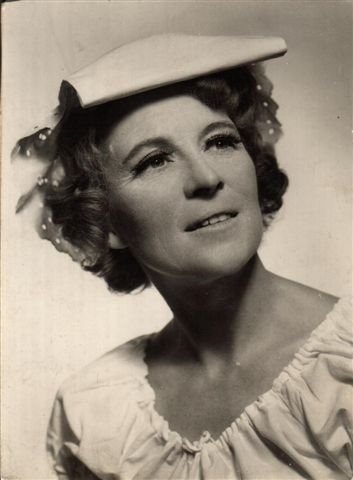
DORIS BOULTON (soprano) Doris Boulton was originally from the Potteries district of England. Her husband worked at a pottery near Irené, on the outskirts of Pretoria. She had an exceptional soprano voice and was also extremely musical – the two gifts do not always go together! She had broadcast extensively with the SABC, but with a change of management, her file was mysteriously lost and she was required to re-audition. This second audition was not favourable, despite her being a better singer than many who continued to give regular broadcasts.
She was singing Richard Strauss’s Serenade in an impossible key, and my attempt at sight-reading this makes me blush even forty-odd years on. Doris and her husband gave Anne and Webster a beautiful white tiled table, inscribed with roses and a few bars of their signature tune, Only a Rose, made by Mr Boulton on the occasion of their silver wedding anniversary in 1963.
In 1966 Doris Boulton produced The Merry Widow in Irené and took the leading role of the widow in question, Hannah Glavari.
[image error]Webster and Anne attending “The Merry Widow” first night as guests of honour.
[image error]Doris Boulton as the Merry Widow (1966)
Doris remained friends with Anne and Webster and visited them a number of times in Penrhyn Bay. She returned to the UK some years ago and settled in Stone. I was sorry to hear from her daughter, Jan Bruns that Doris had passed away in 2008.
HEATHER COXON (soprano) Heather was a charming young schoolgirl. She had a light, sweet soprano.
ROSELLE DEAVALL (mezzo soprano) I first heard Roselle sing when she was fourteen years old. I was impressed at the maturity of her voice at such a young age. We discovered that we lived in the same suburb, and visited each other several times. I still have a reel-to-reel recording of her singing The Mountains of Morne, complete with Irish accent.
She stopped having lessons but took them up again after she left school. In 1966 Webster told me that Roselle had stopped having lessons with them as “They were unable to teach me anything more.” The last I heard was that she was singing with the Performing Arts Company of the Free State. (PACOFS).
NORMA DENNIS (soprano) Norma was the understudy to Diane Todd in the role of Eliza in the production of My Fair Lady in the Empire Theatre, Johannesburg.
[image error]
Mabel Fenney (extreme left) as Jill-all-Alone in East London production of Merrie England. (Photo courtesy of Julian Nicholas)
MABEL FENNEY PERKIN (soprano) Mabel met Anne and Webster first when she appeared with them in a production of Merrie England in East London, in the Eastern Cape. At the time she was preparing for further music diplomas, so she decided to come up to Johannesburg to have lessons with the Booths.
In 1960 she came to Jeppe Girls’ High as a relief music teacher and gave a recital for the girls in the School Hall. She was instrumental in my decision to study with Anne and Webster. She won the University of South Africa Singing Bursary and studied at the Hochschule in Berlin for two years.
She met her second husband, Maurice Perkin while she was abroad and after her divorce and remarriage to Maurice, she lived and worked in England for a number of years before they came out to South Africa. During her time in England, she sang the role of Susannah in a semi-professional production of The Marriage of Figaro. I met her again in 1976 when she was living in Florida (South Africa) and we became very good friends. We sang duets together until she and her husband retired to the South Coast of Natal.
In April 2009 Mabel celebrated her ninetieth birthday. She died in Uvongo on 6 March 2011, just a month short of her ninety-second birthday. She is sadly missed but ever remembered by me.
VALERIE FIGGINS (soprano) Valerie Figgins also attended Jeppe Girls’ High School, and she too was present at the Mabel Fenney recital. Valerie had a strong voice at an early age and studied with another teacher in Johannesburg before going to Anne and Webster for lessons. I do not know how long she remained with them. We were in the Performing Arts Council of the Transvaal’s (PACT) production of Nabucco together in 1965.
ROBINETTE GORDON (soprano) Robin had a sweet soprano voice. When I first met her when I was accompanying for Webster she was singing in the Johannesburg Operatic Society’s production of Show Boat, in which the great Maori bass, Inia Te Wiata was engaged to sing Ole Man River. She went on to sing in further JODS productions of The Yeomen of the Guard, The Merry Widow and Guys and Dolls. I remember coaching her in a jazzy chorus in the latter work – Sit Down, You’re Rocking the Boat! She later joined PACT, where she sang in a number of operas. I was sorry to read of her death several years ago.
MARY HARRISON (mezzo soprano) Mary was an Australian who came to South Africa with a production of My Fair Lady. She and the understudy to Scottish Diane Todd’s Eliza Doolittle, Norma Dennis, took lessons with Anne and Webster while they were appearing in My Fair Lady in Johannesburg. Mary was an attractive redhead, with a lively personality and ready wit. She stayed on in South Africa after the show and established herself as a professional actress in Durban. She died prematurely some years ago. I was also sorry to hear that Diane Todd died from leukemia in London earlier this month (April 2010) at the age of 72.

DUDLEY HOLMES (bass) Dudley was completely taken aback to find me at the piano for one of his lessons. He told me later that he had never sung for anyone but Anne and Webster and was very nervous to sing in front of me. He need not have worried. He had a pleasing bass voice, and went on to do many concerts, recitals and shows, first in Johannesburg, and later in Kimberley, where he lived for many years. He returned to Johannesburg some years ago and kindly contributed a memory to my book with an article about his long association and friendship with Anne and Webster.
INNES KENNERSLEY I played for Innes, who was a miner, several times. At the time he was singing a series of Victorian and Edwardian ballads, such as Goodbye and Parted. He used to arrive at his lesson with a large reel-to-reel tape recorder and record the entire lesson. I wonder what happened to all those interesting recordings. They would certainly be of great interest to me if they are still around.
MYRNA LEACH I played at some of Myrna’s lessons and got to know her better when we were in The Merry Widow together in 1964. She had recently married and was particularly proud that Webster had sung My Prayer at her wedding. I believe she subsequently divorced and married for a second time later.
MARGARET LINKLATER (soprano) Margaret was Scottish and lived on the East Rand, where her family ran a bakery in Benoni. She had a very pleasing soprano voice. I remember her singing Gounod’s O Divine Redeemer.
ROBIN LISTER (boy soprano) Robin had an exceptional soprano voice, more like a mature female soprano than the typical Ernest Lough boy soprano. He made several recordings which Anne and Webster supervised. Through the recordings he became well known and appeared at a number of concerts until his voice broke. After his voice broke, Anne and Webster taught him to play the piano. He became an engineer and immigrated to Australia. Robin Lister sings “When Irish Eyes are Smiling”.
[image error]Robin Lister (1964)

SELWYN LOTZOFF (boy soprano) I played for Selwyn at several eisteddfods and at the Amahl and the Night Visitors audition. I
particularly remember him singing the Afrikaans song, Die Roos. He immigrated to America and now lives in New York. He is pictured (above left) with his wife.
COLLEEN MCMENAMIN (mezzo soprano) Colleen had a rich mezzo voice and she was very keen to turn professional. She auditioned for Brian Brooke’s production of The Sound of Music at the Brooke Theatre. Brian Brooke was impressed with her singing but suggested that she should take speech lessons before considering a stage career. Despite this setback she appeared in several professional productions in Johannesburg.
BRIAN MORRIS (baritone) He had a voice reminiscent of Peter Dawson’s and a confident stage presence. I got to know him better
when he sang in PACT’s production of Nabucco in 1965. Anne chose Brian to take the leading male role of Danillo in her Bloemfontein production of The Merry Widow in 1965. Through this blog I have heard that Brian died in 2006 and is survived by his wife Denise. Those who heard him sing through the years will remember his beautiful voice and charming personality.
PIET MULLER (tenor)
Piet Muller had a beautiful tenor voice. He was studying with Anne and Webster in 1962 and for a time had the lesson before mine. I
particularly remember him singing Can I Forget You? on the day Webster returned to the studio after his serious illness in 1962. Webster sang part of the song to illustrate a particular point to Piet. Amazingly, Webster’s voice sounded as good as ever despite his illness and his advancing age. Several years ago I heard from Piet’s family member that Piet had died some years ago.
RUTH ORMOND (soprano) Ruth was my special friend at the studio. She and I joined the SABC choir,when it was resurrected in 1961, and Anne suggested that we should meet one another. She was still at school, a year-and-a-half younger than me and, like me, she was originally from Glasgow. She was short, with piercing blue eyes and honey-coloured hair. We both thought the world of Anne and Webster and we loved singing, although neither of us was filled with confidence about our vocal abilities.
We did exams together and although we lived a fair distance apart, we visited each other regularly. We made up for the distance between us by making frequent telephone calls. At the cost of a tickey (3d) a call, we could afford to talk as long as we liked – and we did! We made tape recordings of our singing and impromptu play-readings. I still have these recordings in my possession today. In 1962 her mother won a substantial amount of money in the (then) Rhodesian Sweep.
[image error]My dear friend, Ruth Ormond, 1963
Ruth went to Cape Town University to study singing in 1964 and sadly died of a cerebral haemorrhage at the end of her first term there. Her parents created an award in her name at Cape Town for the best first-year soprano. She was nineteen years old when she died. I still miss her. I have never had a dearer friend.
LINDA WALTERS Linda came all the way from Vereeniging for her singing lessons. She sang lighter material, like Fly me to the Moon.
ERNEST WESTBROOK (tenor) I did not know Ernest when he was taking lessons, but I met him many years later when Paddy O’Byrne, the broadcaster gave him my phone number. He had many of Anne and Webster’s recordings and was also an admirer of the Australian bass-baritone, Peter Dawson.
MARY WRIGHT (soprano) Mary’s brother, Desmond Wright, had conducted The Yeomen of the Guard in 1963 when Webster took over the role of Colonel Fairfax at short notice. She had a pleasant light soprano and concentrated on oratorio.
OTHERS:
Richard Darley, Elizabeth du Plessis (soprano), Jennifer Fieldgate, John Fletcher, Yvonne Marais (soprano), Joan Metson, Thea Mullins,
Betsie Oosthuizen (soprano), Bill Perry (tenor), Piet van Zyl (bass).
I do not remember the full names of the following: Corrie, Dell, Erica, Ferdy, Frances and Henrietta (sisters who sang duets together), Gertie, Graham, Gretchen, Miss Greyvenstein, Hennie, Janet, Kathy, Leanore, Lorentzia, Louella, Louis, Marian, Myrtle, Nellie (a mezzo-soprano who moved to the Free State), Reeka, Shirley, Winnie (a Scot who lived in Modderfontein and sang in the local operatic society).
If anyone can tell me what became of any of Anne and Webster’s pupils, or if you studied with them, I would be very glad to hear from you.
Jean Collen 12 September 2018.
BABS WILSON-HILL (MARIE THOMPSON)

Babs Wilson-Hill (Marie Thompson) top left in a show.
The following article, written by Linda Anderson, a relative of Babs, appeared in my book, Sweethearts of Song; A Personal Memoir of Anne Ziegler and Webster Booth
[image error]
LINDA ANDERSON OF BIDFORD-ON-AVON WRITES:
[image error]
MARIE GLADYS WILSON/THOMPSON (BABS WILSON-HILL)
Babs was born in Manchester on 12 September 1908, the second child of Gertrude and Harold Wilson. As a young child, she lost her father during the First World War. She missed her father dearly as she had been very fond of him.
When Babs was in her early years she was living in Chandos Road, Chorlton-cum-Hardy and went to Loreto Convent School. By this time she had been having piano lessons and had also become a very able dancer.
Babs remembers her Aunt May, only eight years older than herself, teaching her a few dances. This sparked off an interest which was later to become her career. She decided to take the subject more seriously and began lessons with the Haines School of Dancing, Whalley Range and later at Sheila Elliot’s School of Dancing, Liverpool. Some of her early performances were in the theatre at the rear of Manchester’s Midland Hotel.
During her dancing years, Babs had been coached by Anna Ivanova who was with the Pavlova Company. Babs was later to become the Principal Ballerina in pantomime with Tom Arnold who produced performances throughout the country. She was in eight pantomimes altogether and was Principal Girl, Fairy, Witch, and Principal Dancer. She performed with and became a friend of Anne Ziegler and Webster Booth and knew George Formby and his wife Beryl well.
George Formby was later to be responsible for Babs being sent to the Isle of Man during the Second World War. He saw her dressed in her WAAF’s uniform and was most amused! He wanted Babs to be part of a team in Jurby, Isle of Man, where a theatre had been set up at the RAF base there. Babs asked that this was to be secondary to her work as an MT driver. She had been advised not to be part of ENSA and so this was a good compromise. When she arrived at the Isle of Man she had her own personal transport waiting to take her to Jurby and was treated as a VIP, much to her surprise! A trunk of her costumes was shipped over to the island. Babs always made her own costumes.
One of the shows she was involved with went to London for one night where she was introduced to a member of the Royal Family.
Later in the war, she was transferred to Ireland, Scotland and finally Stanmore, where at one time she was driving a 15cwt lorry and, as a Corporal, she was also driving a Staff Car. After coming out of the Services Babs went to live in Cobham Surrey. She had a very short, unsuccessful marriage and later moved back to Colwyn Bay.
Babs looks upon her move to Colwyn Bay as a successful one. She has had the advantage of both the sea, in which she was a regular swimmer for many years and the beautiful surrounding countryside. She is also surrounded by many very good friends. Over the years she has been very involved with The Guide Dogs for the Blind Association.
Her friendship with Anne Ziegler and Webster Booth enabled her to spend many months with them in South Africa. When Anne and Webster were thinking that they would never be able to return to the UK, Babs bought a bungalow for them to live in which was near to her in North Wales. They remained in this home until they died.
Babs died on 28 September 2003* (only a few weeks before Anne died on 13 October 2003).
Linda Anderson.
Babs in her beautiful garden in Colwyn Bay (photo: Linda Anderson)
[image error]
*only a few weeks before Anne’s death on 13 October 2003.
Anne had met Babs when she appeared in her first pantomime in Liverpool. Anne was the principal boy, Babs the principal dancer. [image error]
Anne (right) in Liverpool pantomime (1935/36)
When the broadcaster, Leslie Green went to the UK in 1962 he met Babs and interviewed her for his programme Tea With Mr Green on Springbok Radio. Anne and I listened to the programme together. Here is an extract from my diary on 4 September:
4 September Go to the studio in the afternoon. Anne is there by herself and she tells me that Webster has had to do his two extra programmes before he goes (to Rhodesia) today. She told him to go home and have a rest after them if he’s tired so I might not see him. She asks if I’d like to listen to Tea with Mr Green because her girlfriend is going to be on today.
We do scales and exercises. The chemist phones and she arranges to have a silver Wellaton (hair rinse) sent up! She says her hair is a dull mousy grey and she has to do something to liven it up and stop her from looking old!
We listen to Leslie G and she tells me that Babs Wilson-Hill is her very best friend in Britain. She and Babs were in panto together in 1934 and she is very fond of her. They write to one another every week and tell each other all their worries and troubles. She is very well off – she has a lovely home and garden. She shows me a picture of her (which is on the wall). She says she misses her more than anyone else in Britain.
Leslie G introduces his programme by saying that it was due to Anne Ziegler that he is there because she had told him about Babs. He talks about the lovely garden – laburnum, willows, larkspurs, snapdragons… Babs sounds very like Anne, only more so – same laugh, the same intonation of words, very pleasant and slightly “county”. She has a house near Guildford in Surrey. Anne says that Babs wrote and said she made a terrible botch of the whole thing but she sounds terribly self-possessed to me. After it is over, Anne says that one can only have a friend like that once in a lifetime and she thinks everyone needs someone to confide in and tell their troubles to.
Jean Collen 12 September 2018.
.
September 10, 2018
MESSAGES SENT TO MY WEBSITE REGARDING WEBSTER AND ANNE (2008 – 2009).
The following messages were sent to me since I have been running this web page. I am also including additional interesting information in note form. I will protect writers’ privacy by omitting surnames. The oldest information appears first. Click on the links to hear relevant recordings.
31 August 2008
I am writing a history of a music firm in New Zealand, Charles Begg and Co. They were the firm responsible for bringing Anne Ziegler and Webster Booth to New Zealand. I am trying to find out all I can about their tour here and was wondering if you have any information, and, possibly, any photographs. I have got a copy of their autobiography which does deal with the tour but would welcome any additional information.
Many thanks.
Clare
My co-author of the book, Do you remember Anne Ziegler and Webster Booth?, Pamela Davies had received a book of cuttings concerned with Anne and Webster’s tour of New Zealand and Australia in 1948. Pam kindly agreed to compile a list of press cuttings which featured Anne and Webster on their tour. She sent this to me by post and I e-mailed it to Clare. Clare used the list when she went to the National Library to find the cuttings. She found some of the microfiche copies indecipherable but kindly sent me typed copies of some of the articles she managed to locate.
Anne and Webster arriving in New Zealand (1948)
[image error]Anne and Webster arrive in New Zealand. (1948)
6 March 2009
HI, Jeannie
I was searching the internet for a song called and the only one I found was on your site in the listing for the This is the song of the Pirate Ship (Heigh Hi Ho) Nursery School Sing-Along No. 2. I know the tune of the song but really need the lyrics as I can’t remember more than 2 verses and I want to teach it to my class. Are you able to help me?
Thanks a lot!
Regards,
Sharon
I was glad to help Sharon by sending her an MP3 of the song. She was delighted with it and looked forward to teaching it to her class.
6 March 2009
I have 3 photos of Tom Howell’s Opieros….would you like to have electronic copies?
Ken, Swansea
Although the photographs were taken before Webster joined the Opieros in 1927, I was delighted to have them. They included Ken’s great grandmother’s sister, Anita Evans of Llanelli. Recently I have added an article to the blog about Tom Howell’s Opieros and I hope to find out more information about Anita’s role in the concert party soon.
[image error]Tom Howell’s Opieros. Anita Edwards is to the upper right of Tom Howell who is in the middle of the photo.
8 March 2009
I am Rutland Boughton’s grand-daughter and am very interested to realize that Webster Booth sang The Faery Song from the Immortal Hour. I wondered whether you could email me and we could chat from thereon.
I look forward to hearing from you.
Best wishes,
Elaine.
Rutland Boughton was on the staff of the Midland Institute, Birmingham when Webster was studying singing there with Richard Wassell. I was able to send Elaine an MP3 of Webster’s recording of The Faery Song and she, in turn, sent copies to members of her family. Later I became Facebook friends with Elaine.
20 March 2009
Their ‘autobiography’ Duet was ghostwritten by the late Frank S. Stuart. I have researched his background in my critical analysis of the Jasper Maskelyne War Magician myths.
Frank was adept at presenting amusing tales that were only loosely based on factual events.
I have not yet read Duet. I am interested in hearing from you. How accurate a memoir is it?
Richard.
I exchanged several e-mails with Richard about the ghostwriter, Frank S. Stuart. Anne and Webster wrote the latter part of Duet themselves as they felt that Stuart was implying that they were pacifists (as he himself was). It says a lot for the editor at the publisher Stanley Paul that one cannot tell at what point of the book Frank S. Stuart finished writing and where Anne and Webster continued.
Update: Since then I have digitised Duet with the help of John Marwood who proofread my digitisation meticulously. It is available as a paperback and an ebook at: My Bookshop
Various other books concerning Anne and Webster are available at the same link.
[image error]Duet – originally published by Stanley Paul in 1951. Digitised by me several years ago.
10 April 2009
I was really interested to read that you have in your collection the LPs of the 1963 and 1964 performances of ELIJAH and CREATION in the PMB City Hall. I sang in both these performances as a schoolboy. Any idea how or where I could obtain a copy of either the complete version or even some extracts – and/or a copy of the album sleeves? I recall that the ELIJAH LP box featured the Rose window in the Michaelhouse chapel.
Chris
EDINBURGH
As luck would have it I had been given copies of the LPs which I had transferred to CD several years before and sent copies to the music department of Michaelhouse and to Barry Smith in Cape Town who had conducted the performance when he was director of music at Michaelhouse in 1963. I was able to send Chris the CDs by post and e-mail him a copy of the cover of Elijah which features the Rose window of the Michaelhouse chapel.
[image error]Elijah at Michaelhouse School, Balgowan, Natal – September 1963.
Chris shared an amusing anecdote of what had occurred at an Elijah rehearsal:
Your comment about Webster showing some strain on the high notes was possibly not only due to his age. I vividly remember a slightly risque comment he made when he arrived for the first Elijah rehearsal with the orchestra and chorus. Barry Smith had the duty of forewarning him that the Pietermaritzburg organ was pitched notoriously sharp and that the orchestra had to tune their instruments up a semitone. Without batting an eyelid, Webster assured him that it was no problem and he would just ‘wear an extra jock-strap!’, a ‘throw away line’ which was the source of much amusement to the teenage boys and girl in the chorus.
Update: September 2018. Unfortunately, the postal system in South Africa has all but collapsed since that post was written. The Rand is also in a parlous state, so the days of sending anything by post are long gone.
Elijah at Michaelhouse 1963 A brief recitative from the recording.
21 September 2009 – My comment.
Congratulations to Sipho Fubesi (tenor) from Centane in the Eastern Cape, South Africa, who is this year’s winner of the Anne Ziegler prize at the Royal Northern College of Music, Manchester.
14 October 2009 – My comment.
I was very sorry to hear of the death of the Scottish baritone, Ian Wallace at the age of 90. He was one of my favourite singers and I always enjoyed his pithy comments on the BBC programme My Music. He could sing opera, Gilbert and Sullivan, musicals, and Flanders and Swann with the best of them but was not above turning his hand to comic songs with great effect like I can’t do my bally bottom buttons up, Lazin’, and even the rather rude one, Never do it at the station. My personal favourite was his heartfelt singing of Limehouse Reach by Michael Head. He will be fondly remembered and sadly missed by many.
18 October 2009 – a message from Simon.
I just wanted to say how interesting and informative your blog on Anne Ziegler is and how much I have enjoyed the youtube videos. I have been listening to Anne Ziegler since I was 14 and got hold of an old LP, I’m 26 now. I was struck by the video of her singing A Song in the Night. it is beautiful and I wish so much I had it on cd. Do you know of any re-issues featuring it or anywhere I could download it? Also, I thought you may be interested to know there is a video of her on British Pathe.com singing it in 1936 – but alas no sound!!! Wasn’t she beautiful!
Thank you,
Best regards,
Simon
I sent Simon an MP3 of Anne’s recording of A Song in the Night by Loughborough. I think this is one of Anne’s best solo recordings. Click on the link to listen.
1 December 2009 – My comment.
Tenor, Sipho Fubesi is currently appearing as Paris in the RNCM production of La Belle Helene by Offenbach.
Jean Collen. Updated on 10 September 2018.


![[image error]](http://3.bp.blogspot.com/_N1a7kYjpQzQ/SkvE2uSTiOI/AAAAAAAAAiM/LfgdfjDCouQ/s1600-h/Merrie+England+cropped-01.jpg)