Jean Collen's Blog, page 14
April 8, 2019
THE FAUST FANTASY (1935)
I received extracts of this film (about half an hour) on DVD recently and have posted some stills of it to the photos in the group. I quite enjoyed it but generally critics (both contemporary and present-day) were not kind.
December 1934 – Shooting of the film, Faust Fantasy. Anne (Marguerite) and Webster (Faust) began filming the Faust Fantasy. Webster had been married to Paddy Prior for just over two years, but his meeting with Anne spelt the end of this marriage almost before it had begun. He had taken several joint engagements with Paddy and these continued for some time after he met Anne. As late as 28 May 1936 he and Paddy attended Vi Stevens and Bryan Courage’s wedding. As soon as he met Anne he recommended her to the BBC, and less than a month later she sang in the broadcast of Kenneth Leslie-Smith’s Love Needs a Waltz. (extract from my book, A Scattered Garland: Gleanings of the Lives of Webster Booth and Anne Ziegler)
[image error]Mephistopheles and Faust.
14 March 1935 – The Times. Faust Fantasy. A further experiment in the use of colour on the screen was demonstrated yesterday.
Faust Fantasy is almost a full length film – it lasts for over three-quarters of an hour – and while it cannot claim that it has solved the problem of flesh-tints and such reds as are in the glow of torches, and the leaping flames of a fire still undergo a curious metamorphosis once they are photographed, it is an interesting and by no means unsuccessful experiment. It has in its favour its circumspection in avoiding those colours which up to now have consistently repulsed the advances of the camera with the result that some of the “shots” have not only the composition necessary for a well-painted picture but some of the tone and colouring as well. Progress in turning the black-and-white of the screen into colour has been slow, however, and it still remains the medium for fantasy and not for realism. Mr Webster Booth, Mr Dennis Hoey, and Miss Ann Zeigler (sic) play Faust, Mephistopheles and Marguerite, and the hint of strain and hardness in their singing is probably due to the fact that it comes to us second-hand.
Extract from the book OPERA ON FILM by Richard Fawkes
One of Britain’s contributions to filmed opera at this time was an hour-long version of Gounod’s Faust. This was shot at Bushey Studios on the outskirts of London and was produced and directed by Albert Hopkins. It was one of the earliest colour films made in Britain (using the Spectracolour system), but not even that distinction could save it from being dire. Faust has gone down as being the worst operatic film ever made. The singing is quite acceptable. Webster Booth, a former member of the D’Oyly Carte Opera Company, is a smooth-voiced Faust and Anne Ziegler, whom he met on the set and was later to become his third wife, is an attractive Marguerite, but Dennis Hoey plays Mephistopheles as a pantomime villain, the production is cheap and looks it, and the direction is non-existent. The camera is often high to disguise the fact that there is virtually no set. Most scenes are shot against a wall, although there is a risible duel scene filmed in a wood. The final scene when Faust and Mephistopheles visit Marguerite in her cell (she has killed her baby) is a gem of dreadful acting and unimaginative film making.
[image error]The Faust Fantasy
[image error]
Advertisements


April 1, 2019
Protected: DIARIES CONTINUED – 21 – 31 OCTOBER 1963 (PRIVATE)
This post is password protected. You must visit the website and enter the password to continue reading.
Advertisements
DIARIES CONTINUED – October 1963
1
October.- Go
to studio. Irish woman, Eileen Lawless phones about the theatrical
garden party. Talks of “Anne and Leslie”. Ruth phones at night to
invite us to Intimate theatre to see Playboy
of the Western World.
It is excellent. The young actor, James White is brilliant. We have
coffee in Hillbrow afterwards and then take her home.
2
October – Go
into studio. The pianist, Ivor Dennis comes to visit them. I lunch
with Mum and buy some new clothes.
3
October – Go
into studio and Webster arrives after making record with boy soprano,
Robin Lister and feeling exhausted. Anne and I have an interesting
chat. We visit Mrs Hooper and her son Alan. She is the sister of
Ralph Trewhela. I sing for them and they seem to like it.
4 October – Go to studio and Mummy phones with results for ATCL – 77% which is very good.
[image error]
Webster phones and Lucille comes to the studio and we arrange to meet tomorrow at the Rand Show Grounds for the Theatrical Garden Party. I meet Webster outside Thrupps. When I come back, I give him the bob and he is delighted and bends over me and kisses me sweetly and thrillingly. Anne is pleased with the result. Webster goes through songs with me and I have a long chat with him – heaven!
5 October. – Theatrical Garden party. I meet Lucille and Ruth outside the Rand Show Grounds. We have a cold drink in the refreshment pavilion because Anne and Webster are late and we are not too sure how to aid proceedings. The New Zealand bass, Inia te Wiata who is in the country to sing in Show Boat for the Johannesburg Operatic Society, is there, saying that he is very keen to see his old friend, Webster Booth. When Webster and Anne eventually arrive, we can hear them fighting with each other before we even see them. When they see us, Webster stops fighting and is pleased to see us, telling us that we look gorgeous. He puts his arm around me, saying that we have plenty of time to have a look around at everything. In contrast, Anne is still in a terrible mood, doesn’t even speak to us and marches off by herself. Webster has to run to catch up with her and we are left to our own devices.
We
eventually see them having strawberries and cream with the VIPs. He
signals to us to come over to their table but Ruth tells us to ignore
them after Anne’s unpleasant behaviour towards us. Ruth brings me
home and we have tea and decide that we will tell them that we met
some boys we knew and had a hilarious time dancing in the rock ‘n
roll tent! We could have had a lovely time with them were it not for
Anne’s bad mood. I wonder why she was so cross with him.
6
October-
Drive like a hell hound along the airport road and have rather a
reactionary day recovering from Anne’s snub yesterday.
7
October – Go
to studio and work for a bit. Ralph Trewhela phones. He has a friend
who would like to meet Webster. I meet Ruth and her mother and the
latter drives us home where Ruth and I have lunch. We enjoy ourselves
running the Booths down after the disappointment on Saturday, and
singing corny duets together which we record. She invites me to her
house tomorrow to swim. We give her a run home.
8
October – Go
to Ruth’s to swim and have fun apart from developing beetroot sunburn
on my delicate Scottish skin. After having lunch there I go to
studio. Webster is very charming when talking about the garden party
but they make no mention of Anne’s bad mood. Apparently Inia te Wiata
went back to Leslie Green’s house and they all had a party there.
Anne asks if I can come on Monday from now on as they are going to
teach at home on Tuesday.
10
October – Aunt
Ina comes and we spend a day of constant natter as she runs down all
our mutual relatives. We take her to Zoo Lake for tea.
11
October – Go
into studio and lunch with Mum. Anne arrives in the afternoon. It is
impossible to hold a grudge against her for long. Her arm is still
sore and she feels sure she’s getting arthritis. Webster comes and
says I might as well get on and do the LTCL. I sing My
Heart and I
for a last fling before thinking of the next exam.
12
October – Go
to Mrs S in morning and have piano lesson and then work with Elaine.
Just before choir practise Mrs S tells me that Webster was simply
raving about me to her and saying how proud he is of me – and
apparently Anne is also.
Dad
phoned Webster today and he agreed that I could sublet the studio
from next March and that I should go on with licentiate and
fellowship.
We
go to the Piccadilly and see Carry
on Taxi.
14
October – I
work hard at harmony. Ruth phones to ask me to some concerts. She’s
given the Booths free tickets to the Maria Stander recital and is
going to go with them. I wish I was going to that concert too.
[image error]Maria Stader (soprano)
15
October –
Webster phones in the morning to ask if I’d play for him on Thursday,
Friday and possibly Saturday as Anne is going to have her neck
stretched. Naturally I agree. I decline during the rest of the day so
get Mum to phone them to say I can’t come to lesson. Apparently he
and Mum are now on Christian name terms. I phone him at night and he
tells me the hours for accompanying. He says Anne will have to have a
week of treatment. He asks whether I’m feeling any better now and
tells me not to work so hard.
17
October –
Accompany for Webster. During Linda’s lesson he spends time patting
me on the cheek! Yvonne, Margriet, Louisetta, audition, Graham and
Freddie come and we have jolly day with them. Freddie takes us to the
garage and when Webster helps me out of the car he puts his arm
around my waist and keeps it there. He takes me home and we talk
outside for a while. I phone Anne to say he’s on his way home. She is
feeling a lot better after the treatment. She was probably feeling
ill on the day of the garden party and possibly didn’t even want to
go to it!
18
October –
Lucille arrives first and tells me all about her recently holiday.
When Webster arrives wearing his dress suit, he tells me he’s going
to the first night of Show
Boat and
Clara Butt will take me home. Lucille has her lesson and then I have
mine during which we decide what to do for next exam. Selwyn, Myrna,
Gertie and Charlotte come and all goes well as far as the piano is
concerned. I say goodbye to him and am taken home by “Clara Butt”
and husband. I feel a bit put out that Anne was not well enough to
come to the studio but is well enough to attend the first night.
19
October – Go
to Mrs S and have piano lesson. Go to Booth studio and Webster
arrives shortly afterwards full of moans about last night’s late
night at Show
Boat. I make
him some black coffee and we have Leanore who is also tired. Erica
and Ruth follow. Ruth is very agitated and excited about going with
them to hear Maria Stader. At one moment she tells Webster not to
look at her when she’s singing and he says, “You want to spend the
whole evening at the concert with me but you can’t bear me to look at
you!” Robin is full of events in Show
Boat chorus,
and then we have Frances and Henrietta, sisters who sing duets
together. Webster brings me home – we meet Margaret on the way to
the garage. He tells me about their new house in Parktown North and
about the wallpaper he has chosen for his bedroom. He is not keen on
going to the concert as he is still very tired and says it’s a pity I
couldn’t go instead of him but he knows Ruth would be upset if he
didn’t go. He says he doesn’t like going out at night now that he is
old!
20
October –
Ruth phones in the morning to tell me about last night. She got home
at 10.45 and they had coffee in the café in Parktown North
afterwards. She asks me to go to a Shura Cherkasky recital at the
SABC in the afternoon. Gill is there. Cherkasky is brilliant and
plays the Mozart sonata I am playing myself. Ruth brings me home and
we have supper and a cosy chat.
[image error]Shura Cherkassky
March 28, 2019
PROGRAMMES AND ADVERTS – 1944 – 1945
2 January 1944 – Messiah. 2.30pm New Opera House, Blackpool. Festival performance in aid of the Mayor’s Services Welfare Fund. Anne Ziegler, Mary Jarred, Webster Booth, William Parsons, with Huddersfield Choral Society, Liverpool Philharmonic Orchestra (Ena Baga at the organ) conducted by Dr Malcolm Sargent
[image error]
This Blackpool Messiah was the only time that Anne sang the soprano solos in a first-class oratorio performance in the UK.
[image error]
[image error]16 February 1944 London Palladium
4 May 1944 – Palladium. Max Miller, Webster Booth and Anne Ziegler, Jimmy James, Ivy Benson and Ladies’ Band, Rawicz and Landauer, Cairoli Brothers, Charles Warren and Jean, Scott Sanders, Lamar and Rosita, Cawalini and Dogs, Lucille Gaye, Mariora, Palladium Girls.
20 May 1944, ROYAL ALBERT HALL Saturday evening, next at 7. Harold Fielding (for Promarts) presents
ALBERT
SANDLER (favourite Grand
Hotel Music)
WEBSTER
BOOTH & ANNE ZIEGLER (in
Songs from the Shows)
RAWICZ
& LANDAUER (in Nutcracker
Suite, Warsaw Concerto).
Book:
12/-, 10/6, 8/6, 6/-, 5/-, 3/6. Book at Hall (Ken. 3661) and Agents
[image error]9 June 1944 – Leeds Town Hall
15 June 1944 – Golders Green
Hippodrome. Cyril Fletcher,
Webster Booth and Anne Ziegler, Jack Edge, Arthur Worsley, Toledo,
Elly and Joan, Three Gremlins, Dennis Lawes, Delly Kin.
16 June 1944 – Western Daily Press –
Anne Ziegler and Webster Booth
Messrs Churchill and Son, Ltd., announce that consequent on the successful visit of Rawicz and Landauer to the Colston Hall, Bristol, recently, the promoters (Promarts Ltd) have engaged Anne Ziegler and Webster Booth to appear with a supporting cast at a special concert on Saturday, July 8. Full details and booking arrangements will be given in the advertisement columns of this paper very shortly. Anne Ziegler and Webster Booth are principal artists in the BBC Songs from the Shows programmes.
[image error]
[image error]
[image error]
[image error]
3 August 1944 – Nottingham Evening
Post
Thieves broke into the home of Anne Ziegler
and Webster Booth, the musical comedy singers, at Barnet, and got
away with jewellery valued at about £500.
[image error]19 August 1944 Colston Hall.
[image error]
[image error]30 October 1944 Alhambra Theatre, Bradford.
21 November 1944 – Massed brass
All lovers of brass bands on Tyneside who
find it convenient to attend will enjoy the programme of the massed
bands of Harton, Blackhall and Crookhall Collierie and Wallsend
Shipyard at the concert in the City Hall, Newcastle, at 2.30 pm on
Sunday, December 10.
Guest conductor will be Mr Harry Mortimer
of the BBC , and Mr Frank Phillips, the BBC announcer is to introduce
the programme, stars of which, as already announced are Webster Booth
and Anne Ziegler, who are returning to Newcastle especially to sing
for this effort on behalf of the Royal Victoria Infirmary.
25 November 1944 – Central Hall, Coventry for one night only: Webster Booth and Anne Ziegler in Songs from the Shows, with cellist Mannucci and pianist Vina Barnden.
4 December 1944 – Kings Theatre,
Portsmouth Richard Tauber, Anne
Ziegler, Webster Booth, Rawicz & Landauer.
[image error]
[image error]8 January 1944 Colston Hall, Bristol.
[image error]Sweet Yesterday
[image error]16 April 1945, Palace Theatre, Manchester
[image error]
[image error]
[image error]Sweet Yesterday
[image error]The Laughing Lady
[image error]
[image error]1945
31 July 1945 – Robbery. This was not the first burglary at their home. They had been burgled in early 1944, and some time later Webster’s Talbot car was stolen from the garage and was later found abandoned and damaged.
[image error]Victory Royal Command Performance – 5 November 1945
[image error]
[image error]November 1945 – Interview with Scotsman.
Jean Collen 28 March 2019.
Advertisements
March 23, 2019
PROGRAMMES AND ADVERTS – 1942 – 1943
[image error]
1942 – For Brinsworth.
There are still a few tickets, at prices from one to three guineas, available for next Sunday’s variety show at the Palladium, which George Black has arranged for the Variety Artistes Benevolent Fund an Institution of which he is president. One would have to search far to discover a more generous programme of star artistes than that which Mr Black has provided for the occasion, and it seems safe to say that those present at the Palladium and those listeners at home and overseas (for there is to be an extensive broadcast in the forces’ programme) will enjoy a memorable entertainment. In the programme will be Gracie Fields, Arthur Askey, Flanagan and Allen, Vic Oliver, Stanley Holloway, Teddy Brown, Florence Desmond, Jack Warner, Bebe Daniels and Ben Lyon, Rawicz and Landauer, the Condos Brothers, Maurice Colleano, Max Miller, Webster Booth and Anne Ziegler, Willie, West and McGinty, and Francis Day.
[image error]Gangway, London Palladium.
[image error]
[image error]
18 June 1942 – Blackpool season shows.
Most of the Blackpool season shows are now in full swing. George
Black’s Black Vanities
at the New Opera House, opened to full houses. It is produced by
Robert Nesbitt, with dances arranged by Wendy Toye and décor by Alec
Shanks and Joseph Carl; its strong cast includes Douglas Wakefield
and company, Webster Booth and Anne Ziegler, Billy Bennett, Afrique,
Betty Driver and the Darmora Ballet. It is presented in lavish manner
on a stage that is finely equipped and lighted. Salute
to Vanity is a sumptuous opening
scene introducing Marjorie Cormack, Gaye and Elmore, Betty Driver,
Douglas Wakefield and Ron Jeffries, and a lilting musical number, I
Like a Good Time.
In Victorian
Vanity, Webster Booth and Anne
Ziegler have a delightful mid-Victorian setting for The
Second Minuet, and A
Memory of Paris is another
effectively presented episode with Marjorie Cormack as the commère,
Betty Driver singing Mlle L’Amour
in her own vivacious manner, and the Darmora Ballet performing the
Can-Can in their own striking way. Douglas Wakefield, from a
stage-box, has some clever cross-talk with Roy Jeffries, and
Mississippi Minstrels is a futuristic picture of rhapsody in ragtime,
in which Gaye and Elmore score in the Cake
Walk and Betty Driver gives a
lively interpretation of Alexander’s
Ragtime Band. Webster Booth and
Anne Ziegler in Old Kentucky
Home. Marjorie Cormack in Coal
Black Mammy, Billy Nelson and
Roy Jeffries in Mr Gallagher and
Mr Sheen, Sammy Curtis in Miss
Annabel Lee, and Douglas
Wakefield as a coon, singing Ida,
are others heard, and the whole company take part in The
Minstrel Wedding which brings
the first half to a close upon a high note of colour and melody…
On the opening night Billy Bennett kept the audience in laughter with his inimitable monologues, but he is indisposed and Billy Danvers is deputising for him at the moment. Mr Black has given Webster Booth and Anne Ziegler a picturesque setting for their own vocal speciality, and the whole is brought to a dazzling finale with brilliant costumes and scenery in Farewell to Vanity. The musical director is Robert Wolly, stage director, William Stiles, and stage manager, William Roleston, with Charles Henry as chief of production department.
[image error]22 June 1942
August 1942 – Anne Ziegler. Julius Darewski has heard from Webster Booth that Anne Ziegler (Mrs Booth) has had to leave the cast of Black Vanities at the Opera House, Blackpool, through indisposition. Mr Booth is remaining with the company until August 15.
[image error]Roll of Honour Blackpool Opera House – Anne and Webster 1942.
[image error]
1 November 1942 – Golders Green
Hippodrome. Clap
Hands and Smile, with Charlie
Kunz, Webster Booth and Anne Ziegler, Wilson, Keppel and Betty, Dick
Henderson, AJ Powers, Du Barry Twins and Melita, El Granadas, Devon
and Wayne, Bud Cordell.
Webster’s mother, Sarah Booth (née Webster), died suddenly in Birmingham (aged 80) during that week.
9 November 1942 – Yorkshire Post –
BRADFORD OLD CHORAL SOCIETY From Our Own Correspondent – Bradford,
Sunday
Few operas successfully survive a transfer
to the concert platform, and Maritana
(Wallace), with which the
Bradford Old Choral Society opened its season at Eastbrook Hall
yesterday, is no exception. It has no musical tradition, its plot is
complicated; and, shorn of its theatrical trappings, the sentiment is
reminiscent of a Victorian drawing room. Some half a dozen airs alone
have probably secured for it the place it holds in English music an
these were certainly the highlights of the performance.
Of the five principals, Mr Webster Booth
only seemed completely at home in his role of Don Caesar.
Mr Reginald Gibbs, who, as Don José, took
the place of Mr Dennis Noble at very short notice, was less at ease
and rarely gave his audience an opportunity to judge his
capabilities.
Miss Hella Toras, singing the title role
was handicapped, too, by her foreign accent, but if she lacked that
“Anglo-Saxon passion for accuracy” upon which Dr Howells
commented in Leeds recently, she infused a southern passion into her
singing which atoned for much.
Miss Edith Coates (as Lazarillo) and Mr
Samuel Worthington (as the King of Spain) gave performances that were
to be expected of singers of their reputation.
Meeting their fan Gladys outside the stage door of the London Palladium – 13 November 1942.
[image error]
[image error]20 November – Concert at Redhill.
2 December 1942 – Streatham Hill Theatre. Clap Hands and Smile, with Charlie Kunz, Webster Booth and Anne Ziegler, Dick Henderson, Young China, Erikson, Duncan Gray, Devon and Wayne, El Granadas, Norman and Ronnie Munro.
22 December 1942
Messiah
The Liverpool Welsh Choral Union’s
Messiah
seems to spring from a fountain of perpetual freshness and ardour,
and Saturday’s performance in the Philharmonic Hall was solid and
satisfying, though Mr Mansel Thomas’s baton maintained a rather
unremitting tempo in the earlier stages, and occasionally seemed to
achieve colour at the expense of orthodoxy.
Mr Webster Booth’s treatment of the tenor
part provided unquestionably the triumph of the day. His technical
resources, so much more formidable than appears on the surface
furnished the foundation for an eloquent and moving simplicity in Thy
Rebuke, Behold
and See, and But
Thou didst not leave. Miss Joan
Cross, a sweet yet forthright soprano, naturally achieved her highest
flight in I know that my Redeemer
liveth. Very beautiful, too, was
Come unto Him
with its contralto supercession, He
shall feed his flock, by Miss
Ethel Davies. Mr Henry Cummings, in the bass, conserved his resources
for a finely fervent Why do the
nations? and his Darkness
recitative and aria were memorable for dramatic significance.
The choir – which had an adequate male
section in spite of the war – sang with their usual heartiness and
cohesion… Mr Cropper led the orchestra. The trumpet flourishes were
brilliant. Dr Laurence West had charge of the organ. S.J.
1943 – Harold Fielding’s Four Week concert tour. Albert Hall and the Belle Vue in Manchester (the hall seated 7000 people) Anne, Webster, Rawicz and Landauer, Albert Sandler and his trio.
9 March 1943 – The Vagabond King –
Manchester, Palace
With even more than its remembered glamour,
colour and romance, The Vagabond
King, re-proved its popularity
at the Manchester Palace last night.
It
possessed of course, the immense advantage of two principals, Webster
Booth and Anne Ziegler, who were perfect not only in their musical
ability, but also in their looks and manners, for their parts as the
vagabond poet and the high-born lady.
It had Syd Walker, mountain of good humour, managing just once to get in his famous question, “What would you do, Chums?” and Henry Baynton acting down to both his little fingers, the crafty, leering King of France. D.C
[image error]Palace Theatre, Manchester.
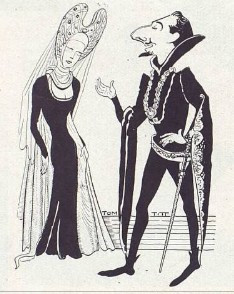
[image error][image error]
23 April 1943 – Good Friday Messiah, Royal Albert Hall, Webster Booth (tenor) Royal Choral Society, conducted by Malcolm Sargent.
27 April 1943 – Successful Revivals
To judge by its reception, The Vagabond King, which opened at the Winter Garden last week, will be a popular revival. The British public like a familiar tune. They demonstrated this in The Vagabond King by holding up the show whenever a well-known air was sung, and particularly when the singers were those popular husband-and-wife-duettists Webster Booth and Anne Ziegler in the roles which brought such success to Derek Oldham and his wife, Winnie Melville, in the original production.
15 November 1943
[image error]
16 December 1943 – Sunday Concerts.
At the Aldershot Hippodrome on Sunday Harold Fielding presented
Webster Booth and Anne Ziegler, with Charles Forwood at the piano.
Supporting artistes were Olga Hegedus, ‘cellist, and Adela Verne,
pianist. The performance was repeated at the Kingston Empire the same
evening.
23 December 1943 –The London Palladium returns to variety next on Boxing Day with a bill including Max Miller, Webster Booth and Anne Ziegler, Ivy Benson and her Ladies’ Band, Rawicz and Landauer, Cairoli Brothers, Jimmy James, Charles Warren and Jean, Reco and May, Scott Sanders, etc.
30 December 1943 – The Palladium.
No mistake has been made in the presentation of the fare for the
holiday audiences who thronged this theatre on Boxing Day. This is
real variety again and Mr Black’s advertisement of “the English
music hall at its best” is fully justified. He has selected a
programme with which the most fastidious of entertainment seekers
will agree. For comedy he has chosen Max Miller, Jimmy James and
Scott Sanders. Max Miller is at the top of his form and is warmly
welcomed for his lilting songs about Sarah, Mary Ann, Lulu and others
and he delves into his white, blue and red books for jokes, which
provoke many a chuckle for the “cheeky chappie” with the
flamboyant garb.
For those who like good music Mr Black has
retained Rawicz and Landauer in their piano duet arrangements from
Strauss, Offenbach, and Tchaikovsky, with Lamar and Rosita, Lucille
Gaye and full ballet. For those who like dancing there is also the
opening Black Magic
number, now speeded up. Good singing is provided by Webster Booth and
Anne Ziegler, who each offer a solo and conclude with a medley of
popular choruses, with Charles Forwood at the piano. George Steele
directs the orchestra efficiently. Charles T Hutchison is the
manager, assisted by David Pollock; Harry Brack is stage manager.
Advertisements
March 22, 2019
PROGRAMMES AND ADVERTS – 1940 – 1941.
The Booths were becoming very popular in the 1940s so I will limit the information to a few years at a time from here on.
[image error]
9 January 1940 – BBC Broadcast. 8.30: The Sleeping Beauty, an excerpt from the pantomime – presented by Prince Littler, with Leonard Henry, Syd Walker, Anne Ziegler: orchestra directed by Ray Theobald, from Golders Green Hippodrome.
A star-studded Sunday concert at the London Palladium on 21 January 1940.
[image error]21 January 1940 – Webster’s 38th birthday.
[image error]4 February 1940 – Regal Cinema, Chester.
17 February 1940 – Stars for Bath
Festival. Two famous radio
stars, one of whom is equally well known to film patrons – Anne
Ziegler and Webster Booth – have been engaged to appear at the
forthcoming festival of the Bath Co-operative Society.
19 February 1940 – Yorkshire Post –
Choral Society Concert. Audience of 1,000 at Horsforth.
Places of worship in Horsforth held evening
services earlier, yesterday, so that townspeople could attend the
concert by the Horsforth New Choral Society in the Glenroyal Cinema.
Upwards of 1,000 attended. It seems that Horsforth New Choral Society, consisting of no more than 60 strong, is more enterprising than the large choral societies in Leeds. With limited resources it engages the leading principals of the day – last night they were Miss Edythe Reeve, Miss Edith Coates, Mr Francis Russell (deputising for Mr Webster Booth at short notice) and Mr Arnold Matters – and during recent years the standard of choral singing has beenfar above the average.
14 March 1940 – Music Hall Debut. Anne and Webster made their debut in Variety at Manchester Palace (MD Jesse Hewitt; M William Taylor; PM D Bush; MusD S Rogers) A short season of twice-nightly variety opens with a pleasant programme. Webster Booth and Anne Ziegler render romantic numbers to the general delight, and are accompanied at the piano by Haward Clarke. The Western Brothers entertain with their amusing topical skits, the outstanding one being on radio propaganda. Billy Russell keeps the fun going with his patter on behalf of the working classes. George Clarke is as cheery as ever in The New Car. Will Hay, Junior, presents The Fourth Form at St Michael’s and Arthur Prince is still one of our most popular ventriloquists. Red Fred, the Five Kenways, Iris Sadler, and the Florence Whiteley Girls complete the programme.
[image error]17 March 1940, Ritz Theatre, Nottingham
22 March 1940 – Good Friday
ROYAL CHORAL SOCIETY, Patron: HIS MAJESTY THE KING,
Good Friday March 22 at 7,
MESSIAH (Handel) ELSIE SUDDABY, MURIEL BRUNSKILL, WEBSTER BOOTH, ROBERT EASTON,
London Philharmonic Orchestra, Dr Malcolm Sargent.
Tickets (all reserved) 7/6, 5/-, 3/6. 2/4 Queen’s Hall (Tel Langham 2823) and Agents
18 April 1940 – The Variety Stage,
Lewisham Hippodrome.
An interesting engagement in the current
variety bill is that of Webster Booth and Anne Ziegler, whose
artistic singing of ballads and excerpts from musical comedies is
warmly welcomed. They score singly and in duets, especially in A
Paradise for Two and Deep
in my Heart.
20 April 1940 9.20 Variety, from the Lewisham Hippodrome: Webster Booth and Anne Ziegler, Al and Bob Harvey, Will Hay, Junion and Company, Issy Bonn, Billy Bissett’s Canadians.
[image error]
4 May 1940 – Burnley Express
A grand variety gala performance at the London Palladium will be on the air for nearly two hours, with only a 20 minute interval (Forces programme) tomorrow. Among those who will be heard will be Gracie Fields, Jack Warner, Arthur Askey, Vic Oliver, Bebe Daniels, Ben Lyon, Florence Desmond, Frances Day, Max Miller, Flanagan and Allen, Teddy Brown, Webster Booth, Anne Ziegler and Rawicz and Landauer.
[image error]Because of the war, this Gala Performance took the place of the usual Royal Variety Performance.
George Black’s Variety Gala
– Much success attended last Sunday’s Gala Variety performance at the Palladium in aid of the Variety Artistes Benevolent Fund. George Black, who is president of the fund, arranged the entertainment in order to minimise the loss suffered by the cancellation of the usual Royal Variety Performance last year. A considerable sum should accrue though, of course, it will not approach the figure of £6,000 which was on the booking plan for the Royal Performance at the time of its cancellation…Webster Booth and Anne Ziegler sang solos and duets in pleasant style…
[image error]Autographs – 13 May 1940
June to October 1940 – On With the Show (Lawrence Wright) North Pier, Blackpool. Anne and Webster appeared in variety and sang Lilac of Louvain by Bruce Sievier and Horatio Nicholls. The words were inspired by an incident where Belgium girls handed sprays of flowers to British soldiers as they marched through the country.
[image error]
[image error]
During their stay in Blackpool they rented a “big Georgian house at Singleton, seven miles from Blackpool”, with twenty-seven acres of ground.
8 November 1940 – Western Daily Press.
BBC THEATRE ORCHESTRA’S VISIT TO BATH
Residents
in Bath will have an opportunity of hearing a Sunday concert by the
BBC Theatre Orchestra, with some favourite soloists on Sunday,
November 17. Olga Haley and Webster Booth will sing solos and duets,
and there will be items by the BBC Theatre Chorus and Jack Mackintosh
solo cornet. The conductor will be Stanford Robinson.
The
concert, which begins in the Pavilion at 6 pm is priced at 5s and 3s
6d for the reserved numbered seats, and 3s 6d for the reserved
numbered seats, and 3s 6d for the unnumbered reserved seats. A
limited number of unreserved tickets can be had in advance, price 1s
3d, from the Pump Room office telephone number 4227. Members of the
Forces in uniform will be admitted for half price at the doors.
The vocal items will include the favourite song from Hiawatha, Onaway, awake Beloved; the aria from Samson and Delilah, Softly Awakes my Heart, and the duet from Act II, Carmen including the Flower Song.
[image error]
[image error]
Merrie England – Captivating Singing in Oldham.
So great was the demand for seats to hear the concert performance of Merrie England by the Oldham Musical Society and well-known soloists at the Odeon Theatre on Sunday that it was necessary to repeat it in the evening. Originally the intention had been to have only an afternoon performance. Both houses were full, and the audiences were enthusiastic.
22 December 1940 – MessiahHallé
Concert Society, Manchester, Webster Booth (tenor), conducted by
Malcolm Sargent.
Later that night there was a big bombing raid on Manchester which destroyed the Free Trade Hall. The hall had not been used for the Messiah performance because the large glass windows could not be blacked out properly, and it was feared that in the event of an air raid the members of the audience would be badly injured by flying glass.
[image error]
17 April 1941 – Empire, Glasgow.
A strong bill is offered here. Vic Oliver’s droll humour is always
appreciated; Douglas Byng gives clever impersonations, and Webster
Booth and Anne Ziegler offer delightful singing. Others are Wheeler
and Wilson, Erikson, Worthy and Jarrett, Two Valors, and the Marion
Palo Trio.
Webster and Anne were proud that although English comedians died the death in Glasgow, Glasgow audiences “loved us”! This reminds me of the book I am reading at the moment – Lost Empires by J.B. Priestley.
[image error]
Richard Herncastle’s account of his life on the music hall, alongside his Uncle Nick, in the period immediately before the outbreak of the first World War in 1914.
This account of life in the Empire Theatres of English Variety.
[image error]
10 May 1941 – Wikipedia. On the afternoon of 10 May 1941, there was a performance of Elgar’s The Dream of Gerontius at Queen’s Hall (Muriel Brunskill singing the angel, Webster Booth the soul, Ronald Stear the Priest and angel of Agony) conducted by Malcolm Sargent, with the London Philharmonic Orchestra and the Royal Choral Society. That night there was a massive air raid in which the chamber of the House of Commons and many other buildings were also destroyed, and damage was inflicted on the British Museum and upon Westminster Abbey. A single incendiary bomb hit the Queen’s Hall, and the auditorium was completely gutted by fire beyond any hope of replacement. The building was a smouldering ruin in heaps of rubble and all that remained intact was the bronze bust of Sir Henry Wood in its alcove, looking out over the chaos. It is not known what became of the portrait bust of Gervase Elwes. In addition, the London Philharmonic Orchestra lost thousands of pounds’ worth of instruments.
26 June 1941
[image error]
24 December 1941 – Gangway
at the Palladium.
On Wednesday afternoon, December 17th 1941, George Black produced
here his “musical smile” in seventeen scenes, entitled Gangway.
It belongs to the category of produced variety – established
variety turns interspersed with spectacular scenes and comic episodes
– that Mr Black has made very largely his own special province and
with which he has found so much success on other occasions. Gangway
(with Bebe Daniels and Ben Lyon, Tommy Trinder, Teddy Brown, and
Webster Booth and Anne Ziegler heading a strong company) promises to
enjoy a long and prosperous run at the Palladium, and it will fully
deserve its success, for its constituent parts are of admirable
quality and good fun is its keynote…
There is some fine vocal work to be enjoyed from Webster Booth and Anne Ziegler (who have Charles Forwood at the piano in their own scene), and it almost goes without saying that the xylophone playing by Teddy Brown has all its usual high appeal. Mr Brown’s lesson to the audience in hand bell and xylophone playing is also an enjoyable event…In addition to scenes already mentioned, others which have been staged in a highly effective way (especially when one considers the difficulties of the times) are the striking Gangway opening number with its use of revolving stage; the colourful Shangri-La Eastern episode with Webster Booth, Anne Ziegler, and ensemble; the finale to the first half in which old and familiar numbers are given new treatments, both vocal and scenic, A Place in the Sun (with Rona Ricardo, Rosita and Lamar, and ensemble), for which Arthur Bliss’ Shape of Things to Come march is used; and the All in White finale. Robert Nesbitt has produced Gangway and George Black has supervised the presentation. Debroy Somers is in charge of the orchestra and the musical side of things.
December
1941 – Times. London
Palladium: Gangway
supervised by Mr George Black.
“This show is distinctly not what you call West End,” declared
Mr. Tommy Trinder at the outset. “It is provincial, don’t you
know, and you, are going to like it.” The quip, rounding off a
run of engagingly impudent sallies at the expense of latecomers,
betokened confidence and promised well. It seems in retrospect to
have been a little rash. There is nothing to dislike in the show; yet
it certainly falls below the level of entertainment we expect from
Mr. George Black. It depends a good deal upon spectacle, and its
chief weaknesses are here. It would be unreasonable to expect beauty
in shows of this order, but so little meaning has Shangri-La
or A Place in the Sun
that it quite fails to be either gay or even cheerful. It is merely a
parade of women in odd costumes and dances that signify nothing.
Mr. Trinder succeeds in being immensely cheerful, and his ready impudence has the good humour which may not endear the bounder of the seaside promenade but prevents us from disliking him. Mr. Ben Lyon and he make good fun of Chinese theatrical conventions, which, queer as they are in their child-like reliance on the imaginative, are not, after all, barbarous, like the convention of our own music-hall stage, which insists that the voice of Miss Bebe Daniels singing a softly sentimental song shall be turned by a microphone into a voice of brass. Mr. Teddy Brown plays the xylophone with a delightful air of absent-mindedness, and Mr. Webster Booth sings almost as Mr. Harry Welchman used to sing.
[image error]Anne and Webster in Gangway.
28 December 1941 – CONCERT FOR KING
GEORGE’S FUND FOR SAILORS
A choir of naval ratings will sing sea
shanties at the Albert Hall on Sunday, December 28, as part of a
concert in aid of King George’s Fund for Sailors (for dependents of
officers and men in the Royal Navy, Merchant Navy, and fishing
fleets).
There will be the massed bands of the Royal
Marines, 110 strong, under the direction of Major J. Ricketts,
Geraldo’s concert orchestra, and Mr Reginald Foort at the organ.
Miss Evelyn Laye will sing a song for sailors composed for the
occasion by Mr Vivian Ellis, who is a lieutenant in the RNVR, and
will himself appear. Miss Eileen Joyce will play the Grieg Concerto,
and Mr Webster Booth, Miss Anne Ziegler, and Miss Vera Lynn will
sing. Rawicz and Landauer will play two pianos, Mr John Gielgud will
recite a poem specially written by Mr John Masefield, and the comedy
side of the afternoon will be in the hands of Mr George Formby. Mr
Ivor Newton is the accompanist.
[image error]One of a number of report cards by various managements, kindly donated to me by a member of this group who wishes to remain anonymous. All reports on Anne and Webster’s performances were very favourable.
Advertisements
March 20, 2019
PROGRAMMES AND ADVERTS (1923 – 1939)

November 1923 Professional debut in Yeomen of the Guard with D’Oyly Carte.
1930 West End Debut at Theatre Royal, Drury Lane.
[image error]Webster Booth as the Duke of Buckingham in his West End Debut 16 April 1930
[image error]Webster Booth as the Duke of Buckingham in his West End Debut 16 April 1930 with Lilian Davies.


[image error]

1933 Scarborough

1 February 1933- Galashiels Concert with Garda Hall and George Baker.

[image error]February 1935 Radio People Anne
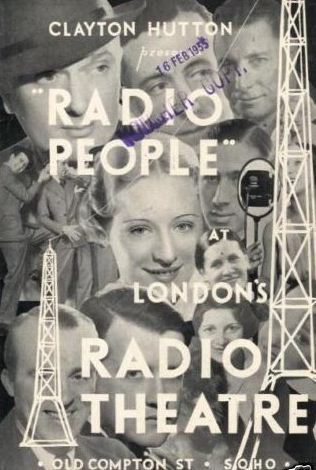
 1935
1935
[image error]
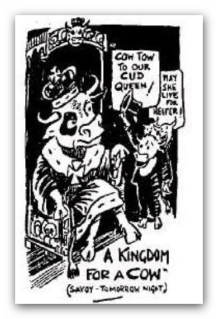
A Kingdom for a Cow (Kurt Weill) 5 July 1936, Savoy Theatre with Jacqueline Francell


1936 The Robber Symphony


[image error]The Robber Symphony (film) with Magda Sonja
[image error]11 December 1935 Samson and Delilah, Hastings Choral union, Whiterock Pavilion
December 1935
[image error]1935 Anne’s first Panto: Mother Goose Liverpool.
Hallé Messiah 17 December 1936


December 1936

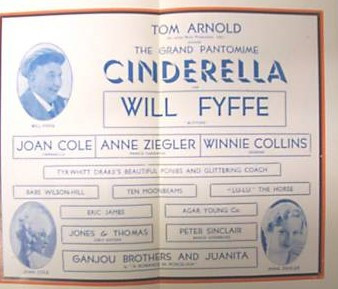
Cinderella in Edinburgh, December 1936 with Will Fyffe.
11 February 1937

[image error]Hiawatha, June 1937
[image error]Hiawatha, June 1937
[image error]Hiawatha, June 1937
February 1938


[image error]Saturday Night Revue film “I love the moon”.
Royal Opera House, Covent Garden 1938


November 9 1938


December 17 1938
[image error]6 January 1939 concert, WB, Flotsam and Jetsam, Chesterfield
[image error]Concert Chesterfield 6 January 1939
March 19, 2019
DIARIES continued – SEPTEMBER 1963.
3 September – Meet Gill Viljoen in town and we go skating. The British champion skater, Daphne Walker is there with two little girls.
[image error]Daphne Walker (1946)
We lunch at the SABC with Doreen Taylor. I talk to Arthur (tuba player) and see Edgar Cree, Gerrit Bonn and Thea Mullins’ sister, Wendy (Kim Shippey’s secretary). I go to singing and Webster gives me tea and tells me Anne is feeling a bit miserable and has probably caught a chill. She remarks on my hair style and even he says it looks beautiful. They say the lipstick they gave me looks lovely. Sing Father of Heav’n and do it well. Anne is impressed with my skates! I meet Doreen Craig after her trip to Europe.
6
September –
Go into studio. Anne comes in looking too beautiful for words. She
tells me about her arthritis which keeps her in constant agony. We
decide that everyone has something to worry them.
10 September – Ear tests with Edith Sanders. I learn that Guy McG is the examiner for my Associate diploma. I go to the studio and Anne answers the door as Webster is on the phone with Mum. He comes into the kitchen and gives me a message. When Heather leaves Anne asks me if I should like to help at the theatrical garden party on 5 October with Ruth. They are on the committee – should be fun. Anne says I look more beautiful every week. They emote about all the music history I have to learn for diploma exam.
12 September – Go into studio and work very hard as diploma is looming. Anne arrives looking too lovely for words in a pretty summer dress. We run down The King and I together and she says I’m the only person to whom she can say it because S. Africans would say she was acting big! Linda Walters arrives and I go out and meet Webster on the ground floor. He is very sweet to me. Ah, what a life this is!
13
September –
Go into studio. Desmond Wright calls. Lucille and Anne arrive and
Webster gives me some tea and complains about the heat. I say if I
don’t pass, he knows what I’ll do, and he says if I do, he’ll take
the keys away! I do vast amount of scales and Anne tells met to open
my mouth wider, and he says, “And a very pretty mouth it is too!”
I phone Ruth at night and we decide to go to the theatrical garden party. There is a disgusting article by Jon Sylvester in the Star about Webster. I phone the Star and complain for I feel really bitter about it!
[image error]
The Star 13 September 1963. Jon Sylvester – radio critic
14
September –
We go to see The
Blue Lamp
with a lovely Jack Warner of 15 years ago – very similar to studio
picture.
16 September – Ruth finishes preliminary exams. I do ear tests with Edith then go up to the studio. Webster is still in one piece after the horrible slating by Jon Silvester in the paper. They tell me all about Mabel Fenney marrying again, Anne’s anaemia, and how well Lucille sang in her exam. He makes tea for us and we make arrangements about lessons next week. We go to the Victoria hotel and dine with Uncle John and Aunt Nellie McKee up from Cape Town. I drink wine!
18
September –
Go to studio. Webster phones in the afternoon, calling me Jeannie,
and asks me to accompany Selwyn and Dennis at an audition in Ansteys
building at the home of Gwen Clark on Saturday. I agree, naturally
enough. He tells me about Elijah
which he is
singing in Pietermaritzburg. I wish him luck and tell him I know
he’ll sing beautifully! He says, “Bless you, dear,” when we say
goodbye.
[image error]
[image error]
19
September –
Go to studio and have dozens of phone calls including one from Brian
Morris. Linda arrives before Anne and then when she comes, I have to
show her the broken window of which she knows nothing. She says she
hopes I don’t mind playing for Dennis and Selwyn on Saturday. Anne
will probably be early in tomorrow after visit to the doctor.
20
September –
Work in studio. When Anne arrives, she tells me she hasn’t got
anaemia but still feels horrid. We have tea and she tells me that
Webster refused to phone her from Michaelhouse to tell her how he is
or to enquire about the blood test she had. She is very hurt. We do
scales for the entire lesson. She gives me a lecture on my
inferiority complex. I phone Dennis’s mother to arrange to meet them
tomorrow. I wash the dishes before I leave. Lucille is doing The
Merry Widow
in Afrikaans in Kempton Park.
21
September –
Accompany Dennis and Selwyn at Gwen Clark’s penthouse in Ansteys.
Taubie Kushlik and Ockert Botha are there. The boys sing well. We
have a lovely tea after the audition (for Amahl
and the Night Visitors)
is over. I go up to the studio afterwards and Anne is still there.
She makes us coffee and tells me she loathes Gwen Clark and all the
pseudo-theatrical types in Johannesburg. She says, “You must think
I’m a bitch!” but I agree with her. She says that when they first
arrived all the society types were inviting them to the races and
other events and were not impressed that they were not rolling in
money and had to work for a living. I stay in the studio until
2.00pm. Lucille’s father arrives to talk to Anne about Lucille.
22
September –
Phone Ruth who tells me about her exams and how Anne raved about me
yesterday during her lesson.
23
September –
Ear tests. Edith plays me her pieces and I sing mine to her. Go to
the studio and Anne is on the phone talking to Lucille’s father. She
tells me she’s sick to death of him. She asks me to make tea and
tells me about a visit to the Capri where she had the ghastly
experience of seeing Dickie Loader and the Blue Jeans. She says
Webster did phone when he arrived at Michaelhouse after all. Webster
phones the studio to say he’s home again. I wash the dishes.
24
September –
Webster answers door and calls me, “Darling!” He says the trip
was fun but tiring when I ask how he is keeping. Heather sings a
ghastly wrong note and he says, “See what I mean!” We grimace at
each other for ages – lovely! Anne tells me that Lucille just
passed her exam. The examiner was not at all impressed with her
voice.
27
September –
Anne comes and we do the French song and when Webster arrives, he
puts everything on tape. He says I shouldn’t take any pills – just
a glass of water! Linda W arrives and tells me she thinks I sing most
beautifully. Webster jokes with me and then says, “Darling, I wish
you all the best of luck.” Ruth phones when I get home and I say
I’ll see her at the garden party.
28
September –
I meet Anne at Edinburgh Court. She has a soothing effect on me. I
sing well for Guy McG and he drools over her. Questions are all fine,
as is the sight- singing. He seems pleased. Anne and I go to Macy’s
where she buys a carpet sweeper and she says she was delighted with
my singing and thinks I should do very well. She says I am turning
out to be another Mabel Fenney! She runs me back to the studio in her
blue Anglia and is a regular love.
Webster
comes and says he hears I sang fabulously and do I want to pay his
1/- bet right now!
29 September – Go to Mrs Sullivan. Margaret arrives in a state after her exam. Mrs S tells me that Webster embarrasses her when he makes her conduct the proceedings for their nursery school record. He told her that they are very proud of me. All the orphans at Nazareth House were allowed to stay up to listen to his programme last week and were very impressed. Listen to Webster’s Great Voices and he plays his Sound an Alarm which is marvellous!
[image error]Nursery School sing-along.
[image error]
29 September – Go to studio to get the sheet music for Rendezvous. Webster answers – still with bad leg. Gertie is there with Anne and they all congratulate me on Grade VII piano exam 85%. Tell them about the record and then depart. I feel sad about Webster in many ways.
[image error]
30 September – Go to see Kimberley Jim. Despite Jim Reeves being the star of the film it is very poor indeed. Webster has only a tiny part as the innkeeper but plays it well, complete with monocle.
[image error]Kimberley Jim with Jim Reeves, Clive Parnell, Arthur Swemmer , Webster and others.
O
Advertisements
March 13, 2019
WEBSTER BOOTH IN ORATORIO
Webster Booth and oratorio
Although Webster Booth is remembered today as a romantic duettist in partnership with his third wife, Anne Ziegler, he told me that oratorio had given him the greatest satisfaction in his singing career. He was certainly a renowned oratorio singer in his day but this has been forgotten by most people who know more about him singing We’ll Gather Lilacs than tenor solos in various oratorios.
Two of my most cherished possessions are Webster’s Messiah and Elijah scores. The Messiah score had belonged to his father, Edwin Booth, whose name is written in the score, followed by Webster’s own name.
[image error]Webster’s Messiah score
[image error]
Elijah cover
In the two front pages, he listed some of his Messiah dates from 1928 when he sang at the Birmingham Town Hall on 3 November 1928 with the Choral and Orchestral Union, to performances of various oratorios in Port Elizabeth, Eastern Cape, South Africa with Robert Selley at the Oratorio Festivals there in 1961. The list includes a performance at the Royal Lodge Chapel on 15 February 1948 with Anne Ziegler in the presence of King George VI, Queen Elizabeth and Princess Margaret, performances with the Huddersfield Choral Society, the Royal Choral Society and the Hallé Concert Society. Several Good Friday Messiahs at the Albert Hall are listed, where the entire work is performed without any cuts.
[image error]His first Good Friday Messiah was on the 10 April 1936 when he was 34 years of age. The Royal Choral Society concerts were usually with his champion, Malcolm Sargent as conductor, but he also sang with Sir Thomas Beecham at the Queens Hall on 17 December 1938.
[image error]21 December 1938 Messiah
He sang in many performances of Elijah, The Creation, Joshua, Judas Maccabeus, The Creation and Elgar’s Dream of Gerontius. It was after an afternoon performance of this last work at the Queen’s Hall on 10 May 1941 that this beautiful hall, Webster’s favourite concert hall, was destroyed by an incendiary bomb that night. Webster preferred Handel to Bach, but I see that he did sing in a performance of the latter’s Christmas Oratorio in South Africa in 1960.
[image error]December 1938 Messiah
Another Good Friday Messiah in April 1943
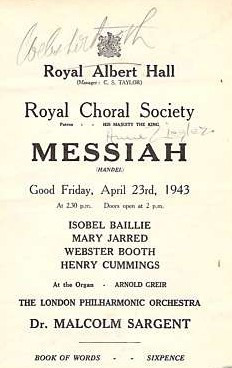
I think it is sad that he did not make a recording of the Dream of Gerontius as he was renowned for his performance in this work. Neither did he take part in complete recordings of Messiah or Elijah. When I was studying with him and Anne Ziegler I learnt the part of the Angel in The Dream of Gerontius and he sang the tenor part with me – how I wish I had a recording of it now! He sang in the first performance in South Africa of the work with the young Keith Jewell, Cape Town’s city organist (then aged 27) in 1957, the year after the Booths arrived in South Africa.
People in South Africa were inclined to think that the Booths had been out of favour in the UK and that was the reason why they moved to South Africa in 1956. This was far from the case. Admittedly their recording contract with HMV had been cancelled in 1951 and I have never been able to work out why the contract was cancelled as they were both in excellent voice at the time. But they had plenty of theatre, television, radio and concert engagements in the 1950s. Webster sang his last Messiahs with the Huddersfield Choral Society in December 1955 and January 1956. They moved to South Africa because of increasing problems with the Inland Revenue rather than because they were not as popular as before.
Anne Ziegler sang in exactly one first class performance of Messiah in Blackpool in January of 1944. Doctor Malcolm Sargent (as he was at that time) conducted the performance with the Huddersfield Choral Society.
[image error]1944 Blackpool Messiah
As a thirteen-year-old girl, I heard Webster and Anne sing in a performance of Messiah at St James’ Presbyterian Church which was then situated in Mars Street Malvern. The advertisement below (from 1956) shows the same soloists and choir at St George’s Presbyterian Church (the main Presbyterian Church in Johannesburg) which appeared a year later at St James. [image error]Even at that young age, I was aware that it must have been a come-down for Webster to be singing this work in a suburban church in South Africa after he had been singing at the Albert Hall not very long before. While Anne sang in the performance at St James under the musical director of the main Presbyterian Church in Johannesburg, Drummond Bell, she was not asked to sing in more important oratorio performances, such as the one at the Johannesburg City Hall a month later, or with Robert Selley at the Port Elizabeth Oratorio Festival.
In 1957 the first South African performance of The Dream of Gerontius (Elgar) was presented at the City Hall in Cape Town with Webster in the main role, conducted by Keith Jewell (aged 27).
[image error]
The Dream of Gerontius was also presented in Port Elizabeth at the Oratorio Festival conducted by Robert Selley, where Webster was a soloist from 1957 to 1962.
[image error]
27 November 1961 – SABC bulletin.
In 1963 Webster was invited to sing in a performance of Elijah with the combined choirs of Michaelhouse and St Anne’s in Natal, conducted by the young Barry Smith who was musical director at Michaelhouse at the time.
[image error] [image error]
The following year he sang in a performance of Creation with the same singers. This time Ronald Charles was the musical director at Michaelhouse.
[image error]
By that time Webster was 64 years of age. When he moved to Knysna he presented excerpts of various oratorios with the Knysna Choral Society and (in his late sixties) sang several bass solos in Elijah in 1968, something he had always wanted to do as he had a very wide range and a resonant lower register.
Webster’s oratorio recordings include the arias from Handel’s Messiah, Judas Maccabeus, Samson, and Acis and Galatea, Mendelssohn’s Elijah and St Paul, and Haydn’s Creation.
Jean Collen
12 July 2017.
Revised and enlarged on 13 March 2019.
Advertisements
March 3, 2019
EXTRACTS FROM MY TEENAGE DIARIES (1960 – AUGUST 1963)
[image error]https://www.lulu.com/duettists
I have published each month of these diaries individually on this website but now I have published the entire book as a pdf file, dating from 1960 until my twentieth birthday on 31 August 1963. The book is substantially illustrated and contains tales of the period, the many musical, broadcasting and theatrical personalities frequenting Johannesburg at that time.
It also tells of my own very innocent life in those days. As I was going through the diaries I wondered what had happened to so many people I knew in those days. Sadly, many of them are dead now, and others have probably left South Africa. I would be delighted to hear from some of my lost friends from those far-off days. Many people are still fresh in my mind, while others, like Elsa and Pam, I do not remember at all.
I am not sure whether this book will be of any interest to anyone at all, but it is now available in my Book Store on Lulu, along with a number of other books – some paperback, others epub and pdf, all reasonably priced. Have a look.
Jean Collen
March 2019.
Advertisements