Heather King's Blog, page 31
September 25, 2022
EVERYTHING PROFOUND MOVES FORWARD IN DISGUISE: PART I
Earlier this year, I wrote two long essays about moving from LA to Tucson.
The second, “Rêve,” will appear in the next (September, Fall) issue of Dappled Things: The Quarterly of Art, Ideas, and Faith.
The first, “Everything Profound Moves Forward in Disguise,” I’ll post here in three parts (cause the thing is almost 8000 words).
Have fun!
“Sunil thought that he, too, had a life. A bad life, certainly—the kind that could be ended as Kalu’s had been and then forgotten, because it made no difference to the people who lived in the overcity. But something he’d come to realize on the roof, leaning out, thinking about what would happen if he leaned too far, was that a boy’s life could still matter to himself.”
–Katherine Boo, Behind the Beautiful Forevers: Life, Death, and Hope in a Mumbai Undercity
Travel for some people is a leisurely, relaxing affair, marked by enjoyable hours of research, calmly-formulated plans, and a sense of pleasant expectation centered around fine meals, comfortable hotels, and a gentle dip into local culture.
Travel for me is a form of extreme sport, marked by arcane, self-imposed rituals, disciplines, and rules that can transform a simple day trip into a modern-day Pilgrim’s Progress.
It’s not that I ever much go anywhere exotic: a trip from LA up the coast to Santa Barbara, a weekend in Joshua Tree. I did make a solitary 10-day pilgrimage to Rome several years ago and, more recently, spent a summer week in Oxford, UK.
But I’ll focus here on road trips—which start with the rule against wasted food. Thus, a week before travel begins, my eating becomes confined to leftovers. It’s nothing for me to subsist during this time for three straight days on quinoa and stewed rhubarb, or roasted beet salad and month-old lebne.
Coupled with the fact that I’m a truly terrible packer, this phenomenon alone imbues the simplest trip with a sense of high “adventure.”
Here I must venture briefly into the nervous system of an alcoholic/addict.
A recovering junkie I know once managed to put together a few days’ clean time, but then needed oral surgery and was prescribed codeine. He read the dosage. He thought, If I take two of these every four hours, I’m gonna cop a habit. That was the last thing he wanted! So he took all the pills at once.
A normal person, hearing the story, might scratch his head: I, sober 34 years, roared with laughter. Clean and sober or not, the addict mind, when confronted with certain courses of action, will simply jump the tracks.
This isn’t because addicts are lazy, or stupid, or indifferent, or incapable of planning.
Rather, when your life revolves around where to find the next drink, or drug, or sex “hit,” to be without mind-altering substances is to risk annihilation. This fear of “running out” generates an intense, almost frantic discomfort with such notions as waiting, doing one thing at a time or, say, reading instructions. You buy a Water-Pik: why read the manual? The dial goes from 1 to 10, clearly you tear away the packaging, plug that sucker in, and crank to 10. Grrrrrr, sand-blast off that plaque!
Similarly, why space the pills out when you can take them in one fell swoop and be done with it? Why pack your travel food in advance, knowing you’ll just obsess during the intervening hours that you’ve forgotten something? I like to wait till the night before, by which time my mingled enthusiasm and fear have reached such a fever pitch that reason simply flees.
For my most recent trip for example, a week-long foray to Arizona, I threw together brown sugar, raisins, cocoa, seaweed, almond butter, a handful of dried figs that had hardened to granite, two cylinders of rice cakes, a stick of butter, and some yogurt.
I packed a ton of food, in short, but nothing that added up to an actual meal. This makes for an interesting travel diet, as a corollary edict while “on vacation” is to avoid like the plague any form of grocery shopping. Having to suss out, drive to, and descend into the existential abyss of a Sprouts or Trader Joe’s breaks the very seize-control spell that the rule against wasted food is meant to create. Grocery shopping while “away” is a capitulation, a failure. It means I didn’t plan well.
Also—I don’t want to say I’m cheap, which is not strictly true. I do, however, have an almost pathological aversion to the squandering of food, time, or money. Granted, this can be taken too far—but what about those children starving in India, or Africa, or down the street?
Having been raised in a blue-collar family of eight kids where we snatched up every stray scrap of food (and attention, and love) like feral dogs, I come by these ideas honestly. Between generational psycho-spiritual wounds inflicted in utero and the unmet need for touch in infancy, I learned how to self-soothe early. Straight A’s, gold stars, candy, laughs at my jokes—the phenomenon of the endorphin “hit” grooved itself from childhood into my nervous system.
So did the love of solitude, quiet, trees, flowers, birds, books—antidotes for the world that has always seemed a little too much, too fast, too loud.
What remains, in my case, is a borderline manically-energized, perpetually tension-filled psyche that careens between fear—that there won’t be enough; that waste of any kind is an egregious, boorish offense against the common good—and the profound, near abject gratitude that there is ever any food, money, or love, at all.
Or as the Italian novelist and poet Cesare Pavese observed: “Religion is the belief that everything that happens to us is extraordinarily important.”
***
I’m anxious about everything—getting a haircut, filling the car with gas, anything that involves people. And though I’ve driven all over creation, somehow each time I prepare for a long drive feels like the first time—will I make it?
I wonder sometimes if life is like this for everyone: the smallest move so often the psychic equivalent of climbing Everest without oxygen.
The packing of road trip toiletries, clothes and books is thus additionally fraught with Holy Grail significance, the upshot being that the night before taking off I often barely sleep.
The next morning I suck down two cups of extra-strength coffee, pray, shower, start hauling the stuff down from my second floor apartment, and load the car. I bring two travel mugs—one of hot tea, “for the drive”; and one of iced or hot coffee, depending on the time of year, for my 3 p.m. caffeine hit.
Sunglasses jammed on, phone plugged in, hasty Sign of the Cross made while fingering the cluster of holy medallions dangling from the rear view mirror, and I’m off.
Inevitably I plan to listen to music en route—Bach toccatas, Townes, Ben Webster—and inevitably I find, for the first few hours at least, that I prefer silence. I’ll generally start by praying a Rosary which, what with distractions, traffic, meandering thoughts, mulled-over resentments, snack breaks, and checking my phone, can take the better part of two hours.
For the second of those hours I will have had to pee really bad. When and where to stop is always a quandary, as I insist upon waiting as long as I possibly can. I myself never know till the last moment at which exit my car, as if of its own accord, will veer off.
At the “travel station,” I first fill the tank. Then I make a beeline inside, scoping out locals and employees on my way to the restroom for bad bleach jobs, botched tattoos, and/or facial scars. Look at this poor, brave soul, I’ll think of the cashier; makes minimum wage and still has it in her (or him) be gracious and kind! (or not). Harking back to my own long years of waitressing (the bulk of which occurred forty years ago), I’ll codependently try to overbond—“Thank you so much! Really appreciate it!”—this, for ringing up a Diet Coke or printing a receipt.
Then, marveling at my compassion for “the common man,” I’ll head back to my verde oliva Fiat 500, settle into the driver’s seat, and sail off free as a bird to a writer’s residency in Wyoming; monastery in Cottonwood, Idaho; or in this case, what promises to be a charming Airbnb in the historic Tucson, Arizona, neighborhood of Armory Park.
I’m not a bad driver, I don’t think. If anything, I suffer from an abundance of caution: moving to the right ten miles before the exit; using the directional to change lanes even on a desolate desert stretch with no other vehicle in sight.
Inwardly, though, I’m like a horse pawing the ground at the starting gate. Nearing my destination, I check the map 20 or 30 times, kick the passenger side gear into a rough heap, and pray the Airbnb isn’t a total dump.
Until I’m completely unpacked and settled, I’m still (in my mind) “on the road.” So the second I wheel in, I throw open the trunk as if the car’s about to explode, grab all I can, and haul in my loot—staggering, dropping, dripping, spewing, spraying, banging shins, and cursing.
At the same time, I’m checking out the place and—whoa, this time I can hardly believe my good fortune! A ‘20s adobe bungalow with Madonna-blue trim! A front stoop with a pale yellow vintage metal glider! Hardwood floors, a kitchen nook with a built-in table, old-school jalousie blinds.In record time I unpack, arrange, scope the place out (medicine cabinet—oh cool, Dr. Bronner’s soap!), fridge—(yesss, half a pound of Peet’s!), plug in my laptop, and test the wifi, which works perfectly.
Sigh—of mingled gratitude and disbelief. How did it even happen that I woke up in my own bed and tonight will sleep in this other bed, with sheets in a gray-and-white feather pattern and pink rickrack?
Then I make myself a cup of coffee, gaze out the window, and consider the lay of the land.
This consists chiefly of drinking in deep draughts of the surrounding trees, flowers, birds, sky, people, street, and smells. For my “job” while traveling is basically to praise, to thank. To receive a little of the body and blood of a place, and to leave behind a little of my own. To that end, I care zero for night life, tourist attractions, or even for the most part food.
My main goals when traveling are to locate a church for Mass, a 12-step meeting, and a place to take long, meandering walks. Riverbanks are ideal (Sioux Falls, San Antonio, Yuma). Good-sized cities will almost always yield up a shaded courtyard, plaza, fountain, community garden, public garden, or greenway.
But even in middle-of-nowhere towns, I’ve found, if you just set out from your mom-and-pop hotel and start walking, you will very often find a trail, or a set of railroad tracks with a path alongside, or a street that peters out to a welcoming expanse of prairie or desert.
I’ve done just that in countless places: Independence, California; Holbrook, Arizona; Winnemucca, Nevada; Nipton, California; Ozona, Texas; Watsonville, Pennsylvania; Kearney, Nebraska…
***
I like being among people without much having to interact with them. This is partly because I’m an introvert, and partly because, as the naturalist and novelist Edward Hoagland has observed: “To be human is to care for things that don’t care for us.” All my life I’ve seemed to love people more than they love me: bar pickups, family members, neighbors. Not, when push comes to shove, that I actually want to meet or converse with most of them!
This is one reason I love Mass. Back in LA, the churches have been closed for months due to COVID, and we parishioners have been reduced to the pathetically poor substitute of livestream services. Tucson churches are open, however, and St. Augustine’s Cathedral, a mere half-hour walk from my Airbnb I learn that first afternoon, has a noon Mass.
The next late morning set off on foot, practically salivating at the prospect of a real sanctuary, a live tabernacle, the smell of wax, the bloody statues, the hush, the gloom.
Mid-October, it’s still in the 90s: the heat has the effect of a sleeping pill. A guy in a stained sombrero snails along the opposite sidewalk. A teenager slo-mo zigzags across the street on her bike. The yards are overhung with old-growth mesquite and cowboy-and-Indians cacti.
I go the long way, through Barrio Viejo, which apparently till a few years ago was a derelict rathole. Then Diane Keaton bought a renovated adobe for 1.5 million and all hell broke loose. Happily, the ‘hood hasn’t been totally wrecked yet and still features lots of charming old hovels with caved-in rooves and termite-gnawed doorframes.
Other touches of local color include El Tiradito, a much-touted, somewhat shabby, local shrine where people light candles to Our Lady of Guadalupe; and a shaded pocket park, entirely deserted, that I make a mental note to re-visit later.
In LA, someone is always breathing down your neck, jostling to pass, or allowing their dog to crowd you off the sidewalk: “Bentley, down! She doesn’t want to be touched!” The slower, dreamier Tucson vibe is balm.
St. Augustine’s is up near downtown, on Stone Avenue. It’s brown and tall with a cross on top and a giant parking lot to the left. Two pudgy guys and a girl are yukking it up on the front steps.
“Are you Catholic?” I accost them. “I think there’s a noon Mass!”
“No, we’re on a scavenger hunt,” one of them smiles. Nice kids.
I tend to proceed on the assumption that other people are interested in the same things I am, which is in fact almost never true. As St. Thérese of Lisieux observed: “If we are able to bear patiently the trial of being displeasing to ourselves, we will be for Jesus a pleasant place of shelter.”
Thérese was a bourgeois French girl who entered an obscure Carmelite convent at the age of 15, developed a form of spirituality now known as “The Little Way,” contracted TB, and died in agony at the age of 24 clutching a crucifix and crying “I love Him!”
I once wrote a book about “walking” with Thérese for a year—a year (and far from the only one in my tormented life, believe me) during which I myself was in emotional and spiritual agony.
This is the first I’ve been inside a church for months, and I wander around drinking everything in: the tiered banks of burning candles, the stained glass, the high ceilings: home. A priest, hearing confessions in the back, is seated across from a blond with false eyelashes and a rather thrilling décolletage. Ah, Mother church! Then I find a spot mid-sanctuary, genuflect, and sink gratefully into the pew.
A guy in a wool watch cap—head in hands, grimy red pack parked in the aisle—is kneeling opposite. His watch beeps: okay. A minute later it beeps again: okay. When it beeps a third time I peer over, see he’s perhaps mentally ill, and realize the alarm is set to go off every sixty seconds.
Which is annoying—but am I, with my own arcane rituals, much different? Aging body aching, head in hands, I’m kneeling, too.
I always get a kick out of the anti-Church brigade that scoffs, “God isn’t just in a little box; God isn’t just an hour in church,” as if anyone who comes to church thinks that. I, for one, come to beg for help, to plead for mercy, to receive the sustenance I need in order to function in the world for the other twenty-three hours.
I, the beeping-watch guy, and the thirty or so other people scattered around the sanctuary, have all been drawn, in the middle of the day, to this temple “not built by human hands”: unseen by the world, and if seen, marginalized, spat upon, sneered at. I’ve come as a member of the crowd to whom Christ preached the Sermon on the Mount: thirsting for meaning, starved for righteousness, poor in spirit.
The outsider sees molesters in bathrobes waving their hands, intoning incoherent prayers; people bowing, standing, kneeling like lemmings.
Losers, misfits, shuffling down the center aisle, mouths open, hands out for a wafer of bread.
For me?
That’s the part that always catches in my throat.
For me.
In the preface to her novel, Wise Blood, Flannery O’Connor observed:
“It is a comic novel about a Christian malgré lui, and as such, very serious, for all comic novels that are any good must be about matters of life and death. Wise Blood was written by an author congenitally innocent of theory, but one with certain preoccupations. That belief in Christ is to some a matter of life and death has been a stumbling block for readers who would prefer to think it a matter of no great consequence. For them Hazel Motes’ integrity lies in his trying with such vigor to get rid of the ragged figure who moves from tree to tree in the back of his mind. For the author, Hazel’s integrity lies in his not being able to. ”


September 23, 2022
PILGRIMAGE TO THE MUSEUM
Here’s how this week’s arts and culture column begins:
Stephen F. Auth serves as executive vice President and a chief investment officer of Federated Global Equities in Manhattan. He’s also a Catholic who, along with his wife Evelyn, has led the New York City street mission for more than fourteen years.
Most to the point here, he’s a lover of art, intimately familiar with the world-class, world-renowned Metropolitan Museum.
He and Evelyn had been haunting the Met galleries for years when, on a guided tour in September, 2009, the docent stopped in front of a small Rembrandt painting called “The Toilet of Bathsheba.”
The docent accurately contextualizes the painting in terms of art history and the trajectory of Rembrandt’s work. She points out the shadowy figure of David in the upper left corner. She reports that Bathsheba is one of the very few nudes painted by Rembrandt in the heavily Protestant Dutch Republic of the 1600s.
Auth notes: “Everything she says is delivered cleanly and precisely. It’s all entirely accurate. Objective. Neutral. Almost scientific. That fits well with my own prejudices. My classical training at one of the country’s great universities has left me instinctively of the mind that art can and should be studied in an almost scientific context.”
“Still, as the docent whisks the group forward to Rembrandt nearby self portraits, I find myself lagging behind, reflecting. “Beneath the rich surface of this canvas, something is stirring. Something dark.”
READ THE WHOLE PIECE HERE.
September 19, 2022
FAMISHED
I just terminated my contract and got the rights back to FAMISHED: a memoir of my NH childhood, growing up in the 60s, alcoholism, law school, ditching the law for writing, conversion to Catholicism, 30 years in LA…all centered around food–with recipes!
In one of my more severe colloborating with-/trusting-others debacles (there have been many), the book (which I GAVE to the people with no advance, our supposed collective hope being to earn money on royalties) was previously published and then, for reasons that will forever remain obscure, basically during the course of four years, not available for sale. No need to belabor the point, other than to say live and learn.
Still, untold hours of writing, editing, revising, correcting galleys, “marketing,” etc. later, I dithered over what to do with the re-acquired manuscript. Should I just lay it to rest and forget about it? Should I pay a book designer a few thousand dollars to design anew, then self-publish? Considering what had gone on before, and the attendant psychic fallout (because in retrospect the whole experience was kind of ghastly), that seemed a little extreme even for my you-need-to-bleed-for-your-work ethos.
Yesterday morning in prayer, it came to me: why not just put the whole damn thing on my website and if people can handle a non-kindle, free-flowing format, they can read it for free?
So that’s what I’ve done. Here’s the PAGE.
As I say at the very end, SHOULD YOU FEEL MOVED TO THROW A FEW BUCKS MY WAY FOR THIS AND THE MYRIAD OTHER OFFERINGS FOUND ON THIS SUPER-SPECIAL WEBSITE, I WOULDN’T FIND IT AMISS. THERE ARE VENMO AND PAYPAL BUTTONS ON THE SIDEBAR TO THE RIGHT. EITHER WAY–THANK YOU!!!
AND TO THOSE OF YOU WHO ALREADY CONTRIBUTE, SEVERAL REGULARLY, EXTRA THANK YOU.
My next freewill offering is going to be a nearly 8000-word essay I wrote about moving from LA to Tucson which after I finished I realized was too long (and too “Catholic”) to be published basically anywhere.
So again (after a truly inordinate amount of time spent working on it over the course of the last several months), I thought Well put it on your website which you spend 300 bucks a month to maintain.
This all might sound like “underearning,” as they say in money-recovery circles. But the reason I can afford to write what I like, give it away if I feel like it, travel where I like, do with days what I like, is because trust me I am way on the ball. Because I work hard to earn a humane living writing, speaking, etc other ways.
I am clear about my money, I’m a good steward of my money, I can give away some of my money, I know exactly how much I earn, how much I spend and on what, how much I have set aside for this, that and the other.
Also I have lived below my means my whole adult sober life.
Most to the point, since quitting my job as a lawyer to write, I have taken to heart Christ’s “Store up your treasure in heaven, where moths cannot devour and rust cannot corrode. For where your heart is, there will your treasure also be.”
It feels good to be able to offer something, to give something. it feels better than anything in fact. So take and eat.
September 17, 2022
I WILL NOT LET THEE GO
This week I decided to take a little two-day road trip to a town a couple of hours south of Tucson–Bisbee, it’s called.
Billed as arty, funky, and creative, it’s an old mining town basically built into a mountain and is connected by endless flights of steep, cardio-enhancing concrete steps.
It’s also seen, or is looking forward to, better days. Like all towns supported by the tourist industry, the locals who own and work in the shops both depend upon and seem to resent visitors. A haze of pot smoke hangs over the place, bikers roar by blaring Fleetwood Mac, gaunt guys with long white beards wander about, and I walked by a group of perhaps meth-heads hanging on the sidewalk who seriously looked out of Mad Max.
Nothing especially wrong or surprising about any of that except that the last couple of days I’ve been thinking I would not feel the need to return.
It’s also very beautiful, as was the drive here–cooler in temperature than Tucson, and with a corresponding plethora of annuals: morning glories, cosmos, something that looks like goldenrod.
The back porch of the place I’ve been staying, “Bliss Bungalow” (not a misnomer), looks out over a stone wall and a kind of mini-meadow alive with butterflies, cicadas maybe and tons of wildflowers and birds.
Since turning 70, I basically think about death ALL THE TIME. Not in a morbid way but in the sense that my death is always before me. People don’t tell you this about getting older, but I have to believe the psycho-spiritual shroud that envelops the ELDERLY is a universal phenomenon.
One of the forms it’s taking for me is that part of me just wants to sit around pulsing with the weirdness of, and gratitude for, existence. Another part is screaming, Don’t just sit there. Time’s a-wasting! DO something. Give ALL of yourself! Make use of every second!
This is the Cross, or part of it, this unresolvable tension.
To that end, since returning from Ireland I have woken at 3 a.m. every morning. I attributted the first couple of weeks to jet lag but now I sincerely think the good Lord is waking me so He and I can have more time togther. So I can pray more.
In prayer, I realize I don’t have to do anything special that I’m not doing already. Every day it seems someone calls who has a problem or situation or crisis. Every day someone emails to ask if I have any advice for an aspiring writer, or to comment on a piece I wrote, or to ask me to do something or other.
Every day practically I jot an idea or reflection down in one of my zillions of notebooks or pads of Post-Its, and many days I actually write a little something on it.
I’m right up the hill here from St. Patrick’s Church, a huge edifice, currently undergoing renovations of some kind, that dominates the landscape. It’s open all day and, as is largely true these days of Catholic churches everywhere, the times I’ve walked by hardly anybody’s in it.
Yesterday I attended 7:30 Mass there, which was held in the basement of the gift shop or maybe rectory, in a room that was a little close and hot, and that was presided over by a priest so full of spirit and joy that tears seeped out of my eyes just to hear him.
“This is the most miraculous Sacrifice! This is the celebration of God’s infinite love and care for us!” Not in a creepy, fanatic way: in a grateful, reverent way with a little life in it. I wonder if priests know how unbelievably hungry we are for a word of consolation, of corroboration that we are “in on” the world beyond this one–because this one, much as we love and are grateful for it, leaves us forever hungry, forever lonely, and forever unfulfilled.
The day before, I’d gone into the main church and just say for a while alone in the sanctuary.
I often think about how a Catholic church is one of the few public places, if not the only one, where you can sit quietly, bury your head in your hands, mouth the Rosary, kneel, sigh, be in anguish, openly weep, without being stared at, thought crazy, or judged. Everyone instinctively gets that you’re just talking to God, or praying, or suffering, or for that matter giving thanks.
Anyway, a dear friend and I had arranged a phone call this morning at 9 and my original thought, especially since I’ve been waking so early, and I haven’t been bowled over by Bisbee, was to take off at the crack of dawn, hightail it home, and be back well before noon.
But when I woke at 3 this morning, instead I thought, Do I really have to run around like a chicken with my head cut off? Sit with God, do my stretches, watch the sun come up, gently pack. Go to 7:30 Mass again. Take a little walk afterward and say to Bisbee, “I will not let Thee go unless Thou bless me” (See teh story of Jacob wrestling with the angel, Genesis 32: 22-31).
Because even if I can’t “feel” it, my time here has borne fruit. I’d heard a lot about the town, I came out of love, I noticed, walked the hills, am leaving the bungalow in tip-tip shape out of love. So I don’t need to rush off; I don’t need to cut my visit short. I’ll come back from Mass and a stroll, have a little breakfast and a cup of tea, and settle in for a chat with my friend overlooking the wildflowers and the stone wall.
The 11th Step in 12-Step spirituality says, “Sought through prayer and meditation to improve our conscious contact with God, praying only for knowledge of His will for us and the power to carry that out.”
God’s will, I sense, is to do what’s in front of me. Quit thinking I need to embark on some giant project. Pay attention to the people I love and who, miracle of miracles, love me.
You know what? Bisbee is a great town. If you have a chance, you should visit yourself.
September 16, 2022
DEATHSONG: MEDIEVAL CHANT WITH DR. ELAINE STRATTON HILD
Here’s how this week’s arts and culture column begins:
When Dr. Elaine Stratton Hild was only 18 years old and a music conservatory student, she was volunteering at a local hospital, playing the viola. One day she was directed to the room of a particular woman who was very ill. She started playing “Amazing Grace” and in the course of the song, the woman died.
“Did I do something wrong?” she asked the hospital staff. “No,” she was told. “You didn’t do anything wrong. That woman rode your hymn right up to heaven.”
She went on to earn a Bachelor of Music in viola performance from the Cleveland Institute of Music. Then, poised for a career with orchestras and chamber music ensembles, she was diagnosed with a rare neurological condition. Continuing to play professionally would have meant possible paralysis in her left hand.
READ THE WHOLE PIECE HERE.
September 14, 2022
THE EXALTATION OF THE HOLY CROSS
This quote from G.K. Chesterton’s Orthodoxy seems especially relevant to today’s Feast:
“Even when I thought, with most other well-informed, though unscholarly, people, that Buddhism and Christianity were alike, there was one thing about them that always perplexed me; I mean the startling difference in their type of religious art. I do not mean in its technical style of representation, but in the things that it was manifestly meant to represent. No two ideals could be more opposite than a Christian saint in a Gothic cathedral and a Buddhist saint in a Chinese temple. The opposition exists at every point; but perhaps the shortest statement of it is that the Buddhist saint always has his eyes shut, while the Christian saint always has them very wide open. The Buddhist saint has a sleek and harmonious body, but his eyes are heavy and sealed with sleep. The mediaeval saint’s body is wasted to its crazy bones, but his eyes are frightfully alive. There cannot be any real community of spirit between forces that produced symbols so different as that. Granted that both images are extravagances, are perversions of the pure creed, it must be a real divergence which could produce such opposite extravagances. The Buddhist is looking with a peculiar intentness inwards. The Christian is staring with a frantic intentness outwards.”
Recently, I came across a related thought in the Viktor Frankl classic, Man’s Search for Meaning.
Some of his most interesting insights, I realized this time around, came post-incarceration. Being released from the Nazi death camps, Frankl immediately noticed, did not make for unadulterated euphoria.
“Psychologically, what was happening to the liberated prisoners could be called ‘depersonalization.’ Everything appeared unreal, unlikely, as in a dream…How often in the past years had we been delivered by dreams?…And now the dream had come true. But could we truly believe in it?”
The released prisoner ate ravenously, talked endlessly. “The pressure which had been on his mind for years was released at last. Hearing him talk, one got the impression that he had to talk, that his desire to speak was irresistible.”
Next, the desire for vengeance naturally arose. “Only slowly could be these men be guided back to the commonplace truth that no one ahs the right to do wrong, not even if wrong has been done to him.”
Expecting compassion and understanding, the newly-freed instead often found indifference. “When, on his return, a man found that in many places he was met only with a shrug of the shoulders and with hackneyed phrases, he tended to become bitter and to ask himself why he had gone through all that he had. When he heard the same phrases nearly everywhere—‘We did not know about it,’ and ‘We, too, have suffered,’ then he asked himself, have they really nothing better to say to me?”
If that wasn’t the cross, I don’t know what would be. Imagine coming out of Auschwitz and having people say, “Well boo-hoo, things were tough for us, too”.
But over time, Frankl saw that this tension between how we wish the world to be and how it actually is—and our consent to live in the tension—is essential to our humanity.
“To be sure, man’s search for meaning and values may arouse inner tension rather than inner equilibrium. However, precisely this tension is an indispensable prerequisite of mental health. There is nothing in the world, I venture to say, that would so effectively help one to survive even the worst conditions, as is the knowledge that there is a meaning in one’s life…
As for myself when I was taken to the concentration camp at Auschwitz, a manuscript of mine ready for publication was confiscated. Certainly, my deep concern to write this manuscript anew helped me to survive the rigors of the camp…
Thus it can be seen that mental health is based on a certain degree of tension, the tension between what one has already achieved and what one still ought to accomplish, or the gap between what one is and what one should become. Such tension is inherent in the human being and therefore is indispensable to mental well-being… I consider it a dangerous misconception of mental hygiene to assume that what man needs in the first place is equilibrium or, as it is called in biology, “homeostasis,” i.e. a tensionless state. What man actually needs is not a tensionless state but rather this driving and struggling for some goal worthy of him.”
Obviously, we don’t want to carry unnecessary tension. But the fact is that the more awake we are to the suffering of the world, and of our part in it, and of our desire to alleviate it, the more tension we’re going to carry.
Tension, however, is to be distinguished from the default state of constant outrage and hostility that characterizes so much of our culture. If we’re outraged, let’s embark on a project, says Frankl (and Christ). Let’s not put ourselves in a stupor of one form or another so that we get to pretend the suffering of the world is an illusion, or doesn’t matter. Alternatively, let’s not sit around in a state of high dudgeon pointing the finger at everyone else.
Let’s find a goal that’s worthy of us.
For Christ, that was to lay down his life for his friends. For Christ, that was to save the world. For Christ, that was the Crucifixion.
Crown him with many crowns. Hail, Redeemer, King Divine.
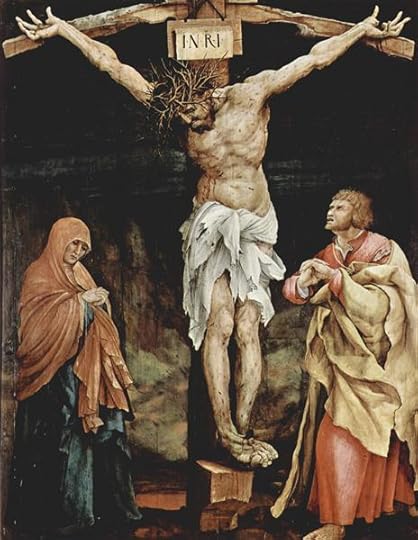 THE CRUCIFIXION
Matthias Grünewald
1523-1524
September 9, 2022
PIANIST MARIA YUDINA: HOLY FOOL
Here’s how this week’s arts and culture column begins:
Maria Yudina (1899-1970), Russian pianist, was openly Orthodox under Communism; a “holy fool” who gave her money to the poor and once responded, legend has it, to a middle-of-the-night summons by Stalin to play Mozart’s Concerto No. 23.
Born to Jewish family in the town of Nevel, in the western part of Russia, her first diary entry, at the age of seventeen reads, “Arrived in Petrograd to start living my life for ART.”
She converted to the Russian-Orthodox church in 1919 and was dismissed from the Petrograd Conservatory in 1930 for replying “Yes” when asked whether she believed in God. She wore a large cross while performing in public, a demonstration of faith that, in Communist Russia, could easily have earned her a death sentence.
READ THE WHOLE PIECE HERE.
September 5, 2022
THE SHADOW OF THE SUN
“These people received three liters of water daily, for everything: drinking, cooking, washing. And daily rations of a half kilogram of corn. Plus, once a week, a small sack of sugar and a piece of soap. The Somalis knew how to set even some of this aside, selling the corn and sugar to dealers hanging around the camp, putting away the money to buy a new camel, and running off into the desert again.
They were unable to live any other way.
Hamed is not surprised at this. ‘That is our nature,’ he says, without resignation, with a touch of pride even. Nature is something one cannot oppose, attempt to improve, or free oneself from. Nature is decreed by God, and is therefore perfect. Drought, heat waves, empty wells, and death on the road also partake of that perfection. Without them, man would be unable later to appreciate the true delight of rain, the heavenly taste of water, and the life-giving sweetness of milk. A beast would not be able to rejoice in the succulent grass, or relish the smell of a meadow, and would not know what it is to stand in a stream of cold, crystal-clear water. It would not even occur to him that this is simply to be in heaven.”
“At nightfall we spotted a simple country church [in a Camerooon village] and beside it a humble house, the rectory. We had arrived at our destination. Somewhere, in one of the rooms, an oil lamp was burning, and a small, wavering glow fell through the open door onto the porch. We entered. It was dark and quiet inside. After a moment, a tall, thin man in a light habit came out to greet us: Father Jan, from southern Poland. He had an emaciated, sweaty face with large, blazing eyes. He had malaria, was clearly running a fever, his body probably wracked by chills and cramps. Suffering, weak and listless, he spoke in a quiet voice. He wanted to play the host somehow, to offer us something, but from his embarrassed gestures and aimless putting about it was plain he didn’t have the means, and didn’t know how. An old woman arrived from the village and began to warm up some rice for us. We drank water, then a boy bought a bottle of banana beer. ‘Why do you stay here, Father?’I asked. ‘Why don’t you leave?’ He gave the impression of a man in whom some small part had already died. There was already something missing. ‘I cannot,’ he answered. ‘Someone has to guard the church.’ And he gestured with his hand toward the black shape visible through the window.
I went to lie down in the adjoining room. I couldn’t sleep. Suddenly, the words of an old altar boy’s response started to play in my head: Pater noster, qui es in caeli…Fiat voluntas tua…sed libera nos a malo…
In the morning, the boy whom I had seen the previous evening beat with a hammer on a dented metal wheel rim hanging on a wire. This served as the bell. Stanislaw and Jan were celebrating morning mass in the church, a mass in which the boy and I were the sole participants.”
—Ryszard Kapuściński, The Shadow of the Sun: My African Life
September 2, 2022
IN THE FOOTSTEPS OF ST. KEVIN
I am back, severely jet-lagged and deeply grateful.
Here’s how this week’s arts and culture column begins:
Last month I spent three weeks in Ireland, dividing my time between Dublin and the Glendalough Hermitage, an hour south of the city.
Glendalough (meaning “valley of two lakes”) is an ancient monastic site and a former center of Celtic Christian spirituality. Pilgrims of various kinds, from all over the globe, descend here—especially in summer. The area is closely associated with St. Kevin, a seventh-century hermit who came to the valley seeking silence and solitude Legend holds that he slept on a little stone shelf in the cliffs, hard by what is now known as the Poulanass Waterfall.
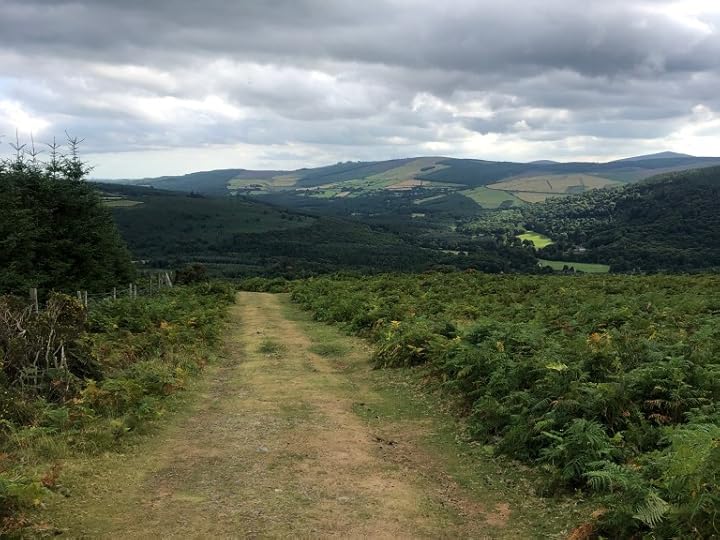
My own free-standing stone hermitage was run by the Sisters of Mercy and situated up on a hill, away from the traffic and crowds. That way when I did visit the Monastic City as it’s called, I could do so on foot, walking from town the long way around on a footpath called The Green Road that winds through forest, bracken and fern.
READ THE WHOLE PIECE HERE.
August 24, 2022
BRIGHT FIELD
My time at the Glendalough Hermitage has been rich. I’m surrounded by trees. The air is fresh and cool–balm after July in Tucson. The phenomenon at daybreak isn’t so much that the sun comes up as that the sky lightens–generally to atmospheric mist, fog, and gloom. Having grown up in New England, the whole setup feels utterly familiar and homey.
The one problem is that it’s hard to take a decent photo because the light’s always so low. One thing the West, Southern California in particular, has going for it is that the light is so gorgeously perfect that just about any image you capture looks gilded and radiant.
One day last week I tramped through a dark wood, up a very steep hill, and around a couple of bends and came out at the edge of meadows and meadows full of…could it be?…I was pretty sure…heather! I’ve never seen my namesake flower growing in the wild so this was a rare thrill.
The path continued on into an emerald green valley filled with grazing sheep. I mean the path went right through them! In fact, everywhere in Ireland, or this part of Ireland, are grazing, bleating, docile, dear sheep. They lend a whole aura of bucolic simplicity and tenderness to the place. (Though I did see a big sign the other day that said iI your dog “worries” my sheep, I think was the term, I will shoot the dog on sight. I was glad I didn’t have a dog).
Basically every one has been very nice. The Sisters of Mercy here at the Hermitage, bus drivers, store clerks. Some other locals clearly have adopted as a point of honor the overt snubbing of tourists, but such is life. As always, I find old men are THE kindest and most gallant.
Wifi and cell reception are spotty, even in the Coach House, where the wifi is supposedly centralized, but again so be it.
Yesterday I took a little field trip to Wicklow Town on the local bus link. There I visited among other things, the Wicklow Gaol
“The Gates of Hell” the interactive exhibit dubs the place, and that’s no exaggeration. The first prisoner was a 72-year-old Catholic priest, arrested for celebrating Mass, and many of the others were also there for the crime of “Pope-worship.” Other heinous trangressions included homelessness, petty thievery, and the inability to pay taxes.
The museum takes visitors through the 1798 Rebellion, through the 1820-1843 expansion of the prison, through the 1840s Famine, 1860s reform, the shipping off of convicts to Australia and “the Colonies,” eventual reform and the departure of the last prisoners in 1924.
After entering the low-ceilinged stone cells, tramping the bleak stairwells, and learning how the pre-reform prisoners were treated–branding, mutilation, flogging, solitary confinement, insane overcrowding, the (clearly sadistic) “traveling hangman”–you begin to wonder why the British during those times aren’t classed with the Germans during the Nazi regime.
When I got to the torture chambers, I had to bolt. So much suffering, so much evil. I just couldn’t take it.
Afterwards, though, sitting by the Leitrim River with a coffee and watching the seagulls, I thought of Mary at the foot of the Cross. She took it. She received it all. She watched her beloved son publicly scourged, spat upon, humiliated, tortured to death. I thought, too, of the Stations of the Cross and of how the Eighth Station is “Jesus Speaks to the Women.” Right before he falls for the third time, is stripped of his garments, and is nailed to the Cross, Jesus spoke to the women.
Womanhood is very much under siege these days, and in ways that are far more oppressive, darker, and chaotic than any ever imposed by the mere “patriarchy.” Woman…womb. And everything in us, on everly level, is ordered to this stupendous, glorious capacity to bring new life into the world. Part of our cross, our crown, our essence, it seems, is this very call to bear witness. To look reality in the eye. To absorb, receive, the darkness of what men will do to not just to women, but to each other.
I need to ponder this more.
Meanwhile I woke at 3:48 am this morning. After a couple of hours I could begin to make out the trees.
R.S. Thomas (1913-2000) was Welsh, not Irish. But I came across this poem in a book here and it summed up not just thist trip, but more and more I see, my life.
BRIGHT FIELD by
R.S. THOMAS
I have seen the sun break through
to illuminate a small field
for a while, and gone my way
and forgotten it. But that was the
pearl of great price, the one field that had
treasure in it. I realise now
that I must give all that I have
to possess it. Life is not hurrying
on to a receding future, nor hankering after
an imagined past. It is the turning
aside like Moses to the miracle
of the lit bush, to a brightness
that seemed as transitory as your youth
once, but is the eternity that awaits you.