
Heather King's Blog, page 32
August 19, 2022
THAT FEEL WHEN NO GIRLFRIEND
Here’s how this week’s arts and culture piece begins:
Alex Lee Moyer’s 2020 documentary TFW No GF — shorthand for “That feel when no girlfriend” — profiles several disaffected young men desperately searching to connect on the dark corners of the internet.
Though the film has its share of crude language, and a couple of violent images, its real subject is the souls of a generation of males who have been nursed, weaned, and raised in cyberspace.
What happens to young men when there are no role models, no authority figures, and no meaningful, flesh-and-blood human contact? And when at their fingertips they have a dopamine-hit-producing alternate reality that rewards the outrageous, the violent, the unhinged?
READ THE WHOLE PIECE HERE.


August 17, 2022
MAKE CLEAR MY WAY
I’m at the Glendalough Hermitage in County Wicklow, Ireland…my own free-standing cottage with all the modcons and surrounded by towering oaks, rowans, hawthorns, birches and yews…yesterday I did a laundry and was encouraged to hang out on the line—which of course I preferred to. Heavenly. Blue sky but coolish with a fresh, moisture-laden breeze smelling of hay and gently decomposing leaves—the early autumn smell of my New Hampshire childhood…
Glendalough is an ancient monastic and pilgrimage site, the center of which is “black with people,” as my friend Benny from Dublin puts it. Tourists—like me!
I made my way down there one early evening, thinking the crowds might have gone, but no. So instead I’ve been setting out from the Hermitage, which is on the other (north) side of the main road through town (the Monastic City as it’s called is on the south side), and though there is no mention of the face in any of the Hermitage literature, brochures, instructions, info etc., nor are any of them marked or pointed to, turns out there are MASSES of nearby trails, almost entirely empty, leading off in every direction.
Some of these are part of the Wicklow Way, a path that goes all the way back to Dublin I believe; some seem to be local; and many of them, I learned from asking the few people I did come across, go on for miles and hours. It’s the best kind of walking, to my mind—basically flat, wide, well-trodden trails, softly packed with dirt and hay, surrounded by ferns, bracken, wild foxglove, impenetrable brush, moss-festooned fallen branches, and dead quiet.
Just north of the Hermitage, accessible through a lichen-encrusted wooden gate, is St. Kevin’s Church. Though unfortunately open only at the moment for Sunday Mass (Father is on retreat and as it is, there are only two priests for three parishes), the church has a really beautifully thought-out and planned Meditation Garden, with four different “parts,” and is altogether practically the best feature of my little life here. St. Kevin was a 6th-century pilgrim who lived in a cave-cell above a lake in the Monastic City and has several legends attached to him, one having to do with a blackbird that I will save as I want to write a column on the Meditation Garden.
In the pasture above the churchyard sheep bleat, and all along the border grow in profusion wild blackberries. Which just happen to be coming ripe. There’s a cemetery there, too, and it’s so nice to walk along remembering the dead and plucking berries. I hope that’s okay. I have restrained myself from nabbing any of the flowers, some wild, some cultivated, that charmingly carpet the area and that I long to gather into a bouquet for my room. But I’m surrounded by green anyway, and am grateful for it.
I immediately checked out a bunch of books from the Hermitage library and since Saturday when I arrived have been pondering such questions as What do I want to receive while here, what does God want from me, what do I want from God, where is my life going, how am I, where am I, who am I? etc—pilgrimage questions, in other words.
I would like to lie down and rest is about the best I can come up with–and that’s not a joke.
I want to be like St. Paul—I want to run the race, I want to finish the course, I want to be in training till my last breath. But does my pace make me impatient and restless with others? Well, often, yes. And maybe that is just part of the tension we hold as humans, or that I hold (along with I’m sure billions of others). I don’t really know how to do it any other way, and I’m not sure I’m meant to.
We long for purity, we humans: purity of heart, purity of motive, purity of way of life. But life, culture, our era and place inevitably make it so we can never be as pure as we’d like to. We can abhor war, and the military-industrial state, for example, but honesty compels us to admit there’s a reason we don’t live without water, sanitation, medicines and food, subject to roving terrorist gangs (or not yet, not completely in the First World).
Human nature is such that the weak are always prey for the strong—we can not like that, we can know that’s wrong, but we’re recipients of and benefit from the people who’ve noticed, lived by, and capitalized on that fact. To truly repudiate “the dirty rotten system,” as Dorothy Day called it, would mean not taking or using a single thing the system provided. It would mean either 1) living in a wilderness entirely alone, or 2) voluntarily going to the worst hellhole on earth and offering ourselves up to die or be killed there. The latter is what Christ did, the worst place on earth being metaphorically the unredeemed human heart.
But before Christ came John the Baptist, who longed for integrity and tried to achieve it the first way, by going to the wilderness: living on locusts and wild honey and dressing in animal skins. They killed him, too, but that he was Christ’s precursor, “not fit to untie his sandal,” as John himself put it, maybe means that Christ was saying you don’t have to go to the wilderness and live alone. You can achieve a certain kind of integrity that way, and it’s genuine integrity—you’re suffering and sacrificing for it. But it may not be redemptive integrity, for lack of a better phrase.
Christ says, Be part of the world; in the world but not of it. Do to the least of your brothers. Participate and contribute as you can, whether under capitalism, communism, a monarchy, or a dictatorship. Don’t aim for a kind of purity that’s impossible to achieve and that will set you apart from your brethren in the wrong way. Know the nature of the battle—which is formidable.
Because maybe the one thing harder than trying to achieve an impossible purity is holding the tension of the fact that others are always dying so we can live; that every bite of food we eat, every drop of water we use, every mile we drive, does in a sense mean that someone else get less. Maybe the one thing harder than living entirely alone is living among people–especially people who may be following a very different light than yours—and for whom you’re in some way trying to lay down your life.
No wonder we’re tired! We are nailed to the Cross of the human condition and may it keep us humble, grateful, mystified, awake, contrite, and surrendered.
But in our search for integrity not despairing. Never despairing. For as Jesus said: “In the world ye shall have tribulation: but be of good cheer; I have overcome the world.”
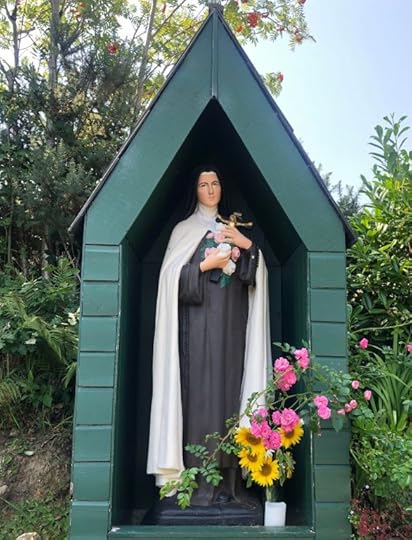 ST THÈRÈSE OF LISIEUX, UP AGAINST THE BLEATING LAMBS IN BACK OF ST. KEVIN’S CHURCH.
 NOTE THE LOVINGLY-TRAINED RAMBLING ROSE.
August 15, 2022
THE FREEDOM TO DO GOOD
Here’s how this week’s arts and culture piece begins:
“We draw people to Christ not by loudly discrediting what they believe, by telling them how wrong they are and how right we are, but by showing them a light that is so lovely that they want with all their hearts to know the source of it.”
–Madeleine L’Engle, author of A Wrinkle in Time
My friend Tensie Hernandez helps run a Catholic Worker house up on the Central Coast. Last week she told me about one of the women she treats at their free clinic.
Fabiola is married to Nano. Their oldest child, Evelyn, 26, was born with cerebral palsy. She’s blind and mute. She has a tracheotomy and a feeding tube.
“La Reina,” Fabiola calls her. The Queen.
READ THE WHOLE PIECE HERE.
August 5, 2022
STRANNIK
Here’s how this week’s arts and culture column begins:
Like all archetypes the archetype of pilgrimage is experienced as compelling. Sometimes the reasons seem obvious to the pilgrim and, on the other hand, the reasons offered, especially to the outsider, do not always seem adequate to the compulsion that is felt.
— Jean Dalby Cliff and Wallace B. Clift, The Archetype of Pilgrimage: Outer Action With Inner Meaning
The compulsion to go off and wander—to connect, to complete oneself, to heal a wound—is as old as man himself. It’s certainly been a continuing theme in my life. In my younger days I hitch-hiked all around the country. I once drove from LA to my New Hampshire hometown and back, alone, and made it a pilgrimage by going to Mass every day for seven weeks. I’ve been a pilgrim in California and within the Archdiocese, visiting innumerable gardens, missions, churches, studios, and museums.
But our real pilgrimage is interior. If a pilgrim is defined as “a person who journeys to a sacred place for religious reasons,” then for every seeker who walks the Camino, another never leaves home.
READ THE WHOLE PIECE HERE.
August 1, 2022
THE PILGRIMAGE CONTINUES
I don’t know if I’ve mentioned that I’m taking off next Tuesday for three weeks in Ireland.
Two of them will be spent in a stone hermitage at Glendalough Abbey in the Wicklow Mountains. Because it’s not enough that I live alone and work alone. I need some time by myself to THINK, damn it!
Anyway, of course I’m very excited, and have two friends over there: one Dublin-born and bred, and the other Cy Kerry, who may be able to arrange her schedule to meet me either in Dublin or at Glendalough.
While the Tucson summer is of course baking hot, Ireland by all accounts is perpetually freezing (by my standards) so I have purchased a little rain poncho and will definitely layer and bring a couple of scarves, and all will be well.
On another note, just throwing this out: might there be a photographer in the Portland, Oregon area willing to shoot the work of the incredible Catholic artist Tomasz Misztal? A mutual friend from the East Coast has been trying to update Tomasz’s website and badly needs updated photos. Without going into a long story, suffice it to say this would be a labor of love.
On we go into August.
July 29, 2022
KNEADED: L.A. BREAD STORIES
Here’s how this week’s arts and culture piece begins:
“Kneaded: L.A. Bread Stories” is an online project sponsored by the L.A. Museum of Natural History.
Through videos, photographs, and written interviews, the offering celebrates L.A.’s history, heritage, and communities through the lens of bread.
Visually appealing, easy to navigate, the site makes you feel as if you’re walking through a giant strip mall with a fantastic mom-and-pop shop behind every door. The colors, layout, visuals, and excerpted quotes all pop. The mouth waters.
Here are Monica May and Kristen Trattner, co-owners of downtown’s Nickel Diner. In 2008 when the restaurant opened, they had three strikes against them: They were women, they were in Skid Row, and funding was scarce. They forged ahead anyway.
READ THE WHOLE PIECE HERE.
July 23, 2022
MY FAMOUS BROTHER JOE
Many thanks to friends, readers, family and beyond for all of the wonderful birthday wishes, gifts, greetings, cards, and words of wisdom this week.
My old friend Patrick, who’s currently in Detroit touring with My Fair Lady, had a huge bouquet of flowers delivered.
One dear woman I’ve met only online told of how, when she turned 70, a friend a decade her senior, “spoke of her aging process in the following way: ‘When I was in my 60’s I had a wonderful decade, but when I turned 70 life became kind of hard because I was learning how to be old but when I turned 80 it was much easier because I had learned to be old.”
Then there was my little brother Joe, who texted, “Happy Birthday, you brazen hussy!”
Joe is a 40-year veteran of the punk scene as well as the founder, lead singer and songwriter of the band The Queers.
We had a long zoom chat the other day, yukking it up about our childhoods on the NH coast, reminisching about our drinking years, and and giving thanks for having followed our respective callings, the result being our next…Conversation with an Artist! A glimpse of my family…hope you like it.
July 22, 2022
INSIDE MADONNA HOUSE’S LAY COMMUNITY OF LOVE
Here’s how this week’s arts and culture column begins:
Madonna House is a lay Catholic community based in Combermere, Ontario and founded in 1947 by Russian emigré Catherine de Hueck Doherty (1896-1985).
Kathy Rodman joined the community in 1957. (Point of interest: her grandfather, Herman Rodman, was editor of The Tidings (later rebranded as today’s Angelus) in the early 1900s.
Today there are 190 community members. 61 others have died.
Kathy knew all of them except two.
Does Madonna House have a mission, a charism? She pauses. “I’d say our mission is to form a lay community of love.” Susanne Stubbs, who also came to Madonna House in the 50s, adds, “I’d say our primary purpose is to love one another and show that love to the world.”
READ THE WHOLE PIECE HERE.
July 18, 2022
MY SHEEP HEAR MY VOICE
Alarmingly, I find an uncontrollable urge comes upon me every so often to “share my thoughts.” This is yesterday’s result!
I enjoy putting these up on YouTube. After a day or so I check, find maybe six people have viewed, and give my own Thumbs Up.
I am learning one tiny thing at a time and having fun. I feel Jesus would approve.
Do you ever feel that you have “nowhere to lay your head”–in and out of the Church? Join the club. The good news is that makes us available and open to everyone.
July 15, 2022
AGNES’S JACKET
Here’s how this week’s arts and culture piece begins:
Agnes Richter, born in 1844, came from Dresden, Germany, and worked as a seamstress. At 49, she was admitted to Dresden’s City Lunatic Asylum, having been diagnosed as suffering from a persecution complex. Though found to be mentally stable, she was institutionalized for two years, then transferred to the Hubertusberg Psychiatric Institution and put under guardianship.
Her condition then rapidly deteriorated. In Threads of Life: A History of the World Through the Eye of a Needle, Clare Hunter describes what happened next“It was there that she took up a needle and thread and began to embroider text on the grey green linen of her regulation asylum jacket, re-fashioned to her own shape. Using different coloured thread and an antiquated German cursive script, she furiously stitched outrage in overlapping words, jagged letters, repeated assertions of self, Ich (I) sewn over and over again; emphatic avowals of existence…It is not set out in neat lines but rather words, phrases, and sentences are crowded together at odd angles across the cloth.”
READ THE WHOLE PIECE HERE.


