
Heather King's Blog, page 36
March 11, 2022
THE GREAT FERMATA
Here’s how this week’s arts and culture column begins:
The Grammy-nominated Pacific Chorale, led by Artistic Director Robert Istad (a Long Beach resident), will perform six transcendent contemporary choral works on March 19, at Our Lady Queen of Angels Catholic Church in Newport Beach.
The program is entitled “Songs of the Soul.”
Works include:
· Frank Martin’s Mass for Double Choir, a masterful setting of the Latin Mass;
· Estonian composer Galina Grigorjeva’s vocal symphony On Leaving, a contemplation on the soul’s release from the mortal body;
· Pulitzer Prize winner Caroline Shaw’s and the swallow, a setting of Psalm 84 inspired by the Syrian refugee crisis;
· Spiritus Mundi, Dale Trumbore’s hymn of gratitude for the fruits of the earth and an exploration of the notion of trust in something greater than oneself;
· Paul Fowler’s wordless, hypnotic Calling and Edie Hill’s We Bloomed in Spring, a setting of the words of St. Teresa of Avila.
READ THE WHOLE PIECE HERE.


March 9, 2022
MANNA IN THE DESERT
Every day, I’m realizing, a few love letters drift in from the universe, in the form of emails, listening and viewing tips, art. A sampling from the past week:
From Michele Catanese, spiritual director in Texas:
“This is called Across the Calm Waters of Heaven by Ahmed Alabaca. He is from San Bernardino, CA and wrote this in 2015 after the mass shooting there as a way to help the community heal. He refers to it as the piece for peace. It is breathtaking. The composer is the conductor of this orchestra performed by musicians of color at something called The Colour Festival. Do read his program notes which are part of Alabaca’s comments because the piece is explained beautifully there. “
Check out Michele’s blog. Her most recent post, “Dust to Dust,” is a reflection on Ash Wednesday.
From Brother Rex of Little Portion Hermitage in Maine:
A quote: “True solitude is not the absence of people, but the presence of God. To place our lives before the face of God, to surrender to the movements of God, is to roam free in a space in which we have been given solitude…If the eruption of God’s presence in us occurs in silence and solitude, it allows us to remain thrown among, mixed up with, radically joined to all of the people, who are made of the same clay as we are.” ~Servant of God Madeleine Delbrel
And a book suggestion, apropos of T of Lisieux (remind me next time I pick a saint to obsess about to find one without two accent marks in his or her first name): Stranger God: Meeting Jesus in Disguise
From Fr. Frank Sabatté, CSP, NYC priest, artist and portrait embroiderer:
A note thanking me for my recent piece on St. Bernadette (his family comes from the same region in France that Bernadette did), and attaching a portrait he did of her in her native dress:
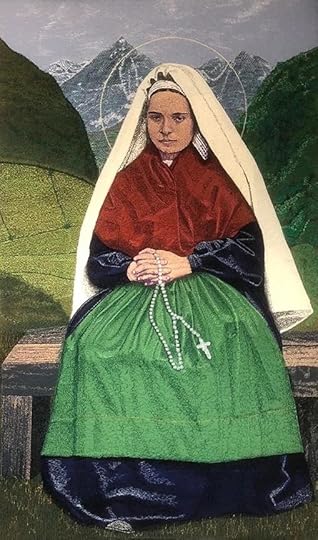 ST. BERNADETTE (SOUBIROUS)
BY FATHER FRANK SABATTÉ
And from Benny McCabe, boulevardier, raconteur, poet, tango dancer, and global pilgrim of Dublin, Ireland: a podcast called “The Purpose of Lent,” offered by Fr. Mark Patrick Hederman, Benedictine monk and former abbot at Glenstal.
LIFT UP YOUR HEADS, FOR YOUR REDEMPTION IS AT HAND!!!
March 6, 2022
THE ROOTS OF LIFE
It’s kind of been all Thérèse of Lisieux, all the time, these past couple of weeks. I just finished re-reading The Hidden Face by Ida Friederike Görres: HIGHLY recommended.
She starts out by saying basically: Who has ever first read The Story of a Soul (Thérèse’s autobiography) and not been deeply disappointed? “To be sure,” Görres notes tartly, “all the saints have done little things, but none of them exclusively little things.”
But in the end, she’s won over: not so much because Thérèse says anything new but because she articulates the poor-in-spirit heart of the Gospel–a “way” that’s so small we sort of never noticed it before.
This passage comes near the end of the book and seems especially apropost for Lent:
“Thérèse, we will remember, once spoke of herself as a sprig of moss in the bouquet among showy flowers. This winsome image captures, over and beyond what was intended, with astonishing precision her palce in the Church. For never does a single mss plant occur by itself in nature; never could it fulfill its function alone. ‘Moss’ immediately evokes a picture of an agglomeration, a carpet; it is in the nature of this kind of plant to appear in colonies.
In the landscape of the Church there is also ‘moss’–that modest ground cover of quiet, little Christians who are, as individuals, inconspicuous and unimportant, but who, as a vast united body which remains constant through the centuries, form the protective carpet around the roots of life, conserving for these the nutritive moisture. Without them there would be no towering giants of the forest. From this point of view, Thérèse is a special example of this widespread, scarcely mentioned but always indispensable spirituality whose individual advocates would be ashamed of so high-sounding an epithet as spirituality…
She is the flower, the crystal, the quintessence of a type of devotion which is far broader and older than her own sphere of life. She was altogether an inheritor, not of the hollow, pompous, sentimental façade which overlay the true face of the Church in the late nineteenth century, but of that substance which rested deep beneath like buried treasure, nameless but unimpaired. Under all outer forms, under scars and decay, the roots of Christian existence lived on, unrecognized, anonymous and silent, but wholesome and pregnant with life, just as in autumn and winter the coming spring lives and waits within the inert soil and the rootstocks of seemingly dead vegetation…
The uniqueness of Thérèse’s message did not lie in what she confided to her loved ones, but in the fact that she dared to express it at all, and that she was able to do so. Only because of this have we heard of it. Only becaue of this has the form of life which has always flourished so silently acquired a face and a voice. Only because of this have countless persons realized that this existence of theirs is a ‘way,’ even a way to sanctity, a way to perfection; that there is an inherent value in all the things which seemed to themselves not worthy of attention.”
–Ida Friederike Görres, The Hidden Face: A Study of St. Thérèse of Lisieux, pp. 404-407
Blessed First Sunday of Lent!
March 4, 2022
THE SPRING IS NOT FOR ME
Here’s how this week’s arts and culture column begins:
Advent is about the light shining in darkness. Lent is about the human condition.
The message delivered by our contemporary world is: You can have it all. You can have things your way. You can outwit death by engineering your life.
That cross marked on our foreheads last Wednesday delivers a very different message: Ashes to ashes. Dust to dust.
Feb. 11 was the optional memorial of Our Lady of Lourdes, and as Lent approached I thought to watch the old black-and-white movie, “The Song of Bernadette” (1943). Based on the popular Franz Werfel novel, the film stars a surprisingly affecting Jennifer Jones in the title role.
Never mind that Bernadette is 14 as the story begins and Jones was 24, with the kind of perfectly sculpted eyebrows, clear skin, and well-kept hands unlikely to have been found among the 19th-century French peasantry.
READ THE WHOLE PIECE HERE.
February 28, 2022
LENT
Whoa, what has happened to…the concept of time?
The other day a blog I subscribe to landed in my mailbox wishing everyone a Happy Mardi Gras. I thought–Mardi Gras? Why, the poor man is confused and accidentally re-published a random post from last year!
After a minute I realized, Oh. Right. Ash Wednesday. This coming week.
One thing is that I traveled week before last, flying back to the Central Coast of California for four days with friends. So that was fun. I saw some California poppies, bush lupine, ice plant in Schiaparelli pink bloom, and lots of very good-looking people with tans, expensive sunglasses, good haircuts, white teeth and positive attitudes. You can ridicule or hate that all you want–but it’s kind of nice in many ways, really, to partake of that atmosphere every so often. Also, gorgeous shore birds.
The other thing is I’ve been working a lot. I’ve signed on to write a study guide on St. Thérèse of Lisieux so am once again knee-deep in The Little Flower, the Little Way, the Holocaust-Victim-of-Love concept, and so much more that dovetails nicely with the forty days in the desert into which we’re collectively heading.
Discoveries about myself and others also abound.
And I am so, so looking forward to Lent 2022.
February 25, 2022
THE GENIUS OF JANE GOODALL
Here’s how this week’s arts and culture column begins:
It’s not too late to catch “Becoming Jane: The Evolution of Dr. Jane Goodall,” an immersive multimedia exhibition running through April 17 at the LA Natural History Museum.
What’s not to like about the aptly named Jane Goodall?
There’s the unusual childhood, marked by an absent father and a constellation of female relatives who encouraged and fostered the young Jane’s independence. In an iconic photo taken just after her first birthday, she’s cuddling Jubilee, the stuffed chimpanzee she’d received as a gift and that eerily presaged her vocation. At five she disappeared one day. Her mother and aunts were so panic-stricken they even called the police. Jane re-appeared hours later, covered with straw and bursting with excitement. Curious as to how hens laid eggs, she’d been in the henhouse and had patiently waited until she’d found out!
There’s her dream, as a high school student, to study and write about animals in Africa; the limited opportunities available to women in that era; the chance invitation, from a boarding-school chum, to visit Kenya. Goodall arrived in Nairobi on her 23rd birthday.
READ THE WHOLE PIECE HERE.
February 18, 2022
BUT BEAUTIFUL: ALTO SAXOPHONIST ART PEPPER
Here’s how this week’s arts and culture piece begins:
Geoff Dyer is a British-born, LA-based writer with four novels and numerous nonfiction meditations on subjects that range from Russian film-maker Andrei Tarkovsky’s cult classic Stalker to the photographs of Garry Winogrand to an inside look at life on an American aircraft carrier. His latest work, out in May, is a reflection on greatness in aging called The Last Days of Roger Federer.
But my favorite is But Beautiful, a lyrical, semi-biographical, semi-imagined “novel” of some of the greatest jazz musicians who have ever lived: Ben Webster, Charles Mingus, Lester (“Prez”) Young, Bud Powell, Chet Baker, Thelonious Monk.
Duke Ellington, one of the few who didn’t burn out before his time is in there.
And so is Art Pepper (1925-1982), West Coast jazz alto sax player, who was born in Gardena, LA, played the Central Avenue clubs during their 40s and 50s heyday, and lived for years on Fargo Street in Echo Park. He spent three years at the since-discredited drug rehab Synanon, at the time in Santa Monica.
READ THE WHOLE PIECE HERE.
February 16, 2022
THE MOST IMPORTANT QUESTION
“True contemplatives, then, are not the ones who withdrew from the world to save their own soul, but the ones who enter into the center of the world and pray to God from there.”
“How to come to this simplicity, this inner sense of self, this conviction of self-worth? ‘Meditate,’ John Eudes said, ‘and explore the small daily events in which you can see your insecurity at work. By meditation you can create distance, and what you can keep at a distance, you can shake off.'”
Re the problem of constantly comparing ourselves to others:
“John Eudes [Father John Eudes Bamberger; abbot emeritus of Abbey of the Genesee] talked about that moment, that point, that spot that lies before the comparison, before the beginning of the vicious circle or the self-fulfilling prophecy. That is the moment, point, or place where mediation can enter in. It is the moment to stop reading, speaking, socializing, and to “waste” your time in meditation. When you find your mind competing again, you might plan an “empty time” of meditation, in this way interrupting the vicious circle of our ruminations and entering into the depth of your own soul. There you can be with him who was before you came, who loved you before you could love, and who has given you your own self before any comparison was possible. In meditation we can come to the affirmation that we are not created by other people but by God, that we are not judged by how we compare with others but how we fulfill the will of God.
This is the time [when you start to feel at home] in which meditation becomes very important; this is an invitation to enter deeper into prayer. Otherwise, you will start complaining within a few weeks that the monastery is not severe enough, not poor enough, not strict enough, and you, as many others before, will leave and start a life which, in fact, is much less poor and less severe.”
Speaking about prayer, I asked John Eudes a question that seemed very basic and a little naïve: ‘When I pray, to whom do I pray? When I say ‘Lord,’ what do I mean?’ ”
“John Eudes responded very differently than I expected. He said, ‘This is the real question, this is the most important question you can raise; at least this is the question that you can make your most important question.’ He stressed with great and convincing emphasis that if I really wanted to take that question seriously, I should realize that there would be little room left for other things.
‘Except,’ he said smiling, ‘when the question exhausts you so much that you need to read Newsweek for a little relaxation’ ‘It is far from easy,’ John Eudes said, ‘to make that question the center of your meditation. You will discover that it involves every part of yourself because the question, Who is the Lord to whom I pray? leads directly to the question, Who am I who wants to pray to the Lord? And then you will soon wonder, Why is the Lord of justice also the Lord of love; the God of fear also the God of gentle compassion? This leads you to the center of meditation. Is there an answer? Yes and no. You will find out in your meditation. You might some day have a flash of understanding even while the question still remains and pulls you closer to God. But it is not a question that can be simply one of your questions. In a way, it needs to be your only question around which all that you do finds its place. It requires a certain decision to make that question the center of your meditation. If you do so, you will realize that you embarking on a long road, a very long road.’ ”
–Henri Nouwen, all from The Genesee Diary: Report from a Trappist Monastery
February 11, 2022
THE LIGHTED WINDOW
Here’s how this week’s arts and culture column begins:
In this culture of takedown tweets, clickbait wars, and foaming-at-the-mouth newscasters, drowning out the distractions can be difficult.
How refreshing to discover, at the eye of the maelstrom, a recent book by Peter Davidson, Senior Research Fellow at Campion Hall, University of Oxford. Davidson has already written an entire book about twilight, and another about the topography of the North, as represented in images and literature.
His newest offering is called The Lighted Window: Evening Walks Remembered.
You might imagine this would be pretty thin gruel but I, for one, was captivated. It’s the kind of book you read with highlighter and Post-Its in hand, stopping every few minutes to jot down the name of a composer, painter, photographer, or writer.
READ THE WHOLE PIECE HERE.
February 7, 2022
THE TASSEL OF HIS CLOAK
Here’s a little something to listen to if you’ve a mind: a February 5, 2022 “Almost Good Catholics” podcast with Krzysztof (Chris) Odyniec and I entitled “Divine Intoxication.”
Chris lives in the Berkeley, California area and has just launched this new venture. The thrust is “Interesting conversations with interesting people about religion and faith,” and he is smart, sharp, and delightful.
The two of us discuss addiction vs free will, the contemporary relevance of St. Thérèse of Lisieux, the glory of womanhood, my weird little life, ET CETERA!
Speaking of interesting, in today’s Gospel (Mark 6:53-56) I noticed that the people from the surronding towns bring the sick people on mats to Christ “in the marketplaces.” Why not the temple, or some quiet, off-to-the-side, place where everyone can appropriately pray and ponder? No, smack in the middle of life, with all its distractions, conflicts, temptations, delights, dramas, noise and color.
May we all touch the tassel of his cloak in our markeplaces today–and be healed.


