
Heather King's Blog, page 38
December 31, 2021
THE LAST HOUR
“The Apostle John describes the present time in a precise way: It is the last hour (1 John 2:18). This statement means that with God’s coming into history we are already in the last times, after which the final phase will be of the second and definitive coming of Christ. Of courses here we are speaking of the quality of tiime, not about quantity. With Jesus the fullness of the time, the fullness of meaning, and the fullness of salvation has come. And there will be no new revelation but rather the full manifestation of what Jesus has already revealed. In this sense we are at the last hour [and] our every action is charged with eternity. In fact, the response we give today to God, who loves us in Jesus Christ, bears upon our future.”
Pope Francis, from today’s Magnificat magazine reflection
I love this. As it is with eternity, and salvation history, so it is with our own individual lives. The fullness of meaning, the fullness of salvation, such as those things are or have become with our seeking, are already here. Today. Now.
The hope is that the fullness of meaning will enlarge yet more with the passing of chronological time. But the meaning for me, on the last day of 2021, is pretty full already.
Today’s reading, from the beginning of John, is one of the most awe-inspiring, glorious, and heart-wrenching in all of the Gospels:
“In the beginning was the Word, and withe Word was with God, and the Word was God…What came to be through him was life, and this life was the light of the human race; the light shines in darkness, and the darkness has not overcome it…The true light, which enlightens everyone, was coming into the world. He was in the world, and the world came to be through him, but the world did not know him. he came to what was his own, but his own people did not accept him.”
The world did not know him; did not care to know him. Not then, not now. I think many stop short at the brokenness, fallenness and failure of the Church (and how could it be otherwise, as the Church is comprised of us?) to live out the Gospel message.
But I don’t see how anyone could go to Christ–to his heart, his life, teachings, death; the parables with their inexhaustible levels of meaning, and fail to be electrified.
Here’s a passage from Search for Silence by Elizabeth O’Connor, a book I’ve mentioned before:
“We are aware of how the hardened structures of society resist change, but those hardened structures that we externalize and call the enemy are really in ourselves. There is something in each of us that wants to keep things as they are. Our whole self-identity is tied in with the present order. Is this not what Jesus was trying to tell us in the conversation with the man at the pool of Bethsaida?
After this, there was a feast of the Jews, and Jesus went up to Jerusalem. Now there is in Jerusalem at the Sheep (Gate) 3 a pool called in Hebrew Bethesda, with five porticoes. In these lay a large number of ill, blind, lame, and crippled. One man was there who had been ill for thirty-eight years.When Jesus saw him lying there and knew that he had been ill for a long time, he said to him, “Do you want to be well?” The sick man answered him, “Sir, I have no one to put me into the pool when the water is stirred up; while I am on my way, someone else gets down there before me.” Jesus said to him, “Rise, take up your mat, and walk.” Immediately the man became well, took up his mat, and walked. Now that day was a sabbath. John 5:1-9
You remember that later Jesus finds him in the temple and says to him, “Now that you are well again, leave your sinful ways, or you may suffer something worse.” Here he makes a direct connection between the man’s sufferings and his rproblems. At some time it would be profitable to reflect on this connection, but now is the startling question, “Do you want to recover?”…Do we really want to give our our illusions about life, our deceits about the kind of people we are, all those false images about the past and fantasies concerning the future? They may be our sins in that they have kept us from living our lives fully, but they are comfortable and familiar, and in our internal establishment they hold together our concept of who we are. Take out even one little piece and there is a trembling in the whole structure–such is the interconnectedness of all our inward workings. We cannot change in one little corner of our lives without feeling the reverberations in other corners. The question–“Do you want to recover?”–might even go to the root of things where the foundations would shake and the whole of us be in danger of collapse.”
The man of our pool story made reply to the question by saying that he never had a chance. The cards were just stacked against him. “Poor me. I do not even have a friend. In the competition, I can’t make it. I have not the advantages of others. But…” There was surely a “but” to shore up self-esteem. “But I am patient. I am persevering. In adversity I wear a brave smile and am warmed by the thought that others see my plight and know me to be longsuffering.”
How I guffaw every time at that last line: the image of the longsuffering, bravely patient, faux martyr, glued to my mat. How often I’ve been that paralytic: thinking to myself “I’d like for things to be better, but sadly no-one will help me! It’s my lot in life to be constantly abandoned, misunderstood, cast aside. ”
This casting off of our chains is exactly what Christ came for! We get to ask ourselves what are we consciously or unconsciously stubbornly holding onto that prevents us from coming fully alive, from taking full responsibility for ourselves, from responding to our vocation if we have one? That’s the Good News that seems so seldom to make its way into our often paltry attempts to evangelize. Evangelize to what? A set of seemingly ad hoc, seemingly impossible-to-follow “rules?” The reason for which many of us wouldn’t even be able to explain simple laypeople terms?
When we’re fully alive, we’re obedient to the rules freely, joyfully, as the baseline. Of course we want to go to Mass on Sundays–many of us want to go as well several times a week. Of course we’ll contribute to the offering basket: we’ll also, more and more, want to offer up our entire lives.
The point being: this year I got up off my mat and walked. I did tons of investigation and made a couple of reconnoitering trips to a new city. Then I made a decision; researched moving costs; bought boxes, packing tape, and buble warp; culled, sorted, gave away; accepted help from friends, and after probably a dozen years of hemming and hawing, got up off my mat and walked.
That would not have been possible had I not had one ear cocked to “the last hour.” Fear, “prudence,” “caution,” would have kept me glued in place. So would a “realistic” attitude–how “smart” was it to think I could start a new life at my age? What if “something happened?” as a few people asked. Well what if it does? What if the worst thing that could happen would be to stay stuck on my mat? What if something wonderful happened in the new place and I missed it!?
Wishing everyone who checks in here, whether frequently or occasionally, an eve of reflection and fun–whatever fun may mean to each of us. I can’t say how grateful I am for the support and largesse, especially this past month. You’re a huge part of my life.
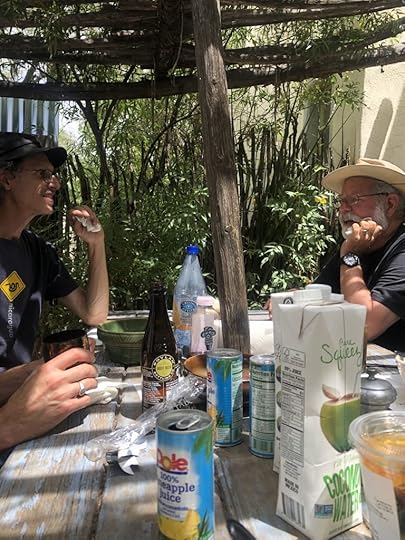 HAPPY NEW YEAR, COMADRE AND COMPADRES!
ETERNAL THANKS FOR HELPNG ME ROLL UP MY MAT.


December 28, 2021
THE HIDDEN LIFE OF TREES
Here’s how this week’s arts and culture column begins:
Peter Wohlleben manages a forest in the Eifel Mountains of Germany. He’s most familiar with “the struggles and strategies of beeches and oaks.” And from decades of observing, studying, living, breathing and walking among the threes, he has come to discover a parallel world that is invisible to most of us.
Modern forestry is principally concerned with producing lumber. It was Wohlleben’s job to size up hundreds of trees a day with an eye toward the marketplace. It was only when, in the mid-90s, he began to organize survival training and log-cabin experiences for tourists that he began to wake up to the mystery, variety, complexity and wonder of trees.
He wrote about that awakening in the 2015 bestseller The Hidden Life of Trees: What They Feel, How They Communicate: Discoveries from a Secret World.
READ THE WHOLE PIECE HERE.
December 25, 2021
JOYOUS CHRISTMAS
“The Infant Christ is the whole Christ. Christ was not more God, more Christ, more man, on the Cross than He was in His Mother’s womb. His first tear, His first smile, His first pulsation in the womb of His Mother, could have saved the world.”
–Caryll Houselander
Like the shepherds, who watched over their flock by night and were thus present to see a host of heavenly angels, I have kept watch this Advent, too.
Is that troublesome person a sign? Can I quell my impatience, fear, my own pain for a few minutes in order to be present to this other person in pain? Can I keep my heart open in spite of the rejection, rebuffs and misunderstandings to which every human being is subject?
Do I notice the heart-wrenching beauty of a sheaf of mesquite branches against the night sky? Am I pulsating every moment with gratitude that, in a continuing miracle of the loaves and fishes, I am in good physical, emotional, spiritual, mental (more or less) and financial health? Would people please leash their monstrously untrained dogs? WHOOPS!
Merry Christmas to all, with gratitude for your readership, spirits, works, joys, sufferings, and prayers–
Christ is born. Glory to God in the highest.
December 22, 2021
SUFFER THE LITTLE CHILDREN
“Producers of great art are no demigods, but fallible human beings, often with neurotic and damaged personalities.”
–Theodor Adorno
I’m not saying I’m a producer of great art–but am I the only one who gets ever-so-slightly OCD over string lights? I used to have two strings of gold metallic LED solar-powered Chinese lantern lights in the garden. Then one of the panels died, so I thought I’d just buy a whole new set. Well! I don’t know if there’s a whole tanker of the things dry-docked in Long Beach and screwing up the supply chain or what, but talk about hen’s teeth.
I finally found a 20-socket string of “warm white” which I thought would be close enough–in fact, these were PAPER lanterns, that would not only instantly get wrecked in rain, but even in the daytime “glowed” an unsightly eggshell-white, not like my burnished gold. Plus suddenly all Chinese lantern string lights have almost doubled in price. I bought one set off ebay that worked for one night, conked out, and that I had to return. The gold metallic lanterns (which sound cheesy but are very cool) are simply nowhere to be found.
Suffering from insomnia one night last week, I happened, possibly through Etsy, upon the PaperLanternStore.com. They have tons of, again, PAPER lantern string lights, in various sizes. And on an impulse I bought three strands of teal blue plug in 4-inch, figuring I could hang them across the French doors that give onto the patio outside my office.
They arrived Monday and took a pair of pliers and a good four hours to assemble. I watched Jean-Pierre Melville’s Un Flic (Alain Delon, Richard Crenna, Catherine Deneuve) AND The Return of the Soldier (Julie Christie, Alan Bates, based on Rebecca West novel) whilst working, and managed to tear only three of the lanterns.
They look pretty great in the dark, though I kind of hung them wrong so must now re-do. And that is not even counting the white plug-in lights on the side ramada, the tiny copper-wire-connected battery-powered lights, two blue and one white, that also have their own proper ritual and place, time to be turned on and off, et cetera.
And don’t even ask about the candles–they inhabit their own special world.
The operative word there being “ritual”…
We’re in the last few days before Christmas and so great is my sense of expectation that you’d think I were about to give birth myself.
I do tend to overdo–everything–but that doesn’t derogate (great word that was used often in law school) from the genunine underlying excitement at the impending birth of Christ; from my love of the Advent and Christmas liturgy; and from the poignancy of the fact that, believers or no, the whole world stands still, if only for a moment, on December 25.
Speaking of standing still–in today’s homily, the priest observed that in sending the angel Gabriel to announce the good news to Mary, Christ left the fate of the cosmos to the decision of one human being. He talked about how much God values human choice–we are infinitely free to choose; infinitely free to love. We’re also free of course to choose against love–but Mary chose in favor of.
The priest went on to observe that our own “Yes “may not change the universe–but it does change us.
Agreed as to the second part–but I’m not so sure that, in its infinitesimal way, our Yes doesn’t change the universe as well.
I might get a little weird this time of year about my lights–but what child isn’t drawn to a candle in a dark window? What child doesn’t jump to be charged with opening the door to welcome a guest? What kid doesn’t want to be the first one up–to wake the others!–on Christmas morning?
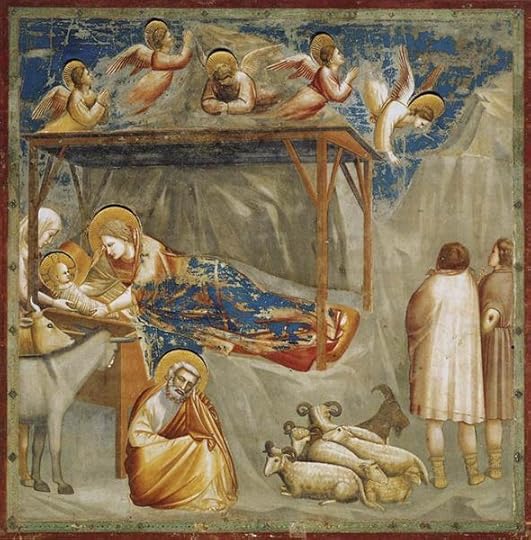 NATIVITÀ. NASCITA DI GESÙ, GIOTTO,
c.1304-1306
December 20, 2021
O ANTIPHONS AND MORE!
Here’s a wonderful post by the good Michele Catanese, a long-time reader, on the “O antiphons”–traditionally used before the Gospel reading and (in slightly different form) for the Magnificat in Evening Prayer, from December 17 through December 23rd. But Michele lays it all out. A post like that is a TON of work–so thank you, Michele.
Here’s the obit for one Renay Mandel Corren who died December 15. It begins: “A plus-sized Jewish lady redneck died in El Paso on Saturday.” I hope I get such a full-bodied tribute when I keel over.
And my dear friend Judy sent along this essay by and video about the retirement after 40 years of Glen Creason, map librarian at the downtown LA Central Library.
Keep me in your heart for a while…that’s a pretty good anthem as we head into the winter solstice, Christmas, and the end of another hard and glorious year…
December 17, 2021
J’ACCUSE!: ON SNITCH CULTURE
Here’s how this week’s arts and culture column begins:
One effect of social media is that the world seems increasingly to resemble a giant courtroom with the combatants shrieking at each other, “J’accuse!!” I accuse, I accuse, I accuse.
“J’accuse!” was of course the opening salvo, in an open letter by Émile Zola to the president of the French Republic, of what came to be known as the Dreyfus affair. Alfred Dreyfus, a Jewish officer, had been accused of treason by the French army.
Nowadays, colleagues spy on co-workers, friends rat out friends, political leaders at the highest level bully, name-call, insinuate, gossip, and slander. News is so biased, depending on the outlet’s audience, that we hardly dare hope for anything remotely approaching the objective truth. Egregiously substandard behavior is foisted off as the fault of deranged “libs,” some form of “identity discrimination,” or the egregiously substandard behavior of one’s enemies. “You can’t accuse me! I accuse you!”
READ THE WHOLE PIECE HERE.
December 13, 2021
COME FLY AWAKE!
I’ve been thinking a lot about the idea of making our goal not how good we are, but how awake we are. How faithful we are to whatever we were put here on earth to do.
So what excites me? What (besides the prospect of coffee) gets me jumping out of bed in the morning?
A new (to me) artist: Richard Diebenkorn. Séraphine de Senlis. Bill Evans.
Goldfinches at my nyjer seed feeder. (I’d had the thing up for weeks and yesterday morning literally prayed in the name of Jesus for the goldfinches to come. By yesterday afternoon they were flocking to it).
How to use the radishes–which I don’t like–that came in the farmbox.
What little I see or hear of evangelizaton is geared toward people who are terrified of being made fun of or belittled. So they want to fortify themselves with intellectual arguments and defenses. They want to be able to point to the Church’s treasury of art, music, cathedrals–which, granted, is stupendous, but far in and of itself from the poverty of spirit that brings us face-to-face with Christ. They want to be well-versed in the biographies and thought of the Church’s “movers and shakers.”
They want a faith based on personal excellence. They want to coninue worshiping power, property, and prestige and to somehow graft that onto…the Cross? That’s a graft that does not and is not ever going to “take,” mainly because the people whose faith was based on personal excellence hounded, persecuted, and finally tortured Christ to death. His entire life, death, resurrection, and apostolate was about personal surrender, abandonment.
The Pharisees’ goal was to be “good,” correct. excellent. Christ’s goal was to come awake, in love.
Ironically, in coming awake we do become “excellent”–interesting, useful, alive–but in a way that’s mostly invisible to the eyes of the world. So it’s all very paradoxical and compelling.
On that note, I have embarked upon a very drastic, very extreme plan.
I have pledged to spend the better part of 3 days, over New Year’s, with 6-8 dear friends. In a cabin. In the woods.
I figure the worst that can happen–this is in fact very likely–is that I will have a nervous breakdown.
The best that can happen–Oh it will be a blast! I can’t wait. The fact is I can’t believe people would be willing to put up with me for that sustained a length of time.
Either way, I’ll get MANY STORIES out of it.
And I’m guaranteed to come way, WAY, more awake.
December 11, 2021
THE FREE WORLD
Here’s how this week’s arts and culture column begins:
In Abandonment to Divine Providence, 17th-century Jesuit priestJean-Pierre de Caussade observed:
“Since the world began, its history is nothing but the account of the campaign waged by the powers of the world and the princes of hell against the humble souls who love God. It is a conflict in which all the odds seem to favor pride, yet humility always wins…
The war which broke out in heaven between St. Michael and Lucifer is still being fought…Every wicked man since Cain, up until those who now consume the world, have outwardly appeared to be great and powerful princes. They have astonished the world and men have bowed down before them. But the face they present to the world is false…
All ancient history, both sacred and profane, is only the record of this conflict. The order established by God has always conquered, and those who have fought with him enjoy eternal happiness….If one solitary soul has all the powers of hell and the world against it, it need fear nothing if it has abandoned itself to the order of God.”
I thought of that passage as I read The Free World: Art and Thought in the Cold War, a newly-published 727-page tome by public intellectual and cultural critic Louis Menand.
READ THE WHOLE PIECE HERE.
December 7, 2021
THE MODERN CONSCIOUSNESS
“I write the way I do because (not though) I am Catholic. This is a fact and nothing covers it like a bald statement. However, I am a Catholic peculiarly possessed of the modern consciousness, that thing Jung describes as unhistorical, solitary, and guilty. To possess this within the Church is to bear a burden, and a necessary burden for the conscious Catholic. It’s to feel the contemporary situation at the ultimate level.
I think that the Church is the only thing that is going to make this horrible world we are coming to endurable; the only thing that makes the Church endurable is that somehow she is the body of Christ and that on this we are fed. It seems to be a fact that you have to suffer as much from the Church as for it but if you believe in the divinity of Christ, you have to cherish the world at the same time that you struggle to endure it. This may explain the lack of bitterness in the stories.”
–Flannery O’Connor, re her short story collection A Good Man is Hard to Find
Emphasis on “It seems to be a fact that you have to suffer as much from the Church as for it.”
As any Catholic knows, part of the Cross is enduring homilies that grate like chalk going the wrong way up a blackboard. We’ve all been to Masses where the priest’s major mode is “harangue.” During the week especially, the parishioners are people mostly in their 60s, 70s or even older who have obviously spruced themselves up and hauled their aching bodies to church, longing for a word of accompaniment, comfort, consolation.
Instead, we get reproached on behalf of the many people who SHOULD be there, but aren’t. ‘You know why there aren’t more people at Mass, my dear brothers and sisters?” Father asked one recent morning. “I’ll tell you why. Because we’re not MARKETING CORRECTLY!” I glanced at the crucifix above the alter, where Christ hung dying, his body contorted in agony. How do you propose to “sell” that?
I tried not to squirm and sigh and roll my eyes, but not entirely successfully. “Thank God!” I muttered when he finished, and I did mean God the Father who I had a hard time believing wasn’t squirming, too.
But later that day I suddenly thought: “Could you not sit with me an hour?”–Christ’s anguished, agitated question to his disciples in the Garden at Gethsemane.
So little is asked of us, really; and like the disciples, I had (mentally) fled, unable to bear even six minutes of mild discomfort.
I thought of the Christians in North Korea who are being imprisoned, tortured, beaten, starved. I thought of Servant of God Fr. Walter Ciszek (whose memorial, once he’s canonized, will be tomorrow): saying Mass under pentaly of death in the woods of his prison camp in Siberia, for men who had fasted since midnight the night before in order to receive the Eucharist. I thought of Blessed Fr. Stanley Rother, “the shepherd who would not leave his flock,” the Oklahoma priest who insisted on staying with the Guatemalan peasants he served in spite of death threats, and who was assassinated there, in his room one night, by paramilitary thugs.
Those are the people who remind me that we don’t market the Cross; we carry it.
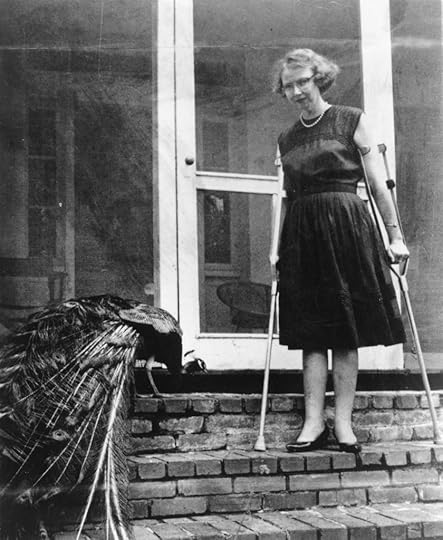 FLANNERY O’CONNOR WITH A BELOVED PEACOCK:
 “THE KING OF THE BIRDS.”
SHE DIED OF LUPUS AT 39.
December 3, 2021
THE THINGS THAT REALLY MATTER
“One of the tests for determining if the work of salvation in your life is genuine is—has God changed the things that really matter to you? If you still yearn for the old things, it is absurd to talk about being born from above—you are deceiving yourself.
–Oswald Chambers, My Utmost for His Highest, entry for November 12
i guess we all yearn to be well-regarded. So it took me a long time to realize–to admit to myself–that I was not to have literary riches or fame, I was not to be a mother or wife, I was to remain celibate. All that I could accept, most days joyfully. Still I yearned, unconsciously, for social status. Let me be “popular” within my recovery circle, among my neighbors, on social media.
In the course of the yearning, I learned there’s a difference between resignation and acceptance. My underlying thought can’t be If I don’t put myself forward, I can’t be rejected or fail. I have to try as best I can and suffer defeat; to see that a lot of my actions and work are not much going to avail.
Then again, over time I’ve been given new eyes to see what “avails.” I hear from a few people each week who say that my work has consoled, inspired, accompanied, comforted, challenged, made laugh. And that comes to be enough–enough and then some. A cornucopia of “enough.” We’re all called to put out to the world what we can and what we’re moved to, simply as a more or less spontaneous desire to share the love of Christ.
NARROW IS THE GATE
As the things that really matter to us change, we become more able to enter through the “narrow gate.” The narrow gate has something to do, it seems to me, with vulnerability, not doing good deeds. It’s an orientation of heart. A true desire for relationship, and a corresponding willingness to let everyone off the hook. We have to want more to give a good account of ourselves to God than to cultivate an image in front of our friends, family, public, or peers. We get to make amends, where due, admit our own mistakes, offer peace, express the need for connection, then let things be and move forward.
“Unbelievers can love others with a magnificent love. But we haven’t been called to this kind of loving. It is not our love that we have to offer, it is the love of God…Supernatural love has to be Jesus’ kind of love; that is to say it has to be incarnate and redemptive. This is not a spiritual love but a love in the flesh (see the parable about the Last Judgment [i.e. Mt 25, the Sheep and the Goats]). It does not give happiness but “buys into” the Beatitudes. This love becomes a goal that is impossible for us to reaach when it is spiritualized, when it is so to speak “unfleshed” from our humanity and no longer attends to genuine human needs.”
—Madeleine Delbrêl, The Joy of Believing
Well that’s good news, because left to my own devices, I can work up zero love for the vast number of people who annoy, frighten or perplex me. But we have to bring our body, one way or another, to this supernatural kind of love. Marriage, for example, is one way of bringing the body; celibacy is another–both, if done intentionally, consciously, sacramentally, a laying down of our lives for our friends.
As for general human interaction, we have to bring our minds, souls, strength to the person in front of us–to be present, to pay attention, to continually stretch ourselves way beyond our comfort zones. We don’t get to sequester ourselves from the Other, whoever the Other may be to us. We may or may not be hands-on works of mercy types. We may or may not be plcketers and placard bearers. But we need to back up our prayer with “work” of one kind or another that is more than writing a check or having an opinion. Ora et labora, as the monks say: prayer AND work.
Again, this needn’t be anything fancy. The other say I was sweeping up around my desk and noticed a tiny brad that had dropped to the floor while I was hanging Christmas lights. I could have just brushed it into the dustpan but “Waste not want not,” I heard my late sainted mother say, and I also heard Thérèse of Lisieux: “To pick up a pin for love can save a soul.”
So I laughed and bent down and picked up that tiny nail and returned it to its right container, not just to be thrifty, but with a conscious intention of love even though my back was killing me and it hurt to bend down.
This idea of bringing our bodies is another reason I’m so attached to walking. I often walk to Mass, maybe a half hour each way, when I could drive as a conscious offering of all that I am, puny though that is. Having fasted for an hour before, what with the walk there, Mass, and the walk back, I’m usually somewhat hungry the whole time, so this is another kind of very gentle, very rudimentary offering that I can make, for whatever it’s worth.
Since I often attend the 5:15 at the Newman Center, it’s dark when I emerge, and I have to cross a super busy intersection, I have even purchased myself a little walking flashlight with a beam at one end and a red flasher on the other: a huge concession to safety, age, and the part of the narrow gate that says We know you’re a free spirit but no need as well to be a heedless ass.
The point being (you might well be wondering) that my life becomes ever more of a piece. I don’t have to separate times of prayer, times of “work,” times when I’m “contributing,” times when I’m “sacrificing.” Times when I’m conscious of Christ, times when I’m not. It’s all work and it’s all prayer, and the things that really matter to me ever evolve.
Right now, for instance, I’m kind of obsessed with my birdfeeders and Christmas cards. I’m reading Ruth Butler’s Hidden in the Shadow of the Master: The Model-Wives of Cézanne, Monet, and Rodin. I’m headed downtown to buy a gift for dear friends at the Tucson Museum of Art store and while there, will shoot over to the MSA Annex and treat myself to a Mt. Fuji rice bowl.
I’m planning a trip to White Sands next April. I/ve already been to morning Mass. In short, my life is so bountiful, so extravagant, that I might just be too fat at the moment to fit through the narrow gate!
Blessed Second Sunday of Advent–


